2 Samuel 19:29

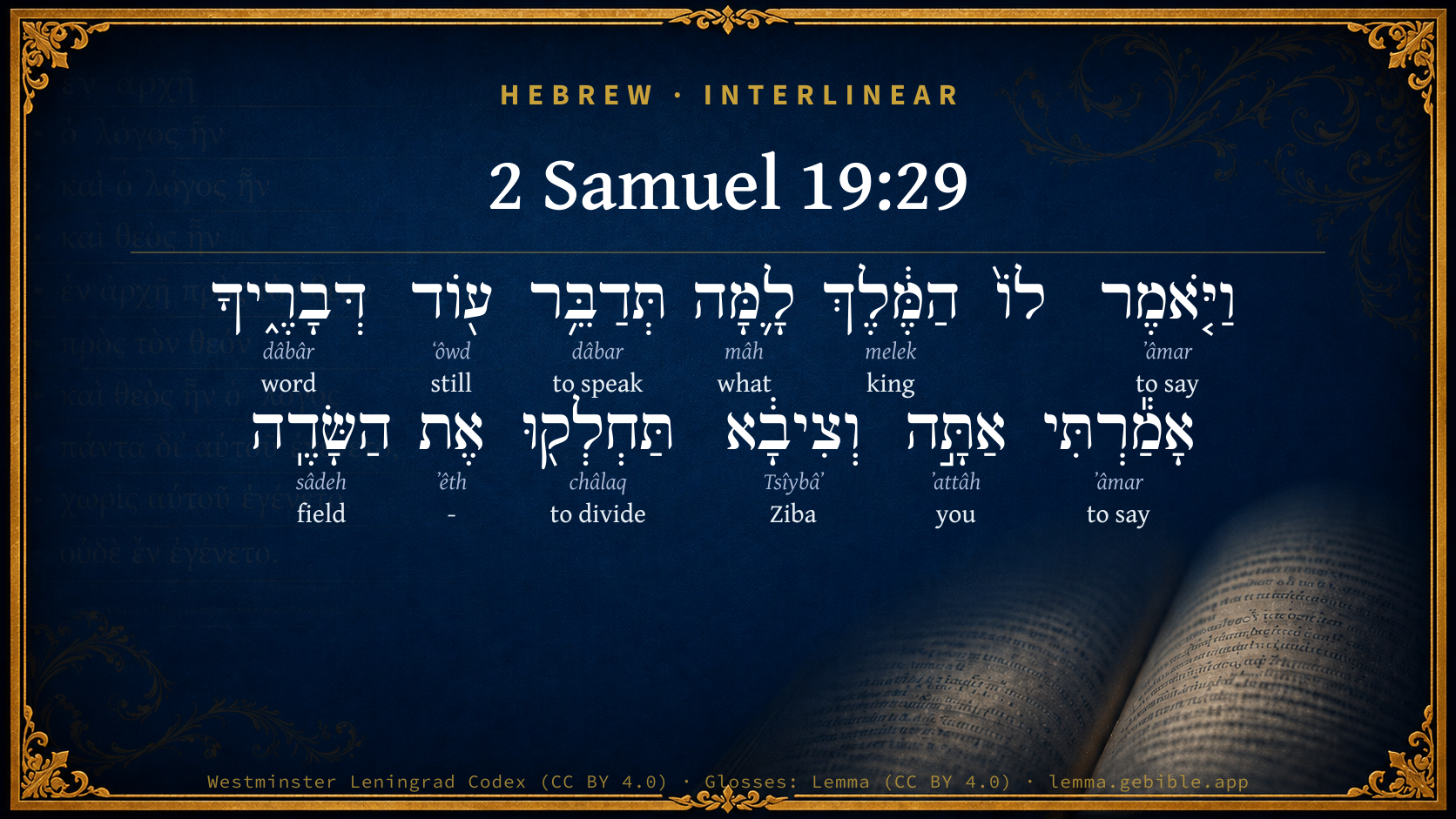
Hebrew (Westminster Leningrad Codex) 2 Samuel 19:29 appears in the Hebrew Old Testament. The text above is from the Westminster Leningrad Codex. Each word links to its Strong’s number, a concise gloss, and parsing drawn from the Open Scriptures Hebrew Bible morphology. Click any word for its full Brown-Driver-Briggs (BDB) entry.
Download image
Cite this verse

2 Samuel 19:29 (World English Bible). Public Domain. Lemma interlinear Bible study tool, https://lemma.gebible.app/v/2-samuel/19/29.

Show BibTeX & RIS
BibTeX
RIS
English Translation
The king said to him, Why speak you any more of your matters? I say, You and Ziba divide the land.
World English Bible · Public Domain
Download a study sheet

One document with this verse’s original text, its word-by-word gloss line, the meaning frame, cross-references with their text, attributed commentary, and full source and license credits — printable, and it pastes into notes with its structure intact.

This verse Autodidact and up

Study sheet (.html) Plain text (.txt)

A passage Seminary Student

Up to 50 verses in one chapter. A passage sheet keeps up to 6 commentary sources and 12 cross-references per verse, in the order this page ranks them, and says so on the sheet whenever that leaves anything out. Ask for a single verse and you get the Autodidact verse sheet above.

Everything on this page stays free to read, with no account — the sheet is a download of what is already on screen, not access to it.

Want to remove ads? Support Godless Engineer
Compare translations 3

The same verse in 3 English versions, stacked beneath the original-language interlinear above. Click any original word for its lexicon entry.

Each is an independent rendering of the whole verse — the interlinear is not word-aligned to these translations.

Highlighted words mark where these versions differ — a whole-verse word diff, not a word-by-word alignment.

  • World English Bible Public Domain
    The king said to him, Why speak you any more of your matters? I say, You and Ziba divide the land.
  • King James Version Public Domain
    And the king said unto him, Why speakest thou any more of thy matters? I have said, Thou and Ziba divide the land.
  • unfoldingWord Literal Text CC BY-SA 4.0
    And the king said to him, “Why do you still speak your words? I have said, ‘You and Ziba shall divide the field.’”

unfoldingWord Literal Text — © unfoldingWord, licensed CC BY-SA 4.0. Word-aligned USFM3 via Door43 (git.door43.org/unfoldingWord/en_ult).

Versions to compare (up to 4)

3 of 4 selected

Show all 18 translations

Every available English version of this verse, each an independent rendering of the whole verse.

  • World English Bible Public Domain
    The king said to him, Why speak you any more of your matters? I say, You and Ziba divide the land.
  • Berean Standard Bible Public Domain
    The king replied, “Why say any more? I hereby declare that you and Ziba are to divide the land.”
  • Majority Standard Bible Public Domain
    The king replied, “Why say any more? I hereby declare that you and Ziba are to divide the land.”
  • King James Version Public Domain
    And the king said unto him, Why speakest thou any more of thy matters? I have said, Thou and Ziba divide the land.
  • American Standard Version (1901) Public Domain
    And the king said unto him, Why speakest thou any more of thy matters? I say, Thou and Ziba divide the land.
  • Revised Version (1885) Public Domain
    And the king said unto him, Why speakest thou any more of thy matters? I say, Thou and Ziba divide the land.
  • Geneva Bible (1599) Public Domain
    And the king said vnto him, Why speakest thou any more of thy matters? I haue said, Thou, and Ziba deuide the landes.
  • Douay-Rheims (1899) Public Domain
    Then the king said to him: Why speakest thou any more? what I have said is determined: thou and Siba divide the possessions.
  • Young's Literal Translation Public Domain
    And the king saith to him, `Why dost thou speak any more of thy matters? I have said, Thou and Ziba -- share ye the field.'
  • Literal Standard Version CC BY-SA 4.0
    And the king says to him, “Why do you speak anymore of your matters? I have said, You and Ziba—share the field.”
  • Unlocked Literal Bible CC BY-SA 4.0
    Then the king said to him, “Why explain anything further? I have decided that you and Ziba will divide the fields.”
  • unfoldingWord Literal Text CC BY-SA 4.0
    And the king said to him, “Why do you still speak your words? I have said, ‘You and Ziba shall divide the field.’”
  • Darby Bible Public Domain
    And the king said to him, Why speakest thou any more of thy matters? I have said, Thou and Ziba divide the land.
  • World Messianic Bible Public Domain
    The king said to him, “Why do you speak any more of your matters? I say, you and Ziba divide the land.”
  • Webster's Bible Public Domain
    And the king said to him, Why speakest thou any more of thy matters? I have said, Thou and Ziba divide the land.
  • Free Bible Version CC BY-SA 4.0
    “Why talk any more about these issues of yours?” David responded. “I've decided that you and Ziba should divide the land.”
  • Bible in Basic English Public Domain
    And the king said, Say nothing more about these things. I say, Let there be a division of the land between Ziba and you.
  • JPS Tanakh (1917) Public Domain
    (19-30) And the king said unto him: 'Why speakest thou any more of thy matters? I say: Thou and Ziba divide the land.'

Literal Standard Version (2020), Covenant Press — licensed CC BY-SA 4.0. Text via the HelloAO Bible API (eBible.org). Unlocked Literal Bible (unfoldingWord) — licensed CC BY-SA 4.0. Text via the HelloAO Bible API (eBible.org). unfoldingWord Literal Text — © unfoldingWord, licensed CC BY-SA 4.0. Word-aligned USFM3 via Door43 (git.door43.org/unfoldingWord/en_ult). Free Bible Version, Dr. Jonathan Gallagher — licensed CC BY-SA 4.0. Text via the HelloAO Bible API (eBible.org).

Word by word

More ways to search: Search by grammar → Find every occurrence → Compare this word →

Practice this passage: Drill this verse → Learn its vocabulary →

וְצִיבָ֔א
Tsîybâʼ
H6717
“and · Ziba”
Conjunction + Noun, Proper
Part of Speech
Conjunction + Noun
Type
Proper
Full BDB Definition

Origin: from the same as H6678

TWOT: None

Ziba = "statue" - a servant of Saul whom David made steward of Jonathan's son Mephibosheth
  1. וַיֹּ֤אמֶר ʼâmar H559 “and · to say” Conjunction + Verb, Qal, Sequential Imperfect, 3rd Person, Masculine, Singular
  2. הַמֶּ֔לֶךְ melek H4428 “the · king” Particle, Definite Article + Noun, Common, Masculine, Singular, Absolute
  3. לָ֛מָּה mâh H4100 “to/for · what” Preposition + Particle, Interrogative
  4. תְּדַבֵּ֥ר dâbar H1696 “to speak” Verb, Piel, Imperfect, 2nd Person, Masculine, Singular
  5. ע֖וֹד ʻôwd H5750 “still” Adverb
  6. דְּבָרֶ֑יךָ dâbâr H1697 “words · your” Noun, Common, Masculine, Plural, Construct + Suffix, Personal, 2nd Person, Masculine, Singular
  7. אָמַ֕רְתִּי ʼâmar H559 “to say” Verb, Qal, Perfect, 1st Person, Common, Singular
  8. אַתָּ֣ה ʼattâh H859 “you” Pronoun, Personal, 2nd Person, Masculine, Singular
  9. תַּחְלְק֖וּ châlaq H2505 “to divide” Verb, Qal, Imperfect, 2nd Person, Masculine, Plural
  10. אֶת ʼêth H853 “-” Particle, Direct Object
  11. הַשָּׂדֶֽה sâdeh H7704 “the · field” Particle, Definite Article + Noun, Common, Masculine, Singular, Absolute

About this verse

These counts appear in no published source. They are computed here, from the morphology-tagged text and Lemma’s own curated glosses. What Lemma adds →

13
words
11
distinct lemmas
Historical
section

Notable vocabulary

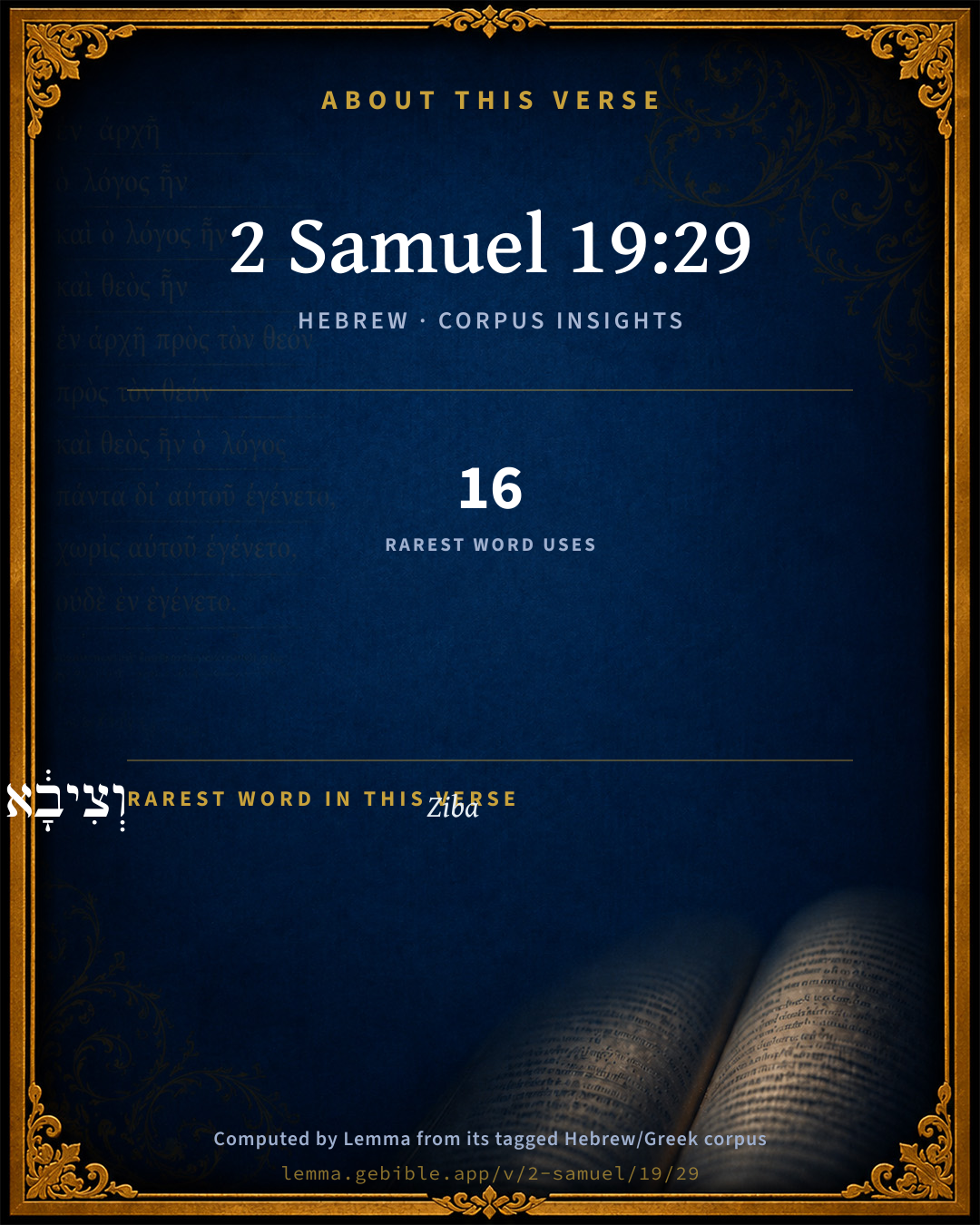
The rarest word here is וְצִיבָ֔א Ziba H6717 — appearing just 16 times in the whole Hebrew Bible.

Shared distinctive vocabulary

וְצִיבָ֔א Ziba H6717 occurs in 13 verses of the Hebrew Bible. Also found in:

Grammatical profile

  • 4 verbs
  • 4 nouns
  • 1 pronoun
  • 1 preposition
  • 1 adverb
  • 2 particles

Verb forms

  • וַיֹּ֤אמֶר Qal · Sequential Imperfect
  • תְּדַבֵּ֥ר Piel · Imperfect
  • אָמַ֕רְתִּי Qal · Perfect
  • תַּחְלְק֖וּ Qal · Imperfect

Repetition

A word recurs within this verse — often emphatic in Hebrew:

  • וַיֹּ֤אמֶר to say H559 ×2

Hebrew & Septuagint length

In English translation the verse runs 21 words from the Hebrew and 24 from the Septuagint (LXX English) — closely comparable.

A rough comparison of the two English renderings, which tokenize alike — not a word-level alignment.

Word counts can differ between the Hebrew and the Greek without any difference in meaning — e.g. the Hebrew direct-object marker אֵת has no separate Greek word, and Greek often adds the article ὁ.

Cross-references

6

Topical passages linked to 2 Samuel 19:29 in the Treasury of Scripture Knowledge — connected by theme and wording, ordered by reader-vote popularity; previews shown in the World English Bible.

  • Deuteronomy 19:17–19 then both the men, between whom the controversy is, shall stand before Yahweh, before the priests and the judges who shall be in those days;
  • Job 19:16–17 I call to my servant, and he gives me no answer; I beg him with my mouth.
  • Psalms 82:2 "How long will you judge unjustly, And show partiality to the wicked?" Selah.
  • Psalms 101:5 I will silence whoever secretly slanders his neighbor. I won't tolerate one who is haughty and conceited.
  • Proverbs 18:13 He who gives answer before he hears, That is folly and shame to him.
  • Acts 18:15 but if they are questions about words and names and your own law, look to it yourselves. For I don't want to be a judge of these matters."

Cross-references courtesy of OpenBible.info (CC BY 4.0).

Hebrew and Greek witnesses Masoretic Hebrew ↔ Greek Septuagint

The same verse in the two great witnesses to the Old Testament, shown verse-for-verse.

These are two independent witnesses, not word-aligned to each other, and the Septuagint is shown in lemma (dictionary) form.

Hebrew 2 Samuel 19:29 Masoretic · Westminster Leningrad Codex

וַיֹּ֤אמֶר לוֹ֙ הַמֶּ֔לֶךְ לָ֛מָּה תְּדַבֵּ֥ר ע֖וֹד דְּבָרֶ֑יךָ אָמַ֕רְתִּי אַתָּ֣ה וְצִיבָ֔א תַּחְלְק֖וּ אֶת הַשָּׂדֶֽה

The king said to him, Why speak you any more of your matters? I say, You and Ziba divide the land.

World English Bible · Public Domain

Greek LXX 2 Samuel 19:29 Septuagint · lemma form

ὅτι οὐ εἰμί πᾶς ὁ οἶκος ὁ πατήρ ἐγώ ἀλλά ἤ ὅτι ἀνήρ θάνατος ὁ κύριος ἐγώ ὁ βασιλεύς καί τίθημι ὁ δοῦλος σύ ἐν ὁ ἐσθίω ὁ τράπεζα σύ καί τίς εἰμί ἐγώ ἔτι δικαίωμα καί ὁ κράζω ἐγώ ἔτι πρός ὁ βασιλεύς

And the king said to him, Why speak you any longer of your matters? I have said, You and Siba shall divide the land.

LXX2012 (modern English Septuagint) · Public Domain

Hebrew: Westminster Leningrad Codex (CC BY 4.0). Greek: Septuagint (public domain); English from LXX2012 (modern English Septuagint) (Public Domain). How the Septuagint differs from the Hebrew →

Targum (Aramaic paraphrase)

1

The Targum is the ancient Jewish Aramaic paraphrase of the Hebrew Scriptures — an interpretive translation, not the Hebrew text itself. Onkelos (literal) and Pseudo-Jonathan (expansive) render the Torah, and Jonathan the Prophets. Coverage is partial: where no permissively-licensed English translation exists for a verse, only the Aramaic is shown. This is verse-level text, not a word-by-word alignment to the Hebrew.

  1. Targum Jonathan Prophets (Joshua–Malachi)
    אֲרֵי לָא הֲוָה כָּל בֵּית אַבָּא אֱלָהֵין גַבְרֵי חַיָבֵי קְטוֹל לְרִבּוֹנִי מַלְכָּא וְשַׁוֵיתָא יַת עַבְדָךְ בְּאָכְלֵי פְתוֹרָךְ וּמָה אִית לִי עוֹד זְכוּ וּלְמִקְבַּל עוֹד קֳדָם מַלְכָּא:

    (no public-domain English translation for this verse)

    Targum Jonathan — Aramaic: “Mikraot Gedolot” (public domain). English: “Sefaria Community Translation” (CC0 1.0 (public-domain dedication)); “London "Chaldee Paraphrase," 1871” (public domain). Text via Sefaria.

Commentary

Notes on 2 Samuel 19:29 from classic Christian and Jewish commentators (each source and its license shown beneath its notes). The classic Christian expositions comment on the surrounding passage and are grouped to its opening verse, so a note may address several verses; the Jewish commentaries on the Tanakh (Rashi and others) are per-verse, so they appear only where the commentator wrote on this verse.

Lemma curates 59 commentaries, every one of them public domain or Creative Commons licensed, each selected and text-cleaned for this edition rather than reprinted as found. About our sources →

Trapp's Complete Commentary

John Trapp

2Sa 19:29 And the king said unto him, Why speakest thou any more of thy matters? I have said, Thou and Ziba divide the land.

Ver. 29. I have said, Thou and Ziba divide the land.] Condemnatur hic Mephiboshethus ex asse. David now, in haste, and full of business, passeth an unjust sentence; intending, perhaps, to be better informed hereafter: and not willing at present to displease Ziba, by taking back from him all that he had given him. The Hebrews say, that because David broke his oath made to Jonathan, and divided Mephibosheth’s land, that afterward his kingdom was divided in Rehoboam’a days. Abulensis thinketh that David made Mephibosheth amends for this wrong some other way.

John Trapp, A Commentary or Exposition upon All the Books of the Old and New Testament (1647–1656) — public domain. Text from a community e-Sword module.

Joseph Benson's Commentary

2Sa 19:29. Thou and Ziba divide the land — The land shall be divided between thee and him, according to my first order, chap. 2Sa 9:10; he and his sons managing it, and supporting themselves out of it, as they did before, and giving the rest of the profits thereof to thee. It is easy to perceive, from this answer of David, that he saw Mephibosheth’s innocence, and the error of his former credulity, and therefore could not bear to hear of it. But he had now no time to discuss the matter more fully: and, therefore, all that he could do for the present was to restore him to his estate, and leave both him and his accuser in their former condition, till he could inquire further. However Ziba might have been faulty toward Mephibosheth, he had been signally faithful and useful to David; and to condemn him unheard, as he had Mephibosheth, was to run the risk of a second rash decision; a decision that might be now as unseasonable as rash, while any rebellion subsisted in his dominions.

Joseph Benson's Commentary on the Old and New Testaments (1811–1818) — public domain. Text from a community e-Sword module.

Geneva Bible (1599)

Geneva Bible translators

David did evil in taking his lands from him before he knew the cause, but much worse, that knowing the truth, he did not restore them.

Geneva Bible (1599) marginal notes — public domain. Text via Bolls.life.

Adam Clarke's Commentary

Verse 29. I have said, Thou and Ziba divide the land.] At first, David gave the land of Saul to Mephibosheth; and Ziba, his sons, and his servants, were to work that land; and to Mephibosheth, as the lord, he was to give the half of the produce. Ziba met David in his distress with provisions, and calumniated Mephibosheth: David, too slightly trusting to his misrepresentation, and supposing that Mephibosheth was actually such a traitor as Ziba represented him, made him on the spot a grant of his master's land. Now he finds that he has acted too rashly, and therefore confirms the former grant; i.e. that Ziba should cultivate the ground, and still continue to give to Mephibosheth, as the lord, the half of the produce. This was merely placing things in statu quo, and utterly annulling the gift that he had made to Ziba. But why did he leave this treacherous man any thing? Answer,

1. He was one of the domestics of Saul, and David wished to show kindness to that house.

2. He had supplied him with the necessaries of life when he was in the greatest distress; and he thinks proper to continue him in his old office, by way of remuneration.

But it was certainly too great a compensation for his services, however then important, when all the circumstances are considered.

Adam Clarke's Commentary on the Bible (1810–1826) — public domain. Text from a community e-Sword/MySword module.

Ellicott's Commentary for English Readers

(29) Divide the land.—When Ziba came to David with his false report about Mephibosheth, David had instantly transferred to him all his master’s possessions (2Sa_16:4); he now saw the injustice of his hasty action, and ought at least to have reversed it, if not to have punished Ziba besides. Either, however, because he had still some doubt of the real merits of the case, or more probably because he was unwilling for political reasons to offend Ziba, he resorts to that halfway and compromise course which was both weak and unjust. The circumstances of the case, the continued mourning of Mephibosheth, the silence of Ziba, concur with the physical infirmity of Mephibosheth to show the truth of his story.

A Bible Commentary for English Readers, edited by Charles John Ellicott (1878–1897) — public domain. Text from a community e-Sword module.

The Cambridge Bible for Schools and Colleges

gen. ed. J. J. S. Perowne

29. Thou and Ziba divide the land] This is usually supposed to be a compromise between the two claimants, either because David suspected the truth of Mephibosheth’s story, or because he was unwilling to alienate Ziba, and possibly a considerable party of Benjamites, by entirely revoking the grant to him (ch. 2Sa_16:4). But it may be a confirmation of the original arrangement by which Ziba was to be Mephibosheth’s tenant, and as he certainly did not cultivate the land for nothing, might be said to share it with him.

The Cambridge Bible for Schools and Colleges (gen. ed. J. J. S. Perowne; Cambridge University Press, 1878–1918) — public domain. Text from a community e-Sword module.

John Gill's Exposition

And the king said unto him, why speakest thou any more of thy matters?.... Of his father's family, and the injuries done by them to David, and of the benefits and favours which he had received from David, or of his temporal affairs, of his estate, which David had given away to Ziba:

I have said, thou and Ziba divide the land; revoking his last grant to Ziba, which gave him all that belonged to Mephibosheth, Sa2 16:4; he established his first decree, that Ziba should have half the profit of the land for tilling it, and the other half be given to Mephibosheth; he did not choose to punish Ziba for slandering his master, being inclined to clemency and mercy, and determined to show no severity at that time; and might be in some fear of Ziba, being a considerable man, lest he should raise a new insurrection, if he bore hard upon him; besides, he might have a large share in his affection, having made a present to him in the time of his distress, and was one of the first that came to meet him upon his return, Sa2 19:17.

John Gill's Exposition of the Whole Bible (1746–1763) — public domain (CC PDM 1.0). Text via the HelloAO Bible API.

Albert Barnes' Notes on the Bible

Unable to get to the bottom of the story, and perhaps unwilling to make an enemy of Ziba, David compromised the matter by dividing the land, thus partially revoking his hasty sentence 2Sa 16:4. We still see the impatient temper of David.

Albert Barnes' Notes on the Bible (1834–1885) — public domain. Text from a community e-Sword/MySword module.

Haydock's Catholic Bible Commentary

More. Hebrew adds, "concerning thy affairs. I have said, Thou and Siba divide the inheritance." (Haydock) --- Thou as the owner, Siba as the administrator, or steward, as he was before. (Jun. Malv.[Junius?; Malvenda?]) --- Sanchez thinks that David made a compensation to Miphiboseth, for what he left in the hands of his servant, as he did not wish to disturb the harmony of the day, nor to inflict any punishment on offenders. (Menochius) --- But most interpreters accuse David of injustice, in suffering Siba to reap the fruits of his perfidy, &c. (Salien) (Calmet, &c.) --- It is not probable, however, that he would deviate from his wonted generosity, nor suffer Miphiboseth to be injured, if he were convinced of his innocence. Perhaps he might judge it expedient that Siba should have a separate establishment, as he was now unfit to act in his former capacity, and had shewn some sort of affection towards his sovereign, when his own son, and most of his subjects, had revolted against him. (Haydock)

George Leo Haydock (1774–1849), Haydock's Catholic Family Bible and Commentary, 1859 edition — public domain. Excludes Psalms (Douay-Rheims chapter numbering differs from Protestant) and Deuterocanonical books (Catholic canon only).

Matthew Poole's English Annotations

Why speakest thou any more of thy matters? For as Ziba was present, so doubtless he was not silent, but said and did what he could to make good his former charge; which must needs occasion many words before the king. And the king was not now at leisure for long debates, and therefore makes an end of the matter.

I have said, to wit, within myself; I have considered the matter as far as now I can, and upon the whole am come to this resolution, wherein I expect that thou and he do both acquiesce. Or, I do now say; I pronounce this sentence in the cause.

Thou and Ziba divide the land: the meaning is either,

1. The land shall be divided between thee and him, as it was by my first order, 2Sa 9:10; he and his sons managing it, and supporting themselves out of it, as they did before, and giving the rest of the profits thereof to thee. And to this the following words may well enough be accommodated, Yea, let him take all, to wit, to his own sole use.

Or, 2. The right and profits of the land shall be equally divided between you. It seems a very rash and harsh sentence, and very unbecoming David’s wisdom, and justice, and gratitude to Jonathan; and Ziba seems to have deserved death for falsely accusing his master of treason, rather than a recompence. But the whole transaction of the matter is not here set down. Possibly Ziba might bring plausible pretences to justify his accusation; and it might be pretended that Mephibosheth neglected the trimming and dressing himself only in policy, and that for a season, till David and his family had destroyed one another by their civil wars, and given him a fit opportunity to take the crown. So that David might really be at a loss what to determine. And Ziba had given proof of his affections to David by an act of kindness which could not be without hazard to himself, 2Sa 16:1,2, which Mephibosheth had not done. And possibly this was only a present sentence, and David resolved to examine things more thoroughly when he had more leisure, and then to make a more full and final determination of the business; which also he might do, though it be not here recorded; for we must not think that nothing was done and said about such things but what is mentioned in Scripture. Besides, Ziba being a powerful man, and the crown not yet firmly fixed upon the king’s head, David might think fit to suspend his final sentence till a more convenient season, and not now to provoke him too much by taking away all his estate from him at once, but to proceed against him by degrees. Howsoever, this is certain, we cannot pass a right judgment upon this action of David’s, unless we understood all the circumstances of it, which we cannot pretend to do.

Matthew Poole's English Annotations on the Holy Bible (1683–1685) — public domain. Text from a community e-Sword/MySword module.

Whedon's Commentary on the Bible

Daniel D. Whedon

29. Why speakest thou any more of thy matters — David evidently felt that Mephibosheth had been injured, and yet it is possible he may have had some suspicion. At all events, he had not now the time nor patience to investigate closely a matter of this kind, and therefore he dismissed it in the quickest way.

Thou and Ziba divide the land — This was not, as some have held, a reversal of his decision in favour of Ziba, for before that Mephibosheth possessed the whole estate of Saul, (2Sa_9:9,) and Ziba was merely a servant, but now he retains only half. The king was desirous that no one should be made unhappy on that joyful day of his restoration; and Mephibosheth obtains and enjoys again the royal favour, and Ziba is much better off than he was before David’s flight.

Daniel D. Whedon (gen. ed.), Commentary on the Old and New Testaments (1874–1909) — public domain. Text from a community e-Sword module.

The Pulpit Commentary

Thou and Ziba divide the land. Two views are taken of this decision the one, that it was a complete reversal of the command in 2Sa_16:4, placing matters upon the old footing, by which Ziba was to have half the produce for cultivating the estate; the other, and apparently the most correct view, is that Ziba was now made actual owner of half the land, and Mephibosheth, instead of a half, would henceforth have only a quarter of the crops. The decision was not equitable, and David speaks in a curt and hurried manner, as though vexed with himself for what he was doing. As a matter of fact, Ziba"s treachery had been most useful to David. Besides the pleasure at the time of finding one man faithful, when "all men were liars", (Psa_116:11) Ziba had been most active in bringing over the tribe of Benjamin to David"s side; and though his motives were selfish and venal, yet, as the king reaped the benefit of his conduct, he was bound not to leave him without reward.

The Pulpit Commentary (1880–1919), ed. H.D.M. Spence-Jones & Joseph S. Exell — public domain. Text from a community e-Sword module.

John Wesley's Explanatory Notes

Divide - The land shall be divided between thee and him, as it was by my first order, chap. ix, 10, he and his sons managing it, and supporting themselves out of it, as they did before, and giving the rest of the profits thereof to thee.

John Wesley, Explanatory Notes Upon the Whole Bible (1754–1765) — public domain. Text via the GEBible commentary corpus.

unfoldingWord translationNotes

Door43 World Missions Community

Why explain anything further?

David uses this rhetorical question to tell him that he does not need to continue talking about his conflict with Ziba. This can be written as a statement. AT: "You do not need to explain this any further." or "You certainly do not need to say any more." (See: Rhetorical Question)

translationWords

king

lord

save

unfoldingWord translationNotes — © Distant Shores Media and the Door43 World Missions Community, licensed CC BY-SA 4.0. Source: git.door43.org/Door43/en_tn.

Lesson kit

Teaching starters — assembled from the data on this page, not authored interpretation. Every prompt links to the verse data it draws on. Edit before teaching.

2 Samuel, in the Historical, opens this verse with 13 words (11 distinct Hebrew lemmas). Its most distinctive word is Tsîybâʼ (“Ziba”). A historical commentator’s framing appears above. Read the whole chapter for the surrounding context.

Discussion questions

  1. How does “Ziba” (Tsîybâʼ) shape what this verse is saying?
  2. 2 Samuel 9:2 shares the word «Ziba» with this verse. How do the two illuminate each other?
  3. “to say” occurs 2× in this one verse. What is the effect of the repetition?
  4. These translations render this verse differently; the difference is in the English rendering, not the original. What questions does that raise?
  5. The verb «וַיֹּ֤אמֶר» is Qal Sequential Imperfect. How does its form color the action?
  6. Reading how Trapp's Complete Commentary and Joseph Benson's Commentary read this verse, where do the two commentators agree and where do they part?

Things to notice

Reading settings

Reading text

Shown beneath each verse's original-language words.

Old Testament
Old Testament edition

Read the OT as the Masoretic Hebrew (MT) or the Greek Septuagint (LXX).

English shown for the Greek Septuagint (in the Hebrew ↔ Greek comparison).

Comparing translations? Open the Compare panel on any verse page to stack up to four side by side.