
Exodus 10:15

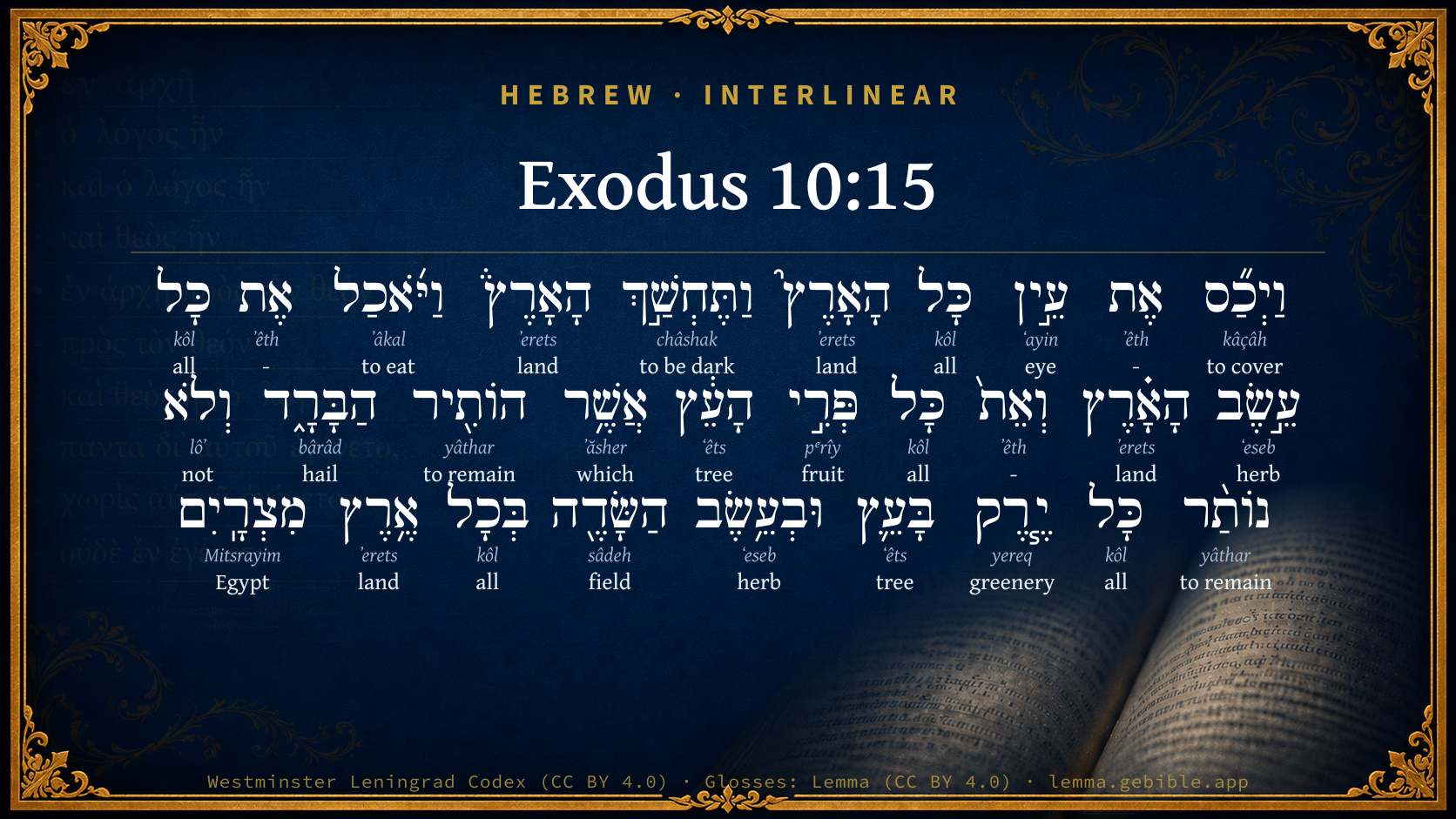
Hebrew (Westminster Leningrad Codex) Exodus 10:15 appears in the Hebrew Old Testament. The text above is from the Westminster Leningrad Codex. Each word links to its Strong’s number, a concise gloss, and parsing drawn from the Open Scriptures Hebrew Bible morphology. Click any word for its full Brown-Driver-Briggs (BDB) entry.
Download image
Cite this verse

Exodus 10:15 (World English Bible). Public Domain. Lemma interlinear Bible study tool, https://lemma.gebible.app/v/exodus/10/15.

Show BibTeX & RIS
BibTeX
RIS
English Translation
For they covered the surface of the whole earth, so that the land was darkened, and they ate every herb of the land, and all the fruit of the trees which the hail had left. There remained nothing green, either tree or herb of the field, through all the land of Egypt.
World English Bible · Public Domain
Highlights
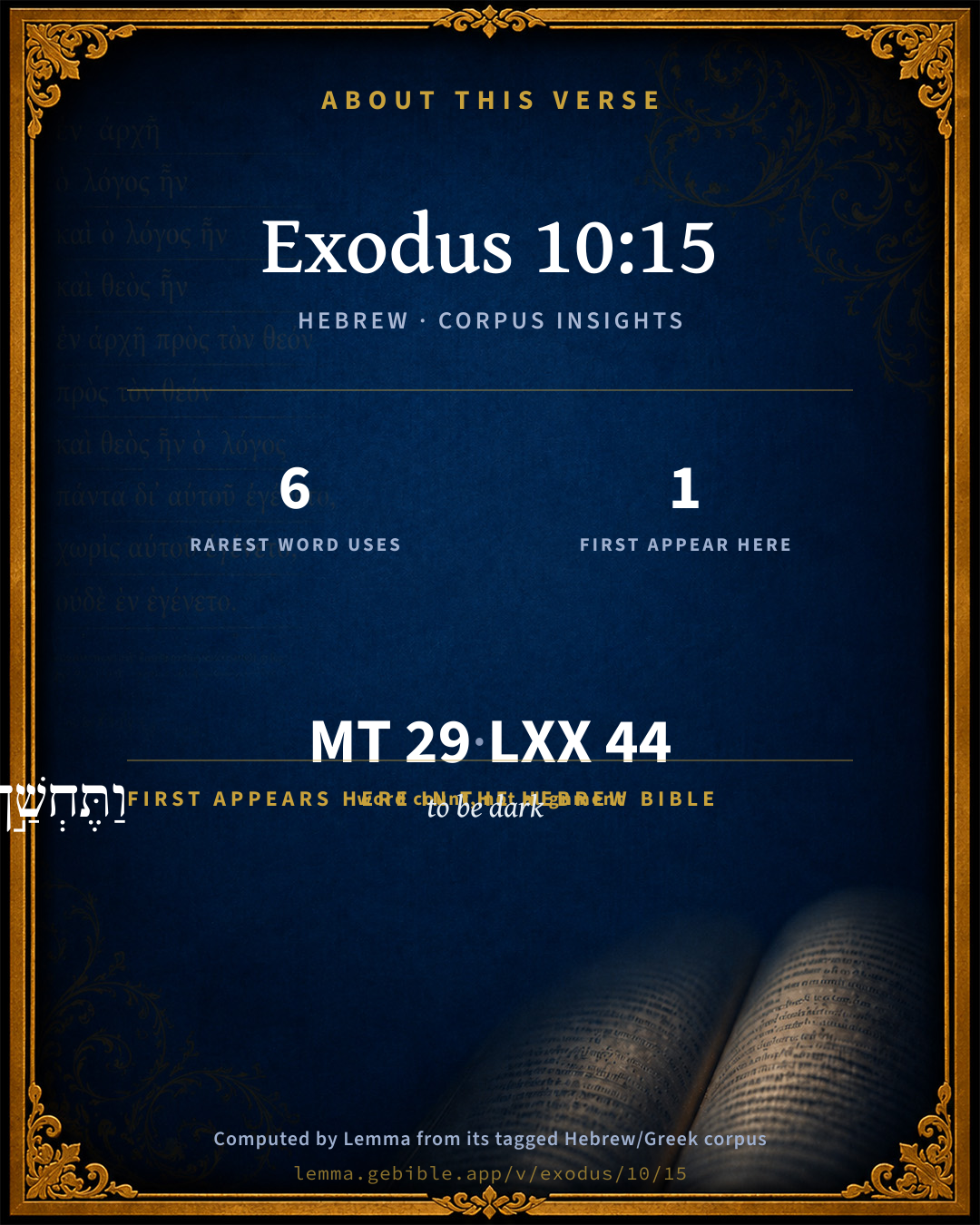
  • 1 first appearance in the Hebrew Bible
Full analysis ↓
Download a study sheet

One document with this verse’s original text, its word-by-word gloss line, the meaning frame, cross-references with their text, attributed commentary, and full source and license credits — printable, and it pastes into notes with its structure intact.

This verse Autodidact and up

Study sheet (.html) Plain text (.txt)

A passage Seminary Student

Up to 50 verses in one chapter. A passage sheet keeps up to 6 commentary sources and 12 cross-references per verse, in the order this page ranks them, and says so on the sheet whenever that leaves anything out. Ask for a single verse and you get the Autodidact verse sheet above.

Everything on this page stays free to read, with no account — the sheet is a download of what is already on screen, not access to it.

Want to remove ads? Support Godless Engineer
Compare translations 3

The same verse in 3 English versions, stacked beneath the original-language interlinear above. Click any original word for its lexicon entry.

Each is an independent rendering of the whole verse — the interlinear is not word-aligned to these translations.

Highlighted words mark where these versions differ — a whole-verse word diff, not a word-by-word alignment.

  • World English Bible Public Domain
    For they covered the surface of the whole earth, so that the land was darkened, and they ate every herb of the land, and all the fruit of the trees which the hail had left. There remained nothing green, either tree or herb of the field, through all the land of Egypt.
  • King James Version Public Domain
    For they covered the face of the whole earth, so that the land was darkened; and they did eat every herb of the land, and all the fruit of the trees which the hail had left: and there remained not any green thing in the trees, or in the herbs of the field, through all the land of Egypt.
  • unfoldingWord Literal Text CC BY-SA 4.0
    And it covered the sight of all of the land, and the land was dark. And it devoured all of the plants of the land and all of the fruit of the trees that the hail had left. And not any of the greenery remained in a tree or in a plant of the field in all of the land of Egypt.

unfoldingWord Literal Text — © unfoldingWord, licensed CC BY-SA 4.0. Word-aligned USFM3 via Door43 (git.door43.org/unfoldingWord/en_ult).

Versions to compare (up to 4)

3 of 4 selected

Show all 18 translations

Every available English version of this verse, each an independent rendering of the whole verse.

  • World English Bible Public Domain
    For they covered the surface of the whole earth, so that the land was darkened, and they ate every herb of the land, and all the fruit of the trees which the hail had left. There remained nothing green, either tree or herb of the field, through all the land of Egypt.
  • Berean Standard Bible Public Domain
    They covered the face of all the land until it was black, and they consumed all the plants on the ground and all the fruit on the trees that the hail had left behind. Nothing green was left on any tree or plant in all the land of Egypt.
  • Majority Standard Bible Public Domain
    They covered the face of all the land until it was black, and they consumed all the plants on the ground and all the fruit on the trees that the hail had left behind. Nothing green was left on any tree or plant in all the land of Egypt.
  • King James Version Public Domain
    For they covered the face of the whole earth, so that the land was darkened; and they did eat every herb of the land, and all the fruit of the trees which the hail had left: and there remained not any green thing in the trees, or in the herbs of the field, through all the land of Egypt.
  • American Standard Version (1901) Public Domain
    For they covered the face of the whole earth, so that the land was darkened; and they did eat every herb of the land, and all the fruit of the trees which the hail had left: and there remained not any green thing, either tree or herb of the field, through all the land of Egypt.
  • Revised Version (1885) Public Domain
    For they covered the face of the whole earth, so that the land was darkened; and they did eat every herb of the land, and all the fruit of the trees which the hail had left: and there remained not any green thing, either tree or herb of the field, through all the land of Egypt.
  • Geneva Bible (1599) Public Domain
    For they couered all the face of the earth, so that the lande was darke: and they did eate all the herbes of the lande, and all the fruites of the trees, which the haile had left, so that there was no greene thing left vpon the trees, nor among the herbes of the fielde throughout all the lande of Egypt.
  • Douay-Rheims (1899) Public Domain
    And they covered the whole face of the earth, wasting all things. And the grass of the earth was devoured, and what fruits soever were on the trees, which the hail had left: and there remained not any thing that was green on the trees, or in the herbs of the earth in all Egypt.
  • Young's Literal Translation Public Domain
    and it covereth the eye of all the land, and the land is darkened; and it eateth every herb of the land, and all the fruit of the trees which the hail hath left, and there hath not been left any green thing in the trees, or in the herb of the field, in all the land of Egypt.'
  • Literal Standard Version CC BY-SA 4.0
    and it covers the eye of all the land, and the land is darkened; and it eats every herb of the land, and all the fruit of the trees which the hail has left, and there has not been left any green thing in the trees, or in the herb of the field, in all the land of Egypt.
  • Unlocked Literal Bible CC BY-SA 4.0
    They covered the surface of the whole land so that it was darkened. They ate every plant in the land and all the fruit of the trees that the hail had left. Throughout all the land of Egypt, no living green plant remained, nor any tree or plant in the fields.
  • unfoldingWord Literal Text CC BY-SA 4.0
    And it covered the sight of all of the land, and the land was dark. And it devoured all of the plants of the land and all of the fruit of the trees that the hail had left. And not any of the greenery remained in a tree or in a plant of the field in all of the land of Egypt.
  • Darby Bible Public Domain
    And they covered the face of the whole land, so that the land was darkened; and they ate every herb of the land, and all the fruit of the trees that the hail had left; and there remained not any green thing on the trees, and in the herbs of the field, throughout the land of Egypt.
  • World Messianic Bible Public Domain
    For they covered the surface of the whole earth, so that the land was darkened, and they ate every herb of the land, and all the fruit of the trees which the hail had left. There remained nothing green, either tree or herb of the field, through all the land of Egypt.
  • Webster's Bible Public Domain
    For they covered the face of the whole earth, so that the land was darkened; and they ate every herb of the land, and all the fruit of the trees which the hail had left: and there remained not any green thing on the trees, or in the herbs of the field, through all the land of Egypt.
  • Free Bible Version CC BY-SA 4.0
    They covered the ground until it looked black, and they ate up all the plants in the fields and all the fruit on the trees that had been left by the hail. Not a single green leaf was left on any tree or plant anywhere in Egypt.
  • Bible in Basic English Public Domain
    For all the face of the earth was covered with them, so that the land was black; and every green plant and all the fruit of the trees which was untouched by the ice-storm they took for food: not one green thing, no plant or tree, was to be seen in all the land of Egypt.
  • JPS Tanakh (1917) Public Domain
    For they covered the face of the whole earth, so that the land was darkened; and they did eat every herb of the land, and all the fruit of the trees which the hail had left; and there remained not any green thing, either tree or herb of the field, through all the land of Egypt.

Literal Standard Version (2020), Covenant Press — licensed CC BY-SA 4.0. Text via the HelloAO Bible API (eBible.org). Unlocked Literal Bible (unfoldingWord) — licensed CC BY-SA 4.0. Text via the HelloAO Bible API (eBible.org). unfoldingWord Literal Text — © unfoldingWord, licensed CC BY-SA 4.0. Word-aligned USFM3 via Door43 (git.door43.org/unfoldingWord/en_ult). Free Bible Version, Dr. Jonathan Gallagher — licensed CC BY-SA 4.0. Text via the HelloAO Bible API (eBible.org).

Word by word

More ways to search: Search by grammar → Find every occurrence → Compare this word →

Practice this passage: Drill this verse → Learn its vocabulary →

יֶ֧רֶק
yereq
H3418
“greenery”
Noun, Common, Masculine, Singular, Absolute
Part of Speech
Noun
Type
Common
Gender
Masculine
Number
Singular
State
Absolute
Full BDB Definition

Origin: from H3417 (in the sense of vacuity of colour)

TWOT: 918a

green, greenness, green plants, greenery
  1. וַיְכַ֞ס kâçâh H3680 “and · to cover” Conjunction + Verb, Piel, Sequential Imperfect, 3rd Person, Masculine, Singular
  2. אֶת ʼêth H853 “-” Particle, Direct Object
  3. עֵ֣ין ʻayin H5869 “eye of” Noun, Common, Both, Singular, Construct
  4. כָּל kôl H3605 “all of” Noun, Common, Masculine, Singular, Construct
  5. הָאָרֶץ֮ ʼerets H776 “the · land” Particle, Definite Article + Noun, Common, Both, Singular, Absolute
  6. וַתֶּחְשַׁ֣ךְ châshak H2821 “and · to be dark” Conjunction + Verb, Qal, Sequential Imperfect, 3rd Person, Feminine, Singular
  7. הָאָרֶץ֒ ʼerets H776 “the · land” Particle, Definite Article + Noun, Common, Both, Singular, Absolute
  8. וַיֹּ֜אכַל ʼâkal H398 “and · to eat” Conjunction + Verb, Qal, Sequential Imperfect, 3rd Person, Masculine, Singular
  9. אֶת ʼêth H853 “-” Particle, Direct Object
  10. כָּל kôl H3605 “all of” Noun, Common, Masculine, Singular, Construct
  11. עֵ֣שֶׂב ʻeseb H6212 “herb of” Noun, Common, Masculine, Singular, Construct
  12. הָאָ֗רֶץ ʼerets H776 “the · land” Particle, Definite Article + Noun, Common, Both, Singular, Absolute
  13. וְאֵת֙ ʼêth H853 “and · -” Conjunction + Particle, Direct Object
  14. כָּל kôl H3605 “all of” Noun, Common, Masculine, Singular, Construct
  15. פְּרִ֣י pᵉrîy H6529 “fruit of” Noun, Common, Masculine, Singular, Construct
  16. הָעֵ֔ץ ʻêts H6086 “the · tree” Particle, Definite Article + Noun, Common, Masculine, Singular, Absolute
  17. אֲשֶׁ֥ר ʼăsher H834 “which” Particle, Relative
  18. הוֹתִ֖יר yâthar H3498 “to remain” Verb, Hiphil, Perfect, 3rd Person, Masculine, Singular
  19. הַבָּרָ֑ד bârâd H1259 “the · hail” Particle, Definite Article + Noun, Common, Masculine, Singular, Absolute
  20. וְלֹא lôʼ H3808 “and · not” Conjunction + Particle, Negative
  21. נוֹתַ֨ר yâthar H3498 “to remain” Verb, Niphal, Perfect, 3rd Person, Masculine, Singular
  22. כָּל kôl H3605 “all of” Noun, Common, Masculine, Singular, Construct
  23. בָּעֵ֛ץ ʻêts H6086 “in/at the · tree” Preposition, Determined + Noun, Common, Masculine, Singular, Absolute
  24. וּבְעֵ֥שֶׂב ʻeseb H6212 “and · in/at · herb of” Conjunction + Preposition + Noun, Common, Masculine, Singular, Construct
  25. הַשָּׂדֶ֖ה sâdeh H7704 “the · field” Particle, Definite Article + Noun, Common, Masculine, Singular, Absolute
  26. בְּכָל kôl H3605 “in/at · all of” Preposition + Noun, Common, Masculine, Singular, Construct
  27. אֶ֥רֶץ ʼerets H776 “land of” Noun, Common, Both, Singular, Construct
  28. מִצְרָֽיִם Mitsrayim H4714 “Egypt” Noun, Proper

About this verse

These counts appear in no published source. They are computed here, from the morphology-tagged text and Lemma’s own curated glosses. What Lemma adds →

29
words
17
distinct lemmas
Pentateuch
section

Notable vocabulary

The rarest word here is יֶ֧רֶק greenery H3418 — appearing just 6 times in the whole Hebrew Bible.

First appearance in Scripture

This word makes its first canonical appearance in the Hebrew Bible here:

  • וַתֶּחְשַׁ֣ךְ to be dark H2821

Shared distinctive vocabulary

יֶ֧רֶק greenery H3418 occurs in 6 verses of the Hebrew Bible. Also found in:

Grammatical profile

  • 5 verbs
  • 19 nouns
  • 5 particles

Verb forms

  • וַיְכַ֞ס Piel · Sequential Imperfect
  • וַתֶּחְשַׁ֣ךְ Qal · Sequential Imperfect
  • וַיֹּ֜אכַל Qal · Sequential Imperfect
  • הוֹתִ֖יר Hiphil · Perfect
  • נוֹתַ֨ר Niphal · Perfect

Repetition

Words recur within this verse — often emphatic in Hebrew:

  • כָּל all H3605 ×5
  • הָאָרֶץ֮ land H776 ×4
  • עֵ֣שֶׂב herb H6212 ×2
  • הָעֵ֔ץ tree H6086 ×2
  • הוֹתִ֖יר to remain H3498 ×2

Hebrew & Septuagint length

In English translation the verse runs 52 words from the Hebrew and 58 from the Septuagint (LXX English) — closely comparable.

A rough comparison of the two English renderings, which tokenize alike — not a word-level alignment.

Word counts can differ between the Hebrew and the Greek without any difference in meaning — e.g. the Hebrew direct-object marker אֵת has no separate Greek word, and Greek often adds the article ὁ.

In the original languages it is 29 Hebrew tokens and 44 Greek tokens — but the two are counted differently (Hebrew bundles its prefixes and suffixes into one token; the Greek is in lemma form), so that isn’t a like-for-like length.

Cross-references

6

Topical passages linked to Exodus 10:15 in the Treasury of Scripture Knowledge — connected by theme and wording, ordered by reader-vote popularity; previews shown in the World English Bible.

  • Exodus 10:5 and they shall cover the surface of the earth, so that one won't be able to see the earth. They shall eat the residue of that which has escaped, which remains to you from the hail, and shall eat every tree which grows for you out of the field.
  • Psalms 78:46 He gave also their increase to the caterpillar, And their labor to the locust.
  • Psalms 105:34–35 He spoke, and the locusts came, And the grasshoppers, without number,
  • Joel 1:6–7 For a nation has come up on my land, strong, and without number. His teeth are the teeth of a lion, And he has the fangs of a lioness.
  • Joel 2:1–11 Blow you the trumpet in Zion, And sound an alarm in my holy mountain! Let all the inhabitants of the land tremble, For the day of Yahweh comes, For it is close at hand:
  • Joel 2:25 I will restore to you the years that the swarming locust has eaten, The great locust, the grasshopper, and the caterpillar, My great army, which I sent among you.

Cross-references courtesy of OpenBible.info (CC BY 4.0).

Hebrew and Greek witnesses Masoretic Hebrew ↔ Greek Septuagint

The same verse in the two great witnesses to the Old Testament, shown verse-for-verse.

These are two independent witnesses, not word-aligned to each other, and the Septuagint is shown in lemma (dictionary) form.

Hebrew Exodus 10:15 Masoretic · Westminster Leningrad Codex

וַיְכַ֞ס אֶת עֵ֣ין כָּל הָאָרֶץ֮ וַתֶּחְשַׁ֣ךְ הָאָרֶץ֒ וַיֹּ֜אכַל אֶת כָּל עֵ֣שֶׂב הָאָ֗רֶץ וְאֵת֙ כָּל פְּרִ֣י הָעֵ֔ץ אֲשֶׁ֥ר הוֹתִ֖יר הַבָּרָ֑ד וְלֹא נוֹתַ֨ר כָּל יֶ֧רֶק בָּעֵ֛ץ וּבְעֵ֥שֶׂב הַשָּׂדֶ֖ה בְּכָל אֶ֥רֶץ מִצְרָֽיִם

For they covered the surface of the whole earth, so that the land was darkened, and they ate every herb of the land, and all the fruit of the trees which the hail had left. There remained nothing green, either tree or herb of the field, through all the land of Egypt.

World English Bible · Public Domain

Greek LXX Exodus 10:15 Septuagint · lemma form

καί καλύπτω ὁ ὄψις ὁ γῆ καί φθείρω ὁ γῆ καί καταἐσθίω πᾶς βοτάνη ὁ γῆ καί πᾶς ὁ καρπός ὁ ξύλον ὅς ὑπολείπω ἀπό ὁ χάλαζα οὐ ὑπολείπω χλωρός οὐδείς ἐν ὁ ξύλον καί ἐν πᾶς βοτάνη ὁ πεδίον ἐν πᾶς γῆ αἴγυπτος

And they covered the face of the earth, and the land was wasted, and they devoured all the herbage of the land, and all the fruit of the trees, which was left by the hail: there was no green thing left on the trees, nor on all the herbage of the field, in all the land of Egypt.

LXX2012 (modern English Septuagint) · Public Domain

Hebrew: Westminster Leningrad Codex (CC BY 4.0). Greek: Septuagint (public domain); English from LXX2012 (modern English Septuagint) (Public Domain). How the Septuagint differs from the Hebrew →

Targum (Aramaic paraphrase)

2

The Targum is the ancient Jewish Aramaic paraphrase of the Hebrew Scriptures — an interpretive translation, not the Hebrew text itself. Onkelos (literal) and Pseudo-Jonathan (expansive) render the Torah, and Jonathan the Prophets. Coverage is partial: where no permissively-licensed English translation exists for a verse, only the Aramaic is shown. This is verse-level text, not a word-by-word alignment to the Hebrew.

  1. Targum Onkelos Torah (Genesis–Deuteronomy)
    וַחֲפָא יָת עֵין שִׁמְשָׁא דְכָל אַרְעָא וַחֲשׁוֹכַת אַרְעָא וַאֲכַל יָת כָּל עֶסְבָּא דְאַרְעָא וְיָת כָּל פֵּירֵי אִילָנָא דִי אַשְׁאַר בַּרְדָא וְלָא אִשְׁתָּאַר כָּל יָרוֹקָא בְּאִילָנָא וּבְעֶסְבָּא דְחַקְלָא בְּכָל אַרְעָא דְמִצְרָיִם:

    (no public-domain English translation for this verse)

    Targum Onkelos — Aramaic: “Onkelos Genesis” (public domain); “Onkelos Exodus” (public domain); “Onkelos Leviticus” (public domain); “Onkelos Numbers” (public domain); “Onkelos Deuteronomy” (public domain). English: “Sefaria Community Translation” (CC0 1.0 (public-domain dedication)); “J.W. Etheridge. The Targums of Onkelos and Jonathan Ben Uzziel on the Pentateuch. London: Longmans, Green, 1862” (public domain). Text via Sefaria.

  2. Targum Pseudo-Jonathan Torah (Genesis–Deuteronomy)
    וַחֲפָא יַת חֶזְוָונָא דְכָל אַרְעָא עַד דִּי חֲשׁוֹכַת אַרְעָא וִישֵׁיצֵי יַת כָּל עִיסְבָּא דְאַרְעָא וְיַת כָּל פֵּירֵי אִילָנָא דִי שַׁיֵּיר בַּרְדָא וְלָא אִשְׁתַּיֵּיר כָּל יְרוֹק בְּאִילָנָא וּבְעִיסְבָּא דְחַקְלָא בְּכָל אַרְעָא דְמִצְרָיִם

    And he covered the face of all the land, until the land was darkened, and every herb of the ground was consumed, and all the fruit of the tree that the hail had left; and nothing green of tree or herb of the field was left in all the land of Mizraim.

    Targum Pseudo-Jonathan — Aramaic: “Targum Jonathan on Genesis” (public domain); “Targum Jonathan on Exodus” (public domain); “Targum Jonathan on Leviticus” (public domain); “Targum Jonathan on Numbers” (public domain); “Targum Jonathan on Deuteronomy” (public domain). English: “The Targum of Jonathan ben Uzziel, trans. J. W. Etheridge, London, 1862” (public domain). Text via Sefaria.

Commentary

Notes on Exodus 10:15 from classic Christian and Jewish commentators (each source and its license shown beneath its notes). The classic Christian expositions comment on the surrounding passage and are grouped to its opening verse, so a note may address several verses; the Jewish commentaries on the Tanakh (Rashi and others) are per-verse, so they appear only where the commentator wrote on this verse.

Lemma curates 59 commentaries, every one of them public domain or Creative Commons licensed, each selected and text-cleaned for this edition rather than reprinted as found. About our sources →

Trapp's Complete Commentary

John Trapp

Exo 10:15 For they covered the face of the whole earth, so that the land was darkened; and they did eat every herb of the land, and all the fruit of the trees which the hail had left: and there remained not any green thing in the trees, or in the herbs of the field, through all the land of Egypt.

Ver. 15. So that the land was darkened.] So many of them flying together, as a cloud. The like was seen in Poland and Silesia in 1575 and 1542. {a}

{a} Bucholc., Chronol.

John Trapp, A Commentary or Exposition upon All the Books of the Old and New Testament (1647–1656) — public domain. Text from a community e-Sword module.

Joseph Benson's Commentary

Exo 10:15. They did eat every green herb of the land — There seems to have been some distance of time between the last plague and this, during which, in that warm and fertile country, new productions had sprouted forth, both out of the ground and from the trees. There remained not any green thing — The earth God has given to the children of men; yet when he pleaseth he can disturb their possession of it, even by locusts and caterpillars. Herb grows for the service of man, yet, when God pleaseth, these contemptible insects shall not only be fellow-commoners with him, but shall eat the bread out of his mouth.

Joseph Benson's Commentary on the Old and New Testaments (1811–1818) — public domain. Text from a community e-Sword module.

Adam Clarke's Commentary

Verse 15. There remained not any green thing] See Clarke on Ex 10:4.

Adam Clarke's Commentary on the Bible (1810–1826) — public domain. Text from a community e-Sword/MySword module.

Ellicott's Commentary for English Readers

(15) They covered the face of the whole earth, so that the land was darkened.—See the comment on Exo_10:5, and compare also Clarke’s Travels in Russia, p. 445:—“The steppes were literally covered with the bodies of these insects. . . . The whole face of nature seemed to be concealed as by a living veil.”

They did eat every herb of the land.—“When these animals arrive in swarms,” says Clarke, “the whole vegetable produce disappears. Nothing escapes them, from the leaves of the forest to the herbs of the plain” (Travels, pp. 446, 447). “It is sufficient,” observes a traveller in Spain, “if these terrible columns stop half an hour on a spot, for everything growing on it—vines, olive-trees, and corn—to be entirely destroyed. After they have passed, nothing remains but the large branches and the roots, which, being underground, have escaped their voracity.”

All the fruit of the trees.—Egypt was famous for its fruits, which consisted of figs, grapes, olives, mulberries, pomegranates, dates, pears, plums, apples, peaches, and the produce of the persea, and the nebk, or sidr. The fruit of the nebk would be ripe in March, and the blossom-buds of the other fruit-trees would be formed, or even opening. On the damage which locusts do to fruit-trees, see the comment on Exo_10:5, and add the following:—“When the weeds in the vineyards do not supply them with sufficient nutriment, they completely strip the bark and buds off the young twigs, so that these shoots remain throughout the summer as white as chalk, without producing fresh foliage” (Pallas, Travels, vol. ii., p. 425).

Which the hail had left.—See Exo_9:25, and comp. Psa_105:32-33 :—“He gave them hail for rain, and flaming fire in their land; he smote their vines also, and their fig trees, and brake the trees of their coasts.”

A Bible Commentary for English Readers, edited by Charles John Ellicott (1878–1897) — public domain. Text from a community e-Sword module.

The Cambridge Bible for Schools and Colleges

gen. ed. J. J. S. Perowne

15. was darkened] i.e. hidden (cf. v. 5) by the multitude of locusts resting upon it. Cf. the description of Thomson, cited on v. 5, ‘the whole face of the mountain was black with them’; and of the Jaffa invasion in 1865 (Joel, p. 90), ‘in parts they covered the ground for miles to a height of several inches.’

not any green thing] cf. the last note on v. 5.

The Cambridge Bible for Schools and Colleges (gen. ed. J. J. S. Perowne; Cambridge University Press, 1878–1918) — public domain. Text from a community e-Sword module.

John Gill's Exposition

For they covered the face of the whole earth,.... Of the whole land of Egypt; and this seems to be the instance in which these locusts differed from all others, that had been or would be, even in their numbers; for though there might have been before, and have been since, such vast numbers of them together as to darken the air and the sun, and by lighting first on one spot, and then on another, have destroyed whole countries; yet never was such an instance known as this, as that they should come in so large a body, and at once to light, and spread, and settle themselves over the whole country. Leo Africanus (p) indeed speaks of a swarm of locusts, which he himself saw at Tagtessa in Africa, A. D. 1510, which covered the whole surface of the ground; but then that was but in one place, but this was a whole country. It is in the original, "they covered the eye of the whole earth"; of which See Gill on Exo 10:5.

so that the land was darkened; the proper colour of the earth, and the green grass on it, could not be seen for them, they lay so thick upon it; and being perhaps of a brown colour, as they often are, the land seemed dark with them:

and they did eat every herb of the land, and all the fruit of the trees, which the hail had left; for though every herb of the field is said to be smitten, and every tree of the field to be broke with it, Exo 9:25, yet this, as has been observed, is to be understood either hyperbolically, or of the greater part thereof, but not of the whole:

and there remained not any green thing in the trees, or in the herbs of the field, through all the land of Egypt; the like is said to befall the province of Carpitania, in the nineth year of Childibert, king of France; which was so wasted by locusts, that not a tree, nor a vineyard, nor a forest, nor any sort of fruit, nor any other green thing remained (q). So Dr. Shaw (r) says of the locusts he saw as above related, that they let nothing escape them, eating up everything that was green and juicy, not only the lesser kinds of vegetables, but the vine likewise, the fig tree, the pomegranate, the palm, and the apple tree, even all the trees of the field. But then such devastations are usually made gradually, by these creatures moving from place to place, whereas this destruction in Egypt was done in one day. Indeed we are told in history, that in one country one hundred and forty acres of land were destroyed in one day (s); but what is this to all the land of Egypt? with this plague may be compared that of the locusts upon the sounding of the fifth trumpet, Rev 9:1.

(p) Descriptio Africae, l. 2. p. 117. (q) Frantzii Hist. Animal. Sacr. par. 5. c. 4. p. 802. (r) Ut supra. (Travels, p. 187. Edit. 2.) (s) Frantz. ib. p. 800.

John Gill's Exposition of the Whole Bible (1746–1763) — public domain (CC PDM 1.0). Text via the HelloAO Bible API.

Matthew Poole's English Annotations

The land was darkened; either by their flying in vast numbers, and so darkening the air, as they have ofttimes done; or by covering the green and lightsome herbs and productions of the earth with their dark and direful bodies.

They did eat every herb of the land. How could this be, when the hail had smitten every herb, and broken every tree? Exo 9:25.

Answ. 1. There seems to have been some distance of time between these two plagues, in which space new productions might be sprouting forth, both out of the ground, and from the trees.

2. The words all and every are commonly understood of the greatest part.

Matthew Poole's English Annotations on the Holy Bible (1683–1685) — public domain. Text from a community e-Sword/MySword module.

Whedon's Commentary on the Bible

Daniel D. Whedon

15. They covered the face of the whole earth — Literally, the eye of the whole earth; so that Egypt could not see sun or sky.

Daniel D. Whedon (gen. ed.), Commentary on the Old and New Testaments (1874–1909) — public domain. Text from a community e-Sword module.

The Pulpit Commentary

The land was darkened. It is not quite clear whether the darkness here spoken of was caused by the locusts when they were still on the wing or after they had settled. It is a fact that the insects come in such dense clouds that while on the wing they obscure the light of the sun, and turn noonday into twilight. And it is also a fact that with their dull brownish bodies and wings they darken the ground after they have settled. Perhaps it is most probable that this last is the fact noticed. (Compare ver. 5.) All the fruit of the trees which the hail had left. Injury to fruit by the hail had not been expressly mentioned in the account of that plague, though perhaps it may be regarded as implied in the expression that the hail "brake every tree of the field" (ver. 25). The damage which locusts do to fruit is well known. They devour it with the green crops, the herbage, and the foliage, before setting to work upon the harder materials, as reeds, twigs, and the bark of trees. In Egypt the principal fruits would be figs, pomegranates; mulberries, grapes, olives, peaches, pears, plums, and apples; together with dates, and the produce of the persea, and the nebk or sidr . The fruit of the nebk is ripe in March. There remained not any green thing. "It is sufficient," observes one writer, "if these terrible columns stop half an hour on a spot, for everything growing on it, vines, olive-trees, and corn, to be entirely destroyed. After they have passed, nothing remains but the large branches and the roots, which, being underground, have escaped their voracity." "Where-ever they settle," says another, "it looks as if fire had burnt up everything." "The country did not seem to be burnt," declares a third, "but to be covered with snow, through the whiteness of the trees and the dryness of the herbs." A fourth sums up his account of the ravages committed by locusts thus to all accounts, wherever the swarms of locusts arrive, the vegetables are entirely consumed and destroyed, appearing as if they had been burnt by fire."

The Pulpit Commentary (1880–1919), ed. H.D.M. Spence-Jones & Joseph S. Exell — public domain. Text from a community e-Sword module.

John Wesley's Explanatory Notes

They covered the face of the earth, and eat up the fruit of it - The earth God has given to the children of men; yet when God pleaseth he can disturb his possession even by locusts or caterpillars. Herb grows for the service of man; yet, when God pleaseth, those contemptible insect's shall not only be fellow- commoners with him, but shall eat the bread out of his mouth.

John Wesley, Explanatory Notes Upon the Whole Bible (1754–1765) — public domain. Text via the GEBible commentary corpus.

Rashi

Rabbi Shlomo Yitzchaki (Rashi)

כל ירק means any green leaf (not “any herb”, since it speaks of the ירק of the trees); old French verdure.

Rashi on the Tanakh — English translations: “The Judaica Press complete Tanach with Rashi, translated by A. J. Rosenberg” (CC BY 4.0); “Pentateuch with Rashi's commentary by M. Rosenbaum and A.M. Silbermann, 1929-1934” (public domain); “The Metsudah Tanach series, Lakewood, N.J” (CC BY 4.0); and “The Book of Joshua, Metsudah Publications, 1997” (CC BY 4.0). Text via Sefaria.

Lesson kit

Teaching starters — assembled from the data on this page, not authored interpretation. Every prompt links to the verse data it draws on. Edit before teaching.

Exodus, in the Pentateuch, opens this verse with 29 words (17 distinct Hebrew lemmas). Its most distinctive word is yereq (“greenery”). A historical commentator’s framing appears above. Read the whole chapter for the surrounding context.

Discussion questions

  1. How does “greenery” (yereq) shape what this verse is saying?
  2. This is the first place “to be dark” appears in Scripture (first appears here). What does its debut here establish?
  3. How does Genesis 1:30, which shares the word «greenery», read alongside this verse?
  4. What does the repetition of “all” (5× in this one verse) do in this verse?
  5. The translations on this page render this verse differently — a whole-verse word diff, not a word-by-word alignment. What might account for the different wordings?
  6. «וַיְכַ֞ס» is a Piel Sequential Imperfect verb. How does that grammatical form shape the action described?
  7. Compare how Trapp's Complete Commentary and Joseph Benson's Commentary read this verse. Where do they agree or differ?

Things to notice

Reading settings

Reading text

Shown beneath each verse's original-language words.

Old Testament
Old Testament edition

Read the OT as the Masoretic Hebrew (MT) or the Greek Septuagint (LXX).

English shown for the Greek Septuagint (in the Hebrew ↔ Greek comparison).

Comparing translations? Open the Compare panel on any verse page to stack up to four side by side.