
Isaiah 32:12

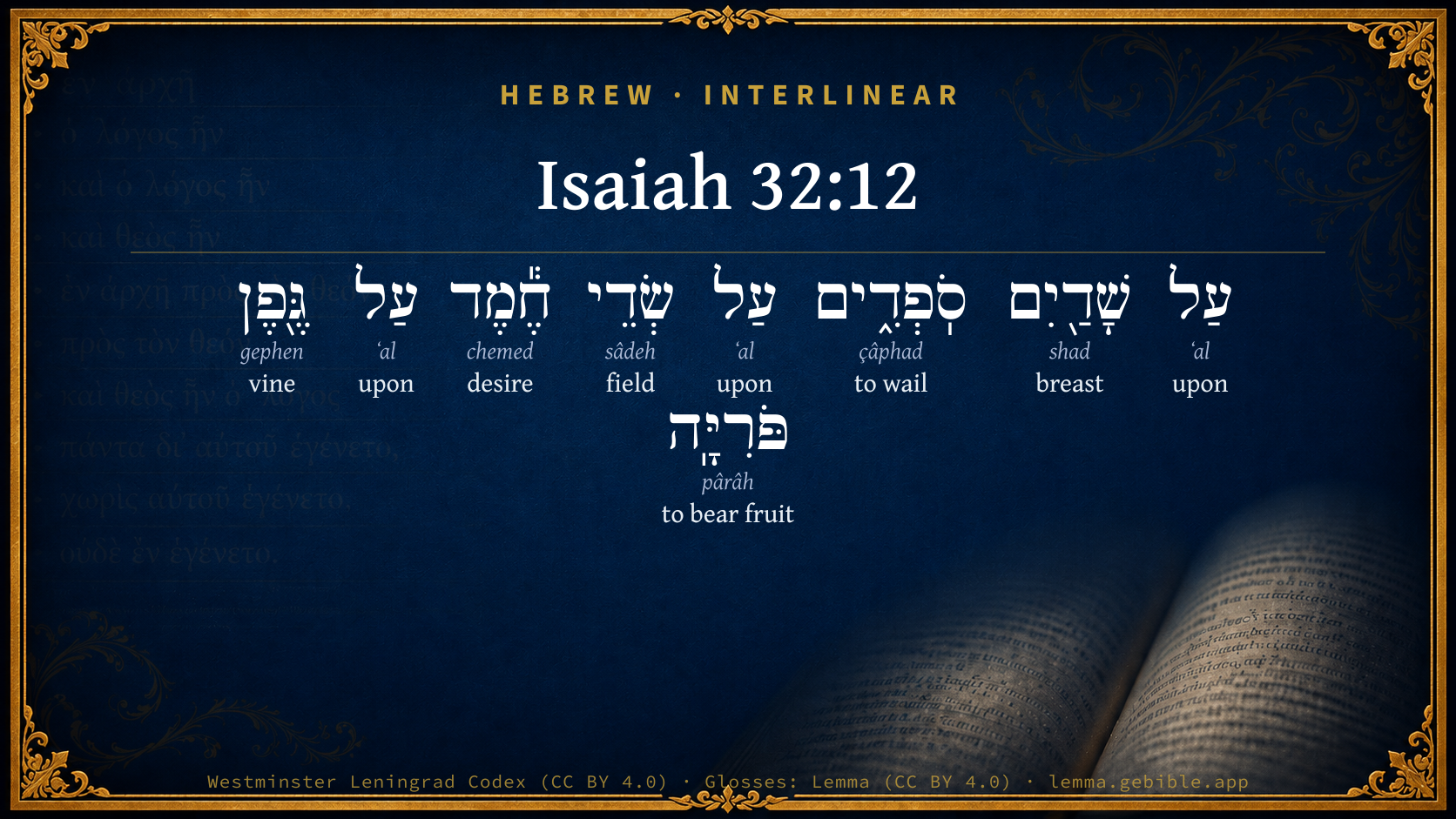
Hebrew (Westminster Leningrad Codex) Isaiah 32:12 appears in the Hebrew Old Testament. The text above is from the Westminster Leningrad Codex. Each word links to its Strong’s number, a concise gloss, and parsing drawn from the Open Scriptures Hebrew Bible morphology. Click any word for its full Brown-Driver-Briggs (BDB) entry.
Download image
Cite this verse

Isaiah 32:12 (World English Bible). Public Domain. Lemma interlinear Bible study tool, https://lemma.gebible.app/v/isaiah/32/12.

Show BibTeX & RIS
BibTeX
RIS
English Translation
They shall strike on the breasts for the pleasant fields, for the fruitful vine.
World English Bible · Public Domain
Download a study sheet

One document with this verse’s original text, its word-by-word gloss line, the meaning frame, cross-references with their text, attributed commentary, and full source and license credits — printable, and it pastes into notes with its structure intact.

This verse Autodidact and up

Study sheet (.html) Plain text (.txt)

A passage Seminary Student

Up to 50 verses in one chapter. A passage sheet keeps up to 6 commentary sources and 12 cross-references per verse, in the order this page ranks them, and says so on the sheet whenever that leaves anything out. Ask for a single verse and you get the Autodidact verse sheet above.

Everything on this page stays free to read, with no account — the sheet is a download of what is already on screen, not access to it.

Want to remove ads? Support Godless Engineer
Compare translations 3

The same verse in 3 English versions, stacked beneath the original-language interlinear above. Click any original word for its lexicon entry.

Each is an independent rendering of the whole verse — the interlinear is not word-aligned to these translations.

Highlighted words mark where these versions differ — a whole-verse word diff, not a word-by-word alignment.

  • World English Bible Public Domain
    They shall strike on the breasts for the pleasant fields, for the fruitful vine.
  • King James Version Public Domain
    They shall lament for the teats, for the pleasant fields, for the fruitful vine.
  • unfoldingWord Literal Text CC BY-SA 4.0
    Be beating upon breasts for the fields of delight, for the vine bearing fruit.

unfoldingWord Literal Text — © unfoldingWord, licensed CC BY-SA 4.0. Word-aligned USFM3 via Door43 (git.door43.org/unfoldingWord/en_ult).

Versions to compare (up to 4)

3 of 4 selected

Show all 18 translations

Every available English version of this verse, each an independent rendering of the whole verse.

  • World English Bible Public Domain
    They shall strike on the breasts for the pleasant fields, for the fruitful vine.
  • Berean Standard Bible Public Domain
    Beat your breasts for the pleasant fields, for the fruitful vines,
  • Majority Standard Bible Public Domain
    Beat your breasts for the pleasant fields, for the fruitful vines,
  • King James Version Public Domain
    They shall lament for the teats, for the pleasant fields, for the fruitful vine.
  • American Standard Version (1901) Public Domain
    They shall smite upon the breasts for the pleasant fields, for the fruitful vine.
  • Revised Version (1885) Public Domain
    They shall smite upon the breasts for the pleasant fields, for the fruitful vine.
  • Geneva Bible (1599) Public Domain
    Men shall lament for the teates, euen for the pleasant fieldes, and for the fruitefull vine.
  • Douay-Rheims (1899) Public Domain
    Mourn for your breasts, for the delightful country, for the fruitful vineyard.
  • Young's Literal Translation Public Domain
    For breasts they are lamenting, For fields of desire, for the fruitful vine.
  • Literal Standard Version CC BY-SA 4.0
    They are lamenting for breasts, || For fields of desire, for the fruitful vine.
  • Unlocked Literal Bible CC BY-SA 4.0
    You will wail for the pleasant fields, for the fruitful vines.
  • unfoldingWord Literal Text CC BY-SA 4.0
    Be beating upon breasts for the fields of delight, for the vine bearing fruit.
  • Darby Bible Public Domain
    They shall smite on the breasts [in lamentation] for the pleasant fields, for the fruitful vineyards.
  • World Messianic Bible Public Domain
    Beat your breasts for the pleasant fields, for the fruitful vine.
  • Webster's Bible Public Domain
    They shall lament for the breasts, for the pleasant fields, for the fruitful vine.
  • Free Bible Version CC BY-SA 4.0
    Beat your breasts in sadness over the loss of your lovely fields, your productive vines,
  • Bible in Basic English Public Domain
    Have sorrow for the fields, the pleasing fields, the fertile vine;
  • JPS Tanakh (1917) Public Domain
    Smiting upon the breasts for the pleasant fields, for the fruitful vine;

Literal Standard Version (2020), Covenant Press — licensed CC BY-SA 4.0. Text via the HelloAO Bible API (eBible.org). Unlocked Literal Bible (unfoldingWord) — licensed CC BY-SA 4.0. Text via the HelloAO Bible API (eBible.org). unfoldingWord Literal Text — © unfoldingWord, licensed CC BY-SA 4.0. Word-aligned USFM3 via Door43 (git.door43.org/unfoldingWord/en_ult). Free Bible Version, Dr. Jonathan Gallagher — licensed CC BY-SA 4.0. Text via the HelloAO Bible API (eBible.org).

Word by word

More ways to search: Search by grammar → Find every occurrence → Compare this word →

Practice this passage: Drill this verse → Learn its vocabulary →

About this verse

These counts appear in no published source. They are computed here, from the morphology-tagged text and Lemma’s own curated glosses. What Lemma adds →

9
words
7
distinct lemmas
Prophets
section

Notable vocabulary

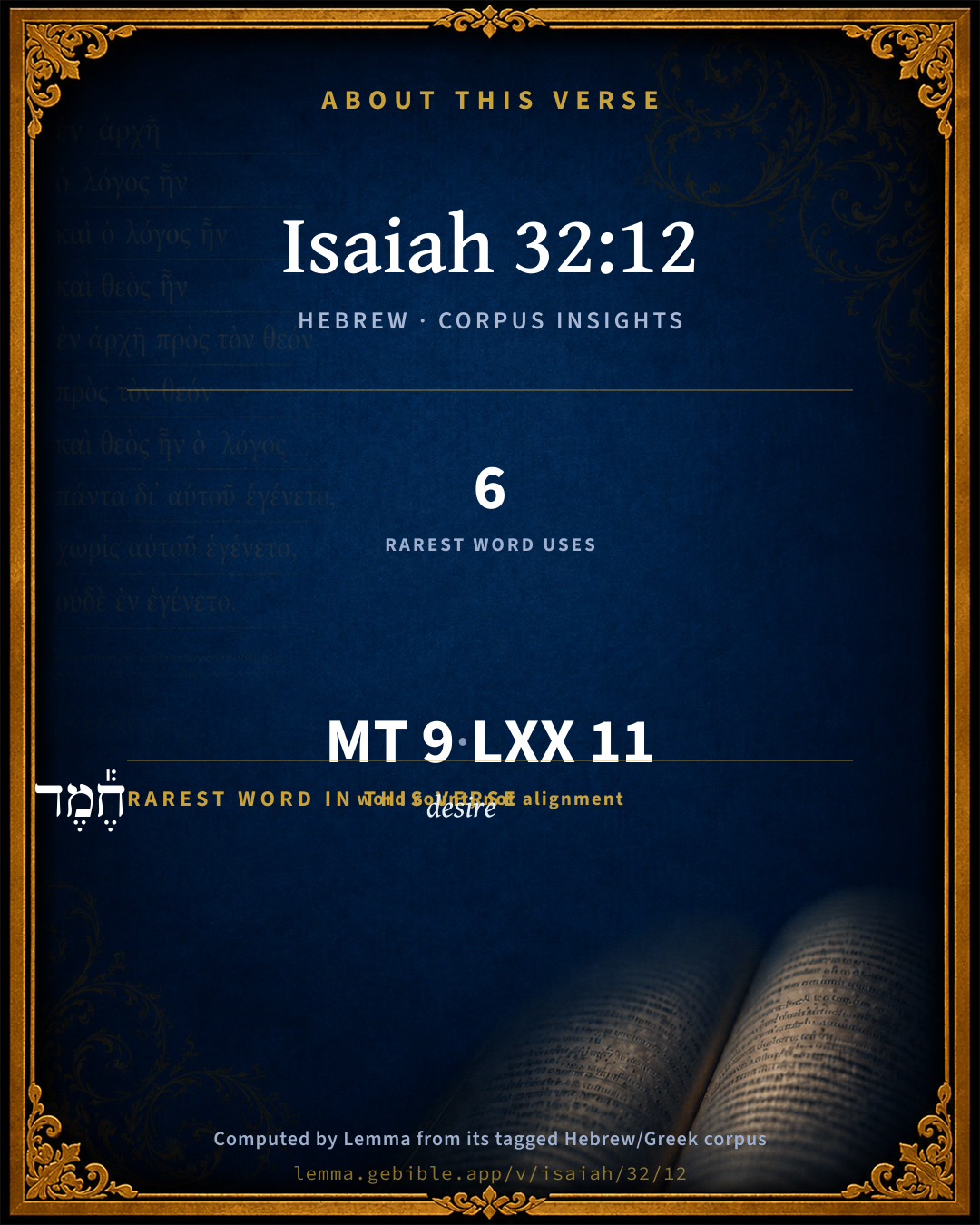
The rarest word here is חֶ֕מֶד desire H2531 — appearing just 6 times in the whole Hebrew Bible.

Shared distinctive vocabulary

חֶ֕מֶד desire H2531 occurs in 6 verses of the Hebrew Bible. Also found in:

Grammatical profile

  • 2 verbs
  • 4 nouns
  • 3 prepositions

Verb forms

  • סֹֽפְדִ֑ים Qal · Participle Active
  • פֹּרִיָּֽה Qal · Participle Active

Repetition

A word recurs within this verse — often emphatic in Hebrew:

Hebrew & Septuagint length

In English translation the verse runs 14 words from the Hebrew and 15 from the Septuagint (LXX English) — closely comparable.

A rough comparison of the two English renderings, which tokenize alike — not a word-level alignment.

Word counts can differ between the Hebrew and the Greek without any difference in meaning — e.g. the Hebrew direct-object marker אֵת has no separate Greek word, and Greek often adds the article ὁ.

In the original languages it is 9 Hebrew tokens and 11 Greek tokens — but the two are counted differently (Hebrew bundles its prefixes and suffixes into one token; the Greek is in lemma form), so that isn’t a like-for-like length.

Cross-references

7

Topical passages linked to Isaiah 32:12 in the Treasury of Scripture Knowledge — connected by theme and wording, ordered by reader-vote popularity; previews shown in the World English Bible.

  • Deuteronomy 8:7–8 For Yahweh your God brings you into a good land, a land of brooks of water, of springs and springs, flowing forth in valleys and hills;
  • Deuteronomy 11:11–12 but the land, where you go over to possess it, is a land of hills and valleys, [and] drinks water of the rain of the sky,
  • Lamentations 2:11 My eyes do fail with tears, my heart is troubled; My liver is poured on the earth, because of the destruction of the daughter of my people, Because the young children and the infants swoon in the streets of the city.
  • Lamentations 4:3–4 Even the jackals draw out the breast, they give suck to their young ones: The daughter of my people is become cruel, like the ostriches in the wilderness.
  • Ezekiel 20:6 in that day I swore to them, to bring them forth out of the land of Egypt into a land that I had searched out for them, flowing with milk and honey, which is the glory of all lands.
  • Ezekiel 20:15 Moreover also I swore to them in the wilderness, that I would not bring them into the land which I had given them, flowing with milk and honey, which is the glory of all lands;
  • Nahum 2:7 It is decreed: she is uncovered, she is carried away; and her handmaids moan as with the voice of doves, beating on their breasts.

Cross-references courtesy of OpenBible.info (CC BY 4.0).

Hebrew and Greek witnesses Masoretic Hebrew ↔ Greek Septuagint

The same verse in the two great witnesses to the Old Testament, shown verse-for-verse.

These are two independent witnesses, not word-aligned to each other, and the Septuagint is shown in lemma (dictionary) form.

Hebrew Isaiah 32:12 Masoretic · Westminster Leningrad Codex

עַל שָׁדַ֖יִם סֹֽפְדִ֑ים עַל שְׂדֵי חֶ֕מֶד עַל גֶּ֖פֶן פֹּרִיָּֽה

They shall strike on the breasts for the pleasant fields, for the fruitful vine.

World English Bible · Public Domain

Greek LXX Isaiah 32:12 Septuagint · lemma form

καί ἐπί ὁ μαστός κόπτω ἀπό ἀγρός ἐπιθύμημα καί ἄμπελος γένημα

and beat your breasts, because of the pleasant field, and the fruit of the vine.

LXX2012 (modern English Septuagint) · Public Domain

On this verse, Adam Clarke's Commentary discusses the Septuagint’s reading. Read the note in Commentary ↓

Hebrew: Westminster Leningrad Codex (CC BY 4.0). Greek: Septuagint (public domain); English from LXX2012 (modern English Septuagint) (Public Domain). How the Septuagint differs from the Hebrew →

Targum (Aramaic paraphrase)

1

The Targum is the ancient Jewish Aramaic paraphrase of the Hebrew Scriptures — an interpretive translation, not the Hebrew text itself. Onkelos (literal) and Pseudo-Jonathan (expansive) render the Torah, and Jonathan the Prophets. Coverage is partial: where no permissively-licensed English translation exists for a verse, only the Aramaic is shown. This is verse-level text, not a word-by-word alignment to the Hebrew.

  1. Targum Jonathan Prophets (Joshua–Malachi)
    עַל דַדִין סִפְּדִין עַל חַקְלֵי חֲמִידְתָּא עַל גוּפְנִיי טָעֲנִין:

    They beat the breasts for the pleasant fields, for the fruit-laden vines.

    Targum Jonathan — Aramaic: “Mikraot Gedolot” (public domain). English: “Sefaria Community Translation” (CC0 1.0 (public-domain dedication)); “London "Chaldee Paraphrase," 1871” (public domain). Text via Sefaria.

Commentary

Notes on Isaiah 32:12 from classic Christian and Jewish commentators (each source and its license shown beneath its notes). The classic Christian expositions comment on the surrounding passage and are grouped to its opening verse, so a note may address several verses; the Jewish commentaries on the Tanakh (Rashi and others) are per-verse, so they appear only where the commentator wrote on this verse.

Lemma curates 59 commentaries, every one of them public domain or Creative Commons licensed, each selected and text-cleaned for this edition rather than reprinted as found. About our sources →

Trapp's Complete Commentary

John Trapp

Isa 32:12 They shall lament for the teats, for the pleasant fields, for the fruitful vine.

Ver. 12. They shall mourn for the teats.] That is, for their grain and wine. The heathens called Ceres their goddess of plenty, πολυμασθον, Mammosam, full teated. Some sense it thus, Let them (infants) mourn for the teats denied them in this day of humiliation, {Jon 3:5-6} or so dried up that there is no milk for them. Others render it, Beating upon their breasts, Plangentes pectora palmis.

John Trapp, A Commentary or Exposition upon All the Books of the Old and New Testament (1647–1656) — public domain. Text from a community e-Sword module.

Geneva Bible (1599)

Geneva Bible translators

By the teats he meaneth the plentiful fields, whereby men are nourished as children with the teat: or, the mothers for sorrow and heaviness shall lack milk.

Geneva Bible (1599) marginal notes — public domain. Text via Bolls.life.

Jamieson, Fausset & Brown

Robert Jamieson, A. R. Fausset & David Brown

lament for . . . teats--rather, shall smite on their breasts in lamentation "for thy pleasant fields" (Nah 2:7) [MAURER]. "Teats" in English Version is used for fertile lands, which, like breasts, nourish life. The transition from "ye" to "they" (Isa 32:11-12) is frequent.

Jamieson, Fausset & Brown — Commentary Critical and Explanatory on the Whole Bible (1871) — public domain (CC PDM 1.0). Text via the HelloAO Bible API.

Adam Clarke's Commentary

Verse 12. They shall lament - for the pleasant fields - "Mourn ye for the pleasant field"] The Septuagint, Syriac, and Vulgate read ספדו siphdu, mourn ye, imperative; twelve MSS., (five ancient,) two editions, the Septuagint, Aquila, Symmachus, Theodotion, Syriac, and Vulgate, all read שדה sadeh, a field; not שדי shedey, breasts.

Adam Clarke's Commentary on the Bible (1810–1826) — public domain. Text from a community e-Sword/MySword module.

Ellicott's Commentary for English Readers

(12) They shall lament for the teats . . .—Better, shall smite upon the breasts. The Hebrew nouns for “teats” and “fields,” Shâdaim and Sadè, have an assonance which may be represented by the Latin ubera and ubertas. In the renewed, unabated luxury of the women of Jerusalem Isaiah sees the precursor of another time of desolation like that which he had foretold before in the reign of Ahaz (Isa_7:24). “Thorns and briers” are again to take the place of the fair gardens in the outskirts of Jerusalem during the invasion of Sennacherib, as they had once before in that of Rezin and Pekah. The “houses of joy” are manifestly what we should call the stately villas of the rich.

A Bible Commentary for English Readers, edited by Charles John Ellicott (1878–1897) — public domain. Text from a community e-Sword module.

The Cambridge Bible for Schools and Colleges

gen. ed. J. J. S. Perowne

12. They shall lament for the teats] R.V. gives a better translation: they shall smite upon the breasts; but the construction is difficult. The verb is a masculine plural participle and signifies strictly “to mourn.” The word for “breasts” might by a slight change of points be read as “fields”; hence some commentators think that the reference to the women is here abandoned, and render, “men shall mourn for the fields.” If the R.V. is right we must suppose that the word “mourn” (like the Greek κόπτεσθαι) meant originally “smite upon (the breast)” and is here used in its literal sense. The clause would be somewhat more easily construed if read as the conclusion of Isa_32:11 (Duhm, “smiting on the breasts”), but even with this change the masculine gender is exceedingly harsh.

The Cambridge Bible for Schools and Colleges (gen. ed. J. J. S. Perowne; Cambridge University Press, 1878–1918) — public domain. Text from a community e-Sword module.

John Gill's Exposition

They shall lament for the teats,.... Either of the beasts of the field, that should be dried up, and give no milk, through the great drought that should be upon the land; or through the waste of the herbage by the enemy; or else of the women, their breasts and paps, which should afford no milk for their infants, through the famine that should press them sore, which would occasion great lamentation, both in mothers and children; though some think are to be understood of the fields, and are explained by them in the next clause; the fruitful earth being compared to a woman, its fields are like breasts or paps, which yield food and nourishment, but now should not afford any, and therefore there would be cause of lamentation. Jarchi interprets it, "they shall beat upon their breasts" (m) a gesture used in lamentation to express exceeding great grief and sorrow, Luk 18:13 some, because the word rendered "lament" is of the masculine gender, and so not applicable to women, render the words in connection with the preceding verse Isa 32:11 thus,

"gird sackcloth on your loins, and on your mourning breasts'' (n);

though they may be interpreted indefinitely, "there shall be lamentation for the teats", among all sorts of people, men, women, and children:

for the pleasant fields, for the fruitful vine; as the fields are when covered with corn and grass, and the vines with clusters of grapes, but now should not be, either through drought, or by being foraged and trampled on by the enemy.

(m) So it is explained in T. Bab. Moed Katon, fol. 27. 2. (n) So Castalio.

John Gill's Exposition of the Whole Bible (1746–1763) — public domain (CC PDM 1.0). Text via the HelloAO Bible API.

Albert Barnes' Notes on the Bible

They shall lament for the teats - Interpreters have been not a little perplexed by this expression. Lowth supposes it is to be taken in connection with the previous verse, and that it denotes that sackcloth was to be girded upon the breast as well as upon the loins. Others have supposed that it denotes to ‘smite upon the breasts,’ as a token of grief; others, that the word ‘breast’ here denotes children by a synecdoche, as having been nourished by the breast, and that the women here were called to mourn over their children. But it is evident, I think, that the word breasts here is used to denote that which nourishes or sustains life, and is synonymous with fruitful fields. It is so used in Homer (Iliad, ix. 141), where οίθαρ ἀρούρης oithar arourēs denotes fertility of land. And here the sense doubtless is, that they would mourn over the fields which once contributed to sustain life, but which were now desolate. In regard to the grammatical difficulties of the place, Rosenmuller and Gesenius may be consulted.

The pleasant fields - Margin, as in Hebrew, ‘Fields of desire.’

Albert Barnes' Notes on the Bible (1834–1885) — public domain. Text from a community e-Sword/MySword module.

Haydock's Catholic Bible Commentary

Mourn. Septuagint, "beat." (Haydock) --- Breasts, suckling infants. In mourning, women beat and uncovered their breasts, which, on any other occasion, would have been deemed very indecent. (Calmet) (Ezechiel xxiii. 34.) (Herodotus ii. 84.)

George Leo Haydock (1774–1849), Haydock's Catholic Family Bible and Commentary, 1859 edition — public domain. Excludes Psalms (Douay-Rheims chapter numbering differs from Protestant) and Deuterocanonical books (Catholic canon only).

Matthew Poole's English Annotations

They shall lament for the teats; either,

1. Properly, because through famine your teats are destitute of milk for the nourishment of your poor children. Or rather,

2. Metaphorically, as the following words explain it,

for the pleasant and fruitful fields, which like teats yielded you plentiful and excellent nourishment, for which the land was said to flow with milk, Eze 20:6. And the earth being compared to the womb that bare us, Job 1:21, it is not strange if its fruitful fields be compared to the breasts which nourish us.

Matthew Poole's English Annotations on the Holy Bible (1683–1685) — public domain. Text from a community e-Sword/MySword module.

Whedon's Commentary on the Bible

Daniel D. Whedon

12. Lament, etc. — Better rendered, Smiting the breasts, as on funeral occasions.

Pleasant fields — The loss of these, and the loss of successive vintages, are the ground of lament. Desolation generally is to befal the proud daughters of Zion.

Daniel D. Whedon (gen. ed.), Commentary on the Old and New Testaments (1874–1909) — public domain. Text from a community e-Sword module.

The Pulpit Commentary

They shall lament for the teats, etc.; rather, they shall beat upon the breasts for the pleasant fields, etc. (so the LXX, the Vulgate, Jarchi, Gesenius, Ewald, Maurer, Knobel, Delitzsch, and Mr. Cheyne). Dr. Kay prefers the rendering of the Authorized Version, understanding by "the teats" such "dry breasts" as Hosea speaks of. (Hos_9:14) But nothing has been said in this place of any such affliction. For the pleasant fields, etc.; i.e. for their loss (see ver. 10).

The Pulpit Commentary (1880–1919), ed. H.D.M. Spence-Jones & Joseph S. Exell — public domain. Text from a community e-Sword module.

John Wesley's Explanatory Notes

The teats - For the pleasant and fruitful fields, which like teats yielded you plentiful and excellent nourishment.

John Wesley, Explanatory Notes Upon the Whole Bible (1754–1765) — public domain. Text via the GEBible commentary corpus.

J. A. Alexander on Isaiah

Joseph Addison Alexander

Mourning for the breasts (or beating on the breasts as a sign of mourning), for the pleasant fields, for the fruitful vine. The same act is described in Nah 2:8, but by a different verb.

Joseph Addison Alexander, The Prophecies of Isaiah (1846–1847; New York: Scribner, 1870–1878) — public domain. Text from a community e-Sword module.

Rashi

Rabbi Shlomo Yitzchaki (Rashi)

on the breasts, lamenting They shall beat their heart.

for the desirable fields For the fields of their desire. The Midrash Aggadah (See twenty-fourth poem to Lamentations Rabbah) states: For the sages of the Sanhedrin, who are like breasts that nurture, they will lament, and for the city of their desire that will be plowed up like a field, and for the fruitful - vine that is Israel, called a vine, as it is said (Psalms 80:9): “You plucked a vine out of Egypt.”

Rashi on the Tanakh — English translations: “The Judaica Press complete Tanach with Rashi, translated by A. J. Rosenberg” (CC BY 4.0); “Pentateuch with Rashi's commentary by M. Rosenbaum and A.M. Silbermann, 1929-1934” (public domain); “The Metsudah Tanach series, Lakewood, N.J” (CC BY 4.0); and “The Book of Joshua, Metsudah Publications, 1997” (CC BY 4.0). Text via Sefaria.

Ibn Ezra

Rabbi Abraham ibn Ezra

סופדים They shall lament. כל all is to be supplied. Comp. וכל הנשים יתנו and all women shall give. (Est. 1:20)

Ibn Ezra on the Tanakh — English translations: “Sefaria Community Translation” (CC0 1.0 (public-domain dedication)); “Yalkut, Sifsei Chachomim Chumash, Metsudah Publications, 2009” (CC BY 4.0); and “Commentary of Ibn Ezra on Isaiah - trans. by M. Friedlander, 1873” (public domain). Text via Sefaria.

Lesson kit

Teaching starters — assembled from the data on this page, not authored interpretation. Every prompt links to the verse data it draws on. Edit before teaching.

Isaiah, in the Prophets, opens this verse with 9 words (7 distinct Hebrew lemmas). Its most distinctive word is chemed (“desire”). A historical commentator’s framing appears above. Read the whole chapter for the surrounding context.

Discussion questions

  1. What does “desire” (chemed) contribute to the verse as a whole?
  2. How does Isaiah 27:2, which shares the word «desire», read alongside this verse?
  3. What does the repetition of “upon” (3× in this one verse) do in this verse?
  4. The translations on this page render this verse differently — a whole-verse word diff, not a word-by-word alignment. What might account for the different wordings?
  5. «סֹֽפְדִ֑ים» is a Qal Participle Active verb. How does that grammatical form shape the action described?
  6. Compare how Trapp's Complete Commentary and Geneva Bible (1599) read this verse. Where do they agree or differ?

Things to notice

Reading settings

Reading text

Shown beneath each verse's original-language words.

Old Testament
Old Testament edition

Read the OT as the Masoretic Hebrew (MT) or the Greek Septuagint (LXX).

English shown for the Greek Septuagint (in the Hebrew ↔ Greek comparison).

Comparing translations? Open the Compare panel on any verse page to stack up to four side by side.