
Exodus 23:11

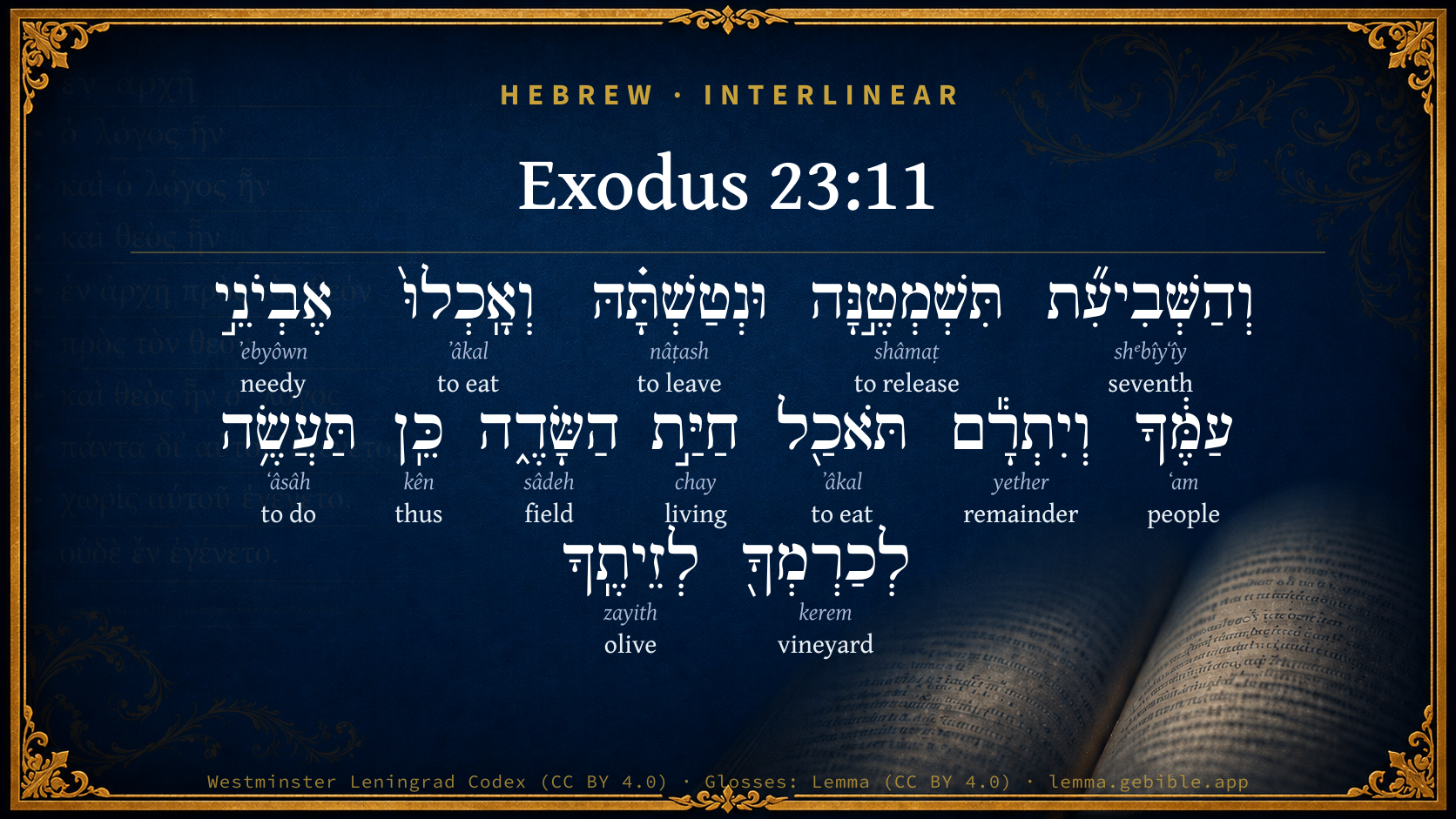
Hebrew (Westminster Leningrad Codex) Exodus 23:11 appears in the Hebrew Old Testament. The text above is from the Westminster Leningrad Codex. Each word links to its Strong’s number, a concise gloss, and parsing drawn from the Open Scriptures Hebrew Bible morphology. Click any word for its full Brown-Driver-Briggs (BDB) entry.
Download image
Cite this verse

Exodus 23:11 (World English Bible). Public Domain. Lemma interlinear Bible study tool, https://lemma.gebible.app/v/exodus/23/11.

Show BibTeX & RIS
BibTeX
RIS
English Translation
but the seventh year you shall let it rest and lie fallow, that the poor of your people may eat; and what they leave the animal of the field shall eat. In like manner you shall deal with your vineyard and with your olive grove.
World English Bible · Public Domain
Highlights
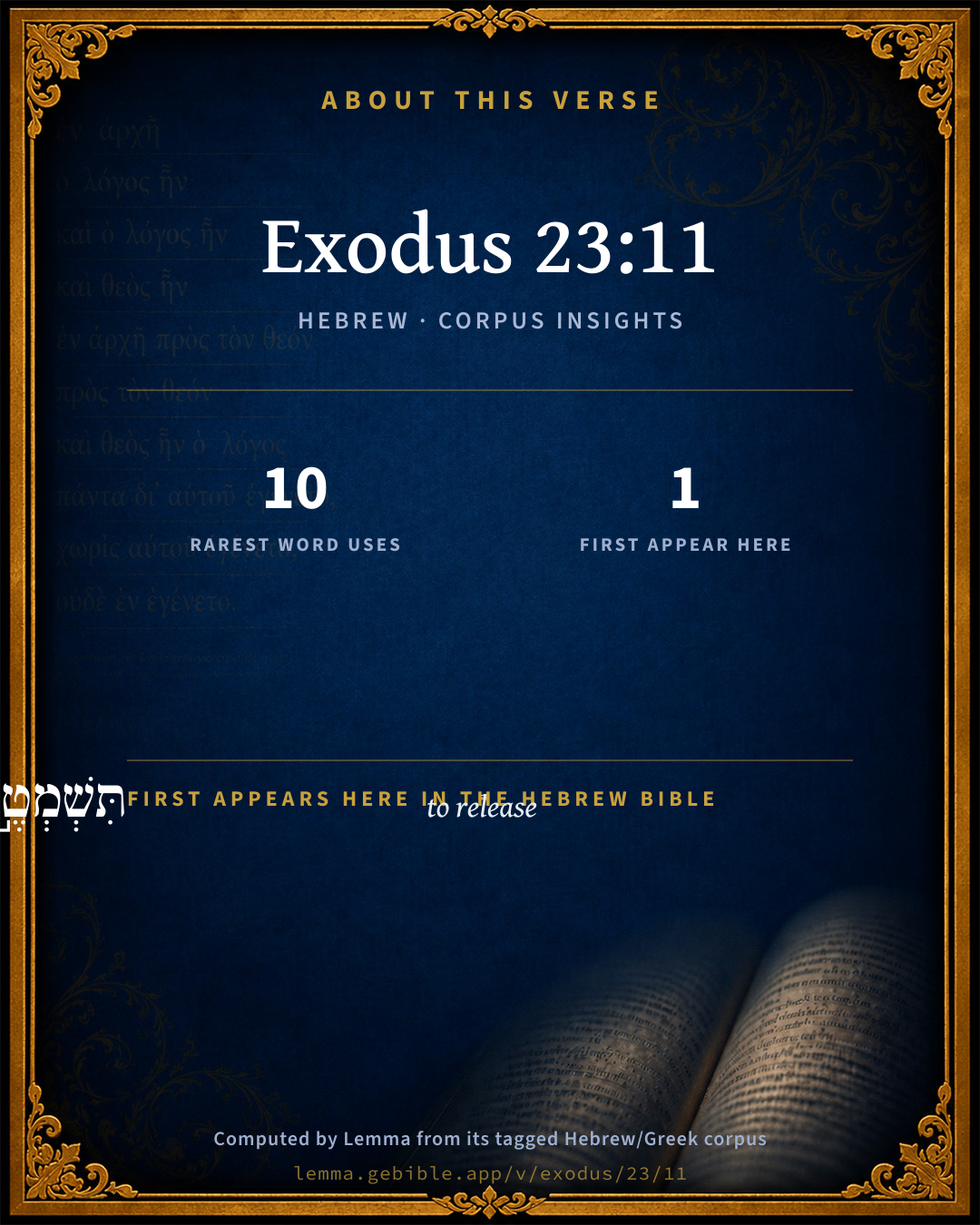
  • 1 first appearance in the Hebrew Bible
Full analysis ↓
Download a study sheet

One document with this verse’s original text, its word-by-word gloss line, the meaning frame, cross-references with their text, attributed commentary, and full source and license credits — printable, and it pastes into notes with its structure intact.

This verse Autodidact and up

Study sheet (.html) Plain text (.txt)

A passage Seminary Student

Up to 50 verses in one chapter. A passage sheet keeps up to 6 commentary sources and 12 cross-references per verse, in the order this page ranks them, and says so on the sheet whenever that leaves anything out. Ask for a single verse and you get the Autodidact verse sheet above.

Everything on this page stays free to read, with no account — the sheet is a download of what is already on screen, not access to it.

Want to remove ads? Support Godless Engineer
Compare translations 3

The same verse in 3 English versions, stacked beneath the original-language interlinear above. Click any original word for its lexicon entry.

Each is an independent rendering of the whole verse — the interlinear is not word-aligned to these translations.

Highlighted words mark where these versions differ — a whole-verse word diff, not a word-by-word alignment.

  • World English Bible Public Domain
    but the seventh year you shall let it rest and lie fallow, that the poor of your people may eat; and what they leave the animal of the field shall eat. In like manner you shall deal with your vineyard and with your olive grove.
  • King James Version Public Domain
    But the seventh year thou shalt let it rest and lie still; that the poor of thy people may eat: and what they leave the beasts of the field shall eat. In like manner thou shalt deal with thy vineyard, and with thy oliveyard.
  • unfoldingWord Literal Text CC BY-SA 4.0
    But the seventh you shall let it drop and leave it alone, and the poor of your people shall eat. And the living things of the field shall eat the reminder. You shall do thus to your vineyard and to your olive orchard.

unfoldingWord Literal Text — © unfoldingWord, licensed CC BY-SA 4.0. Word-aligned USFM3 via Door43 (git.door43.org/unfoldingWord/en_ult).

Versions to compare (up to 4)

3 of 4 selected

Show all 18 translations

Every available English version of this verse, each an independent rendering of the whole verse.

  • World English Bible Public Domain
    but the seventh year you shall let it rest and lie fallow, that the poor of your people may eat; and what they leave the animal of the field shall eat. In like manner you shall deal with your vineyard and with your olive grove.
  • Berean Standard Bible Public Domain
    but in the seventh year you must let it rest and lie fallow, so that the poor among your people may eat from the field and the wild animals may consume what they leave. Do the same with your vineyard and olive grove.
  • Majority Standard Bible Public Domain
    but in the seventh year you must let it rest and lie fallow, so that the poor among your people may eat from the field and the wild animals may consume what they leave. Do the same with your vineyard and olive grove.
  • King James Version Public Domain
    But the seventh year thou shalt let it rest and lie still; that the poor of thy people may eat: and what they leave the beasts of the field shall eat. In like manner thou shalt deal with thy vineyard, and with thy oliveyard.
  • American Standard Version (1901) Public Domain
    but the seventh year thou shalt let it rest and lie fallow; that the poor of thy people may eat: and what they leave the beast of the field shall eat. In like manner thou shalt deal with thy vineyard, `and' with thy oliveyard.
  • Revised Version (1885) Public Domain
    but the seventh year thou shalt let it rest and lie fallow; that the poor of thy people may eat: and what they leave the beast of the field shall eat. In like manner thou shalt deal with thy vineyard, and with thy oliveyard.
  • Geneva Bible (1599) Public Domain
    But the seuenth yeere thou shalt let it rest and lie still, that the poore of thy people may eat, and what they leaue, the beastes of the fielde shall eate. In like maner thou shalt doe with thy vineyard, and with thine oliue trees.
  • Douay-Rheims (1899) Public Domain
    But the seventh year thou shalt let it alone, and suffer it to rest, that the poor of thy people may eat, and whatsoever shall be left, let the beasts of the field eat it: so shalt thou do with thy vineyard and thy oliveyard.
  • Young's Literal Translation Public Domain
    and the seventh thou dost release it, and hast left it, and the needy of thy people have eaten, and their leaving doth the beast of the field eat; so dost thou to thy vineyard -- to thine olive-yard.
  • Literal Standard Version CC BY-SA 4.0
    and [in] the seventh you release it, and have left it, and the needy of your people have eaten, and the beast of the field eats their remainder; so you do to your vineyard [and] to your olive-yard.
  • Unlocked Literal Bible CC BY-SA 4.0
    But in the seventh year you will leave it unplowed and fallow, so that the poor among your people may eat. What they leave, the wild animals will eat. You will do the same with your vineyards and olive orchards.
  • unfoldingWord Literal Text CC BY-SA 4.0
    But the seventh you shall let it drop and leave it alone, and the poor of your people shall eat. And the living things of the field shall eat the reminder. You shall do thus to your vineyard and to your olive orchard.
  • Darby Bible Public Domain
    but in the seventh thou shalt let it rest and lie [fallow], that the poor of thy people may eat [of it]; and what they leave, the beasts of the field shall eat. In like manner thou shalt deal with thy vineyard, and with thine olive-tree.
  • World Messianic Bible Public Domain
    but the seventh year you shall let it rest and lie fallow, that the poor of your people may eat; and what they leave the animal of the field shall eat. In the same way, you shall deal with your vineyard and with your olive grove.
  • Webster's Bible Public Domain
    But the seventh year thou shalt let it rest and lie still; that the poor of thy people may eat: and what they leave, the beasts of the field shall eat. In like manner thou shalt deal with thy vineyard, and with thy olive-yard.
  • Free Bible Version CC BY-SA 4.0
    but in the seventh year you are to let it rest and leave it uncultivated, so that poor people may eat what grows naturally from the field and the wild animals can finish what's left. Follow the same procedure for your vineyards and olive groves.
  • Bible in Basic English Public Domain
    But in the seventh year let the land have a rest and be unplanted; so that the poor may have food from it: and let the beasts of the field take the rest. Do the same with your vine-gardens and your olive-trees.
  • JPS Tanakh (1917) Public Domain
    but the seventh year thou shalt let it rest and lie fallow, that the poor of thy people may eat; and what they leave the beast of the field shall eat. In like manner thou shalt deal with thy vineyard, and with thy oliveyard.

Literal Standard Version (2020), Covenant Press — licensed CC BY-SA 4.0. Text via the HelloAO Bible API (eBible.org). Unlocked Literal Bible (unfoldingWord) — licensed CC BY-SA 4.0. Text via the HelloAO Bible API (eBible.org). unfoldingWord Literal Text — © unfoldingWord, licensed CC BY-SA 4.0. Word-aligned USFM3 via Door43 (git.door43.org/unfoldingWord/en_ult). Free Bible Version, Dr. Jonathan Gallagher — licensed CC BY-SA 4.0. Text via the HelloAO Bible API (eBible.org).

Word by word

More ways to search: Search by grammar → Find every occurrence → Compare this word →

Practice this passage: Drill this verse → Learn its vocabulary →

תִּשְׁמְטֶ֣נָּה
shâmaṭ
H8058
“to release · her”
Verb, Qal, Imperfect, 2nd Person, Masculine, Singular + Suffix, Personal, 3rd Person, Feminine, Singular
Part of Speech
Verb
Stem
Qal
Form
Imperfect
Person
2nd Person
Gender
Masculine
Number
Singular
Full BDB Definition

Origin: a primitive root

TWOT: 2408

to release, let drop or loose or rest or fall - (Qal) to let drop or fall - (Niphal) to be made to fall down, be thrown down - (Hiphil) - to cause to let drop - to release, let drop
  1. וְהַשְּׁבִיעִ֞ת shᵉbîyʻîy H7637 “and · the · seventh” Conjunction + Particle, Definite Article + Adjective, Ordinal number, Feminine, Singular, Absolute
  2. וּנְטַשְׁתָּ֗הּ nâṭash H5203 “and · to leave · her” Conjunction + Verb, Qal, Sequential Perfect, 2nd Person, Masculine, Singular + Suffix, Personal, 3rd Person, Feminine, Singular
  3. וְאָֽכְלוּ֙ ʼâkal H398 “and · to eat” Conjunction + Verb, Qal, Sequential Perfect, 3rd Person, Common, Plural
  4. אֶבְיֹנֵ֣י ʼebyôwn H34 “needy of” Adjective, Adjective, Masculine, Plural, Construct
  5. עַמֶּ֔ךָ ʻam H5971 “people · your” Noun, Common, Masculine, Singular, Construct + Suffix, Personal, 2nd Person, Masculine, Singular
  6. וְיִתְרָ֕ם yether H3499 “and · remainder · their” Conjunction + Noun, Common, Masculine, Singular, Construct + Suffix, Personal, 3rd Person, Masculine, Plural
  7. תֹּאכַ֖ל ʼâkal H398 “to eat” Verb, Qal, Imperfect, 3rd Person, Feminine, Singular
  8. חַיַּ֣ת chay H2416 “living of” Noun, Common, Feminine, Singular, Construct
  9. הַשָּׂדֶ֑ה sâdeh H7704 “the · field” Particle, Definite Article + Noun, Common, Masculine, Singular, Absolute
  10. כֵּֽן kên H3651 “thus” Particle, Demonstrative
  11. תַּעֲשֶׂ֥ה ʻâsâh H6213 “to do” Verb, Qal, Imperfect, 2nd Person, Masculine, Singular
  12. לְכַרְמְךָ֖ kerem H3754 “to/for · vineyard · your” Preposition + Noun, Common, Both, Singular, Construct + Suffix, Personal, 2nd Person, Masculine, Singular
  13. לְזֵיתֶֽךָ zayith H2132 “to/for · olive · your” Preposition + Noun, Common, Masculine, Singular, Construct + Suffix, Personal, 2nd Person, Masculine, Singular

About this verse

These counts appear in no published source. They are computed here, from the morphology-tagged text and Lemma’s own curated glosses. What Lemma adds →

14
words
13
distinct lemmas
Pentateuch
section

Notable vocabulary

The rarest word here is תִּשְׁמְטֶ֣נָּה to release H8058 — appearing just 10 times in the whole Hebrew Bible.

First appearance in Scripture

This word makes its first canonical appearance in the Hebrew Bible here:

  • תִּשְׁמְטֶ֣נָּה to release H8058

Shared distinctive vocabulary

תִּשְׁמְטֶ֣נָּה to release H8058 occurs in 8 verses of the Hebrew Bible. Also found in:

Grammatical profile

  • 5 verbs
  • 6 nouns
  • 2 adjectives
  • 1 particle

Verb forms

  • תִּשְׁמְטֶ֣נָּה Qal · Imperfect
  • וּנְטַשְׁתָּ֗הּ Qal · Sequential Perfect
  • וְאָֽכְלוּ֙ Qal · Sequential Perfect
  • תֹּאכַ֖ל Qal · Imperfect
  • תַּעֲשֶׂ֥ה Qal · Imperfect

Repetition

A word recurs within this verse — often emphatic in Hebrew:

  • וְאָֽכְלוּ֙ to eat H398 ×2

Hebrew & Septuagint length

In English translation the verse runs 45 words from the Hebrew and 44 from the Septuagint (LXX English) — closely comparable.

A rough comparison of the two English renderings, which tokenize alike — not a word-level alignment.

Word counts can differ between the Hebrew and the Greek without any difference in meaning — e.g. the Hebrew direct-object marker אֵת has no separate Greek word, and Greek often adds the article ὁ.

Cross-references

5

Topical passages linked to Exodus 23:11 in the Treasury of Scripture Knowledge — connected by theme and wording, ordered by reader-vote popularity; previews shown in the World English Bible.

  • Leviticus 25:2–7 "Speak to the children of Israel, and tell them, 'When you come into the land which I give you, then the land shall keep a Sabbath to Yahweh.
  • Leviticus 25:11–12 That fiftieth year shall be a jubilee to you. In it you shall not sow, neither reap that which grows of itself, nor gather from the undressed vines.
  • Leviticus 26:34–35 Then the land will enjoy its sabbaths as long as it lies desolate and you are in your enemies' land. Even then the land will rest and enjoy its sabbaths.
  • Leviticus 25:20 If you said, "What shall we eat the seventh year? Behold, we shall not sow, nor gather in our increase;"
  • Leviticus 25:22 You shall sow the eighth year, and eat of the fruits, the old store; until the ninth year, until its fruits come in, you shall eat the old store.

Cross-references courtesy of OpenBible.info (CC BY 4.0).

Hebrew and Greek witnesses Masoretic Hebrew ↔ Greek Septuagint

The same verse in the two great witnesses to the Old Testament, shown verse-for-verse.

These are two independent witnesses, not word-aligned to each other, and the Septuagint is shown in lemma (dictionary) form.

Hebrew Exodus 23:11 Masoretic · Westminster Leningrad Codex

וְהַשְּׁבִיעִ֞ת תִּשְׁמְטֶ֣נָּה וּנְטַשְׁתָּ֗הּ וְאָֽכְלוּ֙ אֶבְיֹנֵ֣י עַמֶּ֔ךָ וְיִתְרָ֕ם תֹּאכַ֖ל חַיַּ֣ת הַשָּׂדֶ֑ה כֵּֽן תַּעֲשֶׂ֥ה לְכַרְמְךָ֖ לְזֵיתֶֽךָ

but the seventh year you shall let it rest and lie fallow, that the poor of your people may eat; and what they leave the animal of the field shall eat. In like manner you shall deal with your vineyard and with your olive grove.

World English Bible · Public Domain

Greek LXX Exodus 23:11 Septuagint · lemma form

ὁ δέ ἕβδομος ἄφεσις ποιέω καί ἀναἵημι αὐτός καί ἐσθίω ὁ πτωχός ὁ ἔθνος σύ ὁ δέ ὑπολείπω ἐσθίω ὁ ἄγριος θηρίον οὕτως ποιέω ὁ ἀμπελών σύ καί ὁ ἐλαιών σύ

But in the seventh year you shall let it rest, and leave it, and the poor of your nation shall feed; and the wild beasts of the field shall eat that which remains: thus shall you do to your vineyard and to your oliveyard.

LXX2012 (modern English Septuagint) · Public Domain

Hebrew: Westminster Leningrad Codex (CC BY 4.0). Greek: Septuagint (public domain); English from LXX2012 (modern English Septuagint) (Public Domain). How the Septuagint differs from the Hebrew →

Targum (Aramaic paraphrase)

2

The Targum is the ancient Jewish Aramaic paraphrase of the Hebrew Scriptures — an interpretive translation, not the Hebrew text itself. Onkelos (literal) and Pseudo-Jonathan (expansive) render the Torah, and Jonathan the Prophets. Coverage is partial: where no permissively-licensed English translation exists for a verse, only the Aramaic is shown. This is verse-level text, not a word-by-word alignment to the Hebrew.

  1. Targum Onkelos Torah (Genesis–Deuteronomy)
    וּשְׁבִעֵתָא תַּשְׁמְטִּנַהּ וְתַרְטְשִׁנַהּ וְיֵיכְלוּן מִסְכְּנֵי עַמָךְ וּשְׁאָרְהוֹן תֵּיכוּל חֵיוַת בָּרָא כֵּן תַּעְבֵּד לְכַרְמָךְ לְזֵיתָךְ:

    (no public-domain English translation for this verse)

    Targum Onkelos — Aramaic: “Onkelos Genesis” (public domain); “Onkelos Exodus” (public domain); “Onkelos Leviticus” (public domain); “Onkelos Numbers” (public domain); “Onkelos Deuteronomy” (public domain). English: “Sefaria Community Translation” (CC0 1.0 (public-domain dedication)); “J.W. Etheridge. The Targums of Onkelos and Jonathan Ben Uzziel on the Pentateuch. London: Longmans, Green, 1862” (public domain). Text via Sefaria.

  2. Targum Pseudo-Jonathan Torah (Genesis–Deuteronomy)
    וּשְׁבִיעִיתָא תִּשְׁמְטִינָא מִפּוּלְחָנָא וְתַפְקַר פֵּירָהָא וְיֵיכְלוּן מִסְכֵּינֵי עַמָּא וְשִׁיּוּרְהוֹן תֵּיכוּל חֵיוַת בָּרָא כְּדֵין תַּעֲבֵיד לְכַרְמָךְ לְזֵיתָךְ

    but the seventh year thou shalt exempt it from labour, and give up the fruit of it to be eaten by the poor of My people; and what they leave shall be eaten by the beasts of the field. And in like manner shalt thou do with thy vine and olive grounds.

    Targum Pseudo-Jonathan — Aramaic: “Targum Jonathan on Genesis” (public domain); “Targum Jonathan on Exodus” (public domain); “Targum Jonathan on Leviticus” (public domain); “Targum Jonathan on Numbers” (public domain); “Targum Jonathan on Deuteronomy” (public domain). English: “The Targum of Jonathan ben Uzziel, trans. J. W. Etheridge, London, 1862” (public domain). Text via Sefaria.

Commentary

Notes on Exodus 23:11 from classic Christian and Jewish commentators (each source and its license shown beneath its notes). The classic Christian expositions comment on the surrounding passage and are grouped to its opening verse, so a note may address several verses; the Jewish commentaries on the Tanakh (Rashi and others) are per-verse, so they appear only where the commentator wrote on this verse.

Lemma curates 59 commentaries, every one of them public domain or Creative Commons licensed, each selected and text-cleaned for this edition rather than reprinted as found. About our sources →

Trapp's Complete Commentary

John Trapp

Exo 23:11 But the seventh [year] thou shalt let it rest and lie still; that the poor of thy people may eat: and what they leave the beasts of the field shall eat. In like manner thou shalt deal with thy vineyard, [and] with thy oliveyard.

Ver. 11. But the seventh year.] That they might learn to live by faith, and be at good leisure to wait upon God. {Deu 31:10-12} Let every one of us keep a spiritual Sabbath, saith Ignatius, {a} Mελετη νομου χαιρων, ου σωματος ανεσει, Better apaid of the meditation of the law, than of the relaxation and rest from labour.

{a} Ep, iii. ad Magnes.

John Trapp, A Commentary or Exposition upon All the Books of the Old and New Testament (1647–1656) — public domain. Text from a community e-Sword module.

Adam Clarke's Commentary

Verse 11. The seventh year thou shalt let it rest] As, every seventh day was a Sabbath day, so every seventh year was to be a Sabbath year. The reasons for this ordinance Calmet gives thus: -

"1. To maintain as far as possible an equality of condition among the people, in setting the slaves at liberty, and in permitting all, as children of one family, to have the free and indiscriminate use of whatever the earth produced.

"2. To inspire the people with sentiments of humanity, by making it their duty to give rest, and proper and sufficient nourishment, to the poor, the slave, and the stranger, and even to the cattle.

"3. To accustom the people to submit to and depend on the Divine providence, and expect their support from that in the seventh year, by an extraordinary provision on the sixth.

"4. To detach their affections from earthly and perishable things, and to make them disinterested and heavenly-minded.

"5. To show them God's dominion over the country, and that HE, not they, was lord of the soil and that they held it merely from his bounty." See this ordinance at length, Lev. xxv.

That God intended to teach them the doctrine of providence by this ordinance, there can be no doubt; and this is marked very distinctly, Le 25:20-21: "And if ye shall say, What shall we eat the seventh year? behold, we shall not sow, nor gather in our increase: then I will command my blessing upon you in the sixth year, and it shall bring forth fruit for three years." That is, There shall be, not three crops in one year, but one crop equal in its abundance to three, because it must supply the wants of three years.

1. For the sixth year, supplying fruit for its own consumption;

2. For the seventh year, in which they were neither to sow nor reap; and

3. For the eighth year, for though they ploughed, sowed, c., that year, yet a whole course of its seasons was requisite to bring all these fruits to perfection, so that they could not have the fruits of the eighth year till the ninth, (see Le 25:22), till which time God promised that they should eat of the old store.

What an astonishing proof did this give of the being, power, providence, mercy, and goodness of God! Could there be an infidel in such a land, or a sinner against God and his own soul, with such proofs before his eyes of God and his attributes as one sabbatical year afforded?

It is very remarkable that the observance of this ordinance is nowhere expressly mentioned in the sacred writings though some suppose, but without sufficient reason, that there is a reference to it in Jer 34:8-9. Perhaps the major part of the people could not trust God, and therefore continued to sow and reap on the seventh year, as on the preceding. This greatly displeased the Lord, and therefore he sent them into captivity; so that the land enjoyed those Sabbaths, through lack of inhabitants, of which their ungodliness had deprived it. See Le 18:24-25, Le 18:28; Le 26:34-35, Le 26:43; 2Ch 36:20-21. Commentators have been much puzzled to ascertain the time in which the sabbatical year began; because, if it began in Abib or March, they must have lost two harvests; for they could neither reap nor plant that year, and of course they could have no crop the year following; but if it began with what was called the civil year, or in Tisri or Marcheshvan, which answers to the beginning of our autumn, they would then have had that year's produce reaped and gathered in.

Adam Clarke's Commentary on the Bible (1810–1826) — public domain. Text from a community e-Sword/MySword module.

Ellicott's Commentary for English Readers

(11) That the poor of thy people may eat.—For fuller particulars see Lev_25:1-7. The owner was to have no larger part of the seventh year’s produce than any one else. He was to take his share with the hireling, the stranger, and even the cattle, which during this year were to browse where they pleased.

Thy vineyard . . . Thy oliveyard.—These would bear a full average produce, and the boon to the poor man would in these respects have been very considerable. Corn, wine, and oil were the staple commodities of Palestine (Deu_8:8; 2Ki_18:32, &c.).

A Bible Commentary for English Readers, edited by Charles John Ellicott (1878–1897) — public domain. Text from a community e-Sword module.

The Cambridge Bible for Schools and Colleges

gen. ed. J. J. S. Perowne

11. thou shalt let it drop and abandon it] viz. the land, less probably the increase: RV. (substantially = AV.) is a paraphrase. The word rendered let drop means properly to fling or throw down (2Ki_9:33, of Jezebel). In Deu_15:2-3 it is differently applied; and is used of letting a debt drop every seventh year, in the ‘year of dropping’ or of ‘release’ (Deu_15:1-2; Deu_15:9); and the rend. release in RVm. here brings out this connexion—though, it is true, it is not more than a verbal one—with the law of Deu_15:1-6.

abandon] or leave, let go; rendered ‘forgo’ in Neh_10:31.

that the poor, &c.] contrast Lev_25:6-7.

In Lev_Exo_25:1-7; Lev_25:20-22 (H), the fallow year, whatever may be the case in Ex., becomes, as has just been remarked, a fixed year for the whole country; and the motive is no longer exclusively a philanthropic one, but a religious one, viz. that the land may ‘keep a sabbath to Jehovah’ (whence the term ‘sabbatical year’): in Deu_15:1-6 it receives an entirely different application, and becomes a fixed septennial ‘year of release,’ applied for the relief of the poor debtor, by the exaction of debts being prohibited in it. Whether however even the present passage gives the original motive of the institution may be doubted. Analogous usages in other countries (see Maine, Village Communities in the East and West, pp. 77–79, 107–113, &c.; Fenton, Early Hebrew Life, 1880, pp. 24–26, 29–32, 64–70) suggest that it may be a relic of communistic agriculture, i.e. of a stage of society in which the fields belonging to a village are the property of the villagers collectively, individuals only acquiring the use of particular portions for a limited period, and the produce, at stated intervals, reverting to the use of the community generally. The fallow year of Ex. and Lev. is similarly an institution limiting the rights of individual ownership in the interests of the community generally: in Ex. the institution is applied so as to minister to the needs of the poorer classes; in Lev_25:1-7 the prominent idea is the benefit which the land would derive from remaining periodically uncultivated.

The Cambridge Bible for Schools and Colleges (gen. ed. J. J. S. Perowne; Cambridge University Press, 1878–1918) — public domain. Text from a community e-Sword module.

John Gill's Exposition

Six days thou shalt do thy work,.... That is, they might do what work they would on the six days of the week:

and on the seventh day thou shall rest; from all the work and labour done on other days, and give up themselves to religious exercises:

that thine ox and thine ass may rest; and so every other beast, as horses, camels, &c.

and the son of thy handmaid, and the stranger, may be refreshed; the former, the Targum of Jonathan, and so Jarchi, interprets, of one uncircumcised, and the latter, of a proselyte of the gate: this law is here repeated, partly to show that it is of the same kind with the former, namely, ceremonial and temporary; and partly, as Jarchi observes, lest it should be said, since all, the year is called the sabbath, there was no need to observe the weekly sabbath.

John Gill's Exposition of the Whole Bible (1746–1763) — public domain (CC PDM 1.0). Text via the HelloAO Bible API.

Haydock's Catholic Bible Commentary

Year. Thus God was pleased to teach them to place entire confidence in him, and to compassionate the distress of the poor. Most people suppose, that the sabbatic year commenced in autumn; as otherwise the land would have remained without any harvest two years. This law began to be observed the 7th year after Josue crossed the Jordan. Jerusalem was thrice besieged during the sabbatic years. (Jeremias xxxiv. 8; 1 Machabees vi. 51.) See Josephus, Antiquities xii. 14. and xiv. 28. God blessed the 6th year, so that it produced as much as three, Leviticus xxv. 21. (Calmet) --- On the feast of tabernacles, (in September) at the beginning of the 7th year, Deuteronomy was to be read aloud to all the people, the Hebrew slaves might obtain their liberty, and if a person could not restore what he had borrowed, it was to be remitted for ever, Deuteronomy xv. and xxxi. 10. (Tirinus)

George Leo Haydock (1774–1849), Haydock's Catholic Family Bible and Commentary, 1859 edition — public domain. Excludes Psalms (Douay-Rheims chapter numbering differs from Protestant) and Deuterocanonical books (Catholic canon only).

Matthew Poole's English Annotations

Thou shalt let it rest, and lie still, i.e. from manuring, ploughing, tilling, and sowing, and reaping also, by comparing Lev 25:3-5. And this God ordained not only for the reason here mentioned, the more comfortable provision of the poor, and for the cattle, but for other weighty reasons; as,

1. That the heart and strength of the land might not be eaten out by continual tillage.

2. That he might both try and exercise, and also secure the obedience of the Israelites.

3. That he might keep them in dependence upon himself, and give to them and all their neighbours a manifest proof of his singular and gracious providence over his people.

4. That by this kind of quit-rent they might be admonished that God alone was the Lord and Proprietary of the land, and they were only tenants at his will.

5. That being freed from their great labours about the land, they might have the more leisure to meditate upon God’s works, and to attend upon the law, which was to be solemnly read at this time, Deu 31:10, &c.

That the poor of thy people may eat.

Quest. What had the poor to eat?

Answ. Not only the fruits of the vines, and olives, and other fruit trees, but also all that grew of its own accord, Lev 25:5, from those seeds which in the last reaping-time were scattered here and there, which were much more numerous now than in other years, because God gave a special blessing to the sixth year, whereby it did bring forth the fruit of three years, Lev 25:21, and in years of so great plenty men are generally more negligent in their reaping, and therefore the relics are more.

In like manner thou shalt deal, i.e. thou shalt not prune nor dress them, nor gather and appropriate to thy own use what they shall produce, but shalt leave them to the poor.

Matthew Poole's English Annotations on the Holy Bible (1683–1685) — public domain. Text from a community e-Sword/MySword module.

Whedon's Commentary on the Bible

Daniel D. Whedon

11. The seventh year… rest — This provision for a sabbatic year is one of the most remarkable enactments of the Mosaic legislation, but we have no evidence that it was ever observed by the nation. It is repeated in fuller form in Lev_25:1-7, and is there associated with the law for the fiftieth year jubilee. The far-reaching and ennobling influences upon a people of the faithful observance of this law must needs be very great. It would (1.) teach that the land was God’s rather than the people’s. (2.) It would afford a rest to the soil, which would be materially helped by remaining fallow one year in seven. (3.) Inasmuch as it has been repeatedly proven that a man will do more and better work by resting one day in seven, it is at least presumable that, by proper care in cultivation, and one year’s rest in seven, the soil will yield as much or more than when no sabbatic year is observed. (4.) It would help to bring all classes of the people into closer sympathy, and remove some of the incitements to anarchical socialism. (5.) It would tend to cultivate the best sentiments of humanity and regard, alike for man and beast. (6.) It would afford extraordinary advantages for mental and moral culture. (7.) It would beget a most beautiful confidence in the providence of God. No people’s faith in God, not even ancient Israel’s, seems ever to have been sufficient to attempt the observance of this law. Hence the judgment of seventy years’ exile and desolation, “until the land had enjoyed her sabbaths.” 2Ch_36:21. Even the resolution to observe the seventh year, after the exile, (Neh_10:31,) does not appear to have been kept. Here is a decisive argument against critics who dispute the Mosaic authorship of the Pentateuch on the ground that the laws therein recorded were not observed before the exile. We have no historical evidence that this law was ever observed.

Rest and lie still — The parallel passage in Lev_25:4, shows that this was intended to stop all sowing and cultivation for the year; not, as some have supposed, that the tilling should go on as usual, but the crops be left to the poor. The thought, rather, is, that the poor of thy people may be allowed free appropriation of such products as grew without sowing and cultivation. No land-owner should that year claim the natural products of the soil for himself.

Daniel D. Whedon (gen. ed.), Commentary on the Old and New Testaments (1874–1909) — public domain. Text from a community e-Sword module.

Rashi

Rabbi Shlomo Yitzchaki (Rashi)

תשמטנה THOU SHALT LET IT REST — by not tilling it (Mekhilta),

ונטשתה AND THOU SHALT ABANDON IT — by not eating of its produce (Mekhilta) after “the time of removal” of the produce has arrived. Another explanation is: תשמטנה THOU SHALT LET IT REST, from what is real work, as, for example, ploughing and sowing, ונטשתה AND LEAVE IT ALONE — not even to manure and to hoe it.

ויתרם תאכל חית השדה AND WHAT THEY LEAVE THE BEASTS OF THE FIELD (the wild animals) SHALL EAT — This cannot be a command that the wild animals shall eat it, viz., that you shall permit them to eat it. No such command is necessary since you have no control over wild animals; it intends by juxtaposition with the preceding words to place in the same category (more lit., to compare) the food of the poor with that of the beast. For how is it in the case of the wild animal? It eats food without the tithe having been separated from it! So too, the poor may in the seventh year eat food without the tithe having been separated from it. From this juxtaposition they (the Rabbis) derived the rule that the law of tithe is not to be observed in the seventh year (Mekhilta).

כך תעשה לכרמך IN LIKE MANNER THOU SHALT DO WITH THY VINEYARD — The first member of the verse, however, speaks of a “white field” (i. e. a bright, shadeless field — a grain field or a vegetable field — in contrast to a שדה אילן which casts shade), as it is said above, (v. 10) “thou shalt sow thy land”.

Rashi on the Tanakh — English translations: “The Judaica Press complete Tanach with Rashi, translated by A. J. Rosenberg” (CC BY 4.0); “Pentateuch with Rashi's commentary by M. Rosenbaum and A.M. Silbermann, 1929-1934” (public domain); “The Metsudah Tanach series, Lakewood, N.J” (CC BY 4.0); and “The Book of Joshua, Metsudah Publications, 1997” (CC BY 4.0). Text via Sefaria.

Ramban (Nachmanides)

Rabbi Moshe ben Nachman (Ramban / Nachmanides)

BUT THE SEVENTH YEAR ‘TISHM’TENAH U’N'TASHTAH’ (THOU SHALT LET IT REST AND LIE FALLOW). “Tishm’tenah — by not tilling it. U’n'tashtah by not eating of its produce after ‘the time of removal.’ Another interpretation: Tishm’tenah — from real work, such as plowing and sowing; u’n'tashtah — from hoeing or manuring it.” This is Rashi’s language. But it is not correct, for according to the law of the Torah we have only been warned against plowing and sowing in the seventh year, but hoeing and manuring, and even weeding, hoeing under the vines, and cutting away thorns, and all other forms of agricultural work, are not forbidden by law of the Torah. This is the conclusion that the Rabbis came to [after a discussion of this matter] at the beginning of Tractate Moed Katan in the Chapter Mashkin: that the Merciful One forbade only plowing and sowing in the seventh year, but did not prohibit secondary kinds of work [such as hoeing, manuring, etc.], which are all forbidden only by Rabbinic ordinance, and the verse mentioned [there in the Talmud] in connection with these secondary kinds of work is a mere support in the Scriptural text. Note 449. Similarly, the law of “removal” is not derived from this verse [as Rashi explained here].Rabbi Abraham ibn Ezra wrote: “Tishm’tenah means: every creditor ‘shamot’ (shall release) that which he hath lent unto his neighbor. — U’n'tashtah means that you should not sow your field.” But it is not a correct comment. Instead, [the true explanation is that] Scripture first said, six years thou shalt sow and gather in the increase thereof, but the seventh year ‘tishm’tenah’ — you should not sow your land; u’n'tashtah — you should not gather in its increase, but instead you are to leave it so that the poor of your people and the beasts of the field may eat the fruits of the tree and the produce of the vineyard. In a similar sense is the verse, ‘v’nitash’ the seventh year, [which thus means: “and we will not gather in the increase of the field in the seventh year”].

Ramban (Nachmanides) on the Tanakh — English translation: “Commentary on the Torah by Ramban (Nachmanides). Translated and annotated by Charles B. Chavel. New York, Shilo Pub. House, 1971-1976” (CC BY 4.0). Text via Sefaria.

Lesson kit

Teaching starters — assembled from the data on this page, not authored interpretation. Every prompt links to the verse data it draws on. Edit before teaching.

Exodus, in the Pentateuch, opens this verse with 14 words (13 distinct Hebrew lemmas). Its most distinctive word is shâmaṭ (“to release”). A historical commentator’s framing appears above. Read the whole chapter for the surrounding context.

Discussion questions

  1. How does “to release” (shâmaṭ) shape what this verse is saying?
  2. This is the first place “to release” appears in Scripture (first appears here). What does its debut here establish?
  3. How does Deuteronomy 15:2, which shares the word «to release», read alongside this verse?
  4. What does the repetition of “to eat” (2× in this one verse) do in this verse?
  5. The translations on this page render this verse differently — a whole-verse word diff, not a word-by-word alignment. What might account for the different wordings?
  6. «תִּשְׁמְטֶ֣נָּה» is a Qal Imperfect verb. How does that grammatical form shape the action described?
  7. Compare how Trapp's Complete Commentary and Adam Clarke's Commentary read this verse. Where do they agree or differ?

Things to notice

  • 1 word makes its first canonical appearance in Scripture here.
  • These translations choose different wording for 24 words in this verse.
  • “to eat” occurs 2× in this single verse.
  • 13 distinct Hebrew lemmas span 14 words in this verse.

Reading settings

Reading text

Shown beneath each verse's original-language words.

Old Testament
Old Testament edition

Read the OT as the Masoretic Hebrew (MT) or the Greek Septuagint (LXX).

English shown for the Greek Septuagint (in the Hebrew ↔ Greek comparison).

Comparing translations? Open the Compare panel on any verse page to stack up to four side by side.