
1 Samuel 20:5

Hebrew (Westminster Leningrad Codex) 1 Samuel 20:5 appears in the Hebrew Old Testament. The text above is from the Westminster Leningrad Codex. Each word links to its Strong’s number, a concise gloss, and parsing drawn from the Open Scriptures Hebrew Bible morphology. Click any word for its full Brown-Driver-Briggs (BDB) entry.
Download image
Cite this verse

1 Samuel 20:5 (World English Bible). Public Domain. Lemma interlinear Bible study tool, https://lemma.gebible.app/v/1-samuel/20/5.

Show BibTeX & RIS
BibTeX
RIS
English Translation
David said to Jonathan, Behold, tomorrow is the new moon, and I should not fail to sit with the king at meat: but let me go, that I may hide myself in the field to the third day at evening.
World English Bible · Public Domain
Download a study sheet

One document with this verse’s original text, its word-by-word gloss line, the meaning frame, cross-references with their text, attributed commentary, and full source and license credits — printable, and it pastes into notes with its structure intact.

This verse Autodidact and up

Study sheet (.html) Plain text (.txt)

A passage Seminary Student

Up to 50 verses in one chapter. A passage sheet keeps up to 6 commentary sources and 12 cross-references per verse, in the order this page ranks them, and says so on the sheet whenever that leaves anything out. Ask for a single verse and you get the Autodidact verse sheet above.

Everything on this page stays free to read, with no account — the sheet is a download of what is already on screen, not access to it.

Want to remove ads? Support Godless Engineer
Compare translations 3

The same verse in 3 English versions, stacked beneath the original-language interlinear above. Click any original word for its lexicon entry.

Each is an independent rendering of the whole verse — the interlinear is not word-aligned to these translations.

Highlighted words mark where these versions differ — a whole-verse word diff, not a word-by-word alignment.

  • World English Bible Public Domain
    David said to Jonathan, Behold, tomorrow is the new moon, and I should not fail to sit with the king at meat: but let me go, that I may hide myself in the field to the third day at evening.
  • King James Version Public Domain
    And David said unto Jonathan, Behold, to morrow is the new moon, and I should not fail to sit with the king at meat: but let me go, that I may hide myself in the field unto the third day at even.
  • unfoldingWord Literal Text CC BY-SA 4.0
    And David said to Jonathan, “Behold, the new moon tomorrow, and sitting, I should sit with the king to eat. But you shall let me go, and I shall hide myself in the field until the third evening.

unfoldingWord Literal Text — © unfoldingWord, licensed CC BY-SA 4.0. Word-aligned USFM3 via Door43 (git.door43.org/unfoldingWord/en_ult).

Versions to compare (up to 4)

3 of 4 selected

Show all 18 translations

Every available English version of this verse, each an independent rendering of the whole verse.

  • World English Bible Public Domain
    David said to Jonathan, Behold, tomorrow is the new moon, and I should not fail to sit with the king at meat: but let me go, that I may hide myself in the field to the third day at evening.
  • Berean Standard Bible Public Domain
    So David told him, “Look, tomorrow is the New Moon, and I am supposed to dine with the king. Instead, let me go and hide in the field until the third evening from now.
  • Majority Standard Bible Public Domain
    So David told him, “Look, tomorrow is the New Moon, and I am supposed to dine with the king. Instead, let me go and hide in the field until the third evening from now.
  • King James Version Public Domain
    And David said unto Jonathan, Behold, to morrow is the new moon, and I should not fail to sit with the king at meat: but let me go, that I may hide myself in the field unto the third day at even.
  • American Standard Version (1901) Public Domain
    And David said unto Jonathan, Behold, to-morrow is the new moon, and I should not fail to sit with the king at meat: but let me go, that I may hide myself in the field unto the third day at even.
  • Revised Version (1885) Public Domain
    And David said unto Jonathan, Behold, tomorrow is the new moon, and I should not fail to sit with the king at meat: but let me go, that I may hide myself in the field unto the third day at even.
  • Geneva Bible (1599) Public Domain
    And Dauid said vnto Ionathan, Behold, to morowe is the first day of the moneth, and I shoulde sit with the King at meate: but let me goe, that I may hide my selfe in the fieldes vnto the third day at euen.
  • Douay-Rheims (1899) Public Domain
    And David said to Jonathan: Behold to morrow is the new moon, and I according to custom am wont to sit beside the king to eat: let me go then that I may be hid in the field till the evening of the third day.
  • Young's Literal Translation Public Domain
    And David saith unto Jonathan, `Lo, the new moon `is' to-morrow; and I do certainly sit with the king to eat; and thou hast sent me away, and I have been hidden in a field till the third evening;
  • Literal Standard Version CC BY-SA 4.0
    And David says to Jonathan, “Behold, the new moon [is] tomorrow; and I certainly sit with the king to eat; and you have sent me away, and I have been hidden in a field until the third evening;
  • Unlocked Literal Bible CC BY-SA 4.0
    David said to Jonathan, “Tomorrow is the new moon, and I ought to sit down to eat with the king. But let me go, so that I may hide myself in the field until the third day at evening.
  • unfoldingWord Literal Text CC BY-SA 4.0
    And David said to Jonathan, “Behold, the new moon tomorrow, and sitting, I should sit with the king to eat. But you shall let me go, and I shall hide myself in the field until the third evening.
  • Darby Bible Public Domain
    And David said to Jonathan, Behold, to-morrow is new moon, and I should not fail to sit with the king at meat; but let me go, that I may hide myself in the field until the third evening.
  • World Messianic Bible Public Domain
    David said to Jonathan, “Behold, tomorrow is the new moon, and I should not fail to dine with the king; but let me go, that I may hide myself in the field to the third day at evening.
  • Webster's Bible Public Domain
    And David said to Jonathan, Behold, to morrow is the new-moon, and I should not fail to sit with the king at meat: but let me go, that I may hide myself in the field to the third day at evening.
  • Free Bible Version CC BY-SA 4.0
    “Well, the New Moon festival is tomorrow, and I'm meant to sit down and eat with the king. But if it's all right with you, I plan to go and hide in the field until the evening three days from now.
  • Bible in Basic English Public Domain
    And David said to Jonathan, Tomorrow is the new moon, and I will not be seated with the king at his table: but let me go to a safe place in the country till the evening.
  • JPS Tanakh (1917) Public Domain
    And David said unto Jonathan: 'Behold, to-morrow is the new moon, when I should sit with the king to eat; so let me go, that I may hide myself in the field unto the third day at even.

Literal Standard Version (2020), Covenant Press — licensed CC BY-SA 4.0. Text via the HelloAO Bible API (eBible.org). Unlocked Literal Bible (unfoldingWord) — licensed CC BY-SA 4.0. Text via the HelloAO Bible API (eBible.org). unfoldingWord Literal Text — © unfoldingWord, licensed CC BY-SA 4.0. Word-aligned USFM3 via Door43 (git.door43.org/unfoldingWord/en_ult). Free Bible Version, Dr. Jonathan Gallagher — licensed CC BY-SA 4.0. Text via the HelloAO Bible API (eBible.org).

Word by word

More ways to search: Search by grammar → Find every occurrence → Compare this word →

Practice this passage: Drill this verse → Learn its vocabulary →

מָחָ֔ר
mâchâr
H4279
“tomorrow”
Noun, Common, Masculine, Singular, Absolute
Part of Speech
Noun
Type
Common
Gender
Masculine
Number
Singular
State
Absolute
Full BDB Definition

Origin: probably from H309

TWOT: 1185a

tomorrow, in time to come, in the future - tomorrow (as the day following the present day) - in future time
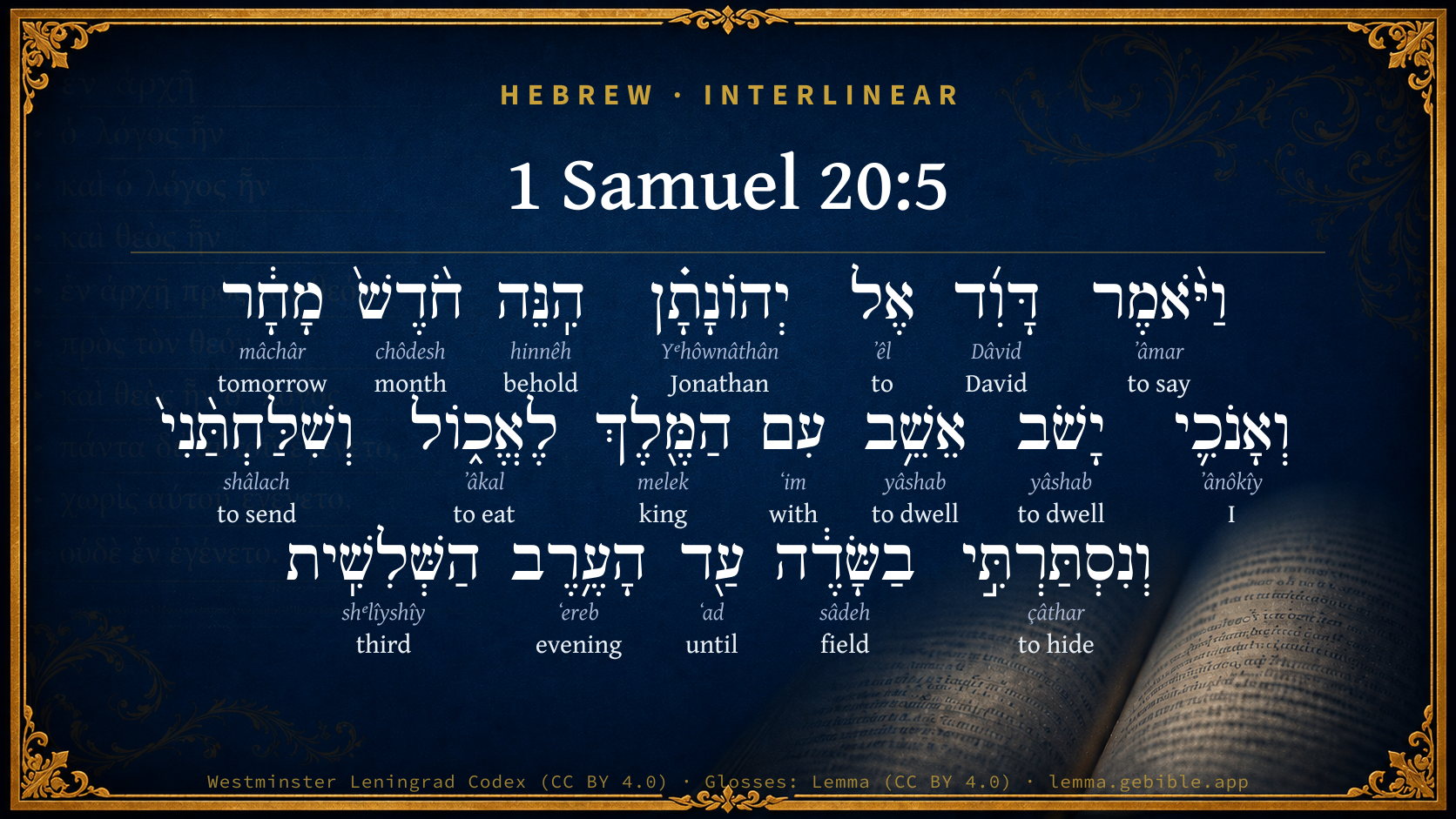
  1. וַיֹּ֨אמֶר ʼâmar H559 “and · to say” Conjunction + Verb, Qal, Sequential Imperfect, 3rd Person, Masculine, Singular
  2. דָּוִ֜ד Dâvid H1732 “David” Noun, Proper
  3. אֶל ʼêl H413 “to” Preposition
  4. יְהוֹנָתָ֗ן Yᵉhôwnâthân H3083 “Jonathan” Noun, Proper
  5. הִֽנֵּה hinnêh H2009 “behold” Particle, Demonstrative
  6. חֹ֨דֶשׁ֙ chôdesh H2320 “month” Noun, Common, Masculine, Singular, Absolute
  7. וְאָנֹכִ֛י ʼânôkîy H595 “and · I” Conjunction + Pronoun, Personal, 1st Person, Common, Singular
  8. יָשֹׁב yâshab H3427 “to dwell” Verb, Qal, Infinitive Absolute
  9. אֵשֵׁ֥ב yâshab H3427 “to dwell” Verb, Qal, Imperfect, 1st Person, Common, Singular
  10. עִם ʻim H5973 “with” Preposition
  11. הַמֶּ֖לֶךְ melek H4428 “the · king” Particle, Definite Article + Noun, Common, Masculine, Singular, Absolute
  12. לֶאֱכ֑וֹל ʼâkal H398 “to eat” Preposition + Verb, Qal, Infinitive Construct
  13. וְשִׁלַּחְתַּ֨נִי֙ shâlach H7971 “and · to send · me” Conjunction + Verb, Piel, Sequential Perfect, 2nd Person, Masculine, Singular + Suffix, Personal, 1st Person, Common, Singular
  14. וְנִסְתַּרְתִּ֣י çâthar H5641 “and · to hide” Conjunction + Verb, Niphal, Sequential Perfect, 1st Person, Common, Singular
  15. בַשָּׂדֶ֔ה sâdeh H7704 “in/at the · field” Preposition, Determined + Noun, Common, Masculine, Singular, Absolute
  16. עַ֖ד ʻad H5704 “until” Preposition
  17. הָעֶ֥רֶב ʻereb H6153 “the · evening” Particle, Definite Article + Noun, Common, Masculine, Singular, Absolute
  18. הַשְּׁלִשִֽׁית shᵉlîyshîy H7992 “the · third” Particle, Definite Article + Adjective, Ordinal number, Feminine, Singular, Absolute

About this verse

These counts appear in no published source. They are computed here, from the morphology-tagged text and Lemma’s own curated glosses. What Lemma adds →

19
words
18
distinct lemmas
Historical
section

Shared distinctive vocabulary

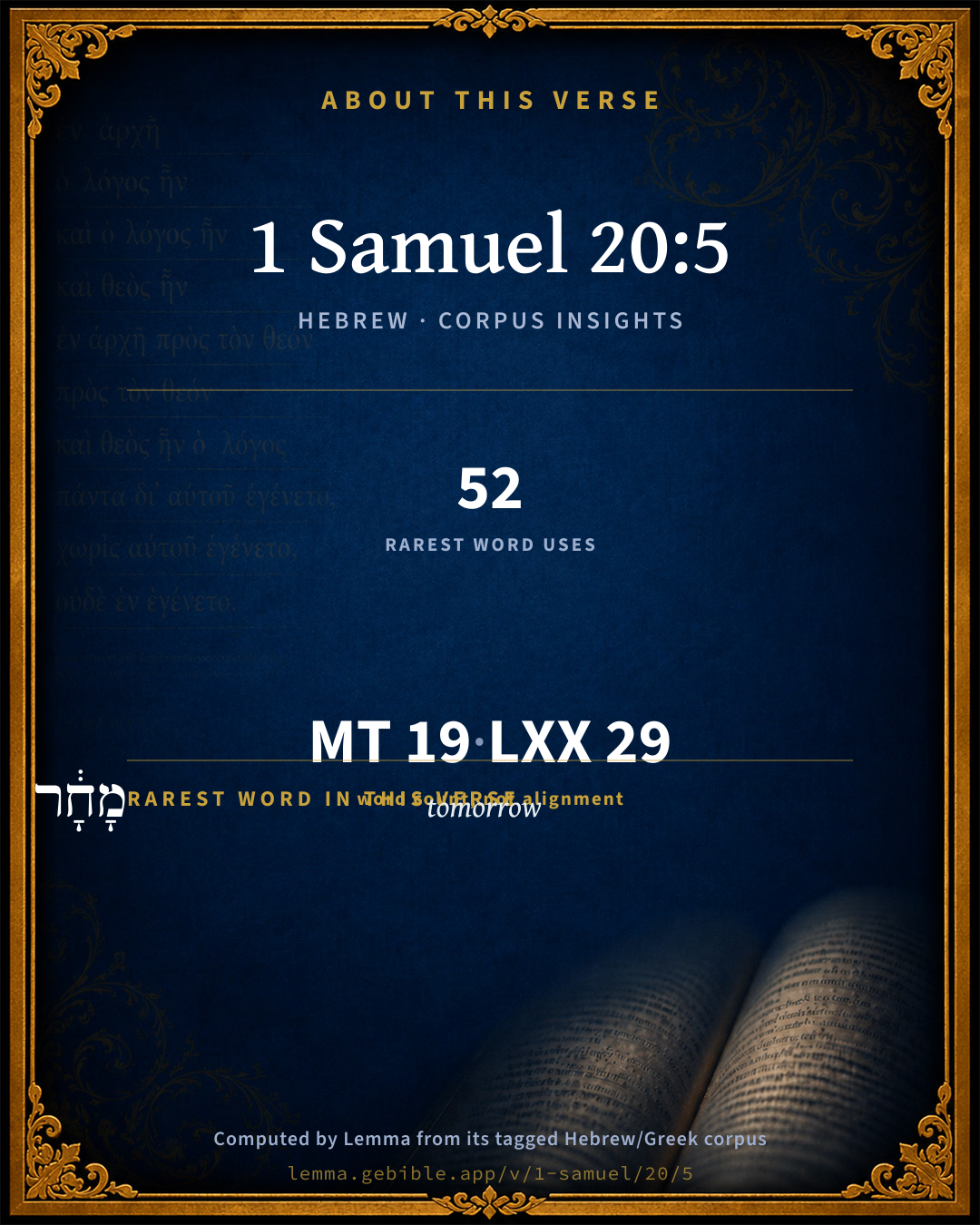
מָחָ֔ר tomorrow H4279 occurs in 52 verses of the Hebrew Bible. Also found in:

Grammatical profile

  • 6 verbs
  • 7 nouns
  • 1 adjective
  • 1 pronoun
  • 3 prepositions
  • 1 particle

Verb forms

  • וַיֹּ֨אמֶר Qal · Sequential Imperfect
  • יָשֹׁב Qal · Infinitive Absolute
  • אֵשֵׁ֥ב Qal · Imperfect
  • לֶאֱכ֑וֹל Qal · Infinitive Construct
  • וְשִׁלַּחְתַּ֨נִי֙ Piel · Sequential Perfect
  • וְנִסְתַּרְתִּ֣י Niphal · Sequential Perfect

Repetition

A word recurs within this verse — often emphatic in Hebrew:

  • יָשֹׁב to dwell H3427 ×2

Hebrew & Septuagint length

In English translation the verse runs 40 words from the Hebrew and 38 from the Septuagint (LXX English) — closely comparable.

A rough comparison of the two English renderings, which tokenize alike — not a word-level alignment.

Word counts can differ between the Hebrew and the Greek without any difference in meaning — e.g. the Hebrew direct-object marker אֵת has no separate Greek word, and Greek often adds the article ὁ.

In the original languages it is 19 Hebrew tokens and 29 Greek tokens — but the two are counted differently (Hebrew bundles its prefixes and suffixes into one token; the Greek is in lemma form), so that isn’t a like-for-like length.

Cross-references

12

Topical passages linked to 1 Samuel 20:5 in the Treasury of Scripture Knowledge — connected by theme and wording, ordered by reader-vote popularity; previews shown in the World English Bible.

  • Numbers 10:10 Also in the day of your gladness, and in your set feasts, and in the beginnings of your months, you shall blow the trumpets over your burnt offerings, and over the sacrifices of your peace-offerings; and they shall be to you for a memorial before your God: I am Yahweh your God.
  • Numbers 28:11 In the beginnings of your months you shall offer a burnt offering to Yahweh: two young bulls, and one ram, seven he-lambs a year old without blemish;
  • 1 Samuel 19:2 Jonathan told David, saying, Saul my father seeks to kill you: now therefore, please take care of yourself in the morning, and live in a secret place, and hide yourself:
  • Psalms 81:3 Blow the trumpet at the New Moon, At the full moon, on our feast day.
  • 1 Samuel 20:6 If your father miss me at all, then say, David earnestly asked leave of me that he might run to Bethlehem his city; for it is the yearly sacrifice there for all the family.
  • 1 Samuel 20:19 When you have stayed three days, you shall go down quickly, and come to the place where you did hide yourself when the business was in hand, and shall remain by the stone Ezel.
  • Psalms 55:12 For it was not an enemy who insulted me, Then I could have endured it. Neither was it he who hated me who raised himself up against me, Then I would have hid myself from him.
  • Proverbs 22:3 A prudent man sees danger, and hides himself; But the simple pass on, and suffer for it.
  • John 8:59 Therefore they took up stones to throw at him, but Jesus was hidden, and went out of the temple, having gone through the midst of them, and so passed by.
  • Acts 17:14 Then the brothers immediately sent out Paul to go as far as to the sea, and Silas and Timothy still stayed there.
  • Colossians 2:16 Let no man therefore judge you in eating, or in drinking, or with respect to a feast day or a new moon or a Sabbath day,
  • 2 Kings 4:23 He said, Why will you go to him today? it is neither new moon nor Sabbath. She said, It shall be well.

Cross-references courtesy of OpenBible.info (CC BY 4.0).

Hebrew and Greek witnesses Masoretic Hebrew ↔ Greek Septuagint

The same verse in the two great witnesses to the Old Testament, shown verse-for-verse.

These are two independent witnesses, not word-aligned to each other, and the Septuagint is shown in lemma (dictionary) form.

Hebrew 1 Samuel 20:5 Masoretic · Westminster Leningrad Codex

וַיֹּ֨אמֶר דָּוִ֜ד אֶל יְהוֹנָתָ֗ן הִֽנֵּה חֹ֨דֶשׁ֙ מָחָ֔ר וְאָנֹכִ֛י יָשֹׁב אֵשֵׁ֥ב עִם הַמֶּ֖לֶךְ לֶאֱכ֑וֹל וְשִׁלַּחְתַּ֨נִי֙ וְנִסְתַּרְתִּ֣י בַשָּׂדֶ֔ה עַ֖ד הָעֶ֥רֶב הַשְּׁלִשִֽׁית

David said to Jonathan, Behold, tomorrow is the new moon, and I should not fail to sit with the king at meat: but let me go, that I may hide myself in the field to the third day at evening.

World English Bible · Public Domain

Greek LXX 1 Samuel 20:5 Septuagint · lemma form

καί εἶπον δαυίδ πρός ιωναθαν ἰδού δή νουμηνία αὔριον καί ἐγώ καταἵζω οὐ καταἧμαι μετά ὁ βασιλεύς ἐσθίω καί ἐκ ἀποστέλλω ἐγώ καί κρύπτω ἐν ὁ πεδίον ἕως δειλός

And David said to Jonathan, Behold, to-morrow is the new moon, and I shall not on any account sit down to eat, but you shall let me go, and I will hide in the plain till the evening.

LXX2012 (modern English Septuagint) · Public Domain

Hebrew: Westminster Leningrad Codex (CC BY 4.0). Greek: Septuagint (public domain); English from LXX2012 (modern English Septuagint) (Public Domain). How the Septuagint differs from the Hebrew →

Targum (Aramaic paraphrase)

1

The Targum is the ancient Jewish Aramaic paraphrase of the Hebrew Scriptures — an interpretive translation, not the Hebrew text itself. Onkelos (literal) and Pseudo-Jonathan (expansive) render the Torah, and Jonathan the Prophets. Coverage is partial: where no permissively-licensed English translation exists for a verse, only the Aramaic is shown. This is verse-level text, not a word-by-word alignment to the Hebrew.

  1. Targum Jonathan Prophets (Joshua–Malachi)
    וַאֲמַר דָוִד לִיהוֹנָתָן הָא יַרְחָא מְחַר וַאֲנָא אַסְחָרָא אַסְחַר עִם מַלְכָּא לְמֵיכַל וְתִשְׁלְחִינַנִי וְאִטַמֵר בְּחַקְלָא עַד עִדַן רַמְשָׁא דְיוֹמָא תְלִיתָאָה:

    (no public-domain English translation for this verse)

    Targum Jonathan — Aramaic: “Mikraot Gedolot” (public domain). English: “Sefaria Community Translation” (CC0 1.0 (public-domain dedication)); “London "Chaldee Paraphrase," 1871” (public domain). Text via Sefaria.

Commentary

Notes on 1 Samuel 20:5 from classic Christian and Jewish commentators (each source and its license shown beneath its notes). The classic Christian expositions comment on the surrounding passage and are grouped to its opening verse, so a note may address several verses; the Jewish commentaries on the Tanakh (Rashi and others) are per-verse, so they appear only where the commentator wrote on this verse.

Lemma curates 59 commentaries, every one of them public domain or Creative Commons licensed, each selected and text-cleaned for this edition rather than reprinted as found. About our sources →

Trapp's Complete Commentary

John Trapp

1Sa 20:5 And David said unto Jonathan, Behold, to morrow [is] the new moon, and I should not fail to sit with the king at meat: but let me go, that I may hide myself in the field unto the third [day] at even.

Ver. 5. Behold, tomorrow is the new moon.] The first day of the month - the Hebrews reckoned their months by the moon - the Calends, which was a kind of a holy day, not only among the Jews, but the Greeks and Romans also, {a} in testimony of thankfulness for their time, which is the Lord’s: according to that of David, "The day is thine, the night also is thine: thou hast prepared the light and the sun." {Psa 74:16}

Let me go, that I may hide myself] From the fury of thy father, whom I have little reason to trust, though I saw him prophesying so lately at Naioth. Vulpes pilum murat, non naturam. Lupus venit fremens, redit tremens: lupus est tamen, et fremens et tremens, {b} So are hypocrites as wicked in their fearful abstaining from sin, as in their furious committing of sin.

{a} Macrob., Sat., lib. i. cap. 16.

{b} Aug., De Verb. Apost. Serm. 21.

John Trapp, A Commentary or Exposition upon All the Books of the Old and New Testament (1647–1656) — public domain. Text from a community e-Sword module.

Tyndale Open Study Notes

Tyndale Open Resources

20:5 new moon festival: The ancient Hebrews followed a lunar calendar, and the new moon marked the start of a new month. Every month was begun with a special sacrifice (Num 28:11-15), which became a monthly festival.

Tyndale Open Study Notes — © Tyndale Open Resources, licensed CC BY-SA 4.0. Text via the HelloAO Bible API.

Geneva Bible (1599)

Geneva Bible translators

At what time there should be a solemn sacrifice, Num. 28:11, to the which they added peace offerings and feasts.

Geneva Bible (1599) marginal notes — public domain. Text via Bolls.life.

Jamieson, Fausset & Brown

Robert Jamieson, A. R. Fausset & David Brown

David said unto Jonathan, Behold, to-morrow the new moon, and I should not fail to sit with the king at meat--The beginning of a new month or moon was always celebrated by special sacrifices, followed by feasting, at which the head of a family expected all its members to be present. David, both as the king's son-in-law and a distinguished courtier, dined on such occasions at the royal table, and from its being generally known that David had returned to Gibeah, his presence in the palace would be naturally expected. This occasion was chosen by the two friends for testing the king's state of feeling. As a suitable pretext for David's absence, it was arranged that he should visit his family at Beth-lehem, and thus create an opportunity of ascertaining how his non-appearance would be viewed. The time and place were fixed for Jonathan reporting to David; but as circumstances might render another interview unsafe, it was deemed expedient to communicate by a concerted signal.

Jamieson, Fausset & Brown — Commentary Critical and Explanatory on the Whole Bible (1871) — public domain (CC PDM 1.0). Text via the HelloAO Bible API.

Adam Clarke's Commentary

Verse 5. To-morrow is the new moon] The months of the Hebrews were lunar months, and they reckoned from new moon to new moon. And as their other feasts, particularly the passover, were reckoned according to this, they were very scrupulous in observing the first appearance of each new moon. On these new moons they offered sacrifices, and had a feast; as we learn from Nu 10:10; Nu 28:11. And we may suppose that the families, on such occasions, sacrificed and feasted together. To this David seems to refer; but the gathering together all the families of a whole tribe seems to have taken place only once in the year. There is a yearly sacrifice there for all the family, 1Sa 20:6.

Adam Clarke's Commentary on the Bible (1810–1826) — public domain. Text from a community e-Sword/MySword module.

Ellicott's Commentary for English Readers

(5) The new moon.—On the religious ceremonies connected with the day of the new moon at the beginning of each month, see the Mosaic enactments in Num_10:10; Num_28:11-15.

At the court of Saul the feast seems to have been carefully observed, doubtless with the blast of trumpets, and with solemn burnt offerings and sin offerings, for we notice in this narrative that the plea of possible ceremonial uncleanness was at once accepted as an excuse for absence. (See 1Sa_20:26.)

The sacrificial and ceremonial rites were accompanied by a state and family banquet, at which David, as the king’s son-in-law, and also as holding a high post in the royal army, was expected to be present.

Jonathan persisted in looking upon his father’s later designs against the life of David as simply frenzied acts, incident upon his distressing malady, and evidently believed that after his strange seizure at Ramah he would return, and treat David with the confidence of old days when he met him at the feast of the new moon. David, however, believed otherwise, and was convinced, to use his own expressive words, that there was but a step between him and death. He would not trust himself, therefore, to Saul’s hands until his friend had made the experiment he suggested.

A Bible Commentary for English Readers, edited by Charles John Ellicott (1878–1897) — public domain. Text from a community e-Sword module.

The Cambridge Bible for Schools and Colleges

gen. ed. J. J. S. Perowne

5. the new moon] The New Moon or first day of the lunar month was celebrated with special sacrifices and blowing of trumpets. See Num_28:11-15; Num_10:10; Psa_81:3. It was observed as a day of rest (Amo_8:5), and apparently used as an opportunity for religious instruction (2Ki_4:23).

to sit with the king at meat] To join as a member of the royal household in the sacrificial feast (1Sa_20:24) which lasted for two days at least (1Sa_20:27).

let me go] As the sequel proved, the plan was well devised for ascertaining whether the lesson of Naioth had wrought any change in Saul, or whether in his sane moments he was now deliberately resolved to kill David.

The Cambridge Bible for Schools and Colleges (gen. ed. J. J. S. Perowne; Cambridge University Press, 1878–1918) — public domain. Text from a community e-Sword module.

John Gill's Exposition

And David said unto Jonathan,.... Moved that the following method might be taken as a trial of the disposition of Saul's mind towards David:

behold, tomorrow is the new moon; the first day of the month, which was kept solemnly with burnt offerings and peace offerings, see Num 10:10. Some say (r) this feast was not kept for the new moon, but because it was the day of the feast of trumpets or the first day of the new year, which fell together on that day; the calends, or first day of the month, was with the Heathens sacred to deity (s), in imitation of the Jews:

and I should not fail to sit with the king at meat; it had been usual for him at such a time to sit at table with the king; next to him, as Jarchi interprets it, either as his son-in-law, or as one of his princes; the custom being for the king, and his family and nobles, to eat together on that day upon the peace offerings; and it was the duty of David to attend at that time, and it might be expected he would:

but let me go; he asked leave of Jonathan, who had power in his father's absence to grant it, he not being yet returned from Naioth:

that I may hide myself in the fields, unto the third day at even; or until the time of the evening of the third day, as the Targum, which was the evening of the second day of the month; for that was the third from that evening they were discoursing together, as Ben Gersom observes; the fields he proposed to hide himself in were near to Gibeah, and he doubtless meant some cave in those fields, where he might be, and not be seen by men; though it cannot be thought that he remained, or proposed to remain, in such a place during that time, where he would be in want of food, but that he would abide incognito among his friends somewhere or another, until the festival was over.

(r) Weemse's Expos. Ceremon. Law, c. 22. p. 100, 101. (s) Macrob. Saturnal. l. 1. c. 15. Alex. ab Alex. Genial. Dier. l. 3. c. 18. in fine.

John Gill's Exposition of the Whole Bible (1746–1763) — public domain (CC PDM 1.0). Text via the HelloAO Bible API.

Albert Barnes' Notes on the Bible

The new moon, or beginning of each month, was celebrated with especial sacrifices and blowing of trumpets (marginal references.) The feast was kept with great solemnity as “a day of gladness,” and we may presume that the “peace offerings” offered on the occasion furnished the tables of those that offered.

Albert Barnes' Notes on the Bible (1834–1885) — public domain. Text from a community e-Sword/MySword module.

Haydock's Catholic Bible Commentary

To-morrow is the new moon. The neomenia, or first day of the moon, kept according to the law, as a festival; and therefore Saul feasted on that day; and expected the attendance of his family. (Challoner) (Numbers x. 10.) --- Moon. Literally, "calends," a Greek word, intimating that the people were informed, or "called" together, on that occasion; as many nations follow the lunar system in the regulation of the year. (Haydock) --- The Rabbins say that people were stationed on the highest hills to observe the first appearance of the moon, and to give notice of it. But for fear of a mistake, two days were observed, as here we see that Saul gave a feast for such a length of time. This, however, is very uncertain. David speaks without any reference to the watchmen, as of a thing well known to all. The reason of Saul’s feasting two days, was because one of them was the sabbath. The following work-day David came to Nobe, (ver. 19,) and partook of the loaves which had been changed on the sabbath day, chap. xxi. 6., and Leviticus xxiv. 8. --- Sit. The custom of sitting at table seems to have been more ancient than that of lying. The Persians chiefly introduced the latter. They had very low tables, so that one of them placed under the feet of Alexander, when he sat upon the throne of Darius, which was too high for him. (Curtius v.) Both customs frequently prevailed at the same time, Ecclesiasticus ix. 12., and xxxi. 12. Women probably always sat, as the Chaldean says Esther did, Esther vii. 8. See Atheneus i. 14. V. Max. ii. 1. --- Day. The second of the month, after the sabbath was ended. (Calmet) --- Pezron thinks that both the last and first days of the month were festivals. (Du Hamel)

George Leo Haydock (1774–1849), Haydock's Catholic Family Bible and Commentary, 1859 edition — public domain. Excludes Psalms (Douay-Rheims chapter numbering differs from Protestant) and Deuterocanonical books (Catholic canon only).

Matthew Poole's English Annotations

The new moon was a solemn and festival time, as among the Romans and other heathens, so also with the Hebrews, who solemnized it with offering peace-offerings to God, and feasting together upon the remainders of it, after the manner. See Num 10:10; 28:11; Psa 81:3.

I should not fail to sit with the king at meat; then he useth to expect my company above other times.

Unto the third day, i.e. unto the next day but one after the new moon; as appears by comparing 1Sa 20:19,27,35. His meaning is not that he should hide himself in any certain place all the three days, but that he should secure himself, either at Bethlehem with his friends, or in any other place, till the third day.

Matthew Poole's English Annotations on the Holy Bible (1683–1685) — public domain. Text from a community e-Sword/MySword module.

Whedon's Commentary on the Bible

Daniel D. Whedon

5. To-morrow is the new moon — The beginning of the Jewish month, when, according to the law, (Num_28:11,) all Israel was to offer a burnt offering unto the Lord. It was Saul’s custom to hold also at this time a civil festival, at which his chief officers were expected to be present.

Daniel D. Whedon (gen. ed.), Commentary on the Old and New Testaments (1874–1909) — public domain. Text from a community e-Sword module.

The Pulpit Commentary

Vers. 5-7. Tomorrow is the new moon. The first day of the new moon was a joyful festival, its appearance being greeted with the sounding of trumpets, and celebrated by a burnt offering and a sin offering. It was, moreover, kept by Saul as a family festival, at which David, as his son-in-law, was expected to be present. As, moreover, David was to hide unto the third day at even, counting from the time when he was arranging his plans with Jonathan, it is plain that it was the rule to prolong the feasting unto the second day. When then Jonathan, convinced by David"s pleading, had consented to aid him in his own way, they arrange that he shall absent himself from this festival, and remain during it hidden out of sight. In case Saul missed him and asked the reason of his absence, Jonathan was to offer as an excuse for him that he had earnestly requested leave to pay a hurried visit to Bethlehem, in order to be present at an annual festival: and if Saul took the excuse in good part it would be a sign that he had no malicious purposes towards David, whereas if he fell into a rage it would be a proof of a settled evil design. A yearly sacrifice for all the family. For all the mishpachah, i.e. not for all Jesse"s household, but for all that subdivision of the tribe of Judah to which Jesse belonged; for a tribe was divided into families, and these again into fathers" houses. (Jos_7:16, Jos_7:17) The occasion would thus be a grand one. In 1Sa_16:2 we have an instance of a special sacrifice at Bethlehem, but this feast of the mishpachah was held every year; and evidently before the temple was built at Jerusalem these local sacrifices were the rule. We may well believe that there was such a festival, and that the fictitious part of Jonathan"s story was that David had been summoned to it.

The Pulpit Commentary (1880–1919), ed. H.D.M. Spence-Jones & Joseph S. Exell — public domain. Text from a community e-Sword module.

John Wesley's Explanatory Notes

To the third day - That is, unto the next day, but one after the new moon. His meaning is not, that he would hide himself in any certain place all the three days, but that he would secure himself either at Bethlehem with his friends, or in any other place 'till the third day.

John Wesley, Explanatory Notes Upon the Whole Bible (1754–1765) — public domain. Text via the GEBible commentary corpus.

Rashi

Rabbi Shlomo Yitzchaki (Rashi)

Behold, tomorrow is the New Moon. The renewal of the moon. And of all those who eat at the king's table, no one declines from coming to the repast on the festive day.

And I usually sit with the king to eat. This is the present tense [meaning] 'and I am accustomed to sit with the king regularly, to eat beside him.'

Let me leave. From now, and I will hide until the evening of the third day, and I will not be with the people eating, and my seat will be empty; the king will wonder about me either tomorrow or the following day.

Rashi on the Tanakh — English translations: “The Judaica Press complete Tanach with Rashi, translated by A. J. Rosenberg” (CC BY 4.0); “Pentateuch with Rashi's commentary by M. Rosenbaum and A.M. Silbermann, 1929-1934” (public domain); “The Metsudah Tanach series, Lakewood, N.J” (CC BY 4.0); and “The Book of Joshua, Metsudah Publications, 1997” (CC BY 4.0). Text via Sefaria.

Lesson kit

Teaching starters — assembled from the data on this page, not authored interpretation. Every prompt links to the verse data it draws on. Edit before teaching.

1 Samuel, in the Historical, opens this verse with 19 words (18 distinct Hebrew lemmas). Its most distinctive word is mâchâr (“tomorrow”). A historical commentator’s framing appears above. Read the whole chapter for the surrounding context.

Discussion questions

  1. The word mâchâr carries the sense “tomorrow.” How does it shape the verse?
  2. How does Genesis 30:33, which shares the word «tomorrow», read alongside this verse?
  3. What does the repetition of “to dwell” (2× in this one verse) do in this verse?
  4. These translations render this verse differently; the difference is in the English rendering, not the original. What questions does that raise?
  5. «וַיֹּ֨אמֶר» is a Qal Sequential Imperfect verb. How does that grammatical form shape the action described?
  6. Compare how Trapp's Complete Commentary and Tyndale Open Study Notes read this verse. Where do they agree or differ?

Things to notice

Reading settings

Reading text

Shown beneath each verse's original-language words.

Old Testament
Old Testament edition

Read the OT as the Masoretic Hebrew (MT) or the Greek Septuagint (LXX).

English shown for the Greek Septuagint (in the Hebrew ↔ Greek comparison).

Comparing translations? Open the Compare panel on any verse page to stack up to four side by side.