Nehemiah 5:16

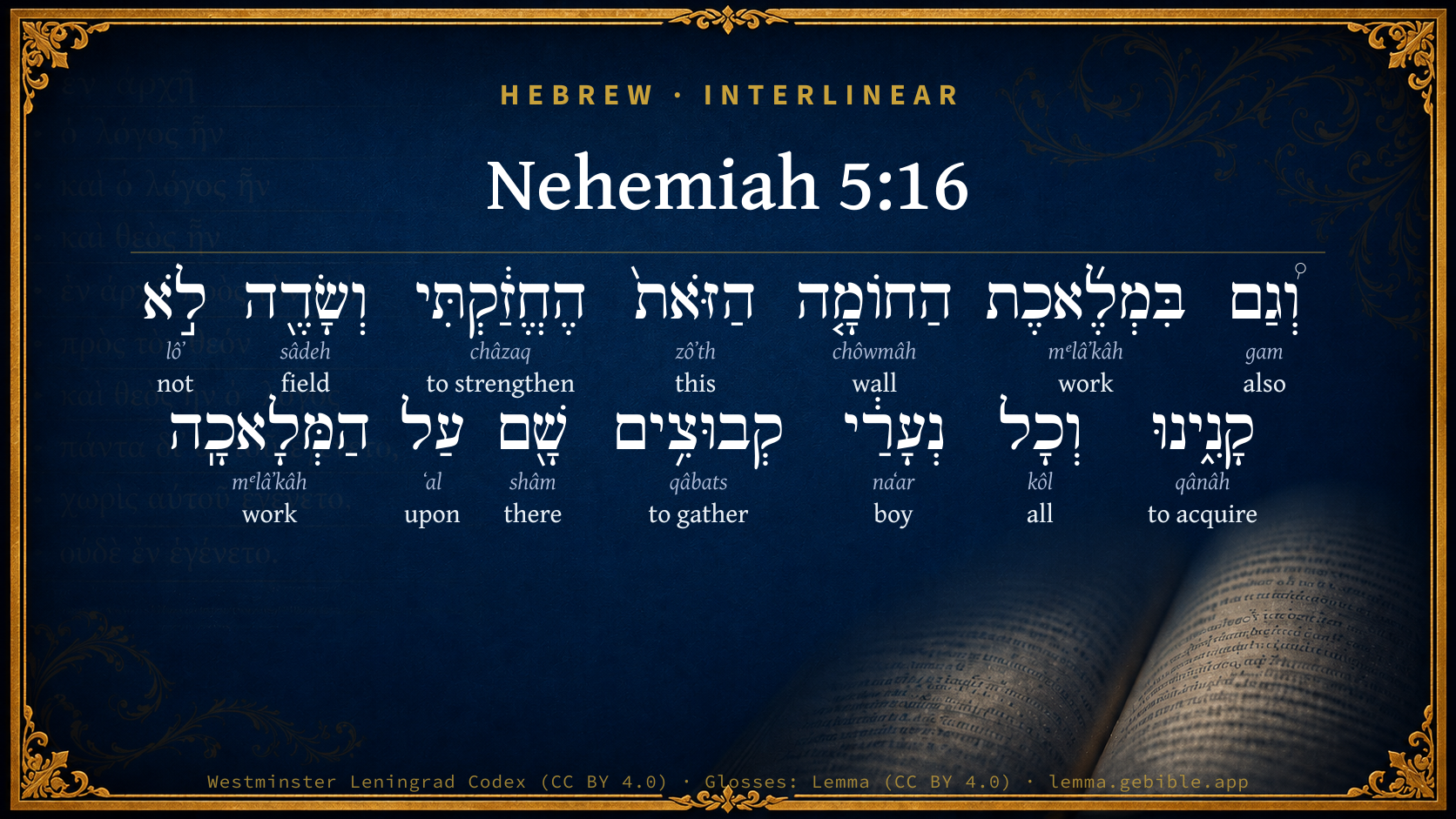
Hebrew (Westminster Leningrad Codex) Nehemiah 5:16 appears in the Hebrew Old Testament. The text above is from the Westminster Leningrad Codex. Each word links to its Strong’s number, a concise gloss, and parsing drawn from the Open Scriptures Hebrew Bible morphology. Click any word for its full Brown-Driver-Briggs (BDB) entry.
Download image
Cite this verse

Nehemiah 5:16 (World English Bible). Public Domain. Lemma interlinear Bible study tool, https://lemma.gebible.app/v/nehemiah/5/16.

Show BibTeX & RIS
BibTeX
RIS
English Translation
Yes, also I continued in the work of this wall, neither bought we any land: and all my servants were gathered there to the work.
World English Bible · Public Domain
Download a study sheet

One document with this verse’s original text, its word-by-word gloss line, the meaning frame, cross-references with their text, attributed commentary, and full source and license credits — printable, and it pastes into notes with its structure intact.

This verse Autodidact and up

Study sheet (.html) Plain text (.txt)

A passage Seminary Student

Up to 50 verses in one chapter. A passage sheet keeps up to 6 commentary sources and 12 cross-references per verse, in the order this page ranks them, and says so on the sheet whenever that leaves anything out. Ask for a single verse and you get the Autodidact verse sheet above.

Everything on this page stays free to read, with no account — the sheet is a download of what is already on screen, not access to it.

Want to remove ads? Support Godless Engineer
Compare translations 3

The same verse in 3 English versions, stacked beneath the original-language interlinear above. Click any original word for its lexicon entry.

Each is an independent rendering of the whole verse — the interlinear is not word-aligned to these translations.

Highlighted words mark where these versions differ — a whole-verse word diff, not a word-by-word alignment.

  • World English Bible Public Domain
    Yes, also I continued in the work of this wall, neither bought we any land: and all my servants were gathered there to the work.
  • King James Version Public Domain
    Yea, also I continued in the work of this wall, neither bought we any land: and all my servants were gathered thither unto the work.
  • unfoldingWord Literal Text CC BY-SA 4.0
    Yes, also I held fast to the work of this wall, and we did not buy a field. And all my young men were gathered there for the work.

unfoldingWord Literal Text — © unfoldingWord, licensed CC BY-SA 4.0. Word-aligned USFM3 via Door43 (git.door43.org/unfoldingWord/en_ult).

Versions to compare (up to 4)

3 of 4 selected

Show all 18 translations

Every available English version of this verse, each an independent rendering of the whole verse.

  • World English Bible Public Domain
    Yes, also I continued in the work of this wall, neither bought we any land: and all my servants were gathered there to the work.
  • Berean Standard Bible Public Domain
    Instead, I devoted myself to the construction of the wall, and all my servants were gathered there for the work; we did not acquire any land.
  • Majority Standard Bible Public Domain
    Instead, I devoted myself to the construction of the wall, and all my servants were gathered there for the work; we did not acquire any land.
  • King James Version Public Domain
    Yea, also I continued in the work of this wall, neither bought we any land: and all my servants were gathered thither unto the work.
  • American Standard Version (1901) Public Domain
    Yea, also I continued in the work of this wall, neither bought we any land: and all my servants were gathered thither unto the work.
  • Revised Version (1885) Public Domain
    Yea, also I continued in the work of this wall, neither bought we any land: and all my servants were gathered thither unto the work.
  • Geneva Bible (1599) Public Domain
    But rather I fortified a portion in the worke of this wall, and we bought no lande, and all my seruants came thither together vnto the worke.
  • Douay-Rheims (1899) Public Domain
    Moreover I built in the work of the wall, and I bought no land, and all my servants were gathered together to the work.
  • Young's Literal Translation Public Domain
    And also, in the work of this wall I have done mightily, even a field we have not bought, and all my servants are gathered there for the work;
  • Literal Standard Version CC BY-SA 4.0
    And also, in the work of this wall I have done mightily, even a field we have not bought, and all my servants are gathered there for the work;
  • Unlocked Literal Bible CC BY-SA 4.0
    I also continued to work on the wall, and we bought no land, and all my servants were gathered there for the work.
  • unfoldingWord Literal Text CC BY-SA 4.0
    Yes, also I held fast to the work of this wall, and we did not buy a field. And all my young men were gathered there for the work.
  • Darby Bible Public Domain
    Yea, also I applied myself to this work of the wall, and we bought no fields; and all my servants were gathered thither for the work.
  • World Messianic Bible Public Domain
    Yes, I also continued in the work of this wall. We didn’t buy any land. All my servants were gathered there to the work.
  • Webster's Bible Public Domain
    Yea, also I continued in the work of this wall, neither bought we any land: and all my servants were gathered thither to the work.
  • Free Bible Version CC BY-SA 4.0
    I also made rebuilding the wall my top priority, and I assigned all my workers to help with that. We didn't acquire any land for ourselves.
  • Bible in Basic English Public Domain
    And I kept on with the work of this wall, and we got no land for ourselves: and all my servants were helping with the work.
  • JPS Tanakh (1917) Public Domain
    Yea, also I set hand to the work of this wall, neither bought we any land; and all my servants were gathered thither unto the work.

Literal Standard Version (2020), Covenant Press — licensed CC BY-SA 4.0. Text via the HelloAO Bible API (eBible.org). Unlocked Literal Bible (unfoldingWord) — licensed CC BY-SA 4.0. Text via the HelloAO Bible API (eBible.org). unfoldingWord Literal Text — © unfoldingWord, licensed CC BY-SA 4.0. Word-aligned USFM3 via Door43 (git.door43.org/unfoldingWord/en_ult). Free Bible Version, Dr. Jonathan Gallagher — licensed CC BY-SA 4.0. Text via the HelloAO Bible API (eBible.org).

Word by word

More ways to search: Search by grammar → Find every occurrence → Compare this word →

Practice this passage: Drill this verse → Learn its vocabulary →

קָנִ֑ינוּ
qânâh
H7069
“to acquire”
Verb, Qal, Perfect, 1st Person, Common, Plural
Part of Speech
Verb
Stem
Qal
Form
Perfect
Person
1st Person
Gender
Common
Number
Plural
Full BDB Definition

Origin: a primitive root

TWOT: 2039

to get, acquire, create, buy, possess - (Qal) - to get, acquire, obtain - of God originating, creating, redeeming His people - possessor - of Eve acquiring - of acquiring knowledge, wisdom - to buy - (Niphal) to be bought - (Hiphil) to cause to possess
  1. וְ֠גַם gam H1571 “and · also” Conjunction + Particle, Accusative
  2. בִּמְלֶ֜אכֶת mᵉlâʼkâh H4399 “in/at · work of” Preposition + Noun, Common, Feminine, Singular, Construct
  3. הַחוֹמָ֤ה chôwmâh H2346 “the · wall” Particle, Definite Article + Noun, Common, Feminine, Singular, Absolute
  4. הַזֹּאת֙ zôʼth H2063 “the · this” Particle, Definite Article + Pronoun, Demonstrative, Feminine, Singular
  5. הֶחֱזַ֔קְתִּי châzaq H2388 “to strengthen” Verb, Hiphil, Perfect, 1st Person, Common, Singular
  6. וְשָׂדֶ֖ה sâdeh H7704 “and · field” Conjunction + Noun, Common, Masculine, Singular, Absolute
  7. לֹ֣א lôʼ H3808 “not” Particle, Negative
  8. וְכָל kôl H3605 “and · all of” Conjunction + Noun, Common, Masculine, Singular, Construct
  9. נְעָרַ֔י naʻar H5288 “boys · my” Noun, Common, Masculine, Plural, Construct + Suffix, Personal, 1st Person, Common, Singular
  10. קְבוּצִ֥ים qâbats H6908 “gathered” Verb, Qal, Participle Passive, Masculine, Plural, Absolute
  11. שָׁ֖ם shâm H8033 “there” Adverb
  12. עַל ʻal H5921 “upon” Preposition
  13. הַמְּלָאכָֽה mᵉlâʼkâh H4399 “the · work” Particle, Definite Article + Noun, Common, Feminine, Singular, Absolute

About this verse

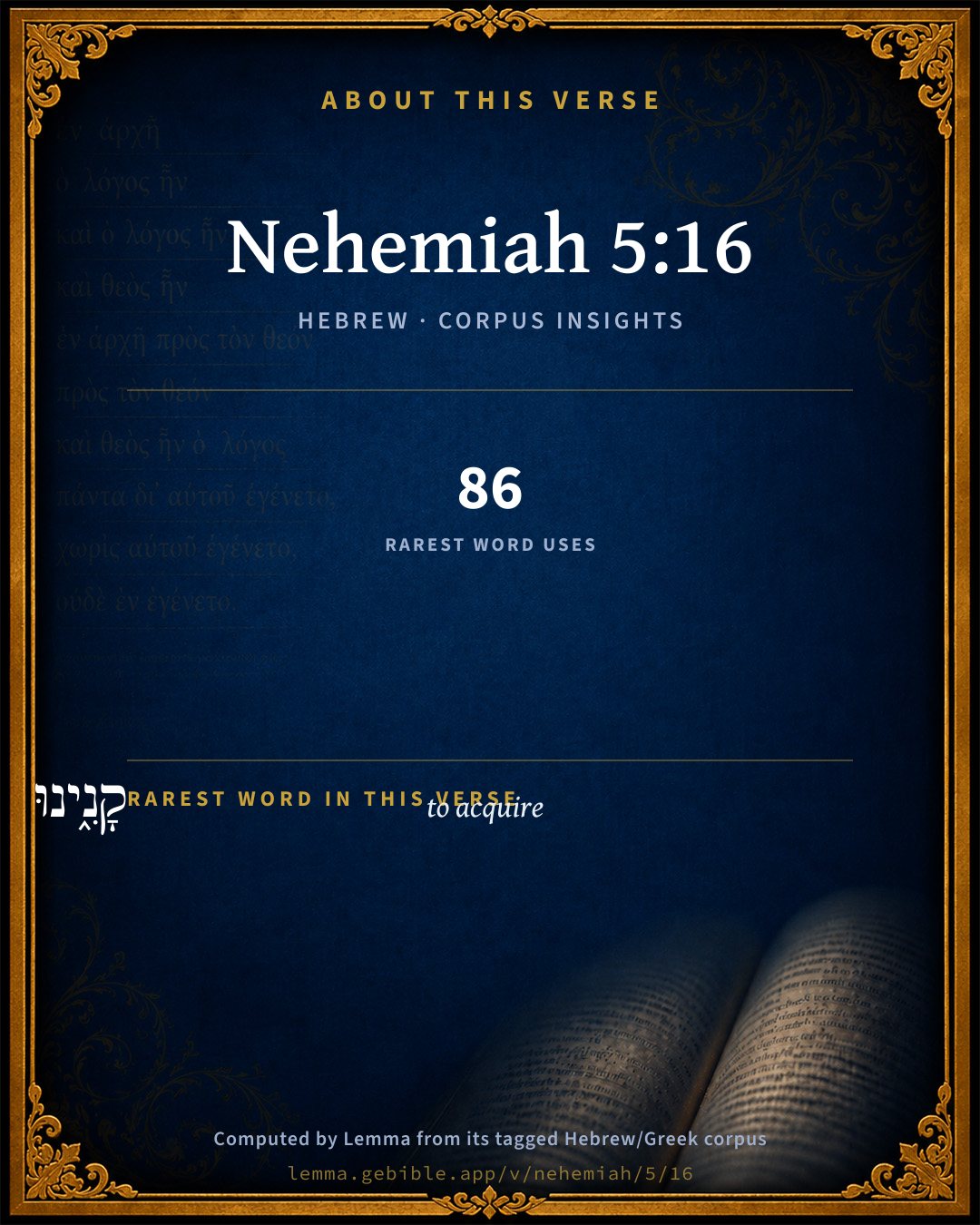
These counts appear in no published source. They are computed here, from the morphology-tagged text and Lemma’s own curated glosses. What Lemma adds →

14
words
13
distinct lemmas
Historical
section

Grammatical profile

  • 3 verbs
  • 6 nouns
  • 1 pronoun
  • 1 preposition
  • 1 adverb
  • 2 particles

Verb forms

  • הֶחֱזַ֔קְתִּי Hiphil · Perfect
  • קָנִ֑ינוּ Qal · Perfect
  • קְבוּצִ֥ים Qal · Participle Passive

Repetition

A word recurs within this verse — often emphatic in Hebrew:

  • בִּמְלֶ֜אכֶת work H4399 ×2

Cross-references

9

Topical passages linked to Nehemiah 5:16 in the Treasury of Scripture Knowledge — connected by theme and wording, ordered by reader-vote popularity; previews shown in the World English Bible.

  • Galatians 6:9 Let us not be weary in doing good, for we will reap in due season, if we don't give up.
  • Acts 20:33–35 I coveted no one's silver, or gold, or clothing.
  • 1 Corinthians 15:58 Therefore, my beloved brothers, be steadfast, immovable, always abounding in the Lord's work, because you know that your labor is not in vain in the Lord.
  • Philippians 2:20–21 For I have no one else like-minded, who will truly care about you.
  • 1 Thessalonians 2:5–6 For neither were we at any time found using words of flattery, as you know, nor a cloak of covetousness (God is witness),
  • Numbers 16:15 Moses was very angry, and said to Yahweh, "Don't respect their offering: I have not taken one donkey from them, neither have I hurt one of them."
  • Luke 8:15 That in the good ground, these are such as in an honest and good heart, having heard the word, hold it tightly, and bring forth fruit with patience.
  • Romans 2:7 to those who by patience in well-doing seek for glory and honor and incorruptibility, eternal life;

Cross-references courtesy of OpenBible.info (CC BY 4.0).

Hebrew and Greek witnesses Masoretic Hebrew ↔ Greek Septuagint

The same verse in the two great witnesses to the Old Testament, shown verse-for-verse.

These are two independent witnesses, not word-aligned to each other, and the Septuagint is shown in lemma (dictionary) form.

Hebrew Nehemiah 5:16 Masoretic · Westminster Leningrad Codex

וְ֠גַם בִּמְלֶ֜אכֶת הַחוֹמָ֤ה הַזֹּאת֙ הֶחֱזַ֔קְתִּי וְשָׂדֶ֖ה לֹ֣א קָנִ֑ינוּ וְכָל נְעָרַ֔י קְבוּצִ֥ים שָׁ֖ם עַל הַמְּלָאכָֽה

Yes, also I continued in the work of this wall, neither bought we any land: and all my servants were gathered there to the work.

World English Bible · Public Domain

Greek LXX Structure differs

The Septuagint has no separate book of Nehemiah. Its Greek text is the second half of Esdras B (2 Esdras), chapters 11–23; Ezra is the first half (1–10).

A verse-for-verse comparison isn’t shown here because the chapters and verses don’t line up. Switch to the LXX edition with the MT / LXX toggle above to read the Greek directly.

Hebrew: Westminster Leningrad Codex (CC BY 4.0). Greek: Septuagint (public domain); English from a public-domain English Septuagint. How the Septuagint differs from the Hebrew →

Commentary

Notes on Nehemiah 5:16 from classic Christian and Jewish commentators (each source and its license shown beneath its notes). The classic Christian expositions comment on the surrounding passage and are grouped to its opening verse, so a note may address several verses; the Jewish commentaries on the Tanakh (Rashi and others) are per-verse, so they appear only where the commentator wrote on this verse.

Lemma curates 59 commentaries, every one of them public domain or Creative Commons licensed, each selected and text-cleaned for this edition rather than reprinted as found. About our sources →

Trapp's Complete Commentary

John Trapp

Neh 5:16 Yea, also I continued in the work of this wall, neither bought we any land: and all my servants [were] gathered thither unto the work.

Ver. 16. Yea, also I continued in the work] He meaneth, saith Lyra, that he wrought with his own hands to draw on others the more, when they should see their governor himself so intent to the work. He was constant at it, and held out till all was finished. And this he recordeth, not out of ostentation, but to show that the love and fear of God constrained him; as it did afterwards Paul, that spiritual builder, who laboured more than they all, and denied himself to bring others to heaven, as himself setteth forth, 2Co 11:1-33. In praising ourselves, our end must be, that our light may be seen, not ourselves seen, Mat 5:16. Men’s praise may be sought, modo tibi non quaeras, sed Christo, Seek not for yourself, but Christ. saith Aretius, so that Christ be thereby set up and served.

Neither bought we any land] As easily we might have done with the surplusage of our revenue; especially if we had exacted the utmost of our right. But public spirits mind not their own interests. Joshua divided the land to Israel, and left none to himself; and that portion that was given him, and he content with, was but a poor one in the barren mountains, as Jerome observes. The late victorious king of Sweden (a second Joshua), in his reprehensory speech to the German plunderers, hath this passage: I protest, before God, that I have not by all this war enriched myself so far as a pair of boots cometh to; yea, I had rather ride without boots than in the least degree enrich myself by the damage of poor people (Mr Clark, in his Life).

John Trapp, A Commentary or Exposition upon All the Books of the Old and New Testament (1647–1656) — public domain. Text from a community e-Sword module.

The Biblical Illustrator

Joseph S. Exell

Neh_5:16

Neither bought we any land.

Nehemiah an example of unworldliness of mind

The people of God maintain a certain unearthly peculiarity throughout all their relationship to earth; they do not become assimilated to the crowd through which they hold the tenor of their way. Like that limpid stream of which we are told that, entering a salt and bituminous lake, it clears its way through the uncongenial waters, untainted and uncommingled, so that it issues forth below as pure as when it entered, so the current of Gods people, passing through the dead sea of this world, does not blend with its waters, but speeds on undefiled to the clear ocean in heaven. Consider how this unworldly spirit will tell on your every-day course.

I. It will restrain you from intimacy, though you cannot avoid intercourse, with the ungodly.

II. You will be distinguished from the world by the moderation with which you will form your plans and prosecute your undertakings.

III. You will show another spirit in the friendships which you form and the associations which you choose.

IV. You will be restrained from that greediness of gain which, more than ever, characterises the world in this present age.

V. You will have a large and open hand for the claims of god, the service of his church, and for the relief of the poor and needy.(Hugh Stowell, M. A.)

The Biblical Illustrator, edited by Joseph S. Exell (c. 1880s–1900s) — public domain. Text from a community e-Sword module.

Joseph Benson's Commentary

Neh 5:16. Yea, also I continued in the work — Overseeing, directing, and encouraging the workmen, which was my whole business; and this at my own cost. Neither bought we any land — Of our poor brethren, whose necessities gave abundant opportunities of enriching myself by good bargains. And all my servants were gathered unto the work — They also were constantly employed in the same work, and received no pay for their labour, though they could not be so employed without the neglect of my own private business.

Joseph Benson's Commentary on the Old and New Testaments (1811–1818) — public domain. Text from a community e-Sword module.

Adam Clarke's Commentary

Verse 16. Neither bought we any land] Neither he nor his officers took any advantage of the necessities of the people, to buy their lands, &c. He even made his own servants to work at the wall.

Adam Clarke's Commentary on the Bible (1810–1826) — public domain. Text from a community e-Sword/MySword module.

Ellicott's Commentary for English Readers

(16) I continued.—I repaired: that is, as superintendent. His servants and himself did not take advantage of the people’s poverty to acquire their land by mortgage; they were, on the contrary, absorbed in the common work.

A Bible Commentary for English Readers, edited by Charles John Ellicott (1878–1897) — public domain. Text from a community e-Sword module.

The Cambridge Bible for Schools and Colleges

gen. ed. J. J. S. Perowne

16. Yea also I continued in the work, &c.] R.V. marg. ‘Heb. held fast to’. It does not appear certain whether Nehemiah here refers to his continuous supervision of the building or to his personal share in the work of restoration at his own cost of some portion of it. The word rendered ‘continued’ (used in its literal sense of ‘held’ in Neh_4:16) admits of either application.

neither bought we any land] In connexion with the previous and the following clauses, these words should be taken to mean that Nehemiah and his friends were too strenuously occupied to interest themselves in the purchase of lands. Former governors had possibly made investments in good land. Such transactions were incompatible with Nehemiah’s ceaseless devotion to the work. But it is necessary also to regard the words as an allusion to the substance of Neh_5:10. Although they had abundant opportunity to make private gain out of mortgaged property, they withstood the temptation of enriching themselves out of their fellow-countrymen. The word ‘land’ is the same as that which in the Plur. the R.V. has altered to ‘fields’ in Neh_5:3-5; Neh_5:11.

all my servants were gathered] Their work at the wall and in Nehemiah’s employ was too incessant to permit of the inspection of purchaseable land or of its proper cultivation if they had purchased it.

The Cambridge Bible for Schools and Colleges (gen. ed. J. J. S. Perowne; Cambridge University Press, 1878–1918) — public domain. Text from a community e-Sword module.

John Gill's Exposition

Moreover, there were at my table an hundred and fifty of the Jews and rulers,.... Every day at his own cost, which must be considerable to provide for such a number, and of such rank:

besides those that came unto us from among the Heathen that are about us; who were proselytes, and came thither to worship, or on a civil account, to give intelligence, and take directions.

John Gill's Exposition of the Whole Bible (1746–1763) — public domain (CC PDM 1.0). Text via the HelloAO Bible API.

Albert Barnes' Notes on the Bible

I continued ... land - i. e. - “I took my share in the work of the wall, as general superintendent. I did not take advantage of the general poverty to buy poor men’s plots of ground.”

Albert Barnes' Notes on the Bible (1834–1885) — public domain. Text from a community e-Sword/MySword module.

Haydock's Catholic Bible Commentary

Wall, pleading no exemption, but making my servants work. (Calmet) --- Though no particular portion was assigned to him, he helped all. (Tirinus) --- No land, as I might have done, on advantageous terms. (Haydock) --- Rare example of disinterestedness! He praises himself without vanity, only to induce others to follow the same course. So Moses, David, St. Paul, and others acted, Numbers xii. 3., &c.

George Leo Haydock (1774–1849), Haydock's Catholic Family Bible and Commentary, 1859 edition — public domain. Excludes Psalms (Douay-Rheims chapter numbering differs from Protestant) and Deuterocanonical books (Catholic canon only).

Matthew Poole's English Annotations

In the work of this wall; overseeing, directing, and encouraging the workmen, which was my whole business; and this at my own cost.

Neither bought we any land of our poor brethren, whose necessities gave me abundant opportunity of enriching myself with good bargains. But I durst not build my house upon other men’s ruins.

Matthew Poole's English Annotations on the Holy Bible (1683–1685) — public domain. Text from a community e-Sword/MySword module.

Whedon's Commentary on the Bible

Daniel D. Whedon

16. Neither bought we any land — By taking advantage of the distress of the people, as the nobles and rulers had done. Comp. Neh_5:10, note.

My servants… unto the work — And were not allowed to tyrannize over the people. Compare Neh_5:15.

Daniel D. Whedon (gen. ed.), Commentary on the Old and New Testaments (1874–1909) — public domain. Text from a community e-Sword module.

The Pulpit Commentary

I continued in the work of this wall. Literally, "I repaired," like the others. (Neh_3:4-31) I employed myself not in buying up men"s fields at low prices, and so enriching myself, but in the restoring and repairing of the wall, over which I exercised a constant superintendence. All my servants were gathered thither. See Neh_4:16.

The Pulpit Commentary (1880–1919), ed. H.D.M. Spence-Jones & Joseph S. Exell — public domain. Text from a community e-Sword module.

John Wesley's Explanatory Notes

I continued - Overseeing, directing, and encouraging the workmen, which was my whole business; and this at my own cost. Bought - Of our poor brethren, whose necessities gave abundant opportunity of enriching myself with good bargains.

John Wesley, Explanatory Notes Upon the Whole Bible (1754–1765) — public domain. Text via the GEBible commentary corpus.

unfoldingWord translationNotes

Door43 World Missions Community

I also continued

"I" refers to Nehemiah.

we bought

The word "we" refers to Nehemiah and his servants.

all my servants were gathered

This can be stated in active form. AT: "I gathered all of my servants there" (See: Active or Passive)

for the work

"to work on the wall"

150 men

"one hundred and fifty men" (See: Numbers)

At my table were the Jews ... from among the nations who were around us

Nehemiah was responsible for providing food for all of these people. This can be stated clearly. AT: "Also, every day I was responsible to feed at our table the Jews and the officials, 150 people; and we also fed the visitors who came from other countries around us (See: Assumed Knowledge and Implicit Information)

my table

This refers to the governor's table. It was a communal table for the community and for discussion of issues.

officials

government leaders

translationWords

works

servant

Jew

nation

unfoldingWord translationNotes — © Distant Shores Media and the Door43 World Missions Community, licensed CC BY-SA 4.0. Source: git.door43.org/Door43/en_tn.

Rashi

Rabbi Shlomo Yitzchaki (Rashi)

wall the wall of the city.

I adhered I busied myself to engage in it constantly.

and we did not buy a field But neither I nor my associates bought the fields of the Jews who were building the wall because of their poverty; they were engaged in building the wall, but I gave them money in order to build the wall.

over the work to build constantly.

Rashi on the Tanakh — English translations: “The Judaica Press complete Tanach with Rashi, translated by A. J. Rosenberg” (CC BY 4.0); “Pentateuch with Rashi's commentary by M. Rosenbaum and A.M. Silbermann, 1929-1934” (public domain); “The Metsudah Tanach series, Lakewood, N.J” (CC BY 4.0); and “The Book of Joshua, Metsudah Publications, 1997” (CC BY 4.0). Text via Sefaria.

Lesson kit

Teaching starters — assembled from the data on this page, not authored interpretation. Every prompt links to the verse data it draws on. Edit before teaching.

Nehemiah, in the Historical, opens this verse with 14 words (13 distinct Hebrew lemmas). Its most distinctive word is qânâh (“to acquire”). A historical commentator’s framing appears above. Read the whole chapter for the surrounding context.

Discussion questions

  1. The word qânâh carries the sense “to acquire.” How does it shape the verse?
  2. How does Galatians 6:9, which shares this passage’s theme, read alongside this verse?
  3. What does the repetition of “work” (2× in this one verse) do in this verse?
  4. The translations on this page render this verse differently — a whole-verse word diff, not a word-by-word alignment. What might account for the different wordings?
  5. «הֶחֱזַ֔קְתִּי» is a Hiphil Perfect verb. How does that grammatical form shape the action described?
  6. Compare how Trapp's Complete Commentary and The Biblical Illustrator read this verse. Where do they agree or differ?

Things to notice

Reading settings

Reading text

Shown beneath each verse's original-language words.

Old Testament
Old Testament edition

Read the OT as the Masoretic Hebrew (MT) or the Greek Septuagint (LXX).

English shown for the Greek Septuagint (in the Hebrew ↔ Greek comparison).

Comparing translations? Open the Compare panel on any verse page to stack up to four side by side.