
Ruth 2:9

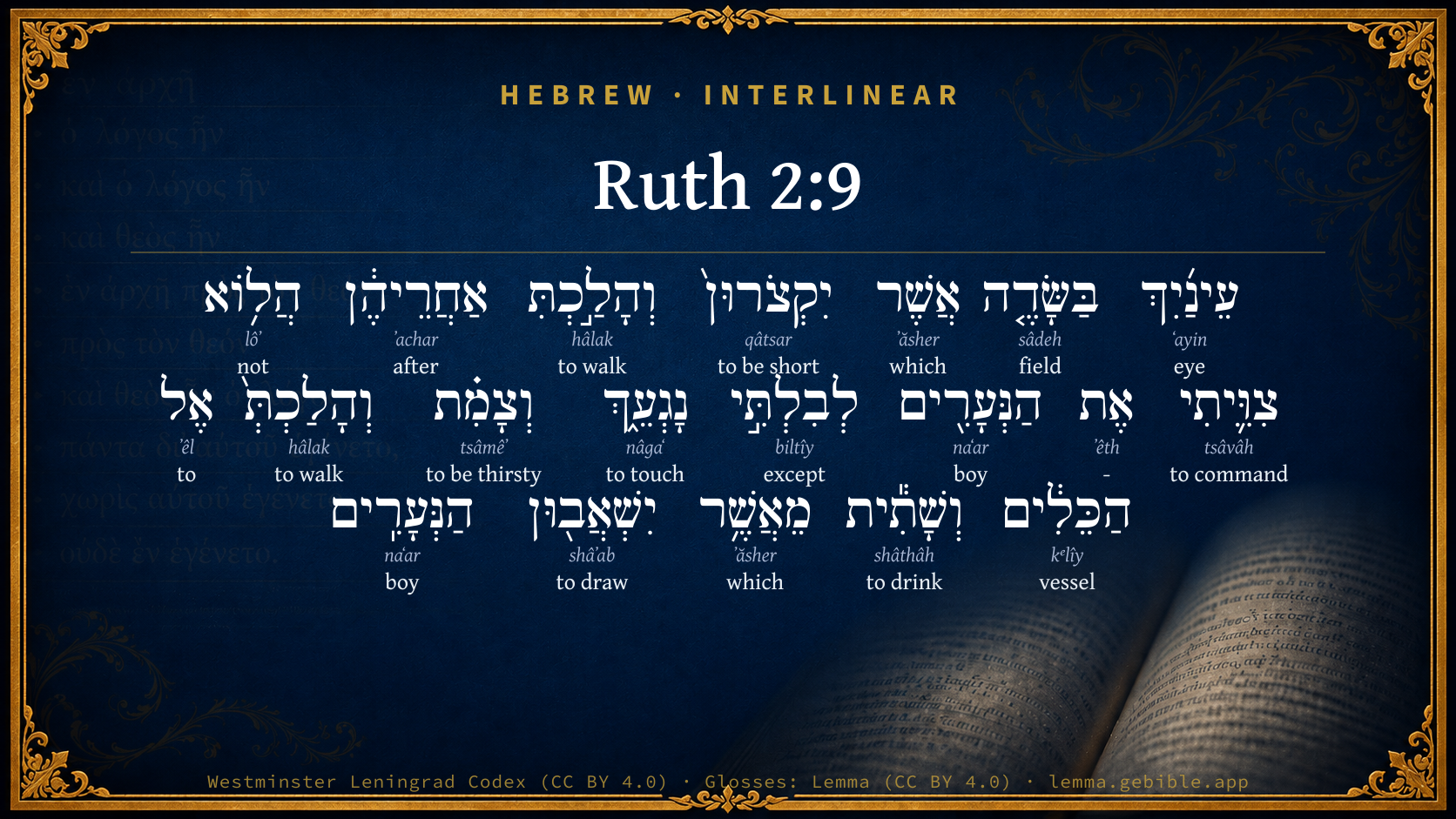
Hebrew (Westminster Leningrad Codex) Ruth 2:9 appears in the Hebrew Old Testament. The text above is from the Westminster Leningrad Codex. Each word links to its Strong’s number, a concise gloss, and parsing drawn from the Open Scriptures Hebrew Bible morphology. Click any word for its full Brown-Driver-Briggs (BDB) entry.
Download image
Cite this verse

Ruth 2:9 (World English Bible). Public Domain. Lemma interlinear Bible study tool, https://lemma.gebible.app/v/ruth/2/9.

Show BibTeX & RIS
BibTeX
RIS
English Translation
Let your eyes be on the field that they reap, and go after them: haven't I charged the young men that they shall not touch you? and when you are thirsty, go to the vessels, and drink of that which the young men have drawn.
World English Bible · Public Domain
Download a study sheet

One document with this verse’s original text, its word-by-word gloss line, the meaning frame, cross-references with their text, attributed commentary, and full source and license credits — printable, and it pastes into notes with its structure intact.

This verse Autodidact and up

Study sheet (.html) Plain text (.txt)

A passage Seminary Student

Up to 50 verses in one chapter. A passage sheet keeps up to 6 commentary sources and 12 cross-references per verse, in the order this page ranks them, and says so on the sheet whenever that leaves anything out. Ask for a single verse and you get the Autodidact verse sheet above.

Everything on this page stays free to read, with no account — the sheet is a download of what is already on screen, not access to it.

Want to remove ads? Support Godless Engineer
Compare translations 3

The same verse in 3 English versions, stacked beneath the original-language interlinear above. Click any original word for its lexicon entry.

Each is an independent rendering of the whole verse — the interlinear is not word-aligned to these translations.

Highlighted words mark where these versions differ — a whole-verse word diff, not a word-by-word alignment.

  • World English Bible Public Domain
    Let your eyes be on the field that they reap, and go after them: haven't I charged the young men that they shall not touch you? and when you are thirsty, go to the vessels, and drink of that which the young men have drawn.
  • King James Version Public Domain
    Let thine eyes be on the field that they do reap, and go thou after them: have I not charged the young men that they shall not touch thee? and when thou art athirst, go unto the vessels, and drink of that which the young men have drawn.
  • unfoldingWord Literal Text CC BY-SA 4.0
    Keep your eyes on the field where they are reaping and follow behind them. Have I not instructed the young men not to touch you? And when you are thirsty, go to the waterpots and drink from what the young men draw.”

unfoldingWord Literal Text — © unfoldingWord, licensed CC BY-SA 4.0. Word-aligned USFM3 via Door43 (git.door43.org/unfoldingWord/en_ult).

Versions to compare (up to 4)

3 of 4 selected

Show all 18 translations

Every available English version of this verse, each an independent rendering of the whole verse.

  • World English Bible Public Domain
    Let your eyes be on the field that they reap, and go after them: haven't I charged the young men that they shall not touch you? and when you are thirsty, go to the vessels, and drink of that which the young men have drawn.
  • Berean Standard Bible Public Domain
    Let your eyes be on the field they are harvesting, and follow along after these girls. Indeed, I have ordered the young men not to touch you. And when you are thirsty, go and drink from the jars the young men have filled.”
  • Majority Standard Bible Public Domain
    Let your eyes be on the field they are harvesting, and follow along after these girls. Indeed, I have ordered the young men not to touch you. And when you are thirsty, go and drink from the jars the young men have filled.”
  • King James Version Public Domain
    Let thine eyes be on the field that they do reap, and go thou after them: have I not charged the young men that they shall not touch thee? and when thou art athirst, go unto the vessels, and drink of that which the young men have drawn.
  • American Standard Version (1901) Public Domain
    Let thine eyes be on the field that they do reap, and go thou after them: have I not charged the young men that they shall not touch thee? and when thou art athirst, go unto the vessels, and drink of that which the young men have drawn.
  • Revised Version (1885) Public Domain
    Let thine eyes be on the field that they do reap, and go thou after them: have I not charged the young men that they shall not touch thee? and when thou art athirst, go unto the vessels, and drink of that which the young men have drawn.
  • Geneva Bible (1599) Public Domain
    Let thine eyes be on the field that they do reape, and goe thou after the maidens. Haue I not charged the seruants, that they touche thee not? Moreouer whe thou art a thirst, go vnto ye vessels, and drinke of that which ye seruants haue drawen.
  • Douay-Rheims (1899) Public Domain
    And follow where they reap. For I have charged my young men, not to molest thee: and if thou art thirsty, go to the vessels, and drink of the waters whereof the servants drink.
  • Young's Literal Translation Public Domain
    thine eyes `are' on the field which they reap, and thou hast gone after them; have not I charged the young men not to touch thee? when thou art athirst then thou hast gone unto the vessels, and hast drunk from that which the young men draw.'
  • Literal Standard Version CC BY-SA 4.0
    your eyes [are] on the field which they reap, and you have gone after them; have I not charged the young men not to touch you? When you are thirsty then you have gone to the vessels, and have drunk from that which the young men draw.”
  • Unlocked Literal Bible CC BY-SA 4.0
    Keep your eyes only on the field where the men are reaping and follow behind the other women. Have I not instructed the men not to touch you? Whenever you are thirsty, you may go to the waterpots and drink the water that the men have drawn.”
  • unfoldingWord Literal Text CC BY-SA 4.0
    Keep your eyes on the field where they are reaping and follow behind them. Have I not instructed the young men not to touch you? And when you are thirsty, go to the waterpots and drink from what the young men draw.”
  • Darby Bible Public Domain
    Let thine eyes be on the field which is being reaped, and go thou after them; have I not charged the young men not to touch thee? And when thou art athirst, go to the vessels and drink of what the young men draw.
  • World Messianic Bible Public Domain
    Let your eyes be on the field that they reap, and go after them. Haven’t I commanded the young men not to touch you? When you are thirsty, go to the vessels, and drink from that which the young men have drawn.”
  • Webster's Bible Public Domain
    Let thy eyes be on the field that they are reaping, and go thou after them: have I not charged the young men that they shall not touch thee? and when thou art thirsty go to the vessels, and drink of that which the young men have drawn.
  • Free Bible Version CC BY-SA 4.0
    Pay attention to what part of the field the men are reaping and follow the women. I've told the men not to bother you. When you get thirsty, go and have a drink from the water jars the servants have filled.”
  • Bible in Basic English Public Domain
    Keep your eyes on the field they are cutting, and go after them; have I not given orders to the young men not to put a hand on you? And when you are in need of drink go to the vessels and take of what the young men have put there.
  • JPS Tanakh (1917) Public Domain
    Let thine eyes be on the field that they do reap, and go thou after them; have I not charged the young men that they shall not touch thee? and when thou art athirst, go unto the vessels, and drink of that which the young men have drawn.'

Literal Standard Version (2020), Covenant Press — licensed CC BY-SA 4.0. Text via the HelloAO Bible API (eBible.org). Unlocked Literal Bible (unfoldingWord) — licensed CC BY-SA 4.0. Text via the HelloAO Bible API (eBible.org). unfoldingWord Literal Text — © unfoldingWord, licensed CC BY-SA 4.0. Word-aligned USFM3 via Door43 (git.door43.org/unfoldingWord/en_ult). Free Bible Version, Dr. Jonathan Gallagher — licensed CC BY-SA 4.0. Text via the HelloAO Bible API (eBible.org).

Word by word

More ways to search: Search by grammar → Find every occurrence → Compare this word →

Practice this passage: Drill this verse → Learn its vocabulary →

וְצָמִ֗ת
tsâmêʼ
H6770
“and · to be thirsty”
Conjunction + Verb, Qal, Sequential Perfect, 2nd Person, Feminine, Singular
Part of Speech
Conjunction + Verb
Stem
Qal
Form
Sequential Perfect
Person
2nd Person
Gender
Feminine
Number
Singular
Full BDB Definition

Origin: a primitive root

TWOT: 1926

(Qal) to be thirsty
  1. עֵינַ֜יִךְ ʻayin H5869 “eyes · your” Noun, Common, Both, Dual, Construct + Suffix, Personal, 2nd Person, Feminine, Singular
  2. בַּשָּׂדֶ֤ה sâdeh H7704 “in/at · field” Preposition + Noun, Common, Masculine, Singular, Absolute
  3. אֲשֶׁר ʼăsher H834 “which” Particle, Relative
  4. יִקְצֹרוּן֙ qâtsar H7114 “to be short” Verb, Qal, Imperfect, 3rd Person, Masculine, Plural + Suffix, n
  5. וְהָלַ֣כְתִּ hâlak H1980 “and · to walk” Conjunction + Verb, Qal, Sequential Perfect, 2nd Person, Feminine, Singular
  6. אַחֲרֵיהֶ֔ן ʼachar H310 “after · them” Preposition + Suffix, Personal, 3rd Person, Feminine, Plural
  7. הֲל֥וֹא lôʼ H3808 “not” Particle, Interrogative + Particle, Negative
  8. צִוִּ֛יתִי tsâvâh H6680 “to command” Verb, Piel, Perfect, 1st Person, Common, Singular
  9. אֶת ʼêth H853 “-” Particle, Direct Object
  10. הַנְּעָרִ֖ים naʻar H5288 “the · boys” Particle, Definite Article + Noun, Common, Masculine, Plural, Absolute
  11. לְבִלְתִּ֣י biltîy H1115 “to/for · except” Preposition + Conjunction
  12. נָגְעֵ֑ךְ nâgaʻ H5060 “to touch · you” Verb, Qal, Infinitive Construct + Suffix, Personal, 2nd Person, Feminine, Singular
  13. וְהָלַכְתְּ֙ hâlak H1980 “and · to walk” Conjunction + Verb, Qal, Sequential Perfect, 2nd Person, Feminine, Singular
  14. אֶל ʼêl H413 “to” Preposition
  15. הַכֵּלִ֔ים kᵉlîy H3627 “the · vessels” Particle, Definite Article + Noun, Common, Masculine, Plural, Absolute
  16. וְשָׁתִ֕ית shâthâh H8354 “and · to drink” Conjunction + Verb, Qal, Sequential Perfect, 2nd Person, Feminine, Singular
  17. מֵאֲשֶׁ֥ר ʼăsher H834 “from · which” Preposition + Pronoun, Relative
  18. יִשְׁאֲב֖וּן shâʼab H7579 “to draw” Verb, Qal, Imperfect, 3rd Person, Masculine, Plural + Suffix, n
  19. הַנְּעָרִֽים naʻar H5288 “the · boys” Particle, Definite Article + Noun, Common, Masculine, Plural, Absolute

About this verse

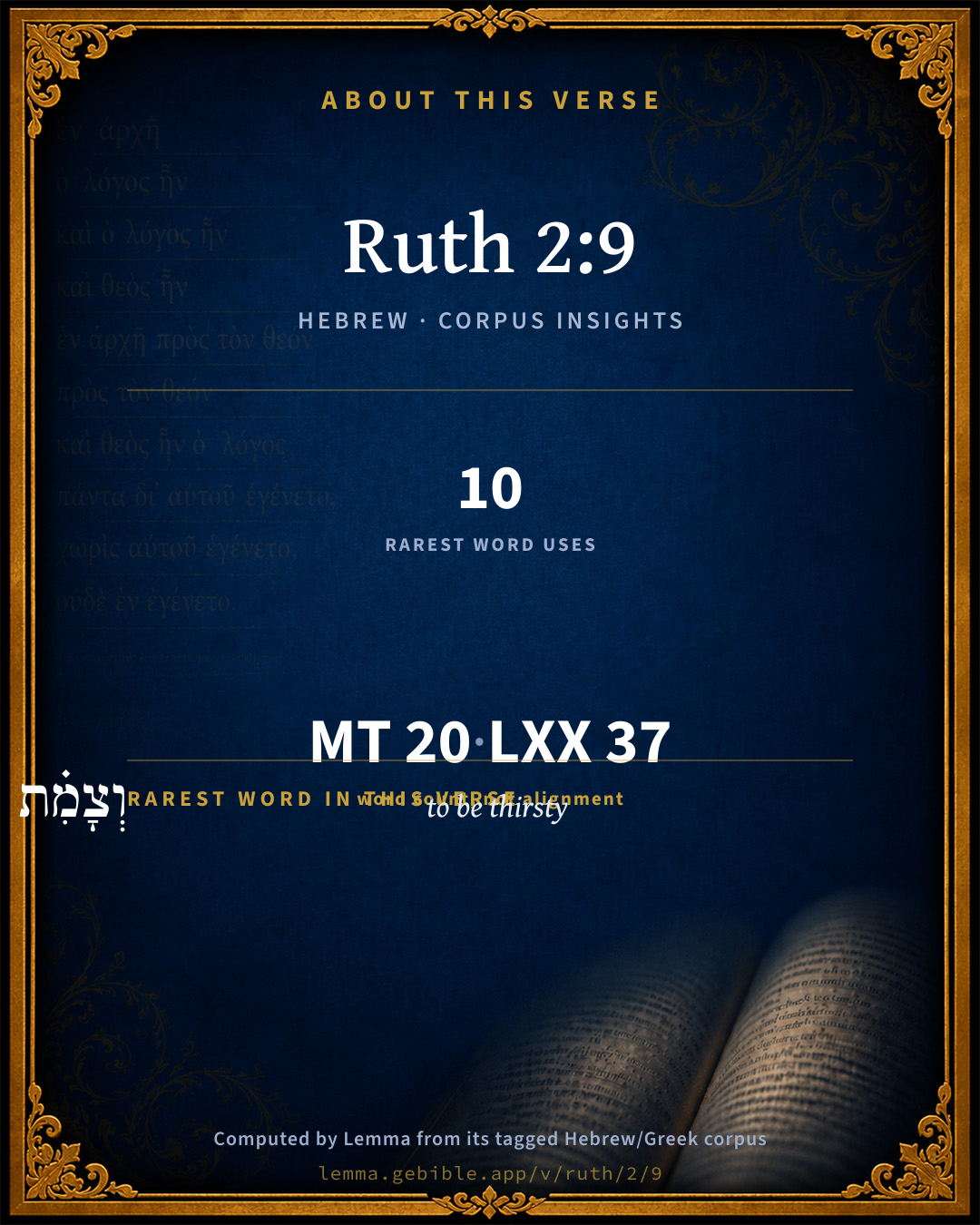
These counts appear in no published source. They are computed here, from the morphology-tagged text and Lemma’s own curated glosses. What Lemma adds →

20
words
17
distinct lemmas
Historical
section

Notable vocabulary

The rarest word here is וְצָמִ֗ת to be thirsty H6770 — appearing just 10 times in the whole Hebrew Bible.

Shared distinctive vocabulary

וְצָמִ֗ת to be thirsty H6770 occurs in 10 verses of the Hebrew Bible. Also found in:

Grammatical profile

  • 8 verbs
  • 5 nouns
  • 1 pronoun
  • 2 prepositions
  • 1 conjunction
  • 3 particles

Verb forms

  • יִקְצֹרוּן֙ Qal · Imperfect
  • וְהָלַ֣כְתִּ Qal · Sequential Perfect
  • צִוִּ֛יתִי Piel · Perfect
  • נָגְעֵ֑ךְ Qal · Infinitive Construct
  • וְצָמִ֗ת Qal · Sequential Perfect
  • וְהָלַכְתְּ֙ Qal · Sequential Perfect
  • וְשָׁתִ֕ית Qal · Sequential Perfect
  • יִשְׁאֲב֖וּן Qal · Imperfect

Repetition

Words recur within this verse — often emphatic in Hebrew:

  • וְהָלַ֣כְתִּ to walk H1980 ×2
  • הַנְּעָרִ֖ים boy H5288 ×2
  • אֲשֶׁר which H834 ×2

Hebrew & Septuagint length

In English translation the verse runs 45 words from the Hebrew and 52 from the Septuagint (LXX English) — closely comparable.

A rough comparison of the two English renderings, which tokenize alike — not a word-level alignment.

Word counts can differ between the Hebrew and the Greek without any difference in meaning — e.g. the Hebrew direct-object marker אֵת has no separate Greek word, and Greek often adds the article ὁ.

In the original languages it is 20 Hebrew tokens and 37 Greek tokens — but the two are counted differently (Hebrew bundles its prefixes and suffixes into one token; the Greek is in lemma form), so that isn’t a like-for-like length.

Cross-references

9

Topical passages linked to Ruth 2:9 in the Treasury of Scripture Knowledge — connected by theme and wording, ordered by reader-vote popularity; previews shown in the World English Bible.

  • 1 John 5:18 We know that whoever is born of God doesn't sin, but he who was born of God keeps himself, and the evil one doesn't touch him.
  • Genesis 20:6 God said to him in the dream, "Yes, I know that in the integrity of your heart you have done this, and I also withheld you from sinning against me. Therefore I didn't allow you to touch her.
  • Psalms 105:15 "Don't touch my anointed ones! Do my prophets no harm!"
  • Proverbs 6:29 So is he who goes in to his neighbor's wife. Whoever touches her will not be unpunished.
  • Matthew 10:42 Whoever gives one of these little ones just a cup of cold water to drink in the name of a disciple, most assuredly I tell you he will in no way lose his reward."
  • 1 Corinthians 7:1 Now concerning the things about which you wrote to me: it is good for a man not to touch a woman.
  • Genesis 24:18–20 She said, "Drink, my lord." She hurried, and let down her pitcher on her hand, and gave him drink.
  • Job 19:21 "Have pity on me, have pity on me, you my friends; For the hand of God has touched me.
  • John 4:7–11 A woman of Samaria came to draw water. Jesus said to her, "Give me a drink."

Cross-references courtesy of OpenBible.info (CC BY 4.0).

Hebrew and Greek witnesses Masoretic Hebrew ↔ Greek Septuagint

The same verse in the two great witnesses to the Old Testament, shown verse-for-verse.

These are two independent witnesses, not word-aligned to each other, and the Septuagint is shown in lemma (dictionary) form.

Hebrew Ruth 2:9 Masoretic · Westminster Leningrad Codex

עֵינַ֜יִךְ בַּשָּׂדֶ֤ה אֲשֶׁר יִקְצֹרוּן֙ וְהָלַ֣כְתִּ אַחֲרֵיהֶ֔ן הֲל֥וֹא צִוִּ֛יתִי אֶת הַנְּעָרִ֖ים לְבִלְתִּ֣י נָגְעֵ֑ךְ וְצָמִ֗ת וְהָלַכְתְּ֙ אֶל הַכֵּלִ֔ים וְשָׁתִ֕ית מֵאֲשֶׁ֥ר יִשְׁאֲב֖וּן הַנְּעָרִֽים

Let your eyes be on the field that they reap, and go after them: haven't I charged the young men that they shall not touch you? and when you are thirsty, go to the vessels, and drink of that which the young men have drawn.

World English Bible · Public Domain

Greek LXX Ruth 2:9 Septuagint · lemma form

ὁ ὀφθαλμός σύ εἰς ὁ ἀγρός ὅς ἐάν θερίζω καί πορεύομαι κατόπισθεν αὐτός ἰδού ἐντέλλω ὁ παιδάριον ὁ μή ἅπτομαι σύ καί ὅς τις διψάω καί πορεύομαι εἰς ὁ σκεῦος καί πίνω ὅθεν ἄν ὑδρεύω ὁ παιδάριον

Let your eyes be on the field where my men shall reap, and you shall go after them: behold, I have charged the young men not to touch you: and when you shall thirst, then you shall go to the vessels, and drink of that which the young men shall have drawn.

LXX2012 (modern English Septuagint) · Public Domain

On this verse, Haydock's Catholic Bible Commentary discusses the Septuagint’s reading. Read the note in Commentary ↓

Hebrew: Westminster Leningrad Codex (CC BY 4.0). Greek: Septuagint (public domain); English from LXX2012 (modern English Septuagint) (Public Domain). How the Septuagint differs from the Hebrew →

Commentary

Notes on Ruth 2:9 from classic Christian and Jewish commentators (each source and its license shown beneath its notes). The classic Christian expositions comment on the surrounding passage and are grouped to its opening verse, so a note may address several verses; the Jewish commentaries on the Tanakh (Rashi and others) are per-verse, so they appear only where the commentator wrote on this verse.

Lemma curates 59 commentaries, every one of them public domain or Creative Commons licensed, each selected and text-cleaned for this edition rather than reprinted as found. About our sources →

Trapp's Complete Commentary

John Trapp

Rth 2:9 [Let] thine eyes [be] on the field that they do reap, and go thou after them: have I not charged the young men that they shall not touch thee? and when thou art athirst, go unto the vessels, and drink of [that] which the young men have drawn.

Ver. 9. Go thou after them.] Mercy is not miserly: charity is no churl. Love is full of good works. This age aboundeth with mouth mercy, {Jas 3:15-16} but a little handful were better than a great many such mouthfuls.

That they should not touch thee.] With a wanton touch, as young men are apt to do, or otherwise wrong thee. Let masters of families make Nebuchadnezzar’s law, that nothing be said or done, by those under their charge, against the God of heaven.

Drink of that which the young men have drawn.] Not without hard labour in those hot and high countries: the courtesy, therefore, was the greater.

John Trapp, A Commentary or Exposition upon All the Books of the Old and New Testament (1647–1656) — public domain. Text from a community e-Sword module.

Geneva Bible (1599)

Geneva Bible translators

That is, take heed in what field they do reap.

Geneva Bible (1599) marginal notes — public domain. Text via Bolls.life.

Jamieson, Fausset & Brown

Robert Jamieson, A. R. Fausset & David Brown

go unto the vessels, and drink of that which the young men have drawn--Gleaners were sometimes allowed, by kind and charitable masters, to partake of the refreshments provided for the reapers. The vessels alluded to were skin bottles, filled with water--and the bread was soaked in vinegar (Rut 2:14); a kind of poor, weak wine, sometimes mingled with a little olive oil--very cooling, as would be required in harvest-time. This grateful refection is still used in the harvest-field.

Jamieson, Fausset & Brown — Commentary Critical and Explanatory on the Whole Bible (1871) — public domain (CC PDM 1.0). Text via the HelloAO Bible API.

Adam Clarke's Commentary

Verse 9. The young men that they shall not touch thee] This was peculiarly necessary, as she was a stranger and unprotected.

Adam Clarke's Commentary on the Bible (1810–1826) — public domain. Text from a community e-Sword/MySword module.

Ellicott's Commentary for English Readers

(9) Have drawn.—Literally, shall (from time to time) draw. Possibly from that self-same well at Bethlehem from which David desired to drink (2Sa_23:15).

A Bible Commentary for English Readers, edited by Charles John Ellicott (1878–1897) — public domain. Text from a community e-Sword module.

The Cambridge Bible for Schools and Colleges

gen. ed. J. J. S. Perowne

9. after them] i.e. the maidens Rth_2:8, who followed the reapers and did the binding.

The Cambridge Bible for Schools and Colleges (gen. ed. J. J. S. Perowne; Cambridge University Press, 1878–1918) — public domain. Text from a community e-Sword module.

John Gill's Exposition

Let thine eyes be upon the field that they do reap, and go thou after them,.... And gather up the loose ears of corn dropped and left by them:

have I not charged the young men that they shall not touch thee? do her no hurt, or offer any incivility or rudeness to her, or even play any wanton tricks with her, as is too common with young persons in the fields at harvest time. This charge he now gave in her hearing, or however suggests that he would, and therefore she might depend upon it she should have no molestation nor any affront given her:

and when thou art athirst: as at such a season of the year, and in the field at such work, and in those hot countries, was frequently the case:

go unto the vessels, and drink of that which the young men have drawn; which they had fetched from wells and fountains in or near the city, and had put into bottles, pitchers, &c. for the use of the reapers and gatherers; we read of the well of Bethlehem, Sa2 23:15 now she is ordered to go to these vessels, and drink when she pleased, without asking leave of any; and Boaz no doubt gave it in charge to his young men not to hinder her.

John Gill's Exposition of the Whole Bible (1746–1763) — public domain (CC PDM 1.0). Text via the HelloAO Bible API.

Albert Barnes' Notes on the Bible

After them - i. e. “after my maidens.” The fields not being divided by hedges, but only by unplowed ridges, it would be easy for her to pass off Boaz’s land without being aware of it, and so find herself among strangers where Boaz could not protect her.

Albert Barnes' Notes on the Bible (1834–1885) — public domain. Text from a community e-Sword/MySword module.

Haydock's Catholic Bible Commentary

Thee. The men tied the corn after the female reapers, (Calmet) and Ruth was authorized to follow, close at their heels, without fear. (Haydock) --- The waters. This is not expressed in Hebrew but it is in the Septuagint and the Chaldean. (Calmet) --- The privilege of having water in those countries was very considerable. (Menochius)

George Leo Haydock (1774–1849), Haydock's Catholic Family Bible and Commentary, 1859 edition — public domain. Excludes Psalms (Douay-Rheims chapter numbering differs from Protestant) and Deuterocanonical books (Catholic canon only).

Matthew Poole's English Annotations

That they shall not touch thee, so as to offer any incivility or injury to thee. Touching is oft taken for hurting, Gen 26:11; Psa 105:15.

Matthew Poole's English Annotations on the Holy Bible (1683–1685) — public domain. Text from a community e-Sword/MySword module.

Whedon's Commentary on the Bible

Daniel D. Whedon

9. That they do reap… go after them — The words they and them refer respectively to the reapers and the maidens of Boaz, for in the Hebrew the verb יקצרון reap, is in the masculine, and the suffix הן them, is in the feminine form. In the absence of fences to mark the exact limits of Boaz’s field, Ruth might, if she allowed herself to become far separated from his reapers, go unlicensed on another’s possessions; hence the charge to keep near his maidens.

Have I not charged the young men — From this remark it seems that the reapers were apt to be rude in their deportment towards defenceless females, if they received no charge from their masters. “Such precautions,” says Dr. Thomson, “are not out of place at this day.

The reapers are gathered from all parts of the country, and largely from the ruder class, and, living far from home, throw off all restraint, and give free license to their tongues, if nothing more.”

Go unto the vessels — This was doubtless a special indulgence to a gleaner. The harvest field was often at some distance from springs or wells, but the occasional refreshment of a drink of water was all important to the heated labourers; hence the vessels of water provided by the young men.

Daniel D. Whedon (gen. ed.), Commentary on the Old and New Testaments (1874–1909) — public domain. Text from a community e-Sword module.

The Pulpit Commentary

Boaz continues his talk, led on by an interest that was, probably, surprising to himself. Let thine eyes be on the field which they are reaping. He feels increasingly anxious concerning the fascinating stranger, and gives her excellent counsel. Let not thine eyes be wiled away, wanderingly, from the work on which thou art so praiseworthily engaged." And go thou behind "them. The reference is not to the same parties, who are indeterminately spoken of in the preceding clause "they" are reaping." A determinate feminine pronoun makes it evident that the reference is to the maidens, who were working in the rear of the reapers (hyreja post eas). Have not I charged the young men not to touch thee? A fine euphemistic injunction; that was best obeyed, however, when most literally construed. And when thou thirstest, go to the jars, and drink of whatever the young men may draw. Most likely it would be from the well that was "by the gate of the city that the young men would draw that very well of which her illustrious descendant, King David, spake, when he "longed, and said, O that one would give me drink of the water of the well in Bethlehem, which is by the gate". (see 2Sa_23:4, 15 1Ch_11:17, 1Ch_11:18) When the water was drawn by the young men, then the maidens would carry the filled jars upon their heads to the resting-place. Gleaners could not be expected to get the freedom of the water which was thus so laboriously drawn, and then fatiguingly carried from a distance. But Boaz made Ruth free, and thus conferred on her a distinguishing privilege, that must have been at once most acceptable and most valuable. The Vulgate renders the last clause too freely which the young men "drink. The familiar well referred-to appears," says Dean Stanley, "close by the gate" of the town ("Sinai and Palestine," p. 163). Yet not very close. It is ," says Dr. John Wilson, "less than half a mile distant from the present village, and is in a rude enclosure, and consists of a large cistern with several small apertures" ("Lands of the Bible," vol. 1. p. 399). Dr. Wilson has no doubt of its identity, though Dr. Robinson hesitated to come to the same conclusion ("Researches," vol. 2. p. 158).

The Pulpit Commentary (1880–1919), ed. H.D.M. Spence-Jones & Joseph S. Exell — public domain. Text from a community e-Sword module.

John Wesley's Explanatory Notes

Touch - So as to offer any incivility or injury to thee.

John Wesley, Explanatory Notes Upon the Whole Bible (1754–1765) — public domain. Text via the GEBible commentary corpus.

Rashi

Rabbi Shlomo Yitzchaki (Rashi)

And [if] you are thirsty, you may go to the vessels And if you are thirsty, do not be ashamed to go and drink from the vessels of water that the young men will draw.

Rashi on the Tanakh — English translations: “The Judaica Press complete Tanach with Rashi, translated by A. J. Rosenberg” (CC BY 4.0); “Pentateuch with Rashi's commentary by M. Rosenbaum and A.M. Silbermann, 1929-1934” (public domain); “The Metsudah Tanach series, Lakewood, N.J” (CC BY 4.0); and “The Book of Joshua, Metsudah Publications, 1997” (CC BY 4.0). Text via Sefaria.

Ibn Ezra

Rabbi Abraham ibn Ezra

And when thou art thirsty. It appears among words that have a final "hey" (ה) at the end.

Ibn Ezra on the Tanakh — English translations: “Sefaria Community Translation” (CC0 1.0 (public-domain dedication)); “Yalkut, Sifsei Chachomim Chumash, Metsudah Publications, 2009” (CC BY 4.0); and “Commentary of Ibn Ezra on Isaiah - trans. by M. Friedlander, 1873” (public domain). Text via Sefaria.

Lesson kit

Teaching starters — assembled from the data on this page, not authored interpretation. Every prompt links to the verse data it draws on. Edit before teaching.

Ruth, in the Historical, opens this verse with 20 words (17 distinct Hebrew lemmas). Its most distinctive word is tsâmêʼ (“to be thirsty”). A historical commentator’s framing appears above. Read the whole chapter for the surrounding context.

Discussion questions

  1. What does “to be thirsty” (tsâmêʼ) contribute to the verse as a whole?
  2. Exodus 17:3 shares the word «to be thirsty» with this verse. How do the two illuminate each other?
  3. “to walk” occurs 2× in this one verse. What is the effect of the repetition?
  4. These translations render this verse differently. What is at stake in choosing one wording over another?
  5. The verb «יִקְצֹרוּן֙» is Qal Imperfect. How does its form color the action?
  6. Reading how Trapp's Complete Commentary and Geneva Bible (1599) read this verse, where do the two commentators agree and where do they part?

Things to notice

Reading settings

Reading text

Shown beneath each verse's original-language words.

Old Testament
Old Testament edition

Read the OT as the Masoretic Hebrew (MT) or the Greek Septuagint (LXX).

English shown for the Greek Septuagint (in the Hebrew ↔ Greek comparison).

Comparing translations? Open the Compare panel on any verse page to stack up to four side by side.