1 Samuel 20:11

Hebrew (Westminster Leningrad Codex) 1 Samuel 20:11 appears in the Hebrew Old Testament. The text above is from the Westminster Leningrad Codex. Each word links to its Strong’s number, a concise gloss, and parsing drawn from the Open Scriptures Hebrew Bible morphology. Click any word for its full Brown-Driver-Briggs (BDB) entry.
Download image
Cite this verse

1 Samuel 20:11 (World English Bible). Public Domain. Lemma interlinear Bible study tool, https://lemma.gebible.app/v/1-samuel/20/11.

Show BibTeX & RIS
BibTeX
RIS
English Translation
Jonathan said to David, Come, and let us go out into the field. They went out both of them into the field.
World English Bible · Public Domain
Download a study sheet

One document with this verse’s original text, its word-by-word gloss line, the meaning frame, cross-references with their text, attributed commentary, and full source and license credits — printable, and it pastes into notes with its structure intact.

This verse Autodidact and up

Study sheet (.html) Plain text (.txt)

A passage Seminary Student

Up to 50 verses in one chapter. A passage sheet keeps up to 6 commentary sources and 12 cross-references per verse, in the order this page ranks them, and says so on the sheet whenever that leaves anything out. Ask for a single verse and you get the Autodidact verse sheet above.

Everything on this page stays free to read, with no account — the sheet is a download of what is already on screen, not access to it.

Want to remove ads? Support Godless Engineer
Compare translations 3

The same verse in 3 English versions, stacked beneath the original-language interlinear above. Click any original word for its lexicon entry.

Each is an independent rendering of the whole verse — the interlinear is not word-aligned to these translations.

Highlighted words mark where these versions differ — a whole-verse word diff, not a word-by-word alignment.

  • World English Bible Public Domain
    Jonathan said to David, Come, and let us go out into the field. They went out both of them into the field.
  • King James Version Public Domain
    And Jonathan said unto David, Come, and let us go out into the field. And they went out both of them into the field.
  • unfoldingWord Literal Text CC BY-SA 4.0
    And Jonathan said to David, “Come, and let us go out the field.” And the two of them went out to the field.

unfoldingWord Literal Text — © unfoldingWord, licensed CC BY-SA 4.0. Word-aligned USFM3 via Door43 (git.door43.org/unfoldingWord/en_ult).

Versions to compare (up to 4)

3 of 4 selected

Show all 18 translations

Every available English version of this verse, each an independent rendering of the whole verse.

  • World English Bible Public Domain
    Jonathan said to David, Come, and let us go out into the field. They went out both of them into the field.
  • Berean Standard Bible Public Domain
    “Come,” he replied, “let us go out to the field.” So the two of them went out into the field,
  • Majority Standard Bible Public Domain
    “Come,” he replied, “let us go out to the field.” So the two of them went out into the field,
  • King James Version Public Domain
    And Jonathan said unto David, Come, and let us go out into the field. And they went out both of them into the field.
  • American Standard Version (1901) Public Domain
    And Jonathan said unto David, Come, and let us go out into the field. And they went out both of them into the field.
  • Revised Version (1885) Public Domain
    And Jonathan said unto David, Come and let us go out into the field. And they went out both of them into the field.
  • Geneva Bible (1599) Public Domain
    And Ionathan sayde to Dauid, Come and let vs goe out into the fielde: and they twaine went out into the fielde.
  • Douay-Rheims (1899) Public Domain
    And Jonathan said to David: Come and let us go out into the field. And when they were both of them gone out into the field,
  • Young's Literal Translation Public Domain
    And Jonathan saith unto David, `Come, and we go out into the field;' and they go out both of them into the field.
  • Literal Standard Version CC BY-SA 4.0
    And Jonathan says to David, “Come, and we go out into the field”; and both of them go out into the field.
  • Unlocked Literal Bible CC BY-SA 4.0
    Jonathan said to David, “Come, let us go out into the field.” So they both went out into the field.
  • unfoldingWord Literal Text CC BY-SA 4.0
    And Jonathan said to David, “Come, and let us go out the field.” And the two of them went out to the field.
  • Darby Bible Public Domain
    And Jonathan said to David, Come and let us go out into the field. And they went out both of them into the field.
  • World Messianic Bible Public Domain
    Jonathan said to David, “Come! Let’s go out into the field.” They both went out into the field.
  • Webster's Bible Public Domain
    And Jonathan said to David, Come, and let us go out into the field. And they went out both of them into the field.
  • Free Bible Version CC BY-SA 4.0
    “Come on, let's go out into the countryside,” Jonathan said. So they both went out into the countryside.
  • Bible in Basic English Public Domain
    And Jonathan said to David, Come, let us go out into the country. And the two of them went out together into the open country.
  • JPS Tanakh (1917) Public Domain
    And Jonathan said unto David: 'Come and let us go out into the field.' And they went out both of them into the field.

Literal Standard Version (2020), Covenant Press — licensed CC BY-SA 4.0. Text via the HelloAO Bible API (eBible.org). Unlocked Literal Bible (unfoldingWord) — licensed CC BY-SA 4.0. Text via the HelloAO Bible API (eBible.org). unfoldingWord Literal Text — © unfoldingWord, licensed CC BY-SA 4.0. Word-aligned USFM3 via Door43 (git.door43.org/unfoldingWord/en_ult). Free Bible Version, Dr. Jonathan Gallagher — licensed CC BY-SA 4.0. Text via the HelloAO Bible API (eBible.org).

Word by word

More ways to search: Search by grammar → Find every occurrence → Compare this word →

Practice this passage: Drill this verse → Learn its vocabulary →

יְהֽוֹנָתָן֙
Yᵉhôwnâthân
H3083
“Jonathan”
Noun, Proper
Part of Speech
Noun
Type
Proper
Full BDB Definition

Origin: from H3068 and H5414

TWOT: None

Jonathan or Jehonathan = "Jehovah has given" - a son of king Saul and a friend of David - a son of the high priest Abiathar and the last descendant of Eli of whom we hear - a nephew of David who like David slew a giant of Gath - an uncle of David - one of David's mighty warriors - one of David's treasurers - a scribe in the time of Jeremiah - a Levite and father of Zechariah, a priest who blew the trumpet at the dedication of the wall - a son or descendant of Gershom, the son of Moses, and a priest to the tribe of Dan - a son of Kareah and a brother of Johanan; a Judaite captain after the fall of Jerusalem - another Judaite father of Peleth - father of Ebed in the time of Ezra - son of Asahel in the time of Ezra - a priest of the family of Melicu in the time of Nehemiah - son of Joiada and his successor to the high priesthood in the time of Nehemiah
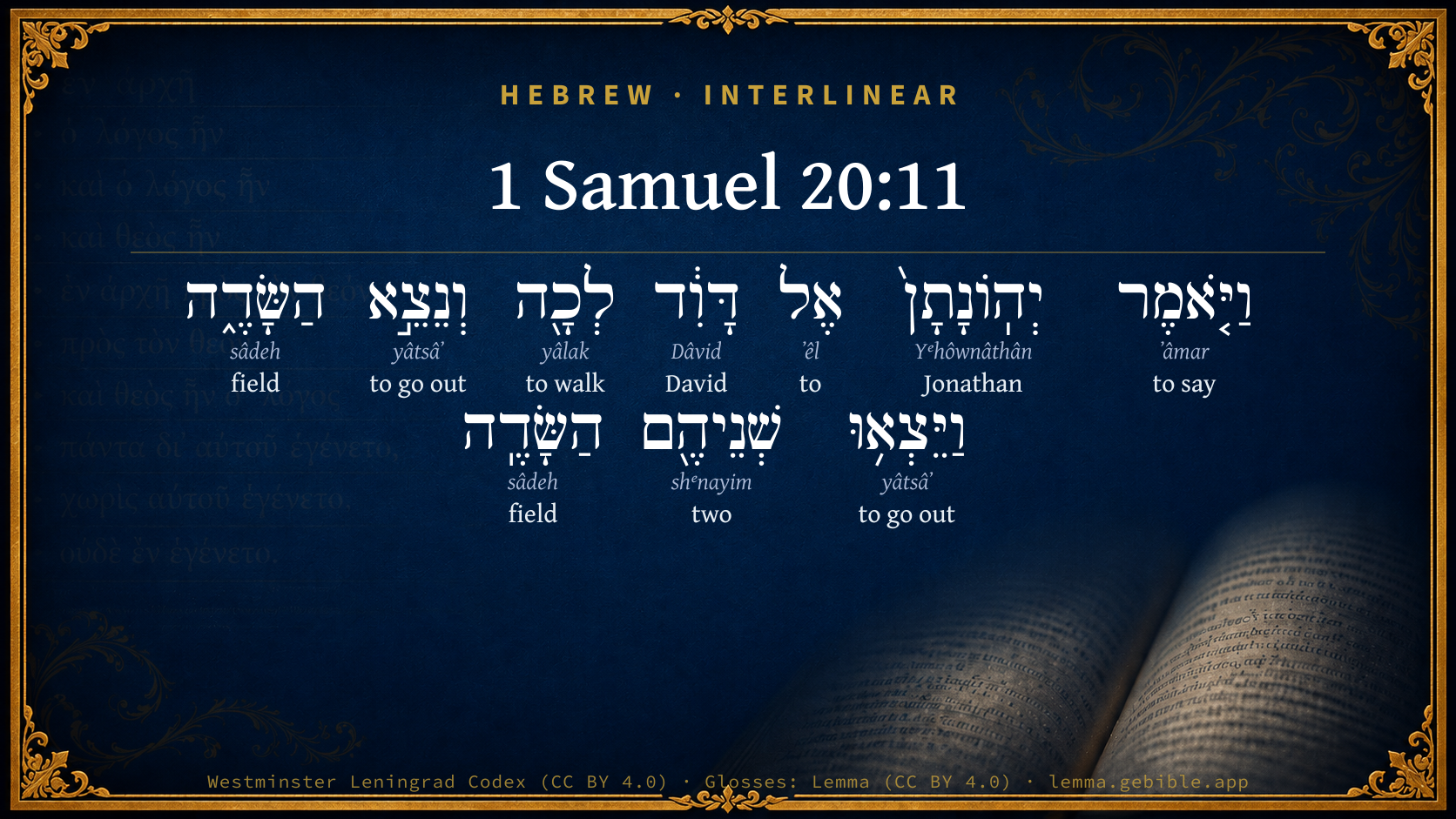
  1. וַיֹּ֤אמֶר ʼâmar H559 “and · to say” Conjunction + Verb, Qal, Sequential Imperfect, 3rd Person, Masculine, Singular
  2. אֶל ʼêl H413 “to” Preposition
  3. דָּוִ֔ד Dâvid H1732 “David” Noun, Proper
  4. לְכָ֖ה yâlak H3212 “walk” Verb, Qal, Imperative, 2nd Person, Masculine, Singular + Suffix, h
  5. וְנֵצֵ֣א yâtsâʼ H3318 “and · to go out” Conjunction + Verb, Qal, Cohortative, 1st Person, Common, Plural
  6. הַשָּׂדֶ֑ה sâdeh H7704 “the · field” Particle, Definite Article + Noun, Common, Masculine, Singular, Absolute
  7. וַיֵּצְא֥וּ yâtsâʼ H3318 “and · to go out” Conjunction + Verb, Qal, Sequential Imperfect, 3rd Person, Masculine, Plural
  8. שְׁנֵיהֶ֖ם shᵉnayim H8147 “two · their” Adjective, Cardinal number, Masculine, Dual, Construct + Suffix, Personal, 3rd Person, Masculine, Plural
  9. הַשָּׂדֶֽה sâdeh H7704 “the · field” Particle, Definite Article + Noun, Common, Masculine, Singular, Absolute

About this verse

These counts appear in no published source. They are computed here, from the morphology-tagged text and Lemma’s own curated glosses. What Lemma adds →

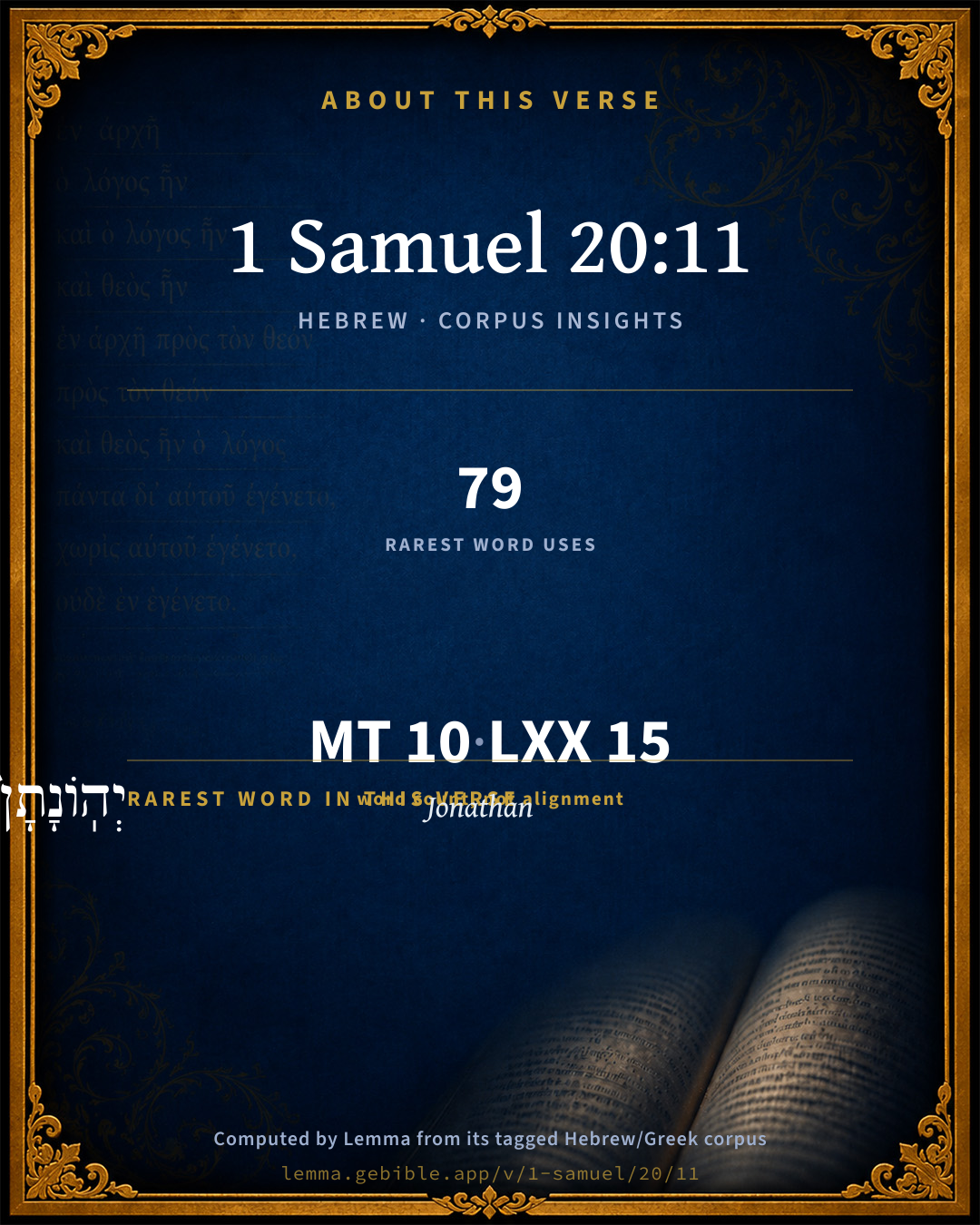
10
words
8
distinct lemmas
Historical
section

Grammatical profile

  • 4 verbs
  • 4 nouns
  • 1 adjective
  • 1 preposition

Verb forms

  • וַיֹּ֤אמֶר Qal · Sequential Imperfect
  • לְכָ֖ה Qal · Imperative
  • וְנֵצֵ֣א Qal · Cohortative
  • וַיֵּצְא֥וּ Qal · Sequential Imperfect

Repetition

Words recur within this verse — often emphatic in Hebrew:

  • וְנֵצֵ֣א to go out H3318 ×2
  • הַשָּׂדֶ֑ה field H7704 ×2

Hebrew & Septuagint length

In English translation the verse runs 22 words from the Hebrew and 19 from the Septuagint (LXX English) — closely comparable.

A rough comparison of the two English renderings, which tokenize alike — not a word-level alignment.

Word counts can differ between the Hebrew and the Greek without any difference in meaning — e.g. the Hebrew direct-object marker אֵת has no separate Greek word, and Greek often adds the article ὁ.

In the original languages it is 10 Hebrew tokens and 15 Greek tokens — but the two are counted differently (Hebrew bundles its prefixes and suffixes into one token; the Greek is in lemma form), so that isn’t a like-for-like length.

Hebrew and Greek witnesses Masoretic Hebrew ↔ Greek Septuagint

The same verse in the two great witnesses to the Old Testament, shown verse-for-verse.

These are two independent witnesses, not word-aligned to each other, and the Septuagint is shown in lemma (dictionary) form.

Hebrew 1 Samuel 20:11 Masoretic · Westminster Leningrad Codex

וַיֹּ֤אמֶר יְהֽוֹנָתָן֙ אֶל דָּוִ֔ד לְכָ֖ה וְנֵצֵ֣א הַשָּׂדֶ֑ה וַיֵּצְא֥וּ שְׁנֵיהֶ֖ם הַשָּׂדֶֽה

Jonathan said to David, Come, and let us go out into the field. They went out both of them into the field.

World English Bible · Public Domain

Greek LXX 1 Samuel 20:11 Septuagint · lemma form

καί εἶπον ιωναθαν πρός δαυίδ πορεύομαι καί μένω εἰς ἀγρός καί ἐκπορεύομαι ἀμφότεροι εἰς ἀγρός

And Jonathan said to David, Go, and abide in the field. And they went out both into the field.

LXX2012 (modern English Septuagint) · Public Domain

Hebrew: Westminster Leningrad Codex (CC BY 4.0). Greek: Septuagint (public domain); English from LXX2012 (modern English Septuagint) (Public Domain). How the Septuagint differs from the Hebrew →

Targum (Aramaic paraphrase)

1

The Targum is the ancient Jewish Aramaic paraphrase of the Hebrew Scriptures — an interpretive translation, not the Hebrew text itself. Onkelos (literal) and Pseudo-Jonathan (expansive) render the Torah, and Jonathan the Prophets. Coverage is partial: where no permissively-licensed English translation exists for a verse, only the Aramaic is shown. This is verse-level text, not a word-by-word alignment to the Hebrew.

  1. Targum Jonathan Prophets (Joshua–Malachi)
    וַאֲמַר יְהוֹנָתָן לְדָוִד אֲזַל וְנִפוֹק לְחַקְלָא וּנְפַקוּ תַּרְוֵיהוֹן לְחַקְלָא:

    (no public-domain English translation for this verse)

    Targum Jonathan — Aramaic: “Mikraot Gedolot” (public domain). English: “Sefaria Community Translation” (CC0 1.0 (public-domain dedication)); “London "Chaldee Paraphrase," 1871” (public domain). Text via Sefaria.

Commentary

Notes on 1 Samuel 20:11 from classic Christian and Jewish commentators (each source and its license shown beneath its notes). The classic Christian expositions comment on the surrounding passage and are grouped to its opening verse, so a note may address several verses; the Jewish commentaries on the Tanakh (Rashi and others) are per-verse, so they appear only where the commentator wrote on this verse.

Lemma curates 59 commentaries, every one of them public domain or Creative Commons licensed, each selected and text-cleaned for this edition rather than reprinted as found. About our sources →

Jamieson, Fausset & Brown

Robert Jamieson, A. R. Fausset & David Brown

THEIR COVENANT RENEWED BY OATH. (Sa1 20:11-23)

Jonathan said to David, Come, let us go into the field--The private dialogue, which is here detailed at full length, presents a most beautiful exhibition of these two amiable and noble-minded friends. Jonathan was led, in the circumstances, to be the chief speaker. The strength of his attachment, his pure disinterestedness, his warm piety, his invocation to God (consisting of a prayer and a solemn oath combined), the calm and full expression he gave of his conviction that his own family were, by the divine will, to be disinherited, and David elevated to the possession of the throne, the covenant entered into with David on behalf of his descendants, and the imprecation (Sa1 20:16) denounced on any of them who should violate his part of the conditions, the reiteration of this covenant on both sides (Sa1 20:17) to make it indissoluble--all this indicates such a power of mutual affection, such magnetic attractiveness in the character of David, such susceptibility and elevation of feeling in the heart of Jonathan, that this interview for dramatic interest and moral beauty stands unrivalled in the records of human friendship.

Jamieson, Fausset & Brown — Commentary Critical and Explanatory on the Whole Bible (1871) — public domain (CC PDM 1.0). Text via the HelloAO Bible API.

Trapp's Complete Commentary

John Trapp

1Sa 20:11 And Jonathan said unto David, Come, and let us go out into the field. And they went out both of them into the field.

Ver. 11. Come, and let us go out into the field.] Where we may be private, and consider of some means of intercourse.

John Trapp, A Commentary or Exposition upon All the Books of the Old and New Testament (1647–1656) — public domain. Text from a community e-Sword module.

Adam Clarke's Commentary

Verse 11. Come, and let us go out into the field] In answer to David's question, he now shows him how he shall convey this intelligence to him.

Adam Clarke's Commentary on the Bible (1810–1826) — public domain. Text from a community e-Sword/MySword module.

The Cambridge Bible for Schools and Colleges

gen. ed. J. J. S. Perowne

11–23. David and Jonathan renew their covenant

11. into the field] To escape observation they leave the city, in which the conversation has been held hitherto.

The Cambridge Bible for Schools and Colleges (gen. ed. J. J. S. Perowne; Cambridge University Press, 1878–1918) — public domain. Text from a community e-Sword module.

John Gill's Exposition

And Jonathan said unto David, come, and let us go out into the field,.... That they might more fully, and freely, and familiarly talk of this affair between them, without any danger of being overheard by the servants of Saul, as they were in his palace, where they now were:

and they went out both of them into the field; which belonged to Gibeah.

John Gill's Exposition of the Whole Bible (1746–1763) — public domain (CC PDM 1.0). Text via the HelloAO Bible API.

Matthew Poole's English Annotations

Lest they should be overheard.

Matthew Poole's English Annotations on the Holy Bible (1683–1685) — public domain. Text from a community e-Sword/MySword module.

Whedon's Commentary on the Bible

Daniel D. Whedon

11. Come and let us go out into the field — There to fix upon some signal by which David might learn the result of Jonathan’s interview with his father.

Daniel D. Whedon (gen. ed.), Commentary on the Old and New Testaments (1874–1909) — public domain. Text from a community e-Sword module.

The Pulpit Commentary

Vers. 11-13. Let us go out into the field. David"s question had shown Jonathan that there were grave difficulties in their way, and so he proposes that they should walk into the country, to be able to talk with one another more freely, and concert measures for the future. And there Jonathan binds himself with a solemn oath, if Saul"s intentions be good, to send a trusty messenger to inform David, but if there be danger, then to come and tell David himself. O Lord God. With a few MSS. we must supply the usual formula of an oath: "As Jehovah the God of Israel liveth." About tomorrow any time, or the third day. This cumbrous translation arose out of the mistaken idea that the word rendered tomorrow could only be used in that limited sense. Strictly it signifies the morning, and is applicable to any morrow. Jonathan fixes one time, and one only, and the passage should be rendered, "By this time on the third morrow." The meeting was to be on the morrow after the second day of the festival, and so on the third morrow after the conversation. The whole may be translated, "As Jehovah the God of Israel liveth, when by this time on the third morrow I have searched my father, and, behold, there be good for David, if then I send not to thee, and uncover thy ear, Jehovah do so and much more to Jonathan." The alternative case is then put, and if the news be evil, Jonathan undertakes himself to be the messenger, and David is to provide for his safety by flight. The concluding prayer that Jehovah might be with David as he had been with Saul contains the same presentiment of David attaining to great power and dignity which is more directly expressed in the following verses.

Vers. 11-23.

The spring of self-sacrifice.

The facts are

1. Jonathan and David retire from observation to confer further.

2. Jonathan undertakes to do all that David requires, and solemnly pledgeshimself to let him know the mind of Saul.

3. He pleads with David, in prospect of his elevation to power, that he andhis house may receive mercy.

4. In his eagerness he seeks a renewal of David"s promise.

5. They then arrange that, after consulting with Saul, an arrow before orbeyond a certain mark shall reveal safety or danger. This beautiful narrative brings out the love and confidence of these young men in such a way that one is constrained to ask whether there is not here, not only an exquisite instance of what all our religious friendship should be in spirit and expression, but a historical foreshadowing of the relation of the loving, confiding soul to the true Anointed of the Lord. We know that in the New Testament the promised land is a shadow of the "better country," the "rock" in the wilderness a figure of Christ, (1Co_10:4) Zion and Jerusalem a type of the city of God, and David, the king after God"s own heart, a pattern of another David, the only begotten of the Father, the eternal King in Zion. (Isa_9:7; Act_2:25-36) Also in the Psalms (Ps 45) and in Isaiah there are references to the deep interest of the Church in Christ and of Christ in the Church. It is not, then, unwarrantable to regard the devotion of Jonathan to the coming king, and because be was beloved as the coming king, as, at all events, suggestive of an analogous devotion of the true believer to Christ. The most striking feature of the narrative before us is the utter self-sacrifice of Jonathan and the deep love from which it sprang. We may notice the main features of the story, and in doing so point out their truth in Christian life.

I There IS A FULL ACQUIESCENCE IN DAVID"S DESIRES SO FAR AS THEY ARE EXPLICITLY KNOWN. Some might regard the retirement of the two into the seclusion of "the field" as suggestive of the private and sacred communion of a believer and Christ; but, without dwelling on that, it may be noticed that as soon as privacy was secured Jonathan at once, with solemn and pathetic earnestness, pledges himself to all that David had so far required. How true this is of a believer in Christ! When the "Anointed of the Lord" makes known his request, whether it be to bear witness for him, to remember his death, or to feed and clothe the little ones, the true heart responds with all zeal and delight. It is a mark of a true Christian, that of delighting to do his will. His yoke is easy and his burden light. It was a very delicate and difficult business to find out Saul"s mind, and involved no little risk to Jonathan; and it is possible that much in which we have to acquiesce involves a strain and tension of feeling, a firmness and endurance, a risk of worldly loss, and a certainty of personal inconvenience; but nevertheless all is welcome, because it is for him who has won our love and is worthy of the best service we can ever render.

II There IS A DISTINCT RECOGNITION OF HIS ENDURING SUPREMACY, AND A CORRESPONDING SENSE OF PERSONAL UNWORTHINESS OF SUCH DISTINGUISHED FRIENDSHIP. It is hard to say in words how refined spiritual minds obtain all their knowledge. They seem to possess an insight, a supersensual instinct, which takes them straight through the present external conditions to the abiding reality. At all events, Jonathan was convinced that his beloved friend was destined to be king in Israel, and he speaks as one not worthy of such honour; and yet, with all this reverence and awe of the coming majesty and power, there was the tender love "passing that of women." Faith saw through the loneliness and oppressed state of David, and recognised the king in Zion. This was the real feeling of the apostles, in their better moods, during the Saviour"s humiliation. They knew that, though men were divided in judgment, he was "the Christ, the Son of the living God". (Mat_16:13-16) The deep love of John when reclining on his bosom, and the sense of unworthiness of Peter when he cried, "Depart from me, for I am a sinful man, O Lord", (Luk_5:8) were only instances of the feeling which usually pervaded their minds. And it is this recognition and the feeling accompanying it which enters into every believer"s life. He is the King, the Hope of the afflicted nations, the "Restorer of paths to dwell in". (Isa_58:12) As Jonathan with passionate love and strong confidence gazed on the beautiful face of David, so do we look with intense interest on Christ and feel sure, in spite of the slow ages and the present antagonisms, that he "must reign," that on his own head an imperishable crown shall flourish. (Ps 72) And while admiration, joy, and satisfaction attend this prevision of the coming glory, the heart is filled with wonder and gratitude in being permitted to call that Chosen One a Friend.

III There IS A FREE SURRENDER OF ALL THAT IS DEAREST TO THE REALISATION OF HIS SUPREMACY. Nothing, humanly speaking, was more precious to Jonathan than his right to the succession, and the prospects of power and distinction involved therein. Nothing in history is more beautiful than the spontaneity and heartiness with which he laid aside all this, and found joy and satisfaction in the coming supremacy of David (vers. 14-17). What noble self-sacrifice for high spiritual purposes! This was more than "houses and lands," more than "father and mother". (Mat_19:29) Only the true spiritual vision of the kingdom of God will account for such deviation from the selfish ways of the world.

Lord" was in the mind of Jonathan, and "the Name" (ch. 17:45) which David had exalted was the "Name" to be still more honoured in his coining reign. And in this is the essence of our Christian life. Surrender of all for Christ: sacrifice of every power, prospect, hope, and wish to the holy purposes for which the "Anointed One" lives. In this there is no exaction and no constraint. Christ does not demand something for his mere personal gratification, and we do not yield to a loss because a more powerful One claims what we have. Jonathan and David were as one (ver. 17). They had but one interest, and lived for one object. Loss and gain were inadequate terms. The surrender to one was as a surrender to self. Loss was gain, and gain was loss. So is it in the mystical union of our lives with Christ. Though we give up all, and perform what men call self-sacrifice, we yet give up nothing. For us "to live is Christ." Blessed oneness! Always giving, always receiving; ever denying self, ever enriching self! The glory of the King is our glory; the sorrows of our heart are his sorrows; deeds to his are deeds to him. (Mat_25:34-40; Heb_4:15)

IV LOVE, CONSTANT AND MASTERFUL, IS THE SPRING OF ALL THIS SELF-SACRIFICE. Jonathan"s love was the master passion that of women pure, steady, unaffected by public opinion and private influence (vers. 30, 31), illumined and regulated by spiritual insight, prompt in expression, giving joy and satisfaction to every deed and word that might bring future honour to David or present comfort in trouble. This undying love, this regnant force, so pure, so sweet, so strong, so gentle: ennobled its possessor, and was regarded by its object as the most beautiful and precious thing on earth. Events show that it was reciprocal. (ver. 41; 2Sa_1:25, 2Sa_1:26) It is this strong master passion that lies at the spring of all our true Christian service. "We love him because he first loved us." "The love of Christ constraineth us." We do his will, lay our talents, possessions, prospects, all we inherit or can acquire, at his feet because we love to do so, and would not do otherwise if we could. No box of ointment is too costly for those dear feet that have trodden the sorrowful paths of life for us! No crown too glorious for that brow that once was pierced and pained for us! No joy too excessive in final enthronement over all principality and power of him who once did battle for us, and destroyed the gigantic foe of God"s people! To measure out our service, to reckon how little we can spare or do, to shut him out from any section of our life this were debasement and shame indeed. Love that of women" seeks satisfaction in living for Christ and glorying only in him.

General lessons:

1. We should inquire whether any of Christ"s requirements have as yet been disregarded.

2. It is a matter of doubt whether the professing Christian Church fullyenters into the joy of Christ"s coming glory, and is sufficiently identified in hope and feeling with it.

3. Each one may ask, Have I surrendered all that is precious to Christ? Isthere any reserve?

4. The due culture of love for Christ as the supreme affection of lifedemands thought and care.

5. The cure of many of the sorrows and ills of Christians and Churches liesin the quickening of this personal interest in Christ.

Vers. 11-23. (THE OPEN COUNTRY, NEAR GIBEAH.)

A covenant of friendship.

Jonathan made a covenant with the house of David" (ver. 16). The friendship of Jonathan and David was expressed and confirmed by a sacred covenant. (1Sa_18:3) The covenant now made differed from the former.

1. It was made at a time of trial. Their friendship was put to a severe test; for it had become clear to the mind of Jonathan that David was destined to be king (ver. 13), as he afterwards stated more fully. (1Sa_23:17) "Jonathan caused David to swear again" (ver. 17), not because he distrusted him, but "because he loved him: for he loved him as be loved his own soul;" and in times of special danger such repeated and solemn assurances may be needful and beneficial.

2. It included the obligation to show kindness to the house of Jonathan aswell as himself. Consider it as

I CONFIRMED BY AN APPEAL TO GOD. It was customary in making a covenant (contract or agreement) to take an oath in which God was appealed to as a witness and an avenger of its violation. (Gen_26:28 Gen_31:45-53) Even when no such appeal is expressly made it should be remembered

1. That he observes the promises and engagements which men make to oneanother, and keeps a faithful record thereof. (Mal_3:16)

2. That he loves to see truth and faithfulness in their speech and conduct. (Deu_7:9 Deu_32:4)

3. That he manifests his displeasure toward those who neglect or violatetheir engagements. (Eze_17:9)

4. That he shows favour and affords help to those who strive to keep themfaithfully. "Who hath not lifted up his soul unto vanity, nor sworn deceitfully. He shall receive the blessing from the Lord" (Psa_24:4; Eph_4:25)

II DEEPENING THE SENSE OF OBLIGATION. In some cases a covenant creates a new obligation; in others (like that of friendship) it intensifies the force and feeling of it

1. By the solemn manner in which it is made.

2. By the greater definiteness in which the obligation is expressed.

3. By the permanent record which is formed of it in the memory, oftenassociated with particular places and objects. (Jos_24:27)

4. And this is important as an incentive to faithfulness in temptation arisingfrom self-interest and strong passion to set it aside. As often as Jonathan and David remembered their sacred covenant they would be impelled to ever higher love and faithfulness.

III CONTRIBUTING TO THE BENEFIT OF BOTH. "By Jehovah," etc. (ver. 12). "And O that thou wouldst while I live show me kindness," etc. (ver. 14). Each received as well as gave assurances of kindness, which served

1. To afford a claim that might be confidently urged in difficulty anddanger (ver. 8).

2. To enrich the soul with a permanent feeling of pure and elevating Joy."very pleasant hast thou been to me". (2Sa_1:26)

3. To preserve it from despondency in hours of darkness and trouble.

4. To increase its aspiration and endeavour after all that is excellent. Thecontinued loyalty of David to Saul and his acts of kindness to him were doubtless greatly incited by the love of Jonathan; and the latter was not less morally strengthened and blessed by the love of David. "There is no influence on a feeling mind stronger than the sense of being loved; nothing more elevating, more securing to the inner life.

IV INVOLVING THE WELFARE OF OTHERS. "And that thou wouldst not cut off thy kindness from my house forever," etc. (vers. 15, 23). "His request that his house may be excepted from this judgment, as executor of which he regards David, is founded on and justified by his position outside the circle of "enemies" (since he recognises God"s will concerning David, and bends to it as David"s friend), so that, though a member of Saul"s house, he does not belong to it as concerns the judgment of extermination" (Erdmann).

1. A parent naturally desires and ought to seek the welfare of his family.

2. He may by his faithful conduct do much to promote it.

3. For the sake of one many are frequently and justly spared and Blessed."is there yet any that is left of the house of Saul, that I may show him kindness for Jonathan"s sake. (2Sa_9:1)

4. The memory of the good is a perpetual incitement to goodness.

Learn

1. The wonderful condescension of God in making with men a friendlycovenant (arrangement, constitution, dispensation), according to which be graciously assures them of unspeakable privileges and blessings. (Gen_9:14; Jer_31:33; Gal_3:15-18)

1. The sure ground which is thereby afforded for confidence and "strongconsolation.

2. The necessity of observing the appointed conditions thereof.

3. To look to God for all good through "Jesus, the Mediator of the newcovenant", (Heb_12:24) and "for Christ"s sake". D. (Eph_4:32)

The Pulpit Commentary (1880–1919), ed. H.D.M. Spence-Jones & Joseph S. Exell — public domain. Text from a community e-Sword module.

Lesson kit

Teaching starters — assembled from the data on this page, not authored interpretation. Every prompt links to the verse data it draws on. Edit before teaching.

1 Samuel, in the Historical, opens this verse with 10 words (8 distinct Hebrew lemmas). Its most distinctive word is Yᵉhôwnâthân (“Jonathan”). A historical commentator’s framing appears above. Read the whole chapter for the surrounding context.

Discussion questions

  1. What does “Jonathan” (Yᵉhôwnâthân) contribute to the verse as a whole?
  2. “to go out” occurs 2× in this one verse. What is the effect of the repetition?
  3. The translations on this page render this verse differently — a whole-verse word diff, not a word-by-word alignment. What might account for the different wordings?
  4. The verb «וַיֹּ֤אמֶר» is Qal Sequential Imperfect. How does its form color the action?
  5. Reading how Jamieson, Fausset & Brown and Trapp's Complete Commentary read this verse, where do the two commentators agree and where do they part?

Things to notice

Reading settings

Reading text

Shown beneath each verse's original-language words.

Old Testament
Old Testament edition

Read the OT as the Masoretic Hebrew (MT) or the Greek Septuagint (LXX).

English shown for the Greek Septuagint (in the Hebrew ↔ Greek comparison).

Comparing translations? Open the Compare panel on any verse page to stack up to four side by side.