
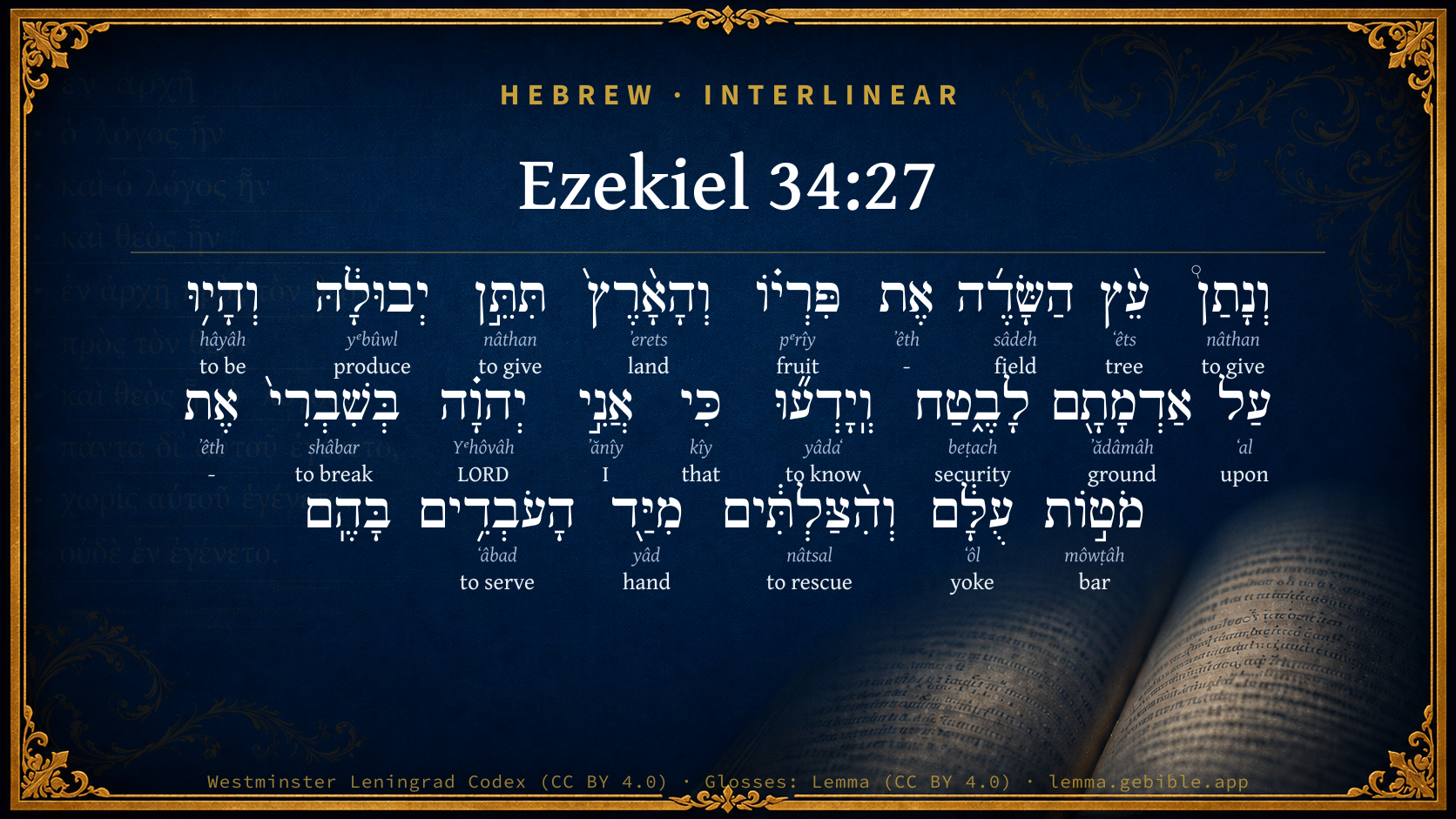
Ezekiel 34:27

Hebrew (Westminster Leningrad Codex) Ezekiel 34:27 appears in the Hebrew Old Testament. The text above is from the Westminster Leningrad Codex. Each word links to its Strong’s number, a concise gloss, and parsing drawn from the Open Scriptures Hebrew Bible morphology. Click any word for its full Brown-Driver-Briggs (BDB) entry.
Download image
Cite this verse

Ezekiel 34:27 (World English Bible). Public Domain. Lemma interlinear Bible study tool, https://lemma.gebible.app/v/ezekiel/34/27.

Show BibTeX & RIS
BibTeX
RIS
English Translation
The tree of the field shall yield its fruit, and the earth shall yield its increase, and they shall be secure in their land; and they shall know that I am Yahweh, when I have broken the bars of their yoke, and have delivered them out of the hand of those who made slaves of them.
World English Bible · Public Domain
Download a study sheet

One document with this verse’s original text, its word-by-word gloss line, the meaning frame, cross-references with their text, attributed commentary, and full source and license credits — printable, and it pastes into notes with its structure intact.

This verse Autodidact and up

Study sheet (.html) Plain text (.txt)

A passage Seminary Student

Up to 50 verses in one chapter. A passage sheet keeps up to 6 commentary sources and 12 cross-references per verse, in the order this page ranks them, and says so on the sheet whenever that leaves anything out. Ask for a single verse and you get the Autodidact verse sheet above.

Everything on this page stays free to read, with no account — the sheet is a download of what is already on screen, not access to it.

Want to remove ads? Support Godless Engineer
Compare translations 3

The same verse in 3 English versions, stacked beneath the original-language interlinear above. Click any original word for its lexicon entry.

Each is an independent rendering of the whole verse — the interlinear is not word-aligned to these translations.

Highlighted words mark where these versions differ — a whole-verse word diff, not a word-by-word alignment.

  • World English Bible Public Domain
    The tree of the field shall yield its fruit, and the earth shall yield its increase, and they shall be secure in their land; and they shall know that I am Yahweh, when I have broken the bars of their yoke, and have delivered them out of the hand of those who made slaves of them.
  • King James Version Public Domain
    And the tree of the field shall yield her fruit, and the earth shall yield her increase, and they shall be safe in their land, and shall know that I am the LORD, when I have broken the bands of their yoke, and delivered them out of the hand of those that served themselves of them.
  • unfoldingWord Literal Text CC BY-SA 4.0
    Then the trees of the field will produce their fruit, and the earth will yield its produce. My sheep will be secure in their land; then they will know that I am Yahweh, when I break the bars of their yoke, and when I rescue them from the hand of those who enslaved them.

unfoldingWord Literal Text — © unfoldingWord, licensed CC BY-SA 4.0. Word-aligned USFM3 via Door43 (git.door43.org/unfoldingWord/en_ult).

Versions to compare (up to 4)

3 of 4 selected

Show all 18 translations

Every available English version of this verse, each an independent rendering of the whole verse.

  • World English Bible Public Domain
    The tree of the field shall yield its fruit, and the earth shall yield its increase, and they shall be secure in their land; and they shall know that I am Yahweh, when I have broken the bars of their yoke, and have delivered them out of the hand of those who made slaves of them.
  • Berean Standard Bible Public Domain
    The trees of the field will give their fruit, and the land will yield its produce; My flock will be secure in their land. Then they will know that I am the LORD, when I have broken the bars of their yoke and delivered them from the hands that enslaved them.
  • Majority Standard Bible Public Domain
    The trees of the field will give their fruit, and the land will yield its produce; My flock will be secure in their land. Then they will know that I am the LORD, when I have broken the bars of their yoke and delivered them from the hands that enslaved them.
  • King James Version Public Domain
    And the tree of the field shall yield her fruit, and the earth shall yield her increase, and they shall be safe in their land, and shall know that I am the LORD, when I have broken the bands of their yoke, and delivered them out of the hand of those that served themselves of them.
  • American Standard Version (1901) Public Domain
    And the tree of the field shall yield its fruit, and the earth shall yield its increase, and they shall be secure in their land; and they shall know that I am Jehovah, when I have broken the bars of their yoke, and have delivered them out of the hand of those that made bondmen of them.
  • Revised Version (1885) Public Domain
    And the tree of the field shall yield its fruit, and the earth shall yield her increase, and they shall be secure in their land; and they shall know that I am the LORD, when I have broken the bars of their yoke, and have delivered them out of the hand of those that served themselves of them.
  • Geneva Bible (1599) Public Domain
    And the tree of the fielde shall yeeld her fruite, and the earth shall giue her fruite, and they shalbe safe in their land, and shall know that I am the Lord, when I haue broken the cordes of their yoke, and deliuered them out of the hands of those that serued themselues of them.
  • Douay-Rheims (1899) Public Domain
    And the tree of the field shall yield its fruit, and the earth shall yield her increase, and they shall be in their land without fear: and they shall know that I am the Lord, when I shall have broken the bonds of their yoke, and shall have delivered them out of the hand of those that rule over them.
  • Young's Literal Translation Public Domain
    And given hath the tree of the field its fruit, And the land doth give her increase, And they have been on their land confident, And they have known that I `am' Jehovah, In My breaking the bands of their yoke, And I have delivered them from the hand of those laying service on them.
  • Literal Standard Version CC BY-SA 4.0
    And the tree of the field has given its fruit, || And the land gives her increase, || And they have been confident on their land, || And they have known that I [am] YHWH, || In My breaking the bands of their yoke, || And I have delivered them from the hand of those laying service on them.
  • Unlocked Literal Bible CC BY-SA 4.0
    Then the trees of the field will produce their fruit, and the earth will yield its produce. My sheep will be secure in their land; then they will know that I am Yahweh, when I break the bars of their yoke, and when I rescue them from the hand of those who enslaved them.
  • unfoldingWord Literal Text CC BY-SA 4.0
    Then the trees of the field will produce their fruit, and the earth will yield its produce. My sheep will be secure in their land; then they will know that I am Yahweh, when I break the bars of their yoke, and when I rescue them from the hand of those who enslaved them.
  • Darby Bible Public Domain
    And the tree of the field shall yield its fruit, and the earth shall yield its increase; and they shall be in safety in their land, and shall know that I [am] Jehovah, when I have broken the bands of their yoke and delivered them out of the hand of those that kept them in servitude.
  • World Messianic Bible Public Domain
    The tree of the field will yield its fruit, and the earth will yield its increase, and they will be secure in their land. Then they will know that I am the LORD, when I have broken the bars of their yoke, and have delivered them out of the hand of those who made slaves of them.
  • Webster's Bible Public Domain
    And the tree of the field shall yield her fruit, and the earth shall yield her increase, and they shall be safe in their land, and shall know that I am the LORD, when I have broken the bands of their yoke, and delivered them out of the hand of those that subjected them to service.
  • Free Bible Version CC BY-SA 4.0
    The trees in the orchards will produce their fruit; the earth will grow its crops; and my flock will live in safety in their country. Then they will know that I am the Lord, when I break their yokes of slavery, and set them free from those who made them slaves.
  • Bible in Basic English Public Domain
    And the tree of the field will give its fruit and the earth will give its increase, and they will be safe in their land; and they will be certain that I am the Lord, when I have had their yoke broken and have given them salvation from the hands of those who made them servants.
  • JPS Tanakh (1917) Public Domain
    And the tree of the field shall yield its fruit, and the earth shall yield her produce, and they shall be safe in their land; and they shall know that I am the LORD, when I have broken the bars of their yoke, and have delivered them out of the hand of those that made bondmen of them.

Literal Standard Version (2020), Covenant Press — licensed CC BY-SA 4.0. Text via the HelloAO Bible API (eBible.org). Unlocked Literal Bible (unfoldingWord) — licensed CC BY-SA 4.0. Text via the HelloAO Bible API (eBible.org). unfoldingWord Literal Text — © unfoldingWord, licensed CC BY-SA 4.0. Word-aligned USFM3 via Door43 (git.door43.org/unfoldingWord/en_ult). Free Bible Version, Dr. Jonathan Gallagher — licensed CC BY-SA 4.0. Text via the HelloAO Bible API (eBible.org).

Word by word

More ways to search: Search by grammar → Find every occurrence → Compare this word →

Practice this passage: Drill this verse → Learn its vocabulary →

מֹט֣וֹת
môwṭâh
H4133
“bars of”
Noun, Common, Feminine, Plural, Construct
Part of Speech
Noun
Type
Common
Gender
Feminine
Number
Plural
State
Construct
Full BDB Definition

Origin: from H4132

TWOT: 1158b

pole, bar of yoke - pole - bar of yoke - of oppression (figuratively)
  1. וְנָתַן֩ nâthan H5414 “and · to give” Conjunction + Verb, Qal, Sequential Perfect, 3rd Person, Masculine, Singular
  2. עֵ֨ץ ʻêts H6086 “tree of” Noun, Common, Masculine, Singular, Construct
  3. הַשָּׂדֶ֜ה sâdeh H7704 “the · field” Particle, Definite Article + Noun, Common, Masculine, Singular, Absolute
  4. אֶת ʼêth H853 “-” Particle, Direct Object
  5. פִּרְי֗וֹ pᵉrîy H6529 “fruit · his” Noun, Common, Masculine, Singular, Construct + Suffix, Personal, 3rd Person, Masculine, Singular
  6. וְהָאָ֨רֶץ֙ ʼerets H776 “and · the · land” Conjunction + Particle, Definite Article + Noun, Common, Both, Singular, Absolute
  7. תִּתֵּ֣ן nâthan H5414 “to give” Verb, Qal, Imperfect, 3rd Person, Feminine, Singular
  8. יְבוּלָ֔הּ yᵉbûwl H2981 “produce · her” Noun, Common, Masculine, Singular, Construct + Suffix, Personal, 3rd Person, Feminine, Singular
  9. וְהָי֥וּ hâyâh H1961 “and · to be” Conjunction + Verb, Qal, Sequential Perfect, 3rd Person, Common, Plural
  10. עַל ʻal H5921 “upon” Preposition
  11. אַדְמָתָ֖ם ʼădâmâh H127 “ground · their” Noun, Common, Feminine, Singular, Construct + Suffix, Personal, 3rd Person, Masculine, Plural
  12. לָבֶ֑טַח beṭach H983 “to/for · security” Preposition + Noun, Common, Masculine, Singular, Absolute
  13. וְֽיָדְע֞וּ yâdaʻ H3045 “and · to know” Conjunction + Verb, Qal, Sequential Perfect, 3rd Person, Common, Plural
  14. כִּי kîy H3588 “that” Conjunction
  15. אֲנִ֣י ʼănîy H589 “I” Pronoun, Personal, 1st Person, Common, Singular
  16. יְהוָ֗ה Yᵉhôvâh H3068 “LORD” Noun, Proper
  17. בְּשִׁבְרִי֙ shâbar H7665 “in/at · to break · me” Preposition + Verb, Qal, Infinitive Construct + Suffix, Personal, 1st Person, Common, Singular
  18. אֶת ʼêth H853 “-” Particle, Direct Object
  19. עֻלָּ֔ם ʻôl H5923 “yoke · their” Noun, Common, Masculine, Singular, Construct + Suffix, Personal, 3rd Person, Masculine, Plural
  20. וְהִ֨צַּלְתִּ֔ים nâtsal H5337 “and · to rescue · them” Conjunction + Verb, Hiphil, Sequential Perfect, 1st Person, Common, Singular + Suffix, Personal, 3rd Person, Masculine, Plural
  21. מִיַּ֖ד yâd H3027 “from · hand of” Preposition + Noun, Common, Both, Singular, Construct
  22. הָעֹבְדִ֥ים ʻâbad H5647 “the · serving” Particle, Definite Article + Verb, Qal, Participle Active, Masculine, Plural, Absolute

About this verse

These counts appear in no published source. They are computed here, from the morphology-tagged text and Lemma’s own curated glosses. What Lemma adds →

24
words
21
distinct lemmas
Prophets
section

Notable vocabulary

The rarest word here is מֹט֣וֹת bar H4133 — appearing just 12 times in the whole Hebrew Bible.

Shared distinctive vocabulary

מֹט֣וֹת bar H4133 occurs in 10 verses of the Hebrew Bible. Also found in:

Grammatical profile

  • 7 verbs
  • 11 nouns
  • 1 pronoun
  • 2 prepositions
  • 1 conjunction
  • 2 particles

Verb forms

  • וְנָתַן֩ Qal · Sequential Perfect
  • תִּתֵּ֣ן Qal · Imperfect
  • וְהָי֥וּ Qal · Sequential Perfect
  • וְֽיָדְע֞וּ Qal · Sequential Perfect
  • בְּשִׁבְרִי֙ Qal · Infinitive Construct
  • וְהִ֨צַּלְתִּ֔ים Hiphil · Sequential Perfect
  • הָעֹבְדִ֥ים Qal · Participle Active

Repetition

A word recurs within this verse — often emphatic in Hebrew:

  • וְנָתַן֩ to give H5414 ×2

Hebrew & Septuagint length

In English translation the verse runs 56 words from the Hebrew and 60 from the Septuagint (LXX English) — closely comparable.

A rough comparison of the two English renderings, which tokenize alike — not a word-level alignment.

Word counts can differ between the Hebrew and the Greek without any difference in meaning — e.g. the Hebrew direct-object marker אֵת has no separate Greek word, and Greek often adds the article ὁ.

Cross-references

20

Topical passages linked to Ezekiel 34:27 in the Treasury of Scripture Knowledge — connected by theme and wording, ordered by reader-vote popularity; previews shown in the World English Bible.

  • Jeremiah 30:8 It shall come to pass in that day, says Yahweh of Hosts, that I will break his yoke from off your neck, and will burst your bonds; and strangers shall no more make him their bondservant;
  • Leviticus 26:13 I am Yahweh your God, who brought you forth out of the land of Egypt, that you should not be their slaves; and I have broken the bars of your yoke, and made you go upright.
  • Leviticus 26:4 then I will give you your rains in their season, and the land shall yield its increase, and the trees of the field shall yield their fruit.
  • Psalms 92:12–14 The righteous shall flourish like the palm tree. He will grow like a cedar in Lebanon.
  • Isaiah 52:2–3 Shake yourself from the dust; arise, sit [on your throne], Jerusalem: loose yourself from the bonds of your neck, captive daughter of Zion.
  • Psalms 85:12 Yes, Yahweh will give that which is good. Our land will yield its increase.
  • Isaiah 4:2 In that day, Yahweh's branch will be beautiful and glorious, and the fruit of the land will be the beauty and glory of the survivors of Israel.
  • Jeremiah 2:20 For of old time I have broken your yoke, and burst your bonds; and you said, I will not serve; for on every high hill and under every green tree you did bow yourself, playing the prostitute.
  • John 15:5–8 I am the vine. You are the branches. He who remains in me, and I in him, the same bears much fruit, for apart from me you can do nothing.
  • Isaiah 9:4 For the yoke of his burden, and the staff of his shoulder, the rod of his oppressor, you have broken as in the day of Midian.
  • Isaiah 10:27 It shall happen in that day, that his burden shall depart from off your shoulder, and his yoke from off your neck, and the yoke shall be destroyed by reason of fatness.
  • Isaiah 14:2–3 The peoples shall take them, and bring them to their place; and the house of Israel shall possess them in the land of Yahweh for servants and for handmaids: and they shall take them captive whose captives they were; and they shall rule over their oppressors.
  • Isaiah 35:1–2 The wilderness and the dry land shall be glad; and the desert shall rejoice, and blossom as the rose.
  • Isaiah 61:3 to appoint to those who mourn in Zion, to give to them a garland for ashes, the oil of joy for mourning, the garment of praise for the spirit of heaviness; that they may be called trees of righteousness, the planting of Yahweh, that he may be glorified.
  • Jeremiah 25:14 For many nations and great kings shall make bondservants of them, even of them; and I will recompense them according to their deeds, and according to the work of their hands.
  • Jeremiah 27:7 All the nations shall serve him, and his son, and his son's son, until the time of his own land come: and then many nations and great kings shall make him their bondservant.
  • Ezekiel 33:29 Then shall they know that I am Yahweh, when I have made the land a desolation and an astonishment, because of all their abominations which they have committed.
  • Ezekiel 34:10 Thus says the Lord Yahweh: Behold, I am against the shepherds; and I will require my sheep at their hand, and cause them to cease from feeding the sheep; neither shall the shepherds feed themselves any more; and I will deliver my sheep from their mouth, that they may not be food for them.
  • Ezekiel 39:28 They shall know that I am Yahweh their God, in that I caused them to go into captivity among the nations, and have gathered them to their own land; and I will leave none of them any more there;
  • Ezekiel 47:12 By the river on the bank of it, on this side and on that side, shall grow every tree for food, whose leaf shall not wither, neither shall the fruit of it fail: it shall bring forth new fruit every month, because the waters of it issue out of the sanctuary; and the fruit of it shall be for food, and the leaf of it for healing.

Cross-references courtesy of OpenBible.info (CC BY 4.0).

Hebrew and Greek witnesses Masoretic Hebrew ↔ Greek Septuagint

The same verse in the two great witnesses to the Old Testament, shown verse-for-verse.

These are two independent witnesses, not word-aligned to each other, and the Septuagint is shown in lemma (dictionary) form.

Hebrew Ezekiel 34:27 Masoretic · Westminster Leningrad Codex

וְנָתַן֩ עֵ֨ץ הַשָּׂדֶ֜ה אֶת פִּרְי֗וֹ וְהָאָ֨רֶץ֙ תִּתֵּ֣ן יְבוּלָ֔הּ וְהָי֥וּ עַל אַדְמָתָ֖ם לָבֶ֑טַח וְֽיָדְע֞וּ כִּי אֲנִ֣י יְהוָ֗ה בְּשִׁבְרִי֙ אֶת מֹט֣וֹת עֻלָּ֔ם וְהִ֨צַּלְתִּ֔ים מִיַּ֖ד הָעֹבְדִ֥ים בָּהֶֽם

The tree of the field shall yield its fruit, and the earth shall yield its increase, and they shall be secure in their land; and they shall know that I am Yahweh, when I have broken the bars of their yoke, and have delivered them out of the hand of those who made slaves of them.

World English Bible · Public Domain

Greek LXX Ezekiel 34:27 Septuagint · lemma form

καί ὁ ξύλον ὁ ἐν ὁ πεδίον δίδωμι ὁ καρπός αὐτός καί ὁ γῆ δίδωμι ὁ ἰσχύς αὐτός καί καταοἰκέω ἐπί ὁ γῆ αὐτός ἐν ἐλπίς εἰρήνη καί γιγνώσκω ὅτι ἐγώ εἰμί κύριος ἐν ὁ συντρίβω ἐγώ ὁ ζυγός αὐτός καί ἐκαἱρέω αὐτός ἐκ χείρ ὁ καταδουλόω αὐτός

And the trees that are in the field shall yield their fruit, and the earth shall yield her strength, and they shall dwell in the confidence of peace on their land, and they shall know that I am the Lord, when I have broken their yoke; and I will deliver them out of the hand of those that enslaved them.

LXX2012 (modern English Septuagint) · Public Domain

Hebrew: Westminster Leningrad Codex (CC BY 4.0). Greek: Septuagint (public domain); English from LXX2012 (modern English Septuagint) (Public Domain). How the Septuagint differs from the Hebrew →

Targum (Aramaic paraphrase)

1

The Targum is the ancient Jewish Aramaic paraphrase of the Hebrew Scriptures — an interpretive translation, not the Hebrew text itself. Onkelos (literal) and Pseudo-Jonathan (expansive) render the Torah, and Jonathan the Prophets. Coverage is partial: where no permissively-licensed English translation exists for a verse, only the Aramaic is shown. This is verse-level text, not a word-by-word alignment to the Hebrew.

  1. Targum Jonathan Prophets (Joshua–Malachi)
    וְיִתֵּן אִילַן חַקְלָא יַת אִבֵּיהּ וְאַרְעָא תִּתֵּן עֲלַלְתָּהּ וִיהוֹן עַל אַרְעֲהוֹן לְרוֹחֲצָן וְיֵדְעוּן אֲרֵי אֲנָא יְיָ כַּד אֶתְבַּר יַת נִיר תּוּקְפֵיהוֹן וְאֵשֵׁיזְבִינוּן מִיַד דִמְפַלְחִין בְּהוֹן:

    (no public-domain English translation for this verse)

    Targum Jonathan — Aramaic: “Mikraot Gedolot” (public domain). English: “Sefaria Community Translation” (CC0 1.0 (public-domain dedication)); “London "Chaldee Paraphrase," 1871” (public domain). Text via Sefaria.

Commentary

Notes on Ezekiel 34:27 from classic Christian and Jewish commentators (each source and its license shown beneath its notes). The classic Christian expositions comment on the surrounding passage and are grouped to its opening verse, so a note may address several verses; the Jewish commentaries on the Tanakh (Rashi and others) are per-verse, so they appear only where the commentator wrote on this verse.

Lemma curates 59 commentaries, every one of them public domain or Creative Commons licensed, each selected and text-cleaned for this edition rather than reprinted as found. About our sources →

John Gill's Exposition

And they shall no more be a prey to the Heathen,.... To the Papists, who shall now be perished out of the land, Psa 10:16,

neither shall, the beasts of the land devour them; neither that beast which rose up out of the sea, nor that which came up out of the earth, Rev 13:1, the pope, both in his secular and ecclesiastic power, being destroyed. So the Targum,

"and the kingdoms of the earth shall not consume them;''

the antichristian kingdoms:

but they, shall dwell safely, and none shall make them afraid; See Gill on Eze 34:25; See Gill on Eze 34:27.

John Gill's Exposition of the Whole Bible (1746–1763) — public domain (CC PDM 1.0). Text via the HelloAO Bible API.

Trapp's Complete Commentary

John Trapp

Eze 34:27 And the tree of the field shall yield her fruit, and the earth shall yield her increase, and they shall be safe in their land, and shall know that I [am] the LORD, when I have broken the bands of their yoke, and delivered them out of the hand of those that served themselves of them.

Ver. 27. And the tree of the field shall yield her fruit.] There shall be a confluence of all comforts and contentments.

When I have broken the bands of their yoke.] Freed them from the Babylonish bondage, but especially from the tyranny of sin and terror of hell; when I have broke the devil’s yoke from off the necks of their souls.

Out of the hands of those that served themselves of them.] As did the devil, whose drudges they were, and who had them wholly at his beck and check.

John Trapp, A Commentary or Exposition upon All the Books of the Old and New Testament (1647–1656) — public domain. Text from a community e-Sword module.

The Biblical Illustrator

Joseph S. Exell

Eze_34:27-31

Shall know that I am the Lord, when I have broken the bands of their yoke.

The yoke removed and the Lord revealed

But do not all men know that God is the Lord? They should know it, for He is clearly to be seen in the works of nature. But man by wisdom knows not God. But do not all know God in this land--this land where there is so much Gospel teaching? Alas! no. You know the report of God which you have heard with the hearing of the ear; but that is a small matter unless it leads to something higher. Those who know the Lord know that He is still the I am that I am, unchangeable in all respects; and we know that the God of our Lord Jesus Christ, the Father of glory, is the same God who revealed himself at Paran, and came with sound of thunder at Sinai. It appears from the text that there is a process by which Gods own people are brought to know the Lord. This process takes place when He breaks the bands of their yoke. Then they know that the Lord is God. It is clear, therefore, that He must, first of all permit His own chosen, for a wise purpose, to come into bondage. I do not commend the bondage; it is a thing to be deplored; but, as Augustine once cried out, Beata culpa! Happy fault! when he saw how sin had made space for the wonderful display of Divine grace, so I venture to say, Blessed bondage, which gives an opportunity for our God to come in and set His children free, and by thus breaking the bands of their yoke to teach them that He Himself is the Lord.

I. It is not difficult to show that the lord breaks the bands of the yoke of His people, for the yokes which they wear at different times are many, and, in the breaking of each one of these, they learn that He is the Lord.

1. You cannot forget the first yoke of which you were conscious. It was a yoke of iron; but you had worn it for many years without feeling it. A spark of Divine life dropped into your bosom, and then you began to perceive that a yoke of sin, of guilt, of condemnation under the law, was firmly fixed upon your neck. Happy is the hour when the Lord breaks that yoke. He alone can remove it, but He does it most effectually, and then we know that He is Jehovah our God that brought us out of the house of bondage. To emancipate a soul from the thraldom of sin is a labour worthy of a God, and to His liberating hand be glory forever and ever.

2. Then the awakened soul begins to be conscious of a second yoke. More or less, according to temperament and circumstances, and so on, but still in each case somewhat, we feel the yoke of natural corruption and inbred sin. The moment we become Christians an inward battle begins. You may presume that sin is completely dead in you, but it laughs while you are boasting, and before long it will make you weep to think that you were so readily deceived. The Lord can break this yoke also, and tear away each one of its bands. Very joyful is the deliverance, and when it comes the text is abundantly fulfilled.

3. Another yoke which the Lords people have too often borne is that of a perpetual tendency to unbelief. Many about whose interest in Christ nobody who knows them can have any doubt at all, whose Christian consistency is beyond all question, whose prayerfulness, whose love of the Word of God, whose simple, child-like trust in Jesus Christ is manifested to everybody except themselves, are nevertheless in heaviness through anxiety as to their state. May the Lord bring up such brothers and sisters out of their prison, and then shall they know that He is the Lord when He has broken the bands of their yoke.

4. Some Christians are also loaded with a yoke through great trouble. If we knew what they have to suffer in business, suffer in body, suffer in the domestic circle--if we knew the weight they have to carry, we should very often communicate to them words of comfort, whereas now, through our not knowing, they are left unheeded, and there is little or no Christian sympathy manifested. Ah, dear brother, it may be that you have been made to carry a very heavy yoke for years, but when the Lord shall break the bands of your yoke then shall you know that He is the Lord.

5. many yokes which Gods people bear they cannot break themselves. The Lord often puts His people on purpose into positions where there is an end of the creature, where all carnal hope fails, where you look all around and not a single ray of light gladdens your weary eye till the star of Bethlehem breaks forth, and heralds the morning. But let us recollect that though yokes be very many, and some of them are such that we cannot possibly break them off, yet there is no yoke but what the Lord can readily enough take from His people. One of His saints of old recorded his experience in these words, Out of the depths have I cried unto Thee, O God, and Thou heardest me. His experience is that of all the captives who trust in the Lord.

6. We may expect the Lord to break the bands of our yoke. Christian, He is bringing you low, He is stripping, you, He is casting you into the mire, He is beating you small as the dust of the streets, and all because by this means He will make you see your nothingness, and will cause you more fully to appreciate the splendour of His grace, and the all-sufficiency of His power. Knowing this, faith may help us to rejoice in tribulation at the moment it arrives, saying, Here is my Fathers black horse come to my door to bring me a new token of love from Him.

II. When He does this then they know Him to be the Lord. Here we come to personal experience. Beloved, when we have great deliverances from bondage then we begin to see the Divine attributes displayed.

1. You all believe God to be very powerful, for you have heard His voice in the thunder, and seen His might in the tempest; but when you have been brought into very deep distress, and God has brought you out of it with a high hand and an outstretched arm, then you have said, Now I see His power. No hand but His could have moved that burden, and He has done it.

2. You must also have seen with wonderful vividness the attribute of wisdom. You have been all in a snarl. You have done your best, and you have made things worse. You have gone for advice, and the advice has perplexed you. You have looked in all directions, and the more you have looked the less hope you have seen; and then, on a sudden, Gods finger has seemed to be put out, and all the knots have been untied, and His Word has been fulfilled,--I will make the crooked places straight and the rough places plain.

3. The Lords love also is clearly revealed in our deliverances.

4. When the bands of our yoke have been broken it is often in answer to prayer, and because that liberty has come in answer to prayer, we have exclaimed, Now I know the Lord.

5. So, again, we know Him from another reason: the special hand of God is often seen in the breaking of the yoke of His people--the special hand. There was a very large sum of money to be paid for the building of the Orphanage, and I was up with certain friends at Regents Park--dining at the house of one of our brethren. I there mentioned that I was short of some £2000 to meet an account which would very soon be due, but that I was sure that God would graciously give it, for it was His work and He would supply its needs in answer to prayer. We were discussing as to whether it was not rather bold to speak too positively about answers to a prayer of such a kind, and while we were still discoursing there came a telegram from the Tabernacle to me, saying, A person unknown has called and left £2000 in banknotes for the Orphanage. I read the telegram to the friends assembled, and their gratitude and astonishment abounded. My dear old friend, Dr. Brock, who is now with God, said, Put down your knives and forks, and let us bless the name of the Lord; and he stood up and poured out his heart in a most wonderful manner in devout thankfulness to the Answerer of prayer. We all heartily joined in that act of devotion. The Lord was there; we felt His presence as much as if it had been a sacramental supper, for the Lord had drawn so near to us. If someone had said to us just then, Well, you know, this is a coincidence, a mere coincidence, we should have laughed, and I for one should have said, It is a very blessed coincidence, and I hope it will go on coinciding; for truly it coincides with the promise and with my faith in God. The devil does not give his followers such coincidences. (C. H. Spurgeon.)

The elect produced on men by the displays of kindness from God

I. The import of this exceeding great and precious promise.

1. It ensures deliverance from the grievous oppression of cruel, inveterate, and powerful enemies. As it respects ourselves, we are to regard the promise as having a chief reference to the deliverance obtained, or to be obtained, for us from our spiritual foes. It is, accordingly, thus applied (Luk_1:74-75). All genuine saints have the happiness to enjoy the glorious liberty of the children of God (Joh_8:36; 2Ti_2:26; Rom_6:14; 1Jn_5:4). To spoil our enemies, to break the bands of their yoke, and thus to deriver us from their wretched dominion, was one grand design of the mission and mediation of the Son of God (Isa_61:1). It is the grand object He has still in view, by the preaching of the everlasting Gospel (Act_26:17-18); and the blessing thus promised is of infinite importance.

2. It ensures abundant supplies for our support. Both the bodies and the souls of Gods people have been bought with a price; and both, therefore, shall be supplied with abundance of nourishment. That single promise secures all (Isa_33:16). He who feeds the ravens when they cry, will not surely suffer His redeemed people to be in want of any kind (Psa_34:9-10).

3. It ensured to the Israelites great happiness and continued security in their inheritance. Canaan was typical of heaven, which accordingly is, in reference to it, denominated another and a better country, even an heavenly. Here, then, it is implicitly promised to all true Israelites, that they shall ultimately have heaven for their inheritance--that is the land in which they are to dwell; and how great is the glory of that land! Surely the people of God shall be safe when there (Rev_21:4). How great, and boundless, and endless, the happiness of the inhabitants! (Rev_7:14-17.)

II. The religious improvement to be made and to which the accomplishment of the promise was to lead. They shall know that I am the Lord.

1. It would lead the Israelites to acknowledge the existence and the providence, the glory and the grace of Jehovah, Jacobs God.

2. It would lead them more and more to admire and love, to worship and obey, the Lord.

Application--

1. What think you of promises like these? What would you think of promises from some great man, ensuring temporal abundance, or temporal riches? But if you have any spiritual discernment, will you not much more value promises of infinitely better things, especially as coming from God?

2. To whom do you look for the supply of all your wants?

3. What improvement do you make of the kindness of God in the dispensations of His providence and grace?

4. The enemies of Israel, and of Israels God, must perish forever. (A. Thomson, D. D.)

The Biblical Illustrator, edited by Joseph S. Exell (c. 1880s–1900s) — public domain. Text from a community e-Sword module.

Tyndale Open Study Notes

Tyndale Open Resources

34:27-31 In this covenant of peace, God’s people experience the blessings that flow from wholeness of relationship with God. This covenant was not essentially different from the original covenant established at Sinai. It offered the experience of genuine, lasting peace that the Sinai covenant offered but never delivered because of the sin of God’s people. In place of the failed kings of the past, they would receive a new and perfect king. In place of the relationship with God that had been repeatedly broken by sin, they would once again be God’s people, the sheep of his pasture. Then they would achieve the goal of the covenant in that the Sovereign Lord would be their God and once again dwell in their midst.

Tyndale Open Study Notes — © Tyndale Open Resources, licensed CC BY-SA 4.0. Text via the HelloAO Bible API.

Geneva Bible (1599)

Geneva Bible translators

The fruits of God’s grace shall appear in great abundance in his Church.

Geneva Bible (1599) marginal notes — public domain. Text via Bolls.life.

Jamieson, Fausset & Brown

Robert Jamieson, A. R. Fausset & David Brown

served themselves of them--availed themselves of their services, as if the Jews were their slaves (Jer 22:13; Jer 25:14; compare Gen 15:13; Exo 1:14).

Jamieson, Fausset & Brown — Commentary Critical and Explanatory on the Whole Bible (1871) — public domain (CC PDM 1.0). Text via the HelloAO Bible API.

The Cambridge Bible for Schools and Colleges

gen. ed. J. J. S. Perowne

27. hands of their yoke] i.e. the yoke bound upon them, Lev_26:13; Jer_2:20, where read “thou hast broken.”

The Cambridge Bible for Schools and Colleges (gen. ed. J. J. S. Perowne; Cambridge University Press, 1878–1918) — public domain. Text from a community e-Sword module.

Matthew Poole's English Annotations

The tree of the field; either those that are planted by man’s industry in the field, or those that grow wild in the field, and yield fruit, as the oak, pine, &c.

The earth, tilled by man. Her increase; great increase, as formerly, when I blessed it.

Safe: see Eze 34:25, and Eze 28:26.

The bands; the power and tyranny of Babylon. Their yoke, which my people groaned under in captivity.

Served themselves of them; made them slaves, and used them so.

Matthew Poole's English Annotations on the Holy Bible (1683–1685) — public domain. Text from a community e-Sword/MySword module.

The Pulpit Commentary

Vers. 27, 28. When I have broken the bands of their yoke. The underlying meaning of the figurative language of ver. 25 is now utterly explained. Israel is to be delivered from its Chaldean and other oppressors. The "yoke shall be broken." They shall no more be a prey to the heathen. None shall make them afraid.

Vers. 27, 28The peace and welfare of the Church.

So much of this book of prophecy is occupied with denunciation and with pictures of destruction and desolation, that a passage like this is grateful and welcome, as a relief and contrast to much of what has gore before. The-prophet was evidently inspired to look into the far future, and to see visions of happiness and of glory which exalted and delighted his spirit. He was taught that the God of infinite compassion has counsels of salvation for sinful men, and plans of felicity for the ransomed Church. Some of the elements of blessedness, assured by God"s faithfulness and mercy to his people, are pictured in these beautiful and encouraging verses.

I PROSPERITY, SECURED BY THE VISITATION OF GOD"S MERCY AND LOVING-KINDNESS. This is figuratively represented by the promise, "The tree of the field shall yield its fruit, and the earth shall yield her increase." The Church is a garden, a vineyard, a forest; when it flourishes, it puts forth signs of vigorous life, and it is fruitful abundantly. The vitality of the Church expresses itself in its praises, thankgivings, and prayers, in its unity and brotherly love, in its deeds of justice and purity, in its benevolent and self-denying efforts for the good of the world.

II DELIVERANCE AND LIBERTY, SECURED BY THE INTERPOSITION OF GOD"S MIGHT. The Lord "broke the bars of their yoke, and delivered them out of the hands of those who made bondmen of them." "Where the Spirit of the Lord is, there is liberty." It is his office to set God"s people free from thraldom to error and to sin, and to make them God"s freedmen, to introduce them into the glorious liberty of the sons of God. The promise must have had a special significance and sweetness for those who, like Ezekiel and his companions, were captives and exiles in a foreign land, and subject to the authority of strangers. Its spiritual meaning is comprehended and appreciated by all Christ"s ransomed ones who are set free, his banished ones for whose return he has devised effectual means.

III SECURITY THROUGH GOD"S PROTECTION. In a less settled state of society than our own, the literal meaning of the promise must have been peculiarly welcome: "They shall no more be a prey to the heathen, neither shall the beasts of the field devour them; but they shall dwell securely, and none shall make them afraid." The Church of Christ is secure as the fold of God"s flock, the fortress of God"s warriors, the home of God"s children. The powers of earth and of hell are strong, but the power of Heaven is mightier, and this power is pledged for the guardianship and safety of the people of Christ. The power of Divine providence controls all outward events. The power of the Divine Spirit within checks every rising fear. "Fear not," says the Almighty Guardian and Helper, "fear not: I am with you! T.

The Pulpit Commentary (1880–1919), ed. H.D.M. Spence-Jones & Joseph S. Exell — public domain. Text from a community e-Sword module.

Lesson kit

Teaching starters — assembled from the data on this page, not authored interpretation. Every prompt links to the verse data it draws on. Edit before teaching.

Ezekiel, in the Prophets, opens this verse with 24 words (21 distinct Hebrew lemmas). Its most distinctive word is môwṭâh (“bar”). A historical commentator’s framing appears above. Read the whole chapter for the surrounding context.

Discussion questions

  1. How does “bar” (môwṭâh) shape what this verse is saying?
  2. How does Leviticus 26:13, which shares the word «bar», read alongside this verse?
  3. What does the repetition of “to give” (2× in this one verse) do in this verse?
  4. These translations render this verse differently; the difference is in the English rendering, not the original. What questions does that raise?
  5. «וְנָתַן֩» is a Qal Sequential Perfect verb. How does that grammatical form shape the action described?
  6. Compare how John Gill's Exposition and Trapp's Complete Commentary read this verse. Where do they agree or differ?

Things to notice

Reading settings

Reading text

Shown beneath each verse's original-language words.

Old Testament
Old Testament edition

Read the OT as the Masoretic Hebrew (MT) or the Greek Septuagint (LXX).

English shown for the Greek Septuagint (in the Hebrew ↔ Greek comparison).

Comparing translations? Open the Compare panel on any verse page to stack up to four side by side.