
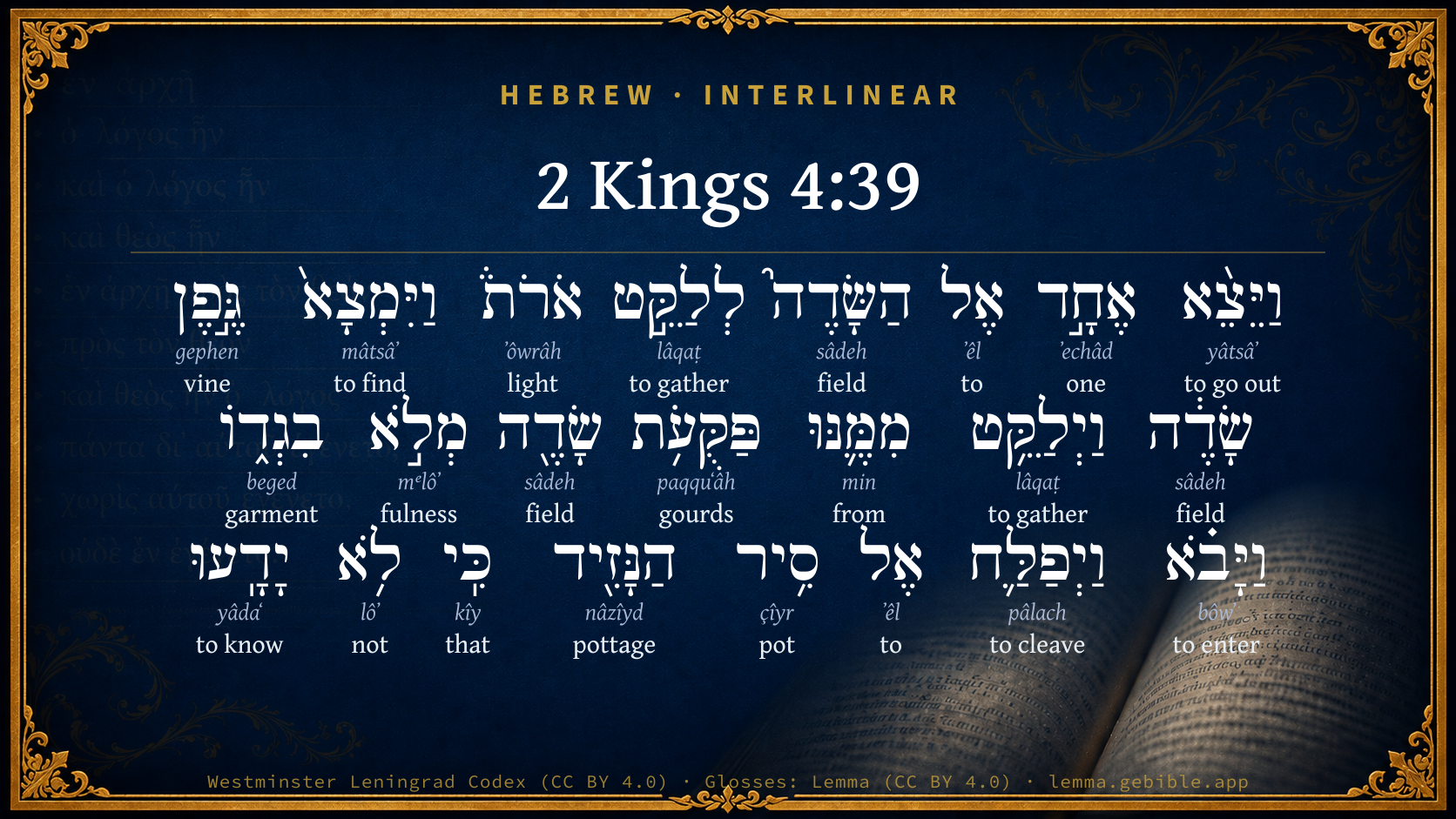
2 Kings 4:39

Hebrew (Westminster Leningrad Codex) 2 Kings 4:39 appears in the Hebrew Old Testament. The text above is from the Westminster Leningrad Codex. Each word links to its Strong’s number, a concise gloss, and parsing drawn from the Open Scriptures Hebrew Bible morphology. Click any word for its full Brown-Driver-Briggs (BDB) entry.
Download image
Cite this verse

2 Kings 4:39 (World English Bible). Public Domain. Lemma interlinear Bible study tool, https://lemma.gebible.app/v/2-kings/4/39.

Show BibTeX & RIS
BibTeX
RIS
English Translation
One went out into the field to gather herbs, and found a wild vine, and gathered of it wild gourds his lap full, and came and shred them into the pot of stew; for they didn't recognize them.
World English Bible · Public Domain
Highlights
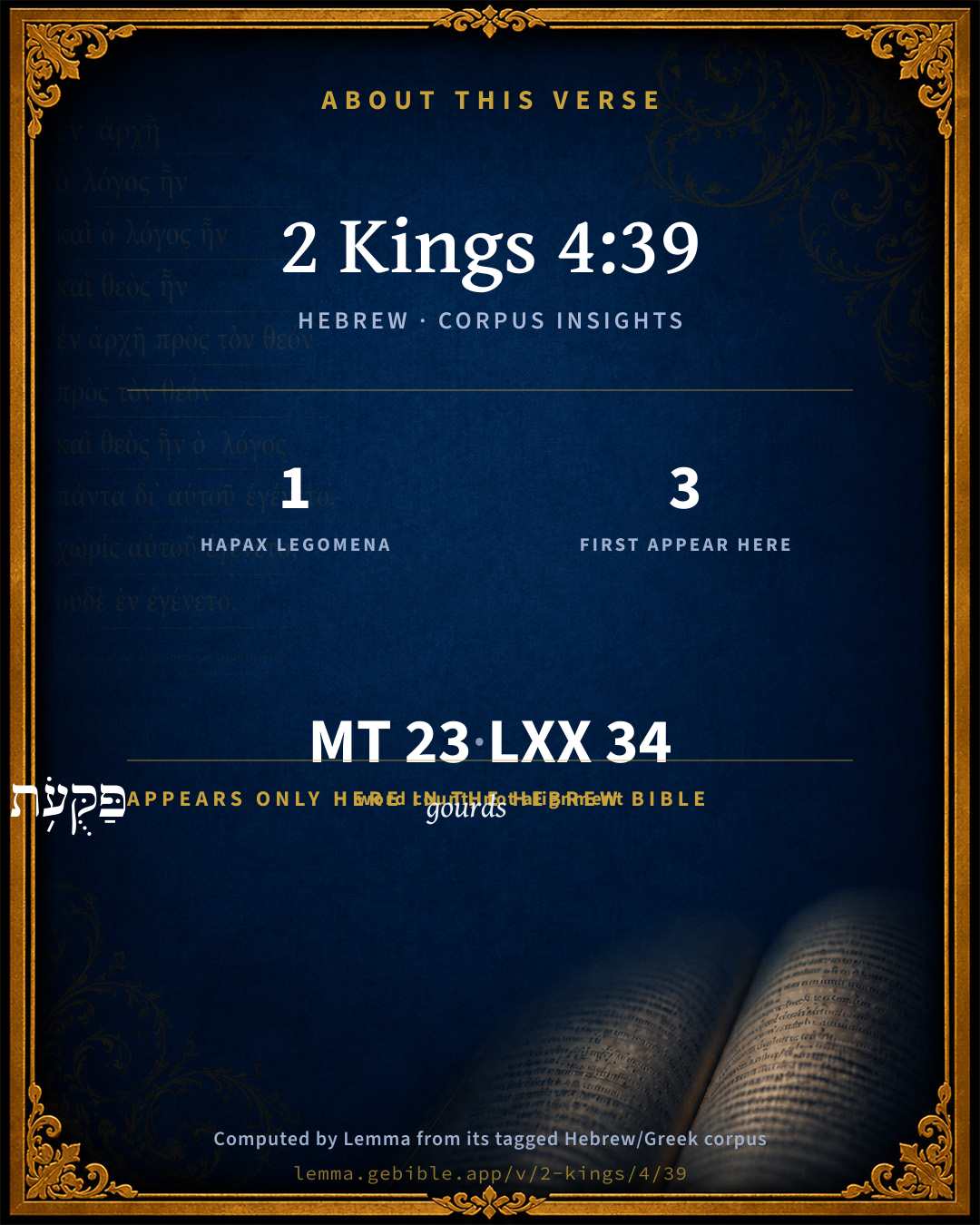
  • 1 hapax legomenon — only here in the Hebrew Bible
  • 3 first appearances in the Hebrew Bible
Full analysis ↓
Download a study sheet

One document with this verse’s original text, its word-by-word gloss line, the meaning frame, cross-references with their text, attributed commentary, and full source and license credits — printable, and it pastes into notes with its structure intact.

This verse Autodidact and up

Study sheet (.html) Plain text (.txt)

A passage Seminary Student

Up to 50 verses in one chapter. A passage sheet keeps up to 6 commentary sources and 12 cross-references per verse, in the order this page ranks them, and says so on the sheet whenever that leaves anything out. Ask for a single verse and you get the Autodidact verse sheet above.

Everything on this page stays free to read, with no account — the sheet is a download of what is already on screen, not access to it.

Want to remove ads? Support Godless Engineer
Compare translations 3

The same verse in 3 English versions, stacked beneath the original-language interlinear above. Click any original word for its lexicon entry.

Each is an independent rendering of the whole verse — the interlinear is not word-aligned to these translations.

Highlighted words mark where these versions differ — a whole-verse word diff, not a word-by-word alignment.

  • World English Bible Public Domain
    One went out into the field to gather herbs, and found a wild vine, and gathered of it wild gourds his lap full, and came and shred them into the pot of stew; for they didn't recognize them.
  • King James Version Public Domain
    And one went out into the field to gather herbs, and found a wild vine, and gathered thereof wild gourds his lap full, and came and shred them into the pot of pottage: for they knew them not.
  • unfoldingWord Literal Text CC BY-SA 4.0
    And one went out to the field to gather herbs, and he found a vine of the field, and he gathered from it gourds of the field, the fullness of his garment. And he came, and he sliced into the pot of stew, for they did not know.

unfoldingWord Literal Text — © unfoldingWord, licensed CC BY-SA 4.0. Word-aligned USFM3 via Door43 (git.door43.org/unfoldingWord/en_ult).

Versions to compare (up to 4)

3 of 4 selected

Show all 18 translations

Every available English version of this verse, each an independent rendering of the whole verse.

  • World English Bible Public Domain
    One went out into the field to gather herbs, and found a wild vine, and gathered of it wild gourds his lap full, and came and shred them into the pot of stew; for they didn't recognize them.
  • Berean Standard Bible Public Domain
    One of them went out to the field to gather herbs, and he found a wild vine from which he gathered as many wild gourds as his garment could hold. Then he came back and cut them up into the pot of stew, though no one knew what they were.
  • Majority Standard Bible Public Domain
    One of them went out to the field to gather herbs, and he found a wild vine from which he gathered as many wild gourds as his garment could hold. Then he came back and cut them up into the pot of stew, though no one knew what they were.
  • King James Version Public Domain
    And one went out into the field to gather herbs, and found a wild vine, and gathered thereof wild gourds his lap full, and came and shred them into the pot of pottage: for they knew them not.
  • American Standard Version (1901) Public Domain
    And one went out into the field to gather herbs, and found a wild vine, and gathered thereof wild gourds his lap full, and came and shred them into the pot of pottage; for they knew them not.
  • Revised Version (1885) Public Domain
    And one went out into the field to gather herbs, and found a wild vine, and gathered thereof wild gourds his lap full, and came and shred them into the pot of pottage: for they knew them not.
  • Geneva Bible (1599) Public Domain
    And one went out into the fielde, to gather herbes, and founde, as it were, a wilde vine, and gathered thereof wilde gourdes his garment ful, and came and shred them into the pot of pottage: for they knew it not.
  • Douay-Rheims (1899) Public Domain
    And one went out into the field to gather wild herbs: and he found something like a wild vine, and gathered of it wild gourds of the field, and filled his mantle, and coming back he shred them into the pot of pottage, for he knew not what it was.
  • Young's Literal Translation Public Domain
    And one goeth out unto the field to gather herbs, and findeth a vine of the field, and gathereth of it gourds of the field -- the fulness of his garment -- and cometh in and splitteth `them' into the pot of pottage, for they knew `them' not;
  • Literal Standard Version CC BY-SA 4.0
    And one goes out to the field to gather herbs, and finds a vine of the field, and gathers gourds of the field from it—the fullness of his garment—and comes in and splits [them] into the pot of stew, for they did not know [them];
  • Unlocked Literal Bible CC BY-SA 4.0
    One of them went out into a field to gather vegetables. He found a wild vine and gathered enough wild gourds to fill the fold of his robe. They cut them up and put them into the stew, but did not know what kind they were.
  • unfoldingWord Literal Text CC BY-SA 4.0
    And one went out to the field to gather herbs, and he found a vine of the field, and he gathered from it gourds of the field, the fullness of his garment. And he came, and he sliced into the pot of stew, for they did not know.
  • Darby Bible Public Domain
    Then one went out into the field to gather herbs, and found a wild vine, and gathered from it his lap full of wild colocynths, and came and shred them into the pot of pottage; for they did not know them.
  • World Messianic Bible Public Domain
    One went out into the field to gather herbs, and found a wild vine, and gathered a lap full of wild gourds from it, and came and cut them up into the pot of stew; for they didn’t recognize them.
  • Webster's Bible Public Domain
    And one went out into the field to gather herbs, and found a wild vine, and gathered from it wild gourds his lap full, and came and shred them into the pot of pottage: for they knew them not.
  • Free Bible Version CC BY-SA 4.0
    One of them went out into the countryside to pick herbs. He found a wild vine and picked as many wild gourds as his cloak could hold. Then he came back and chopped them up into the pot of stew. But nobody knew they were dangerous to eat.
  • Bible in Basic English Public Domain
    And one went out into the field to get green plants and saw a vine of the field, and pulling off the fruit of it till the fold of his robe was full, he came back and put the fruit, cut up small, into the pot of soup, having no idea what it was.
  • JPS Tanakh (1917) Public Domain
    And one went out into the field to gather herbs, and found a wild vine, and gathered thereof wild gourds his lap full, and came and shred them into the pot of pottage; for they knew them not.

Literal Standard Version (2020), Covenant Press — licensed CC BY-SA 4.0. Text via the HelloAO Bible API (eBible.org). Unlocked Literal Bible (unfoldingWord) — licensed CC BY-SA 4.0. Text via the HelloAO Bible API (eBible.org). unfoldingWord Literal Text — © unfoldingWord, licensed CC BY-SA 4.0. Word-aligned USFM3 via Door43 (git.door43.org/unfoldingWord/en_ult). Free Bible Version, Dr. Jonathan Gallagher — licensed CC BY-SA 4.0. Text via the HelloAO Bible API (eBible.org).

Word by word

More ways to search: Search by grammar → Find every occurrence → Compare this word →

Practice this passage: Drill this verse → Learn its vocabulary →

פַּקֻּעֹ֥ת
paqquʻâh
H6498
“gourds of”
Noun, Common, Feminine, Plural, Construct
Part of Speech
Noun
Type
Common
Gender
Feminine
Number
Plural
State
Construct
Full BDB Definition

Origin: from the same as H6497

TWOT: 1804b

gourds
  1. וַיֵּצֵ֨א yâtsâʼ H3318 “and · to go out” Conjunction + Verb, Qal, Sequential Imperfect, 3rd Person, Masculine, Singular
  2. אֶחָ֣ד ʼechâd H259 “one” Adjective, Cardinal number, Masculine, Singular, Absolute
  3. אֶל ʼêl H413 “to” Preposition
  4. הַשָּׂדֶה֮ sâdeh H7704 “the · field” Particle, Definite Article + Noun, Common, Masculine, Singular, Absolute
  5. לְלַקֵּ֣ט lâqaṭ H3950 “to gather” Preposition + Verb, Piel, Infinitive Construct
  6. אֹרֹת֒ ʼôwrâh H219 “lights” Noun, Common, Feminine, Plural, Absolute
  7. וַיִּמְצָא֙ mâtsâʼ H4672 “and · to find” Conjunction + Verb, Qal, Sequential Imperfect, 3rd Person, Masculine, Singular
  8. גֶּ֣פֶן gephen H1612 “vine of” Noun, Common, Both, Singular, Construct
  9. שָׂדֶ֔ה sâdeh H7704 “field” Noun, Common, Masculine, Singular, Absolute
  10. וַיְלַקֵּ֥ט lâqaṭ H3950 “and · to gather” Conjunction + Verb, Piel, Sequential Imperfect, 3rd Person, Masculine, Singular
  11. מִמֶּ֛נּוּ min H4480 “from · us” Preposition + Suffix, Personal, 1st Person, Common, Plural
  12. שָׂדֶ֖ה sâdeh H7704 “field” Noun, Common, Masculine, Singular, Absolute
  13. מְלֹ֣א mᵉlôʼ H4393 “fulness of” Noun, Common, Masculine, Singular, Construct
  14. בִגְד֑וֹ beged H899 “garment · his” Noun, Common, Masculine, Singular, Construct + Suffix, Personal, 3rd Person, Masculine, Singular
  15. וַיָּבֹ֗א bôwʼ H935 “and · to enter” Conjunction + Verb, Qal, Sequential Imperfect, 3rd Person, Masculine, Singular
  16. וַיְפַלַּ֛ח pâlach H6398 “and · to cleave” Conjunction + Verb, Piel, Sequential Imperfect, 3rd Person, Masculine, Singular
  17. אֶל ʼêl H413 “to” Preposition
  18. סִ֥יר çîyr H5518 “pot of” Noun, Common, Both, Singular, Construct
  19. הַנָּזִ֖יד nâzîyd H5138 “the · pottage” Particle, Definite Article + Noun, Common, Masculine, Singular, Absolute
  20. כִּֽי kîy H3588 “that” Conjunction
  21. לֹ֥א lôʼ H3808 “not” Particle, Negative
  22. יָדָֽעוּ yâdaʻ H3045 “to know” Verb, Qal, Perfect, 3rd Person, Common, Plural

About this verse

These counts appear in no published source. They are computed here, from the morphology-tagged text and Lemma’s own curated glosses. What Lemma adds →

23
words
19
distinct lemmas
Historical
section

Notable vocabulary

1 hapax legomenon — a word that appears only here in the entire Hebrew Bible:

  • פַּקֻּעֹ֥ת gourds H6498

First appearance in Scripture

These words make their first canonical appearance in the Hebrew Bible here:

  • אֹרֹת֒ light H219
  • פַּקֻּעֹ֥ת gourds H6498
  • וַיְפַלַּ֛ח to cleave H6398

Shared distinctive vocabulary

אֹרֹת֒ light H219 occurs in 4 verses of the Hebrew Bible. Also found in:

Grammatical profile

  • 7 verbs
  • 10 nouns
  • 1 adjective
  • 3 prepositions
  • 1 conjunction
  • 1 particle

Verb forms

  • וַיֵּצֵ֨א Qal · Sequential Imperfect
  • לְלַקֵּ֣ט Piel · Infinitive Construct
  • וַיִּמְצָא֙ Qal · Sequential Imperfect
  • וַיְלַקֵּ֥ט Piel · Sequential Imperfect
  • וַיָּבֹ֗א Qal · Sequential Imperfect
  • וַיְפַלַּ֛ח Piel · Sequential Imperfect
  • יָדָֽעוּ Qal · Perfect

Repetition

Words recur within this verse — often emphatic in Hebrew:

  • הַשָּׂדֶה֮ field H7704 ×3
  • לְלַקֵּ֣ט to gather H3950 ×2
  • אֶל to H413 ×2

Hebrew & Septuagint length

In English translation the verse runs 38 words from the Hebrew and 40 from the Septuagint (LXX English) — closely comparable.

A rough comparison of the two English renderings, which tokenize alike — not a word-level alignment.

Word counts can differ between the Hebrew and the Greek without any difference in meaning — e.g. the Hebrew direct-object marker אֵת has no separate Greek word, and Greek often adds the article ὁ.

In the original languages it is 23 Hebrew tokens and 34 Greek tokens — but the two are counted differently (Hebrew bundles its prefixes and suffixes into one token; the Greek is in lemma form), so that isn’t a like-for-like length.

Cross-references

4

Topical passages linked to 2 Kings 4:39 in the Treasury of Scripture Knowledge — connected by theme and wording, ordered by reader-vote popularity; previews shown in the World English Bible.

  • Isaiah 5:4 What could have been done more to my vineyard, that I have not done in it? Why, when I looked for it to yield grapes, did it yield wild grapes?
  • Jeremiah 2:21 Yet I had planted you a noble vine, wholly a right seed: how then are you turned into the degenerate branches of a foreign vine to me?
  • Matthew 15:13 But he answered, "Every plant which my heavenly Father didn't plant will be uprooted.
  • Hebrews 12:15 looking carefully lest there be any man who falls short of the grace of God; lest any root of bitterness springing up trouble you, and thereby the many be defiled;

Cross-references courtesy of OpenBible.info (CC BY 4.0).

Hebrew and Greek witnesses Masoretic Hebrew ↔ Greek Septuagint

The same verse in the two great witnesses to the Old Testament, shown verse-for-verse.

These are two independent witnesses, not word-aligned to each other, and the Septuagint is shown in lemma (dictionary) form.

Hebrew 2 Kings 4:39 Masoretic · Westminster Leningrad Codex

וַיֵּצֵ֨א אֶחָ֣ד אֶל הַשָּׂדֶה֮ לְלַקֵּ֣ט אֹרֹת֒ וַיִּמְצָא֙ גֶּ֣פֶן שָׂדֶ֔ה וַיְלַקֵּ֥ט מִמֶּ֛נּוּ פַּקֻּעֹ֥ת שָׂדֶ֖ה מְלֹ֣א בִגְד֑וֹ וַיָּבֹ֗א וַיְפַלַּ֛ח אֶל סִ֥יר הַנָּזִ֖יד כִּֽי לֹ֥א יָדָֽעוּ

One went out into the field to gather herbs, and found a wild vine, and gathered of it wild gourds his lap full, and came and shred them into the pot of stew; for they didn't recognize them.

World English Bible · Public Domain

Greek LXX 2 Kings 4:39 Septuagint · lemma form

καί ἐκἔρχομαι εἷς εἰς ὁ ἀγρός συνλέγω αριωθ καί εὑρίσκω ἄμπελος ἐν ὁ ἀγρός καί συνλέγω ἀπό αὐτός τολύπη ἄγριος πλήρης ὁ ἱμάτιον αὐτός καί ἐνβάλλω εἰς ὁ λέβης ὁ ἕψεμα ὅτι οὐ γιγνώσκω

And he went out into the field to gather herbs, and found a vine in the field, and gathered of it wild gourds, his garment full; and he cast it into the caldron of pottage, for they knew them not.

LXX2012 (modern English Septuagint) · Public Domain

On this verse, Ellicott's Commentary for English Readers discusses the Septuagint’s reading. Read the note in Commentary ↓

Hebrew: Westminster Leningrad Codex (CC BY 4.0). Greek: Septuagint (public domain); English from LXX2012 (modern English Septuagint) (Public Domain). How the Septuagint differs from the Hebrew →

Targum (Aramaic paraphrase)

1

The Targum is the ancient Jewish Aramaic paraphrase of the Hebrew Scriptures — an interpretive translation, not the Hebrew text itself. Onkelos (literal) and Pseudo-Jonathan (expansive) render the Torah, and Jonathan the Prophets. Coverage is partial: where no permissively-licensed English translation exists for a verse, only the Aramaic is shown. This is verse-level text, not a word-by-word alignment to the Hebrew.

  1. Targum Jonathan Prophets (Joshua–Malachi)
    וּנְפַק חָד לְחַקְלָא לְלַקְטָא יֵרוֹקָנִין וְאַשְׁכַּח גוּפְנָא בְּחַקְלָא וְלַקֵיט מִינֵיהּ פִּקְעֵי חַקְלָא מְלֵי לְבוּשֵׁיהּ וַאֲתָא וּפְרַס וּרְמָא לְדוּדָא דְתַבְשִׁלָא אֲרֵי לָא יְדָעוּ:

    (no public-domain English translation for this verse)

    Targum Jonathan — Aramaic: “Mikraot Gedolot” (public domain). English: “Sefaria Community Translation” (CC0 1.0 (public-domain dedication)); “London "Chaldee Paraphrase," 1871” (public domain). Text via Sefaria.

Commentary

Notes on 2 Kings 4:39 from classic Christian and Jewish commentators (each source and its license shown beneath its notes). The classic Christian expositions comment on the surrounding passage and are grouped to its opening verse, so a note may address several verses; the Jewish commentaries on the Tanakh (Rashi and others) are per-verse, so they appear only where the commentator wrote on this verse.

Lemma curates 59 commentaries, every one of them public domain or Creative Commons licensed, each selected and text-cleaned for this edition rather than reprinted as found. About our sources →

Trapp's Complete Commentary

John Trapp

2Ki 4:39 And one went out into the field to gather herbs, and found a wild vine, and gathered thereof wild gourds his lap full, and came and shred [them] into the pot of pottage: for they knew [them] not.

Ver. 39. Of wild gourds his lapful] This is taken to be coloquintida, which is very bitter, saith Valesius, {a} so that physicians call it Fel terrae, the gall of the earth.

{a} De Sac. Plalos., cap. 36.

John Trapp, A Commentary or Exposition upon All the Books of the Old and New Testament (1647–1656) — public domain. Text from a community e-Sword module.

Joseph Benson's Commentary

2Ki 4:39-41. And found a wild vine — This is generally supposed to have been the coloquintida plant, which has a leaf something like that of the vine, but is so very bitter, that some have called it “the gall of the whole earth:” it purges vehemently, and is a sort of poison if not qualified and taken in a moderate quantity. For they knew them not — Neither he that gathered them, nor they that shred them, knew what they were, but took them to be the leaves of a wild vine. They cried out, O thou man of God, there is death in the pot — That is, some deadly thing. This they concluded from its being so bitter and distasteful. He said, Bring meal and cast it into the pot — Together with the pottage, which they had taken out of it. And there was no harm in the pot — Which alteration was not from any virtue in the meal, but from the power of God.

Joseph Benson's Commentary on the Old and New Testaments (1811–1818) — public domain. Text from a community e-Sword module.

Tyndale Open Study Notes

Tyndale Open Resources

4:39-41 The men immediately recognized that the young man’s wild gourds were poisonous; they did not want to be poisoned or to waste the stew during a famine, so they turned to Elisha for help. The flour was a tangible symbol of God’s miraculous provision of food.

Tyndale Open Study Notes — © Tyndale Open Resources, licensed CC BY-SA 4.0. Text via the HelloAO Bible API.

Geneva Bible (1599)

Geneva Bible translators

Which the Apothecaries call colloquintida, and is most vehement and dangerous in purging.

Geneva Bible (1599) marginal notes — public domain. Text via Bolls.life.

Jamieson, Fausset & Brown

Robert Jamieson, A. R. Fausset & David Brown

went out into the field to gather herbs--Wild herbs are very extensively used by the people in the East, even by those who possess their own vegetable gardens. The fields are daily searched for mallow, asparagus, and other wild plants.

wild vine--literally, "the vine of the field," supposed to be the colocynth, a cucumber, which, in its leaves, tendrils, and fruit, bears a strong resemblance to the wild vine. The "gourds," or fruit, are of the color and size of an orange bitter to the taste, causing colic, and exciting the nerves, eaten freely they would occasion such a derangement of the stomach and bowels as to be followed by death. The meal which Elisha poured into the pot was a symbolic sign that the noxious quality of the herbs was removed.

lap full--The hyke, or large cloak, is thrown loosely over the left shoulder and fastened under the right arm, so as to form a lap or apron.

Jamieson, Fausset & Brown — Commentary Critical and Explanatory on the Whole Bible (1871) — public domain (CC PDM 1.0). Text via the HelloAO Bible API.

Adam Clarke's Commentary

Verse 39. Wild gourds] This is generally thought to be the coloquintida, the fruit of a plant of the same name, about the size of a large orange. It is brought hither from the Levant, and is often known by the name of the bitter apple; both the seeds and pulp are intensely bitter, and violently purgative. It ranks among vegetable poisons, as all intense bitters do; but, judiciously employed, it is of considerable use in medicine.

Adam Clarke's Commentary on the Bible (1810–1826) — public domain. Text from a community e-Sword/MySword module.

Ellicott's Commentary for English Readers

(39) Herbs.—A rare word. (See Isa_26:19.) The Targum renders “greens.” The LXX. retains the Hebrew word; the Syriac and Arabic render “mallows.” Thenius thinks that αριωθ, the reading of the LXX., points to another word derived from a different root, and meaning “to pluck,” so that the word would denote legumina.

A wild vine.—Vulg., “quasi vitem silvestrem,” i.e., a running plant, like a vine.

Wild gourds.—In 1Ki_6:18 a related word is used to describe one of the decorations of the Temple (“knops”).

Wild gourds, or cucumbers (cucumeres agrestes, or asinini), are oval in shape, and taste bitter. Their Hebrew name (paqqû‘ôth) is expressive of the fact that when ripe they are apt to burst upon being touched. If eaten they act as a violent purgative. They were mistaken on the present occasion for edible gourds, a favourite food of the people (Num_11:5). The Vulg. renders “colocynth,” or coloquintida, a plant of the same family, bearing large orange-like fruits, which are very bitter, and cause colic (cucumis colocynthi, L.). Keil supposes this to be the “wild vine” intended.

They knew them not.—And so did not stop the young man from his shredding.

A Bible Commentary for English Readers, edited by Charles John Ellicott (1878–1897) — public domain. Text from a community e-Sword module.

The Cambridge Bible for Schools and Colleges

gen. ed. J. J. S. Perowne

39. And one went out] As the needful services were performed by the members of the college among themselves, it was no doubt one of them who went into the field to gather such herbs as he could find.

a wild vine] i.e. some wild plant with vine-like tendrils, named here ‘vine’ for want of knowledge of its true name. The colocynth has tendrils after the fashion of the wild bryony in our hedgerows.

wild gourds] The Hebrew word is explained as meaning ‘wild cucumber’, an egg-shaped fruit with very bitter taste. But the prickly fruit of this plant could hardly be thought fit for pottage. Others think that the ‘colocynth’ is meant, and this was the opinion of the LXX., which renders by τολυπὴ ἀγρία, ‘wild pumpkin’. This fruit might be mistaken for a melon.

for they knew them not] Nobody among the brotherhood had sufficient skill of plants to stop their comrade, and tell him the noxious nature of the herb he had brought home.

The Cambridge Bible for Schools and Colleges (gen. ed. J. J. S. Perowne; Cambridge University Press, 1878–1918) — public domain. Text from a community e-Sword module.

John Gill's Exposition

And one went out into the fields to gather herbs,.... To put into the pottage, the gardens affording none in this time of dearth; or, however, being scarce, were at too great a price for the sons of the prophets to purchase them; and therefore one of them went out into the field to gather what common herbs he could:

and found a wild vine, and gathered thereof wild gourds his lap full; thought to be the same with coloquintida, the leaves of which are very like to a vine, of a very bitter taste, and a very violent purgative, which, if not remedied, will produce ulcerations in the bowels, and issue in death; some think the white brier or white vine is meant, the colour of whose berries is very inviting to look at, but very bitter and ungrateful, and it vehemently purges (b); the Arabs call a sort of mushroom that is white and soft by this name (c), but cannot be meant here, because it has no likeness to a wild vine:

and came and shred them into the pot of pottage; cut or chopped them small, and put them into the pot:

for they knew them not; what they were, the nature and virtue of them, being unskilful in botany.

(b) Vid. Scheuchzer. Physic. Sacr. vol. 3. p. 605, 859. (c) Golius, col. 1817.

John Gill's Exposition of the Whole Bible (1746–1763) — public domain (CC PDM 1.0). Text via the HelloAO Bible API.

Albert Barnes' Notes on the Bible

A wild vine - Not a real wild vine, the fruit of which, if not very palatable, is harmless; but some climbing plant with tendrils. The plant was probably either the Ecbalium elaterium, or “squirting cucumber,” the fruit of which, egg-shaped, and of a very bitter taste, bursts at the slightest touch, when it is ripe, and squirts out sap and seed grains; or the Colocynthis, which belongs to the family of cucumbers, has a vine-shaped leaf, and bears a fruit as large as an orange, very bitter, from which is prepared the drug sold as colocynth. This latter plant grows abundantly in Palestine.

His lap full - literally, “his shawl full.” The prophet brought the fruit home in his “shawl” or “outer garment.”

Albert Barnes' Notes on the Bible (1834–1885) — public domain. Text from a community e-Sword/MySword module.

Haydock's Catholic Bible Commentary

Wild herbs. Hebrew oroth. Septuagint Greek: arioth, may denote any thing that could be "gathered." --- Gourds: colocynthides. They resembled cucumbers; but were so bitter, that they were styled, "the gall of the earth." Vallesius, (Phil. c. 36.) who observes, that a small quantity may cause death, (c. 37.) and that the remedy used by the prophet was supernatural; though Lemnius (c. 7.) asserts, that the mixture of barley-flour would take away the bitterness. (Tirinus) --- It has, in effect, that tendency; but the hand of God must still be acknowledged. (Calmet)

George Leo Haydock (1774–1849), Haydock's Catholic Family Bible and Commentary, 1859 edition — public domain. Excludes Psalms (Douay-Rheims chapter numbering differs from Protestant) and Deuterocanonical books (Catholic canon only).

Matthew Poole's English Annotations

A wild vine; a plant called coloquintida, whose gourds or leaves resemble the leaves of a vine, and are very bitter and pernicious to the eater.

Matthew Poole's English Annotations on the Holy Bible (1683–1685) — public domain. Text from a community e-Sword/MySword module.

Whedon's Commentary on the Bible

Daniel D. Whedon

39. Herbs — ארת, oroth. “This noun is derived from אור, in the signification to shine, glitter, so far as verbs of shining are also applied metaphorically to blossoming, sprouting, ripening.” — Furst. Whether the word means some particular vegetable, or stands for herbs in general, is not settled. Perhaps oroth were a sort of vegetable for which wild gourds might be easily mistaken.

Wild gourds — One species of that extensive family of cucumber-like vegetables, abundant in the East, some of which are edible and some bitter and poisonous. Of one of these species Kitto says: “In the desert part of Syria, Egypt, and Arabia, and on the banks of the rivers Tigris and Euphrates, its tendrils run over vast tracts of ground, offering a prodigious number of gourds, which are crushed under foot by camels, horses, and men. In winter we have seen the extent of many miles covered with the connecting tendrils and dry gourds of the preceding season, the latter exhibiting precisely the same appearance as in our shops; and when crushed, with a crackling noise, beneath the feet, discharging, in the form of a light powder, the valuable drug which they contain.”

Shred them — Sliced them; cut them up into small shreds or slices.

Daniel D. Whedon (gen. ed.), Commentary on the Old and New Testaments (1874–1909) — public domain. Text from a community e-Sword module.

The Pulpit Commentary

And one went out into the field to gather herbs. One of the sons of the prophets, probably, went out into the neighboring country, and looked about for any wild fruits or vegetables that he could see anywhere. And found a wild vine. Not a wild grape vine (Vitis labrusea), the fruit of which would have been harmless, but some cucurbitaceous plant, with tendrils, and a growth like that of the vine. And gathered thereof wild gourds. The exact kind of gourd is uncertain. Recent critics have mostly come to the conclusion that the vegetable intended is the Cucumis agrestis or Ecbalium elaterium, the "squirting cucumber" of English naturalists. This is a kind of gourd, the fruit of which is egg-shaped, has a bitter taste, and bursts when ripe at a slight touch, squirting out sap and seeds. The main ground for this conclusion is etymologieal, tOQup being derived from qp, "to crack" or "split." Another theory, and one which has the ancient versions in its favor, identifies the "gourd" in question with the fruit of the colocynth, which is a gourd-like plant that creeps along the ground, and has a round yellow fruit of the size of a large orange. This fruit is exceedingly bitter, produces colic, and affects the nerves. His lap full; as many as he could carry in the sinus, or large fold, of his beged, or shawl.

And came and shred them into the pot of pottage: for they knew them not; i.e. the sons of the prophets, who stood by and saw them shred into the pot, did not recognize them, or did not know that they were unwholesome.

The Pulpit Commentary (1880–1919), ed. H.D.M. Spence-Jones & Joseph S. Exell — public domain. Text from a community e-Sword module.

Rashi

Rabbi Shlomo Yitzchaki (Rashi)

To gather greens [herbs]. [‘אֹרֹת’ is] field-rocket which is called oruge, and it enlightens [=מֵאִיר] the eyes. Others interpret ‘אֹרֹת’ as herbs, as in, “like a clear heat on herbs [=אוֹר].”

And he found a vine in the field. A vine in the field.

And gathered wild gourds from it. Wild mushrooms sprouted from it, boleiz, in O.F., which are poisonous. And in the name of Rabbi Menachem I heard, “and he gathered in addition to the fruit that grew from it, wild gourds.”

And sliced [them]. Split them.

Rashi on the Tanakh — English translations: “The Judaica Press complete Tanach with Rashi, translated by A. J. Rosenberg” (CC BY 4.0); “Pentateuch with Rashi's commentary by M. Rosenbaum and A.M. Silbermann, 1929-1934” (public domain); “The Metsudah Tanach series, Lakewood, N.J” (CC BY 4.0); and “The Book of Joshua, Metsudah Publications, 1997” (CC BY 4.0). Text via Sefaria.

Lesson kit

Teaching starters — assembled from the data on this page, not authored interpretation. Every prompt links to the verse data it draws on. Edit before teaching.

2 Kings, in the Historical, opens this verse with 23 words (19 distinct Hebrew lemmas). Its most distinctive word is paqquʻâh (“gourds”). A historical commentator’s framing appears above. Read the whole chapter for the surrounding context.

Discussion questions

  1. How does “gourds” (paqquʻâh) shape what this verse is saying?
  2. This verse holds 1 word here found nowhere else in the Hebrew Bible. What might the rare word draw attention to?
  3. 3 words here appear for the first time in Scripture. What is being introduced at this debut?
  4. Esther 8:16 shares the word «light» with this verse. How do the two illuminate each other?
  5. “field” occurs 3× in this one verse. What is the effect of the repetition?
  6. The translations on this page render this verse differently — a whole-verse word diff, not a word-by-word alignment. What might account for the different wordings?
  7. The verb «וַיֵּצֵ֨א» is Qal Sequential Imperfect. How does its form color the action?
  8. Reading how Trapp's Complete Commentary and Joseph Benson's Commentary read this verse, where do the two commentators agree and where do they part?

Things to notice

  • 1 word in this verse appears nowhere else in the Hebrew Bible.
  • 3 words make their first canonical appearance in Scripture here.
  • This verse counts 23 Hebrew ↔ 34 Greek words.
  • These translations choose different wording for 15 words in this verse.
  • “field” occurs 3× in this single verse.

Reading settings

Reading text

Shown beneath each verse's original-language words.

Old Testament
Old Testament edition

Read the OT as the Masoretic Hebrew (MT) or the Greek Septuagint (LXX).

English shown for the Greek Septuagint (in the Hebrew ↔ Greek comparison).

Comparing translations? Open the Compare panel on any verse page to stack up to four side by side.