
2 Chronicles 31:5

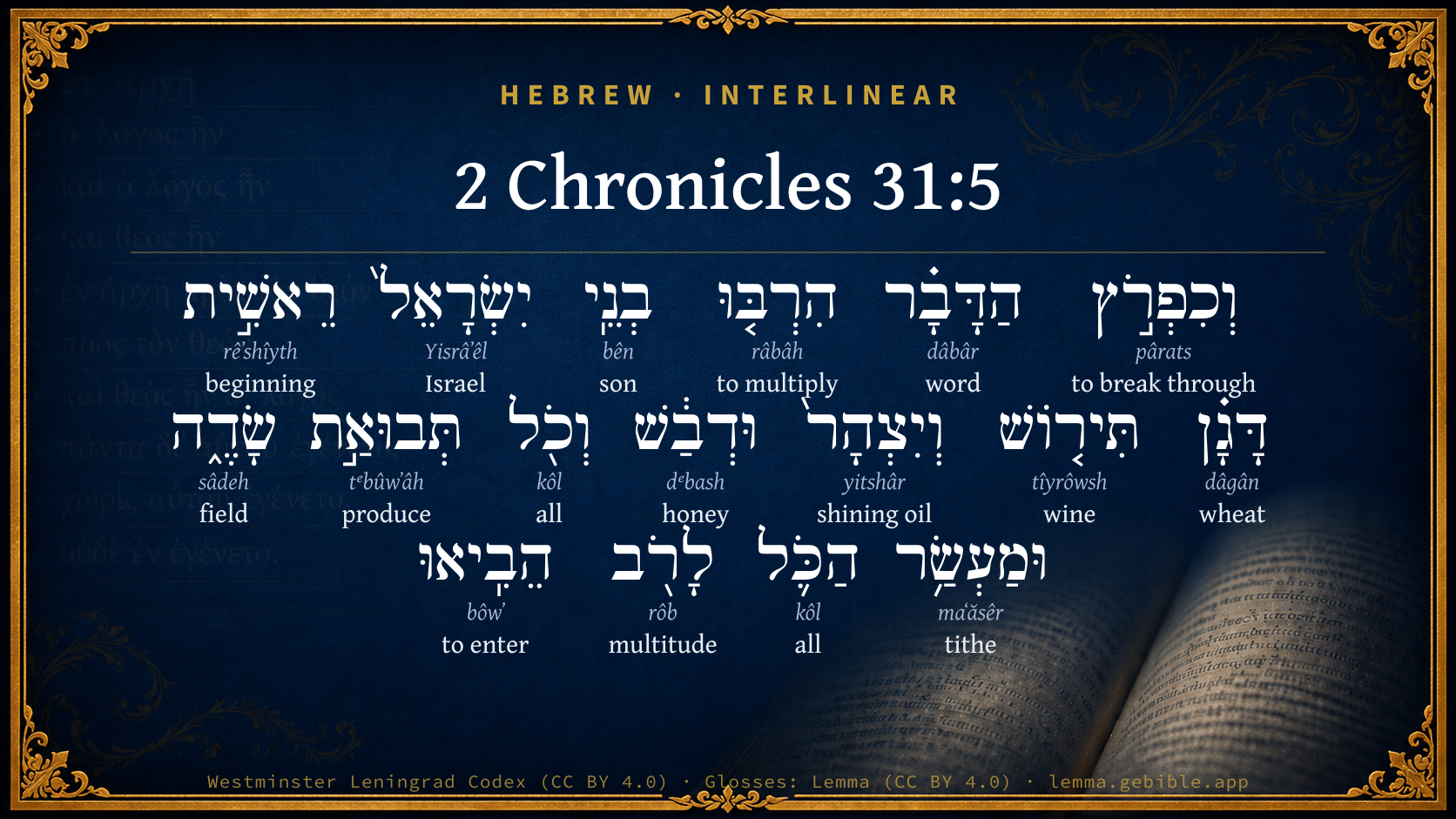
Hebrew (Westminster Leningrad Codex) 2 Chronicles 31:5 appears in the Hebrew Old Testament. The text above is from the Westminster Leningrad Codex. Each word links to its Strong’s number, a concise gloss, and parsing drawn from the Open Scriptures Hebrew Bible morphology. Click any word for its full Brown-Driver-Briggs (BDB) entry.
Download image
Cite this verse

2 Chronicles 31:5 (World English Bible). Public Domain. Lemma interlinear Bible study tool, https://lemma.gebible.app/v/2-chronicles/31/5.

Show BibTeX & RIS
BibTeX
RIS
English Translation
As soon as the commandment came abroad, the children of Israel gave in abundance the first fruits of grain, new wine, and oil, and honey, and of all the increase of the field; and the tithe of all things brought they in abundantly.
World English Bible · Public Domain
Download a study sheet

One document with this verse’s original text, its word-by-word gloss line, the meaning frame, cross-references with their text, attributed commentary, and full source and license credits — printable, and it pastes into notes with its structure intact.

This verse Autodidact and up

Study sheet (.html) Plain text (.txt)

A passage Seminary Student

Up to 50 verses in one chapter. A passage sheet keeps up to 6 commentary sources and 12 cross-references per verse, in the order this page ranks them, and says so on the sheet whenever that leaves anything out. Ask for a single verse and you get the Autodidact verse sheet above.

Everything on this page stays free to read, with no account — the sheet is a download of what is already on screen, not access to it.

Want to remove ads? Support Godless Engineer
Compare translations 3

The same verse in 3 English versions, stacked beneath the original-language interlinear above. Click any original word for its lexicon entry.

Each is an independent rendering of the whole verse — the interlinear is not word-aligned to these translations.

Highlighted words mark where these versions differ — a whole-verse word diff, not a word-by-word alignment.

  • World English Bible Public Domain
    As soon as the commandment came abroad, the children of Israel gave in abundance the first fruits of grain, new wine, and oil, and honey, and of all the increase of the field; and the tithe of all things brought they in abundantly.
  • King James Version Public Domain
    And as soon as the commandment came abroad, the children of Israel brought in abundance the firstfruits of corn, wine, and oil, and honey, and of all the increase of the field; and the tithe of all things brought they in abundantly.
  • unfoldingWord Literal Text CC BY-SA 4.0
    And when the word broke through, the sons of Israel gave in abundance firstfruits of grain, new wine, and oil, and honey, and all the produce of the field. And the tithe of all the abundance they brought in.

unfoldingWord Literal Text — © unfoldingWord, licensed CC BY-SA 4.0. Word-aligned USFM3 via Door43 (git.door43.org/unfoldingWord/en_ult).

Versions to compare (up to 4)

3 of 4 selected

Show all 18 translations

Every available English version of this verse, each an independent rendering of the whole verse.

  • World English Bible Public Domain
    As soon as the commandment came abroad, the children of Israel gave in abundance the first fruits of grain, new wine, and oil, and honey, and of all the increase of the field; and the tithe of all things brought they in abundantly.
  • Berean Standard Bible Public Domain
    As soon as the order went out, the Israelites generously provided the firstfruits of the grain, new wine, oil, and honey, and of all the produce of the field, and they brought in an abundance—a tithe of everything.
  • Majority Standard Bible Public Domain
    As soon as the order went out, the Israelites generously provided the firstfruits of the grain, new wine, oil, and honey, and of all the produce of the field, and they brought in an abundance—a tithe of everything.
  • King James Version Public Domain
    And as soon as the commandment came abroad, the children of Israel brought in abundance the firstfruits of corn, wine, and oil, and honey, and of all the increase of the field; and the tithe of all things brought they in abundantly.
  • American Standard Version (1901) Public Domain
    And as soon as the commandment came abroad, the children of Israel gave in abundance the first-fruits of grain, new wine, and oil, and honey, and of all the increase of the field; and the tithe of all things brought they in abundantly.
  • Revised Version (1885) Public Domain
    And as soon as the commandment came abroad, the children of Israel gave in abundance the firstfruits of corn, wine, and oil, and honey, and of all the increase of the field; and the tithe of all things brought they in abundantly.
  • Geneva Bible (1599) Public Domain
    And when the commandement was spread, the children of Israel brought abundance of first fruites, of corne, wine, and oyle, and honie, and of all the increase of the fielde, and the tithes of all things brought they abundantly.
  • Douay-Rheims (1899) Public Domain
    Which when it was noised abroad in the ears of the people, the children of Israel offered in abundance the firstfruits of corn, wine, and oil, and honey: and brought the tithe of all things which the ground bringeth forth.
  • Young's Literal Translation Public Domain
    and at the spreading forth of the thing have the sons of Israel multiplied the first-fruit of corn, new wine, and oil, and honey, and of all the increase of the field, and the tithe of the whole in abundance they have brought in.
  • Literal Standard Version CC BY-SA 4.0
    and at the spreading forth of the thing, the sons of Israel have multiplied the first-fruit of grain, new wine, and oil, and honey, and of all the increase of the field, and they have brought in the tithe of the whole in abundance.
  • Unlocked Literal Bible CC BY-SA 4.0
    As soon as the command was sent out, the people of Israel generously gave the firstfruits of grain, new wine, oil, honey, and from all their harvest of the field. They brought in a tithe of everything, which was a great quantity.
  • unfoldingWord Literal Text CC BY-SA 4.0
    And when the word broke through, the sons of Israel gave in abundance firstfruits of grain, new wine, and oil, and honey, and all the produce of the field. And the tithe of all the abundance they brought in.
  • Darby Bible Public Domain
    And as soon as the commandment was published, the children of Israel gave in abundance the firstfruits of corn, new wine and oil and honey, and of all the increase of the field; and they brought in abundantly the tithe of all [things].
  • World Messianic Bible Public Domain
    As soon as the commandment went out, the children of Israel gave in abundance the first fruits of grain, new wine, oil, honey, and of all the increase of the field; and they brought in the tithe of all things abundantly.
  • Webster's Bible Public Domain
    And as soon as the commandment came abroad, the children of Israel brought in abundance the first-fruits of corn, wine, and oil, and honey, and of all the increase of the field; and the tithe of all things they brought in abundantly.
  • Free Bible Version CC BY-SA 4.0
    As soon as the message went out, the Israelites generously gave the firstfruits of the grain, new wine, olive oil, and honey, and of all the crops. They brought plenty, a tithe of everything.
  • Bible in Basic English Public Domain
    And when the order was made public, straight away the children of Israel gave, in great amounts, the first-fruits of their grain and wine and oil and honey, and of the produce of their fields; and they took in a tenth part of everything, a great store.
  • JPS Tanakh (1917) Public Domain
    And as soon as the commandment came abroad, the children of Israel gave in abundance the first-fruits of corn, wine, and oil, and honey, and of all the increase of the field; and the tithe of all things brought they in abundantly.

Literal Standard Version (2020), Covenant Press — licensed CC BY-SA 4.0. Text via the HelloAO Bible API (eBible.org). Unlocked Literal Bible (unfoldingWord) — licensed CC BY-SA 4.0. Text via the HelloAO Bible API (eBible.org). unfoldingWord Literal Text — © unfoldingWord, licensed CC BY-SA 4.0. Word-aligned USFM3 via Door43 (git.door43.org/unfoldingWord/en_ult). Free Bible Version, Dr. Jonathan Gallagher — licensed CC BY-SA 4.0. Text via the HelloAO Bible API (eBible.org).

Word by word

More ways to search: Search by grammar → Find every occurrence → Compare this word →

Practice this passage: Drill this verse → Learn its vocabulary →

וְיִצְהָר֙
yitshâr
H3323
“and · shining oil”
Conjunction + Noun, Common, Masculine, Singular, Absolute
Part of Speech
Conjunction + Noun
Type
Common
Gender
Masculine
Number
Singular
State
Absolute
Full BDB Definition

Origin: from H6671

TWOT: 1883c

fresh oil, shining (pure) oil
  1. וְכִפְרֹ֣ץ pârats H6555 “and · like/as · to break through” Conjunction + Preposition + Verb, Qal, Infinitive Construct
  2. הַדָּבָ֗ר dâbâr H1697 “the · word” Particle, Definite Article + Noun, Common, Masculine, Singular, Absolute
  3. הִרְבּ֤וּ râbâh H7235 “to multiply” Verb, Hiphil, Perfect, 3rd Person, Common, Plural
  4. בְנֵֽי bên H1121 “sons of” Noun, Common, Masculine, Plural, Construct
  5. יִשְׂרָאֵל֙ Yisrâʼêl H3478 “Israel” Noun, Proper
  6. רֵאשִׁ֣ית rêʼshîyth H7225 “beginning of” Noun, Common, Feminine, Singular, Construct
  7. דָּגָ֗ן dâgân H1715 “wheat” Noun, Common, Masculine, Singular, Absolute
  8. תִּיר֤וֹשׁ tîyrôwsh H8492 “wine” Noun, Common, Masculine, Singular, Absolute
  9. וּדְבַ֔שׁ dᵉbash H1706 “and · honey” Conjunction + Noun, Common, Masculine, Singular, Absolute
  10. וְכֹ֖ל kôl H3605 “and · all of” Conjunction + Noun, Common, Masculine, Singular, Construct
  11. תְּבוּאַ֣ת tᵉbûwʼâh H8393 “produce of” Noun, Common, Feminine, Singular, Construct
  12. שָׂדֶ֑ה sâdeh H7704 “field” Noun, Common, Masculine, Singular, Absolute
  13. וּמַעְשַׂ֥ר maʻăsêr H4643 “and · tithe of” Conjunction + Noun, Common, Masculine, Singular, Construct
  14. הַכֹּ֛ל kôl H3605 “the · all” Particle, Definite Article + Noun, Common, Masculine, Singular, Absolute
  15. לָרֹ֖ב rôb H7230 “to/for · multitude” Preposition + Noun, Common, Both, Singular, Absolute
  16. הֵבִֽיאוּ bôwʼ H935 “to enter” Verb, Hiphil, Perfect, 3rd Person, Common, Plural

About this verse

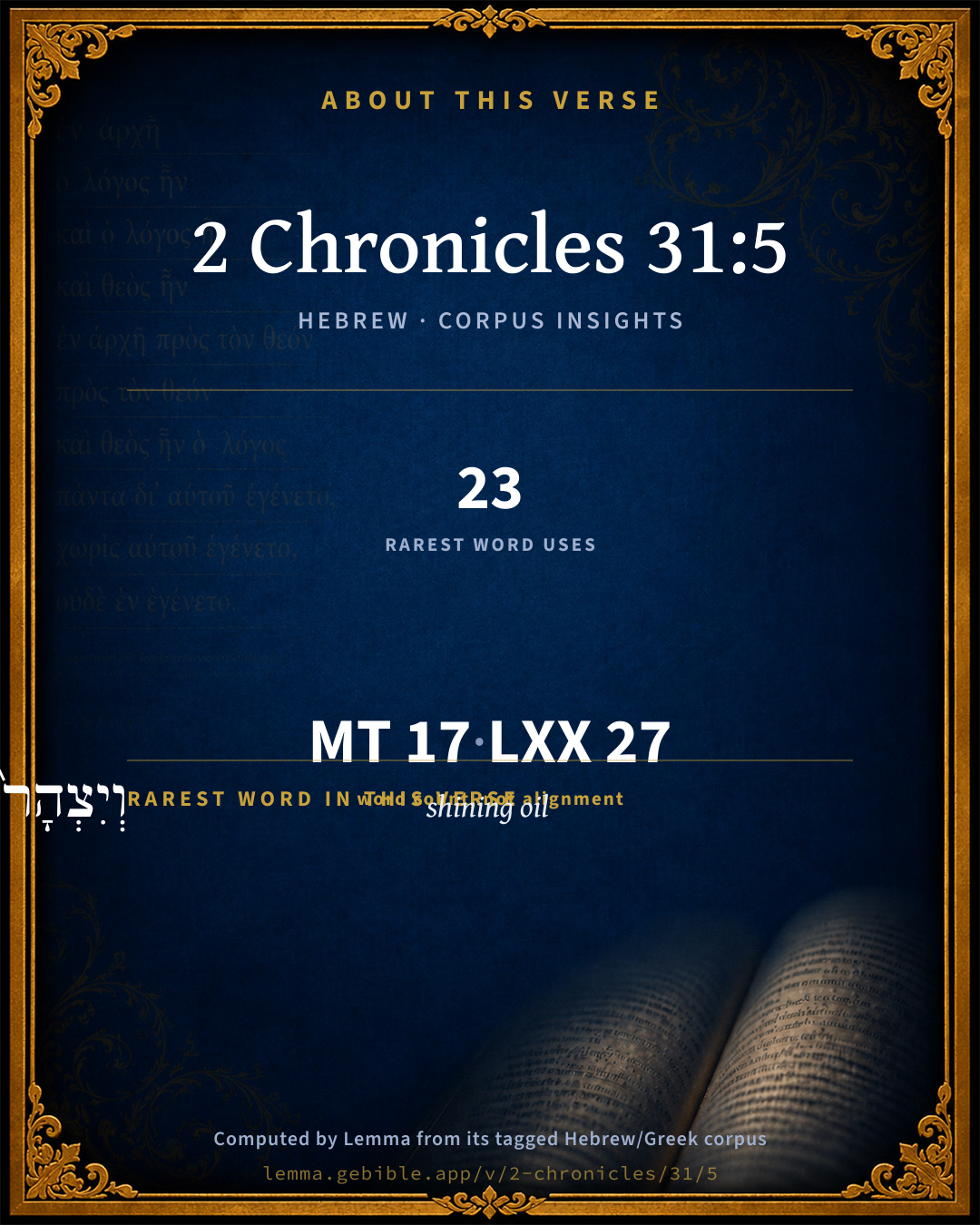
These counts appear in no published source. They are computed here, from the morphology-tagged text and Lemma’s own curated glosses. What Lemma adds →

17
words
16
distinct lemmas
Historical
section

Notable vocabulary

The rarest word here is וְיִצְהָר֙ shining oil H3323 — appearing just 23 times in the whole Hebrew Bible.

Shared distinctive vocabulary

וְיִצְהָר֙ shining oil H3323 occurs in 23 verses of the Hebrew Bible. Also found in:

Grammatical profile

  • 3 verbs
  • 14 nouns

Verb forms

  • וְכִפְרֹ֣ץ Qal · Infinitive Construct
  • הִרְבּ֤וּ Hiphil · Perfect
  • הֵבִֽיאוּ Hiphil · Perfect

Repetition

A word recurs within this verse — often emphatic in Hebrew:

  • וְכֹ֖ל all H3605 ×2

Hebrew & Septuagint length

In English translation the verse runs 43 words from the Hebrew and 37 from the Septuagint (LXX English) — closely comparable.

A rough comparison of the two English renderings, which tokenize alike — not a word-level alignment.

Word counts can differ between the Hebrew and the Greek without any difference in meaning — e.g. the Hebrew direct-object marker אֵת has no separate Greek word, and Greek often adds the article ὁ.

In the original languages it is 17 Hebrew tokens and 27 Greek tokens — but the two are counted differently (Hebrew bundles its prefixes and suffixes into one token; the Greek is in lemma form), so that isn’t a like-for-like length.

Cross-references

18

Topical passages linked to 2 Chronicles 31:5 in the Treasury of Scripture Knowledge — connected by theme and wording, ordered by reader-vote popularity; previews shown in the World English Bible.

  • Nehemiah 13:12 Then brought all Judah the tithe of the grain and the new wine and the oil to the treasuries.
  • Exodus 35:5 'Take from among you an offering to Yahweh. Whoever is of a willing heart, let him bring it, Yahweh's offering: gold, silver, brass,
  • Exodus 35:20–29 All the congregation of the children of Israel departed from the presence of Moses.
  • Exodus 36:5–6 They spoke to Moses, saying, "The people bring much more than enough for the service of the work which Yahweh commanded to make."
  • 2 Chronicles 24:10–11 All the princes and all the people rejoiced, and brought in, and cast into the chest, until they had made an end.
  • Nehemiah 10:35–39 and to bring the first fruits of our ground, and the first fruits of all fruit of all manner of trees, year by year, to the house of Yahweh;
  • Nehemiah 12:44 On that day were men appointed over the chambers for the treasures, for the heave-offerings, for the first fruits, and for the tithes, to gather into them, according to the fields of the cities, the portions appointed by the law for the priests and Levites: for Judah rejoiced for the priests and for the Levites who waited.
  • Nehemiah 13:31 and for the wood-offering, at times appointed, and for the first fruits. Remember me, my God, for good.
  • Proverbs 3:9 Honor Yahweh with your substance, With the first fruits of all your increase:
  • Exodus 22:29 "You shall not delay to offer from your harvest and from the outflow of your presses. "You shall give the firstborn of your sons to me.
  • Exodus 23:19 The first of the first fruits of your ground you shall bring into the house of Yahweh your God. "You shall not boil a kid in its mother's milk.
  • Exodus 34:22 You shall observe the feast of weeks with the first fruits of wheat harvest, and the feast of harvest at the year's end.
  • Exodus 34:26 You shall bring the first of the first fruits of your ground to the house of Yahweh your God. You shall not boil a young goat in its mother's milk."
  • Numbers 18:12 All the best of the oil, and all the best of the vintage, and of the grain, the first fruits of them which they give to Yahweh, to you have I given them.
  • 1 Corinthians 15:20 But now Christ has been raised from the dead. He became the first fruits of those who are asleep.
  • 2 Corinthians 8:2–5 how that in much proof of affliction the abundance of their joy and their deep poverty abounded to the riches of their liberality.
  • James 1:18 Of his own will he brought us forth by the word of truth, that we should be a kind of first fruits of his creatures.
  • Revelation 14:4 These are those who were not defiled with women, for they are virgins. These are those who follow the Lamb wherever he goes. These were redeemed by Jesus from among men, the first fruits to God and to the Lamb.

Cross-references courtesy of OpenBible.info (CC BY 4.0).

Hebrew and Greek witnesses Masoretic Hebrew ↔ Greek Septuagint

The same verse in the two great witnesses to the Old Testament, shown verse-for-verse.

These are two independent witnesses, not word-aligned to each other, and the Septuagint is shown in lemma (dictionary) form.

Hebrew 2 Chronicles 31:5 Masoretic · Westminster Leningrad Codex

וְכִפְרֹ֣ץ הַדָּבָ֗ר הִרְבּ֤וּ בְנֵֽי יִשְׂרָאֵל֙ רֵאשִׁ֣ית דָּגָ֗ן תִּיר֤וֹשׁ וְיִצְהָר֙ וּדְבַ֔שׁ וְכֹ֖ל תְּבוּאַ֣ת שָׂדֶ֑ה וּמַעְשַׂ֥ר הַכֹּ֛ל לָרֹ֖ב הֵבִֽיאוּ

As soon as the commandment came abroad, the children of Israel gave in abundance the first fruits of grain, new wine, and oil, and honey, and of all the increase of the field; and the tithe of all things brought they in abundantly.

World English Bible · Public Domain

Greek LXX 2 Chronicles 31:5 Septuagint · lemma form

καί ὡς προςτάσσω ὁ λόγος πλεονάζω ὁ υἱός ἰσραήλ ἀπαρχή σῖτος καί οἶνος καί ἔλαιον καί μέλι καί πᾶς γένημα ἀγρός καί ἐπιδέκατος πᾶς εἰς πλῆθος φέρω

And as he gave the command, Israel brought abundantly first fruits of corn, and wine, and oil, and honey, and every fruit of the field: and the children of Israel and Juda brought tithes of everything abundantly.

LXX2012 (modern English Septuagint) · Public Domain

Hebrew: Westminster Leningrad Codex (CC BY 4.0). Greek: Septuagint (public domain); English from LXX2012 (modern English Septuagint) (Public Domain). How the Septuagint differs from the Hebrew →

Commentary

Notes on 2 Chronicles 31:5 from classic Christian and Jewish commentators (each source and its license shown beneath its notes). The classic Christian expositions comment on the surrounding passage and are grouped to its opening verse, so a note may address several verses; the Jewish commentaries on the Tanakh (Rashi and others) are per-verse, so they appear only where the commentator wrote on this verse.

Lemma curates 59 commentaries, every one of them public domain or Creative Commons licensed, each selected and text-cleaned for this edition rather than reprinted as found. About our sources →

Trapp's Complete Commentary

John Trapp

2Ch 31:5 And as soon as the commandment came abroad, the children of Israel brought in abundance the firstfruits of corn, wine, and oil, and honey, and of all the increase of the field; and the tithe of all [things] brought they in abundantly.

Ver. 5. And as soon as the commandment came abroad.] Heb., Brake forth. Ahaz had nulled the laws for ministers’ maintenance, that he might bring them to beggary and dishearten them - the like did Julian the apostate; - Hezekiah therefore reviveth those laws with the first: and the people readily obeyeth them.

Brought they in abundantly.] {a} Not pinchingly and deceitfully, as now-a-days. Spoliantur Parochiae et Scholae non aliter ac si fame necare nes velint, saith Luther. Our parishes and schools are so robbed of their right, as if they meant to famish us all. {b} To colour the matter, conscience is pretended by some: but the apostle telleth them it is not conscience, but covetousness. {2Co 9:5}

{a} Libenter et liberaliter.

{b} Maligne dantibas maledicit Deus {Mal 3:9}

John Trapp, A Commentary or Exposition upon All the Books of the Old and New Testament (1647–1656) — public domain. Text from a community e-Sword module.

Joseph Benson's Commentary

2Ch 31:5. As soon as the commandment came abroad — Either, 1st, As soon as the report of this command of the king was known abroad in other parts; or, 2d, As soon as the king had enlarged and extended that command to all the parts of his kingdom, which (2Ch 31:4) was confined to them that dwelt in Jerusalem. Honey — Or dates, as the Hebrew writers generally understand the word דבשׁ, debash, in this place, a name which was given to them because of the sweetness of their taste, in some sort resembling honey. For the law requires no tithes but those of the fruits of trees, or of the earth, or of beasts.

Joseph Benson's Commentary on the Old and New Testaments (1811–1818) — public domain. Text from a community e-Sword module.

Geneva Bible (1599)

Geneva Bible translators

Or, published.

Geneva Bible (1599) marginal notes — public domain. Text via Bolls.life.

Adam Clarke's Commentary

Verse 5. Brought - the first-fruits] These were principally for the maintenance of the priests and Levites; they brought tithes of all the produce of the field, whether commanded or not, as we see in the instance of honey, which was not to be offered to the Lord, Le 2:11, yet it appears it might be offered to the priests as first-fruits, or in the way of tithes.

Adam Clarke's Commentary on the Bible (1810–1826) — public domain. Text from a community e-Sword/MySword module.

Ellicott's Commentary for English Readers

(5) And . . . came abroad.—Literally, And when the word broke forth—i.e., spread abroad.

The children of Israel.—Here the people of Jerusalem, who in the chronicler’s day had a preeminent right to the name. (See on next verse.) The firstfruits were for the priests (Num_18:12, seq., where the oil, wine, and wheat are specified).

And the tithe . . . abundantly.—For the Levites (Num_18:21-24).

A Bible Commentary for English Readers, edited by Charles John Ellicott (1878–1897) — public domain. Text from a community e-Sword module.

The Cambridge Bible for Schools and Colleges

gen. ed. J. J. S. Perowne

5. brought in abundance] R.V. gave in abundance.

and honey] Honey (Heb. dìbash) is not elsewhere mentioned as subject to tithe; perhaps grape syrup (modern Arabic dibs) is meant here, as in Gen_43:11 and Eze_27:17 (according to some commentators). Honey (like leaven) was forbidden for sacrificial use (Lev_2:11).

The Cambridge Bible for Schools and Colleges (gen. ed. J. J. S. Perowne; Cambridge University Press, 1878–1918) — public domain. Text from a community e-Sword module.

John Gill's Exposition

And as soon as the commandment came abroad,.... Not only was published in the city of Jerusalem, but the report of it, or rather that itself, was spread throughout the cities of Judah:

the children of Israel brought in abundance the firstfruits of corn, wine, and oil, and honey; the three first of these are expressed in the law, Deu 18:4 but not honey; wherefore the Targum here, and the Jewish writers in general, interpret it of the "dubsa" of the palm tree, as they call it, the fruit and liquor of that, which is of a sweet taste, and which the Scenite Arabs called "dabusa", as Pliny (w) from Juba relates; for so it should be read, and not "dabulan" or "dablan", as in some copies: but though honey was forbid to be used in sacrifice, it was not forbidden to be eaten; and as the land of Judea abounded with honey, properly so called, the priests might have the firstfruits of that as of other liquors; See Gill on Deu 8:8,

and of all the increase of the field; of the trees of it, vines, fig trees, pomegranates, &c. as Kimchi:

and the tithe of all things; even of herbs, as the same writer, and so the Talmud (x), which were free from tithes by the law, see Mat 23:23,

brought they in abundantly; even of all that their vineyards, oliveyards, and fields produced.

(w) Nat. Hist. l. 13. c. 4. (x) T. Bab. Nedarim, fol. 55. 1.

John Gill's Exposition of the Whole Bible (1746–1763) — public domain (CC PDM 1.0). Text via the HelloAO Bible API.

Albert Barnes' Notes on the Bible

Honey - See the margin. It is doubtful whether bee-honey was liable to first-fruits. The sort here intended may therefore be that which, according to Josephus, was manufactured from dates.

Albert Barnes' Notes on the Bible (1834–1885) — public domain. Text from a community e-Sword/MySword module.

Haydock's Catholic Bible Commentary

Honey for the priests, not for sacrifice, Lev. ii. 11. It may include dates, or palm wine. See Pliny xiii. 4. C. --- Forth; only wheat, barley, the fruits of vine, olive, pomegranate, fig, and palm-trees. R. Solomon) Lev. xxvii. 30. C.

George Leo Haydock (1774–1849), Haydock's Catholic Family Bible and Commentary, 1859 edition — public domain. Excludes Psalms (Douay-Rheims chapter numbering differs from Protestant) and Deuterocanonical books (Catholic canon only).

Matthew Poole's English Annotations

As soon as the commandment came abroad; either,

1. As soon as the report of this command of the king, 2Ch 31:4, was got abroad into other parts. Or,

2. As soon as the king enlarged and extended that command to all the parts of his kingdom, which, 2Ch 31:4, was confined to them that dwell in Jerusalem. Honey, or, dates, as the Hebrew writers generally, and many other learned Hebricians, understand this word, which is given to them because of the sweetness of their taste, in some sort resembling honey. For the law requires no tithes but of the fruits of trees, or of the earth, or of beasts.

Matthew Poole's English Annotations on the Holy Bible (1683–1685) — public domain. Text from a community e-Sword/MySword module.

The Pulpit Commentary

Honey; Hebrew, vbD. This is no doubt the proper word for the honey of bees, for see Jud 14:8-18; 1Sa_14:27; Psa_19:11, and many other passages. It is not certain, however, that the word did not cover other sweet preparations, as probably in Gen_43:11; Eze_27:17. The alternative reading, "dates," has thus come into the margin, but on very insufficient title, as, while there is doubt as to whether the honey of bees was generally tithed, there is none at all that the people"s pious zeal might prompt them to bring tithe of it voluntarily, among other things, that they at any time held in honour and had in abundance.

Vers. 5-19.

A nation"s liberality; or, a lecture on tithes.

I THE IMPOSITION OF THE TITHES. Done by the commandment of Hezekiah (ver. 5), not, however, acting in his own name and by his own authority, but merely publishing the Law of Jehovah for the maintenance of those who conducted the temple service. Under the old economy Jehovah was the sole Head of the Church, as Christ is under the new. For the Hebrew Church the exclusive source of legislation was not the sovereigns or prophets of the nation, but Jehovah; as for the Christian Church it is neither kings nor parliaments, neither Church dignitaries nor Church courts, but Jesus Christ. That which gave binding authority to Hezekiah"s commandment was not that it was "the word of a king", (Ecc_8:4) but that it was the ordinance of Jehovah as declared by Moses (Exo_23:19; Lev_27:30-33; Num_18:12, Num_18:13, Num_18:21, Num_18:24; Deu_26:2-4) That which lends weight to human legislation in the Christian Church is the circumstance that it accords with the teaching of Christ in the New Testament Scriptures.

II THE PAYING OF THE TITHES, ETC.

1. Promptly. "As soon as the commandment came abroad," the children of Israel began to pour in their contributions (ver. 5). The absence of delay, showed their zeal was not fanatical, but religious, and not seeming, but real the last thing to be affected by a man"s religion being his purse; perhapsalso it proved that the king"s liberality had been not without its influence (2Ch_30:24) as certainly it imparted additional value to their gifts. Qui cito dat bis dat.

2. Faithfully. Nothing was omitted or evaded that the Law enjoined. The people presented "the firstfruits of corn, and wine, and oil, and honey, and of all the increase of the field;" paid in the tithes or tenth parts Jehovah had assigned as a portion for the whole tribe of Levi (ver. 5), as well as the tenth parts of such things as were dedicated to the Lord (ver. 6); and rendered free-will offerings to Jehovah over and above what had been directly commanded (ver. 14).

3. Unweariedly. It was no sudden fit of liberality which had overtaken them and quickly expended itself. The firstfruits presenting, tithe-paying, and free-will offering went on for four months (ver. 7). Many can do a generous deed when seized by a momentary impulse, but are wholly unable to bear the strain of continuous giving. That these ancient givers grew not tired of their liberality was a proof that it proceeded from principle rather than from impulse showed they were acting more from respect to the Divine Law than from a desire to gratify their own feelings.

4. Abundantly. So extraordinary was the outburst of liberality, that not only had the priests and Levites obtained the most ample maintenance, having had enough to eat and plenty over (ver. 10), but so fast came the people"s offerings in that they were obliged to be piled up in heaps (ver. 6), while so liberal had they been that, when the tithe season ended, so great a store remained (ver. 10), that the priests and Levites were guaranteed against want throughout the rest of the year. The Christian Church might herein find an example. It is poor policy, besides being unscriptural (Luk_10:7; 1Co_9:14) for Churches or congregations to starve or underpay their ministers.

5. Generally. Most likely there were those who refused to comply with the king"s commandment, acting from a spirit of avarice which could not bear to part with their goods, or a spirit of unbelief which secretly hankered after the false gods they had formerly worshipped, or from a spirit of indifference, because they had no real interest in religion; and doubtless there were those who gave grudgingly and of necessity, adhering strictly to the letter of the Law, never going beyond the bond if they could help it, and certainly never throwing in any free-will offerings; but manifestly also the main body of the people, in the northern kingdom (ver. 5) no less than in the southern (ver. 6), yielded obedience to the king"s commandment, and fell in with the order of the day.

III THE STORING OF THE TITHES.

1. The chambers for their reception. These were prepared in the house of the Lord (ver. 11), in accordance with instructions from Hezekiah, but whether they were old cells or new cannot be determined.

2. The officers for their supervision.

(1) Two superior Cononiah the Levite, and Shimei his brother (ver. 12).

(2) Ten inferior-Jehiel and Azaziah, Nahath and Asahel, Jeri-moth and Jozabad, Eliel and Ismachiah, Mahath and Benaiah who acted as subordinates and assistants to the two chiefs, who derived their authority from Hezekiah the king, the chief magistrate in the state, and Azariah the chief priest of the house of Zadok (ver. 10), and ruler of the house of God (ver. 12).

IV THE DISTRIBUTION OF THE TITHES, ETC.

1. The distributors.

(1) The chief Kore, signifying "Partridge" (Gesenius), a name borne by the son of Ebiasaph, (1Ch_9:18) and here by the son of Imnah. By descent a Levite, he was by occupation "a porter towards the east," i.e. keeper of the king"s gate on the east side of the temple.

(2) The assistants, six in number, named Eden, Miniamin, Jeshua, Shemaiah, Amariah, and Shecaniah, resided in the cities of the priests in different parts of the country.

2. The distribution.

(1) Kore distributed to those priests and Levites who served in the temple, first of such things as were required for the maintenance of themselves and the male children over three years of age who accompanied their parents (being priests) to Jerusalem when the turn came for these to serve, and secondly of such things as were necessary for any portion of their temple service. The distribution to the priests was according to fathers" houses (ver. 17) so much for every house, according to its size; that to the Levites was to individuals from twenty years old and upwards, according to a carefully prepared register.

(2) The assistants distributed necessary portions to those priests and Levites who resided in the priests" cities, not being at the time engaged in active duty at the temple, and to the families of these as well as of those who were engaged (vers. 15-19). Both parts of this work were performed with scrupulous fidelity (ver. 18); the distributors "acted in a holy manner with the holy gifts," distributing them "impartially and disinterestedly to all who had any claim to them" (Keil).

Learn:

1. The duty of Christ"s people to support the ministers of religion.

2. The voluntary character of all acceptable payments towards religion.

3. The necessity of order and system in Church finance.

4. The excellence of Christian liberality. W.

The Pulpit Commentary (1880–1919), ed. H.D.M. Spence-Jones & Joseph S. Exell — public domain. Text from a community e-Sword module.

John Wesley's Explanatory Notes

Came abroad - As Soon as the king extended that command to all the parts of his kingdom, which, ver. 4, was confined to them that dwelt in Jerusalem. Honey - Or, dates, as the Hebrew writers generally, understand this word, which were given to them, because of the sweetness of their taste in some sort resembling honey. For the law requires no tithes, but of the fruits of trees, or of the earth, or of beasts.

John Wesley, Explanatory Notes Upon the Whole Bible (1754–1765) — public domain. Text via the GEBible commentary corpus.

Rashi

Rabbi Shlomo Yitzchaki (Rashi)

And when the word burst forth from the king’s mouth to give a portion to the priests and the Levites, the Children of Israel increased the first of corn, wine, oil, honey date honey.

and all the increase of the field But all these [aforementioned] are not of the grain of the field, but so it is explained in Tractate Nedarim, in the chapter, “Whoever vows [to abstain] from herbs, is permitted to partake of pumpkins,” (55a): Rav Josef questioned: “And when the word burst forth, the Children of Israel increased, etc.” Now if you say that all these [i.e., all plants that are stacked up] are included in the term דָּגָן, what is the meaning of “when the word burst forth”? Replied Abbaye: This is to include fruit of trees and vegetables....Replied Rava: תְּבוּאָה (grain) is one thing, and תְּבוּאַת שָׂדֶה (increase of the field) is another.

Rashi on the Tanakh — English translations: “The Judaica Press complete Tanach with Rashi, translated by A. J. Rosenberg” (CC BY 4.0); “Pentateuch with Rashi's commentary by M. Rosenbaum and A.M. Silbermann, 1929-1934” (public domain); “The Metsudah Tanach series, Lakewood, N.J” (CC BY 4.0); and “The Book of Joshua, Metsudah Publications, 1997” (CC BY 4.0). Text via Sefaria.

Lesson kit

Teaching starters — assembled from the data on this page, not authored interpretation. Every prompt links to the verse data it draws on. Edit before teaching.

2 Chronicles, in the Historical, opens this verse with 17 words (16 distinct Hebrew lemmas). Its most distinctive word is yitshâr (“shining oil”). A historical commentator’s framing appears above. Read the whole chapter for the surrounding context.

Discussion questions

  1. How does “shining oil” (yitshâr) shape what this verse is saying?
  2. How does Numbers 18:12, which shares the word «shining oil», read alongside this verse?
  3. What does the repetition of “all” (2× in this one verse) do in this verse?
  4. The translations on this page render this verse differently — a whole-verse word diff, not a word-by-word alignment. What might account for the different wordings?
  5. «וְכִפְרֹ֣ץ» is a Qal Infinitive Construct verb. How does that grammatical form shape the action described?
  6. Compare how Trapp's Complete Commentary and Joseph Benson's Commentary read this verse. Where do they agree or differ?

Things to notice

Reading settings

Reading text

Shown beneath each verse's original-language words.

Old Testament
Old Testament edition

Read the OT as the Masoretic Hebrew (MT) or the Greek Septuagint (LXX).

English shown for the Greek Septuagint (in the Hebrew ↔ Greek comparison).

Comparing translations? Open the Compare panel on any verse page to stack up to four side by side.