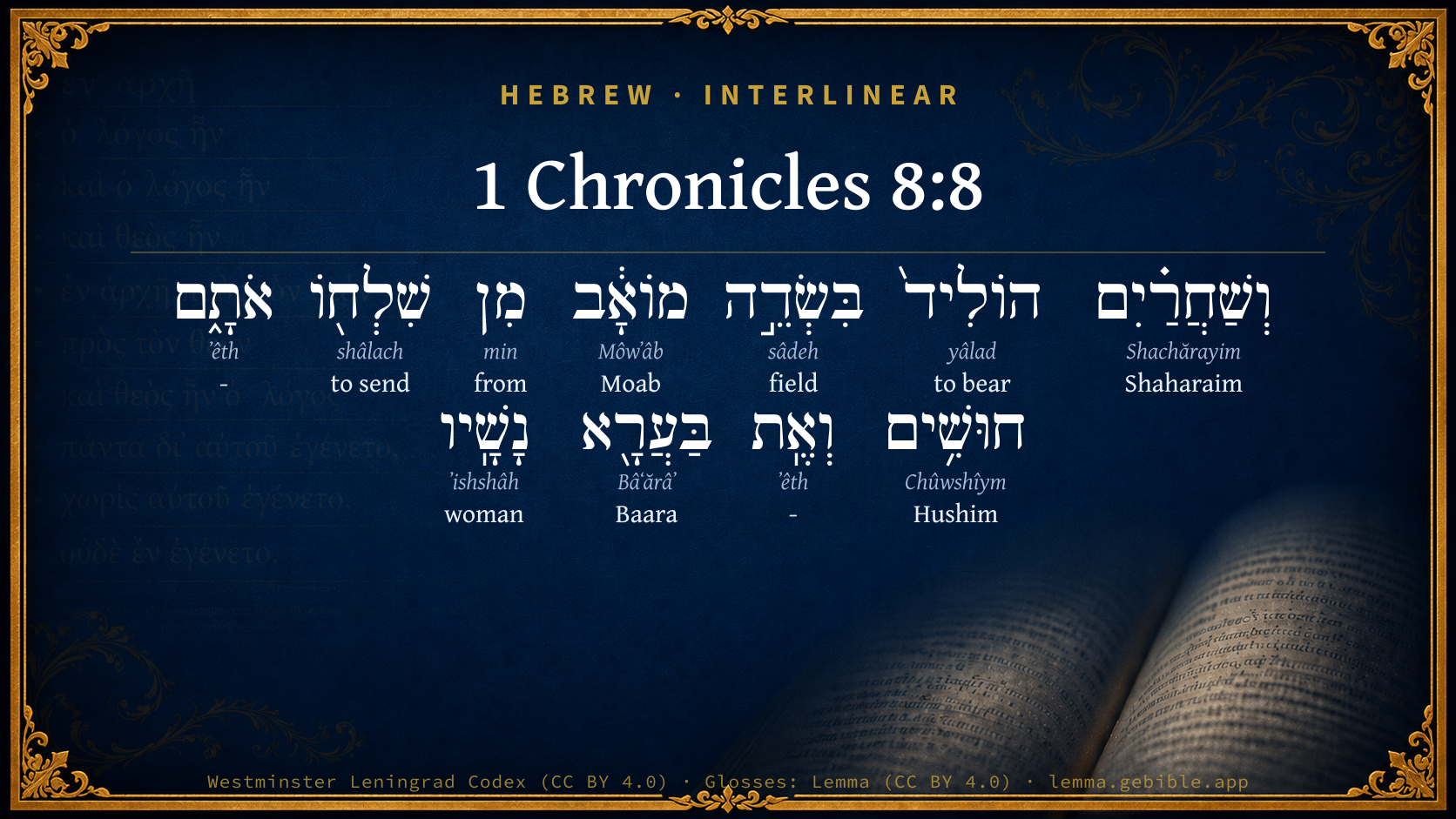
1 Chronicles 8:8

Hebrew (Westminster Leningrad Codex) 1 Chronicles 8:8 appears in the Hebrew Old Testament. The text above is from the Westminster Leningrad Codex. Each word links to its Strong’s number, a concise gloss, and parsing drawn from the Open Scriptures Hebrew Bible morphology. Click any word for its full Brown-Driver-Briggs (BDB) entry.
Download image
Cite this verse

1 Chronicles 8:8 (World English Bible). Public Domain. Lemma interlinear Bible study tool, https://lemma.gebible.app/v/1-chronicles/8/8.

Show BibTeX & RIS
BibTeX
RIS
English Translation
Shaharaim became the father of children in the field of Moab, after he had sent them away; Hushim and Baara were his wives.
World English Bible · Public Domain
Highlights
  • 2 hapax legomena — only here in the Hebrew Bible
  • 2 first appearances in the Hebrew Bible
Full analysis ↓
Download a study sheet

One document with this verse’s original text, its word-by-word gloss line, the meaning frame, cross-references with their text, attributed commentary, and full source and license credits — printable, and it pastes into notes with its structure intact.

This verse Autodidact and up

Study sheet (.html) Plain text (.txt)

A passage Seminary Student

Up to 50 verses in one chapter. A passage sheet keeps up to 6 commentary sources and 12 cross-references per verse, in the order this page ranks them, and says so on the sheet whenever that leaves anything out. Ask for a single verse and you get the Autodidact verse sheet above.

Everything on this page stays free to read, with no account — the sheet is a download of what is already on screen, not access to it.

Want to remove ads? Support Godless Engineer
Compare translations 3

The same verse in 3 English versions, stacked beneath the original-language interlinear above. Click any original word for its lexicon entry.

Each is an independent rendering of the whole verse — the interlinear is not word-aligned to these translations.

Highlighted words mark where these versions differ — a whole-verse word diff, not a word-by-word alignment.

  • World English Bible Public Domain
    Shaharaim became the father of children in the field of Moab, after he had sent them away; Hushim and Baara were his wives.
  • King James Version Public Domain
    And Shaharaim begat children in the country of Moab, after he had sent them away; Hushim and Baara were his wives.
  • unfoldingWord Literal Text CC BY-SA 4.0
    And Shaharaim fathered in the field of Moab after he sent them away, Hushim and Baara, his wives.

unfoldingWord Literal Text — © unfoldingWord, licensed CC BY-SA 4.0. Word-aligned USFM3 via Door43 (git.door43.org/unfoldingWord/en_ult).

Versions to compare (up to 4)

3 of 4 selected

Show all 18 translations

Every available English version of this verse, each an independent rendering of the whole verse.

  • World English Bible Public Domain
    Shaharaim became the father of children in the field of Moab, after he had sent them away; Hushim and Baara were his wives.
  • Berean Standard Bible Public Domain
    Shaharaim had sons in the country of Moab after he had divorced his wives Hushim and Baara.
  • Majority Standard Bible Public Domain
    Shaharaim had sons in the country of Moab after he had divorced his wives Hushim and Baara.
  • King James Version Public Domain
    And Shaharaim begat children in the country of Moab, after he had sent them away; Hushim and Baara were his wives.
  • American Standard Version (1901) Public Domain
    And Shaharaim begat children in the field of Moab, after he had sent them away; Hushim and Baara were his wives.
  • Revised Version (1885) Public Domain
    And Shaharaim begat children in the field of Moab, after he had sent them away; Hushim and Baara were his wives.
  • Geneva Bible (1599) Public Domain
    And Shaharaim begate certaine in the coutrey of Moab, after he had sent away Hushim and Baara his wiues.
  • Douay-Rheims (1899) Public Domain
    And Saharim begot in the land of Moab, after he sent away Husim and Bara his wives.
  • Young's Literal Translation Public Domain
    And Shaharaim begat in the field of Moab, after his sending them away; Hushim and Baara `are' his wives.
  • Literal Standard Version CC BY-SA 4.0
    And Shaharaim begot in the field of Moab after his sending them away; Hushim and Baara [are] his wives.
  • Unlocked Literal Bible CC BY-SA 4.0
    Shaharaim became the father of children in the land of Moab, after he had divorced his wives Hushim and Baara.
  • unfoldingWord Literal Text CC BY-SA 4.0
    And Shaharaim fathered in the field of Moab after he sent them away, Hushim and Baara, his wives.
  • Darby Bible Public Domain
    And Shaharaim begot [children] in the land of Moab after he had sent away Hushim and Baara his wives.
  • World Messianic Bible Public Domain
    Shaharaim became the father of children in the field of Moab, after he had sent them away. Hushim and Baara were his wives.
  • Webster's Bible Public Domain
    And Shaharaim begat children in the country of Moab, after he had sent them away; Hushim and Baara were his wives.
  • Free Bible Version CC BY-SA 4.0
    Shaharaim had sons in Moab after he divorced his wives Hushim and Baara.
  • Bible in Basic English Public Domain
    And Shaharaim became the father of children in the country of the Moabites after driving out Hushim and Beerah his wives;
  • JPS Tanakh (1917) Public Domain
    And Shaharaim begot children in the field of Moab, after he had sent them away, to wit, Hushim and Baara his wives;

Literal Standard Version (2020), Covenant Press — licensed CC BY-SA 4.0. Text via the HelloAO Bible API (eBible.org). Unlocked Literal Bible (unfoldingWord) — licensed CC BY-SA 4.0. Text via the HelloAO Bible API (eBible.org). unfoldingWord Literal Text — © unfoldingWord, licensed CC BY-SA 4.0. Word-aligned USFM3 via Door43 (git.door43.org/unfoldingWord/en_ult). Free Bible Version, Dr. Jonathan Gallagher — licensed CC BY-SA 4.0. Text via the HelloAO Bible API (eBible.org).

Word by word

More ways to search: Search by grammar → Find every occurrence → Compare this word →

Practice this passage: Drill this verse → Learn its vocabulary →

וְשַׁחֲרַ֗יִם
Shachărayim
H7842
“and · Shaharaim”
Conjunction + Noun, Proper
Part of Speech
Conjunction + Noun
Type
Proper
Full BDB Definition

Origin: dual of H7837

TWOT: None

Shaharaim = "double dawn" - a Benjamite, father of Jobab, Zibia, Mesha, Malcham, Jeuz, Shachia, Mirma, Abitub, and Elpaal
  1. הוֹלִיד֙ yâlad H3205 “to bear” Verb, Hiphil, Perfect, 3rd Person, Masculine, Singular
  2. בִּשְׂדֵ֣ה sâdeh H7704 “in/at · field of” Preposition + Noun, Common, Masculine, Singular, Construct
  3. מוֹאָ֔ב Môwʼâb H4124 “Moab” Noun, Proper
  4. מִן min H4480 “from” Preposition
  5. שִׁלְח֖וֹ shâlach H7971 “to send · him” Verb, Piel, Infinitive Construct + Suffix, Personal, 3rd Person, Masculine, Singular
  6. אֹתָ֑ם ʼêth H853 “- · them” Particle, Direct Object + Suffix, Personal, 3rd Person, Masculine, Plural
  7. חוּשִׁ֥ים Chûwshîym H2366 “Hushim” Noun, Proper
  8. וְאֶֽת ʼêth H853 “and · -” Conjunction + Particle, Direct Object
  9. בַּעֲרָ֖א Bâʻărâʼ H1199 “Baara” Noun, Proper
  10. נָשָֽׁיו ʼishshâh H802 “women · his” Noun, Common, Feminine, Plural, Construct + Suffix, Personal, 3rd Person, Masculine, Singular

About this verse

These counts appear in no published source. They are computed here, from the morphology-tagged text and Lemma’s own curated glosses. What Lemma adds →

11
words
10
distinct lemmas
Historical
section

Notable vocabulary

2 hapax legomena — words that appear only here in the entire Hebrew Bible:

  • וְשַׁחֲרַ֗יִם Shaharaim H7842
  • בַּעֲרָ֖א Baara H1199

First appearance in Scripture

These words make their first canonical appearance in the Hebrew Bible here:

  • וְשַׁחֲרַ֗יִם Shaharaim H7842
  • בַּעֲרָ֖א Baara H1199

Shared distinctive vocabulary

חוּשִׁ֥ים Hushim H2366 occurs in 4 verses of the Hebrew Bible. Also found in:

Grammatical profile

  • 2 verbs
  • 6 nouns
  • 1 preposition
  • 2 particles

Verb forms

  • הוֹלִיד֙ Hiphil · Perfect
  • שִׁלְח֖וֹ Piel · Infinitive Construct

Hebrew & Septuagint length

In English translation the verse runs 23 words from the Hebrew and 20 from the Septuagint (LXX English) — closely comparable.

A rough comparison of the two English renderings, which tokenize alike — not a word-level alignment.

Word counts can differ between the Hebrew and the Greek without any difference in meaning — e.g. the Hebrew direct-object marker אֵת has no separate Greek word, and Greek often adds the article ὁ.

In the original languages it is 11 Hebrew tokens and 17 Greek tokens — but the two are counted differently (Hebrew bundles its prefixes and suffixes into one token; the Greek is in lemma form), so that isn’t a like-for-like length.

Cross-references

2

Topical passages linked to 1 Chronicles 8:8 in the Treasury of Scripture Knowledge — connected by theme and wording, ordered by reader-vote popularity; previews shown in the World English Bible.

  • Ruth 1:1 It happened in the days when the judges judged, that there was a famine in the land. A certain man of Bethlehem Judah went to sojourn in the country of Moab, he, and his wife, and his two sons.
  • Genesis 25:6 but to the sons of the concubines who Abraham had, Abraham gave gifts. He sent them away from Isaac his son, while he yet lived, eastward, to the east country.

Cross-references courtesy of OpenBible.info (CC BY 4.0).

Hebrew and Greek witnesses Masoretic Hebrew ↔ Greek Septuagint

The same verse in the two great witnesses to the Old Testament, shown verse-for-verse.

These are two independent witnesses, not word-aligned to each other, and the Septuagint is shown in lemma (dictionary) form.

Hebrew 1 Chronicles 8:8 Masoretic · Westminster Leningrad Codex

וְשַׁחֲרַ֗יִם הוֹלִיד֙ בִּשְׂדֵ֣ה מוֹאָ֔ב מִן שִׁלְח֖וֹ אֹתָ֑ם חוּשִׁ֥ים וְאֶֽת בַּעֲרָ֖א נָשָֽׁיו

Shaharaim became the father of children in the field of Moab, after he had sent them away; Hushim and Baara were his wives.

World English Bible · Public Domain

Greek LXX 1 Chronicles 8:8 Septuagint · lemma form

καί σααρημ γεννάω ἐν ὁ πεδίον μωαβ μετά ὁ ἀποστέλλω αὐτός ωσιμ καί ὁ βααδα γυνή αὐτός

And Saarin begot children in the plain of Moab, after that he had sent away Osin and Baada his wives.

LXX2012 (modern English Septuagint) · Public Domain

On this verse, Ellicott's Commentary for English Readers discusses the Septuagint’s reading. Read the note in Commentary ↓

Hebrew: Westminster Leningrad Codex (CC BY 4.0). Greek: Septuagint (public domain); English from LXX2012 (modern English Septuagint) (Public Domain). How the Septuagint differs from the Hebrew →

Commentary

Notes on 1 Chronicles 8:8 from classic Christian and Jewish commentators (each source and its license shown beneath its notes). The classic Christian expositions comment on the surrounding passage and are grouped to its opening verse, so a note may address several verses; the Jewish commentaries on the Tanakh (Rashi and others) are per-verse, so they appear only where the commentator wrote on this verse.

Lemma curates 59 commentaries, every one of them public domain or Creative Commons licensed, each selected and text-cleaned for this edition rather than reprinted as found. About our sources →

John Gill's Exposition

And of Hushim he begat Abitub, and Elpaal. Before he sent her away, or divorced her, Ch1 8:8.

.

1 Chronicles 8:12

ch1 8:12

ch1 8:12

ch1 8:12The sons of Elpaal; Eber, and Misham, and Shamed,.... Besides those in Ch1 8:14.

who built Ono, and Lod, with the towns thereof; not Shamed, but Elpaal his father, so the Targum; and the Talmudists say (o), these were walled cities from the days of Joshua the son of Nun, and were destroyed in the days of the concubine in Gibea, and Elpaal came and rebuilt them; they were inhabited by the Benjaminites, upon their return from the Babylonish captivity, Neh 11:35 they were near to each other; according to a Jewish chronologer (p), it was three miles from the one to the other; Lod is the same with Lydda, in Act 9:32.

(o) T. Hieros. Megillah, fol. 70. 1. & T. Bab Megillah, fol. 4. 1. So the Targum. (p) Juchasin, fol. 39. 2.

John Gill's Exposition of the Whole Bible (1746–1763) — public domain (CC PDM 1.0). Text via the HelloAO Bible API.

Trapp's Complete Commentary

John Trapp

1Ch 8:8 And Shaharaim begat [children] in the country of Moab, after he had sent them away; Hushim and Baara [were] his wives.

Ver. 8. And begat children in the country of Moab.] Where he sojourned, haply - as did Elimelech {Rth 1:1} - because of the famine.

After he had sent them away.] Or, After he had sent away Hushim and Basra, his wives, quas repudiavit propter causas quae tacentur, saith Vatablus.

John Trapp, A Commentary or Exposition upon All the Books of the Old and New Testament (1647–1656) — public domain. Text from a community e-Sword module.

Keil & Delitzsch

C. F. Keil & F. Delitzsch

And of Hushim he begat Abitub, and Elpaal. Before he sent her away, or divorced her, Ch1 8:8.

.

1 Chronicles 8:12

ch1 8:12

ch1 8:12

ch1 8:12The sons of Elpaal; Eber, and Misham, and Shamed,.... Besides those in Ch1 8:14.

who built Ono, and Lod, with the towns thereof; not Shamed, but Elpaal his father, so the Targum; and the Talmudists say (o), these were walled cities from the days of Joshua the son of Nun, and were destroyed in the days of the concubine in Gibea, and Elpaal came and rebuilt them; they were inhabited by the Benjaminites, upon their return from the Babylonish captivity, Neh 11:35 they were near to each other; according to a Jewish chronologer (p), it was three miles from the one to the other; Lod is the same with Lydda, in Act 9:32.

(o) T. Hieros. Megillah, fol. 70. 1. & T. Bab Megillah, fol. 4. 1. So the Targum. (p) Juchasin, fol. 39. 2.

Keil & Delitzsch — Biblical Commentary on the Old Testament (1861–1891) — public domain (CC PDM 1.0). Text via the HelloAO Bible API. (Old Testament only.)

Geneva Bible (1599)

Geneva Bible translators

After he had put away his two wives.

Geneva Bible (1599) marginal notes — public domain. Text via Bolls.life.

Jamieson, Fausset & Brown

Robert Jamieson, A. R. Fausset & David Brown

Shaharaim begat children in the country of Moab--He had probably been driven to take refuge in that foreign land on the same calamitous occasion that forced Elimelech to emigrate thither (Rut 1:1). But, destitute of natural affection, he forsook or divorced his two wives, and in the land of his sojourn married a third, by whom he had several sons. But there is another explanation given of the conduct of this Benjamite polygamist. His children by Hushim are mentioned (Ch1 8:11), while his other wife is unnoticed. Hence it has been thought probable that it is Baara who is mentioned under the name of Hodesh, so called because her husband, after long desertion, returned and cohabited with her as before.

Jamieson, Fausset & Brown — Commentary Critical and Explanatory on the Whole Bible (1871) — public domain (CC PDM 1.0). Text via the HelloAO Bible API.

Ellicott's Commentary for English Readers

(8) And Shaharaim begat children in the country of Moab.—Shaharaim is apparently out of all connection with the other Benjamite houses. He has been identified with Ahi-Shahar, 1Ch_7:10, because his name has a similar meaning, and even with the mysterious Aher (hypothetically Shaher) of 1Ch_7:12. It is simpler to suppose that weeth-Shaharaim, “and Shaharaim,” has dropped out at the end of 1Ch_8:7 (see Note on 1Ch_8:31). Expelled from Geba, Shaharaim found a refuge in Moab. (Comp. Ruth 1; 1Sa_22:3-4.)

After he had sent them away; Hushim and Baara were his wives.—The Heb. is certainly corrupt. The easiest correction is to read ‘eth-Hushim instead of ‘otham Hushim: “and Shaharaim begat in the country of Moab, after divorcing Hushim and Baara his wives, he begat (1Ch_8:9) of Hodesh his wife, Jobab,” &c. This is supported by the LXX. The emigration of the clan Shaharaim, from its old home in Geba of Benjamin is called a divorce, in the figurative style of these genealogies; just as the amalgamation of clans is marriage. Hushim, in 1Ch_7:12, is a Benjamite clan. In Moab, Shaharaim branched off into seven clans, whose names are given in 1Ch_8:9-10.

A Bible Commentary for English Readers, edited by Charles John Ellicott (1878–1897) — public domain. Text from a community e-Sword module.

The Cambridge Bible for Schools and Colleges

gen. ed. J. J. S. Perowne

8. sent them away; Hushim and Baara were his wives] R.V. mg. sent away Hushim and Baara his wives.

The Cambridge Bible for Schools and Colleges (gen. ed. J. J. S. Perowne; Cambridge University Press, 1878–1918) — public domain. Text from a community e-Sword module.

Albert Barnes' Notes on the Bible

After he had sent them away - Translate it: “after he had divorced his wives, Hushim and Baara.”

Albert Barnes' Notes on the Bible (1834–1885) — public domain. Text from a community e-Sword/MySword module.

Haydock's Catholic Bible Commentary

Saharim. His father is not specified: but his was a Benjamite. (Menochius) --- Some force the Hebrew text to say that Ahod had three sons, whom he sent to form a colony at Manahath, and afterwards he had three others by his two wives, and at last, by Rodes, he had Jobab, &c. (Calmet) --- Begot. Protestants, "children in the country of Moab, after he had sent them away: Hushim and Baara were his wives." But the Septuagint intimate, that "Saharim begot....after he had sent away Osim, and his wife Baara, and he begot of Ada," &c. (Haydock) --- He had perhaps retired into Moab, at the same time as Elimelech, Ruth i. (Tirinus) --- Those who were sent away were men, (eos) according to the Hebrew, unless (Haydock) the word should be eas. (Du Hamel)

George Leo Haydock (1774–1849), Haydock's Catholic Family Bible and Commentary, 1859 edition — public domain. Excludes Psalms (Douay-Rheims chapter numbering differs from Protestant) and Deuterocanonical books (Catholic canon only).

Matthew Poole's English Annotations

In the country of Moab; whither he had removed himself, either at the same time when Elimelech did, Rth 1:1, &c., or upon the same or like occasion.

After he had sent them away; Ehud or Gera last mentioned.

Hushim and Baara were his wives: others join these words with the former, and render the place thus, after he had sent them (to wit, his sons) away, with Hushim and Baara his wives, i.e. as he also sent his wives away from him; which may be here mentioned as a brand upon him, to show that he was without natural affection to his wives and children. And it seems the more probable that he divorced them, because we find him married to another wife, 1Ch 8:9.

Matthew Poole's English Annotations on the Holy Bible (1683–1685) — public domain. Text from a community e-Sword/MySword module.

The Pulpit Commentary

Shaharaim. It has been proposed, in the utter obscurity here, to add this name as a third to Uzza and Ahihud. This may be a way out, but if so, instead of repeating "and Shaharaim," it might be more natural to keep the former enigmatic nominative and object to begat, whether Ehud or Gera. There can be little doubt that a copyist"s error has given us them ( ao) in place of ta, in the latter part of this verse, before the names of the wives. The sentence then would translate, "after his sending away whether by divorce or not Hushim and Baara his wives."

The Pulpit Commentary (1880–1919), ed. H.D.M. Spence-Jones & Joseph S. Exell — public domain. Text from a community e-Sword module.

unfoldingWord translationNotes

Door43 World Missions Community

Shaharaim ... Jobab ... Zibia ... Mesha ... Malkam ... Jeuz ... Sakia ... Mirmah ... Abitub ... Elpaal

These are names of men. (See: How to Translate Names)

Hushim ... Baara ... Hodesh

These are names of women. (See: How to Translate Names)

By his wife Hodesh, Shaharaim became the father of

"Shaharaim and his wife Hodesh had the following sons:"

fathers' houses

extended families, people related to each other who usually lived in different houses, what the UDB calls "clans"

translationWords

ancestor

children

Moab

divorce

clan

unfoldingWord translationNotes — © Distant Shores Media and the Door43 World Missions Community, licensed CC BY-SA 4.0. Source: git.door43.org/Door43/en_tn.

Rashi

Rabbi Shlomo Yitzchaki (Rashi)

And Shaharaim begot He was one of the exiles, and after they sent him out of exile, he begot these.

Hushim and Baara were his wives. These were the names of his wives.

Rashi on the Tanakh — English translations: “The Judaica Press complete Tanach with Rashi, translated by A. J. Rosenberg” (CC BY 4.0); “Pentateuch with Rashi's commentary by M. Rosenbaum and A.M. Silbermann, 1929-1934” (public domain); “The Metsudah Tanach series, Lakewood, N.J” (CC BY 4.0); and “The Book of Joshua, Metsudah Publications, 1997” (CC BY 4.0). Text via Sefaria.

Lesson kit

Teaching starters — assembled from the data on this page, not authored interpretation. Every prompt links to the verse data it draws on. Edit before teaching.

1 Chronicles, in the Historical, opens this verse with 11 words (10 distinct Hebrew lemmas). Its most distinctive word is Shachărayim (“Shaharaim”). A historical commentator’s framing appears above. Read the whole chapter for the surrounding context.

Discussion questions

  1. What does “Shaharaim” (Shachărayim) contribute to the verse as a whole?
  2. 2 words here appear nowhere else in the Hebrew Bible. Why might the author reach for such rare wording?
  3. 2 words make their first appearance in Scripture here. What does this debut establish?
  4. How does Genesis 46:23, which shares the word «Hushim», read alongside this verse?
  5. The translations on this page render this verse differently — a whole-verse word diff, not a word-by-word alignment. What might account for the different wordings?
  6. «הוֹלִיד֙» is a Hiphil Perfect verb. How does that grammatical form shape the action described?
  7. Compare how John Gill's Exposition and Trapp's Complete Commentary read this verse. Where do they agree or differ?

Things to notice

Reading settings

Reading text

Shown beneath each verse's original-language words.

Old Testament
Old Testament edition

Read the OT as the Masoretic Hebrew (MT) or the Greek Septuagint (LXX).

English shown for the Greek Septuagint (in the Hebrew ↔ Greek comparison).

Comparing translations? Open the Compare panel on any verse page to stack up to four side by side.