
Deuteronomy 28:16

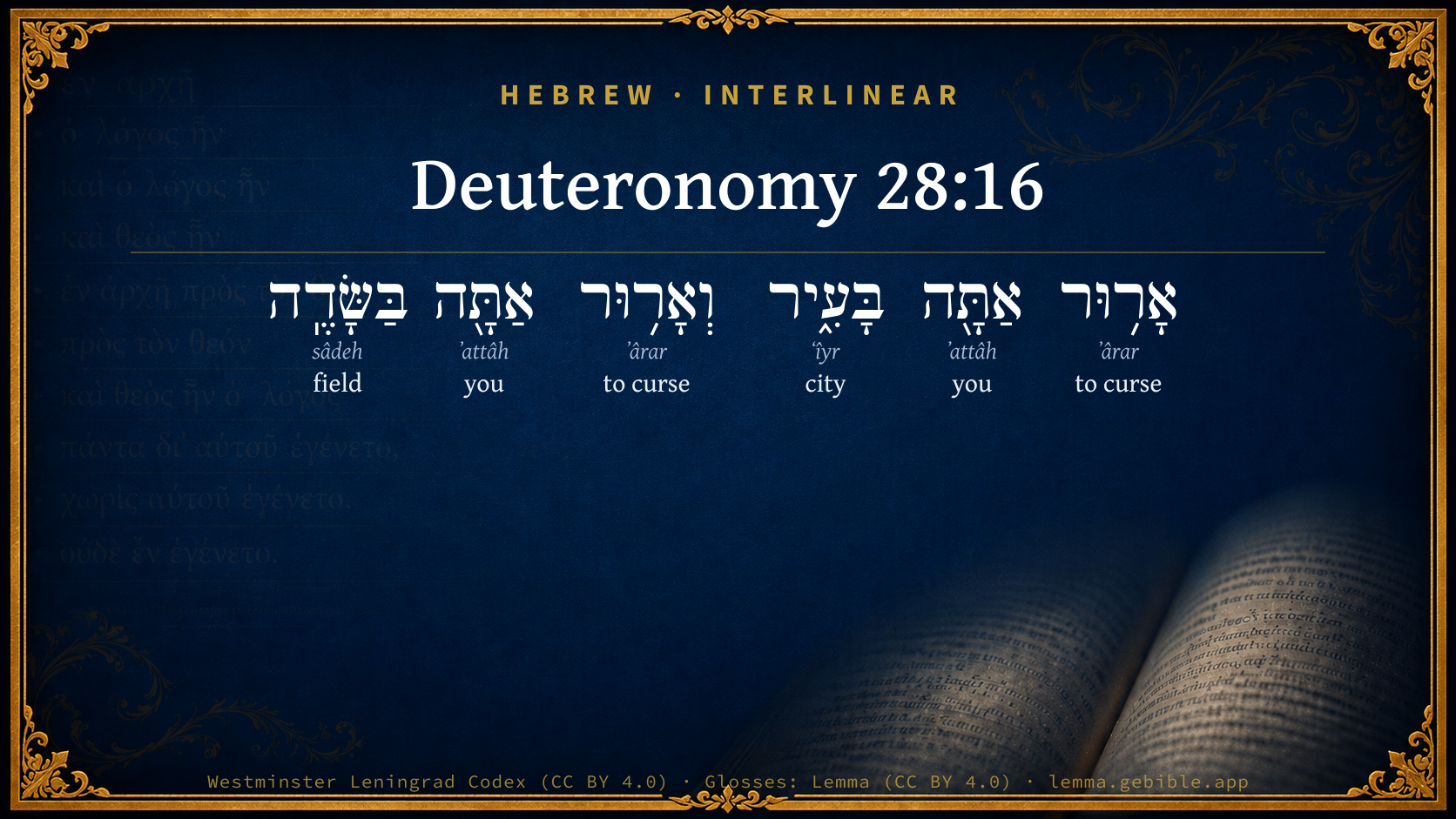
Hebrew (Westminster Leningrad Codex) Deuteronomy 28:16 appears in the Hebrew Old Testament. The text above is from the Westminster Leningrad Codex. Each word links to its Strong’s number, a concise gloss, and parsing drawn from the Open Scriptures Hebrew Bible morphology. Click any word for its full Brown-Driver-Briggs (BDB) entry.
Download image
Cite this verse

Deuteronomy 28:16 (World English Bible). Public Domain. Lemma interlinear Bible study tool, https://lemma.gebible.app/v/deuteronomy/28/16.

Show BibTeX & RIS
BibTeX
RIS
English Translation
Cursed shall you be in the city, and cursed shall you be in the field.
World English Bible · Public Domain
Download a study sheet

One document with this verse’s original text, its word-by-word gloss line, the meaning frame, cross-references with their text, attributed commentary, and full source and license credits — printable, and it pastes into notes with its structure intact.

This verse Autodidact and up

Study sheet (.html) Plain text (.txt)

A passage Seminary Student

Up to 50 verses in one chapter. A passage sheet keeps up to 6 commentary sources and 12 cross-references per verse, in the order this page ranks them, and says so on the sheet whenever that leaves anything out. Ask for a single verse and you get the Autodidact verse sheet above.

Everything on this page stays free to read, with no account — the sheet is a download of what is already on screen, not access to it.

Want to remove ads? Support Godless Engineer
Compare translations 3

The same verse in 3 English versions, stacked beneath the original-language interlinear above. Click any original word for its lexicon entry.

Each is an independent rendering of the whole verse — the interlinear is not word-aligned to these translations.

Highlighted words mark where these versions differ — a whole-verse word diff, not a word-by-word alignment.

  • World English Bible Public Domain
    Cursed shall you be in the city, and cursed shall you be in the field.
  • King James Version Public Domain
    Cursed shalt thou be in the city, and cursed shalt thou be in the field.
  • unfoldingWord Literal Text CC BY-SA 4.0
    Cursed you in the city and cursed you in the field.

unfoldingWord Literal Text — © unfoldingWord, licensed CC BY-SA 4.0. Word-aligned USFM3 via Door43 (git.door43.org/unfoldingWord/en_ult).

Versions to compare (up to 4)

3 of 4 selected

Show all 18 translations

Every available English version of this verse, each an independent rendering of the whole verse.

  • World English Bible Public Domain
    Cursed shall you be in the city, and cursed shall you be in the field.
  • Berean Standard Bible Public Domain
    You will be cursed in the city and cursed in the country.
  • Majority Standard Bible Public Domain
    You will be cursed in the city and cursed in the country.
  • King James Version Public Domain
    Cursed shalt thou be in the city, and cursed shalt thou be in the field.
  • American Standard Version (1901) Public Domain
    Cursed shalt thou be in the city, and cursed shalt thou be in the field.
  • Revised Version (1885) Public Domain
    Cursed shalt thou be in the city, and cursed shalt thou be in the field.
  • Geneva Bible (1599) Public Domain
    Cursed shalt thou bee in the towne, and cursed also in the fielde.
  • Douay-Rheims (1899) Public Domain
    Cursed shalt thou be in the city, cursed in the field.
  • Young's Literal Translation Public Domain
    `Cursed `art' thou in the city, and cursed `art' thou in the field.
  • Literal Standard Version CC BY-SA 4.0
    Cursed [are] you in the city, and cursed [are] you in the field.
  • Unlocked Literal Bible CC BY-SA 4.0
    Cursed will you be in the city, and cursed will you be in the field.
  • unfoldingWord Literal Text CC BY-SA 4.0
    Cursed you in the city and cursed you in the field.
  • Darby Bible Public Domain
    Cursed shalt thou be in the city, and cursed shalt thou be in the field.
  • World Messianic Bible Public Domain
    You will be cursed in the city, and you will be cursed in the field.
  • Webster's Bible Public Domain
    Cursed shalt thou be in the city, and cursed shalt thou be in the field.
  • Free Bible Version CC BY-SA 4.0
    You will be cursed when you're in the town; you will be cursed when you're in the countryside.
  • Bible in Basic English Public Domain
    You will be cursed in the town and cursed in the field.
  • JPS Tanakh (1917) Public Domain
    Cursed shalt thou be in the city, and cursed shalt thou be in the field.

Literal Standard Version (2020), Covenant Press — licensed CC BY-SA 4.0. Text via the HelloAO Bible API (eBible.org). Unlocked Literal Bible (unfoldingWord) — licensed CC BY-SA 4.0. Text via the HelloAO Bible API (eBible.org). unfoldingWord Literal Text — © unfoldingWord, licensed CC BY-SA 4.0. Word-aligned USFM3 via Door43 (git.door43.org/unfoldingWord/en_ult). Free Bible Version, Dr. Jonathan Gallagher — licensed CC BY-SA 4.0. Text via the HelloAO Bible API (eBible.org).

Word by word

More ways to search: Search by grammar → Find every occurrence → Compare this word →

Practice this passage: Drill this verse → Learn its vocabulary →

About this verse

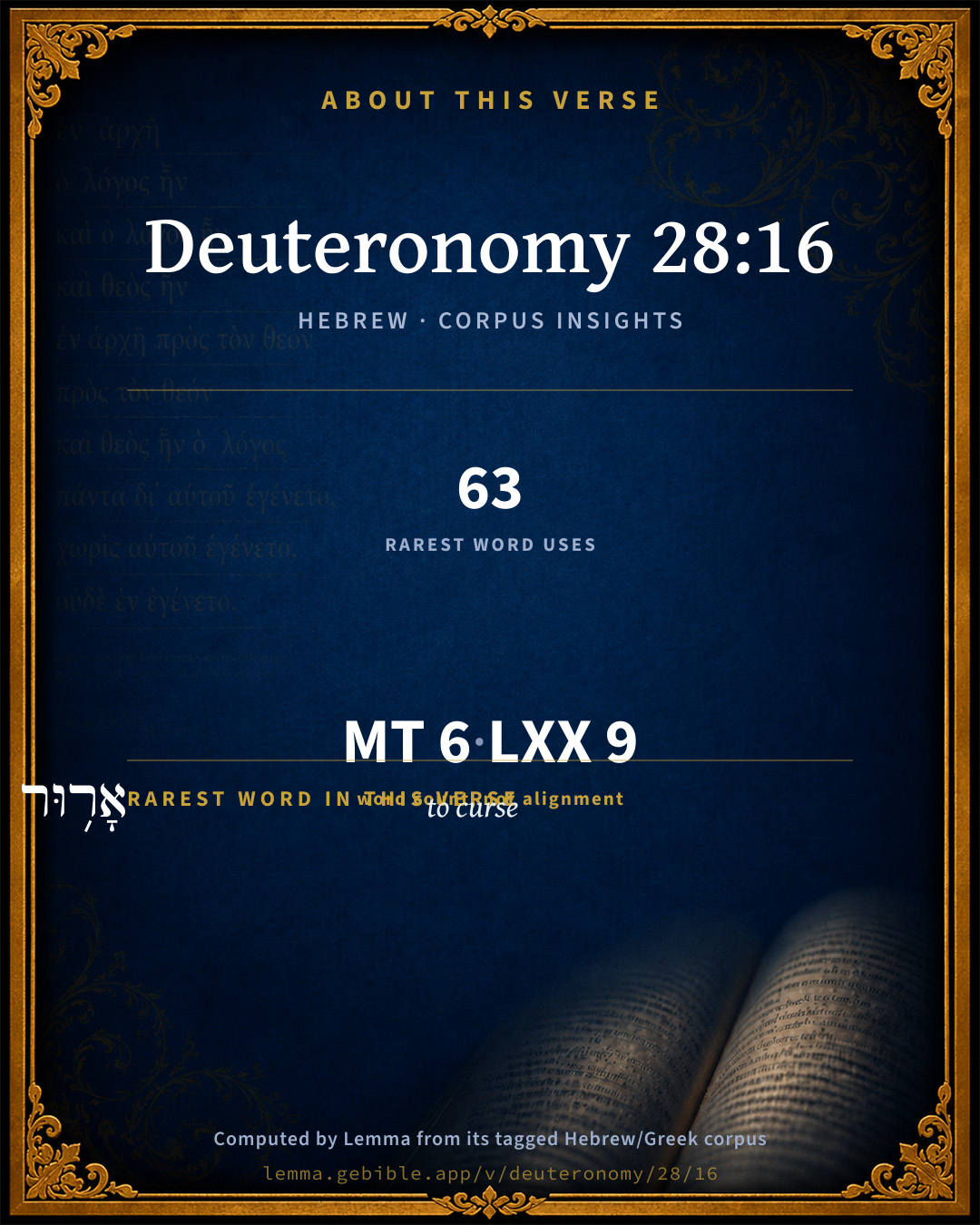
These counts appear in no published source. They are computed here, from the morphology-tagged text and Lemma’s own curated glosses. What Lemma adds →

6
words
4
distinct lemmas
Pentateuch
section

Grammatical profile

  • 2 verbs
  • 2 nouns
  • 2 pronouns

Verb forms

  • אָר֥וּר Qal · Participle Passive
  • וְאָר֥וּר Qal · Participle Passive

Repetition

Words recur within this verse — often emphatic in Hebrew:

  • אָר֥וּר to curse H779 ×2
  • אַתָּ֖ה you H859 ×2

Hebrew & Septuagint length

In English translation the verse runs 15 words from the Hebrew and 15 from the Septuagint (LXX English) — the same length.

A rough comparison of the two English renderings, which tokenize alike — not a word-level alignment.

Word counts can differ between the Hebrew and the Greek without any difference in meaning — e.g. the Hebrew direct-object marker אֵת has no separate Greek word, and Greek often adds the article ὁ.

In the original languages it is 6 Hebrew tokens and 9 Greek tokens — but the two are counted differently (Hebrew bundles its prefixes and suffixes into one token; the Greek is in lemma form), so that isn’t a like-for-like length.

Cross-references

30

Topical passages linked to Deuteronomy 28:16 in the Treasury of Scripture Knowledge — connected by theme and wording, ordered by reader-vote popularity; previews shown in the World English Bible.

  • Malachi 3:9–12 You are cursed with the curse; for you rob me, even this whole nation.
  • Proverbs 3:33 Yahweh's curse is in the house of the wicked, But he blesses the habitation of the righteous.
  • Isaiah 24:6–12 Therefore has the curse devoured the earth, and those who dwell therein are found guilty: therefore the inhabitants of the earth are burned, and few men left.
  • Jeremiah 14:2–5 Judah mourns, and the gates of it languish, they sit in black on the ground; and the cry of Jerusalem is gone up.
  • Jeremiah 14:18 If I go forth into the field, then, behold, the slain with the sword! and if I enter into the city, then, behold, those who are sick with famine! for both the prophet and the priest go about in the land, and have no knowledge.
  • Jeremiah 44:22 so that Yahweh could no longer bear, because of the evil of your doings, and because of the abominations which you have committed; therefore is your land become a desolation, and an astonishment, and a curse, without inhabitant, as it is this day.
  • Lamentations 2:11–22 My eyes do fail with tears, my heart is troubled; My liver is poured on the earth, because of the destruction of the daughter of my people, Because the young children and the infants swoon in the streets of the city.
  • Joel 1:4 What the swarming locust has left, the great locust has eaten. What the great locust has left, the grasshopper has eaten. What the grasshopper has left, the caterpillar has eaten.
  • Joel 1:8–18 Mourn like a virgin dressed in sackcloth for the husband of her youth!
  • Joel 2:3 A fire devours before them, And behind them, a flame burns. The land is as the garden of Eden before them, And behind them, a desolate wilderness. Yes, and no one has escaped them.
  • Haggai 1:9–11 "You looked for much, and, behold, it came to little; and when you brought it home, I blew it away. Why?" says Yahweh of Hosts, "Because of my house that lies waste, while each of you is busy with his own house.
  • Haggai 2:16–17 Through all that time, when one came to a heap of twenty measures, there were only ten. When one came to the wine vat to draw out fifty, there were only twenty.
  • Malachi 2:2 If you will not listen, and if you will not lay it to heart, to give glory to my name," says Yahweh of Hosts, "then will I send the curse on you, and I will curse your blessings. Indeed, I have cursed them already, because you do not lay it to heart.
  • Genesis 3:17–18 To Adam he said, "Because you have listened to your wife's voice, and have eaten of the tree, of which I commanded you, saying, 'You shall not eat of it,' cursed is the ground for your sake. In toil you will eat of it all the days of your life.
  • Genesis 5:29 and he named him Noah, saying, "This same will comfort us in our work and in the toil of our hands, because of the ground which Yahweh has cursed."
  • Genesis 8:21–22 Yahweh smelled the sweet savor. Yahweh said in his heart, "I will not again curse the ground any more for man's sake, because the imagination of man's heart is evil from his youth; neither will I ever again strike everything living, as I have done.
  • Deuteronomy 28:3–14 Blessed shall you be in the city, and blessed shall you be in the field.
  • Deuteronomy 28:55 so that he will not give to any of them of the flesh of his children whom he shall eat, because he has nothing left him, in the siege and in the distress with which your enemy shall distress you in all your gates.
  • 1 Kings 17:1 Elijah the Tishbite, who was of the foreigners of Gilead, said to Ahab, As Yahweh, the God of Israel, lives, before whom I stand, there shall not be dew nor rain these years, but according to my word.
  • 1 Kings 17:5 So he went and did according to the word of Yahweh; for he went and lived by the brook Cherith, that is before the Jordan.
  • 1 Kings 17:12 She said, As Yahweh your God lives, I don't have a cake, but a handful of meal in the jar, and a little oil in the jar: and, behold, I am gathering two sticks, that I may go in and bake it for me and my son, that we may eat it, and die.
  • Isaiah 43:28 Therefore I will profane the princes of the sanctuary; and I will make Jacob a curse, and Israel a reviling.
  • Jeremiah 9:11 I will make Jerusalem heaps, a dwelling-place of jackals; and I will make the cities of Judah a desolation, without inhabitant.
  • Jeremiah 26:6 then will I make this house like Shiloh, and will make this city a curse to all the nations of the earth.
  • Lamentations 1:1 How does the city sit solitary, that was full of people! She has become as a widow, who was great among the nations! She who was a princess among the provinces is become tributary!
  • Lamentations 4:1–13 How is the gold become dim! [how] is the most pure gold changed! The stones of the sanctuary are poured out at the head of every street.
  • Lamentations 5:10 Our skin is black like an oven, Because of the burning heat of famine.
  • Amos 4:6–9 "I also have given you cleanness of teeth in all your cities, And lack of bread in every town; Yet you haven't returned to me," says Yahweh.
  • Malachi 4:6 He will turn the hearts of the fathers to the children, and the hearts of the children to their fathers, lest I come and strike the earth with a curse."
  • Genesis 4:11–12 Now you are cursed because of the ground, which has opened its mouth to receive your brother's blood from your hand.

Cross-references courtesy of OpenBible.info (CC BY 4.0).

Hebrew and Greek witnesses Masoretic Hebrew ↔ Greek Septuagint

The same verse in the two great witnesses to the Old Testament, shown verse-for-verse.

These are two independent witnesses, not word-aligned to each other, and the Septuagint is shown in lemma (dictionary) form.

Hebrew Deuteronomy 28:16 Masoretic · Westminster Leningrad Codex

אָר֥וּר אַתָּ֖ה בָּעִ֑יר וְאָר֥וּר אַתָּ֖ה בַּשָּׂדֶֽה

Cursed shall you be in the city, and cursed shall you be in the field.

World English Bible · Public Domain

Greek LXX Deuteronomy 28:16 Septuagint · lemma form

ἐπικατάρατος σύ ἐν πόλις καί ἐπικατάρατος σύ ἐν ἀγρός

Cursed shall you be in the city, and cursed shall you be in the field.

LXX2012 (modern English Septuagint) · Public Domain

Hebrew: Westminster Leningrad Codex (CC BY 4.0). Greek: Septuagint (public domain); English from LXX2012 (modern English Septuagint) (Public Domain). How the Septuagint differs from the Hebrew →

Targum (Aramaic paraphrase)

2

The Targum is the ancient Jewish Aramaic paraphrase of the Hebrew Scriptures — an interpretive translation, not the Hebrew text itself. Onkelos (literal) and Pseudo-Jonathan (expansive) render the Torah, and Jonathan the Prophets. Coverage is partial: where no permissively-licensed English translation exists for a verse, only the Aramaic is shown. This is verse-level text, not a word-by-word alignment to the Hebrew.

  1. Targum Onkelos Torah (Genesis–Deuteronomy)
    לִיטּ אַתְּ בְּקַרְתָא וְלִיט אַתְּ בְּחַקְלָא

    (no public-domain English translation for this verse)

    Targum Onkelos — Aramaic: “Onkelos Genesis” (public domain); “Onkelos Exodus” (public domain); “Onkelos Leviticus” (public domain); “Onkelos Numbers” (public domain); “Onkelos Deuteronomy” (public domain). English: “Sefaria Community Translation” (CC0 1.0 (public-domain dedication)); “J.W. Etheridge. The Targums of Onkelos and Jonathan Ben Uzziel on the Pentateuch. London: Longmans, Green, 1862” (public domain). Text via Sefaria.

  2. Targum Pseudo-Jonathan Torah (Genesis–Deuteronomy)
    לִיטִין אַתּוּן בְּקַרְתָּא וְלִיטִין אַתּוּן בְּחַקְלָא

    Accursed shall you be in the city and in the field.

    Targum Pseudo-Jonathan — Aramaic: “Targum Jonathan on Genesis” (public domain); “Targum Jonathan on Exodus” (public domain); “Targum Jonathan on Leviticus” (public domain); “Targum Jonathan on Numbers” (public domain); “Targum Jonathan on Deuteronomy” (public domain). English: “The Targum of Jonathan ben Uzziel, trans. J. W. Etheridge, London, 1862” (public domain). Text via Sefaria.

Commentary

Notes on Deuteronomy 28:16 from classic Christian and Jewish commentators (each source and its license shown beneath its notes). The classic Christian expositions comment on the surrounding passage and are grouped to its opening verse, so a note may address several verses; the Jewish commentaries on the Tanakh (Rashi and others) are per-verse, so they appear only where the commentator wrote on this verse.

Lemma curates 59 commentaries, every one of them public domain or Creative Commons licensed, each selected and text-cleaned for this edition rather than reprinted as found. About our sources →

John Gill's Exposition

Cursed shall be the fruit of thy body, and the fruit of thy land, the increase of thy kine, and the flocks of thy sheep. See Gill on Deu 28:4, Deu 28:16.

.

Deuteronomy 28:19

deu 28:19

deu 28:19

deu 28:19Cursed shalt thou be when thou comest in, and cursed shalt thou be when thou goest out. See Gill on Deu 28:6, Deu 28:16.

John Gill's Exposition of the Whole Bible (1746–1763) — public domain (CC PDM 1.0). Text via the HelloAO Bible API.

Trapp's Complete Commentary

John Trapp

Deu 28:16 Cursed [shalt] thou [be] in the city, and cursed [shalt] thou [be] in the field.

Ver. 16. {See Trapp on "Deu 28:15"}

John Trapp, A Commentary or Exposition upon All the Books of the Old and New Testament (1647–1656) — public domain. Text from a community e-Sword module.

Ellicott's Commentary for English Readers

(16-19) Cursed. . . .—Here we have the counterpart of Deu_28:3-6, inclusive. The only difference is in the position of “the basket and the store” which come one place earlier in the curses than in the blessings.

A Bible Commentary for English Readers, edited by Charles John Ellicott (1878–1897) — public domain. Text from a community e-Sword module.

Whedon's Commentary on the Bible

Daniel D. Whedon

16-19. Cursed… in the city… field… basket… store… fruit of body… land… kine… sheep… comest in… goest out — The curses here enumerated stand in contrast with the blessings in 3-6.

Daniel D. Whedon (gen. ed.), Commentary on the Old and New Testaments (1874–1909) — public domain. Text from a community e-Sword module.

unfoldingWord translationNotes

Door43 World Missions Community

General Information:

Moses speaks to the Israelites as if they were one man, so the words "you" and "your" here are singular. (See: Forms of You)

General Information:

These phrases appeared earlier in the chapter. See how you translated many of these words in Deuteronomy 28:3-4 and Deuteronomy 28:5-6.

Cursed will you be

This can be stated in active form. AT: "Yahweh will curse you" (See: Active or Passive)

in the city ... in the field

This merism means that Yahweh will bless them everywhere. See how you translated this in Deuteronomy 28:3. (See: Merism)

your basket and your kneading trough

The Israelites used a basket to carry grain. A "kneading trough" was a bowl they used to mix the grain and make bread. See how you translated this in Deuteronomy 28:5. AT: "all the food you grow and all the food you eat" (See: Metonymy)

translationWords

curse

basket

unfoldingWord translationNotes — © Distant Shores Media and the Door43 World Missions Community, licensed CC BY-SA 4.0. Source: git.door43.org/Door43/en_tn.

Lesson kit

Teaching starters — assembled from the data on this page, not authored interpretation. Every prompt links to the verse data it draws on. Edit before teaching.

Deuteronomy, in the Pentateuch, opens this verse with 6 words (4 distinct Hebrew lemmas). Its most distinctive word is ʼârar (“to curse”). A historical commentator’s framing appears above. Read the whole chapter for the surrounding context.

Discussion questions

  1. The word ʼârar carries the sense “to curse.” How does it shape the verse?
  2. Malachi 3:9–12 shares this passage’s theme. How do the two illuminate each other?
  3. “to curse” occurs 2× in this one verse. What is the effect of the repetition?
  4. These translations render this verse differently. What is at stake in choosing one wording over another?
  5. The verb «אָר֥וּר» is Qal Participle Passive. How does its form color the action?
  6. Reading how John Gill's Exposition and Trapp's Complete Commentary read this verse, where do the two commentators agree and where do they part?

Things to notice

Reading settings

Reading text

Shown beneath each verse's original-language words.

Old Testament
Old Testament edition

Read the OT as the Masoretic Hebrew (MT) or the Greek Septuagint (LXX).

English shown for the Greek Septuagint (in the Hebrew ↔ Greek comparison).

Comparing translations? Open the Compare panel on any verse page to stack up to four side by side.