
2 Chronicles 25:18

Hebrew (Westminster Leningrad Codex) 2 Chronicles 25:18 appears in the Hebrew Old Testament. The text above is from the Westminster Leningrad Codex. Each word links to its Strong’s number, a concise gloss, and parsing drawn from the Open Scriptures Hebrew Bible morphology. Click any word for its full Brown-Driver-Briggs (BDB) entry.
Download image
Cite this verse

2 Chronicles 25:18 (World English Bible). Public Domain. Lemma interlinear Bible study tool, https://lemma.gebible.app/v/2-chronicles/25/18.

Show BibTeX & RIS
BibTeX
RIS
English Translation
Joash king of Israel sent to Amaziah king of Judah, saying, The thistle that was in Lebanon sent to the cedar that was in Lebanon, saying, Give your daughter to my son as wife: and there passed by a wild animal that was in Lebanon, and trod down the thistle.
World English Bible · Public Domain
Download a study sheet

One document with this verse’s original text, its word-by-word gloss line, the meaning frame, cross-references with their text, attributed commentary, and full source and license credits — printable, and it pastes into notes with its structure intact.

This verse Autodidact and up

Study sheet (.html) Plain text (.txt)

A passage Seminary Student

Up to 50 verses in one chapter. A passage sheet keeps up to 6 commentary sources and 12 cross-references per verse, in the order this page ranks them, and says so on the sheet whenever that leaves anything out. Ask for a single verse and you get the Autodidact verse sheet above.

Everything on this page stays free to read, with no account — the sheet is a download of what is already on screen, not access to it.

Want to remove ads? Support Godless Engineer
Compare translations 3

The same verse in 3 English versions, stacked beneath the original-language interlinear above. Click any original word for its lexicon entry.

Each is an independent rendering of the whole verse — the interlinear is not word-aligned to these translations.

Highlighted words mark where these versions differ — a whole-verse word diff, not a word-by-word alignment.

  • World English Bible Public Domain
    Joash king of Israel sent to Amaziah king of Judah, saying, The thistle that was in Lebanon sent to the cedar that was in Lebanon, saying, Give your daughter to my son as wife: and there passed by a wild animal that was in Lebanon, and trod down the thistle.
  • King James Version Public Domain
    And Joash king of Israel sent to Amaziah king of Judah, saying, The thistle that was in Lebanon sent to the cedar that was in Lebanon, saying, Give thy daughter to my son to wife: and there passed by a wild beast that was in Lebanon, and trode down the thistle.
  • unfoldingWord Literal Text CC BY-SA 4.0
    And Joash the king of Israel sent to Amaziah, the king of Judah, saying, “A bramble that was in Lebanon sent to a cedar that was in Lebanon, saying, ‘Give your daughter to my son for a wife,’ but an animal passed over the field that was in Lebanon and trampled the bramble.

unfoldingWord Literal Text — © unfoldingWord, licensed CC BY-SA 4.0. Word-aligned USFM3 via Door43 (git.door43.org/unfoldingWord/en_ult).

Versions to compare (up to 4)

3 of 4 selected

Show all 18 translations

Every available English version of this verse, each an independent rendering of the whole verse.

  • World English Bible Public Domain
    Joash king of Israel sent to Amaziah king of Judah, saying, The thistle that was in Lebanon sent to the cedar that was in Lebanon, saying, Give your daughter to my son as wife: and there passed by a wild animal that was in Lebanon, and trod down the thistle.
  • Berean Standard Bible Public Domain
    But Jehoash king of Israel replied to Amaziah king of Judah: “A thistle in Lebanon sent a message to a cedar in Lebanon, saying, ‘Give your daughter to my son in marriage.’ Then a wild beast in Lebanon came along and trampled the thistle.
  • Majority Standard Bible Public Domain
    But Jehoash king of Israel replied to Amaziah king of Judah: “A thistle in Lebanon sent a message to a cedar in Lebanon, saying, ‘Give your daughter to my son in marriage.’ Then a wild beast in Lebanon came along and trampled the thistle.
  • King James Version Public Domain
    And Joash king of Israel sent to Amaziah king of Judah, saying, The thistle that was in Lebanon sent to the cedar that was in Lebanon, saying, Give thy daughter to my son to wife: and there passed by a wild beast that was in Lebanon, and trode down the thistle.
  • American Standard Version (1901) Public Domain
    And Joash king of Israel sent to Amaziah king of Judah, saying, The thistle that was in Lebanon sent to the cedar that was in Lebanon, saying, Give thy daughter to my son to wife: and there passed by a wild beast that was in Lebanon, and trod down the thistle.
  • Revised Version (1885) Public Domain
    And Joash king of Israel sent to Amaziah king of Judah, saying, The thistle that was in Lebanon sent to the cedar that was in Lebanon, saying, Give thy daughter to my son to wife: and there passed by a wild beast that was in Lebanon; and trode down the thistle.
  • Geneva Bible (1599) Public Domain
    But Ioash King of Israel sent to Amaziah King of Iudah, saying, The thistle that is in Lebanon, sent to the cedar that is in Lebanon, saying, Giue thy daughter to my sonne to wife: and the wilde beast that was in Lebanon went and trode downe the thistle.
  • Douay-Rheims (1899) Public Domain
    But he sent back the messengers, saying: The thistle that is in Libanus, sent to the cedar in Libanus, saying: Give thy daughter to my son to wife: and behold the beasts that were in the wood of Libanus passed by, and trod down the thistle.
  • Young's Literal Translation Public Domain
    `Come, we look one another in the face.' And Joash king of Israel sendeth unto Amaziah king of Judah, saying, `The thorn that `is' in Lebanon hath sent unto the cedar that `is' in Lebanon, saying, Give thy daughter to my son for a wife; and pass by doth a beast of the field that `is' in Lebanon, and treadeth down the thorn.
  • Literal Standard Version CC BY-SA 4.0
    “Come, we look one another in the face.” And Joash king of Israel sends to Amaziah king of Judah, saying, “The thorn that [is] in Lebanon has sent to the cedar that [is] in Lebanon, saying, Give your daughter to my son for a wife; and a beast of the field that [is] in Lebanon passes by and treads down the thorn.
  • Unlocked Literal Bible CC BY-SA 4.0
    But Jehoash the king of Israel sent messengers back to Amaziah king of Judah, saying, “A thistle that was in Lebanon sent a message to a cedar in Lebanon, saying, 'Give your daughter to my son for a wife,' but a wild beast in Lebanon walked by and trampled down the thistle.
  • unfoldingWord Literal Text CC BY-SA 4.0
    And Joash the king of Israel sent to Amaziah, the king of Judah, saying, “A bramble that was in Lebanon sent to a cedar that was in Lebanon, saying, ‘Give your daughter to my son for a wife,’ but an animal passed over the field that was in Lebanon and trampled the bramble.
  • Darby Bible Public Domain
    And Joash king of Israel sent to Amaziah king of Judah, saying, The thorn-bush that is in Lebanon sent to the cedar that is in Lebanon, saying, Give thy daughter to my son as wife; and there passed by the wild beast that is in Lebanon, and trode down the thorn-bush.
  • World Messianic Bible Public Domain
    Joash king of Israel sent to Amaziah king of Judah, saying, “The thistle that was in Lebanon sent to the cedar that was in Lebanon, saying, ‘Give your daughter to my son as his wife. Then a wild animal that was in Lebanon passed by and trampled down the thistle.
  • Webster's Bible Public Domain
    And Joash king of Israel sent to Amaziah king of Judah, saying, The thistle that was in Lebanon sent to the cedar that was in Lebanon, saying, Give thy daughter to my son for a wife: and there passed by a wild beast that was in Lebanon, and trod down the thistle.
  • Free Bible Version CC BY-SA 4.0
    Joash, king of Israel, replied to Amaziah, king of Judah, “A thistle on Lebanon sent a message to a cedar on Lebanon, saying, ‘Give your daughter to my son for a wife,’ but a wild animal of Lebanon passed by and trampled down the thistle.
  • Bible in Basic English Public Domain
    And Joash, king of Israel, sent to Amaziah, king of Judah, saying, The thorn-tree in Lebanon sent to the cedar in Lebanon, saying, Give your daughter to my son for a wife: and a beast from the woodland in Lebanon went by, crushing the thorn under his feet.
  • JPS Tanakh (1917) Public Domain
    And Joash king of Israel sent to Amaziah king of Judah, saying: 'The thistle that was in Lebanon sent to the cedar that was in Lebanon, saying: Give thy daughter to my son to wife; and there passed by the wild beasts that were in Lebanon, and trod down the thistle.

Literal Standard Version (2020), Covenant Press — licensed CC BY-SA 4.0. Text via the HelloAO Bible API (eBible.org). Unlocked Literal Bible (unfoldingWord) — licensed CC BY-SA 4.0. Text via the HelloAO Bible API (eBible.org). unfoldingWord Literal Text — © unfoldingWord, licensed CC BY-SA 4.0. Word-aligned USFM3 via Door43 (git.door43.org/unfoldingWord/en_ult). Free Bible Version, Dr. Jonathan Gallagher — licensed CC BY-SA 4.0. Text via the HelloAO Bible API (eBible.org).

Word by word

More ways to search: Search by grammar → Find every occurrence → Compare this word →

Practice this passage: Drill this verse → Learn its vocabulary →

הַח֜וֹחַ
chôwach
H2336
“the · thorn”
Particle, Definite Article + Noun, Common, Masculine, Singular, Absolute
Part of Speech
Particle + Noun
Type
Common
Gender
Masculine
Number
Singular
State
Absolute
Full BDB Definition

Origin: from an unused root apparently meaning to pierce

TWOT: 620a , 620b

thorn, brier, bramble, thornbush, thicket - hook, ring, fetter
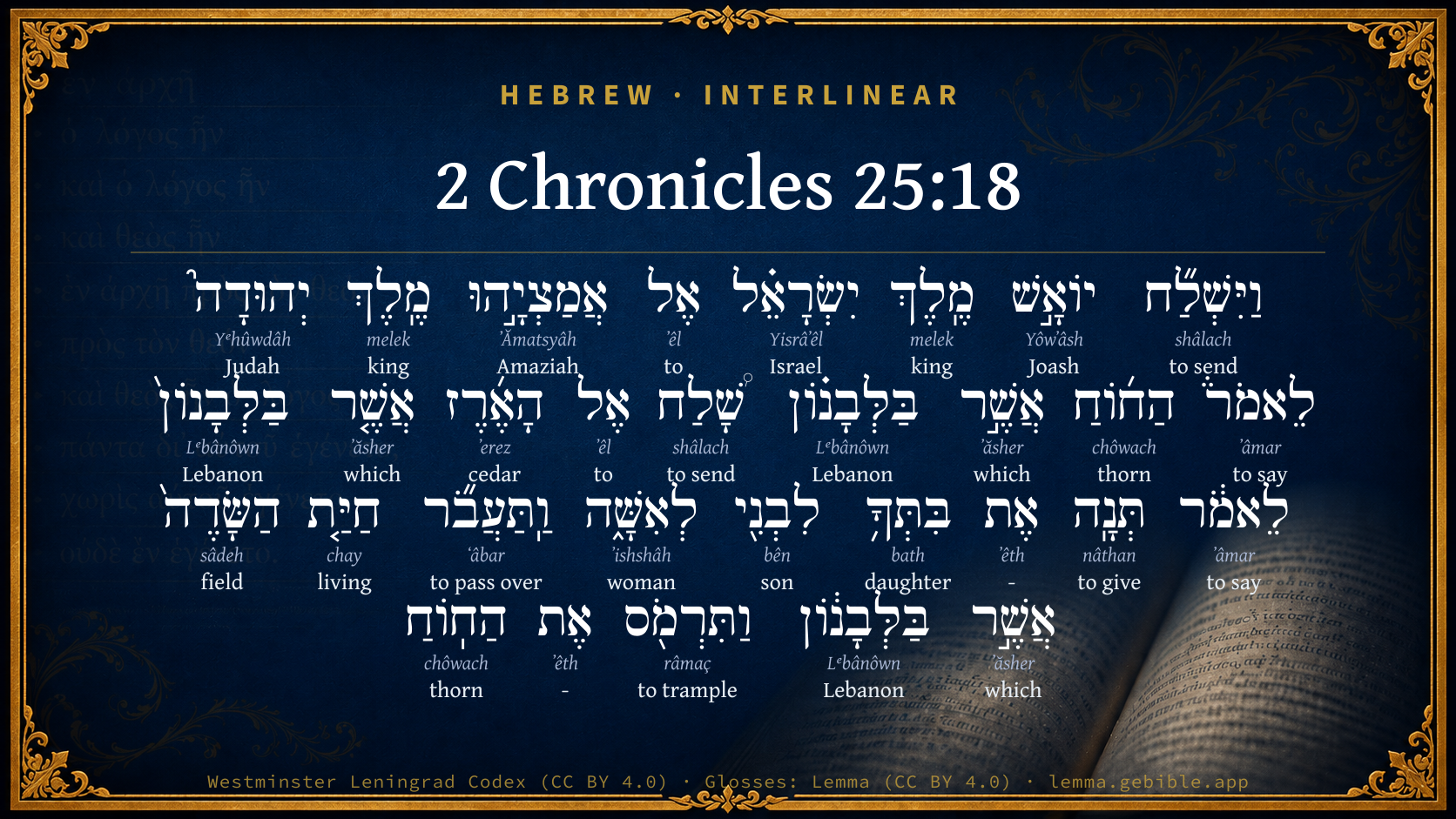
  1. וַיִּשְׁלַ֞ח shâlach H7971 “and · to send” Conjunction + Verb, Qal, Sequential Imperfect, 3rd Person, Masculine, Singular
  2. יוֹאָ֣שׁ Yôwʼâsh H3101 “Joash” Noun, Proper
  3. מֶֽלֶךְ melek H4428 “king of” Noun, Common, Masculine, Singular, Construct
  4. יִשְׂרָאֵ֗ל Yisrâʼêl H3478 “Israel” Noun, Proper
  5. אֶל ʼêl H413 “to” Preposition
  6. אֲמַצְיָ֣הוּ ʼĂmatsyâh H558 “Amaziah” Noun, Proper
  7. מֶֽלֶךְ melek H4428 “king of” Noun, Common, Masculine, Singular, Construct
  8. יְהוּדָה֮ Yᵉhûwdâh H3063 “Judah” Noun, Proper
  9. לֵאמֹר֒ ʼâmar H559 “to say” Preposition + Verb, Qal, Infinitive Construct
  10. אֲשֶׁ֣ר ʼăsher H834 “which” Particle, Relative
  11. בַּלְּבָנ֗וֹן Lᵉbânôwn H3844 “in/at the · Lebanon” Preposition, Determined + Noun, Proper
  12. שָׁ֠לַח shâlach H7971 “to send” Verb, Qal, Perfect, 3rd Person, Masculine, Singular
  13. אֶל ʼêl H413 “to” Preposition
  14. הָאֶ֜רֶז ʼerez H730 “the · cedar” Particle, Definite Article + Noun, Common, Masculine, Singular, Absolute
  15. אֲשֶׁ֤ר ʼăsher H834 “which” Particle, Relative
  16. בַּלְּבָנוֹן֙ Lᵉbânôwn H3844 “in/at the · Lebanon” Preposition, Determined + Noun, Proper
  17. לֵאמֹ֔ר ʼâmar H559 “to say” Preposition + Verb, Qal, Infinitive Construct
  18. תְּנָֽה nâthan H5414 “give” Verb, Qal, Imperative, 2nd Person, Masculine, Singular + Suffix, h
  19. אֶת ʼêth H853 “-” Particle, Direct Object
  20. בִּתְּךָ֥ bath H1323 “daughter · your” Noun, Common, Feminine, Singular, Construct + Suffix, Personal, 2nd Person, Masculine, Singular
  21. לִבְנִ֖י bên H1121 “to/for · son · my” Preposition + Noun, Common, Masculine, Singular, Construct + Suffix, Personal, 1st Person, Common, Singular
  22. לְאִשָּׁ֑ה ʼishshâh H802 “to/for · woman” Preposition + Noun, Common, Feminine, Singular, Absolute
  23. וַֽתַּעֲבֹ֞ר ʻâbar H5674 “and · to pass over” Conjunction + Verb, Qal, Sequential Imperfect, 3rd Person, Feminine, Singular
  24. חַיַּ֤ת chay H2416 “living of” Noun, Common, Feminine, Singular, Construct
  25. הַשָּׂדֶה֙ sâdeh H7704 “the · field” Particle, Definite Article + Noun, Common, Masculine, Singular, Absolute
  26. אֲשֶׁ֣ר ʼăsher H834 “which” Particle, Relative
  27. בַּלְּבָנ֔וֹן Lᵉbânôwn H3844 “in/at the · Lebanon” Preposition, Determined + Noun, Proper
  28. וַתִּרְמֹ֖ס râmaç H7429 “and · to trample” Conjunction + Verb, Qal, Sequential Imperfect, 3rd Person, Feminine, Singular
  29. אֶת ʼêth H853 “-” Particle, Direct Object
  30. הַחֽוֹחַ chôwach H2336 “the · thorn” Particle, Definite Article + Noun, Common, Masculine, Singular, Absolute

About this verse

These counts appear in no published source. They are computed here, from the morphology-tagged text and Lemma’s own curated glosses. What Lemma adds →

31
words
21
distinct lemmas
Historical
section

Notable vocabulary

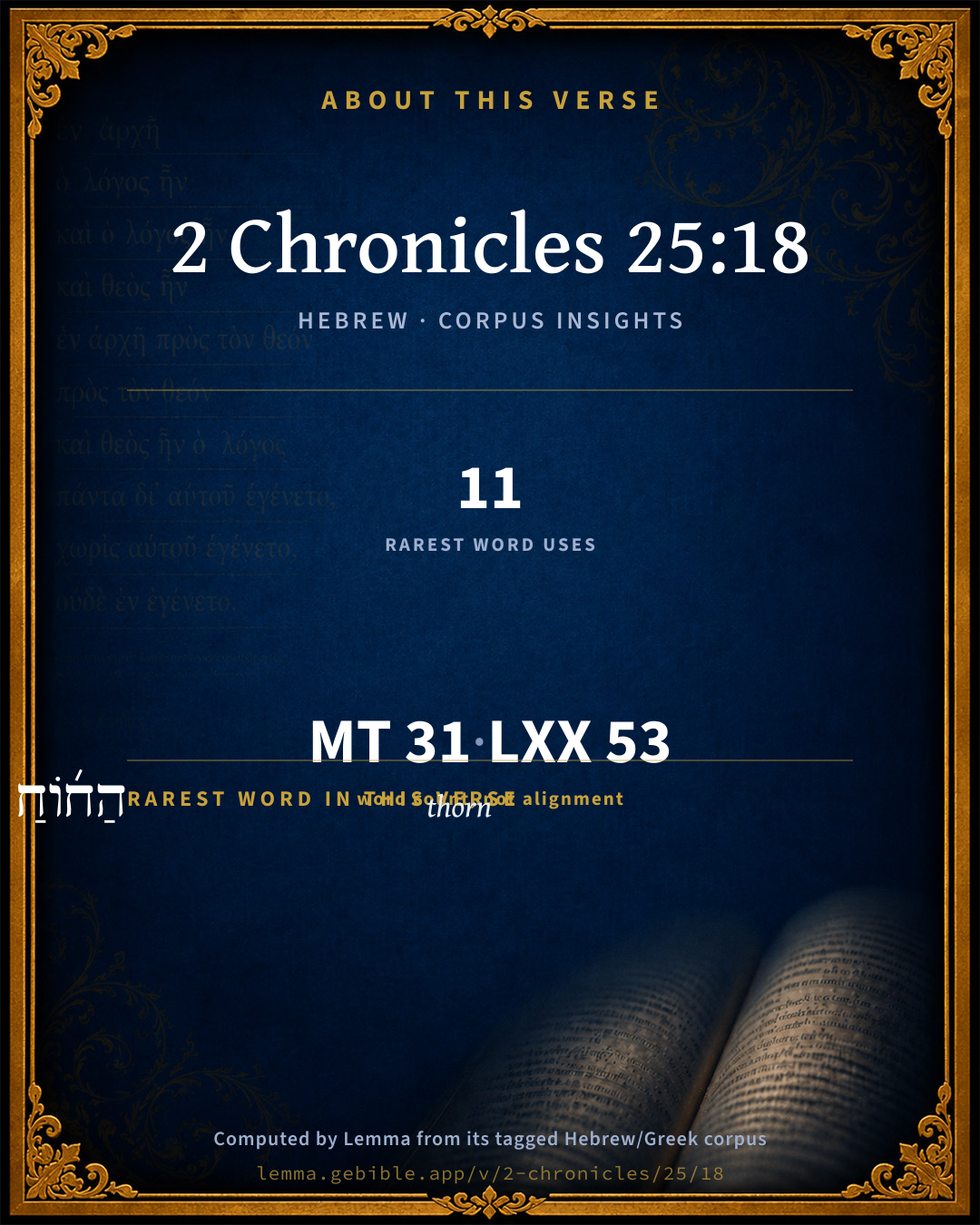
The rarest word here is הַח֜וֹחַ thorn H2336 — appearing just 11 times in the whole Hebrew Bible.

Shared distinctive vocabulary

הַח֜וֹחַ thorn H2336 occurs in 9 verses of the Hebrew Bible. Also found in:

Grammatical profile

  • 7 verbs
  • 17 nouns
  • 2 prepositions
  • 5 particles

Verb forms

  • וַיִּשְׁלַ֞ח Qal · Sequential Imperfect
  • לֵאמֹר֒ Qal · Infinitive Construct
  • שָׁ֠לַח Qal · Perfect
  • לֵאמֹ֔ר Qal · Infinitive Construct
  • תְּנָֽה Qal · Imperative
  • וַֽתַּעֲבֹ֞ר Qal · Sequential Imperfect
  • וַתִּרְמֹ֖ס Qal · Sequential Imperfect

Repetition

Words recur within this verse — often emphatic in Hebrew:

  • בַּלְּבָנ֗וֹן Lebanon H3844 ×3
  • וַיִּשְׁלַ֞ח to send H7971 ×2
  • מֶֽלֶךְ king H4428 ×2
  • לֵאמֹר֒ to say H559 ×2
  • הַח֜וֹחַ thorn H2336 ×2
  • אֲשֶׁ֣ר which H834 ×3
  • אֶל to H413 ×2

Hebrew & Septuagint length

In English translation the verse runs 50 words from the Hebrew and 60 from the Septuagint (LXX English) — closely comparable.

A rough comparison of the two English renderings, which tokenize alike — not a word-level alignment.

Word counts can differ between the Hebrew and the Greek without any difference in meaning — e.g. the Hebrew direct-object marker אֵת has no separate Greek word, and Greek often adds the article ὁ.

In the original languages it is 31 Hebrew tokens and 53 Greek tokens — but the two are counted differently (Hebrew bundles its prefixes and suffixes into one token; the Greek is in lemma form), so that isn’t a like-for-like length.

Cross-references

3

Topical passages linked to 2 Chronicles 25:18 in the Treasury of Scripture Knowledge — connected by theme and wording, ordered by reader-vote popularity; previews shown in the World English Bible.

  • Judges 9:8–15 The trees went forth on a time to anoint a king over them; and they said to the olive tree, Reign you over us.
  • 1 Kings 4:33 He spoke of trees, from the cedar that is in Lebanon even to the hyssop that springs out of the wall; he spoke also of animals, and of birds, and of creeping things, and of fish.
  • Psalms 80:13 The boar out of the wood ravages it. The wild animals of the field feed on it.

Cross-references courtesy of OpenBible.info (CC BY 4.0).

Hebrew and Greek witnesses Masoretic Hebrew ↔ Greek Septuagint

The same verse in the two great witnesses to the Old Testament, shown verse-for-verse.

These are two independent witnesses, not word-aligned to each other, and the Septuagint is shown in lemma (dictionary) form.

Hebrew 2 Chronicles 25:18 Masoretic · Westminster Leningrad Codex

וַיִּשְׁלַ֞ח יוֹאָ֣שׁ מֶֽלֶךְ יִשְׂרָאֵ֗ל אֶל אֲמַצְיָ֣הוּ מֶֽלֶךְ יְהוּדָה֮ לֵאמֹר֒ הַח֜וֹחַ אֲשֶׁ֣ר בַּלְּבָנ֗וֹן שָׁ֠לַח אֶל הָאֶ֜רֶז אֲשֶׁ֤ר בַּלְּבָנוֹן֙ לֵאמֹ֔ר תְּנָֽה אֶת בִּתְּךָ֥ לִבְנִ֖י לְאִשָּׁ֑ה וַֽתַּעֲבֹ֞ר חַיַּ֤ת הַשָּׂדֶה֙ אֲשֶׁ֣ר בַּלְּבָנ֔וֹן וַתִּרְמֹ֖ס אֶת הַחֽוֹחַ

Joash king of Israel sent to Amaziah king of Judah, saying, The thistle that was in Lebanon sent to the cedar that was in Lebanon, saying, Give your daughter to my son as wife: and there passed by a wild animal that was in Lebanon, and trod down the thistle.

World English Bible · Public Domain

Greek LXX 2 Chronicles 25:18 Septuagint · lemma form

καί ἀποστέλλω ιωας βασιλεύς ἰσραήλ πρός αμασιας βασιλεύς ἰουδά λέγω ὁ αχουχ ὁ ἐν ὁ λιβάνος ἀποστέλλω πρός ὁ κέδρος ὁ ἐν ὁ λιβάνος λέγω δίδωμι ὁ θυγάτηρ σύ ὁ υἱός ἐγώ εἰς γυνή καί ἰδού ἔρχομαι ὁ θηρίον ὁ ἀγρός ὁ ἐν ὁ λιβάνος καί ἔρχομαι ὁ θηρίον καί καταπατέω ὁ αχουχ

And Joas king of Israel sent to Amasias king of Juda, saying, The thistle that was in Libanus sent to the cedar that was in Libanus, saying, Give your daughter to my son to wife; but, behold, your wild beasts of the field that are in Libanus shall come: and the wild beasts did come, and trod down the thistle.

LXX2012 (modern English Septuagint) · Public Domain

Hebrew: Westminster Leningrad Codex (CC BY 4.0). Greek: Septuagint (public domain); English from LXX2012 (modern English Septuagint) (Public Domain). How the Septuagint differs from the Hebrew →

Commentary

Notes on 2 Chronicles 25:18 from classic Christian and Jewish commentators (each source and its license shown beneath its notes). The classic Christian expositions comment on the surrounding passage and are grouped to its opening verse, so a note may address several verses; the Jewish commentaries on the Tanakh (Rashi and others) are per-verse, so they appear only where the commentator wrote on this verse.

Lemma curates 59 commentaries, every one of them public domain or Creative Commons licensed, each selected and text-cleaned for this edition rather than reprinted as found. About our sources →

Trapp's Complete Commentary

John Trapp

2Ch 25:18 And Joash king of Israel sent to Amaziah king of Judah, saying, The thistle that [was] in Lebanon sent to the cedar that [was] in Lebanon, saying, Give thy daughter to my son to wife: and there passed by a wild beast that [was] in Lebanon, and trode down the thistle.

Ver. 18-20, &c., to the end of the chapter. {See Trapp on "2Ki 14:8"} {See Trapp on "2Ki 14:9"} {See Trapp on "2Ki 14:10"}

John Trapp, A Commentary or Exposition upon All the Books of the Old and New Testament (1647–1656) — public domain. Text from a community e-Sword module.

The Biblical Illustrator

Joseph S. Exell

2Ch_25:18

The thistle that was in Lebanon sent to the cedar that was in Lebanon.

True and false union

Our parable thus distinguishes between true and false union. The true is inward and real; the false is outward and superficial. The true rests on the fitness of things and on eternal laws; the false relies on the capriciousness of human nature and the ebb and flow of circumstances. The false comes through conquest, coercion, and oppression; the true comes from God, righteousness and liberty. You will find these two kinds of union facing us in all relations of life. Take the history of Christianity in the world.

1. The aim of the Roman Catholic Church has been to create union among all Christians. But, while the aim has been good, the method employed has been bad. The union thus sought has been a false one because it has tried to coerce and compel men to acknowledge the Pope to be the one earthly vicar of Christ.

2. A similar policy has been that of the Established Church of England. As soon as the prayer-book was compiled a series of Acts of Parliament were passed--the Act of Uniformity, etc.--to compel all British subjects to conform to its teaching. An effort was made to establish union by Acts of Parliament. The effort with a right and noble aim has failed because based on false methods.

3. Dissenters have also erred in like manner. At the assembly of Westminster divines a number of eminent Christian men drew up a set of doctrines, which were to be the infallible guide for a section of the followers of Christ. If a carpenter has a certain number of boards to make he gets the wood that is necessary; he takes his measurements; he cuts and planes each board exactly to the size, and length, and breadth, and thickness that he desires; he joins the boards together and makes the box, or floor, or other article as the case may be. All are united to complete the one object intended. But it is impossible for us to apply the word union in this sense to intelligent, thinking human beings. You may cut, measure wood and inanimate objects as you please, but here you have to do with creatures in whom there is the Divine gift of reason and free-will. If you wish to unite men under any government, religious or political, you must first appeal to their reason, and leave them free to act as that reason leads them. The only true basis of union among human beings is the Presence of God--in other words, righteousness, justice, liberty, and truth. For where righteousness, justice, liberty, and truth are, there God is. The members of a family are united not by bearing the same name, resembling each other in stature and features, but by doing what is right and just to each other, and by loving one another. The members of the Church of Christ are not united by repeating the same creed, by meeting in the same place of worship, by calling themselves by the same name, but by having hearts glowing with love to one Saviour, and by gladly serving their one Lord. The people of a nation are united together not by national prejudices and oppressive laws so much as by their common loyalty to a righteous and just government. (J. Lewis.)

.

The Biblical Illustrator, edited by Joseph S. Exell (c. 1880s–1900s) — public domain. Text from a community e-Sword module.

Adam Clarke's Commentary

Verse 18. The thistle that was in Lebanon] See the explanation of this 2Kg 14:9. After reciting this fable, the Targum adds, "Thus hast thou done in the time thou didst send unto me, and didst lead up from the house of Israel a hundred thousand strong warriors for a hundred talents of silver: and after they were sent, thou didst not permit them to go with thee to war, but didst send them back, greatly enraged, so that they spread themselves over the country; and having cut off three thousand, they brought back much spoil."

Adam Clarke's Commentary on the Bible (1810–1826) — public domain. Text from a community e-Sword/MySword module.

Ellicott's Commentary for English Readers

(18) And Joash king of Israel.—This verse is the same as 2Ki_14:9. (See Notes there.)

A Bible Commentary for English Readers, edited by Charles John Ellicott (1878–1897) — public domain. Text from a community e-Sword module.

The Cambridge Bible for Schools and Colleges

gen. ed. J. J. S. Perowne

18. the thistle] R.V. mg., thorn; cp. Pro_26:9 (same Heb. word).

The Cambridge Bible for Schools and Colleges (gen. ed. J. J. S. Perowne; Cambridge University Press, 1878–1918) — public domain. Text from a community e-Sword module.

Haydock's Catholic Bible Commentary

Thistle. This fable insinuated how much Joas despised the insolence of his antagonist, (H.) and Amasias had soon reason to repent. T.

George Leo Haydock (1774–1849), Haydock's Catholic Family Bible and Commentary, 1859 edition — public domain. Excludes Psalms (Douay-Rheims chapter numbering differs from Protestant) and Deuterocanonical books (Catholic canon only).

The Pulpit Commentary

The thistle sent to the cedar. While other history shows frequently the abounding Eastern delight in this exact kind of composition, it will be remembered that it is not absent from Scripture, and that this is not the first recorded instance of it by three hundred and fifty years, for seejh. (Jud 9:7-15) The thistle; Hebrew, jwO. The word occurs, beside the four times here and in the parallel, eight other times: 1Sa_13:6; 2Ch_33:11; Job_31:40 Job_41:2; Pro_26:9; Son_2:2; Isa_34:13; Hos_9:6. Although, then, the word we have here is not the "bramble" (dfa) of Jud_1:9:15, which also is brought before us in its contrast with Lebanon"s cedar, yet the bramble bush, chiefly in virtue of its characteristic thorn, best answers to the average suggestions of all the twelve instances of the use of our word.

The Pulpit Commentary (1880–1919), ed. H.D.M. Spence-Jones & Joseph S. Exell — public domain. Text from a community e-Sword module.

unfoldingWord translationNotes

Door43 World Missions Community

A thistle that was in Lebanon ... trampled down the thistle

This message is in the form of a parable. The worthless thistle represents Amaziah, and the cedar represents Jehoash. The trampling of the thistle by the beast expresses that something bad will happen to the thistle, and it will be powerless to stop it. The point of the parable is that Amaziah was foolish to challenge Jehoash. (See: Parables)

thistle

This is a small, worthless plant with small, sharp thorns.

cedar

a very large type of tree

your heart has lifted you up

This is an idiom that means he had become proud. AT: "you have become proud" (See: Idiom)

why should you cause yourself trouble and fall, both you and Judah with you?

Jehoash used this rhetorical question to warn Amaziah not to fight with him. It can be translated as a statement. AT: "you should not cause yourself trouble and fall, both you and Judah with you." (See: Rhetorical Question)

fall

Here "fall" is a euphemism for "die." (See: Euphemism)

Judah

Here "Judah" is a metonym for the people who lived in Judah. AT: "the people of Judah" (See: Metonymy)

translationWords

Lebanon

beast

proud

trouble

unfoldingWord translationNotes — © Distant Shores Media and the Door43 World Missions Community, licensed CC BY-SA 4.0. Source: git.door43.org/Door43/en_tn.

Rashi

Rabbi Shlomo Yitzchaki (Rashi)

The thistle that was in Lebanon which is of short stature.

sent to the cedar which is the greatest prince of all the trees.

passed by and trampled the thistle The cedar did not wish to kill it because it was degrading in his eyes to cut down the thistle, but a beast of the field passed by and trampled it in contempt, for how did he dare to send such a great insult to the lofty cedar? You too are like the thistle, for you have only two tribes, and now my servants will rise up against you and trample you when they hear of this disgrace.

Rashi on the Tanakh — English translations: “The Judaica Press complete Tanach with Rashi, translated by A. J. Rosenberg” (CC BY 4.0); “Pentateuch with Rashi's commentary by M. Rosenbaum and A.M. Silbermann, 1929-1934” (public domain); “The Metsudah Tanach series, Lakewood, N.J” (CC BY 4.0); and “The Book of Joshua, Metsudah Publications, 1997” (CC BY 4.0). Text via Sefaria.

Lesson kit

Teaching starters — assembled from the data on this page, not authored interpretation. Every prompt links to the verse data it draws on. Edit before teaching.

2 Chronicles, in the Historical, opens this verse with 31 words (21 distinct Hebrew lemmas). Its most distinctive word is chôwach (“thorn”). A historical commentator’s framing appears above. Read the whole chapter for the surrounding context.

Discussion questions

  1. What does “thorn” (chôwach) contribute to the verse as a whole?
  2. 2 Kings 14:9 shares the word «thorn» with this verse. How do the two illuminate each other?
  3. “Lebanon” occurs 3× in this one verse. What is the effect of the repetition?
  4. These translations render this verse differently; the difference is in the English rendering, not the original. What questions does that raise?
  5. The verb «וַיִּשְׁלַ֞ח» is Qal Sequential Imperfect. How does its form color the action?
  6. Reading how Trapp's Complete Commentary and The Biblical Illustrator read this verse, where do the two commentators agree and where do they part?

Things to notice

Reading settings

Reading text

Shown beneath each verse's original-language words.

Old Testament
Old Testament edition

Read the OT as the Masoretic Hebrew (MT) or the Greek Septuagint (LXX).

English shown for the Greek Septuagint (in the Hebrew ↔ Greek comparison).

Comparing translations? Open the Compare panel on any verse page to stack up to four side by side.