Jeremiah 18:14

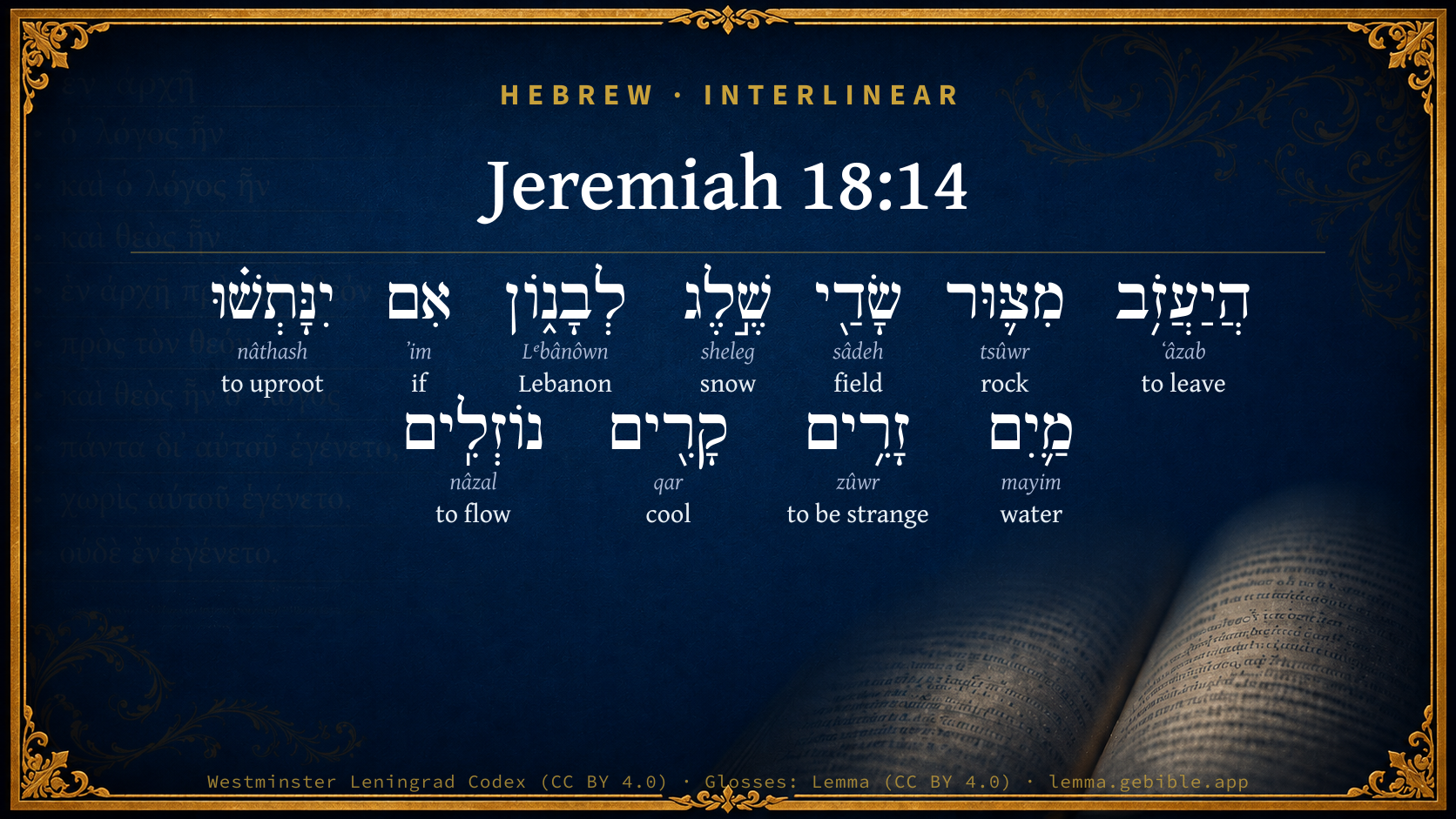
Hebrew (Westminster Leningrad Codex) Jeremiah 18:14 appears in the Hebrew Old Testament. The text above is from the Westminster Leningrad Codex. Each word links to its Strong’s number, a concise gloss, and parsing drawn from the Open Scriptures Hebrew Bible morphology. Click any word for its full Brown-Driver-Briggs (BDB) entry.
Download image
Cite this verse

Jeremiah 18:14 (World English Bible). Public Domain. Lemma interlinear Bible study tool, https://lemma.gebible.app/v/jeremiah/18/14.

Show BibTeX & RIS
BibTeX
RIS
English Translation
Shall the snow of Lebanon fail from the rock of the field? [or] shall the cold waters that flow down from afar be dried up?
World English Bible · Public Domain
Download a study sheet

One document with this verse’s original text, its word-by-word gloss line, the meaning frame, cross-references with their text, attributed commentary, and full source and license credits — printable, and it pastes into notes with its structure intact.

This verse Autodidact and up

Study sheet (.html) Plain text (.txt)

A passage Seminary Student

Up to 50 verses in one chapter. A passage sheet keeps up to 6 commentary sources and 12 cross-references per verse, in the order this page ranks them, and says so on the sheet whenever that leaves anything out. Ask for a single verse and you get the Autodidact verse sheet above.

Everything on this page stays free to read, with no account — the sheet is a download of what is already on screen, not access to it.

Want to remove ads? Support Godless Engineer
Compare translations 3

The same verse in 3 English versions, stacked beneath the original-language interlinear above. Click any original word for its lexicon entry.

Each is an independent rendering of the whole verse — the interlinear is not word-aligned to these translations.

Highlighted words mark where these versions differ — a whole-verse word diff, not a word-by-word alignment.

  • World English Bible Public Domain
    Shall the snow of Lebanon fail from the rock of the field? [or] shall the cold waters that flow down from afar be dried up?
  • King James Version Public Domain
    Will a man leave the snow of Lebanon which cometh from the rock of the field? or shall the cold flowing waters that come from another place be forsaken?
  • unfoldingWord Literal Text CC BY-SA 4.0
    Does the snow of Lebanon leave the rock of the field? Or are foreign, cold, flowing waters removed?

unfoldingWord Literal Text — © unfoldingWord, licensed CC BY-SA 4.0. Word-aligned USFM3 via Door43 (git.door43.org/unfoldingWord/en_ult).

Versions to compare (up to 4)

3 of 4 selected

Show all 18 translations

Every available English version of this verse, each an independent rendering of the whole verse.

  • World English Bible Public Domain
    Shall the snow of Lebanon fail from the rock of the field? [or] shall the cold waters that flow down from afar be dried up?
  • Berean Standard Bible Public Domain
    Does the snow of Lebanon ever leave its rocky slopes? Or do its cool waters flowing from a distance ever run dry?
  • Majority Standard Bible Public Domain
    Does the snow of Lebanon ever leave its rocky slopes? Or do its cool waters flowing from a distance ever run dry?
  • King James Version Public Domain
    Will a man leave the snow of Lebanon which cometh from the rock of the field? or shall the cold flowing waters that come from another place be forsaken?
  • American Standard Version (1901) Public Domain
    Shall the snow of Lebanon fail from the rock of the field? `or' shall the cold waters that flow down from afar be dried up?
  • Revised Version (1885) Public Domain
    Shall the snow of Lebanon fail from the rock of the field? or shall the cold waters that flow down from afar be dried up?
  • Geneva Bible (1599) Public Domain
    Will a man forsake the snowe of Lebanon, which commeth from the rocke of the fielde? or shall the colde flowing waters, that come from another place, be forsaken?
  • Douay-Rheims (1899) Public Domain
    Shall now the snow of Libanus fail from the rock of the field? or can the cold waters that gush out and run down, be taken away?
  • Young's Literal Translation Public Domain
    Doth snow of Lebanon Cease from the rock of the field? Failed are the cold strange waters that flow?
  • Literal Standard Version CC BY-SA 4.0
    Does snow of Lebanon || Cease from the rock of the field? Will the cold strange [waters] that are flowing be forsaken?
  • Unlocked Literal Bible CC BY-SA 4.0
    Does the snow in Lebanon ever leave the rocky hills on its sides? Are the mountain streams coming from far away ever destroyed, those cold streams?
  • unfoldingWord Literal Text CC BY-SA 4.0
    Does the snow of Lebanon leave the rock of the field? Or are foreign, cold, flowing waters removed?
  • Darby Bible Public Domain
    Shall the snow of Lebanon cease from the rock of the field? Shall the cool flowing waters coming from afar be dried up?
  • World Messianic Bible Public Domain
    Will the snow of Lebanon fail from the rock of the field? Will the cold waters that flow down from afar be dried up?
  • Webster's Bible Public Domain
    Will a man leave the snow of Lebanon which cometh from the rock of the field? or shall the cold flowing waters that come from another place be forsaken?
  • Free Bible Version CC BY-SA 4.0
    Does the snow of Lebanon ever disappear from its rocky mountain-tops? Do its cool waters that flow from such distant sources ever dry up?
  • Bible in Basic English Public Domain
    Will the white snow go away from the top of Sirion? will the cold waters flowing from the mountains become dry?
  • JPS Tanakh (1917) Public Domain
    Doth the snow of Lebanon fail from the rock of the field? or are the strange cold flowing waters plucked up?

Literal Standard Version (2020), Covenant Press — licensed CC BY-SA 4.0. Text via the HelloAO Bible API (eBible.org). Unlocked Literal Bible (unfoldingWord) — licensed CC BY-SA 4.0. Text via the HelloAO Bible API (eBible.org). unfoldingWord Literal Text — © unfoldingWord, licensed CC BY-SA 4.0. Word-aligned USFM3 via Door43 (git.door43.org/unfoldingWord/en_ult). Free Bible Version, Dr. Jonathan Gallagher — licensed CC BY-SA 4.0. Text via the HelloAO Bible API (eBible.org).

Word by word

More ways to search: Search by grammar → Find every occurrence → Compare this word →

Practice this passage: Drill this verse → Learn its vocabulary →

קָרִ֖ים
qar
H7119
“cool”
Adjective, Adjective, Masculine, Plural, Absolute
Part of Speech
Adjective
Type
Adjective
Gender
Masculine
Number
Plural
State
Absolute
Full BDB Definition

Origin: contracted from an unused root meaning to chill

TWOT: 2077a

cool - cool, calm, self-possessed (of spirit)
  1. הֲיַעֲזֹ֥ב ʻâzab H5800 “to leave” Particle, Interrogative + Verb, Qal, Imperfect, 3rd Person, Masculine, Singular
  2. מִצּ֛וּר tsûwr H6697 “from · rock of” Preposition + Noun, Common, Masculine, Singular, Construct
  3. שָׂדַ֖י sâdeh H7704 “field” Noun, Common, Masculine, Singular, Absolute
  4. שֶׁ֣לֶג sheleg H7950 “snow of” Noun, Common, Masculine, Singular, Construct
  5. לְבָנ֑וֹן Lᵉbânôwn H3844 “Lebanon” Noun, Proper
  6. אִם ʼim H518 “if” Conjunction
  7. יִנָּתְשׁ֗וּ nâthash H5428 “to uproot” Verb, Niphal, Imperfect, 3rd Person, Masculine, Plural
  8. מַ֛יִם mayim H4325 “water(s)” Noun, Common, Masculine, Plural, Absolute
  9. זָרִ֥ים zûwr H2114 “strange” Adjective, Adjective, Masculine, Plural, Absolute
  10. נוֹזְלִֽים nâzal H5140 “flowing” Verb, Qal, Participle Active, Masculine, Plural, Absolute

About this verse

These counts appear in no published source. They are computed here, from the morphology-tagged text and Lemma’s own curated glosses. What Lemma adds →

11
words
11
distinct lemmas
Prophets
section

Notable vocabulary

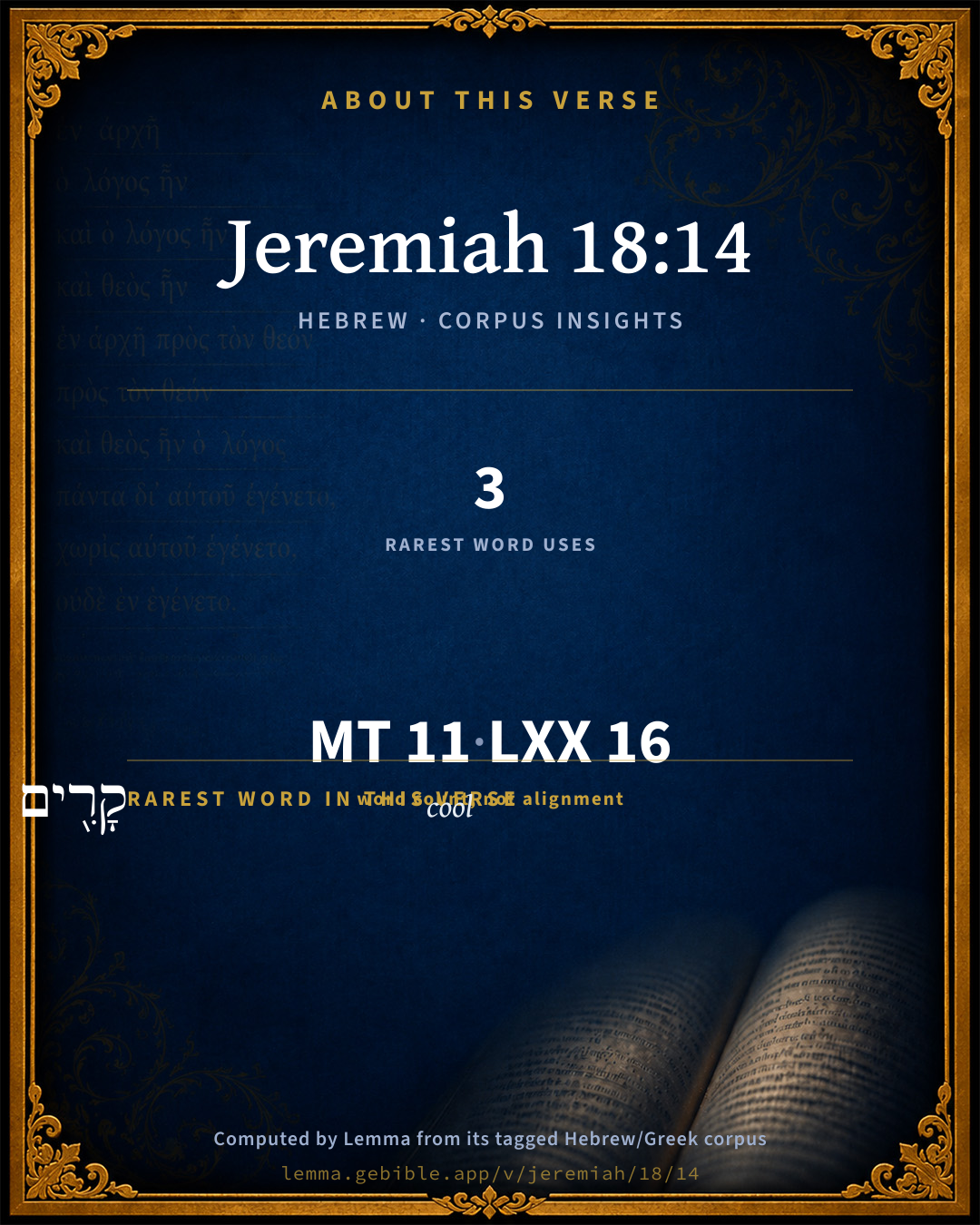
The rarest word here is קָרִ֖ים cool H7119 — appearing just 3 times in the whole Hebrew Bible.

Shared distinctive vocabulary

קָרִ֖ים cool H7119 occurs in 3 verses of the Hebrew Bible. Also found in:

Grammatical profile

  • 3 verbs
  • 5 nouns
  • 2 adjectives
  • 1 conjunction

Verb forms

  • הֲיַעֲזֹ֥ב Qal · Imperfect
  • יִנָּתְשׁ֗וּ Niphal · Imperfect
  • נוֹזְלִֽים Qal · Participle Active

Hebrew & Septuagint length

In the original languages it is 11 Hebrew tokens and 16 Greek tokens — but the two are counted differently (Hebrew bundles its prefixes and suffixes into one token; the Greek is in lemma form), so that isn’t a like-for-like length.

Cross-references

1

Topical passages linked to Jeremiah 18:14 in the Treasury of Scripture Knowledge — connected by theme and wording, ordered by reader-vote popularity; previews shown in the World English Bible.

  • John 6:68 Simon Peter answered him, "Lord, to whom would we go? You have the words of eternal life.

Cross-references courtesy of OpenBible.info (CC BY 4.0).

Hebrew and Greek witnesses Masoretic Hebrew ↔ Greek Septuagint

The same verse in the two great witnesses to the Old Testament, shown verse-for-verse.

These are two independent witnesses, not word-aligned to each other, and the Septuagint is shown in lemma (dictionary) form.

Hebrew Jeremiah 18:14 Masoretic · Westminster Leningrad Codex

הֲיַעֲזֹ֥ב מִצּ֛וּר שָׂדַ֖י שֶׁ֣לֶג לְבָנ֑וֹן אִם יִנָּתְשׁ֗וּ מַ֛יִם זָרִ֥ים קָרִ֖ים נוֹזְלִֽים

Shall the snow of Lebanon fail from the rock of the field? [or] shall the cold waters that flow down from afar be dried up?

World English Bible · Public Domain

Greek LXX Structure differs

In the Septuagint, Jeremiah is about an eighth shorter than the Hebrew and arranges its material differently — the Oracles Against the Nations (Hebrew chapters 46–51) appear in the middle of the Greek book, after 25:13. Because the chapter and verse boundaries do not line up, a verse-for-verse comparison with the Hebrew is not shown.

A verse-for-verse comparison isn’t shown here because the chapters and verses don’t line up. Switch to the LXX edition with the MT / LXX toggle above to read the Greek directly.

On this verse, Haydock's Catholic Bible Commentary discusses the Septuagint’s reading. Read the note in Commentary ↓

Hebrew: Westminster Leningrad Codex (CC BY 4.0). Greek: Septuagint (public domain); English from a public-domain English Septuagint. How the Septuagint differs from the Hebrew →

Targum (Aramaic paraphrase)

1

The Targum is the ancient Jewish Aramaic paraphrase of the Hebrew Scriptures — an interpretive translation, not the Hebrew text itself. Onkelos (literal) and Pseudo-Jonathan (expansive) render the Torah, and Jonathan the Prophets. Coverage is partial: where no permissively-licensed English translation exists for a verse, only the Aramaic is shown. This is verse-level text, not a word-by-word alignment to the Hebrew.

  1. Targum Jonathan Prophets (Joshua–Malachi)
    הָא כְּמָה דְלֵית אֶפְשַׁר דְיִפְסוֹק מֵי תְלַג דְנָחֵית עַל חַקְלֵי לִבְנָן כֵּן לָא יִפְסְקוּן מִמְטַר נַחֲתִין וּמֵי מַבּוּעַ נָבְעִין:

    (no public-domain English translation for this verse)

    Targum Jonathan — Aramaic: “Mikraot Gedolot” (public domain). English: “Sefaria Community Translation” (CC0 1.0 (public-domain dedication)); “London "Chaldee Paraphrase," 1871” (public domain). Text via Sefaria.

Commentary

Notes on Jeremiah 18:14 from classic Christian and Jewish commentators (each source and its license shown beneath its notes). The classic Christian expositions comment on the surrounding passage and are grouped to its opening verse, so a note may address several verses; the Jewish commentaries on the Tanakh (Rashi and others) are per-verse, so they appear only where the commentator wrote on this verse.

Lemma curates 59 commentaries, every one of them public domain or Creative Commons licensed, each selected and text-cleaned for this edition rather than reprinted as found. About our sources →

Trapp's Complete Commentary

John Trapp

Jer 18:14 Will [a man] leave the snow of Lebanon [which cometh] from the rock of the field? [or] shall the cold flowing waters that come from another place be forsaken?

Ver. 14. Will a man leave the snow of Lebanon?] See Jer 2:13, which may stand for a commentary on this verse. The rocks of Lebanon were still covered with snow: whence also it was called Lebanon - i.e., white. Now the Lord was to the Jews as this snow was to the thirsty traveller, cooling and comforting, and therefore in no wise to be left.

Or shall the cold flowing waters that come from another place be forsaken?] Heb., Shall strange, cool, flowing water be forsaken, or fail?

John Trapp, A Commentary or Exposition upon All the Books of the Old and New Testament (1647–1656) — public domain. Text from a community e-Sword module.

The Biblical Illustrator

Joseph S. Exell

Jer_18:14

Will a man leave the snow of Lebanon which cometh from the lock Of the field?

Man severed from the inexhaustible resources

The idea of the text is that a man will cut himself off from the main, will cut himself away from the eternally feeding snow of Lebanon, and will begin to make himself a little cistern--ah me, a broken cistern, a cistern that can hold no water. Let us think of the suicide of isolation, the madness of amputating our life, of leaving the inexhaustible, the eternal, the infinite--and living little, miserable, self-devouring lives. Will a man leave the snow of Lebanon and the fountain that rises from the rock? You would not allow it in business. Shall I tell you what I have heard some of you business men say? Did not one of you point out a man to me, and say, You see that man crossing from the Mansion House to the Bank of England? Yes. Very singular case, you say; that man is living on his capital. I said, What harm is there in that? Why, he is eating himself up, consuming himself. He ought to have his capital so invested that it will bring him in revenue day by day, year by year, and the capital should be kept intact if possible, and still the income should be accruing. I see! That is the text from a secular point of view. This man is living on his capital, he has cut himself off from payable, remunerative, compensative agencies, and he is eating up what he has. The worst thing that can happen in military operations is for the enemy to get behind and to cut off the supplies. That is the horrible possibility and the dreadful mischief, that the supplies should be cut off. Take care how you dwell upon this as an instance of misfortune. I charge you, in the presence of God and the holy angels, foolish man, with doing this very thing. You have cut off your supplies, you have dismissed prayer, you are trying to live on your own miserable individuality and selfhood. Get back to your supplies--back to God, back to the fountain. Live and move and have your being in God, and then no man can impoverish you, until he has impoverished God. (J. Parker.)

The Biblical Illustrator, edited by Joseph S. Exell (c. 1880s–1900s) — public domain. Text from a community e-Sword module.

Tyndale Open Study Notes

Tyndale Open Resources

18:14-15 The answer to these two rhetorical questions was “No.” The snow and the streams of the mountaintops of Lebanon were perennially reliable. By contrast, the Lord’s people were not so reliable. • The ancient highways represented a life of faithfulness to the covenant (6:16), while the muddy paths symbolized a life of self-serving paganism.

Tyndale Open Study Notes — © Tyndale Open Resources, licensed CC BY-SA 4.0. Text via the HelloAO Bible API.

Geneva Bible (1599)

Geneva Bible translators

As no man that hath thirst refuseth fresh conduit waters which he hath at home, to go and seek waters abroad to quench his thirst: so they ought not to seek for help and succor at strangers, and leave God which was present with them.

Geneva Bible (1599) marginal notes — public domain. Text via Bolls.life.

Jamieson, Fausset & Brown

Robert Jamieson, A. R. Fausset & David Brown

Is there any man (living near it) who would leave the snow of Lebanon (that is, the cool melted snow water of Lebanon, as he presently explains), which cometh from the rock of the field (a poetical name for Lebanon, which towers aloft above the surrounding field, or comparatively plain country)? None. Yet Israel forsakes Jehovah, the living fountain close at hand, for foreign broken cisterns. Jer 17:13; Jer 2:13, accord with English Version here. MAURER translates, "Shall the snow of Lebanon cease from the rock to water (literally, 'forsake') My fields" (the whole land around being peculiarly Jehovah's)? Lebanon means the "white mountain"; so called from the perpetual snow which covers that part called Hermon, stretching northeast of Palestine.

that come from another place--that come from far, namely, from the distant lofty rocks of Lebanon. HENDERSON translates, "the compressed waters," namely, contracted within a narrow channel while descending through the gorges of the rocks; "flowing" may in this view be rather "flowing down" (Sol 4:15). But the parallelism in English Version is better, "which cometh from the rock," "that cometh from another place."

be forsaken--answering to the parallel, "Will a man leave," &c. MAURER translates, "dry up," or "fail" (Isa 19:5); the sense thus being, Will nature ever turn aside from its fixed course? The "cold waters" (compare Pro 25:25) refer to the perennial streams, fed from the partial melting of the snow in the hot weather.

Jamieson, Fausset & Brown — Commentary Critical and Explanatory on the Whole Bible (1871) — public domain (CC PDM 1.0). Text via the HelloAO Bible API.

Adam Clarke's Commentary

Verse 14. Will a man leave the snow of Lebanon] Lebanon was the highest mountain in Judea. Would any man in his senses abandon a farm that was always watered by the melted snows of Lebanon, and take a barren rock in its place? How stupid therefore and absurd are my people, who abandon the everlasting God for the worship of idols!

Adam Clarke's Commentary on the Bible (1810–1826) — public domain. Text from a community e-Sword/MySword module.

John Calvin's Commentaries

As I have just said, God here enhances the sin of the people by a twofold comparison; for when one can draw water in his own field, and find there a spring, what folly will it be for him to run to a distance to seek water? And then, when water does not spring up near, but flows from a distance in a pure and cold stream, who will not be satisfied with such water? and if he seeks to find the spring, will not all laugh at such madness? Now God was like a living fountain, and at Jerusalem was the spring where the Jews might drink to their full; and God’s blessings flowed also to them as it were through various channels, so that nothing was wanting to them. We then see that here is condemned a twofold madness in the people, that they despised God’s kindness which was near at hand, as though one close to Mount Libanus refused its cold waters, or as though one would not draw water from a river without going to the spring-head. Since then God offered himself to them in every way, and presented his bounty to them, it was a madness extremely base and inexcusable to reject flowing waters and the fountain itself.

John Calvin's Commentaries (1540-1563) — public domain. Text from the Calvin Translation Society English edition (1840s-50s) via the Christian Classics Ethereal Library (ccel.org). Calvin's coverage is partial (roughly two-thirds of the Bible); uncommented books and verses are honest gaps, never fabricated. The 19th-century editor's footnotes and remarks are omitted so the notes are faithfully Calvin's own voice.

Ellicott's Commentary for English Readers

(14) Will a man leave . . .?—The interpolated words “a man” pervert the meaning of the verse, which should run thus: Will the snow of Lebanon fail from the rock of the field? or shall the cold (or, with some commentators, “rushing “) flowing waters from afar (literally, strange, or, as some take it, that dash down) be dried up? The questions imply an answer in the negative, and assert in a more vivid form what had been expressed more distinctly, though less poetically, in Jer_2:13. The strength of Jehovah was like the unfailing snow of Lebanon (the “white” or snow mountain, like Mont Blanc or Snowdon), like the dashing stream that flows from heights so distant that they belong to a strange country, and which along its whole course was never dried up, and yet men forsook that strength for their own devices. The “streams of Lebanon” appear as the type of cool refreshing waters in Son_4:15. The term “rock of the field” is applied in Jer_17:3; Jer_21:13 to Jerusalem, but there is no reason why it should not be used of Lebanon or any other mountain soaring above the plain. The notion that the prophet spoke of the brook Gihon on Mount Zion, as fed, by an underground channel, from the snows of Lebanon, has not sufficient evidence to commend it, but the “dew of Hermon, and as the dew that descended upon the mountains of Zion” (Psa_133:3) presents, to say the least, a suggestive parallel. Possibly the prophet has the Jordan in his mind. Tacitus (Hist. v. 6) describes it as fed by the snows of Lebanon, the summit of which is, in his expressive language, faithful to its snows through the heat of summer.

A Bible Commentary for English Readers, edited by Charles John Ellicott (1878–1897) — public domain. Text from a community e-Sword module.

The Cambridge Bible for Schools and Colleges

gen. ed. J. J. S. Perowne

14. The unnatural conduct of Israel (cp. Jer_8:7) is illustrated.

rock of the field] The strangeness of the expression has led to the conjectural substitution for “field” (sâdeh) of either (a) Shaddai, a title of Jehovah (e.g. Gen_17:1), or (b) Sirion (Psa_29:6), the Phoenician name (see Deu_3:9) for Hermon (so Co. and Du.), which has a summit crowned with perpetual snow. In the latter case, as Lebanon and Hermon were quite distinct, and as the former seems connected with the Hebrew root meaning whiteness, we may render with Co. “Does the white snow forsooth melt from the rock of Sirion?”

shall the cold waters … be dried up] mg. plucked up, but the emendation in the text is doubtless right, and is obtained by the transposition of two Hebrew consonants. The earlier part of the clause is more difficult to emend. Du., by simply dividing two adjacent words differently, gets for “waters that flow down from afar” “waters of the scatterers,” viz. the northern stars, as bringing rain at the time of their rising. He connects the word he renders “scatterers” with the north by reference to Job_37:9, where for the latter there is given in mg. scattering winds. But we cannot speak with any certainty. The Hebrew for “strange” may have come in through the accidental repetition of “cold,” which stands next in the Hebrew, and differs only in the initial letter. The mg. (the cold waters) “of strange lands that flow down be, etc.” is improbable as a rendering. The general sense at any rate is clear. Nature is constant in her operations, but God, the Rock of Israel, is forsaken by those who used to follow Him.

The Cambridge Bible for Schools and Colleges (gen. ed. J. J. S. Perowne; Cambridge University Press, 1878–1918) — public domain. Text from a community e-Sword module.

John Gill's Exposition

To make their land desolate,.... Not that this was the intention either of those that led them out of the right way into those wrong paths, or of them that went into them; but so it was eventually; this was the issue of things; their idolatry and other sins were the cause of their land being desolate; through the ravage of the enemy, let in upon them by way of judgment; and through the destruction of men by them; so that there were few or none to cultivate and manure it:

and a perpetual hissing; to be hissed at perpetually by the enemy, whenever they passed by it, and observed its desolation; thereby expressing their hatred at its inhabitants; their joy at its desolation; and their satisfaction in it, which would be for ever; or, as Kimchi interprets, a long time. This is the present case of the Jews; and has been ever since their destruction by the Romans; and will be until the fulness of the Gentiles is gathered in:

everyone that passeth thereby shall be astonished: to see the desolations made, and the strange alterations in a place once so famous for fruitfulness and number of inhabitants:

and wag his head; either out of pity, or rather in a way of derision and exultation; see Lam 2:15.

John Gill's Exposition of the Whole Bible (1746–1763) — public domain (CC PDM 1.0). Text via the HelloAO Bible API.

Albert Barnes' Notes on the Bible

Rather, “Will the snow of Lebanon fail from the rock of the field?” The meaning probably is, “Will the snow of Lebanon fail from its rocks which tower above the land of Israel?” The appeal of the prophet is to the unchangeableness of one of nature’s most beautiful phenomena, the perpetual snow upon the upper summits of Lebanon.

Shall the cold ... - literally, “shall the strange, i. e., foreign, “cool, down-flowing waters be plucked up?” The general sense is: God is Israel’s Rock, from whom the never-failing waters flow Jer 2:13 : but men may and do abandon the cool waters which descend front above to seek their happiness in channels of their own digging.

Albert Barnes' Notes on the Bible (1834–1885) — public domain. Text from a community e-Sword/MySword module.

Haydock's Catholic Bible Commentary

Snow. It continues on Libanus seven or eight months, (La Roque quoted. Univ. Hist. ii. p. 363) or all the year; (Tacitus, Hist. v. 6.) and hence the mountain is justly denominated "white," as the Alps and Albion are from albon. (Bochart; Parkhurst, p. 155.) (Haydock) --- Away. Yet my people abandon me, to serve idols! Hebrew may have many other senses to the same purpose. Septuagint, "Shall the mountain springs fail, or snow from Libanus? Shall a stream forcibly driven by the wind, turn aside?" (Haydock) --- The laws of nature are observed by inanimate things, and shall my people be so foolish as to follow mere vanity.

George Leo Haydock (1774–1849), Haydock's Catholic Family Bible and Commentary, 1859 edition — public domain. Excludes Psalms (Douay-Rheims chapter numbering differs from Protestant) and Deuterocanonical books (Catholic canon only).

Matthew Poole's English Annotations

Will a man leave the snow of Lebanon which cometh from the rock of the field? The margins of our Bibles will let us know that there is some variety in the opinions of the most learned interpreters as to the sense of these words. The general sense is plain and obvious, that it is a foolish thing for men to forsake God, who is the fountain of all good and refreshment, and what men do not use to do with reference to poor creature comforts, not to be named with God. But for the grammatical sense of the words, it is not so obvious. The vulgar Latin translates them, Shall the snow of Lebanon fail from the rock of the field? The Septuagint, Shall the dugs fail from the rocks? or, the snow from Lebanon? The Syriac version followeth them. The Arabic version translateth it, Should the snow fail from the mountain of breasts, and from Lebanon? The Chaldee paraphrast thus glosseth, Behold, as it cannot be that the snow water should fail from Lebanon. Pagnine seems to make Lebanon the nominative case, and renders the sense thus, Shall Lebanon leave the snow from the rock of the field? Our translators supply these words, a man, and so make that the nominative case, and make Lebanon the genitive case. Lebanon was a mountainous place, in which were rocks; it had also fruitful valleys; snow fell upon those rocks, and upon a thaw ran down into the lower places, and was grateful to them, as it moistened them, and made them more fruitful.

Or shall the cold flowing waters that come from another place be forsaken? The latter part of the verse seems as hard. Pegnine translates them, Shall other cold flowing waters be forsaken? The vulgar Latin, Or can the other cold flowing waters be plucked up? The LXX. and the Syriac, Or shall the water fail, violently snatched up or taken away with the wind? The Arabic, Or should the foreign cool waters desist? The Chaldee paraphrast glosseth, So the rain waters that come down, and the waters of the fountain that spring, shall not fail. In this great variety, it is very hard certainly to assert the particular sense of these phrases, the knowledge of which depends upon some affections or customs of those places, which we are not so well acquainted with. The next verse is the best guide we have, where the sin laid to the charge of this people is their forsaking God; which sin is here aggravated by this topic, That reason teacheth men not to forsake a greater good for a lesser, though that greater good were but a poor creature comfort, not to be compared with God. This is the general sense, scope, and sum of this verse; so as we shall not need be very solicitous to be able to assert the particular grammatical sense.

Matthew Poole's English Annotations on the Holy Bible (1683–1685) — public domain. Text from a community e-Sword/MySword module.

Whedon's Commentary on the Bible

Daniel D. Whedon

14. Will a man leave the snow of Lebanon… from the rock of the field? etc. — Two questions arise on this passage: How shall it be translated, and how interpreted?

I. Two translations have been proposed which are worthy of notice: —

1. That of Noyes, after Michaelis, Rosenmuller, Neumann, Maurer, and others: Shall the snow from the rock of Lebanon (snow of Lebanon from the rock) forsake my fields? 1) But in this the phrase, “from the rock,” is harsh and unmeaning. It adds nothing to the sense, and is, certainly, a clumsy expression for “rock of Lebanon.” 2) It mentions Lebanon as the source of the water supply of Palestine, while, in other passages, the sea is so mentioned.

2. That of Keil and Nagelsbach: Will the snow of Lebanon cease from the rock of the field? This is the simplest and most strictly grammatical rendering, and is clearly to be preferred.

II. Two interpretations of this last translation have been given.

1. By “the rock of the field” Mount Zion is meant. In favour of this may be considered: 1) Mount Zion is so called in Jer_17:3, while in Jer_21:13, the kindred phrase, “rock of the plain,” is applied to it.

2) In Psa_133:3, the “dew of Hermon,” the conspicuous and representative mountain of the Lebanon group is spoken of as “descending upon the mountains of Zion.” 3) The structure of the sentence clearly forbids us to identify the “rock of the field” with Lebanon. But, as bearing against this view, we should note: 1) The application of this phrase to Mount Zion, in another passage, is not conclusive as to its meaning here, though it does create an affirmative presumption. 2) The bold figure in Psalms 133, in which the dew of Hermon is said to come down upon the mountains of Zion, is no sufficient justification of the assumption that there was supposed to be a connexion between the snow of Lebanon and the springs of Jerusalem. If such a notion as this prevailed, either among the many or the few, we ought to find some notice of it in other places. 3) The word “Lebanon” in this place, is rather an appellative than the name of a locality: As the Lebanon snow, etc. The same remark also applies to the passage above alluded to, in which the “dew of Hermon” is mentioned.

2. By the phrase “rock of the field,” Lebanon is meant. 1) This is the natural interpretation. The snow of Lebanon is the snow that rests on Lebanon, and gives it its name — Lebanon=white mountain — and it can leave only the place where it is. Hence, the “rock of the field” is “Lebanon.” 2) This being the natural view, it is in order now to note that no considerations such as are mentioned above bear with conclusive force against it and in favour of any other. 3) This gives a sense at once intelligible and impressive. Just as appeal was once made to the bow in the heavens, which was not a symbol but only a sign of God’s covenant, so here “the prophet appeals to the unchangeableness of one of nature’s most beautiful phenomena — the perpetual snow on the summits of Lebanon” — as a fit token of man’s unchanging faithfulness to God, the source of all gracious supply. 4) This view is strongly confirmed by the remainder of the verse, with which it is in perfect harmony.

Or shall the cold flowing waters, etc.? — Literally, shall the strange, cool, trickling waters be plucked up? (dried up?) By “strange” waters are meant those that come from afar, whose sources are hidden — a phrase seemingly appropriate to the wealth of springs in Lebanon. The epithet “cold” is also suggestive of these. The general idea is that of faithfulness or constancy. The cool, perennial mountain springs, that seem to flow forth from an unwasting fulness, stand in vivid contrast with the deceitful brooks which are so characteristic of Palestine, and which have already been referred to as a symbol of idolatrous trusts. No fitter emblem of the ever-flowing stream of God’s bounty can be found in the range of material nature than the strange, cool, trickling waters of the Lebanon springs.

Thus do both members of this difficult verse blend in a most appropriate and expressive symbolism. The “rock of the field” points to the Rock of eternity. The sublime vision of perpetual snow resting on its summit symbolizes that glory which the Eternal as a garment wears. And that equally characteristic feature, the mountain stream, whose waters flow on ever conscious of their distant snowy fountains, is happily expressive of the never-failing stream of the divine beneficence. The appeal is to the constancy of these. Is not nature true in her friendships? Does she not stand always visible and always faithful? Do not her streams of beneficent supply pour forth unceasingly? Even so is God to his people; but they turn away from him to follow after vanity, and “make their land desolate and a perpetual hissing.”

Daniel D. Whedon (gen. ed.), Commentary on the Old and New Testaments (1874–1909) — public domain. Text from a community e-Sword module.

The Pulpit Commentary

Vers. 14, 15. Jehovah an unfailing Help to his people; or, the "snow of Lebanon.

One of the most striking scenes visible from a great distance is Hermon, with its snow and vapors. It is covered with white snow all the year round, and from its summits flow down cold, pent-up streams to the valley beneath. God asks why Israel has forsaken him; whether there was any failure of his grace and power. Has he not been constant and ever ready to help? How is it, then, that he is forsaken? The snow of Lebanon is, like the dew of Hermon, a symbol of the grace of God abiding upon Zion, from which the streams of grace flow forth in inexhaustible supply.

I THOSE WHO FORSAKE GOD DO SO BECAUSE OF THEIR OWN PERVERSITY AND NOT BECAUSE OF GOD"S NEGLECT. "Is his arm shortened that it cannot save?" is a question we ought to ask ere we make up our minds to leave God. The secret of spiritual disaffection and apostasy is in ourselves and not in God.

II APOSTASY FROM GOD IS A TRANSCENDENT INSTANCE OF INGRATITUDE.

1. The providences of God have been unceasing, manifold, and overflowing. They have come without effort of man. Yet the sinner has gone away and obstinately continues in his sin.

2. But in the grace of God there are elements that appeal to our deepest affection and trust. It is so rich, undeserved, and free. Why should he have chosen any one? How often has he healed the backslidings of his people! The cross of Christ is the grandest expression of love of which we know. It "passeth knowledge.

III WHEN SINNERS FORSAKE GOD IT IS TO THEIR OWN INJURY.

1. By their pursuit after sinful gratifications they forfeit the enjoyment of Divine mercy. Providential mercies may not always be withdrawn, but their beneficial effect is destroyed. The fellowship and presence of God are lost. His favor and help cannot be expected.

2. The sources of pleasure they apply themselves to are disappointing and fatal. Sinful pleasures soon pall. There is no enduring rapture in the gratification of sense, but an enduring sting remains. The constitution of the sinner is sapped and undermined by his excesses, and the general, social, and political life of the nation corrupted. There is no sorrow so profound and incurable as that which results from the abuse of religious privileges and the loss of the heavenly birthright; it "worketh death." But, in addition to all this, the anger of God is kindled, and who shall extinguish it? He himself can. With him is forgiveness that he may be feared, and plenteous redemption that he may be sought unto. "His mercy endureth forever." It is only needed that we change in heart and life to recover our lost estate and experience again more than our lost joy. M.

The Pulpit Commentary (1880–1919), ed. H.D.M. Spence-Jones & Joseph S. Exell — public domain. Text from a community e-Sword module.

John Wesley's Explanatory Notes

Of Lebanon - Lebanon had rocks, and also fruitful valleys; snow fell upon these rocks, and upon a thaw ran down into the lower places. Reason teaches men not to forsake a greater good for a less, tho' that greater good was but a poor creature comfort, not to be compared with God.

John Wesley, Explanatory Notes Upon the Whole Bible (1754–1765) — public domain. Text via the GEBible commentary corpus.

Rashi

Rabbi Shlomo Yitzchaki (Rashi)

Shall one abandon from rocks of the field the snow of Lebanon Shall a man who needs to drink abandon water that flows from the rock in the fields that comes from the snow of the Lebanon, which is clean?

Shall strange cold... water be abandoned? Or shall flowing spring water, which was strange to all people until now, and it is cold, be abandoned? זָרִים means flowing, and this proves it (2 Kings 19:24): “I dug and drank strange water (זָרִים).” Menahem, however, classified with (Isaiah 1:6) “they have not been sprinkled (זֹרוּ), neither have they been bandaged,” an expression of curative water, and he gave a reason for his statement, and he said that if he wished to speak with an expression of זֶרֶם, a stream, he would double the ‘mem,’ and he would add ‘yud’ ‘mem,’ and he would say זְרוּמִים because of the plural number of מַיִם water, and because they are streams (זְרָמִים).

the field like שָדֶה, a field

cold (froids in French).

flowing (courants in French). And we can also interpret it: “Shall it be abandoned to be strange rejected water, the water that is cold running water?”

Heb. זרים According to the first interpretation, it is an expression of a stream [זֶרֶם]. According to the second interpretation, it is an expression of strangeness, i.e., rejected water.)

Rashi on the Tanakh — English translations: “The Judaica Press complete Tanach with Rashi, translated by A. J. Rosenberg” (CC BY 4.0); “Pentateuch with Rashi's commentary by M. Rosenbaum and A.M. Silbermann, 1929-1934” (public domain); “The Metsudah Tanach series, Lakewood, N.J” (CC BY 4.0); and “The Book of Joshua, Metsudah Publications, 1997” (CC BY 4.0). Text via Sefaria.

Lesson kit

Teaching starters — assembled from the data on this page, not authored interpretation. Every prompt links to the verse data it draws on. Edit before teaching.

Jeremiah, in the Prophets, opens this verse with 11 words (11 distinct Hebrew lemmas). Its most distinctive word is qar (“cool”). A historical commentator’s framing appears above. Read the whole chapter for the surrounding context.

Discussion questions

  1. The word qar carries the sense “cool.” How does it shape the verse?
  2. How does Proverbs 17:27, which shares the word «cool», read alongside this verse?
  3. These translations render this verse differently; the difference is in the English rendering, not the original. What questions does that raise?
  4. «הֲיַעֲזֹ֥ב» is a Qal Imperfect verb. How does that grammatical form shape the action described?
  5. Compare how Trapp's Complete Commentary and The Biblical Illustrator read this verse. Where do they agree or differ?

Things to notice

Reading settings

Reading text

Shown beneath each verse's original-language words.

Old Testament
Old Testament edition

Read the OT as the Masoretic Hebrew (MT) or the Greek Septuagint (LXX).

English shown for the Greek Septuagint (in the Hebrew ↔ Greek comparison).

Comparing translations? Open the Compare panel on any verse page to stack up to four side by side.