
Genesis 2:20

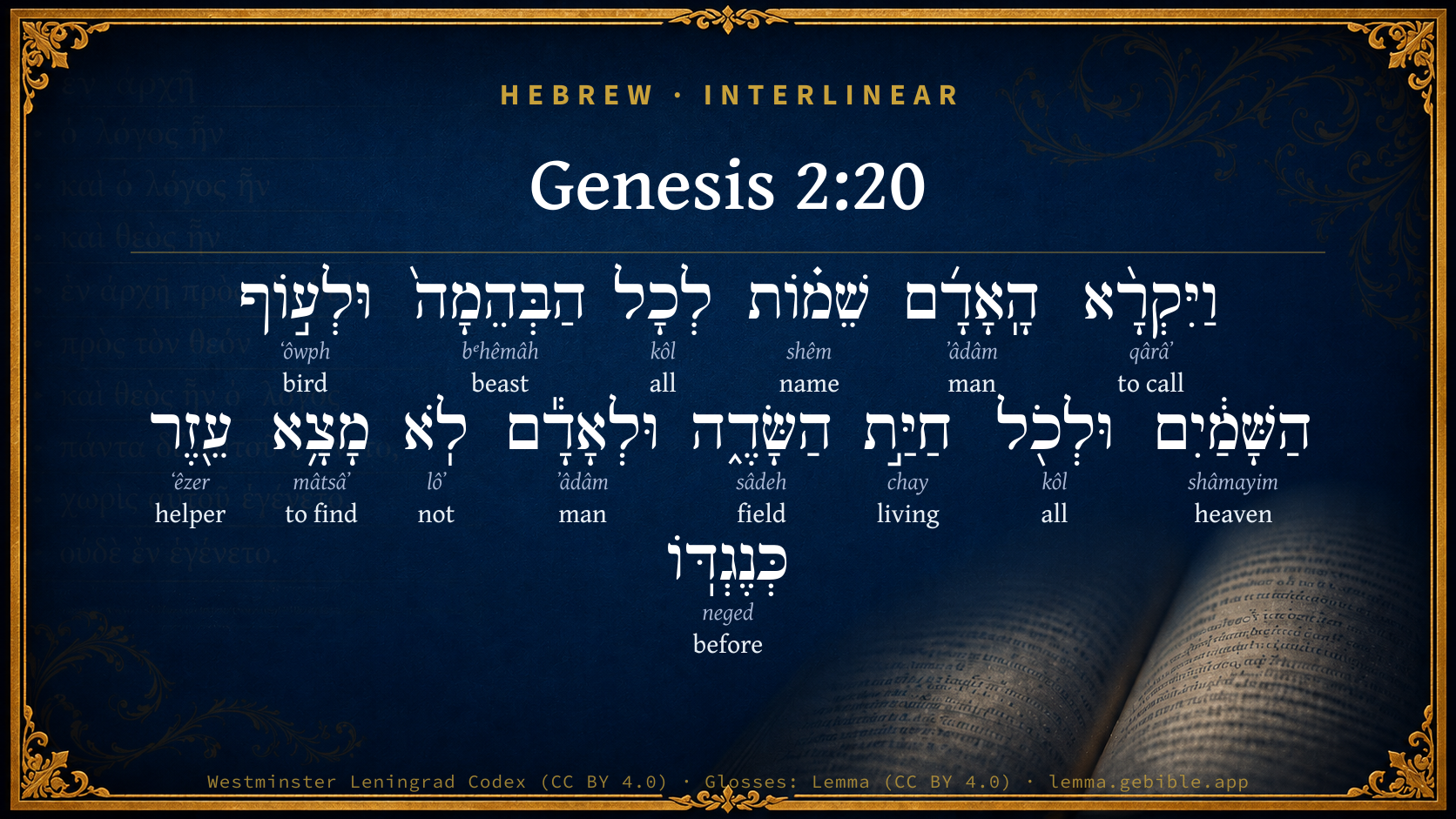
Hebrew (Westminster Leningrad Codex) Genesis 2:20 appears in the Hebrew Old Testament. The text above is from the Westminster Leningrad Codex. Each word links to its Strong’s number, a concise gloss, and parsing drawn from the Open Scriptures Hebrew Bible morphology. Click any word for its full Brown-Driver-Briggs (BDB) entry.
Download image
Cite this verse

Genesis 2:20 (World English Bible). Public Domain. Lemma interlinear Bible study tool, https://lemma.gebible.app/v/genesis/2/20.

Show BibTeX & RIS
BibTeX
RIS
English Translation
The man gave names to all cattle, and to the birds of the sky, and to every animal of the field; but for man there was not found a helper suitable for him.
World English Bible · Public Domain
Highlights
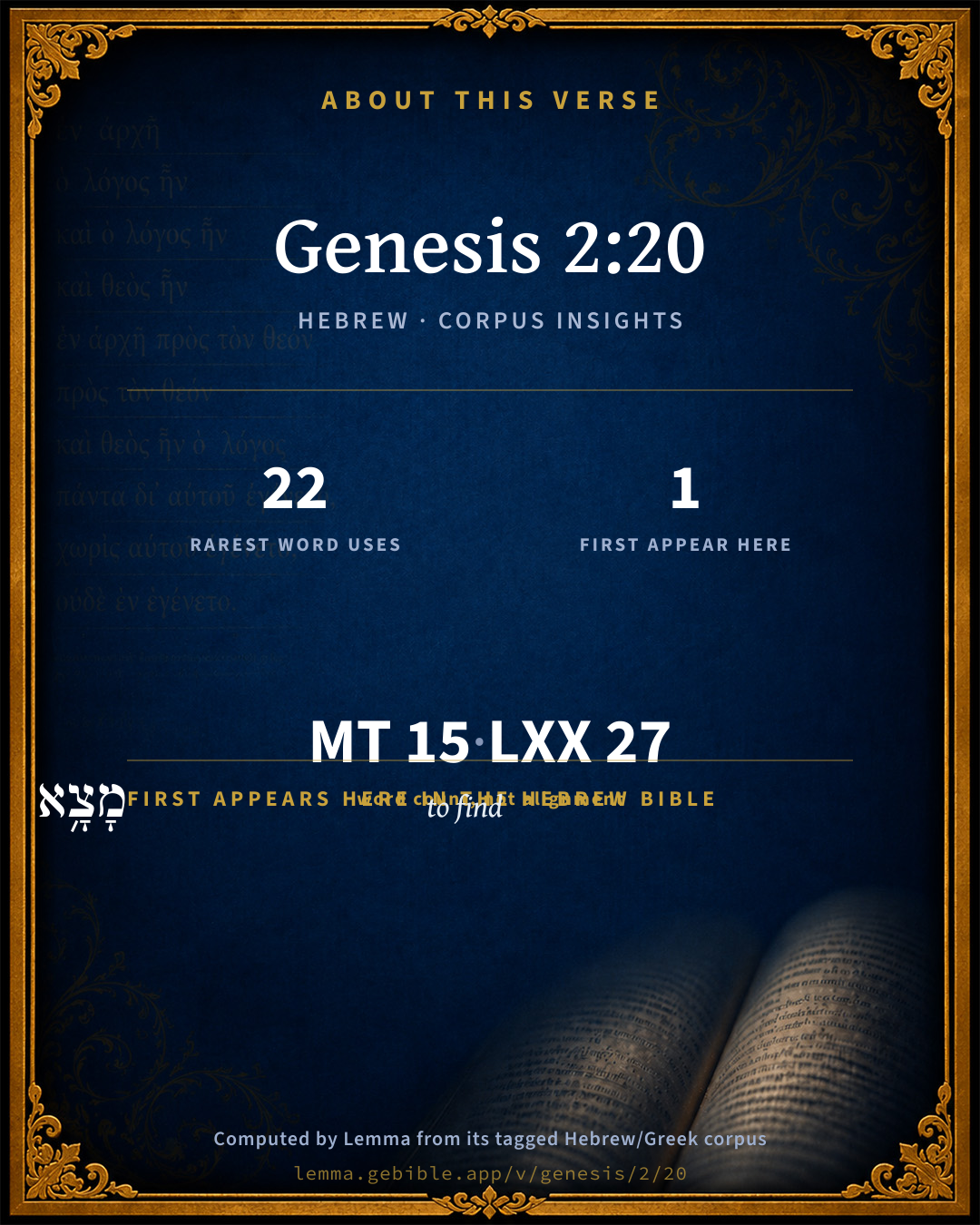
  • 1 first appearance in the Hebrew Bible
Full analysis ↓
Download a study sheet

One document with this verse’s original text, its word-by-word gloss line, the meaning frame, cross-references with their text, attributed commentary, and full source and license credits — printable, and it pastes into notes with its structure intact.

This verse Autodidact and up

Study sheet (.html) Plain text (.txt)

A passage Seminary Student

Up to 50 verses in one chapter. A passage sheet keeps up to 6 commentary sources and 12 cross-references per verse, in the order this page ranks them, and says so on the sheet whenever that leaves anything out. Ask for a single verse and you get the Autodidact verse sheet above.

Everything on this page stays free to read, with no account — the sheet is a download of what is already on screen, not access to it.

Want to remove ads? Support Godless Engineer
Compare translations 3

The same verse in 3 English versions, stacked beneath the original-language interlinear above. Click any original word for its lexicon entry.

Each is an independent rendering of the whole verse — the interlinear is not word-aligned to these translations.

Highlighted words mark where these versions differ — a whole-verse word diff, not a word-by-word alignment.

  • World English Bible Public Domain
    The man gave names to all cattle, and to the birds of the sky, and to every animal of the field; but for man there was not found a helper suitable for him.
  • King James Version Public Domain
    And Adam gave names to all cattle, and to the fowl of the air, and to every beast of the field; but for Adam there was not found an help meet for him.
  • unfoldingWord Literal Text CC BY-SA 4.0
    And the man gave names to all the livestock and to the bird of the sky and to every living thing of the field, but for the man a suitable helper was not found.

unfoldingWord Literal Text — © unfoldingWord, licensed CC BY-SA 4.0. Word-aligned USFM3 via Door43 (git.door43.org/unfoldingWord/en_ult).

Versions to compare (up to 4)

3 of 4 selected

Show all 18 translations

Every available English version of this verse, each an independent rendering of the whole verse.

  • World English Bible Public Domain
    The man gave names to all cattle, and to the birds of the sky, and to every animal of the field; but for man there was not found a helper suitable for him.
  • Berean Standard Bible Public Domain
    The man gave names to all the livestock, to the birds of the air, and to every beast of the field. But for Adam no suitable helper was found.
  • Majority Standard Bible Public Domain
    The man gave names to all the livestock, to the birds of the air, and to every beast of the field. But for Adam no suitable helper was found.
  • King James Version Public Domain
    And Adam gave names to all cattle, and to the fowl of the air, and to every beast of the field; but for Adam there was not found an help meet for him.
  • American Standard Version (1901) Public Domain
    And the man gave names to all cattle, and to the birds of the heavens, and to every beast of the field; but for man there was not found a help meet for him.
  • Revised Version (1885) Public Domain
    And the man gave names to all cattle, and to the fowl of the air, and to every beast of the field; but for man there was not found an help meet for him.
  • Geneva Bible (1599) Public Domain
    The man therefore gaue names vnto all cattell, and to the foule of the heauen, and to euery beast of the fielde: but for Adam founde he not an helpe meete for him.
  • Douay-Rheims (1899) Public Domain
    And Adam called all the beasts by their names, and all the fowls of the air, and all the cattle of the field: but for Adam there was not found a helper like himself.
  • Young's Literal Translation Public Domain
    And the man calleth names to all the cattle, and to fowl of the heavens, and to every beast of the field; and to man hath not been found an helper -- as his counterpart.
  • Literal Standard Version CC BY-SA 4.0
    And the man calls names to all the livestock, and to bird of the heavens, and to every beast of the field; but for man a helper has not been found as his counterpart.
  • Unlocked Literal Bible CC BY-SA 4.0
    The man gave names to all the livestock, to all the birds of the sky, and to every beast of the field. But for the man himself there was found no helper suitable for him.
  • unfoldingWord Literal Text CC BY-SA 4.0
    And the man gave names to all the livestock and to the bird of the sky and to every living thing of the field, but for the man a suitable helper was not found.
  • Darby Bible Public Domain
    And Man gave names to all cattle, and to the fowl of the heavens, and to every beast of the field; but as for Adam, he found no helpmate, his like.
  • World Messianic Bible Public Domain
    The man gave names to all livestock, and to the birds of the sky, and to every animal of the field; but for man there was not found a helper comparable to him.
  • Webster's Bible Public Domain
    And Adam gave names to all cattle, and to the fowls of the air, and to every beast of the field: but for Adam there was not found a help meet for him.
  • Free Bible Version CC BY-SA 4.0
    Adam gave names to all the livestock, all the birds, and all the wild animals. But Adam didn't find anyone like him who could help him.
  • Bible in Basic English Public Domain
    And the man gave names to all cattle and to the birds of the air and to every beast of the field; but Adam had no one like himself as a help.
  • JPS Tanakh (1917) Public Domain
    And the man gave names to all cattle, and to the fowl of the air, and to every beast of the field; but for Adam there was not found a help meet for him.

Literal Standard Version (2020), Covenant Press — licensed CC BY-SA 4.0. Text via the HelloAO Bible API (eBible.org). Unlocked Literal Bible (unfoldingWord) — licensed CC BY-SA 4.0. Text via the HelloAO Bible API (eBible.org). unfoldingWord Literal Text — © unfoldingWord, licensed CC BY-SA 4.0. Word-aligned USFM3 via Door43 (git.door43.org/unfoldingWord/en_ult). Free Bible Version, Dr. Jonathan Gallagher — licensed CC BY-SA 4.0. Text via the HelloAO Bible API (eBible.org).

Word by word

More ways to search: Search by grammar → Find every occurrence → Compare this word →

Practice this passage: Drill this verse → Learn its vocabulary →

עֵ֖זֶר
ʻêzer
H5828
“helper”
Noun, Common, Masculine, Singular, Absolute
Part of Speech
Noun
Type
Common
Gender
Masculine
Number
Singular
State
Absolute
Full BDB Definition

Origin: from H5826

TWOT: 1598a

help, succour - help, succour - one who helps
  1. וַיִּקְרָ֨א qârâʼ H7121 “and · to call” Conjunction + Verb, Qal, Sequential Imperfect, 3rd Person, Masculine, Singular
  2. הָֽאָדָ֜ם ʼâdâm H120 “the · man” Particle, Definite Article + Noun, Common, Masculine, Singular, Absolute
  3. שֵׁמ֗וֹת shêm H8034 “names” Noun, Common, Masculine, Plural, Absolute
  4. לְכָל kôl H3605 “to/for · all of” Preposition + Noun, Common, Masculine, Singular, Construct
  5. הַבְּהֵמָה֙ bᵉhêmâh H929 “the · beast” Particle, Definite Article + Noun, Common, Feminine, Singular, Absolute
  6. וּלְע֣וֹף ʻôwph H5775 “and · to/for · bird of” Conjunction + Preposition + Noun, Common, Masculine, Singular, Construct
  7. הַשָּׁמַ֔יִם shâmayim H8064 “the · heaven(s)” Particle, Definite Article + Noun, Common, Masculine, Plural, Absolute
  8. וּלְכֹ֖ל kôl H3605 “and · to/for · all of” Conjunction + Preposition + Noun, Common, Masculine, Singular, Construct
  9. חַיַּ֣ת chay H2416 “living of” Noun, Common, Feminine, Singular, Construct
  10. הַשָּׂדֶ֑ה sâdeh H7704 “the · field” Particle, Definite Article + Noun, Common, Masculine, Singular, Absolute
  11. וּלְאָדָ֕ם ʼâdâm H120 “and · to/for · man” Conjunction + Preposition + Noun, Common, Masculine, Singular, Absolute
  12. לֹֽא lôʼ H3808 “not” Particle, Negative
  13. מָצָ֥א mâtsâʼ H4672 “to find” Verb, Qal, Perfect, 3rd Person, Masculine, Singular
  14. כְּנֶגְדּֽוֹ neged H5048 “like/as · before · him” Preposition + Preposition + Suffix, Personal, 3rd Person, Masculine, Singular

About this verse

These counts appear in no published source. They are computed here, from the morphology-tagged text and Lemma’s own curated glosses. What Lemma adds →

15
words
13
distinct lemmas
Pentateuch
section

Notable vocabulary

The rarest word here is עֵ֖זֶר helper H5828 — appearing just 22 times in the whole Hebrew Bible.

First appearance in Scripture

This word makes its first canonical appearance in the Hebrew Bible here:

  • מָצָ֥א to find H4672

Shared distinctive vocabulary

עֵ֖זֶר helper H5828 occurs in 21 verses of the Hebrew Bible. Also found in:

Grammatical profile

  • 2 verbs
  • 11 nouns
  • 1 preposition
  • 1 particle

Verb forms

  • וַיִּקְרָ֨א Qal · Sequential Imperfect
  • מָצָ֥א Qal · Perfect

Repetition

Words recur within this verse — often emphatic in Hebrew:

  • הָֽאָדָ֜ם man H120 ×2
  • לְכָל all H3605 ×2

Hebrew & Septuagint length

In English translation the verse runs 33 words from the Hebrew and 37 from the Septuagint (LXX English) — closely comparable.

A rough comparison of the two English renderings, which tokenize alike — not a word-level alignment.

Word counts can differ between the Hebrew and the Greek without any difference in meaning — e.g. the Hebrew direct-object marker אֵת has no separate Greek word, and Greek often adds the article ὁ.

In the original languages it is 15 Hebrew tokens and 27 Greek tokens — but the two are counted differently (Hebrew bundles its prefixes and suffixes into one token; the Greek is in lemma form), so that isn’t a like-for-like length.

Cross-references

1

Topical passages linked to Genesis 2:20 in the Treasury of Scripture Knowledge — connected by theme and wording, ordered by reader-vote popularity; previews shown in the World English Bible.

  • Genesis 2:18 Yahweh God said, "It is not good that the man should be alone; I will make him a helper suitable for him."

Cross-references courtesy of OpenBible.info (CC BY 4.0).

Hebrew and Greek witnesses Masoretic Hebrew ↔ Greek Septuagint

The same verse in the two great witnesses to the Old Testament, shown verse-for-verse.

These are two independent witnesses, not word-aligned to each other, and the Septuagint is shown in lemma (dictionary) form.

Hebrew Genesis 2:20 Masoretic · Westminster Leningrad Codex

וַיִּקְרָ֨א הָֽאָדָ֜ם שֵׁמ֗וֹת לְכָל הַבְּהֵמָה֙ וּלְע֣וֹף הַשָּׁמַ֔יִם וּלְכֹ֖ל חַיַּ֣ת הַשָּׂדֶ֑ה וּלְאָדָ֕ם לֹֽא מָצָ֥א עֵ֖זֶר כְּנֶגְדּֽוֹ

The man gave names to all cattle, and to the birds of the sky, and to every animal of the field; but for man there was not found a helper suitable for him.

World English Bible · Public Domain

Greek LXX Genesis 2:20 Septuagint · lemma form

καί καλέω αδαμ ὄνομα πᾶς ὁ κτῆνος καί πᾶς ὁ πετεινόν ὁ οὐρανός καί πᾶς ὁ θηρίον ὁ ἀγρός ὁ δέ αδαμ οὐ εὑρίσκω βοηθός ὅμοιος αὐτός

And Adam gave names to all the cattle and to all the birds of the sky, and to all the wild beasts of the field, but for Adam there was not found a help like to himself.

LXX2012 (modern English Septuagint) · Public Domain

On this verse, The Cambridge Bible for Schools and Colleges discusses the Septuagint’s reading. Read the note in Commentary ↓

Hebrew: Westminster Leningrad Codex (CC BY 4.0). Greek: Septuagint (public domain); English from LXX2012 (modern English Septuagint) (Public Domain). How the Septuagint differs from the Hebrew →

Targum (Aramaic paraphrase)

2

The Targum is the ancient Jewish Aramaic paraphrase of the Hebrew Scriptures — an interpretive translation, not the Hebrew text itself. Onkelos (literal) and Pseudo-Jonathan (expansive) render the Torah, and Jonathan the Prophets. Coverage is partial: where no permissively-licensed English translation exists for a verse, only the Aramaic is shown. This is verse-level text, not a word-by-word alignment to the Hebrew.

  1. Targum Onkelos Torah (Genesis–Deuteronomy)
    וּקְרָא אָדָם שְׁמָהָן לְכָל בְּעִירָא וּלְעוֹפָא דִּשְׁמַיָּא וּלְכָל חֵוַת בְּרָא וּלְאָדָם לָא אַשְׁכַּח סָמֵךְ לְקִבְלֵהּ

    (no public-domain English translation for this verse)

    Targum Onkelos — Aramaic: “Onkelos Genesis” (public domain); “Onkelos Exodus” (public domain); “Onkelos Leviticus” (public domain); “Onkelos Numbers” (public domain); “Onkelos Deuteronomy” (public domain). English: “Sefaria Community Translation” (CC0 1.0 (public-domain dedication)); “J.W. Etheridge. The Targums of Onkelos and Jonathan Ben Uzziel on the Pentateuch. London: Longmans, Green, 1862” (public domain). Text via Sefaria.

  2. Targum Pseudo-Jonathan Torah (Genesis–Deuteronomy)
    וּקְרָא אָדָם שְׁמָהָן לְכָל בְּעִירָא וּלְכָל עוֹפָא דִשְמַיָא וּלְכָל חֵיוַת בְּרָא וּלְאָדָם לָא אַשְׁכַּח עַד הַשְׁתָּא סְמִיךְ כְּקִבְלֵיהּ

    And Adam called the names of all cattle, and all fowl of the heavens, and all beasts of the field. But for Adam was not found as yet a helper before him.

    Targum Pseudo-Jonathan — Aramaic: “Targum Jonathan on Genesis” (public domain); “Targum Jonathan on Exodus” (public domain); “Targum Jonathan on Leviticus” (public domain); “Targum Jonathan on Numbers” (public domain); “Targum Jonathan on Deuteronomy” (public domain). English: “The Targum of Jonathan ben Uzziel, trans. J. W. Etheridge, London, 1862” (public domain). Text via Sefaria.

Commentary

Notes on Genesis 2:20 from classic Christian and Jewish commentators (each source and its license shown beneath its notes). The classic Christian expositions comment on the surrounding passage and are grouped to its opening verse, so a note may address several verses; the Jewish commentaries on the Tanakh (Rashi and others) are per-verse, so they appear only where the commentator wrote on this verse.

Lemma curates 59 commentaries, every one of them public domain or Creative Commons licensed, each selected and text-cleaned for this edition rather than reprinted as found. About our sources →

Trapp's Complete Commentary

John Trapp

Gen 2:20 And Adam gave names to all cattle, and to the fowl of the air, and to every beast of the field; but for Adam there was not found an help meet for him.

Ver. 20. Adam gave names.] A sign of his sovereignty; {Num 32:38; Num 32:41} an argument also of his wisdom, in giving them names according to their natures, as Hebricians well know.

But for Adam there was not found, &c.] God set all the creatures before him, ere he gave him a wife: (1.) That, seeing the sexes, he might desire to have a help in his kind and nature also. Men should not marry till they find in themselves the need of a wife. (2.) That seeing no other fit help, he might the more prize her. {a}

{a} Ut ei commendatius esset Dei donum. - Pet. Martyr.

John Trapp, A Commentary or Exposition upon All the Books of the Old and New Testament (1647–1656) — public domain. Text from a community e-Sword module.

Jamieson, Fausset & Brown

Robert Jamieson, A. R. Fausset & David Brown

but for Adam there was not found an help meet for him--The design of this singular scene was to show him that none of the living creatures he saw were on an equal footing with himself, and that while each class came with its mate of the same nature, form, and habits, he alone had no companion. Besides, in giving names to them he was led to exercise his powers of speech and to prepare for social intercourse with his partner, a creature yet to be formed.

Jamieson, Fausset & Brown — Commentary Critical and Explanatory on the Whole Bible (1871) — public domain (CC PDM 1.0). Text via the HelloAO Bible API.

Adam Clarke's Commentary

Verse 20. And Adam gave names to all cattle] Two things God appears to have had in view by causing man to name all the cattle, c. 1. To show him with what comprehensive powers of mind his Maker had endued him and 2. To show him that no creature yet formed could make him a suitable companion. And that this twofold purpose was answered we shall shortly see; for,

1. Adam gave names; but how? From an intimate knowledge of the nature and properties of each creature. Here we see the perfection of his knowledge; for it is well known that the names affixed to the different animals in Scripture always express some prominent feature and essential characteristic of the creatures to which they are applied. Had he not possessed an intuitive knowledge of the grand and distinguishing properties of those animals, he never could have given them such names. This one circumstance is a strong proof of the original perfection and excellence of man, while in a state of innocence; nor need we wonder at the account. Adam was the work of an infinitely wise and perfect Being, and the effect must resemble the cause that produced it.

2. Adam was convinced that none of these creatures could be a suitable companion for him, and that therefore he must continue in the state that was not good, or be a farther debtor to the bounty of his Maker; for among all the animals which he had named there was not found a help meet for him. Hence we read,

.... v.21

Adam Clarke's Commentary on the Bible (1810–1826) — public domain. Text from a community e-Sword/MySword module.

Ellicott's Commentary for English Readers

(20) And Adam gave names.—Throughout this chapter Adam is but once mentioned as a proper name; and the regular phrase in the Hebrew is the adam, that is, the man, except in the last clause of this verse. In Gen_2:23 there is a different word for man, namely, ish. We must not confine this giving of names to the domestic animals, nor are we to suppose a long procession of beasts and birds passing before the man, and receiving each its title. Rather, it sets him before us as a keen observer of nature; and as he pursues his occupations in the garden, new animals and birds from time to time come under his notice, and these he studies, and observes their ways and habits, and so at length gives them appellations. Most of these titles would be imitations of their cries, or would be taken from some marked feature in their form or plumage, or mode of locomotion. Adam is thus found possessed of powers of observation and reflection upon the natural objects round him; though we may justly doubt his being capable of the metaphysical discourses put into his mouth by Milton in the Paradise Lost.

But for Adam.—In this one place there is no article, and our version may be right in regarding it as a proper name. Among the animals Adam found many ready to be his friends and domestic servants; and his habits of observation had probably this practical end, of taming such as might be useful. Hence the omission of all notice of reptiles and fish. But while thus he could tame many, and make them share his dwelling, he found among them no counterpart of himself, capable of answering his thoughts and of holding with him rational discourse.

A Bible Commentary for English Readers, edited by Charles John Ellicott (1878–1897) — public domain. Text from a community e-Sword module.

The Cambridge Bible for Schools and Colleges

gen. ed. J. J. S. Perowne

20. the man gave names] We have here the exercise of man’s powers of discrimination and classification. This is the birth of science. Man’s first use of speech is in the naming of animals. The names describe their character or appearance. From the instance given in Gen_2:23 of a name thus applied, it is clear that primaeval man was supposed to speak in the Hebrew language.

but for man] From this clause it appears, as indeed is shewn by Gen_2:18-19, that the animals on being formed were brought to the man, in order that, if it were possible, some amongst them might be the help that his nature needed. The passage implies that the nature of the animals had a kinship with that of man; but, while full of sympathy with the animal world, it implies that companionship, in the truest sense, was not to be found by man in creatures destitute of the higher prerogatives of human nature. “An help meet for man” must be on a level with him in feeling, in intellect, and reason.

for man] Not, as R.V. marg., for Adam. We should undoubtedly here read “for the man” (lâ’âdâm) in accordance with the general usage in this section. The LXX introduces the proper name at Gen_2:16, Lat. Vulg. at Gen_2:19 : both ignore the definite article here and in Gen_2:21-23.

The Cambridge Bible for Schools and Colleges (gen. ed. J. J. S. Perowne; Cambridge University Press, 1878–1918) — public domain. Text from a community e-Sword module.

John Gill's Exposition

And Adam gave names to all cattle, and to the fowls of the air, and to every beast of the field,.... As they came before him, and passed by him, paying as it were their homage to him, their lord and owner:

but for Adam there was not found an help meet for him; and perhaps this might be one reason of their being brought unto him, that he might become sensible that there was none among all the creatures of his nature, and that was fit to be a companion of his; and to him must this be referred, and not to God; not as if God looked out an help meet for him among the creatures, and could find none; but, as Aben Ezra observes, man could not find one for himself; and this made it the more grateful and acceptable to him, when God had formed the woman of him, and presented her before him.

John Gill's Exposition of the Whole Bible (1746–1763) — public domain (CC PDM 1.0). Text via the HelloAO Bible API.

Albert Barnes' Notes on the Bible

We find, however, there was another end served by this review of the animals. “There was not found a helpmeet for the man” - an equal, a companion, a sharer of his thoughts, his observations, his joys, his purposes, his enterprises. It was now evident, from actual survey, that none of these animals, not even the serpent, was possessed of reason, of moral and intellectual ideas, of the faculties of abstracting and naming, of the capacities of rational fellowship or worship. They might be ministers to his purposes, but not helpers meet for him. On the other hand, God was the source of his being and the object of his reverence, but not on a par with himself in needs and resources. It was therefore apparent that man in respect of an equal was alone, and yet needed an associate. Thus, in this passage the existence of the desire is made out and asserted; in keeping with the mode of composition uniformly pursued by the sacred writer Gen 1:2; Gen 2:5.

Albert Barnes' Notes on the Bible (1834–1885) — public domain. Text from a community e-Sword/MySword module.

Haydock's Catholic Bible Commentary

Names, probably in the Hebrew language, in which the names of things, frequently designate their nature and quality. See Bochart. --- (Calmet)

George Leo Haydock (1774–1849), Haydock's Catholic Family Bible and Commentary, 1859 edition — public domain. Excludes Psalms (Douay-Rheims chapter numbering differs from Protestant) and Deuterocanonical books (Catholic canon only).

Matthew Poole's English Annotations

But though, in giving them names, he considered their several natures and perfections, it was evident to himself, as well as to the Lord, that none of them was an help meet for him.

Matthew Poole's English Annotations on the Holy Bible (1683–1685) — public domain. Text from a community e-Sword/MySword module.

Whedon's Commentary on the Bible

Daniel D. Whedon

20. Adam gave names to all cattle — Adam was the first great scientist. For what is all natural science but a discovery of the objects of nature, observing, discriminating, and giving them names? Adam, by a lofty intuition, and a judgment and inspiration unrivaled by any of his sons, first gave facile expression in names to the qualities of the creatures he observed. “Still we are not to suppose that Adam’s insight into the character of the animals was a perfect comprehension of the secrets of nature; it is rather to be regarded as the pure, simple, lively view of an innocent child full of undeveloped depth of mind.” — Gerlach. And yet we may suppose that he uttered the names by means of a divine impulse acting vigorously on his human powers, and giving them a normal development. “The man sees the animals, and thinks of what they are and how they look; and these thoughts, in themselves already inward words, take the form involuntarily of audible names, which he utters to the beasts.” — Delitzsch. And to this we may add the words of Keil: “The thoughts of Adam with regard to the animals, we are not to regard as the mere results of reflection; but as a deep and direct mental insight into the nature of the animals.”

Daniel D. Whedon (gen. ed.), Commentary on the Old and New Testaments (1874–1909) — public domain. Text from a community e-Sword module.

The Pulpit Commentary

And Adam gave names to all cattle, and to the fowl of the air, and to every beast of the field. The portrait here delineated.of the first man is something widely different from that of an infantile savage slowly groping his way towards the possession of articulate speech and intelligible language by imitation of the sounds of animals. Speech and language both spring full-formed, though not completely matured, from the primus homo of the Bible. As to the names that Adam gave the animals, with Calvin we need not doubt that they were founded on the best of reasons, though what they were it is impossible to discover, as it is not absolutely certain that Adam spoke in Hebrew. But for Adam there was not found a help meet for him. This was the chief reason for assembling the creatures. It was meant to reveal his loneliness. The longing for a partner was already deeply seated in his nature, and the survey of the animals, coming to him probably in pairs, could not fail to intensify that secret hunger of his soul, and perhaps evoke it into conscious operation.

The Pulpit Commentary (1880–1919), ed. H.D.M. Spence-Jones & Joseph S. Exell — public domain. Text from a community e-Sword module.

Rashi

Rabbi Shlomo Yitzchaki (Rashi)

ולאדם לא מצא עזר… ויפל ה' אלהים תרדמה FOR THE MAN HE HAD NOT FOUND A HELP MEET FOR HIM … AND THE ETERNAL GOD CAUSED AN OVERPOWERING SLEEP TO FALL — When He brought them, He brought them before him male and female of each and every kind. Thereupon he said: all these have a mate, but I have no mate! Immediately He caused to fall [an overpowering sleep upon him] (Genesis Rabbah 17:4).

Rashi on the Tanakh — English translations: “The Judaica Press complete Tanach with Rashi, translated by A. J. Rosenberg” (CC BY 4.0); “Pentateuch with Rashi's commentary by M. Rosenbaum and A.M. Silbermann, 1929-1934” (public domain); “The Metsudah Tanach series, Lakewood, N.J” (CC BY 4.0); and “The Book of Joshua, Metsudah Publications, 1997” (CC BY 4.0). Text via Sefaria.

Ramban (Nachmanides)

Rabbi Moshe ben Nachman (Ramban / Nachmanides)

BUT FOR ADAM THERE WAS NOT FOUND A HELP MEET FOR HIM. Rashi comments: “When He brought them, He brought them before him as male and female. Thereupon Adam said, ‘All of them have a mate, and I have no mate!’ Immediately, the Eternal G-d caused a deep sleep to fall upon him.” Rashi explained it well for by Scripture’s bringing the verses concerning “the calling of names” into the matter of “the help” that G-d gave Adam, it proves that this interpretation mentioned above is correct.“The calling of names,” in the opinion of the commentators, is to be understood in its plain sense, namely, that everyone should have a name for himself so that they be known and recognized in their progeny by the names Adam would call them, names which would be valid forever. Now when the Holy One, blessed be He, wanted to make “the help” for Adam He brought all species before him since He had to bring them before him in pairs so that he should also give a name to the females of the species; for in some [species, both male and female] are called by one name, and in others they differ, such as bull and cow, tayish (he-goat) and eiz (she-goat), sheep and ewe, and others. When Adam saw them mating with each other, he had a desire for them, but as he found among them no help for himself, he was saddened and fell asleep. G-d then caused a deep sleep to fall upon him so that he should not feel the removal of a rib from his body.In my opinion, however, “the calling of the names” is identical with “the help” [as I explained in the above verse], and the purport thereof is as follows: the Holy One, blessed be He, brought before Adam all the beasts of the field and all the fowl of the heavens, and he, recognizing their nature, called them names, that is, names appropriate to them. By the names it was made clear who is fit to be the help for another, meaning, fit to procreate with one another. Even if we are to believe that names are merely a matter of consensus and not of nature, [i.e., that they do not reflect the essence of the object bearing the name], we can say that “the calling of the names” means the division of the species as — male and female — they passed before Adam and he contemplated their nature as to which of them would be a help to each other in procreation so that they should beget offspring. Thus he called the large creatures by one name and the beasts by another so they would not beget offspring from one another, and so on for all species. And among them all he did not find a natural help for himself so that it could be called by his name for “the calling of the names” signifies the division of the species and the separation of their powers from each other, as I have explained above. Now it does not mean that it was in Adam’s power to find a help for himself among them since they were all created with natures [different from that of man]. But it means that if Adam was to find satisfaction with one of the species and he would choose it for his help, the Holy One, blessed be He, would adapt its nature to him, as He did with the rib, and He would not have found it necessary to build “a new structure.” — this teaches us that He built Eve after the fashion of a store-house.” (Eruvin 18a.) This is the meaning of the verse, And whatsoever the man would call every living creature, that was its name; that is to say, that was to be its name, for the Holy One, blessed be He, would so preserve it along the lines which I have explained.In my opinion it is correct to say that it was His will, blessed be He, not to take Adam’s rib from him to make him a wife until he himself would know that among the created beings there is no help suitable for him and until he would crave to have a help suitable for him like her. This was why it was necessary to take one of his ribs from him. This is the meaning of the verse, But for Adam there was not found a help meet for him; that is to say, but for the name Adam (man), he found no help suited to be opposite him and to be called by his name so that he should beget children from that “help”. We need not resort here, therefore, to the words of the commentators who say that the name “Adam” comes here in place of the reflexive pronoun [“himself.” The verse would thus read: “But for himself] he found no help meet for him,” just as, Ye wives of Lemech, [which should read, “my wives”]; And Jephthah, and Samuel, [which should read, “and Jephthah and myself”]. This is the meaning of Adam’s saying: This is now bone of my bones; that is to say, “This time I have found a help for me which I did not find till now among the other species, for she is bone of my bones, and flesh of my flesh, and is fit to be actually called by my name for we shall propagate together.”In the word zoth (this, this time) there is a secret; it will be made known from our words in the section Vezoth habracha, if my Rock will bless me, enabling me reach thereto. This is why Adam repeats, because ‘zoth’ (this) was taken out of man. [Delve into it] and understand.

Ramban (Nachmanides) on the Tanakh — English translation: “Commentary on the Torah by Ramban (Nachmanides). Translated and annotated by Charles B. Chavel. New York, Shilo Pub. House, 1971-1976” (CC BY 4.0). Text via Sefaria.

Radak

Rabbi David Kimhi (Radak)

ויקרא האדם...ולאדם לא מצא עזר כנגדו, he saw all these creatures parading before him as males partnered by a female, whereas there was no such partner available for him. We find a similar construction in Exodus 24,1 of the Torah writing ואל משה אמר עלה אל ה', or in Genesis 4,23 נשי למך or in Samuel I 12,11 ואת יפתח ואת שמואל. According to Tur, quoting Rabbi Joseph Kimchi, our author’s father, what gave rise to our author supplying other examples of such a strange syntax is the fact that Adam is portrayed as if viewing himself from the outside, as a third party. The names Adam gave the animals were all in Hebrew, seeing that this is the language he spoke. This is also the language in which G’d addressed him. G’d had called him אדם since he was a product of אדמה. Similarly, Adam called his wife חוה, to reflect the fact that she was the mother of the human race, i.e. אם כל חי. Chavah in turn called her son קין, describing him as an acquisition קנין of an איש, a man, paralleling G’d Who up until then had been the Only One who had acquired an איש, meaning her own husband Adam. (Genesis 4,1). Similarly, when Lemech named his son נח, he mentioned that the name symbolised the hope that his son would provide comfort for man, זה ינחמנו, (Genesis 5,29). The way these names reflect words in the Hebrew language closely related to such names, all prove that Hebrew was the language spoken at that time. The fact that we do not know the meaning of all the other names mentioned in the Torah for people of that era only proves our ignorance, knowing neither enough Hebrew nor being endowed with the level of wisdom possessed by our forefathers. We will have to await the end of our exile to once again qualify for the command of Hebrew at the disposal of our ancestors.

Radak on the Tanakh — English translations: “Sefaria Community Translation” (CC0 1.0 (public-domain dedication)); “Eliyahu Munk, HaChut Hameshulash” (CC BY 4.0); “Rabbi Mike Feuer, Jerusalem Anthology” (CC BY 4.0); and “R. David Kimhi on the first book of Psalms, Translated by R.G. Finch, London, 1919” (public domain). Text via Sefaria.

Lesson kit

Teaching starters — assembled from the data on this page, not authored interpretation. Every prompt links to the verse data it draws on. Edit before teaching.

Genesis, in the Pentateuch, opens this verse with 15 words (13 distinct Hebrew lemmas). Its most distinctive word is ʻêzer (“helper”). A historical commentator’s framing appears above. Read the whole chapter for the surrounding context.

Discussion questions

  1. The word ʻêzer carries the sense “helper.” How does it shape the verse?
  2. The word “to find” first appears here in Scripture. What is being introduced at this debut?
  3. Genesis 2:18 shares the word «helper» with this verse. How do the two illuminate each other?
  4. “man” occurs 2× in this one verse. What is the effect of the repetition?
  5. These translations render this verse differently. What is at stake in choosing one wording over another?
  6. The verb «וַיִּקְרָ֨א» is Qal Sequential Imperfect. How does its form color the action?
  7. Reading how Trapp's Complete Commentary and Jamieson, Fausset & Brown read this verse, where do the two commentators agree and where do they part?

Things to notice

Reading settings

Reading text

Shown beneath each verse's original-language words.

Old Testament
Old Testament edition

Read the OT as the Masoretic Hebrew (MT) or the Greek Septuagint (LXX).

English shown for the Greek Septuagint (in the Hebrew ↔ Greek comparison).

Comparing translations? Open the Compare panel on any verse page to stack up to four side by side.