Genesis 23:20

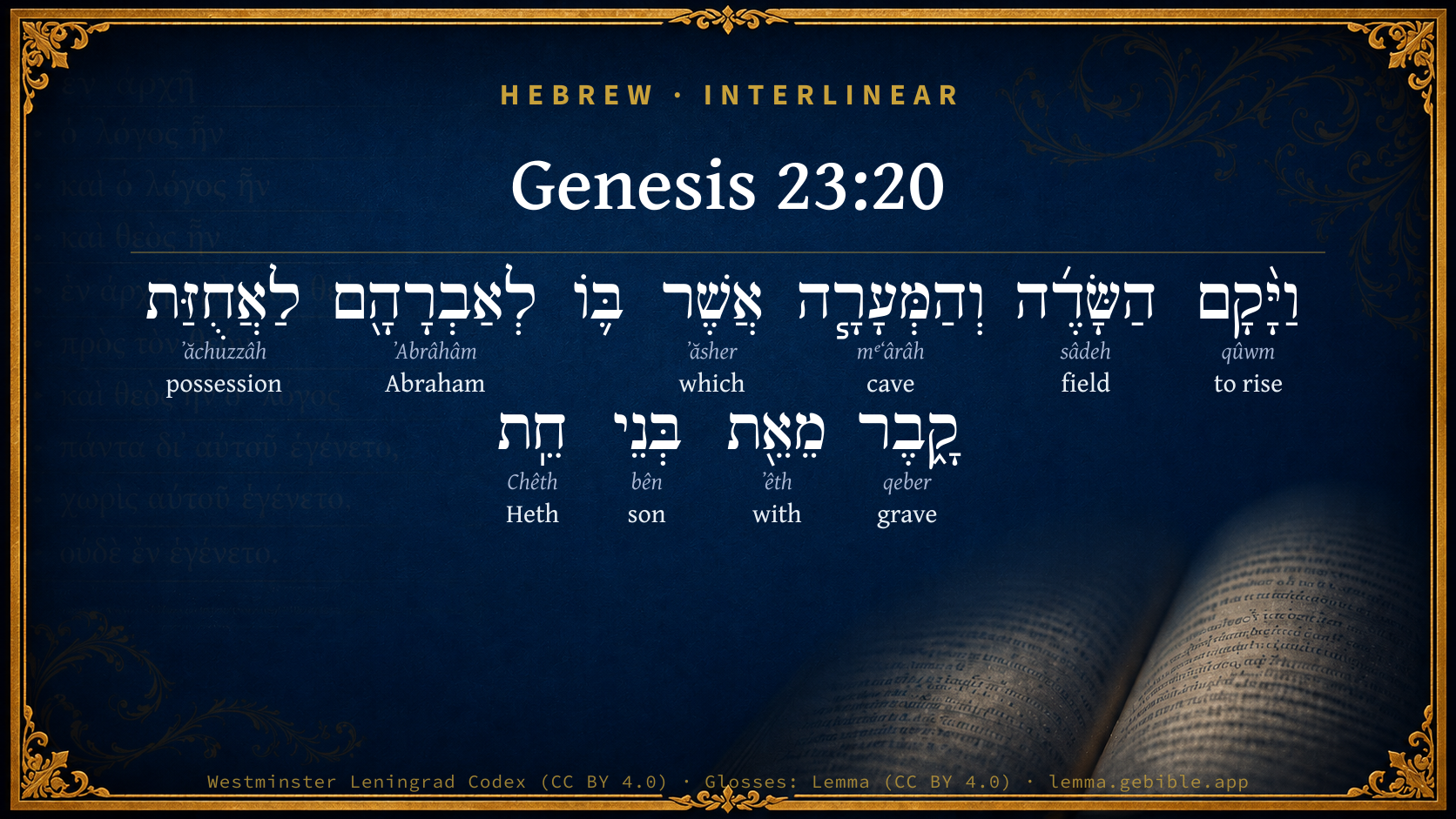
Hebrew (Westminster Leningrad Codex) Genesis 23:20 appears in the Hebrew Old Testament. The text above is from the Westminster Leningrad Codex. Each word links to its Strong’s number, a concise gloss, and parsing drawn from the Open Scriptures Hebrew Bible morphology. Click any word for its full Brown-Driver-Briggs (BDB) entry.
Download image
Cite this verse

Genesis 23:20 (World English Bible). Public Domain. Lemma interlinear Bible study tool, https://lemma.gebible.app/v/genesis/23/20.

Show BibTeX & RIS
BibTeX
RIS
English Translation
The field, and the cave that is therein, were made sure to Abraham for a possession of a burying place by the children of Heth.
World English Bible · Public Domain
Download a study sheet

One document with this verse’s original text, its word-by-word gloss line, the meaning frame, cross-references with their text, attributed commentary, and full source and license credits — printable, and it pastes into notes with its structure intact.

This verse Autodidact and up

Study sheet (.html) Plain text (.txt)

A passage Seminary Student

Up to 50 verses in one chapter. A passage sheet keeps up to 6 commentary sources and 12 cross-references per verse, in the order this page ranks them, and says so on the sheet whenever that leaves anything out. Ask for a single verse and you get the Autodidact verse sheet above.

Everything on this page stays free to read, with no account — the sheet is a download of what is already on screen, not access to it.

Want to remove ads? Support Godless Engineer
Compare translations 3

The same verse in 3 English versions, stacked beneath the original-language interlinear above. Click any original word for its lexicon entry.

Each is an independent rendering of the whole verse — the interlinear is not word-aligned to these translations.

Highlighted words mark where these versions differ — a whole-verse word diff, not a word-by-word alignment.

  • World English Bible Public Domain
    The field, and the cave that is therein, were made sure to Abraham for a possession of a burying place by the children of Heth.
  • King James Version Public Domain
    And the field, and the cave that is therein, were made sure unto Abraham for a possession of a buryingplace by the sons of Heth.
  • unfoldingWord Literal Text CC BY-SA 4.0
    So the field and the cave that in it were deeded to Abraham as property for a burial place from the sons of Heth.

unfoldingWord Literal Text — © unfoldingWord, licensed CC BY-SA 4.0. Word-aligned USFM3 via Door43 (git.door43.org/unfoldingWord/en_ult).

Versions to compare (up to 4)

3 of 4 selected

Show all 18 translations

Every available English version of this verse, each an independent rendering of the whole verse.

  • World English Bible Public Domain
    The field, and the cave that is therein, were made sure to Abraham for a possession of a burying place by the children of Heth.
  • Berean Standard Bible Public Domain
    So the field and its cave were deeded by the Hittites to Abraham as a burial site.
  • Majority Standard Bible Public Domain
    So the field and its cave were deeded by the Hittites to Abraham as a burial site.
  • King James Version Public Domain
    And the field, and the cave that is therein, were made sure unto Abraham for a possession of a buryingplace by the sons of Heth.
  • American Standard Version (1901) Public Domain
    And the field, and the cave that is therein, were made sure unto Abraham for a possession of a burying-place by the children of Heth.
  • Revised Version (1885) Public Domain
    And the field, and the cave that is therein, were made sure unto Abraham for a possession of a buryingplace by the children of Heth.
  • Geneva Bible (1599) Public Domain
    Thus the fielde and the caue, that is therein, was made sure vnto Abraham for a possession of buriall by the Hittites.
  • Douay-Rheims (1899) Public Domain
    And the field was made sure to Abraham, and the cave that was in it, for a possession to bury in, by the children of Heth.
  • Young's Literal Translation Public Domain
    and established are the field, and the cave which `is' in it, to Abraham for a possession of a burying-place, from the sons of Heth.
  • Literal Standard Version CC BY-SA 4.0
    and established are the field, and the cave which [is] in it, to Abraham for a possession of a burying-place, from the sons of Heth.
  • Unlocked Literal Bible CC BY-SA 4.0
    So the field and the cave in it passed to Abraham as a property for a burial place from the sons of Heth.
  • unfoldingWord Literal Text CC BY-SA 4.0
    So the field and the cave that in it were deeded to Abraham as property for a burial place from the sons of Heth.
  • Darby Bible Public Domain
    And the field and the cave that was in it were assured to Abraham for a possession of a sepulchre by the sons of Heth.
  • World Messianic Bible Public Domain
    The field, and the cave that is in it, were deeded to Abraham by the children of Heth as a possession for a burial place.
  • Webster's Bible Public Domain
    And the field, and the cave that is in it were made sure to Abraham for a possession of a burying-place, by the sons of Heth.
  • Free Bible Version CC BY-SA 4.0
    Ownership of the field and the cave there was transferred from the Hittites to Abraham to serve as his burial place.
  • Bible in Basic English Public Domain
    And the field and the hollow rock were handed over to Abraham as his property by the children of Heth.
  • JPS Tanakh (1917) Public Domain
    And the field, and the cave that is therein, were made sure unto Abraham for a possession of a burying-place by the children of Heth.

Literal Standard Version (2020), Covenant Press — licensed CC BY-SA 4.0. Text via the HelloAO Bible API (eBible.org). Unlocked Literal Bible (unfoldingWord) — licensed CC BY-SA 4.0. Text via the HelloAO Bible API (eBible.org). unfoldingWord Literal Text — © unfoldingWord, licensed CC BY-SA 4.0. Word-aligned USFM3 via Door43 (git.door43.org/unfoldingWord/en_ult). Free Bible Version, Dr. Jonathan Gallagher — licensed CC BY-SA 4.0. Text via the HelloAO Bible API (eBible.org).

Word by word

More ways to search: Search by grammar → Find every occurrence → Compare this word →

Practice this passage: Drill this verse → Learn its vocabulary →

About this verse

These counts appear in no published source. They are computed here, from the morphology-tagged text and Lemma’s own curated glosses. What Lemma adds →

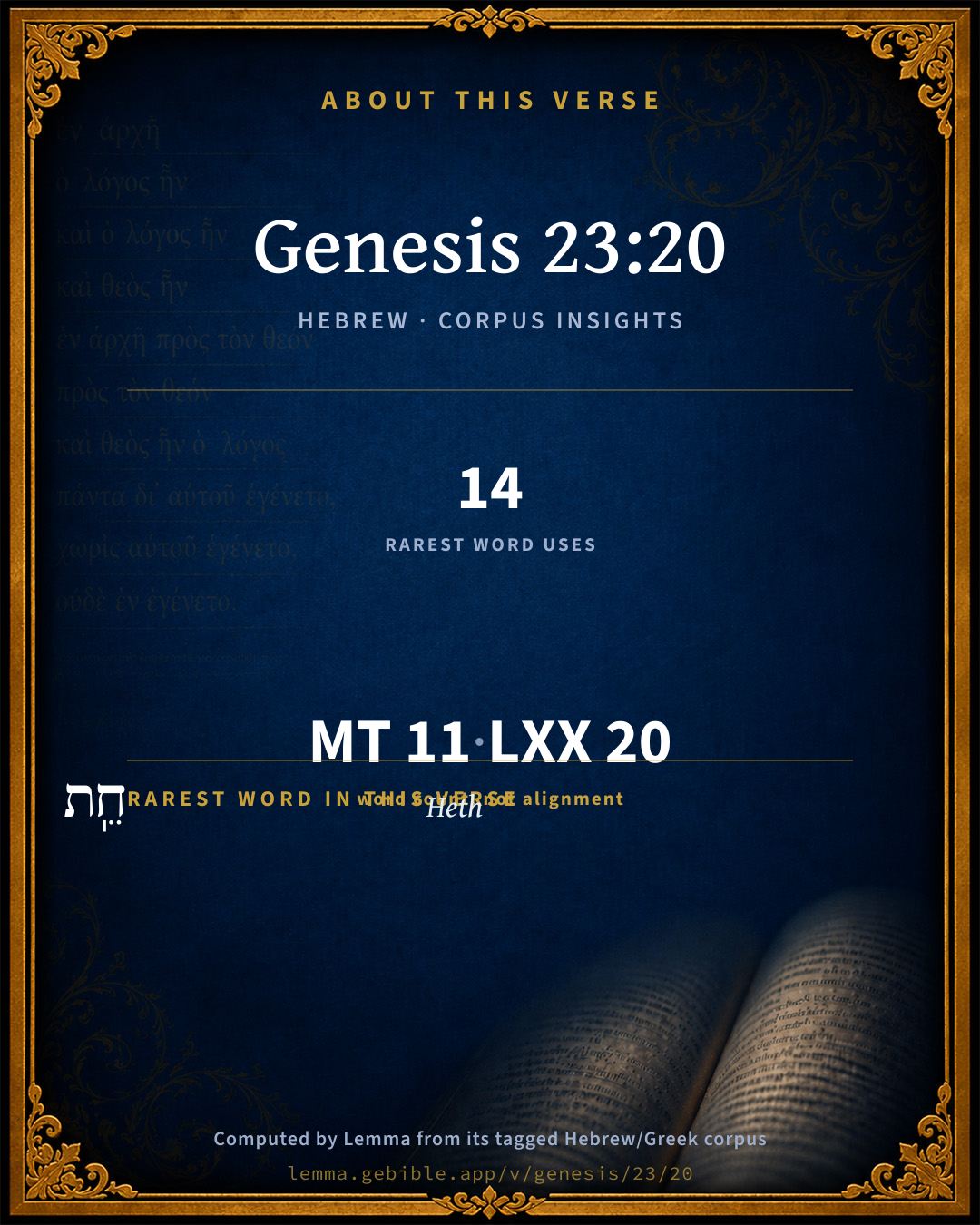
11
words
10
distinct lemmas
Pentateuch
section

Notable vocabulary

The rarest word here is חֵֽת Heth H2845 — appearing just 14 times in the whole Hebrew Bible.

Shared distinctive vocabulary

חֵֽת Heth H2845 occurs in 12 verses of the Hebrew Bible. Also found in:

Grammatical profile

  • 1 verb
  • 7 nouns
  • 2 prepositions
  • 1 particle

Verb forms

  • וַיָּ֨קָם Qal · Sequential Imperfect

Hebrew & Septuagint length

In English translation the verse runs 25 words from the Hebrew and 26 from the Septuagint (LXX English) — closely comparable.

A rough comparison of the two English renderings, which tokenize alike — not a word-level alignment.

Word counts can differ between the Hebrew and the Greek without any difference in meaning — e.g. the Hebrew direct-object marker אֵת has no separate Greek word, and Greek often adds the article ὁ.

In the original languages it is 11 Hebrew tokens and 20 Greek tokens — but the two are counted differently (Hebrew bundles its prefixes and suffixes into one token; the Greek is in lemma form), so that isn’t a like-for-like length.

Cross-references

9

Topical passages linked to Genesis 23:20 in the Treasury of Scripture Knowledge — connected by theme and wording, ordered by reader-vote popularity; previews shown in the World English Bible.

  • Ruth 4:7–10 Now this was [the custom] in former time in Israel concerning redeeming and concerning exchanging, to confirm all things: a man drew off his shoe, and gave it to his neighbor; and this was the [manner of] attestation in Israel.
  • Jeremiah 32:10–14 I subscribed the deed, and sealed it, and called witnesses, and weighed him the money in the balances.
  • Genesis 25:9 Isaac and Ishmael, his sons, buried him in the cave of Machpelah, in the field of Ephron, the son of Zohar the Hittite, which is before Mamre,
  • Genesis 49:31–32 There they buried Abraham and Sarah, his wife. There they buried Isaac and Rebekah, his wife, and there I buried Leah:
  • Genesis 50:5 'My father made me swear, saying, "Behold, I am dying. Bury me in my grave which I have dug for myself in the land of Canaan." Now therefore, please let me go up and bury my father, and I will come again.'"
  • Genesis 50:13 for his sons carried him into the land of Canaan, and buried him in the cave of the field of Machpelah, which Abraham bought with the field, for a possession of a burying-place, from Ephron the Hittite, before Mamre.
  • Genesis 50:24–25 Joseph said to his brothers, "I am dying, but God will surely visit you, and bring you up out of this land to the land which he swore to Abraham, to Isaac, and to Jacob."
  • 2 Samuel 24:24 The king said to Araunah, No; but I will most assuredly buy it of you at a price. Neither will I offer burnt-offerings to Yahweh my God which cost me nothing. So David bought the threshing floor and the oxen for fifty shekels of silver.
  • 2 Kings 21:18 Manasseh slept with his fathers, and was buried in the garden of his own house, in the garden of Uzza: and Amon his son reigned in his place.

Cross-references courtesy of OpenBible.info (CC BY 4.0).

Hebrew and Greek witnesses Masoretic Hebrew ↔ Greek Septuagint

The same verse in the two great witnesses to the Old Testament, shown verse-for-verse.

These are two independent witnesses, not word-aligned to each other, and the Septuagint is shown in lemma (dictionary) form.

Hebrew Genesis 23:20 Masoretic · Westminster Leningrad Codex

וַיָּ֨קָם הַשָּׂדֶ֜ה וְהַמְּעָרָ֧ה אֲשֶׁר בּ֛וֹ לְאַבְרָהָ֖ם לַאֲחֻזַּת קָ֑בֶר מֵאֵ֖ת בְּנֵי חֵֽת

The field, and the cave that is therein, were made sure to Abraham for a possession of a burying place by the children of Heth.

World English Bible · Public Domain

Greek LXX Genesis 23:20 Septuagint · lemma form

καί κυρόω ὁ ἀγρός καί ὁ σπήλαιον ὅς εἰμί ἐν αὐτός ὁ αβρααμ εἰς κτῆσις τάφος παρά ὁ υἱός χετ

So the field and the cave which was in it were made sure to Abraam for possession of a burying place, by the sons of Chet.

LXX2012 (modern English Septuagint) · Public Domain

Hebrew: Westminster Leningrad Codex (CC BY 4.0). Greek: Septuagint (public domain); English from LXX2012 (modern English Septuagint) (Public Domain). How the Septuagint differs from the Hebrew →

Targum (Aramaic paraphrase)

2

The Targum is the ancient Jewish Aramaic paraphrase of the Hebrew Scriptures — an interpretive translation, not the Hebrew text itself. Onkelos (literal) and Pseudo-Jonathan (expansive) render the Torah, and Jonathan the Prophets. Coverage is partial: where no permissively-licensed English translation exists for a verse, only the Aramaic is shown. This is verse-level text, not a word-by-word alignment to the Hebrew.

  1. Targum Onkelos Torah (Genesis–Deuteronomy)
    וְקָם חַקְלָא וּמְעַרְתָּא דִּי בֵהּ לְאַבְרָהָם לְאַחֲסָנַת קְבוּרָא מִן בְּנֵי חִתָּאָה

    (no public-domain English translation for this verse)

    Targum Onkelos — Aramaic: “Onkelos Genesis” (public domain); “Onkelos Exodus” (public domain); “Onkelos Leviticus” (public domain); “Onkelos Numbers” (public domain); “Onkelos Deuteronomy” (public domain). English: “Sefaria Community Translation” (CC0 1.0 (public-domain dedication)); “J.W. Etheridge. The Targums of Onkelos and Jonathan Ben Uzziel on the Pentateuch. London: Longmans, Green, 1862” (public domain). Text via Sefaria.

  2. Targum Pseudo-Jonathan Torah (Genesis–Deuteronomy)
    וְקָם חַקְלָא וּמְעָרְתָּא דְבֵיהּ לְאַבְרָהָם לְאַחֲסָנַת קְבוּרְתָּא מִן בְּנֵי חִיתָּאָה

    And the field and the cave therein were confirmed unto Abraham for an inheritance of sepulture from the sons of Hittah.

    Targum Pseudo-Jonathan — Aramaic: “Targum Jonathan on Genesis” (public domain); “Targum Jonathan on Exodus” (public domain); “Targum Jonathan on Leviticus” (public domain); “Targum Jonathan on Numbers” (public domain); “Targum Jonathan on Deuteronomy” (public domain). English: “The Targum of Jonathan ben Uzziel, trans. J. W. Etheridge, London, 1862” (public domain). Text via Sefaria.

Commentary

Notes on Genesis 23:20 from classic Christian and Jewish commentators (each source and its license shown beneath its notes). The classic Christian expositions comment on the surrounding passage and are grouped to its opening verse, so a note may address several verses; the Jewish commentaries on the Tanakh (Rashi and others) are per-verse, so they appear only where the commentator wrote on this verse.

Lemma curates 59 commentaries, every one of them public domain or Creative Commons licensed, each selected and text-cleaned for this edition rather than reprinted as found. About our sources →

Trapp's Complete Commentary

John Trapp

Gen 23:20 And the field, and the cave that [is] therein, were made sure unto Abraham for a possession of a buryingplace by the sons of Heth.

Ver. 20. Were made sure] sc., by witnesses, without writings: but now it is hard to be sure of anything; there is so much robbery and rapine amongst the sons of men.

John Trapp, A Commentary or Exposition upon All the Books of the Old and New Testament (1647–1656) — public domain. Text from a community e-Sword module.

Joseph Benson's Commentary

Gen 23:20. A burying-place — It is worth noting, 1st, That a burying-place was the first spot of ground Abraham was possessed of in Canaan. 2d, That it was the only piece of land he was ever possessed of, though it was all his own in reversion. Those that have least of this earth find a grave in it.

Joseph Benson's Commentary on the Old and New Testaments (1811–1818) — public domain. Text from a community e-Sword module.

Geneva Bible (1599)

Geneva Bible translators

That is, all the people confirmed the sale.

Geneva Bible (1599) marginal notes — public domain. Text via Bolls.life.

Adam Clarke's Commentary

Verse 20. And the field, c. were made sure] ויקם vaiyakom, were established, caused to stand the whole transaction having been regulated according to all the forms of law then in use.

1. IN this transaction between Abraham and the sons of Heth concerning the cave and field of Machpelah, we have the earliest account on record of the purchase of land. The simplicity, openness, and candour on both sides cannot be too much admired.

2. Sarah being dead, Abraham being only a sojourner in that land, shifting from place to place for the mere purpose of pasturing his flocks, and having no right to any part of the land, wished to purchase a place in which he might have the continual right of sepulture. For this purpose, 1. He goes to the gate of the city, the place where, in all ancient times, justice was administered, and bargains and sales concluded, and where for these purposes the elders of the people sat. 2. He there proposes to buy the cave known by the name of the Cave of Machpelah, the cave of the turning or the double cave, for a burying place for his family. 3. To prevent him from going to any unnecessary expense, the people with one voice offer him the privilege of burying his wife in any of their sepulchres; this appearing to them to be no more than the common rights of hospitality and humanity required. 4. Abraham, intent on making a purchase, Ephron, the owner of the field and cave, values them at four hundred shekels, but at the same time wishes Abraham to receive the whole as a gift. 5. Abraham refuses the gift and weighs down the silver specified. 6. The people who enter in at the gate, i.e., the inhabitants coming from or going to their ordinary occupations in the country, witness the transaction, and thus the conveyance to Abraham is made sure without the intervention of those puzzlers of civil affairs by whose tricks and chicanery property often becomes insecure, and right and succession precarious and uncertain. But this censure does not fall on lawyers properly so called, who are men of honour, and whose office, in every well-regulated state, is as useful as it is respectable. But the accumulation and complex nature of almost all modern systems of law puzzle even justice herself, and often induce decisions by which truth falls in the streets and equity goes backwards. In the first ages of mankind, suspicion, deceit, and guile seem to have had a very limited influence. Happy days of primitive simplicity! When shall they return?

3. We often hear of the rudeness and barbarity of the primitive ages, but on what evidence? Every rule of politeness that could be acted upon in such a case as that mentioned here, is brought into full practice. Is it possible to read the simple narration in this place without admiring the amiable, decent, and polite conduct displayed on both sides? Had even Lord Chesterfield read this account, his good sense would have led him to propose it as a model in all transactions between man and his fellows. There is neither awkward, stiff formality on the one hand, nor frippery or affectation on the other. Decent respect, good sense, good nature, and good breeding, are all prominently displayed. And how highly laudable and useful is all this! A pedant or a boor on either side might have destroyed the simplicity of the whole transaction; the one by engendering caution and suspicion, and the other by exciting disgust. In all such transactions the beau and the boor are equally to be avoided.

From the first no sincerity can be expected, and the manners of the latter render him intolerable. The religion of the Bible recommends and inculcates orderly behaviour, as well as purity of heart and life. They who, under the sanction of religion, trample under foot the decent forms of civil respect, supposing that because they are religious they have a right to be rude, totally mistake the spirit of Christianity, for love or charity (the soul and essence of that religion) behaveth not itself unseemly. Every attentive reader of the thirteenth chapter of St. Paul's first epistle to the Corinthians, will clearly discern that the description of true religion given in that place applies as forcibly to good breeding as to inward and outward holiness. What lessons of honesty, decent respect, and good manners could a sensible man derive from Abraham treating with the sons of Heth for the cave of Machpelah, and William Penn treating with the American Indians for the tract of land now called Pennsylvania! I leave others to draw the parallel, and to show how exactly the conduct and spirit of patriarch the first were exemplified in the conduct and spirit of patriarch the second. Let the righteous be had in everlasting remembrance!

Adam Clarke's Commentary on the Bible (1810–1826) — public domain. Text from a community e-Sword/MySword module.

Ellicott's Commentary for English Readers

(20) Were made sure unto Abraham.—For the difficulties connected with St. Stephen’s apparent confusion of this transaction with that recorded in Gen_33:19, see Note on Act_7:16.

A Bible Commentary for English Readers, edited by Charles John Ellicott (1878–1897) — public domain. Text from a community e-Sword module.

The Cambridge Bible for Schools and Colleges

gen. ed. J. J. S. Perowne

20. were made sure] This verse repeats and summarizes the transaction which for all subsequent ages symbolized to the Israelites their ancestral connexion with, and sacred rights in, the land of Canaan.

a buryingplace] Besides Sarah there were buried in the cave of Machpelah, Abraham (Gen_25:9), Isaac (Gen_35:27; Gen_35:29), Rebekah and Leah (Gen_49:31), Jacob (Gen_50:13).

The cave, which is traditionally identified with the burying-place of Abraham, is still regarded with immense veneration by the Mahommedans. A large mosque has been erected over it. In 1869 the Prussian Crown Prince Frederick, and in 1881 the late King Edward VII, who was then Prince of Wales, received permission to visit the cave. But, as a rule, Christians are not allowed to view it.

The Cambridge Bible for Schools and Colleges (gen. ed. J. J. S. Perowne; Cambridge University Press, 1878–1918) — public domain. Text from a community e-Sword module.

The Pulpit Commentary

And the field, and the cave that is therein, were made sure unto Abraham for a possession of a burying-place by the sons of Heth. The palpable discrepancy between the statements of the Hebrew historian in this chapter concerning the patriarchal sepulcher and those of the Christian orator when addressing the Jewish Sanhedrim (Act_7:16) has been well characterized as praegravis quaedam et perardua, et quorundam judicio inextricabilis quaestio (Pererius). Of course the Gordian knot of difficulty may be very readily cut by boldly asserting that a mistake has been committed somewhere; either by Stephen, the original speaker, under the impulse of emotion confounding the two entirely different stories of Abraham"s purchase of Machpelah and Jacob"s buying of the field near Shechem (Beds, Clarke, Lange, Kalisch, Alford, and others); or by Luke, the first recorder of the Martyr"s Apology, who wrote not the ipsissima verba of the speech, but simply his own recollection of them (Jerome); or by some subsequent transcriber who had tampered with the original text, as, e.g., inserting Abraam, which Luke and Stephen both had omitted, as the nominative to wjnhsato (Beza, Calvin, Bishop Pearce). The Just of these hypotheses would not indeed be fatal to the Inspiration of the record; but the claims of either Luke or Stephen to be authoritative teachers on the subject of religion would be somewhat hard to maintain if it once were admitted that they had blundered on a plain point in their own national history. And yet it is doubtful if any of the proposed solutions of the problem is perfectly satisfactory; such as

(1) that the two purchases of Abraham and Jacob are here intentionally, for the sake of brevity, compressed into one account (Bengel, Pererius, Willet, Hughes); or

(2) that Abraham bought two graves, one at Hebron of Ephron the Hittite, as recorded by Moses, and another at Shechem of the sons of Hamor the father of Shechem (Words. worth); or

(3) that the words "which Abraham bought for a sum of money" should be regarded as a parenthesis, and the sentence read as intimating that Jacob and the fathers were carried over into Shechem, and (afterwards) by the sons of Hamor the lather of Shechem interred in Abraham"s sepulcher at Hebron (Cajetan). Obvious difficulties attach to each of them; but the facts shine out clear enough in spite of the encompassing obscurity, viz., that Abraham bought a tomb at Hebron, in which first the dust of Sarah was deposited, and to which afterwards the bodies of himself, Isaac and Rebekah, Jacob and Leah were consigned, while Joseph and the twelve patriarchs, who all died in Egypt, were brought over to the promised land and buried in Jacob"s field at Shechem.

HOMILIES BY J.F. MONTGOMERY

Ver. 20.

Lessons from the sepulcher.

the field, and the cave that is therein, were made sure unto Abraham for a possession of a burying-place." Abraham"s first and only possession in Canaan, a sepulcher. The importance of the par-chase appears in the careful narrative of the transaction. For himself he was content to live as a stranger and pilgrim; (cf. 1Pe_5:7) but Sarah"s death led him to acquire a burying-place. Declining the offer to use any of the sepulchers of the people of the land (cf. the separation at death between God"s people and aliens), he bought the field and the cave, and carefully prepared the evidence of the purchase. The purchase showed his faith in God"s truth; one of the branches of Adam"s temptation. (Gen_3:4) It had been promised that his seed, after dwelling in a land not theirs, should return and possess that whereon he stood (cf. Jer_32:14, Jer_32:15) Type of entrance into rest after pilgrimage (cf. 2Co_5:1) It showed also his faith in a resurrection (cf. Psa_16:10) The desire that he and his family should lie in the same sepulcher speaks of a life beyond the present. Parted by death, they were one family still. Sarah was to him "my dead." There was a link between them still. The living and dead still one family. Doctrine of communion of saints (cf. Mat_22:32) Death was the gate of life (cf. 1Th_4:16) Canaan a type of the rest which remaineth; Abraham of the "children of the kingdom," pilgrims with a promise. No rest here. Life full of uncertainties. One thing sure, we must die. But

I WE ENTER THE HEAVENLY REST THROUGH DEATH; THE CITY OF GOD THROUGH THE VALLEY OF BACA. Here we walk by faith. Great and glorious promises for our encouragement, that we may not make our home here; yet we know not what we shall be. Sight cannot penetrate the curtain that separates time from eternity. Thus there is the trial, do we walk by faith or by sight? We instinctively shrink from death. It is connected in our mind with sorrow, with interruption of plans, with breaking up of loving companionship; but faith bids us sorrow not as those without hope. It reminds that it is the passing from what is defective and transitory to what is immortal. Here we are trained for the better things beyond, and our thoughts are turned to that sepulcher in which the victory over death was won; thence we see the Lord arising, the pledge of eternal life to all who will have it.

II THE SEPULCHRE WAS MADE SURE TO ABRAHAM. In time he should enter it as one of the company gathered there to await the resurrection day; but meanwhile it was his. And if we look upon this as typical of our interest in the death of Christ, it speaks of comfort and trust. He took our nature that he might "taste death for every man." His grave is. (2Co_5:14) We are buried with him," "planted together in the likeness of his death." The fact of his death is a possession that cannot be taken from us. (Col_3:3, Col_3:4) He died that we might live. If frail man clings to the tomb of some dear one; if the heart is conscious of the link still enduring, shall we not rejoice in our union with him whose triumph makes us also more than conquerors?

III THE FIELD AND CAVE. How small a part did Abraham possess in his lifetime, but it was an earnest of the whole; he felt it so, and in faith buried his dead (cf. Gen_1:25; Heb_11:22) An earnest is all we possess here, but still we have an earnest. In the presence of the Lord, (Joh_14:23) in the peace which he gives, in the spirit of adoption, we have the "substance of things hoped for," a real fragment and sample of the blessedness of heaven. M.

The Pulpit Commentary (1880–1919), ed. H.D.M. Spence-Jones & Joseph S. Exell — public domain. Text from a community e-Sword module.

John Wesley's Explanatory Notes

A burying place - 'Tis worth noting,

1. That a burying-place was the first spot of ground Abraham was possessed of in Canaan.

2. That it was the only piece of land he was ever possessed of, tho' it was all his own in reversion. Those that have least of this earth find a grave in it.

John Wesley, Explanatory Notes Upon the Whole Bible (1754–1765) — public domain. Text via the GEBible commentary corpus.

Keil & Delitzsch

C. F. Keil & F. Delitzsch

The repetition of the statement, that the field with the cave in it was conveyed to Abraham by the Hittites for a burial-place, which gives the result of the negotiation that has been described with, so to speak, legal accuracy, shows the great importance of the event to the patriarch. The fact that Abraham purchased a burying-place in strictly legal form as an hereditary possession in the promised land, was a proof of his strong faith in the promises of God and their eventual fulfilment. In this grave Abraham and Sarah, Isaac and Rebekah, were buried; there Jacob buried Leah; and there Jacob himself requested that he might be buried, thus declaring his faith in the promises, even in the hour of his death.

Keil & Delitzsch — Biblical Commentary on the Old Testament (1861–1891) — public domain (CC PDM 1.0). Text via the HelloAO Bible API. (Old Testament only.)

Radak

Rabbi David Kimhi (Radak)

ויקם...מאת בני חת, All the townspeople had agreed to the sale of Efron’s fields to Avraham. They were quite keen for Avraham to own an ancestral plot in their midst.

Radak on the Tanakh — English translations: “Sefaria Community Translation” (CC0 1.0 (public-domain dedication)); “Eliyahu Munk, HaChut Hameshulash” (CC BY 4.0); “Rabbi Mike Feuer, Jerusalem Anthology” (CC BY 4.0); and “R. David Kimhi on the first book of Psalms, Translated by R.G. Finch, London, 1919” (public domain). Text via Sefaria.

Lesson kit

Teaching starters — assembled from the data on this page, not authored interpretation. Every prompt links to the verse data it draws on. Edit before teaching.

Genesis, in the Pentateuch, opens this verse with 11 words (10 distinct Hebrew lemmas). Its most distinctive word is Chêth (“Heth”). A historical commentator’s framing appears above. Read the whole chapter for the surrounding context.

Discussion questions

  1. The word Chêth carries the sense “Heth.” How does it shape the verse?
  2. How does Genesis 10:15, which shares the word «Heth», read alongside this verse?
  3. These translations render this verse differently. What is at stake in choosing one wording over another?
  4. «וַיָּ֨קָם» is a Qal Sequential Imperfect verb. How does that grammatical form shape the action described?
  5. Compare how Trapp's Complete Commentary and Joseph Benson's Commentary read this verse. Where do they agree or differ?

Things to notice

Reading settings

Reading text

Shown beneath each verse's original-language words.

Old Testament
Old Testament edition

Read the OT as the Masoretic Hebrew (MT) or the Greek Septuagint (LXX).

English shown for the Greek Septuagint (in the Hebrew ↔ Greek comparison).

Comparing translations? Open the Compare panel on any verse page to stack up to four side by side.