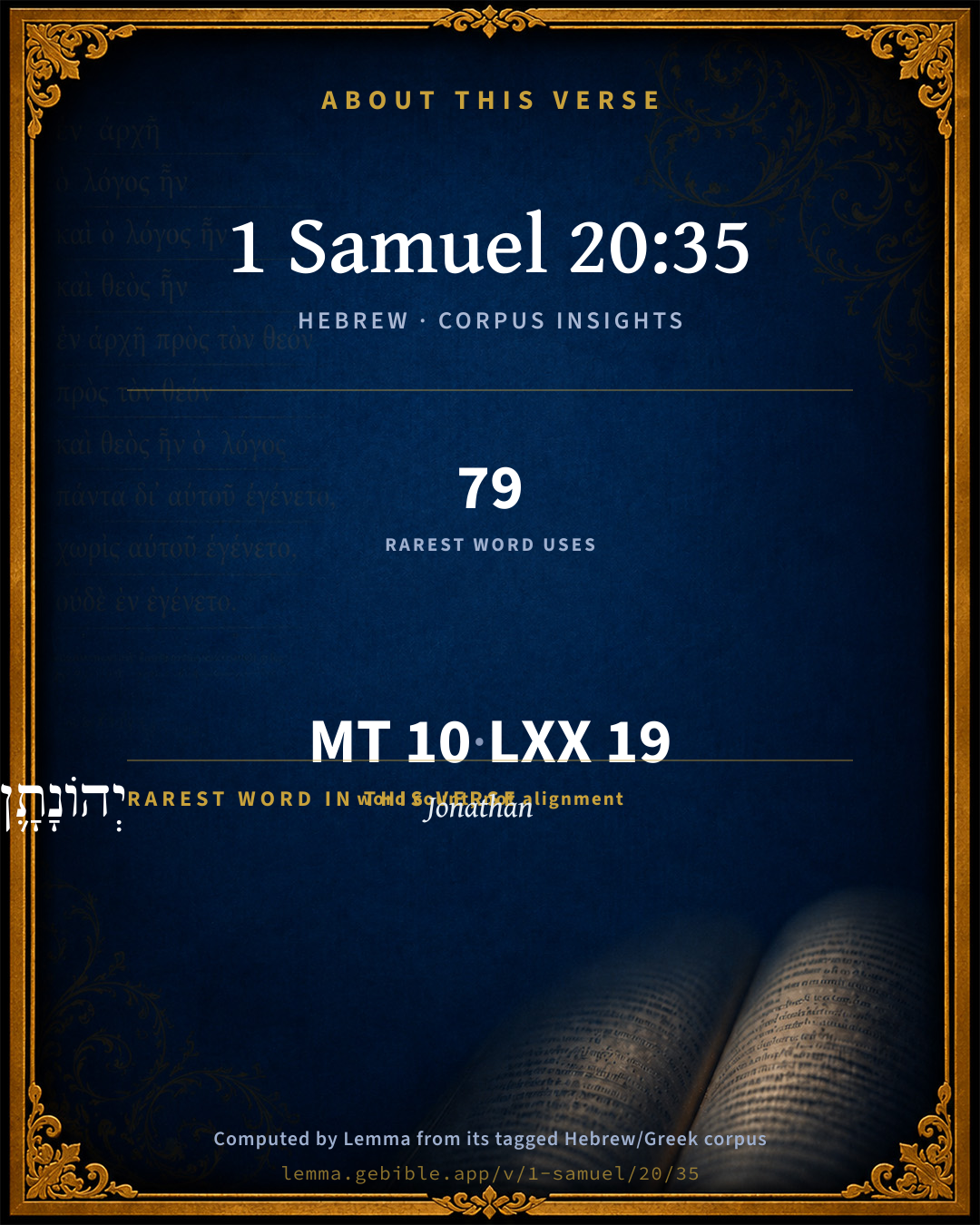
1 Samuel 20:35

Hebrew (Westminster Leningrad Codex) 1 Samuel 20:35 appears in the Hebrew Old Testament. The text above is from the Westminster Leningrad Codex. Each word links to its Strong’s number, a concise gloss, and parsing drawn from the Open Scriptures Hebrew Bible morphology. Click any word for its full Brown-Driver-Briggs (BDB) entry.
Download image
Cite this verse

1 Samuel 20:35 (World English Bible). Public Domain. Lemma interlinear Bible study tool, https://lemma.gebible.app/v/1-samuel/20/35.

Show BibTeX & RIS
BibTeX
RIS
English Translation
It happened in the morning, that Jonathan went out into the field at the time appointed with David, and a little boy with him.
World English Bible · Public Domain
Download a study sheet

One document with this verse’s original text, its word-by-word gloss line, the meaning frame, cross-references with their text, attributed commentary, and full source and license credits — printable, and it pastes into notes with its structure intact.

This verse Autodidact and up

Study sheet (.html) Plain text (.txt)

A passage Seminary Student

Up to 50 verses in one chapter. A passage sheet keeps up to 6 commentary sources and 12 cross-references per verse, in the order this page ranks them, and says so on the sheet whenever that leaves anything out. Ask for a single verse and you get the Autodidact verse sheet above.

Everything on this page stays free to read, with no account — the sheet is a download of what is already on screen, not access to it.

Want to remove ads? Support Godless Engineer
Compare translations 3

The same verse in 3 English versions, stacked beneath the original-language interlinear above. Click any original word for its lexicon entry.

Each is an independent rendering of the whole verse — the interlinear is not word-aligned to these translations.

Highlighted words mark where these versions differ — a whole-verse word diff, not a word-by-word alignment.

  • World English Bible Public Domain
    It happened in the morning, that Jonathan went out into the field at the time appointed with David, and a little boy with him.
  • King James Version Public Domain
    And it came to pass in the morning, that Jonathan went out into the field at the time appointed with David, and a little lad with him.
  • unfoldingWord Literal Text CC BY-SA 4.0
    And it happened in the morning that Jonathan went out the field to the appointment with David, and a small boy with him.

unfoldingWord Literal Text — © unfoldingWord, licensed CC BY-SA 4.0. Word-aligned USFM3 via Door43 (git.door43.org/unfoldingWord/en_ult).

Versions to compare (up to 4)

3 of 4 selected

Show all 18 translations

Every available English version of this verse, each an independent rendering of the whole verse.

  • World English Bible Public Domain
    It happened in the morning, that Jonathan went out into the field at the time appointed with David, and a little boy with him.
  • Berean Standard Bible Public Domain
    In the morning Jonathan went out to the field for the appointment with David, and a small boy was with him.
  • Majority Standard Bible Public Domain
    In the morning Jonathan went out to the field for the appointment with David, and a small boy was with him.
  • King James Version Public Domain
    And it came to pass in the morning, that Jonathan went out into the field at the time appointed with David, and a little lad with him.
  • American Standard Version (1901) Public Domain
    And it came to pass in the morning, that Jonathan went out into the field at the time appointed with David, and a little lad with him.
  • Revised Version (1885) Public Domain
    And it came to pass in the morning, that Jonathan went out into the field at the time appointed with David, and a little lad with him.
  • Geneva Bible (1599) Public Domain
    On the next morning therefore Ionathan than went out into the fielde, at the time appoynted with Dauid, and a litle boy with him.
  • Douay-Rheims (1899) Public Domain
    And when the morning came, Jonathan went into the field, according to the appointment with David, and a little boy with him.
  • Young's Literal Translation Public Domain
    And it cometh to pass in the morning, that Jonathan goeth out into the field for the appointment with David, and a little youth `is' with him.
  • Literal Standard Version CC BY-SA 4.0
    And it comes to pass in the morning, that Jonathan goes out into the field for the appointment with David, and a little youth [is] with him.
  • Unlocked Literal Bible CC BY-SA 4.0
    In the morning, Jonathan went out into the field to the appointment with David, and a young man was with him.
  • unfoldingWord Literal Text CC BY-SA 4.0
    And it happened in the morning that Jonathan went out the field to the appointment with David, and a small boy with him.
  • Darby Bible Public Domain
    And it came to pass in the morning that Jonathan went out into the field, to the place agreed on with David, and a little lad with him.
  • World Messianic Bible Public Domain
    In the morning, Jonathan went out into the field at the time appointed with David, and a little boy with him.
  • Webster's Bible Public Domain
    And it came to pass in the morning, that Jonathan went out into the field at the time appointed with David, and a little lad with him.
  • Free Bible Version CC BY-SA 4.0
    In the morning Jonathan went to the field to the place he had agreed with David, and a young boy was with him.
  • Bible in Basic English Public Domain
    Now in the morning, Jonathan went out into the fields at the time he had said to David, and he had a little boy with him.
  • JPS Tanakh (1917) Public Domain
    And it came to pass in the morning, that Jonathan went out into the field at the time appointed with David, and a little lad with him.

Literal Standard Version (2020), Covenant Press — licensed CC BY-SA 4.0. Text via the HelloAO Bible API (eBible.org). Unlocked Literal Bible (unfoldingWord) — licensed CC BY-SA 4.0. Text via the HelloAO Bible API (eBible.org). unfoldingWord Literal Text — © unfoldingWord, licensed CC BY-SA 4.0. Word-aligned USFM3 via Door43 (git.door43.org/unfoldingWord/en_ult). Free Bible Version, Dr. Jonathan Gallagher — licensed CC BY-SA 4.0. Text via the HelloAO Bible API (eBible.org).

Word by word

More ways to search: Search by grammar → Find every occurrence → Compare this word →

Practice this passage: Drill this verse → Learn its vocabulary →

יְהוֹנָתָ֛ן
Yᵉhôwnâthân
H3083
“Jonathan”
Noun, Proper
Part of Speech
Noun
Type
Proper
Full BDB Definition

Origin: from H3068 and H5414

TWOT: None

Jonathan or Jehonathan = "Jehovah has given" - a son of king Saul and a friend of David - a son of the high priest Abiathar and the last descendant of Eli of whom we hear - a nephew of David who like David slew a giant of Gath - an uncle of David - one of David's mighty warriors - one of David's treasurers - a scribe in the time of Jeremiah - a Levite and father of Zechariah, a priest who blew the trumpet at the dedication of the wall - a son or descendant of Gershom, the son of Moses, and a priest to the tribe of Dan - a son of Kareah and a brother of Johanan; a Judaite captain after the fall of Jerusalem - another Judaite father of Peleth - father of Ebed in the time of Ezra - son of Asahel in the time of Ezra - a priest of the family of Melicu in the time of Nehemiah - son of Joiada and his successor to the high priesthood in the time of Nehemiah
  1. וַיְהִ֣י hâyâh H1961 “and · to be” Conjunction + Verb, Qal, Sequential Imperfect, 3rd Person, Masculine, Singular
  2. בַבֹּ֔קֶר bôqer H1242 “in/at the · morning” Preposition, Determined + Noun, Common, Masculine, Singular, Absolute
  3. וַיֵּצֵ֧א yâtsâʼ H3318 “and · to go out” Conjunction + Verb, Qal, Sequential Imperfect, 3rd Person, Masculine, Singular
  4. הַשָּׂדֶ֖ה sâdeh H7704 “the · field” Particle, Definite Article + Noun, Common, Masculine, Singular, Absolute
  5. לְמוֹעֵ֣ד môwʻêd H4150 “to/for · appointed time of” Preposition + Noun, Common, Masculine, Singular, Construct
  6. דָּוִ֑ד Dâvid H1732 “David” Noun, Proper
  7. וְנַ֥עַר naʻar H5288 “and · boy” Conjunction + Noun, Common, Masculine, Singular, Absolute
  8. קָטֹ֖ן qâṭân H6996 “small” Adjective, Adjective, Masculine, Singular, Absolute
  9. עִמּֽוֹ ʻim H5973 “with · him” Preposition + Suffix, Personal, 3rd Person, Masculine, Singular

About this verse

These counts appear in no published source. They are computed here, from the morphology-tagged text and Lemma’s own curated glosses. What Lemma adds →

10
words
10
distinct lemmas
Historical
section

Grammatical profile

  • 2 verbs
  • 6 nouns
  • 1 adjective
  • 1 preposition

Verb forms

  • וַיְהִ֣י Qal · Sequential Imperfect
  • וַיֵּצֵ֧א Qal · Sequential Imperfect

Hebrew & Septuagint length

In English translation the verse runs 24 words from the Hebrew and 27 from the Septuagint (LXX English) — closely comparable.

A rough comparison of the two English renderings, which tokenize alike — not a word-level alignment.

Word counts can differ between the Hebrew and the Greek without any difference in meaning — e.g. the Hebrew direct-object marker אֵת has no separate Greek word, and Greek often adds the article ὁ.

In the original languages it is 10 Hebrew tokens and 19 Greek tokens — but the two are counted differently (Hebrew bundles its prefixes and suffixes into one token; the Greek is in lemma form), so that isn’t a like-for-like length.

Cross-references

2

Topical passages linked to 1 Samuel 20:35 in the Treasury of Scripture Knowledge — connected by theme and wording, ordered by reader-vote popularity; previews shown in the World English Bible.

  • 1 Samuel 20:19 When you have stayed three days, you shall go down quickly, and come to the place where you did hide yourself when the business was in hand, and shall remain by the stone Ezel.
  • 2 Samuel 20:5 So Amasa went to call [the men of] Judah together; but he stayed longer than the set time which he had appointed him.

Cross-references courtesy of OpenBible.info (CC BY 4.0).

Hebrew and Greek witnesses Masoretic Hebrew ↔ Greek Septuagint

The same verse in the two great witnesses to the Old Testament, shown verse-for-verse.

These are two independent witnesses, not word-aligned to each other, and the Septuagint is shown in lemma (dictionary) form.

Hebrew 1 Samuel 20:35 Masoretic · Westminster Leningrad Codex

וַיְהִ֣י בַבֹּ֔קֶר וַיֵּצֵ֧א יְהוֹנָתָ֛ן הַשָּׂדֶ֖ה לְמוֹעֵ֣ד דָּוִ֑ד וְנַ֥עַר קָטֹ֖ן עִמּֽוֹ

It happened in the morning, that Jonathan went out into the field at the time appointed with David, and a little boy with him.

World English Bible · Public Domain

Greek LXX 1 Samuel 20:35 Septuagint · lemma form

καί γίγνομαι πρωΐ καί ἐκἔρχομαι ιωναθαν εἰς ἀγρός καθώς τάσσω εἰς ὁ μαρτύριον δαυίδ καί παιδάριον μικρός μετά αὐτός

And morning came, and Jonathan went out to the field, as he appointed to do for a signal to David, and a little boy was with him.

LXX2012 (modern English Septuagint) · Public Domain

On this verse, Keil & Delitzsch discusses the Septuagint’s reading. Read the note in Commentary ↓

Hebrew: Westminster Leningrad Codex (CC BY 4.0). Greek: Septuagint (public domain); English from LXX2012 (modern English Septuagint) (Public Domain). How the Septuagint differs from the Hebrew →

Targum (Aramaic paraphrase)

1

The Targum is the ancient Jewish Aramaic paraphrase of the Hebrew Scriptures — an interpretive translation, not the Hebrew text itself. Onkelos (literal) and Pseudo-Jonathan (expansive) render the Torah, and Jonathan the Prophets. Coverage is partial: where no permissively-licensed English translation exists for a verse, only the Aramaic is shown. This is verse-level text, not a word-by-word alignment to the Hebrew.

  1. Targum Jonathan Prophets (Joshua–Malachi)
    וַהֲוָה בְצַפְרָא וּנְפַק יְהוֹנָתָן לְחַקְלָא לְזִמְנָא דַאֲמַר לֵיהּ דָוִד וְיַנִיק זְעִיר עִמֵיהּ:

    (no public-domain English translation for this verse)

    Targum Jonathan — Aramaic: “Mikraot Gedolot” (public domain). English: “Sefaria Community Translation” (CC0 1.0 (public-domain dedication)); “London "Chaldee Paraphrase," 1871” (public domain). Text via Sefaria.

Commentary

Notes on 1 Samuel 20:35 from classic Christian and Jewish commentators (each source and its license shown beneath its notes). The classic Christian expositions comment on the surrounding passage and are grouped to its opening verse, so a note may address several verses; the Jewish commentaries on the Tanakh (Rashi and others) are per-verse, so they appear only where the commentator wrote on this verse.

Lemma curates 59 commentaries, every one of them public domain or Creative Commons licensed, each selected and text-cleaned for this edition rather than reprinted as found. About our sources →

Matthew Henry's Commentary

Here is, 1. Jonathan's faithful performance of his promise to give David notice of the success of his dangerous experiment. He went at the time and to the place appointed (Sa1 20:35), within sight of which he knew David lay hid, sent his footboy to fetch his arrows, which he would shoot at random (Sa1 20:36), and gave David the fatal signal by shooting an arrow beyond the lad (Sa1 20:37): Is not the arrow beyond thee? That word [beyond] David knew the meaning of better than the lad. Jonathan dismissed the lad, who knew nothing of the matter, and, finding the coast clear and no danger of a discovery, he presumed upon one minute's personal conversation with David after he had bidden him flee for his life. 2. The most sorrowful parting of these two friends, who, for aught that appears, never came together again but once, and that was by stealth in a wood, Sa1 23:16. (1.) David addressed himself to Jonathan with the reverence of a servant rather than the freedom of a friend: He fell on his face to the ground, and bowed himself three times, as one deeply sensible of his obligations to him for the good services he had done him. (2.) They took leave of each other with the greatest affection imaginable, with kisses and tears; they wept on each other's neck till David exceeded, Sa1 20:41. The separation of two such faithful friends was equally grievous to them both, but David's case was the more deplorable; for, when Jonathan was returning to his family and friends, David was leaving all his comforts, even those of God's sanctuary, and therefore his grief exceeded Jonathan's, or perhaps it was because his temper was more tender and his passions were stronger. (3.) They referred themselves to the covenant of friendship that was between them, both of them comforting themselves with this in this mournful separation: "We have sworn both of us in the name of the Lord, for ourselves and our heirs, that we and they will be faithful and kind to each other from generation to generation." Thus, while we are at home in the body and absent from the Lord, this is our comfort, that he has made with us an everlasting covenant.

Matthew Henry's Commentary on the Whole Bible (1708–1710) — public domain (CC PDM 1.0). Text via the HelloAO Bible API.

Trapp's Complete Commentary

John Trapp

1Sa 20:35 And it came to pass in the morning, that Jonathan went out into the field at the time appointed with David, and a little lad with him.

Ver. 35. And a little lad with him.] He went no better attended, because to shoot only for his recreation: but indeed that he might get an opportunity, if possible, of communing with David.

John Trapp, A Commentary or Exposition upon All the Books of the Old and New Testament (1647–1656) — public domain. Text from a community e-Sword module.

Geneva Bible (1599)

Geneva Bible translators

For this was the third day, as it was agreed upon, verse 5.

Geneva Bible (1599) marginal notes — public domain. Text via Bolls.life.

Jamieson, Fausset & Brown

Robert Jamieson, A. R. Fausset & David Brown

Jonathan went out into the field at the time appointed--or, "at the place appointed."

Jamieson, Fausset & Brown — Commentary Critical and Explanatory on the Whole Bible (1871) — public domain (CC PDM 1.0). Text via the HelloAO Bible API.

Ellicott's Commentary for English Readers

(35) At the time appointed with David.—This meeting between the friends is not described at any length; all was done as had been pre-arranged, and, alas! everything had come to pass as David in his sad foresight had expected.

A Bible Commentary for English Readers, edited by Charles John Ellicott (1878–1897) — public domain. Text from a community e-Sword module.

The Cambridge Bible for Schools and Colleges

gen. ed. J. J. S. Perowne

35–42. The parting between Jonathan and David

35. at the time appointed] Better, to the place appointed (1Sa_20:19).

a little lad] Who would not suspect the real purpose of Jonathan’s shooting: a vivid touch of reality in the narrative.

The Cambridge Bible for Schools and Colleges (gen. ed. J. J. S. Perowne; Cambridge University Press, 1878–1918) — public domain. Text from a community e-Sword module.

John Gill's Exposition

And it came to pass in the morning:,.... The next morning, the morning of the third day of the month:

that Jonathan went out into the field at the time appointed with David; he went to the place in the field, or near it, where David hid himself, and at the time agreed between them; which, Abarbinel says, was the time the nobles agreed on for walking, and motion, and for hunting, and casting of arrows, so that Jonathan could go forth without suspicion:

and a little lad with him; to carry his bow and arrows, and fetch his arrows when cast.

John Gill's Exposition of the Whole Bible (1746–1763) — public domain (CC PDM 1.0). Text via the HelloAO Bible API.

Matthew Poole's English Annotations

In the morning, to wit, of the third day, appointed, for this work, 1Sa 20:5.

Matthew Poole's English Annotations on the Holy Bible (1683–1685) — public domain. Text from a community e-Sword/MySword module.

The Pulpit Commentary

JONATHAN"S LAST MEETING WITH DAVID (vers. 35-42).

Vers. 35-38. The next morning Jonathan went out into the field, not at the time, but "to the place" appointed, taking with him a little lad, as less likely to suspect a reason. Having shot at the mark, he sends him to pick up the arrows, and as he runs to do so he shoots one beyond him, and, calling aloud, gives David the sign that there was no hope. To keep the boy"s attention engaged he gives him hurried commandsMake speed, haste, stay not. Instead of the arrows the written text has "Jonathan"s lad gathered up the arrow," i.e. that one especially which Jonathan had shot beyond him, and to which his rapid commands referred.

Vers. 35-42.

Warning in danger.

The facts are

1. In accordance with arrangement, Jonathan, on the next day, goes outinto the field, and, on shooting the arrow beyond the lad with him, he cries out the signal of danger.

2. David recognises the sign,and the lad is sent away to the city.

3. Thereupon David and Jonathan embrace each other, and take asorrowful farewell Jonathan giving him his benediction, and reminding him for his comfort of the sacred covenant between them both. A crisis had come in the life of David which demanded prompt action. He had passed from a quiet pastoral occupation to the fall glory of a victor"s triumph, and from thence through the chequered scenes of public service in the army and the court. Meanwhile the hidden purposes of God were fast developing; and now the "anointed" has to take a painful step in order to insure the preservation of life essential to the realisation of the end for which Samuel had chosen him in the name of God. The manner in which Jonathan performed his part is a beautiful instance of wise and faithful friendship under most perilous circumstances. We see here

I HOW WE MAY COME INTO CIRCUMSTANCES OF GREAT DANGER WHICH AT ONE TIME WOULD NOT BE ANTICIPATED. The life of the anointed of the Lord was in real peril by reason of the fixed purpose of an enraged and envious king. No one would have supposed such a condition of things when the ruddy youth went forth to meet the giant, and subsequently received favours at the hand of Saul. But the possibilities of human experience transcend all our effort to foresee. What the web of life will embrace as the weaving goes on who can tell? It is true one stage prepares the way for another according to fixed laws, but we know not what new external condition a day or an hour may bring forth to modify an existing stage. Who less than Divine could have supposed that Adam, pure and blessed, would soon be exposed to so deadly a peril in Eden? or that he who received the homage of wise men and was the subject of angelic praise would be sought by a murderous Herod? The great lines of human experience are still the same. In business affairs the once prosperous come sometimes into risks of property, reputation, and all that is dear. By associations not looked for, characters once without suspicion are in danger of a fatal compromise. The tender, happy youth of a pious home, encircled by all that love can provide, is found far from home on the verge of a moral precipice. No position of privilege or service sets us above the possibility of grave dangers. Even David, the chosen servant, was nigh unto death, and the holy apostle was anxious lest, having preached to others, he himself should at last be a "castaway". (1Co_9:27)

II PROVIDENCE ALWAYS PROVIDES KINDLY WARNINGS OF DANGER AND INCENTIVES TO ESCAPE. In the service of God David came into this great peril, but by the offices of friendship God mercifully provided for his need. The signal was given, and he recognised its meaning. It said to him, "Flee; escape." Perhaps it may be safely said that there is no circumstance of moral and often of material danger into which we may be brought in the unfolding of events but that God makes known our position and opens a way of escape. Even in ordinary affairs the voice of a sober judgment, if not of some personal friend, may warn the merchant of his risks, and suggest a speedy retreat from entanglements. Often a man, gradually forming undesirable associations, is warned by relatives and those who love him best of the peril of his reputation. The quondam youth of purity hears a voice as from a mother"s heart saying, as he in later years stands on the brink of ruin, "Flee!" Providence has many a Jonathan to shoot the arrow and cry "Beyond.

III It is REASONABLE THAT IN ALL TIMES OF DANGER WE SHOULD PROMPTLY ACT ON THE WARNING AT ANY COST. In David"s case we see the reasonableness of his noting the sign, acting on its significance, even though in so doing it cost him the bitter pang of parting from the dearest friend of his life, and becoming a beggar and a fugitive. Only thus could he ultimately fulfil the end of his existence. It was reasonable, for Jonathan knew the danger to be real, and would not deceive. So in any case of our peril, whether of health, business, reputation, Christian profession, or future salvation, it is important at once to heed the voice of warning; for Providence never lies. It is a fact that many are ruined in spite of warning. The reason is, they either will not cultivate the habit of discerning the "signs of the times" in moral and spiritual matters; (Mat_16:3) or, discerning them, they fall under the delusion that somehow they shall escape, even though they remain as they are; or else they refuse to believe the signs. Many reject the testimony of the faithful Jonathan. They prefer their own speculations to the declared testimony of Christ. (Rev_1:18) Verily unbelief is folly, and those who pride themselves on reason are most unreasonable. It often costs much to act promptly on the voice of warning. We may not have to endure a separation from a holy friend as did David; but a temporary loss may be sustained of serious character. The ruin threatening from a man"s entangled business affairs may be escaped by a prompt surrender of luxurious habits and home comforts. To save reputation friends may have to be abandoned. A soul can only be saved from death sometimes by a resolute plucking out of a right eye. (Mat_5:29) Lot lost all in Sodom but saved himself.

General lessons:

1. Knowing the perilous possibilities of life, let us go forward cautiously, yet quietly trusting in God.

2. Whenever it is in our power, let us prove ourselves friends by warningothers of their material or spiritual dangers.

3. We should give careful heed to the first promptings of conscience, remembering that in moral questions the first motions of conscience are safest for action.

4. We may make a useful study of the partings of life of, e.g. , Lot and Abraham, Moses and Pharaoh, Paul and the Ephesians, Christ and his disciples.

Vers. 35-40. (THE STONE EZEL.)

An obedient lad.

(A word to the young.) Prince Jonathan went out into the country, by the stone Ezel, to practise archery of his famous bow, (2Sa_1:18, 2Sa_1:22) and took with him a lad, "a little lad" (ver. 35), to carry his arrows and gather them up after they had been shot at the mark. This lad

1. Had learnt a great lesson, the first and most important lesson of life obedience. He was a young soldier, and had learnt a soldier"s chief duty. "Children, obey your parents". (Eph_6:1) "Servants, obey your masters". (Col_3:22) "Obey" your teachers. (Heb_13:17) Obey magistrates". (Tit_3:1)

2. Had learnt his lesson well. He did what he was told to do willingly, cheerfully, quickly ("make speed, haste, stay not"), fully, "without asking any questions.

3. Was very useful to his master. Though but a little lad, he could be of service to a prince and great hero.

4. Did a greater service than he was aware of. He was seen by David from his hiding place in the rock, and was useful to him as well as to Jonathan. "And the lad knew not anything" (ver. 39). In doing our duty One sees us whom we see not, and regards it as done to him.

5. Did not go unrewarded. He pleased his master, and would be more highly valued for this service and promoted to a higher position, for which it helped to prepare him.

6. Set a pattern of the kind of service we should render to God. "We ought to obey God" (Act_5:29) above all. "Speak, Lord; for thy servant heareth. D.

The Pulpit Commentary (1880–1919), ed. H.D.M. Spence-Jones & Joseph S. Exell — public domain. Text from a community e-Sword module.

Keil & Delitzsch

C. F. Keil & F. Delitzsch

The next morning Jonathan made David acquainted with what had occurred, by means of the sign agreed upon with David. The account of this, and of the meeting between Jonathan and David which followed, is given very concisely, only the main points being touched upon. In the morning (after what had occurred) Jonathan went to the field, דּוד למועד, either "at the time agreed upon with David," or "to the meeting with David," or perhaps better still, "according to the appointment (agreement) with David," and a small boy with him.

Sa1 20:36

To the latter he said, namely as soon as they had come to the field, Run, get the arrows which I shoot. The boy ran, and he shot off the arrows, "to go out beyond him," i.e., so that the arrows flew farther than the boy had run. The form חצי for חץ only occurs in connection with disjunctive accents; beside the present chapter (Sa1 20:36, Sa1 20:37, Sa1 20:38, Chethibh) we find it again in Kg2 9:24. The singular is used here with indefinite generality, as the historian did not consider it necessary to mention expressly, after what he had previously written, that Jonathan shot off three arrows one after another.

Sa1 20:37-39

When the boy came to the place of the shot arrow (i.e., to the place to which the arrow had flown), Jonathan called after him, "See, the arrow is (lies) away from thee, farther off;" and again, "Quickly, haste, do not stand still," that he might not see David, who was somewhere near; and the boy picked up the arrow and came to his lord. The Chethibh החצי is evidently the original reading, and the singular is to be understood as in Sa1 20:37; the Keri החצּים is an emendation, according to the meaning of the words. The writer here introduces the remark in Sa1 20:39, that the boy knew nothing of what had been arranged between Jonathan and David.

Sa1 20:40

Jonathan then gave the boy his things (bow, arrows, and quiver), and sent him with them to the town, that he might be able to converse with David for a few seconds after his departure, and take leave of him unobserved.

Sa1 20:41

When the boy had gone, David rose (from his hiding-place) from the south side, fell down upon his face to the ground, and bowed three times (before Jonathan); they then kissed each other, and wept for one another, "till David wept strongly," i.e., to such a degree that David wept very loud. הנּגב מאצל, "from the side of the south," which is the expression used to describe David's hiding-place, according to its direction in relation to the place where Jonathan was standing, has not been correctly rendered by any of the early translators except Aquila and Jerome. In the Septuagint, the Chaldee, the Syriac, and the Arabic, the statement in Sa1 20:19 is repeated, simply because the translators could not see the force of הנּגב מאצל, although it is intelligible enough in relation to what follows, according to which David fled from thence southwards to Nob.

Sa1 20:42

All that is given of the conversation between the two friends is the parting word spoken by Jonathan to David: "Go in peace. What we two have sworn in the name of the Lord, saying, The Lord be between me and thee, and between my seed and thy seed for ever:" sc., let it stand, or let us abide by it. The clause contains an aposiopesis, which may be accounted for from Jonathan's deep emotion, and in which the apodosis may be gathered from the sense. For it is evident, from a comparison of Sa1 20:23, that the expression "for ever" must be understood as forming part of the oath. - Sa1 21:1. David then set out upon his journey, and Jonathan returned to the town. This verse ought, strictly speaking, to form the conclusion of 1 Samuel 20.

(Note: In our English version it does; but in the Hebrew, which is followed here, it forms the opening verse of Sa1 21:1-15. In the exposition of the following chapter it has been thought better to follow the numbering of the verses in our version rather than that of the original, although the latter is conformed to the Hebrew. - Tr.)

The subject to "arose" is David; not because Jonathan was the last one spoken of (Thenius), but because the following words, "and Jonathan came," etc., are in evident antithesis to "he arose and went."

Keil & Delitzsch — Biblical Commentary on the Old Testament (1861–1891) — public domain (CC PDM 1.0). Text via the HelloAO Bible API. (Old Testament only.)

unfoldingWord translationNotes

Door43 World Missions Community

a young man was with him

Here "him" refers to Jonathan.

he shot an arrow beyond him

"Jonathan shot an arrow beyond the young man"

Is not the arrow beyond you?

Jonathan uses this question to emphasize that the arrow is farther ahead of the young man. The uses of litotes also emphasizes this. The rhetorical question can be translated as a statement. AT: "You should know that the arrow is beyond you." or "The arrow is far beyond you." (See: Rhetorical Question and Litotes)

translationWords

bow and arrow

call

unfoldingWord translationNotes — © Distant Shores Media and the Door43 World Missions Community, licensed CC BY-SA 4.0. Source: git.door43.org/Door43/en_tn.

Rashi

Rabbi Shlomo Yitzchaki (Rashi)

For the meeting with Dovid. At the time which Dovid had set for him.

Rashi on the Tanakh — English translations: “The Judaica Press complete Tanach with Rashi, translated by A. J. Rosenberg” (CC BY 4.0); “Pentateuch with Rashi's commentary by M. Rosenbaum and A.M. Silbermann, 1929-1934” (public domain); “The Metsudah Tanach series, Lakewood, N.J” (CC BY 4.0); and “The Book of Joshua, Metsudah Publications, 1997” (CC BY 4.0). Text via Sefaria.

Lesson kit

Teaching starters — assembled from the data on this page, not authored interpretation. Every prompt links to the verse data it draws on. Edit before teaching.

1 Samuel, in the Historical, opens this verse with 10 words (10 distinct Hebrew lemmas). Its most distinctive word is Yᵉhôwnâthân (“Jonathan”). A historical commentator’s framing appears above. Read the whole chapter for the surrounding context.

Discussion questions

  1. How does “Jonathan” (Yᵉhôwnâthân) shape what this verse is saying?
  2. 1 Samuel 20:19 shares this passage’s theme. How do the two illuminate each other?
  3. These translations render this verse differently. What is at stake in choosing one wording over another?
  4. The verb «וַיְהִ֣י» is Qal Sequential Imperfect. How does its form color the action?
  5. Reading how Matthew Henry's Commentary and Trapp's Complete Commentary read this verse, where do the two commentators agree and where do they part?

Things to notice

Reading settings

Reading text

Shown beneath each verse's original-language words.

Old Testament
Old Testament edition

Read the OT as the Masoretic Hebrew (MT) or the Greek Septuagint (LXX).

English shown for the Greek Septuagint (in the Hebrew ↔ Greek comparison).

Comparing translations? Open the Compare panel on any verse page to stack up to four side by side.