Ruth 2:22

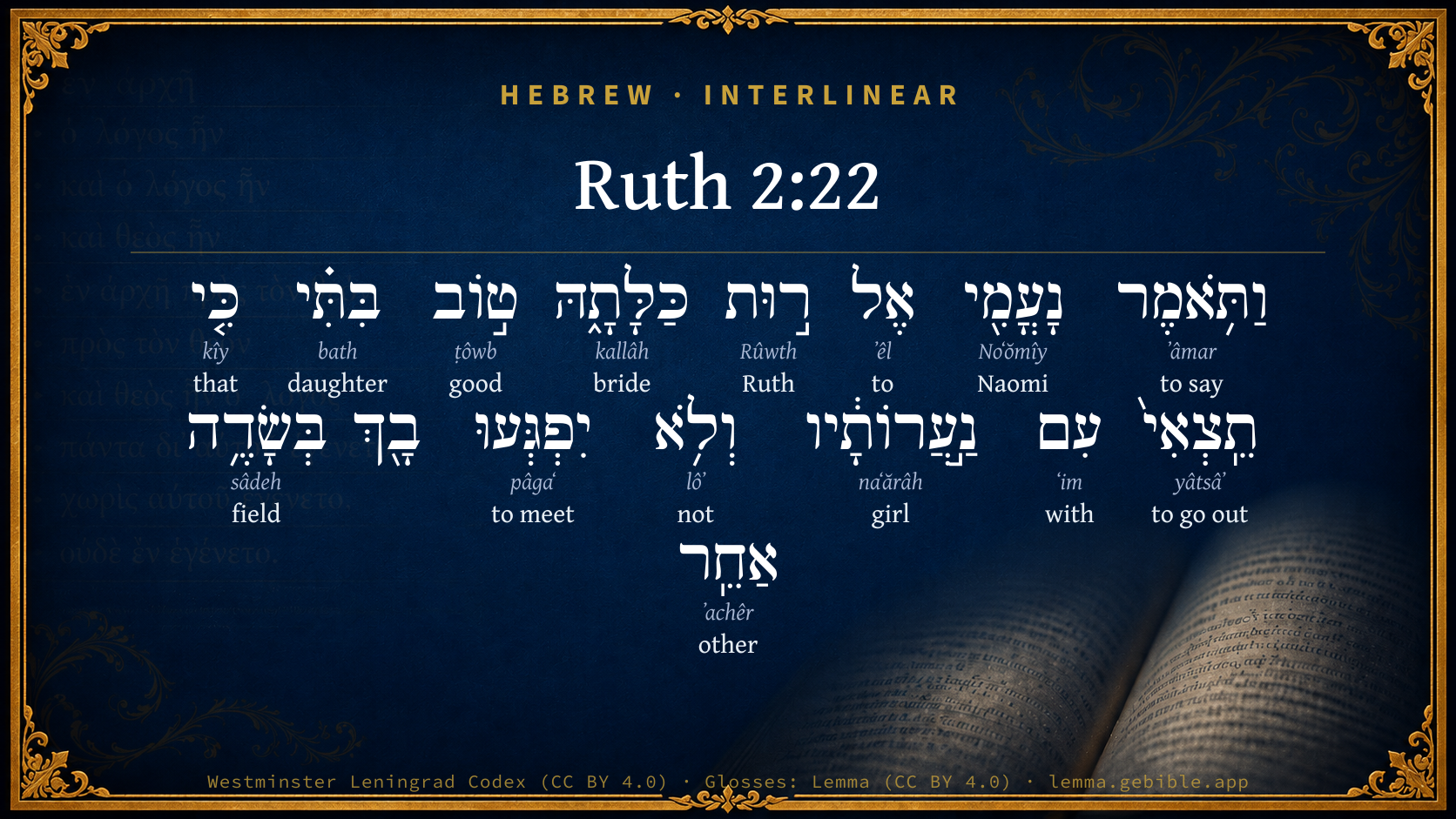
Hebrew (Westminster Leningrad Codex) Ruth 2:22 appears in the Hebrew Old Testament. The text above is from the Westminster Leningrad Codex. Each word links to its Strong’s number, a concise gloss, and parsing drawn from the Open Scriptures Hebrew Bible morphology. Click any word for its full Brown-Driver-Briggs (BDB) entry.
Download image
Cite this verse

Ruth 2:22 (World English Bible). Public Domain. Lemma interlinear Bible study tool, https://lemma.gebible.app/v/ruth/2/22.

Show BibTeX & RIS
BibTeX
RIS
English Translation
Naomi said to Ruth her daughter-in-law, It is good, my daughter, that you go out with his maidens, and that they not meet you in any other field.
World English Bible · Public Domain
Download a study sheet

One document with this verse’s original text, its word-by-word gloss line, the meaning frame, cross-references with their text, attributed commentary, and full source and license credits — printable, and it pastes into notes with its structure intact.

This verse Autodidact and up

Study sheet (.html) Plain text (.txt)

A passage Seminary Student

Up to 50 verses in one chapter. A passage sheet keeps up to 6 commentary sources and 12 cross-references per verse, in the order this page ranks them, and says so on the sheet whenever that leaves anything out. Ask for a single verse and you get the Autodidact verse sheet above.

Everything on this page stays free to read, with no account — the sheet is a download of what is already on screen, not access to it.

Want to remove ads? Support Godless Engineer
Compare translations 3

The same verse in 3 English versions, stacked beneath the original-language interlinear above. Click any original word for its lexicon entry.

Each is an independent rendering of the whole verse — the interlinear is not word-aligned to these translations.

Highlighted words mark where these versions differ — a whole-verse word diff, not a word-by-word alignment.

  • World English Bible Public Domain
    Naomi said to Ruth her daughter-in-law, It is good, my daughter, that you go out with his maidens, and that they not meet you in any other field.
  • King James Version Public Domain
    And Naomi said unto Ruth her daughter in law, It is good, my daughter, that thou go out with his maidens, that they meet thee not in any other field.
  • unfoldingWord Literal Text CC BY-SA 4.0
    Then Naomi said to Ruth her daughter-in-law, “It is good, my daughter, that you go out with his young female workers, so that they do not harm you in any other field.”

unfoldingWord Literal Text — © unfoldingWord, licensed CC BY-SA 4.0. Word-aligned USFM3 via Door43 (git.door43.org/unfoldingWord/en_ult).

Versions to compare (up to 4)

3 of 4 selected

Show all 18 translations

Every available English version of this verse, each an independent rendering of the whole verse.

  • World English Bible Public Domain
    Naomi said to Ruth her daughter-in-law, It is good, my daughter, that you go out with his maidens, and that they not meet you in any other field.
  • Berean Standard Bible Public Domain
    And Naomi said to her daughter-in-law Ruth, “My daughter, it is good for you to work with his young women, so that nothing will happen to you in another field.”
  • Majority Standard Bible Public Domain
    And Naomi said to her daughter-in-law Ruth, “My daughter, it is good for you to work with his young women, so that nothing will happen to you in another field.”
  • King James Version Public Domain
    And Naomi said unto Ruth her daughter in law, It is good, my daughter, that thou go out with his maidens, that they meet thee not in any other field.
  • American Standard Version (1901) Public Domain
    And Naomi said unto Ruth her daughter-in-law, It is good, my daughter, that thou go out with his maidens, and that they meet thee not in any other field.
  • Revised Version (1885) Public Domain
    And Naomi said unto Ruth her daughter in law, It is good, my daughter, that thou go out with his maidens, and that they meet thee not in any other field.
  • Geneva Bible (1599) Public Domain
    And Naomi answered vnto Ruth her daughter in lawe, It is best, my daughter, that thou goe out with his maides, that they meete thee not in an other fielde.
  • Douay-Rheims (1899) Public Domain
    And her mother in law said to her: It is better for thee, my daughter, to go out to reap with his maids, lest in another man's field some one may resist thee.
  • Young's Literal Translation Public Domain
    And Naomi saith unto Ruth her daughter-in-law, `Good, my daughter, that thou goest out with his young women, and they come not against thee in another field.'
  • Literal Standard Version CC BY-SA 4.0
    And Naomi says to her daughter-in-law Ruth, “Good, my daughter, that you go out with his young women, and they do not come against you in another field.”
  • Unlocked Literal Bible CC BY-SA 4.0
    Naomi said to Ruth her daughter-in-law, “It is good, my daughter, that you go out with his young female workers, so that you do not come to harm in any other field.”
  • unfoldingWord Literal Text CC BY-SA 4.0
    Then Naomi said to Ruth her daughter-in-law, “It is good, my daughter, that you go out with his young female workers, so that they do not harm you in any other field.”
  • Darby Bible Public Domain
    And Naomi said to Ruth her daughter-in-law, It is good, my daughter, that thou go out with his maidens, that they meet thee not in any other field.
  • World Messianic Bible Public Domain
    Naomi said to Ruth her daughter-in-law, “It is good, my daughter, that you go out with his maidens, and that they not harm you in any other field.”
  • Webster's Bible Public Domain
    And Naomi said to Ruth her daughter-in-law, It is good, my daughter, that thou shouldst go out with his maidens, that they meet thee not in any other field.
  • Free Bible Version CC BY-SA 4.0
    “That's good, my daughter,” Naomi told Ruth. “Stay with his women workers. Don't go to other fields where you might be molested.”
  • Bible in Basic English Public Domain
    And Naomi said to Ruth, her daughter-in-law, It is better, my daughter, for you to go out with his servant-girls, so that no danger may come to you in another field.
  • JPS Tanakh (1917) Public Domain
    And Naomi said unto Ruth her daughter-in-law: 'It is good, my daughter, that thou go out with his maidens, and that thou be not met in any other field.'

Literal Standard Version (2020), Covenant Press — licensed CC BY-SA 4.0. Text via the HelloAO Bible API (eBible.org). Unlocked Literal Bible (unfoldingWord) — licensed CC BY-SA 4.0. Text via the HelloAO Bible API (eBible.org). unfoldingWord Literal Text — © unfoldingWord, licensed CC BY-SA 4.0. Word-aligned USFM3 via Door43 (git.door43.org/unfoldingWord/en_ult). Free Bible Version, Dr. Jonathan Gallagher — licensed CC BY-SA 4.0. Text via the HelloAO Bible API (eBible.org).

Word by word

More ways to search: Search by grammar → Find every occurrence → Compare this word →

Practice this passage: Drill this verse → Learn its vocabulary →

ר֣וּת
Rûwth
H7327
“Ruth”
Noun, Proper
Part of Speech
Noun
Type
Proper
Full BDB Definition

Origin: probably for H7468

TWOT: None

Ruth = "friendship" - daughter-in-law of Naomi, wife of Boaz, and grandmother of David
  1. וַתֹּ֥אמֶר ʼâmar H559 “and · to say” Conjunction + Verb, Qal, Sequential Imperfect, 3rd Person, Feminine, Singular
  2. נָעֳמִ֖י Noʻŏmîy H5281 “Naomi” Noun, Proper
  3. אֶל ʼêl H413 “to” Preposition
  4. כַּלָּתָ֑הּ kallâh H3618 “bride · her” Noun, Common, Feminine, Singular, Construct + Suffix, Personal, 3rd Person, Feminine, Singular
  5. ט֣וֹב ṭôwb H2896 “good” Adjective, Adjective, Masculine, Singular, Absolute
  6. בִּתִּ֗י bath H1323 “daughter · my” Noun, Common, Feminine, Singular, Construct + Suffix, Personal, 1st Person, Common, Singular
  7. כִּ֤י kîy H3588 “that” Conjunction
  8. תֵֽצְאִי֙ yâtsâʼ H3318 “to go out” Verb, Qal, Imperfect, 2nd Person, Feminine, Singular
  9. עִם ʻim H5973 “with” Preposition
  10. נַ֣עֲרוֹתָ֔יו naʻărâh H5291 “girls · his” Noun, Common, Feminine, Plural, Construct + Suffix, Personal, 3rd Person, Masculine, Singular
  11. וְלֹ֥א lôʼ H3808 “and · not” Conjunction + Particle, Negative
  12. יִפְגְּעוּ pâgaʻ H6293 “to meet” Verb, Qal, Imperfect, 3rd Person, Masculine, Plural
  13. בְּשָׂדֶ֥ה sâdeh H7704 “in/at · field” Preposition + Noun, Common, Masculine, Singular, Absolute
  14. אַחֵֽר ʼachêr H312 “other” Adjective, Adjective, Masculine, Singular, Absolute

About this verse

These counts appear in no published source. They are computed here, from the morphology-tagged text and Lemma’s own curated glosses. What Lemma adds →

16
words
15
distinct lemmas
Historical
section

Notable vocabulary

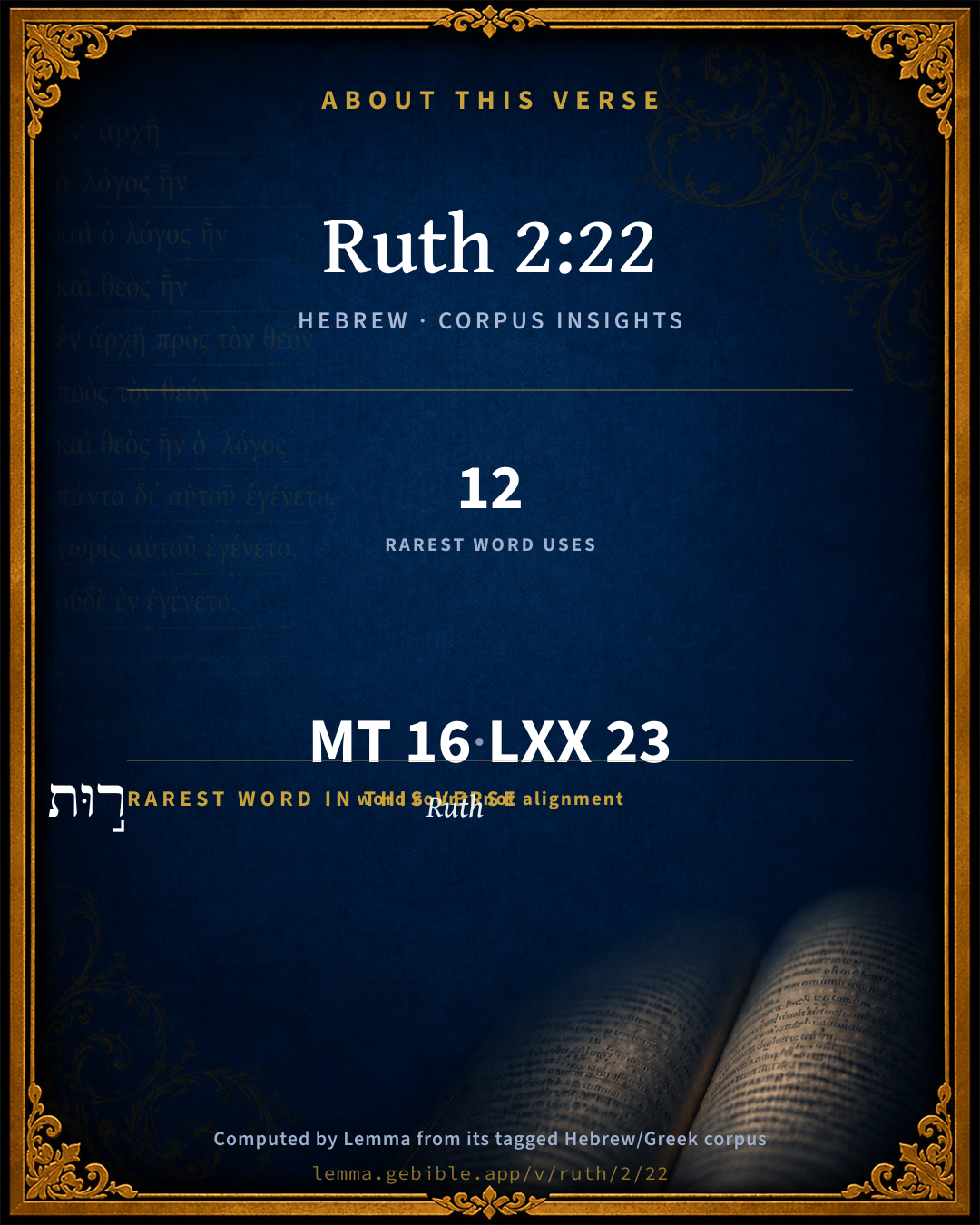
The rarest word here is ר֣וּת Ruth H7327 — appearing just 12 times in the whole Hebrew Bible.

Shared distinctive vocabulary

ר֣וּת Ruth H7327 occurs in 12 verses of the Hebrew Bible. Also found in:

Grammatical profile

  • 3 verbs
  • 6 nouns
  • 2 adjectives
  • 3 prepositions
  • 1 conjunction
  • 1 particle

Verb forms

  • וַתֹּ֥אמֶר Qal · Sequential Imperfect
  • תֵֽצְאִי֙ Qal · Imperfect
  • יִפְגְּעוּ Qal · Imperfect

Hebrew & Septuagint length

In English translation the verse runs 28 words from the Hebrew and 27 from the Septuagint (LXX English) — closely comparable.

A rough comparison of the two English renderings, which tokenize alike — not a word-level alignment.

Word counts can differ between the Hebrew and the Greek without any difference in meaning — e.g. the Hebrew direct-object marker אֵת has no separate Greek word, and Greek often adds the article ὁ.

In the original languages it is 16 Hebrew tokens and 23 Greek tokens — but the two are counted differently (Hebrew bundles its prefixes and suffixes into one token; the Greek is in lemma form), so that isn’t a like-for-like length.

Cross-references

2

Topical passages linked to Ruth 2:22 in the Treasury of Scripture Knowledge — connected by theme and wording, ordered by reader-vote popularity; previews shown in the World English Bible.

  • Song of Solomon 1:8 If you don't know, most beautiful among women, Follow the tracks of the sheep. Graze your young goats beside the shepherds' tents.
  • Proverbs 27:10 Don't forsake your friend and your father's friend. Don't go to your brother's house in the day of your disaster: Better is a neighbor who is near than a distant brother.

Cross-references courtesy of OpenBible.info (CC BY 4.0).

Hebrew and Greek witnesses Masoretic Hebrew ↔ Greek Septuagint

The same verse in the two great witnesses to the Old Testament, shown verse-for-verse.

These are two independent witnesses, not word-aligned to each other, and the Septuagint is shown in lemma (dictionary) form.

Hebrew Ruth 2:22 Masoretic · Westminster Leningrad Codex

וַתֹּ֥אמֶר נָעֳמִ֖י אֶל ר֣וּת כַּלָּתָ֑הּ ט֣וֹב בִּתִּ֗י כִּ֤י תֵֽצְאִי֙ עִם נַ֣עֲרוֹתָ֔יו וְלֹ֥א יִפְגְּעוּ בָ֖ךְ בְּשָׂדֶ֥ה אַחֵֽר

Naomi said to Ruth her daughter-in-law, It is good, my daughter, that you go out with his maidens, and that they not meet you in any other field.

World English Bible · Public Domain

Greek LXX Ruth 2:22 Septuagint · lemma form

καί εἶπον νωεμιν πρός ρουθ ὁ νύμφη αὐτός ἀγαθός θυγάτηρ ὅτι πορεύομαι μετά ὁ κοράσιον αὐτός καί οὐ ἀποἀντάω σύ ἐν ἀγρός ἕτερος

And Noemin said to Ruth her daughter-in-law, It is well, daughter, that you went out with his damsels; thus they shall not meet you in another field.

LXX2012 (modern English Septuagint) · Public Domain

Hebrew: Westminster Leningrad Codex (CC BY 4.0). Greek: Septuagint (public domain); English from LXX2012 (modern English Septuagint) (Public Domain). How the Septuagint differs from the Hebrew →

Commentary

Notes on Ruth 2:22 from classic Christian and Jewish commentators (each source and its license shown beneath its notes). The classic Christian expositions comment on the surrounding passage and are grouped to its opening verse, so a note may address several verses; the Jewish commentaries on the Tanakh (Rashi and others) are per-verse, so they appear only where the commentator wrote on this verse.

Lemma curates 59 commentaries, every one of them public domain or Creative Commons licensed, each selected and text-cleaned for this edition rather than reprinted as found. About our sources →

Trapp's Complete Commentary

John Trapp

Rth 2:22 And Naomi said unto Ruth her daughter in law, [It is] good, my daughter, that thou go out with his maidens, that they meet thee not in any other field.

Ver. 22. It is good, my daughter.] Thus the elder woman must advise the younger, and say,

“ Thesaurum cum virgo, tuum vas fictile servet,

Ut fugias quae sunt noxia, tuta time. ”

That they meet thee not.] Or, Fall not upon thee, or solicit thee to folly. Vulgo dicitur castam esse quam nemo rogarit.

John Trapp, A Commentary or Exposition upon All the Books of the Old and New Testament (1647–1656) — public domain. Text from a community e-Sword module.

The Biblical Illustrator

Joseph S. Exell

Rth_2:22

It is good, my daughter, that thou go out with his maidens.

Instruction from elders

Old persons may be expected to have collected, by reflection and experience, more wisdom than the young, and should be ready to communicate instruction to those that need it. Let the young have their hands prepared for the service of the old, and the old may recompense them abundantly by the words of their mouths. Happy would it have been for Rehoboam and for all his people had he known what respect is due to the wise counsels of the aged. What numbers of young persons take rash steps in the journey of life which cannot be retraced, because they rather choose to follow the impulse of their own passions than to ask and follow the advices of those who brought them into the world. (G. Lawson.)

The acceptance of favours

It is good that thou go forth with his maidens, since he invites thee to glean in his fields. Although Naomi would not be troublesome to her relations, nor solicit favours from them when necessity did not compel her, she was not so high-minded as to reject a favour that was offered. Poor persons, who have seen better days, are sometimes too nice and scrupulous in receiving obligations. It is good to be as independent in the world as our circumstances will allow; but to be absolutely independent is impossible, and to have a spirit above the acceptance of favours, when our circumstances render the acceptance of them needful, is a proud resistance of our spirits to that Providence which manages our concerns and which manages them with wisdom and kindness when it lays our pride in the dust. (G. Lawson.)

That they meet thee not in any other field.

Gadding to be discouraged

Maidens, says one shrewd old commentator, are the fittest company for maidens, among whom a chaste widow, such as Ruth was, may well be recounted. Modesty is the life-guard of chastity. Let this suggest the wider rule that every one should have his chosen field in which to gather Christian instruction and wisdom; and that having chosen it, he ought to keep to it. The common shepherd whom you meet on the mountains will tell you that the wandering sheep never thrives. And further, that we ought to choose for our cherished companions and inner friends those who are gleaners in the gospel-field like ourselves. Wander, through want of vigilance or through secret preference, into the society of the idle, the ungodly, or the immoral, and you are on the enemys ground and in the midst of serpents and snares. You are out of the sphere of Divine protection whenever you walk into the circle of temptation without a call of duty; and there is no Davy-lamp in those noxious mines to prevent explosion, or to protect you from destruction. But the fellowship of them that fear God will show you how to be good, and will make you better. Even the lump of clay, when it was placed near the rose, according to the beautiful Persian proverb, caught some of its fragrance (Son_1:8). (A. Thomson, D. D.)

.

The Biblical Illustrator, edited by Joseph S. Exell (c. 1880s–1900s) — public domain. Text from a community e-Sword module.

Joseph Benson's Commentary

Rth 2:22. That they meet thee not in any other field — Whereby thou wilt both expose thyself to many inconveniences, which thou mayest expect from strangers, and incur his displeasure, as if thou didst despise his kindness.

Joseph Benson's Commentary on the Old and New Testaments (1811–1818) — public domain. Text from a community e-Sword module.

Geneva Bible (1599)

Geneva Bible translators

Or, fall upon thee.

Geneva Bible (1599) marginal notes — public domain. Text via Bolls.life.

Jamieson, Fausset & Brown

Robert Jamieson, A. R. Fausset & David Brown

Naomi said unto Ruth . . . It is good . . . that thou go out with his maidens--a prudent recommendation to Ruth to accept the generous invitation of Boaz, lest, if she were seen straying into other fields, she might not only run the risk of rude treatment, but displease him by seeming indifferent to his kind liberality. Moreover, the observant mind of the old matron had already discerned, in all Boaz' attentions to Ruth, the germs of a stronger affection, which she wished to increase.

Next: Ruth Chapter 3

Jamieson, Fausset & Brown — Commentary Critical and Explanatory on the Whole Bible (1871) — public domain (CC PDM 1.0). Text via the HelloAO Bible API.

Ellicott's Commentary for English Readers

(22) That they meet thee not.—It is good . . . and that people meet thee not. This would not only be throwing away genuine kindness, but would be contemptuously proclaiming the fact.

Maidens.—Naomi speaks of the young women, whereas Ruth had spoken of the young men. We need not suppose that any distinction is intended: Ruth names the young men as the chief workers; Naomi, the young women as those with whom Ruth would be specially thrown.

A Bible Commentary for English Readers, edited by Charles John Ellicott (1878–1897) — public domain. Text from a community e-Sword module.

The Cambridge Bible for Schools and Colleges

gen. ed. J. J. S. Perowne

22. in any other field] In the field of a less pious man than Boaz a poor maiden might come to mischief; cf. Rth_2:9.

The Cambridge Bible for Schools and Colleges (gen. ed. J. J. S. Perowne; Cambridge University Press, 1878–1918) — public domain. Text from a community e-Sword module.

John Gill's Exposition

And Naomi said unto Ruth her daughter in law,.... Observing the charge Boaz had given her, she thought fit to advise her upon it:

it is good, my daughter, that thou go out with his maidens; that is, go out in the morning with them, set out from Bethlehem when they went to work, and so continue with them all the day:

that they meet thee not in any other field; the meaning is, either that men might not meet her in another field alone, or rush upon her at once and unawares, and reproach her, or beat her, or indeed force her; or else that the servants of Boaz might not meet her, or see her in another field, and report it to their master, who would be offended at her; and take it as a slight of his kindness to her; which latter seems rather to be the sense.

John Gill's Exposition of the Whole Bible (1746–1763) — public domain (CC PDM 1.0). Text via the HelloAO Bible API.

Haydock's Catholic Bible Commentary

CHAPTER II.

George Leo Haydock (1774–1849), Haydock's Catholic Family Bible and Commentary, 1859 edition — public domain. Excludes Psalms (Douay-Rheims chapter numbering differs from Protestant) and Deuterocanonical books (Catholic canon only).

Matthew Poole's English Annotations

Whereby thou wilt both expose thyself to many inconveniences, which thou mayst expect from strangers; and incur his displeasure, as if thou didst either despise his proffered kindness, or doubt of the sincerity of his affections and offers.

Matthew Poole's English Annotations on the Holy Bible (1683–1685) — public domain. Text from a community e-Sword/MySword module.

Whedon's Commentary on the Bible

Daniel D. Whedon

22. Not in any other field — This was prudent counsel for Ruth, for in a strange field she would be exposed to annoyances and possible insults, from which in Boaz’s possessions she was now happily shielded by his careful charges to the reapers.

Daniel D. Whedon (gen. ed.), Commentary on the Old and New Testaments (1874–1909) — public domain. Text from a community e-Sword module.

The Pulpit Commentary

And Naomi said to Ruth her daughter-in-law. It is good, my daughter, that thou shouldest go with his young women, and that thou be not set upon in another field. Here again we have the archaic repetition, "Ruth her daughter-in-law." Naomi was grateful for Boaz"s invitation. Compliance with it would be "good," both immediately and prospectively. In particular, it would save Ruth from running the risk of being rudely handled by utter, and perhaps rough and unprincipled, strangers. It is good," says Naomi, "that "they" do not set upon thee in another field." She says they," but allows the parties she had in view to remain, dimly visible, in the shade. No doubt, however, she refers to the reapers, binders, gleaners, and other workers who might have to be encountered "in another field." Meaning," says homely Richard Bernard, "some lewd and lustful men whom Naomi would not so much as make mention of." The verb bAgP is often rendered in our English version fall upon. It originally means to light upon, whether for good or for evil.

The Pulpit Commentary (1880–1919), ed. H.D.M. Spence-Jones & Joseph S. Exell — public domain. Text from a community e-Sword module.

John Wesley's Explanatory Notes

Other field - Whereby thou wilt both expose thyself to many inconveniences, which thou mayst expect from strangers; and incur his displeasure, as if thou didst despise his kindness.

John Wesley, Explanatory Notes Upon the Whole Bible (1754–1765) — public domain. Text via the GEBible commentary corpus.

Ibn Ezra

Rabbi Abraham ibn Ezra

That you go out to glean with his maidens. And not with the young men, as he is in charge of both the male and female reapers.

And that they meet thee not. Referring to men and many others like them.

Ibn Ezra on the Tanakh — English translations: “Sefaria Community Translation” (CC0 1.0 (public-domain dedication)); “Yalkut, Sifsei Chachomim Chumash, Metsudah Publications, 2009” (CC BY 4.0); and “Commentary of Ibn Ezra on Isaiah - trans. by M. Friedlander, 1873” (public domain). Text via Sefaria.

Lesson kit

Teaching starters — assembled from the data on this page, not authored interpretation. Every prompt links to the verse data it draws on. Edit before teaching.

Ruth, in the Historical, opens this verse with 16 words (15 distinct Hebrew lemmas). Its most distinctive word is Rûwth (“Ruth”). A historical commentator’s framing appears above. Read the whole chapter for the surrounding context.

Discussion questions

  1. How does “Ruth” (Rûwth) shape what this verse is saying?
  2. How does Ruth 1:4, which shares the word «Ruth», read alongside this verse?
  3. These translations render this verse differently; the difference is in the English rendering, not the original. What questions does that raise?
  4. «וַתֹּ֥אמֶר» is a Qal Sequential Imperfect verb. How does that grammatical form shape the action described?
  5. Compare how Trapp's Complete Commentary and The Biblical Illustrator read this verse. Where do they agree or differ?

Things to notice

Reading settings

Reading text

Shown beneath each verse's original-language words.

Old Testament
Old Testament edition

Read the OT as the Masoretic Hebrew (MT) or the Greek Septuagint (LXX).

English shown for the Greek Septuagint (in the Hebrew ↔ Greek comparison).

Comparing translations? Open the Compare panel on any verse page to stack up to four side by side.