Nehemiah 5:3

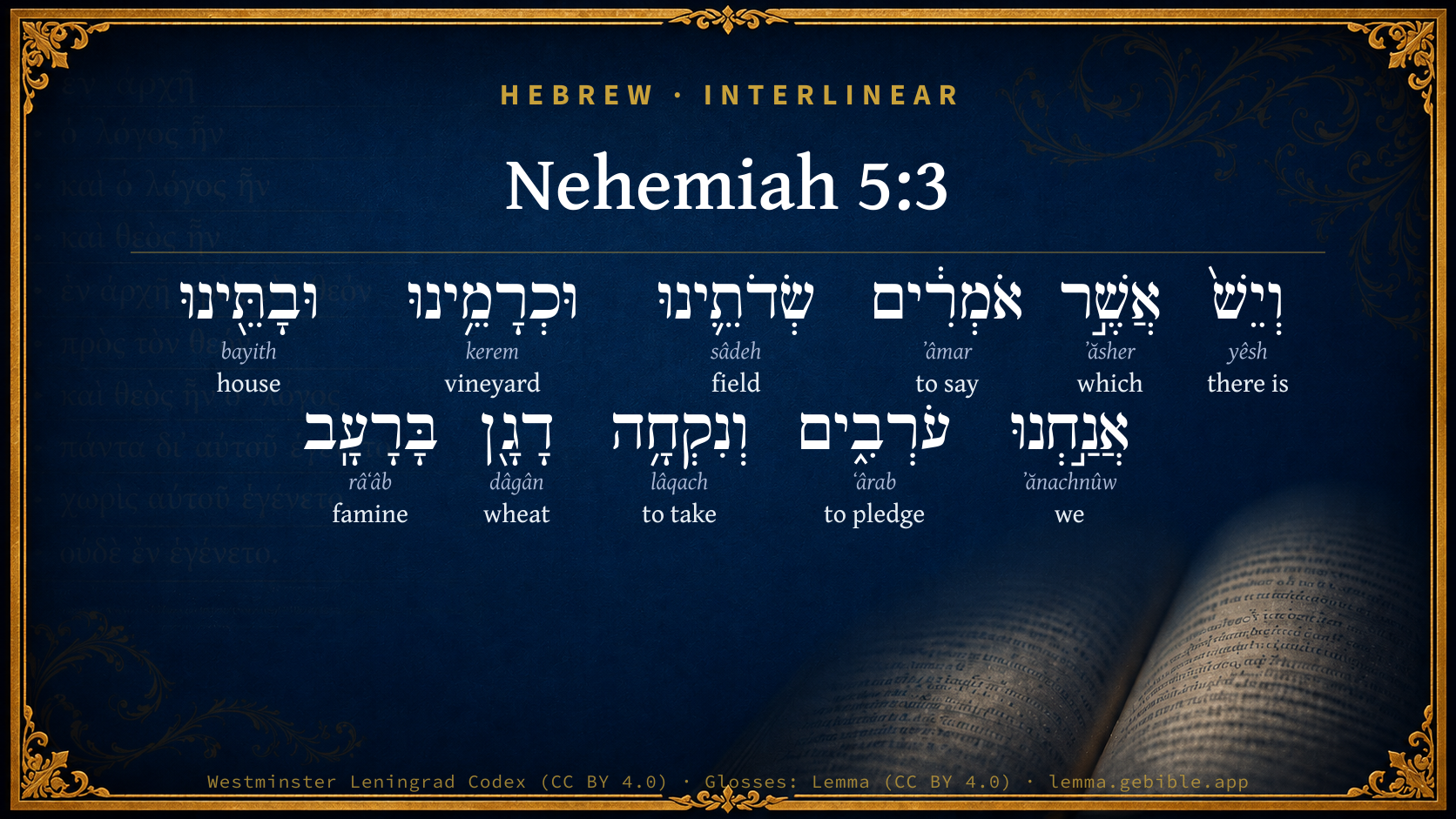
Hebrew (Westminster Leningrad Codex) Nehemiah 5:3 appears in the Hebrew Old Testament. The text above is from the Westminster Leningrad Codex. Each word links to its Strong’s number, a concise gloss, and parsing drawn from the Open Scriptures Hebrew Bible morphology. Click any word for its full Brown-Driver-Briggs (BDB) entry.
Download image
Cite this verse

Nehemiah 5:3 (World English Bible). Public Domain. Lemma interlinear Bible study tool, https://lemma.gebible.app/v/nehemiah/5/3.

Show BibTeX & RIS
BibTeX
RIS
English Translation
Some also there were that said, We are mortgaging our fields, and our vineyards, and our houses: let us get grain, because of the dearth.
World English Bible · Public Domain
Download a study sheet

One document with this verse’s original text, its word-by-word gloss line, the meaning frame, cross-references with their text, attributed commentary, and full source and license credits — printable, and it pastes into notes with its structure intact.

This verse Autodidact and up

Study sheet (.html) Plain text (.txt)

A passage Seminary Student

Up to 50 verses in one chapter. A passage sheet keeps up to 6 commentary sources and 12 cross-references per verse, in the order this page ranks them, and says so on the sheet whenever that leaves anything out. Ask for a single verse and you get the Autodidact verse sheet above.

Everything on this page stays free to read, with no account — the sheet is a download of what is already on screen, not access to it.

Want to remove ads? Support Godless Engineer
Compare translations 3

The same verse in 3 English versions, stacked beneath the original-language interlinear above. Click any original word for its lexicon entry.

Each is an independent rendering of the whole verse — the interlinear is not word-aligned to these translations.

Highlighted words mark where these versions differ — a whole-verse word diff, not a word-by-word alignment.

  • World English Bible Public Domain
    Some also there were that said, We are mortgaging our fields, and our vineyards, and our houses: let us get grain, because of the dearth.
  • King James Version Public Domain
    Some also there were that said, We have mortgaged our lands, vineyards, and houses, that we might buy corn, because of the dearth.
  • unfoldingWord Literal Text CC BY-SA 4.0
    And there were those who said, “We are mortgaging our fields and our vineyards and our houses so we can get grain during the famine.”

unfoldingWord Literal Text — © unfoldingWord, licensed CC BY-SA 4.0. Word-aligned USFM3 via Door43 (git.door43.org/unfoldingWord/en_ult).

Versions to compare (up to 4)

3 of 4 selected

Show all 18 translations

Every available English version of this verse, each an independent rendering of the whole verse.

  • World English Bible Public Domain
    Some also there were that said, We are mortgaging our fields, and our vineyards, and our houses: let us get grain, because of the dearth.
  • Berean Standard Bible Public Domain
    Others were saying, “We are mortgaging our fields, our vineyards, and our homes to get grain during the famine.”
  • Majority Standard Bible Public Domain
    Others were saying, “We are mortgaging our fields, our vineyards, and our homes to get grain during the famine.”
  • King James Version Public Domain
    Some also there were that said, We have mortgaged our lands, vineyards, and houses, that we might buy corn, because of the dearth.
  • American Standard Version (1901) Public Domain
    Some also there were that said, We are mortgaging our fields, and our vineyards, and our houses: let us get grain, because of the dearth.
  • Revised Version (1885) Public Domain
    Some also there were that said, We are mortgaging our fields, and our vineyards, and our houses: let us get corn, because of the dearth.
  • Geneva Bible (1599) Public Domain
    And there were that saide, We must gage our landes, and our vineyardes, and our houses, and take vp corne for the famine.
  • Douay-Rheims (1899) Public Domain
    And there were some that said: Let us mortgage our lands, and our vineyards, and our houses, and let us take corn be- cause of the famine.
  • Young's Literal Translation Public Domain
    And there are who are saying, `Our fields, and our vineyards, and our houses, we are pledging, and we receive corn for the famine.'
  • Literal Standard Version CC BY-SA 4.0
    And there are [those] who are saying, “Our fields, and our vineyards, and our houses, we are pledging, and we receive grain for the famine.”
  • Unlocked Literal Bible CC BY-SA 4.0
    There were also some who said, “We are mortgaging our fields, our vineyards, and our houses to get grain during the famine.”
  • unfoldingWord Literal Text CC BY-SA 4.0
    And there were those who said, “We are mortgaging our fields and our vineyards and our houses so we can get grain during the famine.”
  • Darby Bible Public Domain
    And there were that said, We have had to pledge our fields, and our vineyards, and our houses, that we might procure corn in the dearth.
  • World Messianic Bible Public Domain
    There were also some who said, “We are mortgaging our fields, our vineyards, and our houses. Let us get grain, because of the famine.”
  • Webster's Bible Public Domain
    Some also there were that said, We have mortgaged our lands, vineyards, and houses, that we might buy corn, because of the dearth.
  • Free Bible Version CC BY-SA 4.0
    Others added, “We've had to mortgage our fields, our vineyards, and our homes to buy food during the famine.”
  • Bible in Basic English Public Domain
    And there were some who said, We are giving our fields and our vine-gardens and our houses for debt: let us get grain because we are in need.
  • JPS Tanakh (1917) Public Domain
    Some also there were that said: 'We are mortgaging our fields, and our vineyards, and our houses; let us get corn, because of the dearth.'

Literal Standard Version (2020), Covenant Press — licensed CC BY-SA 4.0. Text via the HelloAO Bible API (eBible.org). Unlocked Literal Bible (unfoldingWord) — licensed CC BY-SA 4.0. Text via the HelloAO Bible API (eBible.org). unfoldingWord Literal Text — © unfoldingWord, licensed CC BY-SA 4.0. Word-aligned USFM3 via Door43 (git.door43.org/unfoldingWord/en_ult). Free Bible Version, Dr. Jonathan Gallagher — licensed CC BY-SA 4.0. Text via the HelloAO Bible API (eBible.org).

Word by word

More ways to search: Search by grammar → Find every occurrence → Compare this word →

Practice this passage: Drill this verse → Learn its vocabulary →

עֹרְבִ֑ים
ʻârab
H6148
“pledging”
Verb, Qal, Participle Active, Masculine, Plural, Absolute
Part of Speech
Verb
Stem
Qal
Form
Participle Active
Gender
Masculine
Number
Plural
State
Absolute
Full BDB Definition

Origin: a primitive root

TWOT: 1686

to pledge, exchange, mortgage, engage, occupy, undertake for, give pledges, be or become surety, take on pledge, give in pledge - (Qal) - to take on pledge, go surety for - to give in pledge - to exchange - to pledge - (Hithpael) - to exchange pledges - to have fellowship with, share
  1. וְיֵשׁ֙ yêsh H3426 “and · there is” Conjunction + Particle, Demonstrative
  2. אֲשֶׁ֣ר ʼăsher H834 “which” Particle, Relative
  3. אֹמְרִ֔ים ʼâmar H559 “saying” Verb, Qal, Participle Active, Masculine, Plural, Absolute
  4. שְׂדֹתֵ֛ינוּ sâdeh H7704 “fields · our” Noun, Common, Masculine, Plural, Construct + Suffix, Personal, 1st Person, Common, Plural
  5. וּכְרָמֵ֥ינוּ kerem H3754 “and · vineyards · our” Conjunction + Noun, Common, Both, Plural, Construct + Suffix, Personal, 1st Person, Common, Plural
  6. וּבָתֵּ֖ינוּ bayith H1004 “and · houses · our” Conjunction + Noun, Common, Masculine, Plural, Construct + Suffix, Personal, 1st Person, Common, Plural
  7. אֲנַ֣חְנוּ ʼănachnûw H587 “we” Pronoun, Personal, 1st Person, Common, Plural
  8. וְנִקְחָ֥ה lâqach H3947 “and · to take” Conjunction + Verb, Qal, Cohortative, 1st Person, Common, Plural
  9. דָגָ֖ן dâgân H1715 “wheat” Noun, Common, Masculine, Singular, Absolute
  10. בָּרָעָֽב râʻâb H7458 “in/at the · famine” Preposition, Determined + Noun, Common, Masculine, Singular, Absolute

About this verse

These counts appear in no published source. They are computed here, from the morphology-tagged text and Lemma’s own curated glosses. What Lemma adds →

11
words
11
distinct lemmas
Historical
section

Notable vocabulary

The rarest word here is עֹרְבִ֑ים to pledge H6148 — appearing just 23 times in the whole Hebrew Bible.

Shared distinctive vocabulary

עֹרְבִ֑ים to pledge H6148 occurs in 23 verses of the Hebrew Bible. Also found in:

Grammatical profile

  • 3 verbs
  • 5 nouns
  • 1 pronoun
  • 2 particles

Verb forms

  • אֹמְרִ֔ים Qal · Participle Active
  • עֹרְבִ֑ים Qal · Participle Active
  • וְנִקְחָ֥ה Qal · Cohortative

Cross-references

4

Topical passages linked to Nehemiah 5:3 in the Treasury of Scripture Knowledge — connected by theme and wording, ordered by reader-vote popularity; previews shown in the World English Bible.

  • Leviticus 25:35–39 "'If your brother has become poor, and his hand can't support him among you; then you shall uphold him. As a stranger and a sojourner he shall live with you.
  • Malachi 3:8–11 Will a man rob God? Yet you rob me! But you say, 'How have we robbed you?' In tithes and offerings.
  • Genesis 47:15–25 When the money was all spent in the land of Egypt, and in the land of Canaan, all the Egyptians came to Joseph, and said, "Give us bread, for why should we die in your presence? For our money fails."
  • Deuteronomy 15:7 If there be with you a poor man, one of your brothers, within any of your gates in your land which Yahweh your God gives you, you shall not harden your heart, nor shut your hand from your poor brother;

Cross-references courtesy of OpenBible.info (CC BY 4.0).

Hebrew and Greek witnesses Masoretic Hebrew ↔ Greek Septuagint

The same verse in the two great witnesses to the Old Testament, shown verse-for-verse.

These are two independent witnesses, not word-aligned to each other, and the Septuagint is shown in lemma (dictionary) form.

Hebrew Nehemiah 5:3 Masoretic · Westminster Leningrad Codex

וְיֵשׁ֙ אֲשֶׁ֣ר אֹמְרִ֔ים שְׂדֹתֵ֛ינוּ וּכְרָמֵ֥ינוּ וּבָתֵּ֖ינוּ אֲנַ֣חְנוּ עֹרְבִ֑ים וְנִקְחָ֥ה דָגָ֖ן בָּרָעָֽב

Some also there were that said, We are mortgaging our fields, and our vineyards, and our houses: let us get grain, because of the dearth.

World English Bible · Public Domain

Greek LXX Structure differs

The Septuagint has no separate book of Nehemiah. Its Greek text is the second half of Esdras B (2 Esdras), chapters 11–23; Ezra is the first half (1–10).

A verse-for-verse comparison isn’t shown here because the chapters and verses don’t line up. Switch to the LXX edition with the MT / LXX toggle above to read the Greek directly.

Hebrew: Westminster Leningrad Codex (CC BY 4.0). Greek: Septuagint (public domain); English from a public-domain English Septuagint. How the Septuagint differs from the Hebrew →

Commentary

Notes on Nehemiah 5:3 from classic Christian and Jewish commentators (each source and its license shown beneath its notes). The classic Christian expositions comment on the surrounding passage and are grouped to its opening verse, so a note may address several verses; the Jewish commentaries on the Tanakh (Rashi and others) are per-verse, so they appear only where the commentator wrote on this verse.

Lemma curates 59 commentaries, every one of them public domain or Creative Commons licensed, each selected and text-cleaned for this edition rather than reprinted as found. About our sources →

Trapp's Complete Commentary

John Trapp

Neh 5:3 [Some] also there were that said, We have mortgaged our lands, vineyards, and houses, that we might buy corn, because of the dearth.

Ver. 3. We have mortgaged our lands, vineyards, &c.] Lands they had, but were little the better for them. Husbandry they had neglected to give attendance upon buildings; neither were they able to stock and store their grounds, and so are forced to part with them at an underrate price. This is many a poor man’s case among us, who yet are little pitied, or relieved, unless it be with a little mouth mercy, as in St James’s days, Jas 2:15-16. Oppressors will be but as friends at a sneeze; the most you can get of them is, God bless you; like they are (many of them) to Darius, who prayed God to help Daniel, but sent him to the lions’ den.

John Trapp, A Commentary or Exposition upon All the Books of the Old and New Testament (1647–1656) — public domain. Text from a community e-Sword module.

The Biblical Illustrator

Joseph S. Exell

Neh_5:3-5

We have mortgaged our lands.

The miseries of debt

I. Mental unrest.

II. Social degradation.

III. Family ruin.

IV. A disregard of a Divine command: Thou shalt not steal. Application--

1. Christians should set the world an example.

2. Watch the beginnings of extravagance.

3. In small things as well as in greater act on Christian principle. (Homiletic Commentary.)

The blessing and curse of mortgages

The history of the mortgage would be the history of the domestic, social, financial, political, and ecclesiastical progress of all ages. It will be useful if I can intelligently and practically speak of the mortgage as a blessing and as a curse. There is much absurd and wholesale denunciation of borrowing money. If I should request all those who have never asked a loan to rise, there would not out of this audience be one get up unless it were some one who had acted so badly at the start that he knew no one would trust him. At the inception of nearly all enterprises, great or small, a loan is necessary. Years ago an Irish man landed with fifty cents in his pocket on the Battery, asked the loan of one dollar from an entire stranger, and now is among the New York princes. A mortgage is merely borrowed strength of others to help us in crises of individual or national life on the promise that we will pay them for the help rendered. But what is true in secularities is more true in ecclesiastical affairs. If churches had not been built till all the money could be raised, tens of thousands of our best churches would never have been built, and millions of those who are now Christians on earth or saints in heaven would never have been comforted or saved. The old Collinss line of steamers went into bankruptcy, but that does not change the fact that they transported hundreds of passengers in safety across the sea; and if all the churches in Christendom to-morrow went down under the thump of the sheriffs hammer, that would not hinder the fact that they have already transported thousands into the kingdom, and have done a stupendous good that all earth and hell can never undo. All consider it right to borrow for a secular institution. Is it not right to borrow for a religious? It is safer to borrow for the Church than for any other institution, because other institutions die, but a Church seldom. When the Israelites of my text wanted to rebuild their homes, and wanted to borrow money for that purpose, the mortgagers did well to let them have it, though I wish they had not asked twelve per cent. But after a while the mortgage spoken of in the text ceased to be a blessing, and became a plague. It had helped them through a domestic and ecclesiastical crisis, but now they could carry it no longer, and they cried out for rescue. If a blessing lies too long, it gets to be a curse. At the first moment the farmer can get the mortgage off his farm, and the merchant the mortgage off his merchandise, and the citizen the mortgage off his home, and the charitable institution the mortgage off its asylum, and the religious society the mortgage off its church, they had better do it. I have heard people argue the advantage of individual debts and national debts and Church debts; but I could not, while the argument was going on, control my risibilities. It is said that such debts keep the individual and the Church and the State busy trying to pay them. No doubt of it. So rheumatism keeps the patient busy with arnica, and neuralgia keeps the patient busy with hartshorn, and the cough with lozenges, and the toothache with lotions; but that is no argument in favour of rheumatism, or neuralgia, or coughs, or toothache. Better, if possible, get rid of these things, and be busy with something else. (T. De Witt Talmage.)

The Biblical Illustrator, edited by Joseph S. Exell (c. 1880s–1900s) — public domain. Text from a community e-Sword module.

Joseph Benson's Commentary

Neh 5:3. Because of the dearth — Not long before this, there had been a great scarcity of corn through want of rain, which God had withheld as a punishment for the people’s taking more care to build their own houses than his temple, as we read Hag 1:9-11. And, in this time of scarcity the rich had no compassion on their poor brethren, who were forced to part with all they had for bread. And this dearth was now increased, from the multitude of the people in and near Jerusalem; from their work, which wholly took them up, and kept them from taking care of their families; and from the expectation of their enemies’ invasion, which hindered them from going abroad to fetch provision, and the people round about from bringing it to them.

Joseph Benson's Commentary on the Old and New Testaments (1811–1818) — public domain. Text from a community e-Sword module.

Tyndale Open Study Notes

Tyndale Open Resources

5:3 Some small landowners had mortgaged everything to survive. The famine made the problem worse because grain was scarce and the price of food naturally increased.

Tyndale Open Study Notes — © Tyndale Open Resources, licensed CC BY-SA 4.0. Text via the HelloAO Bible API.

Adam Clarke's Commentary

Verse 3. Because of the dearth.] About the time of Zerubbabel, God had sent a judicial dearth upon the land, as we learn from Haggai, Hag 1:9, c., for the people it seems were more intent on building houses for themselves than on rebuilding the house of the Lord: "Ye looked for much, and, lo, it is come to little because of mine house that is waste; and ye run, every man unto his own house. Therefore the heaven over you is stayed from dew, and the earth is stayed from her fruit. And I called for a drought upon the land, and upon the mountains, and upon the corn, and upon the new wine, and upon the oil, and upon that which the ground brought forth; and upon men, and upon cattle, and upon all the labour of the hands." This dearth might have been continued, or its effects still felt; but it is more likely that there was a new dearth owing to the great number of people, for whose support the land that had been brought into cultivation was not sufficient.

Adam Clarke's Commentary on the Bible (1810–1826) — public domain. Text from a community e-Sword/MySword module.

Ellicott's Commentary for English Readers

(3) Because of the dearth.—Not any particular famine, strictly speaking, but their present hunger. The past mortgages had straitened their resources.

A Bible Commentary for English Readers, edited by Charles John Ellicott (1878–1897) — public domain. Text from a community e-Sword module.

The Cambridge Bible for Schools and Colleges

gen. ed. J. J. S. Perowne

3. Some also] The complaint in this verse is that among the poorer classes, those who had a little property were compelled to mortgage it in order to obtain the bare necessaries of life.

We have mortgaged] R.V. We are mortgaging. The Hebrew verb expresses a state of things going on at the time.

our lands, vineyards, and houses] R.V. our fields, and our vineyards, and our houses. ‘Fields’ is better than ‘lands,’ which is too large and general a word. The three words refer to the corn-fields, vineyards, and dwellings, such as the poorer householders might possess.

For the tenacity with which the possession of house or land was retained in a family, cf. 1 Kings 21. In the Hebrew these three words stand emphatically at the head of the sentence corresponding to ‘our sons and our daughters’ in the previous verse.

that we might buy corn] R.V. let us get corn. The words are the same as in the previous verse. They express not the purpose of the mortgage, but the resolve of the people to obtain food. By mortgaging their property they had lost the little capital they had. They had not the means to pay the interest on the mortgage as well as to obtain food for their families. The prospect before them was the final loss of property and starvation.

because of the dearth] This might be rendered ‘in the famine.’ But the sense is hardly different. It was necessary to obtain food in the time of scarcity because of the dearth. Cf. ‘through the famine,’ Gen_41:36.

The Cambridge Bible for Schools and Colleges (gen. ed. J. J. S. Perowne; Cambridge University Press, 1878–1918) — public domain. Text from a community e-Sword module.

John Gill's Exposition

Some also there were that said, we have mortgaged our lands, vineyards, and houses,.... Made them over to others, put them into their hands as pledges for money received of them:

that we may buy corn; for the support of their families:

because of the dearth; or famine; which might be occasioned by their enemies lying in wait and intercepting all provisions that might be brought to them; for this seems not to be the famine spoken of in Hag 1:10 for that was some years before this, and for a reason which now was not.

John Gill's Exposition of the Whole Bible (1746–1763) — public domain (CC PDM 1.0). Text via the HelloAO Bible API.

Haydock's Catholic Bible Commentary

Let us. Protestants, "We have mortgaged." --- Famine, or "hunger." (Haydock)

George Leo Haydock (1774–1849), Haydock's Catholic Family Bible and Commentary, 1859 edition — public domain. Excludes Psalms (Douay-Rheims chapter numbering differs from Protestant) and Deuterocanonical books (Catholic canon only).

Matthew Poole's English Annotations

Which might easily happen, both from the multitude of the people now in and near Jerusalem, and from their building work, which wholly took them up, and kept them from taking care of their own families, and from the expectation and dread of their enemies’ invasion, which hindered them from going abroad to fetch in provision, and the people round about from bringing it in to them; or from divers other causes.

Matthew Poole's English Annotations on the Holy Bible (1683–1685) — public domain. Text from a community e-Sword/MySword module.

Whedon's Commentary on the Bible

Daniel D. Whedon

3. Also there were — Another class higher than those of Neh_5:2, for they were the owners of lands, vineyards, and houses. These had brought themselves into distress by mortgaging or pledging their property for food.

Because of the dearth — Literally, in the famine. This famine or scarcity may have been occasioned, not by a pestilence or barrenness of their lands, but because so many of the people had been called from their homes to labour on the wall, and thus had failed to sow and reap their fields. The neighbouring nations, also, being hostile towards them, would be likely to hinder the importation of provisions from a distance.

Daniel D. Whedon (gen. ed.), Commentary on the Old and New Testaments (1874–1909) — public domain. Text from a community e-Sword module.

The Pulpit Commentary

Because of the dearth. Some, who could not say that their families were large, claimed relief on account, as it would seem, not so much of a present as of a past famine, which had forced them to mortgage their fields, vineyards, and houses. That Judaea was liable to famines about this time appears from Hag_1:6, 9-11 2:16-19.

The Pulpit Commentary (1880–1919), ed. H.D.M. Spence-Jones & Joseph S. Exell — public domain. Text from a community e-Sword module.

John Wesley's Explanatory Notes

The dearth - Which might happen, both from the multitude of the people in and near Jerusalem, from their work, which wholly took them up, and kept them from taking care of their families, and from the expectation of their enemies invasion, which hindered them from going abroad to fetch provision, and the people round about from bringing it to them.

John Wesley, Explanatory Notes Upon the Whole Bible (1754–1765) — public domain. Text via the GEBible commentary corpus.

Rashi

Rabbi Shlomo Yitzchaki (Rashi)

And there were some who were saying “Our fields, etc.” And there were some among the poor who were complaining and saying “Our fields, vineyards and houses we shall give to others as a pledge and as security to buy corn for our food.”

for the hunger since the rich do not give any of their property up to us for our support.

Rashi on the Tanakh — English translations: “The Judaica Press complete Tanach with Rashi, translated by A. J. Rosenberg” (CC BY 4.0); “Pentateuch with Rashi's commentary by M. Rosenbaum and A.M. Silbermann, 1929-1934” (public domain); “The Metsudah Tanach series, Lakewood, N.J” (CC BY 4.0); and “The Book of Joshua, Metsudah Publications, 1997” (CC BY 4.0). Text via Sefaria.

Lesson kit

Teaching starters — assembled from the data on this page, not authored interpretation. Every prompt links to the verse data it draws on. Edit before teaching.

Nehemiah, in the Historical, opens this verse with 11 words (11 distinct Hebrew lemmas). Its most distinctive word is ʻârab (“to pledge”). A historical commentator’s framing appears above. Read the whole chapter for the surrounding context.

Discussion questions

  1. How does “to pledge” (ʻârab) shape what this verse is saying?
  2. How does Genesis 43:9, which shares the word «to pledge», read alongside this verse?
  3. These translations render this verse differently; the difference is in the English rendering, not the original. What questions does that raise?
  4. «אֹמְרִ֔ים» is a Qal Participle Active verb. How does that grammatical form shape the action described?
  5. Compare how Trapp's Complete Commentary and The Biblical Illustrator read this verse. Where do they agree or differ?

Things to notice

Reading settings

Reading text

Shown beneath each verse's original-language words.

Old Testament
Old Testament edition

Read the OT as the Masoretic Hebrew (MT) or the Greek Septuagint (LXX).

English shown for the Greek Septuagint (in the Hebrew ↔ Greek comparison).

Comparing translations? Open the Compare panel on any verse page to stack up to four side by side.