
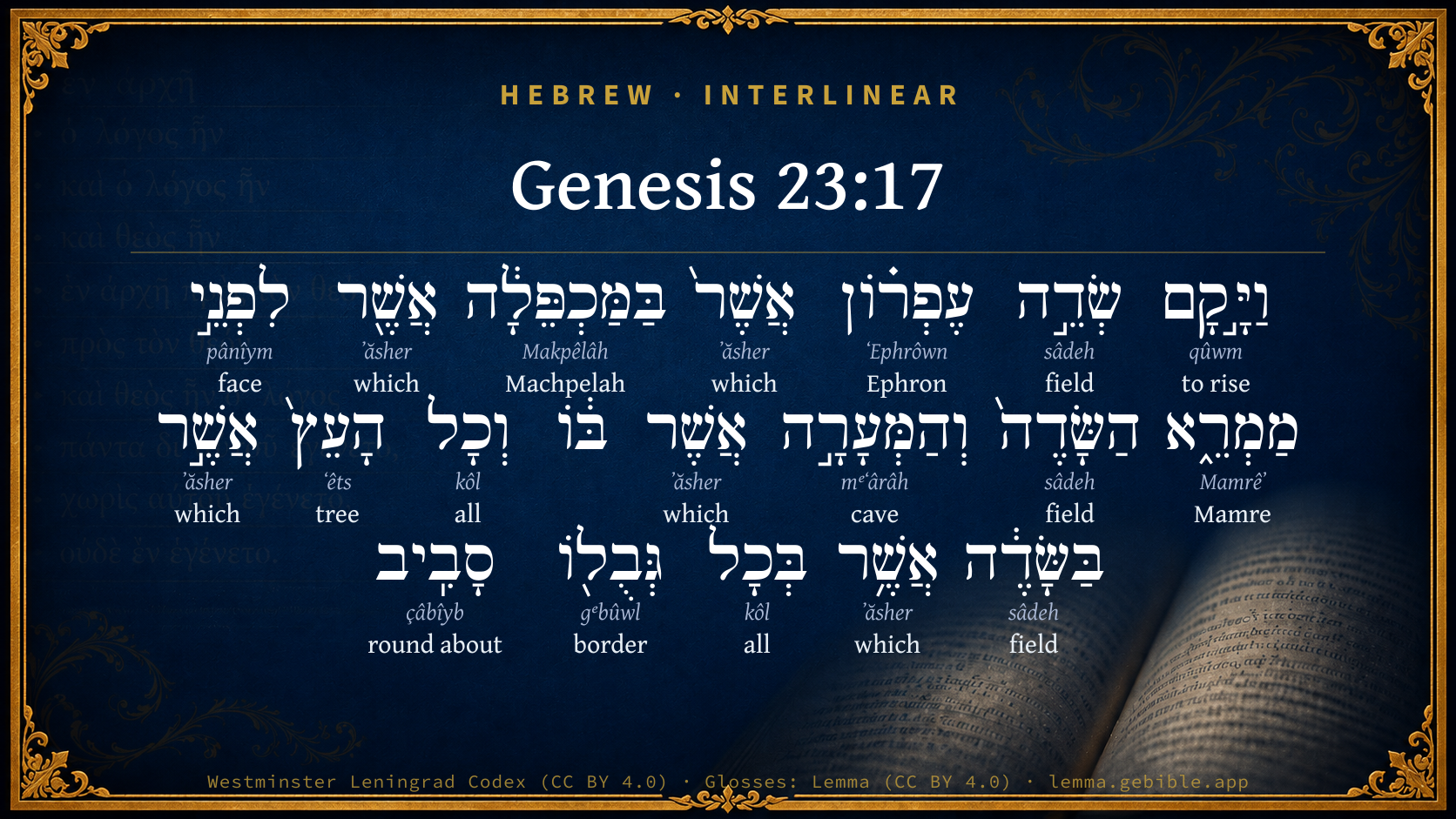
Genesis 23:17

Hebrew (Westminster Leningrad Codex) Genesis 23:17 appears in the Hebrew Old Testament. The text above is from the Westminster Leningrad Codex. Each word links to its Strong’s number, a concise gloss, and parsing drawn from the Open Scriptures Hebrew Bible morphology. Click any word for its full Brown-Driver-Briggs (BDB) entry.
Download image
Cite this verse

Genesis 23:17 (World English Bible). Public Domain. Lemma interlinear Bible study tool, https://lemma.gebible.app/v/genesis/23/17.

Show BibTeX & RIS
BibTeX
RIS
English Translation
So the field of Ephron, which was in Machpelah, which was before Mamre, the field, the cave which was therein, and all the trees that were in the field, that were in all the border of it round about, were made sure
World English Bible · Public Domain
Highlights
  • 1 first appearance in the Hebrew Bible
Full analysis ↓
Download a study sheet

One document with this verse’s original text, its word-by-word gloss line, the meaning frame, cross-references with their text, attributed commentary, and full source and license credits — printable, and it pastes into notes with its structure intact.

This verse Autodidact and up

Study sheet (.html) Plain text (.txt)

A passage Seminary Student

Up to 50 verses in one chapter. A passage sheet keeps up to 6 commentary sources and 12 cross-references per verse, in the order this page ranks them, and says so on the sheet whenever that leaves anything out. Ask for a single verse and you get the Autodidact verse sheet above.

Everything on this page stays free to read, with no account — the sheet is a download of what is already on screen, not access to it.

Want to remove ads? Support Godless Engineer
Compare translations 3

The same verse in 3 English versions, stacked beneath the original-language interlinear above. Click any original word for its lexicon entry.

Each is an independent rendering of the whole verse — the interlinear is not word-aligned to these translations.

Highlighted words mark where these versions differ — a whole-verse word diff, not a word-by-word alignment.

  • World English Bible Public Domain
    So the field of Ephron, which was in Machpelah, which was before Mamre, the field, the cave which was therein, and all the trees that were in the field, that were in all the border of it round about, were made sure
  • King James Version Public Domain
    And the field of Ephron which was in Machpelah, which was before Mamre, the field, and the cave which was therein, and all the trees that were in the field, that were in all the borders round about, were made sure
  • unfoldingWord Literal Text CC BY-SA 4.0
    So the field of Ephron that in Machpelah which before Mamre, the field and the cave that in it, and every tree that in the field, that within all of its surrounding borders, was deeded

unfoldingWord Literal Text — © unfoldingWord, licensed CC BY-SA 4.0. Word-aligned USFM3 via Door43 (git.door43.org/unfoldingWord/en_ult).

Versions to compare (up to 4)

3 of 4 selected

Show all 18 translations

Every available English version of this verse, each an independent rendering of the whole verse.

  • World English Bible Public Domain
    So the field of Ephron, which was in Machpelah, which was before Mamre, the field, the cave which was therein, and all the trees that were in the field, that were in all the border of it round about, were made sure
  • Berean Standard Bible Public Domain
    So Ephron’s field at Machpelah near Mamre, the cave that was in it, and all the trees within the boundaries of the field were deeded over
  • Majority Standard Bible Public Domain
    So Ephron’s field at Machpelah near Mamre, the cave that was in it, and all the trees within the boundaries of the field were deeded over
  • King James Version Public Domain
    And the field of Ephron which was in Machpelah, which was before Mamre, the field, and the cave which was therein, and all the trees that were in the field, that were in all the borders round about, were made sure
  • American Standard Version (1901) Public Domain
    So the field of Ephron, which was in Machpelah, which was before Mamre, the field, and the cave which was therein, and all the trees that were in the field, that were in all the border thereof round about, were made sure
  • Revised Version (1885) Public Domain
    So the field of Ephron, which was in Machpelah, which was before Mamre, the field, and the cave which was therein, and all the trees that were in the field, that were in all the border thereof round about, were made sure
  • Geneva Bible (1599) Public Domain
    So the fielde of Ephron which was in Machpelah, and ouer against Mamre, euen the field and the caue that was therein, and all the trees that were in the fielde, which were in all the borders round about, was made sure
  • Douay-Rheims (1899) Public Domain
    And the field that before was Ephron's, wherein was the double cave, looking towards Mambre, both it and the cave, and all the trees thereof in all its limits round about,
  • Young's Literal Translation Public Domain
    And established are the field of Ephron, which `is' in Machpelah, which `is' before Mamre, the field and the cave which `is' in it, and all the trees which `are' in the field, which `are' in all its border round about,
  • Literal Standard Version CC BY-SA 4.0
    And established are the field of Ephron, which [is] in Machpelah, which [is] before Mamre, the field and the cave which [is] in it, and all the trees which [are] in the field, which [are] around all its border,
  • Unlocked Literal Bible CC BY-SA 4.0
    So the field of Ephron, which was in Machpelah, which was next to Mamre, that is, the field, the cave that was in it, and all the trees that were in the field and all around its border, passed
  • unfoldingWord Literal Text CC BY-SA 4.0
    So the field of Ephron that in Machpelah which before Mamre, the field and the cave that in it, and every tree that in the field, that within all of its surrounding borders, was deeded
  • Darby Bible Public Domain
    So the field of Ephron, which was at Machpelah, which was before Mamre, the field, and the cave that was in it, and all the trees that were in the field, that were in all its borders round about,
  • World Messianic Bible Public Domain
    So the field of Ephron, which was in Machpelah, which was before Mamre, the field, the cave which was in it, and all the trees that were in the field, that were in all of its borders, were deeded
  • Webster's Bible Public Domain
    And the field of Ephron, which was in Machpelah, which was before Mamre, the field and the cave which was in it, and all the trees that were in the field, that were in all the borders round about, were made sure
  • Free Bible Version CC BY-SA 4.0
    So the property was legally transferred. It comprised Ephron's field in Machpelah near Mamre, both the field and the cave there, as well as all the trees in the field, and all the area up to the existing boundaries.
  • Bible in Basic English Public Domain
    So Ephron's field at Machpelah near Mamre, with the hollow in the rock and all the trees in the field and round it,
  • JPS Tanakh (1917) Public Domain
    So the field of Ephron, which was in Machpelah, which was before Mamre, the field, and the cave which was therein, and all the trees that were in the field, that were in all the border thereof round about, were made sure

Literal Standard Version (2020), Covenant Press — licensed CC BY-SA 4.0. Text via the HelloAO Bible API (eBible.org). Unlocked Literal Bible (unfoldingWord) — licensed CC BY-SA 4.0. Text via the HelloAO Bible API (eBible.org). unfoldingWord Literal Text — © unfoldingWord, licensed CC BY-SA 4.0. Word-aligned USFM3 via Door43 (git.door43.org/unfoldingWord/en_ult). Free Bible Version, Dr. Jonathan Gallagher — licensed CC BY-SA 4.0. Text via the HelloAO Bible API (eBible.org).

Word by word

More ways to search: Search by grammar → Find every occurrence → Compare this word →

Practice this passage: Drill this verse → Learn its vocabulary →

בַּמַּכְפֵּלָ֔ה
Makpêlâh
H4375
“in/at the · Machpelah”
Preposition, Determined + Noun, Proper
Part of Speech
Preposition + Noun
Type
Proper
Full BDB Definition

Origin: from H3717

TWOT: 1019b

Machpelah = "double" or " portion" - the location of a burial cave for the patriarchs, near Hebron
  1. וַיָּ֣קָם qûwm H6965 “and · to rise” Conjunction + Verb, Qal, Sequential Imperfect, 3rd Person, Masculine, Singular
  2. שְׂדֵ֣ה sâdeh H7704 “field of” Noun, Common, Masculine, Singular, Construct
  3. עֶפְר֗וֹן ʻEphrôwn H6085 “Ephron” Noun, Proper
  4. אֲשֶׁר֙ ʼăsher H834 “which” Particle, Relative
  5. אֲשֶׁ֖ר ʼăsher H834 “which” Particle, Relative
  6. לִפְנֵ֣י pânîym H6440 “to/for · face(s) of” Preposition + Noun, Common, Both, Plural, Construct
  7. מַמְרֵ֑א Mamrêʼ H4471 “Mamre” Noun, Proper
  8. הַשָּׂדֶה֙ sâdeh H7704 “the · field” Particle, Definite Article + Noun, Common, Masculine, Singular, Absolute
  9. וְהַמְּעָרָ֣ה mᵉʻârâh H4631 “and · the · cave” Conjunction + Particle, Definite Article + Noun, Common, Feminine, Singular, Absolute
  10. אֲשֶׁר ʼăsher H834 “which” Particle, Relative
  11. וְכָל kôl H3605 “and · all of” Conjunction + Noun, Common, Masculine, Singular, Construct
  12. הָעֵץ֙ ʻêts H6086 “the · tree” Particle, Definite Article + Noun, Common, Masculine, Singular, Absolute
  13. אֲשֶׁ֣ר ʼăsher H834 “which” Particle, Relative
  14. בַּשָּׂדֶ֔ה sâdeh H7704 “in/at the · field” Preposition, Determined + Noun, Common, Masculine, Singular, Absolute
  15. אֲשֶׁ֥ר ʼăsher H834 “which” Particle, Relative
  16. בְּכָל kôl H3605 “in/at · all of” Preposition + Noun, Common, Masculine, Singular, Construct
  17. גְּבֻל֖וֹ gᵉbûwl H1366 “border · his” Noun, Common, Masculine, Singular, Construct + Suffix, Personal, 3rd Person, Masculine, Singular
  18. סָבִֽיב çâbîyb H5439 “round about” Noun, Common, Both, Singular, Absolute

About this verse

These counts appear in no published source. They are computed here, from the morphology-tagged text and Lemma’s own curated glosses. What Lemma adds →

20
words
12
distinct lemmas
Pentateuch
section

Notable vocabulary

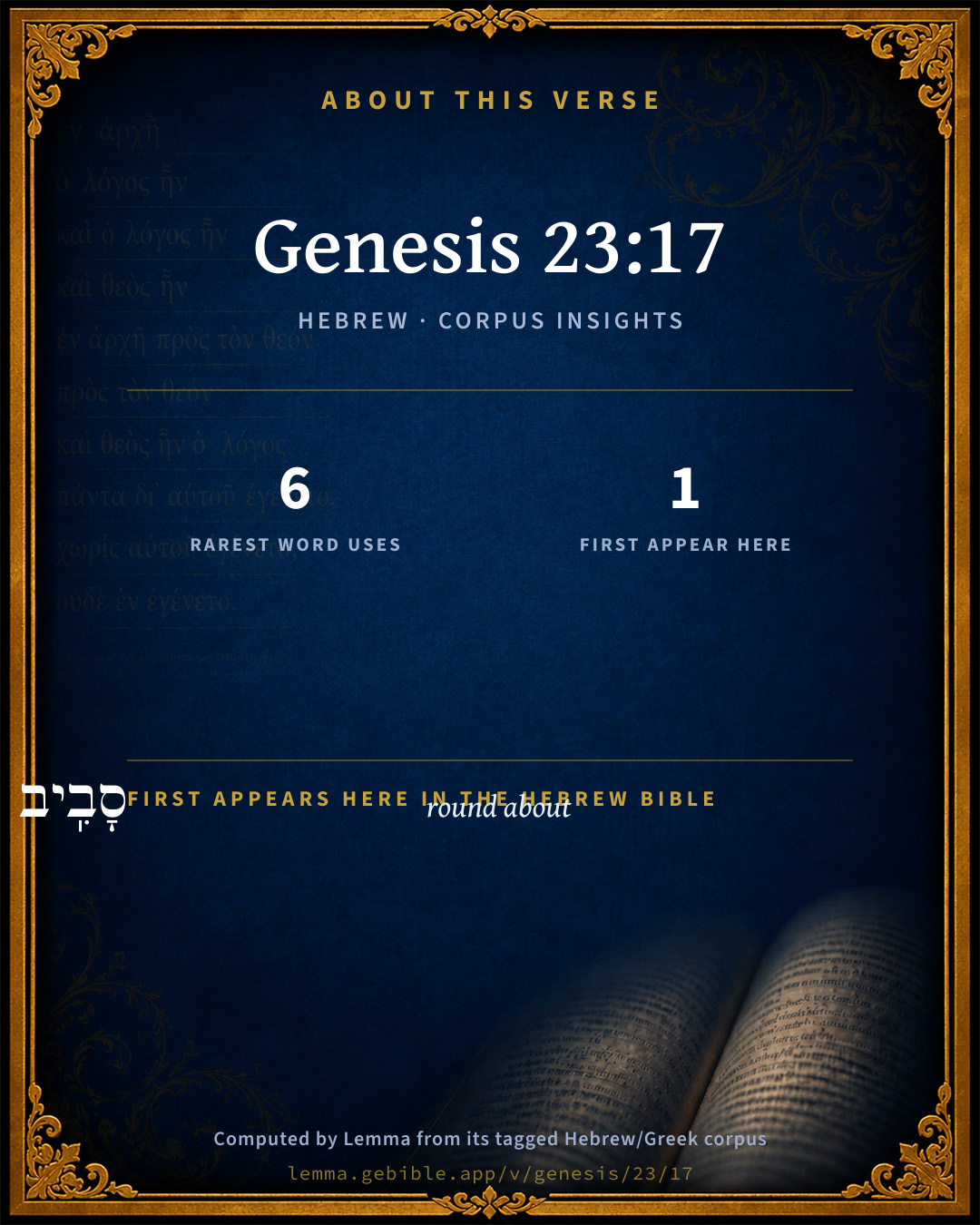
The rarest word here is בַּמַּכְפֵּלָ֔ה Machpelah H4375 — appearing just 6 times in the whole Hebrew Bible.

First appearance in Scripture

This word makes its first canonical appearance in the Hebrew Bible here:

  • סָבִֽיב round about H5439

Shared distinctive vocabulary

בַּמַּכְפֵּלָ֔ה Machpelah H4375 occurs in 6 verses of the Hebrew Bible. Also found in:

Grammatical profile

  • 1 verb
  • 13 nouns
  • 1 preposition
  • 5 particles

Verb forms

  • וַיָּ֣קָם Qal · Sequential Imperfect

Repetition

Words recur within this verse — often emphatic in Hebrew:

  • שְׂדֵ֣ה field H7704 ×3
  • וְכָל all H3605 ×2
  • אֲשֶׁר֙ which H834 ×5

Hebrew & Septuagint length

In English translation the verse runs 42 words from the Hebrew and 50 from the Septuagint (LXX English) — closely comparable.

A rough comparison of the two English renderings, which tokenize alike — not a word-level alignment.

Word counts can differ between the Hebrew and the Greek without any difference in meaning — e.g. the Hebrew direct-object marker אֵת has no separate Greek word, and Greek often adds the article ὁ.

Cross-references

11

Topical passages linked to Genesis 23:17 in the Treasury of Scripture Knowledge — connected by theme and wording, ordered by reader-vote popularity; previews shown in the World English Bible.

  • Genesis 25:9 Isaac and Ishmael, his sons, buried him in the cave of Machpelah, in the field of Ephron, the son of Zohar the Hittite, which is before Mamre,
  • Genesis 50:13 for his sons carried him into the land of Canaan, and buried him in the cave of the field of Machpelah, which Abraham bought with the field, for a possession of a burying-place, from Ephron the Hittite, before Mamre.
  • Genesis 23:20 The field, and the cave that is therein, were made sure to Abraham for a possession of a burying place by the children of Heth.
  • Genesis 49:29–32 He charged them, and said to them, "I am to be gathered to my people. Bury me with my fathers in the cave that is in the field of Ephron the Hittite,
  • Acts 7:16 and they were brought back to Shechem, and laid in the tomb that Abraham bought for a price in silver from the children of Hamor of Shechem.
  • Ruth 4:7–10 Now this was [the custom] in former time in Israel concerning redeeming and concerning exchanging, to confirm all things: a man drew off his shoe, and gave it to his neighbor; and this was the [manner of] attestation in Israel.
  • Psalms 112:5 It is well with the man who deals graciously and lends. He will maintain his cause in judgment.
  • Jeremiah 32:7–14 Behold, Hanamel the son of Shallum your uncle shall come to you, saying, Buy you my field that is in Anathoth; for the right of redemption is yours to buy it.
  • Matthew 10:16 "Behold, I send you out as sheep in the midst of wolves. Therefore be wise as serpents, and harmless as doves.
  • Ephesians 5:15 Therefore watch carefully how you walk, not as unwise, but as wise;
  • Colossians 4:5 Walk in wisdom toward those who are outside, redeeming the time.

Cross-references courtesy of OpenBible.info (CC BY 4.0).

Hebrew and Greek witnesses Masoretic Hebrew ↔ Greek Septuagint

The same verse in the two great witnesses to the Old Testament, shown verse-for-verse.

These are two independent witnesses, not word-aligned to each other, and the Septuagint is shown in lemma (dictionary) form.

Hebrew Genesis 23:17 Masoretic · Westminster Leningrad Codex

וַיָּ֣קָם שְׂדֵ֣ה עֶפְר֗וֹן אֲשֶׁר֙ בַּמַּכְפֵּלָ֔ה אֲשֶׁ֖ר לִפְנֵ֣י מַמְרֵ֑א הַשָּׂדֶה֙ וְהַמְּעָרָ֣ה אֲשֶׁר בּ֔וֹ וְכָל הָעֵץ֙ אֲשֶׁ֣ר בַּשָּׂדֶ֔ה אֲשֶׁ֥ר בְּכָל גְּבֻל֖וֹ סָבִֽיב

So the field of Ephron, which was in Machpelah, which was before Mamre, the field, the cave which was therein, and all the trees that were in the field, that were in all the border of it round about, were made sure

World English Bible · Public Domain

Greek LXX Genesis 23:17 Septuagint · lemma form

καί ἵστημι ὁ ἀγρός εφρων ὅς εἰμί ἐν ὁ διπλοῦς σπήλαιον ὅς εἰμί κατά πρόσωπον μαμβρη ὁ ἀγρός καί ὁ σπήλαιον ὅς εἰμί ἐν αὐτός καί πᾶς δένδρον ὅς εἰμί ἐν ὁ ἀγρός ὅς εἰμί ἐν ὁ ὅριον αὐτός κύκλος

And the field of Ephron, which was in Double Cave, which is opposite Mambre, the field and the cave, which was in it, and every tree which was in the field, and whatever is in its borders round about, were made sure in its borders round about, were made sure

LXX2012 (modern English Septuagint) · Public Domain

On this verse, Keil & Delitzsch discusses the Septuagint’s reading. Read the note in Commentary ↓

Hebrew: Westminster Leningrad Codex (CC BY 4.0). Greek: Septuagint (public domain); English from LXX2012 (modern English Septuagint) (Public Domain). How the Septuagint differs from the Hebrew →

Targum (Aramaic paraphrase)

2

The Targum is the ancient Jewish Aramaic paraphrase of the Hebrew Scriptures — an interpretive translation, not the Hebrew text itself. Onkelos (literal) and Pseudo-Jonathan (expansive) render the Torah, and Jonathan the Prophets. Coverage is partial: where no permissively-licensed English translation exists for a verse, only the Aramaic is shown. This is verse-level text, not a word-by-word alignment to the Hebrew.

  1. Targum Onkelos Torah (Genesis–Deuteronomy)
    וְקָם חֲקַל עֶפְרוֹן דִּי בְּכָפֶלְתָּא דִּי קֳדָם מַמְרֵא חַקְלָא וּמְעַרְתָּא דִּי בֵהּ וְכָל אִילָנֵי דִּי בְחַקְלָא דִּי בְכָל תְּחוּמֵהּ סְחוֹר סְחוֹר

    (no public-domain English translation for this verse)

    Targum Onkelos — Aramaic: “Onkelos Genesis” (public domain); “Onkelos Exodus” (public domain); “Onkelos Leviticus” (public domain); “Onkelos Numbers” (public domain); “Onkelos Deuteronomy” (public domain). English: “Sefaria Community Translation” (CC0 1.0 (public-domain dedication)); “J.W. Etheridge. The Targums of Onkelos and Jonathan Ben Uzziel on the Pentateuch. London: Longmans, Green, 1862” (public domain). Text via Sefaria.

  2. Targum Pseudo-Jonathan Torah (Genesis–Deuteronomy)
    וְקָם זַבִּין חֲקַל עֶפְרוֹן דִי בְכָפֶלְתָּא דִקְדָם מַמְרֵא חַקְלָא וּמְעַרְתָּא דְבֵיהּ וְכָל אִילָנָא דִבְחַקְלָא דִבְכָל תְּחוּמֵיהּ חֲזוֹר חֲזוֹר

    And he confirmed the purchase of the field of Ephron, in which (was) the double (cave) which is before Mamre, The field, and the cave that is therein, and all the trees that were in the field, in all the boundaries thereof round about,

    Targum Pseudo-Jonathan — Aramaic: “Targum Jonathan on Genesis” (public domain); “Targum Jonathan on Exodus” (public domain); “Targum Jonathan on Leviticus” (public domain); “Targum Jonathan on Numbers” (public domain); “Targum Jonathan on Deuteronomy” (public domain). English: “The Targum of Jonathan ben Uzziel, trans. J. W. Etheridge, London, 1862” (public domain). Text via Sefaria.

Commentary

Notes on Genesis 23:17 from classic Christian and Jewish commentators (each source and its license shown beneath its notes). The classic Christian expositions comment on the surrounding passage and are grouped to its opening verse, so a note may address several verses; the Jewish commentaries on the Tanakh (Rashi and others) are per-verse, so they appear only where the commentator wrote on this verse.

Lemma curates 59 commentaries, every one of them public domain or Creative Commons licensed, each selected and text-cleaned for this edition rather than reprinted as found. About our sources →

Trapp's Complete Commentary

John Trapp

Gen 23:17 And the field of Ephron, which [was] in Machpelah, which [was] before Mamre, the field, and the cave which [was] therein, and all the trees that [were] in the field, that [were] in all the borders round about, were made sure

Ver. 17. Which was in Machpelah.] Where was a double cave, one within another: and haply one for men, and another for women. This was not that purchased burying place whereof Stephen spake, {Act 7:16} for that was in Sychem, this in Hebron; that was bought of Emor the father of Sychem, this of Ephron.

John Trapp, A Commentary or Exposition upon All the Books of the Old and New Testament (1647–1656) — public domain. Text from a community e-Sword module.

Adam Clarke's Commentary

Verse 17. All the trees that were in the field] It is possible that all these were specified in the agreement.

Adam Clarke's Commentary on the Bible (1810–1826) — public domain. Text from a community e-Sword/MySword module.

Ellicott's Commentary for English Readers

(17) Before Mamre.—That is, opposite to it. The Haram wherein the bodies of Abraham and Sarah lie, is situated on the eastern side of the valley, so that Abraham’s oak-grove must have been on its western slope. The old Christian tradition, which places it at Ramet-el-Chalil, does not agree with this description, and is, moreover, too far away. The remains pointed out there as those of Abraham’s house, are the ruins of a heathen temple. But it is useless to look for any remains of the abode of a nomad dwelling in tents, especially after the site has been occupied by a great city. Moreover, Hebron itself has changed its position. For Benjamin of Tudela, who visited it nearly seven centuries ago, says that the old Hebron was on the heights, but had been abandoned, and that the new city lay in the valley.

The field, and the cave . . . —It is interesting to compare this document, so legally exact and full, with the numerous tablets of terra-cotta now in our museums, and which record with equal exactness the daily business transactions of the people of Ur-Chasdim, whence Abraham had migrated.

A Bible Commentary for English Readers, edited by Charles John Ellicott (1878–1897) — public domain. Text from a community e-Sword module.

The Cambridge Bible for Schools and Colleges

gen. ed. J. J. S. Perowne

17. So the field of Ephron] This and the following verses contain, in language of legal minuteness, the description of the purchase. The sentence probably represents the form of a deed of sale, such as was included in Hebrew contracts. Similar minute details are found in Babylonian legal deeds of sale. Notice the particular mention of “the field,” “the cave,” “all the trees,” “all the border,” “made sure,” “in the presence of,” “all that went in at the gate of his city.”

before Mamre] i.e. “in front of” = “to the east of,” as in Gen_23:19, cf. Gen_16:12, Gen_25:18; Num_21:11; Deu_32:49 (“over against”). For Mamre, a locality either identified with, or contiguous to, Hebron, cf. Gen_13:18, Gen_35:27.

The Cambridge Bible for Schools and Colleges (gen. ed. J. J. S. Perowne; Cambridge University Press, 1878–1918) — public domain. Text from a community e-Sword module.

John Gill's Exposition

And after this,.... After this affair was over, the bargain struck, the money paid, and possession secured:

Abraham buried Sarah his wife in the cave of the field of Machpelah,

before Mamre; and here he himself was buried, and also Isaac and Rebekah, and Jacob and Leah, Gen 25:9. Benjamin of Tudela (h) says, in his time (who lived in the latter end of the twelfth century), in the field of Machpelah was a city or town, and in it a large temple called Saint Abraham, where were shown the sepulchres of the six persons before mentioned, and inscriptions over each of them, showing whose they were; and that at the end of the field was the house of Abraham, and before the house a fountain, and no other was suffered to be built there in honour to Abraham:

the same is Hebron in the land of Canaan; that is, Mamre is the same place which afterwards was called Hebron, a city in the land of Canaan, in the tribe of Judah, about twenty two miles from Jerusalem to the south, and was one of the cities of refuge. Hebron has the title of Hhaleah, i.e. the chosen or beloved, among the Arabs, where the (Maggarel Mamra) cave of Mamre or Machpelah is still shown, and is always lighted up with lamps, and held in extraordinary veneration by the Mahometans (i).

(h) Itinerarium, p. 48, 49. (i) Shaw's Travels, p. 339. Marg. Ed. 2.

John Gill's Exposition of the Whole Bible (1746–1763) — public domain (CC PDM 1.0). Text via the HelloAO Bible API.

Whedon's Commentary on the Bible

Daniel D. Whedon

17. Field… cave… trees… borders — Observe how every thing is specified — The importance of this is still understood. “It is not enough,” says Thomson, “that you purchase a well-known lot; the contract must mention every thing that belongs to it, and certify that fountains or wells in it, trees upon it, etc., are sold with the field. If you rent a house, not only the building itself, but every room in it, above and below, down to the kitchen, pantry, stable, and hen-coop, must be specified.” — Land and Book, vol. ii, p. 383.

Made sure — The same word is repeated in Gen_23:20. This possession was publicly and legally confirmed to Abraham. On this Dr. Thomson also writes: “When any sale is now to be effected in a town or village, the whole population gather about the parties at the usual place of concourse. There all take part, and enter into the pros and cons with as much earnestness as if it were their own individual affair. By these means, the operation, in all its circumstances and details, is known to many witnesses, and the thing is made sure, without any written contract. In fact, up to this day, in this very city of Hebron, a purchase thus witnessed is legal, while the best-drawn deeds of a London lawyer, though signed and sealed, would be of no avail without such living witnesses.”

Daniel D. Whedon (gen. ed.), Commentary on the Old and New Testaments (1874–1909) — public domain. Text from a community e-Sword module.

The Pulpit Commentary

Vers. 17, 18. And the field of Ephron, which was in Machpelah, here the word is used as a proper name (vide supra)which was before Mamre, ygepli over against (Lange), to the east of (Keil), the oak grove the field, and the cave which was therein, and all the trees that were in the field, that were in all the borders round about, like manner the operations in the contract are just such as are found in modern deeds. It is not enough that you purchase a well-known lot; the contract must mention everything that belongs to it, and certify that fountains or wells in it, trees upon it, &c., are sold with the field" ("Land and Book," p. 578);were made sure literally, stood up or arose, i.e. were confirmed (cf. Lev_27:14, Lev_27:19) unto Abraham for a possession in the presence of the children of Heth, before all that went in at the gate of the city. "This also is true to life. When any sale is now to be effected in a town or village, the whole population gather about the parties at the usual place of concourse, around or near the gate where there is one. There all take part and enter into the pros and cons with as much earnestness as if it were their own individual affair. By these means the operation, in all its circumstances and details, is known to many witnesses, and the thing is made sure without any written contract" ("Land and Book," p. 579).

The Pulpit Commentary (1880–1919), ed. H.D.M. Spence-Jones & Joseph S. Exell — public domain. Text from a community e-Sword module.

Keil & Delitzsch

C. F. Keil & F. Delitzsch

"Thus arose (ויּקם) the field...to Abraham for a possession;" i.e., it was conveyed to him in all due legal form. The expression "the field of Ephron which is at Machpelah" may be explained, according to Gen 23:9, from the fact that the cave of Machpelah was at the end of the field, the field, therefore, belonged to it. In Gen 23:19 the shorter form, "cave of Machpelah," occurs; and in Gen 23:20 the field is distinguished from the cave. The name Machpelah is translated by the lxx as a common noun, τὸ σπήλαιον τὸ διπλοῦν, from מכפּלה doubling; but it had evidently grown into a proper name, since it is sued not only of the cave, but of the adjoining field also (Gen 49:30; Gen 50:13), though it undoubtedly originated in the form of the cave. The cave was before, i.e., probably to the east of, the grove of Mamre, which was in the district of Hebron. This description cannot be reconciled with the tradition, which identifies Mamre and the cave with Ramet el Khalil, where the strong foundation-walls of an ancient heathen temple (according to Rosenmller's conjecture, an Idumaean one) are still pointed out as Abraham's house, and where a very old terebinth stood in the early Christian times; for this is an hour's journey to the north of modern Hebron, and even the ancient Hebron cannot have stretched so far over the mountains which separate the modern city from Rameh, but must also, according to Gen 37:14, have been situated in the valley (see Robinson's later Biblical Researches, pp. 365ff.). There is far greater probability in the Mohammedan tradition, that the Harem, built of colossal blocks with grooved edges, which stands on the western slope of the Beabireh mountain, in the north-western portion of the present town, contains hidden within it the cave of Machpelah with the tomb of the patriarchs (cf. Robinson, Pal. ii. 435ff.); and Rosen. is induced to look for Mamre on the eastern slope of the Rumeidi hill, near to the remarkable well Ain el Jedid.

Keil & Delitzsch — Biblical Commentary on the Old Testament (1861–1891) — public domain (CC PDM 1.0). Text via the HelloAO Bible API. (Old Testament only.)

Kretzmann's Popular Commentary

Paul E. Kretzmann

The Burial of Sarah

v. 17. And the field of Ephron, which was in Machpelah, which was before Mamre, the field, and the cave which was therein, and all the trees that were in the field, that were in all the borders round about, were made sure

v. 18. unto Abraham for a possession in the presence of the children of Heth, before all that went in at the gate of his city. The language is that of a formal instrument used in the transfer of real estate; the location of the field is given: before Mamre, over against the grove of Mamre, adjoining the cave Machpelah, which was at one end of it; the description of the property is accurate and includes even the trees on the plot itself and on its borders on every side. The field was thus conveyed to Abraham with all the appurtenances thereof, the record of the transaction being very minute and the witnesses expressly mentioned.

v. 19. And after this Abraham buried Sarah, his wife, in the cave of the field of Machpelah before Mamre; the same is Hebron, in the land of Canaan. That was the object of the purchase of this field with its cave, which from its name may have had two entrances or been a double cavern.

v. 20. And the field, and the cave that is therein, were made sure unto Abraham for a possession of a burying-place by the sons of Heth. By burying his wife in Canaan, in the Land of Promise, Abraham confessed that Sarah took part in the promised blessing, that her body was buried in the sure hope of the future resurrection by virtue of the redemption of Christ. In that sense the cemeteries of Christian congregations are truly God’s acres, from which He will, on the last day, gather the harvest of rich fruit.

Paul E. Kretzmann, Popular Commentary of the Bible (1921–1924) — public domain. Text from a community e-Sword module.

unfoldingWord translationNotes

Door43 World Missions Community

Machpelah

Machpela was the name of an area or region. See how you translated this in Genesis 23:9. (See: How to Translate Names)

Mamre

This was another name for the city of Hebron. It may have been named after Mamre, the friend of Abraham who lived there. (See: How to Translate Names)

that is, the field, the cave that was in it, and all the trees

This phrase explains what the author meant when he wrote "the field of Ephron." It was not only the field, but also the cave and trees in the field.

passed to Abraham by purchase

"became Abraham's possession when he purchased it" or "belonged to Abraham after he bought it"

in the presence of the sons of Heth

Here "presence" stands for the people serving as witnesses. AT: "with the people of Heth watching as witnesses" (See: Metonymy)

the sons of Heth

Here "sons" stands for those who descended from Heth. See how you translated this in Genesis 23:3. AT: "the descendants of Heth" (See: How to Translate Names)

all those who had come into the gate of his city

This tells which sons of Heth saw Abraham buy the property. See how you translated this in Genesis 23:10. (See: Distinguishing versus Informing or Reminding)

gate of his city

The city gate was where the leaders of the city would meet to make important decisions.

his city

"the city where he lived." This phrase shows that Ephron belonged to that city. It does not mean that he owned it.

translationWords

Abraham

gate

unfoldingWord translationNotes — © Distant Shores Media and the Door43 World Missions Community, licensed CC BY-SA 4.0. Source: git.door43.org/Door43/en_tn.

Rashi

Rabbi Shlomo Yitzchaki (Rashi)

ויקם שדה עפרון AND THE FIELD OF EPHRON WAS MADE SURE (literally, it rose) — It received a rise in importance because it passed from the possession of a commoner (הדיוט an ordinary person) into the possession of a king (Genesis Rabbah 58:8). But the real meaning of the verse is: The field and the cave that was therein and all the trees … became secured to Abraham as a possession etc. (i. e. verse 17 is an incomplete sentence and must be read together with verse 18, thus: ויקם השדה וגו… לאברהם למקנה —The field etc. became secured to Abraham as a possession).

Rashi on the Tanakh — English translations: “The Judaica Press complete Tanach with Rashi, translated by A. J. Rosenberg” (CC BY 4.0); “Pentateuch with Rashi's commentary by M. Rosenbaum and A.M. Silbermann, 1929-1934” (public domain); “The Metsudah Tanach series, Lakewood, N.J” (CC BY 4.0); and “The Book of Joshua, Metsudah Publications, 1997” (CC BY 4.0). Text via Sefaria.

Radak

Rabbi David Kimhi (Radak)

ויקם, it “arose” for Avraham as a purchase, and acquisition. The unusual sounding word קם here also occurs in this sense in Leviticus 27,19 וקם לו, where it describes the legal procedure of redeeming property from the Temple treasurer by paying a premium. The term is chosen to describe a transaction of a permanent, enduring nature.

אשר לפני ממרא, השדה והמערה, both were outside the actual town limits of Kiryat Arba, the present day Chevron then having been known as Mamre. (compare also verse 19). [The Torah makes certain that all the names by which this location had ever been known is mentioned so that no one in the future could challenge this cave as belonging to the Jewish people. Ed.]

Radak on the Tanakh — English translations: “Sefaria Community Translation” (CC0 1.0 (public-domain dedication)); “Eliyahu Munk, HaChut Hameshulash” (CC BY 4.0); “Rabbi Mike Feuer, Jerusalem Anthology” (CC BY 4.0); and “R. David Kimhi on the first book of Psalms, Translated by R.G. Finch, London, 1919” (public domain). Text via Sefaria.

Lesson kit

Teaching starters — assembled from the data on this page, not authored interpretation. Every prompt links to the verse data it draws on. Edit before teaching.

Genesis, in the Pentateuch, opens this verse with 20 words (12 distinct Hebrew lemmas). Its most distinctive word is Makpêlâh (“Machpelah”). A historical commentator’s framing appears above. Read the whole chapter for the surrounding context.

Discussion questions

  1. How does “Machpelah” (Makpêlâh) shape what this verse is saying?
  2. This is the first place “round about” appears in Scripture (first appears here). What does its debut here establish?
  3. How does Genesis 23:9, which shares the word «Machpelah», read alongside this verse?
  4. What does the repetition of “field” (3× in this one verse) do in this verse?
  5. These translations render this verse differently; the difference is in the English rendering, not the original. What questions does that raise?
  6. «וַיָּ֣קָם» is a Qal Sequential Imperfect verb. How does that grammatical form shape the action described?
  7. Compare how Trapp's Complete Commentary and Adam Clarke's Commentary read this verse. Where do they agree or differ?

Things to notice

  • 1 word makes its first canonical appearance in Scripture here.
  • These translations choose different wording for 13 words in this verse.
  • “field” occurs 3× in this single verse.
  • 12 distinct Hebrew lemmas span 20 words in this verse.

Reading settings

Reading text

Shown beneath each verse's original-language words.

Old Testament
Old Testament edition

Read the OT as the Masoretic Hebrew (MT) or the Greek Septuagint (LXX).

English shown for the Greek Septuagint (in the Hebrew ↔ Greek comparison).

Comparing translations? Open the Compare panel on any verse page to stack up to four side by side.