

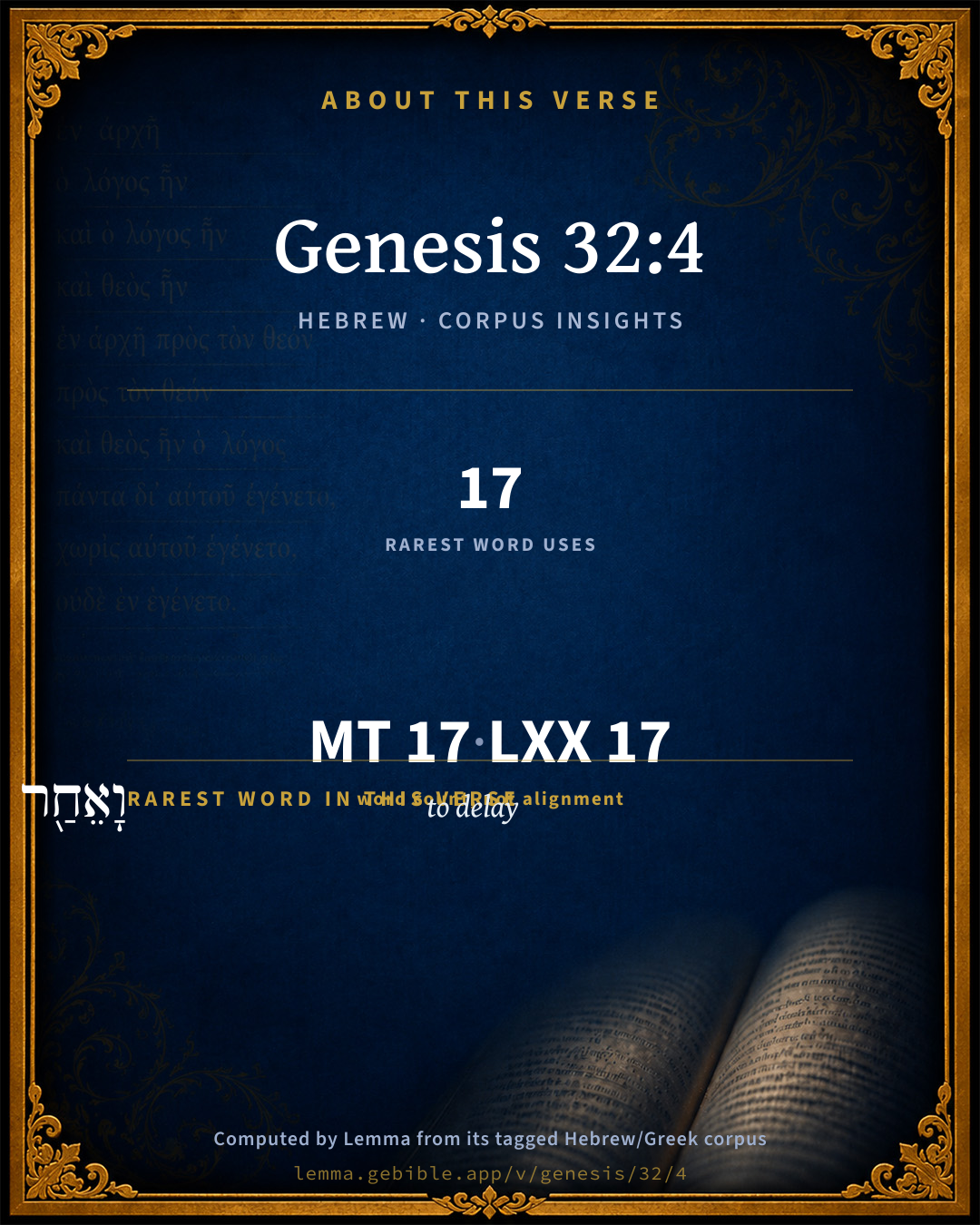
Genesis 32:4

Hebrew (Westminster Leningrad Codex) Genesis 32:4 appears in the Hebrew Old Testament. The text above is from the Westminster Leningrad Codex. Each word links to its Strong’s number, a concise gloss, and parsing drawn from the Open Scriptures Hebrew Bible morphology. Click any word for its full Brown-Driver-Briggs (BDB) entry.
Download image
Cite this verse

Genesis 32:4 (World English Bible). Public Domain. Lemma interlinear Bible study tool, https://lemma.gebible.app/v/genesis/32/4.

Show BibTeX & RIS
BibTeX
RIS
English Translation
He commanded them, saying, "This is what you shall tell my lord, Esau: 'This is what your servant, Jacob, says. I have lived as a foreigner with Laban, and stayed until now.
World English Bible · Public Domain
Download a study sheet

One document with this verse’s original text, its word-by-word gloss line, the meaning frame, cross-references with their text, attributed commentary, and full source and license credits — printable, and it pastes into notes with its structure intact.

This verse Autodidact and up

Study sheet (.html) Plain text (.txt)

A passage Seminary Student

Up to 50 verses in one chapter. A passage sheet keeps up to 6 commentary sources and 12 cross-references per verse, in the order this page ranks them, and says so on the sheet whenever that leaves anything out. Ask for a single verse and you get the Autodidact verse sheet above.

Everything on this page stays free to read, with no account — the sheet is a download of what is already on screen, not access to it.

Want to remove ads? Support Godless Engineer
Compare translations 3

The same verse in 3 English versions, stacked beneath the original-language interlinear above. Click any original word for its lexicon entry.

Each is an independent rendering of the whole verse — the interlinear is not word-aligned to these translations.

Highlighted words mark where these versions differ — a whole-verse word diff, not a word-by-word alignment.

  • World English Bible Public Domain
    He commanded them, saying, "This is what you shall tell my lord, Esau: 'This is what your servant, Jacob, says. I have lived as a foreigner with Laban, and stayed until now.
  • King James Version Public Domain
    And he commanded them, saying, Thus shall ye speak unto my lord Esau; Thy servant Jacob saith thus, I have sojourned with Laban, and stayed there until now:
  • unfoldingWord Literal Text CC BY-SA 4.0
    And he commanded them, saying, “This you will say to my lord, to Esau: ‘This your servant Jacob says, “I have been sojourning with Laban and have remained there until now.

unfoldingWord Literal Text — © unfoldingWord, licensed CC BY-SA 4.0. Word-aligned USFM3 via Door43 (git.door43.org/unfoldingWord/en_ult).

Versions to compare (up to 4)

3 of 4 selected

Show all 18 translations

Every available English version of this verse, each an independent rendering of the whole verse.

  • World English Bible Public Domain
    He commanded them, saying, "This is what you shall tell my lord, Esau: 'This is what your servant, Jacob, says. I have lived as a foreigner with Laban, and stayed until now.
  • Berean Standard Bible Public Domain
    He instructed them, “You are to say to my master Esau, ‘Your servant Jacob says: I have been staying with Laban and have remained there until now.
  • Majority Standard Bible Public Domain
    He instructed them, “You are to say to my master Esau, ‘Your servant Jacob says: I have been staying with Laban and have remained there until now.
  • King James Version Public Domain
    And he commanded them, saying, Thus shall ye speak unto my lord Esau; Thy servant Jacob saith thus, I have sojourned with Laban, and stayed there until now:
  • American Standard Version (1901) Public Domain
    And he commanded them, saying, Thus shall ye say unto my lord Esau: Thus saith thy servant Jacob, I have sojourned with Laban, and stayed until now:
  • Revised Version (1885) Public Domain
    And he commanded them, saying, Thus shall ye say unto my lord Esau; Thus saith thy servant Jacob, I have sojourned with Laban, and stayed until now:
  • Geneva Bible (1599) Public Domain
    To whom he gaue commandement, saying, Thus shall ye speake to my lorde Esau: thy seruant Iaakob sayeth thus, I haue bene a stranger with Laban, and taried vnto this time.
  • Douay-Rheims (1899) Public Domain
    And he commanded them, saying: Thus shall ye speak to my lord Esau: Thus saith thy brother Jacob: I have sojourned with Laban, and have been with him until this day.
  • Young's Literal Translation Public Domain
    and commandeth them, saying, `Thus do ye say to my lord, to Esau: Thus said thy servant Jacob, With Laban I have sojourned, and I tarry until now;
  • Literal Standard Version CC BY-SA 4.0
    and commands them, saying, “Thus you say to my lord, to Esau, Thus said your servant Jacob: I have sojourned with Laban, and I linger until now;
  • Unlocked Literal Bible CC BY-SA 4.0
    He commanded them, saying, “This is what you will say to my master Esau: This is what your servant Jacob says: 'I have been staying with Laban, and have delayed my return until now.
  • unfoldingWord Literal Text CC BY-SA 4.0
    And he commanded them, saying, “This you will say to my lord, to Esau: ‘This your servant Jacob says, “I have been sojourning with Laban and have remained there until now.
  • Darby Bible Public Domain
    And he commanded them, saying, Thus shall ye speak to my lord, to Esau: Thy servant Jacob speaks thus -- With Laban have I sojourned and tarried until now;
  • World Messianic Bible Public Domain
    He commanded them, saying, “This is what you shall tell my lord, Esau: ‘This is what your servant, Jacob, says. I have lived as a foreigner with Laban, and stayed until now.
  • Webster's Bible Public Domain
    And he commanded them, saying, Thus shall ye speak to my lord Esau: Thy servant Jacob saith thus, I have sojourned with Laban, and stayed there till now:
  • Free Bible Version CC BY-SA 4.0
    He told them, “This is what you are to say to my lord Esau. Your servant Jacob sends you this message. I've been staying with Laban up till now,
  • Bible in Basic English Public Domain
    And he gave them orders to say these words to Esau: Your servant Jacob says, Till now I have been living with Laban:
  • JPS Tanakh (1917) Public Domain
    (32-5) And he commanded them, saying: 'Thus shall ye say unto my lord Esau: Thus saith thy servant Jacob: I have sojourned with Laban, and stayed until now.

Literal Standard Version (2020), Covenant Press — licensed CC BY-SA 4.0. Text via the HelloAO Bible API (eBible.org). Unlocked Literal Bible (unfoldingWord) — licensed CC BY-SA 4.0. Text via the HelloAO Bible API (eBible.org). unfoldingWord Literal Text — © unfoldingWord, licensed CC BY-SA 4.0. Word-aligned USFM3 via Door43 (git.door43.org/unfoldingWord/en_ult). Free Bible Version, Dr. Jonathan Gallagher — licensed CC BY-SA 4.0. Text via the HelloAO Bible API (eBible.org).

Word by word

More ways to search: Search by grammar → Find every occurrence → Compare this word →

Practice this passage: Drill this verse → Learn its vocabulary →

וָאֵחַ֖ר
ʼâchar
H309
“and · to delay”
Conjunction + Verb, Qal, Sequential Imperfect, 1st Person, Common, Singular
Part of Speech
Conjunction + Verb
Stem
Qal
Form
Sequential Imperfect
Person
1st Person
Gender
Common
Number
Singular
Full BDB Definition

Origin: a primitive root

TWOT: 68

to delay, hesitate, tarry, defer, remain behind - (Qal) - to delay, tarry (intensive) - to cause one to delay, hinder, keep back - (Piel) to delay, wait, stay behind (but not in hope)
  1. וַיְצַ֤ו tsâvâh H6680 “and · to command” Conjunction + Verb, Piel, Sequential Imperfect, 3rd Person, Masculine, Singular
  2. אֹתָם֙ ʼêth H853 “- · them” Particle, Direct Object + Suffix, Personal, 3rd Person, Masculine, Plural
  3. לֵאמֹ֔ר ʼâmar H559 “to say” Preposition + Verb, Qal, Infinitive Construct
  4. כֹּ֣ה kôh H3541 “thus” Adverb
  5. תֹאמְר֔וּן ʼâmar H559 “to say” Verb, Qal, Imperfect, 2nd Person, Masculine, Plural + Suffix, n
  6. לַֽאדֹנִ֖י ʼâdôwn H113 “to/for · lord · my” Preposition + Noun, Common, Masculine, Singular, Construct + Suffix, Personal, 1st Person, Common, Singular
  7. לְעֵשָׂ֑ו ʻÊsâv H6215 “to/for · Esau” Preposition + Noun, Proper
  8. כֹּ֤ה kôh H3541 “thus” Adverb
  9. אָמַר֙ ʼâmar H559 “to say” Verb, Qal, Perfect, 3rd Person, Masculine, Singular
  10. עַבְדְּךָ֣ ʻebed H5650 “servant · your” Noun, Common, Masculine, Singular, Construct + Suffix, Personal, 2nd Person, Masculine, Singular
  11. יַעֲקֹ֔ב Yaʻăqôb H3290 “Jacob” Noun, Proper
  12. עִם ʻim H5973 “with” Preposition
  13. לָבָ֣ן Lâbân H3837 “Laban” Noun, Proper
  14. גַּ֔רְתִּי gûwr H1481 “to sojourn” Verb, Qal, Perfect, 1st Person, Common, Singular
  15. עַד ʻad H5704 “until” Preposition
  16. עָֽתָּה ʻattâh H6258 “now” Adverb

About this verse

These counts appear in no published source. They are computed here, from the morphology-tagged text and Lemma’s own curated glosses. What Lemma adds →

17
words
14
distinct lemmas
Pentateuch
section

Notable vocabulary

The rarest word here is וָאֵחַ֖ר to delay H309 — appearing just 17 times in the whole Hebrew Bible.

Shared distinctive vocabulary

וָאֵחַ֖ר to delay H309 occurs in 17 verses of the Hebrew Bible. Also found in:

Grammatical profile

  • 6 verbs
  • 5 nouns
  • 2 prepositions
  • 3 adverbs
  • 1 particle

Verb forms

  • וַיְצַ֤ו Piel · Sequential Imperfect
  • לֵאמֹ֔ר Qal · Infinitive Construct
  • תֹאמְר֔וּן Qal · Imperfect
  • אָמַר֙ Qal · Perfect
  • גַּ֔רְתִּי Qal · Perfect
  • וָאֵחַ֖ר Qal · Sequential Imperfect

Repetition

Words recur within this verse — often emphatic in Hebrew:

  • לֵאמֹ֔ר to say H559 ×3
  • כֹּ֣ה thus H3541 ×2

Hebrew & Septuagint length

In English translation the verse runs 32 words from the Hebrew and 27 from the Septuagint (LXX English) — closely comparable.

A rough comparison of the two English renderings, which tokenize alike — not a word-level alignment.

Word counts can differ between the Hebrew and the Greek without any difference in meaning — e.g. the Hebrew direct-object marker אֵת has no separate Greek word, and Greek often adds the article ὁ.

In the original languages it is 17 Hebrew tokens and 17 Greek tokens — but the two are counted differently (Hebrew bundles its prefixes and suffixes into one token; the Greek is in lemma form), so that isn’t a like-for-like length.

Cross-references

15

Topical passages linked to Genesis 32:4 in the Treasury of Scripture Knowledge — connected by theme and wording, ordered by reader-vote popularity; previews shown in the World English Bible.

  • 1 Peter 3:6 as Sarah obeyed Abraham, calling him lord, whose children you now are, if you do well, and are not put in fear by any terror.
  • Genesis 4:7 If you do well, will it not be lifted up? If you don't do well, sin crouches at the door. Its desire is for you, but you are to rule over it."
  • Genesis 23:6 "Hear us, my lord. You are a prince of God among us. In the choice of our tombs bury your dead. None of us will withhold from you his tomb, but that you may bury your dead."
  • Genesis 27:29 Let peoples serve you, Nations bow down to you. Be lord over your brothers, Let your mother's sons bow down to you. Cursed be everyone who curses you, Blessed be everyone who blesses you."
  • Genesis 27:37 Isaac answered Esau, "Behold, I have made him your lord, and all his brothers have I given to him for servants. With grain and new wine have I sustained him. What then will I do for you, my son?"
  • Genesis 32:5 I have oxen, donkeys, flocks, men-servants, and maid-servants. I have sent to tell my lord, that I may find favor in your sight.'"
  • Genesis 32:18 Then you shall say, 'They are your servant, Jacob's. It is a present sent to my lord, Esau. Behold, he also is behind us.'"
  • Genesis 33:8 Esau said, "What do you mean by all this company which I met?" Jacob said, "To find favor in the sight of my lord."
  • Exodus 32:22 Aaron said, "Don't let the anger of my lord grow hot. You know the people, that they are set on evil.
  • 1 Samuel 26:17 Saul knew David's voice, and said, Is this your voice, my son David? David said, It is my voice, my lord, O king.
  • 1 Kings 20:32 So they girded sackcloth on their loins, and [put] ropes on their heads, and came to the king of Israel, and said, Your servant Ben Hadad says, please let me live. He said, Is he yet alive? he is my brother.
  • Proverbs 6:3 Do this now, my son, and deliver yourself, Seeing you have come into the hand of your neighbor. Go, humble yourself. Press your plea with your neighbor.
  • Proverbs 15:1 A gentle answer turns away wrath, But a harsh word stirs up anger.
  • Ecclesiastes 10:4 If the spirit of the ruler rises up against you, don't leave your place; for gentleness lays great offenses to rest.
  • Luke 14:11 For everyone who exalts himself will be humbled, and whoever humbles himself will be exalted."

Cross-references courtesy of OpenBible.info (CC BY 4.0).

Hebrew and Greek witnesses Masoretic Hebrew ↔ Greek Septuagint

The same verse in the two great witnesses to the Old Testament, shown verse-for-verse.

These are two independent witnesses, not word-aligned to each other, and the Septuagint is shown in lemma (dictionary) form.

Hebrew Genesis 32:4 Masoretic · Westminster Leningrad Codex

וַיְצַ֤ו אֹתָם֙ לֵאמֹ֔ר כֹּ֣ה תֹאמְר֔וּן לַֽאדֹנִ֖י לְעֵשָׂ֑ו כֹּ֤ה אָמַר֙ עַבְדְּךָ֣ יַעֲקֹ֔ב עִם לָבָ֣ן גַּ֔רְתִּי וָאֵחַ֖ר עַד עָֽתָּה

He commanded them, saying, "This is what you shall tell my lord, Esau: 'This is what your servant, Jacob, says. I have lived as a foreigner with Laban, and stayed until now.

World English Bible · Public Domain

Greek LXX Genesis 32:4 Septuagint · lemma form

ἀποστέλλω δέ ἰακώβ ἄγγελος ἔμπροσθεν αὐτός πρός ησαυ ὁ ἀδελφός αὐτός εἰς γῆ σηιρ εἰς χώρα εδωμ

And he charged them, saying, Thus shall you⌃ say to my lord Esau: Thus says your servant Jacob; I have sojourned with Laban and tarried until now.

LXX2012 (modern English Septuagint) · Public Domain

Hebrew: Westminster Leningrad Codex (CC BY 4.0). Greek: Septuagint (public domain); English from LXX2012 (modern English Septuagint) (Public Domain). How the Septuagint differs from the Hebrew →

Targum (Aramaic paraphrase)

2

The Targum is the ancient Jewish Aramaic paraphrase of the Hebrew Scriptures — an interpretive translation, not the Hebrew text itself. Onkelos (literal) and Pseudo-Jonathan (expansive) render the Torah, and Jonathan the Prophets. Coverage is partial: where no permissively-licensed English translation exists for a verse, only the Aramaic is shown. This is verse-level text, not a word-by-word alignment to the Hebrew.

  1. Targum Onkelos Torah (Genesis–Deuteronomy)
    וּשְׁלַח יַעֲקֹב אִזְגַּדִּין קֳדָמוֹהִי לְוַת עֵשָׂו אֲחוּהִי לְאַרְעָא דְשֵׂעִיר לַחֲקַל דְאֱדוֹם

    (no public-domain English translation for this verse)

    Targum Onkelos — Aramaic: “Onkelos Genesis” (public domain); “Onkelos Exodus” (public domain); “Onkelos Leviticus” (public domain); “Onkelos Numbers” (public domain); “Onkelos Deuteronomy” (public domain). English: “Sefaria Community Translation” (CC0 1.0 (public-domain dedication)); “J.W. Etheridge. The Targums of Onkelos and Jonathan Ben Uzziel on the Pentateuch. London: Longmans, Green, 1862” (public domain). Text via Sefaria.

  2. Targum Pseudo-Jonathan Torah (Genesis–Deuteronomy)
    וישׁלח וְשָׁדַר יַעֲקב אִזְגַדִין קוֹמוֹי לְוַת עֵשָו אָחוֹי לְאַרְעָא דְגַבְלָא לְחַקְלָא אֱדוֹמָאֵי

    And Jakob sent messengers before him to Esau his brother in the land of Gabla the territory of the Edomites,

    Targum Pseudo-Jonathan — Aramaic: “Targum Jonathan on Genesis” (public domain); “Targum Jonathan on Exodus” (public domain); “Targum Jonathan on Leviticus” (public domain); “Targum Jonathan on Numbers” (public domain); “Targum Jonathan on Deuteronomy” (public domain). English: “The Targum of Jonathan ben Uzziel, trans. J. W. Etheridge, London, 1862” (public domain). Text via Sefaria.

Commentary

Notes on Genesis 32:4 from classic Christian and Jewish commentators (each source and its license shown beneath its notes). The classic Christian expositions comment on the surrounding passage and are grouped to its opening verse, so a note may address several verses; the Jewish commentaries on the Tanakh (Rashi and others) are per-verse, so they appear only where the commentator wrote on this verse.

Lemma curates 59 commentaries, every one of them public domain or Creative Commons licensed, each selected and text-cleaned for this edition rather than reprinted as found. About our sources →

Trapp's Complete Commentary

John Trapp

Gen 32:4 And he commanded them, saying, Thus shall ye speak unto my lord Esau; Thy servant Jacob saith thus, I have sojourned with Laban, and stayed there until now:

Ver. 4. Unto my lord Esau; Thy servant Jacob, &c.] This was not baseness of spirit, much less a renouncing of his birthright and blessing; but a necessary submission for a time, such as was that of David to Saul, {1Sa 24:7; 1Sa 24:9} till the prophecy of his superiority should be fulfilled. That was baseness in the Samaritans, that in writing to Antiochus Epiphanes, that great king of Syria, because he tormented the Jews, to excuse themselves that they were no Jews they styled him, Antiochus the mighty God: {a} the Scripture styles him "a vile person". {Dan 11:21} So was that also in Teridates, king of the Parthians, who, with bended knee and hands held up, worshipped Nero, and thus bespake that monster of mankind: To thee I come as to my god; and thee I adore as I do the sun: what thou decreest of me, I will be and do; for thou art to me both fate and fortune &c. {b} And what shall we think of those superstitious Sicilians, who, when they were excommunicated by Pope Martin IV, laid themselves prostrate at his feet, and cried; - O Lamb of God that takest away the sins of the world, grant us thy peace. The Venetians also, being excommunicated by Pope Clemens V, {c} could not be absolved till such time as their ambassador Dandalus had not only fallen at the Pope’s feet, but lain also under his table as a dog with an iron chain about his neck, feeding on such scraps as were cast unto him. {d} Had this dog dealt by the Pope as the Earl of Wiltshire’s spaniel did, he had served him but right. This earl, with Doctor Cranmer, and others, being sent ambassador to Rome about King Henry’s divorce; when he should have kissed the Pope’s foot, his spaniel, as though he had been of purpose appointed thereunto, went and caught the Pope by the great toe, which the spaniel haply mistook for some kind of repast. {e} But this by the way only. What hard servitude kings and emperors were forced to undergo in former times, and how basely to avile {f} themselves to the beast of Rome, is better known than that it need to be here related. Henry II of England, Henry IV of France, and Henry, the fourth Emperor of Germany, for instance. This last came, in the midst of a sore winter, upon his bare feet, to the gates of the Castle of Canusium, and stood there fasting from morning to night for three days together, waiting for the Pope’s judicial sentence, and craving his pardon: which yet he could not obtain by his own or others’ tears, or by the intercession of any saint, save only of a certain harlot, with whom the Pope was then taking his carnal pleasure. {g} The good emperor mistook who thought that the Pope could be pacified by fasting and prayer. This god required another kind of sacrifice than these. And here that of Solomon was fulfilled, "I have seen servants upon horses, and princes walking as servants upon the earth". {Ecc 10:7}

{a} Josephus.

{b} Hλθον προς σε τον εμον θεον, προσκυνησων σε, ως και τον Mιθραν, και εσομαι τουτο οτι αν συ επικλωσης συ γαρ μοι και μοιρα ει και τυχη. - Dio in Vita Neronis.

{c} Jac. Rev., De Vitis Pontif., p. 198.

{d} Unde ei Canis cognomentum apud suos. - Ibid.

{e} Act. and Mon., fol. 1690.

{f} [Abase.]

{g} Brightm., Upon the Revel., fol. 449.

John Trapp, A Commentary or Exposition upon All the Books of the Old and New Testament (1647–1656) — public domain. Text from a community e-Sword module.

Joseph Benson's Commentary

Gen 32:4. Speak unto my lord Esau — He calls Esau his lord, and himself his servant, to intimate that he did not insist on the prerogatives of the birthright and blessing which he had obtained for himself, but left it to God to fulfil his own purpose in his seed. And he gives him a short account of himself and of his property, and where he had sojourned, expressing withal a desire for his favour and friendship.

Joseph Benson's Commentary on the Old and New Testaments (1811–1818) — public domain. Text from a community e-Sword module.

Keil & Delitzsch

C. F. Keil & F. Delitzsch

From this point Jacob sent messengers forward to his brother Esau, to make known his return in such a style of humility ("thy servant," "my lord") as was adapted to conciliate him. אחר (Gen 32:5) is the first pers. imperf. Kal for אאחר, from אחר to delay, to pass a time; cf. Pro 8:17, and Ges. 68, 2. The statement that Esau was already in the land of Seir (Gen 32:4), or, as it is afterwards called, the field of Edom, is not at variance with Gen 36:6, and may be very naturally explained on the supposition, that with the increase of his family and possessions, he severed himself more and more from his father's house, becoming increasingly convinced, as time went on, that he could hope for no change in the blessings pronounced by his father upon Jacob and himself, which excluded him from the inheritance of the promise, viz., the future possession of Canaan. Now, even if his malicious feelings towards Jacob had gradually softened down, he had probably never said anything to his parents on the subject, so that Rebekah had been unable to fulfil her promise (Gen 27:45); and Jacob, being quite uncertain as to his brother's state of mind, was thrown into the greatest alarm and anxiety by the report of the messengers, that Esau was coming to meet him with 400 men. The simplest explanation of the fact that Esau should have had so many men about him as a standing army, is that given by Delitzsch; namely, that he had to subjugate the Horite population in Seir, for which purpose he might easily have formed such an army, partly from the Canaanitish and Ishmaelitish relations of his wives, and partly from his own servants. His reason for going to meet Jacob with such a company may have been, either to show how mighty a prince he was, or with the intention of making his brother sensible of his superior power, and assuming a hostile attitude if the circumstances favoured it, even though the lapse of years had so far mitigated his anger, that he no longer seriously thought of executing the vengeance he had threatened twenty years before. For we are warranted in regarding Jacob's fear as no vain, subjective fancy, but as having an objective foundation, by the fact that God endowed him with courage and strength for his meeting with Esau, through the medium of the angelic host and the wrestling at the Jabbok; whilst, on the other hand, the brotherly affection and openness with which Esau met him, are to be attributed partly to Jacob's humble demeanour, and still more to the fact, that by the influence of God, the still remaining malice had been rooted out from his heart.

Keil & Delitzsch — Biblical Commentary on the Old Testament (1861–1891) — public domain (CC PDM 1.0). Text via the HelloAO Bible API. (Old Testament only.)

Geneva Bible (1599)

Geneva Bible translators

He reverenced his brother in worldly things, because he chiefly looked to be preferred to the spiritual promise.

Geneva Bible (1599) marginal notes — public domain. Text via Bolls.life.

Jamieson, Fausset & Brown

Robert Jamieson, A. R. Fausset & David Brown

Thus shall ye speak unto my lord Esau--The purport of the message was that, after a residence of twenty years in Mesopotamia, he was now returning to his native land, that he did not need any thing, for he had abundance of pastoral wealth, but that he could not pass without notifying his arrival to his brother and paying the homage of his respectful obeisance. Acts of civility tend to disarm opposition and soften hatred (Ecc 10:4).

Thy servant Jacob--He had been made lord over his brethren (compare Gen 27:29). But it is probable he thought this referred to a spiritual superiority; or if to temporal, that it was to be realized only to his posterity. At all events, leaving it to God to fulfil that purpose, he deemed it prudent to assume the most kind and respectful bearing.

Jamieson, Fausset & Brown — Commentary Critical and Explanatory on the Whole Bible (1871) — public domain (CC PDM 1.0). Text via the HelloAO Bible API.

Adam Clarke's Commentary

Verse 4. Thus shall ye speak unto my lord Esau] Jacob acknowledges the superiority of his brother; for the time was not yet come in which it could be said, The elder shall serve the younger.

Adam Clarke's Commentary on the Bible (1810–1826) — public domain. Text from a community e-Sword/MySword module.

John Calvin's Commentaries

4. Thus shall ye speak unto my lord Esau. Moses here relates the anxiety of Jacob to appease his brother. For this suppliant deprecation was extorted only by great and severe torture of mind. It seems, however, to be an absurd submission, whereby he cedes to his brother that dominion for which he had contended at the hazard of his life. For if Esau has the primogeniture, what does Jacob reserve for himself? For what end did he bring upon himself such hatred, expose himself to such dangers, and at length endure twenty years of banishment, if he does not refuse to be in subjection to his brother? I answer, that though he gives up the temporal dominion, he yields nothing of his right to the secret benediction. He knows that the effect of the divine promise is still suspended: and therefore, being content with the hope of the future inheritance, he does not hesitate, at present, to prefer his brother in honor to himself, and to profess himself his brother’s servant. Nor was there anything feigned in these words; because he was willing to bear his brother on his shoulders; so that he might not lose his own future right, which was as yet concealed.

John Calvin's Commentaries (1540-1563) — public domain. Text from the Calvin Translation Society English edition (1840s-50s) via the Christian Classics Ethereal Library (ccel.org). Calvin's coverage is partial (roughly two-thirds of the Bible); uncommented books and verses are honest gaps, never fabricated. The 19th-century editor's footnotes and remarks are omitted so the notes are faithfully Calvin's own voice.

The Cambridge Bible for Schools and Colleges

gen. ed. J. J. S. Perowne

4. my lord Esau] Jacob adopts the language of extreme courtesy and respect. Cf. Gen_18:3, Gen_43:20, Gen_44:18.

The Cambridge Bible for Schools and Colleges (gen. ed. J. J. S. Perowne; Cambridge University Press, 1878–1918) — public domain. Text from a community e-Sword module.

John Gill's Exposition

And he commanded them,.... Being his servants:

saying, thus shall ye speak unto my lord Esau; being not only a lord of a country, but his eldest brother, and whom he chose to bespeak in this manner, to soften his mind, and incline it to him; and that he might see he did not pique himself upon the birthright and blessing he had obtained; and as if these were forgotten by him, though hereby he does not give up his right in them:

thy servant Jacob saith thus, expressing great humility and modesty; for though his father Isaac by his blessing had made him lord over Esau, the time was not come for this to take place, his father not being yet dead; and besides, was to have its accomplishment not in his own person, but in his posterity:

I have sojourned with Laban, and stayed there until now; had been a sojourner and a servant in Laban's family for twenty years past, and had had an hard master, and therefore could not be the object of his brother's envy, but rather of his pity and compassion.

John Gill's Exposition of the Whole Bible (1746–1763) — public domain (CC PDM 1.0). Text via the HelloAO Bible API.

Matthew Poole's English Annotations

My lord Esau; which title being but a civil respect commonly given in Scripture to such persons as have no authority nor superiority over them who use it, as Gen 23:6; 24:18, Jacob doth not hereby renounce his right of primogeniture which was devolved upon him, nor return it to Esau. Nor if he did hereby acknowledge Esau his superior for the present, would this have been injurious to that right, because Jacob was not yet in actual possession of it, for it was not to commence till his father's death; and indeed did more belong to his posterity than to his person; and as to his person, did more respect his spiritual advantages than his worldly greatness. See Gen 27:29.

I have sojourned with Laban, and stayed there until now, as a stranger and exile, and so a more proper object for thy pity than for thy envy.

Matthew Poole's English Annotations on the Holy Bible (1683–1685) — public domain. Text from a community e-Sword/MySword module.

The Pulpit Commentary

Vers. 4, 5. And he commanded them, saying, Thus shall ye speak unto my lord Esau; Thy servant Jacob saith thus; the expression "my lord "may have been designed to intimate to Esau that he (Jacob) did not intend to assert that superiority or precedency which had been assigned him by Isaac s blessing, (Gen_27:29) at least so far as to claim a share in Isaac"s wealth (Calvin, Bush, Gerlach), but was probably due chiefly to the extreme courtesy of the East (Gerlach), or to a desire to conciliate his brother (Keil), or to a feeling of personal contrition for his misbehavior towards Esau (Kalisch), and perhaps also to a secret apprehension of danger from Esau"s approach (Alford, Inglis)I have sojourned with Laban, and stayed rjaee fut. Kal. of rja curring only here, is a contraction for rjaa, like qseTo for qseaTo (Psa_104:29; vide Gesenius, 2) there until now: and I have (literally, there are to me, so that I stand in need of no further wealth from either thee or Isaac) oxen, and asses, flocks, and menservants, and women servants: cf. 12:16 (Abraham); 26:13, 14 (Isaac)and I have sent to tell my lord, that I may find grace in thy sight (cf. 33:8, 15; 39:4; and vide 6:8; 18:3).

The Pulpit Commentary (1880–1919), ed. H.D.M. Spence-Jones & Joseph S. Exell — public domain. Text from a community e-Sword module.

John Wesley's Explanatory Notes

He calls Esau his Lord, himself his servant, to intimate that he did not insist upon the prerogatives of the birth-right and blessing he had obtained for himself, but left it to God to fulfil his own purpose in his seed. He gives him a short account of himself, that he was not a fugitive and a vagabond, but though long absent had dwelt with his own relations. I have sojourned with Laban, and staid there till now: and that he was not a beggar, nor likely to be a charge to his relations; no, I have oxen and asses - This he knew would (if any thing) recommend him to Esau's good affection. And, he courts his favour; I have sent that I may find grace in thy sight - It is no disparagement to those that have the better cause to become petitioners for reconciliation, and to sue for peace as well as right.

John Wesley, Explanatory Notes Upon the Whole Bible (1754–1765) — public domain. Text via the GEBible commentary corpus.

Rashi

Rabbi Shlomo Yitzchaki (Rashi)

וישלח יעקב מלאכים AND JACOB SENT MESSENGERS (Heb. מלאכים angels) — actually angels (Genesis Rabbah 75:4).

ארצה שעיר means TO THE LAND OF SEIR — A word that requires a ל as prefix has a ה placed as a suffix (Yevamot 13b).

Rashi on the Tanakh — English translations: “The Judaica Press complete Tanach with Rashi, translated by A. J. Rosenberg” (CC BY 4.0); “Pentateuch with Rashi's commentary by M. Rosenbaum and A.M. Silbermann, 1929-1934” (public domain); “The Metsudah Tanach series, Lakewood, N.J” (CC BY 4.0); and “The Book of Joshua, Metsudah Publications, 1997” (CC BY 4.0). Text via Sefaria.

Ramban (Nachmanides)

Rabbi Moshe ben Nachman (Ramban / Nachmanides)

This section was written in order to inform us that the Holy One, blessed be He, delivered His servant, and He redeemed him from the hand of him that is stronger than he, and he sent an angel and saved him, and in order to further teach us that Jacob did not place his trust in his righteousness and that he strove for delivery with all his might. There is yet in this section a hint for future generations, for everything that happened to our father with his brother Esau will constantly occur to us with Esau’s children, and it is proper for us to adhere to the way of the righteous by preparing ourselves in the three things for which he prepared himself: for prayer, for giving him a present, and for rescue by methods of warfare, to flee and to be saved. Our Rabbis have already derived this hint from this section, as I shall mention.

TO ESAU HIS BROTHER UNTO THE LAND SE’IR. Since the southern part of the Land of Israel adjoins Edom, and Jacob’s father dwelt in the land of the South, he had to pass through Edom or near there. Therefore, he feared lest Esau hear of it, and he took the initiative by sending messengers to him in his country. But the Sages have already taken him to task for this, saying in Bereshith Rabbah: “Like one that taketh a dog by the ears is he that passeth by, and meddleth with a strife not his own. The Holy One, blessed be He, said to Jacob, ‘Esau was going his way, and you send him messengers, and say to him, Thus saith thy servant Jacob!“ In my opinion this too hints at the fact that we instigated our falling into the hand of Edom [Rome] for the Hasmonean kings during the period of the Second Temple entered into a covenant with the Romans, and some of them even went to Rome to seek an alliance. This was the cause of their falling into the hands of the Romans. This is mentioned in the words of our Rabbis, and is well publicized in books.

Ramban (Nachmanides) on the Tanakh — English translation: “Commentary on the Torah by Ramban (Nachmanides). Translated and annotated by Charles B. Chavel. New York, Shilo Pub. House, 1971-1976” (CC BY 4.0). Text via Sefaria.

Radak

Rabbi David Kimhi (Radak)

וישלח יעקב מלאכים, even though G’d had assured him of His support twice, he was still afraid of his brother. The reason was that at the time Yaakov had left home Esau had been very angry at him. He was now afraid that due to some sin he might have committed and that he had remained unaware of, he might forfeit G’d’s support. We elaborated on this concept already. In order to find out how Esau felt about him now, he sent some of his mean as emissaries. They were supposed to soften him up if that was necessary.

ארצה שעיר, he had heard that Esau was there at the time although he had not settled there with his family. At this time he still lived in the land of Canaan. We know from 36,6-9 that Esau migrated to the land of Seir only at that time, after the meeting with Yaakov.

שדה אדום, a synonym for “the land of Edom.” We have the same synonym also being used for the land of Moav in Ruth 1,1 when Elimelech left the land of Israel to settle in שדה מואב, meaning in ארץ מואב.

Radak on the Tanakh — English translations: “Sefaria Community Translation” (CC0 1.0 (public-domain dedication)); “Eliyahu Munk, HaChut Hameshulash” (CC BY 4.0); “Rabbi Mike Feuer, Jerusalem Anthology” (CC BY 4.0); and “R. David Kimhi on the first book of Psalms, Translated by R.G. Finch, London, 1919” (public domain). Text via Sefaria.

Lesson kit

Teaching starters — assembled from the data on this page, not authored interpretation. Every prompt links to the verse data it draws on. Edit before teaching.

Genesis, in the Pentateuch, opens this verse with 17 words (14 distinct Hebrew lemmas). Its most distinctive word is ʼâchar (“to delay”). A historical commentator’s framing appears above. Read the whole chapter for the surrounding context.

Discussion questions

  1. What does “to delay” (ʼâchar) contribute to the verse as a whole?
  2. How does Genesis 24:56, which shares the word «to delay», read alongside this verse?
  3. What does the repetition of “to say” (3× in this one verse) do in this verse?
  4. The translations on this page render this verse differently — a whole-verse word diff, not a word-by-word alignment. What might account for the different wordings?
  5. «וַיְצַ֤ו» is a Piel Sequential Imperfect verb. How does that grammatical form shape the action described?
  6. Compare how Trapp's Complete Commentary and Joseph Benson's Commentary read this verse. Where do they agree or differ?

Things to notice

Reading settings

Reading text

Shown beneath each verse's original-language words.

Old Testament
Old Testament edition

Read the OT as the Masoretic Hebrew (MT) or the Greek Septuagint (LXX).

English shown for the Greek Septuagint (in the Hebrew ↔ Greek comparison).

Comparing translations? Open the Compare panel on any verse page to stack up to four side by side.