Genesis 27:3

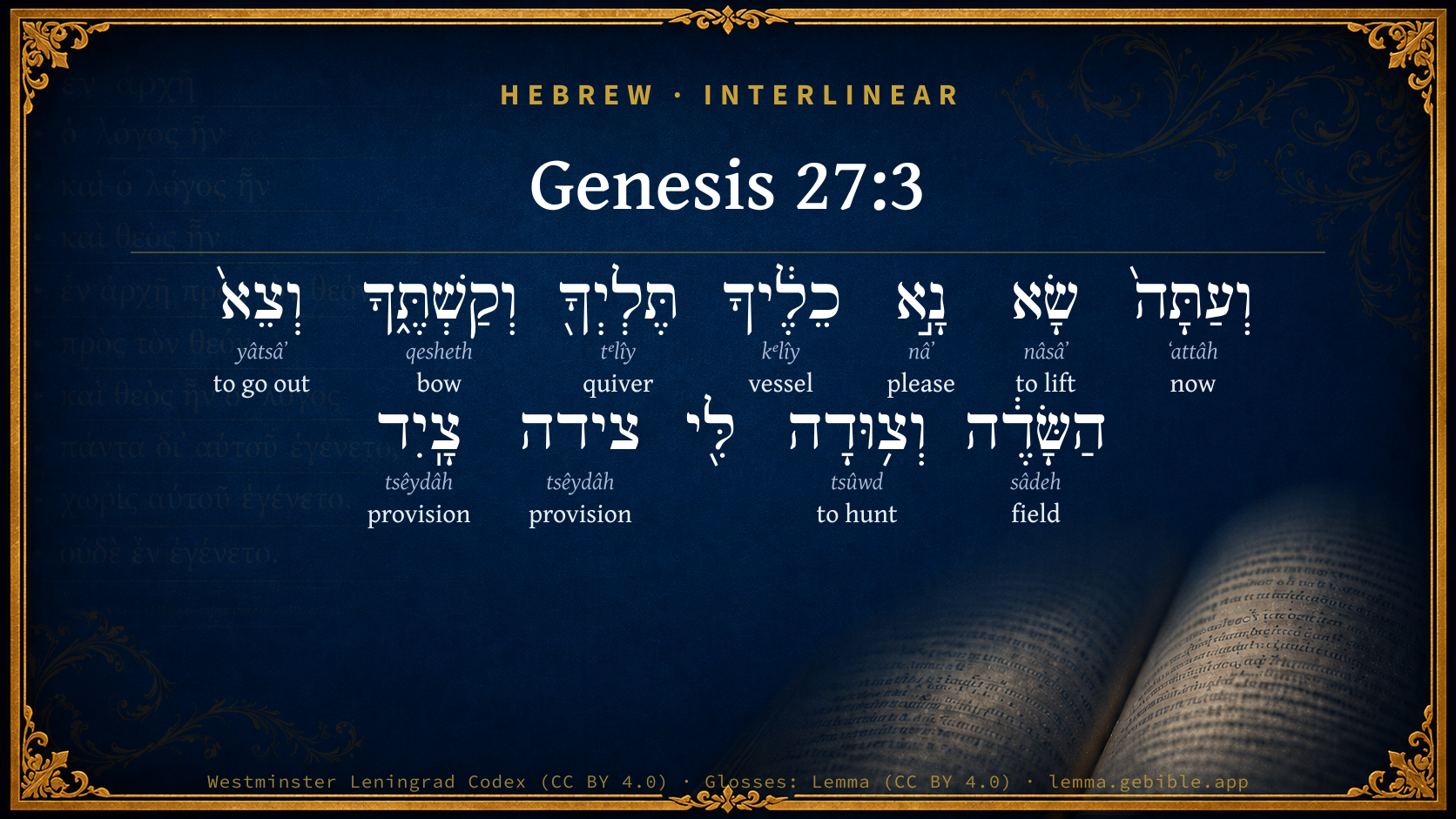
Hebrew (Westminster Leningrad Codex) Genesis 27:3 appears in the Hebrew Old Testament. The text above is from the Westminster Leningrad Codex. Each word links to its Strong’s number, a concise gloss, and parsing drawn from the Open Scriptures Hebrew Bible morphology. Click any word for its full Brown-Driver-Briggs (BDB) entry.
Download image
Cite this verse

Genesis 27:3 (World English Bible). Public Domain. Lemma interlinear Bible study tool, https://lemma.gebible.app/v/genesis/27/3.

Show BibTeX & RIS
BibTeX
RIS
English Translation
Now therefore, please take your weapons, your quiver and your bow, and go out to the field, and take me venison.
World English Bible · Public Domain
Highlights
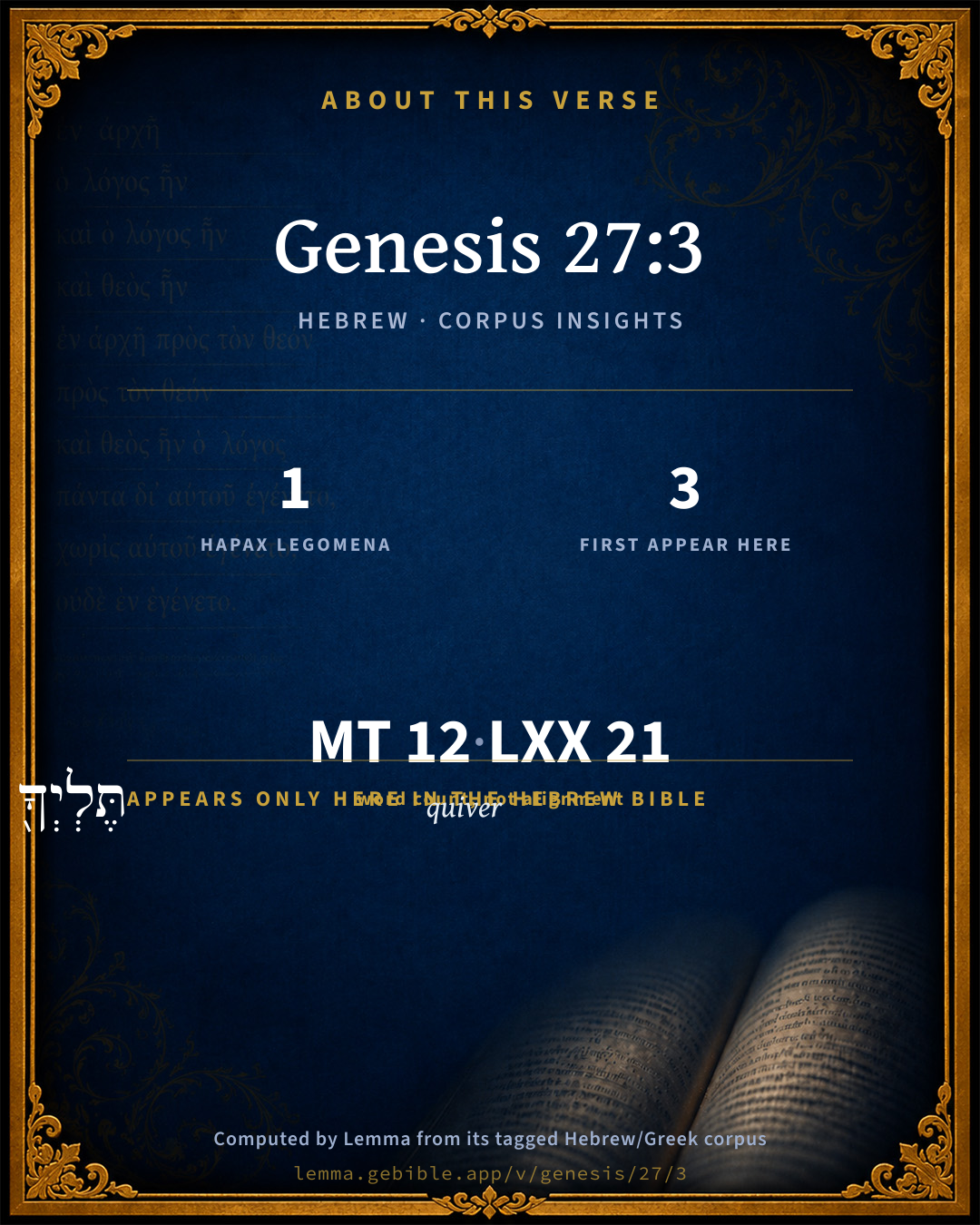
  • 1 hapax legomenon — only here in the Hebrew Bible
  • 3 first appearances in the Hebrew Bible
Full analysis ↓
Download a study sheet

One document with this verse’s original text, its word-by-word gloss line, the meaning frame, cross-references with their text, attributed commentary, and full source and license credits — printable, and it pastes into notes with its structure intact.

This verse Autodidact and up

Study sheet (.html) Plain text (.txt)

A passage Seminary Student

Up to 50 verses in one chapter. A passage sheet keeps up to 6 commentary sources and 12 cross-references per verse, in the order this page ranks them, and says so on the sheet whenever that leaves anything out. Ask for a single verse and you get the Autodidact verse sheet above.

Everything on this page stays free to read, with no account — the sheet is a download of what is already on screen, not access to it.

Want to remove ads? Support Godless Engineer
Compare translations 3

The same verse in 3 English versions, stacked beneath the original-language interlinear above. Click any original word for its lexicon entry.

Each is an independent rendering of the whole verse — the interlinear is not word-aligned to these translations.

Highlighted words mark where these versions differ — a whole-verse word diff, not a word-by-word alignment.

  • World English Bible Public Domain
    Now therefore, please take your weapons, your quiver and your bow, and go out to the field, and take me venison.
  • King James Version Public Domain
    Now therefore take, I pray thee, thy weapons, thy quiver and thy bow, and go out to the field, and take me some venison;
  • unfoldingWord Literal Text CC BY-SA 4.0
    So now, please take your weapons, your quiver, and your bow, and go out the field and hunt game for me.

unfoldingWord Literal Text — © unfoldingWord, licensed CC BY-SA 4.0. Word-aligned USFM3 via Door43 (git.door43.org/unfoldingWord/en_ult).

Versions to compare (up to 4)

3 of 4 selected

Show all 18 translations

Every available English version of this verse, each an independent rendering of the whole verse.

  • World English Bible Public Domain
    Now therefore, please take your weapons, your quiver and your bow, and go out to the field, and take me venison.
  • Berean Standard Bible Public Domain
    Take your weapons—your quiver and bow—and go out into the field to hunt some game for me.
  • Majority Standard Bible Public Domain
    Take your weapons—your quiver and bow—and go out into the field to hunt some game for me.
  • King James Version Public Domain
    Now therefore take, I pray thee, thy weapons, thy quiver and thy bow, and go out to the field, and take me some venison;
  • American Standard Version (1901) Public Domain
    Now therefore take, I pray thee, thy weapons, thy quiver and thy bow, and go out to the field, and take me venison.
  • Revised Version (1885) Public Domain
    Now therefore take, I pray thee, thy weapons, thy quiver and thy bow, and go out to the field, and take me venison;
  • Geneva Bible (1599) Public Domain
    Wherefore nowe, I pray thee take thine instruments, thy quiuer and thy bowe, and get thee to the fielde, that thou mayest take mee some venison.
  • Douay-Rheims (1899) Public Domain
    Take thy arms, thy quiver, and bow, and go abroad: and when thou hast taken some thing by hunting,
  • Young's Literal Translation Public Domain
    and now, take up, I pray thee, thy instruments, thy quiver, and thy bow, and go out to the field, and hunt for me provision,
  • Literal Standard Version CC BY-SA 4.0
    and now, please take up your instruments, your quiver, and your bow, and go out to the field, and hunt provision for me,
  • Unlocked Literal Bible CC BY-SA 4.0
    Therefore take your weapons, your quiver and your bow, and go out to the field and hunt game for me.
  • unfoldingWord Literal Text CC BY-SA 4.0
    So now, please take your weapons, your quiver, and your bow, and go out the field and hunt game for me.
  • Darby Bible Public Domain
    And now, I pray thee, take thy weapons, thy quiver and thy bow, and go out to the field and hunt me venison,
  • World Messianic Bible Public Domain
    Now therefore, please take your weapons, your quiver and your bow, and go out to the field, and get me venison.
  • Webster's Bible Public Domain
    Now therefore take, I pray thee, thy weapons, thy quiver and thy bow, and go out to the field, and take me some venison;
  • Free Bible Version CC BY-SA 4.0
    So please take your bow and arrows and go hunting in the countryside for some meat for me.
  • Bible in Basic English Public Domain
    So take your arrows and your bow and go out to the field and get meat for me;
  • JPS Tanakh (1917) Public Domain
    Now therefore take, I pray thee, thy weapons, thy quiver and thy bow, and go out to the field, and take me venison;

Literal Standard Version (2020), Covenant Press — licensed CC BY-SA 4.0. Text via the HelloAO Bible API (eBible.org). Unlocked Literal Bible (unfoldingWord) — licensed CC BY-SA 4.0. Text via the HelloAO Bible API (eBible.org). unfoldingWord Literal Text — © unfoldingWord, licensed CC BY-SA 4.0. Word-aligned USFM3 via Door43 (git.door43.org/unfoldingWord/en_ult). Free Bible Version, Dr. Jonathan Gallagher — licensed CC BY-SA 4.0. Text via the HelloAO Bible API (eBible.org).

Word by word

More ways to search: Search by grammar → Find every occurrence → Compare this word →

Practice this passage: Drill this verse → Learn its vocabulary →

תֶּלְיְךָ֖
tᵉlîy
H8522
“quiver · your”
Noun, Common, Masculine, Singular, Construct + Suffix, Personal, 2nd Person, Masculine, Singular
Part of Speech
Noun
Type
Common
Gender
Masculine
Number
Singular
State
Construct
Full BDB Definition

Origin: probably from H8518

TWOT: 2512a

quiver - quiver (with its arrows) - quiver (as hanging from shoulder)
  1. וְעַתָּה֙ ʻattâh H6258 “and · now” Conjunction + Adverb
  2. שָׂא nâsâʼ H5375 “lift” Verb, Qal, Imperative, 2nd Person, Masculine, Singular
  3. נָ֣א nâʼ H4994 “please” Particle, Exhortation
  4. כֵלֶ֔יךָ kᵉlîy H3627 “vessels · your” Noun, Common, Masculine, Plural, Construct + Suffix, Personal, 2nd Person, Masculine, Singular
  5. וְקַשְׁתֶּ֑ךָ qesheth H7198 “and · bow · your” Conjunction + Noun, Common, Feminine, Singular, Construct + Suffix, Personal, 2nd Person, Masculine, Singular
  6. וְצֵא֙ yâtsâʼ H3318 “and · go out” Conjunction + Verb, Qal, Imperative, 2nd Person, Masculine, Singular
  7. הַשָּׂדֶ֔ה sâdeh H7704 “the · field” Particle, Definite Article + Noun, Common, Masculine, Singular, Absolute
  8. וְצ֥וּדָה tsûwd H6679 “and · hunt” Conjunction + Verb, Qal, Imperative, 2nd Person, Masculine, Singular + Suffix, h
  9. צידה tsêydâh H6720 “provision” Noun, Common, Both, Singular, Absolute
  10. צָֽיִד tsêydâh H6720 “provision” Noun, Common, Both, Singular, Absolute

About this verse

These counts appear in no published source. They are computed here, from the morphology-tagged text and Lemma’s own curated glosses. What Lemma adds →

12
words
10
distinct lemmas
Pentateuch
section

Notable vocabulary

1 hapax legomenon — a word that appears only here in the entire Hebrew Bible:

  • תֶּלְיְךָ֖ quiver H8522

First appearance in Scripture

These words make their first canonical appearance in the Hebrew Bible here:

  • תֶּלְיְךָ֖ quiver H8522
  • וְצ֥וּדָה to hunt H6679
  • צידה provision H6720

Shared distinctive vocabulary

צידה provision H6720 occurs in 11 verses of the Hebrew Bible. Also found in:

Grammatical profile

  • 3 verbs
  • 6 nouns
  • 1 preposition
  • 1 adverb
  • 1 particle

Verb forms

  • שָׂא Qal · Imperative
  • וְצֵא֙ Qal · Imperative
  • וְצ֥וּדָה Qal · Imperative

Repetition

A word recurs within this verse — often emphatic in Hebrew:

  • צידה provision H6720 ×2

Hebrew & Septuagint length

In English translation the verse runs 21 words from the Hebrew and 20 from the Septuagint (LXX English) — closely comparable.

A rough comparison of the two English renderings, which tokenize alike — not a word-level alignment.

Word counts can differ between the Hebrew and the Greek without any difference in meaning — e.g. the Hebrew direct-object marker אֵת has no separate Greek word, and Greek often adds the article ὁ.

In the original languages it is 12 Hebrew tokens and 21 Greek tokens — but the two are counted differently (Hebrew bundles its prefixes and suffixes into one token; the Greek is in lemma form), so that isn’t a like-for-like length.

Cross-references

3

Topical passages linked to Genesis 27:3 in the Treasury of Scripture Knowledge — connected by theme and wording, ordered by reader-vote popularity; previews shown in the World English Bible.

  • Genesis 25:27–28 The boys grew. Esau was a skillful hunter, a man of the field. Jacob was a quiet man, living in tents.
  • Genesis 10:9 He was a mighty hunter before Yahweh. Therefore it is said, "Like Nimrod, a mighty hunter before Yahweh."
  • 1 Corinthians 6:12 "All things are lawful for me," but not all things are expedient. "All things are lawful for me," but I will not be brought under the power of anything.

Cross-references courtesy of OpenBible.info (CC BY 4.0).

Hebrew and Greek witnesses Masoretic Hebrew ↔ Greek Septuagint

The same verse in the two great witnesses to the Old Testament, shown verse-for-verse.

These are two independent witnesses, not word-aligned to each other, and the Septuagint is shown in lemma (dictionary) form.

Hebrew Genesis 27:3 Masoretic · Westminster Leningrad Codex

וְעַתָּה֙ שָׂא נָ֣א כֵלֶ֔יךָ תֶּלְיְךָ֖ וְקַשְׁתֶּ֑ךָ וְצֵא֙ הַשָּׂדֶ֔ה וְצ֥וּדָה לִּ֖י צידה צָֽיִד

Now therefore, please take your weapons, your quiver and your bow, and go out to the field, and take me venison.

World English Bible · Public Domain

Greek LXX Genesis 27:3 Septuagint · lemma form

νῦν οὖν λαμβάνω ὁ σκεῦος σύ ὁ τε φαρέτρα καί ὁ τόξον καί ἐκἔρχομαι εἰς ὁ πεδίον καί θηρεύω ἐγώ θήρα

Now then take the weapons, both your quiver and your bow, and go into the plain, and get me venison,

LXX2012 (modern English Septuagint) · Public Domain

On this verse, Adam Clarke's Commentary discusses the Septuagint’s reading. Read the note in Commentary ↓

Hebrew: Westminster Leningrad Codex (CC BY 4.0). Greek: Septuagint (public domain); English from LXX2012 (modern English Septuagint) (Public Domain). How the Septuagint differs from the Hebrew →

Targum (Aramaic paraphrase)

2

The Targum is the ancient Jewish Aramaic paraphrase of the Hebrew Scriptures — an interpretive translation, not the Hebrew text itself. Onkelos (literal) and Pseudo-Jonathan (expansive) render the Torah, and Jonathan the Prophets. Coverage is partial: where no permissively-licensed English translation exists for a verse, only the Aramaic is shown. This is verse-level text, not a word-by-word alignment to the Hebrew.

  1. Targum Onkelos Torah (Genesis–Deuteronomy)
    וּכְעַן סַב כְּעַן זֵינָךְ סַיְפָךְ וְקַשְׁתָּךְ וּפוּק לְחַקְלָא וְצוּד לִי צֵידָא

    (no public-domain English translation for this verse)

    Targum Onkelos — Aramaic: “Onkelos Genesis” (public domain); “Onkelos Exodus” (public domain); “Onkelos Leviticus” (public domain); “Onkelos Numbers” (public domain); “Onkelos Deuteronomy” (public domain). English: “Sefaria Community Translation” (CC0 1.0 (public-domain dedication)); “J.W. Etheridge. The Targums of Onkelos and Jonathan Ben Uzziel on the Pentateuch. London: Longmans, Green, 1862” (public domain). Text via Sefaria.

  2. Targum Pseudo-Jonathan Torah (Genesis–Deuteronomy)
    וּכְדוֹן סַב כְּדוֹן מָאנִי זִינָךְ בֵּית גִירַךְ וְקַשְׁתָּךְ וּפוּק לְחַקְלָא וְצוּד לִי צֵידָא

    but now take thy weapons, thy quiver and thy bow; and go forth into the field, and take me venison,

    Targum Pseudo-Jonathan — Aramaic: “Targum Jonathan on Genesis” (public domain); “Targum Jonathan on Exodus” (public domain); “Targum Jonathan on Leviticus” (public domain); “Targum Jonathan on Numbers” (public domain); “Targum Jonathan on Deuteronomy” (public domain). English: “The Targum of Jonathan ben Uzziel, trans. J. W. Etheridge, London, 1862” (public domain). Text via Sefaria.

Commentary

Notes on Genesis 27:3 from classic Christian and Jewish commentators (each source and its license shown beneath its notes). The classic Christian expositions comment on the surrounding passage and are grouped to its opening verse, so a note may address several verses; the Jewish commentaries on the Tanakh (Rashi and others) are per-verse, so they appear only where the commentator wrote on this verse.

Lemma curates 59 commentaries, every one of them public domain or Creative Commons licensed, each selected and text-cleaned for this edition rather than reprinted as found. About our sources →

Trapp's Complete Commentary

John Trapp

Gen 27:3 Now therefore take, I pray thee, thy weapons, thy quiver and thy bow, and go out to the field, and take me [some] venison;

Ver. 3. Take me some venison.] It is some blemish to holy Isaac, that he so favoured and loved Esau, and that because he did eat of his venison, or because venison was in his mouth. {Gen 25:28} "All things are lawful for me, but I will not be brought under of any thing". {1Co 6:12} It is a shame to a saint, to be a slave to his appetite, that it should be said of him, as it was of Epicurus, Dum palato quid sit optimum iudicat, coeli palatium suspexit. {a}

{a} Ennius

John Trapp, A Commentary or Exposition upon All the Books of the Old and New Testament (1647–1656) — public domain. Text from a community e-Sword module.

Joseph Benson's Commentary

Gen 27:3. Take me some venison — In this Isaac designed, not so much the refreshment of his own spirits, as the receiving a fresh instance of his son’s filial duty and affection to him, before he bestowed the designed favour upon him. That my soul may bless thee before I die — May confer my solemn, extraordinary, and prophetic blessing, and thereby may declare and constitute thee the heir of all the blessings bestowed by God upon me and my fathers. For it was no common blessing that Isaac meant for Esau, but that important patriarchal benediction which chiefly related to the peculiar and extraordinary covenant which God entered into with Abraham, to be a God to him and his seed, and to give them the land of Canaan, and in particular to that fundamental part of it, that the Messiah should be of his seed, and bless all the families of the earth. Isaac, out of a fond affection for Esau, endeavoured to entail this blessing on him, unmindful of the oracle that the elder should serve the younger.

Joseph Benson's Commentary on the Old and New Testaments (1811–1818) — public domain. Text from a community e-Sword module.

Tyndale Open Study Notes

Tyndale Open Resources

27:3-4 Like Esau, Isaac allowed his palate to govern his heart (cp. 25:28-34).

Tyndale Open Study Notes — © Tyndale Open Resources, licensed CC BY-SA 4.0. Text via the HelloAO Bible API.

Geneva Bible (1599)

Geneva Bible translators

Hebrew, hunt.

Geneva Bible (1599) marginal notes — public domain. Text via Bolls.life.

Adam Clarke's Commentary

Verse 3. Thy weapons] The original word כלי keley signifies vessels and instruments of any kind; and is probably used here for a hunting spear, javelin, sword, c.

Quiver] תלי teli, from תלה talah, to hang or suspend. Had not the Septuagint translated the word φαρετραν, and the Vulgate pharetram, a quiver, I should rather have supposed some kind of shield was meant but either can be suspended on the arm or from the shoulder. Some think a sword is meant; and because the original signifies to hang or suspend, hence they think is derived our word hanger, so called because it is generally worn in a pendent posture; but the word hanger did not exist in our language previously to the Crusades, and we have evidently derived it from the Persian [Persian] khanjar, a poniard or dagger, the use of which, not only in battles, but in private assassinations, was well known.

Adam Clarke's Commentary on the Bible (1810–1826) — public domain. Text from a community e-Sword/MySword module.

Ellicott's Commentary for English Readers

(3) Thy quiver.—This word does not occur elsewhere, and is rendered in the Targum and Syriac a sword. As it is derived from a root signifying to hang, it probably means, like our word hanger, a sort of knife; but all that we can say for certain is that it was some sort of hunting implement.

Take me some venison.—The Heb. is hunt me a hunting. “Venison,” the Latin venatio, means anything taken by hunting.

A Bible Commentary for English Readers, edited by Charles John Ellicott (1878–1897) — public domain. Text from a community e-Sword module.

The Cambridge Bible for Schools and Colleges

gen. ed. J. J. S. Perowne

3. thy weapons] The quiver and bow are the huntsman’s weapons. Esau as “a man of the field” (Gen_25:27) is to go out “to the field,” i.e. the open country. Targum of Onkelos, “thy sword and thy bow”; cf. Gen_48:22.

The Cambridge Bible for Schools and Colleges (gen. ed. J. J. S. Perowne; Cambridge University Press, 1878–1918) — public domain. Text from a community e-Sword module.

John Gill's Exposition

Now therefore, take, I pray thee, thy weapons,.... Or "thy vessels", or "instruments" (n), his instruments of hunting: as

thy quiver and thy bow; the former is the vessel or instrument, in which arrows were put and carried, and has its name in the Hebrew language from its being hung at the girdle, though another word is more commonly used for a quiver; and Onkelos and Jarchi interpret this of a sword; and which is not disapproved of by Aben Ezra and Ben Melech, who explain it either a quiver or a sword; and the latter was as necessary for hunting as the former, see Gen 27:40; and such a sword may be meant, as Mr. Fuller observes (o), which we call a "hanger" (i.e. a small sword often worn by seamen); and of the bow being an instrument of hunting, not anything need be said:

and go out to the field, and take me some venison; this does not necessarily intend what we commonly call so, but anything hunted in the field, as hares, wild goats, &c. and indeed the latter seems to be what Isaac loved, by the preparation Rebekah afterwards made.

(n) "instrumenta tua", Pagninus, Montanus, Tigurine version, Junius & Tremellius, Piscator; "vasa tua", Vatablus. (o) Miscell. Sacr. l. 1. c. 17.

John Gill's Exposition of the Whole Bible (1746–1763) — public domain (CC PDM 1.0). Text via the HelloAO Bible API.

Matthew Poole's English Annotations

Thy quiver, or, as the Chaldee and Hebrew doctors render it, thy sword; a weapon no less necessary for a hunter of beasts than a bow.

Matthew Poole's English Annotations on the Holy Bible (1683–1685) — public domain. Text from a community e-Sword/MySword module.

Whedon's Commentary on the Bible

Daniel D. Whedon

3. Take me some venison — Hebrews, Hunt for me a hunting. The word does not necessarily mean venison, but any kind of edible game taken by hunting. See Pro_12:27.

Daniel D. Whedon (gen. ed.), Commentary on the Old and New Testaments (1874–1909) — public domain. Text from a community e-Sword module.

The Pulpit Commentary

Now therefore take, I pray thee, thy weapons, the word "weapon" signifying a utensil, vessel, or finished instrument of any sort. (cf. Gen_14:5 Gen_31:37 Gen_45:20) Here it manifestly denotes weapons employed in hunting, and in particular those next specifiedthy quiver the apax legomenon, yliT: from hlT to hang, properly is "that which is suspended;" hence a quiver, faretran (LXX), pharetram (Vulgate), which commonly depends from the shoulders or girdle (Aben Ezra, Rosenm Keil, Kalisch, et alii), though by some it is rendered "sword" (Onkelos; Syriac)and thy bow, (vide Gen_21:16) and go oat to the field, i.e. the open country inhabited by wild beasts, as opposed to cities, villages, or camps (cf. Gen_25:27) and take me some venison literally, hunt for me hunt ing, i.e. the produce of hunting, as in Gen_25:28.

The Pulpit Commentary (1880–1919), ed. H.D.M. Spence-Jones & Joseph S. Exell — public domain. Text from a community e-Sword module.

John Wesley's Explanatory Notes

Take me some venison that I may; bless thee - Esau must go a hunting and bring some venison. In this he designed not so much the refreshment of his own spirits, as the receiving a fresh instance of his son's, filial duty and affection to him, before he bestowed this favour upon him. That my soul may bless thee before I die - Prayer is the work of the soul, and not of the lips only; as the soul must be employed in blessing God, Psalm ciii, 1, so it must be in blessing ourselves and others: the blessing will not go to the heart, if it do not come from the heart.

John Wesley, Explanatory Notes Upon the Whole Bible (1754–1765) — public domain. Text via the GEBible commentary corpus.

unfoldingWord translationNotes

Door43 World Missions Community

General Information:

Isaac continues giving instructions to his older son Isaac.

your weapons

"your hunting equipment"

your quiver

A quiver is a case for holding arrows. AT: "your quiver of arrows" (See: Assumed Knowledge and Implicit Information)

hunt game for me

"hunt a wild animal for me"

Make delicious food for me, the sort that I love

The word "delicious" refers to something that tastes very good. AT: "Cook for me the tasty meat that I love" (See: Assumed Knowledge and Implicit Information)

bless you

In Bible times, a father would often pronounce a formal blessing on his children.

translationWords

bow and arrow

bless

unfoldingWord translationNotes — © Distant Shores Media and the Door43 World Missions Community, licensed CC BY-SA 4.0. Source: git.door43.org/Door43/en_tn.

Rashi

Rabbi Shlomo Yitzchaki (Rashi)

שא נא — The word שא means sharpen, similar to what שא read in the Mishna (Beitzah 28a) “One may not sharpen the knife in the usual manner but one may sharpen it by passing it (משיאין) over another”. Isaac said to Esau, “Sharpen your knife and slaughter an animal according to the regulations so that you may not give me to eat נבלה” (i.e. the flesh of animal that is not killed according to the ritual rules) (Genesis Rabbah 65:13).

תליך means thy sword which is usually hung (at the side).

צודה לי AND HUNT FOR ME [SOME VENISON] of animals that are ownerless, but not of such as are acquired by theft (literally, by robbery).

Rashi on the Tanakh — English translations: “The Judaica Press complete Tanach with Rashi, translated by A. J. Rosenberg” (CC BY 4.0); “Pentateuch with Rashi's commentary by M. Rosenbaum and A.M. Silbermann, 1929-1934” (public domain); “The Metsudah Tanach series, Lakewood, N.J” (CC BY 4.0); and “The Book of Joshua, Metsudah Publications, 1997” (CC BY 4.0). Text via Sefaria.

Radak

Rabbi David Kimhi (Radak)

ועתה...כליך, the tools you use to hunt with.

תליך וקשתך, now he spelled out the tools in detail. Possibly, there were other hunting instruments in addition to these. תליך, is the quiver in which one keeps the arrows. Onkelos translates it as סיפך, “your sword,” (the ending ך in the word as a personal pronoun.). A sword would also be a tool which is hung in a scabbard, or suspended from one’s belt, so. that the root תלה implied in the word תליך is part of his translation.

וצא השדה, Yitzchok issued this instruction as Esau did not go out hunting on a daily basis.

צידה, spelled with the letter ה, but read as ציד. According to a well known aggadic interpretation the letter ה is an allusion to 5 major halachic requirements in killing an animal to make it fit for consumption by Jews. (compare Torah Shleymah 23)

Radak on the Tanakh — English translations: “Sefaria Community Translation” (CC0 1.0 (public-domain dedication)); “Eliyahu Munk, HaChut Hameshulash” (CC BY 4.0); “Rabbi Mike Feuer, Jerusalem Anthology” (CC BY 4.0); and “R. David Kimhi on the first book of Psalms, Translated by R.G. Finch, London, 1919” (public domain). Text via Sefaria.

Lesson kit

Teaching starters — assembled from the data on this page, not authored interpretation. Every prompt links to the verse data it draws on. Edit before teaching.

Genesis, in the Pentateuch, opens this verse with 12 words (10 distinct Hebrew lemmas). Its most distinctive word is tᵉlîy (“quiver”). A historical commentator’s framing appears above. Read the whole chapter for the surrounding context.

Discussion questions

  1. The word tᵉlîy carries the sense “quiver.” How does it shape the verse?
  2. This verse holds 1 word here found nowhere else in the Hebrew Bible. What might the rare word draw attention to?
  3. 3 words here appear for the first time in Scripture. What is being introduced at this debut?
  4. Genesis 42:25 shares the word «provision» with this verse. How do the two illuminate each other?
  5. “provision” occurs 2× in this one verse. What is the effect of the repetition?
  6. The translations on this page render this verse differently — a whole-verse word diff, not a word-by-word alignment. What might account for the different wordings?
  7. The verb «שָׂא» is Qal Imperative. How does its form color the action?
  8. Reading how Trapp's Complete Commentary and Joseph Benson's Commentary read this verse, where do the two commentators agree and where do they part?

Things to notice

  • 1 word in this verse appears nowhere else in the Hebrew Bible.
  • 3 words make their first canonical appearance in Scripture here.
  • This verse counts 12 Hebrew ↔ 21 Greek words.
  • These translations choose different wording for 8 words in this verse.
  • “provision” occurs 2× in this single verse.

Reading settings

Reading text

Shown beneath each verse's original-language words.

Old Testament
Old Testament edition

Read the OT as the Masoretic Hebrew (MT) or the Greek Septuagint (LXX).

English shown for the Greek Septuagint (in the Hebrew ↔ Greek comparison).

Comparing translations? Open the Compare panel on any verse page to stack up to four side by side.