
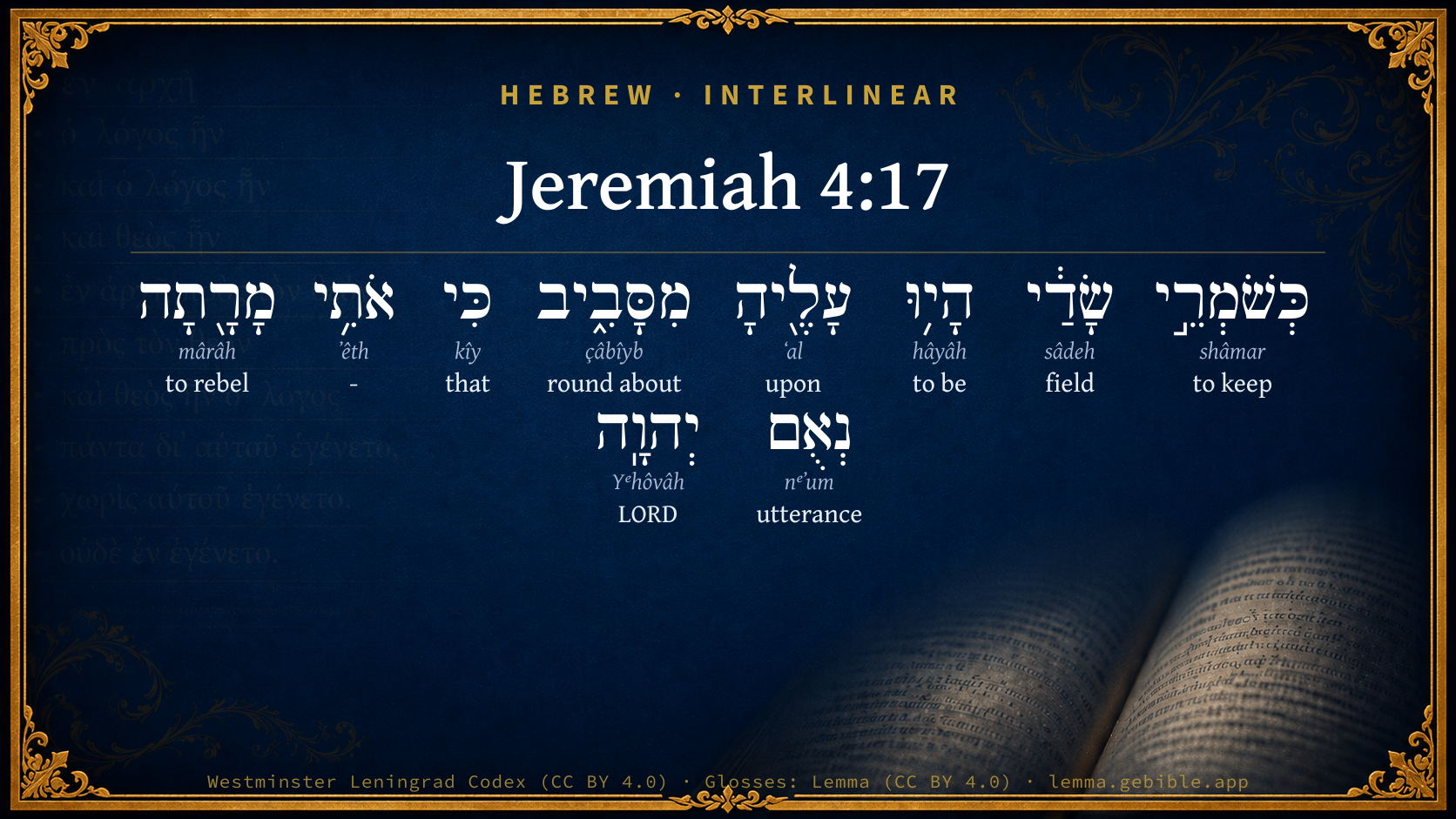
Jeremiah 4:17

Hebrew (Westminster Leningrad Codex) Jeremiah 4:17 appears in the Hebrew Old Testament. The text above is from the Westminster Leningrad Codex. Each word links to its Strong’s number, a concise gloss, and parsing drawn from the Open Scriptures Hebrew Bible morphology. Click any word for its full Brown-Driver-Briggs (BDB) entry.
Download image
Cite this verse

Jeremiah 4:17 (World English Bible). Public Domain. Lemma interlinear Bible study tool, https://lemma.gebible.app/v/jeremiah/4/17.

Show BibTeX & RIS
BibTeX
RIS
English Translation
As keepers of a field are they against her round about, because she has been rebellious against me, says Yahweh.
World English Bible · Public Domain
Download a study sheet

One document with this verse’s original text, its word-by-word gloss line, the meaning frame, cross-references with their text, attributed commentary, and full source and license credits — printable, and it pastes into notes with its structure intact.

This verse Autodidact and up

Study sheet (.html) Plain text (.txt)

A passage Seminary Student

Up to 50 verses in one chapter. A passage sheet keeps up to 6 commentary sources and 12 cross-references per verse, in the order this page ranks them, and says so on the sheet whenever that leaves anything out. Ask for a single verse and you get the Autodidact verse sheet above.

Everything on this page stays free to read, with no account — the sheet is a download of what is already on screen, not access to it.

Want to remove ads? Support Godless Engineer
Compare translations 3

The same verse in 3 English versions, stacked beneath the original-language interlinear above. Click any original word for its lexicon entry.

Each is an independent rendering of the whole verse — the interlinear is not word-aligned to these translations.

Highlighted words mark where these versions differ — a whole-verse word diff, not a word-by-word alignment.

  • World English Bible Public Domain
    As keepers of a field are they against her round about, because she has been rebellious against me, says Yahweh.
  • King James Version Public Domain
    As keepers of a field, are they against her round about; because she hath been rebellious against me, saith the LORD.
  • unfoldingWord Literal Text CC BY-SA 4.0
    Like the watchmen of a field they will be all around against her, since she has been rebellious me —the declaration of Yahweh—

unfoldingWord Literal Text — © unfoldingWord, licensed CC BY-SA 4.0. Word-aligned USFM3 via Door43 (git.door43.org/unfoldingWord/en_ult).

Versions to compare (up to 4)

3 of 4 selected

Show all 18 translations

Every available English version of this verse, each an independent rendering of the whole verse.

  • World English Bible Public Domain
    As keepers of a field are they against her round about, because she has been rebellious against me, says Yahweh.
  • Berean Standard Bible Public Domain
    They surround her like men guarding a field, because she has rebelled against Me,” declares the LORD.
  • Majority Standard Bible Public Domain
    They surround her like men guarding a field, because she has rebelled against Me,” declares the LORD.
  • King James Version Public Domain
    As keepers of a field, are they against her round about; because she hath been rebellious against me, saith the LORD.
  • American Standard Version (1901) Public Domain
    As keepers of a field are they against her round about, because she hath been rebellious against me, saith Jehovah.
  • Revised Version (1885) Public Domain
    As keepers of a field are they against her round about; because she hath been rebellious against me, saith the LORD.
  • Geneva Bible (1599) Public Domain
    They haue compassed her about as the watchmen of the fielde, because it hath prouoked me to wrath, saith the Lord.
  • Douay-Rheims (1899) Public Domain
    They are set round about her, as keepers of fields: because she hath provoked me to wrath, saith the Lord.
  • Young's Literal Translation Public Domain
    As the keepers of a field They have been against her round about, For with Me she hath been rebellious, An affirmation of Jehovah.'
  • Literal Standard Version CC BY-SA 4.0
    As the keepers of a field || They have been against her all around, || For she has been rebellious with Me,” || A declaration of YHWH.
  • Unlocked Literal Bible CC BY-SA 4.0
    They will be like the watchmen of a cultivated field against her all around, since she has been rebellious against me—this is Yahweh's declaration—
  • unfoldingWord Literal Text CC BY-SA 4.0
    Like the watchmen of a field they will be all around against her, since she has been rebellious me —the declaration of Yahweh—
  • Darby Bible Public Domain
    As keepers of a field are they against her round about; for she hath been rebellious against me, saith Jehovah.
  • World Messianic Bible Public Domain
    As keepers of a field, they are against her all around, because she has been rebellious against me,’” says the LORD.
  • Webster's Bible Public Domain
    As keepers of a field they are against her on all sides; because she hath been rebellious against me, saith the LORD.
  • Free Bible Version CC BY-SA 4.0
    They encircle her like men guarding a field, because she has rebelled against me, declares the Lord.
  • Bible in Basic English Public Domain
    Like keepers of a field they are against her on every side; because she has been fighting against me, says the Lord.
  • JPS Tanakh (1917) Public Domain
    As keepers of a field are they against her round about; because she hath been rebellious against Me, saith the LORD.

Literal Standard Version (2020), Covenant Press — licensed CC BY-SA 4.0. Text via the HelloAO Bible API (eBible.org). Unlocked Literal Bible (unfoldingWord) — licensed CC BY-SA 4.0. Text via the HelloAO Bible API (eBible.org). unfoldingWord Literal Text — © unfoldingWord, licensed CC BY-SA 4.0. Word-aligned USFM3 via Door43 (git.door43.org/unfoldingWord/en_ult). Free Bible Version, Dr. Jonathan Gallagher — licensed CC BY-SA 4.0. Text via the HelloAO Bible API (eBible.org).

Word by word

More ways to search: Search by grammar → Find every occurrence → Compare this word →

Practice this passage: Drill this verse → Learn its vocabulary →

מָרָ֖תָה
mârâh
H4784
“to rebel”
Verb, Qal, Perfect, 3rd Person, Feminine, Singular
Part of Speech
Verb
Stem
Qal
Form
Perfect
Person
3rd Person
Gender
Feminine
Number
Singular
Full BDB Definition

Origin: a primitive root

TWOT: 1242

to be contentious, be rebellious, be refractory, be disobedient towards, be rebellious against - (Qal) to be disobedient, be rebellious - towards father - towards God - (Hiphil) to show rebelliousness, show disobedience, disobey
  1. כְּשֹׁמְרֵ֣י shâmar H8104 “like/as · keeping” Preposition + Verb, Qal, Participle Active, Masculine, Plural, Construct
  2. שָׂדַ֔י sâdeh H7704 “field” Noun, Common, Masculine, Singular, Absolute
  3. הָי֥וּ hâyâh H1961 “to be” Verb, Qal, Perfect, 3rd Person, Common, Plural
  4. עָלֶ֖יהָ ʻal H5921 “upon · her” Preposition + Suffix, Personal, 3rd Person, Feminine, Singular
  5. מִסָּבִ֑יב çâbîyb H5439 “from · round about” Preposition + Noun, Common, Both, Singular, Absolute
  6. כִּי kîy H3588 “that” Conjunction
  7. אֹתִ֥י ʼêth H853 “- · me” Particle, Direct Object + Suffix, Personal, 1st Person, Common, Singular
  8. נְאֻם nᵉʼum H5002 “utterance of” Noun, Common, Masculine, Singular, Construct
  9. יְהוָֽה Yᵉhôvâh H3068 “LORD” Noun, Proper

About this verse

These counts appear in no published source. They are computed here, from the morphology-tagged text and Lemma’s own curated glosses. What Lemma adds →

10
words
10
distinct lemmas
Prophets
section

Shared distinctive vocabulary

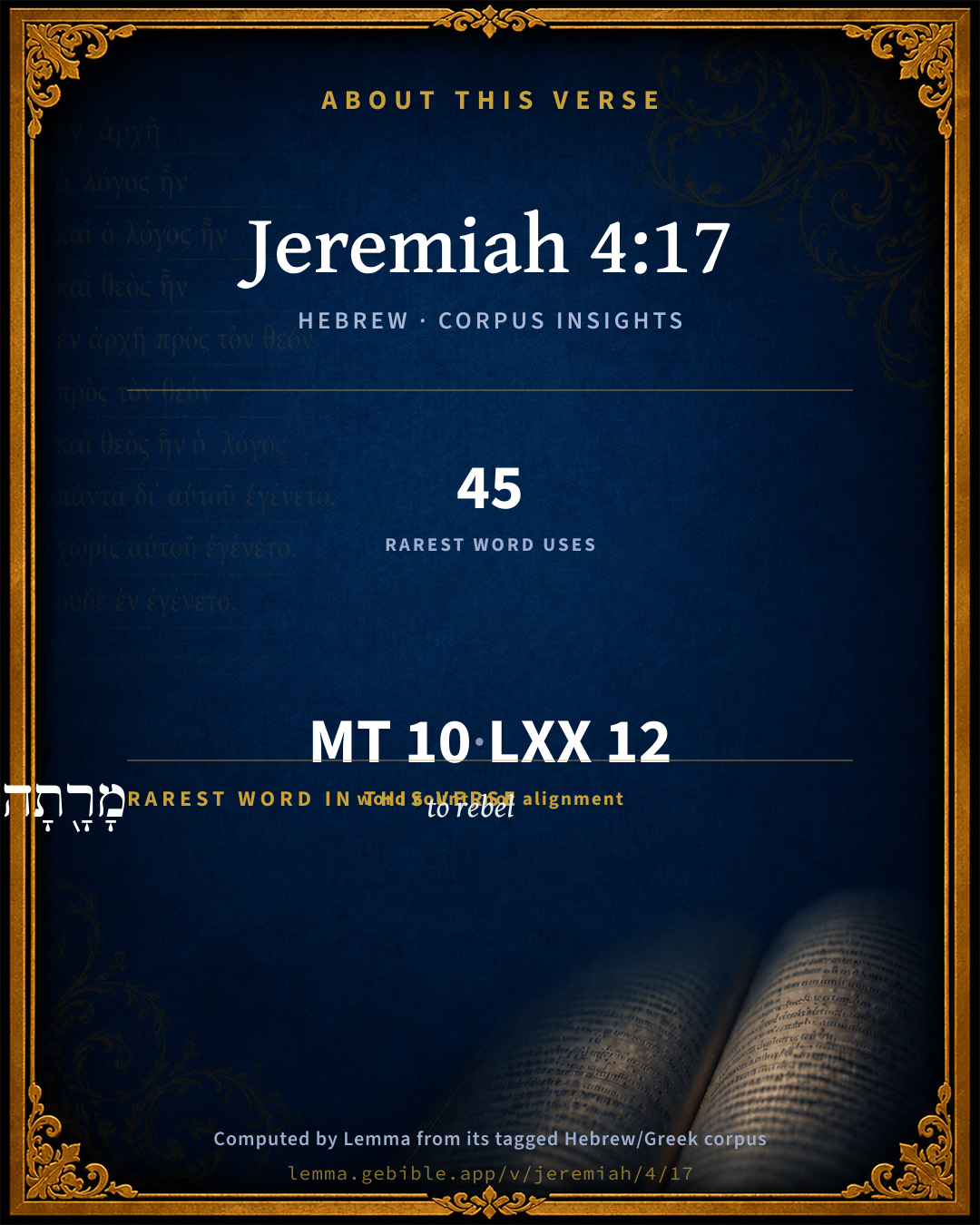
מָרָ֖תָה to rebel H4784 occurs in 44 verses of the Hebrew Bible. Also found in:

Grammatical profile

  • 3 verbs
  • 4 nouns
  • 1 preposition
  • 1 conjunction
  • 1 particle

Verb forms

  • כְּשֹׁמְרֵ֣י Qal · Participle Active
  • הָי֥וּ Qal · Perfect
  • מָרָ֖תָה Qal · Perfect

Hebrew & Septuagint length

In the original languages it is 10 Hebrew tokens and 12 Greek tokens — but the two are counted differently (Hebrew bundles its prefixes and suffixes into one token; the Greek is in lemma form), so that isn’t a like-for-like length.

Cross-references

14

Topical passages linked to Jeremiah 4:17 in the Treasury of Scripture Knowledge — connected by theme and wording, ordered by reader-vote popularity; previews shown in the World English Bible.

  • Jeremiah 5:23 But this people has a revolting and a rebellious heart; they are revolted and gone.
  • 2 Kings 25:1–4 It happened in the ninth year of his reign, in the tenth month, in the tenth day of the month, that Nebuchadnezzar king of Babylon came, he and all his army, against Jerusalem, and encamped against it; and they built forts against it round about.
  • Nehemiah 9:26 Nevertheless they were disobedient, and rebelled against you, and cast your law behind their back, and killed your prophets that testified against them to turn them again to you, and they committed awful blasphemies.
  • Nehemiah 9:30 Yet many years did you bear with them, and testified against them by your Spirit through your prophets: yet would they not give ear: therefore gave you them into the hand of the peoples of the lands.
  • Isaiah 1:8 The daughter of Zion is left like a shelter in a vineyard, Like a hut in a field of melons, Like a besieged city.
  • Isaiah 1:20–23 But if you refuse and rebel, you shall be devoured with the sword; For the mouth of Yahweh has spoken it."
  • Isaiah 30:9 For it is a rebellious people, lying children, children who will not hear the law of Yahweh;
  • Jeremiah 6:2–3 The comely and delicate one, the daughter of Zion, will I cut off.
  • Lamentations 1:8 Jerusalem has grievously sinned; therefore she is become as an unclean thing; All who honored her despise her, because they have seen her nakedness: Yes, she sighs, and turns backward.
  • Lamentations 1:18 Yahweh is righteous; for I have rebelled against his commandment: Please hear all you peoples, and see my sorrow: My virgins and my young men are gone into captivity.
  • Ezekiel 2:3–7 He said to me, Son of man, I send you to the children of Israel, to nations that are rebellious, which have rebelled against me: they and their fathers have transgressed against me even to this very day.
  • Daniel 9:7–19 Lord, righteousness belongs to you, but to us confusion of face, as at this day; to the men of Judah, and to the inhabitants of Jerusalem, and to all Israel, who are near, and who are far off, through all the countries where you have driven them, because of their trespass that they have trespassed against you.
  • Luke 19:43–44 For the days will come on you, when your enemies will throw up a barricade against you, surround you, hem you in on every side,
  • Luke 21:20–24 "But when you see Jerusalem surrounded by armies, then know that its desolation is at hand.

Cross-references courtesy of OpenBible.info (CC BY 4.0).

Hebrew and Greek witnesses Masoretic Hebrew ↔ Greek Septuagint

The same verse in the two great witnesses to the Old Testament, shown verse-for-verse.

These are two independent witnesses, not word-aligned to each other, and the Septuagint is shown in lemma (dictionary) form.

Hebrew Jeremiah 4:17 Masoretic · Westminster Leningrad Codex

כְּשֹׁמְרֵ֣י שָׂדַ֔י הָי֥וּ עָלֶ֖יהָ מִסָּבִ֑יב כִּי אֹתִ֥י מָרָ֖תָה נְאֻם יְהוָֽה

As keepers of a field are they against her round about, because she has been rebellious against me, says Yahweh.

World English Bible · Public Domain

Greek LXX Structure differs

In the Septuagint, Jeremiah is about an eighth shorter than the Hebrew and arranges its material differently — the Oracles Against the Nations (Hebrew chapters 46–51) appear in the middle of the Greek book, after 25:13. Because the chapter and verse boundaries do not line up, a verse-for-verse comparison with the Hebrew is not shown.

A verse-for-verse comparison isn’t shown here because the chapters and verses don’t line up. Switch to the LXX edition with the MT / LXX toggle above to read the Greek directly.

Hebrew: Westminster Leningrad Codex (CC BY 4.0). Greek: Septuagint (public domain); English from a public-domain English Septuagint. How the Septuagint differs from the Hebrew →

Targum (Aramaic paraphrase)

1

The Targum is the ancient Jewish Aramaic paraphrase of the Hebrew Scriptures — an interpretive translation, not the Hebrew text itself. Onkelos (literal) and Pseudo-Jonathan (expansive) render the Torah, and Jonathan the Prophets. Coverage is partial: where no permissively-licensed English translation exists for a verse, only the Aramaic is shown. This is verse-level text, not a word-by-word alignment to the Hebrew.

  1. Targum Jonathan Prophets (Joshua–Malachi)
    כְּנַטְרֵי חַקְלָן הֲווֹ עֲלָהּ מִסְחוֹר סְחוֹר אֲרֵי עַל מֵימְרִי סָרֵיבְתְּ אֲמַר יְיָ:

    (no public-domain English translation for this verse)

    Targum Jonathan — Aramaic: “Mikraot Gedolot” (public domain). English: “Sefaria Community Translation” (CC0 1.0 (public-domain dedication)); “London "Chaldee Paraphrase," 1871” (public domain). Text via Sefaria.

Commentary

Notes on Jeremiah 4:17 from classic Christian and Jewish commentators (each source and its license shown beneath its notes). The classic Christian expositions comment on the surrounding passage and are grouped to its opening verse, so a note may address several verses; the Jewish commentaries on the Tanakh (Rashi and others) are per-verse, so they appear only where the commentator wrote on this verse.

Lemma curates 59 commentaries, every one of them public domain or Creative Commons licensed, each selected and text-cleaned for this edition rather than reprinted as found. About our sources →

Trapp's Complete Commentary

John Trapp

Jer 4:17 As keepers of a field, are they against her round about; because she hath been rebellious against me, saith the LORD.

Ver. 17. As keepers of a field, are they against her.] They have straitly besieged her, so that there is no escaping their hands.

John Trapp, A Commentary or Exposition upon All the Books of the Old and New Testament (1647–1656) — public domain. Text from a community e-Sword module.

Tyndale Open Study Notes

Tyndale Open Resources

4:17-18 The foreign armies already surrounded the capital city. The impending attack was due to the people’s rebellion against the Lord.

Tyndale Open Study Notes — © Tyndale Open Resources, licensed CC BY-SA 4.0. Text via the HelloAO Bible API.

Geneva Bible (1599)

Geneva Bible translators

Which keep the fruits so straightly, that nothing can come in nor out: so should the Babylonians compass Judah.

Geneva Bible (1599) marginal notes — public domain. Text via Bolls.life.

Jamieson, Fausset & Brown

Robert Jamieson, A. R. Fausset & David Brown

keepers of a field--metaphor from those who watch a field, to frighten away the wild beasts.

Jamieson, Fausset & Brown — Commentary Critical and Explanatory on the Whole Bible (1871) — public domain (CC PDM 1.0). Text via the HelloAO Bible API.

Adam Clarke's Commentary

Verse 17. As keepers of a field] In the eastern countries grain is often sown in the open country; and, when nearly ripe, guards are placed at different distances round about it to preserve it from being plundered. Jerusalem was watched, like one of these fields, by guards all round about it; so that none could enter to give assistance, and none who wished to escape were permitted to go out.

Adam Clarke's Commentary on the Bible (1810–1826) — public domain. Text from a community e-Sword/MySword module.

John Calvin's Commentaries

He intimates here that there would be no escape to the Jews when God brought the Chaldeans, for every egress, all the ways, would be closed up, so that they could not migrate to another land. It is the same as though he had said, that such a calamity was nigh them that they could not escape it by exile, it is indeed a sad thing when men flee away naked as from the fire, and seek a place among strangers, and live there in misery and want; but the Prophet declares here, that so grievous was the punishment prepared for the Jews, that it would not indeed be possible for them to save themselves by expatriation and flight, for God would close up every avenue, and would as it were set guards to prevent any to depart.

He afterwards assigns a reason for this, Because they have made me angry The Prophet again shews that God dealt not cruelly with the Jews, nor that they were visited by chance with so many and so grievous calamities, but that they suffered justly, for they had provoked the wrath of God. It would indeed have availed the Jews but little that they dreaded an approaching evil, except they acknowledged that God was punishing them for their perverseness. Hence the reason is stated: it was mentioned, that the Jews might know that these calamities were brought on them by God’s hand. And for the same purpose is what follows —

John Calvin's Commentaries (1540-1563) — public domain. Text from the Calvin Translation Society English edition (1840s-50s) via the Christian Classics Ethereal Library (ccel.org). Calvin's coverage is partial (roughly two-thirds of the Bible); uncommented books and verses are honest gaps, never fabricated. The 19th-century editor's footnotes and remarks are omitted so the notes are faithfully Calvin's own voice.

Ellicott's Commentary for English Readers

(17) Field.—With the meaning, as in all early English, of “open,” not “enclosed,” country (Lev_14:7; Lev_17:5). The image is that of a nomadic tribe encamped in the open country, or of men watching their flocks (Luk_2:8) or crops (Job_27:18). So shall be the tents of the invaders round Jerusalem—keeping, or (as in 2Sa_11:16) “observing,” i.e., “blockading” the city.

A Bible Commentary for English Readers, edited by Charles John Ellicott (1878–1897) — public domain. Text from a community e-Sword module.

The Cambridge Bible for Schools and Colleges

gen. ed. J. J. S. Perowne

17. As keepers of a field] If the MT. stands, the point of comparison will lie in the improvised shelters put up by guardians of cattle in the open country and those put up now by the besiegers round the city. Cp. Job_27:18; 2Sa_11:11. But by an inconsiderable change we can translate, they (the enemy) are lying in wait on the fields round about. So Co.

The Cambridge Bible for Schools and Colleges (gen. ed. J. J. S. Perowne; Cambridge University Press, 1878–1918) — public domain. Text from a community e-Sword module.

John Gill's Exposition

As keepers of a field, are they against her round about,.... As those that are set to watch a field, in which are fruit and corn of any sort, that thieves and robbers, and wild beasts, may not enter to waste and destroy, and are placed on all sides for that purpose; so the Chaldeans were round about Jerusalem, that none could make their escape out of it; see Kg2 25:4,

because she hath been rebellious against me, saith the Lord; it was not without reason that the Lord suffered the Chaldeans to come against Jerusalem, besiege, and take it; the inhabitants of it had rebelled against him, their King and their God; and therefore he delivers them up into the hands of another lord, and a cruel one; they had provoked him to anger with their sins, and caused him to stir up his wrath against them in this way: rebellion against a prince, or against a parent, is a provoking sin; see Sa1 15:23.

John Gill's Exposition of the Whole Bible (1746–1763) — public domain (CC PDM 1.0). Text via the HelloAO Bible API.

Albert Barnes' Notes on the Bible

Jeremiah compares the tents of the besiegers on guard round Jerusalem to the booths erected by shepherds or farmers for the protection of their flocks or produce.

Albert Barnes' Notes on the Bible (1834–1885) — public domain. Text from a community e-Sword/MySword module.

Matthew Poole's English Annotations

They will strictly besiege her, as keepers of a field will be careful who go in and who go out, Zec 12:2; they will watch that none go in to relieve them, and also that none get out to escape: see 2Ch 16:1.

Because she hath been rebellious: God doth not threaten his judgments only, but he labours to convince them that there is a sufficient reason for it, both here and in the next verse.

Matthew Poole's English Annotations on the Holy Bible (1683–1685) — public domain. Text from a community e-Sword/MySword module.

Whedon's Commentary on the Bible

Daniel D. Whedon

17. Keepers of a field — As fields in Palestine were not enclosed, they had to be watched. The huts, or lodges, of these “keepers” might be seen in every direction commanding views of the entire country. Hence the comparison of this verse.

Daniel D. Whedon (gen. ed.), Commentary on the Old and New Testaments (1874–1909) — public domain. Text from a community e-Sword module.

The Pulpit Commentary

As keepers of a field. The prophet compares the tents, or perhaps the booths, (1Ki_20:12, 1Ki_20:16) of the besieging army to the booths of the guardians of the crepe. (Isa_1:8 Job_27:18)

The Pulpit Commentary (1880–1919), ed. H.D.M. Spence-Jones & Joseph S. Exell — public domain. Text from a community e-Sword module.

John Wesley's Explanatory Notes

As keepers - They will watch that none relieve them, and that none get out to escape.

John Wesley, Explanatory Notes Upon the Whole Bible (1754–1765) — public domain. Text via the GEBible commentary corpus.

Rashi

Rabbi Shlomo Yitzchaki (Rashi)

a field like שדה, a field.

for she has rebelled against me She has provoked Me. Comp. (Deut. 9: 24) “You have been rebellious (ממרים),” provoking.

Rashi on the Tanakh — English translations: “The Judaica Press complete Tanach with Rashi, translated by A. J. Rosenberg” (CC BY 4.0); “Pentateuch with Rashi's commentary by M. Rosenbaum and A.M. Silbermann, 1929-1934” (public domain); “The Metsudah Tanach series, Lakewood, N.J” (CC BY 4.0); and “The Book of Joshua, Metsudah Publications, 1997” (CC BY 4.0). Text via Sefaria.

Lesson kit

Teaching starters — assembled from the data on this page, not authored interpretation. Every prompt links to the verse data it draws on. Edit before teaching.

Jeremiah, in the Prophets, opens this verse with 10 words (10 distinct Hebrew lemmas). Its most distinctive word is mârâh (“to rebel”). A historical commentator’s framing appears above. Read the whole chapter for the surrounding context.

Discussion questions

  1. What does “to rebel” (mârâh) contribute to the verse as a whole?
  2. How does Numbers 20:10, which shares the word «to rebel», read alongside this verse?
  3. The translations on this page render this verse differently — a whole-verse word diff, not a word-by-word alignment. What might account for the different wordings?
  4. «כְּשֹׁמְרֵ֣י» is a Qal Participle Active verb. How does that grammatical form shape the action described?
  5. Compare how Trapp's Complete Commentary and Tyndale Open Study Notes read this verse. Where do they agree or differ?

Things to notice

Reading settings

Reading text

Shown beneath each verse's original-language words.

Old Testament
Old Testament edition

Read the OT as the Masoretic Hebrew (MT) or the Greek Septuagint (LXX).

English shown for the Greek Septuagint (in the Hebrew ↔ Greek comparison).

Comparing translations? Open the Compare panel on any verse page to stack up to four side by side.