Exodus 16:25

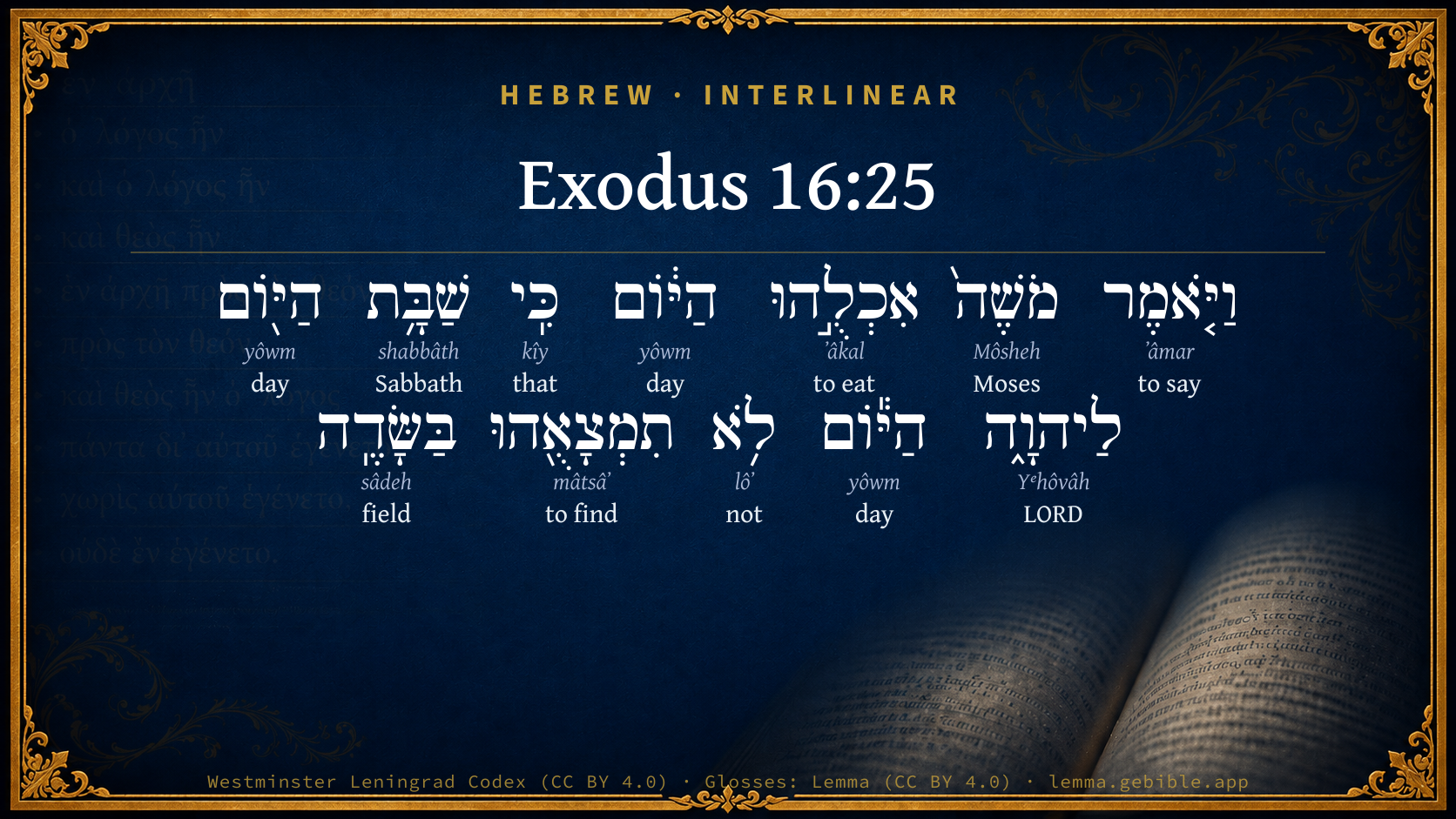
Hebrew (Westminster Leningrad Codex) Exodus 16:25 appears in the Hebrew Old Testament. The text above is from the Westminster Leningrad Codex. Each word links to its Strong’s number, a concise gloss, and parsing drawn from the Open Scriptures Hebrew Bible morphology. Click any word for its full Brown-Driver-Briggs (BDB) entry.
Download image
Cite this verse

Exodus 16:25 (World English Bible). Public Domain. Lemma interlinear Bible study tool, https://lemma.gebible.app/v/exodus/16/25.

Show BibTeX & RIS
BibTeX
RIS
English Translation
Moses said, "Eat that today, for today is a Sabbath to Yahweh. Today you shall not find it in the field.
World English Bible · Public Domain
Download a study sheet

One document with this verse’s original text, its word-by-word gloss line, the meaning frame, cross-references with their text, attributed commentary, and full source and license credits — printable, and it pastes into notes with its structure intact.

This verse Autodidact and up

Study sheet (.html) Plain text (.txt)

A passage Seminary Student

Up to 50 verses in one chapter. A passage sheet keeps up to 6 commentary sources and 12 cross-references per verse, in the order this page ranks them, and says so on the sheet whenever that leaves anything out. Ask for a single verse and you get the Autodidact verse sheet above.

Everything on this page stays free to read, with no account — the sheet is a download of what is already on screen, not access to it.

Want to remove ads? Support Godless Engineer
Compare translations 3

The same verse in 3 English versions, stacked beneath the original-language interlinear above. Click any original word for its lexicon entry.

Each is an independent rendering of the whole verse — the interlinear is not word-aligned to these translations.

Highlighted words mark where these versions differ — a whole-verse word diff, not a word-by-word alignment.

  • World English Bible Public Domain
    Moses said, "Eat that today, for today is a Sabbath to Yahweh. Today you shall not find it in the field.
  • King James Version Public Domain
    And Moses said, Eat that to day; for to day is a sabbath unto the LORD: to day ye shall not find it in the field.
  • unfoldingWord Literal Text CC BY-SA 4.0
    And Moses said, “Eat it today, for it is Sabbath, a day for Yahweh, a day you will not find it in the fields.

unfoldingWord Literal Text — © unfoldingWord, licensed CC BY-SA 4.0. Word-aligned USFM3 via Door43 (git.door43.org/unfoldingWord/en_ult).

Versions to compare (up to 4)

3 of 4 selected

Show all 18 translations

Every available English version of this verse, each an independent rendering of the whole verse.

  • World English Bible Public Domain
    Moses said, "Eat that today, for today is a Sabbath to Yahweh. Today you shall not find it in the field.
  • Berean Standard Bible Public Domain
    “Eat it today,” Moses said, “because today is a Sabbath to the LORD. Today you will not find anything in the field.
  • Majority Standard Bible Public Domain
    “Eat it today,” Moses said, “because today is a Sabbath to the LORD. Today you will not find anything in the field.
  • King James Version Public Domain
    And Moses said, Eat that to day; for to day is a sabbath unto the LORD: to day ye shall not find it in the field.
  • American Standard Version (1901) Public Domain
    And Moses said, Eat that to-day; for to-day is a sabbath unto Jehovah: to-day ye shall not find it in the field.
  • Revised Version (1885) Public Domain
    And Moses said, Eat that today; for today is a sabbath unto the LORD: today ye shall not find it in the field.
  • Geneva Bible (1599) Public Domain
    Then Moses sayde, Eate that to day: for to day is the Sabbath vnto the Lord: to day ye shall not finde it in the fielde.
  • Douay-Rheims (1899) Public Domain
    And Moses said: Eat it to day, because it is the sabbath of the Lord: to day it shall not be found in the field.
  • Young's Literal Translation Public Domain
    And Moses saith, `Eat it to-day, for to-day `is' a sabbath to Jehovah; to-day ye find it not in the field:
  • Literal Standard Version CC BY-SA 4.0
    And Moses says, “Eat it today, for today [is] a Sabbath to YHWH; today you do not find it in the field:
  • Unlocked Literal Bible CC BY-SA 4.0
    Moses said, “Eat that food today, for today is a day reserved as a Sabbath to honor Yahweh. Today you will not find it in the fields.
  • unfoldingWord Literal Text CC BY-SA 4.0
    And Moses said, “Eat it today, for it is Sabbath, a day for Yahweh, a day you will not find it in the fields.
  • Darby Bible Public Domain
    And Moses said, Eat it to-day; for to-day is sabbath to Jehovah: to-day ye shall not find it in the field.
  • World Messianic Bible Public Domain
    Moses said, “Eat that today, for today is a Sabbath to the LORD. Today you shall not find it in the field.
  • Webster's Bible Public Domain
    And Moses said, Eat that to-day; for to-day is a sabbath to the LORD; to-day ye will not find it in the field.
  • Free Bible Version CC BY-SA 4.0
    Moses told them, “Eat it today, because today is a Sabbath to honor the Lord. Today you won't find anything out there.
  • Bible in Basic English Public Domain
    And Moses said, Make your meal today of what you have, for this day is a Sabbath to the Lord: today you will not get any in the fields.
  • JPS Tanakh (1917) Public Domain
    And Moses said: 'Eat that to-day; for to-day is a sabbath unto the LORD; to-day ye shall not find it in the field.

Literal Standard Version (2020), Covenant Press — licensed CC BY-SA 4.0. Text via the HelloAO Bible API (eBible.org). Unlocked Literal Bible (unfoldingWord) — licensed CC BY-SA 4.0. Text via the HelloAO Bible API (eBible.org). unfoldingWord Literal Text — © unfoldingWord, licensed CC BY-SA 4.0. Word-aligned USFM3 via Door43 (git.door43.org/unfoldingWord/en_ult). Free Bible Version, Dr. Jonathan Gallagher — licensed CC BY-SA 4.0. Text via the HelloAO Bible API (eBible.org).

Word by word

More ways to search: Search by grammar → Find every occurrence → Compare this word →

Practice this passage: Drill this verse → Learn its vocabulary →

שַׁבָּ֥ת
shabbâth
H7676
“Sabbath”
Noun, Common, Both, Singular, Absolute
Part of Speech
Noun
Type
Common
Gender
Both
Number
Singular
State
Absolute
Full BDB Definition

Origin: intensive from H7673

TWOT: 2323b

Sabbath - sabbath - day of atonement - sabbath year - week - produce (in sabbath year)
  1. וַיֹּ֤אמֶר ʼâmar H559 “and · to say” Conjunction + Verb, Qal, Sequential Imperfect, 3rd Person, Masculine, Singular
  2. מֹשֶׁה֙ Môsheh H4872 “Moses” Noun, Proper
  3. אִכְלֻ֣הוּ ʼâkal H398 “eat · him” Verb, Qal, Imperative, 2nd Person, Masculine, Plural + Suffix, Personal, 3rd Person, Masculine, Singular
  4. הַיּ֔וֹם yôwm H3117 “the · day” Particle, Definite Article + Noun, Common, Masculine, Singular, Absolute
  5. כִּֽי kîy H3588 “that” Conjunction
  6. הַיּ֖וֹם yôwm H3117 “the · day” Particle, Definite Article + Noun, Common, Masculine, Singular, Absolute
  7. לַיהוָ֑ה Yᵉhôvâh H3068 “to/for · LORD” Preposition + Noun, Proper
  8. הַיּ֕וֹם yôwm H3117 “the · day” Particle, Definite Article + Noun, Common, Masculine, Singular, Absolute
  9. לֹ֥א lôʼ H3808 “not” Particle, Negative
  10. תִמְצָאֻ֖הוּ mâtsâʼ H4672 “to find · him” Verb, Qal, Imperfect, 2nd Person, Masculine, Plural + Suffix, Personal, 3rd Person, Masculine, Singular
  11. בַּשָּׂדֶֽה sâdeh H7704 “in/at the · field” Preposition, Determined + Noun, Common, Masculine, Singular, Absolute

About this verse

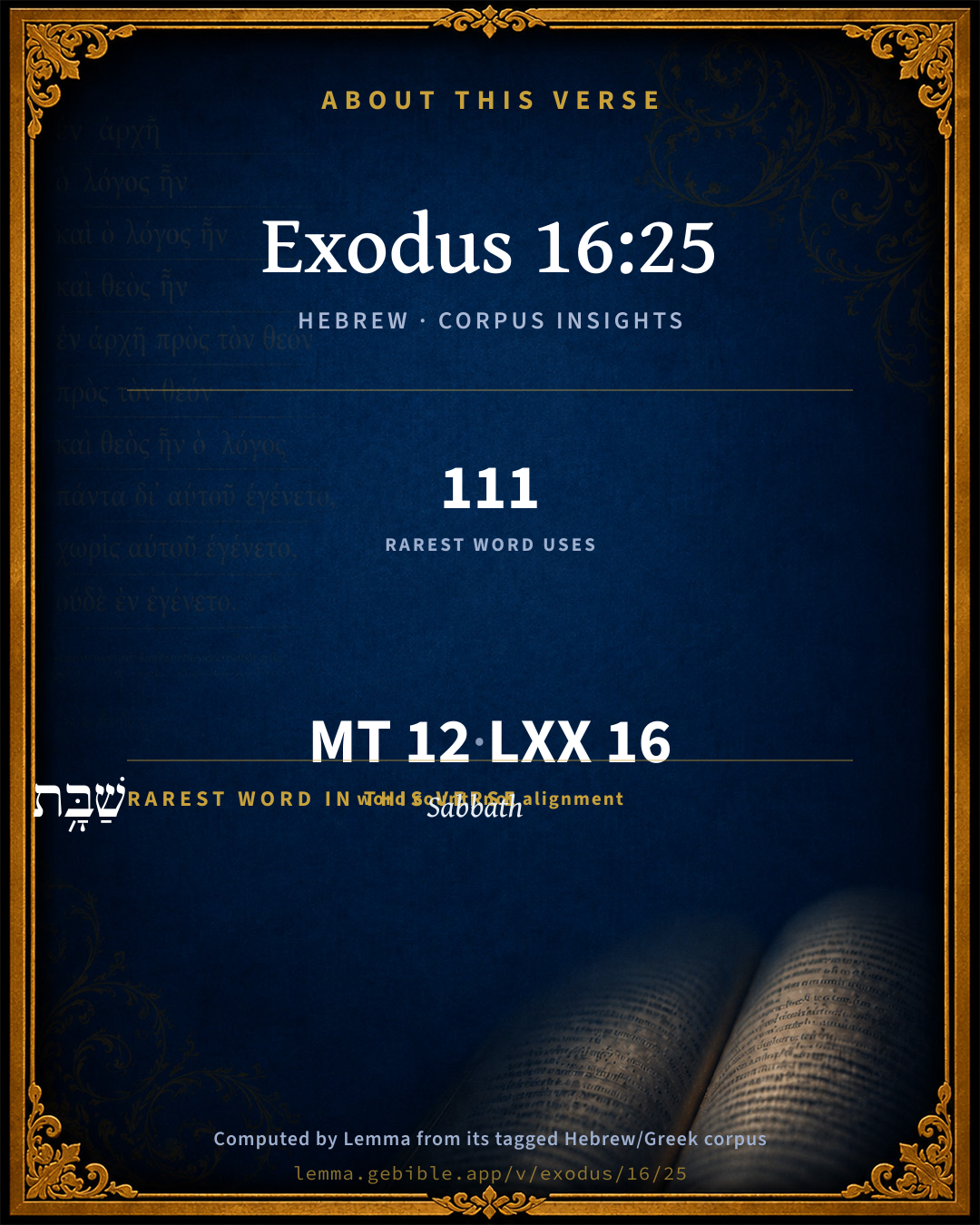
These counts appear in no published source. They are computed here, from the morphology-tagged text and Lemma’s own curated glosses. What Lemma adds →

12
words
10
distinct lemmas
Pentateuch
section

Grammatical profile

  • 3 verbs
  • 7 nouns
  • 1 conjunction
  • 1 particle

Verb forms

  • וַיֹּ֤אמֶר Qal · Sequential Imperfect
  • אִכְלֻ֣הוּ Qal · Imperative
  • תִמְצָאֻ֖הוּ Qal · Imperfect

Repetition

A word recurs within this verse — often emphatic in Hebrew:

  • הַיּ֔וֹם day H3117 ×3

Hebrew & Septuagint length

In English translation the verse runs 21 words from the Hebrew and 22 from the Septuagint (LXX English) — closely comparable.

A rough comparison of the two English renderings, which tokenize alike — not a word-level alignment.

Word counts can differ between the Hebrew and the Greek without any difference in meaning — e.g. the Hebrew direct-object marker אֵת has no separate Greek word, and Greek often adds the article ὁ.

In the original languages it is 12 Hebrew tokens and 16 Greek tokens — but the two are counted differently (Hebrew bundles its prefixes and suffixes into one token; the Greek is in lemma form), so that isn’t a like-for-like length.

Cross-references

3

Topical passages linked to Exodus 16:25 in the Treasury of Scripture Knowledge — connected by theme and wording, ordered by reader-vote popularity; previews shown in the World English Bible.

  • Exodus 16:23 He said to them, "This is that which Yahweh has spoken, 'Tomorrow is a solemn rest, a holy Sabbath to Yahweh. Bake that which you want to bake, and boil that which you want to boil; and all that remains over lay up for yourselves to be kept until the morning."
  • Exodus 16:29 Behold, because Yahweh has given you the Sabbath, therefore he gives you on the sixth day the bread of two days. Everyone stay in his place. Let no one go out of his place on the seventh day."
  • Nehemiah 9:14 and made known to them your holy Sabbath, and commanded them commandments, and statutes, and a law, by Moses your servant,

Cross-references courtesy of OpenBible.info (CC BY 4.0).

Hebrew and Greek witnesses Masoretic Hebrew ↔ Greek Septuagint

The same verse in the two great witnesses to the Old Testament, shown verse-for-verse.

These are two independent witnesses, not word-aligned to each other, and the Septuagint is shown in lemma (dictionary) form.

Hebrew Exodus 16:25 Masoretic · Westminster Leningrad Codex

וַיֹּ֤אמֶר מֹשֶׁה֙ אִכְלֻ֣הוּ הַיּ֔וֹם כִּֽי שַׁבָּ֥ת הַיּ֖וֹם לַיהוָ֑ה הַיּ֕וֹם לֹ֥א תִמְצָאֻ֖הוּ בַּשָּׂדֶֽה

Moses said, "Eat that today, for today is a Sabbath to Yahweh. Today you shall not find it in the field.

World English Bible · Public Domain

Greek LXX Exodus 16:25 Septuagint · lemma form

εἶπον δέ μωυσῆς ἐσθίω σήμερον εἰμί γάρ σάββατον σήμερον ὁ κύριος οὐ εὑρίσκω ἐν ὁ πεδίον

And Moses said, Eat that today, for today is a sabbath to the Lord: it shall not be found in the plain.

LXX2012 (modern English Septuagint) · Public Domain

Hebrew: Westminster Leningrad Codex (CC BY 4.0). Greek: Septuagint (public domain); English from LXX2012 (modern English Septuagint) (Public Domain). How the Septuagint differs from the Hebrew →

Targum (Aramaic paraphrase)

2

The Targum is the ancient Jewish Aramaic paraphrase of the Hebrew Scriptures — an interpretive translation, not the Hebrew text itself. Onkelos (literal) and Pseudo-Jonathan (expansive) render the Torah, and Jonathan the Prophets. Coverage is partial: where no permissively-licensed English translation exists for a verse, only the Aramaic is shown. This is verse-level text, not a word-by-word alignment to the Hebrew.

  1. Targum Onkelos Torah (Genesis–Deuteronomy)
    וַאֲמַר משֶׁה אִכְלוּהִי יוֹמָא דֵין אֲרֵי שַׁבְּתָא יוֹמָא דֵין קֳדָם יְיָ יוֹמָא דֵין לָא תַשְׁכְּחֻנֵהּ בְּחַקְלָא:

    (no public-domain English translation for this verse)

    Targum Onkelos — Aramaic: “Onkelos Genesis” (public domain); “Onkelos Exodus” (public domain); “Onkelos Leviticus” (public domain); “Onkelos Numbers” (public domain); “Onkelos Deuteronomy” (public domain). English: “Sefaria Community Translation” (CC0 1.0 (public-domain dedication)); “J.W. Etheridge. The Targums of Onkelos and Jonathan Ben Uzziel on the Pentateuch. London: Longmans, Green, 1862” (public domain). Text via Sefaria.

  2. Targum Pseudo-Jonathan Torah (Genesis–Deuteronomy)
    וַאֲמַר משֶׁה אִכְלוּהוּ יוֹמָא דֵין אֲרוּם שַׁבְּתָא יוֹמָא דֵין קֳדָם יְיָ יוֹמָא דֵין לָא תִשְׁכְּחוּנֵיהּ בְּחַקְלָא

    And Mosheh said to them, Eat today, because this is the Sabbath day before the Lord. This day you will not find any in the field.

    Targum Pseudo-Jonathan — Aramaic: “Targum Jonathan on Genesis” (public domain); “Targum Jonathan on Exodus” (public domain); “Targum Jonathan on Leviticus” (public domain); “Targum Jonathan on Numbers” (public domain); “Targum Jonathan on Deuteronomy” (public domain). English: “The Targum of Jonathan ben Uzziel, trans. J. W. Etheridge, London, 1862” (public domain). Text via Sefaria.

Commentary

Notes on Exodus 16:25 from classic Christian and Jewish commentators (each source and its license shown beneath its notes). The classic Christian expositions comment on the surrounding passage and are grouped to its opening verse, so a note may address several verses; the Jewish commentaries on the Tanakh (Rashi and others) are per-verse, so they appear only where the commentator wrote on this verse.

Lemma curates 59 commentaries, every one of them public domain or Creative Commons licensed, each selected and text-cleaned for this edition rather than reprinted as found. About our sources →

Trapp's Complete Commentary

John Trapp

Exo 16:25 And Moses said, Eat that to day; for to day [is] a sabbath unto the LORD: to day ye shall not find it in the field.

Ver. 25. Eat that to day.] So shall those that labour in the Lord rest and feast in heaven. Thus the Rabbis moralise it.

John Trapp, A Commentary or Exposition upon All the Books of the Old and New Testament (1647–1656) — public domain. Text from a community e-Sword module.

Geneva Bible (1599)

Geneva Bible translators

God took away the occasion from their labor, to signify how holy he would have the Sabbath kept.

Geneva Bible (1599) marginal notes — public domain. Text via Bolls.life.

Ellicott's Commentary for English Readers

(25) To day is a sabbath.—That is to say, a rest By these words the Sabbath was either instituted, or re-instituted, and became thenceforth binding on the Israelites. Its essential character of a weekly “rest” was at once assigned to it—(1) by its name; (2) by God’s resting on it from His self-imposed task of giving the manna; and (3) by the rest which the absence of manna on the seventh day imposed on the people. Thus the way was prepared for the stringent law of Sabbath observance laid down in the fourth commandment.

A Bible Commentary for English Readers, edited by Charles John Ellicott (1878–1897) — public domain. Text from a community e-Sword module.

John Gill's Exposition

Six days ye shall gather it,.... Day after day, every morning, as they had done the six days past, so they should during their stay in the wilderness:

but on the seventh day, which is the sabbath; which is repeated, being a new thing, to impress it on their minds: in it there shall be none: no manna; none shall fall, and so none can be gathered, and therefore it would be to no purpose to go out and seek for it; as also there would be no need of it, since they would always have a double portion on the sixth day.

John Gill's Exposition of the Whole Bible (1746–1763) — public domain (CC PDM 1.0). Text via the HelloAO Bible API.

Albert Barnes' Notes on the Bible

Eat that today - The practical observance of the Sabbath was thus formally instituted before the giving of the law. The people were to abstain from the ordinary work of every day life: they were not to collect food, nor, as it would seem, even to prepare it as on other days.

Albert Barnes' Notes on the Bible (1834–1885) — public domain. Text from a community e-Sword/MySword module.

Matthew Poole's English Annotations

These words were spoken upon the morning of the sabbath day, as appears from the foregoing verse.

A sabbath unto the Lord, i.e. wholly consecrated to his service, and therefore not to be employed in servile works.

Matthew Poole's English Annotations on the Holy Bible (1683–1685) — public domain. Text from a community e-Sword/MySword module.

Whedon's Commentary on the Bible

Daniel D. Whedon

25. To-day is a sabbath — In three ways the sanctity of the sabbath was marked in this miracle. There was a double quantity on the sixth day, there was none on the seventh day, and that gathered on the sixth did not putrefy on the seventh.

Daniel D. Whedon (gen. ed.), Commentary on the Old and New Testaments (1874–1909) — public domain. Text from a community e-Sword module.

The Pulpit Commentary

Vers. 25, 26. And Moses said. The Sabbath being come, Moses explained fully the reason for the order which he had given, and generalized it. God required the Sabbath to be "a day of holy rest no manna would fall on it, and therefore none could be gathered the produce of the sixth day"s gathering would be found to suffice both for the sixth day and the seventh.

The Pulpit Commentary (1880–1919), ed. H.D.M. Spence-Jones & Joseph S. Exell — public domain. Text from a community e-Sword module.

Rashi

Rabbi Shlomo Yitzchaki (Rashi)

ויאמר משה אכלהו היום AND MOSES SAID, EAT THAT THIS DAY etc. — In the morning, when they had been accustomed to go forth and gather it, they came to enquire, “Shall we go out or not?” He replied to them, “What you have in your possession eat (אכלהו היום)”. In the evening they again came before him and asked him, “How is it now about going out?” He answered them, שבת היום “Today is the Sabbath”. He saw that they were worried believing perhaps the Manna had stopped and would not again fall; he therefore said to them, “Today ye shall not find it [in the field]”. What reason was there to say “Today”? — Today you will not find it, but tomorrow you will find it (Mekhilta).

Rashi on the Tanakh — English translations: “The Judaica Press complete Tanach with Rashi, translated by A. J. Rosenberg” (CC BY 4.0); “Pentateuch with Rashi's commentary by M. Rosenbaum and A.M. Silbermann, 1929-1934” (public domain); “The Metsudah Tanach series, Lakewood, N.J” (CC BY 4.0); and “The Book of Joshua, Metsudah Publications, 1997” (CC BY 4.0). Text via Sefaria.

Lesson kit

Teaching starters — assembled from the data on this page, not authored interpretation. Every prompt links to the verse data it draws on. Edit before teaching.

Exodus, in the Pentateuch, opens this verse with 12 words (10 distinct Hebrew lemmas). Its most distinctive word is shabbâth (“Sabbath”). A historical commentator’s framing appears above. Read the whole chapter for the surrounding context.

Discussion questions

  1. The word shabbâth carries the sense “Sabbath.” How does it shape the verse?
  2. Exodus 16:23 shares this passage’s theme. How do the two illuminate each other?
  3. “day” occurs 3× in this one verse. What is the effect of the repetition?
  4. The translations on this page render this verse differently — a whole-verse word diff, not a word-by-word alignment. What might account for the different wordings?
  5. The verb «וַיֹּ֤אמֶר» is Qal Sequential Imperfect. How does its form color the action?
  6. Reading how Trapp's Complete Commentary and Geneva Bible (1599) read this verse, where do the two commentators agree and where do they part?

Things to notice

Reading settings

Reading text

Shown beneath each verse's original-language words.

Old Testament
Old Testament edition

Read the OT as the Masoretic Hebrew (MT) or the Greek Septuagint (LXX).

English shown for the Greek Septuagint (in the Hebrew ↔ Greek comparison).

Comparing translations? Open the Compare panel on any verse page to stack up to four side by side.