
1 Samuel 11:5

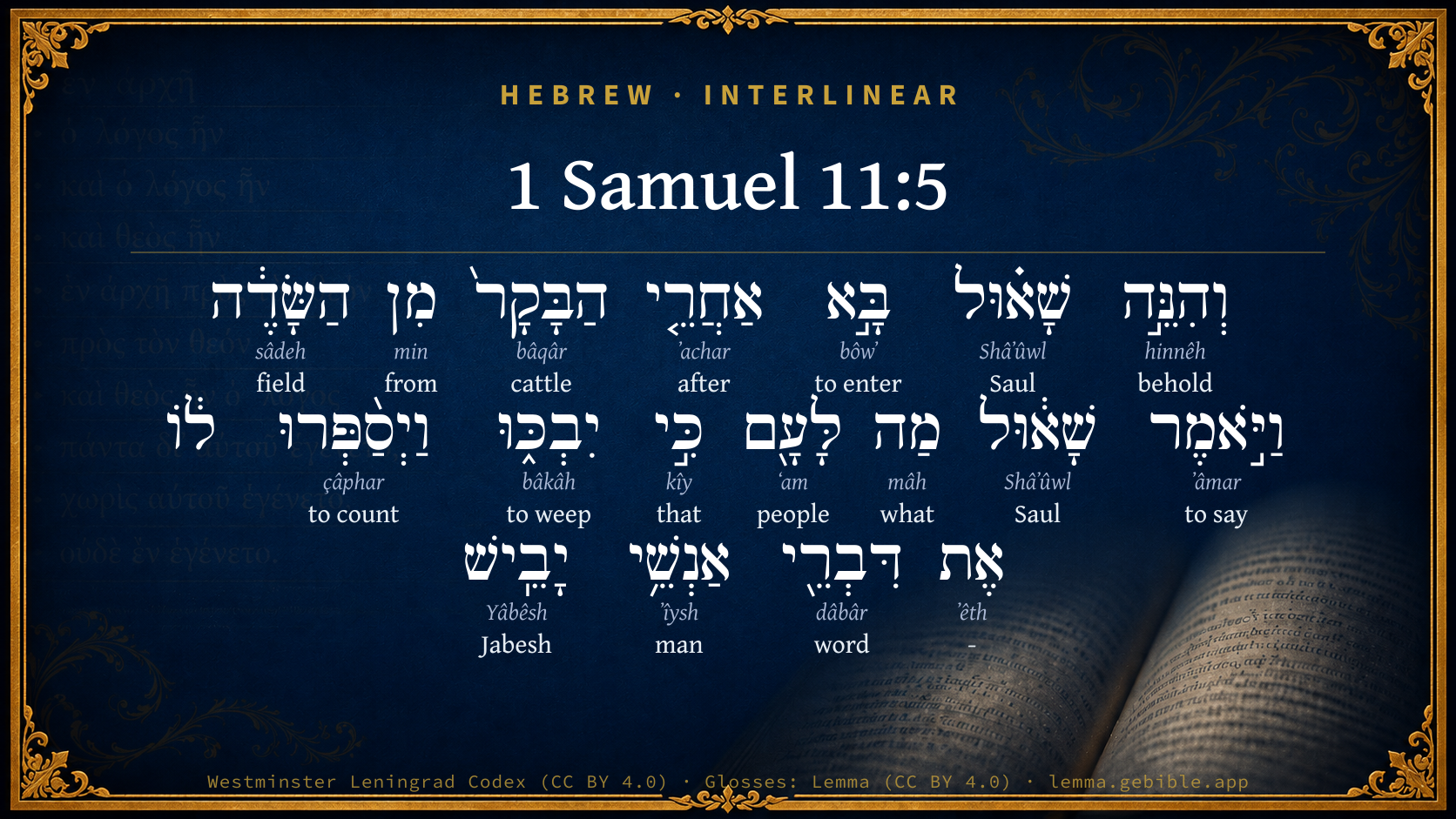
Hebrew (Westminster Leningrad Codex) 1 Samuel 11:5 appears in the Hebrew Old Testament. The text above is from the Westminster Leningrad Codex. Each word links to its Strong’s number, a concise gloss, and parsing drawn from the Open Scriptures Hebrew Bible morphology. Click any word for its full Brown-Driver-Briggs (BDB) entry.
Download image
Cite this verse

1 Samuel 11:5 (World English Bible). Public Domain. Lemma interlinear Bible study tool, https://lemma.gebible.app/v/1-samuel/11/5.

Show BibTeX & RIS
BibTeX
RIS
English Translation
Behold, Saul came following the oxen out of the field; and Saul said, What ails the people that they weep? They told him the words of the men of Jabesh.
World English Bible · Public Domain
Download a study sheet

One document with this verse’s original text, its word-by-word gloss line, the meaning frame, cross-references with their text, attributed commentary, and full source and license credits — printable, and it pastes into notes with its structure intact.

This verse Autodidact and up

Study sheet (.html) Plain text (.txt)

A passage Seminary Student

Up to 50 verses in one chapter. A passage sheet keeps up to 6 commentary sources and 12 cross-references per verse, in the order this page ranks them, and says so on the sheet whenever that leaves anything out. Ask for a single verse and you get the Autodidact verse sheet above.

Everything on this page stays free to read, with no account — the sheet is a download of what is already on screen, not access to it.

Want to remove ads? Support Godless Engineer
Compare translations 3

The same verse in 3 English versions, stacked beneath the original-language interlinear above. Click any original word for its lexicon entry.

Each is an independent rendering of the whole verse — the interlinear is not word-aligned to these translations.

Highlighted words mark where these versions differ — a whole-verse word diff, not a word-by-word alignment.

  • World English Bible Public Domain
    Behold, Saul came following the oxen out of the field; and Saul said, What ails the people that they weep? They told him the words of the men of Jabesh.
  • King James Version Public Domain
    And, behold, Saul came after the herd out of the field; and Saul said, What aileth the people that they weep? And they told him the tidings of the men of Jabesh.
  • unfoldingWord Literal Text CC BY-SA 4.0
    And behold, Saul was coming behind the oxen from the field. And Saul said, “What to the people, that they are weeping?” And they recounted to him the words of the men of Jabesh.

unfoldingWord Literal Text — © unfoldingWord, licensed CC BY-SA 4.0. Word-aligned USFM3 via Door43 (git.door43.org/unfoldingWord/en_ult).

Versions to compare (up to 4)

3 of 4 selected

Show all 18 translations

Every available English version of this verse, each an independent rendering of the whole verse.

  • World English Bible Public Domain
    Behold, Saul came following the oxen out of the field; and Saul said, What ails the people that they weep? They told him the words of the men of Jabesh.
  • Berean Standard Bible Public Domain
    Just then Saul was returning from the field, behind his oxen. “What troubles the people?” asked Saul. “Why are they weeping?” And they relayed to him the words of the men from Jabesh.
  • Majority Standard Bible Public Domain
    Just then Saul was returning from the field, behind his oxen. “What troubles the people?” asked Saul. “Why are they weeping?” And they relayed to him the words of the men from Jabesh.
  • King James Version Public Domain
    And, behold, Saul came after the herd out of the field; and Saul said, What aileth the people that they weep? And they told him the tidings of the men of Jabesh.
  • American Standard Version (1901) Public Domain
    And, behold, Saul came following the oxen out of the field; and Saul said, What aileth the people that they weep? And they told him the words of the men of Jabesh.
  • Revised Version (1885) Public Domain
    And, behold, Saul came following the oxen out of the field; and Saul said, What aileth the people that they weep? And they told him the words of the men of Jabesh.
  • Geneva Bible (1599) Public Domain
    And behold, Saul came following the cattell out of the fielde, and Saul saide, What aileth this people, that they weepe? And they tolde him the tidings of the men of Iabesh.
  • Douay-Rheims (1899) Public Domain
    And behold Saul came, following oxen out of the field, and he said: What aileth the people that they weep? And they told him the words of the men of Jabes.
  • Young's Literal Translation Public Domain
    and lo, Saul hath come after the herd out of the field, and Saul saith, `What -- to the people, that they weep?' and they recount to him the words of the men of Jabesh.
  • Literal Standard Version CC BY-SA 4.0
    and behold, Saul has come out of the field after the herd, and Saul says, “What [is that] to the people, that they weep?” And they recount the words of the men of Jabesh to him.
  • Unlocked Literal Bible CC BY-SA 4.0
    Now Saul was following the oxen out of the field. Saul said, “What is wrong with the people that they are weeping?” They told Saul what the men of Jabesh had said.
  • unfoldingWord Literal Text CC BY-SA 4.0
    And behold, Saul was coming behind the oxen from the field. And Saul said, “What to the people, that they are weeping?” And they recounted to him the words of the men of Jabesh.
  • Darby Bible Public Domain
    And behold, Saul came after the oxen from the field; and Saul said, What [aileth] the people that they weep? And they related to him the words of the men of Jabesh.
  • World Messianic Bible Public Domain
    Behold, Saul came following the oxen out of the field; and Saul said, “What ails the people that they weep?” They told him the words of the men of Jabesh.
  • Webster's Bible Public Domain
    And behold, Saul came after the herd out of the field; and Saul said, What aileth the people that they weep? And they told him the tidings of the men of Jabesh.
  • Free Bible Version CC BY-SA 4.0
    Right then Saul was coming back from plowing a field with his oxen. “Why is everyone so upset?” he asked. They told him what the men from Jabesh had said.
  • Bible in Basic English Public Domain
    Now Saul came from the field, driving the oxen before him; and he said, Why are the people weeping? And they gave him word of what the men of Jabesh had said.
  • JPS Tanakh (1917) Public Domain
    And, behold, Saul came following the oxen out of the field; and Saul said: 'What aileth the people that they weep?' And they told him the words of the men of Jabesh.

Literal Standard Version (2020), Covenant Press — licensed CC BY-SA 4.0. Text via the HelloAO Bible API (eBible.org). Unlocked Literal Bible (unfoldingWord) — licensed CC BY-SA 4.0. Text via the HelloAO Bible API (eBible.org). unfoldingWord Literal Text — © unfoldingWord, licensed CC BY-SA 4.0. Word-aligned USFM3 via Door43 (git.door43.org/unfoldingWord/en_ult). Free Bible Version, Dr. Jonathan Gallagher — licensed CC BY-SA 4.0. Text via the HelloAO Bible API (eBible.org).

Word by word

More ways to search: Search by grammar → Find every occurrence → Compare this word →

Practice this passage: Drill this verse → Learn its vocabulary →

יָבֵֽישׁ
Yâbêsh
H3003
“Jabesh”
Noun, Proper
Part of Speech
Noun
Type
Proper
Full BDB Definition

Origin: the same as H3002 (also Yabeysh yaw-bashe')

TWOT: None

Jabesh = "dry" - a town in the territory of Gilead; according to Eusebius, it is beyond the Jordan, 6 miles (10 kilometers) from Pella, on the mountain road to Gerasa; site unknown but may be modern 'Wadi Yabes' (noun proper locative) - father of Shallum, the 15th king of the northern kingdom (noun proper masculine)
  1. וְהִנֵּ֣ה hinnêh H2009 “and · behold” Conjunction + Particle, Demonstrative
  2. שָׁא֗וּל Shâʼûwl H7586 “Saul” Noun, Proper
  3. בָּ֣א bôwʼ H935 “entering” Verb, Qal, Participle Active, Masculine, Singular, Absolute
  4. אַחֲרֵ֤י ʼachar H310 “after” Preposition
  5. הַבָּקָר֙ bâqâr H1241 “the · cattle” Particle, Definite Article + Noun, Common, Both, Singular, Absolute
  6. מִן min H4480 “from” Preposition
  7. הַשָּׂדֶ֔ה sâdeh H7704 “the · field” Particle, Definite Article + Noun, Common, Masculine, Singular, Absolute
  8. וַיֹּ֣אמֶר ʼâmar H559 “and · to say” Conjunction + Verb, Qal, Sequential Imperfect, 3rd Person, Masculine, Singular
  9. שָׁא֔וּל Shâʼûwl H7586 “Saul” Noun, Proper
  10. מַה mâh H4100 “what” Particle, Interrogative
  11. לָּעָ֖ם ʻam H5971 “to/for the · people” Preposition, Determined + Noun, Common, Masculine, Singular, Absolute
  12. כִּ֣י kîy H3588 “that” Conjunction
  13. יִבְכּ֑וּ bâkâh H1058 “to weep” Verb, Qal, Imperfect, 3rd Person, Masculine, Plural
  14. וַיְסַ֨פְּרוּ çâphar H5608 “and · to count” Conjunction + Verb, Piel, Sequential Imperfect, 3rd Person, Masculine, Plural
  15. אֶת ʼêth H853 “-” Particle, Direct Object
  16. דִּבְרֵ֖י dâbâr H1697 “words of” Noun, Common, Masculine, Plural, Construct
  17. אַנְשֵׁ֥י ʼîysh H376 “men of” Noun, Common, Masculine, Plural, Construct

About this verse

These counts appear in no published source. They are computed here, from the morphology-tagged text and Lemma’s own curated glosses. What Lemma adds →

19
words
17
distinct lemmas
Historical
section

Notable vocabulary

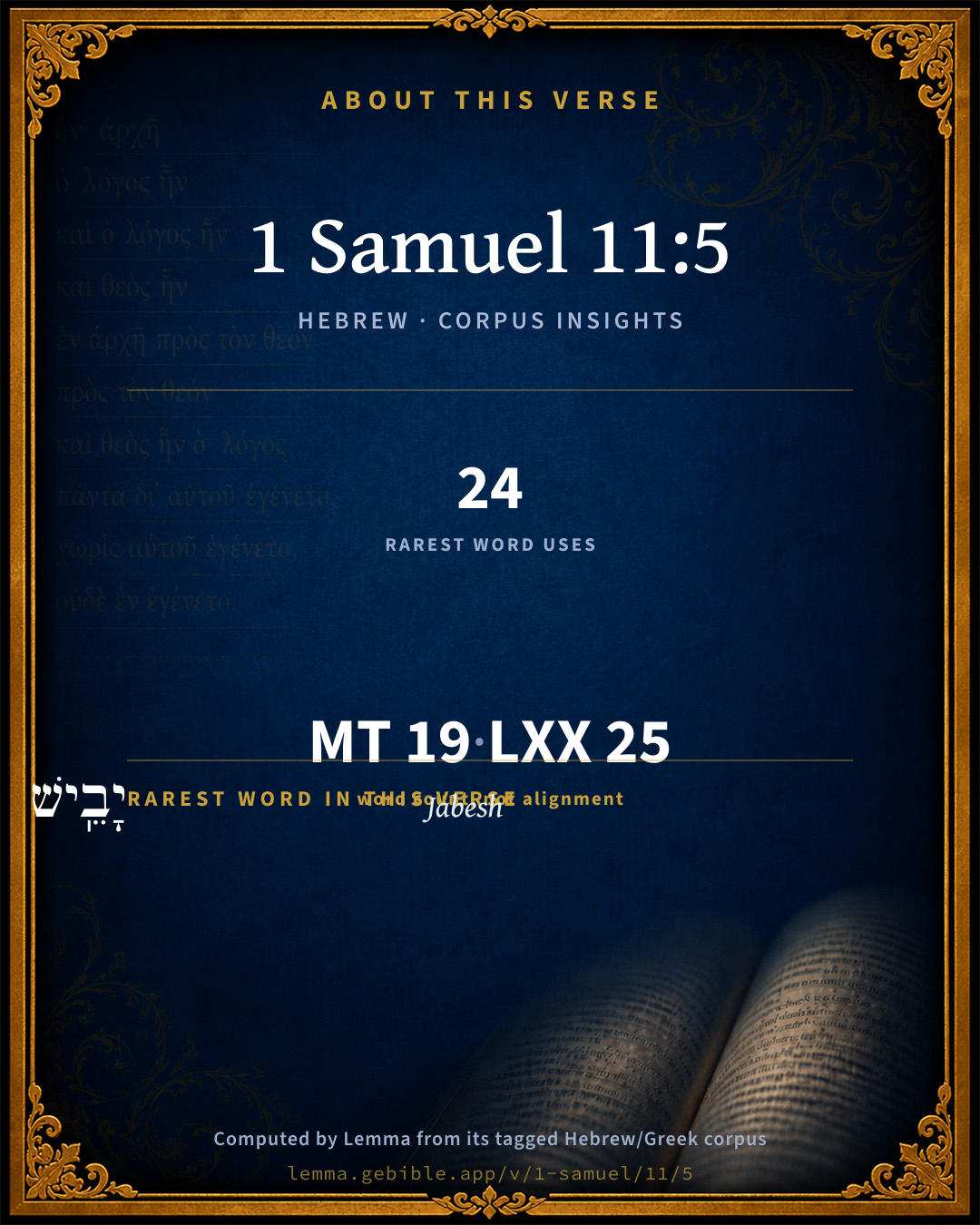
The rarest word here is יָבֵֽישׁ Jabesh H3003 — appearing just 24 times in the whole Hebrew Bible.

Shared distinctive vocabulary

יָבֵֽישׁ Jabesh H3003 occurs in 21 verses of the Hebrew Bible. Also found in:

Grammatical profile

  • 4 verbs
  • 8 nouns
  • 3 prepositions
  • 1 conjunction
  • 3 particles

Verb forms

  • בָּ֣א Qal · Participle Active
  • וַיֹּ֣אמֶר Qal · Sequential Imperfect
  • יִבְכּ֑וּ Qal · Imperfect
  • וַיְסַ֨פְּרוּ Piel · Sequential Imperfect

Repetition

A word recurs within this verse — often emphatic in Hebrew:

  • שָׁא֗וּל Saul H7586 ×2

Hebrew & Septuagint length

In English translation the verse runs 30 words from the Hebrew and 31 from the Septuagint (LXX English) — closely comparable.

A rough comparison of the two English renderings, which tokenize alike — not a word-level alignment.

Word counts can differ between the Hebrew and the Greek without any difference in meaning — e.g. the Hebrew direct-object marker אֵת has no separate Greek word, and Greek often adds the article ὁ.

In the original languages it is 19 Hebrew tokens and 25 Greek tokens — but the two are counted differently (Hebrew bundles its prefixes and suffixes into one token; the Greek is in lemma form), so that isn’t a like-for-like length.

Cross-references

6

Topical passages linked to 1 Samuel 11:5 in the Treasury of Scripture Knowledge — connected by theme and wording, ordered by reader-vote popularity; previews shown in the World English Bible.

  • 1 Kings 19:19 So he departed there, and found Elisha the son of Shaphat, who was plowing, with twelve yoke [of oxen] before him, and he with the twelfth: and Elijah passed over to him, and cast his mantle on him.
  • Genesis 21:17 God heard the voice of the boy. The angel of God called to Hagar out of the sky, and said to her, "What ails you, Hagar? Don't be afraid. For God has heard the voice of the boy where he is.
  • Judges 18:23 They cried to the children of Dan. They turned their faces, and said to Micah, What ails you, that you come with such a company?
  • 1 Samuel 9:1 Now there was a man of Benjamin, whose name was Kish, the son of Abiel, the son of Zeror, the son of Becorath, the son of Aphiah, the son of a Benjamite, a mighty man of valor.
  • Isaiah 22:1 The burden of the valley of vision. What ails you now, that you are wholly gone up to the housetops?
  • Psalms 78:71 From following the ewes that have their young, He brought him to be the shepherd of Jacob, his people, And Israel, his inheritance.

Cross-references courtesy of OpenBible.info (CC BY 4.0).

Hebrew and Greek witnesses Masoretic Hebrew ↔ Greek Septuagint

The same verse in the two great witnesses to the Old Testament, shown verse-for-verse.

These are two independent witnesses, not word-aligned to each other, and the Septuagint is shown in lemma (dictionary) form.

Hebrew 1 Samuel 11:5 Masoretic · Westminster Leningrad Codex

וְהִנֵּ֣ה שָׁא֗וּל בָּ֣א אַחֲרֵ֤י הַבָּקָר֙ מִן הַשָּׂדֶ֔ה וַיֹּ֣אמֶר שָׁא֔וּל מַה לָּעָ֖ם כִּ֣י יִבְכּ֑וּ וַיְסַ֨פְּרוּ ל֔וֹ אֶת דִּבְרֵ֖י אַנְשֵׁ֥י יָבֵֽישׁ

Behold, Saul came following the oxen out of the field; and Saul said, What ails the people that they weep? They told him the words of the men of Jabesh.

World English Bible · Public Domain

Greek LXX 1 Samuel 11:5 Septuagint · lemma form

καί ἰδού σαούλ ἄρχω μετά ὁ πρωΐ ἐκ ἀγρός καί εἶπον σαούλ τίς ὅτι κλαίω ὁ λαός καί διαἡγέομαι αὐτός ὁ ῥῆμα ὁ υἱός ιαβις

And, behold, Saul came after the early morning out of the field: and Saul said, Why does the people week? and they tell him the words of the men of Jabis.

LXX2012 (modern English Septuagint) · Public Domain

Hebrew: Westminster Leningrad Codex (CC BY 4.0). Greek: Septuagint (public domain); English from LXX2012 (modern English Septuagint) (Public Domain). How the Septuagint differs from the Hebrew →

Targum (Aramaic paraphrase)

1

The Targum is the ancient Jewish Aramaic paraphrase of the Hebrew Scriptures — an interpretive translation, not the Hebrew text itself. Onkelos (literal) and Pseudo-Jonathan (expansive) render the Torah, and Jonathan the Prophets. Coverage is partial: where no permissively-licensed English translation exists for a verse, only the Aramaic is shown. This is verse-level text, not a word-by-word alignment to the Hebrew.

  1. Targum Jonathan Prophets (Joshua–Malachi)
    וְהָא שָׁאוּל אָתָא בָּתַר תּוֹרַיָא מִן חַקְלָא וַאֲמַר שְׁאוּל מַה לְעַמָא אֲרֵי בָכָן וְאִשְׁתַּעִיאוּ לֵיהּ יַת פִּתְגָמֵי אֱנָשֵׁי יָבֵשׁ:

    (no public-domain English translation for this verse)

    Targum Jonathan — Aramaic: “Mikraot Gedolot” (public domain). English: “Sefaria Community Translation” (CC0 1.0 (public-domain dedication)); “London "Chaldee Paraphrase," 1871” (public domain). Text via Sefaria.

Commentary

Notes on 1 Samuel 11:5 from classic Christian and Jewish commentators (each source and its license shown beneath its notes). The classic Christian expositions comment on the surrounding passage and are grouped to its opening verse, so a note may address several verses; the Jewish commentaries on the Tanakh (Rashi and others) are per-verse, so they appear only where the commentator wrote on this verse.

Lemma curates 59 commentaries, every one of them public domain or Creative Commons licensed, each selected and text-cleaned for this edition rather than reprinted as found. About our sources →

Matthew Henry's Commentary

What is here related turns very much to the honour of Saul, and shows the happy fruits of that other spirit with which he was endued. Observe here,

I. His humility. Though he was anointed king, and accepted by his people, yet he did not think it below him to know the state of his own flocks, but went himself to see them, and came in the evening, with his servants, after the herd out of the field, Sa1 11:5. This was an evidence that he was not puffed up with his advancement, as those are most apt to be that are raised from a mean estate. Providence had not yet found him business as a king; he left all to Samuel; and therefore, rather than be idle, he would, for the present, apply himself to his country business again. Though the sons of Belial would, perhaps, despise him the more for it, such as were virtuous and wise, and loved business themselves, would think never the worse of him. He had no revenues settled upon him for the support of his dignity, and he was desirous not to be burdensome to the people, for which reason, like Paul, he worked with his hands; for, if he neglect his domestic affairs, how must he maintain himself and his family? Solomon gives it as a reason why men should look well to their herds because the crown doth not endure to every generation, Pro 27:23, Pro 27:24. Saul's did not; he must therefore provide something surer.

II. His concern for his neighbours. When he perceived them in tears, he asked, "What ails the people that they weep? Let me know, that, if it be a grievance which can be redressed, I may help them, and that, if not, I may weep with them." Good magistrates are in pain if their subjects are in tears.

III. His zeal for the safety and honour of Israel. When he heard of the insolence of the Ammonites, and the distress of a city, a mother in Israel, the Spirit of God came upon him, and put great thoughts into his mind, and his anger was kindled greatly, Sa1 11:6. He was angry at the insolence of the Ammonites, angry at the mean and sneaking spirit of the men of Jabesh-Gilead, angry that they had not sent him notice sooner of the Ammonites' descent and the extremity they were likely to be reduced to. He was angry to see his neighbours weeping, when it was fitter for them to be preparing for war. It was a brave and generous fire that was now kindled in the breast of Saul, and such as became his high station.

IV. The authority and power he exerted upon this important occasion. He soon let Israel know that, though he had retired to his privacy, he had a care for the public, and knew how to command men into the field, as well as how to drive cattle out of the field, Sa1 11:5, Sa1 11:7. He sent a summons to all the coasts of Israel, to show the extent of his power beyond his own tribe, even to all the tribes, and ordered all the military men forthwith to appear in arms at a general rendezvous in Bezek. Observe, 1. His modesty, in joining Samuel in commission with himself. He would not execute the office of a king without a due regard to that of a prophet. 2. His mildness in the penalty threatened against those that should disobey his orders. He hews a yoke of oxen in pieces, and sends the pieces to the several cities of Israel, threatening, with respect to him who should decline the public service, not, "Thus shall it be done to him," but, "Thus shall it be done to his oxen." God had threatened it as a great judgment (Deu 28:31), Thy ox shall be slain before thy eyes, and thou shalt not eat thereof. It was necessary that the command should be enforced with some penalty, but this was not nearly so severe as that which was affixed to a similar order by the whole congregation, Jdg 21:5. Saul wished to show that his government was more gentle than that which they had been under. The effect of this summons was that the militia, or trained bands, of the nation, came out as one man, and the reason given is, because the fear of the Lord fell upon them. Saul did not affect to make them fear him, but they were influenced to observe his orders by the fear of God and a regard to him who had made Saul their king and them members one of another. Note, Religion and the fear of God will make men good subjects, good soldiers, and good friends to the public interests of the country. Those that fear God will make conscience of their duty to all men, particularly to their rulers.

V. His prudent proceedings in this great affair, Sa1 11:8. He numbered those that came in to him, that he might know his own strength, and how to distribute his forces in the best manner their numbers would allow. It is the honour of princes to know the number of their men, but it is the honour of the King of kings that there is not any number of his armies, Job 25:3. In this muster, it seems, Judah, though numbered by itself, made no great figure; for, as it was one tribe of twelve, so it was but an eleventh part of the whole number, 30,330, though the rendezvous was at Bezek, in that tribe. They wanted the numbers, or the courage, or the zeal for which that tribe used to be famous; so low was it, just before the sceptre was brought into it in David.

VI. His faith and confidence, and (grounded thereon) his courage and resolution, in this enterprise. It should seem that those very messengers who brought the tidings from Jabesh-Gilead Saul sent into the country to raise the militia, who would be sure to be faithful and careful in their own business, and them he now sends back to their distressed countrymen, with this assurance (in which, it is probable, Samuel encouraged him): "Tomorrow, by such an hour, before the enemy can pretend that the seven days have expired, you shall have deliverance, Sa1 11:9. Be you ready to do your part, and we will not fail to do ours. Do you sally out upon the besiegers, while we surround them." Saul knew he had a just cause, a clear call, and God on his side, and therefore doubted not of success. This was good news to the besieged Gileadites, whose right eyes had wept themselves dry for their calamities, and now began to fail with looking for relief and to ache in expectation of the doom of the ensuing day, when they must look their last; the greater the exigence the more welcome the deliverance. When they heard it they were glad, relying on the assurances that were sent to them. And they sent into the enemies' camp (Sa1 11:10) to tell them that next day they would be ready to meet them, which the enemies understood as an intimation that they despaired of relief, and so were made the more secure by it. If they took not care, by sending out scouts, to rectify their own mistake, they must thank themselves if they were surprised: the besieged were under no obligation to give them notice of the help they were assured of.

VII. His industry and close application to this business. If he had been bred up to war from his youth, and had led regiments as often as he had followed droves, he could not have gone about an affair of this nature more dexterously nor more diligently. When the Spirit of the Lord comes upon men it will make them expert even without experience. A vast army (especially in comparison with the present usage) Saul had now at his foot, and a long march before him, nearly sixty miles, and over Jordan too. No cavalry in his army, but all infantry, which he divides into three battalions, Sa1 11:11. And observe, 1. With what incredible swiftness he flew to the enemy. In a day and a night he came to the place of action, where his own fate, and that of Israel, must be determined. He had passed his word, and would not break it; nay, he was better than his word, for he promised help next day, by that time the sun was hot (Sa1 11:9), but brought it before day, in the morning-watch, Sa1 11:11. Whom God helps he helps right early, Psa 46:5. 2. With what incredible bravery he flew upon the enemy. Betimes in the morning, when they lay dreaming of the triumphs they expected that day over the miserable inhabitants of Jabesh-Gilead, before they were aware he was in the midst of their host; and his men, being marched against them in three columns, surrounded them on every side, so that they could have neither heart nor time to make head against them.

Lastly, To complete his honour, God crowned all these virtues with success. Jabesh-Gilead was rescued, and the Ammonites were totally routed; he had now the day before him to complete his victory in, and so complete a victory it was that those who remained, after a great slaughter, were scattered so that two of them were not left together to encourage or help one another, Sa1 11:11. We may suppose that Saul was the more vigorous in this matter, 1. Because there was some alliance between the tribe of Benjamin and the city of Jabesh-Gilead. That city had declined joining with the rest of the Israelites to destroy Gibeah, which was then punished as their crime, but perhaps was now remembered as their kindness, when Saul of Gibeah came with so much readiness and resolution to relieve Jabesh-Gilead. Yet that was not all; two-thirds of the Benjamites that then remained were provided with wives from that city (Jdg 21:14), so that most of the mothers of Benjamin were daughters of Jabesh-Gilead, for which city Saul, being a Benjamite, had therefore a particular kindness; and we find they returned his kindness, Sa1 31:11, Sa1 31:12. 2. Because it was the Ammonites' invasion that induced the people to desire a king (so Samuel says, Sa1 12:12), so that if he had not done his part, in this expedition, he would have disappointed their expectations, and for ever forfeited their respect.

Matthew Henry's Commentary on the Whole Bible (1708–1710) — public domain (CC PDM 1.0). Text via the HelloAO Bible API.

Trapp's Complete Commentary

John Trapp

1Sa 11:5 And, behold, Saul came after the herd out of the field; and Saul said, What [aileth] the people that they weep? And they told him the tidings of the men of Jabesh.

Ver. 5. Saul came after the herd out of the field.] His volunteers, belike, that guarded him home were dismissed, and he returned to his country employment, till God should give a further opportunity to act as a king.

“ Res age, tutus eris. ”

John Trapp, A Commentary or Exposition upon All the Books of the Old and New Testament (1647–1656) — public domain. Text from a community e-Sword module.

Adam Clarke's Commentary

Verse 5. Saul came after the herd] He had been bred up to an agricultural life, and after his consecration he returned to it, waiting for a call of Divine providence, which he considered he had now received in the message from Jabesh-gilead.

It has often been remarked, that mighty kings and accomplished generals have been chosen from among those who were engaged in agricultural concerns. In these observations one fact is lost sight of, viz., that in ancient times agriculture was the only employment. Trade and commerce were scarcely known; therefore all descriptions of official dignities must be chosen out of this class, there being no other to choose them from. We need not wonder at these words of the poet: -

Jura dabat populis posito modo consul aratro;

Pascebatque suas ipse senator oves.

"The consul, having now laid aside his plough,

gives laws to the people;

And the senator himself feeds his own sheep."

OVID, Fast. lib. i., v. 204-207.

Adam Clarke's Commentary on the Bible (1810–1826) — public domain. Text from a community e-Sword/MySword module.

Ellicott's Commentary for English Readers

(5) And, behold, Saul came after the herd out of the field.—Saul was still busied with his old pursuits. At first this would seem strange, but it must be remembered that the regal authority was something quite new in republican Israel, and that the new king’s duties and privileges at first were vague, and but little understood; besides which, jealousies, such as have already been noticed (1Sa_10:27), no doubt induced Saul and his advisers to keep the royalty in the background till some opportunity for bringing it to the front should present itself. It is, therefore, quite to be understood that the newly-elected king should be spending at least a portion of his time in pursuits which hitherto had occupied his whole life. He was not the first hero summoned from agricultural labours to assume, in a national emergency, the command of an army. Gideon, we read, was called from the threshing-floor to do his great deeds; and to quote from profane history, one of the noblest of the sons of Rome, like Saul, was ploughing when the Senate fetched him to be the dictator and the general of their armies; and to the plough we know that that great man returned when his work was successfully accomplished and his country saved.

A Bible Commentary for English Readers, edited by Charles John Ellicott (1878–1897) — public domain. Text from a community e-Sword module.

The Cambridge Bible for Schools and Colleges

gen. ed. J. J. S. Perowne

5. after the herd] After the oxen, as in 1Sa_11:7. The king elect had returned to his farm work till occasion should call him to higher duties. So Cincinnatus was following the plough, when the messengers of the senate came to offer him the dictatorship (Livy III. 26).

The Cambridge Bible for Schools and Colleges (gen. ed. J. J. S. Perowne; Cambridge University Press, 1878–1918) — public domain. Text from a community e-Sword module.

John Gill's Exposition

And, behold, Saul came after the herd out the field,.... Where he had been to look after the and take care of them, and see what condition they were in, and followed them on their return home; for though he was elected king, he was not inaugurated, and did not take upon him any state; and being despised by some, and no provision as yet made for his support and maintenance as a king, and no business as such for him to do, Samuel still acting in his office, he returned to his father's house, and employed himself in rustic affairs, as he used to do: though some think this was casual, that he had been in the field to recreate himself, or to meditate on the affairs of government, and happened to return just as the herd came out of the field, and so followed them; thus Jarchi interprets it not of his coming after the herd, but of his coming after the fixed and usual time of the herd's coming out of the field; but Josephus (r) is clear for it, that he had been about some rustic business, some part of husbandry in the field, and returned to the city; nor has it been unusual for emperors and kings, and persons in high offices among Greeks and Romans, and other nations, in times of peace, to employ themselves in husbandry; so did the judges of Israel, as Shamgar, and Gideon, and Boaz, Jdg 3:31 so Quinctius Cincinnatus being taken from the plough and made dictator, after he had conquered his enemies, returned to his husbandry (s):

and Saul said, what aileth the people, that they weep? he supposed some evil had befallen them, and desired to know what it was, that, if it lay in his power to help them, he might:

and they told him the tidings of the men of Jabesh; the message they brought, and the account they gave of the distressed case of their city.

(r) Ut supra, (Antiqu. l. 6. c. 5.) sect. 2. (s) Flor. Hist. Roman. l. 1. c. 11. Aurel. Victor. de Vir. Illustr. c. 20. Alex. ab Alex. Genial. Dier. l. 3. c. 11.

John Gill's Exposition of the Whole Bible (1746–1763) — public domain (CC PDM 1.0). Text via the HelloAO Bible API.

Haydock's Catholic Bible Commentary

Field. So David fed sheep, even after he was anointed king. The ancients had very different sentiments of royalty from what we have. Their kings and great men did not esteem it beneath them to cultivate the earth. Several of them wrote on the subject. Jura dabat populis, posito modo prætor aratro,

Pascebatque suas ipse Senator oves. (Ovid, Fast. i.)

Many of the most eminent Roman generals were taken from the plough. (Calmet) --- Xenophon introduces the younger Cyrus, saying, "Many of these trees were planted with my own hands." (Cicero, Senect. 17.)

George Leo Haydock (1774–1849), Haydock's Catholic Family Bible and Commentary, 1859 edition — public domain. Excludes Psalms (Douay-Rheims chapter numbering differs from Protestant) and Deuterocanonical books (Catholic canon only).

Matthew Poole's English Annotations

Saul came after the herd out of the field; for being only anointed king, and not publicly inaugurated, nor owned, nor presented by the generality of the people, nor having yet had opportunity of doing any thing worthy of his place, he thought fit to forbear all royal state, and to retire to his former private and country life, which, howsoever despised in these latter, vain, ambitious, and slothful ages of the world, was anciently in great esteem among the Greeks and Romans, whose princes and generals did frequently exercise themselves in it; though some conceive that he now lived in some state, and that he had been in the fields only to recreate himself, and that his coming after the herd was but accidental, and is mentioned only to usher in what follows of the yoke of oxen.

Matthew Poole's English Annotations on the Holy Bible (1683–1685) — public domain. Text from a community e-Sword/MySword module.

John Wesley's Explanatory Notes

After the herd - For being only anointed king, and not publickly inaugurated, nor having yet had opportunity of doing any thing worthy of his place, he thought fit to forbear all royal state, and to retire to his former private life, which, howsoever despised in this latter ages, was anciently in great esteem. Good magistrates are in pain, if their subjects are in tears.

John Wesley, Explanatory Notes Upon the Whole Bible (1754–1765) — public domain. Text via the GEBible commentary corpus.

Rashi

Rabbi Shlomo Yitzchaki (Rashi)

Behind the cattle. After the appointed time that the cattle come in from the field.

Rashi on the Tanakh — English translations: “The Judaica Press complete Tanach with Rashi, translated by A. J. Rosenberg” (CC BY 4.0); “Pentateuch with Rashi's commentary by M. Rosenbaum and A.M. Silbermann, 1929-1934” (public domain); “The Metsudah Tanach series, Lakewood, N.J” (CC BY 4.0); and “The Book of Joshua, Metsudah Publications, 1997” (CC BY 4.0). Text via Sefaria.

Lesson kit

Teaching starters — assembled from the data on this page, not authored interpretation. Every prompt links to the verse data it draws on. Edit before teaching.

1 Samuel, in the Historical, opens this verse with 19 words (17 distinct Hebrew lemmas). Its most distinctive word is Yâbêsh (“Jabesh”). A historical commentator’s framing appears above. Read the whole chapter for the surrounding context.

Discussion questions

  1. How does “Jabesh” (Yâbêsh) shape what this verse is saying?
  2. How does Judges 21:8, which shares the word «Jabesh», read alongside this verse?
  3. What does the repetition of “Saul” (2× in this one verse) do in this verse?
  4. These translations render this verse differently; the difference is in the English rendering, not the original. What questions does that raise?
  5. «בָּ֣א» is a Qal Participle Active verb. How does that grammatical form shape the action described?
  6. Compare how Matthew Henry's Commentary and Trapp's Complete Commentary read this verse. Where do they agree or differ?

Things to notice

Reading settings

Reading text

Shown beneath each verse's original-language words.

Old Testament
Old Testament edition

Read the OT as the Masoretic Hebrew (MT) or the Greek Septuagint (LXX).

English shown for the Greek Septuagint (in the Hebrew ↔ Greek comparison).

Comparing translations? Open the Compare panel on any verse page to stack up to four side by side.