
Ezekiel 26:8

Hebrew (Westminster Leningrad Codex) Ezekiel 26:8 appears in the Hebrew Old Testament. The text above is from the Westminster Leningrad Codex. Each word links to its Strong’s number, a concise gloss, and parsing drawn from the Open Scriptures Hebrew Bible morphology. Click any word for its full Brown-Driver-Briggs (BDB) entry.
Download image
Cite this verse

Ezekiel 26:8 (World English Bible). Public Domain. Lemma interlinear Bible study tool, https://lemma.gebible.app/v/ezekiel/26/8.

Show BibTeX & RIS
BibTeX
RIS
English Translation
He shall kill with the sword your daughters in the field; and he shall make forts against you, and cast up a mound against you, and raise up the buckler against you.
World English Bible · Public Domain
Download a study sheet

One document with this verse’s original text, its word-by-word gloss line, the meaning frame, cross-references with their text, attributed commentary, and full source and license credits — printable, and it pastes into notes with its structure intact.

This verse Autodidact and up

Study sheet (.html) Plain text (.txt)

A passage Seminary Student

Up to 50 verses in one chapter. A passage sheet keeps up to 6 commentary sources and 12 cross-references per verse, in the order this page ranks them, and says so on the sheet whenever that leaves anything out. Ask for a single verse and you get the Autodidact verse sheet above.

Everything on this page stays free to read, with no account — the sheet is a download of what is already on screen, not access to it.

Want to remove ads? Support Godless Engineer
Compare translations 3

The same verse in 3 English versions, stacked beneath the original-language interlinear above. Click any original word for its lexicon entry.

Each is an independent rendering of the whole verse — the interlinear is not word-aligned to these translations.

Highlighted words mark where these versions differ — a whole-verse word diff, not a word-by-word alignment.

  • World English Bible Public Domain
    He shall kill with the sword your daughters in the field; and he shall make forts against you, and cast up a mound against you, and raise up the buckler against you.
  • King James Version Public Domain
    He shall slay with the sword thy daughters in the field: and he shall make a fort against thee, and cast a mount against thee, and lift up the buckler against thee.
  • unfoldingWord Literal Text CC BY-SA 4.0
    He will kill your daughters in the field. He will set up a siege work and build a ramp against your walls and raise up shields against you.

unfoldingWord Literal Text — © unfoldingWord, licensed CC BY-SA 4.0. Word-aligned USFM3 via Door43 (git.door43.org/unfoldingWord/en_ult).

Versions to compare (up to 4)

3 of 4 selected

Show all 18 translations

Every available English version of this verse, each an independent rendering of the whole verse.

  • World English Bible Public Domain
    He shall kill with the sword your daughters in the field; and he shall make forts against you, and cast up a mound against you, and raise up the buckler against you.
  • Berean Standard Bible Public Domain
    He will slaughter the villages of your mainland with the sword; he will set up siege works against you, build a ramp to your walls, and raise his shields against you.
  • Majority Standard Bible Public Domain
    He will slaughter the villages of your mainland with the sword; he will set up siege works against you, build a ramp to your walls, and raise his shields against you.
  • King James Version Public Domain
    He shall slay with the sword thy daughters in the field: and he shall make a fort against thee, and cast a mount against thee, and lift up the buckler against thee.
  • American Standard Version (1901) Public Domain
    He shall slay with the sword thy daughters in the field; and he shall make forts against thee, and cast up a mound against thee, and raise up the buckler against thee.
  • Revised Version (1885) Public Domain
    He shall slay with the sword thy daughters in the field: and he shall make forts against thee, and cast up a mount against thee, and raise up the buckler against thee.
  • Geneva Bible (1599) Public Domain
    He shall slay with the sword thy daughters in the fielde, and he shall make a fort against thee, and cast a mount against thee, and lift vp the buckler against thee.
  • Douay-Rheims (1899) Public Domain
    Thy daughters that are in the field, he shall kill with the sword: and he shall compass thee with forts, and shall cast up a mount round about: and he shall lift up the buckler against thee.
  • Young's Literal Translation Public Domain
    Thy daughters in the field by sword he slayeth, And he hath made against thee a fort, And hath poured out against thee a mount, And hath raised against thee a buckler.
  • Literal Standard Version CC BY-SA 4.0
    He slays your daughters in the field by sword, || And he has made a fort against you, || And has poured out a mound against you, || And has raised a buckler against you.
  • Unlocked Literal Bible CC BY-SA 4.0
    He will kill your daughters in the field. He will set up a siege work and build a ramp against your walls and raise up shields against you.
  • unfoldingWord Literal Text CC BY-SA 4.0
    He will kill your daughters in the field. He will set up a siege work and build a ramp against your walls and raise up shields against you.
  • Darby Bible Public Domain
    He shall slay with the sword thy daughters in the field, and he shall make forts against thee, and cast up a mound against thee, and lift up the target against thee;
  • World Messianic Bible Public Domain
    He will kill your daughters in the field with the sword. He will make forts against you, cast up a mound against you, and raise up the buckler against you.
  • Webster's Bible Public Domain
    He shall slay with the sword thy daughters in the field: and he shall make a fort against thee, and cast a mount against thee, and lift up the buckler against thee.
  • Free Bible Version CC BY-SA 4.0
    He will kill the people living in your villages of the mainland with the sword. He will construct siege works to attack you. He will build a ramp against your walls, and his soldiers will hold their shields above them as they advance on you.
  • Bible in Basic English Public Domain
    He will put to the sword your daughters in the open country: he will make strong walls against you and put up an earthwork against you, arming himself for war against you.
  • JPS Tanakh (1917) Public Domain
    He shall slay with the sword thy daughters in the field; and he shall make forts against thee, and cast up a mound against thee, and set up bucklers against thee.

Literal Standard Version (2020), Covenant Press — licensed CC BY-SA 4.0. Text via the HelloAO Bible API (eBible.org). Unlocked Literal Bible (unfoldingWord) — licensed CC BY-SA 4.0. Text via the HelloAO Bible API (eBible.org). unfoldingWord Literal Text — © unfoldingWord, licensed CC BY-SA 4.0. Word-aligned USFM3 via Door43 (git.door43.org/unfoldingWord/en_ult). Free Bible Version, Dr. Jonathan Gallagher — licensed CC BY-SA 4.0. Text via the HelloAO Bible API (eBible.org).

Word by word

More ways to search: Search by grammar → Find every occurrence → Compare this word →

Practice this passage: Drill this verse → Learn its vocabulary →

דָּיֵ֗ק
dâyêq
H1785
“bulwark”
Noun, Common, Masculine, Singular, Absolute
Part of Speech
Noun
Type
Common
Gender
Masculine
Number
Singular
State
Absolute
Full BDB Definition

Origin: from a root corresponding to H1751

TWOT: 417a

bulwark, siege-wall, sidewall
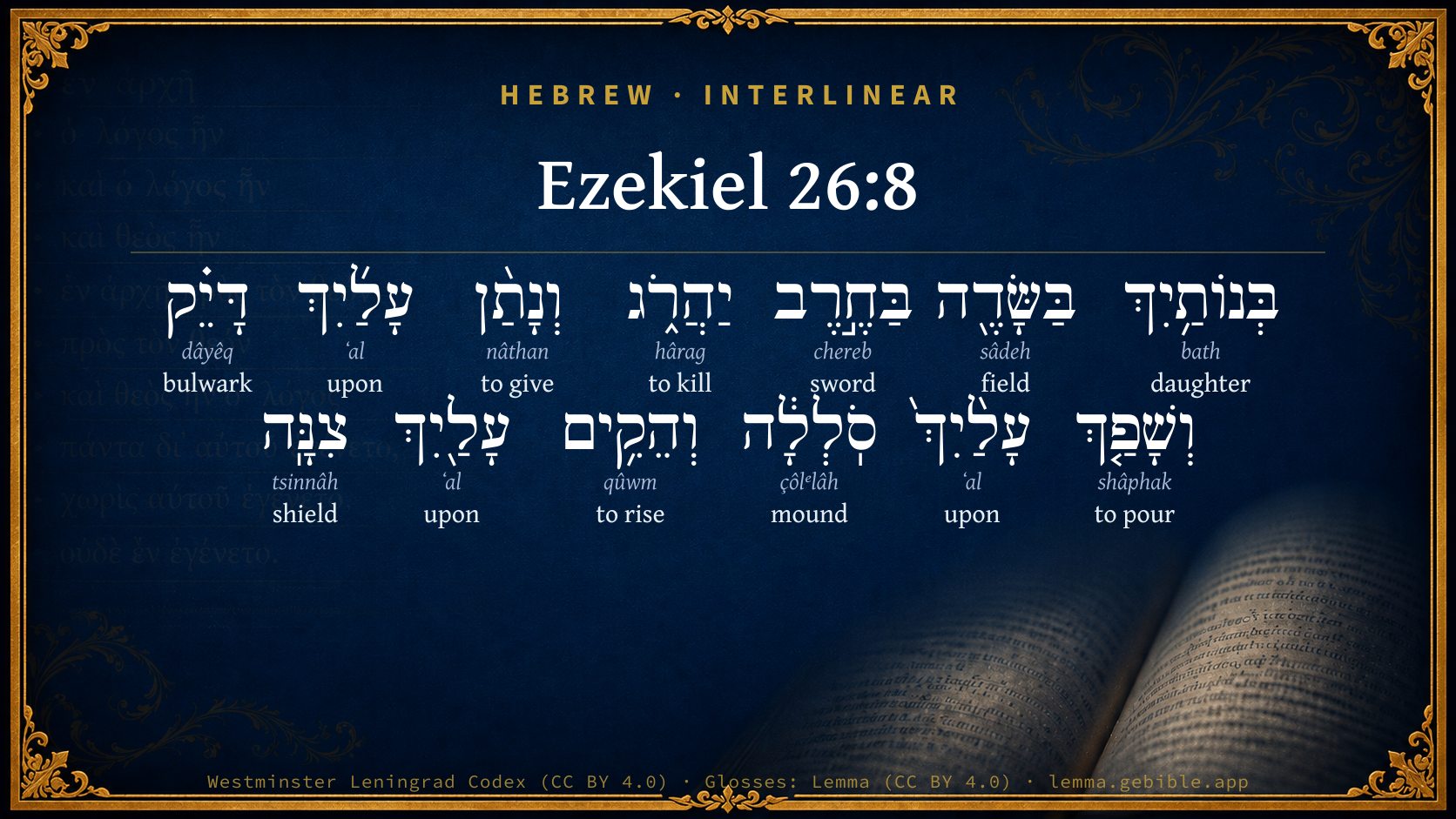
  1. בְּנוֹתַ֥יִךְ bath H1323 “daughters · your” Noun, Common, Feminine, Plural, Construct + Suffix, Personal, 2nd Person, Feminine, Singular
  2. בַּשָּׂדֶ֖ה sâdeh H7704 “in/at the · field” Preposition, Determined + Noun, Common, Masculine, Singular, Absolute
  3. בַּחֶ֣רֶב chereb H2719 “in/at the · sword” Preposition, Determined + Noun, Common, Feminine, Singular, Absolute
  4. יַהֲרֹ֑ג hârag H2026 “to kill” Verb, Qal, Imperfect, 3rd Person, Masculine, Singular
  5. וְנָתַ֨ן nâthan H5414 “and · to give” Conjunction + Verb, Qal, Sequential Perfect, 3rd Person, Masculine, Singular
  6. עָלַ֜יִךְ ʻal H5921 “upon · you” Preposition + Suffix, Personal, 2nd Person, Feminine, Singular
  7. וְשָׁפַ֤ךְ shâphak H8210 “and · to pour” Conjunction + Verb, Qal, Sequential Perfect, 3rd Person, Masculine, Singular
  8. עָלַ֨יִךְ֙ ʻal H5921 “upon · you” Preposition + Suffix, Personal, 2nd Person, Feminine, Singular
  9. סֹֽלְלָ֔ה çôlᵉlâh H5550 “mound” Noun, Common, Feminine, Singular, Absolute
  10. וְהֵקִ֥ים qûwm H6965 “and · to rise” Conjunction + Verb, Hiphil, Sequential Perfect, 3rd Person, Masculine, Singular
  11. עָלַ֖יִךְ ʻal H5921 “upon · you” Preposition + Suffix, Personal, 2nd Person, Feminine, Singular
  12. צִנָּֽה tsinnâh H6793 “shield” Noun, Common, Feminine, Singular, Absolute

About this verse

These counts appear in no published source. They are computed here, from the morphology-tagged text and Lemma’s own curated glosses. What Lemma adds →

13
words
11
distinct lemmas
Prophets
section

Notable vocabulary

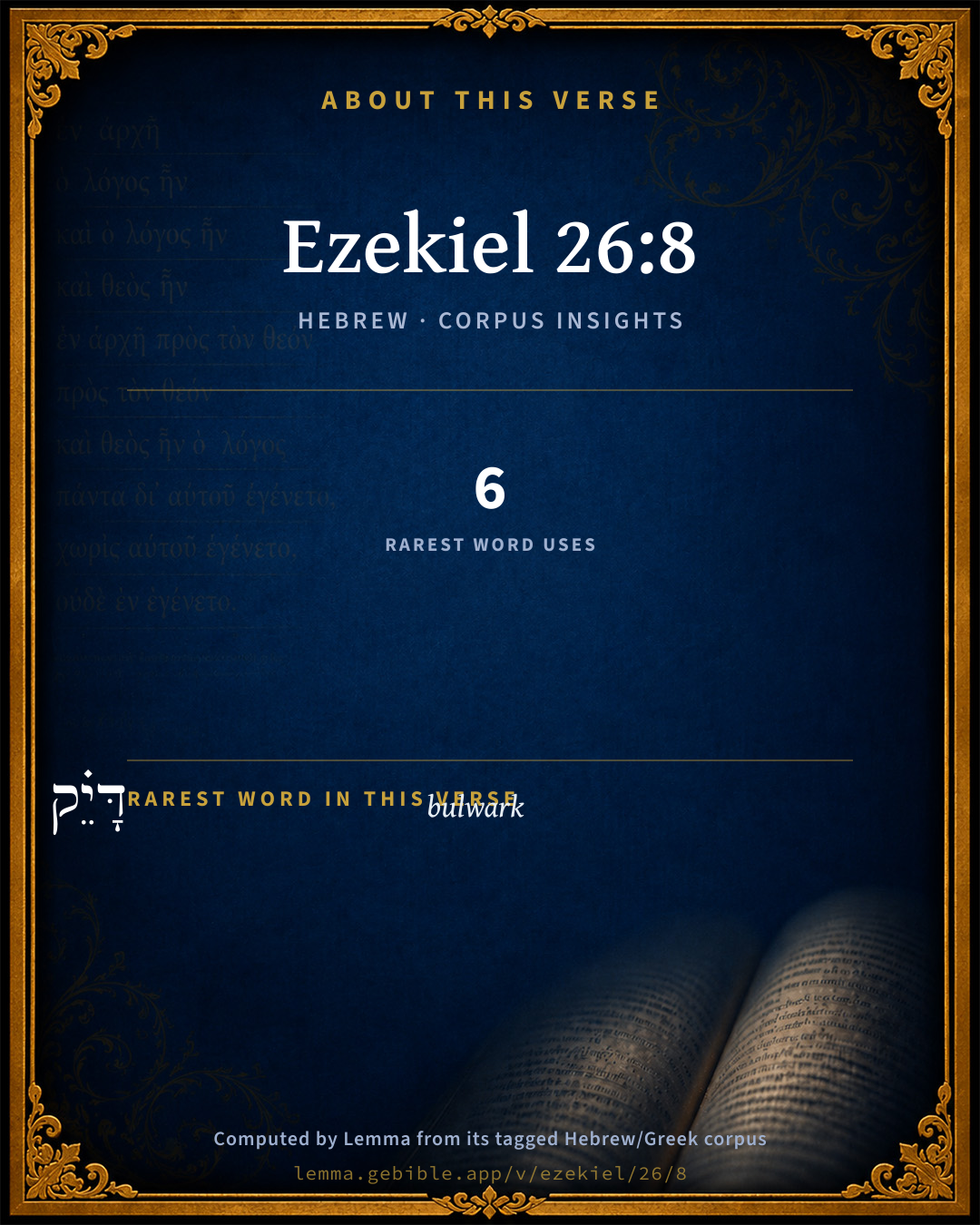
The rarest word here is דָּיֵ֗ק bulwark H1785 — appearing just 6 times in the whole Hebrew Bible.

Shared distinctive vocabulary

דָּיֵ֗ק bulwark H1785 occurs in 6 verses of the Hebrew Bible. Also found in:

Grammatical profile

  • 4 verbs
  • 6 nouns
  • 3 prepositions

Verb forms

  • יַהֲרֹ֑ג Qal · Imperfect
  • וְנָתַ֨ן Qal · Sequential Perfect
  • וְשָׁפַ֤ךְ Qal · Sequential Perfect
  • וְהֵקִ֥ים Hiphil · Sequential Perfect

Repetition

A word recurs within this verse — often emphatic in Hebrew:

  • עָלַ֜יִךְ upon H5921 ×3

Hebrew & Septuagint length

In English translation the verse runs 32 words from the Hebrew and 43 from the Septuagint (LXX English) — closely comparable.

A rough comparison of the two English renderings, which tokenize alike — not a word-level alignment.

Word counts can differ between the Hebrew and the Greek without any difference in meaning — e.g. the Hebrew direct-object marker אֵת has no separate Greek word, and Greek often adds the article ὁ.

Cross-references

5

Topical passages linked to Ezekiel 26:8 in the Treasury of Scripture Knowledge — connected by theme and wording, ordered by reader-vote popularity; previews shown in the World English Bible.

  • Ezekiel 21:22 In his right hand was the divination [for] Jerusalem, to set battering rams, to open the mouth in the slaughter, to lift up the voice with shouting, to set battering rams against the gates, to cast up mounds, to build forts.
  • Jeremiah 6:6 For thus has Yahweh of Hosts said, Hew you down trees, and cast up a mound against Jerusalem: this is the city to be visited; she is wholly oppression in the midst of her.
  • Jeremiah 32:24 Behold, the mounds, they are come to the city to take it; and the city is given into the hand of the Chaldeans who fight against it, because of the sword, and of the famine, and of the pestilence; and what you have spoken has happened; and, behold, you see it.
  • Jeremiah 52:4 It happened in the ninth year of his reign, in the tenth month, in the tenth day of the month, that Nebuchadrezzar king of Babylon came, he and all his army, against Jerusalem, and encamped against it; and they built forts against it round about.
  • 2 Samuel 20:15 They came and besieged him in Abel of Beth Maacah, and they cast up a mound against the city, and it stood against the rampart; and all the people who were with Joab battered the wall, to throw it down.

Cross-references courtesy of OpenBible.info (CC BY 4.0).

Hebrew and Greek witnesses Masoretic Hebrew ↔ Greek Septuagint

The same verse in the two great witnesses to the Old Testament, shown verse-for-verse.

These are two independent witnesses, not word-aligned to each other, and the Septuagint is shown in lemma (dictionary) form.

Hebrew Ezekiel 26:8 Masoretic · Westminster Leningrad Codex

בְּנוֹתַ֥יִךְ בַּשָּׂדֶ֖ה בַּחֶ֣רֶב יַהֲרֹ֑ג וְנָתַ֨ן עָלַ֜יִךְ דָּיֵ֗ק וְשָׁפַ֤ךְ עָלַ֨יִךְ֙ סֹֽלְלָ֔ה וְהֵקִ֥ים עָלַ֖יִךְ צִנָּֽה

He shall kill with the sword your daughters in the field; and he shall make forts against you, and cast up a mound against you, and raise up the buckler against you.

World English Bible · Public Domain

Greek LXX Ezekiel 26:8 Septuagint · lemma form

οὗτος ὁ θυγάτηρ σύ ὁ ἐν ὁ πεδίον μάχαιρα ἀνααἱρέω καί δίδωμι ἐπί σύ προφυλακή καί περιοἰκοδομέω καί ποιέω ἐπί σύ κύκλος χάραξ καί περίστασις ὅπλον καί ὁ λόγχη αὐτός ἀπέναντι σύ δίδωμι

He shall kill your daughters that are in the field with the sword, and shall set a watch against you, and build forts around you, and carry a rampart round against you, and set up warlike works, and array his spears against you.

LXX2012 (modern English Septuagint) · Public Domain

Hebrew: Westminster Leningrad Codex (CC BY 4.0). Greek: Septuagint (public domain); English from LXX2012 (modern English Septuagint) (Public Domain). How the Septuagint differs from the Hebrew →

Targum (Aramaic paraphrase)

1

The Targum is the ancient Jewish Aramaic paraphrase of the Hebrew Scriptures — an interpretive translation, not the Hebrew text itself. Onkelos (literal) and Pseudo-Jonathan (expansive) render the Torah, and Jonathan the Prophets. Coverage is partial: where no permissively-licensed English translation exists for a verse, only the Aramaic is shown. This is verse-level text, not a word-by-word alignment to the Hebrew.

  1. Targum Jonathan Prophets (Joshua–Malachi)
    יַתְבֵי כַפְרָנָךְ דִי בְחַקְלָא בְּחַרְבָּא יִקְטֵיל וְיִבְנֵי עֲלָךְ כַּרְקוֹם וְיִצְבוֹר עֲלָךְ מִלֵיתָא וְיָקִים עֲלָךְ דִי מְזַיְנִין בִּתְרֵסִין:

    (no public-domain English translation for this verse)

    Targum Jonathan — Aramaic: “Mikraot Gedolot” (public domain). English: “Sefaria Community Translation” (CC0 1.0 (public-domain dedication)); “London "Chaldee Paraphrase," 1871” (public domain). Text via Sefaria.

Commentary

Notes on Ezekiel 26:8 from classic Christian and Jewish commentators (each source and its license shown beneath its notes). The classic Christian expositions comment on the surrounding passage and are grouped to its opening verse, so a note may address several verses; the Jewish commentaries on the Tanakh (Rashi and others) are per-verse, so they appear only where the commentator wrote on this verse.

Lemma curates 59 commentaries, every one of them public domain or Creative Commons licensed, each selected and text-cleaned for this edition rather than reprinted as found. About our sources →

Trapp's Complete Commentary

John Trapp

Eze 26:8 He shall slay with the sword thy daughters in the field: and he shall make a fort against thee, and cast a mount against thee, and lift up the buckler against thee.

Ver. 8. He shall slay with the sword.] See on Eze 26:6.

He shall lift up the buckler.] Or, A continued series of bucklers,

“ - ut omnes

Ferre queant subter densa testudine casus. ”

John Trapp, A Commentary or Exposition upon All the Books of the Old and New Testament (1647–1656) — public domain. Text from a community e-Sword module.

Adam Clarke's Commentary

Verse 8. Thy daughters in the field] This seems to be spoken of Palaetyre, or Tyre on the main land; for forts, mounts, engines of war, horses, and chariots could not be brought to act against the other.

Adam Clarke's Commentary on the Bible (1810–1826) — public domain. Text from a community e-Sword/MySword module.

Ellicott's Commentary for English Readers

(8) A fort . . . a mount.—These and the following particulars of the siege indicate the use of the ordinary methods as in the attack of a city on the mainland. The explanation of this is doubtless partly in the fact that Palæotyrus, Old Tyre, upon the mainland, was approached in the ordinary way, and partly that Nebuchadnezzar must have contrived a bridge of boats, or some other method of approaching the island across the shoal and narrow channel (1,200 yards), which at that time separated it from the mainland. That if he built a mole it was afterwards removed, is plain from the fact that when Alexander built one, 250 years later, sand accumulated upon it, until the island has now become a peninsula, connected with the shore by a beach of considerable width.

The buckler is that sort of roof made with shields used in ancient warfare by besiegers to defend themselves from the missiles of the besieged. Herodotus (ix. 61, 99, 102) mentions its use among the Persians.

A Bible Commentary for English Readers, edited by Charles John Ellicott (1878–1897) — public domain. Text from a community e-Sword module.

The Cambridge Bible for Schools and Colleges

gen. ed. J. J. S. Perowne

8. The cities and villages, dependencies of Tyre in the mainland, naturally are the first to suffer. Then the siege of the insular city itself is taken in hand. The order is precise: first the “fort” or moveable tower from which the archers shot so as to counteract the defensive efforts of the besieged (cf. Eze_4:2); then the “mount” or embankment, which in this case was a dam thrown across the narrow strait, in order to gain access to the walls; then the “buckler” or shield, i.e. probably the testudo or roof of shields under cover of which the besiegers operated, and finally (Eze_26:9) the battering engines.

The Cambridge Bible for Schools and Colleges (gen. ed. J. J. S. Perowne; Cambridge University Press, 1878–1918) — public domain. Text from a community e-Sword module.

John Gill's Exposition

He shall slay with the sword thy daughters in the field,.... The first thing he would do would be to destroy the cities, towns and villages on the continent, near to Tyre, and dependent on it, as in Eze 26:6, and so the Targum is here, as there:

and he shall make a fort against thee, and cast a mount against thee; a fort built of wood, and a mount made of earth, from which stones might be cast out of their engines, and arrows shot from their bows into the city, to the damaging of the houses, and the hurt of the inhabitants:

and lift up the buckler against thee; or "shield"; that is, as the Targum paraphrases it,

"set against thee such who are armed with shields;''

to repel the arrows shot out from the city, and so defeat the design of them.

John Gill's Exposition of the Whole Bible (1746–1763) — public domain (CC PDM 1.0). Text via the HelloAO Bible API.

Haydock's Catholic Bible Commentary

Daughters. Many towns were subject to Tyre: almost all Phœnicia acknowledged her dominion, as well as (Calmet) the seas to which her fleets went, ver. 15. (Selden, Mare i. 6.; Curtius iv.) --- These smaller cities shall fall, and the town shall be of no service except to dry nets. (Worthington)

George Leo Haydock (1774–1849), Haydock's Catholic Family Bible and Commentary, 1859 edition — public domain. Excludes Psalms (Douay-Rheims chapter numbering differs from Protestant) and Deuterocanonical books (Catholic canon only).

Matthew Poole's English Annotations

See Eze 26:6.

Make a fort against thee: see Eze 4:2; 17:17.

Cast a mount against thee: he shall draw a line round about thee, and build bastions, raise sconces to defend the lines, to keep in the besieged, and secure the besiegers; or he shall pour out the shot, mighty stones or the like, out of the engines framed and placed on the forts before mentioned; for so did they of old build mighty wooden towers, and there placed engines, out of which they could fling mighty stones or darts against the besieged, who were much annoyed from these high towers, overlooking their walls and streets that none could stir out.

Lift up the buckler: see Eze 23:24.

Matthew Poole's English Annotations on the Holy Bible (1683–1685) — public domain. Text from a community e-Sword/MySword module.

Whedon's Commentary on the Bible

Daniel D. Whedon

8-14. The description is startingly vivid, the outlying villages (“daughters”)

suffer first, then the well-known “fort” and “mount” are erected, and under cover of “the buckler” (a barricade of wickerwork covered with skins) the “engines of war” (R.V., “battering engines”) come into position and the axes (literally, swords) begin their deadly work. A breach is made in the wall, and then comes the charge of the cavalry and chariot force, the dust fills the air, and the fleeing people fall under the hoofs of the horses and the stroke of the swords. Even the temple of Baal is invaded and his sacred pillars (unfortunately translated “garrisons”) are cast to the ground. (Compare 2Ki_10:26.) The city is sacked, and the riches of her temples, her pleasant palaces, and bazaars become the spoil of her conqueror. The city is destroyed, never to be built again, and the music for which she was famous (Isa_23:16) sinks into a groan. Now it is certain that a complete destruction of the city such as Eze_26:12-14 contemplate was not wrought by Nebuchadnezzar, for after this campaign Tyre was able to sustain a very protracted siege under Alexander the Great (see also Eze_29:17-21); but it seems most probable that the prophet’s description of the Nebuchadnezzar campaign melts into the more awful destruction, which he has formerly said would be wrought by “many nations,” which should dash up against the proud city “as I bring up the sea, wave after wave” (Eze_26:3). This fusion of various events is not unusual in prophecy. (Compare particularly Matthew 24; Mark 13.)

Daniel D. Whedon (gen. ed.), Commentary on the Old and New Testaments (1874–1909) — public domain. Text from a community e-Sword module.

The Pulpit Commentary

Vers. 8-10 (For the usual operations of a siege, see notes on Eze_4:1, Eze_4:2) The buckler was the roof of shields under which the besiegers protected themselves from the missiles of the besieged. For engines of war, read battering-rams; for wheels, wagons. The final result will be that the breach will be made, with results such as those described in Ver. 1.

The Pulpit Commentary (1880–1919), ed. H.D.M. Spence-Jones & Joseph S. Exell — public domain. Text from a community e-Sword module.

Rashi

Rabbi Shlomo Yitzchaki (Rashi)

and will station against you shields [Heb. צִנָה,] and will station against you those armed with shields.

Rashi on the Tanakh — English translations: “The Judaica Press complete Tanach with Rashi, translated by A. J. Rosenberg” (CC BY 4.0); “Pentateuch with Rashi's commentary by M. Rosenbaum and A.M. Silbermann, 1929-1934” (public domain); “The Metsudah Tanach series, Lakewood, N.J” (CC BY 4.0); and “The Book of Joshua, Metsudah Publications, 1997” (CC BY 4.0). Text via Sefaria.

Lesson kit

Teaching starters — assembled from the data on this page, not authored interpretation. Every prompt links to the verse data it draws on. Edit before teaching.

Ezekiel, in the Prophets, opens this verse with 13 words (11 distinct Hebrew lemmas). Its most distinctive word is dâyêq (“bulwark”). A historical commentator’s framing appears above. Read the whole chapter for the surrounding context.

Discussion questions

  1. How does “bulwark” (dâyêq) shape what this verse is saying?
  2. How does 2 Kings 25:1, which shares the word «bulwark», read alongside this verse?
  3. What does the repetition of “upon” (3× in this one verse) do in this verse?
  4. These translations render this verse differently. What is at stake in choosing one wording over another?
  5. «יַהֲרֹ֑ג» is a Qal Imperfect verb. How does that grammatical form shape the action described?
  6. Compare how Trapp's Complete Commentary and Adam Clarke's Commentary read this verse. Where do they agree or differ?

Things to notice

Reading settings

Reading text

Shown beneath each verse's original-language words.

Old Testament
Old Testament edition

Read the OT as the Masoretic Hebrew (MT) or the Greek Septuagint (LXX).

English shown for the Greek Septuagint (in the Hebrew ↔ Greek comparison).

Comparing translations? Open the Compare panel on any verse page to stack up to four side by side.