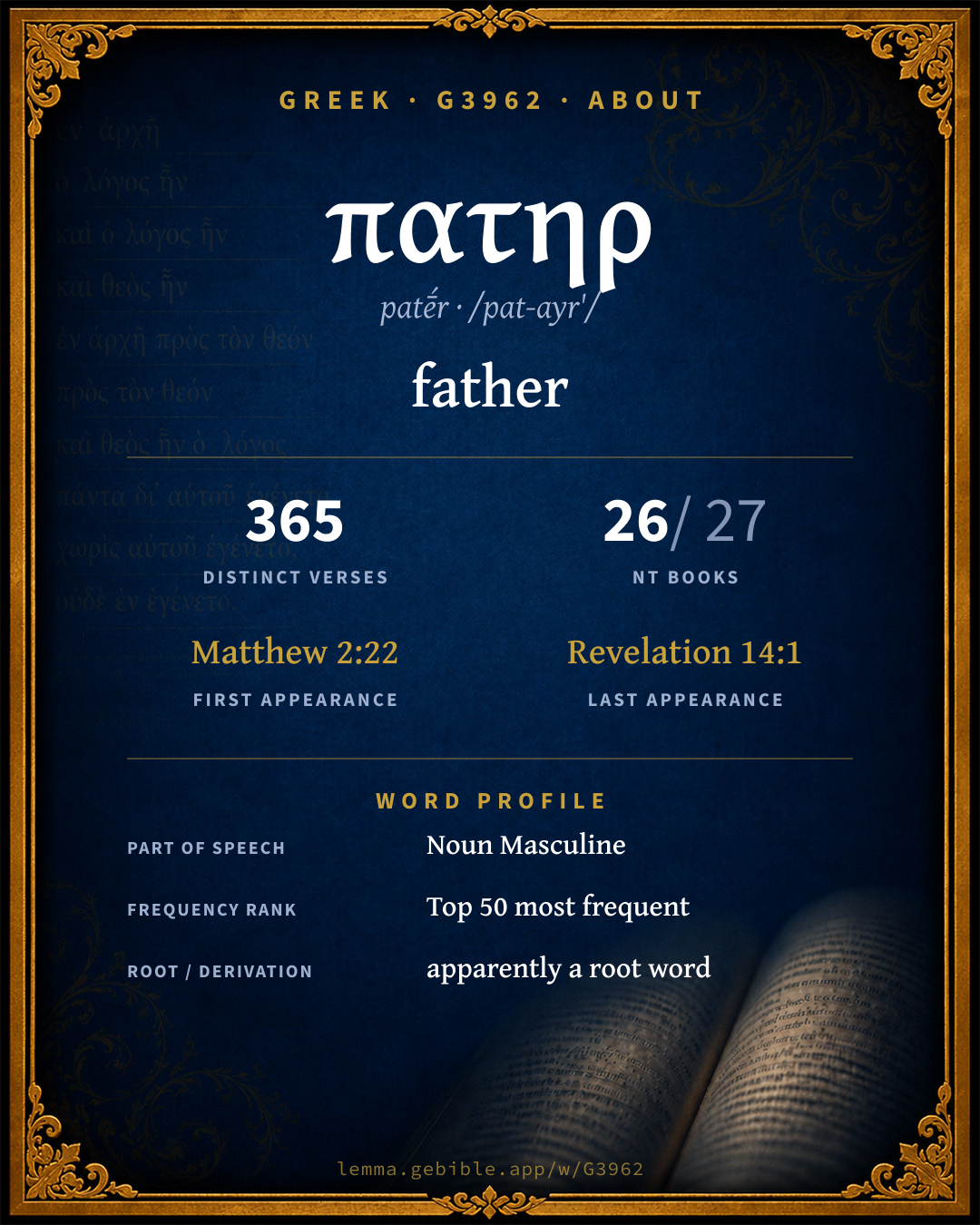
πατήρ
father
‘father’ is one of 3 main senses fuller range ↓
Full lexicon entry — Thayer's Greek Lexicon
From Thayer's Greek Lexicon
Where this word appears
See every Nominative-case word in the Greek New Testament →
Grammar key — what these labels mean
Part of speech
- Noun
- A naming word — a person, place, thing, or idea.
Case
- Nominative
- The case of the subject (and the predicate nominative).
- Genitive
- The case of source, possession, or “of” — answers “whose / from what.”
- Accusative
- The case of the direct object and of extent.
- Dative
- The case of the indirect object, means, or location — “to / for / with / in.”
- Vocative
- The case of direct address (“O Lord”).
Gender
- Masculine
- Grammatically masculine.
Number
- Singular
- One.
- Plural
- More than one.
Grammatical forms 10 distinct
- Noun, Nominative, Singular, Masculine 111 times (27%)
- Noun, Genitive, Singular, Masculine 100 times (24%)
- Noun, Accusative, Singular, Masculine 94 times (23%)
- Noun, Dative, Singular, Masculine 33 times (8%)
- Noun, Vocative, Singular, Masculine 21 times (5%)
- Noun, Nominative, Plural, Masculine 20 times (5%)
- Noun, Genitive, Plural, Masculine 14 times (3%)
- Noun, Accusative, Plural, Masculine 12 times (3%)
+2 more forms (7 occurrences)
Parsed forms decoded from the imported morphology (Robinson–Tischendorf, public domain), counted across 412 parsed occurrences — not distinct verses.
Page 1 of 2 — showing verses 1–200 of 365 distinct verses where G3962 appears, across 26 books. Click any verse to open its interlinear word-by-word view. Verse text shown in the World English Bible for context — . Each verse’s Greek form is shown with its reference; the English is not keyword-highlighted, since the data carries no word-level English alignment. Use “Compare translations” on any verse to read it across multiple English versions. This concordance covers the Greek New Testament; Septuagint (Greek Old Testament) occurrences of this word are not indexed here.
Matthew 56 verses
- Matthew 2:22 πατρὸς n gen sg masc But when he heard that Archelaus was reigning over Judea in the place of his father, Herod, he was afraid to go there. Being warned in a dream, he withdrew into the region of Galilee,
- Matthew 3:9 πατέρα n acc sg masc Don't think to yourselves, 'We have Abraham for our father,' for I tell you that God is able to raise up children to Abraham from these stones.
- Matthew 4:21 πατρὸς n gen sg masc Going on from there, he saw two other brothers, James the son of Zebedee, and John his brother, in the boat with Zebedee their father, mending their nets. He called them.
- Matthew 4:22 πατέρα n acc sg masc They immediately left the boat and their father, and followed him.
- Matthew 5:16 πατέρα n acc sg masc Even so, let your light shine before men; that they may see your good works, and glorify your Father who is in heaven.
- Matthew 5:45 πατρὸς n gen sg masc that you may be children of your Father who is in heaven. For he makes his sun to rise on the evil and the good, and sends rain on the just and the unjust.
- Matthew 5:48 πατὴρ n nom sg masc Therefore you shall be perfect, just as your Father in heaven is perfect.
- Matthew 6:1 πατρὶ n dat sg masc "Be careful that you don't do your charitable giving before men, to be seen by them, or else you have no reward from your Father who is in heaven.
- Matthew 6:4 πατήρ n nom sg masc so that your merciful deeds may be in secret, then your Father who sees in secret will reward you openly.
- Matthew 6:6 πατρί πατήρ n dat sg masc n nom sg masc But you, when you pray, enter into your inner chamber, and having shut your door, pray to your Father who is in secret, and your Father who sees in secret will reward you openly.
- Matthew 6:8 πατὴρ n nom sg masc Therefore don't be like them, for your Father knows what things you need, before you ask him.
- Matthew 6:9 πάτερ n voc sg masc Pray like this: 'Our Father in heaven, may your name be kept holy.
- Matthew 6:14 πατὴρ n nom sg masc "For if you forgive men their trespasses, your heavenly Father will also forgive you.
- Matthew 6:15 πατὴρ n nom sg masc But if you don't forgive men their trespasses, neither will your Father forgive your trespasses.
- Matthew 6:18 πατρί πατήρ n dat sg masc n nom sg masc so that you are not seen by men to be fasting, but by your Father who is in secret, and your Father, who sees in secret, will reward you.
- Matthew 6:26 πατὴρ n nom sg masc See the birds of the sky, that they don't sow, neither do they reap, nor gather into barns. Your heavenly Father feeds them. Aren't you of much more value than they?
- Matthew 6:32 πατὴρ n nom sg masc For the Gentiles seek after all these things, for your heavenly Father knows that you need all these things.
- Matthew 7:11 πατὴρ n nom sg masc If you then, being evil, know how to give good gifts to your children, how much more will your Father who is in heaven give good things to those who ask him!
- Matthew 7:21 πατρός n gen sg masc Not everyone who says to me, 'Lord, Lord,' will enter into the Kingdom of Heaven; but he who does the will of my Father who is in heaven.
- Matthew 8:21 πατέρα n acc sg masc Another of his disciples said to him, "Lord, allow me first to go and bury my father."
- Matthew 10:20 πατρὸς n gen sg masc For it is not you who speak, but the Spirit of your Father who speaks in you.
- Matthew 10:21 πατὴρ n nom sg masc "Brother will deliver up brother to death, and the father his child. Children will rise up against parents, and cause them to be put to death.
- Matthew 10:29 πατρὸς n gen sg masc "Aren't two sparrows sold for an assarion? Not one of them falls on the ground apart from your Father's will,
- Matthew 10:32 πατρός n gen sg masc Everyone therefore who confesses me before men, him I will also confess before my Father who is in heaven.
- Matthew 10:33 πατρός n gen sg masc But whoever denies me before men, him I will also deny before my Father who is in heaven.
- Matthew 10:35 πατρὸς n gen sg masc For I came to set a man at odds against his father, and a daughter against her mother, and a daughter-in-law against her mother-in-law.
- Matthew 10:37 πατέρα n acc sg masc He who loves father or mother more than me is not worthy of me; and he who loves son or daughter more than me isn't worthy of me.
- Matthew 11:25 πάτερ n voc sg masc At that time, Jesus answered, "I thank you, Father, Lord of heaven and earth, that you hid these things from the wise and understanding, and revealed them to infants.
- Matthew 11:26 πατήρ n nom sg masc Yes, Father, for so it was well-pleasing in your sight.
- Matthew 11:27 πατρός πατήρ πατέρα n gen sg masc n nom sg masc n acc sg masc All things have been delivered to me by my Father. No one knows the Son, except the Father; neither does anyone know the Father, except the Son, and he to whom the Son desires to reveal him.
- Matthew 12:50 πατρός n gen sg masc For whoever does the will of my Father who is in heaven, he is my brother, and sister, and mother."
- Matthew 13:43 πατρὸς n gen sg masc Then the righteous will shine forth like the sun in the Kingdom of their Father. He who has ears to hear, let him hear.
- Matthew 15:4 πατέρα πατέρα n acc sg masc n acc sg masc For God commanded, 'Honor your father and your mother,' and, 'He who speaks evil of father or mother, let him be put to death.'
- Matthew 15:5 πατρὶ πατέρα n dat sg masc n acc sg masc But you say, 'Whoever may tell his father or his mother, "Whatever help you might otherwise have gotten from me is a gift devoted to God,"
- Matthew 15:13 πατήρ n nom sg masc But he answered, "Every plant which my heavenly Father didn't plant will be uprooted.
- Matthew 16:17 πατήρ n nom sg masc Jesus answered him, "Blessed are you, Simon Bar Jonah, for flesh and blood has not revealed this to you, but my Father who is in heaven.
- Matthew 16:27 πατρὸς n gen sg masc For the Son of Man will come in the glory of his Father with his angels, and then he will render to everyone according to his deeds.
- Matthew 18:10 πατρός n gen sg masc See that you don't despise one of these little ones, for I tell you that in heaven their angels always see the face of my Father who is in heaven.
- Matthew 18:14 πατρὸς n gen sg masc Even so it is not the will of your Father who is in heaven that one of these little ones should perish.
- Matthew 18:19 πατρός n gen sg masc Again, assuredly I tell you, that if two of you will agree on earth concerning anything that they will ask, it will be done for them by my Father who is in heaven.
- Matthew 18:35 πατήρ n nom sg masc So my heavenly Father will also do to you, if you don't each forgive your brother from your hearts for his misdeeds."
- Matthew 19:5 πατέρα n acc sg masc and said, 'For this cause a man shall leave his father and mother, and shall join to his wife; and the two shall become one flesh?'
- Matthew 19:19 πατέρα n acc sg masc 'Honor your father and mother.' And, 'You shall love your neighbor as yourself.'"
- Matthew 19:29 πατέρα n acc sg masc Everyone who has left houses, or brothers, or sisters, or father, or mother, or wife, or children, or lands, for my name's sake, will receive one hundred times, and will inherit eternal life.
- Matthew 20:23 πατρός n gen sg masc He said to them, "You will indeed drink my cup, and be baptized with the baptism that I am baptized with, but to sit on my right hand and on my left hand is not mine to give; but it is for whom it has been prepared by my Father."
- Matthew 21:31 πατρός n gen sg masc Which of the two did the will of his father?" They said to him, "The first." Jesus said to them, "Most assuredly I tell you that the tax collectors and the prostitutes are entering into the Kingdom of God before you.
- Matthew 23:9 πατέρα πατὴρ n acc sg masc n nom sg masc Call no man on the earth your father, for one is your Father, he who is in heaven.
- Matthew 23:30 πατέρων n gen pl masc and say, 'If we had lived in the days of our fathers, we wouldn't have been partakers with them in the blood of the prophets.'
- Matthew 23:32 πατέρων n gen pl masc Fill up, then, the measure of your fathers.
- Matthew 24:36 πατὴρ n nom sg masc But no one knows of that day and hour, not even the angels of heaven, but my Father only.
- Matthew 25:34 πατρός n gen sg masc Then the King will tell those on his right hand, 'Come, blessed of my Father, inherit the Kingdom prepared for you from the foundation of the world;
- Matthew 26:29 πατρός n gen sg masc But I tell you that I will not drink of this fruit of the vine from now on, until that day when I drink it anew with you in my Father's Kingdom."
- Matthew 26:39 πάτερ n voc sg masc He went forward a little, fell on his face, and prayed, saying, "My Father, if it is possible, let this cup pass away from me; nevertheless, not what I desire, but what you desire."
- Matthew 26:42 πάτερ n voc sg masc Again, a second time he went away, and prayed, saying, "My Father, if this cup can't pass away from me unless I drink it, your desire be done."
- Matthew 26:53 πατέρα n acc sg masc Or do you think that I couldn't ask my Father, and he would even now send me more than twelve legions of angels?
- Matthew 28:19 πατρὸς n gen sg masc Therefore go, and make disciples of all nations, baptizing them in the name of the Father and of the Son and of the Holy Spirit,
Mark 17 verses
- Mark 1:20 πατέρα n acc sg masc Immediately he called them, and they left their father, Zebedee, in the boat with the hired servants, and went after him.
- Mark 5:40 πατέρα n acc sg masc They ridiculed him. But he, having put them all out, took the father of the child and her mother and those who were with him, and went in where the child was lying.
- Mark 7:10 πατέρα πατέρα n acc sg masc n acc sg masc For Moses said, 'Honor your father and your mother;' and, 'He who speaks evil of father or mother, let him be put to death.'
- Mark 7:11 πατρὶ n dat sg masc But you say, 'If a man tells his father or his mother, "Whatever profit you might have received from me is Corban, that is to say, given to God;"'
- Mark 7:12 πατρὶ n dat sg masc then you no longer allow him to do anything for his father or his mother,
- Mark 8:38 πατρὸς n gen sg masc For whoever will be ashamed of me and of my words in this adulterous and sinful generation, the Son of Man also will be ashamed of him, when he comes in the glory of his Father with the holy angels."
- Mark 9:21 πατέρα n acc sg masc He asked his father, "How long has it been since this has come to him?" He said, "From childhood.
- Mark 9:24 πατὴρ n nom sg masc Immediately the father of the child cried out with tears, "I believe. Help my unbelief!"
- Mark 10:7 πατέρα n acc sg masc For this cause a man will leave his father and mother, and will join to his wife,
- Mark 10:19 πατέρα n acc sg masc You know the commandments: 'Do not murder,' 'Do not commit adultery,' 'Do not steal,' 'Do not give false testimony,' 'Do not defraud,' 'Honor your father and mother.'"
- Mark 10:29 πατέρα n acc sg masc Jesus said, "Most assuredly I tell you, there is no one who has left house, or brothers, or sisters, or father, or mother, or wife, or children, or land, for my sake, and for the Gospel's sake,
- Mark 11:10 πατρὸς n gen sg masc Blessed is the kingdom of our father David that is coming in the name of the Lord! Hosanna in the highest!"
- Mark 11:25 πατὴρ n nom sg masc Whenever you stand praying, forgive, if you have anything against anyone; so that your Father, who is in heaven, may also forgive you your transgressions.
- Mark 13:12 πατὴρ n nom sg masc "Brother will deliver up brother to death, and the father his child. Children will rise up against parents, and cause them to be put to death.
- Mark 13:32 πατήρ n nom sg masc But of that day or that hour no one knows, not even the angels in heaven, nor the Son, but only the Father.
- Mark 14:36 πατήρ n nom sg masc He said, "Abba, Father, all things are possible to you. Please remove this cup from me. However, not what I desire, but what you desire."
- Mark 15:21 πατέρα n acc sg masc They compelled one passing by, coming from the country, Simon of Cyrene, the father of Alexander and Rufus, to go with them, that he might bear his cross.
Luke 48 verses
- Luke 1:17 πατέρων n gen pl masc He will go before him in the spirit and power of Elijah, 'to turn the hearts of the fathers to the children,' and the disobedient to the wisdom of the just; to make ready a people prepared for the Lord."
- Luke 1:32 πατρὸς n gen sg masc He will be great, and will be called the Son of the Most High. The Lord God will give him the throne of his father, David,
- Luke 1:55 πατέρας n acc pl masc As he spoke to our fathers, To Abraham and his seed forever."
- Luke 1:59 πατρὸς n gen sg masc It happened on the eighth day, that they came to circumcise the child; and they would have called him Zacharias, after the name of the father.
- Luke 1:62 πατρὶ n dat sg masc They made signs to his father, what he would have him called.
- Luke 1:67 πατὴρ n nom sg masc His father, Zacharias, was filled with the Holy Spirit, and prophesied, saying,
- Luke 1:72 πατέρων n gen pl masc To show mercy towards our fathers, To remember his holy covenant,
- Luke 1:73 πατέρα n acc sg masc The oath which he spoke to Abraham, our father,
- Luke 2:33 πατὴρ n nom sg masc Joseph and his mother were marveling at the things which were spoken concerning him,
- Luke 2:48 πατήρ n nom sg masc When they saw him, they were astonished, and his mother said to him, "Son, why have you treated us this way? Behold, your father and I were anxiously looking for you."
- Luke 2:49 πατρός n gen sg masc He said to them, "Why were you looking for me? Didn't you know that I must be in my Father's house?"
- Luke 3:8 πατέρα n acc sg masc Bring forth therefore fruits worthy of repentance, and don't begin to say among yourselves, 'We have Abraham for our father;' for I tell you that God is able to raise up children to Abraham from these stones!
- Luke 6:23 πατέρες n nom pl masc Rejoice in that day, and leap for joy, for behold, your reward is great in heaven, for their fathers did the same thing to the prophets.
- Luke 6:26 πατέρες n nom pl masc Woe, when men speak well of you! For their fathers did the same thing to the false prophets.
- Luke 6:36 πατὴρ n nom sg masc Therefore be merciful, Even as your Father is also merciful.
- Luke 8:51 πατέρα n acc sg masc When he came to the house, he didn't allow anyone to enter in, except Peter, John, James, the father of the child, and her mother.
- Luke 9:26 πατρὸς n gen sg masc For whoever will be ashamed of me and of my words, of him will the Son of Man be ashamed, when he comes in his glory, and the glory of the Father, and of the holy angels.
- Luke 9:42 πατρὶ n dat sg masc While he was still coming, the demon threw him down and convulsed him violently. But Jesus rebuked the unclean spirit, and healed the boy, and gave him back to his father.
- Luke 9:59 πατέρα n acc sg masc He said to another, "Follow me!" But he said, "Lord, allow me first to go and bury my father."
- Luke 10:21 πάτερ πατήρ n voc sg masc n nom sg masc In that same hour Jesus rejoiced in the Holy Spirit, and said, "I thank you, O Father, Lord of heaven and earth, that you have hidden these things from the wise and understanding, and revealed them to little children. Yes, Father, for so it was well-pleasing in your sight."
- Luke 10:22 πατρός πατήρ πατὴρ n gen sg masc n nom sg masc n nom sg masc Turning to the disciples, he said, "All things have been delivered to me by my Father. No one knows who the Son is, except the Father, and who the Father is, except the Son, and he to whomever the Son desires to reveal him."
- Luke 11:2 πάτερ n voc sg masc He said to them, "When you pray, say, 'Our Father in heaven, May your name be kept holy. May your Kingdom come. May your will be done on Earth, as it is in heaven.
- Luke 11:11 πατέρα n acc sg masc "Which of you fathers, if your son asks for bread, will give him a stone? Or if he asks for a fish, he won't give him a snake instead of a fish, will he?
- Luke 11:13 πατὴρ n nom sg masc If you then, being evil, know how to give good gifts to your children, how much more will your heavenly Father give the Holy Spirit to those who ask him?"
- Luke 11:47 πατέρες n nom pl masc Woe to you! For you build the tombs of the prophets, and your fathers killed them.
- Luke 11:48 πατέρων n gen pl masc So you testify and consent to the works of your fathers. For they killed them, and you build their tombs.
- Luke 12:30 πατὴρ n nom sg masc For the nations of the world seek after all of these things, but your Father knows that you need these things.
- Luke 12:32 πατὴρ n nom sg masc Don't be afraid, little flock, for it is your Father's good pleasure to give you the Kingdom.
- Luke 12:53 πατὴρ πατρί n nom sg masc n dat sg masc They will be divided, father against son, and son against father; mother against daughter, and daughter against her mother; mother-in-law against her daughter-in-law, and daughter-in-law against her mother-in-law."
- Luke 14:26 πατέρα n acc sg masc "If anyone comes to me, and doesn't hate his own father, mother, wife, children, brothers, and sisters, yes, and his own life also, he can't be my disciple.
- Luke 15:12 πατρί πάτερ n dat sg masc n voc sg masc The younger of them said to his father, 'Father, give me my share of your property.' He divided his livelihood between them.
- Luke 15:17 πατρός n gen sg masc But when he came to himself he said, 'How many hired servants of my father's have bread enough to spare, and I'm dying with hunger!
- Luke 15:18 πατέρα πάτερ n acc sg masc n voc sg masc I will get up and go to my father, and will tell him, "Father, I have sinned against heaven, and in your sight.
- Luke 15:20 πατέρα πατὴρ n acc sg masc n nom sg masc "He arose, and came to his father. But while he was still far off, his father saw him, and was moved with compassion, and ran, and fell on his neck, and kissed him.
- Luke 15:21 πάτερ n voc sg masc The son said to him, 'Father, I have sinned against heaven, and in your sight. I am no longer worthy to be called your son.'
- Luke 15:22 πατὴρ n nom sg masc "But the father said to his servants, 'Bring out the best robe, and put it on him. Put a ring on his hand, and shoes on his feet.
- Luke 15:27 πατήρ n nom sg masc He said to him, 'Your brother has come, and your father has killed the fattened calf, because he has received him back safe and healthy.'
- Luke 15:28 πατὴρ n nom sg masc But he was angry, and would not go in. Therefore his father came out, and begged him.
- Luke 15:29 πατρί n dat sg masc But he answered his father, 'Behold, these many years I have served you, and I never disobeyed a commandment of yours, but you never gave me a goat, that I might celebrate with my friends.
- Luke 16:24 πάτερ n voc sg masc He cried and said, 'Father Abraham, have mercy on me, and send Lazarus, that he may dip the tip of his finger in water, and cool my tongue! For I am in anguish in this flame.'
- Luke 16:27 πάτερ πατρός n voc sg masc n gen sg masc "He said, 'I ask you therefore, father, that you would send him to my father's house;
- Luke 16:30 πάτερ n voc sg masc "He said, 'No, father Abraham, but if one goes to them from the dead, they will repent.'
- Luke 18:20 πατέρα n acc sg masc You know the commandments: 'Don't commit adultery,' 'Don't murder,' 'Don't steal,' 'Don't give false testimony,' 'Honor your father and your mother.'"
- Luke 22:29 πατήρ n nom sg masc I confer on you a kingdom, even as my Father conferred on me,
- Luke 22:42 πάτερ n voc sg masc saying, "Father, if you are willing, remove this cup from me. Nevertheless, not my will, but yours, be done."
- Luke 23:34 πάτερ n voc sg masc Jesus said, "Father, forgive them, for they don't know what they are doing." Dividing his garments among them, they cast lots.
- Luke 23:46 πάτερ n voc sg masc Jesus, crying with a loud voice, said, "Father, into your hands I commit my spirit!" Having said this, he breathed his last.
- Luke 24:49 πατρός n gen sg masc Behold, I send forth the promise of my Father on you. But wait in the city of Jerusalem until you are clothed with power from on high."
John 111 verses
- John 1:14 πατρός n gen sg masc The Word became flesh, and lived among us. We saw his glory, such glory as of the one and only Son of the Father, full of grace and truth.
- John 1:18 πατρός n gen sg masc No one has seen God at any time. The one and only Son, who is in the bosom of the Father, he has declared him.
- John 2:16 πατρός n gen sg masc To those who sold the doves, he said, "Take these things out of here! Don't make my Father's house a marketplace!"
- John 3:35 πατὴρ n nom sg masc The Father loves the Son, and has given all things into his hand.
- John 4:12 πατρὸς n gen sg masc Are you greater than our father, Jacob, who gave us the well, and drank of it himself, as did his children, and his cattle?"
- John 4:20 πατέρες n nom pl masc Our fathers worshiped in this mountain, and you Jews say that in Jerusalem is the place where people ought to worship."
- John 4:21 πατρί n dat sg masc Jesus said to her, "Woman, believe me, the hour comes, when neither in this mountain, nor in Jerusalem, will you worship the Father.
- John 4:23 πατρὶ πατὴρ n dat sg masc n nom sg masc But the hour comes, and now is, when the true worshippers will worship the Father in spirit and truth, for the Father seeks such to be his worshippers.
- John 4:53 πατὴρ n nom sg masc So the father knew that it was at that hour in which Jesus said to him, "Your son lives." He believed, as did his whole house.
- John 5:17 πατήρ n nom sg masc But Jesus answered them, "My Father is still working, so I am working, too."
- John 5:18 πατέρα n acc sg masc For this cause therefore the Jews sought all the more to kill him, because he not only broke the Sabbath, but also called God his own Father, making himself equal with God.
- John 5:19 πατέρα n acc sg masc Jesus therefore answered them, "Most assuredly, I tell you, the Son can do nothing of himself, but what he sees the Father doing. For whatever things he does, these the Son also does likewise.
- John 5:20 πατὴρ n nom sg masc For the Father has affection for the Son, and shows him all things that he himself does. He will show him greater works than these, that you may marvel.
- John 5:21 πατὴρ n nom sg masc For as the Father raises the dead and gives them life, even so the Son also gives life to whom he desires.
- John 5:22 πατὴρ n nom sg masc For the Father judges no one, but he has given all judgment to the Son,
- John 5:23 πατέρα πατέρα n acc sg masc n acc sg masc that all may honor the Son, even as they honor the Father. He who doesn't honor the Son doesn't honor the Father who sent him.
- John 5:26 πατὴρ n nom sg masc For as the Father has life in himself, even so he gave to the Son also to have life in himself.
- John 5:36 πατὴρ πατήρ n nom sg masc n nom sg masc But the testimony which I have is greater than that of John, for the works which the Father gave me to accomplish, the very works that I do, testify about me, that the Father has sent me.
- John 5:37 πατήρ n nom sg masc The Father himself, who sent me, has testified about me. You have neither heard his voice at any time, nor seen his form.
- John 5:43 πατρός n gen sg masc I have come in my Father's name, and you don't receive me. If another comes in his own name, you will receive him.
- John 5:45 πατέρα n acc sg masc "Don't think that I will accuse you to the Father. There is one who accuses you, even Moses, on whom you have set your hope.
- John 6:27 πατὴρ n nom sg masc Don't work for the food which perishes, but for the food which remains to eternal life, which the Son of Man will give to you. For God the Father has sealed him."
- John 6:31 πατέρες n nom pl masc Our fathers ate the manna in the wilderness. As it is written, 'He gave them bread out of heaven to eat.'"
- John 6:32 πατήρ n nom sg masc Jesus therefore said to them, "Most assuredly, I tell you, it wasn't Moses who gave you the bread out of heaven, but my Father gives you the true bread out of heaven.
- John 6:37 πατὴρ n nom sg masc All those who the Father gives me will come to me. Him who comes to me I will in no way throw out.
- John 6:40 πατρός n gen sg masc This is the will of the one who sent me, that everyone who sees the Son, and believes in him, should have eternal life; and I will raise him up at the last day."
- John 6:42 πατέρα n acc sg masc They said, "Isn't this Jesus, the son of Joseph, whose father and mother we know? How then does he say, 'I have come down out of heaven?'"
- John 6:44 πατὴρ n nom sg masc No one can come to me unless the Father who sent me draws him, and I will raise him up in the last day.
- John 6:45 πατρὸς n gen sg masc It is written in the prophets, 'They will all be taught by God.' Therefore everyone who hears from the Father, and has learned, comes to me.
- John 6:46 πατέρα n acc sg masc Not that anyone has seen the Father, except he who is from God. He has seen the Father.
- John 6:49 πατέρες n nom pl masc Your fathers ate the manna in the wilderness, and they died.
- John 6:57 πατὴρ πατέρα n nom sg masc n acc sg masc As the living Father sent me, and I live because of the Father; so he who feeds on me, he will also live because of me.
- John 6:58 πατέρες n nom pl masc This is the bread which came down out of heaven-- not as our fathers ate the manna, and died. He who eats this bread will live forever."
- John 6:65 πατρός n gen sg masc He said, "For this cause have I said to you that no one can come to me, unless it is given to him by my Father."
- John 7:22 πατέρων n gen pl masc Moses has given you circumcision (not that it is of Moses, but of the fathers), and on the Sabbath you circumcise a boy.
- John 8:18 πατήρ n nom sg masc I am one who testifies about myself, and the Father who sent me testifies about me."
- John 8:19 πατήρ πατέρα πατέρα n nom sg masc n acc sg masc n acc sg masc They said therefore to him, "Where is your Father?" Jesus answered, "You know neither me, nor my Father. If you knew me, you would know my Father also."
- John 8:27 πατέρα n acc sg masc They didn't understand that he spoke to them about the Father.
- John 8:28 πατὴρ n nom sg masc Jesus therefore said to them, "When you have lifted up the Son of Man, then you will know that I am he, and I do nothing of myself, but as my Father taught me, I say these things.
- John 8:38 πατρὶ πατρὸς n dat sg masc n gen sg masc I say the things which I have seen with my Father; and you also do the things which you have seen with your father."
- John 8:39 πατὴρ n nom sg masc They answered him, "Our father is Abraham." Jesus said to them, "If you were Abraham's children, you would do the works of Abraham.
- John 8:41 πατρὸς πατέρα n gen sg masc n acc sg masc You do the works of your father." They said to him, "We were not born of sexual immorality. We have one Father, God."
- John 8:42 πατὴρ n nom sg masc Therefore Jesus said to them, "If God were your Father, you would love me, for I came out and have come from God. For I haven't come of myself, but he sent me.
- John 8:44 πατρὸς πατρὸς πατὴρ n gen sg masc n gen sg masc n nom sg masc You are of your Father, the devil, and you want to do the desires of your father. He was a murderer from the beginning, and doesn't stand in the truth, because there is no truth in him. When he speaks a lie, he speaks on his own; for he is a liar, and the father of it.
- John 8:49 πατέρα n acc sg masc Jesus answered, "I don't have a demon, but I honor my Father, and you dishonor me.
- John 8:53 πατρὸς n gen sg masc Are you greater than our father, Abraham, who died? The prophets died. Who do you make yourself out to be?"
- John 8:54 πατήρ n nom sg masc Jesus answered, "If I glorify myself, my glory is nothing. It is my Father who glorifies me, of whom you say that he is our God.
- John 8:56 πατὴρ n nom sg masc Your father Abraham rejoiced to see my day. He saw it, and was glad."
- John 10:15 πατὴρ πατέρα n nom sg masc n acc sg masc even as the Father knows me, and I know the Father. I lay down my life for the sheep.
- John 10:17 πατὴρ n nom sg masc Therefore the Father loves me, because I lay down my life, that I may take it again.
- John 10:18 πατρός n gen sg masc No one takes it away from me, but I lay it down by myself. I have power to lay it down, and I have power to take it again. I received this commandment from my Father."
- John 10:25 πατρός n gen sg masc Jesus answered them, "I told you, and you don't believe. The works that I do in my Father's name, these testify about me.
- John 10:29 πατήρ πατρός n nom sg masc n gen sg masc My Father, who has given them to me, is greater than all. No one is able to snatch them out of my Father's hand.
- John 10:30 πατὴρ n nom sg masc I and the Father are one."
- John 10:32 πατρός n gen sg masc Jesus answered them, "I have shown you many good works from my Father. For which of those works do you stone me?"
- John 10:36 πατὴρ n nom sg masc Do you say of him whom the Father sanctified and sent into the world, 'You blaspheme,' because I said, 'I am the Son of God?'
- John 10:37 πατρός n gen sg masc If I don't do the works of my Father, don't believe me.
- John 10:38 πατὴρ πατρί n nom sg masc n dat sg masc But if I do them, though you don't believe me, believe the works; that you may know and believe that the Father is in me, and I in the Father."
- John 11:41 πάτερ n voc sg masc So they took away the stone from the place where the dead man was lying. Jesus lifted up his eyes, and said, "Father, I thank you that you listened to me.
- John 12:26 πατήρ n nom sg masc If anyone serves me, let him follow me. Where I am, there will my servant also be. If anyone serves me, the Father will honor him.
- John 12:27 πάτερ n voc sg masc "Now my soul is troubled. What shall I say? 'Father, save me from this time?' But for this cause I came to this time.
- John 12:28 πάτερ n voc sg masc Father, glorify your name!" Then there came a voice out of the sky, saying, "I have both glorified it, and will glorify it again."
- John 12:49 πατὴρ n nom sg masc For I spoke not from myself, but the Father who sent me, he gave me a commandment, what I should say, and what I should speak.
- John 12:50 πατήρ n nom sg masc I know that his commandment is eternal life. The things therefore which I speak, even as the Father has said to me, so I speak."
- John 13:1 πατέρα n acc sg masc Now before the feast of the Passover, Jesus knowing that his time had come that he would depart from this world to the Father, having loved his own who were in the world, he loved them to the end.
- John 13:3 πατὴρ n nom sg masc Jesus, knowing that the Father had given all things into his hands, and that he came forth from God, and was going to God,
- John 14:2 πατρός n gen sg masc In my Father's house are many mansions. If it weren't so, I would have told you. I am going to prepare a place for you.
- John 14:6 πατέρα n acc sg masc Jesus said to him, "I am the way, the truth, and the life. No one comes to the Father, except through me.
- John 14:7 πατέρα n acc sg masc If you had known me, you would have known my Father also. From now on, you know him, and have seen him."
- John 14:8 πατέρα n acc sg masc Philip said to him, "Lord, show us the Father, and that will be enough for us."
- John 14:9 πατέρα πατέρα n acc sg masc n acc sg masc Jesus said to him, "Have I been with you such a long time, and do you not know me, Philip? He who has seen me has seen the Father. How do you say, 'Show us the Father?'
- John 14:10 πατρὶ πατὴρ πατὴρ n dat sg masc n nom sg masc n nom sg masc Don't you believe that I am in the Father, and the Father in me? The words that I tell you, I speak not from myself; but the Father who lives in me does his works.
- John 14:11 πατρὶ πατὴρ n dat sg masc n nom sg masc Believe me that I am in the Father, and the Father in me; or else believe me for the very works' sake.
- John 14:12 πατέρα n acc sg masc Most assuredly I tell you, he who believes in me, the works that I do, he will do also; and greater works than these will he do; because I am going to my Father.
- John 14:13 πατὴρ n nom sg masc Whatever you will ask in my name, that will I do, that the Father may be glorified in the Son.
- John 14:16 πατέρα n acc sg masc I will pray to the Father, and he will give you another Counselor, that he may be with you forever,--
- John 14:20 πατρί n dat sg masc In that day you will know that I am in my Father, and you in me, and I in you.
- John 14:21 πατρός n gen sg masc One who has my commandments, and keeps them, that person is one who loves me. One who loves me will be loved by my Father, and I will love him, and will reveal myself to him."
- John 14:23 πατήρ n nom sg masc Jesus answered him, "If a man loves me, he will keep my word. My Father will love him, and we will come to him, and make our home with him.
About this entry
At a glance — auto-summarized from this page’s data, not written by a person. Every figure links to its source below. This summary describes the numbers; it doesn’t interpret them.
πατηρ (patḗr) is a Greek noun most often rendered “father.” Scripture first uses it in Matthew 2:22. Spanning 365 verses in 26 books, it ranks among the common words of the Greek New Testament. John dominates its distribution — 111 of 365 verses. Ranging over 3 senses, it is not a single-sense word. The sections below give every sense, occurrence, and version rendering.
Gloss history
Strong's 1890 vs modern scholarship
About this word
Strong's G3962 catalogs a Greek word from the Greek New Testament.
These counts are not copied from any lexicon or concordance. They are computed here, from the morphology-tagged Greek New Testament. What Lemma adds →
- 365
- distinct verses
- The word appears in 365 distinct verses.
- 26 / 27
- NT books
- The word appears in 26 of 27 New Testament books.
- #46
- by frequency
- Top 50 most frequent Greek words (rank 46 of 5,347 Greek words by occurrence).
View all 365 occurrences in the concordance →
By section of the New Testament
By traditional corpus
Conventional, traditional groupings — biblical authorship is debated, so this is a traditional corpus grouping, not an authorship claim. Some books belong to more than one corpus (Luke is in both the Gospels and the Lukan corpus, and so on), so these shares overlap and need not total 100%. Each figure is a share of the word’s 365 distinct verses.
- Gospels 232 verses · 64%
- Johannine 131 verses · 36%
- Lukan (Luke–Acts) 81 verses · 22%
- Pauline corpus 62 verses · 17%
- General (Catholic) Epistles 25 verses · 7%
- Hebrews 8 verses · 2%
- Revelation 5 verses · 1%
How translations render this word
Counts come from each version’s own published word-to-Strong’s tagging or interlinear alignment — an approximate guide to how each version renders this word, not a word-level alignment the data otherwise carries. Because each total is that version’s own tagged count, the per-version totals vary from one another and need not match the appearance or distinct-verse counts above. These counts may also differ from a printed concordance because Lemma counts each distinctly tagged rendering and does not collapse phrase taggings into a single head-word total. This is a fixed set of word-tagged versions (KJV, ASV, BSB, ULT) and does not change with the reading translation you choose elsewhere. Each version’s license is shown beside its name below (and on Sources).
- King James Version: Father 347×, Fathers 49×, Father's 16×
- American Standard Version: Father 339×, Fathers 50×, Of 18×
- Berean Standard Bible: Father 339×, Fathers 46×, Father’s 18×
- unfoldingWord Literal Text: Father 358×, Fathers 51×, Of 38×
King James Version Public Domain
Renders G3962 across 419 tagged occurrences — most commonly:
Plus 7 renderings that appear only once — usually multi-word phrases or single function words the recovered tagging swept in, not distinct renderings.
American Standard Version Public Domain
Renders G3962 across 439 tagged occurrences — most commonly:
Plus 18 renderings that appear only once — usually multi-word phrases or single function words the recovered tagging swept in, not distinct renderings.
Berean Standard Bible Public Domain
Renders G3962 across 411 tagged occurrences — most commonly:
Plus 4 renderings that appear only once — usually multi-word phrases or single function words the recovered tagging swept in, not distinct renderings. Not rendered by a distinct English word in 3 further occurrences.
unfoldingWord Literal Text CC BY-SA 4.0
Renders G3962 across 464 tagged occurrences — most commonly:
Plus 6 renderings that appear only once — usually multi-word phrases or single function words the recovered tagging swept in, not distinct renderings.
Senses in Thayer's
The 3 senses Thayer's distinguishes for this word, in lexicon order (not ranked by frequency or importance). The full entry — with sub-senses — is in the Lexicon Entry tab.
- generator or male ancestor
- metaph.
- God is called the Father
Word origin
Origin: apparently a root word
Apparently a primary word; a father (literally or figuratively near or more remote): - father parent.
— Strong’s Exhaustive Concordance (1890), public domain.
Forms in the corpus
The 13 distinct written forms G3962 takes in the Greek New Testament, most frequent first — each parse links to that case’s occurrences in the concordance.
| Form | Parsing | Example | Uses |
|---|---|---|---|
| πατέρα patéra | Noun, Accusative, Singular, Masculine | Matthew 3:9 | 93 |
| πατὴρ patḕr | Noun, Nominative, Singular, Masculine | Matthew 5:48 | 73 |
| πατρὸς patròs | Noun, Genitive, Singular, Masculine | Matthew 2:22 | 56 |
| πατρός patrós | Noun, Genitive, Singular, Masculine | Matthew 7:21 | 44 |
| πατήρ patḗr | Noun, Nominative, Singular, Masculine | Matthew 6:4 | 38 |
| πατέρες patéres | Noun, Nominative, Plural, Masculine | Luke 6:23 | 24 |
| πατρὶ patrì | Noun, Dative, Singular, Masculine | Matthew 6:1 | 23 |
| πάτερ páter | Noun, Vocative, Singular, Masculine | Matthew 6:9 | 21 |
| πατέρων patérōn | Noun, Genitive, Plural, Masculine | Matthew 23:30 | 14 |
| πατέρας patéras | Noun, Accusative, Plural, Masculine | Luke 1:55 | 12 |
| πατρί patrí | Noun, Dative, Singular, Masculine | Matthew 6:6 | 10 |
| πατράσιν patrásin | Noun, Dative, Plural, Masculine | Acts 7:44 | 3 |
| προπάτορα propátora | Noun, Accusative, Singular, Masculine | Romans 4:1 | 1 |
Same root — word family
Other Thayer's entries built from the same root as G3962, grouped by Strong’s listed origin. These share a root / origin per the lexicon — not necessarily a shared meaning. Each links to that word’s own entry.
Derived from this word
- πατραλωας patralṓias G3964 parricide
- πατρια patriá G3965 family
- πατρικος patrikós G3967 paternal
- πατροπαραδοτος patroparádotos G3970 traditional
- πατρωος patrōios G3971 inherited
Proper names from this root
People and places named from this root — a name, not an additional meaning of the word.
Compare all same-root words → Showing 4 of 7 — not the complete family. 1 of the same-root words is a proper name (a person or place). They share a root, not necessarily a meaning.
Septuagint usage
The same Greek word πατηρ appears 1,106 times in the Greek Old Testament (Septuagint), across 944 verses in 30 books.
- 1,106
- LXX occurrences
- Tagged occurrences of this Greek word in the Septuagint.
- 944
- verses
- Distinct Septuagint verses containing this word.
- 30 / 39
- OT books
- The word appears in 30 of the 39 Old Testament books.
Sample Septuagint occurrences
- Genesis 2:24 πατήρ
- Exodus 1:1 πατήρ
- Leviticus 10:4 πατήρ
- Numbers 3:4 πατήρ
- Deuteronomy 1:8 πατήρ
- Joshua 1:6 πατήρ
- Judges 1:14 πατήρ
- Ruth 2:11 πατήρ
- 1 Samuel 1:25 πατήρ
- 2 Samuel 2:32 πατήρ
- 1 Kings 1:6 πατήρ
- 2 Kings 1:18 πατήρ
Septuagint occurrences (same lexeme)
Every verse where the same Strong’s number (G3962) appears in the Greek Septuagint — showing the first 50 of 944. Verse text shown in the World English Bible for context; the Greek form is the matched word — the English is not keyword-highlighted.
- Genesis 2:24 πατήρ Therefore a man will leave his father and his mother, and will join with his wife, and they will be one flesh.
- Genesis 4:20 πατήρ Adah gave birth to Jabal, who was the father of those who dwell in tents and have cattle.
- Genesis 9:18 πατήρ The sons of Noah who went forth from the ark were Shem, Ham, and Japheth. Ham is the father of Canaan.
- Genesis 9:22 πατήρ Ham, the father of Canaan, saw the nakedness of his father, and told his two brothers outside.
- Genesis 9:23 πατήρ Shem and Japheth took a garment, and laid it on both their shoulders, went in backwards, and covered the nakedness of their father. Their faces were backwards, and they didn't see their father's nakedness.
- Genesis 10:21 πατήρ To Shem, the father of all the children of Eber, the elder brother of Japheth, to him also were children born.
- Genesis 11:28 πατήρ Haran died before his father Terah in the land of his birth, in Ur of the Chaldees.
- Genesis 11:29 πατήρ Abram and Nahor took wives. The name of Abram's wife was Sarai, and the name of Nahor's wife, Milcah, the daughter of Haran who was also the father of Iscah.
- Genesis 12:1 πατήρ Now Yahweh said to Abram, "Get out of your country, and from your relatives, and from your father's house, to the land that I will show you.
- Genesis 15:15 πατήρ But you will go to your fathers in peace. You will be buried in a good old age.
- Genesis 17:4 πατήρ "As for me, behold, my covenant is with you. You will be the father of a multitude of nations.
- Genesis 17:5 πατήρ Neither will your name any more be called Abram, but your name will be Abraham; for the father of a multitude of nations have I made you.
- Genesis 19:31 πατήρ The firstborn said to the younger, "Our father is old, and there is not a man in the earth to come in to us after the manner of all the earth.
- Genesis 19:32 πατήρ Come, let's make our father drink wine, and we will lie with him, that we may preserve our father's seed."
- Genesis 19:33 πατήρ They made their father drink wine that night: and the firstborn went in, and lay with her father. He didn't know when she lay down, nor when she arose.
- Genesis 19:34 πατήρ It came to pass on the next day, that the firstborn said to the younger, "Behold, I lay last night with my father. Let us make him drink wine again, tonight. You go in, and lie with him, that we may preserve our father's seed."
- Genesis 19:35 πατήρ They made their father drink wine that night also. The younger arose, and lay with him. He didn't know when she lay down, nor when she arose.
- Genesis 19:36 πατήρ Thus both of Lot's daughters were with child by their father.
- Genesis 19:37 πατήρ The firstborn bore a son, and named him Moab. The same is the father of the Moabites to this day.
- Genesis 19:38 πατήρ The younger also bore a son, and called his name Ben Ammi. The same is the father of the children of Ammon to this day.
- Genesis 20:12 πατήρ Moreover she is indeed my sister, the daughter of my father, but not the daughter of my mother; and she became my wife.
- Genesis 20:13 πατήρ It happened, when God caused me to wander from my father's house, that I said to her, 'This is your kindness which you shall show to me. Everywhere that we go, say of me, "He is my brother."'"
- Genesis 22:7 πατήρ Isaac spoke to Abraham his father, and said, "My father?" He said, "Here I am, my son." He said, "Here is the fire and the wood, but where is the lamb for a burnt offering?"
- Genesis 22:21 πατήρ Uz his firstborn, Buz his brother, Kemuel the father of Aram,
- Genesis 24:7 πατήρ Yahweh, the God of heaven, who took me from my father's house, and from the land of my birth, who spoke to me, and who swore to me, saying, 'I will give this land to your seed.' He will send his angel before you, and you shall take a wife for my son from there.
- Genesis 24:23 πατήρ and said, "Whose daughter are you? Please tell me. Is there room in your father's house for us to lodge in?"
- Genesis 24:38 πατήρ but you shall go to my father's house, and to my relatives, and take a wife for my son.'
- Genesis 24:40 πατήρ He said to me, 'Yahweh, before whom I walk, will send his angel with you, and prosper your way. You shall take a wife for my son of my relatives, and of my father's house.
- Genesis 26:3 πατήρ Sojourn in this land, and I will be with you, and will bless you. For to you, and to your seed, I will give all these lands, and I will establish the oath which I swore to Abraham your father.
- Genesis 26:5 πατήρ because Abraham obeyed my voice, and kept my charge, my commandments, my statutes, and my laws."
- Genesis 26:15 πατήρ Now all the wells which his father's servants had dug in the days of Abraham his father, the Philistines had stopped, and filled with earth.
- Genesis 26:18 πατήρ Isaac dug again the wells of water, which they had dug in the days of Abraham his father. For the Philistines had stopped them after the death of Abraham. He called their names after the names by which his father had called them.
- Genesis 26:24 πατήρ Yahweh appeared to him the same night, and said, "I am the God of Abraham your father. Don't be afraid, for I am with you, and will bless you, and multiply your seed for my servant Abraham's sake."
- Genesis 27:5 πατήρ Rebekah heard when Isaac spoke to Esau his son. Esau went to the field to hunt for venison, and to bring it.
- Genesis 27:6 πατήρ Rebekah spoke to Jacob her son, saying, "Behold, I heard your father speak to Esau your brother, saying,
- Genesis 27:9 πατήρ Go now to the flock, and get me from there two good kids of the goats. I will make them savory food for your father, such as he loves.
- Genesis 27:10 πατήρ You shall bring it to your father, that he may eat, so that he may bless you before his death."
- Genesis 27:12 πατήρ What if my father touches me? I will seem to him as a deceiver, and I would bring a curse on myself, and not a blessing."
- Genesis 27:14 πατήρ He went, and got them, and brought them to his mother. His mother made savory food, such as his father loved.
- Genesis 27:18 πατήρ He came to his father, and said, "My father?" He said, "Here I am. Who are you, my son?"
- Genesis 27:19 πατήρ Jacob said to his father, "I am Esau your firstborn. I have done what you asked me to do. Please arise, sit and eat of my venison, that your soul may bless me."
- Genesis 27:22 πατήρ Jacob went near to Isaac his father. He felt him, and said, "The voice is Jacob's voice, but the hands are the hands of Esau."
- Genesis 27:26 πατήρ His father Isaac said to him, "Come near now, and kiss me, my son."
- Genesis 27:29 πατήρ Let peoples serve you, Nations bow down to you. Be lord over your brothers, Let your mother's sons bow down to you. Cursed be everyone who curses you, Blessed be everyone who blesses you."
- Genesis 27:30 πατήρ It happened, as soon as Isaac had made an end of blessing Jacob, and Jacob had just gone out from the presence of Isaac his father, that Esau his brother came in from his hunting.
- Genesis 27:31 πατήρ He also made savory food, and brought it to his father. He said to his father, "Let my father arise, and eat of his son's venison, that your soul may bless me."
- Genesis 27:32 πατήρ Isaac his father said to him, "Who are you?" He said, "I am your son, your firstborn, Esau."
- Genesis 27:34 πατήρ When Esau heard the words of his father, he cried with an exceeding great and bitter cry, and said to his father, "Bless me, even me also, my father."
- Genesis 27:36 πατήρ He said, "Isn't he rightly named Jacob? For he has supplanted me these two times. He took away my birthright. See, now he has taken away my blessing." He said, "Haven't you reserved a blessing for me?"
- Genesis 27:38 πατήρ Esau said to his father, "Have you but one blessing, my father? Bless me, even me also, my father." Esau lifted up his voice, and wept.
These are occurrences of the same Greek lexeme (G3962) in the Septuagint — not a translation of any one Hebrew word. The store carries no word-level Hebrew↔Greek alignment, so no Hebrew original is asserted here. Counts come from the recovered LXX Strong's tagging — high-frequency vocabulary is well covered, while rare or late forms may be untagged — so they reflect tagged occurrences and may slightly undercount.