Luke 6:36

Greek (Tischendorf 8th ed.) Luke 6:36 appears in the Greek New Testament. The text above is from the Tischendorf 8th edition. Each word links to its Strong’s number and a concise gloss. Click any word for its full Thayer’s Greek Lexicon entry.
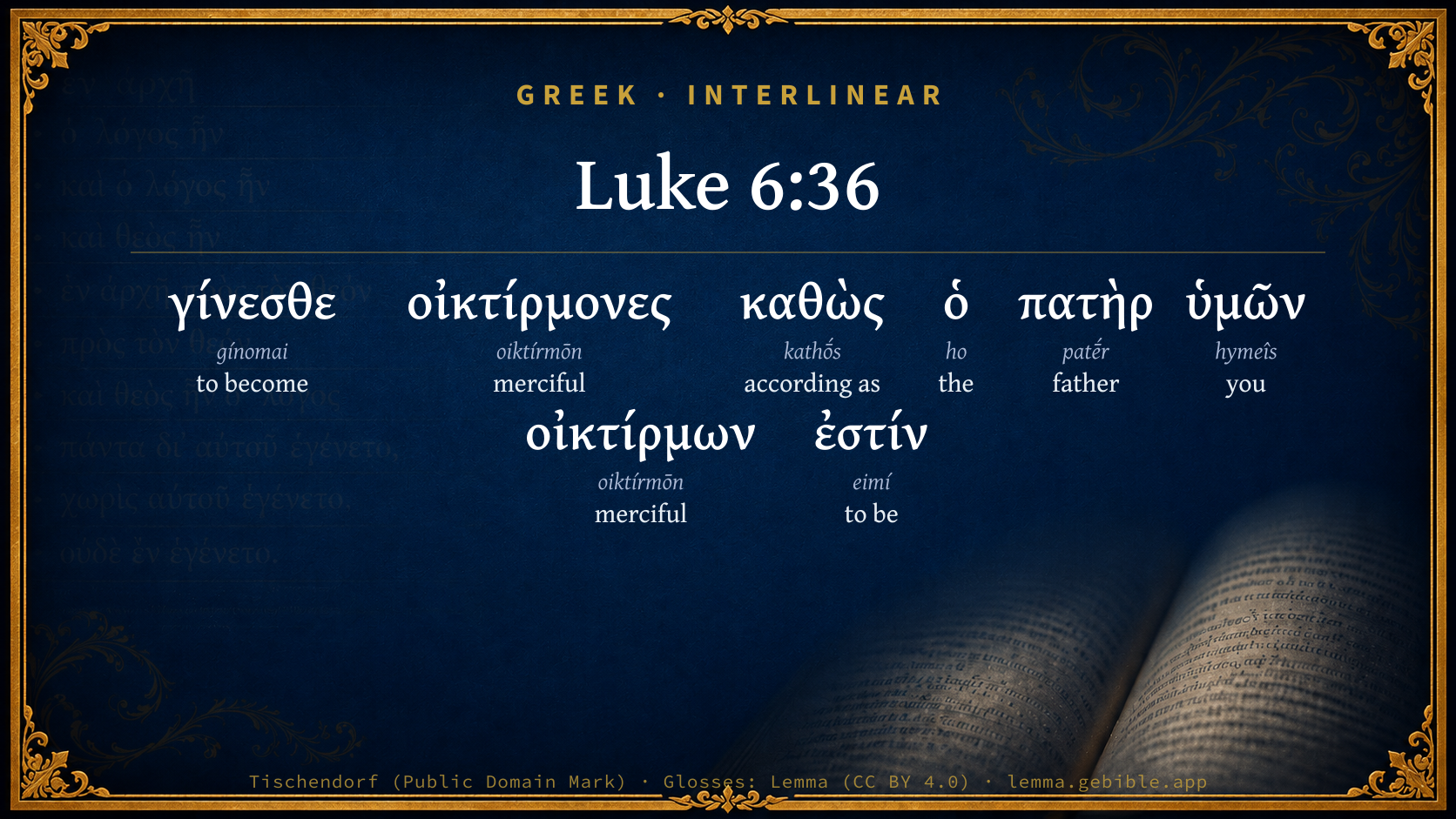
Download image
Cite this verse

Luke 6:36 (World English Bible). Public Domain. Lemma interlinear Bible study tool, https://lemma.gebible.app/v/luke/6/36.

Show BibTeX & RIS
BibTeX
RIS
English Translation
Therefore be merciful, Even as your Father is also merciful.
World English Bible · Public Domain
Highlights
  • 1 first appearance in the Greek New Testament
Full analysis ↓
Download a study sheet

One document with this verse’s original text, its word-by-word gloss line, the meaning frame, cross-references with their text, attributed commentary, and full source and license credits — printable, and it pastes into notes with its structure intact.

This verse Autodidact and up

Study sheet (.html) Plain text (.txt)

A passage Seminary Student

Up to 50 verses in one chapter. A passage sheet keeps up to 6 commentary sources and 12 cross-references per verse, in the order this page ranks them, and says so on the sheet whenever that leaves anything out. Ask for a single verse and you get the Autodidact verse sheet above.

Everything on this page stays free to read, with no account — the sheet is a download of what is already on screen, not access to it.

Want to remove ads? Support Godless Engineer
Compare translations 3

The same verse in 3 English versions, stacked beneath the original-language interlinear above. Click any original word for its lexicon entry.

Each is an independent rendering of the whole verse — the interlinear is not word-aligned to these translations.

Highlighted words mark where these versions differ — a whole-verse word diff, not a word-by-word alignment.

  • World English Bible Public Domain
    Therefore be merciful, Even as your Father is also merciful.
  • King James Version Public Domain
    Be ye therefore merciful, as your Father also is merciful.
  • unfoldingWord Literal Text CC BY-SA 4.0
    Be merciful, just as your Father is merciful.

unfoldingWord Literal Text — © unfoldingWord, licensed CC BY-SA 4.0. Word-aligned USFM3 via Door43 (git.door43.org/unfoldingWord/en_ult).

Versions to compare (up to 4)

3 of 4 selected

Show all 19 translations

Every available English version of this verse, each an independent rendering of the whole verse.

  • World English Bible Public Domain
    Therefore be merciful, Even as your Father is also merciful.
  • Berean Standard Bible Public Domain
    Be merciful, just as your Father is merciful.
  • Majority Standard Bible Public Domain
    Therefore be merciful, just as your Father is merciful.
  • King James Version Public Domain
    Be ye therefore merciful, as your Father also is merciful.
  • American Standard Version (1901) Public Domain
    Be ye merciful, even as your Father is merciful.
  • Revised Version (1885) Public Domain
    Be ye merciful, even as your Father is merciful.
  • Geneva Bible (1599) Public Domain
    Be ye therefore mercifull, as your Father also is mercifull.
  • Douay-Rheims (1899) Public Domain
    Be ye therefore merciful, as your Father also is merciful.
  • Young's Literal Translation Public Domain
    be ye therefore merciful, as also your Father is merciful.
  • Literal Standard Version CC BY-SA 4.0
    be therefore merciful, as also your Father is merciful.
  • Unlocked Literal Bible CC BY-SA 4.0
    Be merciful, just as your Father is merciful.
  • unfoldingWord Literal Text CC BY-SA 4.0
    Be merciful, just as your Father is merciful.
  • Darby Bible Public Domain
    Be ye therefore merciful, even as your Father also is merciful.
  • World Messianic Bible Public Domain
    “Therefore be merciful, even as your Father is also merciful.
  • Webster's Bible Public Domain
    Be ye therefore merciful, as your Father also is merciful.
  • Free Bible Version CC BY-SA 4.0
    Be compassionate, just as your Father is compassionate.
  • Bible in Basic English Public Domain
    Be full of pity, even as your Father is full of pity.
  • Text-Critical English NT CC BY 4.0
    Therefore be merciful, just as your Father is merciful.
  • Tyndale New Testament (1534) Public Domain
    Be ye therfore mercifull as youre father is mercifull.

Literal Standard Version (2020), Covenant Press — licensed CC BY-SA 4.0. Text via the HelloAO Bible API (eBible.org). Unlocked Literal Bible (unfoldingWord) — licensed CC BY-SA 4.0. Text via the HelloAO Bible API (eBible.org). unfoldingWord Literal Text — © unfoldingWord, licensed CC BY-SA 4.0. Word-aligned USFM3 via Door43 (git.door43.org/unfoldingWord/en_ult). Free Bible Version, Dr. Jonathan Gallagher — licensed CC BY-SA 4.0. Text via the HelloAO Bible API (eBible.org).

Word by word

More ways to search: Search by grammar → Find every occurrence → Compare this word →

Practice this passage: Drill this verse → Learn its vocabulary →

About this verse

These counts appear in no published source. They are computed here, from the morphology-tagged text and Lemma’s own curated glosses. What Lemma adds →

8
words
7
distinct lemmas
Gospels
section

Notable vocabulary

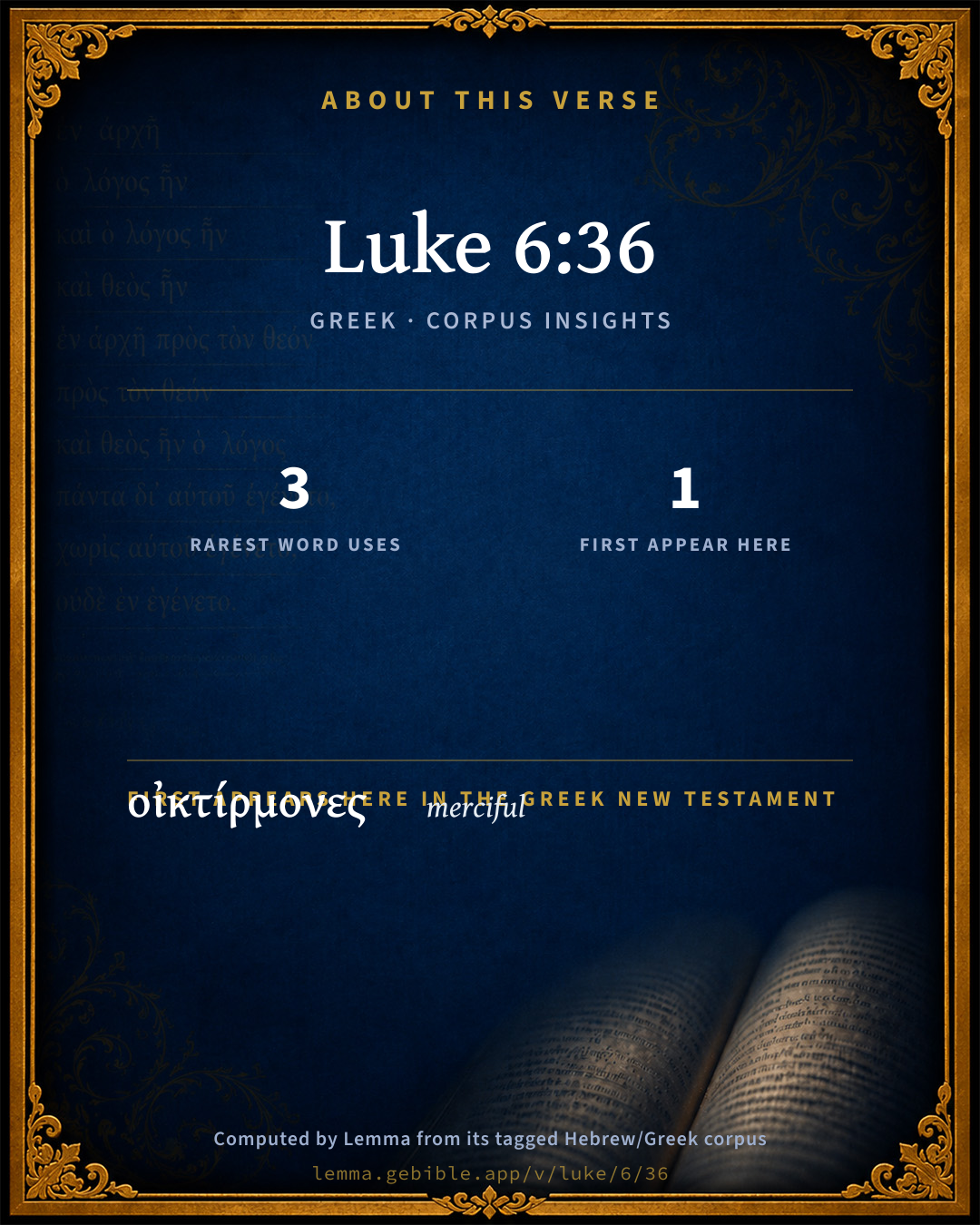
The rarest word here is οἰκτίρμονες merciful G3629 — appearing just 3 times in the whole Greek New Testament.

First appearance in Scripture

This word makes its first canonical appearance in the Greek New Testament here:

  • οἰκτίρμονες merciful G3629

Shared distinctive vocabulary

οἰκτίρμονες merciful G3629 occurs in 2 verses of the Greek New Testament. Also found in:

Repetition

A word recurs within this verse:

  • οἰκτίρμονες merciful G3629 ×2

Cross-references

4

Topical passages linked to Luke 6:36 in the Treasury of Scripture Knowledge — connected by theme and wording, ordered by reader-vote popularity; previews shown in the World English Bible.

  • Ephesians 5:1–2 Be therefore imitators of God, as beloved children.
  • Matthew 5:48 Therefore you shall be perfect, just as your Father in heaven is perfect.
  • 1 Peter 1:15–16 but just as he who called you is holy, you yourselves also be holy in all of your behavior;
  • Ephesians 4:31 Let all bitterness, wrath, anger, outcry, and slander, be put away from you, with all malice.

Cross-references courtesy of OpenBible.info (CC BY 4.0).

Where the printed editions differ

1 variant

Places in this verse where the major printed Greek editions disagree on the wording in a way that affects the translation — a comparison of editions, not a manuscript-by-manuscript collation. The editions are the modern critical texts (Nestlé-Aland 28/27, SBL, Westcott-Hort, Tregelles, Tyndale House) and the traditional texts behind the KJV (the Textus Receptus and the Byzantine/Majority text). It is not a claim about which reading is original.

  1. Extra text
    οὖν

    “therefore”

    In TRByz Not in NA28NA27TynSBLWHTreg

    οὖν (oun) 'therefore' is only in traditional manuscripts (TR+Byz)

Textual data: Translators Amalgamated Greek New Testament (STEPBible TAGNT) · CC BY 4.0.

Commentary

Notes on Luke 6:36 from classic Christian and Jewish commentators (each source and its license shown beneath its notes). The classic Christian expositions comment on the surrounding passage and are grouped to its opening verse, so a note may address several verses; the Jewish commentaries on the Tanakh (Rashi and others) are per-verse, so they appear only where the commentator wrote on this verse.

Lemma curates 59 commentaries, every one of them public domain or Creative Commons licensed, each selected and text-cleaned for this edition rather than reprinted as found. About our sources →

The Biblical Illustrator

Joseph S. Exell

Luk_6:36

Be ye therefore merciful, as your Father also is merciful

The blessing of mercy

Mercy is the one great cry of human nature.

We dare not ask for justice, we can only plead for mercy. We, who want so much mercy from God, must learn to show mercy to our fellow-men. How can we look to Him for mercy if we never show mercy, how can we ask forgiveness unless we forgive? Think of some of the ways in which we can show mercy.

1. We must show mercy and loving-kindness, practically, by deeds, not words.

2. We can show mercy by for giving those who injure us. Few things are more talked of, and less practised, than the duty of forgiveness.

3. Mercy ever brings its sweet reward. Every act of loving-kindness comes back to us with abundant interest. Once a farmer, out on the western prairies of America, started for a distant town, to receive some money due to him. As he left his house, his only child, a little girl, clung lovingly to him, and reminded him of his promise to bring her home a present. Late on the same night the farmer left the town on his way home. The night was very dark and stormy, and he was yet far from his home, and in the wildest part of the road, when he heard the cry of a child. The farmer thought that it might be the device of some robber, as he was known to carry money with him. He was weary and wet with his journey, and inclined to hasten on, but again the cry reached him. The farmer determined that whatever happened he must search for the child, if child there were. Groping in the darkness, at last he found a little figure, drenched with rain, and shivering with cold. Wrapping his cloak about the child, he rode homewards as fast as possible, but when he reached his house, he found it full of neighbours, standing round his weeping wife. One said to another, Do not tell him, it will drive him mad. Then the farmer set down his bundle, and his wife with a cry of joy saw that it was their own lost child. The little one had set forth to meet her father, and had missed her way. The man had, without knowing it, saved his own daughter. (H. J. Wilmot-Buxton, M. A.)

Imitation of the mercy of God

What can be a more endearing motive to the mind of man, than to propose to him a resemblance to the most high God; to urge the conduct of the Father of the universe, as an example for his imitation.

1. The first excellence in the mercy of God which will naturally occur to our thoughts, as deserving our imitation, is its entire disinterestedness and perfect liberality. Our goodness, therefore, must be void of selfish and earthly motives.

2. Its universality. We must endeavour to do all the good we can to all around us, neither slighting the ignorant, nor despising the mean and indigent, nor abandoning the vicious and unworthy in their distress.

(1) Although our mercy may and ought to be universal in will and intention, yet, in consequence of our little power, it must be very limited in reality and in effect (2Co_8:12).

(2) This example of the unconfined extent of the Divine mercy does not hinder us from having a more particular regard to certain persons, and peculiar situations of distress (Gal_6:10).

3. Its unwearied perseverance. Let us, like God, be not weary in well-doing.

4. Its long-suffering patience.

5. Its readiness and willingness to forgive. (James Biddoch, M. A.)

Practical manifestations of mercy

In how many thousand instances does a man hold in his own hands the power of manifesting this blessed quality of mercy! You are an employer; there is some boy in your employment who commits his first transgression, perhaps not really conscious of the evil that he does. Perhaps in an unguarded moment he takes from you something that belongs to you. You do not injure society by exercising mercy towards that boy. How often is it the case that your judicious act of mercy, tempered by justice, has been the means of saving that boy from open exposure, from public punishment; how often it is the salvation of that boy! Do you suppose that it is justice in that case that the penalty of the law shall brand him--that he shall be marked as a criminal, that he shall be self-degraded? This is an instance which men of business will tell me often occurs, and can there be any doubt as to what justice is in that case? So I say, when a mans reputation lies at our mercy, we are bound to make all the allowance we can for his action. If he does a foolish thing, let us be disposed, as far as possible, to make allowance, to think what may have been the peculiar circumstances under which he did it. We are all called upon to exercise this prerogative of mercy, and that in innumerable forms. (E. H. Chapin, D. D.)

Gospel for the fourth Sunday after Trinity

I. WE ARE INCITED TO IMITATION-OF OUR HEAVENLY FATHER. We are His children, and children ought to resemble their parents (Eph_5:1, R.V.)

II. AN APPEAL IS MADE TO OUR SELF-INTEREST. It is a principle of the Divine administration that the standard you apply to others shall be applied to you.

III. OUR LORD SUGGESTS THE WAY IN WHICH WE MAY HOPE TO PASS RIGHTEOUS JUDGMENTS UPON OTHERS. By being first jealous and severe judges of ourselves. (Homiletic Quarterly.)

Man a child of mercy

When God, in His eternal counsel, conceived the thought of mans creation, He called to Him the three ministers who wait constantly upon His throne--Justice, Truth, and Mercy--and thus addressed them: Shall we make man? Then said Justice, O God! make him not: for he will trample upon Thy laws. Truth made answer also, O God! make him not, for he will pollute Thy sanctuaries. But Mercy, dropping upon her knees, and looking up through her tears, exclaimed, O God! make him. I will watch over him with my care through all the dark paths which he may have to tread. Then God made man, and said to him, O man! thou art the child of Mercy: go and deal with thy brother. (Crittenden.)

A condition of receiving mercy

Being sent for by a slave-holder who was seriously unwell, to pray with him, Father Craven approached his bedside and inquired if he had in his will bequeathed liberty to his slaves? No, said the slave-holder, I have bequeathed them to my children. Then, said Father Craven, prayer will be of no avail--God will not show mercy to these who show none to their fellow-men. So he bade him farewell. Soon after a second message was sent for Father Craven to visit the slave-holder and pray with him. He went and asked the slave-holder if he had emancipated his slaves? Yes, said the slave-holder, I have now emancipated them by my will. Will you pray for me? Certainly, said the good man, and he knelt down and commended to God the soul of the sufferer, who seemed near his end. Father Craven agreed with John Jay, a leader in the American revolution, who said, Till America comes into the measure (of abolition) her prayers to heaven will be impious. (Handbook to Scripture Doctrines.)

An all-availing plea

A minister belonging to the Calvinistic Methodists, in a country town, had taught his little boy, who is in his second year, each night before going to sleep, to repeat the prayer: God be merciful to me a sinner. The other Sabbath, while the minister had gone to preach to a village congregation, the child upset the inkstand, and was told his father would whip him for the accident. The minister had no sooner returned, than the child climbed his knee, and putting his mouth close to the fathers ear, softly whispered: Be merciful to me, a sinner, papa. Moved by the ingenuity of the plea, the father kissed his boy, and could not find it in his heart to chide or correct the bright little fellow.

Importance of mercy

Mercy is in the air which we breathe, the daily light which shines upon us, the gracious rain of Gods inheritance. It is the public spring for all the thirsty, the common hospital for all the needy. All the streets of the church are paved with these stones. What would become of the children, if there were not these breasts of consolation? It is mercy that takes us out of the womb, feeds us in the days of our pilgrimage, furnishes us with spiritual provision, closes our eyes in peace, and translates us to a secure resting-place. It is the first petitioners suit, and the first believers article, the contemplation of Enoch, the confidence of Abraham, the burden of the prophetic songs, and the glory of all the apostles, the plea of the penitent, the ecstasies of the reconciled, the believers hosannah, the angels hallelujah. Ordinances, oracles, altars, pulpits, the gates of the grave, and the gates of heaven, do all depend upon mercy. It is the loadstar of the wandering, the ransom of the captive, the antidote of the tempted, the prophet of the living, and the effectual comfort of the dying: there would not be one regenerate saint upon earth, nor one glorified saint in heaven, if it were not for mercy. (The Dictionary of Illustrations.)

Mercy reciprocated

The Marshall DArmont, having taken Crodon, ordered every Spaniard found in the garrison to be put to death. Though it was death to disobey orders, an English soldier ventured to save a Spaniard. He was arraigned for the offence, confessed the fact, and declared himself ready to suffer death if they would save the life of the Spaniard. Surprised at the request, they inquired why he was so much interested. Because, replied he, in a similar situation, he once saved my life. The marshall was so greatly pleased, that he granted him pardon, and saved the Spaniards life as well.

Provision for mercy

Abraham Lincolns doorkeeper had standing orders from him, that no matter how great might be the throng, if either senators or representatives had to wait, or to be turned away without an audience, he must see, before the day closed, every messenger who came to him with a petition for the saving of life.

The law of love

All that is really good is the outcome of the law of love, and its first result and inseparable companion is mercy.

I. FORBEAR.

1. A passion for judging others seems to exist in men. Every one, however backward to amend himself, is ready to correct others. The origin of this spirit is too clear. Deep in mans native selfishness. Exalts self, depresses others.

2. Are we never, then, to judge?

(1) One cannot help forming opinions. It would be indicative of a perverted conscience to regard all with equal complacency. Yes, but this is different from the glad readiness to judge.

(2) Sometimes needful to speak as well as to judge. But not in a censorious spirit, or overbearing tone.

(3) The example of Jesus is the solution of the difficulty. Reprove only when needful. Then in righteous indignation, or in sorrowful rebuke.

II. FORGIVE.

1. Revenge is as natural to man as passing judgment.

2. Often as false and hypocritical, hiding itself under similar disguises.

3. Its root is ultimately the same. Selfishness--contradiction of the law of love.

4. Consequently condemned by example and spirit of Christ. His forgiving mercy was habitual, ready, cordial.

III. GIVE. The more active side of mercy. Opposed to bargaining or exchange--no thought of return. An evidence of sonship of God. When we are merciful, we come nearest to the Divine perfection. (W. R. Clark, M. A.)

Mercy

I. ITS ACTS.

1. Consideration.2. Compassion.

3. Prayer.

4. Helpfulness, according to the need of the object.

II. ITS OBJECTS. Our neighbour.

1. Erring (Jam_5:19-20).

2. Offending.

3. Under persecution.

4. In want.

5. In sickness.

6. In misfortune by the loss of good friends, or the unkindness of bad relations.

III. THE MANNER OF ITS EXERCISE. Acts of mercy are to be performed--

1. With readiness and forwardness of mind (2Co_9:7).

2. With modesty and humility (Mat_6:1).

3. From a kind and merciful, not from a selfish and mercenary temper (Luk_6:32).

4. Without delay (Pro_4:23).

5. Bountifully (1Ti_6:18).

6. With minds full of gratitude to God (1Ch_29:13; 1Ch_29:17).

7. As to Christ Himself (Mat_10:42).

IV. THE BLESSING PROMISED TO THE MERCIFUL. AS for external mercies, the Bible promises them very fully to the merciful.

1. Deliverance out of trouble (Isa_58:10; Psa_41:1).

2. Gods blessing on his labours and undertakings

Deu_15:7-10).

3. The staving off of his trouble, and the lengthening of his tranquility (Dan_4:27).

4. Plenty (Pro_19:17; Pro_3:9).

B Honour (Psa_112:9).

6. Deliverance from enemies (Psa_41:2).

7. God s comforts in his sickness (Psa_51:3).

8. A blessing on his posterity (Psa_37:26).

9. More particularly, mans help in distress and Gods providence. (J. Blair, D. D.)

Are we merciful in our speech to men?

Do we not sometimes take pleasure in making a criticism as sharp and pungent as we can make it? Do we in our literature, in our judgments of the political work or social life of others, strive to speak charitably; or rather, is it not a keen gratification to think that the world enjoys the criticism when the writer is sharp and piquant, and seasons his criticism with that unkindness which sends it home as the feather sends the arrow? (Bishop W. C. Magee.)

Are we merciful as employers of others?

Do we feel that those around us in domestic service, in business, should have their feelings carefully considered? Surely there is a sad want of thoughtful mercy amongst us all I There is no lack of that mercy which comes of being strongly appealed to, and which moves a man to give largely of his money, time, and energy, for the removal of suffering. But the thoughtful, considerate mercy which seeks to prevent suffering and to hinder crime is what we desire to see. (Bishop W. C. Magee.)

The merciful

The world of the natural man is by no means predominantly a merciful world. The tender mercies of the wicked are cruel. A thoroughly bad man is seldom a kind man. The kindliness of a bad man is generally both capricious and selfish. At its best it lacks the essential condition of a Christian charity. Not everything which passes for kindness, not everything which is kindness, is mercy in the sense here intended. There is another word in Scripture, which stands for pity, and the two ideas differ.

1. The objects of pity are the unhappy: the objects of mercy are the undeserving.

(1) Mercy is seen towards those who have no claim upon us. The good Samaritan was merciful as well as pitiful; because the robbed and wounded man whom he succoured was wholly unconnected with him; was not only no relation, but even an alien and of a hostile race.

(2) Mercy is shown, yet more strongly, towards those who have forfeited their claim upon us; those who had a claim, and have lost it. The prodigal son.

2. The nature of mercy.

(1) Sympathy. A fellow-feeling with the undeserving. A deep consciousness of personal demerit, making me at once the equal and the brother of the undeserving.

(2) This sense of fellowship with the sinner is accompanied with a sense of the evil of sin. By this it is prompted.

(3) A desire for the good--the highest good--of the sinful. Mercy rests not in the fall. Mercy is not satisfied with bewailing the misery. Mercy expends not itself in sighs and tears, sits not down with the sorrow and the sinfulness which she both beholds and feels: she looks upward, and she looks onward--upward for help, onward to salvation; and is as ready to succour as she is prompt to sympathise.

3. The working of mercy.

(1) Compassionate thoughts. Mercy, like every grace, has its seat within. We must begin with the heart. The thoughts of mercy will be disciplined into charitableness before she begins to speak or to do. She will recount inwardly the revelation of God concerning sin itself; how it first entered into the world; how it spread its reign hither and thither, till a flood of evil had hidden earth itself from heaven; how it works in the child, struggles for mastery in the man, and leads captive in unsuspected bonds souls born for immortality and for God. She knows how subtle are its workings, how fatal its delusions, how strong its chains. She pities even where she must condemn, and, where she cannot trust, she can at least hope still.

(2) Compassionate thoughts come forth naturally into kindly words. The merciful man speaks mercifully.

(3) Compassionate thoughts and kindly words will run on, lastly, into practical efforts. A man who has a feeling of compassion should always act upon it. (Dean Vaughan.)

Mercifulness

What is it to be merciful? Like other virtues, this, too, has its imitations, worthless and spurious. There is a mercy current among men which is merely an outlet for energy, or the fashion of the day. There is a mercy, so called, which is in reality a luxury, a refined sort of self-indulgence. There is a sort of mercy which people call charity, which gives, but without discrimination or thought. But these, none of these, are mercifulness. No, nor, on the other hand, is it to be confused with pity, a feeling of compassion for the unfortunate; nor has it to do with merely deeds of mercy, acts of kindness. For mercifulness and mercy do not mean the same thing. Mercifulness is what we are and what we do. Mercy, as men count it, may be all outside, no heart in it, or may take its rise from wrong or unworthy motives; while mercifulness must go down to the inner springs of actions, not stop short of guiding principles, have its roots in sound and holy motives. It deals with the quality of the deed rather than the quantity; it examines the texture of which it is made, not the smoothness or bright shimmer; it asks not whether it glitters, but whether it is gold with the true ring.

1. True mercifulness is a characteristic of those who hunger and thirst after righteousness, and they alone will be merciful in Gods way, seeking not to please themselves, but to do His will who is merciful and gracious, slow to anger and plenteous in mercy.

2. True mercifulness is always guided by meekness. It is exercised towards those who have ill requited our kindness, and are undeserving of our mercy.

3. True mercifulness can only be felt by those who have learned to mourn their sin, and in repentance turned unto God, and so have a fellow feeling with those who sin, and long to rescue them.

4. True mercifulness has, as its earliest beginning, poverty of spirit, for only those who in humility know themselves aright will never despair of others, or tire of showing mercy to the undeserving. (C. J. Ridgeway, M. A.)

The mercifulness of God as seen in Christ

1. He was merciful to all, not to some.

2. His mercifulness was provident, thoughtful, wise, seeking the real good of men, marked by the discrimination of prudence, withholding to-day what will do harm instead of good, giving to one what He refuses to another, always keeping before Him as the only true object of mercifulness the well-being of those He came to succour.

3. His mercifulness is unchanging. Time does not wear it out, nor years weaken it. He was merciful even as He loved, unto the end. Many waters could not quench it, neither the floods drown it. The waters came in even unto His soul, suffering and anguish overwhelmed Him; but His mercifulness lived on; it burned like the beacon light of the lighthouse, undimmed by the great storm of affliction that raged around. Nor is He changed now. His mercifulness is as true in His exaltation as in His Passion Heb_2:17-18; Heb_7:24-25). (C. J. Ridgeway, M. A.)

Christs mercifulness and ours

Compare what we call mercifulness with His. His a mercifulness which always kept Gods glory in view, and ours so often centring about self. His a mercifulness shown towards those who were ever seeking His heart, and ours so easily quenched by the first appearance of ingratitude. His a mercifulness that recognized sin as the source of every mans misery, and ours so indifferent to the deepest needs of the men and women around us. His a mercifulness that stooped to help, that touched as well as pitied, and ours always bestowed with a gloved hand, and at a safe distance. His a mercifulness so catholic and wide in its embrace, and ours so narrow and limited by national or religious, or, worse still, party prejudice. His a mercifulness that was provident and wise, and ours capricious and thoughtless, giving to the professional beggar because she importunes us at the very door of the church, or to the man who in veriest cruelty drags little children, often hired for the purpose, through the wet and muddy streets, in the cold and wet, for they are never to be seen on fine days; while to calls that come from those that can guarantee their worth, or to the really poor who will not beg, or to the appeals which are made in Gods house for definite objects, our mercifulness turns a deaf ear. Believe me, it is time for us to learn that true mercifulness is discriminating, thoughtful, wise. His a mercifulness that is always the same, ours so fitful, uncertain, unreliable. His a mercifulness that cost Him self-sacrifice, ours a doing or giving what will not even cost us a thought. His a mercifulness that permeated the whole man in every thought, and word, and deed, ours so superficial, so unreal, our thoughts often breathing harsh judgment upon others, our actions marked by so little consideration of those about us or below us to whom we might be merciful. (C. J. Ridgeway, M. A.)

Christian mercy

I. THE NATURE OF CHRISTIAN MERCY.

1. It has its seat in the heart.

2. It is a supernatural quality.

3. It is an active principle.

(1) It will be manifested toward the inferior animals.

(2) To those of our fellow-creatures who are under bodily affliction and misery.

(3) It will extend to the spiritual miseries of our fellow-min. Mercy to the soul, is the soul of mercy.

(4) Towards our greatest enemies.

II. THE GROUNDS OF CHRISTIAN MERCY.

1. Because it is strictly enjoined by God.

2. Because we stand in constant need of Divine mercy. Were it withdrawn, there would be nothing before us but a fearful looking for of judgment.

3. Because our profession binds us to imitate Christ, who is the perfect pattern of mercy. In Him mercy was embodied. If we are His disciples, we will walk even as He walked.

4. We should be merciful because of the true pleasure which is associated with acts of mercy.

5. Because it is an express condition of our obtaining mercy.

III. THE REWARDS OF CHRISTIAN MERCY.

1. A good name.

2. A peculiar interest in the kind and merciful arrangements of Divine providence.

3. The merciful are blessed with the prayers and blessings of the miserable whom they have relieved.

4. They shall be blessed with the public approval of Christ at the last day. Application:

1. Let the exercise of mercy be pressed on all Christs disciples. Cultivate it. Rejoice in all opportunities of doing good.

2. Let the mercy of God to us be highly valued. We need it daily. Only one channel for its communication--through Christ. Only one way to obtain it--through faith in His word.

3. The unmerciful shall have judgment without mercy. What a dreadful portion to the guilty sinner! (J. Burns, D. D.)

The Biblical Illustrator, edited by Joseph S. Exell (c. 1880s–1900s) — public domain. Text from a community e-Sword module.

Bengel's Gnomon

Johann Albrecht Bengel

Luk 6:36. Γίνεσθε· ἐστί) These two verbs differ:[65] 1Pe 1:16.[66]—ΟἸΚΤΊΡΜΟΝΕς, merciful) The root of all offices of kindness. [Works of mercy, sparing and giving mercy, are immediately subjoined.—V. g.]

[65] γινεσθε implies that man is to become that which he is not naturally: ἐστί, that God essentially is merciful.—ED.

[66] Where Rec. Text reads γένεσθε. But ABC Vulg. read ἔσεσθε, Ye shall be, or be ye, holy. Probably ἔσεσθε, not γίνεσθε, is used there, because no εἰμὶ follows ἅγιος, expressing that God is essentially holy: therefore the verb εἶναι is there used of men, not as strictly referring to them, but with a tacit reference properly to God, who alone is essentially holy, and whose nature we are to try to be partakers of. Transcribers, unable to explain the difficulty of ἔσεσθε, instead of the usual γίνεσθε or γένεσθε, being associated with men, altered accordingly. Bengel’s principle of testing genuine readings applies, “Præstat ardua lectio procliviori.”—ED.

Bengel's Gnomon of the New Testament — English translation (T&T Clark, Edinburgh, 1860) — public domain. Text from a community e-Sword module.

Meyer's Critical & Exegetical Commentary

Heinrich August Wilhelm Meyer

Luk_6:36-38. From this exemplar of the divine benignity in general Jesus now passes over (without οὖν, see the critical remarks) to the special duty of becoming compassionate (γίνεσθε) after Gods example (ἐστί), and connects therewith (Luk_6:37 f.) other duties of love with the corresponding Messianic promises. On Luk_6:37 f. comp. Mat_7:1 f.

ἀπολύετε] set free, Luk_22:68, Luk_23:16. The opposite of what is previously forbidden.

μέτρον καλὸν κ.τ.λ.] a more explicit explanation of δοθήσεται, and a figurative description of the fulness of the Messianic blessedness, οὐ γὰρ φειδομένως ἀντιμετρεῖ ὁ κύριος, ἀλλὰ πλουσίως, Theophylact.

καλόν] a good, i.e. not scanty or insufficient, but a full measure; among the Rabbins, מדה טובה, see Schoettgen, I. p. 273. Observe the climax of the predicates, in respect of all of which, moreover, it is a measure of dry things that is conceived of even in the case of ὑπερεκχ., in connection wherewith Bengel incongruously conceives of fluidity. Instead of ὑπερεκχύνω, Greek writers (Diodorus, Aelian, etc.) have only the form ὑπερεκχέω. Instead of σαλεύω, of close packing by means of shaking, Greek writers use σαλάσσω. See Lobeck, Pathol. p. 87; Jacobs, ad Anthol. VII. p. 95, XI. p. 70.

δώσουσιν] τίνες; οἱ εὐεργετηθέντες πάντως· τοῦ Θεοῦ γὰρ ἀποδιδόντος ὑπὲρ αὐτῶν αὐτοὶ δοκοῦσιν ἀποδιδόναι, Euthymius Zigabenus. But the context offers no definite subject at all. Hence in general: the persons who give (Kühner, II. p. 35 f.). It is not doubtful who they are: the servants who execute the judgment, i.e. the angels, Mat_24:31. Comp. on Luk_16:9.

κόλπος] the gathered fold of the wide upper garment bound together by the girdle, Jer_32:18; Isa_65:6; Rth_3:15; Wetstein and Kypke in loc.

τῷ γὰρ αὐτῷ μέτρῳ] The identity of the measure; e.g. if your measure is giving, beneficence, the same measure shall be applied in your recompense. The δοθήσ. ὑμῖν does not exclude the larger quantity of the contents at the judgment (see what precedes). Theophylact appropriately says: ἔστι γὰρ διδόναι τῷ αὐτῷ μέτρῳ, οὐ μὴν τοσούτῳ.

Meyer — Critical and Exegetical Commentary on the New Testament — English translation by Peter Christie, edited by Frederick Crombie (T&T Clark, 1880) — public domain. Text from a community e-Sword module.

Expositor's Greek Testament

ed. W. Robertson Nicoll

Luk 6:36-38 . Mercifulness inculcated. God the pattern .

Luk 6:36 corresponds to Mat 5:48 , which fitly closes the promulgation of the great law of love = be ye therefore perfect, as your Father in heaven is perfect ( vide notes there). Lk. alters the precept both in its expression ( οἰκτίρμονες for τέλειοι ), and in its setting , making it begin a new train of thought instead of winding up the previous one = be compassionate ( οὖν omitted, [69] [70] [71] [72] , etc.) as, etc. the precepts following being particulars under that general. γίνεσθε , imperative, for the future in Mt. οἰκτίρμονες : a legitimate substitution, as the perfection inculcated referred to loving enemies, and giving opportunity for setting forth the doctrine of God’s free grace. καθὼς for Mt.’s ὡς , common in Lk. (twenty-eight times), witnessing to editorial revision. ὁ πατὴρ ὑ .: without ὁ οὐράνιος , which is implied in the epithet “the Highest” (Luk 6:35 ).

[69] Codex Sinaiticus (sæc. iv.), now at St. Petersburg, published in facsimile type by its discoverer, Tischendorf, in 1862.

[70] Codex Vaticanus (sæc. iv.), published in photographic facsimile in 1889 under the care of the Abbate Cozza-Luzi.

[71] Codex Bezae

[72] Codex Regius--eighth century, represents an ancient text, and is often in agreement with א and B.

The Expositor's Greek Testament, edited by W. Robertson Nicoll (1897–1910) — public domain. Text from a community e-Sword module.

Adam Clarke's Commentary

Verse 36. Be ye therefore merciful] Or, compassionate; οικτιρμινες, from οικτος, commiseration, which etymologists derive from εικω to give place, yield, because we readily concede those things which are necessary to them whom we commiserate. As God is ever disposed to give all necessary help and support to those who are miserable, so his followers, being influenced by the same spirit, are easy to be entreated, and are at all times ready to contribute to the uttermost of their power to relieve or remove the miseries of the distressed. A merciful or compassionate man easily forgets injuries; pardons them without being solicited; and does not permit repeated returns of ingratitude to deter him from doing good, even to the unthankful and the unholy. See Clarke on Mt 5:7.

Adam Clarke's Commentary on the Bible (1810–1826) — public domain. Text from a community e-Sword/MySword module.

Ellicott's Commentary for English Readers

(36) Be ye therefore merciful.—The form of the sentence is the same as that of Mat_5:48, but “merciful” takes the place of “perfect,” as being the noblest of the divine attributes, in which all others reach their completeness. The well-known passage in Shakespeare on the “quality of mercy,” is, perhaps, the best comment on this verse (Merchant of Venice, iv. 1).

A Bible Commentary for English Readers, edited by Charles John Ellicott (1878–1897) — public domain. Text from a community e-Sword module.

The Cambridge Bible for Schools and Colleges

gen. ed. J. J. S. Perowne

36. Be ye therefore merciful] Rather, Become, or Prove yourselves merciful (omit οὖν, אBDL).

merciful] St Matthew has “perfect,” Mat_5:48; but that there is no essential difference between the two Evangelists we may see in such expressions as “the Father of Mercies,” 2Co_1:3; “The Lord is very pitiful and of tender mercy,” Jas_5:11; “Put on therefore as the elect of God...bowels of mercies, kindness,” Col_3:12; Isa_30:18. “God can only be our ideal in His moral attributes, of which Love is the centre.” Van Oosterzee.

“It is an attribute to God Himself,

And earthly power doth then shew likest God’s

When mercy seasons justice.”

Shakespeare.

The Cambridge Bible for Schools and Colleges (gen. ed. J. J. S. Perowne; Cambridge University Press, 1878–1918) — public domain. Text from a community e-Sword module.

John Gill's Exposition

Judge not, and ye shall not be judged,.... See Gill on Mat 7:1.

Condemn not, and ye shall not be condemned; censure not men's persons, and judge not their state, or adjudge them to condemnation, for every offence in practice, or because they differ in principle, lest you should be treated in like manner by others; and especially, lest you should fall under the righteous censure, judgment, and condemnation of God:

forgive; offences and trespasses committed against you, bear with, and pass by injuries and affronts:

and ye shall be forgiven; of God; See Gill on Mat 6:14.

John Gill's Exposition of the Whole Bible (1746–1763) — public domain (CC PDM 1.0). Text via the HelloAO Bible API.

Trapp's Complete Commentary

John Trapp

36 Be ye therefore merciful, as your Father also is merciful.

Ver. 36. {See Trapp on "Mat 5:48"}

John Trapp, A Commentary or Exposition upon All the Books of the Old and New Testament (1647–1656) — public domain. Text from a community e-Sword module.

The Pulpit Commentary

Be ye therefore merciful, as your Father also is merciful. "Yes," goes on the Master, "be ye kind, tender-hearted, merciful; stop not short at the easier love, but go on to the harder; and do this because God does it even to the unthankful and evil" (ver. 35). On this attribute of the mercy of the Most High, James, who had evidently drunk deep of the wisdom contained in this great discourse of his so-called brother, speaks of the Lord as "very pitiful, and of tender mercy". (Jam_5:11)

The Pulpit Commentary (1880–1919), ed. H.D.M. Spence-Jones & Joseph S. Exell — public domain. Text from a community e-Sword module.

Kretzmann's Popular Commentary

Paul E. Kretzmann

The measure of mercifulness:

v. 36. Be ye therefore merciful as your Father also is merciful.

v. 37. Judge not, and ye shall not be judged; condemn not, and ye shall not be condemned; forgive, and ye shall be forgiven;

v. 38. give, and it shall be given unto you; good measure, pressed down, and shaken together, and running over, shall men give into your bosom. For with the same measure that ye mete withal it shall be measured to you again.

Not only kindness and goodness is enjoined upon the Christians, but also mercy or mercifulness, something of that divine quality which had compassion upon us in Christ, our Savior. This will include refraining from officious judging and condemning of our neighbor, of his person and manner of life. Some forms of judging are enjoined by Scripture, as that of the erring brother, Mat 18:15, that of people in public office under a democratic form of government, and others. But so far as the personal life and transgressions of our neighbor are concerned, we must practice forgiveness if we wish to receive forgiveness. We must give if we hope to receive; the measure of God’s gracious kindness being filled in proportion to our sympathetic compassion: a good measure, pressed down, shaken together, and flowing over the top will be our portion if we practice the kindness whose example we have received so richly in our own lives. The generousness of our own nature and the graciousness of God’s spirit are placed side by side, for our emulation, since the thought of His plenteous redemption should be a spur for us, Psa 130:7. "Where this mercy is not found, there is no faith. For if thy heart is full of faith that thou knowest that thy God has shown Himself thus to thee, with such mercy and goodness, without thy merit and altogether for nothing, while thou wert still His enemy and a child of eternal curse: if thou believest this, thou canst not refrain from showing thyself to thy neighbor in the same manner, and all that for love of God and for the benefit of thy neighbor. See to it, then, that thou make no difference between friend and enemy, worthy and unworthy; for thou seest that all those mentioned here have earned the opposite of our love and goodness. " "Therefore, if thy brother be a sinner, cover his sins and pray for him. If thou reveal his sin, thou art truly not a child of the merciful Father, for else thou wouldst be merciful like Him. That surely is true, that we cannot show such mercy to our neighbor as God has shown to us, but that is our great wickedness, that we act contrary to mercy; and that is a sure sign that we have no mercy."

Paul E. Kretzmann, Popular Commentary of the Bible (1921–1924) — public domain. Text from a community e-Sword module.

Cambridge Greek Testament for Schools and Colleges

36. γίνεσθε οἰκτίρμονες. ‘Become,’ or ‘Prove yourselves merciful’ (omit οὖν, אBDL).

οἰκτίρμων. St Matthew has “perfect,” Mat 5:48; but that there is no essential difference between the two Evangelists we may see in such expressions as “the Father of Mercies,” 2Co 1:3; “the Lord is very pitiful and of tender mercy,” Jas 5:11; “Put on therefore as the elect of God … bowels of mercies, kindness,” Col 3:12; Isa 30:18. “God can only be our ideal in His moral attributes, of which Love is the centre.” Van Oosterzee.

“It is an attribute to God Himself,

And earthly power doth then shew likest God’s

When mercy seasons justice.”

SHAKSPEARE.

Cambridge Greek Testament for Schools and Colleges (Cambridge University Press, 1896; 21 vols, various authors incl. Carr, Maclear, Plummer, Farrar, Lumby, Moule, M. R. James, Simcox) — public domain. Text from a community e-Sword module.

Alford’s Greek Testament

Henry Alford

36.] οἰκτίρμ. = τέλειοι Mat 5:48, which last is the larger description, comprehending in it charity and mercy: see note there.

Vv. 37 f. = Mat 7:1, Mat 7:2. The saying is much enriched and expanded here; perhaps it was so uttered by our Lord on some other occasion; for the connexion is very strict in Matt., and would hardly bear this expansion of what is not in that place the leading idea.

Henry Alford, The Greek Testament (1849–1861) — public domain. Text from a community e-Sword module.

International Critical Commentary

36, 37. A further development of the principle of Christian love. Having told His disciples to cherish no personal animus against those who injure them, He now warns them against judging others respecting any supposed misconduct. To pose as a general censor morum is unchristian. Censoriousness is a transgression of the royal law of love, and an invasion of the Divine prerogatives. Not only vengeance but judgment belongs to God. And judgment, when it is inevitable, must be charitable (ἀπολύετε), directed by a desire to acquit rather than to condemn. Comp. 1Co 13:4; Jas 4:11, Jas 4:12. Hillel said, “judge not thy neighbour until thou comest into his place” (Ewald, Hist. of Israel, 6. P. 27). See on ver. 31.

The loose citations of these two verses by Clement of Rome (i. 13:2) and Clement of Alexandria (Strom. 2:18, P. 476, ed. Potter) are interesting. Both have the words ὡς χρηστεύεσθε, οὕτως χρηστευθήσεται ὑμῖν immediately before ᾦ μέτρῳ, κ.τ.λ. They represent γίνεσθε οἰκτίρμονες in Lk., for which Justin has γίνεσθε δὲ χρηστοὶ καὶ οἰκτίρμονες (Try. 96.; Rev 1:15). Comp.ClemHom 3:57. It is probable that Clem. Alex. here quotes Clem. Hom. unconsciously.

International Critical Commentary — older volumes (1896–1929), various authors — public domain. Text from a community e-Sword module.

Vincent's Word Studies in the New Testament

Marvin R. Vincent

Merciful [οικτιρμονες] . See on Jas 5:11.

Marvin R. Vincent, Word Studies in the New Testament (1887–1900) — public domain. Text from a community e-Sword/MySword module.

Lesson kit

Teaching starters — assembled from the data on this page, not authored interpretation. Every prompt links to the verse data it draws on. Edit before teaching.

Luke, in the Gospels, opens this verse with 8 words (7 distinct Greek lemmas). Its most distinctive word is oiktírmōn (“merciful”). A historical commentator’s framing appears above. Read the whole chapter for the surrounding context.

Discussion questions

  1. How does “merciful” (oiktírmōn) shape what this verse is saying?
  2. The word “merciful” first appears here in Scripture. What is being introduced at this debut?
  3. James 5:11 shares the word «merciful» with this verse. How do the two illuminate each other?
  4. “merciful” occurs 2× in this one verse. What is the effect of the repetition?
  5. These translations render this verse differently. What is at stake in choosing one wording over another?
  6. Reading how The Biblical Illustrator and Bengel's Gnomon read this verse, where do the two commentators agree and where do they part?

Things to notice

  • 1 word makes its first canonical appearance in Scripture here.
  • These translations choose different wording for 4 words in this verse.
  • “merciful” occurs 2× in this single verse.
  • 7 distinct Greek lemmas span 8 words in this verse.

Reading settings

Reading text

Shown beneath each verse's original-language words.

Old Testament
Old Testament edition

Read the OT as the Masoretic Hebrew (MT) or the Greek Septuagint (LXX).

English shown for the Greek Septuagint (in the Hebrew ↔ Greek comparison).

Comparing translations? Open the Compare panel on any verse page to stack up to four side by side.