
Luke 15:21

Greek (Tischendorf 8th ed.) Luke 15:21 appears in the Greek New Testament. The text above is from the Tischendorf 8th edition. Each word links to its Strong’s number and a concise gloss. Click any word for its full Thayer’s Greek Lexicon entry.
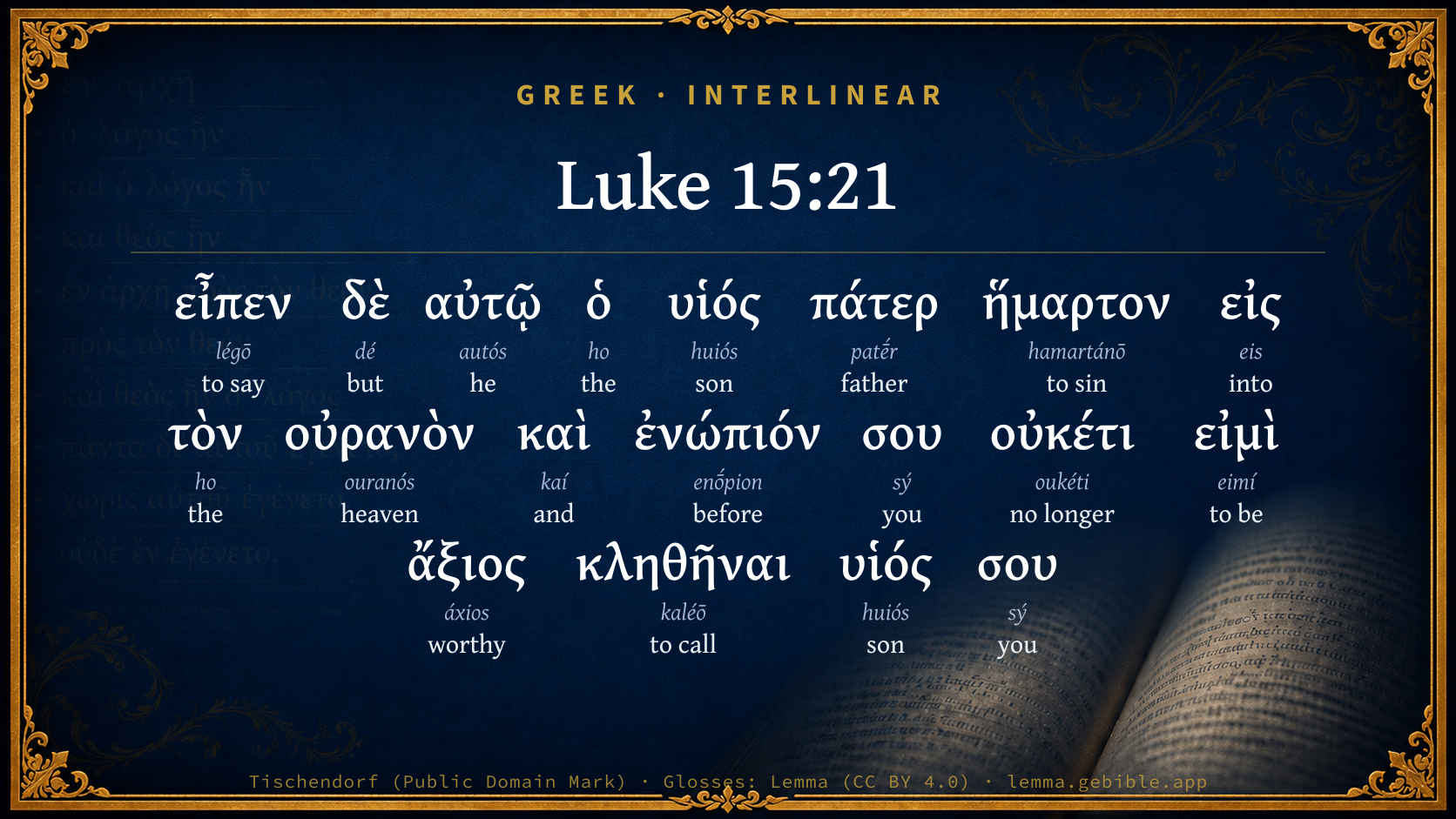
Download image
Cite this verse

Luke 15:21 (World English Bible). Public Domain. Lemma interlinear Bible study tool, https://lemma.gebible.app/v/luke/15/21.

Show BibTeX & RIS
BibTeX
RIS
English Translation
The son said to him, 'Father, I have sinned against heaven, and in your sight. I am no longer worthy to be called your son.'
World English Bible · Public Domain
Download a study sheet

One document with this verse’s original text, its word-by-word gloss line, the meaning frame, cross-references with their text, attributed commentary, and full source and license credits — printable, and it pastes into notes with its structure intact.

This verse Autodidact and up

Study sheet (.html) Plain text (.txt)

A passage Seminary Student

Up to 50 verses in one chapter. A passage sheet keeps up to 6 commentary sources and 12 cross-references per verse, in the order this page ranks them, and says so on the sheet whenever that leaves anything out. Ask for a single verse and you get the Autodidact verse sheet above.

Everything on this page stays free to read, with no account — the sheet is a download of what is already on screen, not access to it.

Want to remove ads? Support Godless Engineer
Compare translations 3

The same verse in 3 English versions, stacked beneath the original-language interlinear above. Click any original word for its lexicon entry.

Each is an independent rendering of the whole verse — the interlinear is not word-aligned to these translations.

Highlighted words mark where these versions differ — a whole-verse word diff, not a word-by-word alignment.

  • World English Bible Public Domain
    The son said to him, 'Father, I have sinned against heaven, and in your sight. I am no longer worthy to be called your son.'
  • King James Version Public Domain
    And the son said unto him, Father, I have sinned against heaven, and in thy sight, and am no more worthy to be called thy son.
  • unfoldingWord Literal Text CC BY-SA 4.0
    Then the son said to him, ‘Father, I have sinned against heaven and before you. I am no longer worthy to be called your son.’

unfoldingWord Literal Text — © unfoldingWord, licensed CC BY-SA 4.0. Word-aligned USFM3 via Door43 (git.door43.org/unfoldingWord/en_ult).

Versions to compare (up to 4)

3 of 4 selected

Show all 19 translations

Every available English version of this verse, each an independent rendering of the whole verse.

  • World English Bible Public Domain
    The son said to him, 'Father, I have sinned against heaven, and in your sight. I am no longer worthy to be called your son.'
  • Berean Standard Bible Public Domain
    The son declared, ‘Father, I have sinned against heaven and against you. I am no longer worthy to be called your son.’
  • Majority Standard Bible Public Domain
    The son declared, ‘Father, I have sinned against heaven and against you. I am no longer worthy to be called your son.’
  • King James Version Public Domain
    And the son said unto him, Father, I have sinned against heaven, and in thy sight, and am no more worthy to be called thy son.
  • American Standard Version (1901) Public Domain
    And the son said unto him, Father, I have sinned against heaven, and in thy sight: I am no more worthy to be called thy son.
  • Revised Version (1885) Public Domain
    And the son said unto him, Father, I have sinned against heaven, and in thy sight: I am no more worthy to be called thy son.
  • Geneva Bible (1599) Public Domain
    And the sonne sayde vnto him, Father, I haue sinned against heauen, and before thee, and am no more worthie to be called thy sonne.
  • Douay-Rheims (1899) Public Domain
    And the son said to him: Father, I have sinned against heaven, and before thee, I am not now worthy to be called thy son.
  • Young's Literal Translation Public Domain
    and the son said to him, Father, I did sin -- to the heaven, and before thee, and no more am I worthy to be called thy son.
  • Literal Standard Version CC BY-SA 4.0
    and the son said to him, Father, I sinned—to Heaven, and before you, and I am no longer worthy to be called your son.
  • Unlocked Literal Bible CC BY-SA 4.0
    The son said to him, 'Father, I have sinned against heaven and against you. I am no longer worthy to be called your son.'
  • unfoldingWord Literal Text CC BY-SA 4.0
    Then the son said to him, ‘Father, I have sinned against heaven and before you. I am no longer worthy to be called your son.’
  • Darby Bible Public Domain
    And the son said to him, Father, I have sinned against heaven and before thee; I am no longer worthy to be called thy son.
  • World Messianic Bible Public Domain
    The son said to him, ‘Father, I have sinned against heaven and in your sight. I am no longer worthy to be called your son.’
  • Webster's Bible Public Domain
    And the son said to him, Father, I have sinned against heaven, and in thy sight, and am no more worthy to be called thy son.
  • Free Bible Version CC BY-SA 4.0
    The son said to him, ‘Father, I've sinned against heaven and against you. I'm no longer worthy to be called your son.’
  • Bible in Basic English Public Domain
    And his son said to him, Father, I have done wrong, against heaven and in your eyes: I am no longer good enough to be named your son.
  • Text-Critical English NT CC BY 4.0
    Then the son said to him, ‘Father, I have sinned against heaven and before yoʋ. I am no longer worthy to be called yoʋr son.’
  • Tyndale New Testament (1534) Public Domain
    And the sonne sayd vnto him: father I have synned agaynst heven and in thy sight and am no moare worthy to be called thy sonne.

Literal Standard Version (2020), Covenant Press — licensed CC BY-SA 4.0. Text via the HelloAO Bible API (eBible.org). Unlocked Literal Bible (unfoldingWord) — licensed CC BY-SA 4.0. Text via the HelloAO Bible API (eBible.org). unfoldingWord Literal Text — © unfoldingWord, licensed CC BY-SA 4.0. Word-aligned USFM3 via Door43 (git.door43.org/unfoldingWord/en_ult). Free Bible Version, Dr. Jonathan Gallagher — licensed CC BY-SA 4.0. Text via the HelloAO Bible API (eBible.org).

Word by word

More ways to search: Search by grammar → Find every occurrence → Compare this word →

Practice this passage: Drill this verse → Learn its vocabulary →

ἄξιος
áxios
G514
“worthy”
Adjective, Nominative, Singular, Masculine
Part of Speech
Adjective
Case
Nominative
Number
Singular
Gender
Masculine
Full Thayer's Definition

Origin: probably from G71

TDNT: 07:19,6

1. weighing, having weight, having the weight of another thing of like value, worth as much 2. befitting, congruous, corresponding to a thing 3. of one who has merited anything worthy a. both in a good and a bad sense
  1. εἶπεν légō G3004 “to say” Verb, Aorist, Active, Indicative, 3rd person, Singular
  2. δὲ dé G1161 “but” Conjunction
  3. αὐτῷ autós G846 “he” Personal pronoun, Dative, Singular, Masculine
  4. ὁ ho G3588 “the” Article, Nominative, Singular, Masculine
  5. υἱός huiós G5207 “son” Noun, Nominative, Singular, Masculine
  6. πάτερ patḗr G3962 “father” Noun, Vocative, Singular, Masculine
  7. ἥμαρτον hamartánō G264 “to sin” Verb, Aorist, Active, Indicative, 1st person, Singular
  8. εἰς eis G1519 “into” Preposition
  9. τὸν ho G3588 “the” Article, Accusative, Singular, Masculine
  10. οὐρανὸν ouranós G3772 “heaven” Noun, Accusative, Singular, Masculine
  11. καὶ kaí G2532 “and” Conjunction
  12. ἐνώπιόν enṓpion G1799 “before” Adverb
  13. σου sý G4771 “you” Personal pronoun, 2nd person, Genitive, Singular
  14. οὐκέτι oukéti G3765 “no longer” Adverb, Negative
  15. εἰμὶ eimí G1510 “to be” Verb, Present, Active, Indicative, 1st person, Singular
  16. κληθῆναι kaléō G2564 “to call” Verb, Aorist, Passive, Infinitive
  17. υἱός huiós G5207 “son” Noun, Nominative, Singular, Masculine
  18. σου sý G4771 “you” Personal pronoun, 2nd person, Genitive, Singular

About this verse

These counts appear in no published source. They are computed here, from the morphology-tagged text and Lemma’s own curated glosses. What Lemma adds →

19
words
16
distinct lemmas
Gospels
section

Shared distinctive vocabulary

ἄξιος worthy G514 occurs in 39 verses of the Greek New Testament. Also found in:
Repetition

Words recur within this verse:

Cross-references

7

Topical passages linked to Luke 15:21 in the Treasury of Scripture Knowledge — connected by theme and wording, ordered by reader-vote popularity; previews shown in the World English Bible.

  • Psalms 51:4 Against you, and you only, have I sinned, And done that which is evil in your sight; That you may be proved right when you speak, And justified when you judge.
  • Luke 15:18–19 I will get up and go to my father, and will tell him, "Father, I have sinned against heaven, and in your sight.
  • Jeremiah 3:13 Only acknowledge your iniquity, that you have transgressed against Yahweh your God, and have scattered your ways to the strangers under every green tree, and you have not obeyed my voice, says Yahweh.
  • 1 Corinthians 8:12 Thus, sinning against the brothers, and wounding their conscience when it is weak, you sin against Christ.
  • Romans 2:4 Or do you despise the riches of his goodness, forbearance, and patience, not knowing that the goodness of God leads you to repentance?
  • Psalms 143:2 Don't enter into judgment with your servant, For in your sight no man living is righteous.
  • Ezekiel 16:63 that you may remember, and be confounded, and never open your mouth any more, because of your shame, when I have forgiven you all that you have done, says the Lord Yahweh.

Cross-references courtesy of OpenBible.info (CC BY 4.0).

Where the printed editions differ

1 variant

Places in this verse where the major printed Greek editions disagree on the wording in a way that affects the translation — a comparison of editions, not a manuscript-by-manuscript collation. The editions are the modern critical texts (Nestlé-Aland 28/27, SBL, Westcott-Hort, Tregelles, Tyndale House) and the traditional texts behind the KJV (the Textus Receptus and the Byzantine/Majority text). It is not a claim about which reading is original.

  1. Extra text
    ποίησόν με ὡς ἕνα τῶν μισθίων σου.

    “do make me as one of the servants of you.”

    In WH Not in NA28NA27TynSBLTregTRByz

    ποίησόν με ὡς ἕνα τῶν μισθίων σου.¶ (poiēson me hōs hena tōn misthiōn sou) 'do make me as one of the servants of you.' is only in a few manuscripts (WH)

Textual data: Translators Amalgamated Greek New Testament (STEPBible TAGNT) · CC BY 4.0.

Commentary

Notes on Luke 15:21 from classic Christian and Jewish commentators (each source and its license shown beneath its notes). The classic Christian expositions comment on the surrounding passage and are grouped to its opening verse, so a note may address several verses; the Jewish commentaries on the Tanakh (Rashi and others) are per-verse, so they appear only where the commentator wrote on this verse.

Lemma curates 59 commentaries, every one of them public domain or Creative Commons licensed, each selected and text-cleaned for this edition rather than reprinted as found. About our sources →

Joseph Benson's Commentary

Luk 15:21. And the son said — The perturbation which the aged parent was in, with ecstasy of joy, hindered him from speaking; so the poor, ragged, meager creature, locked in his arms, began and made his acknowledgments with a tone of voice expressive of the deepest contrition. Father, I have sinned against heaven, &c. — As it commends the good father’s kindness, that he showed it before the prodigal expressed his repentance; so it commends the prodigal’s repentance, that he expressed it after his father had showed him so much love. When he had received the kiss, which sealed his pardon, yet he said, in a spirit of deep contrition, Father, I have sinned. Observe, reader, even those who have received the pardon of their sins, and the comfortable sense of their pardon, yet must have in their hearts a sincere sorrow for them, and with their mouths must make a penitent confession of them, even for those sins which they have reason to hope are pardoned. David wrote the fifty-first Psalm after Nathan had said, The Lord hath taken away thy sin: thou shalt not die. Nay, a comfortable sense of the pardon of sin should increase our sorrow for it; and that is ingenuous, evangelical sorrow, which is increased by such a consideration. Thus Eze 16:61; Eze 16:63, Thou shalt be ashamed and confounded when I am pacified toward thee. The more we see of God’s readiness to forgive us, the more difficult it should be to us to forgive ourselves. The son was going on with his confession and submission, but the father, grieved to see him in that miserable plight, interrupted him, and prevented his proceeding, by ordering his servants, some to bring out the best robe immediately, and a ring and shoes, that he might be clothed in a manner becoming his son; and others, to go and kill a fatted calf, that they might eat and rejoice, and all this without one word of rebuke. This kind treatment was far beyond what the prodigal did or could expect: he came home between hope and fear, fear of being rejected, and hope of being received; but his father was not only better to him than his fears, but better to him than his hopes; not only received him, but received him with respect. He came home in rags, and his father not only clothed but adorned him, putting on him, την στολην την πρωτην, the first, best, or principal robe, the garment laid by, and used only on festival occasions; and a ring on his hand — As a further token of his welcome reception into the family, and of his father’s love and regard. He returned barefoot, and with feet doubtless sore with travelling; but his father provided him with proper shoes, to render him easy and comfortable. He came faint and hungry; and his father not only fed but feasted him, and that with the best provision he had. Thus, for true penitents, who return to their duty, and cast themselves upon the divine mercy in Christ, God doth exceedingly above what they could have dared to ask or think. He clothes them when naked with the robe of righteousness, the garment of salvation, justifies their persons through faith in him who is the Lord their righteousness, and regenerates and sanctifies their nature by his saving grace, restoring them to his blessed image and likeness. And, as a token of their adoption into his family, sends into their hearts the Spirit of his Son, crying, Abba, Father, and sealing them to the day of redemption, signified by the ring put on the prodigal’s hand. Their feet also are shod with the preparation of the gospel of peace, that they may proceed forward with ease and comfort through the journey of life, however rough the road may be in which they have to travel: in other words, through faith in the gospel, and its encouraging declarations and promises, they obtain that peace and tranquillity of mind, that resignation, patience, and contentment, which enables them to persevere in the way of duty, whatever trials they may meet with therein: and they are fed with the bread of life, nay, feasted with the rich and abundant consolations of the gospel: while the whole family of God rejoices at their return to their heavenly Father’s house. Thus the father of the prodigal exhorts, Let us eat and be merry — Greek, και φαγοντες ευφρανθωμεν, eating, let us rejoice, or be cheerful. The English word, merry, both here and wherever else it occurs, whether in the Old or New Testament, implies nothing of levity, but a solid, serious, religious, heart-felt joy: indeed, this was the ordinary meaning of the word two hundred years ago, when our translation was made.

Joseph Benson's Commentary on the Old and New Testaments (1811–1818) — public domain. Text from a community e-Sword module.

Tyndale Open Study Notes

Tyndale Open Resources

15:21 The son gave his rehearsed speech. Some manuscripts add Please take me on as a hired servant. The lack of this sentence in the better manuscripts suggests that his father didn’t give him a chance to finish.

Tyndale Open Study Notes — © Tyndale Open Resources, licensed CC BY-SA 4.0. Text via the HelloAO Bible API.

Bengel's Gnomon

Johann Albrecht Bengel

Luk 15:21. Εἶπε, said) The son did not abuse his Father’s graciousness, so as to prevent his proceeding to say what he had intended. Serious and earnest repentance does not satisfy itself with merely one thought unattended with cost or trouble.

Bengel's Gnomon of the New Testament — English translation (T&T Clark, Edinburgh, 1860) — public domain. Text from a community e-Sword module.

Expositor's Greek Testament

ed. W. Robertson Nicoll

Luk 15:21 . The son repeats his premeditated speech, with or without the last clause; probably with it, as part of a well-conned lesson, repeated half mechanically, yet not insincerely as if to say: I don’t deserve this, I came expecting at most a hireling’s treatment in food and otherwise, I should be ashamed to be anything higher.

The Expositor's Greek Testament, edited by W. Robertson Nicoll (1897–1910) — public domain. Text from a community e-Sword module.

Geneva Bible (1599)

Geneva Bible translators

In true repentance there is a feeling of our sins, joined with sorrow and shame, from whence springeth a confession, after which followeth forgiveness.

Geneva Bible (1599) marginal notes — public domain. Text via Bolls.life.

Jamieson, Fausset & Brown

Robert Jamieson, A. R. Fausset & David Brown

Father, I have sinned, &c.--"This confession is uttered after the kiss of reconciliation" (Eze 16:63) [TRENCH].

Jamieson, Fausset & Brown — Commentary Critical and Explanatory on the Whole Bible (1871) — public domain (CC PDM 1.0). Text via the HelloAO Bible API.

Adam Clarke's Commentary

Verse 21. Make me as one of thy hired servants, is added here by several MSS. and versions; but it is evident this has been added, merely to make his conduct agree with his resolution, Lu 15:19. But by this a very great beauty is lost: for the design of the inspired penman is to show, not merely the depth of the profligate son's repentance, and the sincerity of his conversion, but to show the great affection of the father, and his readiness to forgive his disobedient son. His tenderness of heart cannot wait till the son has made his confession; his bowels yearn over him, and he cuts short his tale of contrition and self-reproach, by giving him the most plenary assurances of his pardoning love.

Adam Clarke's Commentary on the Bible (1810–1826) — public domain. Text from a community e-Sword/MySword module.

Ellicott's Commentary for English Readers

(21) Father, I have sinned against heaven.—The iteration of the self-same words comes to us with a wonderful power and pathos. The contrite soul does not play with its contrition, or seek to vary its expression. But the change is as suggestive as the repetition. Now that he has seen his father, he cannot bring himself to say again, “Make me as one of thy hired servants.” That had been a natural and right wish before; it would savour of unreality and hypocrisy now. This also has its analogue in the history of true penitents. In the first stirrings of contrition they stand afar off, and as they confess their sins hardly dare to hope for restoration to the blessedness of sons; but when they have felt the Father’s kiss, though still confessing that they are unworthy to be called sons, they cannot be satisfied with anything less than sonship.

A Bible Commentary for English Readers, edited by Charles John Ellicott (1878–1897) — public domain. Text from a community e-Sword module.

The Cambridge Bible for Schools and Colleges

gen. ed. J. J. S. Perowne

21. And the son said unto him, Father, I have sinned] Rather, I sinned. Like a true penitent he grieves not for what he has lost, but for what he has done. Here again the language of David furnishes the truest and most touching comment, “I acknowledged my sin unto Thee, and mine iniquity have I not hid. I said, I will confess my transgressions unto the Lord, and thou forgavest the iniquity of my sin,” Psa_32:5. “There is forgiveness with Thee, that Thou mayest be feared,”

Psa_130:4. The Prodigal’s penitence is not mere remorse or sorrow for punishment.

sinned against heaven] This includes and surpasses all the other guilt,

which is the reason why David, though he had sinned so deeply against man, says “against Thee, Thee only have I sinned, and done this evil in Thy sight,” Psa_51:4.

The Cambridge Bible for Schools and Colleges (gen. ed. J. J. S. Perowne; Cambridge University Press, 1878–1918) — public domain. Text from a community e-Sword module.

John Gill's Exposition

And the son said unto him, father,.... Or "my father", as the Syriac version reads; and the Persic version adds, "pardon me": sin lay heavy on him, and he wanted a view and application of pardoning grace, though he seems to be prevented making this request by the kiss he received from his father:

I have sinned against heaven, and in thy sight; this is what he determined to say, and was allowed to say, having a deep sense of his sin and vileness, and which was increased by the love and kindness his father had shown him. The phrase is Jewish; See Gill on Luk 15:18 to which may be added, what is elsewhere said (c),

"what is the sense of that passage, Psa 12:4 "who have said, with our tongues we will prevail?" &c. it designs all the transgressions a man sins against earth; and if , "they sin against heaven", and earth; what is the sense of that in Psa 73:9?''

and am no more worthy to be called thy son: so much he was suffered to say, which fully expresses his sense of his vileness and unworthiness: but he was not allowed to say, "make me as one of thy hired servants"; because this could not be granted; for a son is always a son, and cannot become a servant; see Gal 4:6.

(c) T. Hieros Peah, fol. 16. 1.

John Gill's Exposition of the Whole Bible (1746–1763) — public domain (CC PDM 1.0). Text via the HelloAO Bible API.

Trapp's Complete Commentary

John Trapp

21 And the son said unto him, Father, I have sinned against heaven, and in thy sight, and am no more worthy to be called thy son.

Ver. 21. Father, I have sinned] Confess, and the mends is made. Homo agnoscit, Deus ignoscit. Acknowledge but the debt, and he will cross the book.

And am no more worthy, &c.] Infernus sum, Domine, said that holy martyr, Mr Hooper, at his death. Lord, I am hell, but thou art heaven I am soil, and a sink of sin, but thou a gracious God.

John Trapp, A Commentary or Exposition upon All the Books of the Old and New Testament (1647–1656) — public domain. Text from a community e-Sword module.

Matthew Poole's English Annotations

Now the good thoughts and resolutions of the sinner ripen into action, and the first of it is an expression of his convictions and humiliation by a humble confession of his sins, with their aggravations, as committed against God, and that in the sight of God, and this God his Father, his unworthiness so much as of the name of a son to such a Father. The petitionary part of what he resolved upon, Luk 15:19, is not here again repeated, but to be understood. Men may by the common grace of God, denied to no man, have some good thoughts, but they die away, and come to no maturity, unless the Holy Spirit of God breathes upon them, and maintains and upholdeth them in the soul; but where the Lord designs a thorough change in a soul, the Spirit of the Lord comes, and convinceth the soul of sin and of righteousness: and where he doth so, the resolution ripens into action, and produces in the soul a true and hearty contrition, and confession of its sin, with humble petitions and a resignation of itself to the Lord’s will, and a casting of itself upon God’s free grace and mercy.

Matthew Poole's English Annotations on the Holy Bible (1683–1685) — public domain. Text from a community e-Sword/MySword module.

Whedon's Commentary on the Bible

Daniel D. Whedon

21. The son said—He attempts to repeat the confession he had meditated; but before he is through, his father’s love smothers his words. So does God hasten to bless the earnest prayer of the heart, before the utterance of the lips.

No more worthy to be called thy son—Very properly does he take the place of a hired servant, for he has forfeited his sonship. And every one of the hired servants in the house has a sonship in the background. If this parable were to be acted over again and again, as a drama, or a tableau, each one of the hired servants of the house would have the right in turn to act the part of the original son, wandering and becoming alien, returning and becoming son. They are the hired servants only for the present enactment of the drama. They are all impersonated by this son, and are exalted in his exaltation.

Daniel D. Whedon (gen. ed.), Commentary on the Old and New Testaments (1874–1909) — public domain. Text from a community e-Sword module.

The Pulpit Commentary

Father, I have sinned against heaven, and in thy sight, and am no more worthy to be called thy son. Many, though not all, of the older authorities add here (apparently taking them from ver. 19) the words, "make me as one of thy hired (servants)." The selfsame words of store original resolution are repeated. They had been stamped deep into the sad heart which so intensely desired a return to the old quiet, pure home-life; but now in his father"s presence he feels all is forgiven and forgotten, therefore he no longer asks to be made as one of the servants. He feels that great love will be satisfied with nothing less than restoring him, the erring one, to all the glories and happiness of the old life.

The Pulpit Commentary (1880–1919), ed. H.D.M. Spence-Jones & Joseph S. Exell — public domain. Text from a community e-Sword module.

Scofield Reference Notes

C. I. Scofield

sinned Sin.

(See Scofield "Rom 3:23").

The Scofield Reference Bible (1917 edition), notes by C. I. Scofield — public domain. Text from a community e-Sword module.

Cambridge Greek Testament for Schools and Colleges

21. πάτερ, ἥμαρτον. ‘Father, I sinned.’ There is a deeper accent in this ἥμαρτον than in that of Luk 15:18. Then he spoke in remorse for consequences; now in contrition for offences. Like a true penitent he grieves not for what he has lost, but for what he has done. Here again the language of David furnishes the truest and most touching comment, “I acknowledged my sin unto Thee, and mine iniquity have I not hid. I said, I will confess my transgressions unto the Lord, and Thou forgavest the iniquity of my sin,” Psa 32:5. “There is forgiveness with Thee, that Thou mayest be feared,” Psa 130:4. The Prodigal’s penitence is not mere sorrow for punishment.

ἥμαρτον εἰς τὸν οὐρανόν. This includes and surpasses all the other guilt, which is the reason why David, though he had sinned so deeply against man, says “against Thee, Thee only have I sinned, and done this evil in Thy sight,” Psa 51:4.

ἐνώπιον. See Luk 1:6, Luk 4:7, &c.

Cambridge Greek Testament for Schools and Colleges (Cambridge University Press, 1896; 21 vols, various authors incl. Carr, Maclear, Plummer, Farrar, Lumby, Moule, M. R. James, Simcox) — public domain. Text from a community e-Sword module.

Alford’s Greek Testament

Henry Alford

21.] The intended close of his confession is not uttered;—there is no abatement of his penitence, for all his Father’s touching and reassuring kindness,—but his filial confidence is sufficiently awakened to prevent the request, that he might be as an hired servant.

Henry Alford, The Greek Testament (1849–1861) — public domain. Text from a community e-Sword module.

International Critical Commentary

21. He makes his confession exactly as he had planned it: but it is doubtful whether he makes his humiliating request. The words ποίησον με ὡς κ.τ.λ., are here attested by א B D U X; but almost all other MSS. and most Versions omit them. They may be taken from ver. 19, and internal evidence is against them. Augustine says, Non addit quod in illa meditatione dixerat, Fac me sicut unum de mercenariis tuffs (Quæst. Evang. ii. 33). He had not counted on his father’s love and forgiveness when he decided to make this request; and now emotion prevents him from meeting his father’s generosity with such a proposal. But the servants are not present. They would not run out with the father. Not till the two had reached the house could the order to them be given.

International Critical Commentary — older volumes (1896–1929), various authors — public domain. Text from a community e-Sword module.

Vincent's Word Studies in the New Testament

Marvin R. Vincent

To be called thy son. He omits make me a servant. The slavish spirit vanishes in the clasp of the father 's arms. Bengel suggest that the father would not suffer him to utter the news. I once heard Norman McLeod say in a sermon, "Before the prodigal son reached his home he thought over what he should do to merit restoration. He would be a hired servant. But when his father came out and met him, and put his arms round him, and the poor boy was beginning to say this and that, he just shut his mouth, and said, 'I take you to my heart, and that' enough. '"

Marvin R. Vincent, Word Studies in the New Testament (1887–1900) — public domain. Text from a community e-Sword/MySword module.

Lesson kit

Teaching starters — assembled from the data on this page, not authored interpretation. Every prompt links to the verse data it draws on. Edit before teaching.

Luke, in the Gospels, opens this verse with 19 words (16 distinct Greek lemmas). Its most distinctive word is áxios (“worthy”). A historical commentator’s framing appears above. Read the whole chapter for the surrounding context.

Discussion questions

  1. What does “worthy” (áxios) contribute to the verse as a whole?
  2. Matthew 3:8 shares the word «worthy» with this verse. How do the two illuminate each other?
  3. “son” occurs 2× in this one verse. What is the effect of the repetition?
  4. These translations render this verse differently; the difference is in the English rendering, not the original. What questions does that raise?
  5. Reading how Joseph Benson's Commentary and Tyndale Open Study Notes read this verse, where do the two commentators agree and where do they part?

Things to notice

Reading settings

Reading text

Shown beneath each verse's original-language words.

Old Testament
Old Testament edition

Read the OT as the Masoretic Hebrew (MT) or the Greek Septuagint (LXX).

English shown for the Greek Septuagint (in the Hebrew ↔ Greek comparison).

Comparing translations? Open the Compare panel on any verse page to stack up to four side by side.