

Luke 15:22
Greek (Tischendorf 8th ed.) Luke 15:22 appears in the Greek New Testament. The text above is from the Tischendorf 8th edition. Each word links to its Strong’s number and a concise gloss. Click any word for its full Thayer’s Greek Lexicon entry.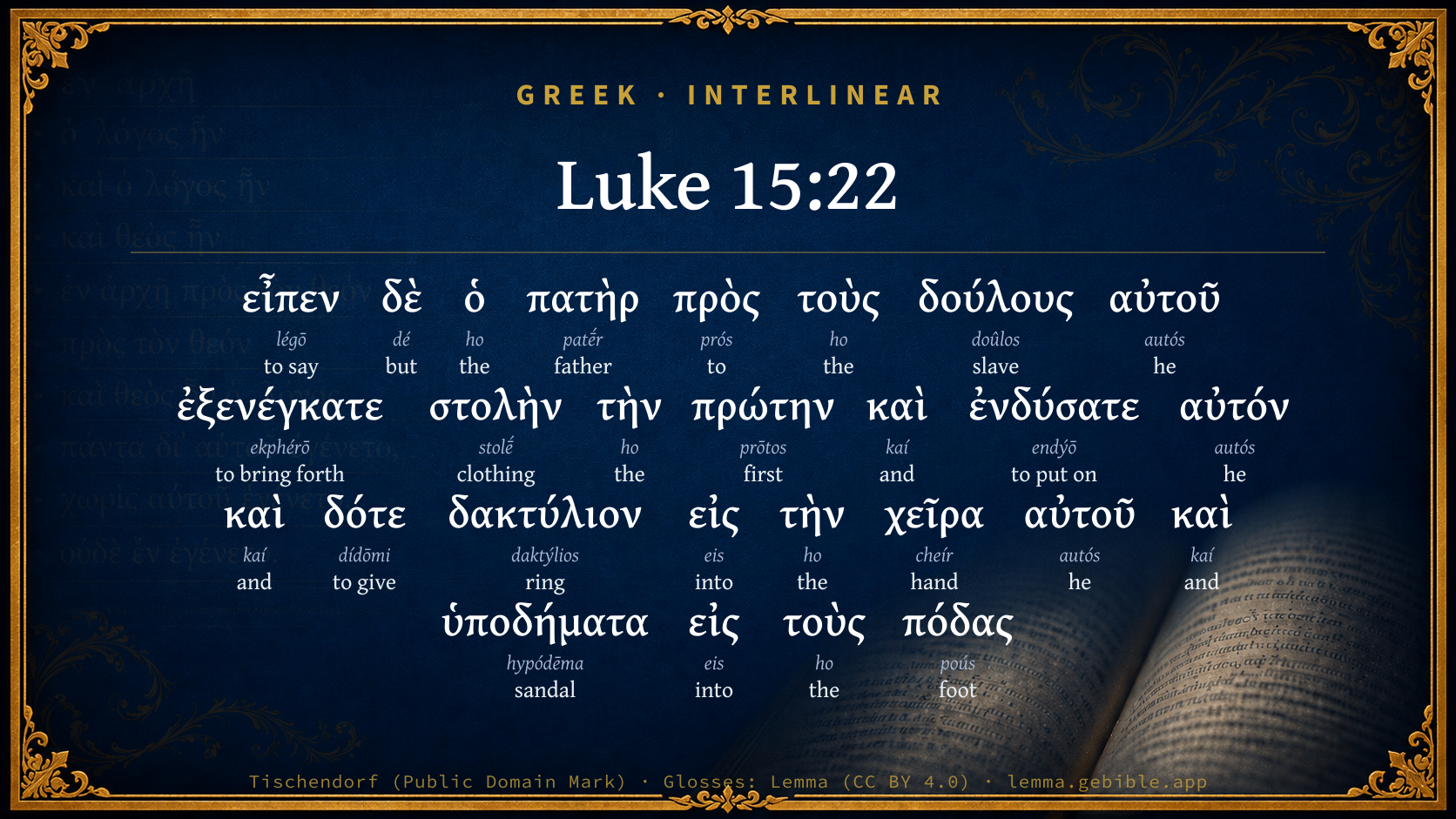
"But the father said to his servants, 'Bring out the best robe, and put it on him. Put a ring on his hand, and shoes on his feet.
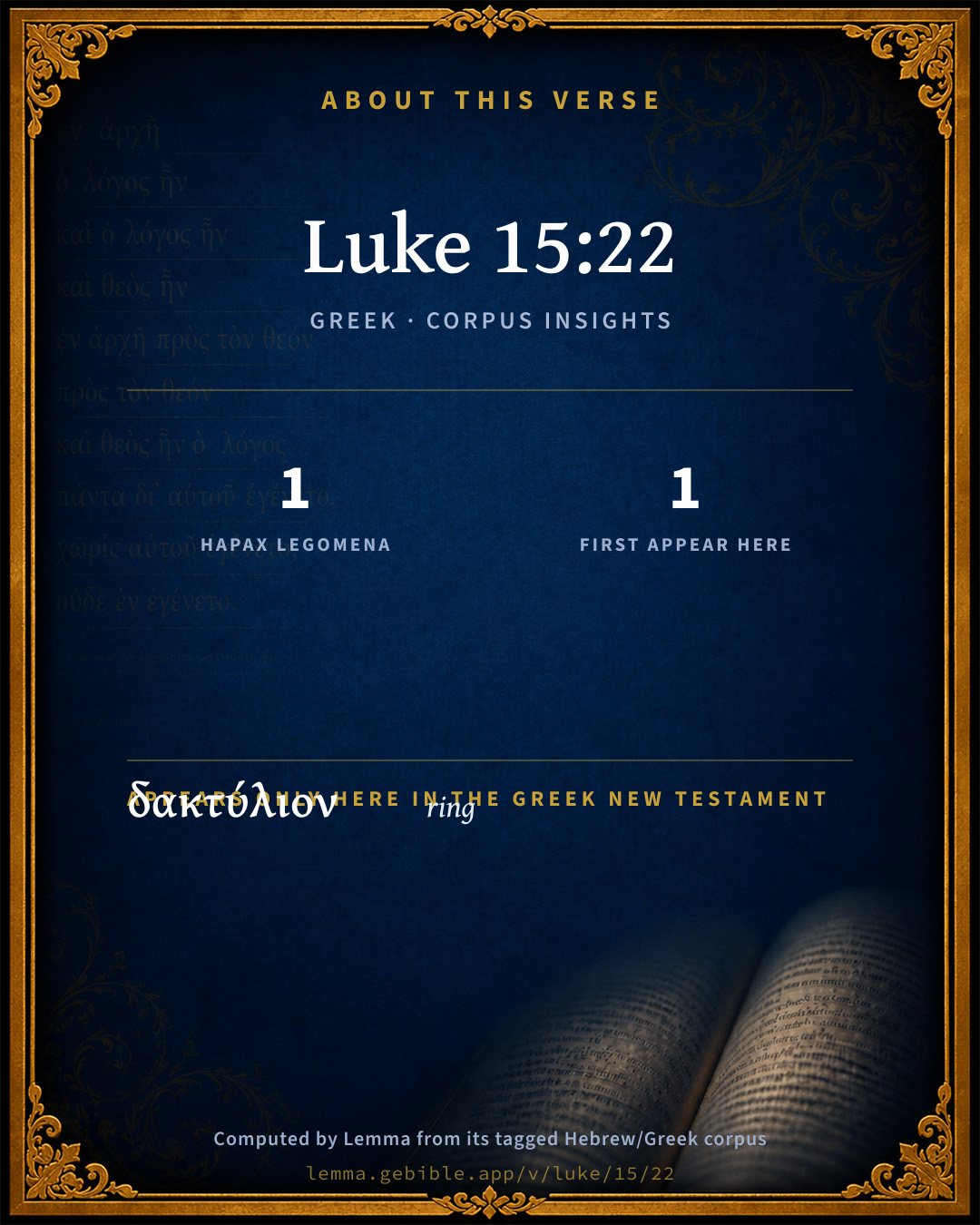
- 1 hapax legomenon — only here in the Greek New Testament
- 1 first appearance in the Greek New Testament
Download a study sheet
One document with this verse’s original text, its word-by-word gloss line, the meaning frame, cross-references with their text, attributed commentary, and full source and license credits — printable, and it pastes into notes with its structure intact.
This verse Autodidact and up
A passage Seminary Student
Up to 50 verses in one chapter. A passage sheet keeps up to 6 commentary sources and 12 cross-references per verse, in the order this page ranks them, and says so on the sheet whenever that leaves anything out. Ask for a single verse and you get the Autodidact verse sheet above.
Everything on this page stays free to read, with no account — the sheet is a download of what is already on screen, not access to it.
Compare translations 3
The same verse in 3 English versions, stacked beneath the original-language interlinear above. Click any original word for its lexicon entry.
Each is an independent rendering of the whole verse — the interlinear is not word-aligned to these translations.
Highlighted words mark where these versions differ — a whole-verse word diff, not a word-by-word alignment.
-
World English Bible Public Domain
"But the father said to his servants, 'Bring out the best robe, and put it on him. Put a ring on his hand, and shoes on his feet.
-
King James Version Public Domain
But the father said to his servants, Bring forth the best robe, and put it on him; and put a ring on his hand, and shoes on his feet:
-
unfoldingWord Literal Text CC BY-SA 4.0
But the father said to his servants, ‘Quickly, bring the first robe and clothe him, and put a ring on his hand, and sandals on his feet.
unfoldingWord Literal Text — © unfoldingWord, licensed CC BY-SA 4.0. Word-aligned USFM3 via Door43 (git.door43.org/unfoldingWord/en_ult).
Show all 19 translations
Every available English version of this verse, each an independent rendering of the whole verse.
-
World English Bible Public Domain
"But the father said to his servants, 'Bring out the best robe, and put it on him. Put a ring on his hand, and shoes on his feet.
-
Berean Standard Bible Public Domain
But the father said to his servants, ‘Quick! Bring the best robe and put it on him. Put a ring on his finger and sandals on his feet.
-
Majority Standard Bible Public Domain
But the father said to his servants, ‘Bring the best robe and put it on him. Put a ring on his finger and sandals on his feet.
-
King James Version Public Domain
But the father said to his servants, Bring forth the best robe, and put it on him; and put a ring on his hand, and shoes on his feet:
-
American Standard Version (1901) Public Domain
But the father said to his servants, Bring forth quickly the best robe, and put it on him; and put a ring on his hand, and shoes on his feet:
-
Revised Version (1885) Public Domain
But the father said to his servants, Bring forth quickly the best robe, and put it on him; and put a ring on his hand, and shoes on his feet:
-
Geneva Bible (1599) Public Domain
Then the father said to his seruaunts, Bring foorth the best robe, and put it on him, and put a ring on his hand, and shoes on his feete,
-
Douay-Rheims (1899) Public Domain
And the father said to his servants: Bring forth quickly the first robe, and put it on him, and put a ring on his hand, and shoes on his feet:
-
Young's Literal Translation Public Domain
`And the father said unto his servants, Bring forth the first robe, and clothe him, and give a ring for his hand, and sandals for the feet;
-
Literal Standard Version CC BY-SA 4.0
And the father said to his servants, Bring forth the foremost robe, and clothe him, and give a ring for his hand, and sandals for the feet;
-
Unlocked Literal Bible CC BY-SA 4.0
The father said to his servants, 'Bring quickly the best robe, and put it on him, and put a ring on his hand, and sandals on his feet.
-
unfoldingWord Literal Text CC BY-SA 4.0
But the father said to his servants, ‘Quickly, bring the first robe and clothe him, and put a ring on his hand, and sandals on his feet.
-
Darby Bible Public Domain
But the father said to his bondmen, Bring out the best robe and clothe him in [it], and put a ring on his hand and sandals on his feet;
-
World Messianic Bible Public Domain
“But the father said to his servants, ‘Bring out the best robe and put it on him. Put a ring on his hand and sandals on his feet.
-
Webster's Bible Public Domain
But the father said to his servants, Bring forth the best robe, and put it on him, and put a ring on his hand, and shoes on his feet:
-
Free Bible Version CC BY-SA 4.0
But the father told his servants, ‘Quick—bring the best robe and put it on him. Put a ring on his finger and sandals on his feet.
-
Bible in Basic English Public Domain
But the father said to his servants, Get out the first robe quickly, and put it on him, and put a ring on his hand and shoes on his feet:
-
Text-Critical English NT CC BY 4.0
But the father said to his servants, ‘ Bring out the best robe and put it on him. Put a ring on his finger and sandals on his feet.
-
Tyndale New Testament (1534) Public Domain
But his father sayde to his servautes: bringe forth that best garment and put it on him and put a rynge on his honde and showes on his fete.
Literal Standard Version (2020), Covenant Press — licensed CC BY-SA 4.0. Text via the HelloAO Bible API (eBible.org). Unlocked Literal Bible (unfoldingWord) — licensed CC BY-SA 4.0. Text via the HelloAO Bible API (eBible.org). unfoldingWord Literal Text — © unfoldingWord, licensed CC BY-SA 4.0. Word-aligned USFM3 via Door43 (git.door43.org/unfoldingWord/en_ult). Free Bible Version, Dr. Jonathan Gallagher — licensed CC BY-SA 4.0. Text via the HelloAO Bible API (eBible.org).
Word by word
More ways to search: Search by grammar → Find every occurrence → Compare this word →
Practice this passage: Drill this verse → Learn its vocabulary →
- Appears 1× in the Greek New Testament
- First appears here
- Part of Speech
- Noun
- Case
- Accusative
- Number
- Singular
- Gender
- Masculine
Full Thayer's Definition
- εἶπεν légō G3004 “to say” Verb, Aorist, Active, Indicative, 3rd person, Singular
- δὲ dé G1161 “but” Conjunction
- ὁ ho G3588 “the” Article, Nominative, Singular, Masculine
- πατὴρ patḗr G3962 “father” Noun, Nominative, Singular, Masculine
- πρὸς prós G4314 “to” Preposition
- τοὺς ho G3588 “the” Article, Accusative, Plural, Masculine
- δούλους doûlos G1401 “slave” Noun, Accusative, Plural, Masculine
- αὐτοῦ autós G846 “he” Personal pronoun, Genitive, Singular, Masculine
- ἐξενέγκατε ekphérō G1627 “to bring forth” Verb, Aorist, Active, Imperative, 2nd person, Plural
- στολὴν stolḗ G4749 “clothing” Noun, Accusative, Singular, Feminine
- τὴν ho G3588 “the” Article, Accusative, Singular, Feminine
- πρώτην prōtos G4413 “first” Adjective, Accusative, Singular, Feminine, Superlative
- καὶ kaí G2532 “and” Conjunction
- ἐνδύσατε endýō G1746 “to put on” Verb, Aorist, Active, Imperative, 2nd person, Plural
- αὐτόν autós G846 “he” Personal pronoun, Accusative, Singular, Masculine
- καὶ kaí G2532 “and” Conjunction
- δότε dídōmi G1325 “to give” Verb, Aorist, Active, Imperative, 2nd person, Plural
- δακτύλιον daktýlios G1146 “ring” Noun, Accusative, Singular, Masculine
- εἰς eis G1519 “into” Preposition
- τὴν ho G3588 “the” Article, Accusative, Singular, Feminine
- χεῖρα cheír G5495 “hand” Noun, Accusative, Singular, Feminine
- αὐτοῦ autós G846 “he” Personal pronoun, Genitive, Singular, Masculine
- καὶ kaí G2532 “and” Conjunction
- ὑποδήματα hypódēma G5266 “sandal” Noun, Accusative, Plural, Neuter
- εἰς eis G1519 “into” Preposition
- τοὺς ho G3588 “the” Article, Accusative, Plural, Masculine
- πόδας poús G4228 “foot” Noun, Accusative, Plural, Masculine
About this verse
These counts appear in no published source. They are computed here, from the morphology-tagged text and Lemma’s own curated glosses. What Lemma adds →
- 27
- words
- 18
- distinct lemmas
- Gospels
- section
Notable vocabulary
1 hapax legomenon — a word that appears only here in the entire Greek New Testament:
- δακτύλιον ring G1146
First appearance in Scripture
This word makes its first canonical appearance in the Greek New Testament here:
- δακτύλιον ring G1146
Shared distinctive vocabulary
ἐξενέγκατε to bring forth G1627 occurs in 8 verses of the Greek New Testament. Also found in:
Cross-references
28Topical passages linked to Luke 15:22 in the Treasury of Scripture Knowledge — connected by theme and wording, ordered by reader-vote popularity; previews shown in the World English Bible.
- Genesis 41:42 Pharaoh took off his signet ring from his hand, and put it on Joseph's hand, and arrayed him in robes of fine linen, and put a gold chain about his neck,
- Esther 8:2 The king took off his ring, which he had taken from Haman, and gave it to Mordecai. Esther set Mordecai over the house of Haman.
- Isaiah 61:10 I will greatly rejoice in Yahweh, my soul shall be joyful in my God; for he has clothed me with the garments of salvation, he has covered me with the robe of righteousness, as a bridegroom decks himself with a garland, and as a bride adorns herself with her jewels.
- Revelation 6:11 A long white robe was given to each of them. They were told that they should rest yet for a while, until their fellow servants and their brothers, who would also be killed even as they were, should complete their course.
- Esther 3:10 The king took his ring from his hand, and gave it to Haman the son of Hammedatha the Agagite, the Jews' enemy.
- Zechariah 3:3–5 Now Joshua was clothed with filthy garments, and was standing before the angel.
- Revelation 7:9 After these things I looked, and behold, a great multitude, which no man could number, out of every nation and of all tribes, peoples, and languages, standing before the throne and before the Lamb, dressed in white robes, with palm branches in their hands.
- Revelation 19:8 It was given to her that she would array herself in bright, pure, fine linen: for the fine linen is the righteous acts of the saints.
- Revelation 3:4–5 Nevertheless you have a few names in Sardis that did not defile their garments. They will walk with me in white, for they are worthy.
- Galatians 4:5–6 that he might redeem those who were under the law, that we might receive the adoption of children.
- Ephesians 4:22–24 that you put away, as concerning your former way of life, the old man, that grows corrupt after the lusts of deceit;
- Deuteronomy 33:25 Your bars shall be iron and brass; As your days, so shall your strength be.
- Psalms 18:33 He makes my feet like deer's feet, And sets me on my high places.
- Psalms 45:13 The princess inside is all glorious. Her clothing is interwoven with gold.
- Psalms 132:9 Let your priest be clothed with righteousness. Let your saints shout for joy!"
- Song of Solomon 7:1 How beautiful are your feet in sandals, prince's daughter! Your rounded thighs are like jewels, The work of the hands of a skillful workman.
- Ezekiel 16:9–13 Then washed I you with water; yes, I thoroughly washed away your blood from you, and I anointed you with oil.
- Romans 8:15 For you didn't receive the spirit of bondage again to fear, but you received the Spirit of adoption, by whom we cry, "Abba! Father!"
- Romans 13:14 But put on the Lord Jesus Christ, and make no provision for the flesh, for its lusts.
- Galatians 3:27 For as many of you as were baptized into Christ have put on Christ.
- Ephesians 6:15 and having fitted your feet with the preparation of the Gospel of peace;
- Revelation 2:17 He who has an ear, let him hear what the Spirit says to the assemblies. To him who overcomes, to him I will give of the hidden manna, and I will give him a white stone, and on the stone a new name written, which no one knows but he who receives it.
- Revelation 7:13–14 One of the elders answered, saying to me, "These who are arrayed in white robes, who are they, and from where did they come?"
- Psalms 132:16 Her priests I will also clothe with salvation. Her saints will shout aloud for joy.
- Matthew 22:11–12 But when the king came in to see the guests, he saw there a man who didn't have on wedding clothing,
- Romans 3:22 even the righteousness of God through faith in Jesus Christ to all and on all those who believe. For there is no distinction,
- Ephesians 1:13–14 in whom you also, having heard the word of the truth, the Gospel of your salvation,--in whom, having also believed, you were sealed with the Holy Spirit of promise,
- Revelation 3:18 I counsel you to buy from me gold refined by fire, that you may become rich; and white garments, that you may clothe yourself, and that the shame of your nakedness may not be revealed; and eye salve to anoint your eyes, that you may see.
Cross-references courtesy of OpenBible.info (CC BY 4.0).
Where the printed editions differ
1 variantPlaces in this verse where the major printed Greek editions disagree on the wording in a way that affects the translation — a comparison of editions, not a manuscript-by-manuscript collation. The editions are the modern critical texts (Nestlé-Aland 28/27, SBL, Westcott-Hort, Tregelles, Tyndale House) and the traditional texts behind the KJV (the Textus Receptus and the Byzantine/Majority text). It is not a claim about which reading is original.
-
Extra text
ταχὺ
“Quickly”
In NA28NA27TynSBLWHTreg Not in TRByzταχὺ (tachu) 'Quickly' is only in older manuscripts (NA28+NA27+Tyn+SBL+WH+Treg)
Textual data: Translators Amalgamated Greek New Testament (STEPBible TAGNT) · CC BY 4.0.
Lesson kit
Teaching starters — assembled from the data on this page, not authored interpretation. Every prompt links to the verse data it draws on. Edit before teaching.
Luke, in the Gospels, opens this verse with 27 words (18 distinct Greek lemmas). Its most distinctive word is daktýlios (“ring”). A historical commentator’s framing appears above. Read the whole chapter for the surrounding context.
Discussion questions
- The word daktýlios carries the sense “ring.” How does it shape the verse?
- 1 word here appears nowhere else in the Greek New Testament. Why might the author reach for such rare wording?
- This is the first place “ring” appears in Scripture (first appears here). What does its debut here establish?
- How does Mark 8:23, which shares the word «to bring forth», read alongside this verse?
- What does the repetition of “into” (2× in this one verse) do in this verse?
- These translations render this verse differently. What is at stake in choosing one wording over another?
- Compare how MacLaren's Expositions of Holy Scripture and Tyndale Open Study Notes read this verse. Where do they agree or differ?
Things to notice
- 1 word in this verse appears nowhere else in the Greek New Testament.
- 1 word makes its first canonical appearance in Scripture here.
- These translations choose different wording for 8 words in this verse.
- “into” occurs 2× in this single verse.
- 18 distinct Greek lemmas span 27 words in this verse.
Commentary
Notes on Luke 15:22 from classic Christian and Jewish commentators (each source and its license shown beneath its notes). The classic Christian expositions comment on the surrounding passage and are grouped to its opening verse, so a note may address several verses; the Jewish commentaries on the Tanakh (Rashi and others) are per-verse, so they appear only where the commentator wrote on this verse.
Lemma curates 59 commentaries, every one of them public domain or Creative Commons licensed, each selected and text-cleaned for this edition rather than reprinted as found. About our sources →
MacLaren's Expositions of Holy Scripture
Alexander MacLaren
Alexander MacLaren, Expositions of Holy Scripture (1904–1910) — public domain. Text from a community e-Sword module.
Tyndale Open Study Notes
Tyndale Open Resources
Tyndale Open Study Notes — © Tyndale Open Resources, licensed CC BY-SA 4.0. Text via the HelloAO Bible API.
Bengel's Gnomon
Johann Albrecht Bengel
Bengel's Gnomon of the New Testament — English translation (T&T Clark, Edinburgh, 1860) — public domain. Text from a community e-Sword module.
Expositor's Greek Testament
ed. W. Robertson Nicoll
The Expositor's Greek Testament, edited by W. Robertson Nicoll (1897–1910) — public domain. Text from a community e-Sword module.
Jamieson, Fausset & Brown
Robert Jamieson, A. R. Fausset & David Brown
Jamieson, Fausset & Brown — Commentary Critical and Explanatory on the Whole Bible (1871) — public domain (CC PDM 1.0). Text via the HelloAO Bible API.
Adam Clarke's Commentary
Adam Clarke's Commentary on the Bible (1810–1826) — public domain. Text from a community e-Sword/MySword module.
Ellicott's Commentary for English Readers
A Bible Commentary for English Readers, edited by Charles John Ellicott (1878–1897) — public domain. Text from a community e-Sword module.
The Cambridge Bible for Schools and Colleges
gen. ed. J. J. S. Perowne
The Cambridge Bible for Schools and Colleges (gen. ed. J. J. S. Perowne; Cambridge University Press, 1878–1918) — public domain. Text from a community e-Sword module.
John Gill's Exposition
John Gill's Exposition of the Whole Bible (1746–1763) — public domain (CC PDM 1.0). Text via the HelloAO Bible API.
Trapp's Complete Commentary
John Trapp
John Trapp, A Commentary or Exposition upon All the Books of the Old and New Testament (1647–1656) — public domain. Text from a community e-Sword module.
Albert Barnes' Notes on the Bible
Albert Barnes' Notes on the Bible (1834–1885) — public domain. Text from a community e-Sword/MySword module.
Haydock's Catholic Bible Commentary
George Leo Haydock (1774–1849), Haydock's Catholic Family Bible and Commentary, 1859 edition — public domain. Excludes Psalms (Douay-Rheims chapter numbering differs from Protestant) and Deuterocanonical books (Catholic canon only).
Matthew Poole's English Annotations
Matthew Poole's English Annotations on the Holy Bible (1683–1685) — public domain. Text from a community e-Sword/MySword module.
Whedon's Commentary on the Bible
Daniel D. Whedon
Daniel D. Whedon (gen. ed.), Commentary on the Old and New Testaments (1874–1909) — public domain. Text from a community e-Sword module.
The Pulpit Commentary
The Pulpit Commentary (1880–1919), ed. H.D.M. Spence-Jones & Joseph S. Exell — public domain. Text from a community e-Sword module.
John Wesley's Explanatory Notes
John Wesley, Explanatory Notes Upon the Whole Bible (1754–1765) — public domain. Text via the GEBible commentary corpus.
unfoldingWord translationNotes
Door43 World Missions Community
unfoldingWord translationNotes — © Distant Shores Media and the Door43 World Missions Community, licensed CC BY-SA 4.0. Source: git.door43.org/Door43/en_tn.
Cambridge Greek Testament for Schools and Colleges
Cambridge Greek Testament for Schools and Colleges (Cambridge University Press, 1896; 21 vols, various authors incl. Carr, Maclear, Plummer, Farrar, Lumby, Moule, M. R. James, Simcox) — public domain. Text from a community e-Sword module.
Alford’s Greek Testament
Henry Alford
Henry Alford, The Greek Testament (1849–1861) — public domain. Text from a community e-Sword module.
International Critical Commentary
International Critical Commentary — older volumes (1896–1929), various authors — public domain. Text from a community e-Sword module.
Vincent's Word Studies in the New Testament
Marvin R. Vincent
Marvin R. Vincent, Word Studies in the New Testament (1887–1900) — public domain. Text from a community e-Sword/MySword module.