John 5:23

Greek (Tischendorf 8th ed.) John 5:23 appears in the Greek New Testament. The text above is from the Tischendorf 8th edition. Each word links to its Strong’s number and a concise gloss. Click any word for its full Thayer’s Greek Lexicon entry.
Download image
Cite this verse

John 5:23 (World English Bible). Public Domain. Lemma interlinear Bible study tool, https://lemma.gebible.app/v/john/5/23.

Show BibTeX & RIS
BibTeX
RIS
English Translation
that all may honor the Son, even as they honor the Father. He who doesn't honor the Son doesn't honor the Father who sent him.
World English Bible · Public Domain
Download a study sheet

One document with this verse’s original text, its word-by-word gloss line, the meaning frame, cross-references with their text, attributed commentary, and full source and license credits — printable, and it pastes into notes with its structure intact.

This verse Autodidact and up

Study sheet (.html) Plain text (.txt)

A passage Seminary Student

Up to 50 verses in one chapter. A passage sheet keeps up to 6 commentary sources and 12 cross-references per verse, in the order this page ranks them, and says so on the sheet whenever that leaves anything out. Ask for a single verse and you get the Autodidact verse sheet above.

Everything on this page stays free to read, with no account — the sheet is a download of what is already on screen, not access to it.

Want to remove ads? Support Godless Engineer
Compare translations 3

The same verse in 3 English versions, stacked beneath the original-language interlinear above. Click any original word for its lexicon entry.

Each is an independent rendering of the whole verse — the interlinear is not word-aligned to these translations.

Highlighted words mark where these versions differ — a whole-verse word diff, not a word-by-word alignment.

  • World English Bible Public Domain
    that all may honor the Son, even as they honor the Father. He who doesn't honor the Son doesn't honor the Father who sent him.
  • King James Version Public Domain
    That all men should honour the Son, even as they honour the Father. He that honoureth not the Son honoureth not the Father which hath sent him.
  • unfoldingWord Literal Text CC BY-SA 4.0
    so that all will honor the Son just as they honor the Father. The one not honoring the Son does not honor the Father having sent him.

unfoldingWord Literal Text — © unfoldingWord, licensed CC BY-SA 4.0. Word-aligned USFM3 via Door43 (git.door43.org/unfoldingWord/en_ult).

Versions to compare (up to 4)

3 of 4 selected

Show all 19 translations

Every available English version of this verse, each an independent rendering of the whole verse.

  • World English Bible Public Domain
    that all may honor the Son, even as they honor the Father. He who doesn't honor the Son doesn't honor the Father who sent him.
  • Berean Standard Bible Public Domain
    so that all may honor the Son just as they honor the Father. Whoever does not honor the Son does not honor the Father who sent Him.
  • Majority Standard Bible Public Domain
    so that all may honor the Son just as they honor the Father. Whoever does not honor the Son does not honor the Father who sent Him.
  • King James Version Public Domain
    That all men should honour the Son, even as they honour the Father. He that honoureth not the Son honoureth not the Father which hath sent him.
  • American Standard Version (1901) Public Domain
    that all may honor the Son, even as they honor the Father. He that honoreth not the Son honoreth not the Father that sent him.
  • Revised Version (1885) Public Domain
    that all may honour the Son, even as they honour the Father. He that honoureth not the Son honoureth not the Father which sent him.
  • Geneva Bible (1599) Public Domain
    Because that all men shoulde honour the Sonne, as they honour the Father: he that honoureth not the Sonne, the same honoureth not the Father, which hath sent him.
  • Douay-Rheims (1899) Public Domain
    That all men may honour the Son, as they honour the Father. He who honoureth not the Son, honoureth not the Father, who hath sent him.
  • Young's Literal Translation Public Domain
    that all may honour the Son according as they honour the Father; he who is not honouring the Son, doth not honour the Father who sent him.
  • Literal Standard Version CC BY-SA 4.0
    that all may honor the Son according as they honor the Father; he who is not honoring the Son, does not honor the Father who sent Him.
  • Unlocked Literal Bible CC BY-SA 4.0
    so that everyone will honor the Son just as they honor the Father. The one who does not honor the Son does not honor the Father who sent him.
  • unfoldingWord Literal Text CC BY-SA 4.0
    so that all will honor the Son just as they honor the Father. The one not honoring the Son does not honor the Father having sent him.
  • Darby Bible Public Domain
    that all may honour the Son, even as they honour the Father. He who honours not the Son, honours not the Father who has sent him.
  • World Messianic Bible Public Domain
    that all may honor the Son, even as they honor the Father. He who doesn’t honor the Son doesn’t honor the Father who sent him.
  • Webster's Bible Public Domain
    That all men should honor the Son, even as they honor the Father. He that honoreth not the Son, honoreth not the Father who hath sent him.
  • Free Bible Version CC BY-SA 4.0
    so that everyone may honor the Son just as they honor the Father. Anyone who doesn't honor the Son doesn't honor the Father who sent him.
  • Bible in Basic English Public Domain
    So that all men may give honour to the Son even as they give honour to the Father. He who gives no honour to the Son gives no honour to the Father who sent him.
  • Text-Critical English NT CC BY 4.0
    so that all may honor the Son just as they honor the Father. Anyone who does not honor the Son does not honor the Father who sent him.
  • Tyndale New Testament (1534) Public Domain
    because that all men shuld honoure the sonne even as they honoure the father. He that honoureth not the sonne the same honoureth not the father which hath sent him.

Literal Standard Version (2020), Covenant Press — licensed CC BY-SA 4.0. Text via the HelloAO Bible API (eBible.org). Unlocked Literal Bible (unfoldingWord) — licensed CC BY-SA 4.0. Text via the HelloAO Bible API (eBible.org). unfoldingWord Literal Text — © unfoldingWord, licensed CC BY-SA 4.0. Word-aligned USFM3 via Door43 (git.door43.org/unfoldingWord/en_ult). Free Bible Version, Dr. Jonathan Gallagher — licensed CC BY-SA 4.0. Text via the HelloAO Bible API (eBible.org).

Word by word

More ways to search: Search by grammar → Find every occurrence → Compare this word →

Practice this passage: Drill this verse → Learn its vocabulary →

τιμῶσι
timáō
G5091
“to honor”
Verb, Present, Active, Subjunctive, 3rd person, Plural
Part of Speech
Verb
Tense
Present
Voice
Active
Mood
Subjunctive
Person
3rd person
Number
Plural
Full Thayer's Definition

Origin: from G5093

TDNT: 10:49,1

1. to estimate, fix the value a. for the value of something belonging to one's self 2. to honour, to have in honour, to revere, venerate
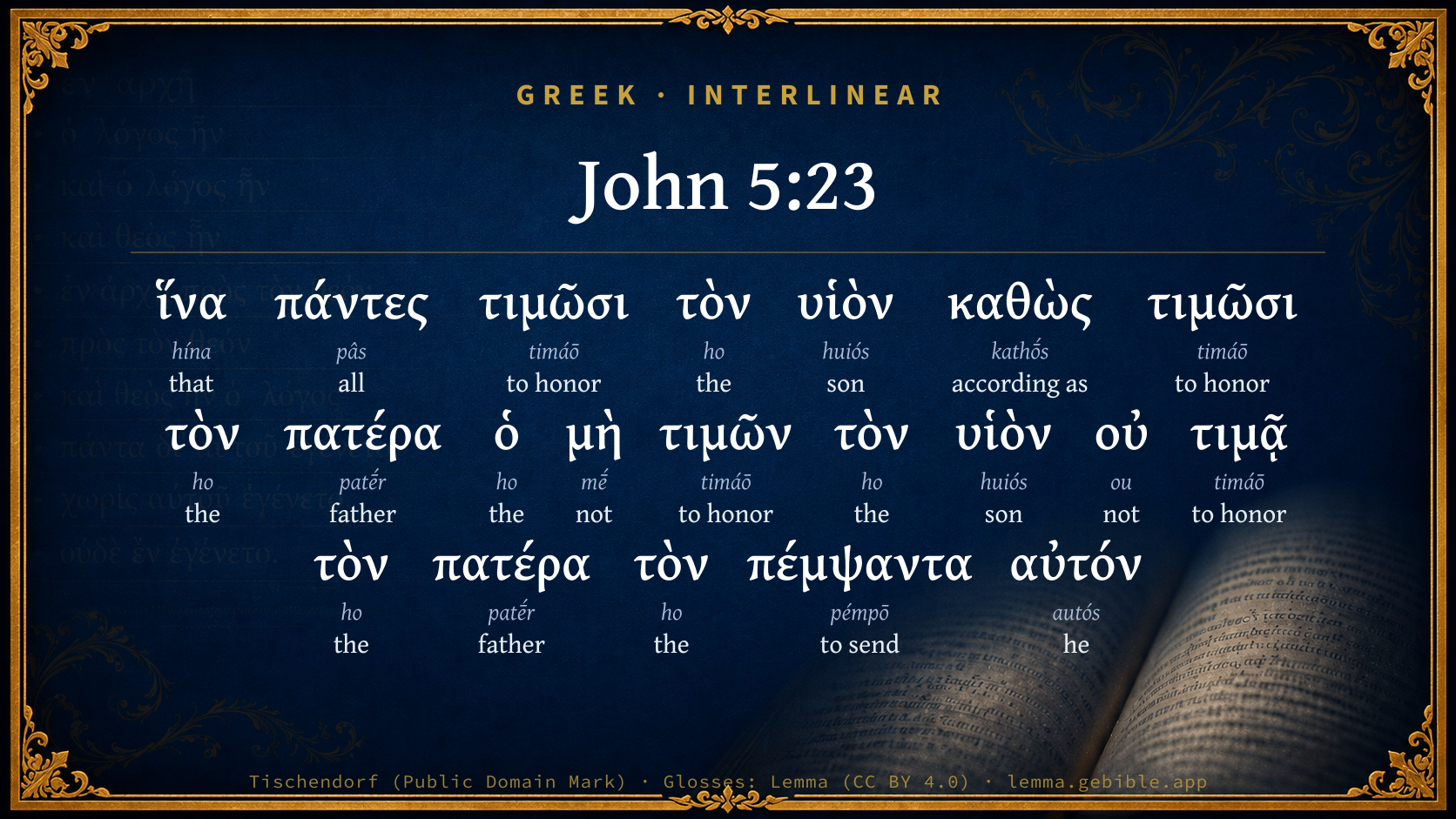
  1. ἵνα hína G2443 “that” Conjunction
  2. πάντες pâs G3956 “all” Adjective, Nominative, Plural, Masculine
  3. τὸν ho G3588 “the” Article, Accusative, Singular, Masculine
  4. υἱὸν huiós G5207 “son” Noun, Accusative, Singular, Masculine
  5. καθὼς kathṓs G2531 “according as” Adverb
  6. τιμῶσι timáō G5091 “to honor” Verb, Present, Active, Indicative, 3rd person, Plural
  7. τὸν ho G3588 “the” Article, Accusative, Singular, Masculine
  8. πατέρα patḗr G3962 “father” Noun, Accusative, Singular, Masculine
  9. ὁ ho G3588 “the” Article, Nominative, Singular, Masculine
  10. μὴ mḗ G3361 “not” Particle, Negative
  11. τιμῶν timáō G5091 “to honor” Verb, Present, Active, Participle, Nominative, Singular, Masculine
  12. τὸν ho G3588 “the” Article, Accusative, Singular, Masculine
  13. υἱὸν huiós G5207 “son” Noun, Accusative, Singular, Masculine
  14. οὐ ou G3756 “not” Particle, Negative
  15. τιμᾷ timáō G5091 “to honor” Verb, Present, Active, Indicative, 3rd person, Singular
  16. τὸν ho G3588 “the” Article, Accusative, Singular, Masculine
  17. πατέρα patḗr G3962 “father” Noun, Accusative, Singular, Masculine
  18. τὸν ho G3588 “the” Article, Accusative, Singular, Masculine
  19. πέμψαντα pémpō G3992 “to send” Verb, Aorist, Active, Participle, Accusative, Singular, Masculine
  20. αὐτόν autós G846 “he” Personal pronoun, Accusative, Singular, Masculine

About this verse

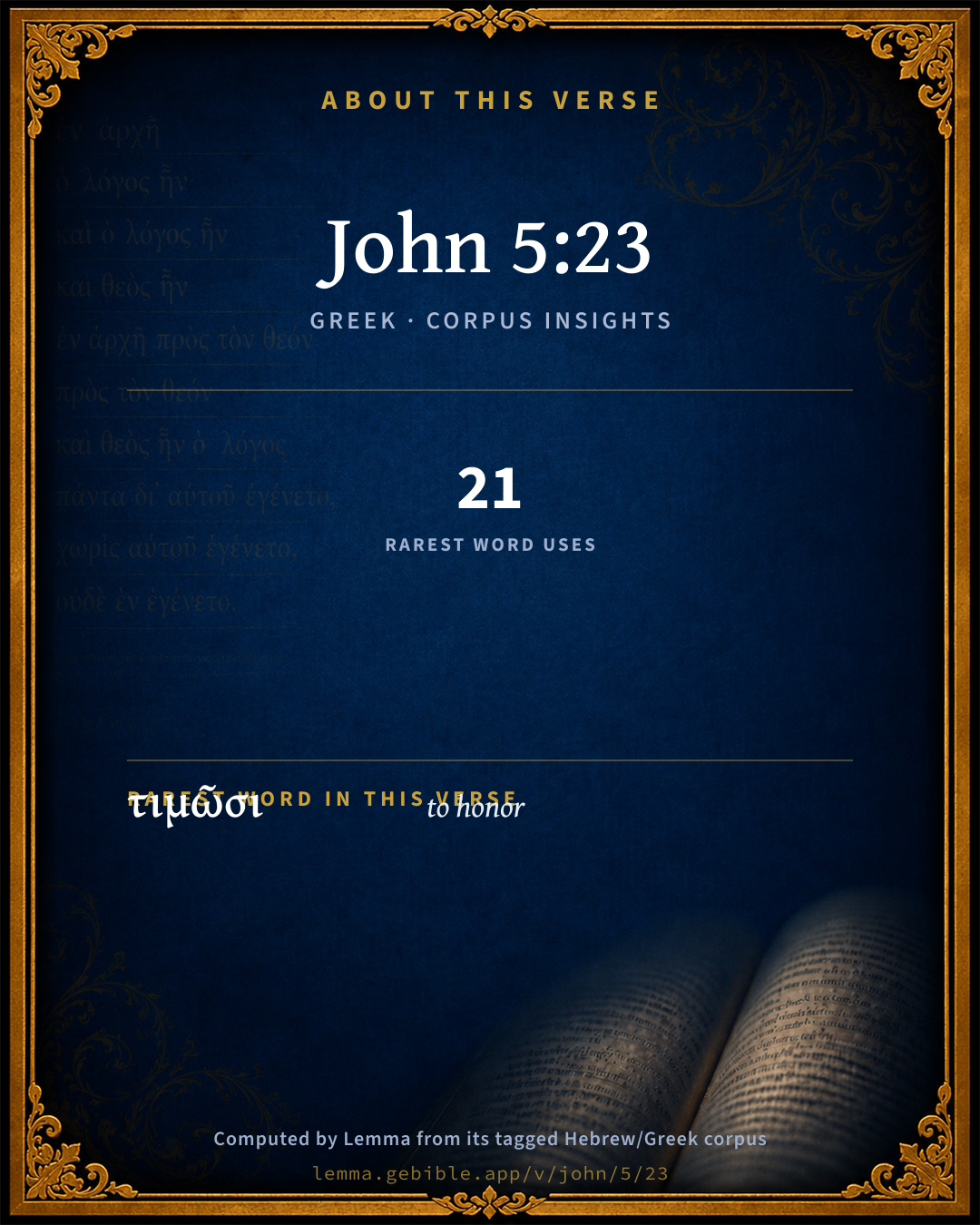
These counts appear in no published source. They are computed here, from the morphology-tagged text and Lemma’s own curated glosses. What Lemma adds →

21
words
11
distinct lemmas
Gospels
section

Notable vocabulary

The rarest word here is τιμῶσι to honor G5091 — appearing just 21 times in the whole Greek New Testament.

Shared distinctive vocabulary

τιμῶσι to honor G5091 occurs in 16 verses of the Greek New Testament. Also found in:

Repetition

Words recur within this verse:

  • τιμῶσι to honor G5091 ×4
  • υἱὸν son G5207 ×2
  • πατέρα father G3962 ×2
  • τὸν the G3588 ×6

Cross-references

46

Topical passages linked to John 5:23 in the Treasury of Scripture Knowledge — connected by theme and wording, ordered by reader-vote popularity; previews shown in the World English Bible.

  • 1 John 2:23 Whoever denies the Son, the same doesn't have the Father. He who confesses the Son has the Father also.
  • Luke 10:16 Whoever listens to you listens to me, and whoever rejects you rejects me. Whoever rejects me rejects him who sent me."
  • Matthew 11:27 All things have been delivered to me by my Father. No one knows the Son, except the Father; neither does anyone know the Father, except the Son, and he to whom the Son desires to reveal him.
  • 2 John 1:9 Whoever transgresses and doesn't remain in the teaching of Christ, doesn't have God. He who remains in the teaching, the same has both the Father and the Son.
  • John 15:23–24 He who hates me, hates my Father also.
  • Jeremiah 17:5–7 Thus says Yahweh: Cursed is the man who trusts in man, and makes flesh his arm, and whose heart departs from Yahweh.
  • Luke 12:8–9 "I tell you, everyone who confesses me before men, him will the Son of Man also confess before the angels of God;
  • 1 Thessalonians 3:11–13 Now may our God and Father himself, and our Lord Jesus Christ, direct our way to you;
  • Ephesians 6:24 Grace be with all those who love our Lord Jesus Christ with incorruptible love. Amen.
  • Hebrews 1:6 Again, when he brings in the firstborn into the world he says, "Let all the angels of God worship him."
  • Titus 3:4–6 But when the kindness of God our Savior and his love toward mankind appeared,
  • Romans 8:9 But you are not in the flesh but in the Spirit, if it is so that the Spirit of God dwells in you. But if any man doesn't have the Spirit of Christ, he is not his.
  • 2 Thessalonians 2:16–17 Now our Lord Jesus Christ himself, and God our Father, who loved us and gave us eternal comfort and good hope through grace,
  • 2 Peter 3:18 But grow in the grace and knowledge of our Lord and Savior Jesus Christ. To him be the glory both now and forever. Amen.
  • John 16:14 He will glorify me, for he will take from what is mine, and will declare it to you.
  • Romans 6:22 But now, being made free from sin, and having become servants of God, you have your fruit of sanctification, and the result of eternal life.
  • Romans 14:7–9 For none of us lives to himself, and none dies to himself.
  • 1 Corinthians 10:31 Whether therefore you eat, or drink, or whatever you do, do all to the glory of God.
  • Psalms 146:3–5 Don't put your trust in princes, Each a son of man in whom there is no help.
  • Isaiah 43:10–11 You are my witnesses, says Yahweh, and my servant whom I have chosen; that you may know and believe me, and understand that I am he: before me there was no God formed, neither shall there be after me.
  • Matthew 12:21 In his name, the Gentiles will hope."
  • Matthew 22:37–38 Jesus said to him, "'You shall love the Lord your God with all your heart, and with all your soul, and with all your mind.'
  • 1 Corinthians 6:19 Or don't you know that your body is a temple of the Holy Spirit which is in you, which you have from God? You are not your own,
  • Revelation 5:8–14 Now when he had taken the book, the four living creatures and the twenty-four elders fell down before the Lamb, each one having a harp, and golden bowls full of incense, which are the prayers of the saints.
  • Psalms 2:12 Kiss the son, lest he be angry, and you perish in the way, For his wrath will soon be kindled. Blessed are all those who take refuge in him.
  • Isaiah 45:21 Declare you, and bring [it] forth; yes, let them take counsel together: who has shown this from ancient time? who has declared it of old? Haven't I, Yahweh? and there is no God else besides me, a just God and a Savior; there is no one besides me.
  • Zechariah 9:9 Rejoice greatly, daughter of Zion! Shout, daughter of Jerusalem! Behold, your king comes to you! He is righteous, and having salvation; Lowly, and riding on a donkey, Even on a colt, the foal of a donkey.
  • Matthew 10:37 He who loves father or mother more than me is not worthy of me; and he who loves son or daughter more than me isn't worthy of me.
  • John 14:1 "Don't let your heart be troubled. Believe in God. Believe also in me.
  • 1 Corinthians 1:3 Grace to you and peace from God our Father and the Lord Jesus Christ.
  • 2 Corinthians 1:9 Yes, we ourselves have had the sentence of death within ourselves, that we should not trust in ourselves, but in God who raises the dead,
  • 2 Corinthians 5:19 namely, that God was in Christ reconciling the world to himself, not reckoning to them their trespasses, and having committed to us the word of reconciliation.
  • 2 Corinthians 13:14 The grace of the Lord Jesus Christ, the love of God, and the communion of the Holy Spirit, be with you all. Amen.
  • Ephesians 1:12–13 to the end that we should be to the praise of his glory, we who had before hoped in Christ:
  • 2 Timothy 1:12 For this cause I suffer also these things. Yet I am not ashamed, for I know him whom I have believed, and I am persuaded that he is able to guard that which I have committed to him against that day.
  • Isaiah 42:8 I am Yahweh, that is my name; and my glory will I not give to another, neither my praise to engraved images.
  • Isaiah 44:6 Thus says Yahweh, the King of Israel, and his Redeemer, Yahweh of Hosts: I am the first, and I am the last; and besides me there is no God.
  • Matthew 28:19 Therefore go, and make disciples of all nations, baptizing them in the name of the Father and of the Son and of the Holy Spirit,
  • John 17:10 All things that are mine are yours, and yours are mine, and I am glorified in them.
  • Romans 1:7 to all who are in Rome, beloved of God, called to be saints: Grace to you and peace from God our Father and the Lord Jesus Christ.
  • Romans 15:12 Again, Isaiah says, "There will be the root of Jesse, He who arises to rule over the Gentiles; On him will the Gentiles hope."
  • 1 Corinthians 16:22 If any man doesn't love the Lord Jesus Christ, let him be accursed. Come, Lord!
  • 2 Corinthians 5:14 For the love of Christ constrains us; because we judge thus, that one died for all, therefore all died.
  • Titus 2:13–14 looking for the blessed hope and appearing of the glory of our great God and Savior, Jesus Christ;
  • Isaiah 45:15 Most assuredly you are a God who hid yourself, God of Israel, the Savior.'
  • 2 Peter 1:1 Simon Peter, a servant and apostle of Jesus Christ, to those who have obtained a like precious faith with us in the righteousness of our God and Savior, Jesus Christ:

Cross-references courtesy of OpenBible.info (CC BY 4.0).

Commentary

Notes on John 5:23 from classic Christian and Jewish commentators (each source and its license shown beneath its notes). The classic Christian expositions comment on the surrounding passage and are grouped to its opening verse, so a note may address several verses; the Jewish commentaries on the Tanakh (Rashi and others) are per-verse, so they appear only where the commentator wrote on this verse.

Lemma curates 59 commentaries, every one of them public domain or Creative Commons licensed, each selected and text-cleaned for this edition rather than reprinted as found. About our sources →

Tyndale Open Study Notes

Tyndale Open Resources

5:23 the Father . . . sent him: In the ancient world, a person could send an authorized representative to seal a contract or make an authoritative decision. Jesus claimed to be God’s representative, so obeying Jesus is the same as obeying God, and dishonoring him is dishonoring God.

Tyndale Open Study Notes — © Tyndale Open Resources, licensed CC BY-SA 4.0. Text via the HelloAO Bible API.

Bengel's Gnomon

Johann Albrecht Bengel

Joh 5:23. Πάντες, all men) Rom 14:11, “As I live, saith the Lord, every knee shall bow to Me, and every tongue confess to God.”—τιμῶσι, should honour) either willingly, escaping judgment through faith: or unwillingly, feeling the wrath of the Judge.[106]

[106] Pro 16:4, “The Lord hath made all things for Himself, yea, even the wicked for the day of evil.”—E. and T.

Bengel's Gnomon of the New Testament — English translation (T&T Clark, Edinburgh, 1860) — public domain. Text from a community e-Sword module.

Meyer's Critical & Exegetical Commentary

Heinrich August Wilhelm Meyer

Joh_5:23. The divine purpose which is to be attained in the relation of mankind to this judicial action of the Son. Observe the Present Subjunctive.

καθώς] for in the Son, who judges, we have the appointed representative of the Father, and thus far (therefore always relatively, Joh_14:23) He is to be honoured as the Father. Comp. what follows. How utterly opposed to this divine intention was the procedure of the Jews, Joh_5:18! It is incorrect, however, to take καθώς, as Baeumlein does, as causal (see on Joh_13:34, Joh_17:2), because the whole context turns upon the equality of the Father and the Son.

οὐ τιμᾷ τὸν πατέρα] i.e. in this very respect, that he does not honour the Son, who is the Sent of the Father.

Meyer — Critical and Exegetical Commentary on the New Testament — English translation by Peter Christie, edited by Frederick Crombie (T&T Clark, 1880) — public domain. Text from a community e-Sword module.

Expositor's Greek Testament

ed. W. Robertson Nicoll

Joh 5:23 . This extreme prerogative is given to the Son ἵνα πάντες τιμῶσι τὸν υἱὸν … This is one purpose, though not the sole purpose, of committing judgment to the Son; that even those supremely and inalienably Divine prerogatives of giving life and judging may be seen to be in Him, and that thus Deity may be honoured in and through Him. The great peril threatening the Jews was that they should deny honour to the Son, and hereby incur the guilt of refusing honour to the Father. In denouncing Him for breaking the Sabbath they were really dishonouring the Father. ὁ μὴ τιμῶν … αὐτόν . μὴ τιμῶν a supposed case, therefore μή : οὐ τιμᾷ actual negation. To dishonour the Father’s messenger is to dishonour the Father. Having explained the relation of His work to the Father’s, and having declared that life-giving and judging are His prerogatives, Jesus now, in Joh 5:24-30 , more definitely shows how these powers are to be exercised in the spiritual regeneration, and in the resurrection and final judgment of men. Joh 5:24-26 . The voice of Jesus gives life eternal. ἀμὴν , ἀμὴν , however incredible what I now say may seem.

The Expositor's Greek Testament, edited by W. Robertson Nicoll (1897–1910) — public domain. Text from a community e-Sword module.

Godet's Commentaries

Frédéric Louis Godet

Ver. 23. And what is the Father’s will in transferring to Jesus the two highest attributes of divinity, making alive, judging? He wills that the homage of adoration which humanity renders to Him should be extended to the Son Himself. “The Father loveth the Son” (Joh 3:35); this is the reason why He wishes to see the world at the feet of the Son, even as at His own. “The equality of honor,” says Weiss, “must correspond with the equality of action.” The word τιμᾷν, to honor, does not directly express the act of adoration, as Reuss remarks. But in the context (καθώς as), it certainly denotes the religious respect of which the act of adoration is the expression. And in claiming for His person this sentiment, in the same sense in which it is due to the Father, Jesus authorizes, as related to Himself, worship properly so called, comp. Joh 20:28; Php 2:10 “that every knee should bow at the name of Jesus;” and the Apocalypse throughout.

The Father is not jealous of such homage. For it is He whom the creature honors in honoring the Son because of His divine character; as also it is to God that honor is refused, when it is refused to the Son. There is a terrible warning for the accusers of Jesus in these last words of the verse. Jesus throws back upon them the charge of blasphemy; they must learn—these zealous defenders of the glory of God—that when they accuse Him, Jesus, as they are doing, because of the miracle which He has performed in the midst of them, it is God to whom the outrage which they inflict upon Him is addressed, and that the treatment to which they subject this weak and poor man touches the Father Himself, who places Himself in closest union with Him. This menacing close of Joh 5:23 is an anticipation of the severe application which is to terminate the discourse (Joh 5:41-47).

The second cycle Joh 5:21-23 was a still very general development of the abridged cycle Joh 5:19-20. In the third cycle, Joh 5:24-29, Jesus now shows the progressive historical realization of these two works of making alive andjudging, which the Father has conferred upon Him. Until this point (Joh 5:21-23) He has attributed them to Himself only under the abstract form of mere competency. Now we behold this twofold power of saving and judging really in exercise, first in the spiritual sphere, Joh 5:24-27; then, in the outward domain, Joh 5:28-29.

Frédéric Louis Godet — Commentaries on Luke, John, Romans, and 1 Corinthians — English translation (T&T Clark, Edinburgh, 1870s–1890s) — public domain. Text from a community e-Sword module.

Jamieson, Fausset & Brown

Robert Jamieson, A. R. Fausset & David Brown

honour the Son as . . . the Father--As he who believes that Christ in the foregoing verses has given a true account of His relation to the Father must of necessity hold Him entitled to the same honor as the Father, so He here adds that it was the Father's express intention in making over all judgment to the Son, that men should thus honor Him.

honoureth not the Father--does not do it in fact, whatever he may imagine, and will be held as not doing it by the Father Himself, who will accept no homage which is not accorded to His own Son.

Jamieson, Fausset & Brown — Commentary Critical and Explanatory on the Whole Bible (1871) — public domain (CC PDM 1.0). Text via the HelloAO Bible API.

Adam Clarke's Commentary

Verse 23. That all men should honour the Son, c.] If then the Son is to be honoured, EVEN AS the Father is honoured, then the Son must be God, as receiving that worship which belongs to God alone. To worship any creature is idolatry: Christ is to be honoured even as the Father is honoured therefore Christ is not a creature; and, if not a creature, consequently the Creator. See Joh 1:3.

He that honoureth not the Son] God will not receive that man's adoration who refuses to honour Jesus, even as he honours him. The Jews expected the Messiah as a great and powerful Prince; but they never thought of a person coming in that character enrobed with all the attributes of Godhead. To lead them off from this error, our Lord spoke the words recorded in these verses.

Adam Clarke's Commentary on the Bible (1810–1826) — public domain. Text from a community e-Sword/MySword module.

John Calvin's Commentaries

23. That all men may honor the Son. This clause sufficiently confirms the suggestion which I threw out a little ago, that when it is said that God reigns in the person of Christ, this does not mean that he reposes in heaven, as indolent kings are wont to do, but because in Christ he manifests his power and shows himself to be present. For what else is the meaning of these words, that all men may honor the Son, but that the Father wishes to be acknowledged and worshipped in the Son? Our duty, therefore, is to seek God the Father in Christ, to behold his power in Christ, and to worship him in Christ. For, as immediately follows, he who honoureth not the Son deprives God of the honor which is due to him. All admit that we ought to worship God, and this sentiment, which is natural to us, is deeply rooted in our hearts, so that no man dares absolutely to refuse to God the honor which is due to him; yet the minds of men lose themselves in going out of the way to seek God. Hence so many pretended deities, hence so many perverse modes of worship. We shall never, therefore, find the true God but in Christ, nor shall we ever worship Him aright but by kissing the Son, as David tells us, (Psalm 2:12;) for, as John elsewhere declares,

He who hath not the Son hath not the Father, (1 John 2:23.)

Mahometans and Jews do indeed adorn with beautiful and magnificent titles the God whom they worship; but we ought to remember that the name of God, when it is separated from Christ, is nothing else than a vain imagination. Whoever then desires to have his worship approved by the true God, let him not turn aside from Christ. Nor was it otherwise with the Fathers under the Law; for though they beheld Christ darkly under shadows, yet never did God reveal himself out of Christ. But now, since Christ has been manifested in the flesh and appointed to be King over us, the whole world must bend the knee to him, in order to obey God; for the Father having made him sit at his right hand, he who forms a conception of God without Christ takes away the half of him.

John Calvin's Commentaries (1540-1563) — public domain. Text from the Calvin Translation Society English edition (1840s-50s) via the Christian Classics Ethereal Library (ccel.org). Calvin's coverage is partial (roughly two-thirds of the Bible); uncommented books and verses are honest gaps, never fabricated. The 19th-century editor's footnotes and remarks are omitted so the notes are faithfully Calvin's own voice.

The Cambridge Bible for Schools and Colleges

gen. ed. J. J. S. Perowne

23. honoureth not the Father] Because he refuses to honour the Father’s representative.

which hath sent] Better, which sent. See on Joh_20:21.

The Cambridge Bible for Schools and Colleges (gen. ed. J. J. S. Perowne; Cambridge University Press, 1878–1918) — public domain. Text from a community e-Sword module.

John Gill's Exposition

That all men should honour the Son,.... This is the end of all judgment, and the exercise of all authority, and power being committed to him; namely, that he might have the honour given him by men that is due unto him:

even as they honour the Father; that the same honour and glory may be given to the one, as to the other, which must never have been done was he not equal with him, since he gives not his glory to another, Isa 42:8. Indeed, all men do not honour the Father as they should; the Gentiles, who had some knowledge of God, glorified him not as God; and the Jews, who had an external revelation of the one, true, and living God, which other nations had not, yet were greatly deficient in honouring him, which made him complaining say, "if then I be a father, where is mine honour?" Mal 1:6. And Christians, who are favoured with a clearer revelation still of the Father of Christ, are much wanting in giving him his due glory; but in common he is honoured, though in an imperfect manner; nor is there so much danger of his losing his honour, as of the Son's losing his; the reason is this, though the Son is in the form of God, and equal with him, yet by taking upon him the form of a servant, by becoming man, he has veiled the glory of his divine person, and made himself of no reputation; and by reason of this was reckoned by many, or most, as a mere man: wherefore, by agreement, that judgment, power, and authority, which equally belonged to the Father, and the Son, the exercise of it is put visibly and openly into the Son's hands, that he might have his due honour and glory from all men, whether they will or not: from true believers in him he has it willingly, by their ascribing deity to him, by putting their trust in him, by attributing the whole of their salvation to him, and the glory of it, and by worshipping him: and he will be honoured by all men at the last day; they will be obliged to do it; for all judgment being committed to him, and he being Judge of all, every knee shall bow to him, and every tongue shall confess that he is Lord, to his own glory, and to the glory of God the Father; see Isa 45:23.

He that honoureth not the Son; that denies his divine sonship, or his proper deity; that detracts from the dignity of his person or office; that shows no regard to him in point of salvation, or of obedience:

honoureth not the Father which hath sent him; they are so the same in nature and perfections, in power, will, affections, and operations; and their interests and honours are so involved together, that whatever dishonour is done to one, reflects on the other: and indeed, whatever is done in a way of disrespect to the Son, as incarnate, and in his office capacity, highly reflects on his Father, that sent him in the fulness of time, in human nature, to obtain eternal redemption for his people, according to a rule often expressed by the Jews, "a man's messenger is as himself"; See Gill on Mat 10:40.

John Gill's Exposition of the Whole Bible (1746–1763) — public domain (CC PDM 1.0). Text via the HelloAO Bible API.

Trapp's Complete Commentary

John Trapp

23 That all men should honour the Son, even as they honour the Father. He that honoureth not the Son honoureth not the Father which hath sent him.

Ver. 23. He that honoureth not the Son] As Jews and Turks do not. Nor Papists, that (upon the matter) despoil him of his threefold office, and so deny the Lord that bought them.

John Trapp, A Commentary or Exposition upon All the Books of the Old and New Testament (1647–1656) — public domain. Text from a community e-Sword module.

Albert Barnes' Notes on the Bible

That all men should honour ... - To honor is to esteem, reverence, praise, do homage to. We honor one when we ascribe to him in our hearts, and words, and actions the praise and obedience which are due to him. We honor God when we obey him and worship him aright. We honor the Son when we esteem him to be as he is; when we have right views and feelings toward him. As he is declared to be God Joh 1:1, as he here says he has power and authority equal with God, so we honor him when we regard him as such. The primitive Christians are described by Pliny, in a letter to the Emperor Trajan, as meeting together to sing hymns to Christ “as God.” So we honor him aright when we regard him as possessed of wisdom, goodness, power, eternity, omniscience - equal with God.

Even as - To the same extent; in the same manner. Since the Son is to be honored even as the Father, it follows that he must be equal with the Father. To “honor the Father” must denote “religious” homage, or the rendering of that honor which is due to God; so to honor the Son must also denote “religious” homage. If our Saviour here did not intend to teach that he ought to be “worshipped,” and to be esteemed as “equal” with God, it would be difficult to teach it by any language which we could use.

He that honoureth not the Son - He that does not believe on him, and render to him the homage which is his due as the equal of God.

Honoureth not the Father - Does not worship and obey the Father the First Person of the Trinity - that is does not worship God. He may imagine that he worships God, but there is no God but the God subsisting as Father, Son, and Holy Spirit. He that withholds proper homage from one, withholds it from all. He that should refuse to honor “the Father,” could not be said to honor “God;” and in the like manner, he that honoreth not “the Son,” honoreth not “the Father.” This appears further from the following considerations:

The Father wills that the Son should be honored. He that refuses to do it disobeys the Father. They are equal. He that denies the one denies also the other. The same feeling that leads us to honor the “Father” will also lead us to honor the “Son,” for he is “the brightness of his glory, and the express image of his person,” Heb 1:3. The evidence of the existence of the Son is the same as that of the Father. He has the same wisdom, goodness, omnipresence, truth, power.

And from these verses we may learn:

1. That those who do not render proper homage to Jesus Christ do not worship the true God.

2. There is no such God as the infidel professes to believe in. There can be but one God; and if the God of the Bible be the true God, then all other gods are false gods.

3. Those who withhold proper homage from Jesus Christ, who do not honor him even as they honor the Father, cannot be Christians.

4. One evidence of piety is when We are willing to render proper praise and homage to Jesus Christ - to love him, and serve and obey him, with all our hearts.

5. “As a matter of fact,” it may be added that they who do not honor the Son do not worship God at all. The infidel has no form of worship; he has no place of secret prayer, no temple of worship, no family altar. Who ever yet heard of an infidel that prayed? Where do such men build houses of worship? Where do they meet to praise God? Nowhere. As certainly as we hear the name “infidel,” we are certain at once that we hear the name of a man who has no form of religion in his family, who never prays in secret, and who will do nothing to maintain the public worship of God. Account for it as men may, it is a fact that no one can dispute, that it is only they who do honor to the Lord Jesus that have any form of the worship of God, or that honor him; “and their veneration for God is just in proportion to their love for the Redeemer - just as they honor him.”

Albert Barnes' Notes on the Bible (1834–1885) — public domain. Text from a community e-Sword/MySword module.

Matthew Poole's English Annotations

That his Son might be honoured by all men, Psa 2:11,12; Php 2:10, with the same honour which is given to the Father; for the Son is sent by the Father, not as one inferior to him, as a servant is sent by his master, but as an equal is sent by his friend, Joh 4:34; 6:38; 7:28. And look, as a great prince, when he sendeth his ambassador, expects that those of whom he is sent should give him honour, and the same honour as to himself; so doth the Father: so that

he that honoureth not the Son, honoureth not the Father which hath sent him. It is a text which reflects dreadfully upon such as honour not Christ, especially, the Jews and Socinians, who professedly do not honour him with the same honour with which they yet pretend to honour the Father, and are concluded by this text not in truth to honour the Father.

Matthew Poole's English Annotations on the Holy Bible (1683–1685) — public domain. Text from a community e-Sword/MySword module.

Whedon's Commentary on the Bible

Daniel D. Whedon

23. Even as they honour the Father—Alike should they be adored; both as one Deity, and inasmuch as the Son is the representative of the Father.

Daniel D. Whedon (gen. ed.), Commentary on the Old and New Testaments (1874–1909) — public domain. Text from a community e-Sword module.

The Pulpit Commentary

The purpose of the entire commission of judgment to the Son, a bestowment which illustrates the quickening results that he (who does the will of the Father) wills to effect, is now gathered to a lofty climax, abundantly vindicating the right he had claimed to call God his own Father. It is as follows, in order that all may honour the Son. Timwsin , not proskunwsin ("honour," not "worship"), is the word used; but seeing that the identical sentiment of reverence due to the Supreme Being, to the Father, is that which is here said to be due to the Son, and is here declared to be the reason why all judgment is entrusted to the issues of his will, we are at a loss to know how loftier attributes could be ascribed to the Son. It is surprising that Weiss should declare it "impossible to find any statements here as to the metaphysical unity and equality of the Son and the Father, although current apologetics believe it has succeeded in doing so" ("Life of Christ," vol. 2:326, note). Luthardt asks, "What other form of timh than that which calls him "Lord and God" shall belief now assume, than that which the Christian Church cherishes toward Jesus?" Thoma points to Eph_2:1-5 Col_2:11-13, and other great parallels in the New Testament. We gladly accept them, not as proof that the Johannist framed Christ"s discourse from them, but as proof that the ideas of St. Paul were not originated by him. but came from the direct assertions of Christ, of which we have the historic trace.

The Pulpit Commentary (1880–1919), ed. H.D.M. Spence-Jones & Joseph S. Exell — public domain. Text from a community e-Sword module.

John Wesley's Explanatory Notes

That all men may honour the Son, even as they honour the Father - Either willingly, and so escaping condemnation, by faith: or unwillingly, when feeling the wrath of the Judge. This demonstrates the EQUALITY of the Son with the Father. If our Lord were God only by office or investiture, and not in the unity of the Divine essence, and in all respects equal in Godhead with the Father, he could not be honoured even as, that is, with the same honour that they honoured the Father. He that honoureth not the Son - With the same equal honour, greatly dishonoureth the Father that sent him.

John Wesley, Explanatory Notes Upon the Whole Bible (1754–1765) — public domain. Text via the GEBible commentary corpus.

Cambridge Greek Testament for Schools and Colleges

23. οὐ τιμᾷ. By not knowing the Father’s representative.

Cambridge Greek Testament for Schools and Colleges (Cambridge University Press, 1896; 21 vols, various authors incl. Carr, Maclear, Plummer, Farrar, Lumby, Moule, M. R. James, Simcox) — public domain. Text from a community e-Sword module.

Alford’s Greek Testament

Henry Alford

23.] This being so, the end of all is, the honour of the Father in and by the Son. He (the Son) is the Lord of life, and the Judge of the world;—all must honour Him with equal honour to that which they pay to the Father:—and whosoever does not, however he may imagine that he honours or approaches God, does not honour him at all;—because He can only be known or honoured by us as ‘the Father who sent His Son.’

Henry Alford, The Greek Testament (1849–1861) — public domain. Text from a community e-Sword module.

Vincent's Word Studies in the New Testament

Marvin R. Vincent

Which sent Him. A phrase peculiar to John, and used only by the Lord, of the Father. See Joh 4:34; Joh 6:38, 39; Joh 7:16, 28, 33, etc.

Marvin R. Vincent, Word Studies in the New Testament (1887–1900) — public domain. Text from a community e-Sword/MySword module.

Lesson kit

Teaching starters — assembled from the data on this page, not authored interpretation. Every prompt links to the verse data it draws on. Edit before teaching.

John, in the Gospels, opens this verse with 21 words (11 distinct Greek lemmas). Its most distinctive word is timáō (“to honor”). A historical commentator’s framing appears above. Read the whole chapter for the surrounding context.

Discussion questions

  1. The word timáō carries the sense “to honor.” How does it shape the verse?
  2. How does Matthew 15:4, which shares the word «to honor», read alongside this verse?
  3. What does the repetition of “to honor” (4× in this one verse) do in this verse?
  4. These translations render this verse differently. What is at stake in choosing one wording over another?
  5. Compare how Tyndale Open Study Notes and Bengel's Gnomon read this verse. Where do they agree or differ?

Things to notice

  • These translations choose different wording for 16 words in this verse.
  • “to honor” occurs 4× in this single verse.
  • 11 distinct Greek lemmas span 21 words in this verse.

Reading settings

Reading text

Shown beneath each verse's original-language words.

Old Testament
Old Testament edition

Read the OT as the Masoretic Hebrew (MT) or the Greek Septuagint (LXX).

English shown for the Greek Septuagint (in the Hebrew ↔ Greek comparison).

Comparing translations? Open the Compare panel on any verse page to stack up to four side by side.