
Matthew 16:27

Greek (Tischendorf 8th ed.) Matthew 16:27 appears in the Greek New Testament. The text above is from the Tischendorf 8th edition. Each word links to its Strong’s number and a concise gloss. Click any word for its full Thayer’s Greek Lexicon entry.
Download image
Cite this verse

Matthew 16:27 (World English Bible). Public Domain. Lemma interlinear Bible study tool, https://lemma.gebible.app/v/matthew/16/27.

Show BibTeX & RIS
BibTeX
RIS
English Translation
For the Son of Man will come in the glory of his Father with his angels, and then he will render to everyone according to his deeds.
World English Bible · Public Domain
Highlights
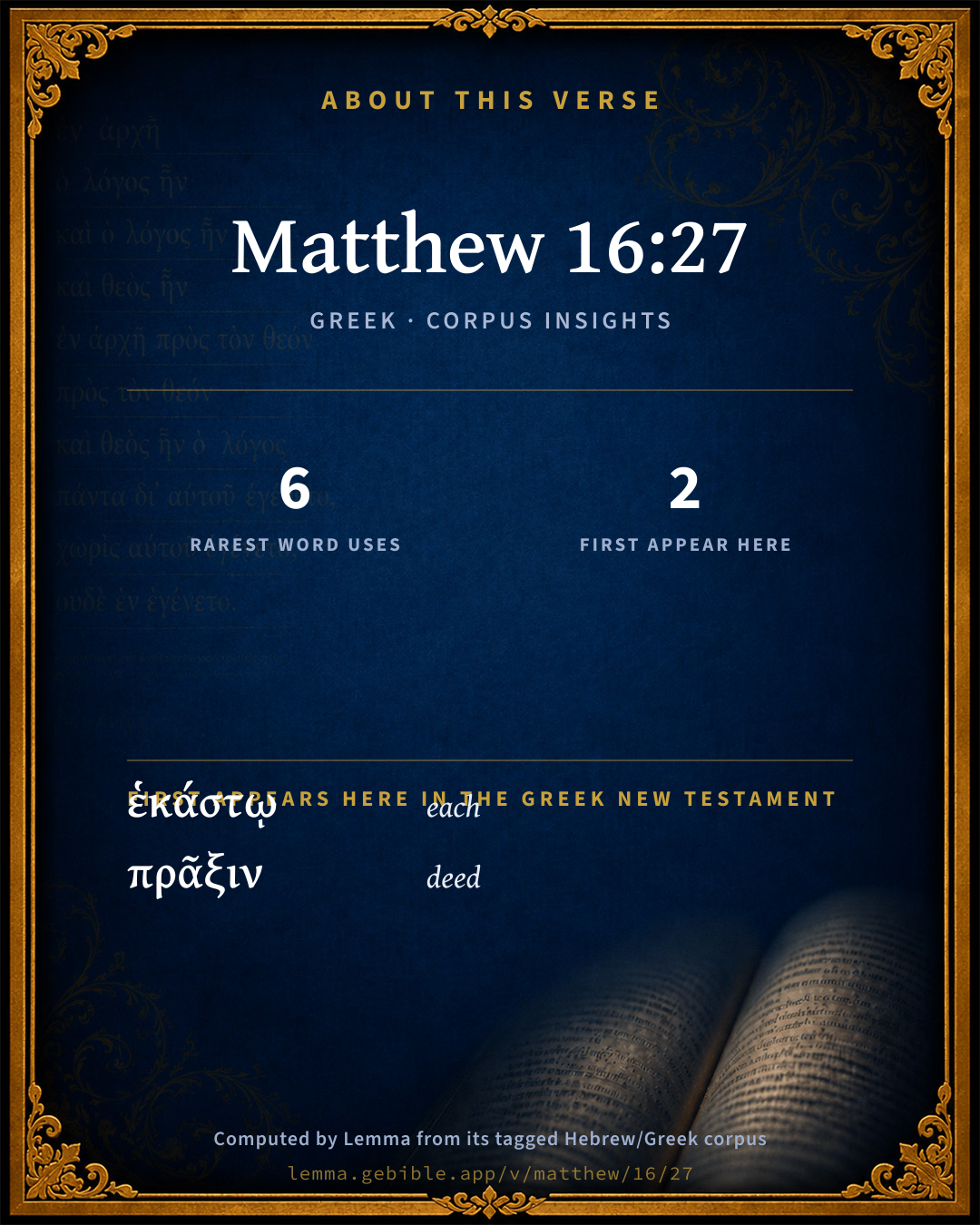
  • 2 first appearances in the Greek New Testament
Full analysis ↓
Download a study sheet

One document with this verse’s original text, its word-by-word gloss line, the meaning frame, cross-references with their text, attributed commentary, and full source and license credits — printable, and it pastes into notes with its structure intact.

This verse Autodidact and up

Study sheet (.html) Plain text (.txt)

A passage Seminary Student

Up to 50 verses in one chapter. A passage sheet keeps up to 6 commentary sources and 12 cross-references per verse, in the order this page ranks them, and says so on the sheet whenever that leaves anything out. Ask for a single verse and you get the Autodidact verse sheet above.

Everything on this page stays free to read, with no account — the sheet is a download of what is already on screen, not access to it.

Want to remove ads? Support Godless Engineer
Compare translations 3

The same verse in 3 English versions, stacked beneath the original-language interlinear above. Click any original word for its lexicon entry.

Each is an independent rendering of the whole verse — the interlinear is not word-aligned to these translations.

Highlighted words mark where these versions differ — a whole-verse word diff, not a word-by-word alignment.

  • World English Bible Public Domain
    For the Son of Man will come in the glory of his Father with his angels, and then he will render to everyone according to his deeds.
  • King James Version Public Domain
    For the Son of man shall come in the glory of his Father with his angels; and then he shall reward every man according to his works.
  • unfoldingWord Literal Text CC BY-SA 4.0
    For the Son of Man is about to come in the glory of his Father with his angels. And then he will repay each one according to his action.

unfoldingWord Literal Text — © unfoldingWord, licensed CC BY-SA 4.0. Word-aligned USFM3 via Door43 (git.door43.org/unfoldingWord/en_ult).

Versions to compare (up to 4)

3 of 4 selected

Show all 19 translations

Every available English version of this verse, each an independent rendering of the whole verse.

  • World English Bible Public Domain
    For the Son of Man will come in the glory of his Father with his angels, and then he will render to everyone according to his deeds.
  • Berean Standard Bible Public Domain
    For the Son of Man will come in His Father’s glory with His angels, and then He will repay each one according to what he has done.
  • Majority Standard Bible Public Domain
    For the Son of Man will come in His Father’s glory with His angels, and then He will repay each one according to what he has done.
  • King James Version Public Domain
    For the Son of man shall come in the glory of his Father with his angels; and then he shall reward every man according to his works.
  • American Standard Version (1901) Public Domain
    For the Son of man shall come in the glory of his Father with his angels; and then shall he render unto every man according to his deeds.
  • Revised Version (1885) Public Domain
    For the Son of man shall come in the glory of his Father with his angels; and then shall he render unto every man according to his deeds.
  • Geneva Bible (1599) Public Domain
    For the Sonne of man shall come in the glory of his Father with his Angels, and then shall he giue to euery man according to his deedes.
  • Douay-Rheims (1899) Public Domain
    For the Son of man shall come in the glory of his Father with his angels: and then will he render to every man according to his works.
  • Young's Literal Translation Public Domain
    `For, the Son of Man is about to come in the glory of his Father, with his messengers, and then he will reward each, according to his work.
  • Literal Standard Version CC BY-SA 4.0
    For the Son of Man is about to come in the glory of His Father, with His messengers, and then He will reward each according to his work.
  • Unlocked Literal Bible CC BY-SA 4.0
    For the Son of Man will come in the glory of his Father with his angels. Then he will reward every person according to what he has done.
  • unfoldingWord Literal Text CC BY-SA 4.0
    For the Son of Man is about to come in the glory of his Father with his angels. And then he will repay each one according to his action.
  • Darby Bible Public Domain
    For the Son of man is about to come in the glory of his Father with his angels, and then he will render to each according to his doings.
  • World Messianic Bible Public Domain
    For the Son of Man will come in the glory of his Father with his angels, and then he will give to everyone according to his deeds.
  • Webster's Bible Public Domain
    For the Son of man will come in the glory of his Father, with his angels; and then he will reward every man according to his works.
  • Free Bible Version CC BY-SA 4.0
    For the Son of man is going to come in his Father's glory, together with his angels. Then he will give everyone what they deserve according to what they've done.
  • Bible in Basic English Public Domain
    For the Son of man will come in the glory of his Father with his angels; and then he will give to every man the reward of his works.
  • Text-Critical English NT CC BY 4.0
    For the Son of Man will come with his angels in the glory of his Father, and then he will repay each person according to what he has done.
  • Tyndale New Testament (1534) Public Domain
    For the sonne of man shall come in the glory of his father with his angels: and then shall he rewarde every man accordinge to his dedes.

Literal Standard Version (2020), Covenant Press — licensed CC BY-SA 4.0. Text via the HelloAO Bible API (eBible.org). Unlocked Literal Bible (unfoldingWord) — licensed CC BY-SA 4.0. Text via the HelloAO Bible API (eBible.org). unfoldingWord Literal Text — © unfoldingWord, licensed CC BY-SA 4.0. Word-aligned USFM3 via Door43 (git.door43.org/unfoldingWord/en_ult). Free Bible Version, Dr. Jonathan Gallagher — licensed CC BY-SA 4.0. Text via the HelloAO Bible API (eBible.org).

Word by word

More ways to search: Search by grammar → Find every occurrence → Compare this word →

Practice this passage: Drill this verse → Learn its vocabulary →

πρᾶξιν
prâxis
G4234
“deed”
Noun, Accusative, Singular, Feminine
Part of Speech
Noun
Case
Accusative
Number
Singular
Gender
Feminine
Full Thayer's Definition

Origin: from G4238

TDNT: 16:42,9

1. a doing, a mode of acting, a deal, a transaction a. the doings of the apostles b. in a bad sense, wicked deed, crime, wicked doings (our practices i.e. trickery) 2. a thing to be done, business
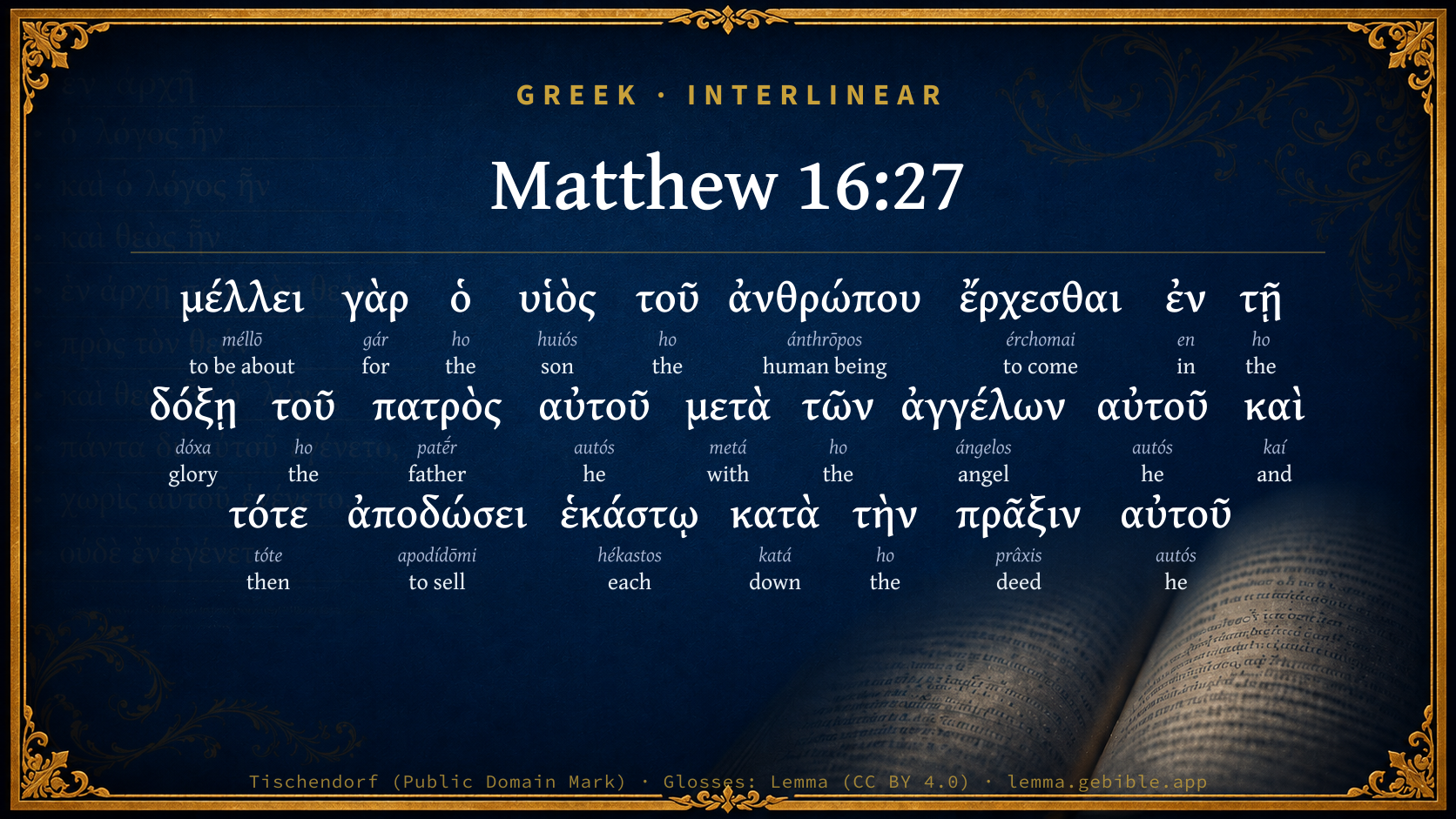
  1. μέλλει méllō G3195 “to be about” Verb, Present, Active, Indicative, 3rd person, Singular
  2. γὰρ gár G1063 “for” Conjunction
  3. ὁ ho G3588 “the” Article, Nominative, Singular, Masculine
  4. υἱὸς huiós G5207 “son” Noun, Nominative, Singular, Masculine
  5. τοῦ ho G3588 “the” Article, Genitive, Singular, Masculine
  6. ἀνθρώπου ánthrōpos G444 “human being” Noun, Genitive, Singular, Masculine
  7. ἔρχεσθαι érchomai G2064 “to come” Verb, Present, Middle or Passive deponent, Infinitive
  8. ἐν en G1722 “in” Preposition
  9. τῇ ho G3588 “the” Article, Dative, Singular, Feminine
  10. δόξῃ dóxa G1391 “glory” Noun, Dative, Singular, Feminine
  11. τοῦ ho G3588 “the” Article, Genitive, Singular, Masculine
  12. πατρὸς patḗr G3962 “father” Noun, Genitive, Singular, Masculine
  13. αὐτοῦ autós G846 “he” Personal pronoun, Genitive, Singular, Masculine
  14. μετὰ metá G3326 “with” Preposition
  15. τῶν ho G3588 “the” Article, Genitive, Plural, Masculine
  16. ἀγγέλων ángelos G32 “angel” Noun, Genitive, Plural, Masculine
  17. αὐτοῦ autós G846 “he” Personal pronoun, Genitive, Singular, Masculine
  18. καὶ kaí G2532 “and” Conjunction
  19. τότε tóte G5119 “then” Adverb
  20. ἀποδώσει apodídōmi G591 “to sell” Verb, Future, Active, Indicative, 3rd person, Singular
  21. ἑκάστῳ hékastos G1538 “each” Adjective, Dative, Singular, Masculine
  22. κατὰ katá G2596 “down” Preposition
  23. τὴν ho G3588 “the” Article, Accusative, Singular, Feminine
  24. αὐτοῦ autós G846 “he” Personal pronoun, Genitive, Singular, Masculine

About this verse

These counts appear in no published source. They are computed here, from the morphology-tagged text and Lemma’s own curated glosses. What Lemma adds →

25
words
18
distinct lemmas
Gospels
section

Notable vocabulary

The rarest word here is πρᾶξιν deed G4234 — appearing just 6 times in the whole Greek New Testament.

First appearance in Scripture

These words make their first canonical appearance in the Greek New Testament here:

  • ἑκάστῳ each G1538
  • πρᾶξιν deed G4234

Shared distinctive vocabulary

πρᾶξιν deed G4234 occurs in 6 verses of the Greek New Testament. Also found in:
Repetition

Words recur within this verse:

Cross-references

34

Topical passages linked to Matthew 16:27 in the Treasury of Scripture Knowledge — connected by theme and wording, ordered by reader-vote popularity; previews shown in the World English Bible.

  • Psalms 62:12 Also to you, Lord, belongs loving kindness, For you reward every man according to his work.
  • 2 Corinthians 5:10 For we must all be revealed before the judgment seat of Christ; that each one may receive the things in the body, according to what he has done, whether good or bad.
  • Romans 2:6 who "will pay back to everyone according to their works:"
  • Romans 14:12 So then each one of us will give account of himself to God.
  • Jeremiah 17:10 I, Yahweh, search the mind, I try the heart, even to give every man according to his ways, according to the fruit of his doings.
  • Revelation 22:12–15 "Behold, I come quickly. My reward is with me, to repay to each man according to his work.
  • Isaiah 3:10–11 Tell the righteous "Good!" For they shall eat the fruit of their deeds.
  • Matthew 10:41–42 He who receives a prophet in the name of a prophet will receive a prophet's reward: and he who receives a righteous man in the name of a righteous man will receive a righteous man's reward.
  • Ephesians 6:8 knowing that whatever good thing each one does, he will receive the same again from the Lord, whether he is bound or free.
  • Proverbs 24:12 If you say, "Behold, we didn't know this;" Doesn't he who weighs the hearts consider it? He who keeps your soul, doesn't he know it? Shall he not render to every man according to his work?
  • Jude 1:14 About these also Enoch, the seventh from Adam, prophesied, saying, "Behold, the Lord came with ten thousands of his holy ones,
  • Revelation 20:12 I saw the dead, the great and the small, standing before the throne, and they opened books. Another book was opened, which is the book of life. The dead were judged out of the things which were written in the books, according to their works.
  • Job 34:11 For the work of a man will he render to him, And cause every man to find according to his ways.
  • Jeremiah 32:19 great in counsel, and mighty in work; whose eyes are open on all the ways of the sons of men, to give everyone according to his ways, and according to the fruit of his doings:
  • Mark 8:38 For whoever will be ashamed of me and of my words in this adulterous and sinful generation, the Son of Man also will be ashamed of him, when he comes in the glory of his Father with the holy angels."
  • Revelation 2:23 I will kill her children with Death, and all the assemblies will know that I am he who searches the minds and hearts. I will give to each one of you according to your deeds.
  • Matthew 25:31 "But when the Son of Man comes in his glory, and all the holy angels with him, then he will sit on the throne of his glory.
  • Ezekiel 7:27 The king shall mourn, and the prince shall be clothed with desolation, and the hands of the people of the land shall be troubled: I will do to them after their way, and according to their deserts will I judge them; and they shall know that I am Yahweh.
  • Luke 21:27 Then they will see the Son of Man coming in a cloud with power and great glory.
  • 2 Thessalonians 1:7–10 and to give relief to you that are afflicted with us, when the Lord Jesus is revealed from heaven with his mighty angels in flaming fire,
  • Revelation 1:7 Behold, he is coming with the clouds, and every eye will see him, including those who pierced him. All the tribes of the earth will mourn over him. Even so, Amen.
  • Zechariah 14:5 You shall flee by the valley of my mountains; for the valley of the mountains shall reach to Azel; yes, you shall flee, just like you fled from before the earthquake in the days of Uzziah king of Judah. Yahweh my God will come, and all the holy ones with you.
  • Matthew 24:30 and then the sign of the Son of Man will appear in the sky. Then all the tribes of the earth will mourn, and they will see the Son of Man coming on the clouds of the sky with power and great glory.
  • Mark 14:62 Jesus said, "I AM. You will see the Son of Man sitting at the right hand of Power, and coming with the clouds of the sky."
  • Matthew 26:64 Jesus said to him, "You have said it. Nevertheless, I tell you, henceforth you will see the Son of Man sitting at the right hand of Power, and coming on the clouds of the sky."
  • Acts 1:11 who also said, "You men of Galilee, why do you stand looking into the sky? This Jesus, who was received up from you into the sky will come back in the same way as you saw him going into the sky."
  • Daniel 7:10 A fiery stream issued and came forth from before him: thousands of thousands ministered to him, and ten thousand times ten thousand stood before him: the judgment was set, and the books were opened.
  • Matthew 13:49 So will it be in the end of the world. The angels will come forth, and separate the wicked from among the righteous,
  • Luke 9:26 For whoever will be ashamed of me and of my words, of him will the Son of Man be ashamed, when he comes in his glory, and the glory of the Father, and of the holy angels.
  • Luke 22:69 From now on, the Son of Man will be seated at the right hand of the power of God."
  • 1 Peter 1:17 If you call on him as Father, who without respect of persons judges according to each man's work, pass the time of your living as strangers here in reverent fear:
  • 1 Thessalonians 1:10 and to wait for his Son from heaven, whom he raised from the dead-- Jesus, who delivers us from the wrath to come.
  • Matthew 13:41 The Son of Man will send out his angels, and they will gather out of his Kingdom all things that cause stumbling, and those who do iniquity,
  • 1 Thessalonians 4:16 For the Lord himself will descend from heaven with a shout, with the voice of the archangel, and with God's trumpet. The dead in Christ will rise first,

Cross-references courtesy of OpenBible.info (CC BY 4.0).

Commentary

Notes on Matthew 16:27 from classic Christian and Jewish commentators (each source and its license shown beneath its notes). The classic Christian expositions comment on the surrounding passage and are grouped to its opening verse, so a note may address several verses; the Jewish commentaries on the Tanakh (Rashi and others) are per-verse, so they appear only where the commentator wrote on this verse.

Lemma curates 59 commentaries, every one of them public domain or Creative Commons licensed, each selected and text-cleaned for this edition rather than reprinted as found. About our sources →

The Biblical Illustrator

Joseph S. Exell

Mat_16:27-28

For the Son of Man shall come in the glory of His Father.

The coming of the Son of Man

1. The judgment of the world has been committed to the Son as Mediator, as an appropriate honour to One who had humbled Himself for the redemption of the world.

2. Christ is qualified to be Judge, as the Son of God, of the same essence as the Father; the perfections of the Godhead will appear glorious in Him.

3. The saints in judgment will be manifested as the doers of the will of God upon earth.

4. The work of the Judge will be, not to justify, or to make righteous, but to prove the saints by their works, that they are righteous already.

5. Men will be judged by their works, to show that God in the work of mans salvation supports the cause of infinite holiness.

6. Judgment will not be according to the works visible to men, but to all done in secret.

7. Judgment according to works will condemn the ungodly, and make them dumb before God. (D. Charles.)

I. The son of man As the promised, manifested, ascended One.

II. His reappearance on earth Predicted, possible, necessary.

III. His superhuman glory. His herald, person, retinue is glorious.

IV. His important work. To raise the dead, change the living, judge all, reward each, resign the reins of government into His Fathers hand. (A. Macfarlane.)

I. That the Lord Jesus Christ shall return to this earth as a man in the glory of God with His angels.

II. That all Christs believing people shall appear with Him.

III. The Lord at His coming in His glory shall reward every man according to his works. (H. McNeile.)

An awful premonition

Compared with the doom which will be inflicted upon the ungodly at the coming of Christ, the death of nature is nothing.

I. The sinners death is but a faint presage of the sinners doom at the coming of the Son of Man in his glory.

1. We can make but little comparison between the two in the point of time. Physical dying is but the work of a moment; the doom of the wicked when Christ comes will never die.

2. In point of loss there is no comparison.

3. Neither does death hear any comparison with the last judgment in point of terror.

4. The pains of death are not comparable to the pains of the judgment at the second advent.

II. In the state of separate spirits they have not fully tasted of death, nor will they do so until Christ comes. Till after the second advent their bodies do not suffer; they know that this present state will end, after judgment no end; they have not been put to the shame of a public sentence. (C. H. Spurgeon.)

Waiting for Christs coming

I saw a picture the other day in a shop window, with which I was greatly pleased; it represented a room in which was a window looking out upon the sea; a lady with a grave, anxious face sat by the window, and two little children were playing on the carpet. On the table lay a letter, which seemed just to have been opened, and against the wall was hanging the portrait of a gentleman. There was very little writing underneath the picture, and very little was wanted; for I could understand the story which the picture was intended to tell, as plainly as if the painter had told me himself. The father of these little children was evidently absent from them beyond the sea. There was his portrait, but he was far away. But he had sent them s letter containing the joyful news that he was coming home again! And so there was the mother sitting at that window, day after day, and looking across the wide waters, in the hope of at last seeing the white sails of the ship which should bring the long-expected one home. Now this picture, I think, may remind us of what the Lord Jesus used to tell His disciples about His coming again. (Ready for work.)

The Biblical Illustrator, edited by Joseph S. Exell (c. 1880s–1900s) — public domain. Text from a community e-Sword module.

Godbey's Commentary on the New Testament

William B. Godbey

THE SECOND COMING

Mat 16:27-28. “For the Son of man is about to come in the glory of His Father, with His angels, and will then give to each one according to his work. Truly, I say unto you, There are certain ones of those standing here who may not taste of death, until they may see the Son of man coming in His kingdom.” Mar 8:38; Mar 9:1 : “For whosoever shall be ashamed of Me and My words in this adulterous and wicked generation, truly, the Son of man shall be ashamed of him, when He may come in the glory of His Father, with His holy angels. And He said to them, Truly, I say unto you, That there are certain ones of those standing here who may not taste of death until they may see the kingdom of God having come in power.”

Luk 9:26-27 : “For whosoever may be ashamed of Me and My words, of him shall the Son of man be ashamed, when He shall come in His glory, and that of the Father, and that of the holy angels. And, truly, I say unto you, There are certain ones of those standing here who may not taste of death until they may see the kingdom of God.” Very pertinently does our Savior here follow that terribly rigid and close sermon on discipleship, by one of the grandest of all possible inspirations, to settle the problem of discipleship, at any and every conceivable cost, making sure of heaven if we lose everything else, which is certainly the normal verdict of sound intelligence.

a. As this passage, recorded by Mark and Luke, reads in E.V., it has been the puzzle of millions. I know not why they give us the future tense, indicative mode, when the Greek has the present subjunctive. Within about one week from the time of this utterance, Peter, James, and John actually witnessed a prelude of His second coming on the Mount of Transfiguration.

“For not having followed cunningly devised fables, having made known unto you the power and coming of our Lord Jesus Christ, but having been eye-witnesses of His majesty. . . . And we heard this voice borne from heaven, being along with Him in the holy mount.” (2Pe 1:16-18.)

Here you see, Peter certifies that they witnessed His power and coming, while they were with Him in the holy mount. Now what was that holy mount? Why the Mount of Transfiguration, which they actually visited in a few days from that time, it being the preliminary coming of the Lord in His glory; i.e., an actual adumbration of His second coming. As Peter, James, and John were all present in His audience, and actually witnessed this prelude of His second and glorious coming, we, on the Mount of Transfiguration, have a preliminary fulfillment of this prophecy.

b. Within forty years of that date, while many of those people were still living, the Lord actually came, in His awful retributive judgments on the unbelieving Jews, executing righteous retribution for the rejection of His Son, destroying Jerusalem, and desolating the land with the awful scourge of the Roman armies, putting an end to the Jewish State and nationality, and annihilating the Jewish polity. Some able critics here find the fulfillment of this prophecy.

c. On the day of Pentecost the kingdom did certainly, as Mark says, “come in power,” having been on earth during the ministry of our Savior; but in the fiery baptisms and rushing tempest on the day of Pentecost it certainly did come in the signal manifestation of unprecedented power.

d. I see no reason why we may not take the whole passage as it is, and apply it to the existing generation, as it simply affirms a gracious possibility; i.e., there are some of those who are standing here, who may not taste of death until they may see the Son of man coming in His kingdom. Hence you see it simply affirms a gracious possibility on the part of that generation to see the Son of man coming in His glory, with the glory of the Father and the holy angels, before they pass away. You must remember that man has always been a failure. He failed in Eden; failed in antediluvian times; failed after the flood, landing in Egyptian slavery; failed in Judaism, rejecting and murdering their own Savior; and, according to the prophecies, will fail in the Gentile age, bringing on the tribulation, and forfeiting the millennium. Is not this very discouraging? O no! While man is a failure under all circumstances, God is an invariable and glorious success. Hence, all of these human failures should only inspire us to give up humanity, and fly to God, sinking away, lost in Him, to spend an eternity of bliss. The generation contemporary with Jesus was no exception. There was a gracious possibility for that generation to have preached the gospel to every nation, and so evangelize the world as to meet the condition of our Lord’s return (Mat 24:14); as in that case He would have returned in His glory before the death of that generation. Here our Savior assures us, “Whosoever may be ashamed of Me and My words, in this wicked and adulterous world, the Son of man shall be ashamed of him, when He may come in the glory of His Father, with His holy angels.” Remember, this is the peroration of that awful sermon on discipleship, which nowadays is dodged, perverted, and misconstrued by clergy and laity, laying under contribution all their wits, to devise an easy way to heaven, washing, dressing, and educating old Adam, and taking him along with them. N.B. In a similar manner we find so many tender footed on the coming of the Lord, which our Savior here gives in immediate connection with His exposition of discipleship. The true, blood-washed, fire-baptized, and Spirit-filled disciple is not troubled when we preach the coming of the Lord, but elated with heaven-born enthusiasm, causing him to leap, shout, and run to meet Him. Jesus here calls the people who are ashamed of Him and His words, “a wicked and adulterous generation.” Far from shame or embarrassment at the coming of the Lord, we should be watching and waiting, and ready with shouts, to meet Him. “And now, little children, abide in Him, in order that if He may appear, we may have boldness, and not shrink with embarrassment from Him at His coming.” E.V. says we “may not be ashamed.” This is the same word which our Lord uses with reference to His words and His presence when He comes in His glory. Hence we should all be so saved and sanctified as to put us in perfect harmony with the words of Jesus; so we do not want to turn and twist them about, nor evade their force in any way, but want them to remain just as Jesus gave them. And as to Himself, “He is the fairest among ten thousand, and altogether lovely.” Since His ascension, the widowed Church has mourned the absence of her Heavenly Spouse, and longed for His return, even now watching and waiting, ready to run to meet Him with shouts of triumph. So be sure that you are not ashamed nor embarrassed, when you read His Word, and contemplate His personal coming in a cloud this day.

William B. Godbey, Commentary on the New Testament (1896–1900) — public domain. Text from a community e-Sword module.

Tyndale Open Study Notes

Tyndale Open Resources

16:27 The exhortation to deny oneself and follow Jesus is rooted in the fact that Jesus will return to judge all people according to their deeds (see 19:28; 24:29-31; 25:31; Ps 62:12; Prov 24:12).

Tyndale Open Study Notes — © Tyndale Open Resources, licensed CC BY-SA 4.0. Text via the HelloAO Bible API.

Bengel's Gnomon

Johann Albrecht Bengel

Mat 16:27. Μέλλει ἔρχεσθαι, is about to come) A stronger expression than ἐλεύσεται will come. As the teaching concerning the person of Christ is immediately followed by that concerning His Cross, so is the latter by that concerning His glory.—τότε, then) All things are put off till then.—ἀποδώσει ἑκάστῳ, He will render to each individual) This is the attribute of Divine Majesty; see Rom 2:6.[770]—πρᾶξιν, action, conduct, doing) The word is put in the singular, for the whole life of man is one doing.[771]

[770] There is most frequent recurrence of this expression in Scripture.—V. g.

[771] From which, according as it is subject to Christ or to the belly, many works continually, and as a natural consequence, either good or else bad, come forth (result).—V. g.

Bengel's Gnomon of the New Testament — English translation (T&T Clark, Edinburgh, 1860) — public domain. Text from a community e-Sword module.

Meyer's Critical & Exegetical Commentary

Heinrich August Wilhelm Meyer

Mat_16:27. Γάρ] justifies and confirms what Jesus has just stated with respect to the loss of the ψυχή. I say that not without reason; for assuredly the time of the second coming and of a righteous retribution is drawing near (μέλλει being put first for sake of emphasis).

ἐν τῇ δόξῃ τοῦ πατρ. αὐτ.] in the same glory as belongs to God. For in this state of glory (Joh_17:5) the ascended Christ occupies the place of σύνθρονος of God.

τὴν πρᾶξιν] the conduct, the sum of ones doings, including, in particular, that self-denying adherence to their faith and their confession on which, above all, so much depended, in the case of the apostles, in the midst of those persecutions which they were called upon to endure.

Meyer — Critical and Exegetical Commentary on the New Testament — English translation by Peter Christie, edited by Frederick Crombie (T&T Clark, 1880) — public domain. Text from a community e-Sword module.

Expositor's Greek Testament

ed. W. Robertson Nicoll

Mat 16:27 . μέλλει points to something near and certain; note the emphatic position. ἔρχεσθαι ἐν τ . δ ., the counterpart experience to the passion; stated objectively in reference to the Son of Man , the passion spoken of in the second person (Mat 16:21 ). In Mk. both are objectively put; but the disciples took the reference as personal (Mar 8:32 ).

Mat 16:27 . his belongs to a third group of texts to be taken into account in an attempt to fix the import of the title those which refer to apocalyptic glory in terms drawn from Dan 7:13 . τότε ἀποδώσει : the Son of Man comes to make final awards. The reference to judgment comes in to brace up disciples to a heroic part. It is an aid to spirits not equal to this part in virtue of its intrinsic nobleness; yet not much of an aid to those to whom the heroic life is not in itself an attraction. The absolute worth of the true life is Christ’s first and chief line of argument; this is merely subsidiary.

The Expositor's Greek Testament, edited by W. Robertson Nicoll (1897–1910) — public domain. Text from a community e-Sword module.

Geneva Bible (1599)

Geneva Bible translators

Like a King, as Matt. 6:29.

Geneva Bible (1599) marginal notes — public domain. Text via Bolls.life.

Jamieson, Fausset & Brown

Robert Jamieson, A. R. Fausset & David Brown

For the Son of man shall come in the glory of his Father with his angels--in the splendor of His Father's authority and with all His angelic ministers, ready to execute His pleasure.

and then he shall reward, &c.

Jamieson, Fausset & Brown — Commentary Critical and Explanatory on the Whole Bible (1871) — public domain (CC PDM 1.0). Text via the HelloAO Bible API.

Adam Clarke's Commentary

Verse 27. For the Son of man shall come in the glory of his Father] This seems to refer to Da 7:13-14. "Behold, one like the Son of man came - to the ancient of Days - and there was given him dominion, and glory, and a kingdom, that all people, and nations, and languages should serve him." This was the glorious Mediatorial kingdom which Jesus Christ was now about to set up, by the destruction of the Jewish nation and polity, and the diffusion of his Gospel through the whole world. If the words be taken in this sense, the angels or messengers may signify the apostles and their successors in the sacred ministry, preaching the Gospel in the power of the Holy Ghost. It is very likely that the words do not apply to the final judgment, to which they are generally referred; but to the wonderful display of God's grace and power after the day of pentecost.

Adam Clarke's Commentary on the Bible (1810–1826) — public domain. Text from a community e-Sword/MySword module.

Ellicott's Commentary for English Readers

(27) For the Son of man shall come.—The fact stands in a logical relation to the preceding verse. The fact that the Son of Man is about to come to execute judgment, clothes its abstract statement with an awful certainty. No bribe can be offered to the Eternal Judge to change the sentence of forfeiture if that forfeiture has been rightfully incurred. From first to last in our Lord’s teaching (e.g., for its earlier stages, Mat_7:23-24; Joh_5:26-27) this claim to be the future Judge of all men is never absent. It is asserted in every great discourse, implied in almost every parable.

With his angels.—We are justified by Mat_25:31 in referring the possessive pronoun to Christ rather than the Father. “All things that the Father hath are Mine” (Joh_16:15), and among these the angels that do His pleasure.

His works.—The better MSS. give a word in the singular, his doing or conduct. The sentence is made to depend on the collective character of what has been done rather than on the multitude of individual acts.

A Bible Commentary for English Readers, edited by Charles John Ellicott (1878–1897) — public domain. Text from a community e-Sword module.

The Cambridge Bible for Schools and Colleges

gen. ed. J. J. S. Perowne

27. For] The reason given why the higher life—the soul—is of priceless value: (1) The Judge is at hand who will condemn self-indulgence and all the works of the lower life, and will reward those who have denied themselves. (2) Further (Mat_16:28) this judgment shall not be delayed—it is very near. The same motive for the Christian life is adduced by St Paul, Php_4:5, “Let your moderation be known unto all men. The Lord is at hand.” Cp. 1Co_16:22.

The Cambridge Bible for Schools and Colleges (gen. ed. J. J. S. Perowne; Cambridge University Press, 1878–1918) — public domain. Text from a community e-Sword module.

Trapp's Complete Commentary

John Trapp

27 For the Son of man shall come in the glory of his Father with his angels; and then he shall reward every man according to his works.

Ver. 27. In the glory of his Father with his angels] Great will he the glory of the man Christ Jesus at his second coming. He shall come riding on the clouds (not that he needs them, but to show his sovereignty), environed with flaming fire, mounted on a stately throne, attended by an innumerable company of angels (for they shall all come with him, not one of them left in heaven, 2Th 1:7; Mat 25:31), who shall minister unto him in this great work irresistibly, justly, speedily, Rev 15:6, Christ himself shining in the midst of them, with such an exuberance and excess of glory, as that the sun shall seem but a snuff to him. This glory, however it is here called "The glory of the Father," because he is the fountain, as of the Deity so of the divine glory wherewith Christ is crowned, Php 2:9; 1Ti 3:16; yet is it his own glory (as he is one with the Father and the Holy Ghost), and so it is called, Mat 25:31; Joh 17:5. Now if Israel so shouted for joy at Solomon’s coronation, and in the day of his espousals, that the earth rang again, 1Ki 1:40; Son 3:11; if the Grecians so cried out " Soter, soter" Saviour, Savior, to Flaminius the Roman general, when he had set them at liberty, that the very birds, astonished at the noise, fell down to the earth: oh, how great shall be the saints’ joy to see Christ the King in his beauty and bravery at the last judgment!

John Trapp, A Commentary or Exposition upon All the Books of the Old and New Testament (1647–1656) — public domain. Text from a community e-Sword module.

Haydock's Catholic Bible Commentary

Shall come in the glory. Jesus Christ wishing to shew his disciples the greatness of his glory at his future coming, reveals to them in this life as much as it was possible for them to comprehend, purposely to strengthen them against the scandal of his ignominious death. (St. John Chrysostom)

George Leo Haydock (1774–1849), Haydock's Catholic Family Bible and Commentary, 1859 edition — public domain. Excludes Psalms (Douay-Rheims chapter numbering differs from Protestant) and Deuterocanonical books (Catholic canon only).

Matthew Poole's English Annotations

This verse makes it plain, that our Saviour by ψυχη in the former verse understood the soul of man, or eternal life, that blessed state which is prepared for the saints of God; for he here minds them that there shall be a last judgment, and gives them a little description of it.

1. As to the Judge, the Son of man, him whom you now see in the shape of a man, and whom men vilify and contemn under that notion. He is to be the Judge of quick and dead, Act 10:42; 2Ti 4:1.

2. As to the splendour of it. He shall come in the glory of his Father. It is also his glory, Joh 17:5; he calls it the glory of his Father, because by his eternal generation he received it together with the Divine nature from his Father, and it was common to him with his Father; or because his commission for judgment was from his Father:

For the Father judgeth no man, but hath committed all judgment unto the Son, Joh 5:22.

With his angels; his holy angels, 1Th 1:7.

And then he shall reward every man according to his works: not for his works. Our Saviour is not here speaking of the cause of the reward, but the rule and measure of it: According to his deeds, Rom 2:6.

According to his labour, 1Co 3:8. According to that he hath done, 2Co 5:10. Not according to his faith, but works, for faith without works is dead; but these works must spring out of a root of faith, without which it is impossible to please God. He shall reward him, by a reward of grace, not of debt, Rom 4:4. Works shall be rewarded, but not as with a penny for a pennyworth, but of grace.

Matthew Poole's English Annotations on the Holy Bible (1683–1685) — public domain. Text from a community e-Sword/MySword module.

Whedon's Commentary on the Bible

Daniel D. Whedon

27. For — This particle shows that the verse which it introduces explains and enforces the consideration of the previous verses. To save one’s life to gain the world with the loss of the soul, is a bad bargain, for the judgment day is coming. Shall come — From heaven at the end of the world. In the glory of his Father… angels — The same words describe the scenic splendour of his judgment advent in Mat_24:31. Reward — For every suffering there shall then be a compensation. In view of this reward at the judgment day, they were to toil and suffer for the consummation (described in the next verse) of Christ’s kingdom on earth.

Daniel D. Whedon (gen. ed.), Commentary on the Old and New Testaments (1874–1909) — public domain. Text from a community e-Sword module.

The Pulpit Commentary

For the Son of man shall come. The final judgment would put things in their true light would show the value of self-sacrifice, would reveal the punishment of self-pleasing. Our Lord seems to refer to Dan_7:13, as it were, in testimony to the truth of what he had just said. Shall come; mellei ercesyai : venturus est (Vulgate), is more than the bare announcement, and implies that it is in accordance with the eternal counsels of God that he should appear this second time. In the glory of his Father. As one with the Father, and his Representative. So he speaks of "the glory which thou hast given me". (Joh_17:22) Reward; apodwsei : render, reddet (Vulgate). The term includes punishment as well as recompense. Works (praxin); doing, work. The word does not signify isolated acts, but general course of conduct, practice as a whole.

The Pulpit Commentary (1880–1919), ed. H.D.M. Spence-Jones & Joseph S. Exell — public domain. Text from a community e-Sword module.

John Wesley's Explanatory Notes

For the Son of man shall come - For there is no way to escape the righteous judgment of God.

John Wesley, Explanatory Notes Upon the Whole Bible (1754–1765) — public domain. Text via the GEBible commentary corpus.

Burkitt's Expository Notes on the New Testament

William Burkitt

There is a twofold judgment spoken of by this evangelist St. Matthew, namely, a particular coming of Christ to execute vengeance on the Jews, at the destruction of Jerusalem; and a general coming at the day of judgment.

If we understand this place of the latter, we have then, 1. The judge described, The Son of man, he who was and is both God and man, shall judge both angels and men.

2. The splendour of that day declared, He shall come in glory with his holy angels. The attendance of angels shall be required by Christ not for necessity but for majesty.

3. The work and business of that day demonstrated, and that is, To render to every man according to his work.

Learn, That the judgment of the great day will be most glorious and righteous: Christ will be glorious in his person, and glorious in his attendance: and the judgment will be according to righteousness, Without respect of persons, according to what has been done in the body.

William Burkitt's Expository Notes on the New Testament (1700–1703) — public domain. Text from a community e-Sword module.

The People's New Testament

B. W. Johnson

27. For the Son of man shall come. Then all shall receive their deserts; those who lose their lives shall gain life; those who choose the world shall lose all. As Christ begins to teach of dying on the cross, he begins to give prominence to his coming again.

B. W. Johnson's The People's New Testament with Notes (1889–1891) — public domain. Electronic text from the Christian Classics Ethereal Library (CCEL) ThML edition.

unfoldingWord translationNotes

Door43 World Missions Community

the Son of Man ... his Father ... Then he

Here Jesus refers to himself in the third person. AT: "I, the Son of man ... my Father ... Then I" (See: First, Second, or Third Person)

will come in the glory of his Father

"will come, having the same glory as his Father"

with his angels

"and the angels will be with him." If you translate the first part of the sentence with Jesus speaking in the first person, you can translate this as "and my Father's angels will be with me." (See: First, Second, or Third Person)

his Father

This is an important title for God that describes the relationship between God and the Son of Man, Jesus. (See: Translating Son and Father)

according to what he has done

"according to what each person has done"

Truly I say to you

"I tell you the truth." This phrase adds emphasis to what Jesus says next.

you

All occurrences of this word are plural and refer to the disciples. (See: Forms of You)

will not taste death

Here "taste" means to experience. AT: "will not experience death" or" will not die" (See: Idiom)

until they see the Son of Man coming in his kingdom

Here "his kingdom" represents him being King. AT: "until they see the Son of Man coming as King" or "until they see the evidence that the Son of Man is King" (See: Metonymy)

translationWords

Son of Man

glory

God the Father

angel

works

amen

die

kingdom

unfoldingWord translationNotes — © Distant Shores Media and the Door43 World Missions Community, licensed CC BY-SA 4.0. Source: git.door43.org/Door43/en_tn.

Cambridge Greek Testament for Schools and Colleges

27. γάρ. The reason given why the higher life—the soul—is of priceless value: (1) The Judge is at hand who will condemn self-indulgence and all the works of the lower life, and will reward those who have denied themselves. (2) Further (Mat 16:28) this judgment shall not be delayed—it is very near. The same motive for the Christian life is adduced by St Paul, Php 4:5, τὸ ἐπιεικὲς ὑμῶν γνωσθήτω πᾶσιν ἀνθρώποις. ὁ Κύριος ἐγγύς. Cp. 1Co 16:22.

Cambridge Greek Testament for Schools and Colleges (Cambridge University Press, 1896; 21 vols, various authors incl. Carr, Maclear, Plummer, Farrar, Lumby, Moule, M. R. James, Simcox) — public domain. Text from a community e-Sword module.

Alford’s Greek Testament

Henry Alford

27.] A further revelation of this important chapter respecting the Son of Man. He is to be Judge of all—and, as in ch. 13:41, is to appear with His angels, and in the glory of His Father—the δόξα ἣν δέδωκάς μοι, Joh 17:22. Mark and Luke place here, not this declaration, but that of our ch. 10:33. Our Lord doubtless joined the two. Compare ch. 24:30; 25:31.

γάρ implies, “And it is not without reason that I thus speak: a time will come when the truth of what I say will be shewn.”

τὴν πρ.] his work, considered as a whole.

Henry Alford, The Greek Testament (1849–1861) — public domain. Text from a community e-Sword module.

International Critical Commentary

27. For the Son of Man is about to come in the glory of His Father with His angels. And then He shall give to each man according to his work.] Mk. has: “For whosoever shall be ashamed of Me and my words in this adulterous and sinful generation, the Son of Man shall be ashamed of him when He shall come in the glory of His Father with the holy angels.” Mt. has already inserted words parallel to the first clause of Mk. in 10:33. He therefore omits them here, and makes of ὅταν ἔλθῃ a main clause, μέλλει γὰρ—ἔρχεσθαι. μέλλειν, which here emphasises the nearness of the coming, is characteristic of Mat 17:12; Mat 17:22 μέλλει—παραδίδοσθαι for Mk.’s παραδίδοται, 20:17, 22, 24:6. He then adds, by way of compensation for the omitted clause of Mk., καὶ τότε ἀποδώσει ἑκάστῳ κατὰ τὴν πρᾶξιν αὐτοῦ.—ἐν τῇ δόξῃτοῦ πατρός αὐτοῦ] For the glory of the Messiah; cf. Enoch 61:8 “The Lord of Spirits placed the Elect One on the throne of glory,” 62:2 “The Lord of Spirits seated Him on the throne of His glory”; and Test. Lev_18Lev_18.

καὶ τότε ἀποδώσει, κ.τ.λ.] For the conception of the Messiah in glory judging men after their works, cf. Enoch 45:3 “On that day Mine Elect One will sit on the throne of glory, and make choice amongst their deeds,” 69:27 “And He sat on the throne of His glory, and the sum of judgement was committed to Him, the Son of Man.” The terms seem to be borrowed from Ps 61:13 σὺ ἀποδώσεις ἑκάστῳ κατὰ τὰ ἔργα αὐτοῦ; cf. Pro 24:12, Ecclus 32:24.

(M)

International Critical Commentary — older volumes (1896–1929), various authors — public domain. Text from a community e-Sword module.

Lesson kit

Teaching starters — assembled from the data on this page, not authored interpretation. Every prompt links to the verse data it draws on. Edit before teaching.

Matthew, in the Gospels, opens this verse with 25 words (18 distinct Greek lemmas). Its most distinctive word is prâxis (“deed”). A historical commentator’s framing appears above. Read the whole chapter for the surrounding context.

Discussion questions

  1. What does “deed” (prâxis) contribute to the verse as a whole?
  2. 2 words here appear for the first time in Scripture. What is being introduced at this debut?
  3. Luke 23:51 shares the word «deed» with this verse. How do the two illuminate each other?
  4. “the” occurs 6× in this one verse. What is the effect of the repetition?
  5. The translations on this page render this verse differently — a whole-verse word diff, not a word-by-word alignment. What might account for the different wordings?
  6. Reading how The Biblical Illustrator and Godbey's Commentary on the New Testament read this verse, where do the two commentators agree and where do they part?

Things to notice

  • 2 words make their first canonical appearance in Scripture here.
  • These translations choose different wording for 13 words in this verse.
  • “the” occurs 6× in this single verse.
  • 18 distinct Greek lemmas span 25 words in this verse.

Reading settings

Reading text

Shown beneath each verse's original-language words.

Old Testament
Old Testament edition

Read the OT as the Masoretic Hebrew (MT) or the Greek Septuagint (LXX).

English shown for the Greek Septuagint (in the Hebrew ↔ Greek comparison).

Comparing translations? Open the Compare panel on any verse page to stack up to four side by side.