
John 6:31

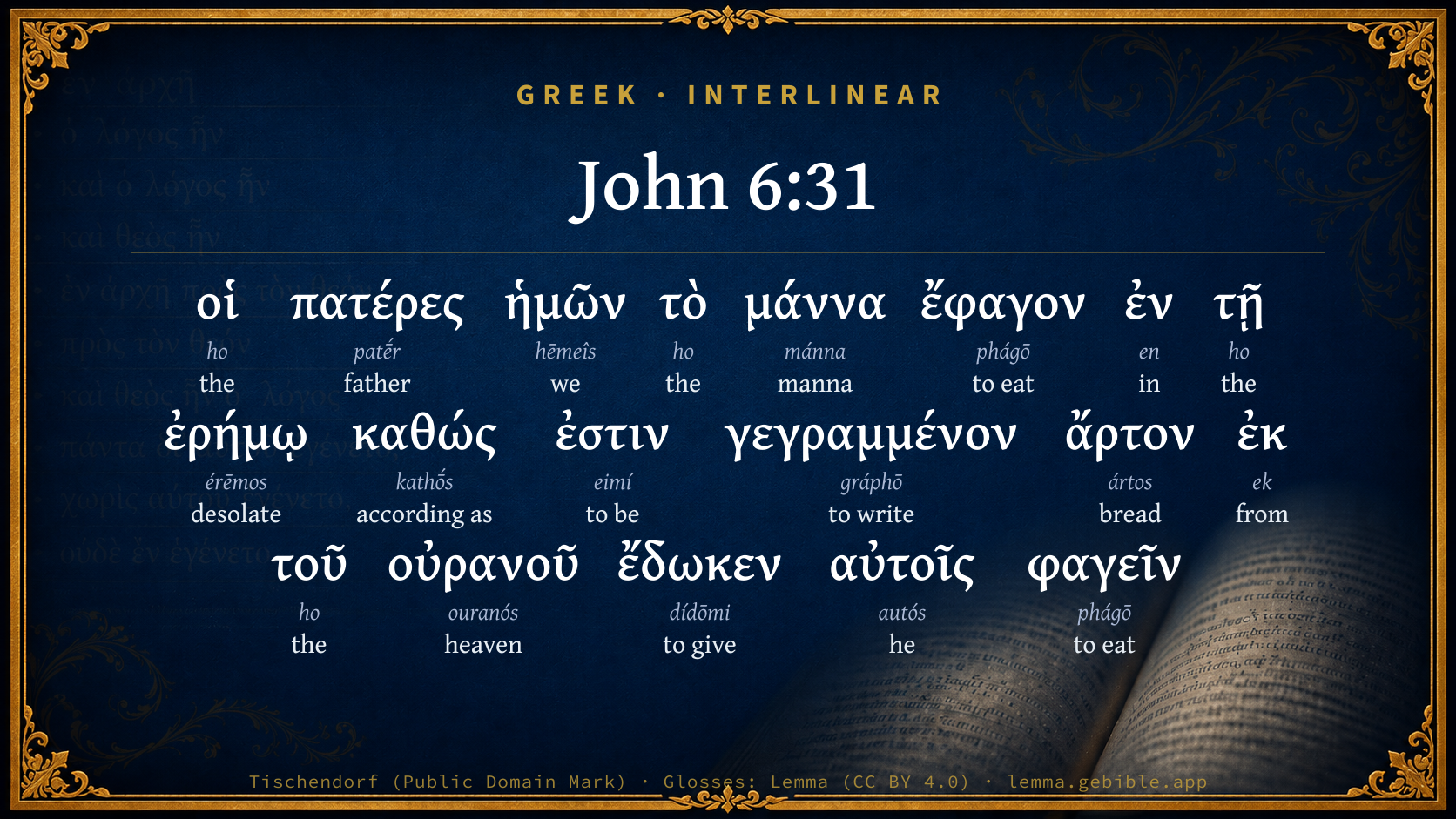
Greek (Tischendorf 8th ed.) John 6:31 appears in the Greek New Testament. The text above is from the Tischendorf 8th edition. Each word links to its Strong’s number and a concise gloss. Click any word for its full Thayer’s Greek Lexicon entry.
Download image
Cite this verse

John 6:31 (World English Bible). Public Domain. Lemma interlinear Bible study tool, https://lemma.gebible.app/v/john/6/31.

Show BibTeX & RIS
BibTeX
RIS
English Translation
Our fathers ate the manna in the wilderness. As it is written, 'He gave them bread out of heaven to eat.'"
World English Bible · Public Domain
Highlights
  • 1 first appearance in the Greek New Testament
Full analysis ↓
Download a study sheet

One document with this verse’s original text, its word-by-word gloss line, the meaning frame, cross-references with their text, attributed commentary, and full source and license credits — printable, and it pastes into notes with its structure intact.

This verse Autodidact and up

Study sheet (.html) Plain text (.txt)

A passage Seminary Student

Up to 50 verses in one chapter. A passage sheet keeps up to 6 commentary sources and 12 cross-references per verse, in the order this page ranks them, and says so on the sheet whenever that leaves anything out. Ask for a single verse and you get the Autodidact verse sheet above.

Everything on this page stays free to read, with no account — the sheet is a download of what is already on screen, not access to it.

Want to remove ads? Support Godless Engineer
Compare translations 3

The same verse in 3 English versions, stacked beneath the original-language interlinear above. Click any original word for its lexicon entry.

Each is an independent rendering of the whole verse — the interlinear is not word-aligned to these translations.

Highlighted words mark where these versions differ — a whole-verse word diff, not a word-by-word alignment.

  • World English Bible Public Domain
    Our fathers ate the manna in the wilderness. As it is written, 'He gave them bread out of heaven to eat.'"
  • King James Version Public Domain
    Our fathers did eat manna in the desert; as it is written, He gave them bread from heaven to eat.
  • unfoldingWord Literal Text CC BY-SA 4.0
    Our fathers ate the manna in the wilderness, just as it is written, ‘He gave them bread from heaven to eat.’”

unfoldingWord Literal Text — © unfoldingWord, licensed CC BY-SA 4.0. Word-aligned USFM3 via Door43 (git.door43.org/unfoldingWord/en_ult).

Versions to compare (up to 4)

3 of 4 selected

Show all 19 translations

Every available English version of this verse, each an independent rendering of the whole verse.

  • World English Bible Public Domain
    Our fathers ate the manna in the wilderness. As it is written, 'He gave them bread out of heaven to eat.'"
  • Berean Standard Bible Public Domain
    Our fathers ate the manna in the wilderness, as it is written: ‘He gave them bread from heaven to eat.’”
  • Majority Standard Bible Public Domain
    Our fathers ate the manna in the wilderness, as it is written: ‘He gave them bread from heaven to eat.’”
  • King James Version Public Domain
    Our fathers did eat manna in the desert; as it is written, He gave them bread from heaven to eat.
  • American Standard Version (1901) Public Domain
    Our fathers ate the manna in the wilderness; as it is written, He gave them bread out of heaven to eat.
  • Revised Version (1885) Public Domain
    Our fathers ate the manna in the wilderness; as it is written, He gave them bread out of heaven to eat.
  • Geneva Bible (1599) Public Domain
    Our fathers did eate Manna in the desart, as it is written, Hee gaue them bread from heauen to eate.
  • Douay-Rheims (1899) Public Domain
    Our fathers did eat manna in the desert, as it is written: He gave them bread from heaven to eat.
  • Young's Literal Translation Public Domain
    our fathers the manna did eat in the wilderness, according as it is having been written, Bread out of the heaven He gave them to eat.'
  • Literal Standard Version CC BY-SA 4.0
    Our fathers ate the manna in the wilderness, according as it is having been written: He gave them bread out of Heaven to eat.”
  • Unlocked Literal Bible CC BY-SA 4.0
    Our fathers ate the manna in the wilderness, as it is written, 'He gave them bread from heaven to eat.'”
  • unfoldingWord Literal Text CC BY-SA 4.0
    Our fathers ate the manna in the wilderness, just as it is written, ‘He gave them bread from heaven to eat.’”
  • Darby Bible Public Domain
    Our fathers ate the manna in the wilderness, as it is written, He gave them bread out of heaven to eat.
  • World Messianic Bible Public Domain
    Our fathers ate the manna in the wilderness. As it is written, ‘He gave them bread out of heaven to eat.’”
  • Webster's Bible Public Domain
    Our fathers ate manna in the desert; as it is written, He gave them bread from heaven to eat.
  • Free Bible Version CC BY-SA 4.0
    “Our forefathers ate manna in the desert in fulfillment of the Scripture that says, ‘He gave them bread from heaven to eat.’”
  • Bible in Basic English Public Domain
    Our fathers had the manna in the waste land, as the Writings say, He gave them bread from heaven.
  • Text-Critical English NT CC BY 4.0
    Our fathers ate the manna in the wilderness, just as it is written, ‘He gave them bread from heaven to eat.’ ”
  • Tyndale New Testament (1534) Public Domain
    Oure fathers dyd eate Manna in the desert as that is writte: He gave them breed from heaven to eate.

Literal Standard Version (2020), Covenant Press — licensed CC BY-SA 4.0. Text via the HelloAO Bible API (eBible.org). Unlocked Literal Bible (unfoldingWord) — licensed CC BY-SA 4.0. Text via the HelloAO Bible API (eBible.org). unfoldingWord Literal Text — © unfoldingWord, licensed CC BY-SA 4.0. Word-aligned USFM3 via Door43 (git.door43.org/unfoldingWord/en_ult). Free Bible Version, Dr. Jonathan Gallagher — licensed CC BY-SA 4.0. Text via the HelloAO Bible API (eBible.org).

Word by word

More ways to search: Search by grammar → Find every occurrence → Compare this word →

Practice this passage: Drill this verse → Learn its vocabulary →

μάννα
mánna
G3131
“manna”
Hebrew transliteration
Part of Speech
Hebrew transliteration
Full Thayer's Definition

Origin: of hebrew origin H4478

TDNT: 11:42,6

manna = "what is it" 1. the food that nourished the Israelites for forty years in the wilderness 2. of the manna was kept in the ark of the covenant 3. symbolically, that which is kept in the heavenly temple for the food of angels and the blessed
  1. οἱ ho G3588 “the” Article, Nominative, Plural, Masculine
  2. πατέρες patḗr G3962 “father” Noun, Nominative, Plural, Masculine
  3. ἡμῶν hēmeîs G2249 “we” Personal pronoun, 1st person, Genitive, Plural
  4. τὸ ho G3588 “the” Article, Accusative, Singular, Neuter
  5. ἔφαγον phágō G5315 “to eat” Verb, Aorist, Active, Indicative, 3rd person, Plural
  6. ἐν en G1722 “in” Preposition
  7. τῇ ho G3588 “the” Article, Dative, Singular, Feminine
  8. ἐρήμῳ érēmos G2048 “desolate” Adjective, Dative, Singular, Feminine
  9. καθώς kathṓs G2531 “according as” Adverb
  10. ἐστιν eimí G1510 “to be” Verb, Present, Active, Indicative, 3rd person, Singular
  11. γεγραμμένον gráphō G1125 “to write” Verb, Perfect, Passive, Participle, Nominative, Singular, Neuter
  12. ἄρτον ártos G740 “bread” Noun, Accusative, Singular, Masculine
  13. ἐκ ek G1537 “from” Preposition
  14. τοῦ ho G3588 “the” Article, Genitive, Singular, Masculine
  15. οὐρανοῦ ouranós G3772 “heaven” Noun, Genitive, Singular, Masculine
  16. ἔδωκεν dídōmi G1325 “to give” Verb, Aorist, Active, Indicative, 3rd person, Singular
  17. αὐτοῖς autós G846 “he” Personal pronoun, Dative, Plural, Masculine
  18. φαγεῖν phágō G5315 “to eat” Verb, Aorist, Active, Infinitive

About this verse

These counts appear in no published source. They are computed here, from the morphology-tagged text and Lemma’s own curated glosses. What Lemma adds →

19
words
15
distinct lemmas
Gospels
section

Notable vocabulary

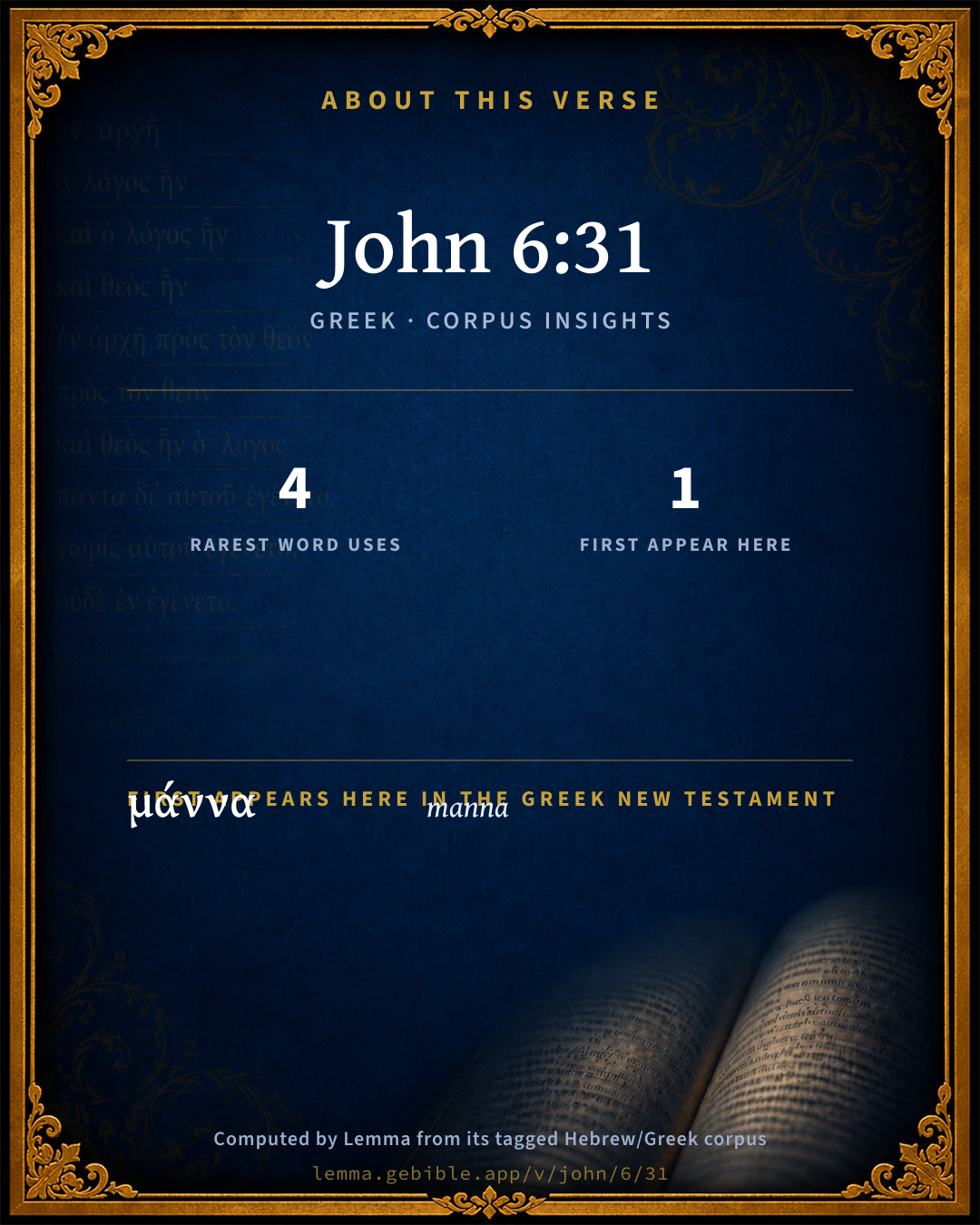
The rarest word here is μάννα manna G3131 — appearing just 4 times in the whole Greek New Testament.

First appearance in Scripture

This word makes its first canonical appearance in the Greek New Testament here:

Shared distinctive vocabulary

μάννα manna G3131 occurs in 4 verses of the Greek New Testament. Also found in:
Repetition

Words recur within this verse:

  • ἔφαγον to eat G5315 ×2
  • οἱ the G3588 ×4

Cross-references

13

Topical passages linked to John 6:31 in the Treasury of Scripture Knowledge — connected by theme and wording, ordered by reader-vote popularity; previews shown in the World English Bible.

  • Nehemiah 9:15 and gave them bread from the sky for their hunger, and brought forth water for them out of the rock for their thirst, and commanded those who they should go in to possess the land which you had sworn to give them.
  • Psalms 105:40 They asked, and he brought quails, And satisfied them with the bread of the sky.
  • Psalms 78:24–25 He rained down manna on them to eat, And gave them food from the sky.
  • Exodus 16:4–15 Then said Yahweh to Moses, "Behold, I will rain bread from the sky for you, and the people shall go out and gather a day's portion every day, that I may test them, whether they will walk in my law, or not.
  • Exodus 16:35 The children of Israel ate the manna forty years, until they came to an inhabited land. They ate the manna until they came to the borders of the land of Canaan.
  • Numbers 11:6–9 but now our soul is dried away; there is nothing at all save this manna to look on.
  • Deuteronomy 8:3 He humbled you, and allowed you to hunger, and fed you with manna, which you didn't know, neither did your fathers know; that he might make you know that man does not live by bread only, but by everything that proceeds out of the mouth of Yahweh does man live.
  • Nehemiah 9:20 You gave also your good Spirit to instruct them, and didn't withhold your manna from their mouth, and gave them water for their thirst.
  • John 6:49 Your fathers ate the manna in the wilderness, and they died.
  • Joshua 5:12 The manna ceased on the next day, after they had eaten of the produce of the land; neither had the children of Israel manna any more; but they ate of the fruit of the land of Canaan that year.
  • Revelation 2:17 He who has an ear, let him hear what the Spirit says to the assemblies. To him who overcomes, to him I will give of the hidden manna, and I will give him a white stone, and on the stone a new name written, which no one knows but he who receives it.
  • John 6:58 This is the bread which came down out of heaven-- not as our fathers ate the manna, and died. He who eats this bread will live forever."
  • 1 Corinthians 10:3 and all ate the same spiritual food;

Cross-references courtesy of OpenBible.info (CC BY 4.0).

Commentary

Notes on John 6:31 from classic Christian and Jewish commentators (each source and its license shown beneath its notes). The classic Christian expositions comment on the surrounding passage and are grouped to its opening verse, so a note may address several verses; the Jewish commentaries on the Tanakh (Rashi and others) are per-verse, so they appear only where the commentator wrote on this verse.

Lemma curates 59 commentaries, every one of them public domain or Creative Commons licensed, each selected and text-cleaned for this edition rather than reprinted as found. About our sources →

Bengel's Gnomon

Johann Albrecht Bengel

Joh 6:31. Ἔφαγον, did eat) They appear to speak more moderately than if they were to say: Moses gave us [a sign], therefore our fathers believed him: do Thou also give, and we will believe Thee: comp. ver. foll.—ἄρτον ἐκ τοῦ οὐρανοῦ ἔδωκεν αὐτοῖς φαγεῖν) Septuag., Exo 16:4, ἄρτους ἐκ τοῦ οὐρανοῦ; Psa 78:24, ἄρτον οὐρανοῦ ἔδωκεν αὐτοῖς; Exod. same ch. Joh 6:15, ἔδωκε φαγεῖν. If that λεπτόν [Septuag. Exo 16:14; “a small round thing,” Engl. Vers.], small thing, was true bread, (Num 11:7, “The manna was as coriander seed,”) why should not also circular loaves [as the five, with which Jesus fed the 5000] be true bread?—ἐκ τοῦ σὐρανοῦ, from heaven) Heaven, as opposed to the earth, is taken in the widest sense in the psalm; whence manna is also called the bread of angels, or of heavenly beings: but Jesus opposes to the heaven from which the ancient manna came, the highest heaven. It is with reference to this that the Lord Himself seven times saith, that He has come from heaven: Joh 6:32-33; Joh 6:38; Joh 6:50-51; Joh 6:58; Joh 6:62.

Bengel's Gnomon of the New Testament — English translation (T&T Clark, Edinburgh, 1860) — public domain. Text from a community e-Sword module.

Expositor's Greek Testament

ed. W. Robertson Nicoll

Joh 6:31 . This is proved by the suggestion added in Joh 6:31 . οἱ πατέρες … φαγεῖν ; they demanded that He as Messiah should make good His claim by outdoing Moses. Schoettgen and Lightfoot quote from Rabbinical literature a relevant and significant saying: “Qualis fuit redemptor primus (Moses) talis erit redemptor ultimus (Messias). Redemptor prior descendere fecit pro iis Manna, sic et Redemptor posterior descendere faciet Manna, sicut scriptum est,” Psa 73:16 . See other instructive passages in Lightfoot. According to this expectation that the Messiah would feed His people supernaturally the crowd now insinuate that though Jesus had given them bread He had not fulfilled the expectation and given them bread from heaven. (For the expression “bread of heaven” see Exo 14:4 and Psa 78:23-24 .) To this challenge to fulfil Messianic expectation by showing Himself greater than Moses Jesus replies (Joh 6:32 ), οὐ Μωσῆς … ἀληθινόν . A double denial; not Moses, but “my Father” s the giver, and although the manna was in a sense “bread from heaven” it was not “the true bread from heaven,” τὸν ἄρτον ἐκ τοῦ οὐρανοῦ τὸν ἀληθινόν . This my Father is now giving to you; ὁ γὰρ ἄρτος … τῷ κόσμῳ .

The Expositor's Greek Testament, edited by W. Robertson Nicoll (1897–1910) — public domain. Text from a community e-Sword module.

Jamieson, Fausset & Brown

Robert Jamieson, A. R. Fausset & David Brown

Our fathers did eat manna, &c.--insinuating the inferiority of Christ's miracle of the loaves to those of Moses: "When Moses claimed the confidence of the fathers, 'he gave them bread from heaven to eat'--not for a few thousands, but for millions, and not once only, but daily throughout their wilderness journey."

Jamieson, Fausset & Brown — Commentary Critical and Explanatory on the Whole Bible (1871) — public domain (CC PDM 1.0). Text via the HelloAO Bible API.

Adam Clarke's Commentary

Verse 31. Our fathers did eat manna in the desert] Their argument seems to run thus: Thou hast, we grant, fed five thousand men with five loaves and two small fishes; but what is this in comparison of what Moses did in the desert, who for forty years fed more than a million of persons with bread from heaven: do something like this, and then we will believe in thee, as we have believed in Moses.

Adam Clarke's Commentary on the Bible (1810–1826) — public domain. Text from a community e-Sword/MySword module.

John Calvin's Commentaries

31. Our fathers ate manna in the wilderness. Thus we see that Christ put his finger on the sore, when he told them that they came like brute beasts to fill their belly; for they discover this gross disposition, when they demand a Messiah by whom they are to be fed. And as to the magnificent terms in which they extol the grace of God in the manna, they do this cunningly, in order to bury the doctrine of Christ, by which he condemned them for immoderate desire of corruptible food; for they contrast with it the magnificent title bestowed on the manna, when it is called heavenly bread But when the Holy Spirit bestows on the manna the honorable appellation of the bread of heaven, (Psalm 78:24,) it is not with this intention, as if God fed his people, like a herd of swine, and gave them nothing more valuable; and, therefore, they are without excuse, when they wickedly reject the spiritual food of the soul, which God now offers to them.

John Calvin's Commentaries (1540-1563) — public domain. Text from the Calvin Translation Society English edition (1840s-50s) via the Christian Classics Ethereal Library (ccel.org). Calvin's coverage is partial (roughly two-thirds of the Bible); uncommented books and verses are honest gaps, never fabricated. The 19th-century editor's footnotes and remarks are omitted so the notes are faithfully Calvin's own voice.

Ellicott's Commentary for English Readers

(31) Our fathers did eat manna.—He claims to be the Messiah; but the Messiah was to be greater than Moses, and the sign He has shown is less. The Messiah was to cause manna again to fall from heaven, as their Rabbis taught. They had eaten food which, if miraculously multiplied, was still the food of earth—the common bread and common relish—and this on the grassy sward not far removed from the habitations of men. Their fathers had eaten the manna which came direct from God, and was gathered from the granite rocks of the desert; and the Psalmist had told, and Hebrew children loved to chant, that “bread from heaven was that which He gave them to eat.”

A Bible Commentary for English Readers, edited by Charles John Ellicott (1878–1897) — public domain. Text from a community e-Sword module.

The Cambridge Bible for Schools and Colleges

gen. ed. J. J. S. Perowne

31. manna] More exactly, the manna.

He gave them bread from heaven to eat] A rough quotation of ‘had rained down manna upon them to eat’ (Psa_78:24). They artfully suppress the nominative (which in the Psalm is ‘God’), and leave ‘Moses’ to be understood. Possibly Neh_9:15 is in their thoughts; if so, there is the same artfulness. On ‘it is written’ see on Joh_2:17. ‘From heaven’ is literally ‘out of heaven.’

The Cambridge Bible for Schools and Colleges (gen. ed. J. J. S. Perowne; Cambridge University Press, 1878–1918) — public domain. Text from a community e-Sword module.

John Gill's Exposition

Then Jesus said unto them, verily, verily, I say unto you,.... It is truth, and may be depended on, whether it will be believed or not:

Moses gave you not that bread from heaven; in which Christ denies that that bread, or manna, did come from heaven; that is, from the highest heavens, only from the air, and was not such celestial bread he after speaks of, and which came down from the heaven of heavens: and moreover, he denies that Moses gave them that bread; it was the Lord that gave them it, as is expressly said in the passage referred to, in the above citation. Moses had no hand in it; he did not so much as pray for it, much less procure it, or prepare it: it was promised and prepared by God, and rained by him, and who directed to the gathering and use of it. This stands opposed to a notion of the Jews, that the manna was given by means of Moses, for his sake, and on account of his merits: for they say (g),

"there arose up three good providers, or pastors for Israel, and they are these, Moses, and Aaron, and Miriam; and three good gifts were given by their means, and they are these, the well, the cloud, and the manna; the well by the merits of Miriam; the pillar of cloud by the merits of Aaron; , "the manna, by the merits of Moses".''

This our Lord denies; and affirms,

but my Father giveth you the true bread from heaven: he not only gave the manna to the Jewish fathers, and not Moses; but he also gives that bread which the manna was typical of, by which he means himself; who may be compared to bread, because of the original of it, or the matter of it, of which it is made, wheat, he is called a corn of wheat, Joh 12:24; and from its preparation for food, being threshed, and winnowed, and ground, and kneaded, and baked; all which may express the sufferings and death of Christ, by which he becomes fit food for faith; and from its being the main part of human sustenance, and from its nourishing and strengthening nature, and from its being a means of maintaining and supporting life: and he may be called the "true" bread, because he is the truth and substance of the types of him; the unleavened bread, eaten at the passover, was typical of him, as he was free from sin in nature and life; and from all error in doctrine; and so was the showbread a type of his intercession, and set forth the continuance of it, its efficacy and acceptance, of which the priests only shared; and so were the meat offerings in the sacrifices, which were offered up day by day: and particularly the manna, the bread from heaven, the Jews were now speaking of: Christ was the truth of that type; that was but shadowy bread, Christ is the true bread, or the antitype of it in its name; whether it be derived from "manah", to prepare, Christ being the bread of life, and salvation of God, prepared in the council and covenant of grace, and by his sufferings and death before the face of all people; or from the words "man hu", what is it? Christ being as little known by carnal men, as the manna was at first to the Israelites: and in its nature, kind, form, and quality; it was round in form, which might be expressive of the perfections of Christ, and particularly his eternity, being without beginning or end; it was white in colour, which may denote the purity and innocence of him; it was sweet in taste, as he, his fruits, his word, and ordinances, are to them that are born again; it was small in quantity, which may set forth the meanness of Christ in his state of humiliation: it was also typical of Christ in its usefulness; it was sufficient to supply a, great multitude, and that for many years, as the fulness of grace in Christ is sufficient for the whole family in heaven, and in earth, in time, and to all eternity; the Israelites all shared in it, and had all an equal portion of it; so all the people of God have an interest in Christ, and equally participate of the blessings of his grace, and shall enjoy the same eternal life and glory by him: one has neither more nor less than another; Christ is all in all, and made alike all things to them: and he may be called the bread "from heaven"; because he came from thence, not by change of place, but by assumption of nature, even from the highest heavens, the third heaven, from whence the manna came not: he is the Lord from heaven, and is such bread as has a virtue and tendency in it to nourish men for heaven, and is truly of a heavenly nature: and this is Christ's Father's gift, and is of pure grace, without any consideration of works and merits in men. Philo the Jew says (h), the heavenly food of the soul, which is called "manna", the divine word distributes alike to all that ask.

(g) T. Bab. Taanith, fol. 9. 1. Seder Olam Rabba, p. 28. (h) Quis rer. divin. haeres. p. 507.

John Gill's Exposition of the Whole Bible (1746–1763) — public domain (CC PDM 1.0). Text via the HelloAO Bible API.

Trapp's Complete Commentary

John Trapp

31 Our fathers did eat manna in the desert; as it is written, He gave them bread from heaven to eat.

Ver. 31. Our fathers did eat manna in the desert] Here they bewray themselves, and confirm what our Saviour had said of them, Joh 6:26, viz. that they followed him only for provender. Sic sorex suo perit indicio. So the fish sepia {a} is discovered and taken by the black colour that it casteth up purposely to conceal itself.

{a} A cuttle fish which secrets a pigment of a rich brown colour (used in monochrome water-colour painting). ŒD

John Trapp, A Commentary or Exposition upon All the Books of the Old and New Testament (1647–1656) — public domain. Text from a community e-Sword module.

Albert Barnes' Notes on the Bible

Our fathers - The Jews who were led by Moses through the wilderness.

Did eat manna - This was the name given by the Jews to the food which was furnished to them by God in their journey. It means literally, “What is this?” and was the question which they asked when they first saw it, Exo 16:14-15. It was small like frost, and of the size of coriander-seed, and had a sweetish taste like honey. It fell in great quantities, and was regarded by the Jews as proof of a continued miracle during forty years, and was incontestable evidence of the interposition of God in favor of their fathers. The manna which is sold in the shops of druggists is a different substance from this. It is obtained from the bark of certain trees in Armenia, Georgia, Persia, and Arabia. It is procured, as resin is, by making an incision in the bark, and it flows out or distils from the tree.

As it is written - The substance of this is written in Psa 78:24-25.

He gave them - This was regarded as a miraculous interference in their behalf, and an attestation of the divine mission of Moses, and hence they said familiarly that Moses gave it to them.

Bread from heaven - The word “heaven,” in the Scriptures, denotes often the region of the air, the atmosphere, or that region in which the clouds are. See Mat 16:3; “The sky (heaven) is red and lowering.” Also Mat 3:16; Luk 4:15; Luk 5:18. The Jews, as appears from their writings (see Lightfoot), expected that the Messiah would provide his followers with plenty of delicious food; and as Moses had provided for the Jews in the wilderness, so they supposed that Christ would make provision for the temporal wants of his friends. This was the sign, probably, which they were now desirous of seeing.

Albert Barnes' Notes on the Bible (1834–1885) — public domain. Text from a community e-Sword/MySword module.

Haydock's Catholic Bible Commentary

Christ having declared that he was greater than Moses, (since Moses could not promise them bread which should never perish) the Jews wished for some sign by which they might believe in him; therefore they say, Our fathers did eat manna in the desert, but you have only given us bread; where then is the food that perishes not? Christ therefore answers them, that the food which Moses gave them, was not the true manna from heaven, but that it was only a figure of himself, who came down from heaven to give life to the world. (St. Augustine) --- St. John Chrysostom observes, that the Jews here acknowledge Christ to be God, since they entreat Christ not merely to ask his Father to give it them; but, do thou thyself give it us.

George Leo Haydock (1774–1849), Haydock's Catholic Family Bible and Commentary, 1859 edition — public domain. Excludes Psalms (Douay-Rheims chapter numbering differs from Protestant) and Deuterocanonical books (Catholic canon only).

Matthew Poole's English Annotations

Here they magnify Moses; he did not bring them a law only, but confirmed it by signs from heaven to be the will of God, by obtaining for them bread to be mined from heaven to satisfy their hunger, Exo 16:15; Num 11:7; which is also confirmed by the psalmist, Psa 78:25. This Moses did for the whole congregation of Israel forty years together. From hence they would seem to conclude, that they had more ground to believe Moses than Christ, who, though he had indeed lately fed five thousand with five loaves, yet had done no such thing. Not considering that Moses, in what he did, was but an instrument to obtain of God by prayer such a miracle, for supporting his people in the wilderness; and that what he had done, was done by a creating power inherent in himself, by which he multiplied that little proportion of bread which they had, to make it sufficient to feed such a quantity as five thousand, besides women and children; to which effect it bare no proportion.

Matthew Poole's English Annotations on the Holy Bible (1683–1685) — public domain. Text from a community e-Sword/MySword module.

Whedon's Commentary on the Bible

Daniel D. Whedon

31. Our fathers did eat manna—Just so. In the middle of the second month after their start from Egypt, the Israelites went forth one morning and found a small round thing upon the ground, and they cried, (Man-hu?)

“What is this?” And they found that it was bread rained from the skies; and their question, Man-hu?—manna, became its name. Exo_16:14-15. And this bread was their food until their arrival under Joshua at Gilgal. “The manna ceased on the morrow after they had eaten or the old corn of the land, neither had the Children of Israel manna any more.” Jos_5:12. The only trace left on earth of its existence was, (Exo_16:32,) an omer thereof, kept by Jehovah’s command, “for your generations; that they may see the bread wherewith I have fed you in the wilderness, when I brought you forth out of the land of Egypt.” The different vegetable productions to which, from some apparent suiting to the Scripture description the name manna has been applied, have no other title to the name than resemblance.

Written—Quoted nearly correctly from Psa_78:24-25 : “God… rained down manna for them to eat. Man did eat angels’ food.” Psa_105:40 : “He satisfied them with the bread of heaven.” If Jesus will give them this true Mosaic sign, they will pledge their full allegiance to him as king of the Jews.

Daniel D. Whedon (gen. ed.), Commentary on the Old and New Testaments (1874–1909) — public domain. Text from a community e-Sword module.

The Pulpit Commentary

Our fathers, they continued, ate the manna in the wilderness; even as it has been written, He gave them bread out of heaven to eat. If Moses did this, the Christ should do more, seeing he makes this exhaustive claim upon our faith. The manna (see Ex 16 Nu 11) appeared like the hoar frost out of heaven. It was gifted with numerous qualities perishable if not immediately used, respecting in mysterious way the sabbath sanctity, attending the Israelites through their forty years" wandering, terminating when no longer wanted, utterly unlike, in quantity and quality, to what is the Oriental manna of commerce (Smith"s "Dictionary of the Bible," art. "Manna"). The psalmists spoke of it (Psa_78:24 Psa_105:40) as virtually coming down out of heaven, as "corn of heaven," as "angels" food." The Targum of Jonathan, Deu_34:6, says, "God caused bread to descend from heaven upon the sons of Israel," and a rabbinical commentary on Ecclesiastes, quoted by Lightfoot and Wettestein: "Redemptor prior descendere fecit pro iis manna; sic et Redemptor posterior descendere faciet manna." Consequently, they make the challenge, not as though Jesus had done no sign, but as though he had not done enough to put himself on an equality with Moses.

The Pulpit Commentary (1880–1919), ed. H.D.M. Spence-Jones & Joseph S. Exell — public domain. Text from a community e-Sword module.

John Wesley's Explanatory Notes

Our fathers ate manna - This sign Moses gave them. He gave them bread from heaven - From the lower sublunary heaven; to which Jesus opposes the highest heaven: in which sense he says seven times, ver. 32, 33, 38, 50, 58, 62, that he himself came down from heaven.

John Wesley, Explanatory Notes Upon the Whole Bible (1754–1765) — public domain. Text via the GEBible commentary corpus.

The People's New Testament

B. W. Johnson

31. Our fathers did eat manna in the wilderness. He may have fed a few thousands on the day before, but what was that to feeding of the whole host of Israel for forty years in the wilderness? Is he as great a leader as Moses, in whose time the manna fell?

B. W. Johnson's The People's New Testament with Notes (1889–1891) — public domain. Electronic text from the Christian Classics Ethereal Library (CCEL) ThML edition.

Cambridge Greek Testament for Schools and Colleges

31. ἐστιν γεγραμ. See on Joh 2:17. What follows is a rough quotation of ‘had rained down manna upon them to eat’ (Psa 78:24), or possibly of Neh 9:15. In either case they artfully suppress the nominative, ‘God,’ and leave ‘Moses’ to be understood. The ἐκ points to Neh 9:15; not merely from above, but out of heaven itself.

Cambridge Greek Testament for Schools and Colleges (Cambridge University Press, 1896; 21 vols, various authors incl. Carr, Maclear, Plummer, Farrar, Lumby, Moule, M. R. James, Simcox) — public domain. Text from a community e-Sword module.

Alford’s Greek Testament

Henry Alford

31.] This answers to ch. 4:12, ‘Art thou greater than our father Jacob,’ &c. It is spoken in unbelief and opposition; not, as many have supposed, as a request for the Bread of Life, meaning it by the sign, but in the ordinary sign seeking spirit of the Jews. Stier says well, “They have been hesitating between better and worse thoughts, till at last unbelief prevails.” The σημεῖον here demanded is the sign from heaven, the proof of the sealing by God; such a proof would be, in their estimation, compared with His present miracles, as the manna (bread from heaven) was, compared to the multiplied loaves and fishes.

The manna was extolled by the Jews as the greatest miracle of Moses. Josephus calls it θεῖον καὶ παράδοξον βρῶμα: see also Wisd. 16:20, 21. “They forgot that their fathers disbelieved Moses almost from the time when they began to eat the manna; and that the Psalm from which they quote most strongly sets forth this;—that they despised the manna, and preferred ordinary meat to it.” Stier.

Observe our Lord’s πιστ. εἰς and their πιστ. σοι. The former, the casting their whole hopes and faith on Him, is what He requires: but they will not even give the latter, common credence, to Him.

Their τί ἐργάζῃ; Meyer remarks, is a retort of our Lord’s command, ver. 27. There is no σύ expressed, but the stress is on the τί.

Henry Alford, The Greek Testament (1849–1861) — public domain. Text from a community e-Sword module.

International Critical Commentary

31. To appreciate the significance of this allusion to the manna, it must be borne in mind that there was a general belief, more or less explicit, that Messiah when He came would outdo Moses, the great national hero of Israel, in the wonders which he would accomplish. Thus there was a Rabbinical saying: “The former redeemer caused manna to descend for them; in like manner shall our latter redeemer cause manna to come down, as it is written, ‘There shall be a handful of corn in the earth’ (Psa 72:16).”1 Accordingly the questioners of Jesus are here represented as telling Him that something more wonderful than the miracle of the loaves was expected of one who claimed to be the Messiah (cf. vv. 14, 27). We have here a reminiscence of an objection to Jesus which is historical: “The key to the understanding of the whole situation is an acquaintance with the national expectation of the greater Moses. But this knowledge is not obtruded upon us by the evangelist. It is tacitly assumed. In fact, the meaning is unintelligible, except to one who is brought up among the ideas of his time, or to one who, like a modern critic, has made them his special study.”2

οἱ πατέρες ἡμῶν κτλ. As Chrysostom notes, this corresponds to the reference made by the Samaritan woman to “our father Jacob” (4:12; see Introd., p. cxi, for the schematism of the present discourse).

The provision of the manna (Exo 16:15, Num 11:7, Num 21:5, Deu 8:3, Wisd. 16:20, 2 Esd. 1:19) was counted by the Jews as the greatest achievement of Moses. Josephus says of the manna θεῖον ἦν τὸ βρῶμα καὶ παράδοξον (Antt. iii. i. 6).

καθώς ἐστιν γεγραμμένον. This is the usual form of citation in in. (see on 2:17).

ἄρτον ἐκ τοῦ οὐρανοῦ ἔδωκεν αὐτοῖς φαγεῖν (from Exo 16:15 freely quoted; but cf. Psa 78:24, Neh 9:15). Their appeal is: “What Moses gave us was bread from heaven; can you do the same?” The loaves with which the multitudes had been fed were not ἐκ τοῦ οὐρανοῦ, but the ordinary barley loaves (v. 9) with which all were familiar.

International Critical Commentary — older volumes (1896–1929), various authors — public domain. Text from a community e-Sword module.

Vincent's Word Studies in the New Testament

Marvin R. Vincent

Manna. Properly, the manna, referring to the familiar historic fact. A passage is cited from a Hebrew commentary on Ecclesiastes, as follows : "As the first Redeemer made the manna to descend, as it is written, 'Behold I will rain bread from heaven for you'; so the later Redeemer also shall make the manna to descend, as it is written, 'May there be abundance of corn in the earth. '"

Marvin R. Vincent, Word Studies in the New Testament (1887–1900) — public domain. Text from a community e-Sword/MySword module.

Lesson kit

Teaching starters — assembled from the data on this page, not authored interpretation. Every prompt links to the verse data it draws on. Edit before teaching.

John, in the Gospels, opens this verse with 19 words (15 distinct Greek lemmas). Its most distinctive word is mánna (“manna”). A historical commentator’s framing appears above. Read the whole chapter for the surrounding context.

Discussion questions

  1. How does “manna” (mánna) shape what this verse is saying?
  2. This is the first place “manna” appears in Scripture (first appears here). What does its debut here establish?
  3. How does John 6:49, which shares the word «manna», read alongside this verse?
  4. What does the repetition of “to eat” (2× in this one verse) do in this verse?
  5. These translations render this verse differently. What is at stake in choosing one wording over another?
  6. Compare how Bengel's Gnomon and Expositor's Greek Testament read this verse. Where do they agree or differ?

Things to notice

  • 1 word makes its first canonical appearance in Scripture here.
  • These translations choose different wording for 6 words in this verse.
  • “to eat” occurs 2× in this single verse.
  • 15 distinct Greek lemmas span 19 words in this verse.

Reading settings

Reading text

Shown beneath each verse's original-language words.

Old Testament
Old Testament edition

Read the OT as the Masoretic Hebrew (MT) or the Greek Septuagint (LXX).

English shown for the Greek Septuagint (in the Hebrew ↔ Greek comparison).

Comparing translations? Open the Compare panel on any verse page to stack up to four side by side.