
Matthew 10:35

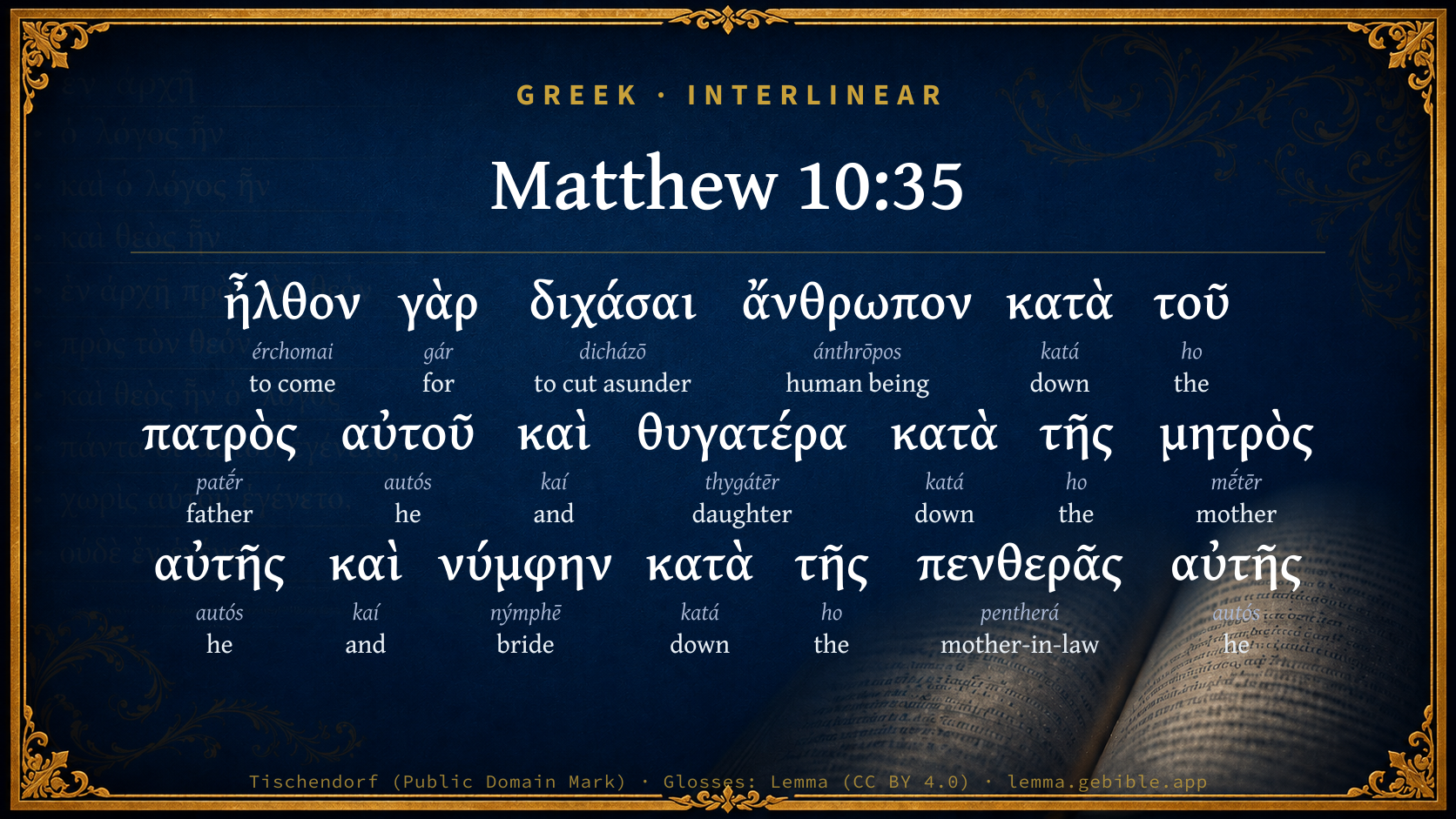
Greek (Tischendorf 8th ed.) Matthew 10:35 appears in the Greek New Testament. The text above is from the Tischendorf 8th edition. Each word links to its Strong’s number and a concise gloss. Click any word for its full Thayer’s Greek Lexicon entry.
Download image
Cite this verse

Matthew 10:35 (World English Bible). Public Domain. Lemma interlinear Bible study tool, https://lemma.gebible.app/v/matthew/10/35.

Show BibTeX & RIS
BibTeX
RIS
English Translation
For I came to set a man at odds against his father, and a daughter against her mother, and a daughter-in-law against her mother-in-law.
World English Bible · Public Domain
Highlights
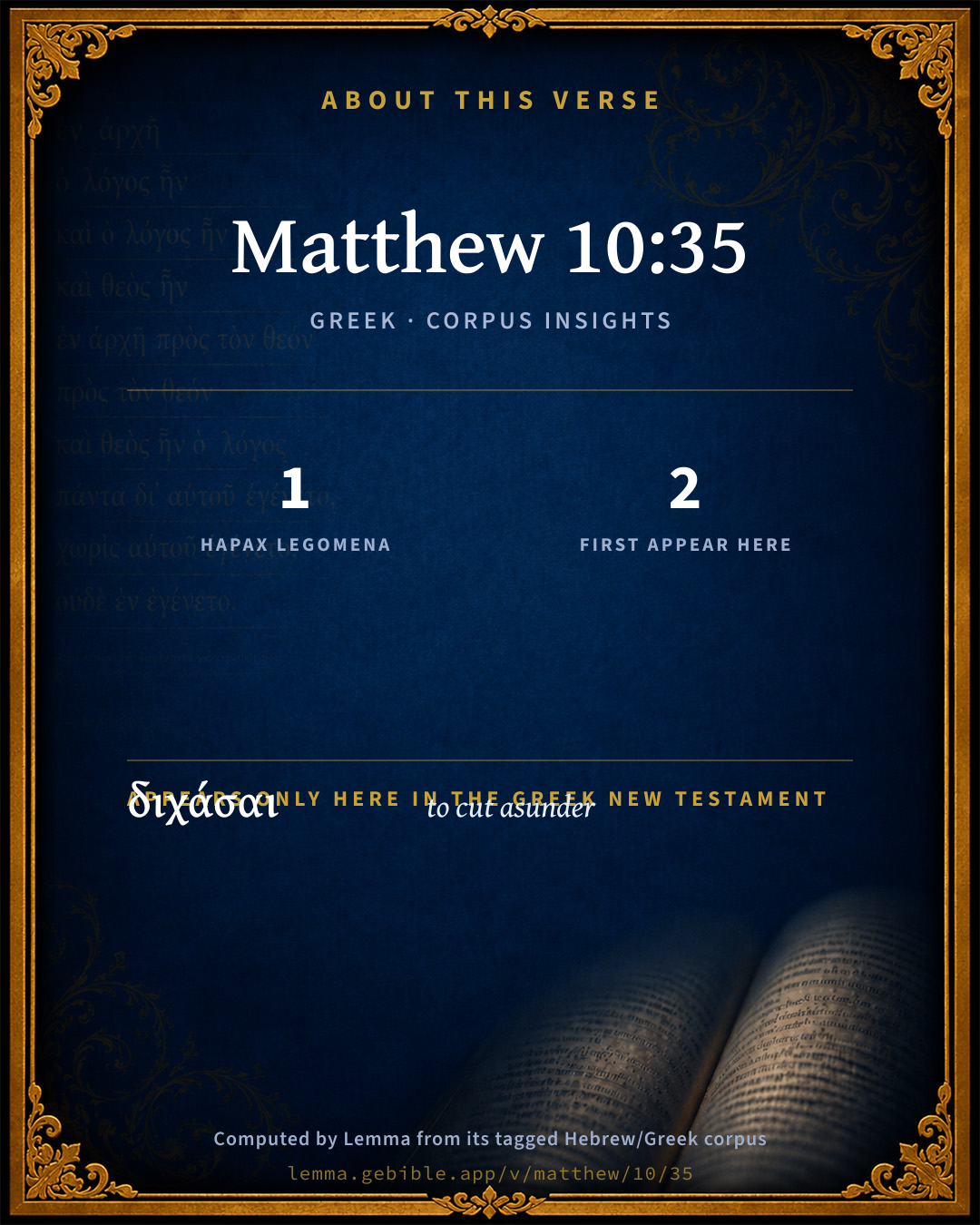
  • 1 hapax legomenon — only here in the Greek New Testament
  • 2 first appearances in the Greek New Testament
Full analysis ↓
Download a study sheet

One document with this verse’s original text, its word-by-word gloss line, the meaning frame, cross-references with their text, attributed commentary, and full source and license credits — printable, and it pastes into notes with its structure intact.

This verse Autodidact and up

Study sheet (.html) Plain text (.txt)

A passage Seminary Student

Up to 50 verses in one chapter. A passage sheet keeps up to 6 commentary sources and 12 cross-references per verse, in the order this page ranks them, and says so on the sheet whenever that leaves anything out. Ask for a single verse and you get the Autodidact verse sheet above.

Everything on this page stays free to read, with no account — the sheet is a download of what is already on screen, not access to it.

Want to remove ads? Support Godless Engineer
Compare translations 3

The same verse in 3 English versions, stacked beneath the original-language interlinear above. Click any original word for its lexicon entry.

Each is an independent rendering of the whole verse — the interlinear is not word-aligned to these translations.

Highlighted words mark where these versions differ — a whole-verse word diff, not a word-by-word alignment.

  • World English Bible Public Domain
    For I came to set a man at odds against his father, and a daughter against her mother, and a daughter-in-law against her mother-in-law.
  • King James Version Public Domain
    For I am come to set a man at variance against his father, and the daughter against her mother, and the daughter in law against her mother in law.
  • unfoldingWord Literal Text CC BY-SA 4.0
    For I came to set a man against his father, and a daughter against her mother, and a daughter-in-law against her mother-in-law;

unfoldingWord Literal Text — © unfoldingWord, licensed CC BY-SA 4.0. Word-aligned USFM3 via Door43 (git.door43.org/unfoldingWord/en_ult).

Versions to compare (up to 4)

3 of 4 selected

Show all 19 translations

Every available English version of this verse, each an independent rendering of the whole verse.

  • World English Bible Public Domain
    For I came to set a man at odds against his father, and a daughter against her mother, and a daughter-in-law against her mother-in-law.
  • Berean Standard Bible Public Domain
    For I have come to turn ‘a man against his father, a daughter against her mother, a daughter-in-law against her mother-in-law.
  • Majority Standard Bible Public Domain
    For I have come to turn ‘a man against his father, a daughter against her mother, a daughter-in-law against her mother-in-law.
  • King James Version Public Domain
    For I am come to set a man at variance against his father, and the daughter against her mother, and the daughter in law against her mother in law.
  • American Standard Version (1901) Public Domain
    For I came to set a man at variance against his father, and the daughter against her mother, and the daughter in law against her mother in law:
  • Revised Version (1885) Public Domain
    For I came to set a man at variance against his father, and the daughter against her mother, and the daughter in law against her mother in law:
  • Geneva Bible (1599) Public Domain
    For I am come to set a man at variance against his father, and the daughter against her mother, and the daughter in law against her mother in lawe.
  • Douay-Rheims (1899) Public Domain
    For I came to set a man at variance against his father, and the daughter against her mother, and the daughter in law against her mother in law.
  • Young's Literal Translation Public Domain
    for I came to set a man at variance against his father, and a daughter against her mother, and a daughter-in-law against her mother-in-law,
  • Literal Standard Version CC BY-SA 4.0
    for I came to set a man at variance against his father, and a daughter against her mother, and a daughter-in-law against her mother-in-law,
  • Unlocked Literal Bible CC BY-SA 4.0
    For I came to set a man against his father, and a daughter against her mother, and a daughter-in-law against her mother-in-law.
  • unfoldingWord Literal Text CC BY-SA 4.0
    For I came to set a man against his father, and a daughter against her mother, and a daughter-in-law against her mother-in-law;
  • Darby Bible Public Domain
    For I have come to set a man at variance with his father, and the daughter with her mother, and the daughter-in-law with her mother-in-law;
  • World Messianic Bible Public Domain
    For I came to set a man at odds against his father, and a daughter against her mother, and a daughter-in-law against her mother-in-law.
  • Webster's Bible Public Domain
    For I am come to set a man at variance against his father, and the daughter against her mother, and the daughter-in-law against her mother-in-law.
  • Free Bible Version CC BY-SA 4.0
    I've come ‘to turn a man against his father, a daughter against her mother, and a daughter-in-law against her mother-in-law.
  • Bible in Basic English Public Domain
    For I have come to put a man against his father, and the daughter against her mother, and the daughter-in-law against her mother-in-law:
  • Text-Critical English NT CC BY 4.0
    For I have come to set a man against his father, a daughter against her mother, and a daughter-in-law against her mother-in-law.
  • Tyndale New Testament (1534) Public Domain
    For I am come to set a man at varyaunce ageynst hys father and the doughter ageynst hyr mother and the doughterlawe ageynst her motherlawe:

Literal Standard Version (2020), Covenant Press — licensed CC BY-SA 4.0. Text via the HelloAO Bible API (eBible.org). Unlocked Literal Bible (unfoldingWord) — licensed CC BY-SA 4.0. Text via the HelloAO Bible API (eBible.org). unfoldingWord Literal Text — © unfoldingWord, licensed CC BY-SA 4.0. Word-aligned USFM3 via Door43 (git.door43.org/unfoldingWord/en_ult). Free Bible Version, Dr. Jonathan Gallagher — licensed CC BY-SA 4.0. Text via the HelloAO Bible API (eBible.org).

Word by word

More ways to search: Search by grammar → Find every occurrence → Compare this word →

Practice this passage: Drill this verse → Learn its vocabulary →

διχάσαι
dicházō
G1369
“to cut asunder”
Verb, Aorist, Active, Infinitive
Part of Speech
Verb
Tense
Aorist
Voice
Active
Mood
Infinitive
Full Thayer's Definition

Origin: from a derivative of G1364

TDNT: None

1. to cut into two parts, cleave asunder, sever
  1. ἦλθον érchomai G2064 “to come” Verb, Aorist, Active, Indicative, 1st person, Singular
  2. γὰρ gár G1063 “for” Conjunction
  3. ἄνθρωπον ánthrōpos G444 “human being” Noun, Accusative, Singular, Masculine
  4. κατὰ katá G2596 “down” Preposition
  5. τοῦ ho G3588 “the” Article, Genitive, Singular, Masculine
  6. πατρὸς patḗr G3962 “father” Noun, Genitive, Singular, Masculine
  7. αὐτοῦ autós G846 “he” Personal pronoun, Genitive, Singular, Masculine
  8. καὶ kaí G2532 “and” Conjunction
  9. θυγατέρα thygátēr G2364 “daughter” Noun, Accusative, Singular, Feminine
  10. κατὰ katá G2596 “down” Preposition
  11. τῆς ho G3588 “the” Article, Genitive, Singular, Feminine
  12. μητρὸς mḗtēr G3384 “mother” Noun, Genitive, Singular, Feminine
  13. αὐτῆς autós G846 “he” Personal pronoun, Genitive, Singular, Feminine
  14. καὶ kaí G2532 “and” Conjunction
  15. νύμφην nýmphē G3565 “bride” Noun, Accusative, Singular, Feminine
  16. κατὰ katá G2596 “down” Preposition
  17. τῆς ho G3588 “the” Article, Genitive, Singular, Feminine
  18. πενθερᾶς pentherá G3994 “mother-in-law” Noun, Genitive, Singular, Feminine
  19. αὐτῆς autós G846 “he” Personal pronoun, Genitive, Singular, Feminine

About this verse

These counts appear in no published source. They are computed here, from the morphology-tagged text and Lemma’s own curated glosses. What Lemma adds →

20
words
13
distinct lemmas
Gospels
section

Notable vocabulary

1 hapax legomenon — a word that appears only here in the entire Greek New Testament:

  • διχάσαι to cut asunder G1369

First appearance in Scripture

These words make their first canonical appearance in the Greek New Testament here:

  • διχάσαι to cut asunder G1369
  • νύμφην bride G3565

Shared distinctive vocabulary

πενθερᾶς mother-in-law G3994 occurs in 5 verses of the Greek New Testament. Also found in:
Repetition

Words recur within this verse:

  • κατὰ down G2596 ×3
  • τοῦ the G3588 ×3
  • αὐτοῦ he G846 ×3
  • καὶ and G2532 ×2

Cross-references

5

Topical passages linked to Matthew 10:35 in the Treasury of Scripture Knowledge — connected by theme and wording, ordered by reader-vote popularity; previews shown in the World English Bible.

  • Micah 7:5–6 Don't trust in a neighbor. Don't put confidence in a friend. With the woman lying in your embrace, Be careful of the words of your mouth!
  • Matthew 10:21 "Brother will deliver up brother to death, and the father his child. Children will rise up against parents, and cause them to be put to death.
  • Luke 21:16 You will be handed over even by parents, brothers, relatives, and friends. Some of you they will cause to be put to death.
  • Matthew 24:10 Then many will stumble, and will deliver up one another, and will hate one another.
  • Mark 13:12 "Brother will deliver up brother to death, and the father his child. Children will rise up against parents, and cause them to be put to death.

Cross-references courtesy of OpenBible.info (CC BY 4.0).

Commentary

Notes on Matthew 10:35 from classic Christian and Jewish commentators (each source and its license shown beneath its notes). The classic Christian expositions comment on the surrounding passage and are grouped to its opening verse, so a note may address several verses; the Jewish commentaries on the Tanakh (Rashi and others) are per-verse, so they appear only where the commentator wrote on this verse.

Lemma curates 59 commentaries, every one of them public domain or Creative Commons licensed, each selected and text-cleaned for this edition rather than reprinted as found. About our sources →

The Biblical Illustrator

Joseph S. Exell

Mat_10:35

To set a man at variance against his Father.

The year separation.

I. That union of families in religion is desirable. Because all its members have the same interests at stake; they are all under substantially the same obligations; it promotes the happiness of a family, gives consolation in times of affliction, promotes the eternal welfare of all.

II. That religion does, in fact, make a separation in families, It divides families at the Communion table; in respect of their prospects of future glory, and at the judgment-bar with unerring accuracy. Lessons: Pray more for impenitent children, &c.; contemplate the possibility of a family being united in heaven. (Dr. A. Barites.)

Those who are most near, are most easily divided. (Bengel.)

Children and parents

There is a climax of three degrees. Brother shall be against brother, parent against child, child against parents-each worse than the preceding. The history of the Church has many illustrations of this. Such were the histories of Perpetua and Felicitas, in the persecution of Severus, where the children refused to listen to parents entreaties to give up Christ, and died in their steadfastness; and such was the dreadful speech recorded of Philip II. of Spain, who thought that he was showing zeal for God by declaring of the Protestants, If it were my own son, I would bring the faggot. (W. Benham.)

Domestic variance occasioned by religion

Too often is this prediction fulfilled in the case of converts (especially those from Judaism) even at the present day-the most devoted son or daughter has too often to feel that their adopting Christianity has severed them from beloved parents. The Rev. Moses Margdionth, in a narrative drawn up in the year 1842, illustrates this by his own experience. Mr. Margdionth had been led, by a remarkable chain of circumstances, to embrace Christianity. He was a native of Poland, but did not receive baptism until his arrival in London, having left his country for the purpose of study, and more especially of acquiring religious knowledge. He felt it his duty as soon as possible to acquaint his parents with his change of faith, and his father at first wrote him an affectionate answer, entreating him to come home and recant his apostacy, but finding that nothing would induce him to renounce Christianity and return to his house, ceased to answer his letters, and for a long time seemed to ignore his existence. Still, however, Margdionth persevered in writing, and at length, to use his own words-I received a most severe letter from my father, telling me that if I did not return immediately to his house, I should never be permitted to call myself his son: that he should hate me with perfect hatred, and that he should prohibit my writing to him any more. My dear mother wrote again with affectionate sadness, telling me that she had not ceased to weep for me, and had even injured her eyes with weeping. It is consolatory to find that Mr. Margdionth, who spared no effort or exertion to win hack the heart of his father, was rewarded at length by a complete reconciliation, though we have no ground to believe that his parents ever embraced Christianity. Yet sadder tales meet us in the annals of missions among the heathen. Harriet Winslow, the devoted American missionary in Ceylon, mentions the very sad case of a youth named Tupyen, who had become interested in Christianity by reading part of a Tamil Bible, lent him by another young man. He begged permission to attend the mission school at Tillipally, but when it came to his fathers knowledge that he had there avowed himself a Christian, the poor fellow was, when he next returned home, shut up, and otherwise most severely treated. Once he made his escape to Tillipally, and there told the missionary, Mr. Peel, what had befallen him. He took a Testament, and pointing to this very passage (Mat_10:31-39), said, with tears-That very good. But again falling into the hands of his father, Tupyen was beaten, tabooed, threatened, insulted in every possible way, so that at length, alas, he signed a recantation of Christianity.

Social obstacles to religion

I. The reasons why men labour to prevent their fellows from rising to a vital Christian experience.

1. We are to remember that social life is not merely the accidental juxtaposition of man with man; it organizes itself. Men stand related to each other in such a way that if one goes out of the circle, it is like the going of one out from a quartette of singers.

2. It is frequently the case that the escape of one from a circle towards a true and high religious life, is hindered on account of the social ambitions which prevail. Circles defend themselves against men going to desert for religion.

3. Another reason why persons endeavour to prevent the escape of men to a higher religious plane, is the judgment and rebuke which is always reflected, by such a course, upon their own career.

II. What the motives are by which this social hindrance works.

1. There is the battle of fear into which men go.

2. Next is the battle of interest. Men try to dissuade their fellow-men from true religion on account of the effects which it will have upon their interests in life.

3. Then there are persons who are peculiarly sensitive to praise. They cannot bear the shady side of mens opinions. A circle, by a judicious silence, can make a man feel as though the fogs of Newfoundland were on him.

4. Then there is the battle of dissuasion.

III. The modes of resistance that one may lawfully set up against these things.

1. It should be made clear that you are in earnest and sincere.

2. That that which is upon you is not a mere whim.

3. Remember that you need and shall have the help of God. (H. W. Beecher.)

The souls longing for God not hindered by social obstacles

As birds, when their time of emigration comes, and they feel the impulse to fly to the summer-land, and will not be stopped, either by the snap of the fowlers gun or by the sweep of the hawk, or by any solicitation, but rise, and fly through night and through day, to find that summer-land: so souls feel the fascinating call of God, and, rising, soar-and must, because the Holy Ghost is upon them. (H. W. Beecher.)

Society troubled by men leafing it for a better life

The smallest wheel in my watch, emigrating, would leave all the rest of the wheels, big and little, in a very sorry plight. Although it may be very small, and stand on its own rights as a wheel, yet, after all, it has been cogged, and notched, and adjusted, so that the whole structure depends on that. You might as well smash the watch as to take that out. Frequently it is the case that the members of a circle are so affiliated, so exactly fitted to each other, that if you take one out, all the rest are dissevered. And it is not surprising, it does not imply any great degree of depravity, to say that where a number of men are living an ordinary, an average, social life, and one of them is inspired with a higher, a holier religious purpose, and desires and means to go up on a level that none of them have been standing on, his emigration upward wrenches them all. And it is not strange that they try to stop it. (H. W. Beecher.)

Unrest a vital process

The unrest of a Christless soul, a Christless nation, a Christless world, is really the beginning of a vital process, which in its first stages is always a travail. The Lord is not afraid of the storm of strife and frenzy which He stirs in the world. We think that these are death pains; He knows that they are birth pains, through which the glorious golden future is being born. (J. B. Brown, B. A.)

A boys foes at school

When a boy first comes from home, full of the natural desire of doing his duty, of improving himself, of getting on well, he is presently beset by the ridicule of all the worthless and foolish boys around him, who want to sink him to their own level. How completely true it is that his foes are they of his own household-that is, they who are most immediately about him, those of his own age, and his own place in the school. They become his idol; before their most foolish, most low, and most wicked voices he gives up his affections, his understanding, and his conscience; from this mass of ignorance, and falsehood, and selfishness, he looks for the guide of his opinions and his conduct. (T. Arnold, D. D.)

The Biblical Illustrator, edited by Joseph S. Exell (c. 1880s–1900s) — public domain. Text from a community e-Sword module.

Bengel's Gnomon

Johann Albrecht Bengel

Mat 10:35. Διχάσαι, to separate) A necessary consequence of what precedes.—ἄνθρωπον, a man) sc. a son who loves Me: see Mat 10:37.—κατὰ, against) In this passage those are put in opposition, who are otherwise naturally most attached, to each other.

Bengel's Gnomon of the New Testament — English translation (T&T Clark, Edinburgh, 1860) — public domain. Text from a community e-Sword module.

Meyer's Critical & Exegetical Commentary

Heinrich August Wilhelm Meyer

Mat_10:35-36. Comp. Mat_10:21. Involuntary recollection of Mic_7:6. Comp. also Sota xlix. 2, in Schoettgen.

ἦλθον γάρ] solemn repetition.

διχάσαι] to separate (Plat. Polit. p. 264 D), i.e. to place a man in that attitude of party hostility (διχοστασία) toward his father which results in their separation, and so on.

νύμφη: young wife (common in classical writers), specially in the sense of daughter-in-law (in the LXX.).

καὶ ἐχθροὶ, κ.τ.λ.] imminent, as if already present: and a mans enemies (are) the members of his own family! ἐχθροί is a predicate.

Meyer — Critical and Exegetical Commentary on the New Testament — English translation by Peter Christie, edited by Frederick Crombie (T&T Clark, 1880) — public domain. Text from a community e-Sword module.

Expositor's Greek Testament

ed. W. Robertson Nicoll

Mat 10:35 . escription of the discord. διχάσαι , to divide in two ( δίχα ), to separate in feeling and interest, here only in N.T.; verifies the truth of Grotius’ comment as to the “sword”. ἄνθρωπον κατὰ τοῦ πατρὸς αὐτοῦ . In this and the following clauses it is the young that are set against the old . “In all great revolutions of thought the change begins from the young” (Carr, Cambridge Gr. T.). νύμφην , a young wife, here as opposed to πενθερᾶς , a daughter-in-law.

The Expositor's Greek Testament, edited by W. Robertson Nicoll (1897–1910) — public domain. Text from a community e-Sword module.

Jamieson, Fausset & Brown

Robert Jamieson, A. R. Fausset & David Brown

For I am come to set a man at variance against his father, and the daughter against her mother, and the daughter-in-law against her mother-in-law--(See on Luk 12:51).

Jamieson, Fausset & Brown — Commentary Critical and Explanatory on the Whole Bible (1871) — public domain (CC PDM 1.0). Text via the HelloAO Bible API.

Adam Clarke's Commentary

Verse 35. I am come to set a man at variance] The spirit of Christ can have no union with the spirit of the world. Even a father, while unconverted, will oppose a godly child. Thus the spirit that is in those who sin against God is opposed to that spirit which is in the followers of the Most High. It is the spirits then that are in opposition, and not the persons.

Adam Clarke's Commentary on the Bible (1810–1826) — public domain. Text from a community e-Sword/MySword module.

Ellicott's Commentary for English Readers

(35) The words are partly, as the marginal reference shows, an echo of Mic_7:6, but the selection of the special relationships as typical instances suggests the thought of some personal application. Had Zebedee looked with displeasure on the calling of his two sons? or was there variance between the daughter-in-law and the mother-in-law in the household of Peter? Were the brethren of the Lord, who as yet believed not, as the foes of a man’s own household?

A Bible Commentary for English Readers, edited by Charles John Ellicott (1878–1897) — public domain. Text from a community e-Sword module.

The Cambridge Bible for Schools and Colleges

gen. ed. J. J. S. Perowne

35. to set … at variance] The Greek word occurs here only in the New Testament, and is rare elsewhere. The root is the same as that of the word translated to “cut asunder.” The word is used by Plato of a scientific distinction. Here the thought of the dividing sword is carried on. Comp. Mic_7:6, where see Dr Pusey’s note, who quotes Tertullian to shew how true Christ’s words proved in the second century.

The Cambridge Bible for Schools and Colleges (gen. ed. J. J. S. Perowne; Cambridge University Press, 1878–1918) — public domain. Text from a community e-Sword module.

John Gill's Exposition

And a man's foes shall be they of his own household. His children, and his servants, such that he has either begotten and brought up, or are daily fed at his table, and maintained by him. This, with the former instances, are borrowed from Mic 7:6 and the times of the Gospel are set forth in the same dismal and black characters, as those in which the prophet lived; and much such a description do the Jews themselves give, of the times of their expected Messiah; which agreeing in words, as well as things, I cannot forbear transcribing.

"The government shall be turned to heresy (Sadducism), and there will be no reproof; the synagogue shall become a brothel house, Galilee shall be destroyed, and Gablan shall be laid waste, and the men of the border shall wander from city to city, and shall obtain no mercy; the wisdom of the Scribes shall stink, and they that fear to sin shall be despised, and truth shall fail; young men shall turn pale, or put to shame, the faces of old men, and old men shall stand before young men; the "son" shall deal basely "with his father, the daughter shall rise up against her mother, and the daughter-in-law against her mother-in-law, and the enemies of a man shall be they of his own house": the face of that generation shall be as the face of a dog, and the son shall not reverence his father (o).''

All which characters, how exactly they agree with the generation in which Christ lived, is easy to observe.

(o) Misn. Sota, c. 9. sect. 15. T. Bab. Sanhedrim, fol. 97. 1. Zohar in Num. fol. 102. 3. & Raya Mehimna in ib. in Lev. fol. 28. 2. Shirhashirim Rabba, fol. 11. 4. Derech Eretz Zuta, fol. 19. 4.

John Gill's Exposition of the Whole Bible (1746–1763) — public domain (CC PDM 1.0). Text via the HelloAO Bible API.

Trapp's Complete Commentary

John Trapp

35 For I am come to set a man at variance against his father, and the daughter against her mother, and the daughter in law against her mother in law.

Ver. 35. For I am come to set a man at variance, &c.] By accident it happened so, through men’s singular corruption, causing them as bats to fly against the light of the gospel, to hate it as thieves do a torch in the night; or as the panther, which so hates man, that he tears his picture wherever he finds it.

John Trapp, A Commentary or Exposition upon All the Books of the Old and New Testament (1647–1656) — public domain. Text from a community e-Sword module.

Haydock's Catholic Bible Commentary

I am come to set a man at variance, &c. Not that this was the end or design of the coming of our Saviour; but that his coming, and his doctrine would have this effect, by reason of the obstinate resistance that many would make, and of their persecuting all such as should adhere to him. (Challoner) --- Not that Christ came for this end, to cause divisions between father and son, &c. On the contrary, the Scriptures teach us to love every one without exception, and especially our kindred; but this is to shew, and foretell what would happen in the same families, when some of them were Christians. We have divers instances of the truth of this in the Lives of the Saints. (Witham) --- No one can he connected with the earth and joined to heaven. Those who wish to enjoy the peace of heaven, must not be united to the lovers of this world by any connection. (Baradius)

George Leo Haydock (1774–1849), Haydock's Catholic Family Bible and Commentary, 1859 edition — public domain. Excludes Psalms (Douay-Rheims chapter numbering differs from Protestant) and Deuterocanonical books (Catholic canon only).

Whedon's Commentary on the Bible

Daniel D. Whedon

35. I am come to set a man at variance against his father — So God set faithful Abraham at variance against his father, the idolatrous Terah. So religion sets the pious child in opposition to the impious parent. So temperance sets the sober child at variance with the drunken father. For the right, the pure, the good are at variance with the wrong, the defiled, the bad. Light is as much opposed to darkness, as darkness is to light. Truth would annihilate error, and holiness hates sin. The daughter against her mother — The Christianized daughter shall abhor the lusts and licentiousness of her heathen mother. The converted mother shall turn with horror from the impurity of her heathen daughter. The daughter-in-law — The ties of marriage are often dearer than the ties of consanguinity. Yet even these must yield to higher claims and the ties of God and truth, higher than any ties of man to man.

Daniel D. Whedon (gen. ed.), Commentary on the Old and New Testaments (1874–1909) — public domain. Text from a community e-Sword module.

The Pulpit Commentary

Parallel passage: Luk_12:53 (cf. supra, vers. 21, 22). For I am come; I came (Revised Version). Notice the threefold hlyon . Christ would leave in his hearers" minds no room for thinking that he was ignorant of what the immediate result of his coming would be. To. A mere infinitive, not even with tou , much less ina with subject. The result is not in any sense the final cause of his coming. Set a man at variance against (dicasai ... kata). By the preposition is implied enmity, by the verb complete severance. For relation to God is the great line of cleavage, and that not only in God"s sight, but in outcome of character. His father. From this word till the end of ver. 36 our Lord adopts Micah"s (Mic_7:6) description of a general time of distrust for his own picture of the discord introduced by his coming. The wording is hardly taken from the LXX

The Pulpit Commentary (1880–1919), ed. H.D.M. Spence-Jones & Joseph S. Exell — public domain. Text from a community e-Sword module.

The People's New Testament

B. W. Johnson

35. For I come to set a man at variance with his father. This was not the Savior's object, but the effect. The conversion of individual members of the family would cause variance. In nearly all quarrels, except those about religion, the members of the same family stand together, but in religious feuds the family circle is often broken and its parts arrayed against each other.

B. W. Johnson's The People's New Testament with Notes (1889–1891) — public domain. Electronic text from the Christian Classics Ethereal Library (CCEL) ThML edition.

Cambridge Greek Testament for Schools and Colleges

35. διχάσαι. ἅπαξ λεγ. in N.T. carries on the idea of separation involved in μάχαιρα, for which Luke in parallel passage Luk 12:52 has διαμερισμόν.

Cambridge Greek Testament for Schools and Colleges (Cambridge University Press, 1896; 21 vols, various authors incl. Carr, Maclear, Plummer, Farrar, Lumby, Moule, M. R. James, Simcox) — public domain. Text from a community e-Sword module.

International Critical Commentary

35. For I came to divide a man against his father, and a daughter against her mother, and a bride against her mother-in-law.] Luk 12:52, Luk 12:53 has a similar thought in different words.

Cf. B. Sanhed. 97a “In the period when the Son of David shall come, a daughter will rise up against her mother, a daughter-in-law against her mother-in-law.” For similar formulas in Babylonian Inscriptions, cf. Jeremias, Babylonisches im NT, p. 97.

Cf. also Sotah 49a b “The son despises the father, the daughter rebels against the mother, the daughter-in-law against the mother-in-law, and a man’s enemies are they of his own household.”

International Critical Commentary — older volumes (1896–1929), various authors — public domain. Text from a community e-Sword module.

Vincent's Word Studies in the New Testament

Marvin R. Vincent

Set at variance [διχασαι] . Lit., part asunder. Wyc., to depart = part.

Daughter - in - law [νυμφην] . So. A. V. and Rev.; but the full force is lost in this rendering. The word means bride, and though sometimes used in classical Greek of any married woman, it carries a notion of comparative youth. Thus in Homer, "Odyssey," 4 743, the aged nurse, Euryclea, addresses Penelope (certainly not a bride) as numfa filh (dear bride), of course as a term of affection or petting. Compare "Iliad," 3 130, where Iris addressed Helen in the same way. The radical and bitter character of the division brought into households by the Gospel is shown by the fact of its affecting domestic relations in their very freshness. They newly - married wife shall be set at variance with her mother - in - law. Wycliffe's rendering is peculiar : And the son's wife against the wife 's or husband 's mother.

Marvin R. Vincent, Word Studies in the New Testament (1887–1900) — public domain. Text from a community e-Sword/MySword module.

Lesson kit

Teaching starters — assembled from the data on this page, not authored interpretation. Every prompt links to the verse data it draws on. Edit before teaching.

Matthew, in the Gospels, opens this verse with 20 words (13 distinct Greek lemmas). Its most distinctive word is dicházō (“to cut asunder”). A historical commentator’s framing appears above. Read the whole chapter for the surrounding context.

Discussion questions

  1. The word dicházō carries the sense “to cut asunder.” How does it shape the verse?
  2. 1 word here appears nowhere else in the Greek New Testament. Why might the author reach for such rare wording?
  3. 2 words make their first appearance in Scripture here. What does this debut establish?
  4. How does Matthew 8:14, which shares the word «mother-in-law», read alongside this verse?
  5. What does the repetition of “down” (3× in this one verse) do in this verse?
  6. The translations on this page render this verse differently — a whole-verse word diff, not a word-by-word alignment. What might account for the different wordings?
  7. Compare how The Biblical Illustrator and Bengel's Gnomon read this verse. Where do they agree or differ?

Things to notice

  • 1 word in this verse appears nowhere else in the Greek New Testament.
  • 2 words make their first canonical appearance in Scripture here.
  • These translations choose different wording for 8 words in this verse.
  • “down” occurs 3× in this single verse.
  • 13 distinct Greek lemmas span 20 words in this verse.

Reading settings

Reading text

Shown beneath each verse's original-language words.

Old Testament
Old Testament edition

Read the OT as the Masoretic Hebrew (MT) or the Greek Septuagint (LXX).

English shown for the Greek Septuagint (in the Hebrew ↔ Greek comparison).

Comparing translations? Open the Compare panel on any verse page to stack up to four side by side.