
John 7:22

Greek (Tischendorf 8th ed.) John 7:22 appears in the Greek New Testament. The text above is from the Tischendorf 8th edition. Each word links to its Strong’s number and a concise gloss. Click any word for its full Thayer’s Greek Lexicon entry.
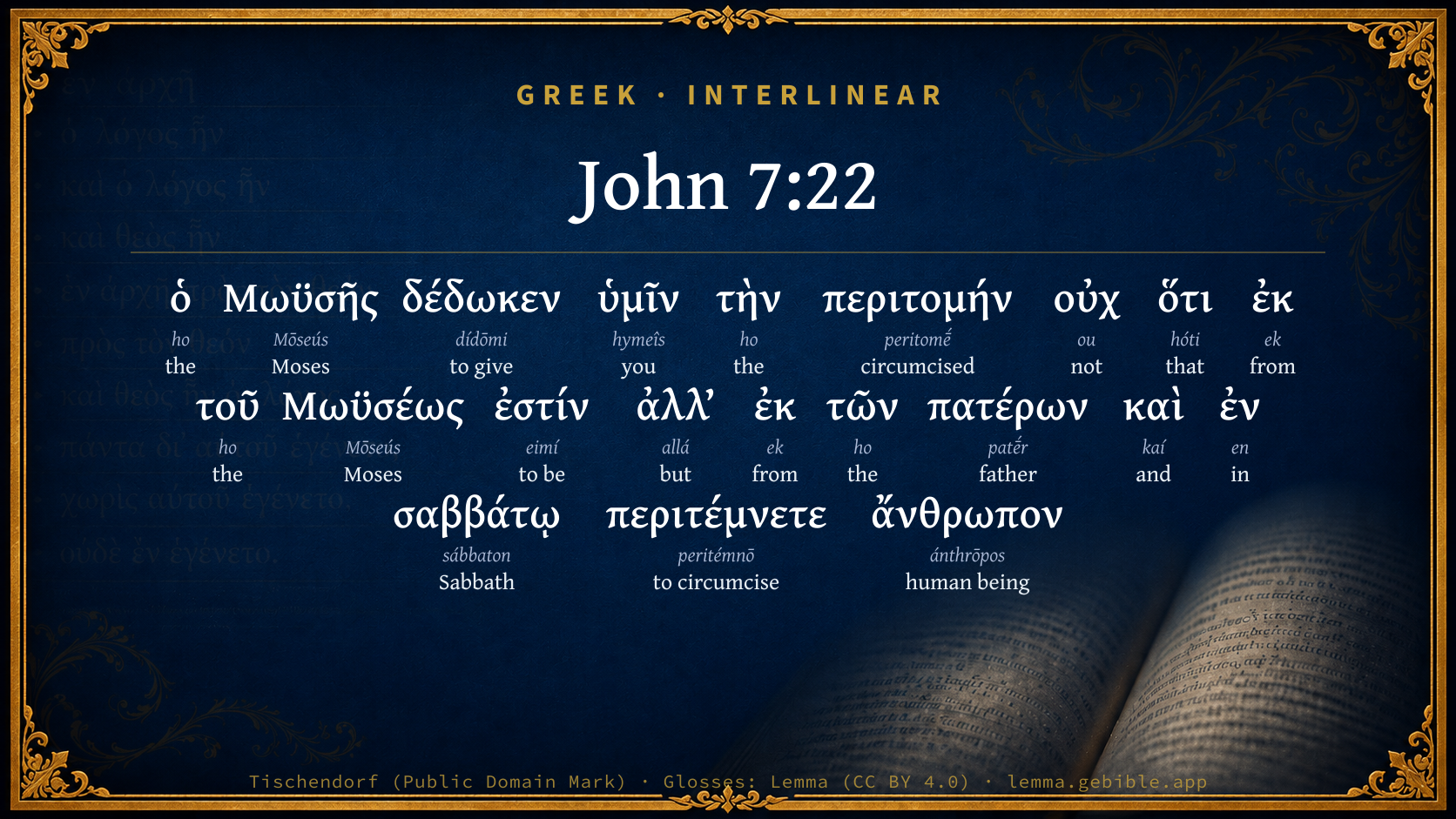
Download image
Cite this verse

John 7:22 (World English Bible). Public Domain. Lemma interlinear Bible study tool, https://lemma.gebible.app/v/john/7/22.

Show BibTeX & RIS
BibTeX
RIS
English Translation
Moses has given you circumcision (not that it is of Moses, but of the fathers), and on the Sabbath you circumcise a boy.
World English Bible · Public Domain
Highlights
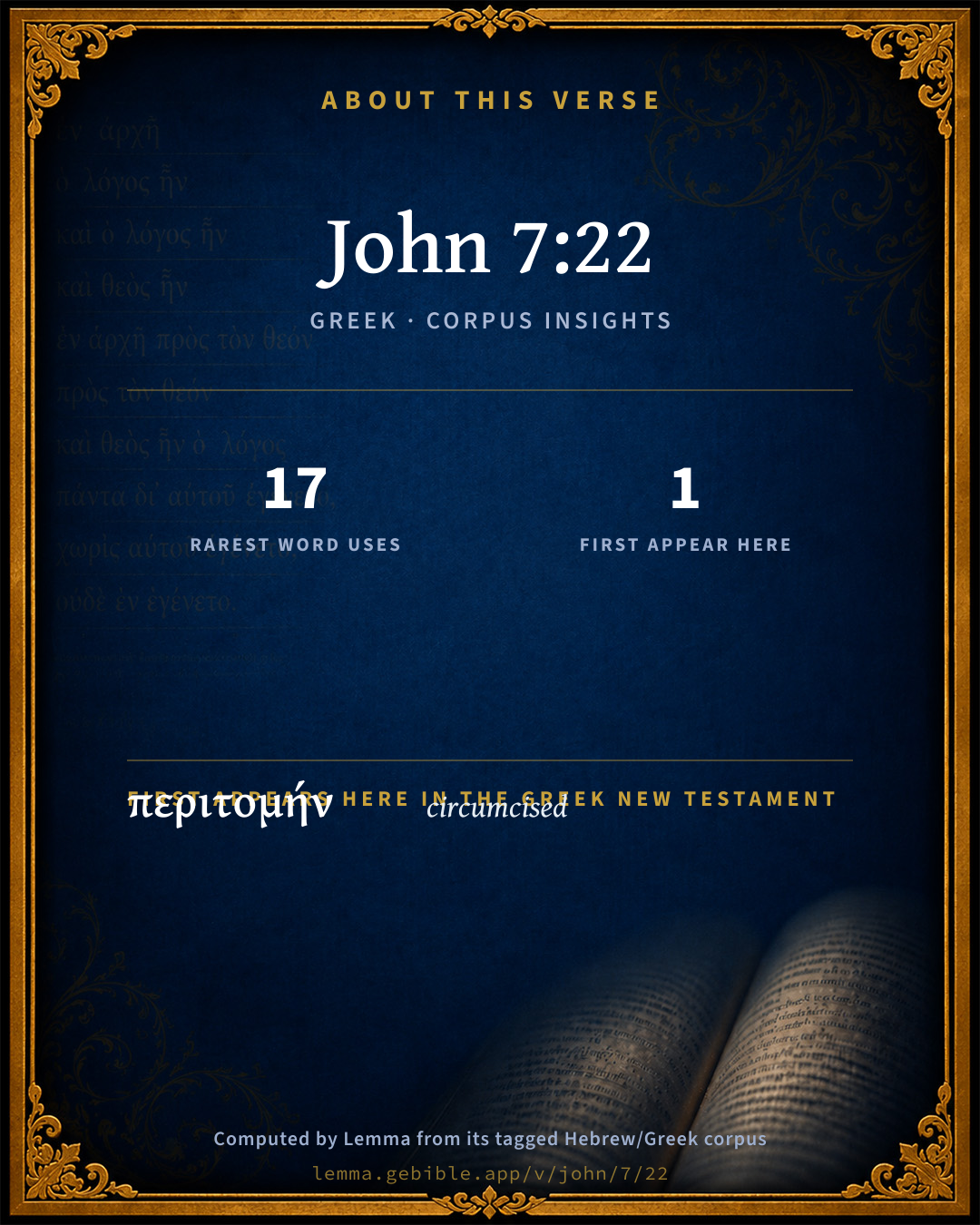
  • 1 first appearance in the Greek New Testament
Full analysis ↓
Download a study sheet

One document with this verse’s original text, its word-by-word gloss line, the meaning frame, cross-references with their text, attributed commentary, and full source and license credits — printable, and it pastes into notes with its structure intact.

This verse Autodidact and up

Study sheet (.html) Plain text (.txt)

A passage Seminary Student

Up to 50 verses in one chapter. A passage sheet keeps up to 6 commentary sources and 12 cross-references per verse, in the order this page ranks them, and says so on the sheet whenever that leaves anything out. Ask for a single verse and you get the Autodidact verse sheet above.

Everything on this page stays free to read, with no account — the sheet is a download of what is already on screen, not access to it.

Want to remove ads? Support Godless Engineer
Compare translations 3

The same verse in 3 English versions, stacked beneath the original-language interlinear above. Click any original word for its lexicon entry.

Each is an independent rendering of the whole verse — the interlinear is not word-aligned to these translations.

Highlighted words mark where these versions differ — a whole-verse word diff, not a word-by-word alignment.

  • World English Bible Public Domain
    Moses has given you circumcision (not that it is of Moses, but of the fathers), and on the Sabbath you circumcise a boy.
  • King James Version Public Domain
    Moses therefore gave unto you circumcision; (not because it is of Moses, but of the fathers;) and ye on the sabbath day circumcise a man.
  • unfoldingWord Literal Text CC BY-SA 4.0
    Because of this, Moses has given you circumcision (not that it is from Moses, but from the fathers), and on the Sabbath you circumcise a man.

unfoldingWord Literal Text — © unfoldingWord, licensed CC BY-SA 4.0. Word-aligned USFM3 via Door43 (git.door43.org/unfoldingWord/en_ult).

Versions to compare (up to 4)

3 of 4 selected

Show all 19 translations

Every available English version of this verse, each an independent rendering of the whole verse.

  • World English Bible Public Domain
    Moses has given you circumcision (not that it is of Moses, but of the fathers), and on the Sabbath you circumcise a boy.
  • Berean Standard Bible Public Domain
    But because Moses gave you circumcision, you circumcise a boy on the Sabbath (not that it is from Moses, but from the patriarchs.)
  • Majority Standard Bible Public Domain
    But because Moses gave you circumcision, you circumcise a boy on the Sabbath (not that it is from Moses, but from the patriarchs.)
  • King James Version Public Domain
    Moses therefore gave unto you circumcision; (not because it is of Moses, but of the fathers;) and ye on the sabbath day circumcise a man.
  • American Standard Version (1901) Public Domain
    Moses hath given you circumcision (not that it is of Moses, but of the fathers); and on the sabbath ye circumcise a man.
  • Revised Version (1885) Public Domain
    For this cause hath Moses given you circumcision (not that it is of Moses, but of the fathers); and on the sabbath ye circumcise a man.
  • Geneva Bible (1599) Public Domain
    Moses therefore gaue vnto you circumcision, (not because it is of Moses, but of the fathers) and ye on the Sabbath day circumcise a man.
  • Douay-Rheims (1899) Public Domain
    Therefore, Moses gave you circumcision (not because it is of Moses, but of the fathers;) and on the sabbath day you circumcise a man.
  • Young's Literal Translation Public Domain
    because of this, Moses hath given you the circumcision -- not that it is of Moses, but of the fathers -- and on a sabbath ye circumcise a man;
  • Literal Standard Version CC BY-SA 4.0
    because of this, Moses has given you the circumcision—not that it is of Moses, but of the fathers—and on a Sabbath you circumcise a man;
  • Unlocked Literal Bible CC BY-SA 4.0
    Moses gave you circumcision (not that it is from Moses, but from the ancestors), and on the Sabbath you circumcise a man.
  • unfoldingWord Literal Text CC BY-SA 4.0
    Because of this, Moses has given you circumcision (not that it is from Moses, but from the fathers), and on the Sabbath you circumcise a man.
  • Darby Bible Public Domain
    Therefore Moses gave you circumcision (not that it is of Moses, but of the fathers), and ye circumcise a man on sabbath.
  • World Messianic Bible Public Domain
    Moses has given you circumcision (not that it is of Moses, but of the fathers), and on the Sabbath you circumcise a boy.
  • Webster's Bible Public Domain
    Moses therefore gave to you circumcision, (not because it is from Moses, but from the fathers) and ye on the sabbath circumcise a man.
  • Free Bible Version CC BY-SA 4.0
    “However, because Moses told you to circumcise—not that it really came from Moses, but from your forefathers before him—you perform circumcision on the Sabbath.
  • Bible in Basic English Public Domain
    Moses gave you circumcision--not that it comes from Moses, but from the fathers--and even on the Sabbath you give a child circumcision.
  • Text-Critical English NT CC BY 4.0
    Moses gave you circumcision (not that it came from Moses, but from the fathers), and that is why you circumcise a boy even on the Sabbath.
  • Tyndale New Testament (1534) Public Domain
    Moses therfore gave vnto you circumcision: not because it is of Moses but of the fathers. And yet ye on the Saboth daye circumcise a man.

Literal Standard Version (2020), Covenant Press — licensed CC BY-SA 4.0. Text via the HelloAO Bible API (eBible.org). Unlocked Literal Bible (unfoldingWord) — licensed CC BY-SA 4.0. Text via the HelloAO Bible API (eBible.org). unfoldingWord Literal Text — © unfoldingWord, licensed CC BY-SA 4.0. Word-aligned USFM3 via Door43 (git.door43.org/unfoldingWord/en_ult). Free Bible Version, Dr. Jonathan Gallagher — licensed CC BY-SA 4.0. Text via the HelloAO Bible API (eBible.org).

Word by word

More ways to search: Search by grammar → Find every occurrence → Compare this word →

Practice this passage: Drill this verse → Learn its vocabulary →

περιτέμνετε
peritémnō
G4059
“to circumcise”
Verb, Present, Active, Indicative, 2nd person, Plural
Part of Speech
Verb
Tense
Present
Voice
Active
Mood
Indicative
Person
2nd person
Number
Plural
Full Thayer's Definition

Origin: from G4012 and the base of G5114

TDNT: 07:12,8

1. to cut around 2. to circumcise a. cut off one's prepuce (used of that well known rite by which not only the male children of the Israelites, on the eighth day after birth, but subsequently also "proselytes of righteousness" were consecrated to Jehovah and introduced into the number of his people) b. to get one's self circumcised, present one's self to be circumcised, receive circumcision c. since by the rite of circumcision a man was separated from the unclean world and dedicated to God, the word is transferred to denote the extinguishing of lusts and the removal of sins
  1. ὁ ho G3588 “the” Article, Nominative, Singular, Masculine
  2. Μωϋσῆς Mōseús G3475 “Moses” Noun, Nominative, Singular, Masculine
  3. δέδωκεν dídōmi G1325 “to give” Verb, Perfect, Active, Indicative, 3rd person, Singular
  4. ὑμῖν hymeîs G5210 “you” Personal pronoun, 2nd person, Dative, Plural
  5. τὴν ho G3588 “the” Article, Accusative, Singular, Feminine
  6. περιτομήν peritomḗ G4061 “circumcised” Noun, Accusative, Singular, Feminine
  7. οὐχ ou G3756 “not” Particle, Negative
  8. ὅτι hóti G3754 “that” Conjunction
  9. ἐκ ek G1537 “from” Preposition
  10. τοῦ ho G3588 “the” Article, Genitive, Singular, Masculine
  11. Μωϋσέως Mōseús G3475 “Moses” Noun, Genitive, Singular, Masculine
  12. ἐστίν eimí G1510 “to be” Verb, Present, Active, Indicative, 3rd person, Singular
  13. ἀλλ’ allá G235 “but” Conjunction
  14. ἐκ ek G1537 “from” Preposition
  15. τῶν ho G3588 “the” Article, Genitive, Plural, Masculine
  16. πατέρων patḗr G3962 “father” Noun, Genitive, Plural, Masculine
  17. καὶ kaí G2532 “and” Conjunction
  18. ἐν en G1722 “in” Preposition
  19. σαββάτῳ sábbaton G4521 “Sabbath” Noun, Dative, Singular, Neuter
  20. ἄνθρωπον ánthrōpos G444 “human being” Noun, Accusative, Singular, Masculine

About this verse

These counts appear in no published source. They are computed here, from the morphology-tagged text and Lemma’s own curated glosses. What Lemma adds →

21
words
16
distinct lemmas
Gospels
section

Notable vocabulary

The rarest word here is περιτέμνετε to circumcise G4059 — appearing just 17 times in the whole Greek New Testament.

First appearance in Scripture

This word makes its first canonical appearance in the Greek New Testament here:

  • περιτομήν circumcised G4061

Shared distinctive vocabulary

περιτέμνετε to circumcise G4059 occurs in 15 verses of the Greek New Testament. Also found in:
Repetition

Words recur within this verse:

Cross-references

4

Topical passages linked to John 7:22 in the Treasury of Scripture Knowledge — connected by theme and wording, ordered by reader-vote popularity; previews shown in the World English Bible.

  • Leviticus 12:3 In the eighth day the flesh of his foreskin shall be circumcised.
  • Genesis 17:10–14 This is my covenant, which you shall keep, between me and you and your seed after you. Every male among you shall be circumcised.
  • Romans 4:9–11 Is this blessing then pronounced on the circumcised, or on the uncircumcised also? For we say that faith was accounted to Abraham for righteousness.
  • Galatians 3:17 Now I say this. A covenant confirmed beforehand by God in Christ, the law, which came four hundred thirty years after, does not annul, so as to make the promise of no effect.

Cross-references courtesy of OpenBible.info (CC BY 4.0).

Commentary

Notes on John 7:22 from classic Christian and Jewish commentators (each source and its license shown beneath its notes). The classic Christian expositions comment on the surrounding passage and are grouped to its opening verse, so a note may address several verses; the Jewish commentaries on the Tanakh (Rashi and others) are per-verse, so they appear only where the commentator wrote on this verse.

Lemma curates 59 commentaries, every one of them public domain or Creative Commons licensed, each selected and text-cleaned for this edition rather than reprinted as found. About our sources →

Tyndale Open Study Notes

Tyndale Open Resources

7:22 The law required circumcision on the eighth day (Lev 12:3) and permitted a boy to be circumcised even if that day fell on the Sabbath. Jesus argued as a rabbi would, from “the lesser to the greater,” using circumcision as a precedent for healing, both of which are religious works.

Tyndale Open Study Notes — © Tyndale Open Resources, licensed CC BY-SA 4.0. Text via the HelloAO Bible API.

Bengel's Gnomon

Johann Albrecht Bengel

Joh 7:22. Διὰ τοῦτο, on this account) This is presently after explained by the οὐχ ὀτι, to wit, not because: Comp. ch. Joh 8:47 [Ye therefore hear not—God’s words—because ye are not of God; διὰ τοῦτο—ὅτι]; Joh 10:17, “Therefore doth My Father love Me, because.” A similar expression occurs, Mar 12:24, “Do ye not therefore err, because ye know not the Scriptures,” when the force of the particle ὅτι is hidden in the participle [μὴ εἰδότες].—δέδωκεν, gave) Gen 17:10; circumcision given as seal of the covenant between God and Abraham]. Exo 12:44, “Every man’s servant—when thou hast circumcised him, shall eat of the passover. Lev 12:3, “In the eighth day the flesh of the foreskin—of every man-child, shall be circumcised].—οὐχ ὅτί, not because) By this clause the dignity of circumcision is exalted, in respect to the Sabbath, than which it is older and therefore entitled to take the precedence.[183]

[183] i.e. Than the Jewish Sabbath; but the primitive Sabbath was instituted in Paradise, and is therefore ages older than circumcision.—E. and T.

Bengel's Gnomon of the New Testament — English translation (T&T Clark, Edinburgh, 1860) — public domain. Text from a community e-Sword module.

Jamieson, Fausset & Brown

Robert Jamieson, A. R. Fausset & David Brown

Moses . . . gave unto you circumcision, &c.--Though servile work was forbidden on the sabbath, the circumcision of males on that day (which certainly was a servile work) was counted no infringement of the Law. How much less ought fault to be found with One who had made a man "every whit whole"--or rather, "a man's entire body whole"--on the sabbath-day? What a testimony to the reality of the miracle, none daring to meet the bold appeal.

Jamieson, Fausset & Brown — Commentary Critical and Explanatory on the Whole Bible (1871) — public domain (CC PDM 1.0). Text via the HelloAO Bible API.

Adam Clarke's Commentary

Verse 22. But of the fathers] That is, it came from the patriarchs. Circumcision was not, properly speaking, one of the laws of the Mosaic institution, it having been given at first to Abraham, and continued among his posterity till the giving of the law: Ge 17:9-10, c.

Ye - circumcise a man.] That is, a male child: for every male child was circumcised when eight days old and if the eighth day after its birth happened to be a Sabbath, it was nevertheless circumcised, that the law might not be broken, which had enjoined the circumcision to take place at that time, Le 12:3. From this and several other circumstances it is evident that the keeping of the Sabbath, even in the strictest sense of the word, ever admitted of the works of necessity and mercy to be done on it; and that those who did not perform such works on that day, when they had opportunity, were properly violators of every law founded on the principles of mercy and justice. If the Jews had said, Why didst thou not defer the healing of the sick man till the ensuing day? He might have well answered, Why do ye not defer the circumcising of your children to the ensuing day, when the eighth day happens to be a Sabbath? - which is a matter of infinitely less consequence than the restoration of this long-afflicted man.

Adam Clarke's Commentary on the Bible (1810–1826) — public domain. Text from a community e-Sword/MySword module.

John Calvin's Commentaries

22. Therefore Moses gave you circumcision The particle therefore appears to be unsuitable; and, accordingly, some take διὰ τούτο (on this account, or therefore) in the sense of διὰ τούτο, (because;) but the Greek syntax is unfavourable to their opinion. I explain it simply as meaning, that circumcision was enjoined in such a manner that the practice of that symbolical rite was necessary even on the Sabbath-day Therefore, says he; that is, it has in this manner been sufficiently demonstrated to them, that the worship of the Sabbath is not violated by the works of God. And although Christ accommodates the instance of circumcision to the present subject, yet he immediately makes use of a correction, when he says, that Moses was not the first minister of circumcision. But it was enough for his purpose, that Moses, who so rigidly demanded the keeping of the Sabbath, commanded that infants should be circumcised on the eighth day, even though it should fall on the day of Rest

John Calvin's Commentaries (1540-1563) — public domain. Text from the Calvin Translation Society English edition (1840s-50s) via the Christian Classics Ethereal Library (ccel.org). Calvin's coverage is partial (roughly two-thirds of the Bible); uncommented books and verses are honest gaps, never fabricated. The 19th-century editor's footnotes and remarks are omitted so the notes are faithfully Calvin's own voice.

Ellicott's Commentary for English Readers

(22) Moses therefore gave unto you circumcision.—Some MSS., and many editors, place the “therefore,” or, on this account, at the close of the last verse, reading, “Ye all marvel on this account,” and then the present verse, “Moses gave unto you circumcision . . .” The reading of our version is, however, better supported, and agrees better with the writer’s style. “On this account hath Moses given you circumcision, not because it is of Moses, but of the fathers.” The argument is, “Ye circumcise on the Sabbath day because circumcision is part of the Mosaic law; but Moses gave you circumcision because he had an anterior and higher authority for it, and in practice you recognise this and make it override the Sabbath. But if circumcision is allowed, why not a deed of mercy? This is the practice and precept of your rulers. But if a patriarchal rite is greater than the Mosaic Sabbath, because the fathers were anterior to Moses, how much more an act of love, which is anterior to all time.”

A man.—Used here, and in the next verse, as equivalent to a male child, as in Joh_16:21.

A Bible Commentary for English Readers, edited by Charles John Ellicott (1878–1897) — public domain. Text from a community e-Sword module.

The Cambridge Bible for Schools and Colleges

gen. ed. J. J. S. Perowne

22. Moses therefore gave] Better, For this cause (Joh_12:18; Joh_12:27) Moses hath given. Comp. Joh_8:47.

of Moses … of the fathers] ‘Originating with Moses … originating with the fathers.’ Circumcision originated with the Patriarchs, and was a more ancient institution than the Sabbath. When, therefore, the two ordinances clashed, the younger had to give place; it was more fit that the Sabbath should be broken, than that circumcision should be administered on the wrong day. If then the Sabbath could give way to a mere ceremonial observance, how much more might it give way to a work of mercy? The law of charity is older and higher than any ceremonial law.

on the sabbath] Rather, on a Sabbath; so also in Joh_7:23.

The Cambridge Bible for Schools and Colleges (gen. ed. J. J. S. Perowne; Cambridge University Press, 1878–1918) — public domain. Text from a community e-Sword module.

John Gill's Exposition

If a man on the sabbath day receive circumcision,.... As it was certain in many instances he did:

that the law of Moses might not be broken; either the law concerning circumcision, which confirmed the law given to Abraham, and required it should be on the eighth day, let it fall when it would, even on a sabbath day; and therefore on that day, male children received circumcision, that that law might be kept, and not be broken: or else the law concerning the sabbath; and the sense be, if circumcision was administered on the sabbath day, "without breaking the law of Moses", as some render the words, which commanded the observation of the sabbath,

are ye angry at me; and pursue me with so much wrath and bitterness,

because I have made a man every whit whole on the sabbath day? or "a man that was whole, sound on the sabbath day"; who was wholly, or all over disordered, every limb of whom shook with the palsy: or as some think the sense is, he was made every whit whole, both in soul and body; and then the argument is, if it was, no breach of the sabbath to make a wound, and lay a plaster on it, as in circumcision; it would be no violation of it, nor ought any to be offended with it, that Christ should heal a diseased man, who was so in every part of his body, and restore health to his soul likewise and nothing is more common with the Jews than to say, the danger of life, and , "the preservation of the soul", or life, drive away the sabbath (b).

(b) T. Bab. Sabbat, fol. 132. 1.

John Gill's Exposition of the Whole Bible (1746–1763) — public domain (CC PDM 1.0). Text via the HelloAO Bible API.

Trapp's Complete Commentary

John Trapp

22 Moses therefore gave unto you circumcision; (not because it is of Moses, but of the fathers;) and ye on the sabbath day circumcise a man.

Ver. 22. Moses therefore] Tam severus sabbati exactor, As strict as he was for the observation of the sabbath, yet he was not against circumcision, and the healing again of the child’s wound, upon that day. And if any object that circumcision was a sacrament, and so a sabbath day’s work, it may be answered, 1. That this cure also was much to the glory of God. 2. That the man was cured on both sides, and received both sanitatem in corpore, et sanctitatem in corde, health in the body and purity of the heart.

Ye on the sabbath day circumcise] q.d. If you may wound a man on the sabbath day, may not I heal one? If you may heal on the sabbath one member of the circumcised, may not I make a man whole every whit? If you be at pains to cure such a one with your hand, may not I without pains cure a man with my word only? What if circumcision be a sacrament? so was this that I have done a special means of bringing much glory to God.

John Trapp, A Commentary or Exposition upon All the Books of the Old and New Testament (1647–1656) — public domain. Text from a community e-Sword module.

Albert Barnes' Notes on the Bible

Moses therefore gave unto you circumcision - Moses commanded you to circumcise your children, Lev 12:3. The word “therefore” in this place - literally “on account of this” - means, “Moses on this account gave you circumcision, not because it is of Moses, but of the fathers;” that is, the reason was not that he himself appointed it as a new institution, but he found it already in existence, and incorporated it in his institutions and laws.

Not because ... - Not that it is of Moses. Though Jesus spoke in accordance with the custom of the Jews, who ascribed the appointment of circumcision to Moses, yet he is careful to remind them that it was in observance long before Moses. So, also, the Sabbath was kept before Moses, and alike in the one case and the other they ought to keep in mind the design of the appointment.

Of the fathers - Of the patriarchs, Abraham, Isaac, and Jacob, Gen 17:10.

Ye on the sabbath-day ... - The law required that the child should be circumcised on the eighth day. If that day happened to be the Sabbath, yet they held that he was to be circumcised, as there was a positive law to that effect; and as this was commanded, they did not consider it a breach of the Sabbath.

A man - Not an adult man, but a man-child. See Joh 16:21; “She remembereth no more the anguish, for joy that a man is born into the world.”

Albert Barnes' Notes on the Bible (1834–1885) — public domain. Text from a community e-Sword/MySword module.

Matthew Poole's English Annotations

The particle therefore, or, for this, δια τουτο, maketh in this verse a great difficulty, what the meaning of it should be. The most probable account of it is, that it belongeth to the former verse, which should end thus, and ye all marvel for this. This indeed maketh all plain; otherwise it is very hard to give an account what force it can have, if we consider it as a note of a cause.

Moses gave you circumcision, that is, a law about circumcision; yet that law had not its rise from Moses: the law was given to your father Abraham, Gen 17:10, long before Moses’s time. In obedience to that law, you circumcise a male child, or a proselyte, that is, a man grown, on the sabbath day.

Matthew Poole's English Annotations on the Holy Bible (1683–1685) — public domain. Text from a community e-Sword/MySword module.

Whedon's Commentary on the Bible

Daniel D. Whedon

22. Of the fathers—Given first to Abraham by God, it was incorporated into the Mosaic law. This did not make it prior to the Sabbath; for that was at the creation.

Daniel D. Whedon (gen. ed.), Commentary on the Old and New Testaments (1874–1909) — public domain. Text from a community e-Sword module.

The Pulpit Commentary

Moses on this account (for this cause) hath given (assigned) you the circumcision (not that it is of Moses, but of the fathers). If we accept the text as above, the question arises Does it refer to the parenthetical clause or to the principal verb? Meyer renders as follows: "Therefore Moses gave you circumcision, not because it originated with Moses, but (because it originated) with the fathers, and so ye circumcise," etc., making the precedence of the law of circumcision to the sabbatic law part of the very purport of his appointment. But many others, "For this cause to teach this lesson Moses, who gave the ten commandments, one of which involved the sabbatic rest, took up into the Law which he gave you the still older law of the Abrahamic covenant, and laid down the stringent rule that the rite must be performed on the eighth (Lev_12:3) a principle which was seen to involve the infringement of the sabbath law. This is, in substance, the view of Moulton, Lange, Westcott, and others. To expound the dia touto by the ouc oti is (Westcott) contrary to the usage of 2Co_1:24 2Co_3:5 Php_4:17 2Th_3:9; but it is still more against the argument. Moses did not give circumcision because it was of the fathers, at least that is not the point; but Jesus argues that he gave circumcision as a mode of legislation which will involve a modification of his own sabbatic regimen. Stringent as was the law of the sabbath, it would have, on occasion, to yield to the more searching and stringent rule of admission into the covenant of grace. "If the sabbath could give way to a mere ceremonial law, how much more to a work of mercy, which is older and higher than any ritual!" "Mish. Sabb.," 19:1, fol. 128, b, "Everything required for circumcision may be completed on the sabbath;" and so 19:2. The reason is given: "Midrash Tanchuma," fol. 9, b, "The healing of a sick man dangerously ill, and circumcision, break through the sabbath sanctity."

The Pulpit Commentary (1880–1919), ed. H.D.M. Spence-Jones & Joseph S. Exell — public domain. Text from a community e-Sword module.

John Wesley's Explanatory Notes

Moses gave you circumcision - The sense is, because Moses enjoined your circumcision (though indeed it was far more ancient than him) you think it no harm to circumcise a man on the Sabbath: and are ye angry at me (which anger had now continued sixteen months) for doing so much greater a good, for healing a man, body and soul, on the Sabbath?

John Wesley, Explanatory Notes Upon the Whole Bible (1754–1765) — public domain. Text via the GEBible commentary corpus.

Scofield Reference Notes

C. I. Scofield

but of the fathers

Gen 17:10. (See Scofield "Mat 12:1").

The Scofield Reference Bible (1917 edition), notes by C. I. Scofield — public domain. Text from a community e-Sword module.

The People's New Testament

B. W. Johnson

22–24. If a man on the sabbath day, etc.? The argument is this: You blame me for healing an impotent man on the Sabbath; yet you break the Sabbath to circumcise a child if the eighth day after its birth falls on the Sabbath. You say that the law of circumcision was given to Abraham, is older than the Sabbath law, and must be kept if the Sabbath is to be broken. Now the law of love and mercy is older than Moses; why find fault if it is kept on the Sabbath? They should judge righteously, instead of by outward appearances.

B. W. Johnson's The People's New Testament with Notes (1889–1891) — public domain. Electronic text from the Christian Classics Ethereal Library (CCEL) ThML edition.

Cambridge Greek Testament for Schools and Colleges

22. διὰ τ. Μ. For this cause M. hath given you: the perfect indicates that the gift abides, the present result of a past act.

οὐκ ὅτι. Not that; the sentence is a parenthesis, and ὅτι does not answer to διὰ τοῦτο. The meaning is not, ‘For this cause M. hath given you circumcision, because it originated (ἐκ) not with him but with the fathers:’ which spoils the argument. Διὰ τοῦτο means, ‘in order to teach the same lesson as I do.’ It is not easy to determine the object of the parenthesis: whether it states (1) a mere matter of fact; or (2) the reason why circumcision on the eighth day (as being the older law, reaffirmed side by side with the later one) prevailed over the Sabbath; or (3) a reason why it might have been expected that the Sabbath (as being of Moses and in the Decalogue, whereas circumcision was not) would have prevailed over the law about circumcision. Anyhow the national conscience felt that it was better that the Sabbath should be broken, than that circumcision, the sign of the covenant and token of sanctification, should be postponed, and Jesus claims this right instinct as justifying Him. If then the Sabbath could give way to ceremonial ordinance, how much more to a work of mercy? The law of charity is higher than any ceremonial law. Ἐν σάββατῳ, on a Sabbath; any that fell on the eighth day.

Cambridge Greek Testament for Schools and Colleges (Cambridge University Press, 1896; 21 vols, various authors incl. Carr, Maclear, Plummer, Farrar, Lumby, Moule, M. R. James, Simcox) — public domain. Text from a community e-Sword module.

Alford’s Greek Testament

Henry Alford

22.] διὰ τοῦτο is variously placed; either at the end of ver. 21, so as to come after θαυμάζετε, (Cod. , lat. q, Theophyl., Beza, and many of the moderns, Lücke, De Wette, Stier, Lachmann, &c.,)—or at the beginning of this verse (Codd. , , , , , , , Δ, Λ, [, , Γ, Π,] ., the syriac versions, ., ., , Chrys., Cyril, Grotius, &c.). I prefer the latter arrangement: because (1) I believe τοῦτο would not be used in the sense required by the other, but αὐτό (nor can I see that the ἓν ἔργον makes the τοῦτο any more applicable (see Stier, edn. 2, iv. 315); nay, it seems to me to take the attention off from the particular work done, and fix it on the mere ἓν ἔργ. ποιῆσαι, abstractedly—‘Ye wonder that I have acted at all’): and (2) because I find διὰ τοῦτο joined with ὅτι to be a usual mode of speaking with our Evangelist, see ch. 5:16, 18; 8:47 (θαυμάζειν διά τι is used Mar 6:6: Rev 17:7: see also Joh 3:29). (3) I see an appropriateness of meaning in ver. 22 with the διὰ τοῦτο, which it has not without it. Moses on this account gave you circumcision, not because it is of Moses, but of the fathers; (the repetition of ἐκ τ. Μωυ. ἐστ. does not necessarily imply a parenthesis: John constantly uses these formal repetitions: this in answer to Stier, iv. 315, edn. 2)—i.e. it is no part of the law of Moses, properly so called,—but was adopted by Moses, and thereby becomes part of his law. The meaning of οὐχ ὅτι, ‘not that,’ implying ‘I mean not, that,’ does not seem to suit the context so well, because it would leave the preceding διὰ τοῦτο without any thing to refer to. Now you circumcise on the Sabbath, to avoid breaking the law of Moses, &c. If our Lord had said these last words (in ver. 23) merely, the argument would not have been strict: they might have answered, that circumcision was not only a command of the law, but anterior to it: whereas ver. 22 takes this answer from them; reminding them that though they regarded its sanction as derived from Moses, it was in fact older,—and tacitly approving their doing it on the Sabbath. Then the argument is, If this may be done on the Sabbath:—if an ordinance strictly Mosaic (which the Sabbath in its Jewish mode of observance was) may be set aside by another, Mosaic also, but more ancient, and borrowed from a more general and direct command of God (“circumcisio est antiquior rigido otio sabbati per Mosen imperato”—Grotius), how much more may it by a deed of mercy, a benevolent exercise of divine power, the approval of which is anterior to and deeper than all ceremonial enactment?

Henry Alford, The Greek Testament (1849–1861) — public domain. Text from a community e-Sword module.

International Critical Commentary

22. Μωϋσῆς δέδωκεν ὑμῖν τὴν περιτομή. περιτομή does not occur elsewhere in the Gospels; but we have περιτέμνειν (Luk 1:59, Luk 2:21). The ordinance of circumcision on the eighth day after birth is re-enacted, Lev 12:3.

οὐχ ὅτι ἐκ τοῦ Μωϋσέως ἐστὶν ἀλλʼ ἐκ τῶν πατέρων. This is an evangelistic comment on the words of Jesus, interpolated exactly as at 12:6, οὐκ ὅτι … ἀλλʼ (see Introd., p. xxxiv). The covenant of circumcision went back to Abraham (Gen 17:10, Gen 21:4, Act 7:8). For τῶν πατέρων, see on 6:58.

καὶ ἐν σαββάτῳ κτλ. B om. ἐν, but ins. אDLTΘW (cf. 5:16).

Even if the eighth day after the birth of the child fell on a Sabbath, the act of circumcision was performed. Lightfoot (Hor. Hebr. in loc.) cites the Rabbinical rule: “Rabbi Akiba saith, ‘Work that may be done on the eve of the Sabbath must not be done on the Sabbath, but circumcision … may be done on the Sabbath.’”1

Justin uses the argument of the text in the Dialogue with Trypho (§ 27), appealing to the injunction to circumcise on the Sabbath.

International Critical Commentary — older volumes (1896–1929), various authors — public domain. Text from a community e-Sword module.

Lesson kit

Teaching starters — assembled from the data on this page, not authored interpretation. Every prompt links to the verse data it draws on. Edit before teaching.

John, in the Gospels, opens this verse with 21 words (16 distinct Greek lemmas). Its most distinctive word is peritémnō (“to circumcise”). A historical commentator’s framing appears above. Read the whole chapter for the surrounding context.

Discussion questions

  1. The word peritémnō carries the sense “to circumcise.” How does it shape the verse?
  2. The word “circumcised” first appears here in Scripture. What is being introduced at this debut?
  3. Luke 1:59 shares the word «to circumcise» with this verse. How do the two illuminate each other?
  4. “Moses” occurs 2× in this one verse. What is the effect of the repetition?
  5. The translations on this page render this verse differently — a whole-verse word diff, not a word-by-word alignment. What might account for the different wordings?
  6. Reading how Tyndale Open Study Notes and Bengel's Gnomon read this verse, where do the two commentators agree and where do they part?

Things to notice

  • 1 word makes its first canonical appearance in Scripture here.
  • These translations choose different wording for 8 words in this verse.
  • “Moses” occurs 2× in this single verse.
  • 16 distinct Greek lemmas span 21 words in this verse.

Reading settings

Reading text

Shown beneath each verse's original-language words.

Old Testament
Old Testament edition

Read the OT as the Masoretic Hebrew (MT) or the Greek Septuagint (LXX).

English shown for the Greek Septuagint (in the Hebrew ↔ Greek comparison).

Comparing translations? Open the Compare panel on any verse page to stack up to four side by side.