
Luke 16:24

Greek (Tischendorf 8th ed.) Luke 16:24 appears in the Greek New Testament. The text above is from the Tischendorf 8th edition. Each word links to its Strong’s number and a concise gloss. Click any word for its full Thayer’s Greek Lexicon entry.
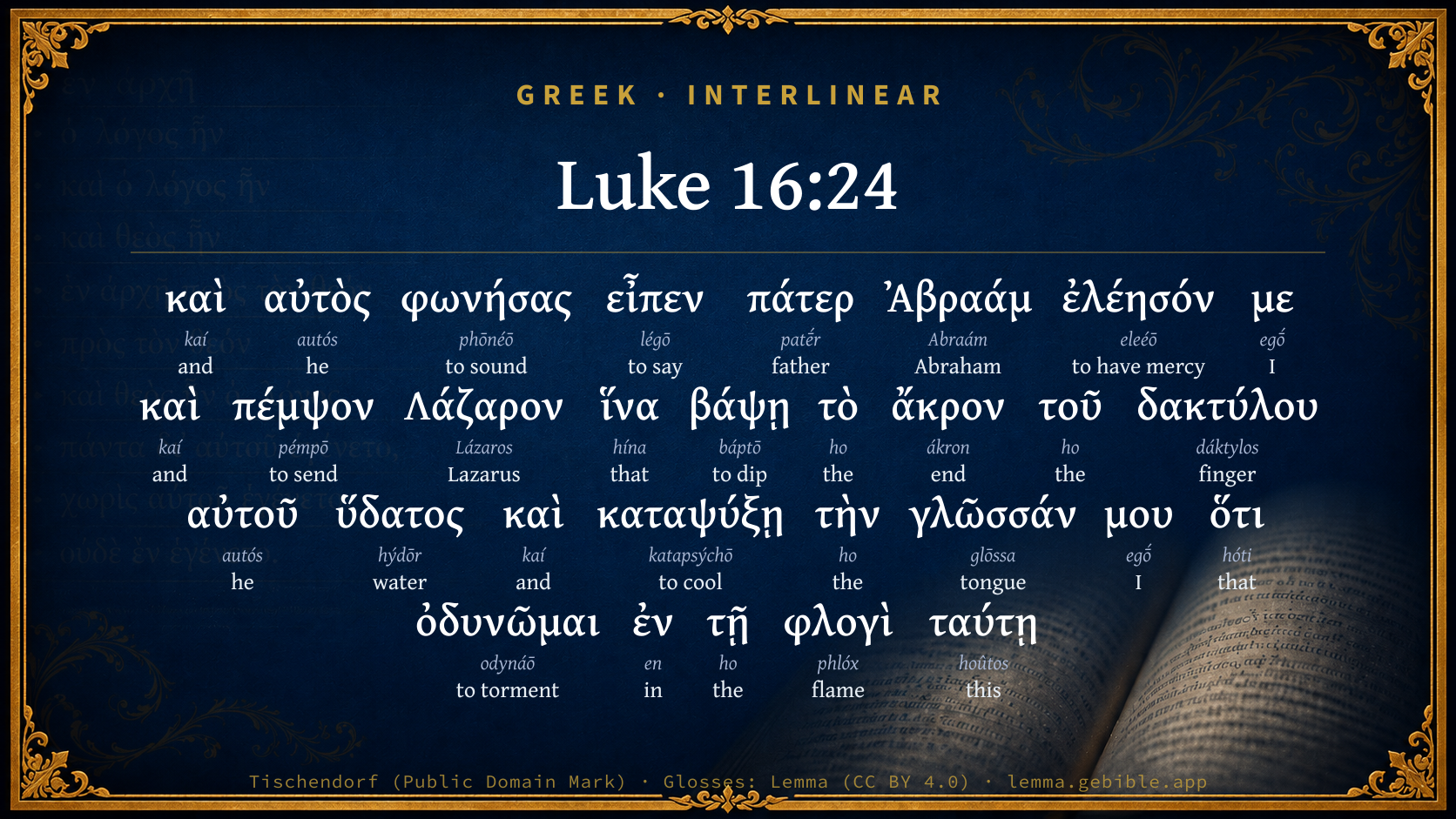
Download image
Cite this verse

Luke 16:24 (World English Bible). Public Domain. Lemma interlinear Bible study tool, https://lemma.gebible.app/v/luke/16/24.

Show BibTeX & RIS
BibTeX
RIS
English Translation
He cried and said, 'Father Abraham, have mercy on me, and send Lazarus, that he may dip the tip of his finger in water, and cool my tongue! For I am in anguish in this flame.'
World English Bible · Public Domain
Highlights
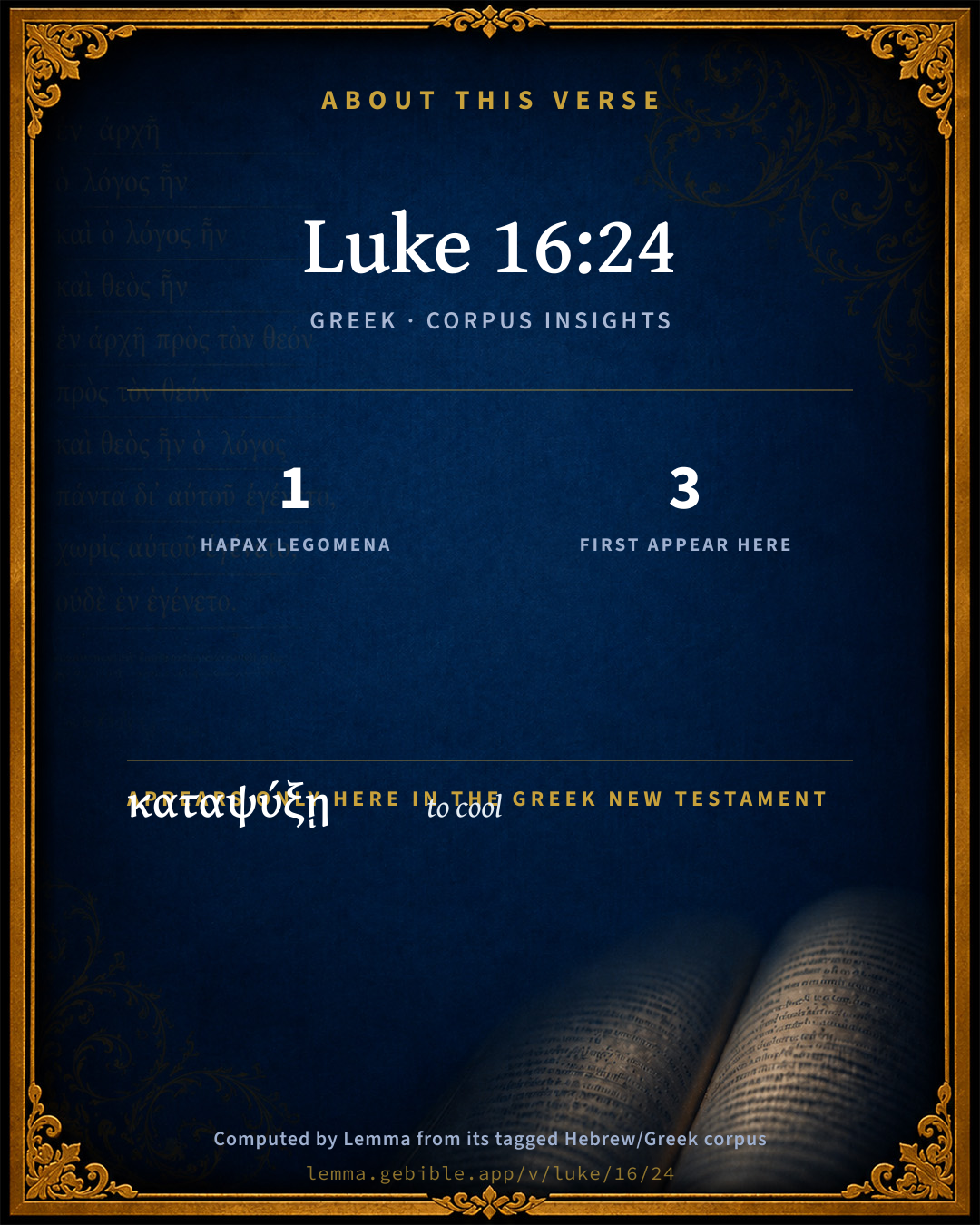
  • 1 hapax legomenon — only here in the Greek New Testament
  • 3 first appearances in the Greek New Testament
Full analysis ↓
Download a study sheet

One document with this verse’s original text, its word-by-word gloss line, the meaning frame, cross-references with their text, attributed commentary, and full source and license credits — printable, and it pastes into notes with its structure intact.

This verse Autodidact and up

Study sheet (.html) Plain text (.txt)

A passage Seminary Student

Up to 50 verses in one chapter. A passage sheet keeps up to 6 commentary sources and 12 cross-references per verse, in the order this page ranks them, and says so on the sheet whenever that leaves anything out. Ask for a single verse and you get the Autodidact verse sheet above.

Everything on this page stays free to read, with no account — the sheet is a download of what is already on screen, not access to it.

Want to remove ads? Support Godless Engineer
Compare translations 3

The same verse in 3 English versions, stacked beneath the original-language interlinear above. Click any original word for its lexicon entry.

Each is an independent rendering of the whole verse — the interlinear is not word-aligned to these translations.

Highlighted words mark where these versions differ — a whole-verse word diff, not a word-by-word alignment.

  • World English Bible Public Domain
    He cried and said, 'Father Abraham, have mercy on me, and send Lazarus, that he may dip the tip of his finger in water, and cool my tongue! For I am in anguish in this flame.'
  • King James Version Public Domain
    And he cried and said, Father Abraham, have mercy on me, and send Lazarus, that he may dip the tip of his finger in water, and cool my tongue; for I am tormented in this flame.
  • unfoldingWord Literal Text CC BY-SA 4.0
    And crying out, he said, ‘Father Abraham, have mercy on me and send Lazarus, that he may dip the tip of his finger in water and cool my tongue, for I am tormented in this flame.’

unfoldingWord Literal Text — © unfoldingWord, licensed CC BY-SA 4.0. Word-aligned USFM3 via Door43 (git.door43.org/unfoldingWord/en_ult).

Versions to compare (up to 4)

3 of 4 selected

Show all 19 translations

Every available English version of this verse, each an independent rendering of the whole verse.

  • World English Bible Public Domain
    He cried and said, 'Father Abraham, have mercy on me, and send Lazarus, that he may dip the tip of his finger in water, and cool my tongue! For I am in anguish in this flame.'
  • Berean Standard Bible Public Domain
    So he cried out, ‘Father Abraham, have mercy on me and send Lazarus to dip the tip of his finger in water and cool my tongue. For I am in agony in this fire.’
  • Majority Standard Bible Public Domain
    So he cried out, ‘Father Abraham, have mercy on me and send Lazarus to dip the tip of his finger in water and cool my tongue. For I am in agony in this fire.’
  • King James Version Public Domain
    And he cried and said, Father Abraham, have mercy on me, and send Lazarus, that he may dip the tip of his finger in water, and cool my tongue; for I am tormented in this flame.
  • American Standard Version (1901) Public Domain
    And he cried and said, Father Abraham, have mercy on me, and send Lazarus, that he may dip the tip of his finger in water, and cool my tongue; for I am in anguish in this flame.
  • Revised Version (1885) Public Domain
    And he cried and said, Father Abraham, have mercy on me, and send Lazarus, that he may dip the tip of his finger in water, and cool my tongue; for I am in anguish in this flame.
  • Geneva Bible (1599) Public Domain
    Then he cried, and saide, Father Abraham, haue mercie on mee, and sende Lazarus that hee may dippe the tip of his finger in water, and coole my tongue: for I am tormented in this flame.
  • Douay-Rheims (1899) Public Domain
    And he cried, and said: Father Abraham, have mercy on me, and send Lazarus, that he may dip the tip of his finger in water, to cool my tongue: for I am tormented in this flame.
  • Young's Literal Translation Public Domain
    and having cried, he said, Father Abraham, deal kindly with me, and send Lazarus, that he may dip the tip of his finger in water, and may cool my tongue, because I am distressed in this flame.
  • Literal Standard Version CC BY-SA 4.0
    and having cried, he said, Father Abraham, deal kindly with me, and send Lazarus, that he may dip the tip of his finger in water, and may cool my tongue, because I am distressed in this flame.
  • Unlocked Literal Bible CC BY-SA 4.0
    So he cried out and said, 'Father Abraham, have mercy on me and send Lazarus, that he may dip the tip of his finger in water and cool my tongue, for I am in anguish in this flame.'
  • unfoldingWord Literal Text CC BY-SA 4.0
    And crying out, he said, ‘Father Abraham, have mercy on me and send Lazarus, that he may dip the tip of his finger in water and cool my tongue, for I am tormented in this flame.’
  • Darby Bible Public Domain
    And he crying out said, Father Abraham, have compassion on me, and send Lazarus that he may dip the tip of his finger in water and cool my tongue, for I am suffering in this flame.
  • World Messianic Bible Public Domain
    He cried and said, ‘Father Abraham, have mercy on me, and send Lazarus, that he may dip the tip of his finger in water and cool my tongue! For I am in anguish in this flame.’
  • Webster's Bible Public Domain
    And he cried, and said, Father Abraham, have mercy on me, and send Lazarus, that he may dip the tip of his finger in water, and cool my tongue: for I am tormented in this flame.
  • Free Bible Version CC BY-SA 4.0
    ‘Father Abraham,’ he called out, ‘Have mercy on me and send Lazarus to dip the tip of his finger in water and cool my tongue, because I'm burning in agony.’
  • Bible in Basic English Public Domain
    And he gave a cry and said, Father Abraham, have mercy on me and send Lazarus, so that he may put the end of his finger in water and put it on my tongue, for I am cruelly burning in this flame.
  • Text-Critical English NT CC BY 4.0
    So he called out and said, ‘Father Abraham, have mercy on me and send Lazarus to dip the tip of his finger in water and cool my tongue, for I am in agony in these flames.’
  • Tyndale New Testament (1534) Public Domain
    and he cryed and sayd: father Abraham have mercy on me and sende Lazarus that he maye dippe the tippe of his fynger in water and cole my tonge: for I am tourmented in this flame.

Literal Standard Version (2020), Covenant Press — licensed CC BY-SA 4.0. Text via the HelloAO Bible API (eBible.org). Unlocked Literal Bible (unfoldingWord) — licensed CC BY-SA 4.0. Text via the HelloAO Bible API (eBible.org). unfoldingWord Literal Text — © unfoldingWord, licensed CC BY-SA 4.0. Word-aligned USFM3 via Door43 (git.door43.org/unfoldingWord/en_ult). Free Bible Version, Dr. Jonathan Gallagher — licensed CC BY-SA 4.0. Text via the HelloAO Bible API (eBible.org).

Word by word

More ways to search: Search by grammar → Find every occurrence → Compare this word →

Practice this passage: Drill this verse → Learn its vocabulary →

καταψύξῃ
katapsýchō
G2711
“to cool”
Verb, Aorist, Active, Subjunctive, 3rd person, Singular
Part of Speech
Verb
Tense
Aorist
Voice
Active
Mood
Subjunctive
Person
3rd person
Number
Singular
Full Thayer's Definition

Origin: from G2596 and G5594

TDNT: None

1. to cool off, make cool
  1. καὶ kaí G2532 “and” Conjunction
  2. αὐτὸς autós G846 “he” Personal pronoun, Nominative, Singular, Masculine
  3. φωνήσας phōnéō G5455 “to sound” Verb, Aorist, Active, Participle, Nominative, Singular, Masculine
  4. εἶπεν légō G3004 “to say” Verb, Aorist, Active, Indicative, 3rd person, Singular
  5. πάτερ patḗr G3962 “father” Noun, Vocative, Singular, Masculine
  6. Ἀβραάμ Abraám G11 “Abraham” Noun, Proper, indeclinable
  7. ἐλέησόν eleéō G1653 “to have mercy” Verb, Aorist, Active, Imperative, 2nd person, Singular
  8. με egṓ G1473 “I” Personal pronoun, 1st person, Accusative, Singular
  9. καὶ kaí G2532 “and” Conjunction
  10. πέμψον pémpō G3992 “to send” Verb, Aorist, Active, Imperative, 2nd person, Singular
  11. Λάζαρον Lázaros G2976 “Lazarus” Noun, Accusative, Singular, Masculine
  12. ἵνα hína G2443 “that” Conjunction
  13. βάψῃ báptō G911 “to dip” Verb, Aorist, Active, Subjunctive, 3rd person, Singular
  14. τὸ ho G3588 “the” Article, Accusative, Singular, Neuter
  15. ἄκρον ákron G206 “end” Noun, Accusative, Singular, Neuter
  16. τοῦ ho G3588 “the” Article, Genitive, Singular, Masculine
  17. δακτύλου dáktylos G1147 “finger” Noun, Genitive, Singular, Masculine
  18. αὐτοῦ autós G846 “he” Personal pronoun, Genitive, Singular, Masculine
  19. ὕδατος hýdōr G5204 “water” Noun, Genitive, Singular, Neuter
  20. καὶ kaí G2532 “and” Conjunction
  21. τὴν ho G3588 “the” Article, Accusative, Singular, Feminine
  22. γλῶσσάν glōssa G1100 “tongue” Noun, Accusative, Singular, Feminine
  23. μου egṓ G1473 “I” Personal pronoun, 1st person, Genitive, Singular
  24. ὅτι hóti G3754 “that” Conjunction
  25. ὀδυνῶμαι odynáō G3600 “to torment” Verb, Present, Passive, Indicative, 1st person, Singular
  26. ἐν en G1722 “in” Preposition
  27. τῇ ho G3588 “the” Article, Dative, Singular, Feminine
  28. φλογὶ phlóx G5395 “flame” Noun, Dative, Singular, Feminine
  29. ταύτῃ hoûtos G3778 “this” Demonstrative pronoun, Dative, Singular, Feminine

About this verse

These counts appear in no published source. They are computed here, from the morphology-tagged text and Lemma’s own curated glosses. What Lemma adds →

30
words
23
distinct lemmas
Gospels
section

Notable vocabulary

1 hapax legomenon — a word that appears only here in the entire Greek New Testament:

  • καταψύξῃ to cool G2711

First appearance in Scripture

These words make their first canonical appearance in the Greek New Testament here:

  • βάψῃ to dip G911
  • καταψύξῃ to cool G2711
  • φλογὶ flame G5395

Shared distinctive vocabulary

βάψῃ to dip G911 occurs in 2 verses of the Greek New Testament. Also found in:
Repetition

Words recur within this verse:

Cross-references

27

Topical passages linked to Luke 16:24 in the Treasury of Scripture Knowledge — connected by theme and wording, ordered by reader-vote popularity; previews shown in the World English Bible.

  • John 4:10 Jesus answered her, "If you knew the gift of God, and who it is who says to you, 'Give me a drink,' you would have asked him, and he would have given you living water."
  • Revelation 22:1 He showed me a river of water of life, clear as crystal, proceeding out of the throne of God and of the Lamb,
  • John 4:14 but whoever drinks of the water that I will give him will never thirst again; but the water that I will give him will become in him a well of water springing up to eternal life."
  • Revelation 7:16–17 They will never be hungry, neither thirsty any more; neither will the sun beat on them, nor any heat;
  • Matthew 25:41 Then he will say also to those on the left hand, 'Depart from me, you cursed, into the eternal fire which is prepared for the devil and his angels;
  • James 3:6 And the tongue is a fire. The world of iniquity among our members is the tongue, which defiles the whole body, and sets on fire the course of nature, and is set on fire by Gehenna.
  • Luke 3:8 Bring forth therefore fruits worthy of repentance, and don't begin to say among yourselves, 'We have Abraham for our father;' for I tell you that God is able to raise up children to Abraham from these stones!
  • Luke 16:30 "He said, 'No, father Abraham, but if one goes to them from the dead, they will repent.'
  • Revelation 20:15 If anyone was not found written in the book of life, he was cast into the lake of fire.
  • Isaiah 66:24 They shall go forth, and look on the dead bodies of the men who have transgressed against me: for their worm shall not die, neither shall their fire be quenched; and they shall be an abhorring to all flesh.
  • Zechariah 14:12 This will be the plague with which Yahweh will strike all the peoples who have warred against Jerusalem: their flesh will consume away while they stand on their feet, and their eyes will consume away in their sockets, and their tongue will consume away in their mouth.
  • James 2:13 For judgment is without mercy to him who has shown no mercy. Mercy triumphs over judgment.
  • Isaiah 27:11 When the boughs of it are withered, they shall be broken off; the women shall come, and set them on fire; for it is a people of no understanding: therefore he who made them will not have compassion on them, and he who formed them will show them no favor.
  • Mark 9:43–49 If your hand causes you to stumble, cut it off. It is better for you to enter into life maimed, rather than having your two hands to go into Gehenna, into the unquenchable fire,
  • Romans 9:7–8 Neither, because they are Abraham's seed, are they all children. But, "In Isaac will your seed be called."
  • 2 Thessalonians 1:8 giving vengeance to those who don't know God, and to those who don't obey the Gospel of our Lord Jesus,
  • Revelation 14:10–11 he also will drink of the wine of the wrath of God, which is prepared unmixed in the cup of his anger. He will be tormented with fire and sulfur in the presence of the holy angels, and in the presence of the Lamb.
  • 1 Samuel 28:16 Samuel said, Why then do you ask of me, seeing Yahweh is departed from you, and is become your adversary?
  • Isaiah 41:17–18 The poor and needy seek water, and there is none, and their tongue fails for thirst; I, Yahweh, will answer them, I, the God of Israel, will not forsake them.
  • Isaiah 65:13–14 Therefore thus says the Lord Yahweh, Behold, my servants shall eat, but you shall be hungry; behold, my servants shall drink, but you shall be thirsty; behold, my servants shall rejoice, but you shall be disappointed;
  • Matthew 3:9 Don't think to yourselves, 'We have Abraham for our father,' for I tell you that God is able to raise up children to Abraham from these stones.
  • Matthew 5:22 But I tell you, that everyone who is angry with his brother without a cause shall be in danger of the judgment; and whoever shall say to his brother, 'Raca!' shall be in danger of the council; and whoever shall say, 'You fool!' shall be in danger of the fire of Gehenna.
  • John 7:37 Now on the last and greatest day of the feast, Jesus stood and cried out, "If anyone is thirsty, let him come to me and drink!
  • John 8:33–39 They answered him, "We are Abraham's seed, and have never been in bondage to anyone. How do you say, 'You will be made free?'"
  • John 8:53–56 Are you greater than our father, Abraham, who died? The prophets died. Who do you make yourself out to be?"
  • Romans 4:12 The father of circumcision to those who not only are of the circumcision, but who also walk in the steps of that faith of our father Abraham, which he had in uncircumcision.
  • Revelation 19:20 The beast was taken, and with him the false prophet who worked the signs in his sight, with which he deceived those who had received the mark of the beast and those who worshiped his image. These two were thrown alive into the lake of fire that burns with sulfur.

Cross-references courtesy of OpenBible.info (CC BY 4.0).

Commentary

Notes on Luke 16:24 from classic Christian and Jewish commentators (each source and its license shown beneath its notes). The classic Christian expositions comment on the surrounding passage and are grouped to its opening verse, so a note may address several verses; the Jewish commentaries on the Tanakh (Rashi and others) are per-verse, so they appear only where the commentator wrote on this verse.

Lemma curates 59 commentaries, every one of them public domain or Creative Commons licensed, each selected and text-cleaned for this edition rather than reprinted as found. About our sources →

Joseph Benson's Commentary

Luk 16:24-25. He cried, Father Abraham, have mercy on me — Being in an agony of pain, by reason of the flames, and the anguish felt in his conscience, he cried to Abraham to take pity on him, his son, and send Lazarus to give him, if it were but the very least degree of relief, by dipping the tip of his finger in water to cool his tongue, for his torment was intolerable. Abraham might have replied, Thou art not my son, I disown thee; what has become of thy purple and fine linen, thy perfumes, thy feastings, thy dancings? Where are thy delicious wines, now that thou art so earnestly begging a drop of water to cool thy tongue? Instead of thy stately palace, thou art shut up in hell; instead of pleasure, thou art filled with pain; instead of music and mirth, nothing is heard but wailing and gnashing of teeth. No: such speeches, however just, would not have been suitable to the humanity of blessed Abraham; for which reason that good patriarch did not so much as put this wicked man in mind of his ill-spent life; only, being to justify God for having made so sudden and so remarkable a change in his state, he called him his son, and spake of his past debauched way of living in the softest manner possible, showing us the sweet disposition of the blessed in heaven. It cannot be denied, that there is one precedent here in Scripture, of praying to a departed saint: but who is he that prays? and with what success? Will any one who considers this be inclined to imitate him? And Abraham said, Son — That is, according to the flesh; remember, &c. — Is it not worthy of observation, that Abraham will not revile, even a damned soul? And shall living men revile one another? That thou in thy lifetime receivedst thy good things — He bade him consider, that in his lifetime he chose and accepted of worldly things, as his good, his happiness, despising heaven, and valuing, and seeking nothing but the riches, pleasures, and honours of earth. And can any be at a loss then to know why he was in torments? This damnable idolatry, had there been nothing else, was enough to sink him to the nethermost hell. But Abraham further intimates to him, that having enjoyed the good things of this world in the greatest perfection, he could not think it hard if, by the sentence of God, in the open violation of whose laws he had lived, especially of the great law enjoining sincere and fervent love to God and man, he was deprived of that heaven, and of those spiritual and eternal blessings, which he had always despised. And likewise Lazarus evil things — He reminded him that Lazarus, on the other hand, had borne the miseries of life with patience, had trusted in God, and looked forward to a better state: but now he is comforted — His afflictions are all brought to an end, and he is refreshed with eternal joys, which know neither hunger, nor cold, nor pain. He who had no house in which to hide his head, is now a free citizen, and blessed inhabitant of heaven: immortal joys and everlasting love refresh his soul, who lately desired the crumbs from thy table. Glory is his splendid robe for ever, health and gladness attend him always, who was covered only with sores and ulcers upon earth; and he is delighted with the sweet society of God, of angels, and of all the saints, whom no man regarded upon earth, and whose sores the dogs licked, more compassionate than his fellow-creatures. And thou art tormented — Instead of thy purple robe and fine linen, thou art invested with a robe of fiery flame: instead of sumptuous fare, art fed with bitter tears, and gnawed continually by a condemning conscience; instead of thy past elegancies and comforts, nothing but torment and anguish surrounds thee. Observe well, reader, it is not the merely being in a state of poverty and affliction on the one hand, or of wealth, affluence, and ease on the other, that causes this difference in the future conditions of men, that in itself saves or destroys their souls: but it is the right or wrong use of either state. When a man considers the good things of this life as his chief good; when his heart is taken up by them, and he is so intent on the gaining, the retaining, the increasing, or the enjoyment of them, as to neglect making his peace with God, and giving his heart to him in holy love, and his life in uniform obedience; or, when he makes his riches the instruments of pride, luxury, and uncharitableness; of impiety toward God, and inhumanity toward his fellow-creatures; — then he so receives his good things here as to give up all right to the good things hereafter; and having been here comforted by the enjoyment of temporal goods, will hereafter be tormented by the suffering of eternal evils. “For,” as an able writer well observes, and as is intimated in the note on Luk 16:21, “our Lord’s principal view in this discourse most evidently was, to warn men of the danger of that worldly- mindedness, neglect of religion, and devotedness to pleasure and profit, which is not so much any one vice, as it is the foundation and source of all vices. It is that which makes men regardless of futurity, and not to have God in all their thoughts. It is that deceitfulness of riches, ambition, and voluptuousness, and the care of things temporal, which stifle all sense of religion, choke the word, and it becomes unfruitful.”

Joseph Benson's Commentary on the Old and New Testaments (1811–1818) — public domain. Text from a community e-Sword module.

Tyndale Open Study Notes

Tyndale Open Resources

16:24 I am in anguish in these flames: See Matt 25:41; Rev 20:10, 14-15. • Send Lazarus: Ironically, the man was still treating Lazarus as a lowly servant.

Tyndale Open Study Notes — © Tyndale Open Resources, licensed CC BY-SA 4.0. Text via the HelloAO Bible API.

Bengel's Gnomon

Johann Albrecht Bengel

Luk 16:24. Αὐτὸς, himself). No longer now does he enjoy the attendance of slaves, but is a beggar himself.—πάτερ, father) Implying his “glorying in the flesh” [boasting of mere outward privileges of descent from the father of the faithful]: ‘Son’ in Luk 16:25 corresponds to ‘Father’ here.—πέμψον, send) Even as yet the self-indulger holds in little esteem Lazarus, even as yet in little esteem Moses: Luk 16:30.—ἵνα βάψῃ, that he may dip) This verb does not always imply a great abundance of water: from it is derived βαπτίζω. Not even the slightest mitigation is vouchsafed. This truly is “the wine of the wrath of God poured out, ἄκρατον, without mixture.” Rev 14:10, (Chrysostom observes, ἡ τῆς ἐλεημοσύνης σταγὼν ἀμίκτως ἔχει πρὸς τὴν ἀπήνειαν, A drop of the Divine compassion is not mixed with the unfeeling hard-heartedness of this rich feaster.—γλῶσσαν, tongue) His tongue it was that had especially sinned.

Bengel's Gnomon of the New Testament — English translation (T&T Clark, Edinburgh, 1860) — public domain. Text from a community e-Sword module.

Meyer's Critical & Exegetical Commentary

Heinrich August Wilhelm Meyer

Luk_16:24. Καὶ αὐτός] and he, on his part, as opposed to the patriarch and to Lazarus.

The poetical discourse as it advances now gives us a conversation from the two parts of Hades (for Rabbinical analogies, see in Lightfoot, p. 864 f.), in which, however, the prayer for the service of Lazarus is not on the part of the rich man continued presumption[212] (Lange, L. J. II. 1, p. 394: that Lazarus was to be sent on an errand for him), but finds its motive simply in the fact that it is precisely Lazarus whom he sees reposing on Abrahams bosom. The text does not go further, but leaves to be felt with sufficient profundity what is the humiliating reversal of the relation (that the despised beggar was now to be the reviver of the rich man).

τὸ ἄκρον τ. δακτ.] even only such a smallest cooling, what a favour it would be to him in his glowing heat! Lange grotesquely conjectures that he asks only for such a delicate touching, because he had seen Lazarus in the impurity of his sores. In his condition he certainly had done with such reflections.

ὕδατος] Genitivus materiae. See Bernhardy, p. 168; Buttmann, Neut. Gr. p. 148 [E. T. 170].

[212] Comp. also Bengel: Adhuc vmpendit Lazarum heluo.

Meyer — Critical and Exegetical Commentary on the New Testament — English translation by Peter Christie, edited by Frederick Crombie (T&T Clark, 1880) — public domain. Text from a community e-Sword module.

Expositor's Greek Testament

ed. W. Robertson Nicoll

Luk 16:24 . Πάτερ Ἀ .: the rich man, like Lazarus, is a Jew, and probably, as a son of Abraham, very much surprised that he should find himself in such a place (Mat 3:8-9 ), and still hoping that the patriarch can do something for him. καταψύξῃ ( καταψύχω , here only in N.T.): surely that small service will not be refused! If the flames cannot be put out, may the pain they cause not be mitigated by a cooling drop of water on the tip of the tongue? a pathetic request.

The Expositor's Greek Testament, edited by W. Robertson Nicoll (1897–1910) — public domain. Text from a community e-Sword module.

Jamieson, Fausset & Brown

Robert Jamieson, A. R. Fausset & David Brown

Father Abraham--a well-founded, but unavailing, claim of natural descent (Luk 3:8; Joh 8:37).

mercy on me--who never showed any (Jam 2:3).

send Lazarus--the pining victim of his merciless neglect.

that he may--take me hence? No; that he dares not to ask.

dip . . . tongue--that is the least conceivable and the most momentary abatement of his torment; that is all. But even this he is told is (1) unreasonable.

Jamieson, Fausset & Brown — Commentary Critical and Explanatory on the Whole Bible (1871) — public domain (CC PDM 1.0). Text via the HelloAO Bible API.

Ellicott's Commentary for English Readers

(24) Send Lazarus, that he may dip the tip of his finger . . .—The words, in their relation to the effect of the punishment on the rich man’s character, offer two tenable explanations. On the one hand, they have been thought to indicate the old selfish arrogance and heartlessness of the man who still looks on Lazarus as one who may be sent hither and thither, at any cost of suffering, to do his bidding and minister to his ease; on the other, we may see in them the traces of pride conquered, and the cry for mercy at last coming from lips that had never uttered it before, and the craving for help and sympathy from one whom in his lifetime he had despised as beneath his notice. There is something terribly significant in the fact that it is the “tongue” that suffers most in that agonising flame. That was the organ of the sense which the man had pampered by his riotous and sumptuous living: that is now the chief instrument of retribution. The lesson is the same as that which a poet of our own has taught us—

“The gods are just, and of our pleasant vices

Make instruments to scourge us.”—

Shakespeare, King Lear, v. 3.

A Bible Commentary for English Readers, edited by Charles John Ellicott (1878–1897) — public domain. Text from a community e-Sword module.

The Cambridge Bible for Schools and Colleges

gen. ed. J. J. S. Perowne

24. I am tormented] Rather, I am suffering pain. The verb is not basanizomai but odundmai, as in Luk_2:48, where it is rendered ‘sorrowing.’

in this flame] Perhaps meant to indicate the agony of remorseful memories. In Hades no

“Lethe the river of oblivion rolls:

Her watery labyrinth, whereof who drinks

Forthwith his former state and being forgets,

Forgets both joy and grief, pleasure and pain.”

As for the material flame and the burning tongue, “we may,” says Archbishop Trench, “safely say that the form in which the sense of pain, with the desire after alleviation, embodies itself, is figurative.” Even the fierce and gloomy Tertullian says that how to understand what is meant by these details “is scarcely perhaps discovered by those who enquire with gentleness, but by contentious controversialists never.”

The Cambridge Bible for Schools and Colleges (gen. ed. J. J. S. Perowne; Cambridge University Press, 1878–1918) — public domain. Text from a community e-Sword module.

John Gill's Exposition

But Abraham said, son,.... He calls him "son", not in a spiritual sense; he was not one of Abraham's spiritual seed, that trod in the steps of his faith; but because he was so according to the flesh; and in return to his calling him father: good men have not always good children, nor is any trust to be put in birth and parentage:

remember, that thou in thy lifetime receivedst thy good things; temporal good things; a land flowing with milk and honey; all the outward blessings of life that could be wished for, the Jews had, whilst they were in their own land; and also ecclesiastical good things, as the adoption, the glory, the covenants, the giving of the law, and the service of God, and the promises, the fathers, and the Messiah according to the flesh, even all external privileges and ordinances, Rom 9:4.

And likewise Lazarus evil things; Christ was surrounded with the infirmities of human nature, he assumed; was attended with much outward meanness and poverty; was loaded with calumnies and reproaches; and followed with the wrath, hatred, and persecution of men; and suffered many evil things, as buffetings, scourging, spitting, and cruel mockings, and at last death itself:

but now he is comforted; see Psa 16:9 compared with Act 2:25. Christ being raised from the dead, and set in human nature at the right hand of God, is comforted with the presence of God, which for a while he was deprived of, when on the cross; and is delighted with the glory that it put upon him as man; and with pleasure sees the travail of his soul continually, his elect and redeemed ones, called and gathered by the grace of God, who are his jewels, his portion, and goodly heritage:

and thou art tormented; as were many of the Jews, his implacable enemies and persecutors in hell, and others in captivity, bondage, and distress.

John Gill's Exposition of the Whole Bible (1746–1763) — public domain (CC PDM 1.0). Text via the HelloAO Bible API.

Trapp's Complete Commentary

John Trapp

24 And he cried and said, Father Abraham, have mercy on me, and send Lazarus, that he may dip the tip of his finger in water, and cool my tongue; for I am tormented in this flame.

Ver. 24. And cool my tongue] In his tongue he was most tortured, quia plus lingua peccaverat, saith Cyprian. So Nestorius the heretic had his tongue eaten up with worms. {a} So Thomas Arundel, Archbishop of Canterbury, and Stephen Gardiner, Bishop of Winchester (two notorious persecutors), died with their tongues thrust out, big swollen, and black with inflammation of their bodies. A spectacle worthy to be noted of all such bloody burning persecutors.

{a} Nestorii lingua vermibus exesa. Evang.

John Trapp, A Commentary or Exposition upon All the Books of the Old and New Testament (1647–1656) — public domain. Text from a community e-Sword module.

Albert Barnes' Notes on the Bible

Father Abraham - The Jews considered it a signal honor that Abraham was their “father” - that is, that they were “descendants” from him. Though this man was now in misery, yet he seems not to have abandoned the idea of his relation to the father of the faithful. The Jews supposed that departed spirits might know and converse with each other. See Lightfoot on this place. Our Saviour speaks in conformity with that prevailing opinion; and as it was not easy to convey ideas about the spiritual world without some such representation, he, therefore, speaks in the language which was usual in his time. We are not, however, to suppose that this was “literally” true, but only that it was designed to represent more clearly the sufferings of the rich man in hell.

Have mercy on me - Pity me. The rich man is not represented as calling on “God.” The mercy of God will be at an end when the soul is lost. Nor did he “ask” to be released from that place. Lost spirits “know” that their sufferings will have no end, and that it would be in vain to ask to escape the place of torment. Nor does he ask to be admitted where Lazarus was. He had no “desire” to be in a holy place, and he well knew that there was no restoration to those who once sink down to hell.

Send Lazarus - This shows how low he was reduced, and how the circumstances of people change when they die. Just before, Lazarus was laid at his gate full of sores; now he is happy in heaven. Just before, he had nothing to give, and the rich man could expect to derive no benefit from him; now he asks, as the highest favor, that he might come and render him relief. Soon the poorest man on earth, if he is a friend of God, will have mercies which the rich, if unprepared to die, can never obtain. The rich will no longer despise such people; they would “then” be glad of their friendship, and would beg for the slightest favor at their hands.

Dip the tip ... - This was a small favor to ask, and it shows the greatness of his distress when so small a thing would be considered a great relief.

Cool my tongue - The effect of great “heat” on the body is to produce almost insupportable thirst. Those who travel in burning deserts thus suffer inexpressibly when they are deprived of water. So “pain” of any kind produces thirst, and particularly if connected with fever. The sufferings of the rich man are, therefore, represented as producing burning “thirst,” so much that even a drop of water would be refreshing to his tongue. We can scarce form an idea of more distress and misery than where this is continued from one day to another without relief. We are not to suppose that he had been guilty of any particular wickedness with his “tongue” as the cause of this. It is simply an idea to represent the natural effect of great suffering, and especially suffering in the midst of great heat.

I am tormented - I am in anguish - in insupportable distress.

In this flame - The lost are often represented as suffering “in flames,” because “fire” is an image of the severest pain that we know. It is not certain, however, that the wicked will be doomed to suffer in “material” fire. See the notes at Mar 9:44.

Albert Barnes' Notes on the Bible (1834–1885) — public domain. Text from a community e-Sword/MySword module.

Whedon's Commentary on the Bible

Daniel D. Whedon

24. Father Abraham—He reminds the great father of his descent from him. And he who sat at the banquet once, and refused the crumb to the beggar, now sees the beggar at the banquet, and is refused his supplication.

Dip… cool my tongue… this flame—That tongue which had so often been pampered with sensual gratifications, is now parched with the terrible deprivation. Those licentious passions which had heated his blood will now, in the atmosphere of the new world, kindle to a flame. Besides, the effeminacy which he had cultivated induces him to magnify his new sufferings, and he is perfectly miserable. But all these miseries are, it may be, rather natural than penal. This is the intermediate state, after death, but before the judgment-day. Sentence has not yet been pronounced, and penalty is not yet in its full sense now inflicted. So that we have here, perhaps, the natural sorrow of the lost spirit on leaving the body. Accommodation to his condition may enable his wretched excitement to subside into a permanent state of quiet, settled, and, perhaps, even contented consciousness of badness and woe. This poor wretch prays not to God but to a holy father. The result is a poor encouragement for praying to dead saints.

Flame—Are the damned tormented by a real material fire? We might, perhaps, answer—the visible fire may be but a material emblem of an immaterial power. The element of the very lake of fire may be to the human soul what the fire is to the visible human body.

Daniel D. Whedon (gen. ed.), Commentary on the Old and New Testaments (1874–1909) — public domain. Text from a community e-Sword module.

The Pulpit Commentary

And he cried and said, Father Abraham, have mercy on me, and send Lazarus, that he may dip the tip of his finger in water, and cool my tongue; for I am tormented in this flame. His intense longing seems to be for companionship. "Oh for a friend," he seems to say, "who could speak to me, comfort me, give me the smallest alleviation of the pain I suffer!" What picture of a hell was ever painted by man comparable to this vision of eternal solitude, peopled alone by remorseful memories, described by Jesus? As the Divine Speaker advanced in his thrilling, melancholy description of the rich man"s condition in the world to come, how vividly must the listeners have recalled the Master"s earnest advice to them, in his former parable of the steward, to make to themselves while here friends who would receive them into everlasting habitations! They saw the meaning of that detail of the parable then. Were flay, in their luxurious abundance, were they making friends here who would help them there in the eternal tents? Were they not, perhaps, making the same mistake as the rich man of the story? The question might be asked Why is Abraham, the father of the chosen race, the centre of this blessed life in Hades? In reply, firstly, it must be remembered that the whole colouring of this parable is peculiarly rabbinic, and in the schools of the rabbis the life of the blessed in Paradise is represented as a banquet, over which, until Messiah come, Abraham is represented as presiding. And, secondly, when the parable was spoken, the Saviour was actually on earth; his great redemption work had still to be accomplished. There was truth as well as error mingled in that strange rabbinical teaching. Messiah, as Messiah, when the parable was being probably acted, had not entered that realm where Abraham and many another holy and humble man of heart were in the enjoyment of exquisite bliss.

The Pulpit Commentary (1880–1919), ed. H.D.M. Spence-Jones & Joseph S. Exell — public domain. Text from a community e-Sword module.

John Wesley's Explanatory Notes

Father Abraham, have mercy on me - It cannot be denied, but here is one precedent in Scripture of praying to departed saints: but who is it that prays, and with what success? Will any, who considers this, be fond of copying after him?

John Wesley, Explanatory Notes Upon the Whole Bible (1754–1765) — public domain. Text via the GEBible commentary corpus.

Burkitt's Expository Notes on the New Testament

William Burkitt

Observe here, 1. The place where the rich man suffers, it is in hell: the souls of wicked men, when they leave their bodies, do certainly go into a place of torment, which is not only beyond expression, but our apprehension also; Eye hath not seen, nor ear heard, nor hath it entered into the heart of man to conceive, those dreadful things which God hath prepared for them that hate him.

Observe, 2. The sin for which he suffers: it is the sin of unmercifulness.

Thence learn, that uncharitableness and unmercifulness to the poor, is a very great sin, and such a sin as alone, and without any other guilt, is sufficient to ruin a man forever; there is found in this sin great impiety towards God, and great inhumanity towards our own nature.

Observe, 3. The nature and quality of his sufferings; they are exceedingly painful, and void of the least degree of comfort; not a drop of water is granted to cool an inflamed tongue.

Learn thence, that the least refreshments are impatiently desired by the damned souls in hell, but righteously denied and withheld from them: a drop of water was desired, but not granted. No cup of water, no bowls of wine in hell; there is but one full cup in hell, and that is the cup of God’s wrath, without any mixture of mercy or pity. That throat will be forever parched with thirst then, which is drenched and drowned with excess now: the songs of the drunkard here, will be turned into howlings and lamentations there.

William Burkitt's Expository Notes on the New Testament (1700–1703) — public domain. Text from a community e-Sword module.

The People's New Testament

B. W. Johnson

24. And he cried. The only instance in the New Testament of prayers to the saints. Father Abraham. His trust was in his fleshly descent. He said, “We have Abraham to our father.” Send Lazarus. He seems to think that he has some claims on him, in return for his crumbs. Dip the tip of his finger in water. He only dares ask the smallest favors. Tormented in this flame. “Flame may be regarded as a figurative term, to represent acutest suffering of which a spirit is susceptible by a material image of misery the most dire.”—Greswell.

B. W. Johnson's The People's New Testament with Notes (1889–1891) — public domain. Electronic text from the Christian Classics Ethereal Library (CCEL) ThML edition.

unfoldingWord translationNotes

Door43 World Missions Community

he cried out and said

"the rich man called out to say" or "he shouted out to Abraham"

Father Abraham

Abraham was the ancestor of all the Jews, including the rich man.

have mercy on me

"please have pity on me" or "please be merciful to me"

and send Lazarus

"by sending Lazarus" or "and tell Lazarus to come to me"

he may dip the tip of his finger

This indicates the smallness of the amount requested. AT: "he may wet the tip of his finger"

I am in anguish in this flame

"I am in terrible pain in this flame" or "I am suffering terribly in this fire"

translationWords

ancestor

Abraham

mercy

anguish

unfoldingWord translationNotes — © Distant Shores Media and the Door43 World Missions Community, licensed CC BY-SA 4.0. Source: git.door43.org/Door43/en_tn.

Cambridge Greek Testament for Schools and Colleges

24. ὕδατος. The partitive genitive—‘in some water.’ But he who refused the crumbs is denied the drops.

ὀδυνῶμαι. ‘I am suffering pain.’ The verb is not βασανίζομαι. See Luk 2:48, where ὀδυνῶμαι is rendered ‘sorrowing.’

ἐν τῇ φλογὶ ταύτη. Perhaps meant to indicate the agony of remorseful memories. In Hades no

“Lethe the river of oblivion rolls:

Her watery labyrinth, whereof who drinks

Forthwith his former state and being forgets,

Forgets both joy and grief, pleasure and pain.”

As for the material flame and the burning tongue, “we may,” says Archbishop Trench, “safely say that the form in which the sense of pain, with the desire after alleviation, embodies itself, is figurative.” Even the fierce and gloomy Tertullian says that how to understand what is meant by these details “is scarcely perhaps discovered by those who inquire with gentleness, but by contentious controversialists never.”

Cambridge Greek Testament for Schools and Colleges (Cambridge University Press, 1896; 21 vols, various authors incl. Carr, Maclear, Plummer, Farrar, Lumby, Moule, M. R. James, Simcox) — public domain. Text from a community e-Sword module.

Alford’s Greek Testament

Henry Alford

24.] ‘Superbus temporis, mendicus inferni.’ (Trench, Par. in loc.)

On πάτερ Ἀβρ. see Mat 3:9.

φλογί, not subjective only, though perhaps mainly. The omission of the article before βασάνοις points no doubt to subjective torments;—but where lies the limit between inner and outer to the disembodied? Hardened sinners have died crying ‘Fire!’—Did the fire leave them, when they left their bodies?

Henry Alford, The Greek Testament (1849–1861) — public domain. Text from a community e-Sword module.

International Critical Commentary

24. Πάτερ Ἀβραάμ. He appeals to their relationship, and to his fatherly compassion. Will not Abraham take pity on one of his own sons? Comp. Joh 8:53. Note the characteristic καὶ αὐτός (see on 1:17, 5:14). The φωνήσας implies raising his voice, in harmony with ἀπὸ μακρόθεν.

πέμψον Λάζαπον. Not that he assumes that Lazarus is at his beck and call, although Lange thinks that this is “the finest masterstroke of the parable” that Dives unconsciously retains his arrogant attitude towards Lazarus. See also his strange explanation of the finger-drop of water (L of C. i. p. 507). On earth Dives was not arrogant; he did not drive Lazarue from his gate; but neglectful. In Hades he is so humbled by his pain that he is willing to receive alleviation from anyone, even Lazarus.

ἵνα βάψῃ τὸ ἄκρον τοῦ δακτύλου αὐτοῦ ὕδατος. The smallest alleviation will be welcome. On earth no enjoyment was too extravagant: now the most trifling is worth imploring.

With the part. gen. ὕδατος comp. βάψει τὸν δάκτυλον τὸν δεξιὸν ἀπὸ τοῦ ἐλαίου (Lev 14:16). To understand τι and make ὔδατός τι nom. to βάψη is an improbable constr. See win. xxx. 8. c, p. 252.

ὀδυνῶμαι ἐν τῇ φλογὶ ταύτῃ. “I am in anguish in this flame” of insatiable desires and of remorse: a prelude to the γέεννα τοῦ πυρός (Mat 5:22). For ὀδυνῶμαι see on 2:48.

International Critical Commentary — older volumes (1896–1929), various authors — public domain. Text from a community e-Sword module.

Vincent's Word Studies in the New Testament

Marvin R. Vincent

Cool [καταψυχειν] . Only here in New Testament. Common in medical language. See on ch. Luk 21:26. Compare the exquisite passage in Dante, where Messer Adamo, the false coiner, horribly mutilated, and in the lowest circle of Malebolge, says :

" I had, while living, much of what I wished; And now, alas! a drop of water crave.

The rivulets that from the verdant hills Of Cassentin descend down into Arno, Making their channels to be soft and cold, Ever before me stand, and not in vain : For far more doth their image dry me up Than the disease which strips my face of flesh. " Inferno, 30, 65 sq.

Tormented [οδυνωμαι] . Used by Luke only. Tormented is too strong.

The word is used of the sorrow of Joseph and Mary when the child Jesus was missing (ch. 2 48); and of the grief of the Ephesian elders on parting with Paul (Act 20:38). Rev., I am in anguish.

Marvin R. Vincent, Word Studies in the New Testament (1887–1900) — public domain. Text from a community e-Sword/MySword module.

Lesson kit

Teaching starters — assembled from the data on this page, not authored interpretation. Every prompt links to the verse data it draws on. Edit before teaching.

Luke, in the Gospels, opens this verse with 30 words (23 distinct Greek lemmas). Its most distinctive word is katapsýchō (“to cool”). A historical commentator’s framing appears above. Read the whole chapter for the surrounding context.

Discussion questions

  1. How does “to cool” (katapsýchō) shape what this verse is saying?
  2. This verse holds 1 word here found nowhere else in the Greek New Testament. What might the rare word draw attention to?
  3. 3 words here appear for the first time in Scripture. What is being introduced at this debut?
  4. John 13:26 shares the word «to dip» with this verse. How do the two illuminate each other?
  5. “the” occurs 4× in this one verse. What is the effect of the repetition?
  6. The translations on this page render this verse differently — a whole-verse word diff, not a word-by-word alignment. What might account for the different wordings?
  7. Reading how Joseph Benson's Commentary and Tyndale Open Study Notes read this verse, where do the two commentators agree and where do they part?

Things to notice

  • 1 word in this verse appears nowhere else in the Greek New Testament.
  • 3 words make their first canonical appearance in Scripture here.
  • These translations choose different wording for 5 words in this verse.
  • “the” occurs 4× in this single verse.
  • 23 distinct Greek lemmas span 30 words in this verse.

Reading settings

Reading text

Shown beneath each verse's original-language words.

Old Testament
Old Testament edition

Read the OT as the Masoretic Hebrew (MT) or the Greek Septuagint (LXX).

English shown for the Greek Septuagint (in the Hebrew ↔ Greek comparison).

Comparing translations? Open the Compare panel on any verse page to stack up to four side by side.