John 8:28

Greek (Tischendorf 8th ed.) John 8:28 appears in the Greek New Testament. The text above is from the Tischendorf 8th edition. Each word links to its Strong’s number and a concise gloss. Click any word for its full Thayer’s Greek Lexicon entry.
Download image
Cite this verse

John 8:28 (World English Bible). Public Domain. Lemma interlinear Bible study tool, https://lemma.gebible.app/v/john/8/28.

Show BibTeX & RIS
BibTeX
RIS
English Translation
Jesus therefore said to them, "When you have lifted up the Son of Man, then you will know that I am he, and I do nothing of myself, but as my Father taught me, I say these things.
World English Bible · Public Domain
Download a study sheet

One document with this verse’s original text, its word-by-word gloss line, the meaning frame, cross-references with their text, attributed commentary, and full source and license credits — printable, and it pastes into notes with its structure intact.

This verse Autodidact and up

Study sheet (.html) Plain text (.txt)

A passage Seminary Student

Up to 50 verses in one chapter. A passage sheet keeps up to 6 commentary sources and 12 cross-references per verse, in the order this page ranks them, and says so on the sheet whenever that leaves anything out. Ask for a single verse and you get the Autodidact verse sheet above.

Everything on this page stays free to read, with no account — the sheet is a download of what is already on screen, not access to it.

Want to remove ads? Support Godless Engineer
Compare translations 3

The same verse in 3 English versions, stacked beneath the original-language interlinear above. Click any original word for its lexicon entry.

Each is an independent rendering of the whole verse — the interlinear is not word-aligned to these translations.

Highlighted words mark where these versions differ — a whole-verse word diff, not a word-by-word alignment.

  • World English Bible Public Domain
    Jesus therefore said to them, "When you have lifted up the Son of Man, then you will know that I am he, and I do nothing of myself, but as my Father taught me, I say these things.
  • King James Version Public Domain
    Then said Jesus unto them, When ye have lifted up the Son of man, then shall ye know that I am he, and that I do nothing of myself; but as my Father hath taught me, I speak these things.
  • unfoldingWord Literal Text CC BY-SA 4.0
    Then Jesus said to them, “When you have lifted up the Son of Man, then will you know that I am, and that I do nothing from myself. But just as the Father taught me, I speak these things.

unfoldingWord Literal Text — © unfoldingWord, licensed CC BY-SA 4.0. Word-aligned USFM3 via Door43 (git.door43.org/unfoldingWord/en_ult).

Versions to compare (up to 4)

3 of 4 selected

Show all 19 translations

Every available English version of this verse, each an independent rendering of the whole verse.

  • World English Bible Public Domain
    Jesus therefore said to them, "When you have lifted up the Son of Man, then you will know that I am he, and I do nothing of myself, but as my Father taught me, I say these things.
  • Berean Standard Bible Public Domain
    So Jesus said, “When you have lifted up the Son of Man, then you will know that I am He, and that I do nothing on My own, but speak exactly what the Father has taught Me.
  • Majority Standard Bible Public Domain
    So Jesus said, “When you have lifted up the Son of Man, then you will know that I am He, and that I do nothing on My own, but speak exactly what My Father has taught Me.
  • King James Version Public Domain
    Then said Jesus unto them, When ye have lifted up the Son of man, then shall ye know that I am he, and that I do nothing of myself; but as my Father hath taught me, I speak these things.
  • American Standard Version (1901) Public Domain
    Jesus therefore said, When ye have lifted up the Son of man, then shall ye know that I am `he', and `that' I do nothing of myself, but as the Father taught me, I speak these things.
  • Revised Version (1885) Public Domain
    Jesus therefore said, When ye have lifted up the Son of man, then shall ye know that I am he, and that I do nothing of myself, but as the Father taught me, I speak these things.
  • Geneva Bible (1599) Public Domain
    Then said Iesus vnto them, When ye haue lift vp the Sonne of man, then shall ye know that I am he, and that I doe nothing of my selfe, but as my Father hath taught me, so I speake these things.
  • Douay-Rheims (1899) Public Domain
    Jesus therefore said to them: When you shall have lifted up the Son of man, then shall you know, that I am he, and that I do nothing of myself, but as the Father hath taught me, these things I speak:
  • Young's Literal Translation Public Domain
    Jesus, therefore, said to them, `When ye may lift up the Son of Man then ye will know that I am `he'; and of myself I do nothing, but according as my Father did teach me, these things I speak;
  • Literal Standard Version CC BY-SA 4.0
    Jesus, therefore, said to them, “When you may lift up the Son of Man then you will know that I AM; and I do nothing of Myself, but according as My Father taught Me, these things I speak;
  • Unlocked Literal Bible CC BY-SA 4.0
    Jesus said, “When you have lifted up the Son of Man, then will you know that I AM, and that I do nothing of myself. As the Father taught me, I speak these things.
  • unfoldingWord Literal Text CC BY-SA 4.0
    Then Jesus said to them, “When you have lifted up the Son of Man, then will you know that I am, and that I do nothing from myself. But just as the Father taught me, I speak these things.
  • Darby Bible Public Domain
    Jesus therefore said to them, When ye shall have lifted up the Son of man, then ye shall know that I am [he], and [that] I do nothing of myself, but as the Father has taught me I speak these things.
  • World Messianic Bible Public Domain
    Yeshua therefore said to them, “When you have lifted up the Son of Man, then you will know that I am he, and I do nothing of myself, but as my Father taught me, I say these things.
  • Webster's Bible Public Domain
    Then said Jesus to them, When ye have lifted up the Son of man, then shall ye know that I am he, and that I do nothing of myself; but as my Father hath taught me, I speak these things.
  • Free Bible Version CC BY-SA 4.0
    So Jesus explained to them: “When you have lifted up the Son of man then you'll know that I am the ‘I am,’ and that I do nothing of myself, but only say what the Father taught me.
  • Bible in Basic English Public Domain
    So Jesus said, When the Son of man has been lifted up by you, then it will be clear to you who I am, and that I do nothing of myself, but say as the Father gave me teaching.
  • Text-Critical English NT CC BY 4.0
    So Jesus said to them, “When you lift up the Son of Man, then you will know that I am he and that I do nothing on my own authority, but I speak these things just as my Father taught me.
  • Tyndale New Testament (1534) Public Domain
    and he that sent me is with me. The father hath not lefte me alone for I do alwayes those thinges that please him.

Literal Standard Version (2020), Covenant Press — licensed CC BY-SA 4.0. Text via the HelloAO Bible API (eBible.org). Unlocked Literal Bible (unfoldingWord) — licensed CC BY-SA 4.0. Text via the HelloAO Bible API (eBible.org). unfoldingWord Literal Text — © unfoldingWord, licensed CC BY-SA 4.0. Word-aligned USFM3 via Door43 (git.door43.org/unfoldingWord/en_ult). Free Bible Version, Dr. Jonathan Gallagher — licensed CC BY-SA 4.0. Text via the HelloAO Bible API (eBible.org).

Word by word

More ways to search: Search by grammar → Find every occurrence → Compare this word →

Practice this passage: Drill this verse → Learn its vocabulary →

ὑψώσητε
hypsóō
G5312
“to exalt”
Verb, Aorist, Active, Subjunctive, 2nd person, Plural
Part of Speech
Verb
Tense
Aorist
Voice
Active
Mood
Subjunctive
Person
2nd person
Number
Plural
Full Thayer's Definition

Origin: from G5311

TDNT: 18:06,1

1. to lift up on high, to exalt 2. metaph. a. to raise to the very summit of opulence and prosperity b. to exalt, to raise to dignity, honour and happiness
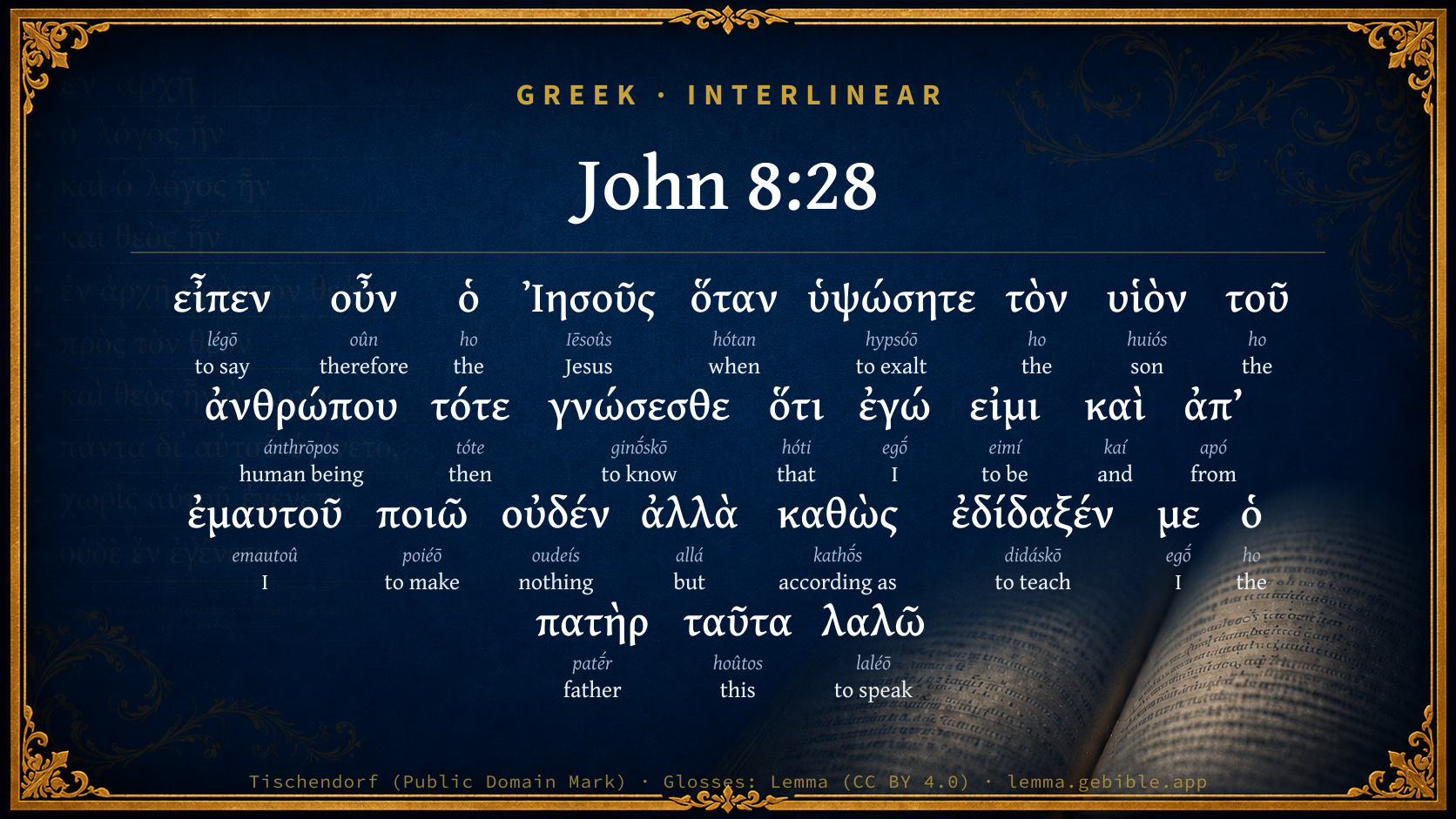
  1. εἶπεν légō G3004 “to say” Verb, Aorist, Active, Indicative, 3rd person, Singular
  2. οὖν oûn G3767 “therefore” Conjunction
  3. ὁ ho G3588 “the” Article, Nominative, Singular, Masculine
  4. Ἰησοῦς Iēsoûs G2424 “Jesus” Noun, Nominative, Singular, Masculine
  5. ὅταν hótan G3752 “when” Conjunction
  6. τὸν ho G3588 “the” Article, Accusative, Singular, Masculine
  7. υἱὸν huiós G5207 “son” Noun, Accusative, Singular, Masculine
  8. τοῦ ho G3588 “the” Article, Genitive, Singular, Masculine
  9. ἀνθρώπου ánthrōpos G444 “human being” Noun, Genitive, Singular, Masculine
  10. τότε tóte G5119 “then” Adverb
  11. γνώσεσθε ginṓskō G1097 “to know” Verb, Future, Middle deponent, Indicative, 2nd person, Plural
  12. ὅτι hóti G3754 “that” Conjunction
  13. ἐγώ egṓ G1473 “I” Personal pronoun, 1st person, Nominative, Singular
  14. εἰμι eimí G1510 “to be” Verb, Present, Active, Indicative, 1st person, Singular
  15. καὶ kaí G2532 “and” Conjunction
  16. ἀπ’ apó G575 “from” Preposition
  17. ἐμαυτοῦ emautoû G1683 “I” Reflexive pronoun, 1st person, Genitive, Singular, Masculine
  18. ποιῶ poiéō G4160 “to make” Verb, Present, Active, Indicative, 1st person, Singular
  19. οὐδέν oudeís G3762 “nothing” Adjective, Accusative, Singular, Neuter, Negative
  20. ἀλλὰ allá G235 “but” Conjunction
  21. καθὼς kathṓs G2531 “according as” Adverb
  22. ἐδίδαξέν didáskō G1321 “to teach” Verb, Aorist, Active, Indicative, 3rd person, Singular
  23. με egṓ G1473 “I” Personal pronoun, 1st person, Accusative, Singular
  24. ὁ ho G3588 “the” Article, Nominative, Singular, Masculine
  25. πατὴρ patḗr G3962 “father” Noun, Nominative, Singular, Masculine
  26. ταῦτα hoûtos G3778 “this” Demonstrative pronoun, Accusative, Plural, Neuter
  27. λαλῶ laléō G2980 “to speak” Verb, Present, Active, Indicative, 1st person, Singular

About this verse

These counts appear in no published source. They are computed here, from the morphology-tagged text and Lemma’s own curated glosses. What Lemma adds →

28
words
24
distinct lemmas
Gospels
section

Notable vocabulary

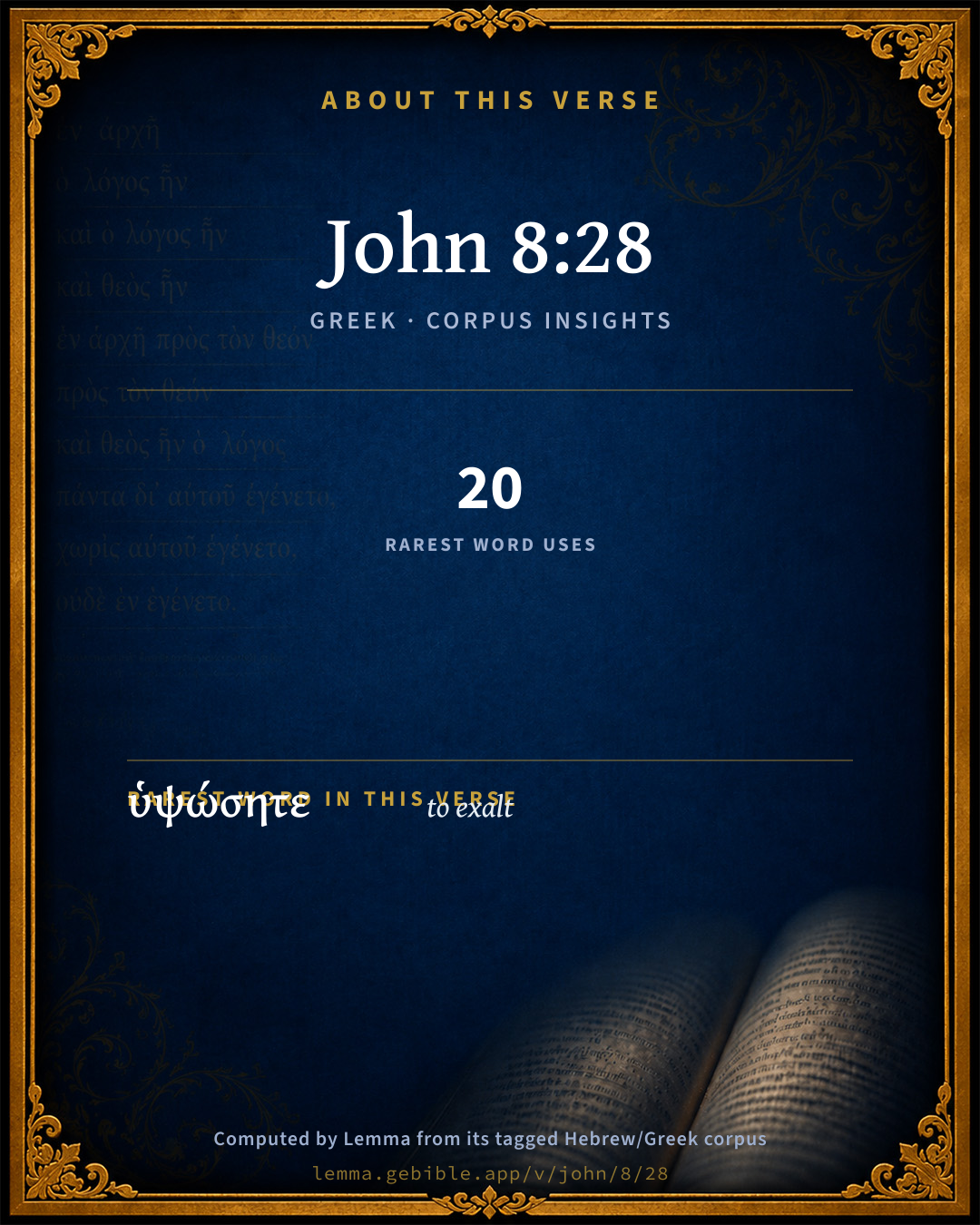
The rarest word here is ὑψώσητε to exalt G5312 — appearing just 20 times in the whole Greek New Testament.

Shared distinctive vocabulary

ὑψώσητε to exalt G5312 occurs in 16 verses of the Greek New Testament. Also found in:

Repetition

Words recur within this verse:

Cross-references

17

Topical passages linked to John 8:28 in the Treasury of Scripture Knowledge — connected by theme and wording, ordered by reader-vote popularity; previews shown in the World English Bible.

  • John 5:19 Jesus therefore answered them, "Most assuredly, I tell you, the Son can do nothing of himself, but what he sees the Father doing. For whatever things he does, these the Son also does likewise.
  • John 5:30 I can of myself do nothing. As I hear, I judge, and my judgment is righteous; because I don't seek my own will, but the will of my Father who sent me.
  • John 6:38 For I have come down from heaven, not to do my own will, but the will of him who sent me.
  • John 12:49–50 For I spoke not from myself, but the Father who sent me, he gave me a commandment, what I should say, and what I should speak.
  • John 3:14 As Moses lifted up the serpent in the wilderness, even so must the Son of Man be lifted up,
  • John 12:32–34 And I, if I am lifted up from the earth, will draw all people to myself."
  • 1 Thessalonians 2:15–16 who killed both the Lord Jesus and their own prophets, and drove us out, and didn't please God, and are contrary to all men;
  • Matthew 27:50–54 Jesus cried again with a loud voice, and yielded up his spirit.
  • John 8:24 I said therefore to you that you will die in your sins; for unless you believe that I am he, you will die in your sins."
  • John 11:42 I know that you always listen to me, but because of the multitude that stands around I said this, that they may believe that you sent me."
  • John 16:10 about righteousness, because I am going to my Father, and you won't see me any more;
  • John 19:18 where they crucified him, and with him two others, on either side one, and Jesus in the middle.
  • Acts 2:41 Then those who gladly received his word were baptized. There were added that day about three thousand souls.
  • Acts 4:4 But many of those who heard the word believed, and the number of the men came to be about five thousand.
  • Romans 1:4 who was declared to be the Son of God with power, according to the Spirit of holiness, by the resurrection from the dead, Jesus Christ our Lord,
  • Hebrews 2:2–3 For if the word spoken through angels proved steadfast, and every transgression and disobedience received a just recompense;
  • Numbers 16:28–30 Moses said, Hereby you shall know that Yahweh has sent me to do all these works; for [I have] not [done them] of my own mind.

Cross-references courtesy of OpenBible.info (CC BY 4.0).

Commentary

Notes on John 8:28 from classic Christian and Jewish commentators (each source and its license shown beneath its notes). The classic Christian expositions comment on the surrounding passage and are grouped to its opening verse, so a note may address several verses; the Jewish commentaries on the Tanakh (Rashi and others) are per-verse, so they appear only where the commentator wrote on this verse.

Lemma curates 59 commentaries, every one of them public domain or Creative Commons licensed, each selected and text-cleaned for this edition rather than reprinted as found. About our sources →

The Biblical Illustrator

Joseph S. Exell

Joh_8:28-29

When ye have lifted up the Son of Man.

--As instruments they would lift Him to the cross; as a result He would ascend to His throne. (W. H. Van Doren, D. D.)

Christ forecasting His death and destiny

Christs language here

I. REVEALS HIS SUBLIME HEROISM IN THE PROSPECT OF A TERRIBLE DEATH. When ye have lifted up, an expression more than once used to signify His crucifixion. This was

1. The culmination of human wickedness. This could reach no higher point than the putting to death of the Son of God.

2. The culmination of human suffering. Crucifixion involved ignominy, insult, torture. Yet how calmly Christ speaks about it--He endured the

Cross and despised the shame. There was no faltering note, no complaint, no perturbation, dismay.

II. EXPRESSES HIS UNSHAKEN FAITH IN THE TRIUMPH OF HIS CAUSE. Then shall ye know, etc.

1. He was not discouraged by apparent failure. To the world His life ending in crucifixion would appear a stupendous failure: to Him it was a success. His death was as a seed falling into the earth.

2. He did not despair of mans improvability. He believed that there would come a reaction in mens minds concerning Him. When He was gone they would begin to think, recognize, and give Him credit for excellency, which they did not when He was amongst them.

3. He was not doubtful of ultimate success. He saw the day of Pentecost, the result of apostolic labours, the triumph of His truth through all successive ages, and at last His character moulding the race to His own ideal.

III. IMPLIES A PRINCIPLE OF CONDUCT COMMON IN ALL HISTORY: viz., that good men undervalued in life are appreciated when gone. We see this principle

1. In the family. Members may live together for years, and through infirmity of temper, clashing of tastes, collision of opinion, etc., excellencies may be entirely overlooked. One dies--father, mother, brother, sister--and then attributes of goodness come up in the memory that never appeared before.

2. In the State. Public men, devoted to the common good, and loyal to conscience, clash with popular opinions and prejudices and are bitterly denounced. They die, and their virtues emerge, and fill the social atmosphere with fragrance. Burke, Hume, and Cobden are examples of this.

3. In the Church. A minister labours for years among a people--too thoughtful to be appreciated by the thoughtless, too honest to bow to current prejudices--so that his work passes unacknowledged and unrequited. He dies, and has a moral epiphany. It was so with Arnold and Robertson.

IV. INDICATES A CONSCIOUSNESS OF HIS PECULIAR RELATION TO THE ETERNAL FATHER. As my Father hath taught me, etc. (Joh_8:29).

1. He was the Pupil of the Father.

2. He was the Companion of the Father.

3. He was the servant of the Father. I do always those things that please Him, though I displease you.

Conclusion:

1. This subject reveals the sublime uniqueness of Christ. Who, amongst all the millions of men that have appeared, could use such language as this? Who could forecast such a terrible future with such accuracy and composure? Who could proclaim such a Divine relationship? As our system has but one sun, our universe has but one Christ.

2. This subject suggests the Christ verifying force of human history. What Christ here predicts history has established. Through His crucifixion ever increasing multitudes have been convinced that He is the true Messiah. (D. Thomas, D. D.)

He that hath sent Me is with Me

1. Unity of essence.

2. Communion of spirit.

3. Consciousness of favour.

4. Present help.

5. One in eternal plans.

Jehovah was ever at His right hand in might, majesty, and love. To be with God is to have light without darkness, truth without falsehood, power without weakness, love without limit. The sunbeams spread their golden wings over us, and yet abide with the sun, from whence they flow. He who sent His Son into the world was so with Him, that He shared, so to speak, all the opprobrium and enmity with which His mission was met. In the same manner is Christ with His people. (Mat_25:40). (W. H. Van Doren, D. D.)

The exemplary life

I. LIFE COMMISSIONED BY GOD. Sent me. Christ was appointed by God to His Work (1Jn_4:14). Every life is a plan of God. Cunning workmen in building the Temple were inspired by Him. He sends to all kinds of lawful work. Lowly workers realize this, it will exalt and encourage you.

II. LIFE APPROVED OF GOD. Our Lords life and work were ever well pleasing to God. So may our life and work be if, by His help, we are diligent, faithful, unselfish, and do all as unto Him.

III. LIFE ACCOMPANIED BY GOD. Please God in your life and you will realize His gracious presence. His presence is an assurance of support in trial, victory in conflict, guidance, progress, etc. (W. Jones.)

The Father hath not left Me alone. Let us not think holiness in the hearts of men here in the world is a forlorn, forsaken, and outcast thing from God, that He hath no regard of. Holiness, wherever it is, though never so small, if it be but hearty and sincere, it can no more be cut off and discontinued from God, than a sunbeam here upon earth can be broken off from its intercourse with the sun, and be left alone amidst the mire and dust of this world. The sun may as well discard its own rays, and banish them from itself, into some region of darkness, far remote from it, where they shall have no dependence at all upon it, as God can forsake and abandon holiness in the world, and leave it a poor orphan thing, that shall have no influence at all from Him to preserve and keep it. Holiness is something of God, wherever it is; it is an efflux from Him, that always hangs upon Him, and lives in Him, as the sunbeams, though they gild this lower world, and spread their golden wings over us, yet they are not so much here, where they shine, as in the sun, from whence they flow. God cannot draw a curtain betwixt Himself and holiness, which is nothing but the splendour and shining of Himself. He cannot hide His face from it; He cannot desert it, in the world (Mat_28:20; Act_9:4-5; 2Ti_4:17). (R. Cudworth.)

I do always those things which please Him.--Eternally, past, present, and future at all times, everywhere, in all ways, He requires from all, and teaches all those things which please God. Of whom but the eternal Son and Spirit can this be said? (W. H. Van Doren, D. D.)

The Christians motto

Observe Christ as

I. THE MEDIATOR. Our text is true of our Lord every way.

1. Of His incarnation we read, Lo, I come … I delight to do Thy will. He did the thing which pleased the Father during His obscure life as the carpenters Son. He was The holy child Jesus. At the end of His retirement the Father set His seal upon His beloved Son in whom He was well pleased at His baptism, when He fulfilled all righteousness, a type of the perfect obedience He intended to render. His temptation and victory were well pleasing to God, the token whereof was the ministration of angels. Throughout His life He fulfilled Isa_42:21. He magnified the ceremonial law by coming under it and observing it until the time when it passed away; and the moral law by such obedience as enabled Him to say, Which of you convinceth him of sin. Hence the same attestation at the Transfiguration as at the Baptism, and the answer to His prayer, Father, glorify Thy name. The miracles were tokens of the Fathers pleasure Act_2:22). In His death it pleased the Father to bruise Him. It pleased God that He should ascend, for He received gifts for men. God is pleased with His intercession, for it is all prevalent. It will please that He should come again; for all judgment is committed to His hands.

2. The saving works of Jesus are lovely in the Fathers eyes. The pleasure of the Lord shall prosper, etc. I have no pleasure in the death, etc.

3. The benefits which Christ confers on the saints please the Father; for it pleased the Father that in Him should all fulness dwell, and it pleases Him when of His fulness we receive grace for grace.

II. THE MODEL. In taking Christ as our example

1. It implied that we ourselves are rendered pleasing to God. As long as a man is obnoxious to God, all he does is obnoxious. They that are in the flesh cannot please God.

2. Included in this is the avoiding all things that displease Him.

(1) Pride, whether of talent, self-righteousness, wealth, dress, rank. The Lord resisted the proud.

(2) Sloth--which God couples with wickedness.

(3) Unwatchfulness, carelessness, indifference, neglect.

(4) Anger, oppression, craftiness, covetousness, worldliness.

(5) Unbelief--doubts of His power and faithfulness.

(6) Murmuring.

3. It should be our intent and earnest design to please God. We shall not do this by accident; we must give our whole souls to it.

4. The text is positive and practical. Do.

(1) Christ was prayerful, and it cannot please the Father for His child not to speak to Him.

(2) Christ loved God and man.

(3) Christ pleased not Himself, and to please God we must deny ourselves.

(4) Christ was separate from sinners, and we must not be conformed to the world.

(5) To please God note Psa_69:30, and Heb_13:16, and learn to cultivate a thankful spirit; note-- 1Jn_3:22, and Heb_11:5-6. and believe; note Col_1:10, and learn that resignation is pleasing to God.

5. These things must be actually done. I do. It will not suffice to talk or pray about them or to be charmed with them.

6. Always. At home as husband or wife, etc.; at business as master or servant. There must not be at any moment anything that we should not like God to see, nor be where we should not like Christ to find us.

7. By doing the things that please God.

(1) We shall enjoy and retain the presence of the Father, not otherwise.

(2) We shall be girded with strength; otherwise we shall be impotent.

(3) The Lord will be with us in our work.

Conclusion:

1. Is this too high a model? Would you prefer an example that would let you be contented with a measure of sin? Do you think it an impossible ideal? But what about the promised help of the Spirit?

2. Have you failed? Then grieve over it, and try again. (C. H. Spurgeon.)

We must please God always

It will not suffice to say I do the things which please God when I go out to worship. The Christian must aim to say I do always. I have known some persons take a holiday from Christs service sometimes. They say Once a year surely one may indulge. If holiness is slavery then surely you are the slave of sin. (C. H. Spurgeon.)

Conduct insisted by love

A child had a beautiful canary, which sang to him from early morning. The mother of the child was ill--so ill that the song of the little bird, which to the boy was delicious music, disturbed and distressed her so that she could scarcely bear to hear it. He put it in a room far away, but the birds notes reached the sick bed, and caused pain to her in her long, feverish days. One morning, as the child stood holding his mothers hand, he saw that when his pet sang, an expression of pain passed over her dear face. She had never yet told him that she could not bear the noise, but she did so now. It is no music to me, she said, as he asked her if the notes were not pretty. He looked at her in wonder. And do you really dislike the sound? Indeed I do, she said. The child, full of love to his mother, left the room. The golden feathers of the pretty canary were glistening in the sunshine, and he was trilling forth his loveliest notes; but they had ceased to please the boy. They were no longer pretty or soothing to him, and taking the cage in his hand he left the house. When he returned he told his mother that the bird would disturb her rest no more, for he had given it to his little cousin. But you loved it so, she said; how could you part with the canary? I loved the canary, mother, he replied; but I love you more. I could not really love anything that gave you pain. It would not be true love if I did. (Quiver.)

As He spake these words many believed on Him

The force of truth

A woman in Scotland, who was determined, as far as possible, not to have anything to do with religion, threw her Bible and all the tracts she could find in her house into the fire. One of the tracts fell down out of the flames, so she picked it up and thrust it in again. A second time it slipped down, and once more she put it back. Again her evil intention was frustrated, but the next time she was more successful, though, even then only half of it was consumed. Taking up the portion that fell out of the fire, she exclaimed, Surely the devil is in that tract, for it wont burn. Her curiosity was excited; she began to read it, and it was the means of her conversion. It was one of my sermons. Verily that sermon, and the woman too, were saved, yet so as by fire. What wondrous ways the Lord has of bringing home the truth! (C. H. Spurgeon.)

A word in season

Lady Huntingdon once spoke to a workman who was repairing a garden wall, and pressed him to thoughtfulness on the state of his soul. Some years afterwards, she was speaking to another man on the same subject, and said, Thomas, I fear you never pray, nor look to Jesus Christ for salvation. Your ladyship is mistaken, answered the man; I heard what passed between you and James at such a time, and the word you designed for him took effect on me. How did you hear it? I heard it on the other side of the garden, through a hole in the wall, and shall never forget the impression I received.

The Biblical Illustrator, edited by Joseph S. Exell (c. 1880s–1900s) — public domain. Text from a community e-Sword module.

Joseph Benson's Commentary

Joh 8:28-29. Then said Jesus, When ye have lifted up the Son of man — From the earth on the cross; and have proceeded so far as to put him to a violent death, then, instead of seeing his cause and interest overborne by that outrageous attempt, shall ye know — By some new and convincing tokens; that I am he — This, doubtless, refers to the prodigies attending his death, his resurrection, and ascension, the effusion of the Holy Spirit upon his disciples, the amazing miracles wrought by the apostles in his name, and the wonderful success which he should give to the gospel through their ministry; and that I do nothing of myself — Nothing by my own authority, separate from that of my Father; but as my Father hath taught me, I speak — I teach such doctrines only as he has commissioned me to declare; and he that sent me is with me — Besides, my Father is always with me to bear his testimony to the truth of what I say, and to support and vindicate me. The Father hath not left me alone — Never from the moment I came into the world, nor will he ever leave me; for I do always those things that please him — I always act agreeably to his will, and faithfully and constantly pursue the important work which he has committed to my trust.

Joseph Benson's Commentary on the Old and New Testaments (1811–1818) — public domain. Text from a community e-Sword module.

Godbey's Commentary on the New Testament

William B. Godbey

THE CRUCIFIXION

Joh 8:28-29. “Then Jesus said, When you may lift up the Son of man, then you shall know that I am He; and I do nothing of Myself; but as the Father taught Me, these things I speak.” In that memorable sermon to Nicodemus, in the beginning of His ministry, in His reference to Moses lifting up the serpent, our Lord assures us by what death He is going to die. Here He repeats the affirmation. This was quite a new departure, as the Jews had no such a punishment, it being peculiarly Roman. Hence, His death by the hands of the Gentiles, by the most cruel of all methods, He predicts ever and anon. When His ministry thus wound up, it was too late for those hard-hearted, unbelieving Jews, as doubtless the Holy Spirit withdrew, leaving them to their dreadful doom; meanwhile, the darkening sun, rending rocks, heaving earthquakes, bursting tombs, risen saints, rending veil, descending angels, empty sepulcher, etc., would inundate them with conviction that they had actually killed the Prince of light, not a few of them repenting and getting saved during the Pentecostal revival, but vast multitudes only the more hardened, evidently having crossed the dead- line, and sealed their doom in endless woe. “The One having sent Me is with Me; He has not left Me alone, because I always do those things pleasing unto Him.” Jesus is our only Paragon. Such is the bountiful redeeming grace which He gives His humble followers, that we are enabled always to do those things pleasing to the Father, thus walking in His footprints and emulating His example.

William B. Godbey, Commentary on the New Testament (1896–1900) — public domain. Text from a community e-Sword module.

Tyndale Open Study Notes

Tyndale Open Resources

8:28 The synoptic Gospels describe Jesus as predicting his death three times (e.g., Mark 8:31; 9:31; 10:33-34). John parallels this (John 3:14; 8:28; 12:33-34), showing that the Father governs his Son’s fate.

Tyndale Open Study Notes — © Tyndale Open Resources, licensed CC BY-SA 4.0. Text via the HelloAO Bible API.

Bengel's Gnomon

Johann Albrecht Bengel

Joh 8:28. Ὑψώσητε, ye shall lift up) on the cross.—τότε) then, not before: 1Co 2:8, “Which none of the princes of this world knew: for had they known it, they would not have crucified the Lord of glory.”—γνώσεσθε) ye shall know from the fact, what now ye believe not on the credit of My word; Joh 8:24, “I said, that ye shall die in your sins: for if ye believe not that I am He, ye shall die in your sins.’ We read the event recorded, Mat 27:54, “When the centurion, and they that were with him, saw the earthquake, and those things that were done, they feared greatly and said, Truly this was the Son of God;” Luk 23:47, etc., “All the people that came together to that sight, beholding the things which were done, smote their breasts;” Act 2:41, “Three thousand souls—added” [to the church on Pentecost]; Joh 21:20, “Thou seest how many thousands of Jews there are, which believe.”—καὶ, and) The connection of the words is this; I am (that which at some time to come ye shall know) and I do nothing of Myself, etc. From this to the end of Joh 8:29 there are four sentences: The first begins with, and I of Myself; the second with, and He who; the third with, hath not left me; the fourth with, because [for]. Of these the second and third are parallel; and also the first and fourth.—ποιῶ, I do) Understand, and I speak.—καθὼς—ταῦτα, as—these things) A similar mode of expression occurs, Num 32:31, ὅσα—οὕτω, whatsoever things [the Lord hath said]—so [will we do].—See Comen. in Didact.—λαλῶ) these things, which I speak, I speak. Understand, and I do. The one is to be supplied from the other.

Bengel's Gnomon of the New Testament — English translation (T&T Clark, Edinburgh, 1860) — public domain. Text from a community e-Sword module.

Meyer's Critical & Exegetical Commentary

Heinrich August Wilhelm Meyer

Joh_8:28-29. Οὖν] not merely a continuation of the narration (De Wette), but: therefore, in reference to this non-understanding, as is also confirmed by the words τότε γνώσεσθε, which refer to οὐκ ἔγνωσαν in Joh_8:27, and, indeed, considered as to its matter, logically correct, seeing that if the Jews had recognised the Messiahship of Jesus, they would also have understood what He said to them of the Father.

ὅταν ὑψώσητε, etc.] when ye shall have lifted up, namely, on to the cross. Comp. on Joh_3:14, Joh_6:62. The crucifixion is treated as an act of the Jews, who brought it about, as also in Act_3:14 f.

τότε-g0- γνώσ-g0-.] Comp. Joh_12:32, Joh_6:62. Then will the result follow, which till then you reject, that you will know, etc. Reason: because the death of Jesus is the condition of His δόξα, and of the mighty manifestations thereof (the outpouring of the Spirit; miraculous works of the apostles; building up of the Church; punishment of the Jews; second coming to judgment). Then shall your eyes be opened, which will take place partly with your own will, and still in time (as in Act_2:36 ff; Act_4:4; Act_6:7; Rom_11:11 ff.); partly against your will, and too late (comp. on Mat_23:39; Luk_13:34 f.). Bengel aptly remarks: cognoscetis ex re, quod nunc ex verbo non creditis.

καὶ ἀπʼ ἐμαυτοῦ, etc.] still dependent on ὅτι, and, indeed, as far as μετʼ ἐμοῦ ἐστιν; so that to the universal ποιῶ, the special λαλῶ and the general μετʼ ἐμοῦ ἐστιν (is my helper and support) together correspond. Hence there is no brevity of discourse requiring to be completed by supplying in thought λαλῶ to ποιῶ, and ποιῶ along with λαλῶ (De Wette, after Bengel). Nonnus already took the correct view (he begins Joh_8:29 with ὅττι καὶ, etc.); and the objection (Lücke, De Wette, and several others) that οὐκ ἀφῆκε, etc. would then stand too disconnected, has no force, since it is just in John that the asyndetic continuation of a discourse is very common, and, in fact, would also be the case here if καὶ ὁ πέμψ. etc. were no longer dependent on ὅτι.

ταῦτα] is arbitrarily and without precedent (Mat_9:33 cannot be adduced as one) explained as equivalent to οὕτως, from a commingling of two notions. By the demonstrative ταῦτα Jesus means His doctrine generally (comp. Joh_8:26), with whose presentation He was now occupied. But of this He discoursed in harmony with the instructions received from the Father, i.e. in harmony with the instructions derived from His direct intuition of divine truth with the Father prior to His incarnation. Comp. Joh_8:38; Joh_1:18; Joh_3:13; Joh_6:46; Joh_7:16 f.

οὑκ ἀφῆκε, etc.] Independent corroboration of the last thought, negatively expressed on account of His apparent forsakenness in the face of many and powerful enemies. The Praet. refers to the experience felt in every case, during the course of His entire activity, until now (comp. afterwards πάντοτε), not to the point of time when He was sent; the reason afterwards assigned would not be appropriate to this latter reference. Comp. also Joh_16:32.

ὅτι ἐγὼ, etc.] because I, etc. Reason assigned for the οὐκ ἀφῆκε, etc. How could He ever leave me alone, as I am He who, etc.? (ἐγώ with emphasis). Comp. Joh_15:10. Olshausen regards οὐκ ἀφῆκε, etc. as the expression of equality of essence, and ὅτι as assigning the ground of His knowledge. The former idea is erroneous, as the meaning of οὐκ ἀφῆκε, etc. is identical with that of μετʼ ἐμοῦ ἐστιν; and the latter would be an inadequate reason, because it relates merely to moral agreement.

Meyer — Critical and Exegetical Commentary on the New Testament — English translation by Peter Christie, edited by Frederick Crombie (T&T Clark, 1880) — public domain. Text from a community e-Sword module.

Expositor's Greek Testament

ed. W. Robertson Nicoll

Joh 8:28 . Therefore ( οὖν ) Jesus said to them, Ὅταν … εἰμι , “when ye have lifted up the Son of Man, them shall ye know that I am He”. ὑψώσητε has the double reference of elevation on the cross and elevation to the Messianic throne, cf. Joh 3:14 . The people were thus to elevate Him and then they would recognise Him, Act 2:37 , etc. ὅτι ἐγώ εἰμι “that I am He,” i.e. , “the Son of Man”. What follows is not dependent on ὅτι (against Meyer, Holtzmann, Westcott); the καὶ ἀπʼ ἐμαυτοῦ begins a new statement, as the present, ποιῶ , shows. The sequence of thought is: ye shall know that I am Messiah: and indeed I now act as such, for of myself I do nothing, but as my Father has taught me, so I speak. This is the present proof that He was Messiah.

The Expositor's Greek Testament, edited by W. Robertson Nicoll (1897–1910) — public domain. Text from a community e-Sword module.

Jamieson, Fausset & Brown

Robert Jamieson, A. R. Fausset & David Brown

When ye have lifted up the Son of man--The plainest intimation He had yet given in public of the manner and the authors of His death.

then shall ye know that I am he, &c.--that is, find out, or have sufficient evidence, how true was all He said, though they would be far from owning it.

Jamieson, Fausset & Brown — Commentary Critical and Explanatory on the Whole Bible (1871) — public domain (CC PDM 1.0). Text via the HelloAO Bible API.

Adam Clarke's Commentary

Verse 28. When ye have lifted up] When ye have crucified me, and thus filled up the measure of your iniquities, ye shall know that I am the Christ, by the signs that shall follow; and ye shall know that what I spoke is true, by the judgments that shall follow. To be lifted up, is a common mode of expression, among the Jewish writers, for to die, or to be killed.

Adam Clarke's Commentary on the Bible (1810–1826) — public domain. Text from a community e-Sword/MySword module.

John Calvin's Commentaries

28. When you shall have exalted the Son of man. Offended at that stupidity which the Evangelist has described, Christ again declares that they do not deserve that he should open his mouth to speak to them any more. “You now,” says he, “have all your senses — as it were — fascinated, and, therefore, you understand nothing of all that I say; but the time will yet come, when you shall know that a Prophet of God has lived among you, and has spoken to you.” This is the manner in which we ought to deal with wicked men; we ought expressly to summon them to the judgment-seat of God. But this knowledge, which Christ speaks of, comes too late, when the reprobate and unbelievers, dragged to punishment, reluctantly acknowledge that God, to whom they ought mildly to have given honor and reverence, is their Judge. For he does not promise them repentance, but declares that, after they have been struck with new and unexpressed horror at the wrath of God, they will be aroused from that sleep in which they now repose. Thus Adam’s eyes were opened, so that, overwhelmed with shame, he sought in vain for places of concealment, and ultimately was convinced that he was ruined. Yet that knowledge of Adam, which was in itself useless, turned to his advantage through the grace of God; but the reprobate, being overwhelmed with despair, have their eyes opened only for this purpose, that they may perceive their destruction. To this kind of knowledge God conducts them in a variety of ways. Sometimes it happens that, constrained by heavy afflictions, they learn that God is angry with them; sometimes, without any outward punishment, he inwardly torments them; and, at other times, he permits them to sleep until he call them out of the world.

By the term exalt Christ points out his own death. He mentions his death, in order to warn them that, though they destroy him according to the flesh, they will gain nothing by it; as if he had said, “Now you treat me with haughty scorn, while I speak to you; but ere long your wickedness will proceed farther, even so far as to put me to death. Then will you triumph, as if you had gained your wish, but within a short time you shall feel, to your utter ruin, how widely my death differs from destruction.” He employs the word exalt, in order to vex them the more. Their intention was to plunge Christ into the lowest hell. He tells them that they will be completely disappointed, and that the event will be altogether contrary to what they thus expect. He may, indeed, have intended to allude to the outward form of his death, that he was to be lifted up on the cross; but he looked chiefly to the glorious result of it, which soon afterwards followed, contrary to the expectation of all. True, indeed, in the cross itself he gained a splendid triumph over Satan, before God and the angels, by blotting out the hand-writing of sin, and cancelling the condemnation of death, (Colossians 2:14;) but it was only after that the Gospel had been preached, that this triumph began to be made known to men. The same thing which happened shortly afterwards — that Christ rose out of the grave, and ascended to heaven — is what we ought daily to expect; for, notwithstanding all the contrivances of wicked men to oppress Christ in his Church, not only will he rise in spite of them, but he will turn their wicked efforts into the means of promoting the progress of his kingdom.

That I am. I have already stated that this does not refer to Christ’s Divine essence, but to his office; which appears still more clearly from what follows, when he affirms that he does nothing but by the command of the Father; for this means, that he was sent by God, and that he performs his office faithfully.

And that I do nothing of myself. That is, I do not put myself forward, to attempt anything rashly. Again, the word speak, refers to the same thing, that is, to the office of teaching; for when Christ wishes to prove that he does nothing but by the commandment of the Father, he says that he speaks as he has been taught by Him. The meaning of the words, therefore, may be summed up thus: In the whole of these proceedings, which you condemn, no part is my own, but I only execute what God has enjoined upon me; the words which you hear from my mouth are his words, and my calling, of which He is the Author, is directed by him alone. Let us remember, however, what I have sometimes mentioned already, that these words are accommodated to the capacity of the hearers. For, since they thought that Christ was only one of the ordinary rank of men, he asserts that whatever in him is Divine is not his own; meaning that it is not of man or by man; because the Father teaches us by him, and appoints him to be the only Teacher of the Church; and for this reason he affirms that he has been taught by the Father

John Calvin's Commentaries (1540-1563) — public domain. Text from the Calvin Translation Society English edition (1840s-50s) via the Christian Classics Ethereal Library (ccel.org). Calvin's coverage is partial (roughly two-thirds of the Bible); uncommented books and verses are honest gaps, never fabricated. The 19th-century editor's footnotes and remarks are omitted so the notes are faithfully Calvin's own voice.

Ellicott's Commentary for English Readers

(28) Then said Jesus unto them.—Better, There-fore . . . The teaching arises immediately out of the want of understanding just mentioned.

When ye have lifted up the Son of man.—Better, When ye shall have lifted up . . . (Comp. Notes on Joh_3:14; Joh_6:62; Joh_12:32; Joh_12:34.) Both the Crucifixion and Ascension are implied here. Now. for the first time, they are marked out as the instruments of the Crucifixion (comp. Act_3:15), and therefore the means by which He will return to His Father’s throne.

Then shall ye know . . .—These words confirm the view that the teaching of these verses arises immediately out of their present ignorance. Then the veil will be removed. Then the death of Christ will be followed by His glory. As we read these words they impress us with that calm of assured certainty with which they are uttered (comp. Joh_8:12) before the events, and reminds us of the signal way in which they were fulfilled. (Comp., e.g., Notes on Mat_23:39 and Act_2:37.)

That I am he.—Comp. Note on Joh_8:24.

And that I do nothing of myself.—This is dependent on “know that” in the previous clause; as is the remainder of the verse, and probably the first clause of the following verse also. They will then know that He is divine, and that the acts and words which they cannot now understand are part of the divine life in union with the Father. Now they marvel and ask, “How knoweth this man letters, having never learned?” (Joh_7:15): then they shall know that according as the Father taught Him, He spake these things. Now they cannot understand the witness of the Father (Joh_8:19): then they shall know that He that sent Him was with Him.

A Bible Commentary for English Readers, edited by Charles John Ellicott (1878–1897) — public domain. Text from a community e-Sword module.

The Cambridge Bible for Schools and Colleges

gen. ed. J. J. S. Perowne

28. Then said Jesus unto them] Better, as so often (see on Joh_8:21), Therefore said Jesus, i.e. in consequence of their gross want of perception. ‘Unto them’ is of doubtful authority.

When ye have lifted up] On the Cross: comp. Joh_3:14 and Joh_12:32. The Crucifixion was the act of the Jews, as Peter tells them in Solomon’s Porch (Act_3:13-15).

then shall ye know] Better, then shall ye perceive. It is the same verb as is used in Joh_8:27, and evidently refers back to that (comp. Joh_8:43). Had they known the Messiah they would have known His Father also (Joh_14:9). But when by crucifying Him they have brought about His glory, then and not till then will their eyes be opened. Then will facts force upon them what no words could teach them. Comp. Joh_12:32.

that I am he] See on Joh_8:24.

but as my Father hath taught me] Better, but that as My Father taught Me, i.e. before the Incarnation; aorist, not perfect, like ‘heard’ in Joh_8:26. The construction depending on ‘then shall ye understand’ continues to the end of this verse, and possibly down to ‘is with Me.’

The Cambridge Bible for Schools and Colleges (gen. ed. J. J. S. Perowne; Cambridge University Press, 1878–1918) — public domain. Text from a community e-Sword module.

John Gill's Exposition

Then said Jesus to those Jews that believed on him,.... For he knew instantly who they were, and when they believed on him; and therefore he immediately turned himself to them, and thus addressed them;

if ye continue in my word; meaning the Gospel, called his, because he was both the author, and preacher, and sum, and substance of it: and to continue in it, is having cordially received it, to abide by it, and hold it fast, and not to be moved from it, by the temptations of Satan; the cunning of those that lie in wait to deceive; nor by the revilings and persecutions, the frowns and flatteries of men: and when men continue thus steadfast in it, and faithful to it, it is an evidence that it has come with power, and has a place in their hearts, and that they are the true followers of Christ:

then are ye my disciples indeed; there are two sorts of disciples of Christ; some are only nominal, and merely in profession such; and these sometimes draw back from him, discontinue in his word, and go out from among his people; which shows that they never were of them, nor are the true disciples of Jesus; for the genuine disciples of Christ continue in his Gospel, hold fast to him, the head, and remain with his people; which to do to the end, is an evidence, of their being disciples indeed.

John Gill's Exposition of the Whole Bible (1746–1763) — public domain (CC PDM 1.0). Text via the HelloAO Bible API.

Trapp's Complete Commentary

John Trapp

28 Then said Jesus unto them, When ye have lifted up the Son of man, then shall ye know that I am he, and that I do nothing of myself; but as my Father hath taught me, I speak these things.

Ver. 28. When ye have lifted up the Son, &c.] 1. Upon the cross, as the brazen serpent was upon a pole. And, 2. By the cross to the crown, though they intended no such thing. If there be any way to heaven on horseback (said Bradford) it is by the cross.

John Trapp, A Commentary or Exposition upon All the Books of the Old and New Testament (1647–1656) — public domain. Text from a community e-Sword module.

Albert Barnes' Notes on the Bible

When ye have lifted up - When you have crucified. See Joh 3:14 note; also Joh 12:32 note.

The Son of man - See the notes at Mat 8:19-20.

Then shall ye know - Then shall you have evidence or proof.

That I am he - Am the Messiah, which I have professed to be.

And that I do nothing of myself - That is, you shall have proof that God has sent me; that I am the Messiah; and that God concurs with me and approves my doctrine. This proof was furnished by the miracles that attended the death of Jesus - the earthquake and darkness; but chiefly by his resurrection from the dead, which proved, beyond a doubt, that he was what he affirmed he was - the Messiah.

Albert Barnes' Notes on the Bible (1834–1885) — public domain. Text from a community e-Sword/MySword module.

Haydock's Catholic Bible Commentary

When you shall have lifted up, &c. That is, have put me to the death of the cross; (see John iii. 14. and xii. 32.) you, that is, many of you, shall know, and believe in me, as your Messias. (Witham)

George Leo Haydock (1774–1849), Haydock's Catholic Family Bible and Commentary, 1859 edition — public domain. Excludes Psalms (Douay-Rheims chapter numbering differs from Protestant) and Deuterocanonical books (Catholic canon only).

Matthew Poole's English Annotations

It is your unhappiness, that while I am alive, and preaching the gospel to you, inviting you to repentance, and faith in me, as the true Messiah, you will not believe me to be indeed what I am; but you shall lift me up upon the cross, (for that is meant by lifting up, as Joh 3:14; 12:32), and when that time cometh, you shall know that I am the light of the world, as Joh 8:12; for after that, the gospel began to be preached to all nations: or, that I am the true Messiah, he whom the Father hath sent into the world. Some of you shall then know it by those signs and wonders that shall attend my death and resurrection, and to your shame and confusion: others of you shall know it to your eternal joy and salvation; believing on me then, whom you will not now acknowledge; and that what I have done, I have only done by commission from my Father, not of myself; and that what I have taught, I have had in commission from my Father to teach.

Matthew Poole's English Annotations on the Holy Bible (1683–1685) — public domain. Text from a community e-Sword/MySword module.

Whedon's Commentary on the Bible

Daniel D. Whedon

28. When ye have lifted up—Jesus here plainly means the lifting to the cross. And this by implication embraces his lifting to his throne of glory.

That I am—Rejecting the unauthorized he. Even on his cross the shuddering Jews, amidst the signs from heaven, felt a guilty consciousness that they were crucifying the Holy One. But the words from this extend into a broader meaning. It is the crucifixion by which the world knows the power of Christ, the Redeemer and Judge. Consequent upon that, Israel must look upon Him whom they have pierced, and mourn. The cross is the prelude to the judgment-throne.

Daniel D. Whedon (gen. ed.), Commentary on the Old and New Testaments (1874–1909) — public domain. Text from a community e-Sword module.

The Pulpit Commentary

But when Jesus turns to them again he calls special attention to the main source of their continuous misconception and rejection. Not only is he "the Son," and "the Son of God," but indubitably he is also "the Son of man." He has come down from heaven and is before them as a Man among men Jesus." He has taken upon himself the form of a slave, the fashion of man. That the manifestation of the Divine should be perfectly realized in the human, though a fundamental truth lying at the heart of all revelation, is nevertheless not the alphabet of Divine teaching; nay, it is the very highest and most recondite of all truths. This humbled humanity of the incarnate Logos led on to other issues of enormous significance. The eternal Son in the form of God would become, as "Son of man," obedient unto death. The highest revelation of the Son of God, and therefore of the Father, would be effected by the surrender of that mysterious life of his for the world"s behoof. The previous announcements of this truth, which we now see to be the very crown and culmination of the gospel, had greatly offended his hearers of all kinds, and on distinct grounds. In the words that follow a touch of deeper meaning than any which had preceded is supplied when he proceeds to associate this death of the Son of man with the wilful act of the ecclesiastical authorities in Jerusalem. Jesus therefore said (unto them), When ye shall have lifted up the Son of man. (compare here notes on Joh_3:14 Joh_6:62 Joh 12:32) The word uqow is used with the twofold sense of exaltation on the cross" signifying by what death he should glorify God and also of the issues of that lifting up by means of the tree of ignoble torment and mortal agony to the throne of glory. The twofold meaning of the word cannot be excluded Here. then ye shall come to know then the process of proof will be completedthat I am (he) that I am that which fundamentally I am declaring to you, that my testimonies have unique but trenchant confirmationand that I am doing nothing from myself, but that even as the Father taught me, (so) these things I speak. The "he that sent me" (ver. 26), is here replaced by "the Father." "The things which I heard from (para) him" is replaced by "even as the Father taught me," and the tauta lalw are repeated. "The cross and the crown" will be the proof to the most obtuse and bigoted that I am that which I say I am." The forecast is here given of the conversion of his murderers, the overwhelming effects produced by the resurrection and the ascension of Jesus, and the gift of the Holy Ghost. (Act_2:36 Act_4:4 Act_6:7 Rom_11:11) Bengel: "Cognoscetis ex re, quod nunc ex verbo non creditis."

The Pulpit Commentary (1880–1919), ed. H.D.M. Spence-Jones & Joseph S. Exell — public domain. Text from a community e-Sword module.

John Wesley's Explanatory Notes

When ye shall have lifted up - On the cross, ye shall know - And so many of them did, that I AM - God over all; and that I do nothing of myself - Being one with the Father.

John Wesley, Explanatory Notes Upon the Whole Bible (1754–1765) — public domain. Text via the GEBible commentary corpus.

Scofield Reference Notes

C. I. Scofield

Son of man

(See Scofield "Mat 8:20").

The Scofield Reference Bible (1917 edition), notes by C. I. Scofield — public domain. Text from a community e-Sword module.

Kretzmann's Popular Commentary

Paul E. Kretzmann

The distinguishing sign:

v. 28. Then said Jesus unto them, When ye have lifted up the Son of Man, then shall ye know that I am He, and that I do nothing of Myself; but as My Father hath taught Me, I speak these things.

v. 29. And He that sent Me is with Me; the Father hath not left Me alone; for I do always those things that please Him.

v. 30. As He spake these words, many believed on Him.

In spite of all the enmity and the lack of understanding, the Lord continues to proclaim His message concerning Himself and His office in the world. He points forward to the great culmination of His labors in the world. The time would come that they would raise up the Son of Man, nail Him to the cross. Through this death He would enter into the glory of His Father. This fact would become a distinguishing mark. He that believes on the crucified Christ has the necessary spiritual understanding of the Gospel and its meaning. They that reject the crucified Christ will find that He will become their Judge. To them He will be revealed in the majesty of His divine power, and they will understand when it is too late that He did nothing in His labors on earth on His own initiative, by arrogant presumption, but that He had spoken only what the Father had taught Him to say. For the union between the two persons of the Godhead is so intimate that all their great undertakings for the salvation of mankind are done together. For although He has been sent out by the Father, yet the Father is with Him; there is a distinction of persons, but one divine essence. He is true to the purpose of the Father, to the divine will for the salvation of the world; and therefore His conduct pleases the Father at all times, there is perfect sympathy and correspondence between them. Now finally some of the divine truths penetrated into the hearts and minds of some of the hearers, and many were won for Christ. His Word, whenever and wherever it is preached, will always have some effect and success, on account of its inherent power.

Paul E. Kretzmann, Popular Commentary of the Bible (1921–1924) — public domain. Text from a community e-Sword module.

The People's New Testament

B. W. Johnson

28. When ye have lifted up the Son of man. Lifted him up on the cross. His “lifting up” would be the means of breaking down unbelief. We can see how this was verified. In fifty days after he was lifted up three thousand believed in a single day, and the work of faith went on until the civilized world acknowledged him as King.

B. W. Johnson's The People's New Testament with Notes (1889–1891) — public domain. Electronic text from the Christian Classics Ethereal Library (CCEL) ThML edition.

unfoldingWord translationNotes

Door43 World Missions Community

When you have lifted up

This refers to placing Jesus on the cross to kill him.

Son of Man

Jesus used the title "Son of Man" to refer to himself.

I AM

As God the Son, Jesus knows God the Father unlike anyone else. Possible meanings are 1) Jesus was identifying himself as Yahweh by saying, "I am God" or 2) Jesus was saying, "I am the one I claim to be."

As the Father taught me, I speak these things

"I am only saying what my Father taught me to say." The word "Father" is an important title for God. (See: Translating Son and Father)

He who sent me

The word "He" refers to God.

As Jesus was saying these things

"As Jesus spoke these words"

many believed in him

"many people trusted him"

translationWords

Son of Man

God the Father

teach

believe

unfoldingWord translationNotes — © Distant Shores Media and the Door43 World Missions Community, licensed CC BY-SA 4.0. Source: git.door43.org/Door43/en_tn.

Cambridge Greek Testament for Schools and Colleges

28. εἶπεν οὖν ὁ Ἰ. Jesus therefore said; because of their gross dulness.

ὑψώσητε. On the Cross: see on Joh 3:14 and Joh 12:32. The Crucifixion was the act of the Jews, as S. Peter tells them (Act 3:13-15).

τότε γνώσεσθε. Then shall ye perceive, as in Joh 8:27; the same verb is purposely used in both places (comp. Joh 8:43). Had they known the Messiah they would have known His Father also (Joh 14:9). But when by crucifying Him they have brought about His glory, then and not till then will their eyes be opened. Then will facts force upon them what no words could teach them. Comp. Joh 12:32.

ὅτι ἐγώ εἰμι. That I am (see on Joh 8:24), and (that) of Myself I do nothing (Joh 5:19), but (that) even as the Father taught Me, I speak these things. The construction depends on γνώσεσθε probably as far as λαλῶ, and possibly as far as ἐστιν: but it would be quite in S. John’s style to begin an independent sentence with each καί. These aorists, ἤκονσα (Joh 8:26; Joh 8:40; Joh 3:32, Joh 15:15) and ἐδίδαξεν, refer back to the point before the Incarnation when the Son was commissioned and furnished for His work. Ταῦτα λαλῶ is not put for οὕτω λαλῶ (Joh 12:50). There is a reminiscence of this verse in the Ignatian Epistles (Magn. VII); ὁ κύριος ἄνευ τοῦ πατρὸς οὐδὲν ἐποίησεν. See on Joh 8:29, Joh 10:9.

Cambridge Greek Testament for Schools and Colleges (Cambridge University Press, 1896; 21 vols, various authors incl. Carr, Maclear, Plummer, Farrar, Lumby, Moule, M. R. James, Simcox) — public domain. Text from a community e-Sword module.

Alford’s Greek Testament

Henry Alford

28.] This connects (οὖν being the continuation of the foregoing, see above on ver. 21) with ver. 26, and also with ver. 27, as the τότε γνώσεσθε shews, referring to the οὐκ ἔγνωσαν. On ὑψ. see ch. 3:14. ‘When ye shall have been the instruments of accomplishing that death by which He shall enter into His glory:’ for the latter idea is clearly implied here.

τότε γνώσ.] Perhaps, in different ways:—some, by the power of the Holy Spirit poured out after the exaltation of Christ, and to their own salvation; others by the judgments which were to follow ere long, and to their own dismay and ruin.

The construction and connexion of the following appears to be this: καὶ ἀπʼ ἐμαυτοῦ … depends on ὅτι, and is an expansion of ἐγώ εἰμι: whereas ver. 29 is an independent assertion.

The interchange of ποιῶ and λαλῶ is remarkable. The construction is not elliptical, so that ποιῶ κ. λαλῶ should be understood in both cases; but the declaration of ver. 25 is still in the Lord’s mind, His ποιεῖν being all a declaration of the Father,—a λαλεῖν in the widest sense. Cf. Bengel: “cognoscetis ex re, quod nunc ex verbo non creditis.”

Henry Alford, The Greek Testament (1849–1861) — public domain. Text from a community e-Sword module.

International Critical Commentary

28. εἶπεν οὖν ὁ Ἰησοῦς, “Jesus therefore said,” sc. because of their misunderstanding. אDNΓΔΘ add αὐτοῖς, but om. BLTW; אD further add πάλιν.

ὅταν ὑψώσητε τὸν υἱὸν τοῦ ἀνθρώπου, “When you shall have lifted up,” sc. on the Cross, “the Son of Man.” See on 3:14 for ὑψοῦν in Joh 12:32. In the present passage ὑψοῦν must relate to the lifting up on the Cross, and not to the “lifting up” of the Ascension, for the latter was not in any sense the act of the Jews, as the Crucifixion was (cf. Act 3:14).

For the title “the Son of Man,” see Introd., p. cxxxi.

τότε γνώσεσθε ὅτι ἐγώ εἰμι, “then ye shall know that I am (the Son of Man),” the predicate of ἐγώ εἰμι being understood from the preceding clause of the sentence. Otherwise, we must take ἐγώ εἰμι as used absolutely, as in v. 24 (cf. 8:58, 13:19), the phrase being then identical with the self-designation of Yahweh in the prophets, אֲנִי־הוּא “I (am) He” (see Introd., p. cxx). On either interpretation, the style of the sentence is that of Divine proclamations: cf. Eze 11:10 ἐπιγνώσεσθε ὅτι ἐγὼ κύριος.

Too late, the pressure of facts, the fall of Jerusalem and the like, would convince them of the truth of His words: “cognoscetis ex re, quod nunc ex uerbo non creditis” (Bengel). This, rather than the conviction of sin wrought by the Holy Spirit (16:8f.), seems to be the force of τότε γνώσεσθε.

ὅτι governs not only ἐγώ εἰμι, but also the next clause ἀπʼ ἐμαυτοῦ ποιῶ οὐδέν κτλ. This had been said before, 5:30 (cf. 12:49). For its significance, see note on 5:19. Ignatius (Magn. 7) has ὁ κύριος ἄνευ τοῦ πατρὸς οὐδὲν ἐποίησεν, a reminiscence of these Johannine phrases.

ἀλλὰ καθὼς ἐδίδαξέν με ὁ πατήρ. Cf. v. 26, and see 7:16. 17 After πατήρ, BΓΔ add μου, but om. אDLNTΘ. W om. ὁ πατήρ.

ταῦτα λαλῶ: ταῦτα referring to the specific teachings of this section. Cf. 12:36 ταῦτα ἐλάλησεν ὁ Ἰησοῦς, and v. 30 ταῦτα λαλοῦντος. With the sentence καθὼς ἐδίδαξεν … λαλῶ, cf. the parallels 12:50 and 14:31.

International Critical Commentary — older volumes (1896–1929), various authors — public domain. Text from a community e-Sword module.

Vincent's Word Studies in the New Testament

Marvin R. Vincent

Lifted up. See on 3 14.

Ye shall know [γνωσεσθε] . Render, perceive, here as in ver. 27.

I am He. As in ver. 24, on which see note.

Of myself [απ εμαυτου] . Properly, from myself, as Rev., at Rev 7:17, but not here. See on 7 17.

Hath taught [εδιδαξεν] . Rev., more correctly, taught. The aorist tense, regarding the teaching as a single act. Compare hkousa, I heard, Joh 3:32. I speak these things [παυτα λαλω] . Not equivalent to so I speak (i. e., as the Father taught me), but an absolute declaration with reference to these present revelations.

Marvin R. Vincent, Word Studies in the New Testament (1887–1900) — public domain. Text from a community e-Sword/MySword module.

Godet's Commentaries

Frédéric Louis Godet

Vv. 28, 29. “Jesus therefore said to them, when you have lifted up the Son of man, then shall you know that I am he and that I do nothing of myself, but that I speak these things to you according to the teachings of my Father, 29 and that he that sent me is with me; the Father has not left me alone, because I do always that which is pleasing to him.”

The lifting up of the Son of man refers especially to the death on the cross; this appears from the second person: you have lifted up. But Jesus could not hope that the cross would by itself cause the scales to fall from the eyes of the Jews and extort from them the confession: It is He! It could not produce this effect except by becoming for Him the stepping-stone to the throne and the passage to glory. The word to lift up, therefore, contains here the same amphibology as in Joh 3:14, and the second person of the plural assumes thus a marked tinge of irony: “When by killing me you shall have put me on the throne....” The term Son of man designates that lowly appearance which is now the ground of His rejection. The recognition of Jesus here predicted took place in the conscience of all the Jews without exception when, after the sending of the Holy Spirit, the holy and divine nature of His person, of His work and of His teaching was manifested in Israel by the apostolic preaching, by the appearance of the Church, and then, finally, by the judgment which struck Jerusalem and all the people. At the sight of this, the want of understanding came to its end whether they would or not, and was transformed into faith in some, in others into voluntary hardening. This recognition never ceases to be effected in Israel by reason of the spectacle of the development of the Church; it will end in the final conversion of the nation, when they will cry out with one voice, as if on a new Palm-day: “Blessed is He that cometh in the name of the Lord” (Luk 13:35). What calm dignity, what serene majesty, in these words: Then you shall know ...! They recall, as Hengstenberg remarks, those grave and menacing declarations of Jehovah: “Mine eye shall not pity thee... and ye shall know that I am the Lord,” Eze 7:4. Comp. the same form of expression, Eze 11:10; Eze 12:20; Exo 10:2, etc. Weiss compares with this saying the word of Jesus respecting the sign of Jonah (Mat 12:39 ff.). A still more striking parallel in the Synoptics seems to me to be the word addressed to the Sanhedrim, Mat 26:64 : “You shall see the Son of man seated at the right hand of power and coming on the clouds of heaven.” Some interpreters claim that John should have written οὕτως, thus, instead of ταῦτα, these things. But the thought is this: “and that I declare to you these things (ταῦτα) which you hear,according to (καθώς) the teaching which I have received from the Father.” The expression is therefore correct. The whole of the end of the verse depends on γνώσεσθε, you shall know. Jesus here sums up all His preceding affirmations, while presenting them by anticipation as the contents of that future recognition which He announces: “that I am he;” comp. Joh 8:24 : “that I do and teach nothing of myself;” comp. Joh 7:16-17. This verse therefore means: “You yourselves will then say amen to all these declarations which you so lightly reject at this hour.”

It appears to me natural to make the first clause of Joh 8:29 also depend on the verb, You shall know; it sums up the declarations of Joh 8:16-18. The following clause then reproduces very forcibly (by asyndeton) this last affirmation: is with me. In contrast with the present which escapes Him, Jesus with assured confidence lays hold of the future: “You may reject me if you will, yet the Father remains in inner communion with me, as I have said to you, and He will protect my work.” One might be tempted to understand the words οὐκ ἀφῆκε in this sense. “In sending me, He has not suffered me to come alone here below; He has willed to accompany me Himself.” This indeed would be the most simple sense of the aorist. But in this case, how are we to understand what follows: “Because I do always that which is pleasing to Him?” Hengstenberg, who explains thus, has recourse to the divine foreknowledge: “He has not suffered me to come alone, since He well knows that I am faithful to Him in all things.” This sense is evidently forced. We must therefore understand the aorist ἀφῆκε in the sense in which we find it in the passage, Act 14:17 : “God has not left Himself without witness.” “God has, in no moment of my career, left me to walk alone, because at every moment He sees me doing that which pleases Him.” An instant therefore, a single one, in which Jesus had acted or spoken of His own impulse would have brought a rupture between Him and God; God would have immediately withdrawn from Jesus Himself, and that in the measure in which this will of His own was fixed within Him.

The voluntary and complete dependence of Christ was the constant condition of the co-operation of the Father; comp. the words of Joh 10:17 and Joh 15:10, which express in the main the same thought. Certainly, if the evangelist had written his Gospel to set forth the theory of the Logos, he would never have put this saying into the mouth of Jesus. For it seems directly to contradict it. The communion of the Son and the Father is regarded here as resting upon a purely moral condition. But we see by this how real was the feeling which Jesus had of His truly human existence, and how John himself has taken for granted the humanity of his Master. Τὰ ἀρεστά, that which is pleasing to Him, designates the will of the Father, not from the point of view of the articles of a code, but in that which is most spiritual and inward in it. Indeed, this term does not express the contents only of the doing of Jesus, but its motive. He did not only what was pleasing to the Father, but He did it because it was pleasing to Him. It is proved by this saying that Jesus had the consciousness, not only of not having committed the least positive sin, but also of not having neglected the least good, and that in His feelings as well as in His outward conduct.

Here is one of the passages where we can make palpable the fact that the discourses of Jesus in the fourth Gospel are not compositions of the writer, but real discourses of Christ. 1. The communion with God which Jesus affirms can only be a real historical fact. It cannot have been invented by the author. If it were not in the experience, it would not be in the thought. 2. The allusion to the Jewish law (Joh 8:17-18), in order to justify a fact of so inward a nature, contains a surprising accommodation, which necessarily implies the historical surroundings in which Jesus taught. 3. The locality indicated with so much precision in Joh 8:20 testifies of a perfectly accurate historical recollection; otherwise, there would be here a piece of charlatanism, which it would be impossible to reconcile with the seriousness of the whole narrative.

Frédéric Louis Godet — Commentaries on Luke, John, Romans, and 1 Corinthians — English translation (T&T Clark, Edinburgh, 1870s–1890s) — public domain. Text from a community e-Sword module.

Lesson kit

Teaching starters — assembled from the data on this page, not authored interpretation. Every prompt links to the verse data it draws on. Edit before teaching.

John, in the Gospels, opens this verse with 28 words (24 distinct Greek lemmas). Its most distinctive word is hypsóō (“to exalt”). A historical commentator’s framing appears above. Read the whole chapter for the surrounding context.

Discussion questions

  1. The word hypsóō carries the sense “to exalt.” How does it shape the verse?
  2. How does Matthew 11:23, which shares the word «to exalt», read alongside this verse?
  3. What does the repetition of “the” (4× in this one verse) do in this verse?
  4. The translations on this page render this verse differently — a whole-verse word diff, not a word-by-word alignment. What might account for the different wordings?
  5. Compare how The Biblical Illustrator and Joseph Benson's Commentary read this verse. Where do they agree or differ?

Things to notice

Reading settings

Reading text

Shown beneath each verse's original-language words.

Old Testament
Old Testament edition

Read the OT as the Masoretic Hebrew (MT) or the Greek Septuagint (LXX).

English shown for the Greek Septuagint (in the Hebrew ↔ Greek comparison).

Comparing translations? Open the Compare panel on any verse page to stack up to four side by side.