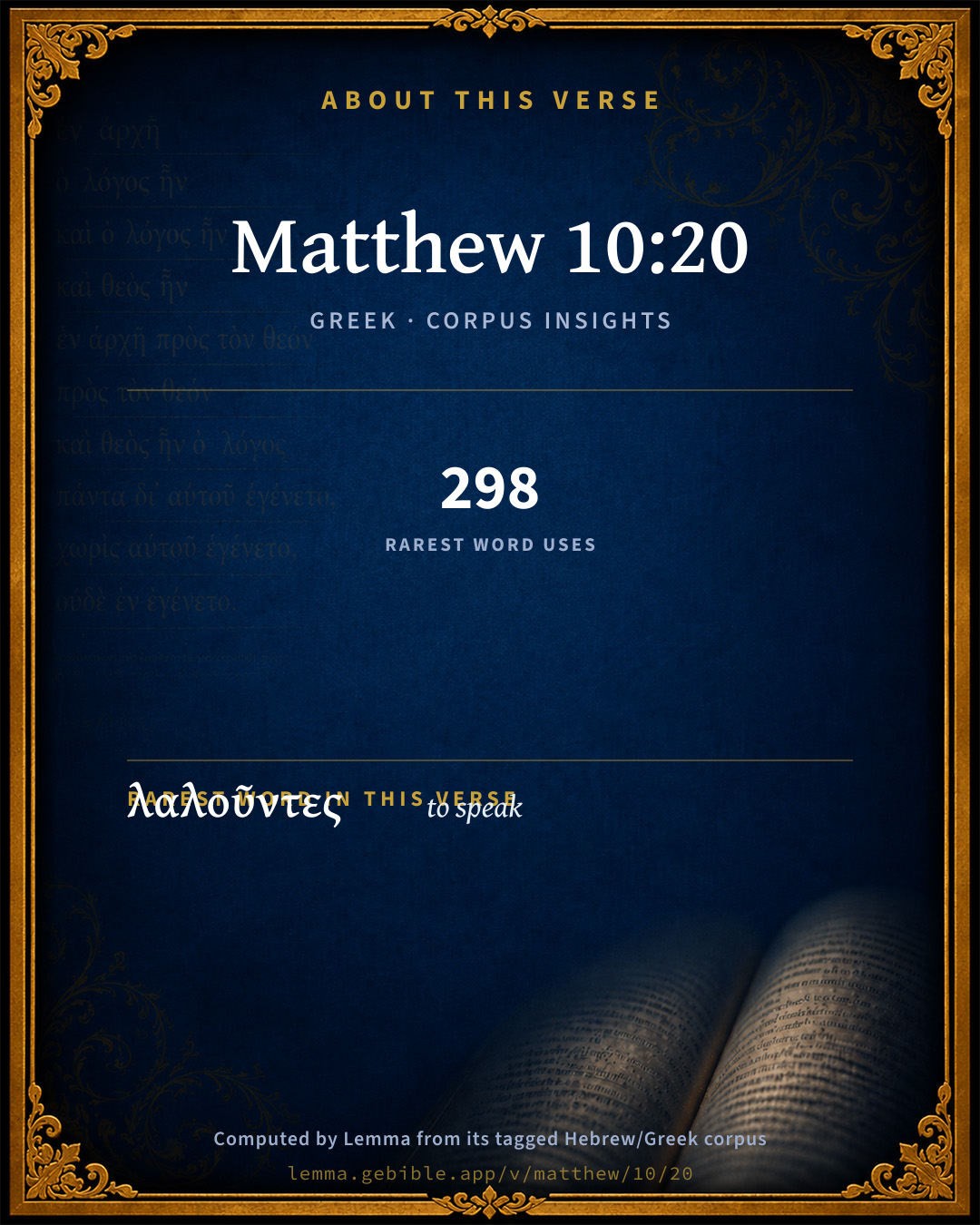
Matthew 10:20

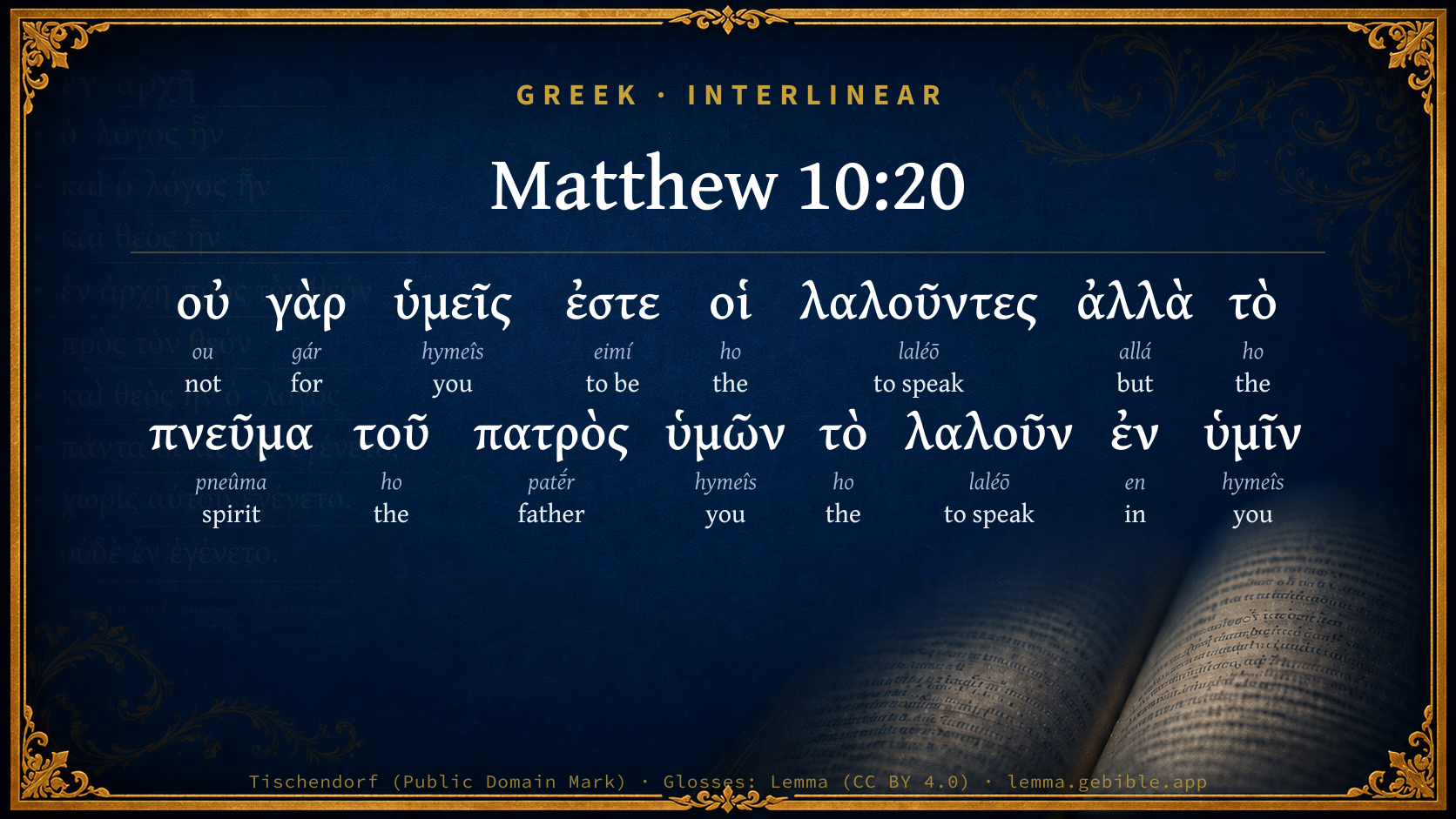
Greek (Tischendorf 8th ed.) Matthew 10:20 appears in the Greek New Testament. The text above is from the Tischendorf 8th edition. Each word links to its Strong’s number and a concise gloss. Click any word for its full Thayer’s Greek Lexicon entry.
Download image
Cite this verse

Matthew 10:20 (World English Bible). Public Domain. Lemma interlinear Bible study tool, https://lemma.gebible.app/v/matthew/10/20.

Show BibTeX & RIS
BibTeX
RIS
English Translation
For it is not you who speak, but the Spirit of your Father who speaks in you.
World English Bible · Public Domain
Download a study sheet

One document with this verse’s original text, its word-by-word gloss line, the meaning frame, cross-references with their text, attributed commentary, and full source and license credits — printable, and it pastes into notes with its structure intact.

This verse Autodidact and up

Study sheet (.html) Plain text (.txt)

A passage Seminary Student

Up to 50 verses in one chapter. A passage sheet keeps up to 6 commentary sources and 12 cross-references per verse, in the order this page ranks them, and says so on the sheet whenever that leaves anything out. Ask for a single verse and you get the Autodidact verse sheet above.

Everything on this page stays free to read, with no account — the sheet is a download of what is already on screen, not access to it.

Want to remove ads? Support Godless Engineer
Compare translations 3

The same verse in 3 English versions, stacked beneath the original-language interlinear above. Click any original word for its lexicon entry.

Each is an independent rendering of the whole verse — the interlinear is not word-aligned to these translations.

Highlighted words mark where these versions differ — a whole-verse word diff, not a word-by-word alignment.

  • World English Bible Public Domain
    For it is not you who speak, but the Spirit of your Father who speaks in you.
  • King James Version Public Domain
    For it is not ye that speak, but the Spirit of your Father which speaketh in you.
  • unfoldingWord Literal Text CC BY-SA 4.0
    For you are not the one speaking, but the Spirit of your Father speaking through you.

unfoldingWord Literal Text — © unfoldingWord, licensed CC BY-SA 4.0. Word-aligned USFM3 via Door43 (git.door43.org/unfoldingWord/en_ult).

Versions to compare (up to 4)

3 of 4 selected

Show all 19 translations

Every available English version of this verse, each an independent rendering of the whole verse.

  • World English Bible Public Domain
    For it is not you who speak, but the Spirit of your Father who speaks in you.
  • Berean Standard Bible Public Domain
    For it will not be you speaking, but the Spirit of your Father speaking through you.
  • Majority Standard Bible Public Domain
    For it will not be you speaking, but the Spirit of your Father speaking through you.
  • King James Version Public Domain
    For it is not ye that speak, but the Spirit of your Father which speaketh in you.
  • American Standard Version (1901) Public Domain
    For it is not ye that speak, but the Spirit of your Father that speaketh in you.
  • Revised Version (1885) Public Domain
    For it is not ye that speak, but the Spirit of your Father that speaketh in you.
  • Geneva Bible (1599) Public Domain
    For it is not yee that speake, but the spirite of your father which speaketh in you.
  • Douay-Rheims (1899) Public Domain
    For it is not you that speak, but the Spirit of your Father that speaketh in you.
  • Young's Literal Translation Public Domain
    for ye are not the speakers, but the Spirit of your Father that is speaking in you.
  • Literal Standard Version CC BY-SA 4.0
    for you are not the speakers, but the Spirit of your Father that is speaking in you.
  • Unlocked Literal Bible CC BY-SA 4.0
    For it is not you who will speak, but the Spirit of your Father who will speak in you.
  • unfoldingWord Literal Text CC BY-SA 4.0
    For you are not the one speaking, but the Spirit of your Father speaking through you.
  • Darby Bible Public Domain
    For *ye* are not the speakers, but the Spirit of your Father which speaks in you.
  • World Messianic Bible Public Domain
    For it is not you who speak, but the Spirit of your Father who speaks in you.
  • Webster's Bible Public Domain
    For it is not ye that speak, but the Spirit of your Father which speaketh in you.
  • Free Bible Version CC BY-SA 4.0
    For it isn't you who will speak but the Spirit of the Father will speak through you.
  • Bible in Basic English Public Domain
    Because it is not you who say the words, but the Spirit of your Father in you.
  • Text-Critical English NT CC BY 4.0
    For it will not be you speaking, but the Spirit of your Father speaking through you.
  • Tyndale New Testament (1534) Public Domain
    For it is not ye that speke but the sprite of your father which speaketh in you.

Literal Standard Version (2020), Covenant Press — licensed CC BY-SA 4.0. Text via the HelloAO Bible API (eBible.org). Unlocked Literal Bible (unfoldingWord) — licensed CC BY-SA 4.0. Text via the HelloAO Bible API (eBible.org). unfoldingWord Literal Text — © unfoldingWord, licensed CC BY-SA 4.0. Word-aligned USFM3 via Door43 (git.door43.org/unfoldingWord/en_ult). Free Bible Version, Dr. Jonathan Gallagher — licensed CC BY-SA 4.0. Text via the HelloAO Bible API (eBible.org).

Word by word

More ways to search: Search by grammar → Find every occurrence → Compare this word →

Practice this passage: Drill this verse → Learn its vocabulary →

λαλοῦντες
laléō
G2980
“to speak”
Verb, Present, Active, Participle, Nominative, Plural, Masculine
Part of Speech
Verb
Tense
Present
Voice
Active
Mood
Participle
Case
Nominative
Number
Plural
Gender
Masculine
Full Thayer's Definition

Origin: a prolonged form of an otherwise obsolete verb

TDNT: 05:09,5

1. to utter a voice or emit a sound 2. to speak a. to use the tongue or the faculty of speech b. to utter articulate sounds 3. to talk 4. to utter, tell 5. to use words in order to declare one's mind and disclose one's thoughts a. to speak
  1. οὐ ou G3756 “not” Particle, Negative
  2. γὰρ gár G1063 “for” Conjunction
  3. ὑμεῖς hymeîs G5210 “you” Personal pronoun, 2nd person, Nominative, Plural
  4. ἐστε eimí G1510 “to be” Verb, Present, Active, Indicative, 2nd person, Plural
  5. οἱ ho G3588 “the” Article, Nominative, Plural, Masculine
  6. ἀλλὰ allá G235 “but” Conjunction
  7. τὸ ho G3588 “the” Article, Nominative, Singular, Neuter
  8. πνεῦμα pneûma G4151 “spirit” Noun, Nominative, Singular, Neuter
  9. τοῦ ho G3588 “the” Article, Genitive, Singular, Masculine
  10. πατρὸς patḗr G3962 “father” Noun, Genitive, Singular, Masculine
  11. ὑμῶν hymeîs G5210 “you” Personal pronoun, 2nd person, Genitive, Plural
  12. τὸ ho G3588 “the” Article, Nominative, Singular, Neuter
  13. λαλοῦν laléō G2980 “to speak” Verb, Present, Active, Participle, Nominative, Singular, Neuter
  14. ἐν en G1722 “in” Preposition
  15. ὑμῖν hymeîs G5210 “you” Personal pronoun, 2nd person, Dative, Plural

About this verse

These counts appear in no published source. They are computed here, from the morphology-tagged text and Lemma’s own curated glosses. What Lemma adds →

16
words
10
distinct lemmas
Gospels
section

Repetition

Words recur within this verse:

  • λαλοῦντες to speak G2980 ×2
  • οἱ the G3588 ×4
  • ὑμεῖς you G5210 ×3

Cross-references

16

Topical passages linked to Matthew 10:20 in the Treasury of Scripture Knowledge — connected by theme and wording, ordered by reader-vote popularity; previews shown in the World English Bible.

  • 2 Samuel 23:2 The Spirit of Yahweh spoke by me, His word was on my tongue.
  • Luke 21:15 for I will give you a mouth and wisdom which all your adversaries will not be able to withstand or to contradict.
  • Acts 6:10 They weren't able to withstand the wisdom and the Spirit by which he spoke.
  • Luke 12:12 for the Holy Spirit will teach you in that same hour what you must say."
  • 2 Peter 1:21 For no prophecy ever came by the will of man: but holy men of God spoke, being moved by the Holy Spirit.
  • Acts 2:4 They were all filled with the Holy Spirit, and began to speak with other languages, as the Spirit gave them the ability to speak.
  • Acts 4:8 Then Peter, filled with the Holy Spirit, said to them, "You rulers of the people, and elders of Israel,
  • 2 Corinthians 13:3 seeing that you seek a proof of Christ who speaks in me; who toward you is not weak, but is powerful in you.
  • Mark 12:36 For David himself said in the Holy Spirit, 'The Lord said to my Lord, Sit at my right hand, Until I make your enemies the footstool of your feet.'
  • Acts 7:55–56 But he, being full of the Holy Spirit, looked up steadfastly into heaven, and saw the glory of God, and Jesus standing on the right hand of God,
  • Luke 11:13 If you then, being evil, know how to give good gifts to your children, how much more will your heavenly Father give the Holy Spirit to those who ask him?"
  • Acts 13:9 But Saul, who is also called Paul, filled with the Holy Spirit, fastened his eyes on him,
  • Acts 28:25 When they didn't agree among themselves, they departed after Paul had spoken one word, "The Holy Spirit spoke rightly through Isaiah, the prophet, to our fathers,
  • 1 Peter 1:12 To them it was revealed, that not to themselves, but to you, did they minister these things, which now have been announced to you through those who preached the Gospel to you by the Holy Spirit sent out from heaven; which things angels desire to look into.
  • Matthew 6:32 For the Gentiles seek after all these things, for your heavenly Father knows that you need all these things.
  • Luke 12:30–32 For the nations of the world seek after all of these things, but your Father knows that you need these things.

Cross-references courtesy of OpenBible.info (CC BY 4.0).

Commentary

Notes on Matthew 10:20 from classic Christian and Jewish commentators (each source and its license shown beneath its notes). The classic Christian expositions comment on the surrounding passage and are grouped to its opening verse, so a note may address several verses; the Jewish commentaries on the Tanakh (Rashi and others) are per-verse, so they appear only where the commentator wrote on this verse.

Lemma curates 59 commentaries, every one of them public domain or Creative Commons licensed, each selected and text-cleaned for this edition rather than reprinted as found. About our sources →

The Biblical Illustrator

Joseph S. Exell

Mat_10:20

For it is not ye that speak.

The Christian ministry a ministry of the Spirit

The text applied-

I. To the apostles.

1. The primary reference is to the apostles.

2. The fact of the Spirit of the Father speaking in the apostles is evident from the effects produced by their word.

II. To ourselves.

1. This is the dispensation of the Spirit.

2. The minister of the Spirit prepares diligently for his pulpit ministrations. (C. Clayton, M. A.)

The intuitional element in lift,

The disciples were a helpless body of men for thinking purposes, and could not imagine beforehand, in their simplicity and rudeness and ignorance, what would be best for them; but if they gave themselves wholly to the ministry of Christ, and then were called before magistrates, it would be given them in that hour what they should say. The range of saying was very limited. It was not that they should understand all theology, providence, learning; but the power of self-defence against magistrates. They were to maintain innocency and simplicity; not to be tricked into casuistry.

1. The nation and times from which the sacred Scriptures came were anterior to the philosophizing period which was ushered in later. Facts, events, things, emotions, belong to the periods which generated the Scriptures.

2. Every man recognizes the fact that the mind acts with different degrees of clearness and certainty under different conditions. The range of the eye is limited, but in perfect health you can see more clearly than when health is impaired; also when atmospheric conditions are favourable. So it is with faculty. The faculties of the mind have a wonderful power of development. The limit to which you can draw out the mind-for that is the meaning of education-is immense. But that is not the only limit of the expansible faculties of the mind. They are subject to instantaneous development. As a grain of powder, which is small, but which, when touched by fire, expands instantly into a thousand times its bulk and diameter, and generates a power that was unsuspected before, so the mental faculties can be touched with a fire that shall give them an immense flash and scope and penetration utterly unlike the ordinary experience of men in life. (Beecher.)

A latent prophetic gift in man

There is a latent spirit of prophecy in everybody who is highly organized. This action of the mind is seen in lower forms. Take, for example, the inspiration which fear breeds. If a mans leading idea is gold, he has an instinct by which he avoids things unfavourable. Others work on the plane of philosophical power. Scholars have the critical judgment. These flashings of inspiration are of the highest value; in business, art. There may be error in these intuitions; so there is in ordinary experience. These flashes of prophecy should be corrected.

1. The primary benefit that comes from these moral intuitions is comfort and direction of the individual. They clear his reason, they furnish an ideal; they redeem him from bondage.

2. These inspirations work mostly beyond the senses, in the invisible. Is it unreasonable to expect a certain degree of excitability of mind in the Divine realm? (Beecher.)

Intuition begotten of fear

A man is walking sluggishly home, and thinking of the drudgery of the day, and he hears the fire-bell, and instantly he says, Why, that is my district; how did I leave things? Instantly he thinks of the way in which he left his shop and the tire; and then he says to himself, If it is there, what treasure I have in that shop, open and exposed! Why, there is powder there! In an instant that man, not by any slow process of analyzing, but with a flash, thinks of a thousand things; and they are all material things; they are not higher thoughts and realities at all. (Beecher.)

Intuition illuminates, but does not create, facts

Of course, when the flash of inspiration comes to a man in practical matters, there must be material for it to illuminate or act upon. If in a gallery of pictures there is a central electric fire, and the light flashes into the room, a spectator who has a liking for pictures, standing there, feels the inspiration in a minute; and if the light instantly goes out, he exclaims, I have seen them: I know them; let the light go out; but if a man is in an empty room, where there is nothing on the walls, if the light were to flash, he might look around and not know anything more than he did before. Let a man store his mind with knowledge, with facts, with realities, with materials of various kinds, and then, when swelling, flashing revelations come, he has something for them to inspire; but they never inspire emptiness or ignorance; they merely give to what a man does know, facts, principles, materials, spiritual or ethical forms and proportions and revelatory power for the future. (Beecher.)

Intuition needs correction

We know, too, that these intuitions, these flashes of prophecy should be corrected. We dig gold out of a vein, and we know that there is dross in it. Gold absolutely pure is seldom found anywhere; but we do not reject the ore if there is only ninety per cent of gold in it. I think that men who buy dry mines, and spend good money on nothing at all, ought to be willing to take a mine that has ninety per cent of pure metal in it. If it has fifty per cent or forty per cent., or even twenty per cent., it is worth working: it more than pays expenses. (Beecher.)

Luther before the Diet of Worms

Never perhaps has this promise been more clearly fulfilled than in the case of Luther before the Diet of Worms. The intrepid monk, who had hitherto boldly braved all his enemies, spoke on this occasion, when he found himself in the presence of those who thirsted for his blood, with calmness, dignity, and humility. There was no exaggeration, no mere human enthusiasm, no anger; overflowing with the liveliest emotion, he was still at peace; modest, though withstanding the powers of the earth; great in presence of all the grandeur of the world. This is an indisputable mark that Luther obeyed God, and not the suggestions of his own pride. In the hall of the Diet there was One greater than Charles and than Luther.

The Biblical Illustrator, edited by Joseph S. Exell (c. 1880s–1900s) — public domain. Text from a community e-Sword module.

Bengel's Gnomon

Johann Albrecht Bengel

Mat 10:20. οἱ λαλοῦντες, that speak) A similar use of the article occurs in Joh 6:63.—ἐν ὑμῖν, in you) As instruments.

Bengel's Gnomon of the New Testament — English translation (T&T Clark, Edinburgh, 1860) — public domain. Text from a community e-Sword module.

Jamieson, Fausset & Brown

Robert Jamieson, A. R. Fausset & David Brown

For it is not ye that speak, but the Spirit of your Father which speaketh in you--How remarkably this has been verified, the whole history of persecution thrillingly proclaims--from the Acts of the Apostles to the latest martyrology.

Jamieson, Fausset & Brown — Commentary Critical and Explanatory on the Whole Bible (1871) — public domain (CC PDM 1.0). Text via the HelloAO Bible API.

Adam Clarke's Commentary

Verse 20. For it is - the Spirit of your Father, c.] This was an extraordinary promise, and was literally fulfilled to those first preachers of the Gospel and to them it was essentially necessary, because the New Testament dispensation was to be fully opened by their extraordinary inspiration. In a certain measure, it may be truly said, that the Holy Spirit animates the true disciples of Christ, and enables them to speak. The Head speaks in his members, by his Spirit; and it is the province of the Spirit of God to speak for God. Neither surprise, defect of talents, nor even ignorance itself, could hurt the cause of God, in the primitive times, when the hearts and minds of those Divine men were influenced by the Holy Spirit.

Your Father] This is added to excite and increase their confidence in God.

Adam Clarke's Commentary on the Bible (1810–1826) — public domain. Text from a community e-Sword/MySword module.

Ellicott's Commentary for English Readers

(20) It is not ye that speak.—The words are strong. Human thoughts and purposes seem as if utterly suppressed, and the inspiring agency alone is recognised. It would be obviously beside the drift of our Lord’s discourse to make this promise of special aid in moments of special danger the groundwork of a theory of inspiration as affecting the written records of the work of the disciples.

A Bible Commentary for English Readers, edited by Charles John Ellicott (1878–1897) — public domain. Text from a community e-Sword module.

The Cambridge Bible for Schools and Colleges

gen. ed. J. J. S. Perowne

20. the Spirit of your Father] The Christian “apologist” shall not stand alone. The same Spirit instructs him which inspires the universal Church. St Paul experienced this consolation: “At my first answer no man stood with me.… notwithstanding the Lord stood with me and strengthened me.” 2Ti_4:16-17.

The Cambridge Bible for Schools and Colleges (gen. ed. J. J. S. Perowne; Cambridge University Press, 1878–1918) — public domain. Text from a community e-Sword module.

John Gill's Exposition

And the brother shall deliver up the brother to death,.... Christ having fortified the minds of his disciples by the foregoing promises of divine influence and assistance, proceeds to open more largely and particularly the sorrows, troubles, and afflictions they must expect would attend the faithful ministration of his Gospel; as, that the true followers of Christ should not only be persecuted and betrayed, and delivered up into the hands of the civil magistrate, by persons that were strangers to them; but even by their nearest relations, brethren, whom the nearness of blood, should oblige to the tenderest regards to each other, to the securing of property and preserving of life: these should deliver up those that were so nearly related to them in the bonds of consanguinity, into the hands persecuting men in power, in order to be put to death; than which scarce anything can be more barbarous and unnatural, though the next instances exceed it:

and the father the child, and the children shall rise up against their parents, and cause them to be put to death. The father laying aside his natural affection for his child, whom he has begotten, and brought up, and has took so much care of, and delight in, and perhaps his only one, his son aud heir; and yet, professing a faith different from his, such is his blind zeal and bigotry, that, breaking through all the ties of parental relation and affection, he delivers him up into the hands of wicked magistrates, to put him to death: and, on the other hand, children, forgetting the bonds they are in, and the obligations they lie under to their aged parents, rise up against them, and either with their own hands murder them, or appear as witnesses against them, and give their hearty consent to the taking away of their lives; even of them who have been the means and instruments of bringing them into the world, and of bringing them up in it. This shows the sad corruption of human nature, its enmity to the Gospel of Christ, and the inveterate malice and hatred of Satan against Christ, and his interest. Something like this is said by the Jews themselves, as what shall be in the times of the Messiah; for a little before his coming, or in the age in which the son of David comes, they say,

"the son shall deal basely by his father, the daughter shall rise up against her mother--a man's enemies shall be of his own household; the face of that generation shall be as the face of a dog; and the son shall not reverence his father (g).''

(g) Misn. Sota, c. 9. sect. 15.

John Gill's Exposition of the Whole Bible (1746–1763) — public domain (CC PDM 1.0). Text via the HelloAO Bible API.

Trapp's Complete Commentary

John Trapp

20 For it is not ye that speak, but the Spirit of your Father which speaketh in you.

Ver. 20. But the Spirit of your Father] Who borroweth your mouth for the present, to speak by. It is he that forms your speeches for you, dictates them to you, filleth you with matter, and furnisheth you with words. Fear not therefore your rudeness to reply. There is no mouth into which God cannot put words: and how often doth he choose the weak and unlearned to confound the wise and mighty, as he did Balaam’s ass to confute his master!

John Trapp, A Commentary or Exposition upon All the Books of the Old and New Testament (1647–1656) — public domain. Text from a community e-Sword module.

Whedon's Commentary on the Bible

Daniel D. Whedon

20. It is not ye that speak — Their words will be God’s words. In the demoniacs the devils spake through the human organs. In the arraigned apostles the Holy Spirit shall speak, making their voice his voice, and their tongue his organ. The Spirit of your Father — It is God’s Spirit, and at that moment he recognises you as sons of God. Hence our Lord does not here say, My Father, but places the protecting fatherhood of God directly over his apostles.

The assurances here given that premeditation of their speech was unnecessary to the apostles before their persecutors, are not to be rashly applied to every preacher in the administration of the Gospel. A neglect of preparation for the pulpit is carelessness; an avoidance of it under the expectation of inspiration is fanaticism. No doubt a divine influence attends a faithful administration of the word, but not so as to supersede the best and fullest exertion of the human faculties.

We have here the doctrine of inspiration stated in its strongest form. In the apostles, in the moment of trial, the Holy Spirit would reside, and the words they spake should be his words. Its existence with the apostles, at any rate, in certain exigencies, is here beyond doubt asserted. And who can affirm, that in those sacred documents, the New Testament Scriptures, the same inspiration does not exist. If the apostles were furnished with this inspiration in their momentary times of trial, how much more important, that in recording their words for ages for the instruction of the Church and the conversion of the world, they should possess the same high qualification.

Daniel D. Whedon (gen. ed.), Commentary on the Old and New Testaments (1874–1909) — public domain. Text from a community e-Sword module.

Cambridge Greek Testament for Schools and Colleges

20. τὸ πνεῦμα τοῦ πατρὸς ὑμῶν. The Christian ‘apologist’ shall not stand alone. The same Spirit instructs him which inspires the universal Church. St Paul experienced such consolation: ἐν τῇ πρώτῃ μου ἀπολογίᾳ οὐδεὶς συμπαρεγένετο … ὁ δὲ Κύριός μοι παρέστη. 2Ti 4:16-17. It is to this work of the Holy Spirit that the word παράκλητος may be especially referred. He is the Advocate in court standing by the martyr’s side. This is the classical force of παράκλητος.

Cambridge Greek Testament for Schools and Colleges (Cambridge University Press, 1896; 21 vols, various authors incl. Carr, Maclear, Plummer, Farrar, Lumby, Moule, M. R. James, Simcox) — public domain. Text from a community e-Sword module.

Alford’s Greek Testament

Henry Alford

20. οὐ γὰρ ὑμ. κ.τ.λ.] This shews the reference of the command to a future mission of the Apostles, see Joh 15:26, Joh 15:27. (1) It is to be observed that our Lord never in speaking to His disciples says our Father, but either my Father (ch. 18:10), or your Father (as here), or both conjoined (Joh 20:17); never leaving it to be inferred that God is in the same sense His Father and our Father. (2) It is also to be observed that in the great work of God in the world, human individuality sinks down and vanishes, and God alone, His Christ, His Spirit, is the great worker, as here οὐχ ὑμεῖς ἐστε.… ἀλλὰ τὸ πν. τοῦ π. ὑμ.

Henry Alford, The Greek Testament (1849–1861) — public domain. Text from a community e-Sword module.

International Critical Commentary

(M) 20. For not ye are the speakers, but the Spirit of your Father which speaketh in you.] Mk. has: “For not ye are the speakers, but the Holy Spirit.”

International Critical Commentary — older volumes (1896–1929), various authors — public domain. Text from a community e-Sword module.

Lesson kit

Teaching starters — assembled from the data on this page, not authored interpretation. Every prompt links to the verse data it draws on. Edit before teaching.

Matthew, in the Gospels, opens this verse with 16 words (10 distinct Greek lemmas). Its most distinctive word is laléō (“to speak”). A historical commentator’s framing appears above. Read the whole chapter for the surrounding context.

Discussion questions

  1. The word laléō carries the sense “to speak.” How does it shape the verse?
  2. How does 2 Samuel 23:2, which shares this passage’s theme, read alongside this verse?
  3. What does the repetition of “to speak” (2× in this one verse) do in this verse?
  4. These translations render this verse differently; the difference is in the English rendering, not the original. What questions does that raise?
  5. Compare how The Biblical Illustrator and Bengel's Gnomon read this verse. Where do they agree or differ?

Things to notice

  • These translations choose different wording for 8 words in this verse.
  • “to speak” occurs 2× in this single verse.
  • 10 distinct Greek lemmas span 16 words in this verse.

Reading settings

Reading text

Shown beneath each verse's original-language words.

Old Testament
Old Testament edition

Read the OT as the Masoretic Hebrew (MT) or the Greek Septuagint (LXX).

English shown for the Greek Septuagint (in the Hebrew ↔ Greek comparison).

Comparing translations? Open the Compare panel on any verse page to stack up to four side by side.