Luke 12:30

Greek (Tischendorf 8th ed.) Luke 12:30 appears in the Greek New Testament. The text above is from the Tischendorf 8th edition. Each word links to its Strong’s number and a concise gloss. Click any word for its full Thayer’s Greek Lexicon entry.
Download image
Cite this verse

Luke 12:30 (World English Bible). Public Domain. Lemma interlinear Bible study tool, https://lemma.gebible.app/v/luke/12/30.

Show BibTeX & RIS
BibTeX
RIS
English Translation
For the nations of the world seek after all of these things, but your Father knows that you need these things.
World English Bible · Public Domain
Download a study sheet

One document with this verse’s original text, its word-by-word gloss line, the meaning frame, cross-references with their text, attributed commentary, and full source and license credits — printable, and it pastes into notes with its structure intact.

This verse Autodidact and up

Study sheet (.html) Plain text (.txt)

A passage Seminary Student

Up to 50 verses in one chapter. A passage sheet keeps up to 6 commentary sources and 12 cross-references per verse, in the order this page ranks them, and says so on the sheet whenever that leaves anything out. Ask for a single verse and you get the Autodidact verse sheet above.

Everything on this page stays free to read, with no account — the sheet is a download of what is already on screen, not access to it.

Want to remove ads? Support Godless Engineer
Compare translations 3

The same verse in 3 English versions, stacked beneath the original-language interlinear above. Click any original word for its lexicon entry.

Each is an independent rendering of the whole verse — the interlinear is not word-aligned to these translations.

Highlighted words mark where these versions differ — a whole-verse word diff, not a word-by-word alignment.

  • World English Bible Public Domain
    For the nations of the world seek after all of these things, but your Father knows that you need these things.
  • King James Version Public Domain
    For all these things do the nations of the world seek after: and your Father knoweth that ye have need of these things.
  • unfoldingWord Literal Text CC BY-SA 4.0
    For all the nations of the world seek these things, but your Father knows that you need them.

unfoldingWord Literal Text — © unfoldingWord, licensed CC BY-SA 4.0. Word-aligned USFM3 via Door43 (git.door43.org/unfoldingWord/en_ult).

Versions to compare (up to 4)

3 of 4 selected

Show all 19 translations

Every available English version of this verse, each an independent rendering of the whole verse.

  • World English Bible Public Domain
    For the nations of the world seek after all of these things, but your Father knows that you need these things.
  • Berean Standard Bible Public Domain
    For the Gentiles of the world strive after all these things, and your Father knows that you need them.
  • Majority Standard Bible Public Domain
    For the Gentiles of the world strive after all these things, and your Father knows that you need them.
  • King James Version Public Domain
    For all these things do the nations of the world seek after: and your Father knoweth that ye have need of these things.
  • American Standard Version (1901) Public Domain
    For all these things do the nations of the world seek after: but your Father knoweth that ye have need of these things.
  • Revised Version (1885) Public Domain
    For all these things do the nations of the world seek after: but your Father knoweth that ye have need of these things.
  • Geneva Bible (1599) Public Domain
    For all such things the people of the world seeke for: and your Father knoweth that ye haue neede of these things.
  • Douay-Rheims (1899) Public Domain
    For all these things do the nations of the world seek. But your Father knoweth that you have need of these things.
  • Young's Literal Translation Public Domain
    for all these things do the nations of the world seek after, and your Father hath known that ye have need of these things;
  • Literal Standard Version CC BY-SA 4.0
    for the nations of the world seek after all these things, and your Father has known that you have need of these things;
  • Unlocked Literal Bible CC BY-SA 4.0
    For all the nations of the world look for these things, and your Father knows that you need them.
  • unfoldingWord Literal Text CC BY-SA 4.0
    For all the nations of the world seek these things, but your Father knows that you need them.
  • Darby Bible Public Domain
    for all these things do the nations of the world seek after, and your Father knows that ye have need of these things;
  • World Messianic Bible Public Domain
    For the nations of the world seek after all of these things, but your Father knows that you need these things.
  • Webster's Bible Public Domain
    For all these things do the nations of the world seek after: and your Father knoweth that ye have need of these things.
  • Free Bible Version CC BY-SA 4.0
    These are all things that people in the world worry about, but your Father knows you need them.
  • Bible in Basic English Public Domain
    For the nations of the world go in search of all these things: but your Father has knowledge that you have need of them.
  • Text-Critical English NT CC BY 4.0
    For the nations of the world seek after all these things, and your Father knows that you need them.
  • Tyndale New Testament (1534) Public Domain
    for all suche thinges the hethen people of the worlde seke for. Youre father knoweth that ye have nede of suche thinges.

Literal Standard Version (2020), Covenant Press — licensed CC BY-SA 4.0. Text via the HelloAO Bible API (eBible.org). Unlocked Literal Bible (unfoldingWord) — licensed CC BY-SA 4.0. Text via the HelloAO Bible API (eBible.org). unfoldingWord Literal Text — © unfoldingWord, licensed CC BY-SA 4.0. Word-aligned USFM3 via Door43 (git.door43.org/unfoldingWord/en_ult). Free Bible Version, Dr. Jonathan Gallagher — licensed CC BY-SA 4.0. Text via the HelloAO Bible API (eBible.org).

Word by word

More ways to search: Search by grammar → Find every occurrence → Compare this word →

Practice this passage: Drill this verse → Learn its vocabulary →

χρῄζετε
chrḗizō
G5535
“to need”
Verb, Present, Active, Indicative, 2nd person, Plural
Part of Speech
Verb
Tense
Present
Voice
Active
Mood
Indicative
Person
2nd person
Number
Plural
Full Thayer's Definition

Origin: from G5532

TDNT: None

1. to have need of, to be in want of
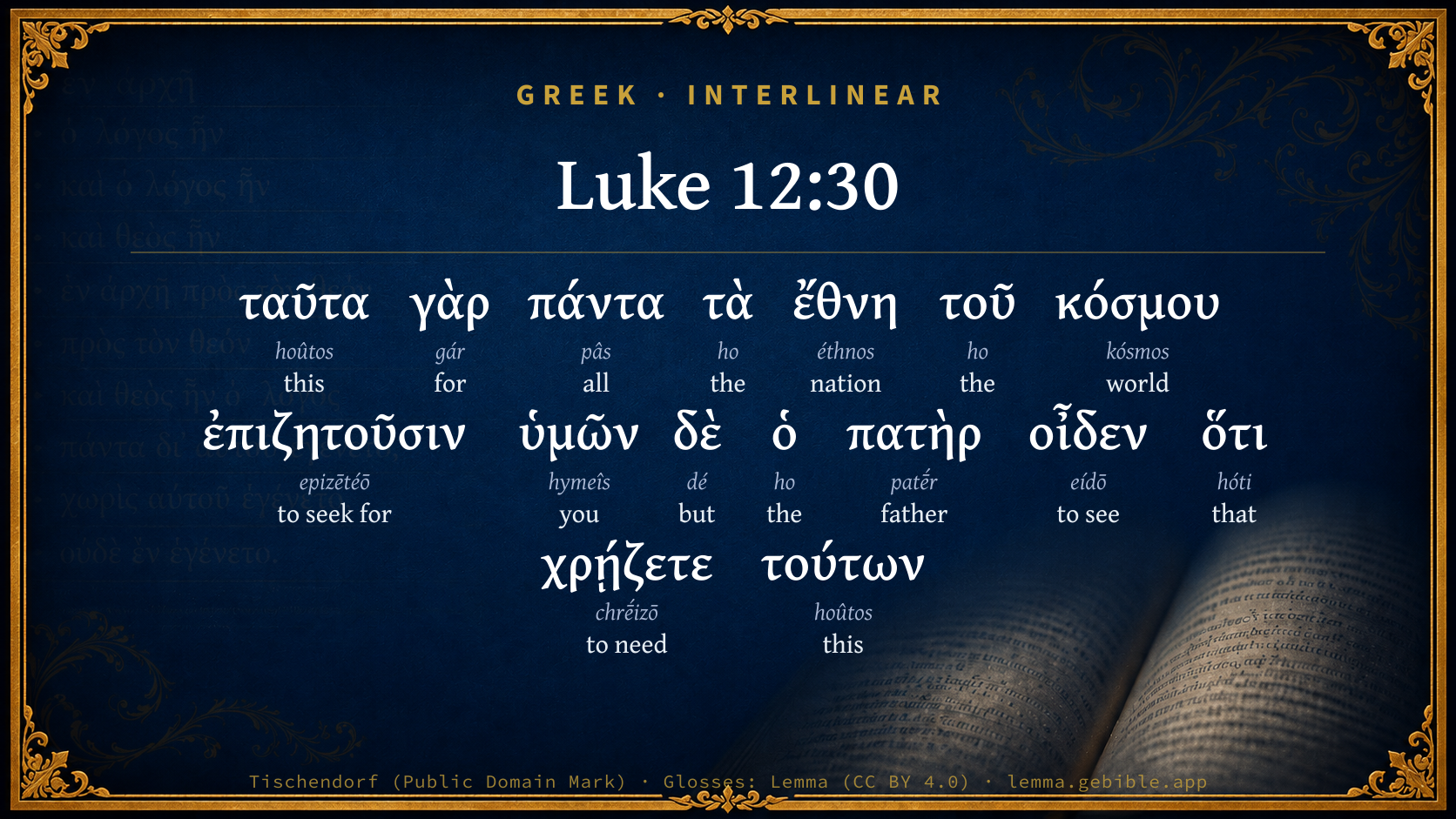
  1. ταῦτα hoûtos G3778 “this” Demonstrative pronoun, Accusative, Plural, Neuter
  2. γὰρ gár G1063 “for” Conjunction
  3. πάντα pâs G3956 “all” Adjective, Nominative, Plural, Neuter
  4. τὰ ho G3588 “the” Article, Nominative, Plural, Neuter
  5. ἔθνη éthnos G1484 “nation” Noun, Nominative, Plural, Neuter
  6. τοῦ ho G3588 “the” Article, Genitive, Singular, Masculine
  7. κόσμου kósmos G2889 “world” Noun, Genitive, Singular, Masculine
  8. ἐπιζητοῦσιν epizētéō G1934 “to seek for” Verb, Present, Active, Indicative, 3rd person, Plural
  9. ὑμῶν hymeîs G5210 “you” Personal pronoun, 2nd person, Genitive, Plural
  10. δὲ dé G1161 “but” Conjunction
  11. ὁ ho G3588 “the” Article, Nominative, Singular, Masculine
  12. πατὴρ patḗr G3962 “father” Noun, Nominative, Singular, Masculine
  13. οἶδεν eídō G1492 “to see” Verb, Perfect, Active, Indicative, 3rd person, Singular
  14. ὅτι hóti G3754 “that” Conjunction
  15. τούτων hoûtos G3778 “this” Demonstrative pronoun, Genitive, Plural, Neuter

About this verse

These counts appear in no published source. They are computed here, from the morphology-tagged text and Lemma’s own curated glosses. What Lemma adds →

16
words
13
distinct lemmas
Gospels
section

Notable vocabulary

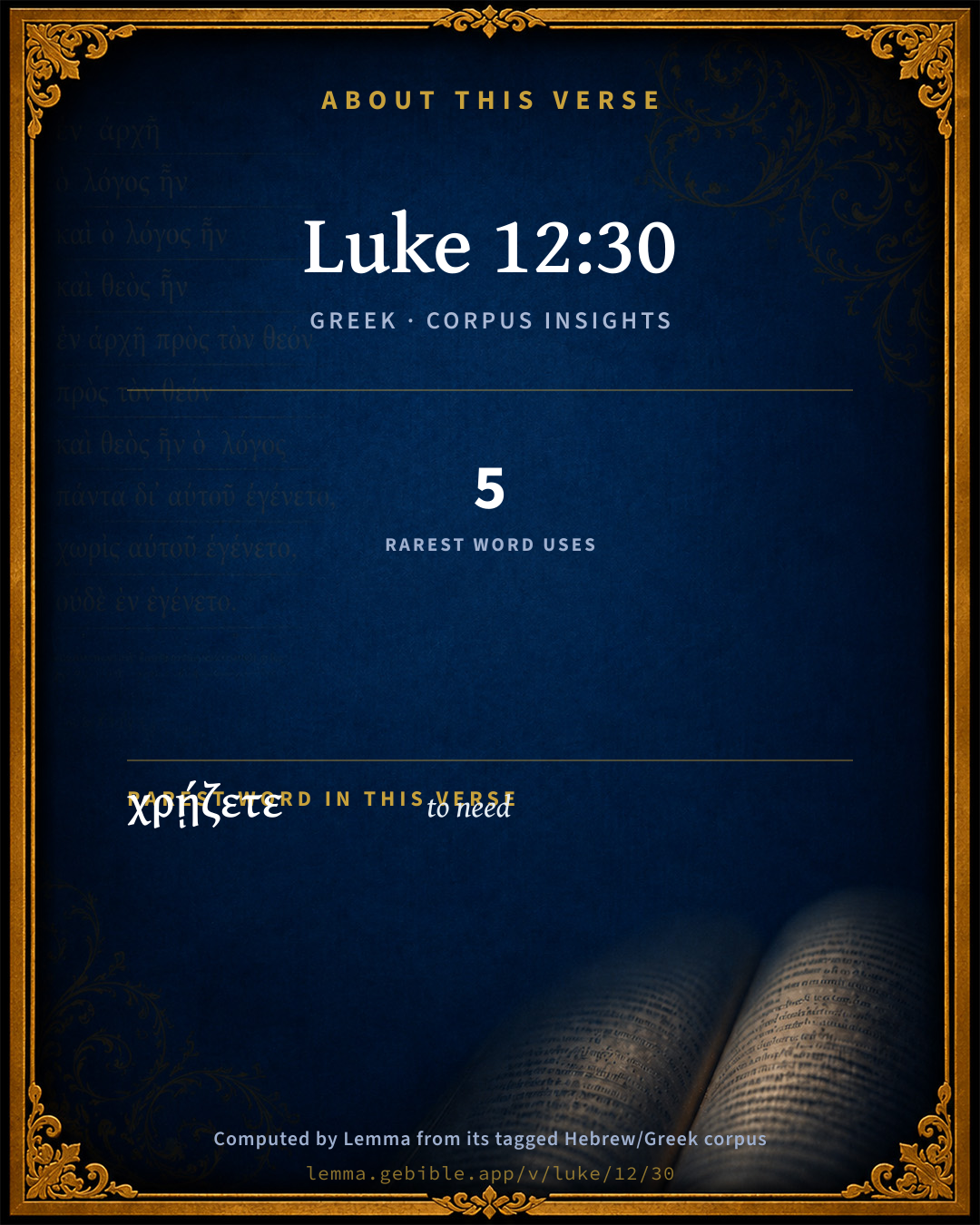
The rarest word here is χρῄζετε to need G5535 — appearing just 5 times in the whole Greek New Testament.

Shared distinctive vocabulary

χρῄζετε to need G5535 occurs in 5 verses of the Greek New Testament. Also found in:

Repetition

Words recur within this verse:

Cross-references

11

Topical passages linked to Luke 12:30 in the Treasury of Scripture Knowledge — connected by theme and wording, ordered by reader-vote popularity; previews shown in the World English Bible.

  • Matthew 6:32 For the Gentiles seek after all these things, for your heavenly Father knows that you need all these things.
  • Matthew 6:8 Therefore don't be like them, for your Father knows what things you need, before you ask him.
  • Luke 12:32 Don't be afraid, little flock, for it is your Father's good pleasure to give you the Kingdom.
  • Ephesians 4:17 This I say therefore, and testify in the Lord, that you no longer walk as the rest of the Gentiles also walk, in the futility of their mind,
  • Matthew 18:14 Even so it is not the will of your Father who is in heaven that one of these little ones should perish.
  • 1 Thessalonians 4:5 not in the passion of lust, even as the Gentiles who don't know God;
  • 1 Peter 4:2–4 that you no longer should live the rest of your time in the flesh for the lusts of men, but for the will of God.
  • Matthew 5:47 If you only greet your friends, what more do you do than others? Don't even the tax collectors do the same?
  • Matthew 10:20 For it is not you who speak, but the Spirit of your Father who speaks in you.
  • Matthew 6:1 "Be careful that you don't do your charitable giving before men, to be seen by them, or else you have no reward from your Father who is in heaven.
  • John 20:17 Jesus said to her, "Don't touch me, for I haven't yet ascended to my Father; but go to my brothers, and tell them, 'I am ascending to my Father and your Father, to my God and your God.'"

Cross-references courtesy of OpenBible.info (CC BY 4.0).

Commentary

Notes on Luke 12:30 from classic Christian and Jewish commentators (each source and its license shown beneath its notes). The classic Christian expositions comment on the surrounding passage and are grouped to its opening verse, so a note may address several verses; the Jewish commentaries on the Tanakh (Rashi and others) are per-verse, so they appear only where the commentator wrote on this verse.

Lemma curates 59 commentaries, every one of them public domain or Creative Commons licensed, each selected and text-cleaned for this edition rather than reprinted as found. About our sources →

MacLaren's Expositions of Holy Scripture

Alexander MacLaren

Luke

ANXIOUS ABOUT EARTH, OR EARNEST ABOUT THE KINGDOM

Luk 12:22 - Luk 12:31.

The parable of the rich fool was spoken to the multitude, but our Lord now addresses the disciples. ‘Therefore’ connects the following with the foregoing teachings. The warnings against anxiety are another application of the prohibition of laying up treasure for self. Torturing care is the poor man’s form of worldliness, as luxurious self-indulgence is the rich man’s. There are two kinds of gout, as doctors tell us-one from high living, and one from poverty of blood. This passage falls into two parts-the prohibition against anxious care {Luk 12:22 - Luk 12:31}, and the exhortation to set the affections on the true treasure {Luk 12:31 - Luk 12:34}.

I. The first part gives the condemnation of anxiety about earthly necessities.

The precept is first stated generally, and then followed by a series of reasons enforcing it. As to the precept, we may remark that the disciples were mostly poor men, who might think that they were in no danger of the folly branded in the parable. They had no barns bursting with plenty, and their concern was how to find food and clothing, not what to do with superfluities. Christ would have them see that the same temper may be in them, though it takes a different shape. Dives and Lazarus may be precisely alike.

The temper condemned here is ‘self-consuming care,’ the opposite of trust. Its misery is forcibly expressed by the original meaning of the Greek word, which implies being torn in pieces, and thus paints the distraction and self-inflicted harrassment which are the lot of the anxious mind. Prudent foresight and strenuous work are equally outside this prohibition. Anxiety is so little akin to foresight that it disables from exercising it, and both hinders from seeing what to do to provide daily bread, and from doing it.

The disciples’ danger of being thus anxious may be measured by the number and variety of reasons against it given by Jesus. The first of these is that such anxiety does not go deep enough, and forgets how we come to have lives to be fed and bodies to be clothed. We have received the greater, life and body, without our anxiety. The rich fool could keep his goods, but not his ‘soul’ or ‘life.’ How superficial, then, after all, our anxieties are, when God may end life at any moment! Further, since the greater is given, the less which it needs will also be given. The thought of God as ‘a faithful creator’ is implied. We must trust Him for the ‘more’; we may trust Him for the less.

The second reason bids us look with attention at examples of unanxious lives abundantly fed. Perhaps Elijah’s feathered providers, or the words of the Psalmist {Psa 147:9}, were in Christ’s mind. The raven was one of the ‘unclean’ birds, and of ill omen, from Noah’s days, and yet had its meat in due season, though that meat was corpses. Notice the allusions to the preceding parable in ‘sow not, neither reap,’ and in ‘neither have storehouse nor barn.’ In these particulars the birds are inferior to us, and, so to speak, the harder to care for. If they who neither work nor store still get their living, shall not we, who can do both? Our superior value is in part expressed by the capacity to sow and reap; and these are more wholesome occupations for a man than worrying.

How lovingly Jesus looked on all creatures, and how clearly He saw everywhere God’s hand at work! As Luther said, ‘God spends every year in feeding sparrows more than the revenues of the King of France.’

The third reason is the impotence of anxiety {Luk 12:25}. It is difficult to decide between the two possible renderings here. That of ‘a cubit’ to the ‘stature’ corresponds best with the growth of the lilies, while ‘age’ preserves an allusion to the rich fool, and avoids treating the addition of a foot and a half to an ordinary man’s height as a small thing. But age is not measured by cubits, and it is best to keep to ‘stature.’

At first sight, the argument of Luk 12:23 seems to be now inverted, and what was ‘more’ to be now ‘least.’ But the supposed addition, if possible, would be of the smallest importance as regards ensuring food or clothing, and measured by the divine power required to effect it, is less than the continual providing which God does. That smaller work of His, no anxiety will enable us to do. How much less can we effect the complicated and wide-reaching arrangements needed to feed and clothe ourselves! Anxiety is impotent. It only works on our own minds, racking them in vain, but has no effect on the material world, not even on our own bodies, still less on the universe.

The fourth reason bids us look with attention at examples of unanxious existence clothed with beauty. Christ here teaches the highest use of nature, and the noblest way of looking at it. The scientific botanist considers how the lilies grow, and can tell all about cells and chlorophyll and the like. The poet is in raptures with their beauty. Both teach us much, but the religious way of looking at nature includes and transcends both the others. Nature is a parable. It is a visible manifestation of God, and His ways there shadow His ways with us, and are lessons in trust.

The glorious colours of the lily come from no dyer’s vats, nor the marvellous texture of their petals from any loom. They are inferior to us in that they do not toil or spin, and in their short blossoming time. Man’s ‘days are as grass; as a flower of the field so he flourisheth’; but his date is longer, and therefore he has a larger claim on God. ‘God clothes the grass of the field’ is a truth quite independent of scientific truths or hypotheses about how He does it. If the colours of flowers depend on the visits of insects, God established the dependence, and is the real cause of the resulting loveliness.

The most modern theories of the evolutionist do not in the least diminish the force of Christ’s appeal to creation’s witness to a loving Care in the heavens. But that appeal teaches us that we miss the best and plainest lesson of nature, unless we see God present and working in it all, and are thereby heartened to trust quietly in His care for us, who are better than the ravens because we have to sow and reap, or than the lilies because we must toil and spin.

Luk 12:29 adds to the reference to clothing a repeated prohibition as to the other half of our anxieties, and thus rounds off the whole with the same double warning as in verse 22. But it gives a striking metaphor in the new command against ‘being of doubtful mind.’ The word so rendered means to be lifted on high, and thence to be tossed from height to depth, as a ship in a storm. So it paints the wretchedness of anxiety as ever shuttlecocked about between hopes and fears, sometimes up on the crest of a vain dream of good, sometimes down in the trough of an imaginary evil. We are sure to be thus the sport of our own fancies, unless we have our minds fixed on God in quiet trust, and therefore stable and restful.

Luk 12:30 gives yet another reason against not only anxiety, but against that eager desire after outward things which is the parent of anxiety. If we ‘seek after’ them, we shall not be able to avoid being anxious and of doubtful mind. Such seeking, says Christ, is pure heathenism. The nations of the world who know not God make these their chief good, and securing them the aim of their lives. If we do the like, we drop to their level. What is the difference between a heathen and a Christian, if the Christian has the same objects and treasures as the heathen? That is a question which a good many so-called Christians at present would find it hard to answer.

But the crowning reason of all is kept for the last. Much of what precedes might be spoken by a man who had but the coldest belief in Providence. But the great and blessed faith in our Father, God, scatters all anxious care. How should we be anxious if we know that we have a Father in heaven, and that He knows our needs? He recognises our claims on Him. He made the needs, and will send the supply. That is a wide truth, stretching far beyond the mere earthly wants of food and raiment. My wants, so far as God has made me to feel them, are prophecies of God’s gifts. He has made them as doors by which He will come in and bless me. How, then, can anxious care fret the heart which feels the Father’s presence, and knows that its emptiness is the occasion for the gift of a divine fullness? Trust is the only reasonable temper for a child of such a father. Anxious care is a denial of His love or knowledge or power.

II. Luk 12:31 - Luk 12:34 point out the true direction of effort and affection, and the true way of using outward good so as to secure the higher riches.

It is useless to tell men not to set their longings or efforts on worldly things unless you tell them of something better. Life must have some aim, and the mind must turn to something as supremely good. The only way to drive out heathenish seeking after perishable good is to fill the heart with the love and longing for eternal and spiritual good. The ejected demon comes back with a troop at his heels unless his house be filled. To seek ‘the kingdom,’ to count it our highest good to have our wills and whole being bowed in submission to the loving will of God, to labour after entire conformity to it, to postpone all earthly delights to that, and to count them all but loss if we may win it-this is the true way to conquer worldly anxieties, and is the only course of life which will not at last earn the stern judgment, ‘Thou fool.’

That direction of all our desires and energies to the attainment of the kingdom which is the state of being ruled by the will of God, is to be accompanied with joyous, brave confidence. How should they fear whose desires and efforts run parallel with the ‘Father’s good pleasure’? They are seeking as their chief good what He desires, as His chief delight, to give them. Then they may be sure that, if He gives that, He will not withhold less gifts than may be needed. He will not ‘spoil the ship for a ha’p’orth of tar,’ nor allow His children, whom He has made heirs of a kingdom, to starve on their road to their crown. If they can trust Him to give them the kingdom, they may surely trust Him for bread and clothes.

Mark, too, the tenderness of that ‘little flock.’ They might fear when they contrasted their numbers with the crowds of worldly men; but, being a flock, they have a shepherd, and that is enough to quiet anxiety.

Seeking and courage are to be crowned by surrender of outward good and the use of earthly wealth in such manner as that it will secure an unfailing treasure in heaven. The manner of obeying this command varies with circumstances. For some the literal fulfilment is best; and there are more Christian men to-day whose souls would be delivered from the snares if they would part with their possessions than we are willing to believe.

Sometimes the surrender is rather to be effected by the conscientious consecration and prayerful use of wealth. That is for each man to settle for himself. But what is not variable is the obligation to set the kingdom high above all else, and to use all outward wealth, as Christ’s servants, not for luxury and self-gratification, but as in His sight and for His glory. Let us not be afraid of believing what Jesus and His Apostles plainly teach, that wealth so spent here is treasured in heaven, and that a Christian’s place in the future life depends upon this among other conditions-how he used his money here.

Alexander MacLaren, Expositions of Holy Scripture (1904–1910) — public domain. Text from a community e-Sword module.

Tyndale Open Study Notes

Tyndale Open Resources

12:30 unbelievers: Greek ethnē, sometimes translated “the nations” or “the Gentiles.” To a Jewish audience, it meant all who were not God’s people.

Tyndale Open Study Notes — © Tyndale Open Resources, licensed CC BY-SA 4.0. Text via the HelloAO Bible API.

Bengel's Gnomon

Johann Albrecht Bengel

Luk 12:30. Πάντα) Construe with ταῦτα.

Bengel's Gnomon of the New Testament — English translation (T&T Clark, Edinburgh, 1860) — public domain. Text from a community e-Sword module.

Expositor's Greek Testament

ed. W. Robertson Nicoll

Luk 12:30 . τ . ἔ . τοῦ κόσμου , the nations of the world ; this addition is peculiar to Lk., the expression here only in N.T., but frequent with the Rabbis (Lightfoot, ad loc. ); meaning with them the peoples of the outside world as distinct from the Jews; here probably all (Jews included) but Christians. On the thought vide on Mt.

The Expositor's Greek Testament, edited by W. Robertson Nicoll (1897–1910) — public domain. Text from a community e-Sword module.

Adam Clarke's Commentary

Verse 30. The nations of the world seek after] Or, earnestly seek, επιζητει from επι above, over, and ζητεω, I seek; to seek one thing after another, to be continually and eagerly coveting. This is the employment of the nations of this world, utterly regardless of God and eternity! It is the essence of heathenism to live only for this life; and it is the property of Christianity to lead men to live here in reference to another and better world. Reader! how art thou living?

Dr. Lightfoot observes on this place, that κοσμος, the world, and αιων, world or age, have a meaning in the sacred writings which they have not in profane authors. αιων has relation to the Jewish ages, and κοσμος to the ages that are not Jewish: hence, by συντελεια του αιωνος, Mt 24:3, is meant the end of the Jewish age or world: and προ χρονων αιωνιων, Tit 1:2, means before the Jewish world began; and hence it is that the term world is very often, in the New Testament, to be understood only of the Gentiles.

Adam Clarke's Commentary on the Bible (1810–1826) — public domain. Text from a community e-Sword/MySword module.

The Cambridge Bible for Schools and Colleges

gen. ed. J. J. S. Perowne

30. the nations of the world] But you have not the same excuse that the heathen have for over-anxiety about transient needs.

The Cambridge Bible for Schools and Colleges (gen. ed. J. J. S. Perowne; Cambridge University Press, 1878–1918) — public domain. Text from a community e-Sword module.

John Gill's Exposition

For all these things do the nations of the world seek after,.... That is, the Gentiles, as in Mat 6:32 who are frequently, in the Jewish writings, called, in distinction from the Jews, , "the nations of the world" (s). This is an argument used to dissuade from an immediate and anxious concern for food and raiment, because it is Heathenish, and therefore very unbecoming the disciples and followers of Christ: it need not be wondered at in those that know not God, and do not acknowledge his providence, and are strangers to his covenant and promises; but must be very unsuitable to the characters of such who know that godliness has the promise of this life, and of that which is to come:

and your Father knoweth that ye have need of these things; and therefore it is needless to be so anxious about them: the Persic version reads, "all these things", and so some copies; that is, meat, drink, and clothing, all the necessaries of life; See Gill on Mat 6:32.

(s) Vid. T. Bab. Gittin, fol. 28. 2. & 29.

John Gill's Exposition of the Whole Bible (1746–1763) — public domain (CC PDM 1.0). Text via the HelloAO Bible API.

Cambridge Greek Testament for Schools and Colleges

30. τὰ ἔθνη τοῦ κόσμου. Christians have not the same excuse that the heathen have for over-anxiety about transient needs.

Cambridge Greek Testament for Schools and Colleges (Cambridge University Press, 1896; 21 vols, various authors incl. Carr, Maclear, Plummer, Farrar, Lumby, Moule, M. R. James, Simcox) — public domain. Text from a community e-Sword module.

International Critical Commentary

30. ταῦτα γὰρ πάντα. This is the right combination; not πάντα τὰ ἔθνη: hæc enim omnia gentes mundi quærunt. The heathen seek anxiously after all these things, because they know nothing of God’s providential care. The phrase τὰ ἔθνη τοῦ κόσμου occurs nowhere else in N.T. or LXX, but represents an Aramaic expression common in Rabbinical writings.

The plural verb shows that the different nations are considered distributively; and the compound expresses the anxiety with which they seek. Each nation seeks laboriously after the sum-total of these things. On the difference between ταῦτα πάντα here and πάντα ταῦτα, Mat 6:32, see Win. lxi. 2, b, p. 686. In both places ἐπιζητοῦσιν is the true reading, and ἐπιζητεῖ a grammatical correction.

ὑμῶν δὲ ὁ πατήρ. But you, who know that you have such a Father, have no need to be disturbed about these wants.

International Critical Commentary — older volumes (1896–1929), various authors — public domain. Text from a community e-Sword module.

Lesson kit

Teaching starters — assembled from the data on this page, not authored interpretation. Every prompt links to the verse data it draws on. Edit before teaching.

Luke, in the Gospels, opens this verse with 16 words (13 distinct Greek lemmas). Its most distinctive word is chrḗizō (“to need”). A historical commentator’s framing appears above. Read the whole chapter for the surrounding context.

Discussion questions

  1. How does “to need” (chrḗizō) shape what this verse is saying?
  2. How does Matthew 6:32, which shares the word «to need», read alongside this verse?
  3. What does the repetition of “the” (3× in this one verse) do in this verse?
  4. These translations render this verse differently. What is at stake in choosing one wording over another?
  5. Compare how MacLaren's Expositions of Holy Scripture and Tyndale Open Study Notes read this verse. Where do they agree or differ?

Things to notice

Reading settings

Reading text

Shown beneath each verse's original-language words.

Old Testament
Old Testament edition

Read the OT as the Masoretic Hebrew (MT) or the Greek Septuagint (LXX).

English shown for the Greek Septuagint (in the Hebrew ↔ Greek comparison).

Comparing translations? Open the Compare panel on any verse page to stack up to four side by side.