John 6:49

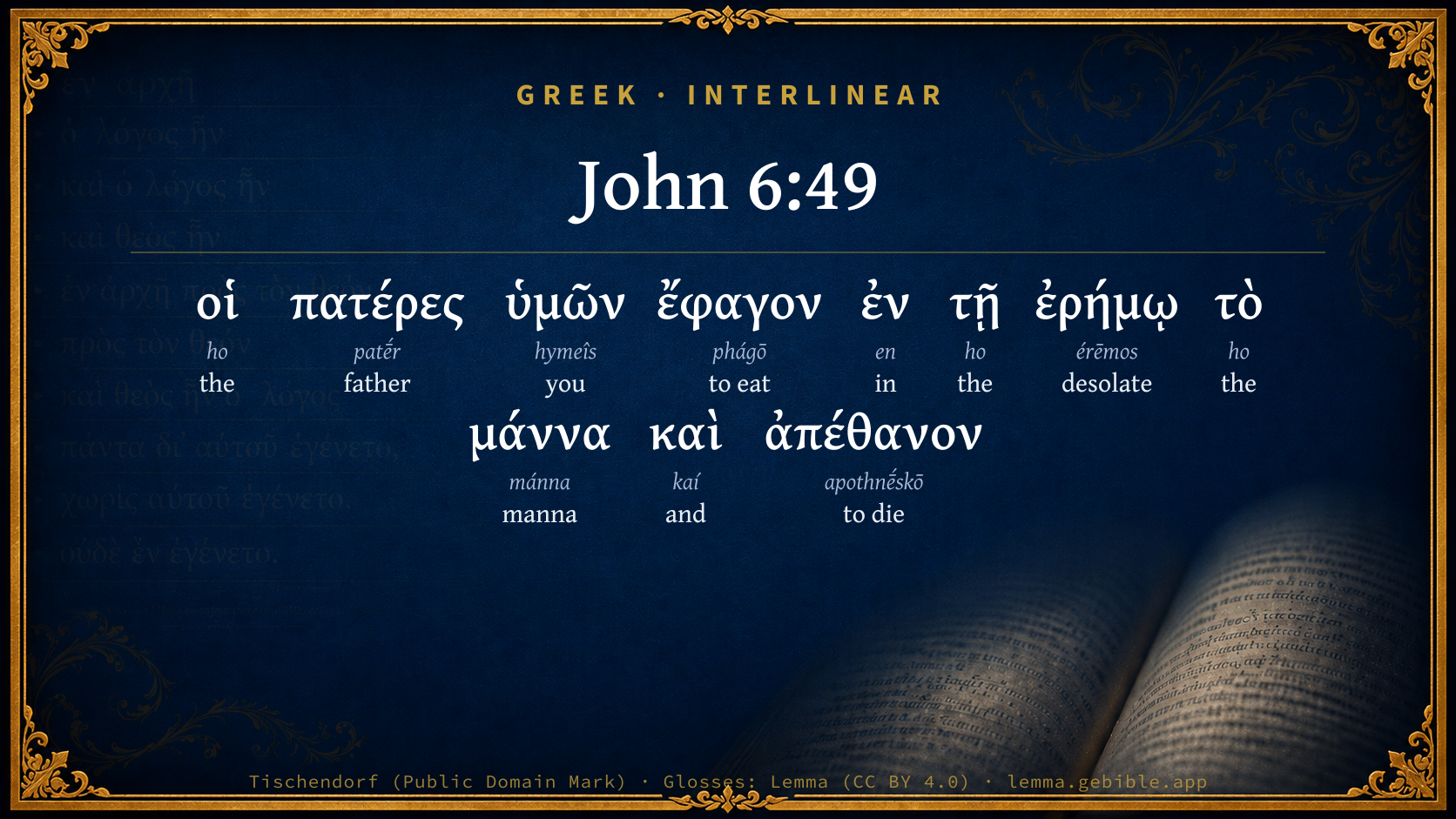
Greek (Tischendorf 8th ed.) John 6:49 appears in the Greek New Testament. The text above is from the Tischendorf 8th edition. Each word links to its Strong’s number and a concise gloss. Click any word for its full Thayer’s Greek Lexicon entry.
Download image
Cite this verse

John 6:49 (World English Bible). Public Domain. Lemma interlinear Bible study tool, https://lemma.gebible.app/v/john/6/49.

Show BibTeX & RIS
BibTeX
RIS
English Translation
Your fathers ate the manna in the wilderness, and they died.
World English Bible · Public Domain
Download a study sheet

One document with this verse’s original text, its word-by-word gloss line, the meaning frame, cross-references with their text, attributed commentary, and full source and license credits — printable, and it pastes into notes with its structure intact.

This verse Autodidact and up

Study sheet (.html) Plain text (.txt)

A passage Seminary Student

Up to 50 verses in one chapter. A passage sheet keeps up to 6 commentary sources and 12 cross-references per verse, in the order this page ranks them, and says so on the sheet whenever that leaves anything out. Ask for a single verse and you get the Autodidact verse sheet above.

Everything on this page stays free to read, with no account — the sheet is a download of what is already on screen, not access to it.

Want to remove ads? Support Godless Engineer
Compare translations 3

The same verse in 3 English versions, stacked beneath the original-language interlinear above. Click any original word for its lexicon entry.

Each is an independent rendering of the whole verse — the interlinear is not word-aligned to these translations.

Highlighted words mark where these versions differ — a whole-verse word diff, not a word-by-word alignment.

  • World English Bible Public Domain
    Your fathers ate the manna in the wilderness, and they died.
  • King James Version Public Domain
    Your fathers did eat manna in the wilderness, and are dead.
  • unfoldingWord Literal Text CC BY-SA 4.0
    Your fathers ate the manna in the wilderness, and they died.

unfoldingWord Literal Text — © unfoldingWord, licensed CC BY-SA 4.0. Word-aligned USFM3 via Door43 (git.door43.org/unfoldingWord/en_ult).

Versions to compare (up to 4)

3 of 4 selected

Show all 19 translations

Every available English version of this verse, each an independent rendering of the whole verse.

  • World English Bible Public Domain
    Your fathers ate the manna in the wilderness, and they died.
  • Berean Standard Bible Public Domain
    Your fathers ate the manna in the wilderness, yet they died.
  • Majority Standard Bible Public Domain
    Your fathers ate the manna in the wilderness, yet they died.
  • King James Version Public Domain
    Your fathers did eat manna in the wilderness, and are dead.
  • American Standard Version (1901) Public Domain
    Your fathers ate the manna in the wilderness, and they died.
  • Revised Version (1885) Public Domain
    Your fathers did eat the manna in the wilderness, and they died.
  • Geneva Bible (1599) Public Domain
    Your fathers did eate Manna in the wildernesse, and are dead.
  • Douay-Rheims (1899) Public Domain
    Your fathers did eat manna in the desert, and are dead.
  • Young's Literal Translation Public Domain
    your fathers did eat the manna in the wilderness, and they died;
  • Literal Standard Version CC BY-SA 4.0
    your fathers ate the manna in the wilderness and they died;
  • Unlocked Literal Bible CC BY-SA 4.0
    Your fathers ate the manna in the wilderness, and they died.
  • unfoldingWord Literal Text CC BY-SA 4.0
    Your fathers ate the manna in the wilderness, and they died.
  • Darby Bible Public Domain
    Your fathers ate the manna in the wilderness and died.
  • World Messianic Bible Public Domain
    Your fathers ate the manna in the wilderness and they died.
  • Webster's Bible Public Domain
    Your fathers ate manna in the wilderness, and are dead.
  • Free Bible Version CC BY-SA 4.0
    Your forefathers ate manna in the desert but they still died.
  • Bible in Basic English Public Domain
    Your fathers took the manna in the waste land--and they are dead.
  • Text-Critical English NT CC BY 4.0
    Your fathers ate the manna in the wilderness, and died.
  • Tyndale New Testament (1534) Public Domain
    Youre fathers dyd eate Mana in the wildernes and are deed.

Literal Standard Version (2020), Covenant Press — licensed CC BY-SA 4.0. Text via the HelloAO Bible API (eBible.org). Unlocked Literal Bible (unfoldingWord) — licensed CC BY-SA 4.0. Text via the HelloAO Bible API (eBible.org). unfoldingWord Literal Text — © unfoldingWord, licensed CC BY-SA 4.0. Word-aligned USFM3 via Door43 (git.door43.org/unfoldingWord/en_ult). Free Bible Version, Dr. Jonathan Gallagher — licensed CC BY-SA 4.0. Text via the HelloAO Bible API (eBible.org).

Word by word

More ways to search: Search by grammar → Find every occurrence → Compare this word →

Practice this passage: Drill this verse → Learn its vocabulary →

About this verse

These counts appear in no published source. They are computed here, from the morphology-tagged text and Lemma’s own curated glosses. What Lemma adds →

11
words
9
distinct lemmas
Gospels
section

Notable vocabulary

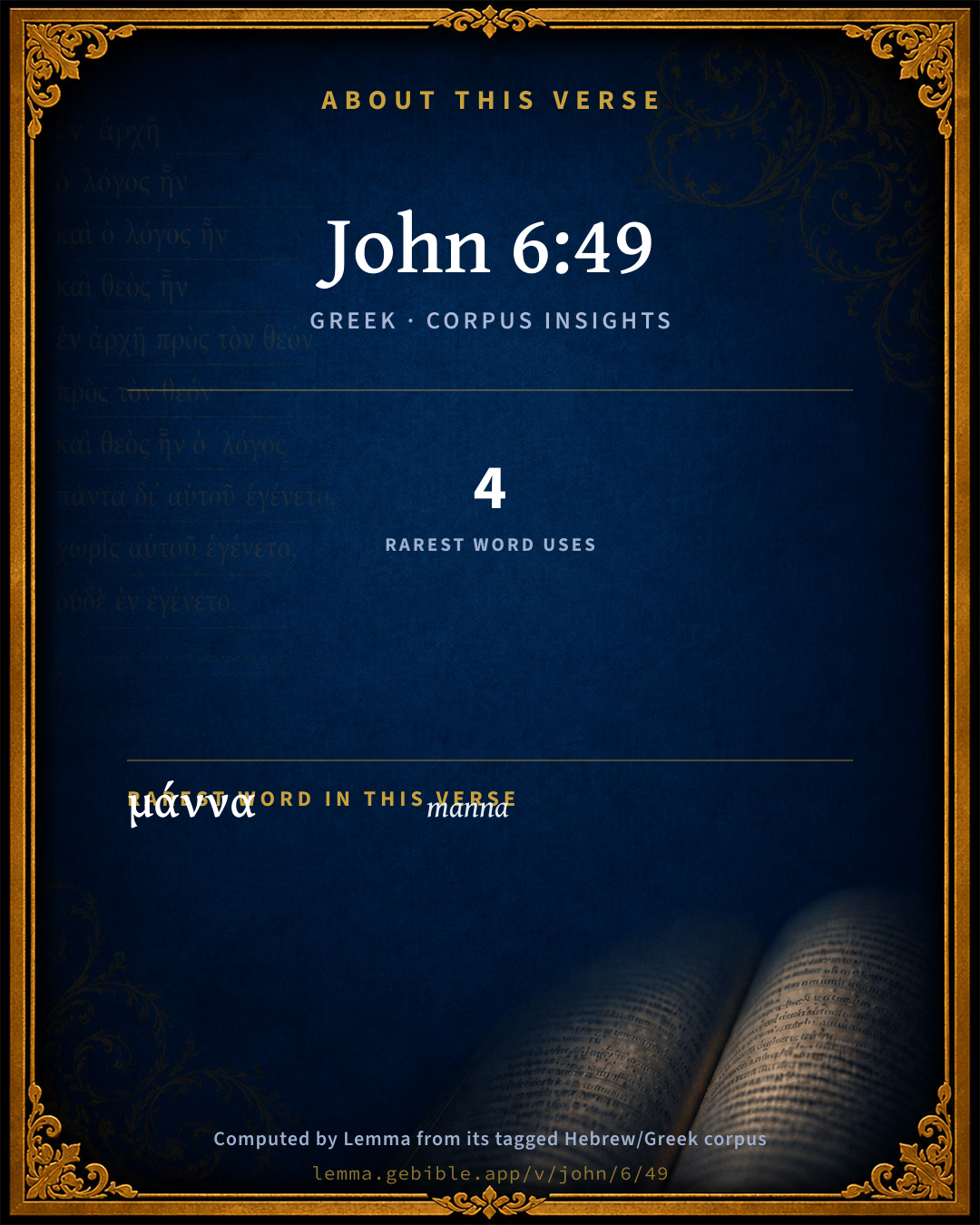
The rarest word here is μάννα manna G3131 — appearing just 4 times in the whole Greek New Testament.

Shared distinctive vocabulary

μάννα manna G3131 occurs in 4 verses of the Greek New Testament. Also found in:

Repetition

A word recurs within this verse:

Cross-references

7

Topical passages linked to John 6:49 in the Treasury of Scripture Knowledge — connected by theme and wording, ordered by reader-vote popularity; previews shown in the World English Bible.

  • Jude 1:5 Now I desire to remind you, though you already know this, that the Lord, having saved a people out of the land of Egypt, afterward destroyed those who didn't believe.
  • 1 Corinthians 10:3–5 and all ate the same spiritual food;
  • Hebrews 3:17–19 With whom was he displeased forty years? Wasn't it with those who sinned, whose bodies fell in the wilderness?
  • Numbers 26:65 For Yahweh had said of them, They shall surely die in the wilderness. There was not left a man of them, save Caleb the son of Jephunneh, and Joshua the son of Nun.
  • Zechariah 1:5 Your fathers, where are they? And the prophets, do they live forever?
  • John 6:31 Our fathers ate the manna in the wilderness. As it is written, 'He gave them bread out of heaven to eat.'"
  • John 6:58 This is the bread which came down out of heaven-- not as our fathers ate the manna, and died. He who eats this bread will live forever."

Cross-references courtesy of OpenBible.info (CC BY 4.0).

Commentary

Notes on John 6:49 from classic Christian and Jewish commentators (each source and its license shown beneath its notes). The classic Christian expositions comment on the surrounding passage and are grouped to its opening verse, so a note may address several verses; the Jewish commentaries on the Tanakh (Rashi and others) are per-verse, so they appear only where the commentator wrote on this verse.

Lemma curates 59 commentaries, every one of them public domain or Creative Commons licensed, each selected and text-cleaned for this edition rather than reprinted as found. About our sources →

The Cambridge Bible for Schools and Colleges

gen. ed. J. J. S. Perowne

49. Christ answers them out of their own mouths. They had spoken of the manna as superior to the multiplied loaves and fishes; but the manna did not preserve men from death. The same word is used both in Joh_6:49 and Joh_6:50; therefore for ‘are dead’ it will be better to substitute died. Moreover, the point is, not that they are dead now, but that they perished then; the manna did not save them. They ate the manna and died.

The Cambridge Bible for Schools and Colleges (gen. ed. J. J. S. Perowne; Cambridge University Press, 1878–1918) — public domain. Text from a community e-Sword module.

Tyndale Open Study Notes

Tyndale Open Resources

6:49-50 Jesus connected the manna of the Exodus with himself, then pointed out a major difference: The Israelites remained mortal and they all died, whereas the bread from heaven (Jesus himself) provides eternal life (6:47, 51, 58).

Tyndale Open Study Notes — © Tyndale Open Resources, licensed CC BY-SA 4.0. Text via the HelloAO Bible API.

Bengel's Gnomon

Johann Albrecht Bengel

Joh 6:49. Οἱ πατέρες, your fathers) concerning whom ye have spoken, Joh 6:31, “Our fathers did eat manna,” etc.—ὑμῶν, your) Your, He saith, not our: by which very expression He shows, that He has a higher descent than they had supposed; Joh 6:42, “Is not this Jesus, the son of Joseph?”—ἔφαγον τὸ μάννα ἐν τῇ ἐρήμῳ, did eat manna in the wilderness) Their own very words are retorted on the Jews; see Joh 6:31.—καὶ ἀπέθανον) and yet they died, and that by a terrible death.

Bengel's Gnomon of the New Testament — English translation (T&T Clark, Edinburgh, 1860) — public domain. Text from a community e-Sword module.

Meyer's Critical & Exegetical Commentary

Heinrich August Wilhelm Meyer

Joh_6:49-50. Οἱ πατέρες, κ.τ.λ.] regeruntur Judaeis verba ipsorum Joh_6:31, Bengel.

ἀπέθανον … ἀποθάνῃ] a diversity in the reference which is full of meaning: loss of earthly life, loss of eternal life, whose development, already begun in time (see on Joh_3:15), the death of the body does not interrupt (Joh_11:25).

οὗτός ἐστιν ὁ ἄρτος, κ.τ.λ.] of this nature is the bread which cometh down from heaven: one (τὶς) must eat thereof, and (in consequence of this eating) not die. This representation is contained in οὗτος … ἵνα; see on Joh_6:29. The expression, however, is not conditional (ἐάν τις), because the telic reference (ἵνα) does not belong to the last part merely. The present participle shows that Jesus does not mean by οὗτος His own concrete Personality, which is not named till Joh_6:51, but intends to set forth and exhibit the true bread from heaven generally, according to its real nature (comp. Joh_6:58). On τὶς, one, comp. Dem. Phil. i. 8, and Bremi, p. 118; Ellendt, Lex. Soph. II. 883; Nägelsbach on the Iliad, p. 299, ed. 3.

Meyer — Critical and Exegetical Commentary on the New Testament — English translation by Peter Christie, edited by Frederick Crombie (T&T Clark, 1880) — public domain. Text from a community e-Sword module.

Expositor's Greek Testament

ed. W. Robertson Nicoll

Joh 6:49-50 . οἱ πατέρες … μὴ ἀποθάνῃ , “Your fathers ate the manna in the desert and died: this is the bread which comes down out of heaven, that a man may eat of it and not die”. In other words: The manna which was given to your fathers to maintain them in physical, earthly life, could not assert its power against death, and maintain them continually in life. Your fathers died physically. The bread which comes down from heaven does not give physical life; it is not sent for that purpose, but the life which it is given to maintain, it maintains in continuance and precludes death. Taken in connection with the context, the words interpret themselves. Godet however says: “Jesus, both here and elsewhere, certainly denies even physical death in the case of the believer. Cf. Joh 8:51 . That which properly constitutes death, in what we call by this name, is the total cessation of moral and physical existence. Now this fact does not take place in the case of the believer at the moment when his friends see him die.” This seems to misrepresent the fact of death for the sake of misrepresenting the present passage.

The Expositor's Greek Testament, edited by W. Robertson Nicoll (1897–1910) — public domain. Text from a community e-Sword module.

Jamieson, Fausset & Brown

Robert Jamieson, A. R. Fausset & David Brown

Your fathers--of whom ye spake (Joh 6:31); not "ours," by which He would hint that He had a higher descent, of which they dreamt not [BENGEL].

did eat manna . . . and are dead--recurring to their own point about the manna, as one of the noblest of the ordained preparatory illustrations of His own office: "Your fathers, ye say, ate manna in the wilderness; and ye say well, for so they did, but they are dead--even they whose carcasses fell in the wilderness did eat of that bread; the Bread whereof I speak cometh down from heaven, which the manna never did, that men, eating of it, may live for ever."

Jamieson, Fausset & Brown — Commentary Critical and Explanatory on the Whole Bible (1871) — public domain (CC PDM 1.0). Text via the HelloAO Bible API.

Adam Clarke's Commentary

Verse 49. Your fathers did eat manna - and are dead.] That bread neither preserved their bodies alive, nor entitled them to life eternal; but those who receive my salvation, shall not only be raised again in the last day, but shall inherit eternal life. It was an opinion of the Jews themselves that their fathers, who perished in the wilderness, should never have a resurrection. Our Lord takes them on their own ground: Ye acknowledge that your fathers who fell in the wilderness shall never have a resurrection; and yet they ate of the manna: therefore that manna is not the bread that preserves to everlasting life, according even to your own concession.

Adam Clarke's Commentary on the Bible (1810–1826) — public domain. Text from a community e-Sword/MySword module.

John Calvin's Commentaries

49. Your fathers ate manna in the wilderness, and are dead. He says that the manna was a perishing food to their fathers, for it did not free them from death. It follows, therefore, that souls do not find anywhere else than in him that food by which they are fed to spiritual life. Besides, we must keep in remembrance what I formerly stated, that what is here said does not relate to the manna, so far as it was a secret figure of Christ; for in that respect Paul calls it spiritual food, (1 Corinthians 10:3.) But we have said that Christ here accommodates his discourse to the hearers, who, caring only about feeding the belly, looked for nothing higher in the manna. Justly, therefore does he declare that their fathers are dead, that is, those who in the same manner, were devoted to the belly, or, in other words, who thought of nothing higher than this world. And yet he invites them to eat, when he says that he has come, that any man may eat; for this mode of expression has the same meaning as if he said, that he is ready to give himself to all, provided that they are only willing to believe. That not one of those who have once eaten Christ shall die — must be understood to mean, that the life which he bestows on us is never extinguished, as we stated under the Fifth Chapter.

John Calvin's Commentaries (1540-1563) — public domain. Text from the Calvin Translation Society English edition (1840s-50s) via the Christian Classics Ethereal Library (ccel.org). Calvin's coverage is partial (roughly two-thirds of the Bible); uncommented books and verses are honest gaps, never fabricated. The 19th-century editor's footnotes and remarks are omitted so the notes are faithfully Calvin's own voice.

Ellicott's Commentary for English Readers

(49) Your fathers . . . and are dead.—Better, . . . and died.—The manna which their fathers ate (Joh_6:31) seemed to them a greater work than this which He has done. Its true relation to Him is shown in the fact that those who ate it afterwards died; whereas He is the true spiritual food for the world, and those who feed upon Him shall not afterwards die. That was manna, special in time and circumstance; this is bread, the true sustenance for all times and all circumstances. That seemed to them to come from heaven, and this from earth; but this outer earth-born form of flesh contains the true life, in the only way in which humanity could receive it. The life itself cometh down from heaven.

A Bible Commentary for English Readers, edited by Charles John Ellicott (1878–1897) — public domain. Text from a community e-Sword module.

John Gill's Exposition

I am the living bread which came down from heaven,.... This is the same with what is said in Joh 6:33, which is true of Christ, as he has life in him; and is the author and giver of life to others; and is of an heavenly original, and came from heaven to give life to men: and such is the virtue of this living and heavenly bread, that

if any man eat of this bread he shall live for ever; not a natural, but a spiritual life; a life of sanctification, which is begun here, and will be perfected hereafter; and a life of glory, which will never end:

and the bread that I will give is my flesh; or "body", as all the Oriental versions render it. Here our Lord explains more clearly and fully what he means, under the notion of bread; and which shows, that by bread he did not design merely his doctrine, but his flesh, his human nature; though not as abstracted from his deity, but as in union with it:

which I will give for the life of the world; and which he did by the offering up of his body, and making his soul, or giving himself an offering, a propitiatory sacrifice for sin; which was done in the most free and voluntary manner, in the room and stead of his people, to procure eternal life for them, even for the whole world of his elect; whether among Jews or Gentiles; particularly the latter are here meant, in opposition to a notion of the Jews, that the world, or the Gentiles, would receive no benefit by the Messiah when he came; See Gill on Joh 3:16.

John Gill's Exposition of the Whole Bible (1746–1763) — public domain (CC PDM 1.0). Text via the HelloAO Bible API.

Trapp's Complete Commentary

John Trapp

49 Your fathers did eat manna in the wilderness, and are dead.

Ver. 49. Did eat manna] They fed upon sacraments, and yet many of them perished eternally. A man may go to hell with font water on his face, and be haled from the table to the tormentor, as he, Mat 22:13.

Your fathers did eat, &c.] They sought only the satisfying of their bodily hunger, and they had it, but yet are dead. Manna could not immortalize them, as the poets feign their ambrosia did their dunghill deities. "Meats for the belly, and the belly for meats, but God will destroy both it and them." These mentioned in the text fed upon sacraments, and yet they died in God’s displeasure, 1Co 10:3; 1Co 10:5. The carcase of the sacrament cannot give life, but the soul of it, which is Christ; neither do the sacraments work as a medicine, whether men sleep or wake, by virtue inherent in them, ex opere operate, sed ex opere operantis, i.e. according to the disposition and qualification of the party that partaketh.

John Trapp, A Commentary or Exposition upon All the Books of the Old and New Testament (1647–1656) — public domain. Text from a community e-Sword module.

Albert Barnes' Notes on the Bible

Your fathers did eat manna - There was a real miracle performed in their behalf; there was a perpetual interposition of God which showed that they were his chosen people.

And are dead - The bread which they ate could not save them from death. Though God interfered in their behalf, yet they died. We may learn,

That that is not the most valuable of God’s gifts which merely satisfies the temporal wants. That the most distinguished temporal blessings will not save from death. Wealth, friends, food, raiment, will not preserve life. There is need of something better than mere earthly blessings; there is need of that bread which cometh down from heaven, and which giveth life to the world.

Albert Barnes' Notes on the Bible (1834–1885) — public domain. Text from a community e-Sword/MySword module.

Matthew Poole's English Annotations

Your fathers by nature, or in respect of unbelief, did eat manna in the wilderness, and they are naturally dead; (manna would not always preserve their natural life); and those of them who were unbelievers, are also dead eternally; their eating of manna, which was a type of me, without believing in me, would not save them.

Matthew Poole's English Annotations on the Holy Bible (1683–1685) — public domain. Text from a community e-Sword/MySword module.

Whedon's Commentary on the Bible

Daniel D. Whedon

49. Eat manna—Parallel to that manna is Christ; parallel to their living by manna is our life by Christ; parallel to their gathering and eating is our faith in receiving Christ; as in Joh_6:47.

Dead—There is one great opposition in the parallels: the manna gave but a transient earthly life; this true manna gives heavenly and eternal life.

Daniel D. Whedon (gen. ed.), Commentary on the Old and New Testaments (1874–1909) — public domain. Text from a community e-Sword module.

The Pulpit Commentary

Vers. 49, 50. Your fathers did eat the manna in the wilderness, and they died. The Lord went back to the very words of the Jews in ver. 31. The Heaven-given manna by which Jehovah sustained the temporal life of the fathers in the wilderness did not convey the antidote to death. "The carcases of these fathers fell in the wilderness." He does not say, "perished out of God"s sight forever," or were condemned, but that there was nothing in the eating of manna which arrested, or averted, or triumphed, over death; yet he added: This (Bread of life) is the Bread which cometh down from heaven, in order that any one (tiv) may eat thereof, and may not die. The eating of the Bread of life (the life-giving Bread), which I myself am, the thorough assimilation, the entire acceptance of me as God"s Gift of life to the world, confers the very principle of life; and, though a partaker may seem to perish, he does not die (cf. Joh 8:51-11:26, notes) he will not "taste of death," "he will never die." The life will be stronger than death; it will survive apparent extinction. Meyer says that here Christ reserves to ver. 51 the positive offer "of his own concrete Personality, and is exhibiting the true Bread, according to its real nature." Still he has said, "I am the life-giving Bread," and is undoubtedly preparing for the following announcement, which adds a new and startling thought, calculated to sustain the former one.

The Pulpit Commentary (1880–1919), ed. H.D.M. Spence-Jones & Joseph S. Exell — public domain. Text from a community e-Sword module.

Cambridge Greek Testament for Schools and Colleges

49. ἔφαγον … ἀπέθ. Ate the manna … and they died, see on Joh 8:52. The point is, not that they are dead now, but that they died then; the manna did not save them. He answers them out of their own mouths. On the other hand, the Bread of Life is a permanent source of spiritual life here and a pledge of resurrection hereafter.

Cambridge Greek Testament for Schools and Colleges (Cambridge University Press, 1896; 21 vols, various authors incl. Carr, Maclear, Plummer, Farrar, Lumby, Moule, M. R. James, Simcox) — public domain. Text from a community e-Sword module.

Alford’s Greek Testament

Henry Alford

49.] That bread from heaven had no power to keep off death, and that, death owing to unbelief:—our Lord by thus mentioning οἱ πατέρες ὑμῶν and their death, certainly hints at the similar unbelief of these Jews. And the same dubious sense of ἀποθάνῃ prevails in ver. 50. Death is regarded as being swallowed up in the glory of the resurrection, and the second death—which was hidden in the former ἀπέθανον—has over him who eats this Bread of Life, no power: nay, he is brought, even here, into a resurrection state from sin and death: see Rom_6. init. and Col_3 init.

Henry Alford, The Greek Testament (1849–1861) — public domain. Text from a community e-Sword module.

International Critical Commentary

49. The argument in vv. 49-51 is as follows: The manna which nourished the bodily life of the Israelites in the desert, did not secure them from physical death at last (see on v. 58). In this it was like ordinary bread, although divinely given. The Bread of Life, which Jesus offers in His own Person, has not to do with the nourishment of the bodily life, nor does it secure those who believe in Him from the death of the body. But it is the appropriate and divinely given nourishment of man’s spirit, and he who continually feeds on it—that is, he who continually keeps in spiritual touch with Jesus—is secure against spiritual death; he shall live for ever, having assimilated the true Bread of Life.

οἱ πατέρες ὑμῶν κτλ. They had said of οἱ πατέρες ἡμῶν κτλ. (v. 31), and this is the reply. Jesus does not say “our fathers,” but “your fathers”; cf. Ἀβραὰμ ὁ πατὴπ ὑῶν (8:58). See, however, for the phrase “your law,” on 8:17; and cf. v. 58 below.

ἐν τῇ ἐρήμῳ τὸ μάννα. So BCDTWΘ, but אALΓΔ have the order τὸ μάννα ἐν τῇ ἐρήμῳ as in v. 31.

καὶ ἀπέθανον, sc. of physical death; in v. 50 μὴ ἀποθανῃ refers to spiritual death. See v. 58.

International Critical Commentary — older volumes (1896–1929), various authors — public domain. Text from a community e-Sword module.

Vincent's Word Studies in the New Testament

Marvin R. Vincent

Are dead [απεθανον] . The aorist points, not to their present condition but to the historical fact; they died. So Rev.

Marvin R. Vincent, Word Studies in the New Testament (1887–1900) — public domain. Text from a community e-Sword/MySword module.

Lesson kit

Teaching starters — assembled from the data on this page, not authored interpretation. Every prompt links to the verse data it draws on. Edit before teaching.

John, in the Gospels, opens this verse with 11 words (9 distinct Greek lemmas). Its most distinctive word is mánna (“manna”). A historical commentator’s framing appears above. Read the whole chapter for the surrounding context.

Discussion questions

  1. What does “manna” (mánna) contribute to the verse as a whole?
  2. John 6:31 shares the word «manna» with this verse. How do the two illuminate each other?
  3. “the” occurs 3× in this one verse. What is the effect of the repetition?
  4. These translations render this verse differently. What is at stake in choosing one wording over another?
  5. Reading how The Cambridge Bible for Schools and Colleges and Tyndale Open Study Notes read this verse, where do the two commentators agree and where do they part?

Things to notice

  • These translations choose different wording for 5 words in this verse.
  • “the” occurs 3× in this single verse.
  • 9 distinct Greek lemmas span 11 words in this verse.

Reading settings

Reading text

Shown beneath each verse's original-language words.

Old Testament
Old Testament edition

Read the OT as the Masoretic Hebrew (MT) or the Greek Septuagint (LXX).

English shown for the Greek Septuagint (in the Hebrew ↔ Greek comparison).

Comparing translations? Open the Compare panel on any verse page to stack up to four side by side.