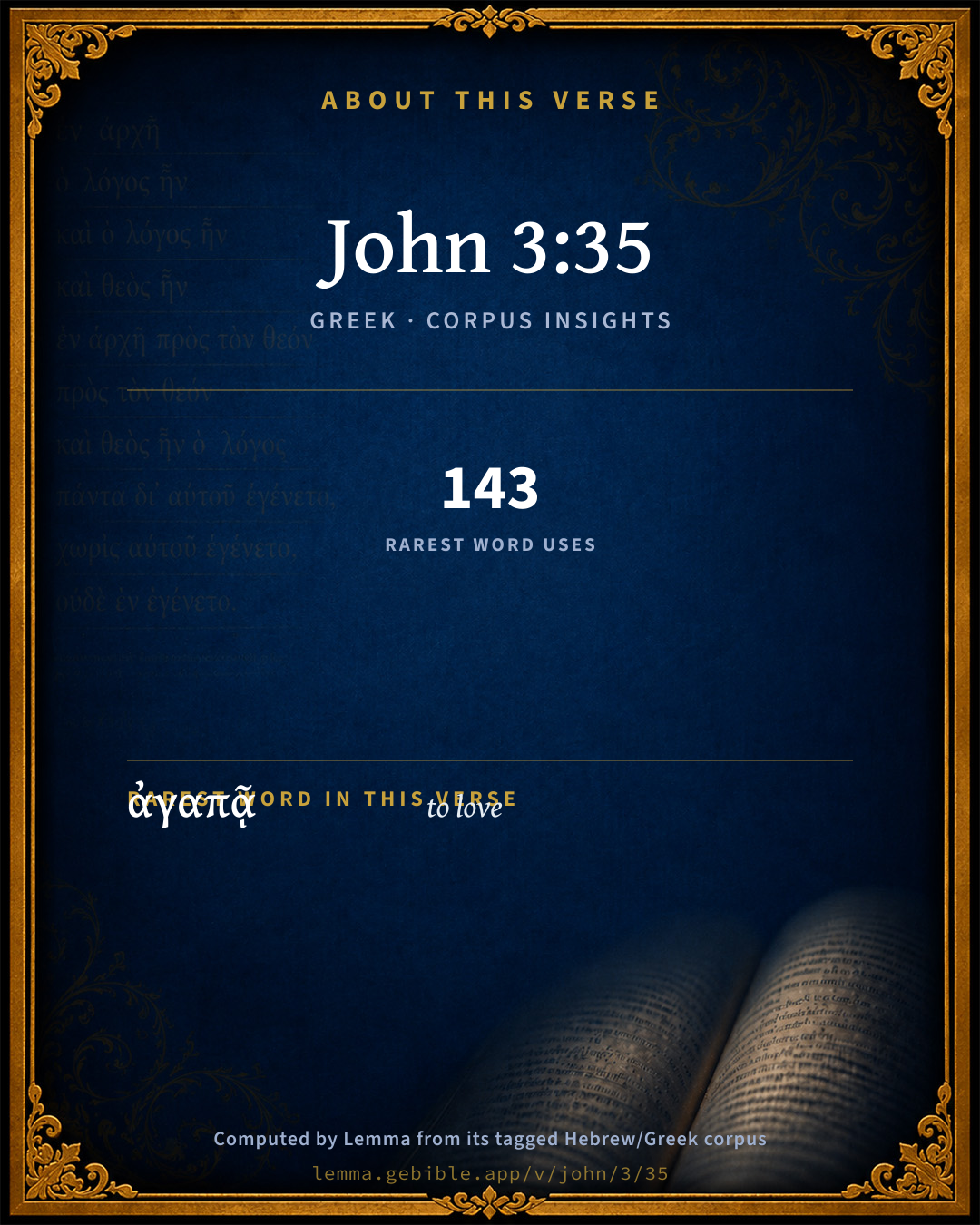
John 3:35

Greek (Tischendorf 8th ed.) John 3:35 appears in the Greek New Testament. The text above is from the Tischendorf 8th edition. Each word links to its Strong’s number and a concise gloss. Click any word for its full Thayer’s Greek Lexicon entry.
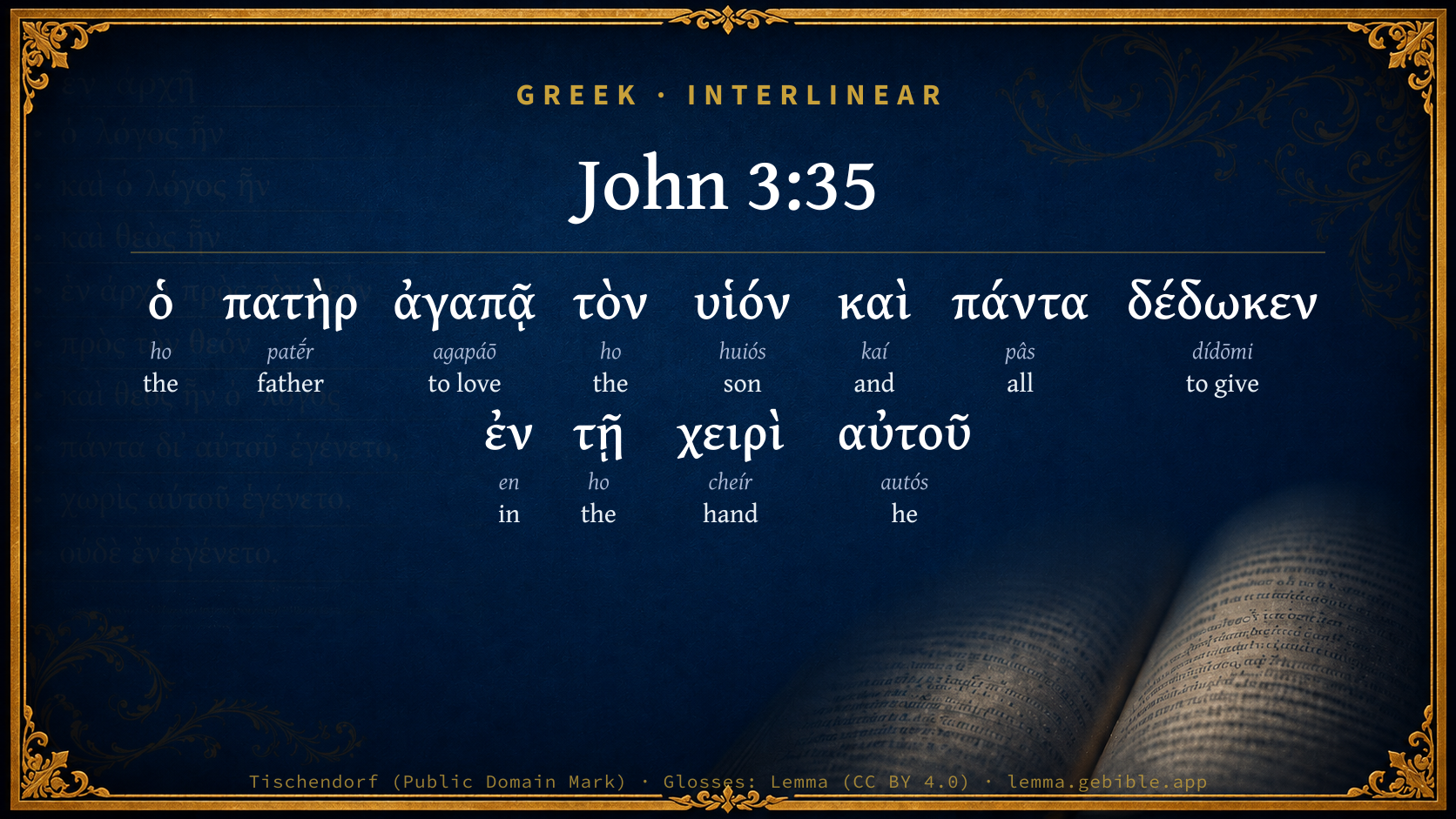
Download image
Cite this verse

John 3:35 (World English Bible). Public Domain. Lemma interlinear Bible study tool, https://lemma.gebible.app/v/john/3/35.

Show BibTeX & RIS
BibTeX
RIS
English Translation
The Father loves the Son, and has given all things into his hand.
World English Bible · Public Domain
Download a study sheet

One document with this verse’s original text, its word-by-word gloss line, the meaning frame, cross-references with their text, attributed commentary, and full source and license credits — printable, and it pastes into notes with its structure intact.

This verse Autodidact and up

Study sheet (.html) Plain text (.txt)

A passage Seminary Student

Up to 50 verses in one chapter. A passage sheet keeps up to 6 commentary sources and 12 cross-references per verse, in the order this page ranks them, and says so on the sheet whenever that leaves anything out. Ask for a single verse and you get the Autodidact verse sheet above.

Everything on this page stays free to read, with no account — the sheet is a download of what is already on screen, not access to it.

Want to remove ads? Support Godless Engineer
Compare translations 3

The same verse in 3 English versions, stacked beneath the original-language interlinear above. Click any original word for its lexicon entry.

Each is an independent rendering of the whole verse — the interlinear is not word-aligned to these translations.

Highlighted words mark where these versions differ — a whole-verse word diff, not a word-by-word alignment.

  • World English Bible Public Domain
    The Father loves the Son, and has given all things into his hand.
  • King James Version Public Domain
    The Father loveth the Son, and hath given all things into his hand.
  • unfoldingWord Literal Text CC BY-SA 4.0
    The Father loves the Son and has given all things into his hand.

unfoldingWord Literal Text — © unfoldingWord, licensed CC BY-SA 4.0. Word-aligned USFM3 via Door43 (git.door43.org/unfoldingWord/en_ult).

Versions to compare (up to 4)

3 of 4 selected

Show all 19 translations

Every available English version of this verse, each an independent rendering of the whole verse.

  • World English Bible Public Domain
    The Father loves the Son, and has given all things into his hand.
  • Berean Standard Bible Public Domain
    The Father loves the Son and has placed all things in His hands.
  • Majority Standard Bible Public Domain
    The Father loves the Son and has placed all things in His hands.
  • King James Version Public Domain
    The Father loveth the Son, and hath given all things into his hand.
  • American Standard Version (1901) Public Domain
    The Father loveth the Son, and hath given all things into his hand.
  • Revised Version (1885) Public Domain
    The Father loveth the Son, and hath given all things into his hand.
  • Geneva Bible (1599) Public Domain
    The Father loueth the Sonne, and hath giuen all things into his hande.
  • Douay-Rheims (1899) Public Domain
    The Father loveth the Son: and he hath given all things into his hand.
  • Young's Literal Translation Public Domain
    the Father doth love the Son, and all things hath given into his hand;
  • Literal Standard Version CC BY-SA 4.0
    the Father loves the Son, and has given all things into His hand;
  • Unlocked Literal Bible CC BY-SA 4.0
    The Father loves the Son and has given all things into his hand.
  • unfoldingWord Literal Text CC BY-SA 4.0
    The Father loves the Son and has given all things into his hand.
  • Darby Bible Public Domain
    The Father loves the Son, and has given all things [to be] in his hand.
  • World Messianic Bible Public Domain
    The Father loves the Son, and has given all things into his hand.
  • Webster's Bible Public Domain
    The Father loveth the Son, and hath given all things into his hand.
  • Free Bible Version CC BY-SA 4.0
    The Father loves the Son and has placed everything in his hands.
  • Bible in Basic English Public Domain
    The Father has love for the Son and has put all things into his hands.
  • Text-Critical English NT CC BY 4.0
    The Father loves the Son and has put all things in his hand.
  • Tyndale New Testament (1534) Public Domain
    The father loveth the sonne and hath geven all thinges into his honde.

Literal Standard Version (2020), Covenant Press — licensed CC BY-SA 4.0. Text via the HelloAO Bible API (eBible.org). Unlocked Literal Bible (unfoldingWord) — licensed CC BY-SA 4.0. Text via the HelloAO Bible API (eBible.org). unfoldingWord Literal Text — © unfoldingWord, licensed CC BY-SA 4.0. Word-aligned USFM3 via Door43 (git.door43.org/unfoldingWord/en_ult). Free Bible Version, Dr. Jonathan Gallagher — licensed CC BY-SA 4.0. Text via the HelloAO Bible API (eBible.org).

Word by word

More ways to search: Search by grammar → Find every occurrence → Compare this word →

Practice this passage: Drill this verse → Learn its vocabulary →

About this verse

These counts appear in no published source. They are computed here, from the morphology-tagged text and Lemma’s own curated glosses. What Lemma adds →

12
words
10
distinct lemmas
Gospels
section

Repetition

A word recurs within this verse:

Cross-references

24

Topical passages linked to John 3:35 in the Treasury of Scripture Knowledge — connected by theme and wording, ordered by reader-vote popularity; previews shown in the World English Bible.

  • Matthew 28:18 Jesus came to them and spoke to them, saying, "All authority has been given to me in heaven and on earth.
  • Luke 10:22 Turning to the disciples, he said, "All things have been delivered to me by my Father. No one knows who the Son is, except the Father, and who the Father is, except the Son, and he to whomever the Son desires to reveal him."
  • John 5:20 For the Father has affection for the Son, and shows him all things that he himself does. He will show him greater works than these, that you may marvel.
  • John 5:22 For the Father judges no one, but he has given all judgment to the Son,
  • Matthew 11:27 All things have been delivered to me by my Father. No one knows the Son, except the Father; neither does anyone know the Father, except the Son, and he to whom the Son desires to reveal him.
  • John 17:2 even as you gave him authority over all flesh, he will give eternal life to all whom you have given him.
  • Ephesians 1:22 He put all things in subjection under his feet, and gave him to be head over all things for the assembly,
  • Psalms 2:8 Ask of me, and I will give the nations for your inheritance, The uttermost parts of the earth for your possession.
  • Isaiah 9:6–7 For to us a child is born, to us a son is given; and the government shall be on his shoulder: and his name shall be called Wonderful, Counselor, Mighty God, Everlasting Father, Prince of Peace.
  • John 13:3 Jesus, knowing that the Father had given all things into his hands, and that he came forth from God, and was going to God,
  • 1 Corinthians 15:27 For, "He put all things in subjection under his feet." But when he says, "All things are put in subjection," it is evident that he is excepted who subjected all things to him.
  • Hebrews 2:8–9 You have put all things in subjection under his feet." For in that he subjected all things to him, he left nothing that is not subject to him. But now we don't see all things subjected to him, yet.
  • 1 Peter 3:22 who is at the right hand of God, having gone into heaven, angels and authorities and powers being made subject to him.
  • Hebrews 1:2 has at the end of these days spoken to us by his Son, whom he appointed heir of all things, through whom also he made the worlds.
  • Philippians 2:9–11 Therefore God also highly exalted him, and gave to him the name which is above every name;
  • Genesis 41:44 Pharaoh said to Joseph, "I am Pharaoh, and without you shall no man lift up his hand or his foot in all the land of Egypt."
  • Genesis 41:55 When all the land of Egypt was famished, the people cried to Pharaoh for bread, and Pharaoh said to all the Egyptians, "Go to Joseph. What he says to you, do."
  • Proverbs 8:30 Then I was the craftsman by his side. I was a delight day by day, Always rejoicing before him,
  • Isaiah 42:1 Behold, my servant, whom I uphold; my chosen, in whom my soul delights: I have put my Spirit on him; he will bring forth justice to the Gentiles.
  • Matthew 3:17 Behold, a voice out of the heavens said, "This is my beloved Son, with whom I am well pleased."
  • Matthew 17:5 While he was still speaking, behold, a bright cloud overshadowed them. Behold, a voice came out of the cloud, saying, "This is my beloved Son, in whom I am well pleased. Listen to him."
  • John 15:9 Even as the Father has loved me, I also have loved you. Remain in my love.
  • John 17:23 I in them, and you in me, that they may be perfected into one; that the world may know that you sent me, and loved them, even as you loved me.
  • John 17:26 I made known to them your name, and will make it known; that the love with which you loved me may be in them, and I in them."

Cross-references courtesy of OpenBible.info (CC BY 4.0).

Commentary

Notes on John 3:35 from classic Christian and Jewish commentators (each source and its license shown beneath its notes). The classic Christian expositions comment on the surrounding passage and are grouped to its opening verse, so a note may address several verses; the Jewish commentaries on the Tanakh (Rashi and others) are per-verse, so they appear only where the commentator wrote on this verse.

Lemma curates 59 commentaries, every one of them public domain or Creative Commons licensed, each selected and text-cleaned for this edition rather than reprinted as found. About our sources →

Joseph Benson's Commentary

Joh 3:35-36. The Father loveth the Son — Incomparably, beyond the most faithful of his servants, and with an affection very different from the regard which he hath manifested, does, or ever will manifest to any of his other messengers. They were servants, and were treated as such, being endued with scanty portions of the Spirit, compared to those of which he is possessed; whereas this is the Son, for which reason God has anointed him with the oil of gladness above his fellows. And hath given all things into his hand — Hath not only made him the greatest prophet and priest, but the greatest king also, that ever was; even king and judge universal, by whose laws men must govern their lives, and at whose bar they shall all be finally tried. He, therefore, that believeth on the Son — With a living faith, a faith of the operation of God, Col 2:12; he that receiveth him in all his offices and characters; hath everlasting life — Hath a title to it, being a child of God, is an heir of it, has an increasing meetness for it, and an earnest of it by the Holy Spirit in his heart. And he that believeth not the Son — That does not receive his doctrine in faith and love, and with an obedient mind; or, who is disobedient to the Son, as the original expression seems more properly to signify; and continues in unbelief and disobedience, shall not see, or enjoy life — Either spiritual or eternal; but the wrath of God abideth on him — Being unpardoned and unrenewed, he remains under the guilt of all his sins, and is continually exposed to that wrath of God which, if his repentance, faith, and new obedience do not prevent, will quickly sink him into final condemnation and ruin. It is justly observed here, by Dr. Doddridge, that “it is of great importance to preserve a difference in the translation between ο πιστευων εις τον υιον, he that believeth on the Son, and ο απειθων τω υιω, he that is disobedient to the Son; because the latter phrase explains the former, and shows that the faith, to which the promise of life is annexed, is an effectual principle of sincere and reserved obedience; and it is impossible to make one part of Scripture consistent with another, unless this be taken into our idea of saving faith.” It must be observed, also, that in Scripture the word abide has frequently a particular signification, denoting the adhesion and permanency of the thing that is said to abide. Of this signification we have an example here, for the Baptist does not speak of that momentary wrath, or displeasure of God, whereby he often chastises his people for their offences, or even cuts them off by a premature death, but of that abiding wrath which torments and does not kill, and being once inflicted never comes to an end. “Thus the Baptist bare testimony to Jesus anew, setting forth his dignity, in the plenitude of his commission, the excellence of his gifts, the nearness of his relation to his heavenly Father, as his only Son, and the greatness of his power, as universal judge:” and thus he concluded those of his testimonies to Christ, which are recorded in the gospel; and was quickly after imprisoned by Herod.

Joseph Benson's Commentary on the Old and New Testaments (1811–1818) — public domain. Text from a community e-Sword module.

Bengel's Gnomon

Johann Albrecht Bengel

Joh 3:35. Πάντα, all things) Sec Joh 3:29; Joh 3:36. To Christ belongs both the Bride (Joh 3:29, He that hath the bride is the bridegroom), and the Life (Joh 3:36, He that believeth on the Son, hath everlasting life).—ἐν τῇ χειρί, into His hand) He, therefore, who does not come into the hand [does not bow under the authority] of the Son, does not either receive through faith from the hand of the Son; he does not experience the grace of the Son. The same expression occurs, ch. Joh 13:3, “Jesus knowing that the Father had given all things into His hands.” Subsequently [the expression is] under His feet: 1Co 15:27, “He hath put all things under His feet.”

Bengel's Gnomon of the New Testament — English translation (T&T Clark, Edinburgh, 1860) — public domain. Text from a community e-Sword module.

Meyer's Critical & Exegetical Commentary

Heinrich August Wilhelm Meyer

Joh_3:35. A further description of the dignity of Christ. The Father hath given unlimited power to His beloved Son.

ἀγαπ.] the ground of the δέδωκ.

πάντα] neut. and without limitation. Falsely Kuinoel: omnes doctrinae suae partes (comp. Grotius: omnia mysteria regni)! Nothing is exempted from the Messianic ʼξουσία, by virtue of which Christ is κεφαλὴ ὑπὲρ πάντα, Eph_1:22, and πάντων κύριος, Act_10:36; comp. Joh_13:3, Joh_17:2; Mat_11:27; 1Co_15:27; Heb_2:8.

ἐν τῇ χειρὶ αὐτοῦ] Result of the directionio of the gift, a well-known constructio praegnans. Winer, p. 385 (E. T. p. 454).

Meyer — Critical and Exegetical Commentary on the New Testament — English translation by Peter Christie, edited by Frederick Crombie (T&T Clark, 1880) — public domain. Text from a community e-Sword module.

Expositor's Greek Testament

ed. W. Robertson Nicoll

Joh 3:35 . ὁ πατὴρ … αὐτοῦ . These absolute expressions, “the Father,” “the Son,” are more naturally referred to the evangelist than to the Baptist. This absolute use of “the Son” as a designation of Christ certainly suggests, if it does not prove, the proper Divinity of Christ. It is the favourite designation in this Gospel. The love of the Father for the Son is the reason for His giving to Him the Spirit: nay, it accounts for His committing all things to His hand; πάντα δέδωκεν ἐν τῇ χειρὶ αὐτοῦ , that is, to possess and to rule. “Facit hic amor, quo Filium amplexus nos quoque in eo amplectitur, ut per illius manum nobis bona sua omnia communicet” Calvin. But Calvin does not make the mistake of supposing that the words signify “by means of His hand”; cf. Beza. God has made Christ His plenipotentiary for this world and has done so because of His love. It was a boon then to Christ to come into this world and win it to Himself. There is no history, movement, or life of God so glorious as the history of God incarnate.

The Expositor's Greek Testament, edited by W. Robertson Nicoll (1897–1910) — public domain. Text from a community e-Sword module.

Geneva Bible (1599)

Geneva Bible translators

Committed them to his power and will.

Geneva Bible (1599) marginal notes — public domain. Text via Bolls.life.

Jamieson, Fausset & Brown

Robert Jamieson, A. R. Fausset & David Brown

The Father loveth, &c.--See on Mat 11:27, where we have the "delivering over of all things into the hands of the Son," while here we have the deep spring of that august act in the Father's ineffable "love of the Son."

Jamieson, Fausset & Brown — Commentary Critical and Explanatory on the Whole Bible (1871) — public domain (CC PDM 1.0). Text via the HelloAO Bible API.

Adam Clarke's Commentary

Verse 35. All things into his hand.] See Clarke on Mt 11:27. A principal design of John is, to show that Christ was infinitely above every teacher, prophet, and Divine messenger that had ever yet appeared. The prophets had various gifts: some had visions, others dreams; some had the gift of teaching, others of comforting, c. but none possessed all these gifts: Christ alone possessed their plenitude, and is all things in all.

Adam Clarke's Commentary on the Bible (1810–1826) — public domain. Text from a community e-Sword/MySword module.

John Calvin's Commentaries

35. The Father loveth the Son. But what is the meaning of this reason? Does he regard all others with hatred? The answer is easy, that he does not speak of the common love with which God regards men whom he has created, or his other works, but of that peculiar love which, beginning with the Son, flows from him to all the creatures. For that love with which, embracing the Son, he embraces us also in him, leads him to communicate all his benefits to us by his hand.

John Calvin's Commentaries (1540-1563) — public domain. Text from the Calvin Translation Society English edition (1840s-50s) via the Christian Classics Ethereal Library (ccel.org). Calvin's coverage is partial (roughly two-thirds of the Bible); uncommented books and verses are honest gaps, never fabricated. The 19th-century editor's footnotes and remarks are omitted so the notes are faithfully Calvin's own voice.

Ellicott's Commentary for English Readers

(35) The Father loveth the Son.—Comp. Note on Mat_11:27, which is remarkable as an instance of what we call distinctly Johannine thought and diction in the earlier Gospels. We shall meet the words again in Joh_5:20.

A Bible Commentary for English Readers, edited by Charles John Ellicott (1878–1897) — public domain. Text from a community e-Sword module.

The Cambridge Bible for Schools and Colleges

gen. ed. J. J. S. Perowne

35. loveth the Son] Comp. Joh_5:20. This is the reason for His giving all things into His hand. Christ is thus made ‘Head over all things’ (Eph_1:22), and ‘Lord of all’ (Act_10:36).

The Cambridge Bible for Schools and Colleges (gen. ed. J. J. S. Perowne; Cambridge University Press, 1878–1918) — public domain. Text from a community e-Sword module.

John Gill's Exposition

He that believeth on the Son,.... Who is a proper object of faith and trust; which, if he was not truly and properly God, he would not be: and this is to be understood not of any sort of faith, a temporary, or an historical one; but of that which is the faith of God's elect, the gift of God, and the operation of his Spirit; by which a man sees the Son, goes unto him, ventures and relies upon him, and commits himself to him, and expects life and salvation from him; and who shall not be ashamed and confounded; for such an one

hath everlasting life; he has it in Christ his head, in whom he believes; he has a right unto it through the justifying righteousness of Christ, and a meetness for it by his grace; he has it in faith and hope; he has the beginning of it in the knowledge of Christ, and communion with him; he has some foretastes of it in his present experience; and he has the earnest and pledge of it in his heart, even the blessed Spirit, who works him up for this selfsame thing:

and he that believeth not the Son; that does not believe Christ to be the Son of God, or Jesus to be the Messiah; or rejects him as the Saviour; who lives and dies in a state of impenitence and unbelief:

shall not see life; eternal life; he shall not enter into it, and enjoy it; he shall die the second death. Very remarkable are the following words of the Jews (b) concerning the Messiah, whom they call the latter Redeemer:

"whosoever believes in him "shall" live; but he that believes not in him shall go to the nations of the world, and they shall kill him.''

But the wrath of God abideth on him; as the sentence of wrath, of condemnation, and death, and the curse of the law were pronounced upon him in Adam, as on all mankind, it continues, and will continue, and will never be reversed, but will be executed on him, he not being redeemed from it, as his final unbelief shows; and as he was by nature a child of wrath, as others, he remains such; and as the wrath of God is revealed from heaven against all unrighteousness and ungodliness of men, it comes upon the children of disobedience, and remains there; it hangs over their heads, and lights upon them, and they will be filled with a dreadful sense of it to all eternity. The Syriac and Arabic versions render it, "shall abide upon him"; so some copies.

(b) Midrash Ruth, fol. 33. 2.

John Gill's Exposition of the Whole Bible (1746–1763) — public domain (CC PDM 1.0). Text via the HelloAO Bible API.

Trapp's Complete Commentary

John Trapp

35 The Father loveth the Son, and hath given all things into his hand.

Ver. 35. The Father loveth the Son] Therefore faith may have firm footing. God hath laid help upon one that is mighty, Psa 89:19, that our faith and hope may be in God, 1Pe 1:21.

John Trapp, A Commentary or Exposition upon All the Books of the Old and New Testament (1647–1656) — public domain. Text from a community e-Sword module.

Albert Barnes' Notes on the Bible

Loveth the Son - Loves him eminently, above all the prophets and all the other messengers of God.

Hath given all things into his hand - See the notes at Mat 28:18.

Albert Barnes' Notes on the Bible (1834–1885) — public domain. Text from a community e-Sword/MySword module.

Haydock's Catholic Bible Commentary

The Father loveth the Son. The Father loveth John, loveth Paul, yet he hat not given all things into their hands. The Father loveth the Son, not as a lord does his servants, not as an adopted Son, but as his only begotten Son; therefore hath he given all things into his hands, that as the Father is, so may the Son be. (St. Augustine)

George Leo Haydock (1774–1849), Haydock's Catholic Family Bible and Commentary, 1859 edition — public domain. Excludes Psalms (Douay-Rheims chapter numbering differs from Protestant) and Deuterocanonical books (Catholic canon only).

Matthew Poole's English Annotations

The eternal Father loved the world, Joh 3:16, but he loved the Son with a more singular and peculiar love; so that all things were by the Father delivered to him, Mat 11:27, all power in heaven and earth, Mat 28:18; to give eternal life to as many as the Father had given him, Joh 17:2; the keys of hell and of death, Rev 1:18. So as every man hath reason to receive and embrace Christ and his testimony, and to believe in him.

Matthew Poole's English Annotations on the Holy Bible (1683–1685) — public domain. Text from a community e-Sword/MySword module.

Whedon's Commentary on the Bible

Daniel D. Whedon

35. Father loveth the Son—From a messenger the Baptist now testifies to Jesus as the Son. His language, inspired by that Son himself, richly accords with many of the Lord’s own testimonies to himself.

All things into his hand—His supremacy over all probationary things entitles him to the submission, faith, and obedience described in the next verse.

Daniel D. Whedon (gen. ed.), Commentary on the Old and New Testaments (1874–1909) — public domain. Text from a community e-Sword module.

The Pulpit Commentary

Vers. 35, 36. These fired verses certainly have the ring of the Gospel as a whole, and correspond with the fulness of Christological teaching, with which the words of Christ abound, as well as the Epistle of John; yet there is no exact parallel in the later revelation, From whom could such a statement come with greater power than from him who heard the Divine voice from heaven saying, "This is my beloved Son: hear him"? The Berleb. Bible (quoted by Hengstenberg) adds, to the great words, the Father loveth the Son, "as I sufficiently learned from the voice at the Jordanand hath given all things into his hand. The "all things" may he taken by us in their widest sense (cf. Mat_11:27) exousia in heaven and earth"; (Mat_28:18; cf. Rev_1:18) and the power of determining the final condition of all souls, suggested in ver. 36. But we may conceive a less extended horizon limiting the vision of the Baptist: all things belonging to the kingdom of God, to the progress and consummation of it in the world. John need not be supposed to have swept onward into the eternal future, but mainly to have been thinking of the mutual relations of the forerunner and the Christ. The Son will determine the place of his herald and of his disciple. There is no limit expressed. He who had these matters entrusted to him might easily be supposed to have "all things in his hand." He rested the less upon the greater.

The Pulpit Commentary (1880–1919), ed. H.D.M. Spence-Jones & Joseph S. Exell — public domain. Text from a community e-Sword module.

Burkitt's Expository Notes on the New Testament

William Burkitt

The Father loved the Son from eternity, as he was his Son by eternal generation; and he loved by his Mediator by special constitution; he loves him as the brightness if his own glory, and the express image of his own person, with an essential, natural, and necessary love; and he loves him as Mediator, for undertaking our cause, and interposing for our peace.

Learn hence, That God the Father had a special love and affection to Christ, not only in regard of his eternal Sonship, but with respect to his office and Mediatorship; The Father loveth the Son. It follows, He hath given all things into his hand; that is, he hath intrusted him with all things necessary to our salvation.

Lord! what a privilege this, that our happiness is in Christ’s hand, not in our own without his. O wonderful goodness, to put our concerns into the sure hands of his Son, which were lost by the weak hands of Adam!

William Burkitt's Expository Notes on the New Testament (1700–1703) — public domain. Text from a community e-Sword module.

Cambridge Greek Testament for Schools and Colleges

35. ἀγαπᾷ. See on Joh 3:16 and comp. Joh 5:10. The words seem to be an echo of the voice from heaven which John had so lately heard; οὖτός ἐστιν ὁ υἱός μου ὁ ἀγαπητός. The love explains the giving all into His hand, so that He becomes πάντων κύριος (Act 10:36), and κεφαλὴ ὑπὲρ πάντα (Eph 1:22).

δέδωκεν. In S. John statements respecting the Father’s gifts to the Son are specially frequent. He has given Him all things (Joh 13:3); to have life in Himself (Joh 3:26); all judgment (Joh 3:22; Joh 3:27); His name and glory (Joh 17:11; Joh 17:24); authority over all flesh (Joh 17:2); faithful disciples (Joh 6:39); commandment what to say (Joh 12:49) and do (Joh 14:31, Joh 17:4). Here the hand signifies power to dispose of and control. Note the pregnant construction; ‘has given into, so that they remain in His hand;’ in Joh 1:18; Joh 1:32-33, we have the converse, a verb of rest with a preposition of motion.

Cambridge Greek Testament for Schools and Colleges (Cambridge University Press, 1896; 21 vols, various authors incl. Carr, Maclear, Plummer, Farrar, Lumby, Moule, M. R. James, Simcox) — public domain. Text from a community e-Sword module.

Alford’s Greek Testament

Henry Alford

35.] This, again, is the ground why the Father gives not the Spirit by measure (to Him): see Mat 11:27-29, with which this verse forms a remarkable point of connexion, shewing that what is commonly known as John’s form of expression was not confined to him, but originated higher, having its traces in the synoptic narrative, which is confessedly, in its main features, independent of him.

Henry Alford, The Greek Testament (1849–1861) — public domain. Text from a community e-Sword module.

International Critical Commentary

35. ὁ πατὴρ ἀγαπᾷ τὸυ υἱόν. It is characteristic of Jn. to use the verb ἀγαπᾶν of the mutual love of God the Father and Christ (see on 3:16 above). In 5:20 we find ὁ γὰρ πατὴρ φιλεῖ τὸν υἰόν, in a context similar to that of the present passage; but it does not seem probable that, in describing the inmost mystery of the Divine Love, Jn. would have ventured to differentiate between φιλεῖν and ἀγαπᾶν. As to the alleged distinction between them, see on 21:17.

For the absolute use of ὁ υἱός in Jn., see on 3:17 above.

πάντα δέδωκεν ἐν τῇ χειρὶ αὐτοῦ. So in 13:3 (where see note) πάντα ἔδωκεν αὐτῷ ὁ πατὴρ εἰς τὰς χεῖρας. It is a favourite thought in Jn., that the Father has given all things to the Incarnate Son; e.g. judgment 5:22, 27, to have life in Himself 5:26, authority 17:2, glory 17:24, His Name 17:11, His commandments 12:49 (cf. 14:31, 17:4), and even His disciples 6:37 (where see note). The parallel in the Synoptists is πάντα μοι παρεδόθη ὑπὸ τιο͂ πατρός μου (Luk 10:22, Mat 11:27); and there can be little hesitation in accepting the saying that “the Father gave all things” to His Son as a genuine saying of Jesus. “What grace is in the Pauline Epistles, giving is in the Fourth Gospel” (Abbott, Diat. 2742).

International Critical Commentary — older volumes (1896–1929), various authors — public domain. Text from a community e-Sword module.

Godet's Commentaries

Frédéric Louis Godet

Ver. 35. “The Father loveth the Son and hath given all things into his hand.”

The asyndeton between this verse and the preceding may be rendered by this emphatic form: “Because also the Father loveth...” This absolute communication of the Spirit results from the incomparable love which the Father has for the Son. These words are, as it were, the echo of that divine declaration which John had heard at the baptism: “This is my beloved Son.” The term ἀγαπᾷ, loves, is taken in the absolute sense, like the expressions: sent and the words. Jesus had used the term Son, when speaking with Nicodemus, Joh 3:16-18; the second Psalm already applied it to the Messiah in Joh 3:7; Joh 3:12 (where every other explanation seems to us untenable); Isaiah and Micah had expressed themselves in a similar way (Isa 9:5; Mic 5:2-3). John himself had heard it at the baptism. It is not surprising, therefore, that he uses it here. From this love of the Father flows the gift of all things. Some interpreters, starting from Joh 3:34, have applied this expression solely to spiritual gifts, to the powers of the Holy Spirit. But the expression into His handdoes not accord with this sense. There is rather an advance upon the idea of Joh 3:34 : “Not only the Spirit, but all things.” By the Spirit, the Son reigns in the heart of believers; this is not enough; the Father has, moreover, given Him universal sovereignty, that He may be able to make all things serve the good of His own. This is exactly the thought which Paul expresses in Eph 1:22 by that untranslatable phrase: αὐτὸν ἔδωκεν κεφαλὴν ὑπὲρ πάντα τῇ ἐκκλησίᾳ . The hand is the symbol of free disposal. Thereby John meant to say: “I complain of being despoiled by Him! But He has a right to everything and can take everything without encroachment.” And from this follows the striking application which he makes to his disciples, in closing, of the truth which he has just proclaimed:

Frédéric Louis Godet — Commentaries on Luke, John, Romans, and 1 Corinthians — English translation (T&T Clark, Edinburgh, 1870s–1890s) — public domain. Text from a community e-Sword module.

Lesson kit

Teaching starters — assembled from the data on this page, not authored interpretation. Every prompt links to the verse data it draws on. Edit before teaching.

John, in the Gospels, opens this verse with 12 words (10 distinct Greek lemmas). Its most distinctive word is agapáō (“to love”). A historical commentator’s framing appears above. Read the whole chapter for the surrounding context.

Discussion questions

  1. What does “to love” (agapáō) contribute to the verse as a whole?
  2. Matthew 28:18 shares this passage’s theme. How do the two illuminate each other?
  3. “the” occurs 3× in this one verse. What is the effect of the repetition?
  4. These translations render this verse differently. What is at stake in choosing one wording over another?
  5. Reading how Joseph Benson's Commentary and Bengel's Gnomon read this verse, where do the two commentators agree and where do they part?

Things to notice

Reading settings

Reading text

Shown beneath each verse's original-language words.

Old Testament
Old Testament edition

Read the OT as the Masoretic Hebrew (MT) or the Greek Septuagint (LXX).

English shown for the Greek Septuagint (in the Hebrew ↔ Greek comparison).

Comparing translations? Open the Compare panel on any verse page to stack up to four side by side.