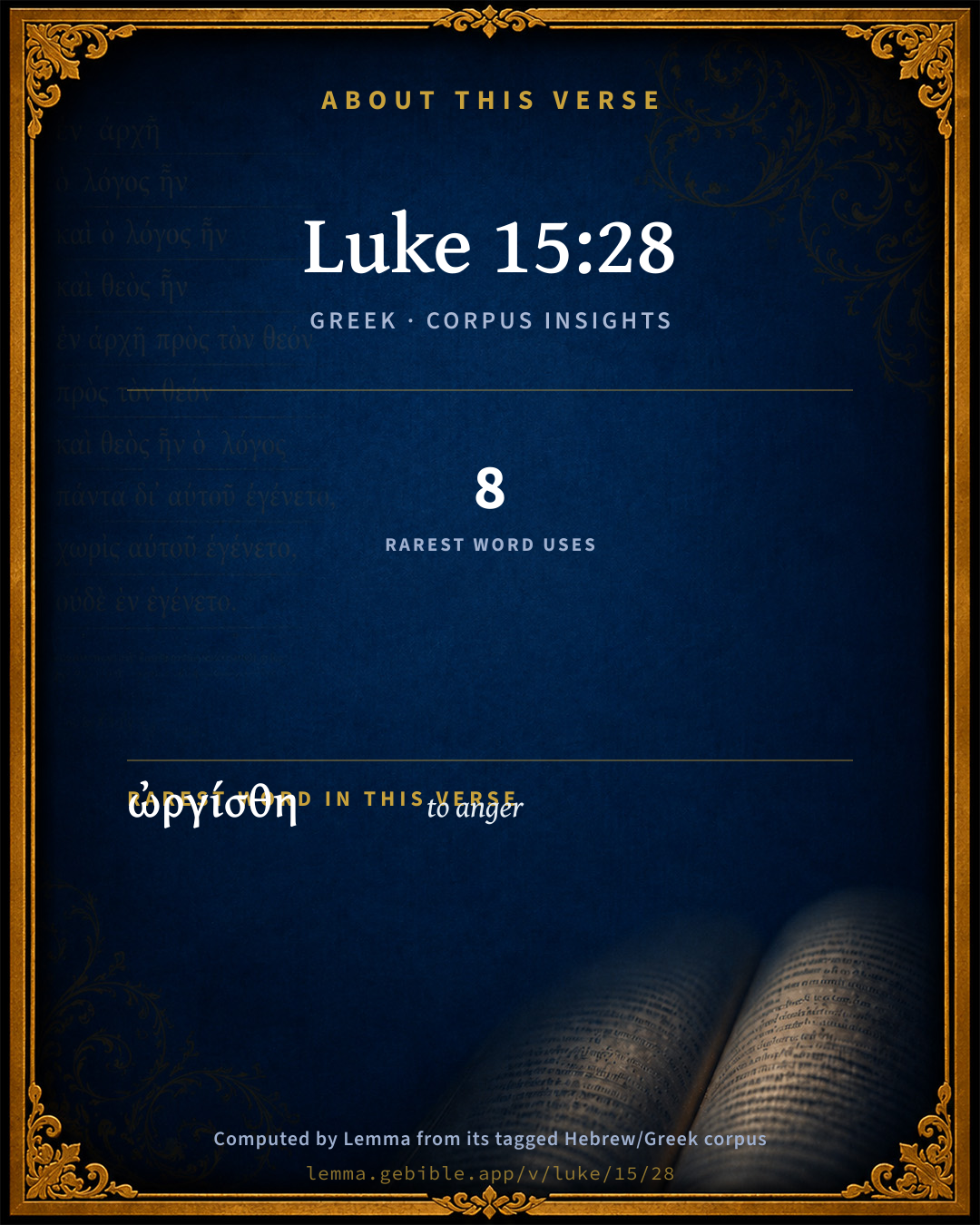
Luke 15:28

Greek (Tischendorf 8th ed.) Luke 15:28 appears in the Greek New Testament. The text above is from the Tischendorf 8th edition. Each word links to its Strong’s number and a concise gloss. Click any word for its full Thayer’s Greek Lexicon entry.
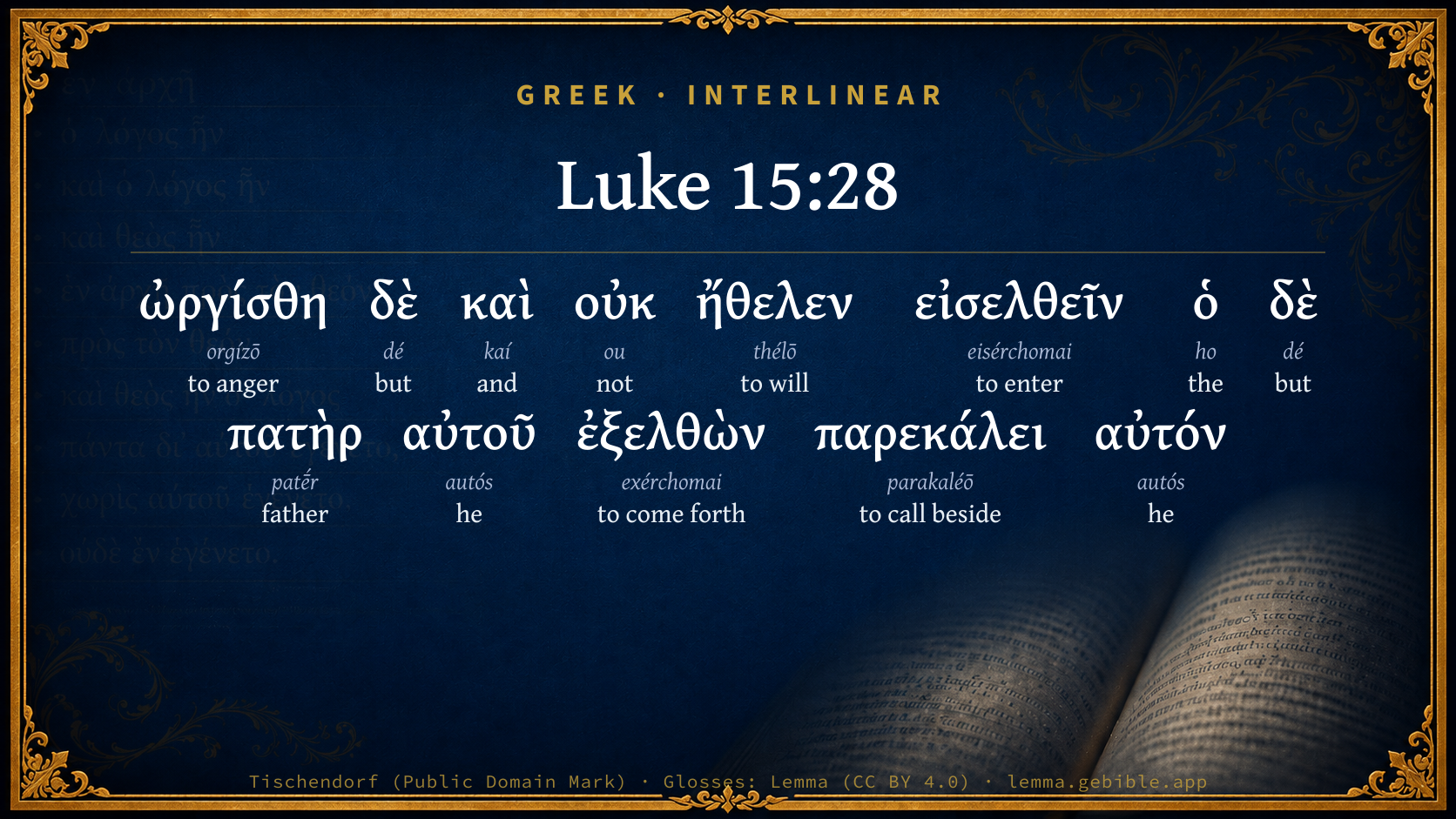
Download image
Cite this verse

Luke 15:28 (World English Bible). Public Domain. Lemma interlinear Bible study tool, https://lemma.gebible.app/v/luke/15/28.

Show BibTeX & RIS
BibTeX
RIS
English Translation
But he was angry, and would not go in. Therefore his father came out, and begged him.
World English Bible · Public Domain
Download a study sheet

One document with this verse’s original text, its word-by-word gloss line, the meaning frame, cross-references with their text, attributed commentary, and full source and license credits — printable, and it pastes into notes with its structure intact.

This verse Autodidact and up

Study sheet (.html) Plain text (.txt)

A passage Seminary Student

Up to 50 verses in one chapter. A passage sheet keeps up to 6 commentary sources and 12 cross-references per verse, in the order this page ranks them, and says so on the sheet whenever that leaves anything out. Ask for a single verse and you get the Autodidact verse sheet above.

Everything on this page stays free to read, with no account — the sheet is a download of what is already on screen, not access to it.

Want to remove ads? Support Godless Engineer
Compare translations 3

The same verse in 3 English versions, stacked beneath the original-language interlinear above. Click any original word for its lexicon entry.

Each is an independent rendering of the whole verse — the interlinear is not word-aligned to these translations.

Highlighted words mark where these versions differ — a whole-verse word diff, not a word-by-word alignment.

  • World English Bible Public Domain
    But he was angry, and would not go in. Therefore his father came out, and begged him.
  • King James Version Public Domain
    And he was angry, and would not go in: therefore came his father out, and intreated him.
  • unfoldingWord Literal Text CC BY-SA 4.0
    But he became angry and was not willing to go in, and his father came out entreated him.

unfoldingWord Literal Text — © unfoldingWord, licensed CC BY-SA 4.0. Word-aligned USFM3 via Door43 (git.door43.org/unfoldingWord/en_ult).

Versions to compare (up to 4)

3 of 4 selected

Show all 19 translations

Every available English version of this verse, each an independent rendering of the whole verse.

  • World English Bible Public Domain
    But he was angry, and would not go in. Therefore his father came out, and begged him.
  • Berean Standard Bible Public Domain
    The older son became angry and refused to go in. So his father came out and pleaded with him.
  • Majority Standard Bible Public Domain
    The older son became angry and refused to go in. So his father came out and pleaded with him.
  • King James Version Public Domain
    And he was angry, and would not go in: therefore came his father out, and intreated him.
  • American Standard Version (1901) Public Domain
    But he was angry, and would not go in: and his father came out, and entreated him.
  • Revised Version (1885) Public Domain
    But he was angry, and would not go in: and his father came out, and entreated him.
  • Geneva Bible (1599) Public Domain
    Then he was angry, and would not goe in: therefore came his father out and entreated him.
  • Douay-Rheims (1899) Public Domain
    And he was angry, and would not go in. His father therefore coming out began to entreat him.
  • Young's Literal Translation Public Domain
    `And he was angry, and would not go in, therefore his father, having come forth, was entreating him;
  • Literal Standard Version CC BY-SA 4.0
    And he was angry, and would not go in, therefore his father, having come forth, was pleading him;
  • Unlocked Literal Bible CC BY-SA 4.0
    The older son was angry and would not go in, and his father came out and begged him.
  • unfoldingWord Literal Text CC BY-SA 4.0
    But he became angry and was not willing to go in, and his father came out entreated him.
  • Darby Bible Public Domain
    But he became angry and would not go in. And his father went out and besought him.
  • World Messianic Bible Public Domain
    But he was angry and would not go in. Therefore his father came out and begged him.
  • Webster's Bible Public Domain
    And he was angry, and would not go in; therefore his father came out, and entreated him.
  • Free Bible Version CC BY-SA 4.0
    The brother became angry. He refused to go in. So his father came out to plead with him.
  • Bible in Basic English Public Domain
    But he was angry and would not go in; and his father came out and made a request to him to come in.
  • Text-Critical English NT CC BY 4.0
    But the older son was angry and would not go in. So his father came out and began pleading with him.
  • Tyndale New Testament (1534) Public Domain
    And he was angry and wolde not goo in. Then came his father out and entreated him.

Literal Standard Version (2020), Covenant Press — licensed CC BY-SA 4.0. Text via the HelloAO Bible API (eBible.org). Unlocked Literal Bible (unfoldingWord) — licensed CC BY-SA 4.0. Text via the HelloAO Bible API (eBible.org). unfoldingWord Literal Text — © unfoldingWord, licensed CC BY-SA 4.0. Word-aligned USFM3 via Door43 (git.door43.org/unfoldingWord/en_ult). Free Bible Version, Dr. Jonathan Gallagher — licensed CC BY-SA 4.0. Text via the HelloAO Bible API (eBible.org).

Word by word

More ways to search: Search by grammar → Find every occurrence → Compare this word →

Practice this passage: Drill this verse → Learn its vocabulary →

ὠργίσθη
orgízō
G3710
“to anger”
Verb, Aorist, Passive, Indicative, 3rd person, Singular
Part of Speech
Verb
Tense
Aorist
Voice
Passive
Mood
Indicative
Person
3rd person
Number
Singular
Full Thayer's Definition

Origin: from G3709

TDNT: 5:382,*

1. to provoke, to arouse to anger 2. to be provoked to anger, be angry, be wroth
  1. δὲ dé G1161 “but” Conjunction
  2. καὶ kaí G2532 “and” Conjunction
  3. οὐκ ou G3756 “not” Particle, Negative
  4. ἤθελεν thélō G2309 “to will” Verb, Imperfect, Active, Indicative, 3rd person, Singular
  5. εἰσελθεῖν eisérchomai G1525 “to enter” Verb, Aorist, Active, Infinitive
  6. ὁ ho G3588 “the” Article, Nominative, Singular, Masculine
  7. δὲ dé G1161 “but” Conjunction
  8. πατὴρ patḗr G3962 “father” Noun, Nominative, Singular, Masculine
  9. αὐτοῦ autós G846 “he” Personal pronoun, Genitive, Singular, Masculine
  10. ἐξελθὼν exérchomai G1831 “to come forth” Verb, Aorist, Active, Participle, Nominative, Singular, Masculine
  11. παρεκάλει parakaléō G3870 “to call beside” Verb, Imperfect, Active, Indicative, 3rd person, Singular
  12. αὐτόν autós G846 “he” Personal pronoun, Accusative, Singular, Masculine

About this verse

These counts appear in no published source. They are computed here, from the morphology-tagged text and Lemma’s own curated glosses. What Lemma adds →

13
words
11
distinct lemmas
Gospels
section

Notable vocabulary

The rarest word here is ὠργίσθη to anger G3710 — appearing just 8 times in the whole Greek New Testament.

Shared distinctive vocabulary

ὠργίσθη to anger G3710 occurs in 8 verses of the Greek New Testament. Also found in:

Repetition

Words recur within this verse:

  • δὲ but G1161 ×2
  • αὐτοῦ he G846 ×2

Cross-references

21

Topical passages linked to Luke 15:28 in the Treasury of Scripture Knowledge — connected by theme and wording, ordered by reader-vote popularity; previews shown in the World English Bible.

  • 1 Samuel 18:8 Saul was very angry, and this saying displeased him; and he said, They have ascribed to David ten thousands, and to me they have ascribed but thousands: and what can he have more but the kingdom?
  • Genesis 4:5–7 but he didn't respect Cain and his offering. Cain was very angry, and the expression on his face fell.
  • Jonah 4:9 God said to Jonah, "Is it right for you to be angry about the vine?" He said, "I am right to be angry, even to death."
  • Luke 15:2 The Pharisees and the scribes murmured, saying, "This man welcomes sinners, and eats with them."
  • Isaiah 65:5 who say, Stand by yourself, don't come near to me, for I am holier than you. These are a smoke in my nose, a fire that burns all the day.
  • Jonah 4:1–4 But it displeased Jonah exceedingly, and he was angry.
  • Luke 7:39 Now when the Pharisee who had invited him saw it, he said to himself, "This man, if he were a prophet, would have perceived who and what kind of woman this is who touches him, that she is a sinner."
  • Luke 13:34 "Jerusalem, Jerusalem, that kills the prophets, and stones those who are sent to her! How often I wanted to gather your children together, like a hen gathers her own brood under her wings, and you refused!
  • 1 Samuel 17:28 Eliab his eldest brother heard when he spoke to the men; and Eliab's anger was kindled against David, and he said, Why are you come down? and with whom have you left those few sheep in the wilderness? I know your pride, and the naughtiness of your heart; for you have come down that you might see the battle.
  • Isaiah 66:5 Hear the word of Yahweh, you who tremble at his word: Your brothers who hate you, who cast you out for my name's sake, have said, Let Yahweh be glorified, that we may see your joy; but it is those who shall be disappointed.
  • Matthew 20:11 When they received it, they murmured against the master of the household,
  • Luke 5:30 Their scribes and the Pharisees murmured against his disciples, saying, "Why do you eat and drink with the tax collectors and sinners?"
  • Luke 24:47 and that repentance and remission of sins should be preached in his name to all the nations, beginning at Jerusalem.
  • Acts 13:45 But when the Jews saw the multitudes, they were filled with jealousy, and contradicted the things which were spoken by Paul, and blasphemed.
  • Acts 14:2 But the disbelieving Jews stirred up and embittered the souls of the Gentiles against the brothers.
  • Romans 10:19 But I ask, didn't Israel know? First Moses says, "I will provoke you to jealousy with that which is no nation, With a nation void of understanding I will make you angry."
  • Acts 13:50 But the Jews stirred up the devout and prominent women and the chief men of the city, and stirred up a persecution against Paul and Barnabas, and threw them out of their borders.
  • Acts 14:19 But some Jews from Antioch and Iconium came there, and having persuaded the multitudes, they stoned Paul, and dragged him out of the city, supposing that he was dead.
  • Acts 22:21–22 "He said to me, 'Depart, for I will send you out far from here to the Gentiles.'"
  • 2 Corinthians 5:20 We are therefore ambassadors on behalf of Christ, as though God were entreating by us. We beg you on behalf of Christ, be reconciled to God.
  • 1 Thessalonians 2:16 forbidding us to speak to the Gentiles that they may be saved; to fill up their sins always. But wrath has come on them to the uttermost.

Cross-references courtesy of OpenBible.info (CC BY 4.0).

Where the printed editions differ

1 variant

Places in this verse where the major printed Greek editions disagree on the wording in a way that affects the translation — a comparison of editions, not a manuscript-by-manuscript collation. The editions are the modern critical texts (Nestlé-Aland 28/27, SBL, Westcott-Hort, Tregelles, Tyndale House) and the traditional texts behind the KJV (the Textus Receptus and the Byzantine/Majority text). It is not a claim about which reading is original.

  1. Different wording
    δὲ

    “And”

    In NA28NA27TynSBLWHTreg Not in TRByz

    οὖν (oun) 'therefore' occurs in traditional manuscripts (TR+Byz) instead of δὲ (de) 'And' in older manuscripts (NA28+NA27+Tyn+SBL+WH+Treg)

Textual data: Translators Amalgamated Greek New Testament (STEPBible TAGNT) · CC BY 4.0.

Commentary

Notes on Luke 15:28 from classic Christian and Jewish commentators (each source and its license shown beneath its notes). The classic Christian expositions comment on the surrounding passage and are grouped to its opening verse, so a note may address several verses; the Jewish commentaries on the Tanakh (Rashi and others) are per-verse, so they appear only where the commentator wrote on this verse.

Lemma curates 59 commentaries, every one of them public domain or Creative Commons licensed, each selected and text-cleaned for this edition rather than reprinted as found. About our sources →

Tyndale Open Study Notes

Tyndale Open Resources

15:28 The older brother was angry that his father would forgive such a sinner when he, the faithful son, had worked hard to achieve his position. Like the religious leaders, he refused to rejoice when his brother was found.

Tyndale Open Study Notes — © Tyndale Open Resources, licensed CC BY-SA 4.0. Text via the HelloAO Bible API.

Bengel's Gnomon

Johann Albrecht Bengel

Luk 15:28. Οὐκ ἤθελεν, would not) Great perversity and unkindness on his part.—ἐξελθὼν, having come out) Great leniency and forbearance on the part of the Father.

Bengel's Gnomon of the New Testament — English translation (T&T Clark, Edinburgh, 1860) — public domain. Text from a community e-Sword module.

Jamieson, Fausset & Brown

Robert Jamieson, A. R. Fausset & David Brown

came his father out, and entreated him--"Like as a father pitieth his children, so the Lord pitieth them that fear Him" (Psa 103:13). As it is the elder brother who now errs, so it is the same paternal compassion which had fallen on the neck of the younger that comes forth and pleads with the elder.

Jamieson, Fausset & Brown — Commentary Critical and Explanatory on the Whole Bible (1871) — public domain (CC PDM 1.0). Text via the HelloAO Bible API.

Adam Clarke's Commentary

Verse 28. He was angry] This refers to the indignation of the scribes and Pharisees, mentioned Lu 15:1-2. In every point of view, the anger of the older son was improper and unreasonable. He had already received his part of the inheritance, see Lu 15:12, and his profligate brother had received no more than what was his just dividend. Besides, what the father had acquired since that division he had a right to dispose of as he pleased, even to give it all to one son; nor did the ancient customs of the Asiatic countries permit the other children to claim any share in such property thus disposed of. The following is an institute of the GENTOO law on this subject: (CODE, chap. ii. sect. 9, p. 79:) "If a father gives, by his own choice, land, houses, orchards, and the earning of his own industry, to one of his sons, the other sons shall not receive any share of it." Besides, whatever property the father had acquired after the above division, the son or sons, as the prodigal in the text, could have no claim at all on, according to another institute in the above Asiatic laws, see chap. ii. sect. ii. p. 85, but the father might divide it among those who remained with him: therefore is it said in the text, "Son, thou art ALWAYS with me, and ALL that I have is THINE," Lu 15:31.

Adam Clarke's Commentary on the Bible (1810–1826) — public domain. Text from a community e-Sword/MySword module.

Ellicott's Commentary for English Readers

(28) And he was angry, and would not go in.—This, then, was the first feeling. He who professed obedience to his father is out of harmony with his father’s mind. He “shuts love out,” and, as by a righteous judgment, is himself “shut out from love.”

A Bible Commentary for English Readers, edited by Charles John Ellicott (1878–1897) — public domain. Text from a community e-Sword module.

The Cambridge Bible for Schools and Colleges

gen. ed. J. J. S. Perowne

28. he was angry] The feelings of the Jews towards the Gentiles (1Th_2:14-16) when they were embracing the offers of the Gospel —(“The Jews...were filled with envy and spake against those things which were spoken by Paul, contradicting and blaspheming,” Act_13:45)—and the feelings of the Pharisees towards our Lord, when He ate with publicans and sinners, are the earliest historical illustrations of this phase of the parable. It illustrates feelings which refer more directly to such historical phenomena; the earlier part is of more universal application. Yet envy and lovelessness are too marked characteristics of modern religionism to render the warning needless.

would not go in] “For is stat Israel,” sed “Foris stat non excluditur.” Ambrose.

therefore came his father out and intreated him] “How often would I have gathered thy children together...but ye would not,” Luk_13:34; see Act_17:5; Act_17:13; Act_22:21; Act_28:27. The yearning chapters addressed to the obstinacy of Israel by St Paul (Rom_10:11) furnish another illustration of this picture.

The Cambridge Bible for Schools and Colleges (gen. ed. J. J. S. Perowne; Cambridge University Press, 1878–1918) — public domain. Text from a community e-Sword module.

John Gill's Exposition

And he was angry,.... Particularly that the fatted calf was killed, Luk 15:27 the preaching of a crucified Christ, and of free and full salvation by him, is highly displeasing and provoking to self-righteous persons; they are angry at it, that it should be free, that election to salvation should be of grace, that justification should be freely by the grace of God, and that pardon of sin should be according to the riches of God's grace, and salvation be by grace, and not by works; and that it should be discriminating, that God should appoint some, and not all unto salvation; that Christ should redeem some, and not all; and that all men are not called unto it, by his Spirit and grace; and that it should be full and complete, so as nothing can be added to it; and that it should be for sinners, and alone by Christ, and by him as crucified: it would be agreeable, was it taught that salvation was by Christ in a doctrinal way, by giving laws and rules to men, whereby to save themselves; or that Christ saves by example, and not by his sacrifice, in a way of satisfaction for sin. Now, though no grievous words were used, nor any thing said that might justly provoke, yet such was the pride of his heart, that he could not bear that his brother should be taken so much notice of, who had acted and lived so scandalously; and besides, his own character as a righteous person, was neglected by this doctrine; and his own righteousness laid aside, in the business of justification and salvation, which was intolerable by him:

and would not go in; into his father's house, nor to the feast, nor into the kingdom of heaven, or Gospel dispensation; the Scribes and Pharisees shut it up to themselves, and others; would neither go in themselves, nor suffer others; they did not believe Jesus to be the Messiah, nor did they receive, but reject him; nor did they give any credit to the doctrines, nor submit to the ordinances of that dispensation:

therefore came his father out; not in a way of wrath and judgment, but in the ministry of the word; for though the Jews rejected it, it was not at once taken away from them, but was continued time after time, and for some considerable time: the Jews of old had the ministry of the word, both by angels and men; God frequently went forth to them by his prophets, and at last by his Son; and though they were angry with him, and rejected him, yet still the ministry of the word, by the disciples of Christ, were continued a good while to them; which shows the condescending goodness and grace of God, and his patience and longsuffering towards them:

and entreated him; the Persic version reads, "and said unto him, why dost thou not go in?" this regards the external call by the ministry of the word, to the outward duties of religion, to means of grace; to give credit to the doctrines, and to attend the ordinances of the Gospel.

John Gill's Exposition of the Whole Bible (1746–1763) — public domain (CC PDM 1.0). Text via the HelloAO Bible API.

Trapp's Complete Commentary

John Trapp

28 And he was angry, and would not go in: therefore came his father out, and intreated him.

Ver. 28. And he was angry] Christi consilium est ostendere, iniquum esse qui fratri in gratiam recepto obtrectat, etiamsi sanctitate Angelis non cedat. Calvin.

John Trapp, A Commentary or Exposition upon All the Books of the Old and New Testament (1647–1656) — public domain. Text from a community e-Sword module.

Whedon's Commentary on the Bible

Daniel D. Whedon

28. Angry… would not go in—Our Lord now holds up to the murmuring Pharisees of Luk_15:2 a likeness of themselves for them to recognize and avoid. As the elder son is angry at the joy which welcomes the prodigal home from his wanderings, so have these men murmured at the mercy with which Jesus has received the publican and the sinner.

Came his father out and entreated—As God now, by Jesus, entreats these doctors of Israel not to spurn the outcast publicans and sinners who may be induced to forsake their sins.

Daniel D. Whedon (gen. ed.), Commentary on the Old and New Testaments (1874–1909) — public domain. Text from a community e-Sword module.

The Pulpit Commentary

Therefore came his father out, and entreated him. The disapprobation of Jesus for Pharisee opinions was very marked, yet here and elsewhere his treatment of them, with a few exceptional cases, was generally very gentle and loving. There was something in their excessive devotion to the letter of the Divine Law, to the holy temple, to the proud traditions of their race, that was admirable. It was a love to God, but a love all marred and blurred. It was a patriotism, but a patriotism utterly mistaken. The elder brother here was a representative of the great and famous sect, both in its fair and repulsive aspect, in its moral severity and correctness, in its harshness and exclusive pride. The father condescended to entreat this angry elder son; and Jesus longed to win these proud mistaken Pharisees.

The Pulpit Commentary (1880–1919), ed. H.D.M. Spence-Jones & Joseph S. Exell — public domain. Text from a community e-Sword module.

John Wesley's Explanatory Notes

He was angry, and would not go in - How natural to us is this kind of resentment!

John Wesley, Explanatory Notes Upon the Whole Bible (1754–1765) — public domain. Text via the GEBible commentary corpus.

unfoldingWord translationNotes

Door43 World Missions Community

these many years

"for many years"

I slaved for you

"I worked extremely hard for you" or "I worked as hard as a slave for you"

never broke a rule of yours

"never disobeyed any of your commands" or "always obeyed everything you told me to do"

a young goat

A young goat was smaller and less expensive than a fatted calf. AT: "even a young goat" (See: Assumed Knowledge and Implicit Information)

your son

"that son of yours." The older son refers to his brother this way in order to show how angry he is.

devoured your living

Food is a metaphor for money. After one eats food, the food is no longer there and there is nothing to eat. The money that the brother had received was no longer there and there was no more to spend. AT: "wasted all your wealth" or "thrown away all your money" (See: Metaphor)

with prostitutes

Possible meanings are 1) he assumed this is how his brother spent the money or 2) he speaks of prostitutes to exaggerate the sinfulness of his brother's actions in the "country far away" (Luke 15:13). (See: Hyperbole and Generalization)

fattened calf

A calf is a young cow. People would give one of their calves special food so that it would grow well, and then when they wanted to have a special feast, they would eat that calf. See how you translated this phrase in Luke 15:23. AT: "the best calf" or "the young animal we have been making fat" (See: Assumed Knowledge and Implicit Information)

translationWords

anger

beg

goat

devour

prostitute

unfoldingWord translationNotes — © Distant Shores Media and the Door43 World Missions Community, licensed CC BY-SA 4.0. Source: git.door43.org/Door43/en_tn.

Cambridge Greek Testament for Schools and Colleges

28. ὠργίσθη. The feelings of the Jews towards the Gentiles (1Th 2:14-16) when they were embracing the offers of the Gospel—(“The Jews … were filled with envy and spake against those things which were spoken by Paul, contradicting and blaspheming,” Act 13:45)—and the feelings of the Pharisees towards our Lord, when He ate with publicans and sinners, are the earliest historical illustrations of this phase of the parable. It illustrates feelings which refer more directly to such historical phenomena; the earlier part is of more universal application. Yet envy and lovelessness are too marked characteristics of modern religionism to render the warning needless.

οὐκ ἤθελεν εἰσελθεῖν. “Foris stat Israel,” sed “Foris stat non excluditur.” Ambrose.

ἐξελθὼν παρεκάλει αὐτόν. “How often would I have gathered thy children together … but ye would not,” Luk 13:34; see Act 17:5; Act 17:13; Act 22:21; Act 28:27. The yearning chapters addressed to the obstinacy of Israel by St Paul (Rom 10:11) furnish another illustration of this picture.

Cambridge Greek Testament for Schools and Colleges (Cambridge University Press, 1896; 21 vols, various authors incl. Carr, Maclear, Plummer, Farrar, Lumby, Moule, M. R. James, Simcox) — public domain. Text from a community e-Sword module.

Alford’s Greek Testament

Henry Alford

28-32.] Stier well remarks (iii. 255, edn. 2) that this elder is now the lost son: he has lost all childlike filial feeling; he betrays the hypocrite within. The love and forbearance of the father are eminently shewn—the utter want of love and humility in the son strongly contrasted with them.

Henry Alford, The Greek Testament (1849–1861) — public domain. Text from a community e-Sword module.

International Critical Commentary

28. ὠπγίσθη δὲ καὶ οὐκ ἤθελεν. Note the characteristic δὲ καί here and ver. 32 (see on 3:9), and the change of tense: the unwillingness to go in was a state which continued. Hence the father’s entreaties continue also (παρεκάλει). He treats both sons with equal tenderness: the ἐξελθών here is parallel to δραμών in ver. 20.

The reading ἠθέλησεν (A L P Q R X) arose from a wish to harmonize the tenses. The reading οὖν (P Q Γ Δ) instead of δέ (א A B D L R X) is followed in Vulg. (pater ergo illius) and AV. (“therefore came his father out”): but it is a correction to the sake of smoothness. Lat. Vet either vero or autem.

International Critical Commentary — older volumes (1896–1929), various authors — public domain. Text from a community e-Sword module.

Vincent's Word Studies in the New Testament

Marvin R. Vincent

He was angry [ωργισθη] . Not with a mere temporary fit of passion, but, as the word imports, with a deep - seated wrath.

Marvin R. Vincent, Word Studies in the New Testament (1887–1900) — public domain. Text from a community e-Sword/MySword module.

Godet's Commentaries

Frédéric Louis Godet

Vers. 28b-32. This interview contains the full revelation of pharisaic feeling, and brings into view the contrast between it and the fatherly heart of God. The procedure of the father, who steps out to his son and invites him to enter, is realized in the very conversation which Jesus, come from God, holds with them at the moment. The answer of the son (Luk 15:29-30) includes two accusations against his father: the one bears on his way of acting toward himself (Luk 15:29), the other on his conduct in respect of his other son (Luk 15:30). The contrast is meant to bring out the partiality of the father. The blind and innocent self-satisfaction which forms the heart of pharisaism could not be better depicted than in the words: “neither transgressed I at any time thy commandment;” and the servile and mercenary position of the legal Jew in the theocracy, than thus: “Lo! these many years do I serve thee.” Bengel makes the simple observation on these words: servus erat. What in reality was his father to him? A master! He even counts the years of his hard servitude: There are so many years!...Such is man’s view of accomplishing good under the law: a labour painfully carried through, and which consequently merits payment. But by its very nature it is totally deprived of the delights which belong only to the sphere of free love; it has no other idea of them than that which it gets by seeing those joys of the reconciled sinner, by which it is scandalized. The joy which is wanting to it is this kid to make merry with its friends, which has never been granted to it.

With the hard and ill-paid labour of legal obedience he contrasts (Luk 15:30) the life of his brother, merry in sin, happier still, if possible, in the hour of his return and pardon. The meaning is, that in the eyes of pharisaism, as virtue is a task, sin is a pleasure; and hence there ought to be a payment for the first, an equivalent of pain for the second. The father, by refusing to the one his just reward, by adding in the case of the other joy to joy, the enjoyments of the paternal home to those of debauchery, has shown his preference for the sinner and his sympathy with sin. Thy son, says the elder son, instead of: my brother. He would express at once the partiality of his father and his own dislike to the sinner. Do not those sayings which Jesus puts into the mouth of the righteous legalist, contain the keenest criticism of a state of soul wherein men discharge duty all the while abhorring it, and wherein, while avoiding sin, they thirst after it? The particular μετὰ πορνῶν is a stroke of the pencil added to the picture of Luk 15:13 by the charitable hand of the elder brother.

The father’s answer meets perfectly the two accusations of his son. Luk 15:31 replies to Luk 15:29; Luk 15:32 to Luk 15:30. The father first clears himself from the charge of injustice to the son who is speaking to him; and with what condescension! “My child (τέκνον).” This form of address has in it something more loving even than υἷε, son. Then he reminds him that his life with him might have been a feast all along. There was no occasion, therefore, to make a special feast for him. And what good would a particular gift serve, when everything in the house was continually at his disposal? The meaning of this remarkable saying is, that nothing prevented the believing Israelite from already enjoying the sweets of divine communion,—a fact proved by the Psalms; comp. e.g., Psalms 23, 63. St. Paul himself, who ordinarily presents the law as the instrument of condemnation, nevertheless derives the formula of grace from a saying of Moses (Rom 10:6-8), proving that in his eyes grace is already in the law, through the pardon which accompanies sacrifice and the Holy Spirit granted to him who asks Him (Psa 51:9-14); and that when he speaks of the law as he ordinarily does, it is after the manner of his adversaries, isolating the commandment from grace. In the same way as Luk 15:31 presents theocratic fidelity as a happiness, and not a task, so Luk 15:32 reveals sin as a misery, and not as an advantage. There was therefore ground for celebrating a feast on the return of one who had just escaped from so great a misery, and by its arrival had restored the life of the family in its completeness. Thy brother, says the father; it is the answer to the thy son of Luk 15:30. He reminds him of the claims of fraternal love. Here Jesus stops; He does not say what part the elder son took. It lay with the Pharisees themselves, by the conduct which they would adopt, to decide this question and finish the narrative.

The Tübingen school (Zeller, Volkmar, Hilgenfeld, not Köstlin) agree in regarding the elder son, not as the pharisaic party, but as the Jewish people in general; the younger son, not as the publicans, but Gentile nations. “The elder son is unmistakeably the image of Judaism, which deems that it possesses special merit because of its fidelity to the one true God. The younger son...is the not less easily recognised portrait of Gentile humanity given up to polytheism and immorality. The discontent of the first, on seeing the reception granted to his brother, represents the jealousy of the Jews on account of the entrance of the Gentiles into the Church” (Hilgenfeld, die Evangel. p. 198). It would follow, then: 1. that this parable had been invented and put into the mouth of Jesus by Luke, with the view of supporting the system of his master, Paul; 2. that to this invention he had added a second, intended to accredit the former, that of the historical situation described Luk 15:1-2. But, 1. Is it conceivable that the evangelist, who marked out his own programme for himself, Luk 1:1-4, should take the liberty of treating his materials in so free and easy a style? 2. Have we not found in this description a multitude of delicate allusions to the historical surroundings amid which the parable is reputed to have been uttered, and which would not be applicable in the sense proposed (Luk 15:15; Luk 15:17, etc.)? 3. How from this parable St. Paul might have extracted the doctrine of justification by faith, is easy to understand. But that this order was inverted, that the parable was invented as an after-thought to give a body to the Pauline doctrine, is incompatible with the absence of every dogmatic element in the exposition. Would not the names of repentance, faith, justification, and the idea of expiation, have been infallibly introduced, if it had been the result of a dogmatic study contemporary with the ministry of Paul? 4. We have seen that the description finds its perfect explanation, that there remains not a single obscure point in the light in which it is placed by Luke. It is therefore arbitrary to seek another setting for it. The prejudice which has led the Tübingen school to this contra-textual interpretation is evident.

Keim, while discovering, like this school, Paulinism as the basis of the parable (p. 80), thinks that here we have one of the passages wherein the author, with the view of conciliating, more or less abjures his master, St. Paul. The evangelist dares not wholly disapprove the Judeo-Christianity which holds by the commandments; he praises it even (Luk 15:31). He only demands that it shall authorize the entrance of the Gentiles into the Church; and on this condition he lets its legal spirit pass. We should thus have simply the juxtaposition of the two principles which conflicted with one another in the apostolic churches. But, 1. In this attempt at conciliation, the elder son would be completely sacrificed to the younger; for the latter is seated at table in the house, the former is without, and we remain in ignorance as to whether he will re-enter. And this last would represent the apostolic Christianity which founded the Church! 2. Adopting biblical premises, Luk 15:31 can easily be applied to the Mosaic system faithfully observed, and that, as we have seen, according to the view of St. Paul himself. 3. It belonged to the method of progressive transition, which Jesus always observed, to seek to develope within the bosom of the Mosaic dispensation, and without ever attacking it, the new principle which was to succeed it, and the germ of which was already deposited in it. Jesus did not wish to suppress anything which He had not completely replaced and surpassed. He therefore accepted the ancient system, while attaching to it the new. The facts pointed out by Keim are fully explained by this situation.

Holtzmann thinks that our parable, which is not found in Matthew, may really be only an amplification of that of the two sons, which is found in that evangelist (Mat 21:28-30). Does not this supposition do too much honour to the alleged amplifier, whether Luke or any other?

Frédéric Louis Godet — Commentaries on Luke, John, Romans, and 1 Corinthians — English translation (T&T Clark, Edinburgh, 1870s–1890s) — public domain. Text from a community e-Sword module.

Lesson kit

Teaching starters — assembled from the data on this page, not authored interpretation. Every prompt links to the verse data it draws on. Edit before teaching.

Luke, in the Gospels, opens this verse with 13 words (11 distinct Greek lemmas). Its most distinctive word is orgízō (“to anger”). A historical commentator’s framing appears above. Read the whole chapter for the surrounding context.

Discussion questions

  1. The word orgízō carries the sense “to anger.” How does it shape the verse?
  2. How does Matthew 5:22, which shares the word «to anger», read alongside this verse?
  3. What does the repetition of “but” (2× in this one verse) do in this verse?
  4. These translations render this verse differently. What is at stake in choosing one wording over another?
  5. Compare how Tyndale Open Study Notes and Bengel's Gnomon read this verse. Where do they agree or differ?

Things to notice

Reading settings

Reading text

Shown beneath each verse's original-language words.

Old Testament
Old Testament edition

Read the OT as the Masoretic Hebrew (MT) or the Greek Septuagint (LXX).

English shown for the Greek Septuagint (in the Hebrew ↔ Greek comparison).

Comparing translations? Open the Compare panel on any verse page to stack up to four side by side.