
John 10:15

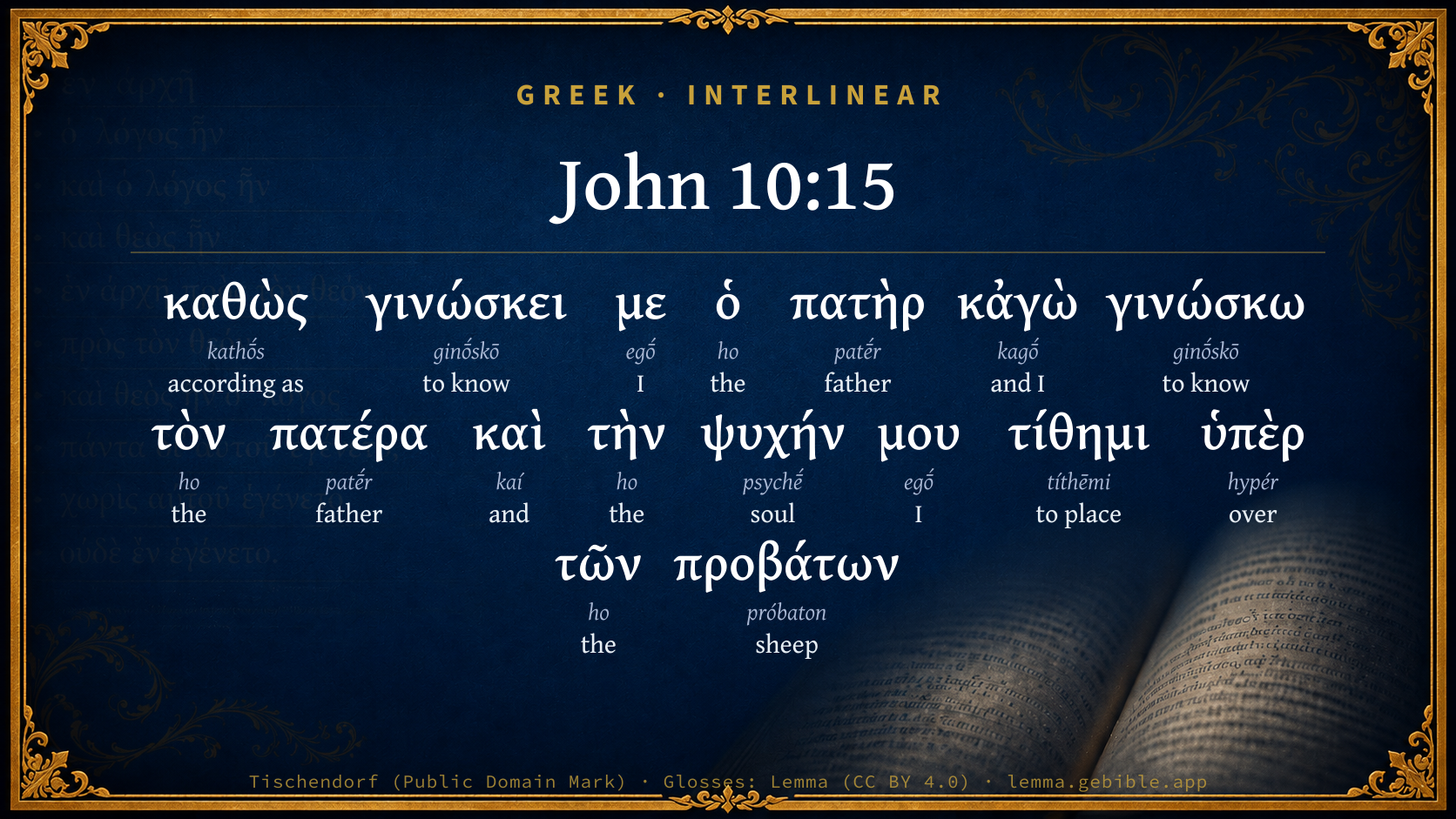
Greek (Tischendorf 8th ed.) John 10:15 appears in the Greek New Testament. The text above is from the Tischendorf 8th edition. Each word links to its Strong’s number and a concise gloss. Click any word for its full Thayer’s Greek Lexicon entry.
Download image
Cite this verse

John 10:15 (World English Bible). Public Domain. Lemma interlinear Bible study tool, https://lemma.gebible.app/v/john/10/15.

Show BibTeX & RIS
BibTeX
RIS
English Translation
even as the Father knows me, and I know the Father. I lay down my life for the sheep.
World English Bible · Public Domain
Download a study sheet

One document with this verse’s original text, its word-by-word gloss line, the meaning frame, cross-references with their text, attributed commentary, and full source and license credits — printable, and it pastes into notes with its structure intact.

This verse Autodidact and up

Study sheet (.html) Plain text (.txt)

A passage Seminary Student

Up to 50 verses in one chapter. A passage sheet keeps up to 6 commentary sources and 12 cross-references per verse, in the order this page ranks them, and says so on the sheet whenever that leaves anything out. Ask for a single verse and you get the Autodidact verse sheet above.

Everything on this page stays free to read, with no account — the sheet is a download of what is already on screen, not access to it.

Want to remove ads? Support Godless Engineer
Compare translations 3

The same verse in 3 English versions, stacked beneath the original-language interlinear above. Click any original word for its lexicon entry.

Each is an independent rendering of the whole verse — the interlinear is not word-aligned to these translations.

Highlighted words mark where these versions differ — a whole-verse word diff, not a word-by-word alignment.

  • World English Bible Public Domain
    even as the Father knows me, and I know the Father. I lay down my life for the sheep.
  • King James Version Public Domain
    As the Father knoweth me, even so know I the Father: and I lay down my life for the sheep.
  • unfoldingWord Literal Text CC BY-SA 4.0
    just as the Father knows me, and I know the Father; and I lay down my life for the sheep.

unfoldingWord Literal Text — © unfoldingWord, licensed CC BY-SA 4.0. Word-aligned USFM3 via Door43 (git.door43.org/unfoldingWord/en_ult).

Versions to compare (up to 4)

3 of 4 selected

Show all 19 translations

Every available English version of this verse, each an independent rendering of the whole verse.

  • World English Bible Public Domain
    even as the Father knows me, and I know the Father. I lay down my life for the sheep.
  • Berean Standard Bible Public Domain
    just as the Father knows Me and I know the Father. And I lay down My life for the sheep.
  • Majority Standard Bible Public Domain
    just as the Father knows Me and I know the Father. And I lay down My life for the sheep.
  • King James Version Public Domain
    As the Father knoweth me, even so know I the Father: and I lay down my life for the sheep.
  • American Standard Version (1901) Public Domain
    even as the Father knoweth me, and I know the Father; and I lay down my life for the sheep.
  • Revised Version (1885) Public Domain
    even as the Father knoweth me, and I know the Father; and I lay down my life for the sheep.
  • Geneva Bible (1599) Public Domain
    As the Father knoweth me, so know I the Father: and I lay downe my life for my sheepe.
  • Douay-Rheims (1899) Public Domain
    As the Father knoweth me, and I know the Father: and I lay down my life for my sheep.
  • Young's Literal Translation Public Domain
    according as the Father doth know me, and I know the Father, and my life I lay down for the sheep,
  • Literal Standard Version CC BY-SA 4.0
    according as the Father knows Me, and I know the Father, and My life I lay down for the sheep,
  • Unlocked Literal Bible CC BY-SA 4.0
    The Father knows me, and I know the Father, and I lay down my life for the sheep.
  • unfoldingWord Literal Text CC BY-SA 4.0
    just as the Father knows me, and I know the Father; and I lay down my life for the sheep.
  • Darby Bible Public Domain
    as the Father knows me and I know the Father; and I lay down my life for the sheep.
  • World Messianic Bible Public Domain
    even as the Father knows me, and I know the Father. I lay down my life for the sheep.
  • Webster's Bible Public Domain
    As the Father knoweth me, even so I know the Father: and I lay down my life for the sheep.
  • Free Bible Version CC BY-SA 4.0
    just as the Father knows me and I know him. I lay down my life for the sheep.
  • Bible in Basic English Public Domain
    Even as the Father has knowledge of me and I of the Father; and I am giving my life for the sheep.
  • Text-Critical English NT CC BY 4.0
    even as the Father knows me and I know the Father. I lay down my life for the sheep.
  • Tyndale New Testament (1534) Public Domain
    As my father knoweth me: even so knowe I my father. And I geve my lyfe for the shepe:

Literal Standard Version (2020), Covenant Press — licensed CC BY-SA 4.0. Text via the HelloAO Bible API (eBible.org). Unlocked Literal Bible (unfoldingWord) — licensed CC BY-SA 4.0. Text via the HelloAO Bible API (eBible.org). unfoldingWord Literal Text — © unfoldingWord, licensed CC BY-SA 4.0. Word-aligned USFM3 via Door43 (git.door43.org/unfoldingWord/en_ult). Free Bible Version, Dr. Jonathan Gallagher — licensed CC BY-SA 4.0. Text via the HelloAO Bible API (eBible.org).

Word by word

More ways to search: Search by grammar → Find every occurrence → Compare this word →

Practice this passage: Drill this verse → Learn its vocabulary →

προβάτων
próbaton
G4263
“sheep”
Noun, Genitive, Plural, Neuter
Part of Speech
Noun
Case
Genitive
Number
Plural
Gender
Neuter
Full Thayer's Definition

Origin: probably from a presumed. derivative of G4260

TDNT: 17:29,9

1. any four footed, tame animal accustomed to graze, small cattle (opp. to large cattle, horses, etc.), most commonly a sheep or a goat a. a sheep, and so always in the NT
  1. καθὼς kathṓs G2531 “according as” Adverb
  2. γινώσκει ginṓskō G1097 “to know” Verb, Present, Active, Indicative, 3rd person, Singular
  3. με egṓ G1473 “I” Personal pronoun, 1st person, Accusative, Singular
  4. ὁ ho G3588 “the” Article, Nominative, Singular, Masculine
  5. πατὴρ patḗr G3962 “father” Noun, Nominative, Singular, Masculine
  6. κἀγὼ kagṓ G2504 “and I” Personal pronoun, 1st person, Nominative, Singular, Aramaic form
  7. γινώσκω ginṓskō G1097 “to know” Verb, Present, Active, Indicative, 1st person, Singular
  8. τὸν ho G3588 “the” Article, Accusative, Singular, Masculine
  9. πατέρα patḗr G3962 “father” Noun, Accusative, Singular, Masculine
  10. καὶ kaí G2532 “and” Conjunction
  11. τὴν ho G3588 “the” Article, Accusative, Singular, Feminine
  12. ψυχήν psychḗ G5590 “soul” Noun, Accusative, Singular, Feminine
  13. μου egṓ G1473 “I” Personal pronoun, 1st person, Genitive, Singular
  14. τίθημι títhēmi G5087 “to place” Verb, Present, Active, Indicative, 1st person, Singular
  15. ὑπὲρ hypér G5228 “over” Preposition
  16. τῶν ho G3588 “the” Article, Genitive, Plural, Neuter

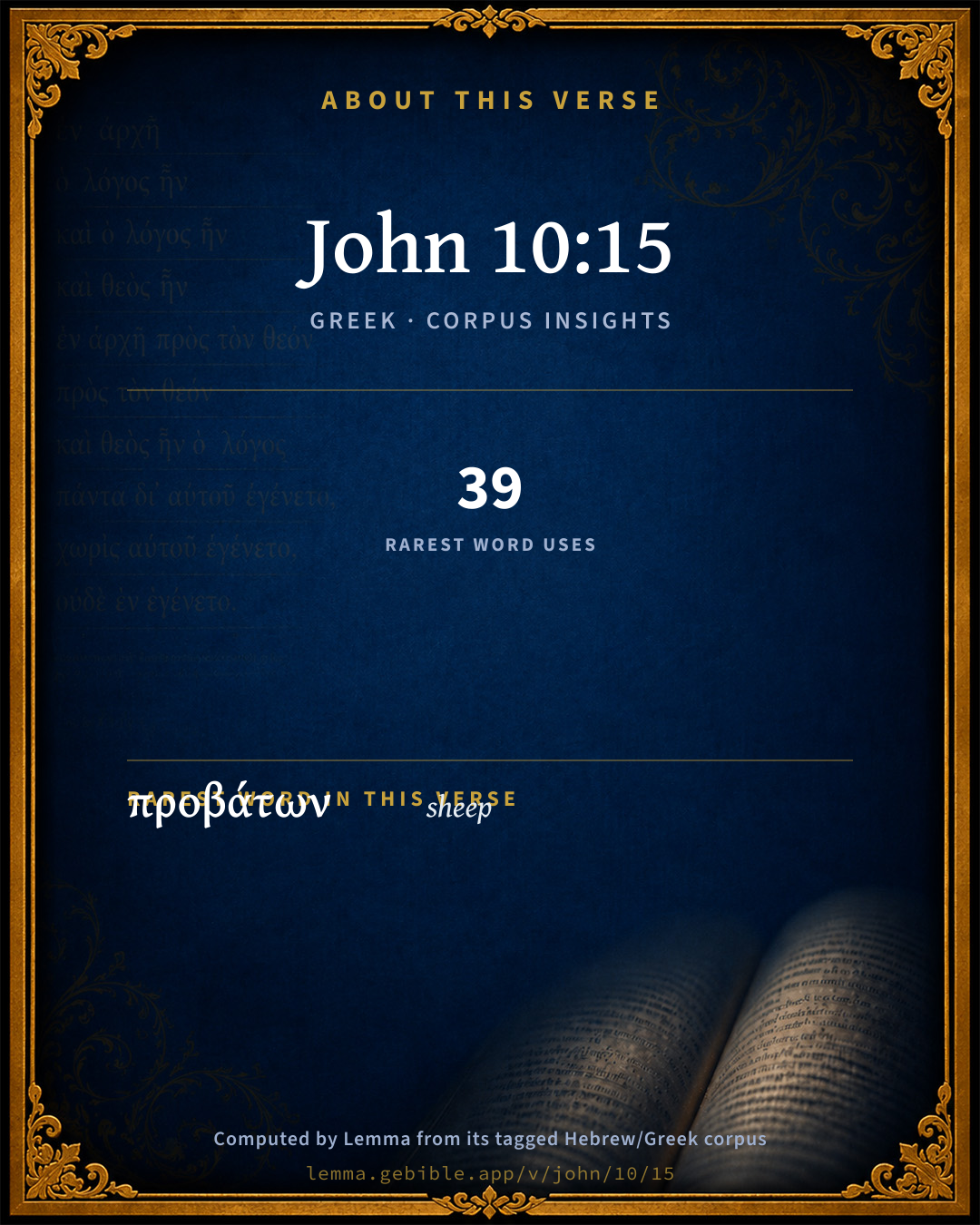
About this verse

These counts appear in no published source. They are computed here, from the morphology-tagged text and Lemma’s own curated glosses. What Lemma adds →

17
words
11
distinct lemmas
Gospels
section

Shared distinctive vocabulary

προβάτων sheep G4263 occurs in 37 verses of the Greek New Testament. Also found in:
Repetition

Words recur within this verse:

  • γινώσκει to know G1097 ×2
  • πατὴρ father G3962 ×2
  • ὁ the G3588 ×4
  • με I G1473 ×2

Cross-references

24

Topical passages linked to John 10:15 in the Treasury of Scripture Knowledge — connected by theme and wording, ordered by reader-vote popularity; previews shown in the World English Bible.

  • Galatians 1:4 who gave himself for our sins, that he might deliver us out of this present evil age, according to the will of our God and Father--
  • John 10:11 I am the good shepherd. The good shepherd lays down his life for the sheep.
  • Isaiah 53:10 Yet it pleased Yahweh to bruise him; he has put him to grief: when you shall make his soul an offering for sin, he shall see [his] seed, he shall prolong his days, and the pleasure of Yahweh shall prosper in his hand.
  • Matthew 11:27 All things have been delivered to me by my Father. No one knows the Son, except the Father; neither does anyone know the Father, except the Son, and he to whom the Son desires to reveal him.
  • 1 Peter 3:18 Because Christ also suffered for sins once, the righteous for the unrighteous, that he might bring you to God; being put to death in the flesh, but made alive in the spirit;
  • 1 John 2:2 And he is the atoning sacrifice for our sins, and not for ours only, but also for the whole world.
  • Zechariah 13:7 "Awake, sword, against my shepherd, And against the man who is close to me," says Yahweh of Hosts. Strike the shepherd, and the sheep will be scattered; And I will turn my hand against the little ones.
  • Matthew 20:28 even as the Son of Man came not to be served, but to serve, and to give his life as a ransom for many."
  • John 10:17–18 Therefore the Father loves me, because I lay down my life, that I may take it again.
  • John 15:13 Greater love has no one than this, that someone lay down his life for his friends.
  • Ephesians 5:2 Walk in love, even as Christ also loved you, and gave himself up for us, an offering and a sacrifice to God for a sweet-smelling fragrance.
  • 1 Timothy 2:5–6 For there is one God, and one mediator between God and men, the man Christ Jesus,
  • 1 Peter 2:24 who his own self bore our sins in his body on the tree, that we, having died to sins, might live to righteousness; by whose stripes you were healed.
  • Isaiah 53:4–6 Surely he has borne our sickness, and carried our suffering; yet we considered him plagued, struck by God, and afflicted.
  • Isaiah 53:8 By oppression and judgment he was taken away; and as for his generation, who [among them] considered that he was cut off out of the land of the living for the disobedience of my people to whom the stroke [was due]?
  • Daniel 9:26 After the sixty-two weeks the Anointed One shall be cut off, and shall have nothing: and the people of the prince who shall come shall destroy the city and the sanctuary; and the end of it shall be with a flood, and even to the end shall be war; desolations are determined.
  • Luke 10:21 In that same hour Jesus rejoiced in the Holy Spirit, and said, "I thank you, O Father, Lord of heaven and earth, that you have hidden these things from the wise and understanding, and revealed them to little children. Yes, Father, for so it was well-pleasing in your sight."
  • John 1:18 No one has seen God at any time. The one and only Son, who is in the bosom of the Father, he has declared him.
  • John 6:46 Not that anyone has seen the Father, except he who is from God. He has seen the Father.
  • John 8:55 You have not known him, but I know him. If I said, 'I don't know him,' I would be like you, a liar. But I know him, and keep his word.
  • John 17:25 Righteous Father, the world hasn't known you, but I knew you; and these knew that you sent me.
  • Galatians 3:13 Christ redeemed us from the curse of the law, having become a curse for us. For it is written, "Cursed is everyone who hangs on a tree,"
  • Titus 2:14 who gave himself for us, that he might redeem us from all iniquity, and purify for himself a people for his own possession, zealous for good works.
  • Revelation 5:2–9 I saw a mighty angel proclaiming with a loud voice, "Who is worthy to open the book, and to break its seals?"

Cross-references courtesy of OpenBible.info (CC BY 4.0).

Commentary

Notes on John 10:15 from classic Christian and Jewish commentators (each source and its license shown beneath its notes). The classic Christian expositions comment on the surrounding passage and are grouped to its opening verse, so a note may address several verses; the Jewish commentaries on the Tanakh (Rashi and others) are per-verse, so they appear only where the commentator wrote on this verse.

Lemma curates 59 commentaries, every one of them public domain or Creative Commons licensed, each selected and text-cleaned for this edition rather than reprinted as found. About our sources →

Tyndale Open Study Notes

Tyndale Open Resources

10:15 The Father and the Son share a profound intimacy, which Jesus shares with his sheep through the Holy Spirit (14:23-31; 15:1-11).

Tyndale Open Study Notes — © Tyndale Open Resources, licensed CC BY-SA 4.0. Text via the HelloAO Bible API.

Bengel's Gnomon

Johann Albrecht Bengel

Joh 10:15. Καθώς, as) This is connected with the preceding verse. Often the relation of believers towards Christ is derived from the peculiar relation of Christ towards the Father: ch. Joh 14:20, “I am in My Father, and ye in Me, and I in you;” Joh 15:10, “If ye keep My commandments, ye shall abide in My love, even as I have kept My Father’s commandments and abide in His love; Joh 17:8; Joh 17:21, “I have given unto them the words which Thou gavest Me;—That they all may be one, as Thou, Father, art in Me, and I in Thee, that they also may be one in us;” Mat 11:27, “Neither knoweth any man the Father, save the Son, and he to whomsoever the Son will reveal Him;” Luk 22:29, “I appoint unto you a kingdom, as My Father hath appointed unto Me;” 1Co 11:3, “The Head of every man is Christ,—and the Head of Christ is God;” 1Co 15:28, “The Son also Himself shall be subject unto Him that put all things under Him, that God may be all in all;” Rev 3:21, “To him that overcometh will I grant to sit with Me on My throne, even as I also overcame, and am set down with My Father on His throne.”—καί) and for that reason [viz. because I am the Good Shepherd]. Hence [from this act of love] it is that the sheep know the ‘goodness’ of the Shepherd.—τίθημι, I lay down) Present. The whole life of Christ was a going to death.

Bengel's Gnomon of the New Testament — English translation (T&T Clark, Edinburgh, 1860) — public domain. Text from a community e-Sword module.

Expositor's Greek Testament

ed. W. Robertson Nicoll

Joh 10:15 . This reciprocal knowledge is so sure and profound that it can only be compared to the mutual knowledge of the Father and the Son: καθὼς … πατέρα . He then applies to Himself what had been stated in general of all good shepherds in Joh 10:11 ; and Joh 10:16 might suitably have begun with the words “And my life I lay down for the sheep”. This statement is, however, prompted by His reference to His knowledge of the Father. He knows it is the Father’s will that He should lay down His life. See Joh 10:17-18 .

The Expositor's Greek Testament, edited by W. Robertson Nicoll (1897–1910) — public domain. Text from a community e-Sword module.

Geneva Bible (1599)

Geneva Bible translators

Loveth me, alloweth me.

Geneva Bible (1599) marginal notes — public domain. Text via Bolls.life.

Jamieson, Fausset & Brown

Robert Jamieson, A. R. Fausset & David Brown

As the Father knoweth me, even so know I the Father--What claim to absolute equality with the Father could exceed this? (See on Mat 11:27).

and I lay down my life for the sheep--How sublime this, immediately following the lofty claim of the preceding clause! It is the riches and the poverty of "the Word made flesh"--one glorious Person reaching at once up to the Throne and down even to the dust of death, "that we might live through Him." A candid interpretation of the words, "for the sheep," ought to go far to establish the special relation of the vicarious death of Christ to the Church.

Jamieson, Fausset & Brown — Commentary Critical and Explanatory on the Whole Bible (1871) — public domain (CC PDM 1.0). Text via the HelloAO Bible API.

John Calvin's Commentaries

15. As the Father knoweth me. It is unnecessary, and is not even expedient, that we should enter into those thorny questions, How is it that the Father knows his Wisdom? For Christ simply declares that, so far as he is the bond of our union with God, he is placed between Him and us; as if he had said, that it is no more possible for him to forget us, than that he should be rejected or disregarded by the Father. At the same time, he demands the duty which we mutually owe to him, because, as he employs all the power which he has received from the Father for our protection, so he wishes that we should be obedient and devoted to him, as he is wholly devoted to his Father, and refers everything to him.

John Calvin's Commentaries (1540-1563) — public domain. Text from the Calvin Translation Society English edition (1840s-50s) via the Christian Classics Ethereal Library (ccel.org). Calvin's coverage is partial (roughly two-thirds of the Bible); uncommented books and verses are honest gaps, never fabricated. The 19th-century editor's footnotes and remarks are omitted so the notes are faithfully Calvin's own voice.

Ellicott's Commentary for English Readers

(15) As the Father knoweth me, even so know I the Father.—Better, . . . and I know the Father. Our version, by its rendering, and by the division of verses, fails to give the full meaning, and there is thus, indeed, no reason for the assertion of the mutual knowledge of the Father and the Son. But connecting the words with those of the previous verse, we have, “I am the Good Shepherd, and know those who are Mine, and those who are Mine know Me, even as the Father knoweth Me, and I know the Father.” This deeper sense of union between the human spirit and Himself, and the wondrous likening of it to the union of Himself and the Father, is present to His mind as the close of His work on earth draws near. We find it again in Joh_14:20; Joh_15:10; Joh_17:8; Joh_17:21. It is bound up with the thought of the love which lays down His own life for them. This is repeated here and again in Joh_10:17-18.

A Bible Commentary for English Readers, edited by Charles John Ellicott (1878–1897) — public domain. Text from a community e-Sword module.

The Cambridge Bible for Schools and Colleges

gen. ed. J. J. S. Perowne

15. As the Father knoweth me, even so, &c.] This rendering entirely obscures the true meaning. There should be no full stop at the end of Joh_10:14, and the sentence should run; I know Mine, and Mine know Me, even as the Father knoweth Me and I know the Father. So intimate is the relation between the Good Shepherd and His sheep that it may be compared to the relation between the Father and the Son. The same thought runs through the discourses in the latter half of the Gospel: Joh_14:20, Joh_15:10, Joh_17:8; Joh_17:10; Joh_17:18; Joh_17:21.

The Cambridge Bible for Schools and Colleges (gen. ed. J. J. S. Perowne; Cambridge University Press, 1878–1918) — public domain. Text from a community e-Sword module.

John Gill's Exposition

As the Father knoweth me,.... These words, with what follow, are in connection with Joh 10:14; and the sense is, that the mutual knowledge of Christ, and his sheep, is like that which his Father and he have of each other. The Father knows Christ as his own Son, and loves him as such, in the most strong and affectionate manner; and has entrusted him with the persons, grace, and glory, of all his people:

even so know I the Father; or rather, "and I know the Father"; as he needs must, since he lay in his bosom, and still does, and knows his nature, perfections, purposes, and his whole mind and will; and loves him most ardently, which he has shown by his coming down from heaven, to do his will; and trusts in him for the accomplishment of everything he promised unto him:

and I lay down my life for the sheep; which proves him to be the good shepherd, Joh 10:11. The Vulgate Latin version reads, "for my sheep"; which were his, by the Father's gift, and for no other has he laid down his life. The Ethiopic version, as before, renders it, or rather explains it, "I lay down my life for the redemption of my sheep".

John Gill's Exposition of the Whole Bible (1746–1763) — public domain (CC PDM 1.0). Text via the HelloAO Bible API.

Trapp's Complete Commentary

John Trapp

15 As the Father knoweth me, even so know I the Father: and I lay down my life for the sheep.

Ver. 15. I lay down my life] Yet as man he was ζωον φιλοζωον. (Aesop, Fab.) Quis vitam non vult? Who does not want life? saith Augustine; and Quis enim vult mori? prorsus nemo, Indeed who wishes to die, absolutely no one, saith another. And, "skin after skin," or skin upon skin, "and all that a man hath will he give for his life," saith that old deceiver, truly, Job 2:4. Yet our Saviour held not his life dear for his sheep’s safety. Because he saw we should fall sore (said that angel, John Bradford) therefore he would suffer sore. Yea, if his once suffering had not been enough, he would yet once more come again. God the Father, I am sure, saith he, if the death of his Son incarnate would not serve, would himself and the Holy Ghost also become incarnate, and die for us.

John Trapp, A Commentary or Exposition upon All the Books of the Old and New Testament (1647–1656) — public domain. Text from a community e-Sword module.

Albert Barnes' Notes on the Bible

As the Father knoweth me ... - See the Mat 11:27 note; also Luk 10:22 note.

I lay down my life for the sheep - That is, I give my life as an atoning sacrifice for their sins. I die in their place, to redeem them from sin, and danger, and death. See Joh 10:17-18.

Albert Barnes' Notes on the Bible (1834–1885) — public domain. Text from a community e-Sword/MySword module.

Haydock's Catholic Bible Commentary

I lay down. That is, in a short time shall lay down my life for my sheep: for all, and in a special manner for my elect. See ver. 28. (Witham)

George Leo Haydock (1774–1849), Haydock's Catholic Family Bible and Commentary, 1859 edition — public domain. Excludes Psalms (Douay-Rheims chapter numbering differs from Protestant) and Deuterocanonical books (Catholic canon only).

Matthew Poole's English Annotations

By these words our Saviour openeth how he knew his sheep, and should be again known of them, even as the Father knoweth him, and he knows his Father: this mutual knowledge between the Father and Christ was joined with perfect love and delight. Thus our Saviour knoweth those that are his sheep, not only fully and distinctly, so as to call them all by their names; but so as to love them, delight in them; so as to be ready to lay down his life for their good, and eternal salvation. Christ, to show not only the sincerity, but the degrees, of his love to his people, doth often compare it to the love wherewith his Father loved him, Joh 15:9; 17:23,26. So that if we can believe that God the Father loved Christ his only begotten Son, we may also believe that both the Father and Christ love those that are truly the sheep of Christ. The love that Christ hath to his people is as true and as certain as the Father’s love to Christ, or Christ’s love to his Father; and this could be showed by no higher act than that of laying down his life, Joh 15:13. Now, saith he,

I lay down, that is, I am ready to lay down, or I shall shortly lay down, my life for the sheep: whether sheep can signify all and every person born into the world, is their concern more strictly to inquire, who are so tenacious of that point. That Christ died equally for all and every man: as also, whether upon that principle that absurdity must not follow. That Christ loved those who shall yet perish eternally, with such a love as the Father loved him, and he loved the Father.

Matthew Poole's English Annotations on the Holy Bible (1683–1685) — public domain. Text from a community e-Sword/MySword module.

Whedon's Commentary on the Bible

Daniel D. Whedon

15. Life for the sheep—In this verse the Saviour emerges from the figurative, except so far as the term sheep is concerned, and speaks in deep, solemn, literal words. Whilst the thief and robber would slay he would die for the sheep. He dies for them as a shepherd, slain by the wolf in rescuing the sheep, would die for the sheep. No substitutional sacrifice is here expressed; certainly no judicial substitution, by which the Saviour bears a suffering which stands in place of the penalty upon the sinner. And yet there is an alternative substitution; the sheep would die if he does not, and he dies instead of them. The blessed Saviour now speaks in solemn prophecy perhaps to the very men by whose agency the final sacrifice should be made—the slaying of the true Shepherd by the wolves. One of the Christian Fathers, who was born before the apostles died, thus testifies to the doctrine of the atonement: “Christ our Lord gave his blood for us by the will of God; and flesh for our flesh, and life for our life.” (Clemens Romanus, 1st Epistle to the Corinthians.)

For the sheep—This is no proof-text in behalf of a limited atonement. It is not because Christ died for the sheep alone that the sheep alone are mentioned; but, because the sheep are the subject of the discourse, his death for them alone needs to be mentioned. Affirming that Christ died for the sheep is not denying that he died for others besides the sheep.

Daniel D. Whedon (gen. ed.), Commentary on the Old and New Testaments (1874–1909) — public domain. Text from a community e-Sword module.

The Pulpit Commentary

The great offering.

Our Lord Jesus is the chief Shepherd, under whom all other spiritual pastors are called to labor for the welfare of the flock, to whom they owe their authority, and by whose example they are bidden to be guided. He is the great Shepherd, who has proved his power to deliver and to save. And he is the good Shepherd, who shrinks from no effort and from no self-denial, in order to secure the welfare of his own. What more could he do than he did, when he laid down his life lop the sheep?

I THIS OFFERING WAS DELIBERATELY PURPOSED. Nothing can be more absurd than the notion of some modern critics, who contend that the Lord Jesus never contemplated such a close to his ministry until within a short period of his betrayal, and that he accepted the martyrdom as inevitable, and in order to save his credit with his followers. The Gospel record makes it manifest that from the early days of his ministry Jesus knew how that ministry would end. In his conversations with his disciples he gave them to understand that his life of service was to be crowned by a death of sacrifice.

II THIS OFFERING WAS VOLUNTARILY RENDERED. There had been times when the life of Jesus seemed to be in danger, and on such occasions he had escaped out of his enemies" hands, for his hour was not yet come. And to the last he possessed power either to crush or to evade his foes. But when the time came for him to be offered up, he made no resistance. He set his face towards Jerusalem. He acted in a manner certain to bring on the crisis. His miracles, his teaching, and especially his denunciations of the Pharisees, were of a nature to ensure the open opposition of his bitter foes. He withheld his supernatural power when he might have saved himself. In short, he laid down his life as something precious, which nevertheless he was content and ready to part with.

III THIS OFFERING WAS VICARIOUS IN ITS MORAL IMPORT.

1. Christ died on behalf of his sheep, and in defense of them. This, which was obscurely seen by the high priest, was very present to our Lord"s own mind. He had no personal end to serve by consenting to a death of pain and ignominy. It was for the sake of his flock that the Shepherd sacrificed himself.

2. Christ died in the stead of his sheep. As a shepherd may fight with a wild beast that attacks the flock, may receive wounds of which he himself may die, and yet may slay the beast and deliver the sheep of his charge; so our Savior, by his death, delivered his spiritual flock "from the bitter pains of eternal death." Not by way of a bargain, as if suffering were something that could be transferred from one to another, as though Jesus endured an equivalent for the punishment men deserved; but by Way of substitution and moral mediation.

IV THIS OFFERING WAS REDEMPTIVE IN ITS PURPOSE. "Ye were redeemed," writes Peter, "with the precious blood of Christ, as of a Lamb without blemish." The bondage of sinful men was exchanged for liberty, their malady for health, their death for life.

V THIS OFFERING WAS ACCEPTED BY THE FATHER. Of this our Lord was confident beforehand. "Therefore doth the Father love me," he himself says in the anticipation of his sacrifice (ver. 17). It was necessary that this should be the case, that the Father should approve the offering. This language may easily be misunderstood and misrepresented, as if there were something arbitrary in the pleasure or displeasure of the Eternal. But the fact is that the Father delights in that which is in accordance with unchanging reason and righteousness. What Christ did and suffered, and the aim he set before him, was what commended itself to the mind of the God of wisdom and justice. And, indeed, it was by the Father"s will that Christ"s work was undertaken, and his acceptance of it was the ratification of his own counsels.

VI THIS OFFERING WAS EFFECTIVE AND SUCCESSFUL IN ITS RESULTS FOR MEN. In this supreme instance, benevolence was not in vain. If the Shepherd died, the flock was ransomed. And Christ "sees of the travail of his soul, and is satisfied. T.

The Pulpit Commentary (1880–1919), ed. H.D.M. Spence-Jones & Joseph S. Exell — public domain. Text from a community e-Sword module.

John Wesley's Explanatory Notes

As the Father knoweth me, and I know the Father - With such a knowledge as implies an inexpressible union: and I lay down my life - Speaking of the present time. For his whole life was only a going unto death.

John Wesley, Explanatory Notes Upon the Whole Bible (1754–1765) — public domain. Text via the GEBible commentary corpus.

Alford’s Greek Testament

Henry Alford

15.] The knowledge of His sheep here spoken of is more than the mere knowing by name: it is a knowledge corresponding to the Father’s knowledge of Him;—i.e. entire, perfect, all-comprehensive: and their knowledge of Him corresponds to His of the Father,—i.e. is intimate, direct, and personal: both being bound together by holy and inseparable Love. Beware of rendering [the former clause of] ver. 15 as in E. V. as an independent sentence, ‘As my Father knoweth me, even so know I the Father:’ it is merely the sequel to ver. 14, and should stand, as the Father knoweth me and I know the Father.

ὑπὲρ τ. προβ.] for those my sheep—not, for all; that, however true, is not the point brought out here: the Lord lays down His life strictly and properly, and in the depths of the Divine counsel, for those who are His sheep.

Henry Alford, The Greek Testament (1849–1861) — public domain. Text from a community e-Sword module.

International Critical Commentary

15. καθὼς γιν … κἀγὼ γινώσκω … We have seen on 6:57 that the constr. καθὼς … κἀγώ may be taken in two different ways. In the present passage we may either (1) place a full stop after ἐμά, and then we have a new sentence, sc. “As the Father knoweth me, so I know the Father,” the constr. being the same as that at 15:9, 20:21; or (2) we may treat καθὼς γινώσκει … τὸν πατέρα as explanatory of the preceding words, sc. “I know mine, and mine know me, even as the Father knoweth me, and I know the Father,” the constr. then being similar to that at 6:57, 17:21. The A.V. follows (1), the R.V. adopts (2); and both are legitimate renderings of the Greek, and consistent with Johannine usage. The difficulty of (1) is that the words “As the Father knoweth me, so I know the Father,” would seem to be irrelevant to the context, unless we are to connect them with what is said in v. 17, and understand by v. 15, “As the Father knoweth me, so I know the Father, and, because I know Him and His will, I lay down my life for the sheep.”1 But this is to interpolate a thought which is not expressly stated. On the other hand, it may be objected to the rendering (2), that it suggests that the knowledge of Christ by His true disciples is comparable in degree and in kind to the knowledge that He has of the Father. No other statement in the Fourth Gospel or elsewhere claims for His disciples so intimate a knowledge of Christ as this would seem to do (the promise of 14:20 is for the future, not the present). But we have seen (on 6:57) that καθὼς … καί does not, in fact, imply a perfect or complete parallelism with what has gone before. All that is said here, if rendering (2) be adopted, as we believe it must be, is that the mutual knowledge by Christ’s sheep of their Good Shepherd, and His knowledge of them, may be compared with the mutual knowledge of the Son and the Father; it is not the perfection or intimacy of the knowledge that is in view, it is its reciprocal character. Cf. 1Co 11:3; and see further on 17:18.

Adopting rendering (2), the sequence of thought in vv. 14, 15, is plain: “I am the Good Shepherd, as is shown first by my knowledge of my sheep and theirs of me, and secondly by my readiness to lay down my life on their behalf.” These are the two principal marks of the Good Shepherd which have been noted in the preceding verses.

The mutual knowledge of the Father and the Son which is brought in here parenthetically is explicitly stated in the great declaration Mat 11:27, Luk 10:22, and is implied at 17:21 and at many other points in the Gospel. That Jesus knew God in a unique manner and in pre-eminent degree was His constant claim (see on 7:29; and cf. also 8:55, 17:25).

καὶ τὴν ψυχήν μου τίθημι κτλ. This is repeated, like a refrain, from v. 11, in the Johannine manner. See note on 3:16 for such repetitions.

For τίθημι, א*DW have δίδωμι. See the similar variant in v. 11, and the note there.

International Critical Commentary — older volumes (1896–1929), various authors — public domain. Text from a community e-Sword module.

Vincent's Word Studies in the New Testament

Marvin R. Vincent

As the Father knoweth me. Connect these words with the previous sentence : mine own know me, even as the Father knoweth me, etc.

Marvin R. Vincent, Word Studies in the New Testament (1887–1900) — public domain. Text from a community e-Sword/MySword module.

Lesson kit

Teaching starters — assembled from the data on this page, not authored interpretation. Every prompt links to the verse data it draws on. Edit before teaching.

John, in the Gospels, opens this verse with 17 words (11 distinct Greek lemmas). Its most distinctive word is próbaton (“sheep”). A historical commentator’s framing appears above. Read the whole chapter for the surrounding context.

Discussion questions

  1. The word próbaton carries the sense “sheep.” How does it shape the verse?
  2. Matthew 7:15 shares the word «sheep» with this verse. How do the two illuminate each other?
  3. “to know” occurs 2× in this one verse. What is the effect of the repetition?
  4. The translations on this page render this verse differently — a whole-verse word diff, not a word-by-word alignment. What might account for the different wordings?
  5. Reading how Tyndale Open Study Notes and Bengel's Gnomon read this verse, where do the two commentators agree and where do they part?

Things to notice

  • These translations choose different wording for 4 words in this verse.
  • “to know” occurs 2× in this single verse.
  • 11 distinct Greek lemmas span 17 words in this verse.

Reading settings

Reading text

Shown beneath each verse's original-language words.

Old Testament
Old Testament edition

Read the OT as the Masoretic Hebrew (MT) or the Greek Septuagint (LXX).

English shown for the Greek Septuagint (in the Hebrew ↔ Greek comparison).

Comparing translations? Open the Compare panel on any verse page to stack up to four side by side.