John 14:20

Greek (Tischendorf 8th ed.) John 14:20 appears in the Greek New Testament. The text above is from the Tischendorf 8th edition. Each word links to its Strong’s number and a concise gloss. Click any word for its full Thayer’s Greek Lexicon entry.
Download image
Cite this verse

John 14:20 (World English Bible). Public Domain. Lemma interlinear Bible study tool, https://lemma.gebible.app/v/john/14/20.

Show BibTeX & RIS
BibTeX
RIS
English Translation
In that day you will know that I am in my Father, and you in me, and I in you.
World English Bible · Public Domain
Download a study sheet

One document with this verse’s original text, its word-by-word gloss line, the meaning frame, cross-references with their text, attributed commentary, and full source and license credits — printable, and it pastes into notes with its structure intact.

This verse Autodidact and up

Study sheet (.html) Plain text (.txt)

A passage Seminary Student

Up to 50 verses in one chapter. A passage sheet keeps up to 6 commentary sources and 12 cross-references per verse, in the order this page ranks them, and says so on the sheet whenever that leaves anything out. Ask for a single verse and you get the Autodidact verse sheet above.

Everything on this page stays free to read, with no account — the sheet is a download of what is already on screen, not access to it.

Want to remove ads? Support Godless Engineer
Compare translations 3

The same verse in 3 English versions, stacked beneath the original-language interlinear above. Click any original word for its lexicon entry.

Each is an independent rendering of the whole verse — the interlinear is not word-aligned to these translations.

Highlighted words mark where these versions differ — a whole-verse word diff, not a word-by-word alignment.

  • World English Bible Public Domain
    In that day you will know that I am in my Father, and you in me, and I in you.
  • King James Version Public Domain
    At that day ye shall know that I am in my Father, and ye in me, and I in you.
  • unfoldingWord Literal Text CC BY-SA 4.0
    In that day you will know that I am in my Father, and you in me, and I in you.

unfoldingWord Literal Text — © unfoldingWord, licensed CC BY-SA 4.0. Word-aligned USFM3 via Door43 (git.door43.org/unfoldingWord/en_ult).

Versions to compare (up to 4)

3 of 4 selected

Show all 19 translations

Every available English version of this verse, each an independent rendering of the whole verse.

  • World English Bible Public Domain
    In that day you will know that I am in my Father, and you in me, and I in you.
  • Berean Standard Bible Public Domain
    On that day you will know that I am in My Father, and you are in Me, and I am in you.
  • Majority Standard Bible Public Domain
    On that day you will know that I am in My Father, and you are in Me, and I am in you.
  • King James Version Public Domain
    At that day ye shall know that I am in my Father, and ye in me, and I in you.
  • American Standard Version (1901) Public Domain
    In that day ye shall know that I am in my Father, and ye in me, and I in you.
  • Revised Version (1885) Public Domain
    In that day ye shall know that I am in my Father, and ye in me, and I in you.
  • Geneva Bible (1599) Public Domain
    At that day shall ye knowe that I am in my Father, and you in me, and I in you.
  • Douay-Rheims (1899) Public Domain
    In that day you shall know, that I am in my Father, and you in me, and I in you.
  • Young's Literal Translation Public Domain
    in that day ye shall know that I `am' in my Father, and ye in me, and I in you;
  • Literal Standard Version CC BY-SA 4.0
    in that day you will know that I [am] in My Father, and you in Me, and I in you;
  • Unlocked Literal Bible CC BY-SA 4.0
    On that day you will know that I am in my Father, and that you are in me, and that I am in you.
  • unfoldingWord Literal Text CC BY-SA 4.0
    In that day you will know that I am in my Father, and you in me, and I in you.
  • Darby Bible Public Domain
    In that day ye shall know that I [am] in my Father, and ye in me, and I in you.
  • World Messianic Bible Public Domain
    In that day you will know that I am in my Father, and you in me, and I in you.
  • Webster's Bible Public Domain
    At that day ye shall know that I am in my Father, and ye in me, and I in you.
  • Free Bible Version CC BY-SA 4.0
    On that day you will know that I live in the Father, you live in me, and I live in you.
  • Bible in Basic English Public Domain
    At that time it will be clear to you that I am in my Father, and you are in me, and I in you.
  • Text-Critical English NT CC BY 4.0
    On that day you will know that I am in my Father, and you are in me, and I am in you.
  • Tyndale New Testament (1534) Public Domain
    That daye shall ye knowe that I am in my father and you in me and I in you.

Literal Standard Version (2020), Covenant Press — licensed CC BY-SA 4.0. Text via the HelloAO Bible API (eBible.org). Unlocked Literal Bible (unfoldingWord) — licensed CC BY-SA 4.0. Text via the HelloAO Bible API (eBible.org). unfoldingWord Literal Text — © unfoldingWord, licensed CC BY-SA 4.0. Word-aligned USFM3 via Door43 (git.door43.org/unfoldingWord/en_ult). Free Bible Version, Dr. Jonathan Gallagher — licensed CC BY-SA 4.0. Text via the HelloAO Bible API (eBible.org).

Word by word

More ways to search: Search by grammar → Find every occurrence → Compare this word →

Practice this passage: Drill this verse → Learn its vocabulary →

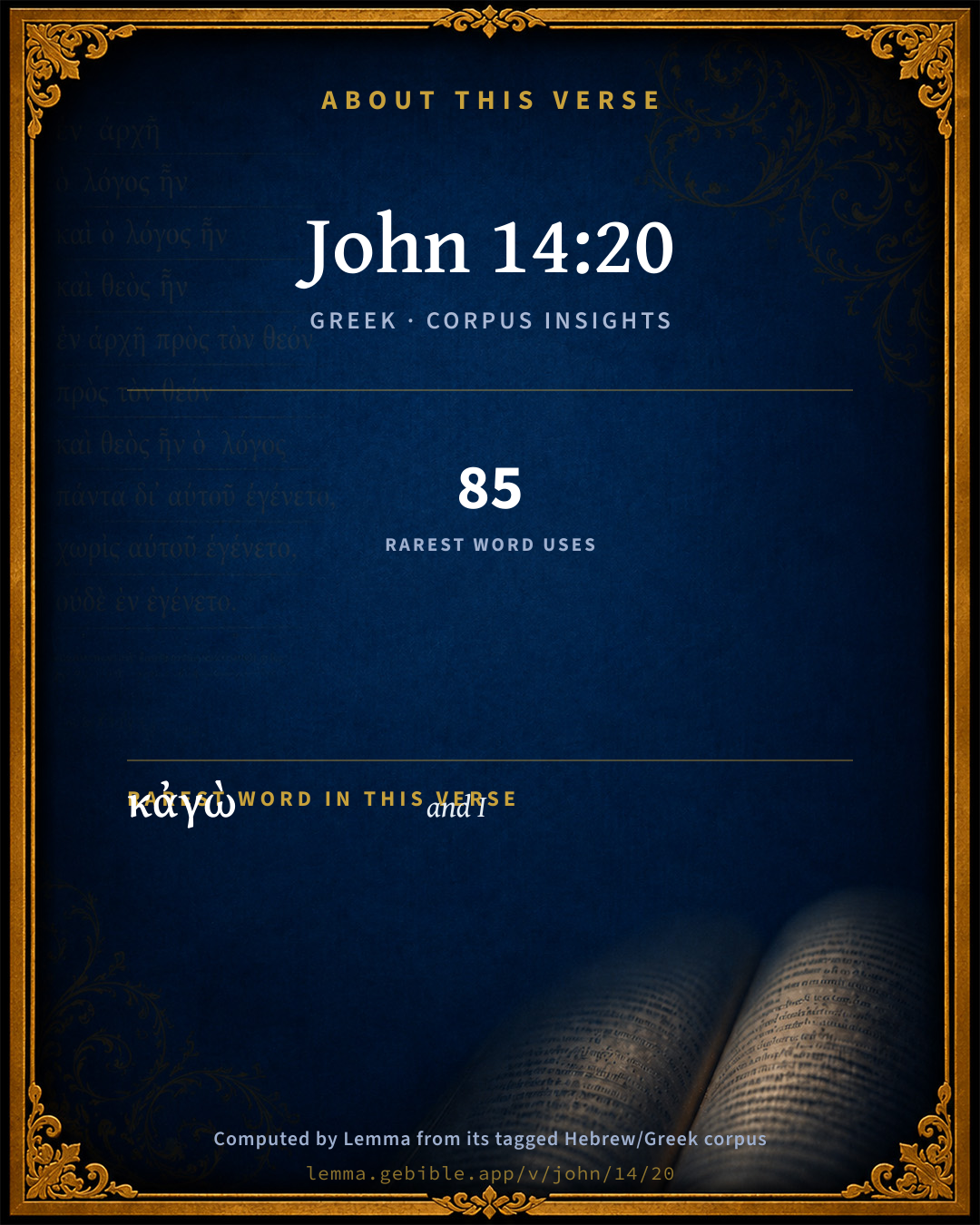
κἀγὼ
kagṓ
G2504
“and I”
Personal pronoun, 1st person, Nominative, Singular, Aramaic form
Part of Speech
Personal pronoun
Person
1st person
Case
Nominative
Number
Singular
Degree
Aramaic form
Full Thayer's Definition

Origin: from G2532 and G1473 (so also the dative case kamoi kam-oy', and accusative case kame kam-eh'

TDNT: None

1. and I 2. I also, I as well, I likewise, in like manner I 3. even I, this selfsame I
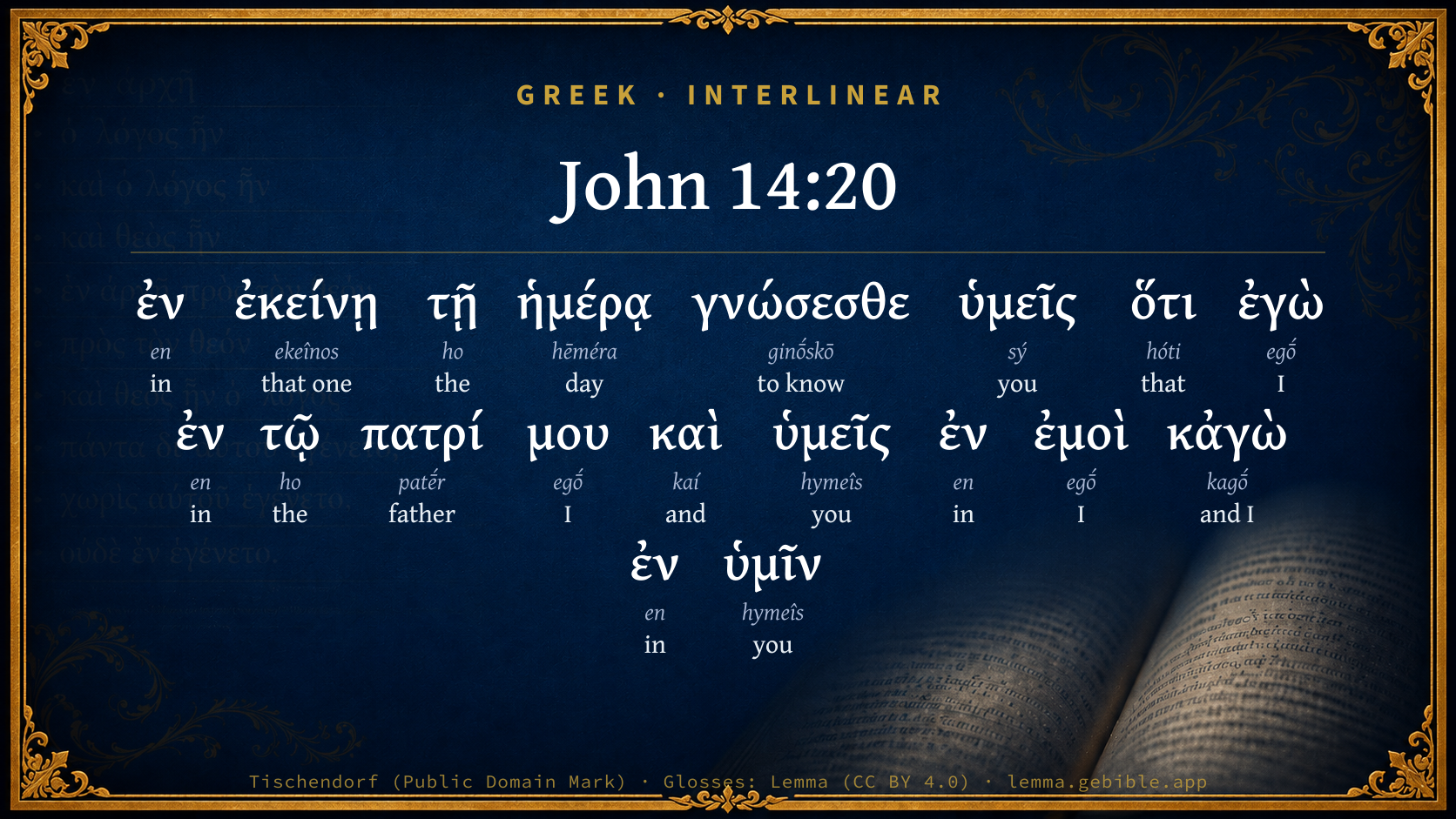
  1. ἐν en G1722 “in” Preposition
  2. ἐκείνῃ ekeînos G1565 “that one” Demonstrative pronoun, Dative, Singular, Feminine
  3. τῇ ho G3588 “the” Article, Dative, Singular, Feminine
  4. ἡμέρᾳ hēméra G2250 “day” Noun, Dative, Singular, Feminine
  5. γνώσεσθε ginṓskō G1097 “to know” Verb, Future, Middle deponent, Indicative, 2nd person, Plural
  6. ὑμεῖς sý G4771 “you” Personal pronoun, 2nd person, Nominative, Plural
  7. ὅτι hóti G3754 “that” Conjunction
  8. ἐγὼ egṓ G1473 “I” Personal pronoun, 1st person, Nominative, Singular
  9. ἐν en G1722 “in” Preposition
  10. τῷ ho G3588 “the” Article, Dative, Singular, Masculine
  11. πατρί patḗr G3962 “father” Noun, Dative, Singular, Masculine
  12. μου egṓ G1473 “I” Personal pronoun, 1st person, Genitive, Singular
  13. καὶ kaí G2532 “and” Conjunction
  14. ὑμεῖς hymeîs G5210 “you” Personal pronoun, 2nd person, Nominative, Plural
  15. ἐν en G1722 “in” Preposition
  16. ἐμοὶ egṓ G1473 “I” Personal pronoun, 1st person, Dative, Singular
  17. ἐν en G1722 “in” Preposition
  18. ὑμῖν hymeîs G5210 “you” Personal pronoun, 2nd person, Dative, Plural

About this verse

These counts appear in no published source. They are computed here, from the morphology-tagged text and Lemma’s own curated glosses. What Lemma adds →

19
words
12
distinct lemmas
Gospels
section

Repetition

Words recur within this verse:

Cross-references

23

Topical passages linked to John 14:20 in the Treasury of Scripture Knowledge — connected by theme and wording, ordered by reader-vote popularity; previews shown in the World English Bible.

  • John 15:5–7 I am the vine. You are the branches. He who remains in me, and I in him, the same bears much fruit, for apart from me you can do nothing.
  • Galatians 2:20 I have been crucified with Christ, and it is no longer I that live, but Christ living in me. That life which I now live in the flesh, I live by faith in the Son of God, who loved me, and gave himself up for me.
  • John 17:21–23 that they may all be one; even as you, Father, are in me, and I in you, that they also may be one in us; that the world may believe that you sent me.
  • John 17:26 I made known to them your name, and will make it known; that the love with which you loved me may be in them, and I in them."
  • John 14:10 Don't you believe that I am in the Father, and the Father in me? The words that I tell you, I speak not from myself; but the Father who lives in me does his works.
  • 1 John 4:12 No one has seen God at any time. If we love one another, God remains in us, and his love has been perfected in us.
  • John 10:38 But if I do them, though you don't believe me, believe the works; that you may know and believe that the Father is in me, and I in the Father."
  • Romans 8:1 There is therefore now no condemnation to those who are in Christ Jesus, who don't walk according to the flesh, but according to the Spirit.
  • 2 Corinthians 13:5 Test your own selves, whether you are in the faith. Test your own selves. Or don't you know as to your own selves, that Jesus Christ is in you?--unless indeed you are disqualified.
  • John 16:26 In that day you will ask in my name; and I don't say to you, that I will pray to the Father for you,
  • Colossians 1:27 to whom God was pleased to make known what are the riches of the glory of this mystery among the Gentiles, which is Christ in you, the hope of glory;
  • John 6:56 He who eats my flesh and drinks my blood lives in me, and I in him.
  • John 16:23 "In that day you will ask me no questions. Most assuredly I tell you, whatever you may ask of the Father in my name, he will give it to you.
  • 2 Corinthians 5:17 Therefore if anyone is in Christ, he is a new creation. The old things have passed away. Behold, all things have become new.
  • Colossians 1:19 For all the fullness was pleased to dwell in him;
  • Colossians 2:9 For in him all the fullness of the Godhead dwells bodily,
  • John 17:11 I am no more in the world, but these are in the world, and I am coming to you. Holy Father, keep them through your name which you have given me, that they may be one, even as we are.
  • 1 Corinthians 1:30 But of him, you are in Christ Jesus, who was made to us wisdom from God, and righteousness and sanctification, and redemption:
  • Ephesians 2:10 For we are his workmanship, created in Christ Jesus for good works, which God prepared before that we would walk in them.
  • John 17:7 Now they have known that all things whatever you have given me are from you,
  • 2 Corinthians 5:19 namely, that God was in Christ reconciling the world to himself, not reckoning to them their trespasses, and having committed to us the word of reconciliation.
  • Romans 16:7 Greet Andronicus and Junias, my relatives and my fellow prisoners, who are notable among the apostles, who also were in Christ before me.
  • 2 Corinthians 12:2 I know a man in Christ, fourteen years ago (whether in the body, I don't know, or whether out of the body, I don't know; God knows), such a one caught up into the third heaven.

Cross-references courtesy of OpenBible.info (CC BY 4.0).

Commentary

Notes on John 14:20 from classic Christian and Jewish commentators (each source and its license shown beneath its notes). The classic Christian expositions comment on the surrounding passage and are grouped to its opening verse, so a note may address several verses; the Jewish commentaries on the Tanakh (Rashi and others) are per-verse, so they appear only where the commentator wrote on this verse.

Lemma curates 59 commentaries, every one of them public domain or Creative Commons licensed, each selected and text-cleaned for this edition rather than reprinted as found. About our sources →

The Biblical Illustrator

Joseph S. Exell

Joh_14:20

At that day ye shall know that I am in My Father, and ye in Me, and I in you

Christs legacy

I.

THE LEGACY ITSELF: Knowledge. Ye shall know. God delivered the Jews to some extent from ignorance by the law, which was their schoolmaster. But in the gospel we are graduates, and know as a matter of history and experience what was only previously known in prophecy and type, in the manifestation of Christ, and the presence of the Spirit. Consider this knowledge as opposed to

1. Ignorance. As there is a profitable ignorance which is a reverent abstinence from searching into Gods secrets, so there is an unprofitable ignorant knowledge which puffs us up. And one strange effect of this ignorance is that every man murmurs that someone else has more land or money than he, yet every man thinks that he has more knowledge than all the world beside. Wherefore the prophet (Jer_10:14) calls this confident believer in his own wisdom a fool, as the greatest reproach that can be fastened upon him. Now, this foolishness is not narrowness of understanding, nor inability to acquire knowledge, for many good men are unlettered and dull. The fool is he who trusteth in his own heart; and against this Christ has left us this legacy of knowledge.

2. Inconsideration. God takes it worse to be neglected than to be injured. Dares an officer who receives instruction from his prince on nonperformance say, I never thought of it? Dares a subject, a servant, or a son? God shows the inconsiderate man

(1) The book of His creatures. Every ant asks him, Where had I this providence and industry? Every flower, Where had I this beauty, fragrance, medicinal virtue?

(2) The Scriptures, where every merciful promise cries, Why am I here to meet thee and perform Gods purpose towards thee, if thou never consider me? So with every judgment.

(3) The example of Christ, who reconsidered His prayer, Yet not My will, but Thine, be done. Since, then, our best acts of reading or hearing and praying need consideration, value this legacy.

3. Concealment. It must be published for the benefit of others. Virtue that is never produced into action is not worthy of the name (Phm_1:6).

II. THE TIME WHEN THIS LEGACY ACCRUES TO US. At that day.

1. The word itself affords cheerfulness. When God inflicted the greatest plague on Egypt it was at midnight; and when He would intimate both deaths at once He says, Thou fool, this night, etc. Against all supply of knowledge He calls him fool; against all sense of comfort in the day He threatens night.

2. It was a certain day: That--and soon. For after Christ had made His will at this supper, and given strength to His will by His death, and proved His will by His resurrection, and left the Church possessed of His estate by His ascension, within ten days after that He poured out this legacy of knowledge.

3. On that day the Holy Ghost came as a wind to note a powerful working; filled them, to note the abundance; and gave them utterance, to infer the communication of their knowledge to others. But He was poured forth for the benefit of all. The prophets, high as their calling was, saw nothing without the Spirit; with the Spirit simple man understands the prophets.

III. OUR PORTION IN THIS LEGACY--the measure of the knowledge of those mysteries which we are to receive. When Felix the Manichaean would prove to Augustine that Manes was the Holy Spirit who should teach all truth, because Manes taught many things of which men were ignorant concerning the frame and nature of the heavens, Augustine answered, The Holy Ghost makes us Christians, not mathematicians. This knowledge is to know the end and the way--heaven and Christ. Now, in all our journeys, a moderate pace brings a man most surely to his journeys end, and so does a sober knowledge in the mysteries of religion. Therefore, the Holy Ghost did not give the apostles all kind of knowledge, but knowledge enough for their present work, and so with us. The points of knowledge necessary for our salvation are three.

1. The mystery of the Trinity. I am in My Father. Origin tells us that the principal use of knowledge is to know the Trinity. For to know that there is one God, natural reason serves our turn. But to know that the Son is in the Father I need the Scriptures, and the light of the Holy Spirit on the Scriptures, for Jews and Arians have the Bible too. But consider that Christ says, ye shall know, not ye shall know how. It is enough for a happy subject to enjoy the sweetness of a peaceable government, though he knows not the ways by which his prince governs, so it is enough for a Christian to enjoy the working of Gods grace, though he inquire not into

Gods unrevealed decrees. When the Church asked how the body of Christ was in the sacrament we see what an inconvenient answer it fell upon. Make much of that knowledge with which the Spirit hath trusted you, and believe the rest. No man knows how his soul came into him, yet no man doubts that he has a soul.

2. The mystery of the Incarnation--Ye in Me. For since the devil has taken manhood in one lump in Adam, Christ to deliver us as entirely took all mankind upon Him. So that the same pretence that the devil hath against us, You are mine, for you sinned in Adam, we have also for our discharge, we are delivered, for we paid our debt in Christ.

3. The assurance of this grows from the third part of our knowledge the mystery of our redemption, in our sanctification. I in you. This last is the best. To know that Christ is in the Father may serve me to convince another who denies the Trinity; to know we are in Christ may show that we are more honoured than angels. But what worth is this if I know not that Christ is in me. How then is this? Here the question is lawful, for it has been revealed. It is by our obedience to His inspiration, and by our reverent use of His sacrament, when the Spirit visits us with effectual grace, and Christ marries Himself to our souls. (J. Donne, D. D.)

The experimental knowledge of the Christian mysteries

Our Lord had just been exhorting His disciples to believe that He was in the Father and the Father in Him; and had been gently wondering at the slowness of their faith. Now He tells them that, when He is gone, they shall know the thing which, with Him by their side, they found it so hard to believe.

I. The principle that underlies these wonderful words is that CHRISTIAN EXPERIENCE IS THE BEST TEACHER OF FUNDAMENTAL CHRISTIAN TRUTH. Observe with what decision our Lord carries that principle into regions where we might suppose at first sight that it was altogether inapplicable.

1. Ye shall know that I am in My Father. How can such a thing as the relation between Christ and God ever be a matter of consciousness? Must it not always be a matter that we must take on trust? Not so; remember what has gone before. If I have these things I know that it is Jesus Christ that gives them, and I know that He could not give them if He did not dwell in God and were not Divine. These new influences, this revolution in my being, this healing touch, these new hopes, these reversed desires, all these things bear upon their very front the signature that they are wrought by a Divine hand, and as sure as I am of my own Christian consciousness, so sure am I that all its experiences proclaim their author, and that Christ who does them is in God. On the subject of Christs Divinity, many profound and learned arguments have been urged by theologians, and these are all well and needful in their places, but the true way to be sure of it is to have Him dwelling with us and working on us.

2. In like manner, the other elements of this knowledge flow necessarily from Christian experiences. That ye are in Me, and I in you. If a Christian man carries the consciousness of Christs presence, and has Him as a Sun in his darkness, and as a Life source feeding his deadness with life, then he knows with a consciousness which is irrefragable that Jesus Christ is in him.

3. So, let us learn what the Christian mans experience ought to be, and to do for him. It should make all the fundamentals of the gospel vitally and vividly true; and, certified by what had passed within your own spirits, you should be able to say, we have the witness in ourselves. And though there will remain much in Christian doctrine which is not capable of that plain and all-sufficing verification; much about which we must still depend on the teaching of others, the central facts which make the gospel may all become elements of our very consciousness which stand undeniable to us, whosoever denies them.

II. SUCH A DIRECT WAY TO KNOWLEDGE IS REASONABLE.

1. It is in plain analogy with the manner by which we attain to the knowledge of everything except the mere external facts. How do you know anything about love? You may read poems and tragedies to the end of time, and you will not understand it until you come under its spell for yourself; and then all the things that men said about it cease to be mere words, because you yourself have experienced the emotion. And the only way to be sure, with a vital certitude, of Christ, is to take Christ for your very own, and then He comes into your very being, and dwells there unchanged, the Sun and the Life.

2. Though such certitude is not available for other people, the fact that so many millions of men allege that they possess this certitude is available for other people. And there is nothing to be said by the unbeliever to this. Whether this man be a sinner or no, I know not. You may jangle as much as you like about the controversial points that surround the Christian revelation. One thing I know, that whereas I was blind, now I see. And we may push the war into the enemys quarters, and say, Why! herein is a marvellous thing, that you that know everything do not know whence this Man is. And yet He has opened mine eyes. You want facts; there are some. You want verification; we have verified by experiment, and we set to our seals that God is true.

3. But, you say, that is not a fair account of the way in which Christian men and women generally feel about this matter. Well, so much the worse for the so-called Christian men and women. And if they are Christians, and do not know by this inward experience that Christ is Divine and their Saviour, then either their experience is wretchedly superficial and fragmentary; or, having the facts, they have failed to make their own by reflection the certitudes which are their own. (A. Maclaren, D. D.)

The Father, Christ, and His people one

1. The importance of a definite knowledge and firm belief of the more recondite doctrines of Christianity is greatly underrated. By the infidel they are considered as mystical dreams, scholastic abstractions, characterized by self-contradiction and absurdity. The rationalistic Christian for the same reason explains away the passages that teach them. But there are also men--loud in proclaiming their belief of all these doctrines--whose belief ofthem is little more than a belief that the propositions in which they are stated, and who plainly consider them as having little connection with the formation of character and guidance of conduct. But I do not worship the Christian God if I do not worship God in Christ; and as Christian worship is rational worship, I cannot worship God in Christ, without knowing what is meant by God being in Christ, and believing it. All Christian motive and comfort flow from Christian doctrine understood and believed.

2. The phrase, that day, does not seem here to refer to some short fixed period--as the time when our Lord returned to the disciples after His resurrection--or, the time of the giving of the Holy Spirit at Pentecost,--or, the time of the second coming; but to the whole period from our Lords coming after the Resurrection, to His coming the second time for complete salvation. The phrase is very often so used in the Old Testament Isa_12:1; Zec_13:1; Zec_14:9).

I. THE DOCTRINES.

1. Christ is in the Father. The sentiment is more fully expressed in verses 10,

11. Note--

(1) The relation between our Lord and the Father as Divine persons? They are, with the Holy Spirit, possessors of the one Divine essence, are of the same perfections and prerogatives. It is the most intimate relation in the universe. The Father and the Son are one. This is a union with the Father common to the Son and to the Spirit; but there is a union with the Father peculiar to the Son. He is the Son of the Father, the Father is His Father.

(2) The relation between our Lord as the man Christ Jesus, and the Father?

(a) The man Christ Jesus is in personal unity with the Divinity. He is related to God as no man ever was, ever will be, ever can be. He was God manifest in flesh.

(b) The man Christ Jesus was, from the very moment of His beginning to exist as a man, brought entirely under the influence of the Holy Spirit, through whom the one Divinity does all things. In other relations the Son stands alone. Here He stands, at the head of an innumerable multitude of brethren.

(3) The relation between our Lord as God-man, Mediator and the Father. It belonged to the Father, as sustaining the majesty of Godhead, to appoint the Mediator. Our Lord took not this honour on Himself. He was in the Father, as the ambassador is in his prince or sovereign; and the Father was in Him, as the prince or sovereign is in his ambassador. His doctrine was the doctrine of God; His works were the works of God.

2. Christs people are in Him.

(1) By the Divine constitution, every believer is brought into such an intimacy of relation with Jesus Christ, as that he is treated as if he had done what Christ has done. So that in him he is justified, sanctified, and redeemed (1Co_1:30), absolutely secured of a complete salvation, from His connection with Him.

(2) Besides, Christs people are in Him, as the branch in the vine, as the members in the head. As new creatures, in Him they live, and move, and have their being (Joh_6:57).

3. Christ is in His people. They are animated by His Spirit. But that Spirit, enabling them to understand and believe His word, makes them think, will, choose along with Him, walk as He also walked; so that they are His animated images, His living epistles.

II. THE KNOWLEDGE OF THE DOCTRINES. The apostles had heard them again and again, and they had some misty general conception of them; but they had no clear apprehension. But the time was approaching when their views should be enlarged, and their faith confirmed, and experience called in to the aid of faith.

1. The Resurrection, to some extent, cleared their minds. They saw that their Master was in the Father. He was thereby powerfully declared to be the Son of God (Joh_20:28).

2. The outpouring of the Holy Spirit went still farther in extending their views and confirming their faith (see Peters sermon on the Day of Pentecost).

3. And all the true followers of our Lord, in every age and country, are all made to know these doctrines by the teaching of His Spirit through the word, and the working of the Spirit in their hearts. They lie at the very foundation of all their hopes, and all their holiness.

4. And at the great day of doom, they shall know more clearly still, and as eternity rolls on, new depths of meaning are found in these unfathomable words. (J. Brown, D. D.)

The union between Christ and His people

It is a union of mutual in-being, not a union of affection only, such as the stones have, when they lie together in a heap; but rather such as is between the wine and the water, when they are put together, saving that they are not mixed together. Christ is not mixed with a Christian, a Christian is not mixed with Christ; Christ is not a Christian, a Christian is not Christ; but there is a union of mutual in-being. Now, you know, when the fire gets into the iron, is united to it, is in it, the properties of the fire are communicated to the iron; the iron forgets his own blackness, and shines with the shining of the fire, and burns with the burning of the fire. And as a coal, though it be never so dark and black a body, when the fire comes, get into it, the properties of the fire are communicated to it, and it burns like the fire itself, and melts like the fire itself, and shines like the fire itself. So, when the Lord Jesus Christ is united to a soul, look what excellencies there are in Christ, what graces in Christ, the same are communicated to it; the soul shines with Christs shining, and warms with His warming: there is grace answerable for His grace. (W. Bridge, M. A.)

The Biblical Illustrator, edited by Joseph S. Exell (c. 1880s–1900s) — public domain. Text from a community e-Sword module.

MacLaren's Expositions of Holy Scripture

Alexander MacLaren

John

THE GIFTS OF THE PRESENT CHRIST

Joh 14:20 - Joh 14:21.

We have heard our Lord in the previous verse unveiling His deepest and strongest encouragements to His downcast followers. These were: His presence with them, their true sight of Him, and their participation in His life. The first part of our present text is closely connected with these, for it gives us their upshot and consequence. Because Christ’s true disciple is conscious of Christ’s presence, sees Him with the eyes of his spirit, and draws life from Him, therefore he will know by experience the deep truths of Christ’s indwelling at once in the Father and in His servant, and of His servant’s indwelling in Him. Our Lord had just previously been exhorting His disciples to believe that He was in the Father and the Father in Him; and had been gently wondering at the slowness of their faith. Now He tells them that, when He is gone, their spiritual stature will be so increased as that they shall know the thing which, with Him by their side, they found it so hard to believe.

The second part of our present text is the close of this whole section of our Lord’s discourse, and in it He urges the requirement of practical obedience, as the sign and test of love, and as the condition of receiving these high and wonderful things of which He has been speaking. He has been unveiling spiritual blessings, which may seem recondite and up in the clouds, and which, as a matter of fact, have often been perverted into dreamy mysticisms of a most immoral and unpractical kind. And so He brings us sharp back again here to very plain truths, and would teach us that all these lofty and ineffable gifts of which He has been dimly speaking are to be reached only by the commonplace road of honest obedience and simple conformity to His commandments. In these last words of my text, He administers the antidote and the check to the possible abuses of the great things which He has been saying.

I. Note, then, first, the knowledge that comes with the Christ who comes.

‘At that day’ covers the whole period of which He has been speaking, between His withdrawal from the disciples and His final corporeal coming to judgment-that great day of which generations are but the moments. In it the men who love Him are to have His presence, His vision, His life, and because they have, ‘Ye shall know that I am in My Father, and ye in Me, and I in you,’ The principle that underlies these wonderful words is that Christian experience is the best teacher of fundamental Christian truth. Observe with what decision, and with what strange boldness, our Lord carries that principle into regions where we might suppose at first sight that it was altogether inapplicable. ‘Ye shall know that I am in My Father.’ How can such a thing as the relation between Christ and God ever be a matter of consciousness to us here upon earth? Must it not always be a truth that we must take on trust and believe because we have been told it, without having any verification in ourselves? Not so; remember what has gone before. If a man has the consciousness of Christ’s presence with Him, sees Him with the true inward eye, which is the only real organ of real vision, and is drawing from Him, moment by moment, His own high and immortal life, then is it not true that this man’s experiences are of such a sort as to be utterly inexplicable, except on the ground that they come from a divine source? If I have these experiences I know that it is Jesus Christ who gives them, and I know that He could not give them, if He did not dwell in God and were not divine. These new influences, this revolution in my being, this healing, constraining, cleansing touch, these calming, gladdening, elevating powers, these new hopes, these reversed desires, loving all to which I was formerly indifferent, and growing dead to all that formerly appealed most strongly to me; all these things bear upon their very front the signature that they are wrought by a divine hand, and as sure as I am of my own Christian consciousness, so sure am I that all its experiences proclaim their Author, and that Christ who gives me them is in God. ‘Ye shall know that I am in My Father.’

The New Testament, as I read it, is full at every point of the divinity of Jesus Christ; and many profound and learned arguments on that subject have been urged by theologians, and these are all well and needful in their places, but the true way to be sure of it is to have Him dwelling with us and working in us; and then what was an article of belief becomes an article of knowledge, and we know Him to be our Saviour and the Son of God.

In like manner, and yet more obviously, the other elements of this knowledge which Christ promises here may be shown to flow naturally and necessarily from Christian experiences. ‘That ye are in Me, and I in you,’-if a Christian man carries the consciousness of Christ’s presence, and has Him as a Sun in his darkness, and as a Life-source feeding his deadness with life, then he knows with a consciousness which is irrefragable that Jesus Christ is in him, for he feels His touch; and he knows that he is in Christ, for he is aware of the power that girdles him, and in which he has peace and righteousness and all.

So, dear brethren, let us learn what the Christian man’s experience ought to be and to do for him. It should change the articles of our creed into elements of our consciousness. It should make all the fundamentals of the Gospel vitally and vividly true; and certified by what has passed within our own spirits We should be able to say: ‘We have the witness in ourselves.’ And though there will remain much that is uncertain, much in Christian doctrine which is not capable of that clear and all-sufficing verification; much about which we must still depend on the mere teaching of others, or on our own study, the central facts which make the Gospel may all become, by this plain and short path, elements of our very consciousness which stand undeniable to us, whosoever denies them.

Such a direct way to knowledge is reasonable, is in full analogy with the manner by which we attain to the knowledge of everything except the mere external facts, the knowledge of which has arrogated to itself the exclusive name of ‘science,’ How do you know anything about love? You may read poems and tragedies to the end of time, and you will not understand it until you come under its spell for yourself; and then all the things that men said about it cease to be mere words, because you yourself have experienced the emotion.

‘He must be loved, ere that to you

He will seem worthy of your love,’

and the only way to be sure, with a vital certitude, of Christ, is to take Christ for your very own, and then He comes into your very being, and dwells there quickening, the Sun and the Life.

So, dear brethren, though such certitude arising from experience, which in its nature is the very highest, is not available for other people, the fact that so many millions of men allege that in varying degrees they possess this certitude is available for other people, and there is nothing to be said by the unbeliever to this, the attestation of the Christian consciousness to the truth of the truths which it has tried. ‘Whether this man be a sinner or no, I know not.’ You may jangle as much as you like about the questionable and controversial points that surround the Christian revelation, I do not care in the present connection what answer you give to them. ‘Whether this man be a sinner or no, I know not. One thing I know, that whereas I was blind, now I see.’ And we may push the war into the enemy’s quarters, and say: ‘Why! herein is a marvellous thing, that you that know everything do not know whence this man is, and yet He has opened mine eyes. You want facts; there are some. You want verification; we have verified by experience, and we set to our seals that God is true.’

‘Oh but,’ you say, ‘this is not a fair account of the way in which Christian men and women generally feel about this matter.’ Well, all that I can say about that is, so much the worse for the so-called Christian men and women. And if they are Christians, and do not know by this inward experience that Christ is divine and their Saviour, then there is only one of two reasons to be given for it; either their experience is so wretchedly superficial and fragmentary, so rudimentary as to be scarcely worth calling by the name or, having the facts, they have failed to appreciate their significance, and to make their own by reflection the certitudes which are their own.

Brethren, it becomes every Christian man and woman to be able to say, ‘Because I have Christ with me, and see Him, and derive my life from Him, I know that He is in the Father, and I in Him, and He in me.’ And if you cannot say that, it is your own grasp of Him, or your meditation upon what you have got by your grasp, that is painfully and sinfully defective.

II. My text speaks of the obedience which is the sign and test of love.

The words here are substantially equivalent to former words in the chapter which we have already considered, where our Lord says: ‘If ye love Me, ye will keep My commandments.’

There is, however, a slight difference in the point of view in the two sayings; the former begins with the root and traces it upwards and outwards to its fruits, love blossoming into obedience. Our text reverses the process, and takes the thing by the other end; begins with the fruits and traces them downwards and inwards to the root. ‘He that hath and keepeth My commandments, he it is that loveth Me.’ The two sayings substantially mean the same thing; but in the one love is put first as the cause of obedience, and in the other obedience is put first, as the certain fruit and sure sign of love. The connection between these and the preceding words is, as I have already pointed out, that our Lord here brings all His lofty promises down to the sharp, practical requirement of obedience, as the only condition on which they can be fulfilled.

So note, and very briefly about this matter, how remarkably our Lord here declares the possession of His commandments to be a sign of love to Him. ‘He that hath,’ a word which is generally passed over in our reading-’He that hath My commandments, He it is that loveth Me.’ Of course there are two ways of having His commandments; there is having them in the Bible, and there is having them in the heart;-present before my eye, as a law that I ought to obey, or present within my will, as a power that shapes it. And the latter is the only kind of ‘having’ that Christ regards as real and valid. The rest is only preparatory and superficial. Love possesses the knowledge of the loved one’s will. Is not that true? Do we not all know how strange is the power of divining desires that goes along with true affection, and how the power, not only of divining, but of treasuring, these desires is the test and the thermometer of our true love? Some of us, perhaps, keep laid away in sacred, secret places tattered, yellow, old bits of paper with the words of a dear one on them, that we would not part with. ‘He that hath My commandments’ laid up in lavender in the deepest recesses of his faithful heart, he it is ‘that loveth Me.’

In like manner, our Lord says, the practical obedience to His commandments is the sure sign and test of love. I need not dwell upon that. There are two motives for keeping commandments-one because they are commanded, and one because we love Him that commands. The one is slavery, the other is liberty. The one is like the Arctic regions, cold and barren, the other is like tropical lands, full of warmth and sunshine, glorious and glad fertility.

The form of the sentence suggests how easy it is for people to delude themselves about their love to Jesus Christ. That emphatic ‘he,’ and the putting first of the character before its root is pointed out, are directed against false pretensions to love. The love that Christ stamps with His hall-mark, and passes as genuine, is no mere emotion, however passionate, however sweet; no mere sentiment, however pure, however deep. The tiniest little rivulet that drives a mill is better than a Niagara that rushes and foams and tumbles idly. And there is much so-called love to Jesus Christ that goes masquerading up and down the world, from which the paint is stripped by the sharp application of the words of my text. Character and conduct are the true demonstrations of Christian love, and it is only love so attested that He accepts.

III. Lastly, notice the further and sweeter gifts of divine love and manifestation which reward our love and obedience.

‘He that loveth Me shall be loved of My Father, and I will love him, and will manifest Myself to him.’ Two things, then, He tells us, are the rich rewards and sparkling crowns with which He crowns our poor love to Him-the love of the Father and the love of the Christ, separate and yet united, and the further manifestation of Christ’s sweetness to the waiting heart.

Note, as to the first, the extraordinary boldness of that majestic saying: ‘If a man loves Me, My Father will love him.’ God regards our love to Jesus Christ as the fulfilling of the law, as equivalent to our supreme love to Himself, as containing in it the germ of all that is pleasing in His sight. And so, upon our hearts, if we love Christ, there falls the benediction of the Father’s love. Of course I need not remind you that our Lord here is not beginning at the very beginning of everything; for prior to all men’s love to Christ is Christ’s love to men, and ours to Him is but the reflection and the echo called forth by His to us. ‘We love Him because He first loved us’ digs a story deeper down in the building than the words of my text, which is speaking, not of the process by which a man comes to receive the love of God for the first time, but of the process by which a Christian man grows in his possession of it. That being understood, here is a great lesson. It is not all the same to God whether a man is a scoundrel or a saint. The divine love is over all its works, and embraces every variety of humanity, the most degraded, alien, hostile. But in this generation, as it seems to me, there is great need for preaching that whilst that is gloriously and blessedly true, the other thing is just as true, that to know the deepest depth and to taste the sweetest sweetness of the love of our Father God, there must be in our hearts love to Him whom He has sent, which manifests itself by our obedience. God’s love is a moral love; and whilst the sunbeams play upon the ice and melt it sometimes, they flash back from, and rest most graciously and fully on, the rippling stream into which the ice has turned. God loves them that love Him not, but the depths of His heart and the secret, sacred favours of His grace can only be bestowed upon those who in some measure are conformed, and are growingly being conformed, to His likeness in Jesus Christ, and who love Him and obey Him.

And, in like manner, my text tells us that if we wish to know all that it is possible for us here, amidst the clouds, and shadows, and darknesses, to know of that dear Lord, the path to such knowledge is plain. Walk in the way of obedience, and Christ will meet you with the unveiling of more and more of His love. To live what we believe is the sure way to increase its amount. To be faithful to the little is the certain way to inherit the much. And Christ manifests Himself, in all deep and recondite sweetness, gentleness, constraining power, to the men who treasure the partial knowledge as yet possessed, in their loving hearts and obedient wills, and who make a conscience of translating all their knowledge into conduct, and of basing all their conduct on knowledge of Him. He gives us His whole self at the first, but we traverse the breadth of the gift by degrees. He puts Himself into our hands and into our hearts when we humbly trust Him and imperfectly try to love Him. But the flower is but a bud when we get it, and, as we hold it, it opens its petals to the light.

So, if ‘any man wills to do His will, he shall know of the doctrine’; and if, touched by His divine love and infinite sacrifice for me, I cast my poor self upon Him, and try to love Him back again, and to keep His commandments because I love, then day by day I shall realise more and more of His strong, immortal, all-satisfying love, and see more and more deeply into that Saviour, whose infinite beauties remain unrevealed after all revelation, and to know more and more of whom shall be the Heaven of Heavens yonder, as it is the joy and life of the soul here.

Alexander MacLaren, Expositions of Holy Scripture (1904–1910) — public domain. Text from a community e-Sword module.

Tyndale Open Study Notes

Tyndale Open Resources

14:20 Jesus’ resurrection (14:19) inaugurated his spiritual union with his disciples, which is parallel to the union he enjoys with the Father (see 15:4-5; 1 Jn 1:3).

Tyndale Open Study Notes — © Tyndale Open Resources, licensed CC BY-SA 4.0. Text via the HelloAO Bible API.

Bengel's Gnomon

Johann Albrecht Bengel

Joh 14:20. Ἐκείνῃ, in that) after that “little while” (ἔτι μικρόν).—ἡμέρᾳ day) the day of the Resurrection.—γνώσεσθε, ye shall know) better than we do now.—ὑμεῖς) ye, concerning whom see the following verses.—ἐν τῷ) in My Father, viz. the living Father, ch. Joh 6:57. Understand, and the Father in Me; and infer, the Father in you, and you in the Father.

Bengel's Gnomon of the New Testament — English translation (T&T Clark, Edinburgh, 1860) — public domain. Text from a community e-Sword module.

Meyer's Critical & Exegetical Commentary

Heinrich August Wilhelm Meyer

Joh_14:20-21. At that day;[153] in the historical fulfilment this was the day of Pentecost. Not: at that time (De Wette), or, as Hengstenberg twists it: in the period of time, beginning with the day of the resurrection (comp. Weiss); for a definite fact, marked off in point of time, is treated of, and this is the advent of Christ in the Paraclete. Comp. Joh_16:23.

γνώσεσθε, κ.τ.λ.] This dynamic immanence of Christ in the Father (see on Joh_10:38), which exists even in His state of exaltation (Col_3:3), like the analogous reciprocal relation between Him and the disciples, according to which they live and move in Him and He in them (Gal_2:20), was to become for them a matter of experimental acquaintance through the Spirit.

Joh_14:21. General moral condition of this promised ΓΝΏΣΕΣΘΕ. Comp. Joh_14:15.

Ὁ ἜΧΩΝ, Κ.Τ.Λ.] Augustine: qui habet in memoria et servat in vita. The ἜΧΕΙΝ, however, is rather the internal possession of the commandments, obtained by faith, the appropriated living presence of them in the believing consciousness, as the consequence of the ἀκούειν. Comp. Joh_5:38.

ἘΚΕῖΝΌς ἘΣΤΙΝ] with great and exclusive emphasis.

In ἈΓΑΠΗΘΉΣ. and ἈΓΑΠΉΣΩ lies the peculiar mutual love.

ΚΑῚ ἘΓῺ ἈΓΑΠ.] Ὡς ἈΜΦΟΤΈΡΩΝ ΤᾺ ΑὐΤᾺ ΘΕΛΌΝΤΩΝ Κ. ἈΠΟΔΕΧΟΜΈΝΩΝ, Euth. Zigabenus.

ἘΜΦΑΝΊΣΩ ΑὐΤῷ ἘΜΑΥΤΌΝ] corresponds to the ΓΝΏΣΕΣΘΕ, which was to commence through this very causing of Himself to appear in virtue of the communication of the Spirit. On ἐμφαν., comp. Exo_33:13; Exo_33:18; Sap. Joh_1:2; Mat_27:53. The expression is such, that it sets forth the relation of the self-demonstration of the Lord to His individual loving ones, not His manifestation at the Parousia, which certainly will be glorious and universal (in answer to Luthardt). Those who explain it of the resurrection of Christ understand the appearances of the Risen One to be referred to, 1 Corinthians 15 (Grotius, Hilgenfeld, and many others).

[153] Luthardt, according to his view of the entire passage, must understand the day of the Parousia, whereby he assigns to γνώσεσθε the moment of the completed knowledge.

Meyer — Critical and Exegetical Commentary on the New Testament — English translation by Peter Christie, edited by Frederick Crombie (T&T Clark, 1880) — public domain. Text from a community e-Sword module.

Expositor's Greek Testament

ed. W. Robertson Nicoll

Joh 14:20 . ἐν ἐκείνῃ τῇ ἡμέρᾳ , “in that day,” which does not mean Pentecost, but the new Christian era which was to be characterised by these experiences. Cf. Holtzmann. The sense of a new life produced by Christ would compel the conviction ὅτι ἐγὼ ἐν τῷ πατρί … “that I am in the Father” in vital union with the source of all life, “and that you are in me,” vitally connected with me so as to receive that life that I live, “and I in you,” filling you with all the fulness that is in myself, living out my own life in and through you, and finding in you room for the output of all I am.

The Expositor's Greek Testament, edited by W. Robertson Nicoll (1897–1910) — public domain. Text from a community e-Sword module.

Geneva Bible (1599)

Geneva Bible translators

The Son is in the Father after such sort, that he is of one selfsame substance with the Father, but he is in his disciples in a certain respect as an aider and helper of them.

Geneva Bible (1599) marginal notes — public domain. Text via Bolls.life.

Jamieson, Fausset & Brown

Robert Jamieson, A. R. Fausset & David Brown

At that day--of the Spirit's coming.

ye shall know that I am in my Father, ye in me, I in you--(See on Joh 17:22-23).

Jamieson, Fausset & Brown — Commentary Critical and Explanatory on the Whole Bible (1871) — public domain (CC PDM 1.0). Text via the HelloAO Bible API.

Adam Clarke's Commentary

Verse 20. That I am in my Father] After my resurrection, ye shall be more fully convinced of this important truth, that I and the Father are ONE; for I will live in you by the energy of my Spirit, and ye shall live in me by faith, love, and obedience.

Adam Clarke's Commentary on the Bible (1810–1826) — public domain. Text from a community e-Sword/MySword module.

John Calvin's Commentaries

20. At that day Some refer this to the day of Pentecost; but it rather denotes the uninterrupted course, as it were, of a single day, from the time when Christ exerted the power of his Spirit till the last resurrection. From that time they began to know, but it was a sort of feeble beginning, because the Spirit had not yet wrought so powerfully in them. For the object of these words is, to show that we cannot, by indolent speculation, know what is the sacred and mystical union between us and him, and again, between him and the Father; but that the only way of knowing it is, when he diffuses his life in us by the secret efficacy of the Spirit; and this is the trial of faith, which I lately mentioned.

As to the manner in which this passage was formerly abused by the Aryans, to prove that Christ is God only by participation and by grace, it is easy to refute their sophistry. For Christ does not speak merely of his eternal essence, but of that Divine power which was manifested in him. As the Father has laid up in the Son all fullness of blessings, so, on the other hand, the Son has conveyed himself entirely into us. He is said to be in us, because he plainly shows, by the efficacy of his Spirit, that he is the Author and the cause of our life.

John Calvin's Commentaries (1540-1563) — public domain. Text from the Calvin Translation Society English edition (1840s-50s) via the Christian Classics Ethereal Library (ccel.org). Calvin's coverage is partial (roughly two-thirds of the Bible); uncommented books and verses are honest gaps, never fabricated. The 19th-century editor's footnotes and remarks are omitted so the notes are faithfully Calvin's own voice.

Ellicott's Commentary for English Readers

(20) At that day ye shall know—i.e., the day of the gift of the Comforter, in whom Christ shall come to them. In the first reference the Day of Pentecost is meant, but the words hold good of every spiritual quickening, and will hold good of the final coming in the last day. The pronoun “ye” is emphatic—“Ye shall know for yourselves.”

That I am in my Father, and ye in me, and I in you.—Comp. Note on Joh_10:38. The result of this spiritual illumination would be that they should of themselves know the immanence of the Son in the Father, and their own union with the Father through Him. They ask now (Joh_14:8) for a manifestation of the Father. The Spirit should so bring the life of Christ to their hearts that they would read in it the manifestation of the Father, and feel that in and through that life their own spirit has communion with God. The Spirit would witness with their spirit that they were the children of God. They would seek no longer for a Theophany from without, but in the depth of their inmost lives would cry, “Abba, Father.”

A Bible Commentary for English Readers, edited by Charles John Ellicott (1878–1897) — public domain. Text from a community e-Sword module.

The Cambridge Bible for Schools and Colleges

gen. ed. J. J. S. Perowne

20. At that day] Comp. Joh_16:23; Joh_16:26. Pentecost, and thenceforth, to the end of the world. They will come to know, for experience will teach them, that the presence of the Spirit is the presence of Christ, and through Him of the Father.

ye in me, and I in you] Comp. Joh_15:4-5, Joh_17:21; Joh_17:23; 1Jn_3:24; 1Jn_4:13; 1Jn_4:15-16.

The Cambridge Bible for Schools and Colleges (gen. ed. J. J. S. Perowne; Cambridge University Press, 1878–1918) — public domain. Text from a community e-Sword module.

John Gill's Exposition

At that day ye shall know,.... The things they should know, or the objects of knowledge are,

that I am in my Father; in his bosom, in union with him, partaker of the same nature, perfections, and glory with him, and equal to him:

and you in me: that they were in union with him as the branches in the vine, and as the members are in the head, and how they were loved in him, chosen in him, righteous in him, risen with him, and made to sit together in heavenly places in him:

and I in you; formed in their hearts, living in them, dwelling in them, as in his temples, and filling them with grace and glory. The knowledge of these things promised, designs a more clear and distinct knowledge of them; something of them was known already, but not so perfectly as should be hereafter; and this does not suppose that these unions between the Father and Christ, and between Christ and his people, shall then begin to be; for as the union between the Father and the Son is as eternal as themselves; so the union between Christ and his people, as he is the head and representative of them, is as early as his investiture with the office of a Mediator, and his suretyship engagements for them, which were from eternity; and are the ground, and foundation of his being in them, and they in him in the effectual calling; nor does it suggest that they shall begin to be known; only that they shall be known in a more perfect manner: the time when this will be, is "at that day": meaning either when he should "live" in the body again, be raised from the dead, when he should he declared to be the Son of God with power, when it would appear, that he had the same power with the Father, by raising himself from the dead, and when he would rise as a public head representing them, for their justification, and they should see themselves justified and discharged in him; or the day of "Pentecost", when "the Spirit of truth", he promises to pray for, should come to them in an extraordinary manner, and lead them into the knowledge of these things; or the last day, the resurrection morn, when, by virtue of union to Christ, the saints shall rise and "live" with him for ever, and shall have a perfect knowledge of these several unions; see Joh 17:21.

John Gill's Exposition of the Whole Bible (1746–1763) — public domain (CC PDM 1.0). Text via the HelloAO Bible API.

Trapp's Complete Commentary

John Trapp

20 At that day ye shall know that I am in my Father, and ye in me, and I in you.

Ver. 20. That I am in my Father and you in me] Oh happy union, the ground of communion! interest! the ground of influence! Hence we have communication of Christ’s secrets, 1Co 2:6; the testimony of Jesus, 1Co 1:5; consolation in all afflictions, 2Co 1:5; sanctification of all occurrences, Php 1:21; participation of Christ’s merit and Spirit, and what not?

John Trapp, A Commentary or Exposition upon All the Books of the Old and New Testament (1647–1656) — public domain. Text from a community e-Sword module.

Albert Barnes' Notes on the Bible

At that day - In the time when my life shall be fully manifested to you, and you shall receive the assurance that I live. This refers to the time after his resurrection, and to the manifestations which in various ways he would make that he was alive.

That I am in my “Father ... - That we are most intimately and indissolubly united. See the notes at Joh 10:38.

Ye in me - That there is a union between us which can never be severed. See the notes at Joh 15:1-7.

Albert Barnes' Notes on the Bible (1834–1885) — public domain. Text from a community e-Sword/MySword module.

Haydock's Catholic Bible Commentary

In that day, when I am risen again, or when the Holy Ghost is come, you shall know that I am in the Father, and how, and in what manner: as also, how I am in you, and you in me. Our Saviour Christ, on several occasions, speaks of different ways of being united, or of being one; as first, of being one in nature and substance, and by such an union, as agrees only with the divine persons, who are one in all things. 2ndly, Persons may be one, or united in affection and love, which also, as to its most perfect manner, agrees only with the three divine persons; but a similitude, and an imitation of this union of love, is found among creatures, both when they love God, and when for God’s sake, they love one another: yet these unions are as different as God, and his creatures. The Arians and Socinians lay hold on these expressions, and of the words, (chap. xvii. ver. 21.) when Christ prays, that his disciples may be one, as he and his Father are one, which words imply no more than a similitude, and an imitation of that union of love (with which the three divine persons love one another) though at an infinite distance. If the old or new Arians examined, with a sincere desire of finding the truth (which they ought to seek from many passages in the New Testament, as well as from the sense and tradition of the Church, guided by the promised Spirit of Truth) they might certainly find how different is the union of nature and substance of the eternal Son with his eternal Father, and of that union of the three divine persons, when they are said to be one, from that inferior and lesser union of love and affection, by which either God loves his adoptive children, his faithful servants, or they love one another: they would easily discover, that many things are said of the unity and union of the divine persons, which could not be true, unless they were one and the same God, coeternal and consubstantial, which by no means can be said of God and his creatures, nor of the union of affection only, by which the creatures love one another. (Witham)

George Leo Haydock (1774–1849), Haydock's Catholic Family Bible and Commentary, 1859 edition — public domain. Excludes Psalms (Douay-Rheims chapter numbering differs from Protestant) and Deuterocanonical books (Catholic canon only).

Matthew Poole's English Annotations

Some understand our Saviour here speaking of the day of his resurrection; others interpret it of the days of Pentecost, when there should be such an effusion of the blessed Spirit: but the following words discover, that it is best interpreted of the day of judgment, and the general resurrection: for they speak of two great mysteries, which the disciples should understand in that day which is here spoken of; to wit, the personal union of Christ with his Father, and the mystical union of believers with Christ: as to both which, though the apostles and believers knew much more after Christ’s resurrection, and the pouring forth of the Spirit in the days of Pentecost, than they knew before those times; yet it is a very imperfect knowledge they ever had, or yet have, of those mysterious unions; but in the resurrection we shall understand these things clearly.

Matthew Poole's English Annotations on the Holy Bible (1683–1685) — public domain. Text from a community e-Sword/MySword module.

Whedon's Commentary on the Bible

Daniel D. Whedon

20. At that day—We have here the prophetic formula, In that day. In those days, or, In the last days, by which is intimated a foreseen future period, opening into an indefinite extension. It is the day of the Spirit dispensation, extending onward to the day of the Second Advent. So Isa_11:13 : “The Lord alone shall be exalted in that day.” And Isa_2:2 : “In the last days the mountain of the Lord’s house [Zion] shall be… exalted above the hills; and all nations shall flow unto it.”

Ye shall know—It shall be by experience. There shall be no guess, or mere expectation, or hope so about it. The religion of the Spirit is not a hope, but an enjoyment. “For what a man seeth, why doth he yet hope for?” Rom_8:24.

Daniel D. Whedon (gen. ed.), Commentary on the Old and New Testaments (1874–1909) — public domain. Text from a community e-Sword module.

The Pulpit Commentary

In that day of glorious re-communion with you, begun in the Resurrection-surprises, which will aid your faith and triumphantly establish the mysteries and marvels of Pentecost, you shall know what you now most imperfectly apprehend by faith, that I am in my Father, as One lifted up into God, and that I act entirely with and for and as my Father, fulfilling all that I have told you of my personal relationship with him; and then, he adds, you shall know that as I am in my Father, you (are) in me, living in and by my power, and continuously drawing life from me; and what is still more, I in you; i.e. as the Father has acted in and through my will, and I have spoken his words and done his works, so I will energize in you. Your "greater works" will prove my "greater power." Your own consciousness of my presence, and of continuous communion with me, will reveal to you, as you never knew before, that I am in my Father, and also that I am in you. So the apparent paradox presents itself, that in order to know the Father, to see the Father, we must commune with the humanity of Jesus; but in order to realize and come into contact with that humanity, we have to grasp that it is lifted up into God. Because he is in the Father he is able to be with and in us.

The Pulpit Commentary (1880–1919), ed. H.D.M. Spence-Jones & Joseph S. Exell — public domain. Text from a community e-Sword module.

John Wesley's Explanatory Notes

At that day - When ye see me after my resurrection; but more eminently at the day of pentecost.

John Wesley, Explanatory Notes Upon the Whole Bible (1754–1765) — public domain. Text via the GEBible commentary corpus.

The People's New Testament

B. W. Johnson

20. At that day ye shall know. “That day” began on Pentecost. There was no more doubting after the Holy Spirit was sent. “That day” still comes to every soul that wholly surrenders to the will of Christ (7:17).

B. W. Johnson's The People's New Testament with Notes (1889–1891) — public domain. Electronic text from the Christian Classics Ethereal Library (CCEL) ThML edition.

Cambridge Greek Testament for Schools and Colleges

20. ἐν ἐκ. τ. ἡμ. Comp. Joh 16:23; Joh 16:26. Pentecost, and thenceforth to the end of the world. They will come to know, for experience will teach them, that the presence of the Spirit is the presence of Christ, and through Him of the Father. For ὑμεῖς ἐν ἐμοί comp. Joh 15:4-5, Joh 17:21; Joh 17:23; 1Jn 3:24; 1Jn 4:13; 1Jn 4:15-16.

Cambridge Greek Testament for Schools and Colleges (Cambridge University Press, 1896; 21 vols, various authors incl. Carr, Maclear, Plummer, Farrar, Lumby, Moule, M. R. James, Simcox) — public domain. Text from a community e-Sword module.

Alford’s Greek Testament

Henry Alford

20.] ἐκ. τῇ ἡμ., no particular day: but ‘each of these periods, as its continually increasing light breaks upon you, shall bring increased knowledge of your unity in Me with the Father, and my dwelling in you by the Spirit.’ If any particular day is to be thought of, it would naturally be the Pentecost.

Henry Alford, The Greek Testament (1849–1861) — public domain. Text from a community e-Sword module.

International Critical Commentary

20. ἐν ἐκείνῃ τῇ ἡμέρᾳ, i.e. in the new Dispensation of the Spirit, which will begin with the Resurrection. See on 16:23.

γνώσεσθε ὑμεῖς κτλ, “you will know” (ὑμεῖς being emphatic) “that I am in my Father, etc.” At v. 10 (where see note) Jesus had indicated that the disciples ought to have reached as far as faith in His ineffable union with the Father; but He now promises that they shall know it, and recognise it as true, when the illumination of the Spirit has been granted to their minds.

καὶ ὑμεῖς ἐν ἐμοὶ κἀγὼ ἐν ὑμῖν. He had given this to them as a precept of life (15:4, where see note); but the assurance that they might indeed reckon themselves as “in Him” could not be complete until the realisation that they shared His Life (v. 19) was confirmed by the Spirit’s internal witness. This assurance is the highest point in Christian experience. Cf. 17:21, 23, 26; and see especially the note on 17:18.

The Loving Disciple is Loved by God, and to Him Jesus Will Manifest Himself (V. 21)

International Critical Commentary — older volumes (1896–1929), various authors — public domain. Text from a community e-Sword module.

Godet's Commentaries

Frédéric Louis Godet

Vv. 20, 21. “In that day you shall know that I am in my Father and you in me and I in you. 21. He who has my commandments and keeps them, he it is who loves me; and he who loves me shall be loved by my Father, and I will love him and will manifest myself to him.”

The absence of a particle between these words and the preceding and following ones betrays the emotion with which Jesus contemplates and foretells the decisive day of Pentecost. It is, in a new form, the reaffirmation of the same promise.

The expression that day indicates a precise moment, not a period, as Reuss thinks. And as the great circumstances of Jesus’ ministry connect themselves naturally with the Jewish feasts, and as the feast of the Passover, which was about to be the time of His death, was to be followed soon by that of Pentecost, there is nothing to prevent us from thinking, whatever Lucke, de Wette, Weiss, etc., may say, that the day of which He is here speaking was already in their view the day of Pentecost; comp. the ἔτι μικρόν, in a little while, Joh 14:19. However this may be, Jesus contrasts this day of the coming of the Spirit, whatever it is, with the present moment, when the disciples have so much difficulty in forming an idea of the relation of their Master to the Father (Joh 14:9-10). ῾Υμεῖς, you : “from your own experience, and not only, as to-day, from my words.” Comp. Joh 16:25. The object of this spiritual illumination of believers will be, first, the relation of Jesus to the Father; they will have a consciousness of Jesus as of a being who lives and acts in God, and in whom God lives and acts as in another self. This immediate consciousness of the relations between Jesus and God will spring from the living consciousness which they will receive of their own relation to Jesus; they will feel Him living in them and will feel themselves living in Him; and in the experience of this relation to Him (they transported into Him and He transported into them), they will understand that which He had said to them, without succeeding in making Himself understood, of what God is to Him and what He is to God. Then, finally, the transcendent fact of the communion between Jesus and God will become for them the object of a distinct perception through the immediate experience of their own communion with Jesus. These are the μεγαλεῖα τοῦ θεοῦ, the wonderful things of God, which Peter and the disciples celebrate in new tongues on the day of Pentecost.

Frédéric Louis Godet — Commentaries on Luke, John, Romans, and 1 Corinthians — English translation (T&T Clark, Edinburgh, 1870s–1890s) — public domain. Text from a community e-Sword module.

Lesson kit

Teaching starters — assembled from the data on this page, not authored interpretation. Every prompt links to the verse data it draws on. Edit before teaching.

John, in the Gospels, opens this verse with 19 words (12 distinct Greek lemmas). Its most distinctive word is kagṓ (“and I”). A historical commentator’s framing appears above. Read the whole chapter for the surrounding context.

Discussion questions

  1. How does “and I” (kagṓ) shape what this verse is saying?
  2. John 15:5–7 shares this passage’s theme. How do the two illuminate each other?
  3. “in” occurs 4× in this one verse. What is the effect of the repetition?
  4. The translations on this page render this verse differently — a whole-verse word diff, not a word-by-word alignment. What might account for the different wordings?
  5. Reading how The Biblical Illustrator and MacLaren's Expositions of Holy Scripture read this verse, where do the two commentators agree and where do they part?

Things to notice

Reading settings

Reading text

Shown beneath each verse's original-language words.

Old Testament
Old Testament edition

Read the OT as the Masoretic Hebrew (MT) or the Greek Septuagint (LXX).

English shown for the Greek Septuagint (in the Hebrew ↔ Greek comparison).

Comparing translations? Open the Compare panel on any verse page to stack up to four side by side.