John 6:58

Greek (Tischendorf 8th ed.) John 6:58 appears in the Greek New Testament. The text above is from the Tischendorf 8th edition. Each word links to its Strong’s number and a concise gloss. Click any word for its full Thayer’s Greek Lexicon entry.
Download image
Cite this verse

John 6:58 (World English Bible). Public Domain. Lemma interlinear Bible study tool, https://lemma.gebible.app/v/john/6/58.

Show BibTeX & RIS
BibTeX
RIS
English Translation
This is the bread which came down out of heaven-- not as our fathers ate the manna, and died. He who eats this bread will live forever."
World English Bible · Public Domain
Download a study sheet

One document with this verse’s original text, its word-by-word gloss line, the meaning frame, cross-references with their text, attributed commentary, and full source and license credits — printable, and it pastes into notes with its structure intact.

This verse Autodidact and up

Study sheet (.html) Plain text (.txt)

A passage Seminary Student

Up to 50 verses in one chapter. A passage sheet keeps up to 6 commentary sources and 12 cross-references per verse, in the order this page ranks them, and says so on the sheet whenever that leaves anything out. Ask for a single verse and you get the Autodidact verse sheet above.

Everything on this page stays free to read, with no account — the sheet is a download of what is already on screen, not access to it.

Want to remove ads? Support Godless Engineer
Compare translations 3

The same verse in 3 English versions, stacked beneath the original-language interlinear above. Click any original word for its lexicon entry.

Each is an independent rendering of the whole verse — the interlinear is not word-aligned to these translations.

Highlighted words mark where these versions differ — a whole-verse word diff, not a word-by-word alignment.

  • World English Bible Public Domain
    This is the bread which came down out of heaven-- not as our fathers ate the manna, and died. He who eats this bread will live forever."
  • King James Version Public Domain
    This is that bread which came down from heaven: not as your fathers did eat manna, and are dead: he that eateth of this bread shall live for ever.
  • unfoldingWord Literal Text CC BY-SA 4.0
    This is the bread that has come down from heaven, not just as the fathers ate and died. The one eating this bread will live into eternity.”

unfoldingWord Literal Text — © unfoldingWord, licensed CC BY-SA 4.0. Word-aligned USFM3 via Door43 (git.door43.org/unfoldingWord/en_ult).

Versions to compare (up to 4)

3 of 4 selected

Show all 19 translations

Every available English version of this verse, each an independent rendering of the whole verse.

  • World English Bible Public Domain
    This is the bread which came down out of heaven-- not as our fathers ate the manna, and died. He who eats this bread will live forever."
  • Berean Standard Bible Public Domain
    This is the bread that came down from heaven. Unlike your fathers, who ate the manna and died, the one who eats this bread will live forever.”
  • Majority Standard Bible Public Domain
    This is the bread that came down from heaven. Unlike your fathers, who ate the manna and died, the one who eats this bread will live forever.”
  • King James Version Public Domain
    This is that bread which came down from heaven: not as your fathers did eat manna, and are dead: he that eateth of this bread shall live for ever.
  • American Standard Version (1901) Public Domain
    This is the bread which came down out of heaven: not as the fathers ate, and died; he that eateth this bread shall live for ever.
  • Revised Version (1885) Public Domain
    This is the bread which came down out of heaven: not as the fathers did eat, and died: he that eateth this bread shall live for ever.
  • Geneva Bible (1599) Public Domain
    This is that bread which came downe from heauen: not as your fathers haue eaten Manna, and are deade. Hee that eateth of this bread, shall liue for euer.
  • Douay-Rheims (1899) Public Domain
    As the living Father hath sent me, and I live by the Father; so he that eateth me, the same also shall live by me.
  • Young's Literal Translation Public Domain
    this is the bread that came down out of the heaven; not as your fathers did eat the manna, and died; he who is eating this bread shall live -- to the age.'
  • Literal Standard Version CC BY-SA 4.0
    this is the bread that came down out of Heaven; not as your fathers ate the manna, and died; he who is eating this bread will live—throughout the age.”
  • Unlocked Literal Bible CC BY-SA 4.0
    This is the bread that has come down from heaven, not as the fathers ate and died. He who eats this bread will live forever.”
  • unfoldingWord Literal Text CC BY-SA 4.0
    This is the bread that has come down from heaven, not just as the fathers ate and died. The one eating this bread will live into eternity.”
  • Darby Bible Public Domain
    This is the bread which has come down out of heaven. Not as the fathers ate and died: he that eats this bread shall live for ever.
  • World Messianic Bible Public Domain
    This is the bread which came down out of heaven—not as our fathers ate the manna and died. He who eats this bread will live forever.”
  • Webster's Bible Public Domain
    This is that bread which came down from heaven: not as your fathers ate manna, and are dead: he that eateth of this bread shall live for ever.
  • Free Bible Version CC BY-SA 4.0
    Now this is the bread that came down from heaven, not the kind your forefathers ate and still died. Anyone who eats this bread will live forever.”
  • Bible in Basic English Public Domain
    This is the bread which has come down from heaven. It is not like the food which your fathers had: they took of the manna, and are dead; but he who takes this bread for food will have life for ever.
  • Text-Critical English NT CC BY 4.0
    This is the bread that came down from heaven, not as your fathers ate the manna, and died. Whoever eats this bread will live forever.”
  • Tyndale New Testament (1534) Public Domain
    This is the breed which cam from heaven: not as youre fathers have eaten Manna and are deed. He that eateth of this breed shall live ever.

Literal Standard Version (2020), Covenant Press — licensed CC BY-SA 4.0. Text via the HelloAO Bible API (eBible.org). Unlocked Literal Bible (unfoldingWord) — licensed CC BY-SA 4.0. Text via the HelloAO Bible API (eBible.org). unfoldingWord Literal Text — © unfoldingWord, licensed CC BY-SA 4.0. Word-aligned USFM3 via Door43 (git.door43.org/unfoldingWord/en_ult). Free Bible Version, Dr. Jonathan Gallagher — licensed CC BY-SA 4.0. Text via the HelloAO Bible API (eBible.org).

Word by word

More ways to search: Search by grammar → Find every occurrence → Compare this word →

Practice this passage: Drill this verse → Learn its vocabulary →

τρώγων
trṓgō
G5176
“to chew”
Verb, Present, Active, Participle, Nominative, Singular, Masculine
Part of Speech
Verb
Tense
Present
Voice
Active
Mood
Participle
Case
Nominative
Number
Singular
Gender
Masculine
Full Thayer's Definition

Origin: probably strengthened from a collateral form of the base of G5134 and G5147 through the idea of corrosion or wear, or perhaps rather of a base of G5167 and G5149 through the idea of a crunching sound

TDNT: 11:56,1

1. to gnaw, crunch, chew raw vegetables or fruits (as nuts, almonds) a. of animals feeding b. of men 2. to eat
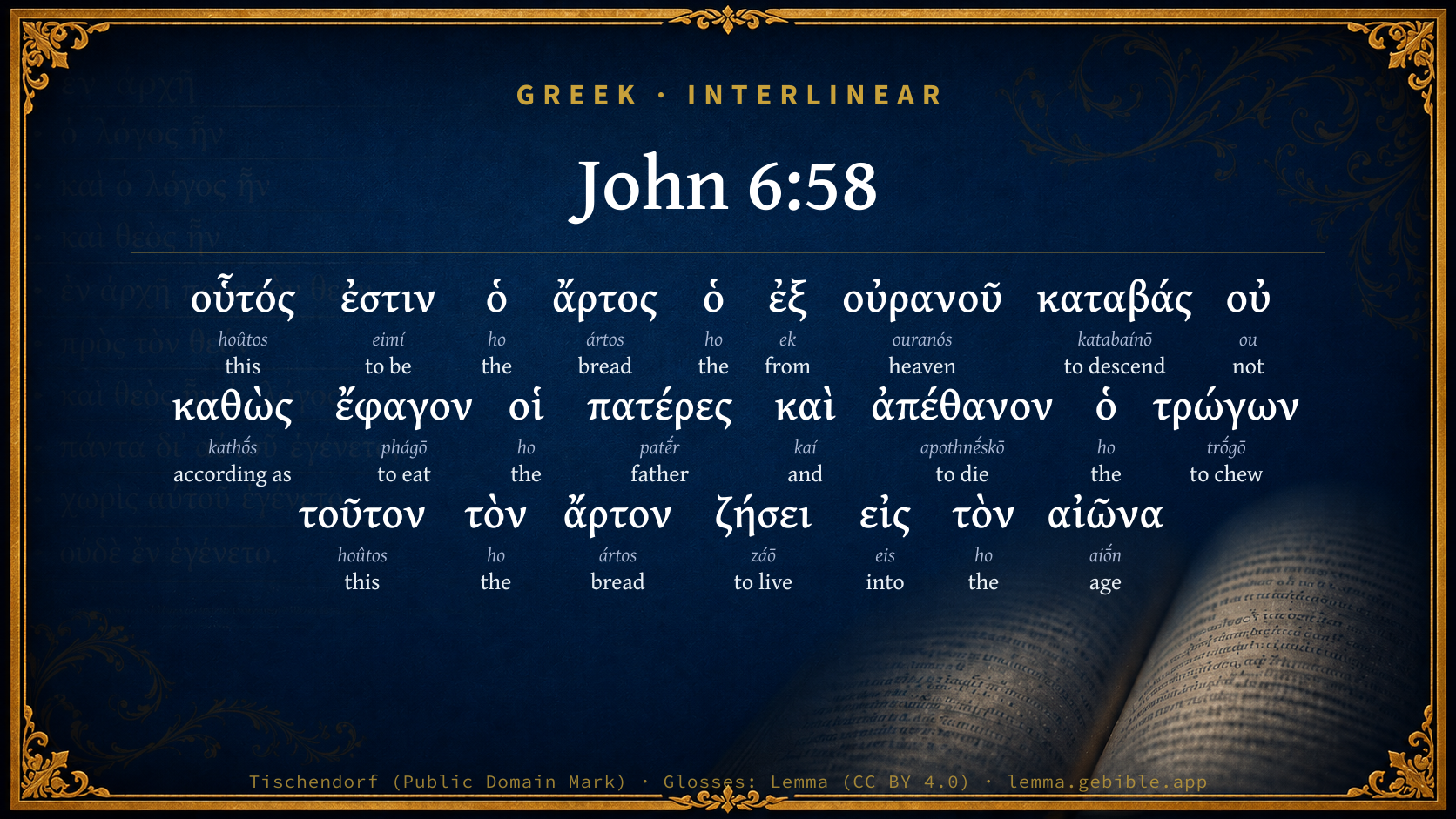
  1. οὗτός hoûtos G3778 “this” Demonstrative pronoun, Nominative, Singular, Masculine
  2. ἐστιν eimí G1510 “to be” Verb, Present, Active, Indicative, 3rd person, Singular
  3. ὁ ho G3588 “the” Article, Nominative, Singular, Masculine
  4. ἄρτος ártos G740 “bread” Noun, Nominative, Singular, Masculine
  5. ὁ ho G3588 “the” Article, Nominative, Singular, Masculine
  6. ἐξ ek G1537 “from” Preposition
  7. οὐρανοῦ ouranós G3772 “heaven” Noun, Genitive, Singular, Masculine
  8. καταβάς katabaínō G2597 “to descend” Verb, Aorist, Active, Participle, Nominative, Singular, Masculine
  9. οὐ ou G3756 “not” Particle, Negative
  10. καθὼς kathṓs G2531 “according as” Adverb
  11. ἔφαγον phágō G5315 “to eat” Verb, Aorist, Active, Indicative, 3rd person, Plural
  12. οἱ ho G3588 “the” Article, Nominative, Plural, Masculine
  13. πατέρες patḗr G3962 “father” Noun, Nominative, Plural, Masculine
  14. καὶ kaí G2532 “and” Conjunction
  15. ἀπέθανον apothnḗskō G599 “to die” Verb, Aorist, Active, Indicative, 3rd person, Plural
  16. ὁ ho G3588 “the” Article, Nominative, Singular, Masculine
  17. τοῦτον hoûtos G3778 “this” Demonstrative pronoun, Accusative, Singular, Masculine
  18. τὸν ho G3588 “the” Article, Accusative, Singular, Masculine
  19. ἄρτον ártos G740 “bread” Noun, Accusative, Singular, Masculine
  20. ζήσει záō G2198 “to live” Verb, Future, Active, Indicative, 3rd person, Singular
  21. εἰς eis G1519 “into” Preposition
  22. τὸν ho G3588 “the” Article, Accusative, Singular, Masculine
  23. αἰῶνα aiṓn G165 “age” Noun, Accusative, Singular, Masculine

About this verse

These counts appear in no published source. They are computed here, from the morphology-tagged text and Lemma’s own curated glosses. What Lemma adds →

24
words
17
distinct lemmas
Gospels
section

Notable vocabulary

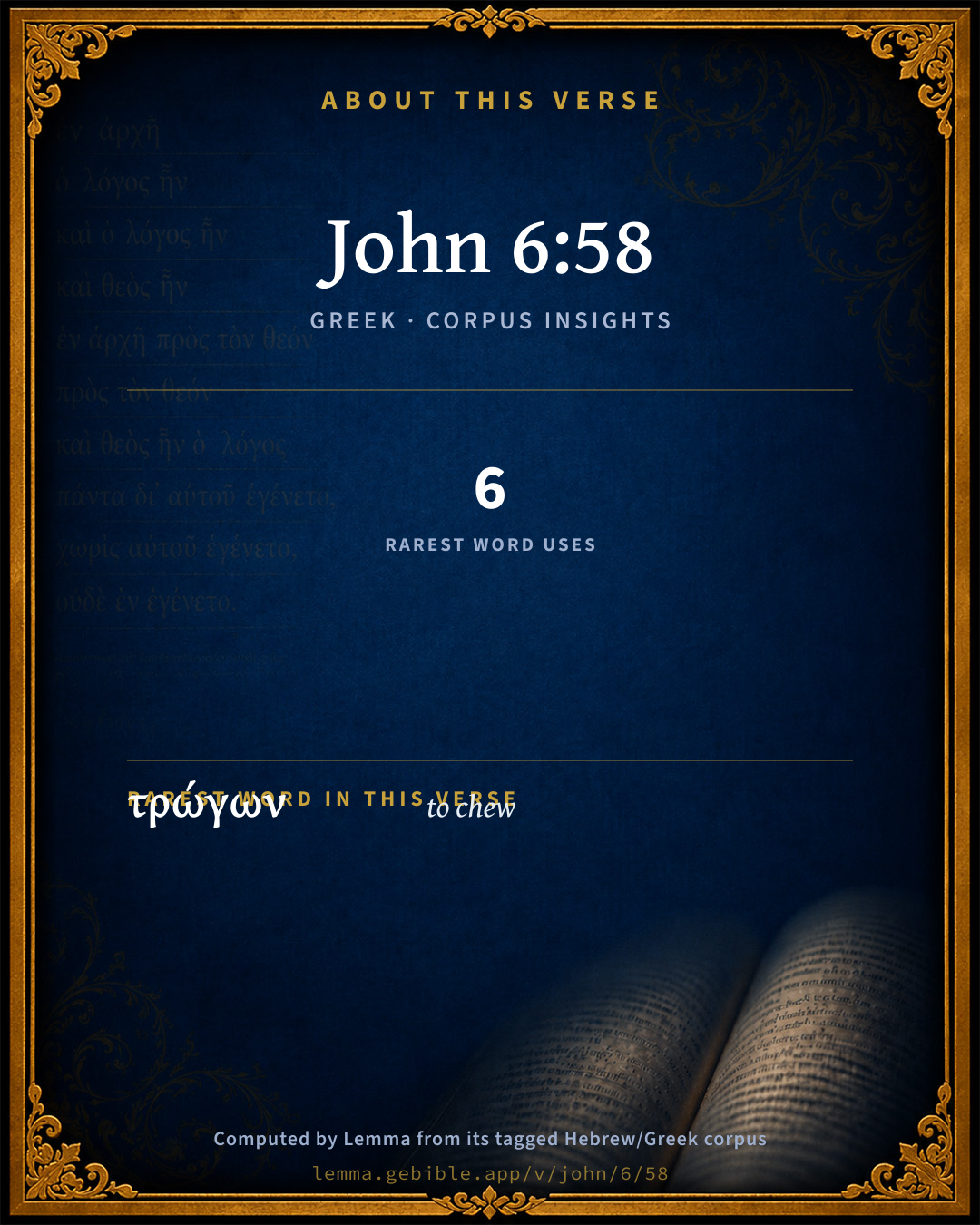
The rarest word here is τρώγων to chew G5176 — appearing just 6 times in the whole Greek New Testament.

Shared distinctive vocabulary

τρώγων to chew G5176 occurs in 6 verses of the Greek New Testament. Also found in:

Repetition

Words recur within this verse:

  • ἄρτος bread G740 ×2
  • ὁ the G3588 ×6
  • οὗτός this G3778 ×2

Cross-references

4

Topical passages linked to John 6:58 in the Treasury of Scripture Knowledge — connected by theme and wording, ordered by reader-vote popularity; previews shown in the World English Bible.

  • John 3:36 One who believes in the Son has eternal life, but one who disobeys the Son won't see life, but the wrath of God remains on him."
  • John 6:47–51 Most assuredly, I tell you, he who believes in me has eternal life.
  • John 6:31–34 Our fathers ate the manna in the wilderness. As it is written, 'He gave them bread out of heaven to eat.'"
  • John 6:41 The Jews therefore murmured concerning him, because he said, "I am the bread which came down out of heaven."

Cross-references courtesy of OpenBible.info (CC BY 4.0).

Where the printed editions differ

2 variants

Places in this verse where the major printed Greek editions disagree on the wording in a way that affects the translation — a comparison of editions, not a manuscript-by-manuscript collation. The editions are the modern critical texts (Nestlé-Aland 28/27, SBL, Westcott-Hort, Tregelles, Tyndale House) and the traditional texts behind the KJV (the Textus Receptus and the Byzantine/Majority text). It is not a claim about which reading is original.

  1. Extra text
    ὑμῶν

    “of you”

    In TRByz Not in NA28NA27TynSBLWHTreg

    ὑμῶν (humōn) 'of you' is only in traditional manuscripts (TR+Byz)

  2. Extra text
    μάννα

    “manna”

    In TRByz Not in NA28NA27TynSBLWHTreg

    μάννα (manna) 'manna' is only in traditional manuscripts (TR+Byz)

Textual data: Translators Amalgamated Greek New Testament (STEPBible TAGNT) · CC BY 4.0.

Commentary

Notes on John 6:58 from classic Christian and Jewish commentators (each source and its license shown beneath its notes). The classic Christian expositions comment on the surrounding passage and are grouped to its opening verse, so a note may address several verses; the Jewish commentaries on the Tanakh (Rashi and others) are per-verse, so they appear only where the commentator wrote on this verse.

Lemma curates 59 commentaries, every one of them public domain or Creative Commons licensed, each selected and text-cleaned for this edition rather than reprinted as found. About our sources →

Bengel's Gnomon

Johann Albrecht Bengel

Joh 6:58. Οὗτος, this) that is, I Myself, Joh 6:57.—ὁ ἄρτος, the bread) His discourse goes back to those things which were set forth in Joh 6:32, “My Father giveth you the true bread from heaven.”

Bengel's Gnomon of the New Testament — English translation (T&T Clark, Edinburgh, 1860) — public domain. Text from a community e-Sword module.

Meyer's Critical & Exegetical Commentary

Heinrich August Wilhelm Meyer

Joh_6:58-59. A concluding summary, repeating the figure from which the whole discourse arose, Joh_6:32.

οὗτος] of this nature, as explained in Joh_6:32-57. Comp. Joh_6:50; not: this, which gives life to him who partakes of it (Lücke); nor: this, i.e. my flesh and blood (De Wette); what follows requires in οὗτος the idea of modality.

οὐ καθὼς, κ.τ.λ.] It is the bread that came down from heaven, but not in the same way and manner that the fathers did eat heavenly bread. It is quite different in the case of this bread.

Joh_6:59 is simply an historical observation, without any further significance (Chrysostom: in order to impress us with the great guilt of the people of Capernaum). That ταῦτα means simply the discourse from Joh_6:41 onwards, and that what precedes down to Joh_6:40 was not spoken in the synagogue, but elsewhere, upon the first meeting with the people, Joh_6:24-25 (Ewald), would need to have been more distinctly indicated. Taking Johns words as they stand, ἐν συναγωγῇ, etc., is a more definite (according to Schenkel, indeed, mistaken) supplementary explanation of the vague πέραν τ. θαλάσσης of Joh_6:25.

ἐν συναγωγῇ, without the Art., as in Joh_18:20 : in synagogue; then follows the still more detailed designation of the locality, teaching in Capernaum.

Meyer — Critical and Exegetical Commentary on the New Testament — English translation by Peter Christie, edited by Frederick Crombie (T&T Clark, 1880) — public domain. Text from a community e-Sword module.

Expositor's Greek Testament

ed. W. Robertson Nicoll

Joh 6:58 . οὗτός ἐστιν … αἰῶνα . These characteristics, now mentioned, identify this bread from heaven as something of a different and superior nature to the manna.

The Expositor's Greek Testament, edited by W. Robertson Nicoll (1897–1910) — public domain. Text from a community e-Sword module.

Jamieson, Fausset & Brown

Robert Jamieson, A. R. Fausset & David Brown

This is that bread, &c.--a sort of summing up of the whole discourse, on which let this one further remark suffice--that as our Lord, instead of softening down His figurative sublimities, or even putting them in naked phraseology, leaves the great truths of His Person and Office, and our participation of Him and it, enshrined for all time in those glorious forms of speech, so when we attempt to strip the truth of these figures, figures though they be, it goes away from us, like water when the vessel is broken, and our wisdom lies in raising our own spirit, and attuning our own ear, to our Lord's chosen modes of expression. (It should be added that although this discourse has nothing to do with the Sacrament of the Supper, the Sacrament has everything to do with it, as the visible embodiment of these figures, and, to the believing partaker, a real, yea, and the most lively and affecting participation of His flesh and blood, and nourishment thereby of the spiritual and eternal life, here below).

Jamieson, Fausset & Brown — Commentary Critical and Explanatory on the Whole Bible (1871) — public domain (CC PDM 1.0). Text via the HelloAO Bible API.

John Calvin's Commentaries

58. This is the bread which came down from heaven. He returns to the comparison between the manna and his flesh, with which he had begun; for it was necessary that he should close the sermon in this manner: “There is no reason why you should prefer Moses to me, because he fed your fathers in the wilderness; since I supply you with far more excellent food, for I bring heavenly life with me.” For — as was formerly said — the bread is said to have come down from heaven, because it has nothing earthly or corruptible in its nature, but breathes the immortality of the kingdom of God. They who were only bent on feeding the belly, did not find such virtue in the manna; for while the manna had a twofold use, the Jews, with whom Christ is now disputing, beheld in it nothing else than bodily food. But the life of the soul is not fading, but makes continual progress until the whole man is renewed.

John Calvin's Commentaries (1540-1563) — public domain. Text from the Calvin Translation Society English edition (1840s-50s) via the Christian Classics Ethereal Library (ccel.org). Calvin's coverage is partial (roughly two-thirds of the Bible); uncommented books and verses are honest gaps, never fabricated. The 19th-century editor's footnotes and remarks are omitted so the notes are faithfully Calvin's own voice.

Ellicott's Commentary for English Readers

(58) This is that (better, the) bread which came down . . . i.e., of this nature, which He has expounded from Joh_6:32 onwards. The tense is now in the past, pointing to His historic coming, because He has asserted that He is the bread. (Comp. Joh_6:33; Joh_6:38.)

Not as your fathers did eat manna, and are dead.—Read, with the best MSS., not as your fathers did eat, and are dead.

The discourse ends with that which has been the text of it.

A Bible Commentary for English Readers, edited by Charles John Ellicott (1878–1897) — public domain. Text from a community e-Sword module.

The Cambridge Bible for Schools and Colleges

gen. ed. J. J. S. Perowne

58. This is that bread] Better, this is the Bread: see on Joh_6:48. The verse is a general summing up of the whole, returning from the imagery of Flesh and Blood to the main expression of the discourse—the Bread that came down from heaven and its superiority to all earthly food.

not as your fathers did eat manna, and are dead] Better, not as the Fathers did eat and died (see on Joh_6:49): ‘your’ and ‘manna’ are wanting in the best MSS. It is not in that way that the Bread comes down from heaven, nor is it such food.

eateth of] Omit ‘of,’ as in Joh_6:54; Joh_6:56 : ‘of’ is rightly inserted in Joh_6:26; Joh_6:50-51.

The Cambridge Bible for Schools and Colleges (gen. ed. J. J. S. Perowne; Cambridge University Press, 1878–1918) — public domain. Text from a community e-Sword module.

John Gill's Exposition

Many therefore of his disciples,.... Not of the twelve, nor of the seventy, but of the multitude of the disciples, who followed him from place to place, attended on his ministry, and might be baptized in his name; see Joh 4:1;

when they had heard this; that his flesh and blood were truly and really meat and drink, and that none had life in them, or should have eternal life, but such as eat and drink the same:

said, this is an hard saying; or it is to be objected to; so "an hard thing", the word here used in the Syriac version, and , "it is to me a hard thing", are phrases used to express an objection in the Talmudic writings, where they are often met with: or it is difficult to be understood and received; so , "an hard saying", or "an hard cause", is a cause difficult to be tried and determined, Exo 18:26, and is used of that which seems incredible and absurd, and is surprising and unaccountable: so it is said (z), that

"it happened to a certain woman, that she came before R. Abika: she said to him, I have seen a spot; he said to her, perhaps there is a wound in thee; she answered him, yes, and it is healed; he replied, perhaps it may be opened, and the blood brought out; she answered him, yes; and he pronounced her clean. R. Abika saw his disciples look upon one another; and he said unto them, , "is this an hard saying with you?"''

is it a difficult thing with you? does it seem absurd to you? or are you surprised at it? anything difficult, or which seems irreconcilable, is so called: so the slaying the passover between the two evenings is called by Aben Ezra, in Exo 12:6, , "an hard saying". In like sense the phrase is used here; and the allusion may be to food that is hard of digestion, since Christ had been speaking of himself under the metaphors of bread and meat. As some of the doctrines of Christ are comparable to milk, which is easy of digestion; others are like to strong meat, which belongs to those of full age, and cannot be digested by children, by babes in Christ, and much less be received, ate, and digested, with ease and pleasure, by carnal minds; who therefore say, as these Capernaites did,

who can hear it? this saying, or doctrine, concerning eating the flesh, and drinking the blood of Christ; or "him" Christ, who delivered this doctrine: such preaching, and such a preacher, are intolerable; there is no hearing, nor bearing them: hence we afterwards read, that these withdrew from the ministry of Christ, Joh 6:66.

(z) Misn. Nidda, c. 8, sect. 3.

John Gill's Exposition of the Whole Bible (1746–1763) — public domain (CC PDM 1.0). Text via the HelloAO Bible API.

Trapp's Complete Commentary

John Trapp

58 This is that bread which came down from heaven: not as your fathers did eat manna, and are dead: he that eateth of this bread shall live for ever.

Ver. 58. This is that bread] Here our Saviour returns to that comparison he had made before between manna and his flesh; and so concludes as he began. A pattern for preachers.

John Trapp, A Commentary or Exposition upon All the Books of the Old and New Testament (1647–1656) — public domain. Text from a community e-Sword module.

Albert Barnes' Notes on the Bible

This is that bread ... - This is the true bread that came down. The word “that” should not be in the translation.

Shall live for ever - Not on the earth, but in the enjoyments of a better world.

Albert Barnes' Notes on the Bible (1834–1885) — public domain. Text from a community e-Sword/MySword module.

Haydock's Catholic Bible Commentary

As the living Father hath sent me, his only, his true Son, to become man; and I live by the Father, proceeding always from him; so he that eateth me, first by faith only, by believing in me; and secondly, he that eateth my body and blood, truly made meat and drink, though after a spiritual manner, (not in that visible, bloody manner as the Capharnaites fancied to themselves) shall live by me, and live for ever, happy in the kingdom of my glory. (Witham)

George Leo Haydock (1774–1849), Haydock's Catholic Family Bible and Commentary, 1859 edition — public domain. Excludes Psalms (Douay-Rheims chapter numbering differs from Protestant) and Deuterocanonical books (Catholic canon only).

Matthew Poole's English Annotations

There is no more said in this verse than Joh 6:49-51; See Poole on "Joh 6:49", and following verses to Joh 6:51. From this whole discourse it is as evident as the light, that the justification of the soul depends upon believing; and the spiritual life of the soul floweth not from love or obedience to the works of the law, but from faith in Jesus Christ: though it be true, that true faith cannot be without works, and no man without obedience in sincerity (though not in perfection) to the will of God, shall ever obtain eternal life and salvation; but this obedience is not faith, nor doth it enter into the justification of the soul, but is the certain and necessary product of that faith which justifieth, which cannot be justified as true and saving without obedience. In all this discourse here is no mention of love, or obedience, as that to which the promises of life everlasting and a joyful resurrection are so often made; but only of eating Christ; eating his flesh and drinking his blood; eating him as the bread which came down from heaven, &c.; which are phrases no way expressive of obedience to the works of the law, but of believing, Joh 6:47-49. The other texts of Scripture make it plain enough, that there can be no believing without obeying, nor any eternal life and salvation obtained without both.

Matthew Poole's English Annotations on the Holy Bible (1683–1685) — public domain. Text from a community e-Sword/MySword module.

Whedon's Commentary on the Bible

Daniel D. Whedon

4. To be placed on record by his apostolic reporter for the instruction of his Church through all generations. Blessed be the name of the Lord our God for the holy record!

58. Your fathers did eat manna—The figure of the manna, by his gainsayers first adduced, (Joh_6:31,) suggested by the bread to the five thousand, pervades all this discourse. Manna, bread, flesh, blood, Christ, are the serial terms along which the thought runs.

Daniel D. Whedon (gen. ed.), Commentary on the Old and New Testaments (1874–1909) — public domain. Text from a community e-Sword module.

The Pulpit Commentary

Here the Lord returns once more to the starting point of the discourse. This is the bread that came down from heaven (cf. vers. 50, 51). Already he had said, "I am the living Bread that came down from heaven," and he has expanded the statement to show how much was contained or involved in eating it. He has, moreover, emphasized the two sides of his offer of himself to the world, and shown how the twofold reception of both sides becomes a thorough acceptance of himself, and a twofold identification of himself with his people. He forthwith returns to the original statement, and to its implied contrast with that which these sign-loving Jews had demanded. Not as (your) fathers ate, and died: he that eateth of this bread shall live forever. This is a strong reassertion of the language of vers. 49-51. Life itself in its highest sense shall be independent of death, and will triumph over it.

The Pulpit Commentary (1880–1919), ed. H.D.M. Spence-Jones & Joseph S. Exell — public domain. Text from a community e-Sword module.

John Wesley's Explanatory Notes

This is - That is, I am the bread - Which is not like the manna your fathers ate, who died notwithstanding.

John Wesley, Explanatory Notes Upon the Whole Bible (1754–1765) — public domain. Text via the GEBible commentary corpus.

The People's New Testament

B. W. Johnson

58. This is that bread. Himself. He probably laid his hand upon himself as he spoke.

B. W. Johnson's The People's New Testament with Notes (1889–1891) — public domain. Electronic text from the Christian Classics Ethereal Library (CCEL) ThML edition.

Cambridge Greek Testament for Schools and Colleges

58. A general summing-up of the whole, returning from the Flesh and Blood to the main theme,—the Bread from heaven and its superiority to the highest earthly food. Οὗτος again may be subject or predicate; there is no ἵνα (Joh 6:50) or ὅτι to lead up to, but the οὐ καθὼς κ.τ.λ. seems to shew that οὗτος is the predicate. Ὁ καταβάς corresponds to ἀπέστειλε in Joh 6:57; both aorists refer to the historic fact of the Incarnation. In this sense Christ came once for all: in another sense He is always coming, ὁ καταβαίνων (Joh 6:50).

οὐ καθὼς κ.τ.λ. Irregularly expressed contrast to οὖτος: Of this nature (giving eternal life) is the Bread which came down from heaven; not as the fathers did eat and died (Joh 6:49). Comp. 1Jn 3:11-12.

Cambridge Greek Testament for Schools and Colleges (Cambridge University Press, 1896; 21 vols, various authors incl. Carr, Maclear, Plummer, Farrar, Lumby, Moule, M. R. James, Simcox) — public domain. Text from a community e-Sword module.

International Critical Commentary

58. This verse contains a summary of the whole discourse, and so it goes back to the saying about the heavenly Bread (v. 33), ending with what was said in v. 51, that he who feeds on it shall live for ever. Jn.’s report of the words of Jesus often passes without pause into his own comments (see on 3:16), and it has been suggested (Abbott, Diat. 1957) that v. 58 was intended to be the evangelist’s short statement of what has gone before. But if so, ταῦτα εἶπεν in v. 59 is clumsy. We can hardly separate v. 58 from what precedes, despite some slight changes in the form of expression, which are duly noted below. As has already been said (p. cxvi), Jn. is prone to vary words and the order of words when reiterating something already recorded.

οὗτός ἐστιν κτλ., repeated from v. 50, except that here the aor. participle καταβάς is used (as in v. 51) of the descent from heaven of the mystical Bread. For the rec. ἐκ τοῦ οὐρανοῦ (אDLNWΓΔΘ), BCT have ἐξ οὐρανοῦ, and this may be right; but on the six previous occurrences of the phrase “descending from heaven” (vv. 33, 38, 41, 42, 50, 51), τοῦ οὐρανοῦ is the best-supported reading.

οὐ καθὼς ἔφαγον κτλ., repeated, with slight variations, from v. 49. The sentence is a good example of Jn.’s partiality for the constr. called anacoluthon.

For οὐ καθώς, cf. 14:27, 1Jn 3:12; the only other occurrence in the N.T. being 2Co 8:5.

οἱ πατέρες. The rec. with DΔNΘ and Syr. sin. adds ὑμῶν (from v. 49); om. אBCLTW. The expression οἱ

πατέρες occurs again, in the words of Christ, at 7:22, where it refers to the patriarchs. It also is found Act 13:32, Rom 9:5, Rom 11:28, Rom 15:8, Heb 1:1, 2Pe 3:4, and is used quite vaguely of the Israelites of the olden time. Here it is limited by the context to the generation of the Exodus from Egypt. But no distinction is to be drawn between οἱ πατέρες ὑμῶν of v. 49 and οἱ πατέρες of v. 58 (cf., e.g., Act 13:32 and Act 26:6).

Some minor uncials add τὸ μάννα after οἱ πατέρες ὑμῶν, from v. 49.

καὶ ἀπέθανον. Lightfoot (Hor. Hebr., on 6:39) cites a Jewish saying, “The generation in the wilderness have no part in the world to come,” and if this were pre-Christian in date (which is uncertain) it would suggest that καὶ ἀπέθανον should be interpreted of spiritual death. But we have already seen (v. 49) that the argument requires it to indicate the death of the body, from which even the manna could not save those who ate it.

ὁ τρώγων τοῦτον τὸν ἄρτον ζήσει εἰς τὸν αἰῶνα. This is repeated from v. 51, with the substitution of ὁ τρώγων with the acc. for ἐάν τις φάγῃ with ἐκ and the gen.

ζήσει. So אBCNWΘ; the rec. has ζήσεται. Cf. v. 51.

International Critical Commentary — older volumes (1896–1929), various authors — public domain. Text from a community e-Sword module.

Godet's Commentaries

Frédéric Louis Godet

Ver. 58. “This is the bread which came down from heaven: not as your fathers did eat the manna and are dead; he who eats this bread shall live forever.”

The pronoun οὖτος does not mean: “Such is the bread” (Reuss, Keil); but “This bread (Joh 6:57) is that which came down,”—that which the manna was not in reality; hence the two opposite consequences pointed out in what follows. Here is the final appeal: to reject it, will be to die; to accept it, will be to live.

Frédéric Louis Godet — Commentaries on Luke, John, Romans, and 1 Corinthians — English translation (T&T Clark, Edinburgh, 1870s–1890s) — public domain. Text from a community e-Sword module.

Lesson kit

Teaching starters — assembled from the data on this page, not authored interpretation. Every prompt links to the verse data it draws on. Edit before teaching.

John, in the Gospels, opens this verse with 24 words (17 distinct Greek lemmas). Its most distinctive word is trṓgō (“to chew”). A historical commentator’s framing appears above. Read the whole chapter for the surrounding context.

Discussion questions

  1. The word trṓgō carries the sense “to chew.” How does it shape the verse?
  2. Matthew 24:38 shares the word «to chew» with this verse. How do the two illuminate each other?
  3. “bread” occurs 2× in this one verse. What is the effect of the repetition?
  4. These translations render this verse differently. What is at stake in choosing one wording over another?
  5. Reading how Bengel's Gnomon and Meyer's Critical & Exegetical Commentary read this verse, where do the two commentators agree and where do they part?

Things to notice

Reading settings

Reading text

Shown beneath each verse's original-language words.

Old Testament
Old Testament edition

Read the OT as the Masoretic Hebrew (MT) or the Greek Septuagint (LXX).

English shown for the Greek Septuagint (in the Hebrew ↔ Greek comparison).

Comparing translations? Open the Compare panel on any verse page to stack up to four side by side.