John 10:25

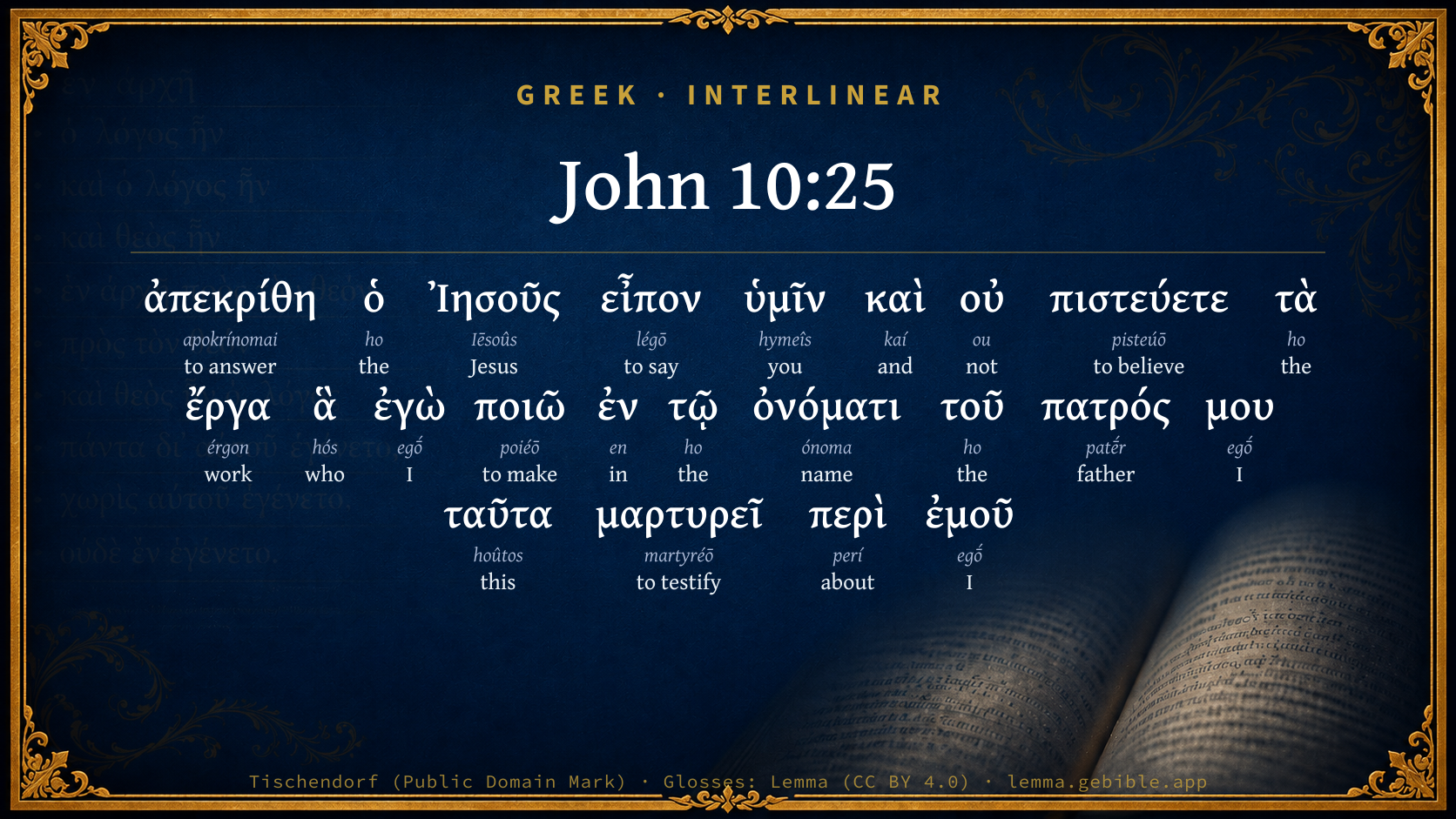
Greek (Tischendorf 8th ed.) John 10:25 appears in the Greek New Testament. The text above is from the Tischendorf 8th edition. Each word links to its Strong’s number and a concise gloss. Click any word for its full Thayer’s Greek Lexicon entry.
Download image
Cite this verse

John 10:25 (World English Bible). Public Domain. Lemma interlinear Bible study tool, https://lemma.gebible.app/v/john/10/25.

Show BibTeX & RIS
BibTeX
RIS
English Translation
Jesus answered them, "I told you, and you don't believe. The works that I do in my Father's name, these testify about me.
World English Bible · Public Domain
Download a study sheet

One document with this verse’s original text, its word-by-word gloss line, the meaning frame, cross-references with their text, attributed commentary, and full source and license credits — printable, and it pastes into notes with its structure intact.

This verse Autodidact and up

Study sheet (.html) Plain text (.txt)

A passage Seminary Student

Up to 50 verses in one chapter. A passage sheet keeps up to 6 commentary sources and 12 cross-references per verse, in the order this page ranks them, and says so on the sheet whenever that leaves anything out. Ask for a single verse and you get the Autodidact verse sheet above.

Everything on this page stays free to read, with no account — the sheet is a download of what is already on screen, not access to it.

Want to remove ads? Support Godless Engineer
Compare translations 3

The same verse in 3 English versions, stacked beneath the original-language interlinear above. Click any original word for its lexicon entry.

Each is an independent rendering of the whole verse — the interlinear is not word-aligned to these translations.

Highlighted words mark where these versions differ — a whole-verse word diff, not a word-by-word alignment.

  • World English Bible Public Domain
    Jesus answered them, "I told you, and you don't believe. The works that I do in my Father's name, these testify about me.
  • King James Version Public Domain
    Jesus answered them, I told you, and ye believed not: the works that I do in my Father's name, they bear witness of me.
  • unfoldingWord Literal Text CC BY-SA 4.0
    Jesus replied to them, “I told you, but you do not believe. The works that I do in the name of my Father, these testify concerning me.

unfoldingWord Literal Text — © unfoldingWord, licensed CC BY-SA 4.0. Word-aligned USFM3 via Door43 (git.door43.org/unfoldingWord/en_ult).

Versions to compare (up to 4)

3 of 4 selected

Show all 19 translations

Every available English version of this verse, each an independent rendering of the whole verse.

  • World English Bible Public Domain
    Jesus answered them, "I told you, and you don't believe. The works that I do in my Father's name, these testify about me.
  • Berean Standard Bible Public Domain
    “I already told you,” Jesus replied, “but you did not believe. The works I do in My Father’s name testify on My behalf.
  • Majority Standard Bible Public Domain
    “I already told you,” Jesus replied, “but you did not believe. The works I do in My Father’s name testify on My behalf.
  • King James Version Public Domain
    Jesus answered them, I told you, and ye believed not: the works that I do in my Father's name, they bear witness of me.
  • American Standard Version (1901) Public Domain
    Jesus answered them, I told you, and ye believe not: the works that I do in my Father's name, these bear witness of me.
  • Revised Version (1885) Public Domain
    Jesus answered them, I told you, and ye believe not: the works that I do in my Father’s name, these bear witness of me.
  • Geneva Bible (1599) Public Domain
    Iesus answered them, I tolde you, and ye beleeue not: the workes that I doe in my Fathers Name, they beare witnes of me.
  • Douay-Rheims (1899) Public Domain
    Jesus answered them: I speak to you, and you believe not: the works that I do in the name of my Father, they give testimony of me.
  • Young's Literal Translation Public Domain
    Jesus answered them, `I told you, and ye do not believe; the works that I do in the name of my Father, these testify concerning me;
  • Literal Standard Version CC BY-SA 4.0
    Jesus answered them, “I told you, and you do not believe; the works that I do in the Name of My Father, these testify concerning Me;
  • Unlocked Literal Bible CC BY-SA 4.0
    Jesus replied to them, “I told you, but you do not believe. The works that I do in the name of my Father, these testify concerning me.
  • unfoldingWord Literal Text CC BY-SA 4.0
    Jesus replied to them, “I told you, but you do not believe. The works that I do in the name of my Father, these testify concerning me.
  • Darby Bible Public Domain
    Jesus answered them, I told you, and ye do not believe. The works which I do in my Father's name, these bear witness concerning me:
  • World Messianic Bible Public Domain
    Yeshua answered them, “I told you, and you don’t believe. The works that I do in my Father’s name, these testify about me.
  • Webster's Bible Public Domain
    Jesus answered them, I told you, and ye believed not: the works that I did in my Father's name, they testify concerning me.
  • Free Bible Version CC BY-SA 4.0
    Jesus replied, “I already told you but you refuse to believe it. The miracles I do in my Father's name prove who I am.
  • Bible in Basic English Public Domain
    Jesus said in answer, I have said it and you have no belief: the works which I do in my Father's name, these give witness about me.
  • Text-Critical English NT CC BY 4.0
    Jesus answered them, “I did tell you, but you do not believe. The works that I do in my Father's name testify about me,
  • Tyndale New Testament (1534) Public Domain
    Iesus answered them: I tolde you and ye beleve not. The workes that I do in my fathers name they beare witnes of me.

Literal Standard Version (2020), Covenant Press — licensed CC BY-SA 4.0. Text via the HelloAO Bible API (eBible.org). Unlocked Literal Bible (unfoldingWord) — licensed CC BY-SA 4.0. Text via the HelloAO Bible API (eBible.org). unfoldingWord Literal Text — © unfoldingWord, licensed CC BY-SA 4.0. Word-aligned USFM3 via Door43 (git.door43.org/unfoldingWord/en_ult). Free Bible Version, Dr. Jonathan Gallagher — licensed CC BY-SA 4.0. Text via the HelloAO Bible API (eBible.org).

Word by word

More ways to search: Search by grammar → Find every occurrence → Compare this word →

Practice this passage: Drill this verse → Learn its vocabulary →

μαρτυρεῖ
martyréō
G3140
“to testify”
Verb, Present, Active, Indicative, 3rd person, Singular
Part of Speech
Verb
Tense
Present
Voice
Active
Mood
Indicative
Person
3rd person
Number
Singular
Full Thayer's Definition

Origin: from G3144

TDNT: 11:54,6

1. to be a witness, to bear witness, i.e. to affirm that one has seen or heard or experienced something, or that he knows it because taught by divine revelation or inspiration a. to give (not to keep back) testimony b. to utter honourable testimony, give a good report c. conjure, implore
  1. ἀπεκρίθη apokrínomai G611 “to answer” Verb, Aorist, Middle deponent, Indicative, 3rd person, Singular
  2. ὁ ho G3588 “the” Article, Nominative, Singular, Masculine
  3. Ἰησοῦς Iēsoûs G2424 “Jesus” Noun, Nominative, Singular, Masculine
  4. εἶπον légō G3004 “to say” Verb, Aorist, Active, Indicative, 1st person, Singular
  5. ὑμῖν hymeîs G5210 “you” Personal pronoun, 2nd person, Dative, Plural
  6. καὶ kaí G2532 “and” Conjunction
  7. οὐ ou G3756 “not” Particle, Negative
  8. πιστεύετε pisteúō G4100 “to believe” Verb, Present, Active, Indicative, 2nd person, Plural
  9. τὰ ho G3588 “the” Article, Nominative, Plural, Neuter
  10. ἔργα érgon G2041 “work” Noun, Nominative, Plural, Neuter
  11. ἃ hós G3739 “who” Relative pronoun, Accusative, Plural, Neuter
  12. ἐγὼ egṓ G1473 “I” Personal pronoun, 1st person, Nominative, Singular
  13. ποιῶ poiéō G4160 “to make” Verb, Present, Active, Indicative, 1st person, Singular
  14. ἐν en G1722 “in” Preposition
  15. τῷ ho G3588 “the” Article, Dative, Singular, Neuter
  16. ὀνόματι ónoma G3686 “name” Noun, Dative, Singular, Neuter
  17. τοῦ ho G3588 “the” Article, Genitive, Singular, Masculine
  18. πατρός patḗr G3962 “father” Noun, Genitive, Singular, Masculine
  19. μου egṓ G1473 “I” Personal pronoun, 1st person, Genitive, Singular
  20. ταῦτα hoûtos G3778 “this” Demonstrative pronoun, Nominative, Plural, Neuter
  21. περὶ perí G4012 “about” Preposition
  22. ἐμοῦ egṓ G1473 “I” Personal pronoun, 1st person, Genitive, Singular

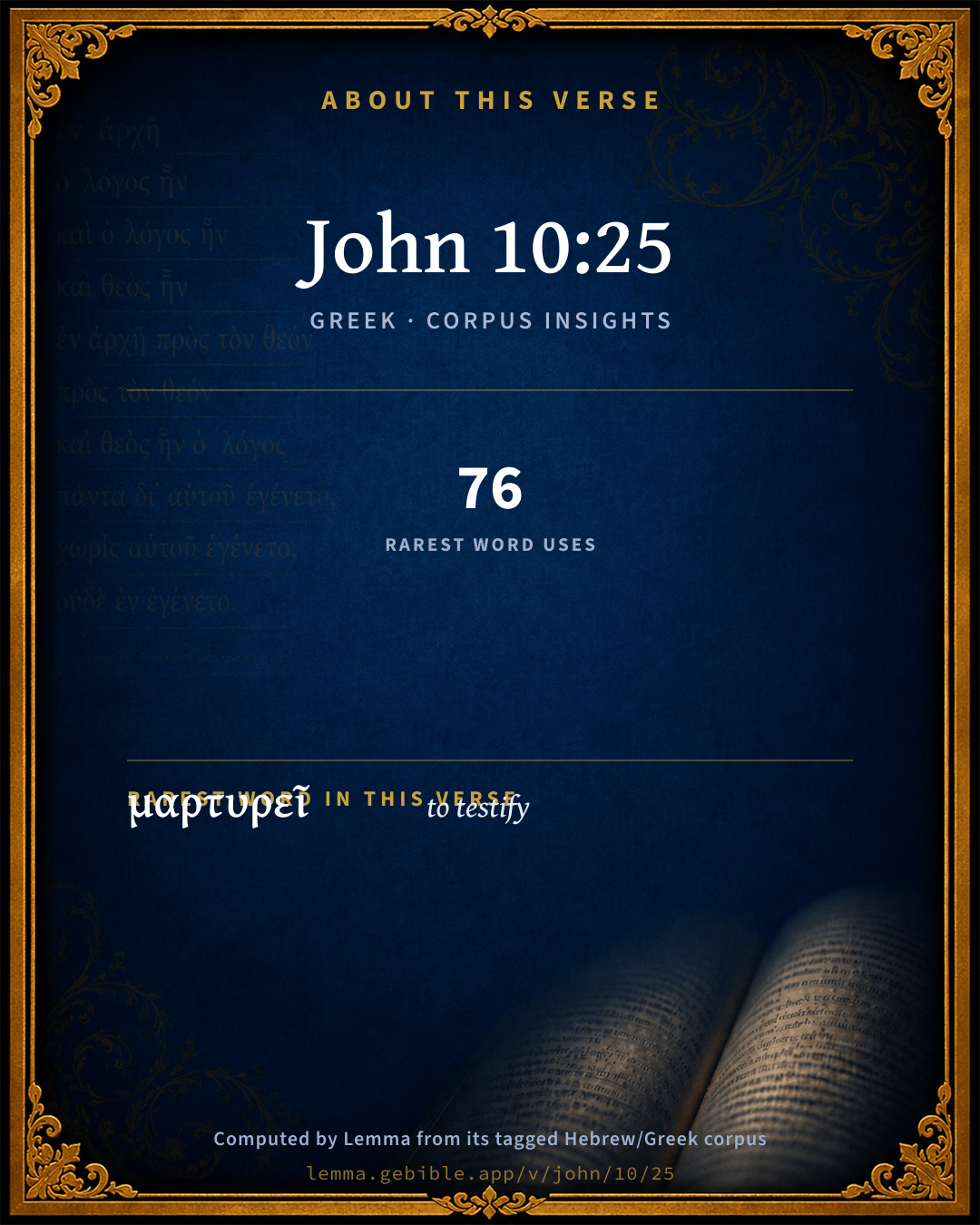
About this verse

These counts appear in no published source. They are computed here, from the morphology-tagged text and Lemma’s own curated glosses. What Lemma adds →

23
words
18
distinct lemmas
Gospels
section

Repetition

Words recur within this verse:

Cross-references

15

Topical passages linked to John 10:25 in the Treasury of Scripture Knowledge — connected by theme and wording, ordered by reader-vote popularity; previews shown in the World English Bible.

  • John 10:38 But if I do them, though you don't believe me, believe the works; that you may know and believe that the Father is in me, and I in the Father."
  • John 8:58 Jesus said to them, "Most assuredly, I tell you, before Abraham came into existence, I AM."
  • John 5:17–43 But Jesus answered them, "My Father is still working, so I am working, too."
  • John 14:11 Believe me that I am in the Father, and the Father in me; or else believe me for the very works' sake.
  • Hebrews 2:3 how will we escape if we neglect so great a salvation-- which at the first having been spoken through the Lord, was confirmed to us by those who heard;
  • John 3:2 The same came to him by night, and said to him, "Rabbi, we know that you are a teacher come from God, for no one can do these signs that you do, unless God is with him."
  • John 7:31 But of the multitude, many believed in him. They said, "When the Christ comes, he won't do more signs than those which this man has done, will he?"
  • John 8:12 Again, therefore, Jesus spoke to them, saying, "I am the light of the world. He who follows me will not walk in the darkness, but will have the light of life."
  • John 8:24 I said therefore to you that you will die in your sins; for unless you believe that I am he, you will die in your sins."
  • John 10:32 Jesus answered them, "I have shown you many good works from my Father. For which of those works do you stone me?"
  • John 11:47 The chief priests therefore and the Pharisees gathered a council, and said, "What are we doing? For this man does many signs.
  • John 12:37 But though he had done so many signs before them, yet they didn't believe in him,
  • John 20:30 Therefore Jesus did many other signs in the presence of his disciples, which are not written in this book;
  • Acts 10:38 even Jesus of Nazareth, how God anointed him with the Holy Spirit and with power, who went about doing good and healing all who were oppressed by the devil, for God was with him.
  • Acts 2:22 "Men of Israel, hear these words! Jesus of Nazareth, a man approved by God to you by mighty works and wonders and signs which God did by him in the midst of you, even as you yourselves know,

Cross-references courtesy of OpenBible.info (CC BY 4.0).

Commentary

Notes on John 10:25 from classic Christian and Jewish commentators (each source and its license shown beneath its notes). The classic Christian expositions comment on the surrounding passage and are grouped to its opening verse, so a note may address several verses; the Jewish commentaries on the Tanakh (Rashi and others) are per-verse, so they appear only where the commentator wrote on this verse.

Lemma curates 59 commentaries, every one of them public domain or Creative Commons licensed, each selected and text-cleaned for this edition rather than reprinted as found. About our sources →

Tyndale Open Study Notes

Tyndale Open Resources

10:25-42 In Jesus’ final public presentation of evidence about himself in this Gospel, he gives an exhaustive statement of his identity (10:30).

10:25 Jesus had already provided the Jewish people and their religious leaders with sufficient proof that he is the Son of God. The problem was not lack of information, but their unwillingness to believe him.

Tyndale Open Study Notes — © Tyndale Open Resources, licensed CC BY-SA 4.0. Text via the HelloAO Bible API.

Bengel's Gnomon

Johann Albrecht Bengel

Joh 10:25. Εἶπον ὑμῖν, I have told you) i.e. I am the Christ. A similar formula occurs, Mat 26:64, “Tell us whether Thou be the Christ, the Son of God? Jesus saith, Thou hast said.” Moreover Jesus often said, even in this chapter, Jesus is the Christ. I told you (and ye believed not; I tell you) and ye believe not [πιστεύετε, not believed, as Engl. Vers.] Καὶ, and, for but. Comp. Joh 10:26, ἀλλά, but [ye believe not],—τὰ ἔργα, the works) which even might have convinced those who do not believe words.—περὶ ἐμοῦ, concerning Me) that I am the Christ.

Bengel's Gnomon of the New Testament — English translation (T&T Clark, Edinburgh, 1860) — public domain. Text from a community e-Sword module.

Meyer's Critical & Exegetical Commentary

Heinrich August Wilhelm Meyer

Joh_10:25-26. Jesus had not only told them (on many occasions, if not always so directly as, for example, to the woman of Samaria, or the man born blind) that He was the Messiah, but had also testified to the fact by His Messianic works (v. 36). But they do not believe. The actual proof of their unbelief is first subjoined in the second clause: for ye belong not to my sheep; otherwise ye would stand in a totally different relation to me than that of unbelief; ye would hear my voice, and know me, and follow me, Joh_10:4; Joh_10:14; Joh_10:27.

ἐγὼ … ὑμεῖς] Reproachful antithesis.

καθὼς εἶπον ὑμῖν] belong, as both Lachmann and Tischendorf also punctuate, to what precedes (comp. Joh_1:33); but not, however, in such a way that Jesus merely makes a retrospective reference to the figure of the πρόβατα (Fritzsche: ut similitudine utar, quam supra posui), which would render this repulse very meaningless; but in such a way that Jesus recalls to their recollection the negative declaration itself as having been already uttered. It is true, indeed, that He had not given direct expression to the words ὅτι οὐκ ἐστὲ, etc. in the preceding allegory; indirectly, however, He had done so, namely, by a description of His sheep, which necessarily involved the denial that the Ἰουδαῖοι belonged to them. That this is the force of καθʼ εἶπ. ὑμ., He Himself declares by the exhibition of the relation of His sheep that follows. We are precluded from regarding it as an introduction to what follows (Curss., Cant., Corb., Arr., Euth. Zigabenus, Tholuck, Godet), in which case a comma ought to be placed before καθώς, and a colon after ὑμῖν, by the circumstance that Jesus nowhere else quotes and (in the form of a summary) repeats a longer discourse of His own. In keeping with the style of the Gospels, only a brief, sententious saying, such as Joh_13:33, would be fitted for such self-quotation. In this case, however, the quotation would embrace at least Joh_10:27-28.

The circumstance that Jesus should refer to this allegory about two months after the date of Joh_10:1-21, which has been erroneously used as an argument against the originality of the discourse (Strauss, Baur), may be simply accounted for by the assumption that during the interval He had had no further discussions with His hierarchical opponents,a supposition which is justified by its accounting for the silence observed by John relatively to that period. The presupposition involved in the words καθὼς εἶπον ὑμῖν, that Jesus here has in the main the same persons before Him as during the delivery of His discourse regarding the shepherd, has nothing against it; and there is no necessity even for the assumption that John and Jesus conceived the discourses to be directed against the Ἰουδαῖοι as a whole (Brückner).

Meyer — Critical and Exegetical Commentary on the New Testament — English translation by Peter Christie, edited by Frederick Crombie (T&T Clark, 1880) — public domain. Text from a community e-Sword module.

Expositor's Greek Testament

ed. W. Robertson Nicoll

Joh 10:25 . Therefore He replies: “I told you and ye believe not. The works which I do in my Father’s name, these witness concerning me.” These works tell you what I am. They are works done in my Father’s name, that is, wholly as His representative. These show what kind of Christ He sends you and that I am He.

The Expositor's Greek Testament, edited by W. Robertson Nicoll (1897–1910) — public domain. Text from a community e-Sword module.

Geneva Bible (1599)

Geneva Bible translators

The doctrine of the Gospel is proved from heaven by two witnesses: both by the purity of the doctrine, and by miracles.

Geneva Bible (1599) marginal notes — public domain. Text via Bolls.life.

Jamieson, Fausset & Brown

Robert Jamieson, A. R. Fausset & David Brown

Jesus answered them, I told you--that is, in substance, what I am (for example Joh 7:37-38; Joh 8:12, Joh 8:35-36, Joh 8:58).

Jamieson, Fausset & Brown — Commentary Critical and Explanatory on the Whole Bible (1871) — public domain (CC PDM 1.0). Text via the HelloAO Bible API.

Adam Clarke's Commentary

Verse 25. I told you, c.] That is, I told you before what I tell you now again, that the works which I do, bear testimony to me. I have told you that I am the light of the world: the Son of God: the good shepherd: that I am come to save - to give life - to give liberty-to redeem you: that, in order to this, I must die, and rise again and that I am absolute master of my life, and of my death. Have you not noticed my omniscience, in searching and discovering the very secrets of your hearts? Have you not seen my omnipotence in the miracles which I have wrought? Have not all these been sufficient to convince you? - and yet ye will not believe!-See the works which bore testimony to him, as the Messiah, enumerated, Mt 11:5.

Adam Clarke's Commentary on the Bible (1810–1826) — public domain. Text from a community e-Sword/MySword module.

John Calvin's Commentaries

25. I have told you. Our Lord Jesus does not conceal that he is the Christ, and yet he does not teach them as if they were willing to learn, but rather reproaches them with obstinate malice, because, though they had been taught by the word and works of God, they had not yet made any progress. Accordingly, that they do not know him, he imputes to their own fault, as if he said: “My doctrine is easily enough understood, but the blame lies with you, because you maliciously resist God.”

The works which I do. He speaks of his works, in order to convict them of being doubly obstinate; for, besides the doctrine, they had a striking testimony in his miracles, if they had not been ungrateful to God. He twice repeats the words, You do not believe, in order to prove that, of their own accord, they were deaf to doctrine, and blind to works; which is a proof of extreme and desperate malice. He says that he did the works in the name of his Father; because his design was, to testify the power of God in them, by which it might be openly declared that he came from God.

John Calvin's Commentaries (1540-1563) — public domain. Text from the Calvin Translation Society English edition (1840s-50s) via the Christian Classics Ethereal Library (ccel.org). Calvin's coverage is partial (roughly two-thirds of the Bible); uncommented books and verses are honest gaps, never fabricated. The 19th-century editor's footnotes and remarks are omitted so the notes are faithfully Calvin's own voice.

Ellicott's Commentary for English Readers

(25) I told you, and ye believed not.—Better, and ye believe not, as all the best MSS. Here, as in Joh_8:25, where a similar direct question was put to Him, the answer is indirect. It could not be otherwise. Their misconception of the Messianic work had made the very word Messiah an impossible one for Him to utter to them. To have said He was the Messiah would have been to sanction their thought of Him as a temporal prince; to have said that He was not would have been to contradict the essential truth. He refers them, then, to His earlier words and deeds in proof of what He was. To inquirers of simpler hearts, as the woman of Samaria and the man born blind, He had used the word Messiah. To them He had again and again told the same truth, though the actual word had never crossed His lips while speaking to them.

The works that I do in my Father’s name.—Comp. Note on Joh_5:36. This appeal to His works, and the assertion that they were done in His Father’s name, is itself an answer in word and in deed that He was the Messiah.

A Bible Commentary for English Readers, edited by Charles John Ellicott (1878–1897) — public domain. Text from a community e-Sword module.

The Cambridge Bible for Schools and Colleges

gen. ed. J. J. S. Perowne

25. I told you, and ye believed not] The best authorities have, and ye believe not: their unbelief still continues. To some few, the woman at the well, the man born blind, and the Apostles, Jesus had explicitly declared Himself to be the Messiah; to all He had implicitly declared Himself by His works and teaching.

the works] in the widest sense, not miracles alone; His Messianic work generally. See on Joh_5:36. The pronouns are emphatically opposed; ‘the works which I do … they.… But ye believe not.

The Cambridge Bible for Schools and Colleges (gen. ed. J. J. S. Perowne; Cambridge University Press, 1878–1918) — public domain. Text from a community e-Sword module.

John Gill's Exposition

Jesus answered them, I told you, and ye believed not,.... He had often said, what amounted to it, in his ministry and doctrine; as that God was his Father, and he was the light of the world, and the good shepherd, and the like; but they gave no heed nor credit to his words, even though he told them, that unless they believed he was such a person, they should die in their sins:

the works that I do in my Father's name, they bear witness of me; such as healing the sick, dispossessing devils, cleansing lepers, giving sight to the blind, causing the deaf to hear, the dumb to speak, and the lame to walk, and raising the dead to life; suggesting, that besides his words, his doctrine and ministry, they had his miracles before them, which plainly showed who he was; so that they need not have been in any doubt of mind, or suspense about him; nor had they any reason to complain of his hiding himself from them, or depriving them of the knowledge of him.

John Gill's Exposition of the Whole Bible (1746–1763) — public domain (CC PDM 1.0). Text via the HelloAO Bible API.

Trapp's Complete Commentary

John Trapp

25 Jesus answered them, I told you, and ye believed not: the works that I do in my Father’s name, they bear witness of me.

Ver. 25. I told you, and ye believed not] q.d. Your malice lies in the way, that neither mine oracles nor miracles can work upon your hearts. Therefore also Christ enlargeth them with a double unbelief: Ye believe not, saith he; and again, Ye believe not: this is the damning sin against the gospel; yea, this some will have to be that sin against the Holy Ghost, for which there is no pardon.

John Trapp, A Commentary or Exposition upon All the Books of the Old and New Testament (1647–1656) — public domain. Text from a community e-Sword module.

Albert Barnes' Notes on the Bible

I told you - It is not recorded that Jesus had told them in so many words that he was the Christ, but he had used expressions designed to convey the same truth, and which many of them understood as claiming to be the Messiah. See Joh 5:19; Joh 8:36, Joh 8:56; Joh 10:1. The expression “the Son of God” they understood to be equivalent to the Messiah. This he had often used of himself in a sense not to be mistaken.

The works - The miracles, such as restoring the blind, curing the sick, etc.

In my Father’s name - By the power and command of God. Jesus was either the Messiah or an impostor. The Pharisees charged him with being the latter Mat 26:60-61; Mat 27:63; Joh 18:36; but God would not give such power to an impostor. The power of working miracles is an attestation of God to what is taught. See the notes at Mat 4:24.

Albert Barnes' Notes on the Bible (1834–1885) — public domain. Text from a community e-Sword/MySword module.

Haydock's Catholic Bible Commentary

The works and miracles, that I do in the name of my Father, they give testimony of me, and shew who I am, being foretold by the prophets. See John v. 31, &c. (Witham)

George Leo Haydock (1774–1849), Haydock's Catholic Family Bible and Commentary, 1859 edition — public domain. Excludes Psalms (Douay-Rheims chapter numbering differs from Protestant) and Deuterocanonical books (Catholic canon only).

Matthew Poole's English Annotations

I have in effect told it you more than once; I have told you that I am sent of the Father, &c., I have said enough for you to conclude it; but you will not understand, you will not receive it, you will not believe what I say. What need you any further witness of it, than those works which I do by Divine power; by virtue of my oneness with my Father, and of that power and authority which he hath committed to me, that by them I might confirm the doctrine which I have taught you?

Matthew Poole's English Annotations on the Holy Bible (1683–1685) — public domain. Text from a community e-Sword/MySword module.

Whedon's Commentary on the Bible

Daniel D. Whedon

25. Told you… believed not—Jesus replies only to give them no hope. The works which raised their hopes of his power to be a successful hero-Messiah, ought to warn them that his word was true.

Bear witness of me—Prove that I am the true Christ, though not the Messiah of your fancy.

Daniel D. Whedon (gen. ed.), Commentary on the Old and New Testaments (1874–1909) — public domain. Text from a community e-Sword module.

The Pulpit Commentary

Jesus answered them. The reply of Jesus is full of wisdom. If he had at once given an affirmative answer, they would have misunderstood him, because he was not the Christ of their expectations. If he had denied that he was the Messiah, he would have been untrue to his deepest consciousness of reality. The answer was: I spake with you told you what I amand ye believe not. To the woman in Samaria, to the Capernaites, to the blind man, to Peter and the other apostles, and in several emphatic forms, he had admitted his Messiahship. In John 8 he had claimed the highest honors and announced his Divine commission, and appealed to his great Messianic works, but his endeavor to rectify their Messianic ideal had, through their obtuseness, failed of its purpose. So now once more he referred them to works done in his Father"s name, which hitherto had failed to convince them: The works that I do in my Father"s, (Joh_5:19, Joh_5:36) they bear witness concerning me.

The Pulpit Commentary (1880–1919), ed. H.D.M. Spence-Jones & Joseph S. Exell — public domain. Text from a community e-Sword module.

The People's New Testament

B. W. Johnson

25. I told you, and ye believed not. See John 5:19; 8:36, 56, 58 and 9:36.

B. W. Johnson's The People's New Testament with Notes (1889–1891) — public domain. Electronic text from the Christian Classics Ethereal Library (CCEL) ThML edition.

unfoldingWord translationNotes

Door43 World Missions Community

Connecting Statement:

Jesus begins to respond to the Jews.

in the name of my Father

Here "name" is a metonym for the power of God. Here "Father" is an important title for God. Jesus performed miracles through his Father's power and authority. AT: "through my Father's power" or "with my Father's power" (See: Metonymy and Translating Son and Father)

these testify concerning me

His miracles offer proof about him like a person who testifies would offer proof in a court of law. AT: "offer proof concerning me" (See: Personification)

not my sheep

The word "sheep" is a metaphor for the followers of Jesus. AT: "not my followers" or "not my disciples" (See: Metaphor)

translationWords

believe

works

testimony

ewe

unfoldingWord translationNotes — © Distant Shores Media and the Door43 World Missions Community, licensed CC BY-SA 4.0. Source: git.door43.org/Door43/en_tn.

Cambridge Greek Testament for Schools and Colleges

25. εἶπον … πιστεύετε. The change of tense is significant: His declaration is past; their unbelief still continues. To a few, the woman at the well, the man born blind, and the Apostles, Jesus had explicitly declared Himself to be the Messiah; to all He had implicitly declared Himself by His works and teaching.

τὰ ἔργα. see on Joh 5:20; Joh 5:36: all the details of His Messianic work. Ἐγώ is an emphatic answer to the preceding σύ (‘If Thou art the Christ’), and to the following ὑμεῖς: ταῦτα also is emphatic; ‘the works which I do … they … but ye believe not.’ For this retrospective use of οὗτος see on Joh 3:32.

Cambridge Greek Testament for Schools and Colleges (Cambridge University Press, 1896; 21 vols, various authors incl. Carr, Maclear, Plummer, Farrar, Lumby, Moule, M. R. James, Simcox) — public domain. Text from a community e-Sword module.

Alford’s Greek Testament

Henry Alford

25.] He had often told them, in unmistakable descriptions of Himself; see ch. 5:19; 8:36, 56, 58, &c. &c. But the great reference here is to His works, as in ver. 37.

Observe the sharp contrast of ἐγώ and ὑμεῖς.

Henry Alford, The Greek Testament (1849–1861) — public domain. Text from a community e-Sword module.

International Critical Commentary

25. “Art thou the Christ?” is one of those questions which cannot be answered by a direct “Yes” or “No,” if misunderstanding is to be avoided. If He had said “Yes,” they would have assumed that He claimed to be the Messiah of Jewish patriotic expectation; and this He was not. But He could not say “No” without disavowing His mission. So He answers by saying (1) that He had told them already, and (2) that His works sufficiently exhibit Him as the Anointed of God.

א*D omit αὐτοῖς, but ins. אcABLWΘ B omits ὁ before Ἰησοῦς, as it frequently does.

εἶπον ὑμῖν (see on 6:36, 11:40). The only open avowal by Jesus of His Messiahship recorded by Jn. before this point in the narrative is at 4:26, and this was addressed, not to the Jews but to the Samaritan woman. But He had told them indirectly, and more than once (e.g. 5:39, 8:24, 56, 9:37; cf. 2:16); if their thoughts had been in tune with His, they would have understood.

καὶ οὐ πιστεύετε, “and yet (note καί for καίτοι or ἀλλά; see on 1:10) you do not believe,” πιστεύειν being used absolutely; see on 1:7. The reason for their unbelief is explained in v. 26.

τὰ ἔργα. For ἔργα used of the “works” of Christ, see on 5:20.

The place of “signs” as generating faith in Christ has already been discussed (see on 2:11); here He speaks, as at 5:36, of the value of His “works” as “witnessing” to His claims, which is the same thing put into different words. His works bear witness as to the kind of Messiah which He is. For the idea of “witness” in Jn., see Introd., p. xcii.

τὰ ἔργα ἃ ἐγὼ (emphatic) ποιῶ ἐν τῷ ὀνόματι τοῦ πατρός μου. For the phrase “the Name of my Father,” see on 5:43. The works of Jesus were done, not only as the ambassador of the Father and sent by Him (see on 3:17), but as by one to whom the “Name,” that is the providential power of the Father, had been given (see on 17:11, and cf. 14:26). There is no special reference to the invocation of the Name of God comparable with the invocation of names of power common in Gnostic magic. In the Fourth Gospel the ἔργα of Christ are the ἔργα of the Father (cf. v. 37).

ταῦτα, the subject of the sentence, repeated for the sake of emphasis; see on 6:46.

The Jews Do Not Believe in Jesus, Because They are Not of His Flock. He is Their True Shepherd, Would They But Recognise It; Other Shepherds are False Guides (vv. 26-29, 1-6)

26 ff. In our arrangement of the text we have at v. 26 the first appearance in Jn. of the image of Jesus as the Shepherd, and of His followers as His sheep. The image is introduced without any explanation, but it is apparent from the Synoptic Gospels that it was one which Jesus often used, and which must have been familiar to His disciples. He called them His “little flock” (Luk 12:32); and He declared His mission to be primarily addressed to “the lost sheep of the house of Israel” (Mat 10:6, Mat 15:24). One of the most touching of His parables is that in which He compared Himself with a shepherd seeking a lost and strayed sheep, while the rest of his flock are left temporarily by themselves (Mat 18:12, Luk 15:4). The wandering crowds move His pity, because they are as “sheep without a shepherd” (Mar 6:34, Mat 9:36). He told His disciples, in words from Zechariah, that when their Shepherd was smitten, they would be like sheep scattered abroad (Mar 14:27, Mat 26:31). This was one of the illustrations by which Jesus was accustomed to describe His own ministry; and the apostolic writers speak of Him in the next generation as the “Shepherd of souls” (1Pe 2:25), “the great Shepherd of the sheep” (Heb 13:20), without adding any comment or explanation.

This imagery, natural to a pastoral people, was already familiar to the Jews. In the Psalms, Yahweh is the Shepherd of His people (Psa 23:1, 77:20, 79:13, 80:1, 95:7, 100:3; cf. Eze 34:12-16). And it is particularly to be observed that Messiah is spoken of in the O.T. as a Shepherd. Micah (5:4) and Isaiah (40:11) both speak of the future Deliverer as one who will feed His flock; and in the Psalms of Solomon (xvii. 45) the same picture is found of the Messianic king tending the flock of Yahweh. Cf. 2 Ezr 2:34. This idea of the Messiah as Shepherd is developed in the verses which follow here.

The sequence of thought in vv. 26-29, 1-18, must now be set out. In v. 24, the Jews ask Jesus for a plain answer to the question, “Art thou the Messiah?” In the note on v. 25 it has been pointed out that an answer “Yes” or “No” might have been misleading. Jesus first replies that He has in effect, told them already, and then that His “works should be a sufficient witness. He now goes on to give a fuller answer. The reason why the Jews did not realise at once that He was the Messiah was that they were not His true “sheep.” Were they His sheep, they would recognise His voice as that of their Shepherd, and would follow Him unhesitatingly (v. 27). He it is indeed who gives His sheep eternal safety, and no one can snatch them out of His hand, or out of the hand of God who gave them to Him (v. 28). They are “the sheep of His hand,” as the Psalmist has it (Psa 95:7).

It ought to be possible always to recognise a true shepherd. He comes into the fold through the door, and does not climb over the wall, as a thief would do (v. 1). The porter opens the door to him, and the sheep recognise his voice: he calls them by name, and leads them forth (v. 3). He leads and they follow, recognising his voice (v. 4), while they would run from that of a stranger (v. 5). But the Jews did not understand what bearing this allegory had on the question they had asked, sc. “Art thou the Messiah?” In particular, they cannot perceive what or where is the door into the fold by which the true shepherd enters. So Jesus explains this.

“I am the Door,” He says (v. 7). Accordingly all claiming to be your Messianic shepherds who did not pass through this Door are thieves and robbers (v. 8), as is further established by the fact that the sheep of Israel did not attend to them (v. 8). “I am the Door,” and not only for the shepherds, but for the sheep. I am the Door for the shepherds because I am the Door for the sheep. It is only through me that you can enter the fold of safety, and be led out into good pastures (v. 9). The thieves and robbers come only to destroy and kill. I am come to give life abundantly (v. 10).

And then the main theme is resumed, the metaphor of the Door having been explained. I am the Good Shepherd, who gives His life for the sheep, unlike the hireling who runs away when there is danger (vv. 11-13). I know my sheep, and they know me (just as the Father knows me and I know Him), vv. 14, 15. I have other sheep besides those of the Flock of Israel: them also I must lead, and they too shall hear my voice. So shall there be One Flock and One Shepherd (v. 16).

The Father loves me, because I am thus laying down my life, to take it up again (v. 17). My death is voluntary. But the Father knows and approves. Indeed this is His commandment (v. 18). The fact is, that I and my Father are One (v. 30).

International Critical Commentary — older volumes (1896–1929), various authors — public domain. Text from a community e-Sword module.

Godet's Commentaries

Frédéric Louis Godet

Vv. 25, 26. “Jesus answered them, I told you and you do not believe; the works which I do in my Father’s name, these works bear witness of me. 26. But, as for you, you do not believe; for you are not of my sheep, as I said to you.”

The position of Jesus with relation to the Jews had never been so critical. To answer yes, is not possible for Him; for the meaning which they give to the term Christ has, so to speak, nothing in common with that which He Himself attaches to it. To say no. is still less possible; for He is indeed the Christ promised of God, and, in this sense, the one whom they expect. His reply is admirable for its wisdom. He refers, as in Joh 8:25, to His testimonies in which He had applied to Himself the Messianic symbols of the old covenant and in some sort spelt out His title of Christ, so that if they were willing to believe, they had only to pronounce it themselves. Thus is His reply explained. The verb: I said to you, has no object; it is easy to supply the ellipsis: that which you ask me. To His own testimony, if it does not appear to them sufficient, there is added, moreover, that of the Father. His miracles were all works of the Father; for they were wrought with the invocation of His name; if Jesus were an impostor, would God have answered him thus? If these testimonies failed with them, it is the result of their unbelief (Joh 10:26). He is not the Messiah whom their heart demands: this is the reason why they affect not to understand what is so clear. The subject ὑμεῖς, you, placed at the beginning, signifies: It is not I, it is you, who are responsible for this result. And the following declaration: You are not of my sheep, shows them that the moral disposition is what is wanting to them that they may recognize in Him the divine Shepherd. The formula of quotation: as I said to you, is omitted by the Alexandrian MSS. But perhaps this omission arises from the fact that these words were not found textually in the preceding discourses. The authority of 12 Mjj., supported by that of the most ancient Vss., appears to us to guarantee their authenticity. In our first edition, we made them the preamble of Joh 10:27, especially because of the relation between the contents of this verse and that of Joh 10:3-5. The pronoun ὑμῖν, you, however (“as I said to you”), favors rather the connection of this formula of quotation with Joh 10:26. For Jesus has never applied to the unbelieving Jews the promises of Joh 10:27; while He has frequently addressed to them charges equivalent to that of Joh 10:26. The charge of not being His sheep really formed the basis of the parables, Joh 10:1-5 and Joh 10:7-10, in which Jesus had distinguished clearly from His sheep the mass of the people and their rulers, His interlocutors in general. Reuss: “Jesus had nowhere said this.” Then again: “The allegory of the sheep,” he says, “had been presented to an entirely different public.” Finally, he maliciously adds: “It is only the readers of the Gospel who have not left the scene.” We have shown that Jesus had said this, and it is not difficult to show that He had said it to the same hearers. For the discourse in Joh 10:1-18 had not been addressed, as Reuss asserts, to pilgrim strangers who had come to the feast of Tabernacles and afterwards had departed, but to the inhabitants of Jerusalem, in response to some of the Pharisees (Joh 9:40) who had asked: “And are we also blind?” No doubt, we cannot hold that it was identically the same individuals who were found there again after two months; but it was the same population all whose members were alike in their dependence on the rulers and their general hostility to Jesus. The essential aim of the following words, in which Jesus describes the privileges of His sheep, is certainly that of making His hearers feel what an abyss separates them from such a condition.

Nevertheless this description naturally becomes an invitation to come to Him, addressed to those who are the least ill-disposed.

Frédéric Louis Godet — Commentaries on Luke, John, Romans, and 1 Corinthians — English translation (T&T Clark, Edinburgh, 1870s–1890s) — public domain. Text from a community e-Sword module.

Lesson kit

Teaching starters — assembled from the data on this page, not authored interpretation. Every prompt links to the verse data it draws on. Edit before teaching.

John, in the Gospels, opens this verse with 23 words (18 distinct Greek lemmas). Its most distinctive word is martyréō (“to testify”). A historical commentator’s framing appears above. Read the whole chapter for the surrounding context.

Discussion questions

  1. What does “to testify” (martyréō) contribute to the verse as a whole?
  2. How does John 10:38, which shares this passage’s theme, read alongside this verse?
  3. What does the repetition of “the” (4× in this one verse) do in this verse?
  4. These translations render this verse differently. What is at stake in choosing one wording over another?
  5. Compare how Tyndale Open Study Notes and Bengel's Gnomon read this verse. Where do they agree or differ?

Things to notice

Reading settings

Reading text

Shown beneath each verse's original-language words.

Old Testament
Old Testament edition

Read the OT as the Masoretic Hebrew (MT) or the Greek Septuagint (LXX).

English shown for the Greek Septuagint (in the Hebrew ↔ Greek comparison).

Comparing translations? Open the Compare panel on any verse page to stack up to four side by side.