Matthew 23:32

Greek (Tischendorf 8th ed.) Matthew 23:32 appears in the Greek New Testament. The text above is from the Tischendorf 8th edition. Each word links to its Strong’s number and a concise gloss. Click any word for its full Thayer’s Greek Lexicon entry.
Download image
Cite this verse

Matthew 23:32 (World English Bible). Public Domain. Lemma interlinear Bible study tool, https://lemma.gebible.app/v/matthew/23/32.

Show BibTeX & RIS
BibTeX
RIS
English Translation
Fill up, then, the measure of your fathers.
World English Bible · Public Domain
Download a study sheet

One document with this verse’s original text, its word-by-word gloss line, the meaning frame, cross-references with their text, attributed commentary, and full source and license credits — printable, and it pastes into notes with its structure intact.

This verse Autodidact and up

Study sheet (.html) Plain text (.txt)

A passage Seminary Student

Up to 50 verses in one chapter. A passage sheet keeps up to 6 commentary sources and 12 cross-references per verse, in the order this page ranks them, and says so on the sheet whenever that leaves anything out. Ask for a single verse and you get the Autodidact verse sheet above.

Everything on this page stays free to read, with no account — the sheet is a download of what is already on screen, not access to it.

Want to remove ads? Support Godless Engineer
Compare translations 3

The same verse in 3 English versions, stacked beneath the original-language interlinear above. Click any original word for its lexicon entry.

Each is an independent rendering of the whole verse — the interlinear is not word-aligned to these translations.

Highlighted words mark where these versions differ — a whole-verse word diff, not a word-by-word alignment.

  • World English Bible Public Domain
    Fill up, then, the measure of your fathers.
  • King James Version Public Domain
    Fill ye up then the measure of your fathers.
  • unfoldingWord Literal Text CC BY-SA 4.0
    And you, fill up the measure of your fathers!

unfoldingWord Literal Text — © unfoldingWord, licensed CC BY-SA 4.0. Word-aligned USFM3 via Door43 (git.door43.org/unfoldingWord/en_ult).

Versions to compare (up to 4)

3 of 4 selected

Show all 19 translations

Every available English version of this verse, each an independent rendering of the whole verse.

  • World English Bible Public Domain
    Fill up, then, the measure of your fathers.
  • Berean Standard Bible Public Domain
    Fill up, then, the measure of the sin of your fathers.
  • Majority Standard Bible Public Domain
    Fill up, then, the measure of the sin of your fathers.
  • King James Version Public Domain
    Fill ye up then the measure of your fathers.
  • American Standard Version (1901) Public Domain
    Fill ye up then the measure of your fathers.
  • Revised Version (1885) Public Domain
    Fill ye up then the measure of your fathers.
  • Geneva Bible (1599) Public Domain
    Fulfill ye also ye measure of your fathers.
  • Douay-Rheims (1899) Public Domain
    Fill ye up then the measure of your fathers.
  • Young's Literal Translation Public Domain
    and ye -- ye fill up the measure of your fathers.
  • Literal Standard Version CC BY-SA 4.0
    and you fill up the measure of your fathers.
  • Unlocked Literal Bible CC BY-SA 4.0
    You also fill up the measure of your fathers.
  • unfoldingWord Literal Text CC BY-SA 4.0
    And you, fill up the measure of your fathers!
  • Darby Bible Public Domain
    and *ye*, fill ye up the measure of your fathers.
  • World Messianic Bible Public Domain
    Fill up, then, the measure of your fathers.
  • Webster's Bible Public Domain
    Fill ye up then the measure of your fathers.
  • Free Bible Version CC BY-SA 4.0
    So get on with it—finish it all off using your forefathers' methods!
  • Bible in Basic English Public Domain
    Make full, then, the measure of your fathers.
  • Text-Critical English NT CC BY 4.0
    Fill up, then, the measure of your fathers.
  • Tyndale New Testament (1534) Public Domain
    Fulfill ye lyke wyse the measure of youre fathers.

Literal Standard Version (2020), Covenant Press — licensed CC BY-SA 4.0. Text via the HelloAO Bible API (eBible.org). Unlocked Literal Bible (unfoldingWord) — licensed CC BY-SA 4.0. Text via the HelloAO Bible API (eBible.org). unfoldingWord Literal Text — © unfoldingWord, licensed CC BY-SA 4.0. Word-aligned USFM3 via Door43 (git.door43.org/unfoldingWord/en_ult). Free Bible Version, Dr. Jonathan Gallagher — licensed CC BY-SA 4.0. Text via the HelloAO Bible API (eBible.org).

Word by word

More ways to search: Search by grammar → Find every occurrence → Compare this word →

Practice this passage: Drill this verse → Learn its vocabulary →

μέτρον
métron
G3358
“measure”
Noun, Accusative, Singular, Neuter
Part of Speech
Noun
Case
Accusative
Number
Singular
Gender
Neuter
Full Thayer's Definition

Origin: an apparently primary word

TDNT: 14:32,6

1. measure, an instrument for measuring a. a vessel for receiving and determining the quantity of things, whether dry or liquid b. a graduated staff for measuring, a measuring rod c. proverbially, the rule or standard of judgment 2. determined extent, portion measured off, measure or limit a. the required measure, the due, fit, measure
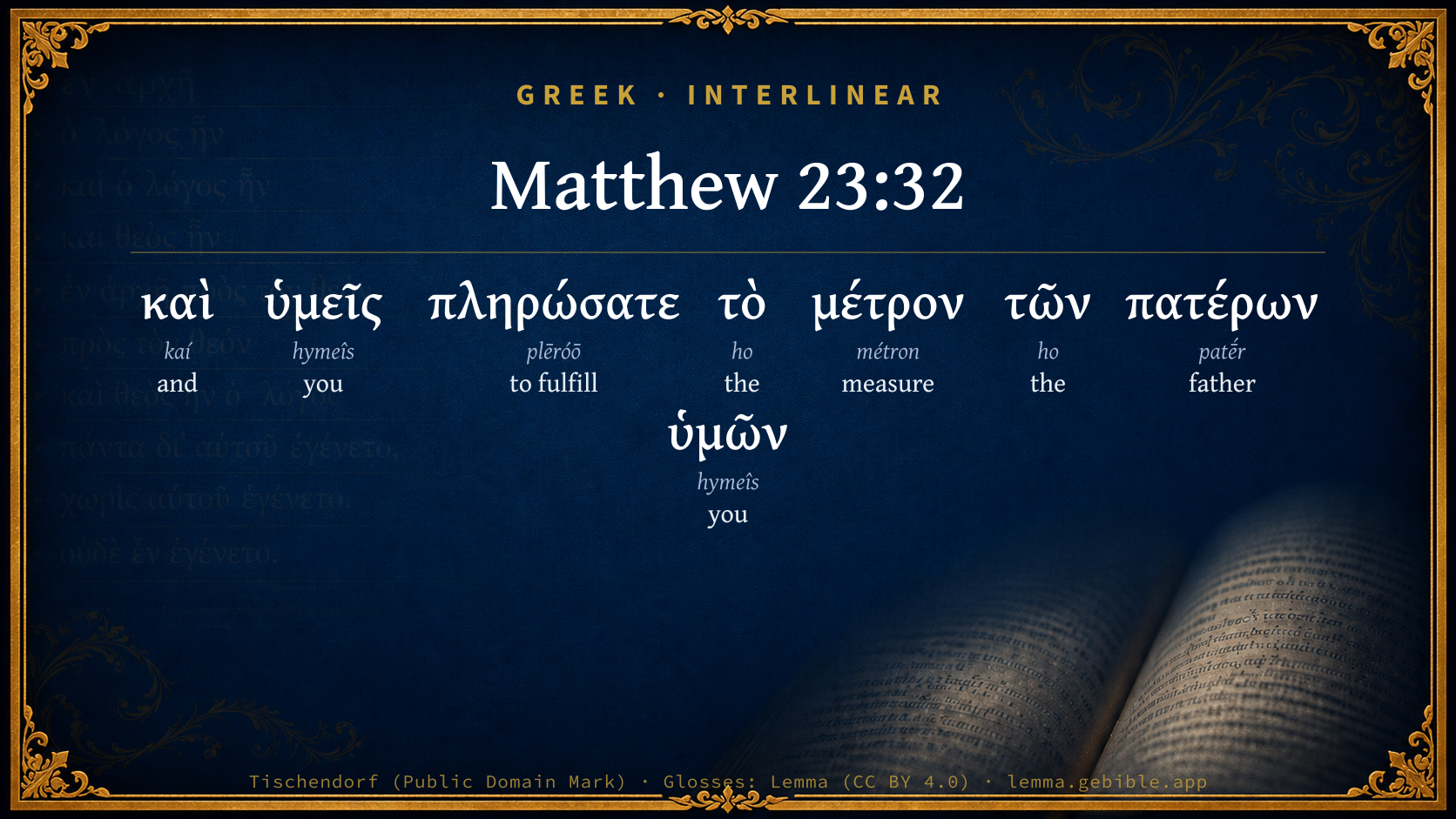
  1. καὶ kaí G2532 “and” Conjunction
  2. ὑμεῖς hymeîs G5210 “you” Personal pronoun, 2nd person, Nominative, Plural
  3. πληρώσατε plēróō G4137 “to fulfill” Verb, Aorist, Active, Imperative, 2nd person, Plural
  4. τὸ ho G3588 “the” Article, Accusative, Singular, Neuter
  5. τῶν ho G3588 “the” Article, Genitive, Plural, Masculine
  6. πατέρων patḗr G3962 “father” Noun, Genitive, Plural, Masculine
  7. ὑμῶν hymeîs G5210 “you” Personal pronoun, 2nd person, Genitive, Plural

About this verse

These counts appear in no published source. They are computed here, from the morphology-tagged text and Lemma’s own curated glosses. What Lemma adds →

8
words
6
distinct lemmas
Gospels
section

Notable vocabulary

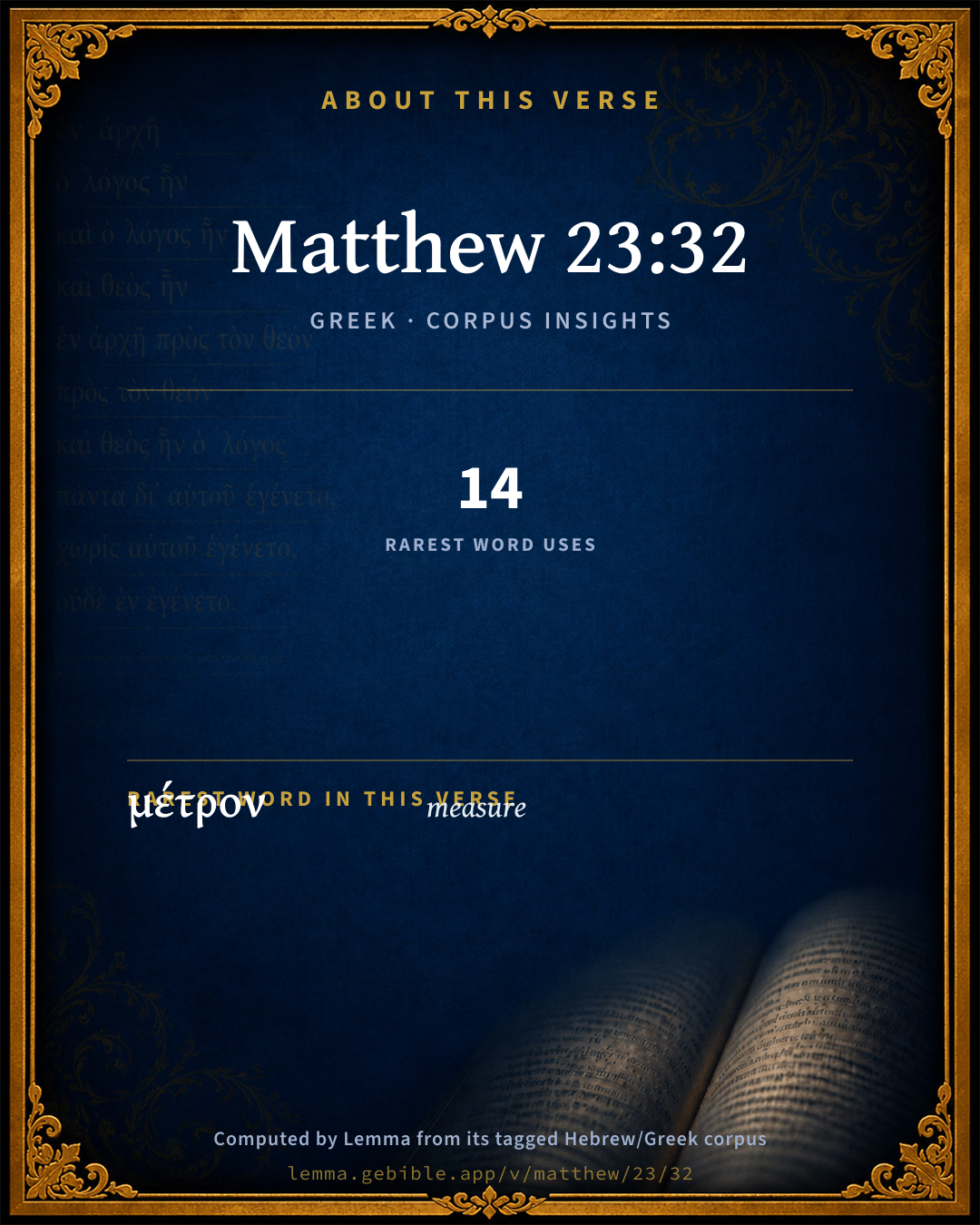
The rarest word here is μέτρον measure G3358 — appearing just 14 times in the whole Greek New Testament.

Shared distinctive vocabulary

μέτρον measure G3358 occurs in 12 verses of the Greek New Testament. Also found in:

Repetition

Words recur within this verse:

Cross-references

3

Topical passages linked to Matthew 23:32 in the Treasury of Scripture Knowledge — connected by theme and wording, ordered by reader-vote popularity; previews shown in the World English Bible.

  • Genesis 15:16 In the fourth generation they will come here again, for the iniquity of the Amorite is not yet full."
  • Numbers 32:14 Behold, you are risen up in your fathers' place, an increase of sinful men, to augment yet the fierce anger of Yahweh toward Israel.
  • 1 Thessalonians 2:16 forbidding us to speak to the Gentiles that they may be saved; to fill up their sins always. But wrath has come on them to the uttermost.

Cross-references courtesy of OpenBible.info (CC BY 4.0).

Commentary

Notes on Matthew 23:32 from classic Christian and Jewish commentators (each source and its license shown beneath its notes). The classic Christian expositions comment on the surrounding passage and are grouped to its opening verse, so a note may address several verses; the Jewish commentaries on the Tanakh (Rashi and others) are per-verse, so they appear only where the commentator wrote on this verse.

Lemma curates 59 commentaries, every one of them public domain or Creative Commons licensed, each selected and text-cleaned for this edition rather than reprinted as found. About our sources →

Joseph Benson's Commentary

Mat 23:32-36. Fill ye up then the measure of your fathers’ wickedness — Ye may now be as wicked as they: a word of permission, not of command: as if he had said, I contend with you no longer: I leave you to yourselves: you have conquered: now ye may follow the devices of your own hearts. Ye serpents — Our Lord having now given up all hope of reclaiming them, speaks thus to deter others from the like sins. Wherefore — That it may appear you are the true children of those murderers, and have a right to have their iniquities visited on you: behold, I send — Is not this speaking as one having authority? Prophets — Men with supernatural credentials; Wise men — Such as have both natural abilities and experience; and scribes — Men of learning: but all will not avail. That upon you may come all the righteous blood — The consequence of which will be, that upon you will come the punishment of the blood of all the righteous men; shed upon the earth — Temporal punishment must be intended, because in the life to come men shall not be punished for the sins of others to which they were not accessary. From the blood of righteous Abel — The first prophet and preacher of righteousness, unto the blood of Zacharias, son of Barachias — Most commentators think that Zechariah, the son of Jehoiada the priest, mentioned 2Ch 24:20, (where see the note,) is here meant: and that either the words, son of Barachias, are the officious addition of some early transcriber of this gospel, (who might confound this martyr with Zechariah, one of the twelve minor prophets,) or that Jehoiada was also called Barachiah, having, as was not then uncommon, two names, both which, it may be observed, signify nearly the same thing: the latter word signifying one that blesses the Lord, and Jehoiada one that confesses him. Dr. Blayney, however, is confident that Zechariah, the minor prophet, is here intended, and that he was actually murdered, as is here said, though the Scriptures of the Old Testament are silent concerning the barbarous action. See the argument to my notes on Zechariah. Whom ye slew — So he says, because by imitating their fathers’ conduct, they made the murder, committed by them, their own; between the temple — That is, the house properly called the temple; and the altar — Which stood in the outer court. Our Lord seems to refer to this instance, rather than to any other, because he was the last of the prophets that was slain by the Jews for reproving their wickedness; and we may add, (supposing Zechariah the son of Jehoiada to be meant,) because God’s requiring his blood, as well as that of Abel, is particularly taken notice of in Scripture, that holy man’s last words being, The Lord look upon it, and require it, 2Ch 24:22. All these things — The punishment of all these murders; shall come upon this generation — This Jesus foreknew would be the case; and that though every possible method would be tried in order to their conversion, they would make light of all, and by so doing pull down upon themselves such terrible vengeance, as should be a standing monument of the divine displeasure against all the murders committed on the face of the earth from the beginning of time.

Joseph Benson's Commentary on the Old and New Testaments (1811–1818) — public domain. Text from a community e-Sword module.

Tyndale Open Study Notes

Tyndale Open Resources

23:32 finish what your ancestors started: By killing God’s Messiah, they would bring to completion Israel’s history of killing God’s messengers (see 1 Thes 2:14-16).

Tyndale Open Study Notes — © Tyndale Open Resources, licensed CC BY-SA 4.0. Text via the HelloAO Bible API.

Bengel's Gnomon

Johann Albrecht Bengel

Mat 23:32. Καὶ ὑμεῖς πληρώσατε, fill ye up then) The pronoun ὑμεῖς, you, is not only introduced in contrast to your fathers, but also shows that there is an indicative force in the imperative πληρώσατε, fill ye up; q.d. ye will fill up, fill ye up therefore: cf. Joh 13:27. Fill ye up whenever ye will, be ye no longer hindered; be ye left to yourselves: perform then with the hand that which you cherish in the heart.—τὸ μέτρον, the measure) As there is a measure of life and of suffering, so is there also of sin, when, for example, to three transgressions is added a fourth; see Amo 1:3, etc.

Bengel's Gnomon of the New Testament — English translation (T&T Clark, Edinburgh, 1860) — public domain. Text from a community e-Sword module.

Meyer's Critical & Exegetical Commentary

Heinrich August Wilhelm Meyer

Mat_23:32. Quite in keeping with the deepening intensity of this outburst of indignation is the bitter irony of the imperative πληρώσατε (comp. Mat_25:45), the mere permissive sense of which (Grotius, Wetstein, Kuinoel) is too feeble.[11] This filling up of the measure (of the sins) of the fathers was brought about by their sons (haereditario jure, Calvin), when they put Jesus Himself as well as His messengers to death.

καὶ ὑμεῖς] ye also. The force of καί is to be sought in the fact that ΠΛΗΡΏΣΑΤΕ, Κ.Τ.Λ., is intended to indicate a line of conduct corresponding to and supplementing that of the fathers, and in regard to which the sons also must take care not to come short.

[11] The readings ἐπληρώσατε (D H, min.) and πληρώσετε (B* min. vss.) are nothing but traces of the difficulty felt in regard to the imperative. The former is preferred, though at the same time erroneously interpreted by Wilke, Rhetor. p. 367; the latter, again, is adopted by Ewald, who regards κ. ὑμεῖς πληρώσετε as also dependent on ὅτι.

Meyer — Critical and Exegetical Commentary on the New Testament — English translation by Peter Christie, edited by Frederick Crombie (T&T Clark, 1880) — public domain. Text from a community e-Sword module.

Expositor's Greek Testament

ed. W. Robertson Nicoll

Mat 23:32 . καὶ , and, as ye have called yourselves their sons, so show yourselves to be such indeed (Weiss). πληρώσατε . The reading πληρώσετε is due to shrinking from the idea conveyed by the imperative. To the same cause is due the permissive (Grotius al. ) or ironical (De W.) senses put upon the imperative. Christ means what He says: “Fill up the measure of your fathers; crown their misdeeds by killing the prophet God has sent to you . Do at last what has long been in your hearts. The hour is come.”

The Expositor's Greek Testament, edited by W. Robertson Nicoll (1897–1910) — public domain. Text from a community e-Sword module.

Geneva Bible (1599)

Geneva Bible translators

A proverb used of the Jews, which hath this meaning, Go ye on also and follow your ancestors, that at length your wickedness may come to the full.

Geneva Bible (1599) marginal notes — public domain. Text via Bolls.life.

Adam Clarke's Commentary

Verse 32. Fill ye up then] Notwithstanding the profession you make, ye will fill up the measure of your fathers-will continue to walk in their way, accomplish the fulness of every evil purpose by murdering me; and then, when the measure of your iniquity is full, vengeance shall come upon you to the uttermost, as it did on your rebellious ancestors. The 31st verse should be read in a parenthesis, and then the 32d will appear to be, what it is, an Inference from the 30th.

Ye will fill up, or fill ye up - πληρωσατε but it is manifest that the imperative is put here for the future, a thing quite consistent with the Hebrew idiom, and frequent in the Scriptures. So Joh 2:19, Destroy this temple, &c., i.e. Ye will destroy or pull down this temple, and I will rebuild it in three days-Ye will crucify me, and I will rise again the third day. Two good MSS. have the word in the future tense: and my old MS. Bible has it in the present-Ge (ye) fulfillen the mesure of youre (your) fadris.

Adam Clarke's Commentary on the Bible (1810–1826) — public domain. Text from a community e-Sword/MySword module.

Ellicott's Commentary for English Readers

(32) Fill ye up then . . .—The English fails to give the pathetic abruptness of the original: And ye—fill ye up the measure of your fathers. The thought implied is that which we find in Gen_15:16, and of which the history of the world offers but too many illustrations. Each generation, as it passes, adds something to the ever-accumulating mass of evil. At last the penalty falls, as though the long-suffering of God had been waiting till the appointed limit had been reached, and the measure of iniquity was at last full.

A Bible Commentary for English Readers, edited by Charles John Ellicott (1878–1897) — public domain. Text from a community e-Sword module.

John Gill's Exposition

Ye servants, ye generation of vipers,.... The latter of these names, John the Baptist calls the Sadducees and Pharisees by, in Mat 3:7 and Christ, in Mat 12:34 both express their craft and subtlety, their inward poison, and venomous nature; their fair outside, and specious pretences; their hypocrisy, malice, and wickedness; in which they were like to the old serpent, their father the devil, and to their ancestors, that murdered the prophets; nor could any good thing be expected, from such a viperous generation:

how can ye escape the damnation of hell? signifying, that it was impossible that they should; nor could they surely expect it themselves, who must be conscious to themselves of their wickedness, malice, and deceit. The Persic version reads it, "where can ye escape?" &c. and so Beza says it was read, in one ancient copy of his; and the sense is, whither can ye flee? to whom, or what can you have recourse to, to screen you from the wrath to come? Rocks and mountains, caves and dens, will be of no service. The phrase,

, "the judgment, or damnation of hell", is a phrase often used in the Talmud (p), and Midrashes (q) of the Jews; and intends future torment, and the everlasting vengeance and wrath of God, the unquenchable fire prepared for the devil and his angels, and which impenitent unbelieving sinners cannot escape,

(p) T. Bab. Berncot, fol. 61. 1. Erubin, fol. 18. 2. Yebamot, fol. 102. 2. Sota, fol. 4. 2. & 5. 1. & Bava Bathra, fol. 10. 1. (q) Bemidbar Rabba, fol. 203. 1. Shirhashirim Rabba, fol. 14. 2. & Midrash Kohelet, fol. 76. 1.

John Gill's Exposition of the Whole Bible (1746–1763) — public domain (CC PDM 1.0). Text via the HelloAO Bible API.

Trapp's Complete Commentary

John Trapp

32 Fill ye up then the measure of your fathers.

Ver. 32. Fill ye up then the measure] Ironice dictum. Ironic saying. It gives us to understand that sinners are stinted, and cannot do what mischief they would. If at any time they exceed their commission (as they are apt) and help forward the affliction, as out of their innate malice they will, God will soon grow jealous for Jerusalem, and take them off, Zec 1:14-15. When wickedness hath filled her ephah, God will soon transport it into the land of Shinar, Zec 5:8-11. When it is once ripe in the field, God will not suffer it to shed, to grow again, but cuts it up by a just and seasonable vengeance.

John Trapp, A Commentary or Exposition upon All the Books of the Old and New Testament (1647–1656) — public domain. Text from a community e-Sword module.

Albert Barnes' Notes on the Bible

Fill ye up, then ... - This is a prediction of what they were about to do. He would have them act out their true spirit, and show what they were, and evince to all that they had the spirit of their fathers, Compare the notes at Joh 13:27. This was done be putting him to death, and persecuting the apostles.

The measure - The full amount, so as to make it complete. By your slaying me, fill up what is lacking of the iniquity of your fathers until the measure is full; until the national iniquity is complete; until as much has been committed as God can possibly bear, and then shall come upon you all this blood, and you shall be destroyed, Mat 23:34-35.

Albert Barnes' Notes on the Bible (1834–1885) — public domain. Text from a community e-Sword/MySword module.

Haydock's Catholic Bible Commentary

Jesus Christ does not here persuade the Jews to continue on in their wicked ways, as if praising and sanctioning their conduct; but only predicts his own death, which they were about to compass, and which crime would greatly exceed that of their fathers: as he was the greatest, and even the Lord of all the other prophets, whom their fathers had put to death. (Denis the Carthusian)

George Leo Haydock (1774–1849), Haydock's Catholic Family Bible and Commentary, 1859 edition — public domain. Excludes Psalms (Douay-Rheims chapter numbering differs from Protestant) and Deuterocanonical books (Catholic canon only).

The Pulpit Commentary

Fill ye up then; kai umeiv plhrwsate : do ye also (as well as they) fill up. An imperative, expressive of Divine irony, containing virtually a prophecy. Complete your evil work, finish that which your fathers began. (comp. Joh_13:27) The measure. There is a certain limit to iniquity; when this is reached, punishment falls. The metaphor is derived from a full cup, which a single drop more will make overflow. This added drop would be the death of Christ and the persecution of his followers. Then vengeance must follow. (comp. Gen_15:16 1Th_2:16)

Vers. 32-39. Prophecy of their future.

I THEIR CONTINUANCE IN THE SINS OF THEIR FATHERS.

1. Prediction of their treatment of Christs disciples. They would fill up the measure of their fathers; the Lord knew it in his Divine foreknowledge. They were still what John the Baptist had once called them serpents, "a generation of vipers." How were such as they to escape from the condemnation of Gehenna? For hypocrisy hardens the heart. The state of the hypocrite is hopeless, perhaps, beyond that of most other sinners; self-satisfied as he is, he will not repent and come to Christ. "Wherefore," the Lord said, "I send unto you prophets." Mark the majestic "I send;" it asserts his authority, his equality in the truth of his Divine nature with God the Father. Mark the solemn "wherefore;" it contains a depth of inscrutable meaning meaning full of mercy on the one side, full of awful mystery on the other. He would send his messengers unto them. Then even now he cared for their souls, even now he sought to save them. But he knew in his Divine omniscience how they would treat his servants; they would persecute them, and scourge them in their synagogues; some they would kill and crucify. The mission of the apostles would increase the guilt of the Jews; the good tidings of salvation would be to them, not life, but death. The Divine foreknowledge is not inconsistent with human free will. The Pharisees had the power to choose or to reject the Saviour. He would not have mocked them with the offer of an unattainable salvation, an inaccessible heaven. Yet he knew that they would reject him, for he was God, infinite in knowledge as in all other Divine attributes. That knowledge did not destroy their free agency; it did not remove their guilt. Here is one of those deep mysteries which human thought cannot penetrate; hereafter it shall be revealed.

2. The consequence to themselves. On them would come all the righteous blood shed upon the earth. It must be so; for they had inherited the guilt of their ancestors, and that accumulated inheritance of evil had hardened their hearts into very stone. It must be so; for it was in the course of God"s awful justice. As he hardened the heart of Pharaoh, who first hardened his own heart; so now he sent his messengers to the hardened Pharisees, that upon them might come all the righteous blood shed upon the earth. It is the ordinance of God, the law of that human nature which is his work, that wilful sin wilfully persevered in should lead on to guilt deeper yet. It would be so in the case of these hard-hearted Jews. Their obstinate unbelief would soon lead to a crime greater than any which the world, wicked as it was, had seen from the very beginning. That awful crime would fill up the measure of the long catalogue of deeds of blood. It would all fall upon that generation, from the first murder that ever was to the last recorded in the Hebrew canon; for all the accumulated blood guiltiness of mankind would be summed up in the tremendous guilt of those who were so soon about to cry, "His blood be on us, and on our children!" "Verily I say unto you, All these things must come upon this generation." We feel it must be so. We hear the dread sentence, and we bow in silent awe before the judgment of God. And yet we know and feel that Christ cared even for those hardhearted sinners, and would have saved them in his tender pity. But, alas! they would not come to him, that they might have life.

II THE LAMENT OVER JERUSALEM.

1. The Lord"s love. The stern language of most awful condemnation changes. We hear the tenderest accents of Divine pity, the sad wailing of disappointed love. The Lord had wept over Jerusalem. Now again his sacred heart yearns with mighty compassion for the city which he loved so well tie sorrows over the whole city, not only for the scribes and Pharisees whose hypocrisy he had denounced; his glance takes in the whole population, the poor and ignorant as well as the rich and learned; the deceived as well as the deceivers. His glance takes in all times, not only the present rejection of his grace, the awful guilt that was close at hand; but also their past offences, their past refusals of his offered mercies. Again and again he had wished to gather them together into his little flock, into his holy Church; again and again during his ministry upon earth, again and again before his incarnation, when he sent his warnings from heaven, he would have gathered them together, even as a hen gathereth her chickens under her wings. A most touching simile, expressive of yearning affection, of tender solicitude, expressive too of the Lord"s power and knowledge, wide-reaching in its range, all-embracing in its individual tenderness. Jerusalem, with its great population, was as a brood of chickens in his sight; he knew all, he cared for all; he would have sheltered all under his wings. But alas! they would not. He wished to gather them together; they did not wish to be gathered under the shelter of the Saviour"s love. The Lord clearly asserts the great mystery of man"s free will. He willeth that all men should be saved; but he doth not force the will of man. He would draw us to himself by the constraining attraction of love. He does not use his almighty power to compel our obedience. Enforced obedience is without value; enforced love is not love; the very phrase is a contradiction in terms, for love is essentially free and spontaneous. He calls us, he invites us; he warns, he threatens, he chastens; he manifests his love, that the sight of that great love may kindle tire flame of love in our unloving hearts; he came down from heaven for us men and for our salvation; he, the eternal Son of God, became a Man of sorrows and acquainted with grief; he gave himself to die in the mysterious depth of his exceeding great love; he declares his love by the unanswerable eloquence of the cross. But he leaves us free. Man was made in the image of God. The human will is a sacred thing; it must not be forced, or moral distinctions are lost, and love is annihilated and holiness is impossible. We know it is so, though we cannot solve the perplexing mystery. Let us try to yield up our will to him; to pray the deep holy prayer which he prayed in his agony, "Father, not my will, but thine be done.

2. The consequence of the rejection of his love. "Your house is left unto you desolate." The Lord is about to depart from the temple. It is no longer what it had been the house of God. He calls it "your house." It had been long without the ark, without the Shechinah; now it would be without the presence of Christ, without the favour of God. It was left desolate left to them; for God was leaving the temple, the city, the nation. Tacitus and Josephus tell us that, before the fall of Jerusalem, the awful voice of departing Deity was heard, "Let us depart hence." Christ was leaving the temple now. "Ye shall not see me henceforth," he said, "till ye shall say, Blessed is he that cometh in the name of the Lord." They would see him, indeed, once again in his sufferings on the cross. They would see, and yet not see, for their eyes were holden. Yet these last words were words of mercy and hope. He looked on through the ages, through the long period of Israel"s unbelief and banishment, to the great restoration that is to come, when they shall look on him whom they have pierced, and mourn for him; "and so all Israel shall be saved". (Rom_11:26)

LESSONS.

1. As a man lives, so, as a rule, he will die. "Remember thy Creator in the days of thy youth.

2. Sin leads on to sin, guilt to yet deeper guilt. Take heed betimes.

3. The Lord weeps over the hard hearted. "There is joy in heaven over one sinner that repenteth." May he soften our hearts and give us true repentance!

The Pulpit Commentary (1880–1919), ed. H.D.M. Spence-Jones & Joseph S. Exell — public domain. Text from a community e-Sword module.

John Wesley's Explanatory Notes

Fill ye up - A word of permission, not of command: as if he had said, I contend with you no longer: I leave you to yourselves: you have conquered: now ye may follow the devices of your own hearts. The measure of your fathers - Wickedness: ye may now be as wicked as they.

John Wesley, Explanatory Notes Upon the Whole Bible (1754–1765) — public domain. Text via the GEBible commentary corpus.

The People's New Testament

B. W. Johnson

32. Fill ye up the measure of your fathers. The language of prophecy as well as irony and invective; as if he had said: Fill the measure of the guilt of your fathers to the brim. Crucify the Holy One and thus fill up the cup of iniquity.

B. W. Johnson's The People's New Testament with Notes (1889–1891) — public domain. Electronic text from the Christian Classics Ethereal Library (CCEL) ThML edition.

unfoldingWord translationNotes

Door43 World Missions Community

You also fill up the measure of your fathers

Jesus uses this as a metaphor meaning the Pharisees will complete the wicked behavior that their forefathers started when they killed the prophets. AT: "You also finish the sins your ancestors began" (See: Metaphor)

You serpents, you offspring of vipers

Serpents are snakes, and vipers are poisonous snakes. They are dangerous and often symbols of evil. AT: "You are as evil as dangerous and poisonous snakes" (See: Doublet and Metaphor)

offspring of vipers

Here "offspring" means "having the characteristic of." See how you translated a similar phrase in Matthew 3:7.

how will you escape the judgment of hell?

Jesus uses this question as a rebuke. AT: "there is no way for you to escape the judgment of hell!" (See: Rhetorical Question)

translationWords

ancestor

sin

serpent

offspring

judge

hell

unfoldingWord translationNotes — © Distant Shores Media and the Door43 World Missions Community, licensed CC BY-SA 4.0. Source: git.door43.org/Door43/en_tn.

Cambridge Greek Testament for Schools and Colleges

32. καὶ nearly = ‘and so.’ See Dr Moulton’s note, Winer, p. 540, cp. Php 4:9; Php 4:12.

Cambridge Greek Testament for Schools and Colleges (Cambridge University Press, 1896; 21 vols, various authors incl. Carr, Maclear, Plummer, Farrar, Lumby, Moule, M. R. James, Simcox) — public domain. Text from a community e-Sword module.

International Critical Commentary

32. And you will fill up the measure of your fathers.] “And you will sin as they sinned.”

(L)

32. πληρώσετε] So B.* S1 60. πληρώσατε is read by א B2 C al, but the imperative breaks the connection: “You acknowledge that you are physically descended from prophet-murderers, and, in fact, you are also morally their successors, and will sin as they sinned.” The present would be even better than the future, and the Aramaic original may have had the participle = “Ye are filling up”; that is, “You sin, e.g., in the murder of the Baptist as they sinned.” D H al have the aorist ἐπληρώσατε, which gives an inferior sense.

International Critical Commentary — older volumes (1896–1929), various authors — public domain. Text from a community e-Sword module.

Lesson kit

Teaching starters — assembled from the data on this page, not authored interpretation. Every prompt links to the verse data it draws on. Edit before teaching.

Matthew, in the Gospels, opens this verse with 8 words (6 distinct Greek lemmas). Its most distinctive word is métron (“measure”). A historical commentator’s framing appears above. Read the whole chapter for the surrounding context.

Discussion questions

  1. The word métron carries the sense “measure.” How does it shape the verse?
  2. Matthew 7:2 shares the word «measure» with this verse. How do the two illuminate each other?
  3. “you” occurs 2× in this one verse. What is the effect of the repetition?
  4. These translations render this verse differently; the difference is in the English rendering, not the original. What questions does that raise?
  5. Reading how Joseph Benson's Commentary and Tyndale Open Study Notes read this verse, where do the two commentators agree and where do they part?

Things to notice

  • These translations choose different wording for 1 word in this verse.
  • “you” occurs 2× in this single verse.
  • 6 distinct Greek lemmas span 8 words in this verse.

Reading settings

Reading text

Shown beneath each verse's original-language words.

Old Testament
Old Testament edition

Read the OT as the Masoretic Hebrew (MT) or the Greek Septuagint (LXX).

English shown for the Greek Septuagint (in the Hebrew ↔ Greek comparison).

Comparing translations? Open the Compare panel on any verse page to stack up to four side by side.