John 14:11

Greek (Tischendorf 8th ed.) John 14:11 appears in the Greek New Testament. The text above is from the Tischendorf 8th edition. Each word links to its Strong’s number and a concise gloss. Click any word for its full Thayer’s Greek Lexicon entry.
Download image
Cite this verse

John 14:11 (World English Bible). Public Domain. Lemma interlinear Bible study tool, https://lemma.gebible.app/v/john/14/11.

Show BibTeX & RIS
BibTeX
RIS
English Translation
Believe me that I am in the Father, and the Father in me; or else believe me for the very works' sake.
World English Bible · Public Domain
Download a study sheet

One document with this verse’s original text, its word-by-word gloss line, the meaning frame, cross-references with their text, attributed commentary, and full source and license credits — printable, and it pastes into notes with its structure intact.

This verse Autodidact and up

Study sheet (.html) Plain text (.txt)

A passage Seminary Student

Up to 50 verses in one chapter. A passage sheet keeps up to 6 commentary sources and 12 cross-references per verse, in the order this page ranks them, and says so on the sheet whenever that leaves anything out. Ask for a single verse and you get the Autodidact verse sheet above.

Everything on this page stays free to read, with no account — the sheet is a download of what is already on screen, not access to it.

Want to remove ads? Support Godless Engineer
Compare translations 3

The same verse in 3 English versions, stacked beneath the original-language interlinear above. Click any original word for its lexicon entry.

Each is an independent rendering of the whole verse — the interlinear is not word-aligned to these translations.

Highlighted words mark where these versions differ — a whole-verse word diff, not a word-by-word alignment.

  • World English Bible Public Domain
    Believe me that I am in the Father, and the Father in me; or else believe me for the very works' sake.
  • King James Version Public Domain
    Believe me that I am in the Father, and the Father in me: or else believe me for the very works' sake.
  • unfoldingWord Literal Text CC BY-SA 4.0
    Believe me that I in the Father, and the Father in me. But if not, believe because of the works themselves.

unfoldingWord Literal Text — © unfoldingWord, licensed CC BY-SA 4.0. Word-aligned USFM3 via Door43 (git.door43.org/unfoldingWord/en_ult).

Versions to compare (up to 4)

3 of 4 selected

Show all 19 translations

Every available English version of this verse, each an independent rendering of the whole verse.

  • World English Bible Public Domain
    Believe me that I am in the Father, and the Father in me; or else believe me for the very works' sake.
  • Berean Standard Bible Public Domain
    Believe Me that I am in the Father and the Father is in Me—or at least believe on account of the works themselves.
  • Majority Standard Bible Public Domain
    Believe Me that I am in the Father and the Father is in Me—or at least believe Me on account of the works themselves.
  • King James Version Public Domain
    Believe me that I am in the Father, and the Father in me: or else believe me for the very works' sake.
  • American Standard Version (1901) Public Domain
    Believe me that I am in the Father, and the Father in me: or else believe me for the very works' sake.
  • Revised Version (1885) Public Domain
    Believe me that I am in the Father, and the Father in me: or else believe me for the very works’ sake.
  • Geneva Bible (1599) Public Domain
    Beleeue me, that I am in the Father, and the Father is in me: at the least, beleeue me for the very workes sake.
  • Douay-Rheims (1899) Public Domain
    Believe you not that I am in the Father, and the Father in me?
  • Young's Literal Translation Public Domain
    believe me, that I `am' in the Father, and the Father in me; and if not, because of the works themselves, believe me.
  • Literal Standard Version CC BY-SA 4.0
    believe Me, that I [am] in the Father, and the Father in Me; and if not, because of the works themselves, believe Me.
  • Unlocked Literal Bible CC BY-SA 4.0
    Believe me that I am in the Father, and the Father is in me, or else believe because of the works themselves.
  • unfoldingWord Literal Text CC BY-SA 4.0
    Believe me that I in the Father, and the Father in me. But if not, believe because of the works themselves.
  • Darby Bible Public Domain
    Believe *me* that I [am] in the Father and the Father in me; but if not, believe me for the works' sake themselves.
  • World Messianic Bible Public Domain
    Believe me that I am in the Father, and the Father in me; or else believe me for the very works’ sake.
  • Webster's Bible Public Domain
    Believe me that I am in the Father, and the Father in me: or else believe me for the very works' sake.
  • Free Bible Version CC BY-SA 4.0
    Believe me when I tell you that I live in the Father, and the Father lives in me, or at least believe because of the evidence provided by all that I've done.
  • Bible in Basic English Public Domain
    Have faith that I am in the Father and that the Father is in me: at least, have faith in me because of what I do.
  • Text-Critical English NT CC BY 4.0
    Believe me that I am in the Father and the Father is in me; but if not, believe me because of the works themselves.
  • Tyndale New Testament (1534) Public Domain
    Beleve me that I am [in] the father and the father in me. At the leest beleve me for the very workes sake.

Literal Standard Version (2020), Covenant Press — licensed CC BY-SA 4.0. Text via the HelloAO Bible API (eBible.org). Unlocked Literal Bible (unfoldingWord) — licensed CC BY-SA 4.0. Text via the HelloAO Bible API (eBible.org). unfoldingWord Literal Text — © unfoldingWord, licensed CC BY-SA 4.0. Word-aligned USFM3 via Door43 (git.door43.org/unfoldingWord/en_ult). Free Bible Version, Dr. Jonathan Gallagher — licensed CC BY-SA 4.0. Text via the HelloAO Bible API (eBible.org).

Word by word

More ways to search: Search by grammar → Find every occurrence → Compare this word →

Practice this passage: Drill this verse → Learn its vocabulary →

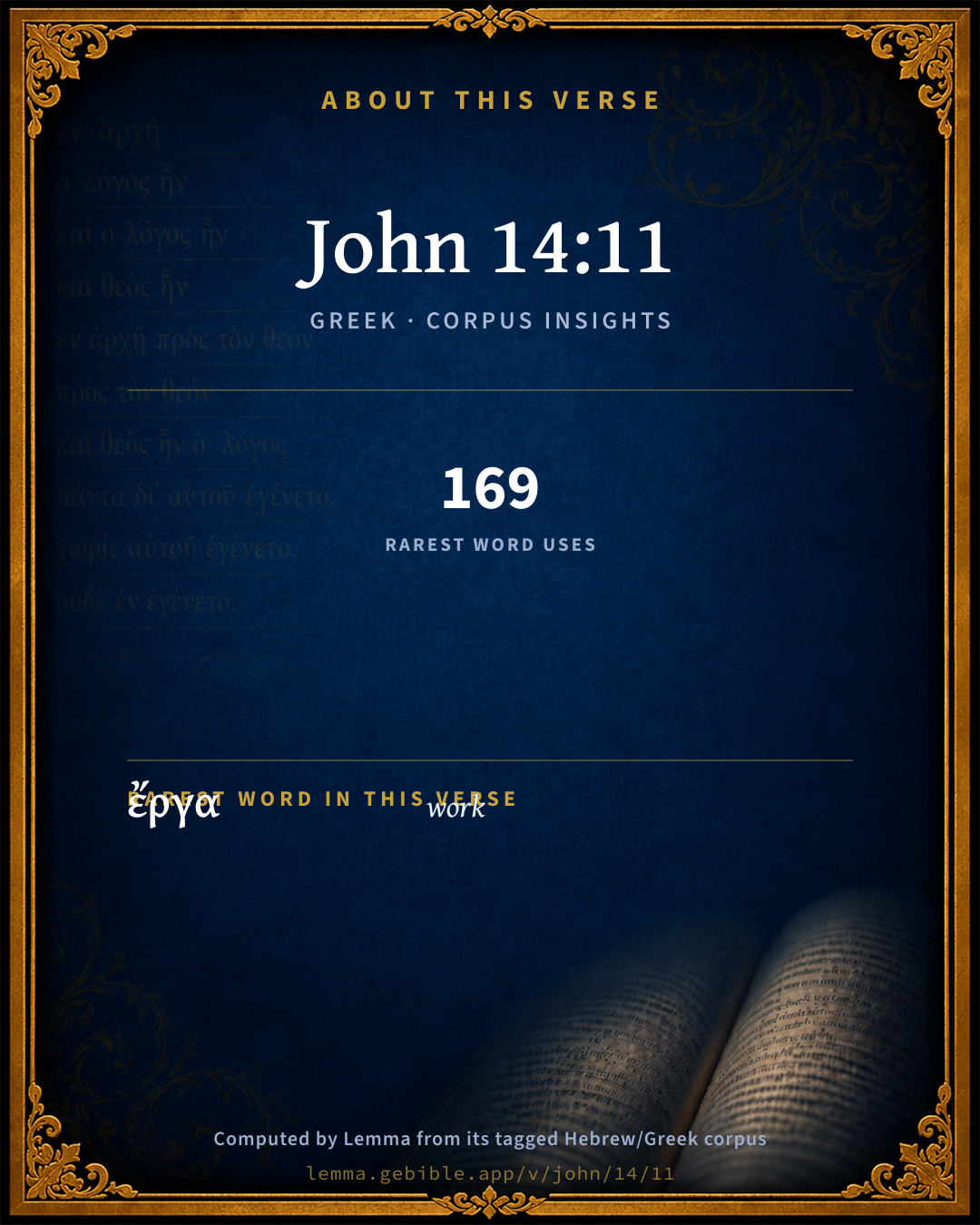
ἔργα
érgon
G2041
“work”
Noun, Accusative, Plural, Neuter
Part of Speech
Noun
Case
Accusative
Number
Plural
Gender
Neuter
Full Thayer's Definition

Origin: from a primary (but obsolete) ergo (to work)

TDNT: 12:35,3

1. business, employment, that which any one is occupied a. that which one undertakes to do, enterprise, undertaking 2. any product whatever, any thing accomplished by hand, art, industry, or mind 3. an act, deed, thing done: the idea of working is emphasised in opp. to that which is less than work
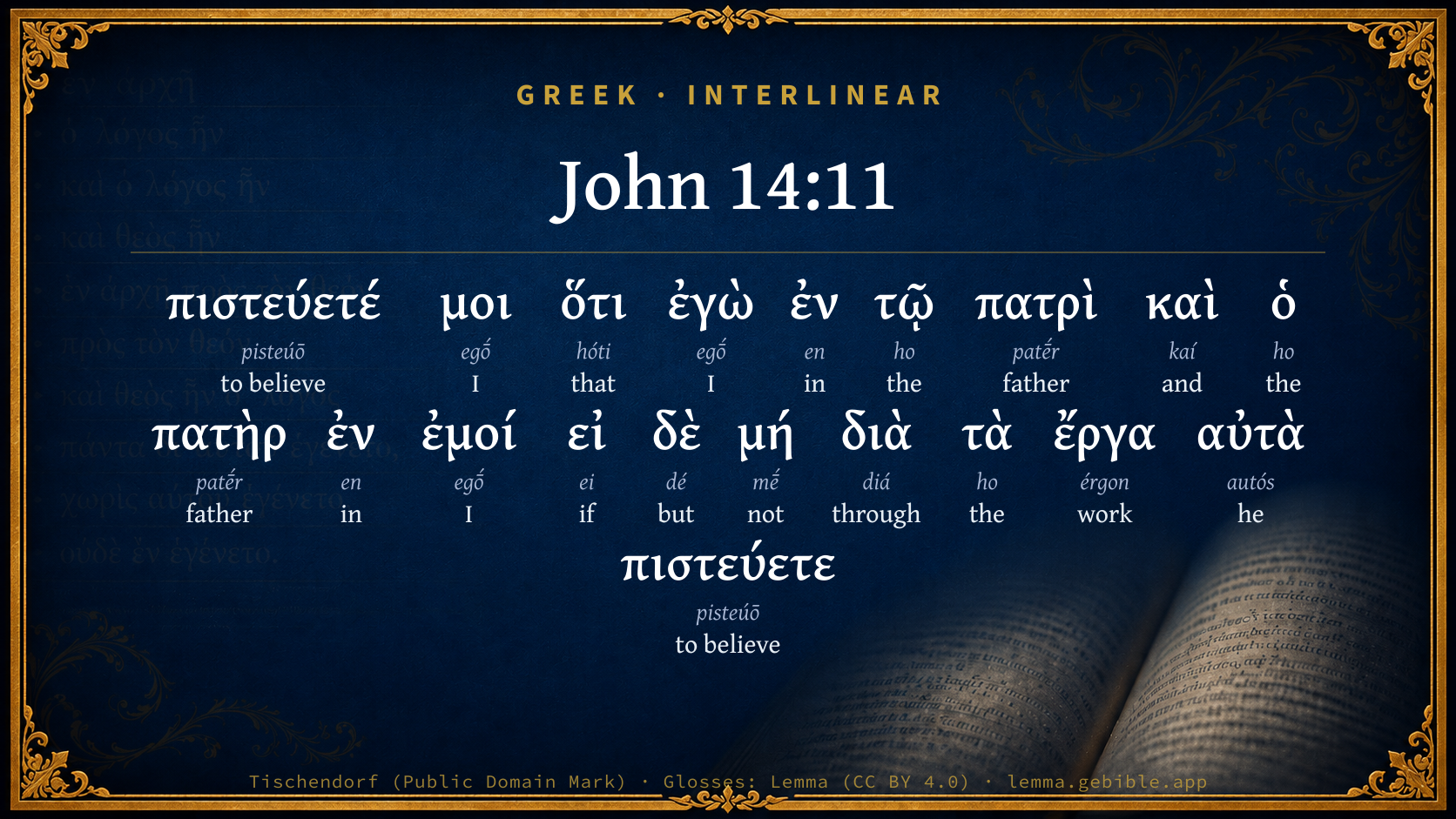
  1. πιστεύετέ pisteúō G4100 “to believe” Verb, Present, Active, Imperative, 2nd person, Plural
  2. μοι egṓ G1473 “I” Personal pronoun, 1st person, Dative, Singular
  3. ὅτι hóti G3754 “that” Conjunction
  4. ἐγὼ egṓ G1473 “I” Personal pronoun, 1st person, Nominative, Singular
  5. ἐν en G1722 “in” Preposition
  6. τῷ ho G3588 “the” Article, Dative, Singular, Masculine
  7. πατρὶ patḗr G3962 “father” Noun, Dative, Singular, Masculine
  8. καὶ kaí G2532 “and” Conjunction
  9. ὁ ho G3588 “the” Article, Nominative, Singular, Masculine
  10. πατὴρ patḗr G3962 “father” Noun, Nominative, Singular, Masculine
  11. ἐν en G1722 “in” Preposition
  12. ἐμοί egṓ G1473 “I” Personal pronoun, 1st person, Dative, Singular
  13. εἰ ei G1487 “if” Conditional
  14. δὲ dé G1161 “but” Conjunction
  15. μή mḗ G3361 “not” Particle, Negative
  16. διὰ diá G1223 “through” Preposition
  17. τὰ ho G3588 “the” Article, Accusative, Plural, Neuter
  18. αὐτὰ autós G846 “he” Personal pronoun, Accusative, Plural, Neuter
  19. πιστεύετε pisteúō G4100 “to believe” Verb, Present, Active, Imperative, 2nd person, Plural

About this verse

These counts appear in no published source. They are computed here, from the morphology-tagged text and Lemma’s own curated glosses. What Lemma adds →

20
words
13
distinct lemmas
Gospels
section

Repetition

Words recur within this verse:

  • πιστεύετέ to believe G4100 ×2
  • πατρὶ father G3962 ×2
  • μοι I G1473 ×3
  • τῷ the G3588 ×3
  • ἐν in G1722 ×2

Cross-references

10

Topical passages linked to John 14:11 in the Treasury of Scripture Knowledge — connected by theme and wording, ordered by reader-vote popularity; previews shown in the World English Bible.

  • John 10:38 But if I do them, though you don't believe me, believe the works; that you may know and believe that the Father is in me, and I in the Father."
  • John 5:36 But the testimony which I have is greater than that of John, for the works which the Father gave me to accomplish, the very works that I do, testify about me, that the Father has sent me.
  • John 10:25 Jesus answered them, "I told you, and you don't believe. The works that I do in my Father's name, these testify about me.
  • John 14:10 Don't you believe that I am in the Father, and the Father in me? The words that I tell you, I speak not from myself; but the Father who lives in me does his works.
  • Acts 2:22 "Men of Israel, hear these words! Jesus of Nazareth, a man approved by God to you by mighty works and wonders and signs which God did by him in the midst of you, even as you yourselves know,
  • Hebrews 2:4 God also bearing witness with them, both by signs and wonders, and by various works of power, and by gifts of the Holy Spirit, according to his own will?
  • Matthew 11:4–5 Jesus answered them, "Go and tell John the things which you hear and see:
  • John 10:32 Jesus answered them, "I have shown you many good works from my Father. For which of those works do you stone me?"
  • Luke 7:21–23 In that hour he cured many of diseases and plagues and evil spirits; and to many who were blind he gave sight.
  • John 12:38–40 that the word of Isaiah the prophet might be fulfilled, which he spoke, "Lord, who has believed our report? To whom has the arm of the Lord been revealed?"

Cross-references courtesy of OpenBible.info (CC BY 4.0).

Commentary

Notes on John 14:11 from classic Christian and Jewish commentators (each source and its license shown beneath its notes). The classic Christian expositions comment on the surrounding passage and are grouped to its opening verse, so a note may address several verses; the Jewish commentaries on the Tanakh (Rashi and others) are per-verse, so they appear only where the commentator wrote on this verse.

Lemma curates 59 commentaries, every one of them public domain or Creative Commons licensed, each selected and text-cleaned for this edition rather than reprinted as found. About our sources →

The Biblical Illustrator

Joseph S. Exell

Joh_14:11

Believe Me … for the very works sake

The miracles

I.

SHOULD WE BELIEVE THE MIRACLES?

1. Are miracles possible? Hume, Spinosa, and others say, No: reason pronounces them impossible. But whose reason? Theirs? Then that contradicts the all but universal reason, which affirms that with God all things are possible.

2. Are miracles improbable and incredible? Yes, say the same authorities. But did they live when they are alleged to have been performed? One ground of disbelief is, that it is impossible to believe what contradicts experience. But what remains to be proved is, Did miracles contradict the experience of the professed witnesses? The denizens of the equator never saw ice. Their experience contradicts that of the Greenlanders. But which shall we accept? Another ground is that it is unlikely that the Creator would disturb the beneficent order of events. Granted, except for the best and wisest purposes, and in such a way as not to derange the order of the universe. This is what is claimed for Christ; and, indeed, on behalf of the freedom and beneficence of the Creator. The anti-miraculous position is the dethronement of God in favour of natural law.

3. Have we satisfactory ground to believe that Christ performed miracles? There is the same evidence for them as that Caesar entered Gaul and

Britain. Upon this evidence the Christian Church is built; the witnesses died to support their testimony. The fabrication of this testimony would be more miraculous than what it records.

II. SHOULD WE BE INDUCED BY THEM TO ADMIT CHRISTS DIVINE CLAIMS? Yes, for

1. They are the acts of a Creator. We recognize the same Voice saying, Let there be light! that said, Lazarus, come forth! We believe Him for the works sake.

2. Christ is the efficient Agent in all miracles. He promised, and gave to, the apostles their supernatural power; and they referred the effects of it back to Him, and exerted it to produce faith in Him.

3. Christ performed miracles by His own power and in His own name, which the apostles never did.

Conclusion:

1. The blessedness of belief in Christ.

2. The peril of disbelief. (E. N. Kirk, D. D.)

The reasonableness of the evidence of miracles, and its impotence alone

It is quite consistent with Gods wisdom to reveal Himself to the senses,as well as to the soul; and if the gospel were utterly deficient in this latter kind of proof, one great evidence that it is from God would be wanted--an evidence that we are fortified in expecting from the analogies of nature. God has written His glory--e.g., in the heart--at the same time, He has so constructed the visible universe, that the heavens declare the glory of God. And when the eternal Word is manifested into the world, we naturally expect that Divine power shall be shown, as well as Divine beneficence. Miracles, therefore, are exactly what we should expect; and I acknowledge a great corroboration and verification of His claims to Sonship. Besides, they startled and aroused many to His claims who otherwise would never have attended to them. Still the great truth remains untouched, that they, appealing only to the natural man, cannot convey the spiritual certainty of truth which the spiritual man alone apprehends. However, as the natural and spiritual in us are both from God, why should God not have spoken to both, and why should not Christ appeal to natural works, subordinate always to the spiritual self-evidence of Truth itself? (F. W. Robertson, M. A.)

The Biblical Illustrator, edited by Joseph S. Exell (c. 1880s–1900s) — public domain. Text from a community e-Sword module.

Bengel's Gnomon

Johann Albrecht Bengel

Joh 14:11. Πιστεύετέ μοι) Non creditis is the reading of the Lat. Vulg. arising from alliteration [the transcriber’s eye catching the similar letters and word] at the preceding verse, which also had, Non credis quia. Thence the Latin transcriber also has omitted mihi[347] also at the end of the verse. Believe, Believe: an instance of Epanalepsis [See Append., “When the same word is in the beginning of the preceding member, and in the end of the following member of the sentence”].—ὅτι) because [but Engl. Vers. that]: with which comp. the διά, for the sake of presently after. Believe Me for the sake of, My very affirmation, which is sufficient ground for believers to rest on. This is the first motive to faith; one which Christ alone could have proposed: a second is afforded by the miracles, on account of which the apostles also could have been believed [could claim their hearers’ faith] concerning Christ.—ἔργα, the works) which ye have heretofore seen, and which ye are about to see: Joh 14:12, etc., “Greater works than these shall he do.” [For these could not have been of any other, save Divine origination. Psa 72:18, “The Lord God—who only doeth wondrous things;” Psa 136:4, “To Him, who alone doeth great wonders.” The footing on which false miracles rest is altogether distinct: 2Th 2:9, “The working of Satan, with all power, and signs, and lying wonders.”—V. g.]—πιστεύετέ μοι, believe Me) εἰς ἐμέ, on Me, in the foll. verse. He who believes Christ, when speaking concerning Himself, believes on Christ: whereas, he who believes Peter, when speaking concerning Christ, believes not on Peter, but on Christ.

[347] This word, both in the beginning and in the end of this verse, though it is not reckoned among the inferior readings by the margin of Ed. 2, yet is exiled from the second place [the end of the verse] by the Germ. Vers.—E. B. ABQab Rec. Text have μοι at the end of the ver. But Dc Vulg. Syr. and L omit it.—E. and T.

Bengel's Gnomon of the New Testament — English translation (T&T Clark, Edinburgh, 1860) — public domain. Text from a community e-Sword module.

Expositor's Greek Testament

ed. W. Robertson Nicoll

Joh 14:11 . πιστεύετέ μοι … πιστεύετε . “Believe me,” i.e. , my assertion, not my manifestation, “or if you find that difficult, believe on account of the works themselves”. The mention of His works and the evidence they afford that He is in the Father suggests to Him a ground of comfort for His disciples in view of His departure. And from this point onwards in this chapter it is to the comforting of the disciples our Lord addresses Himself. First, in Joh 14:12-14 ; second, in Joh 14:15-17 ; third, in Joh 14:18-21 . The mention of the Paraclete in connection with this third item of encouragement gives rise to a fourth interruption, this time by Judas, Joh 14:22-24 ; and at Joh 14:25 . Jesus resumes His explanation of the Paraclete’s function, and closes with several considerations calculated to remove their fears.

The Expositor's Greek Testament, edited by W. Robertson Nicoll (1897–1910) — public domain. Text from a community e-Sword module.

Ellicott's Commentary for English Readers

(11) Believe me that I am in the Father.—He passes now from Philip, and addresses Himself to the whole body of the apostles. He claims from them a personal trust in Himself, which should accept His statement that He and the Father were immanent in each other.

Or else believe me for the very works’ sake.—If they cannot receive the truth on the testimony of His word, He will take lower ground with them. He will place before them the evidence He had placed before the Jews. Let them, if they will not hear Him, believe on account of the very works which He had done. (Comp. Note on Joh_5:19-20; Joh_10:37-38.)

A Bible Commentary for English Readers, edited by Charles John Ellicott (1878–1897) — public domain. Text from a community e-Sword module.

The Cambridge Bible for Schools and Colleges

gen. ed. J. J. S. Perowne

11. Believe me] The English obliterates the fact that Christ now turns from S. Philip and addresses all the eleven: ‘believe’ is plural not singular. ‘You have been with Me long enough to believe what I say; but if not, at any rate believe what I do. My words need no credentials: but if credentials are demanded, there are My works.’ He had said the same, somewhat more severely, to the Jews (Joh_10:37-38); and he repeats it much more severely in reference to the Jews (Joh_15:22; Joh_15:24). Note the progress from ‘believe Me’ here to ‘believe on Me’ in the next verse; the one grows out of the other.

The Cambridge Bible for Schools and Colleges (gen. ed. J. J. S. Perowne; Cambridge University Press, 1878–1918) — public domain. Text from a community e-Sword module.

John Gill's Exposition

Believe me that I am in the Father, and the Father in me,.... Take my word for the truth of this; you may assure yourselves that nothing is more certain; but if you will not believe upon my saying so, either believe for the sake of the doctrines I have preached unto you, which are such as never any mere man spoke, and which have been delivered in such a manner, and with such authority, as never were by man. Some copies read, by way of interrogation, and so the Ethiopic version; and the Vulgate Latin version reads, "believe ye not?"

or else believe me for the very work's sake: meaning his miraculous works, such as raising the dead, cleansing the lepers, causing the deaf to hear, and giving sight to the blind; and which were such as none but a divine person could ever perform.

John Gill's Exposition of the Whole Bible (1746–1763) — public domain (CC PDM 1.0). Text via the HelloAO Bible API.

Trapp's Complete Commentary

John Trapp

11 Believe me that I am in the Father, and the Father in me: or else believe me for the very works’ sake.

Ver. 11. Believe me that I am, &c.] Take my bare word without any further pawn or proof. This is an honour due to Christ only, that he is αυτοπιστος, He is Amen, "the faithful and true witness," Rev 3:14.

John Trapp, A Commentary or Exposition upon All the Books of the Old and New Testament (1647–1656) — public domain. Text from a community e-Sword module.

Albert Barnes' Notes on the Bible

Believe me ... - Believe my declarations that I am in the Father, etc. There were two grounds on which they might believe; one was his own testimony, the other was his works.

Or else - If credit is not given to my words, let there be to my miracles.

For the very works’ sake - On account of the works; or, be convinced by the miracles themselves. Either his own testimony was sufficient to convince them, or the many miracles which he had performed in healing the sick, raising the dead, etc.

Albert Barnes' Notes on the Bible (1834–1885) — public domain. Text from a community e-Sword/MySword module.

Matthew Poole's English Annotations

Believe my words (for that is your duty); but yet if you will not believe my words, declaring to you my union with my Father, yet when you see me doing such works as none but God can do, believe me for their sake. It is true, that both the prophets and the apostles spake God’s words, not their own, to the people, and also did many great and mighty works; but still their doctrine led unto another, that was Christ; and their miracles were not wrought in their own names, but in the name of Christ. Elijah raised the Shunammite’s dead child to life by prayer to God that he would do it; and the apostles bid the lame man arise and walk, in the name of the Lord Jesus Christ. Christ’s doctrine terminated in himself; he called men to believe in him, and he wrought miracles by his own power, and by a virtue proceeding out of and from himself, though by the power of his Father also, because he and his Father were one in essence.

Matthew Poole's English Annotations on the Holy Bible (1683–1685) — public domain. Text from a community e-Sword/MySword module.

Whedon's Commentary on the Bible

Daniel D. Whedon

11. Believe me… or… for the very works’ sake—That is, believe me from my own self-evident nature as you see me before you; or believe me for the sake of the very miracles I perform. The living character of Jesus was its own evidence, speaking for itself, and worthy to inspire faith of the highest kind in the higher order of mind. Even at the present day the person and character of Jesus, as mirrored in the Gospels, is a unique and powerful proof of its own divinity. But if Philip’s mind could not appreciate this proof, let him look at the divine works of Jesus, and acknowledge that he who possesses so supernatural a power in his deeds must possess a supernatural power in his words.

Daniel D. Whedon (gen. ed.), Commentary on the Old and New Testaments (1874–1909) — public domain. Text from a community e-Sword module.

The Pulpit Commentary

Believe me when I say that I am in the Father, and the Father in me, on the ground of my simple affirmation. My words are spirit and life, and carry their own evidence with them. Christ is not here antithetically contrasting (as Lange suggests) words and works, as though the words were his, and the works the Father"s; but he is appealing to their spiritual intuition of truth which is legible by its own light as eternal and Divine, and then reminding them that they may fail in transcendental vision and fall back on reason and its processes, which will come nearer to their understandingOr else (ei de mh), if it be after all that you cannot take my words as the Father"s words, as the utterance of the Divine thought, believe me believe that I am in the Father, etc. by reason of the very works which are the witness of the Father"s power, holiness, and love. In this last appeal he turns from Philip to the whole group of the apostles. Miracles are, if not primary evidence, secondary and convincing evidence, where the eye has been blinded by the mists of doubt, and the vision of the Father confused and withheld by lack of inward purity. Moreover, by Christ"s erga are meant, not merely the supernatural portents, but all the work of his life, all the healing of souls, all the conversion of souls, all the indubitable issues of his approach to the heart of man. The great ergon is salvation from sin, the gift of righteousness, and the life where before there was moral death. (see notes, Vers. 19, 20 Joh_10:37, Joh_10:38)

The Pulpit Commentary (1880–1919), ed. H.D.M. Spence-Jones & Joseph S. Exell — public domain. Text from a community e-Sword module.

John Wesley's Explanatory Notes

Believe me - On my own word, because I am God. The works - This respects not merely the miracles themselves, but his sovereign, Godlike way of performing them.

John Wesley, Explanatory Notes Upon the Whole Bible (1754–1765) — public domain. Text via the GEBible commentary corpus.

Cambridge Greek Testament for Schools and Colleges

11. πιστεύετέ μοι. In English we lose the point that Jesus now turns from S. Philip and addresses all the Eleven. ‘Ye have been with Me long enough to believe what I say; but if not, at any rate believe what I do. My words need no credentials: but if credentials are demanded, there are My works.’ He had said the same, somewhat more severely, to the Jews (Joh 10:37-38, where see note); and He repeats it much more severely in reference to the Jews (Joh 15:22; Joh 15:24). Note the progress from πιστεύετέ μοι here to ὁ πιστεύων εἰς ἐμέ in Joh 14:12; the one grows out of the other.

Cambridge Greek Testament for Schools and Colleges (Cambridge University Press, 1896; 21 vols, various authors incl. Carr, Maclear, Plummer, Farrar, Lumby, Moule, M. R. James, Simcox) — public domain. Text from a community e-Sword module.

Alford’s Greek Testament

Henry Alford

11-24.] Jesus will make proof of His abiding union with the Father, in His union with His own: and this, vv. 12-14, in answering prayer: vv. 15-17, in the sending of the Spirit: vv. 18 ff., as a pledge of the completion of this union in His personal return. The Lord now unfolds out of this ποιεῖ τὰ ἔργα αὐτοῦ, the great promise of the Paraclete.

διὰ τὰ ἔργα αὐτά] See ch. 10:38. The object here seems to be, to fix their attention on the works as a plain testimony even to such as could not simply believe so deep a thing on His assertion (πιστ. μοι), and one which (ver. 12) should become subjective in themselves hereafter,—by virtue of their living union with Him who is gone to the Father, and become the dispenser and channel of the Spirit. “Qui Christo de se loquenti credit, in Christum credit.” Bengel.

μείζ. τούτων] This word μείζ. is not to be evaded (so as to = πλείονα, Lampe), but taken in its full strict sense. And the keys to its meaning will be found ch. 1:51; 5:20. The works which Jesus did, His Apostles also did,—scil., raising the dead, &c.;—greater works than those, they did,—not in degree, but in kind: spiritual works, under the dispensation of the Spirit, which had not yet come in. But they did them, not as separate from Him: but in Him, and by Him; and so (ch. 5:21) He is said to do them. The work which He did by Peter’s sermon, Act_2, was one of these μείζονα τούτων,—the first-fruits of the unspeakable gift.

This union of them with and in Him is expressed here by τὰ ἔρ. ἃ ἐγὼ ποιῶ, κἀκεῖνος ποιήσει.

“He has sown, we reap; and the harvest is greater than the seed-time,” Stier. v. 189, edn. 2.

Henry Alford, The Greek Testament (1849–1861) — public domain. Text from a community e-Sword module.

International Critical Commentary

11. πιστεύετέ μοι. The plural shows that Jesus now addresses Himself not to Philip individually, but to the disciples collectively, whose spokesman for the moment Philip was. “Believe me,” sc. believe my words when I tell you that I am in the Father and the Father in me (repeated in identical terms from v. 10). He does not say “Believe in me” here. He merely appeals (as at 5:47, 10:38) to the testimony of His own sayings, as worthy of credit (cf. 4:21).

εἰ δὲ μή, διὰ τὰ ἔργα αὐτὰ πιστεύετέ μοι. This is the appeal to His miraculous works (cf. 3:2, 5:36, 10:37) in support of His great claim of unity with the Father. The faith which is generated by an appeal like this is not the highest type of faith, but it is not despised by Jesus. Better to believe because of miracles than not to believe at all. See on 6:36, 10:38; and cf. 2:23, 3:2, 4:48.

The concluding μοι is omitted after πιστεύετε by אDLW, but ins. ABΓΔΘ.

International Critical Commentary — older volumes (1896–1929), various authors — public domain. Text from a community e-Sword module.

Vincent's Word Studies in the New Testament

Marvin R. Vincent

Believe me [πιστευετε μοι] . The plural of the imperative : "believe ye me." Compare believest thou, ver. 10. These words are addressed to the disciples collectively, whose thought Philip had voiced.

Or else [ει δε μη] . Literally, but if not. If you do not believe on the authority of my personal statement.

For the very works' sake [δια τα εργα αυτα] . Literally, on account of the works themselves, irrespective of my oral testimony.

Marvin R. Vincent, Word Studies in the New Testament (1887–1900) — public domain. Text from a community e-Sword/MySword module.

Lesson kit

Teaching starters — assembled from the data on this page, not authored interpretation. Every prompt links to the verse data it draws on. Edit before teaching.

John, in the Gospels, opens this verse with 20 words (13 distinct Greek lemmas). Its most distinctive word is érgon (“work”). A historical commentator’s framing appears above. Read the whole chapter for the surrounding context.

Discussion questions

  1. What does “work” (érgon) contribute to the verse as a whole?
  2. John 10:38 shares this passage’s theme. How do the two illuminate each other?
  3. “to believe” occurs 2× in this one verse. What is the effect of the repetition?
  4. These translations render this verse differently. What is at stake in choosing one wording over another?
  5. Reading how The Biblical Illustrator and Bengel's Gnomon read this verse, where do the two commentators agree and where do they part?

Things to notice

  • These translations choose different wording for 6 words in this verse.
  • “to believe” occurs 2× in this single verse.
  • 13 distinct Greek lemmas span 20 words in this verse.

Reading settings

Reading text

Shown beneath each verse's original-language words.

Old Testament
Old Testament edition

Read the OT as the Masoretic Hebrew (MT) or the Greek Septuagint (LXX).

English shown for the Greek Septuagint (in the Hebrew ↔ Greek comparison).

Comparing translations? Open the Compare panel on any verse page to stack up to four side by side.