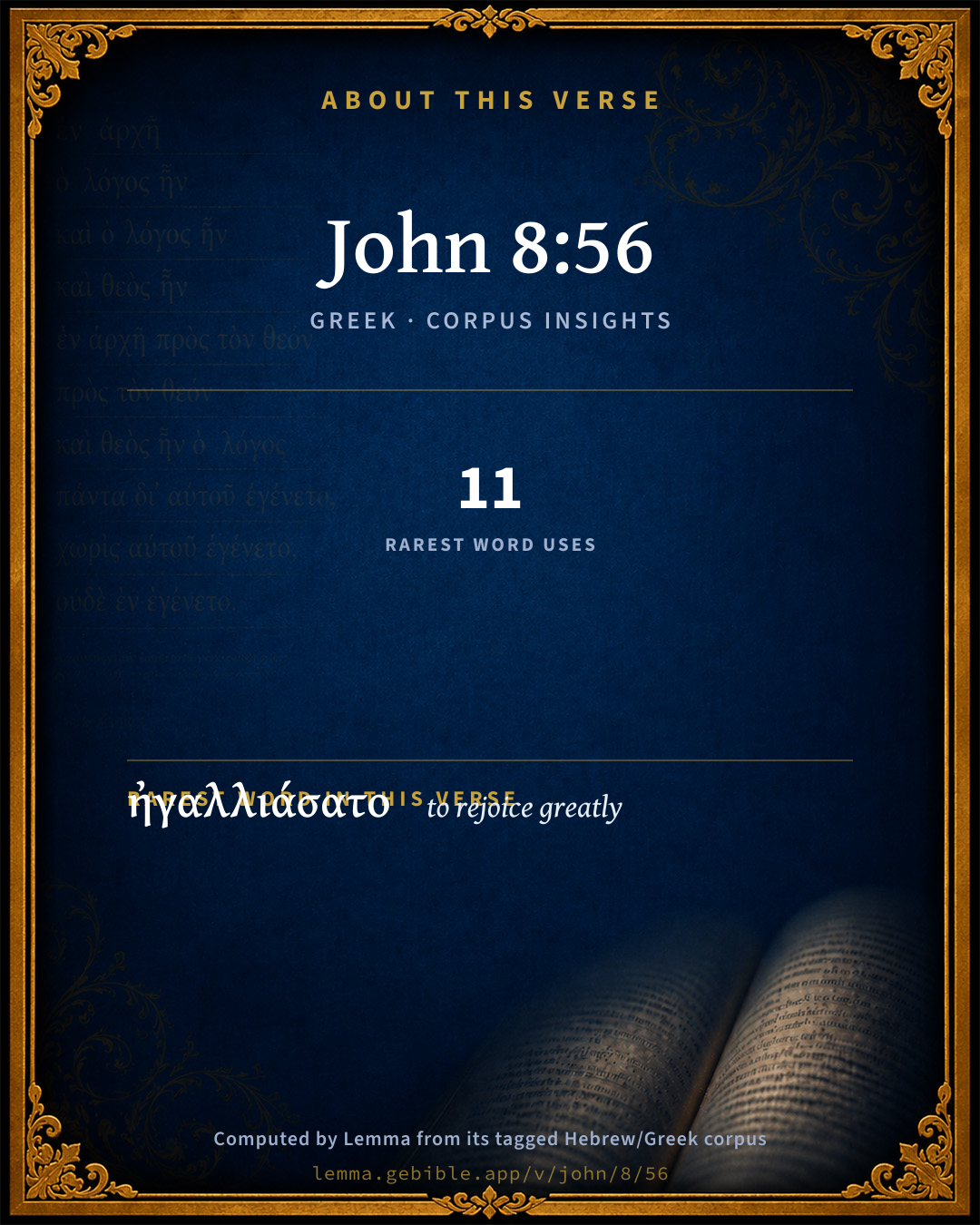
John 8:56

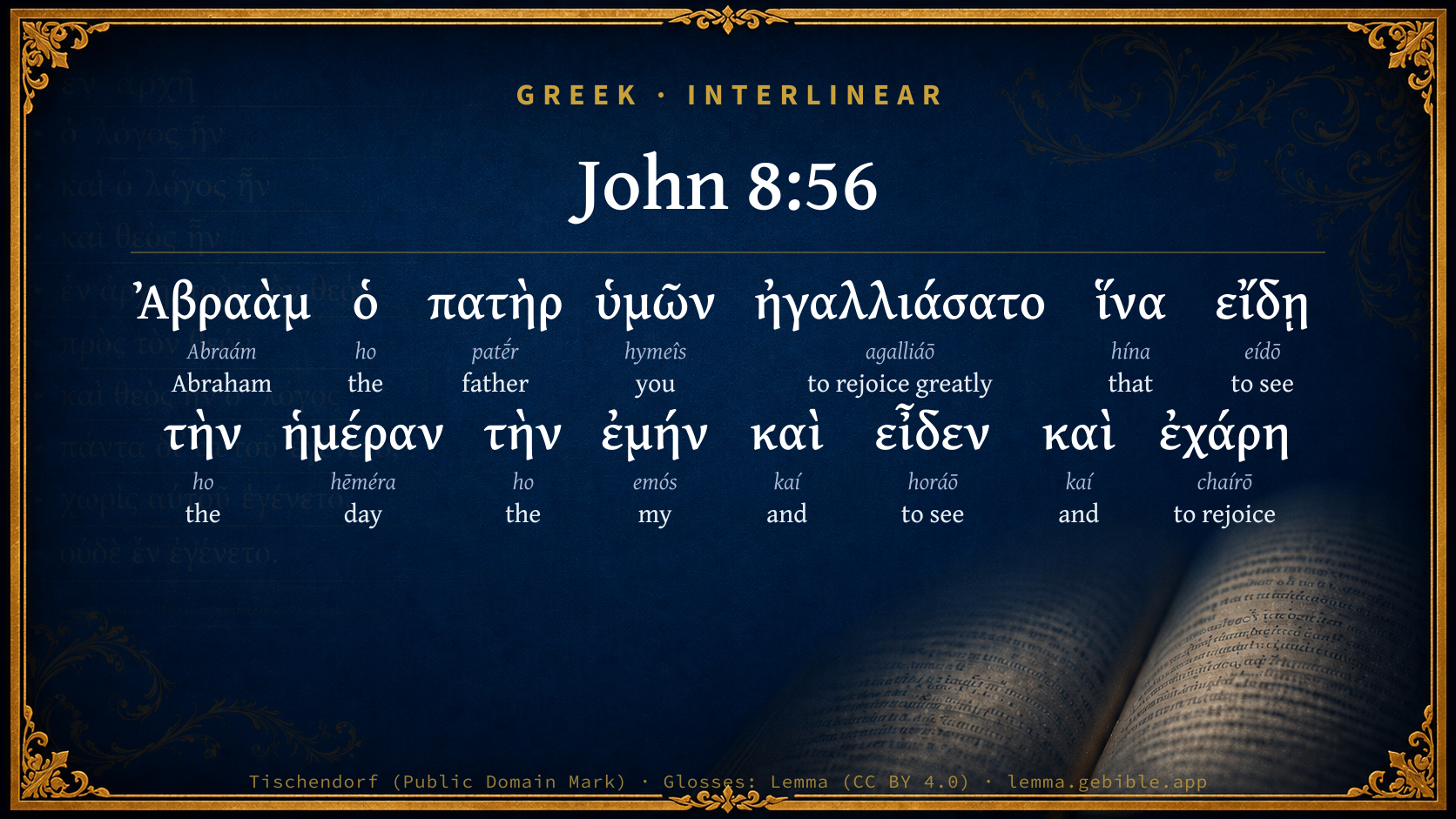
Greek (Tischendorf 8th ed.) John 8:56 appears in the Greek New Testament. The text above is from the Tischendorf 8th edition. Each word links to its Strong’s number and a concise gloss. Click any word for its full Thayer’s Greek Lexicon entry.
Download image
Cite this verse

John 8:56 (World English Bible). Public Domain. Lemma interlinear Bible study tool, https://lemma.gebible.app/v/john/8/56.

Show BibTeX & RIS
BibTeX
RIS
English Translation
Your father Abraham rejoiced to see my day. He saw it, and was glad."
World English Bible · Public Domain
Download a study sheet

One document with this verse’s original text, its word-by-word gloss line, the meaning frame, cross-references with their text, attributed commentary, and full source and license credits — printable, and it pastes into notes with its structure intact.

This verse Autodidact and up

Study sheet (.html) Plain text (.txt)

A passage Seminary Student

Up to 50 verses in one chapter. A passage sheet keeps up to 6 commentary sources and 12 cross-references per verse, in the order this page ranks them, and says so on the sheet whenever that leaves anything out. Ask for a single verse and you get the Autodidact verse sheet above.

Everything on this page stays free to read, with no account — the sheet is a download of what is already on screen, not access to it.

Want to remove ads? Support Godless Engineer
Compare translations 3

The same verse in 3 English versions, stacked beneath the original-language interlinear above. Click any original word for its lexicon entry.

Each is an independent rendering of the whole verse — the interlinear is not word-aligned to these translations.

Highlighted words mark where these versions differ — a whole-verse word diff, not a word-by-word alignment.

  • World English Bible Public Domain
    Your father Abraham rejoiced to see my day. He saw it, and was glad."
  • King James Version Public Domain
    Your father Abraham rejoiced to see my day: and he saw it, and was glad.
  • unfoldingWord Literal Text CC BY-SA 4.0
    Your father Abraham rejoiced that he might see my day, and he saw and was glad.”

unfoldingWord Literal Text — © unfoldingWord, licensed CC BY-SA 4.0. Word-aligned USFM3 via Door43 (git.door43.org/unfoldingWord/en_ult).

Versions to compare (up to 4)

3 of 4 selected

Show all 19 translations

Every available English version of this verse, each an independent rendering of the whole verse.

  • World English Bible Public Domain
    Your father Abraham rejoiced to see my day. He saw it, and was glad."
  • Berean Standard Bible Public Domain
    Your father Abraham rejoiced that he would see My day. He saw it and was glad.”
  • Majority Standard Bible Public Domain
    Your father Abraham rejoiced that he would see My day. He saw it and was glad.”
  • King James Version Public Domain
    Your father Abraham rejoiced to see my day: and he saw it, and was glad.
  • American Standard Version (1901) Public Domain
    Your father Abraham rejoiced to see my day; and he saw it, and was glad.
  • Revised Version (1885) Public Domain
    Your father Abraham rejoiced to see my day; and he saw it, and was glad.
  • Geneva Bible (1599) Public Domain
    Your father Abraham reioyced to see my day, and he sawe it, and was glad.
  • Douay-Rheims (1899) Public Domain
    Abraham your father rejoiced that he might see my day: he saw it, and was glad.
  • Young's Literal Translation Public Domain
    Abraham, your father, was glad that he might see my day; and he saw, and did rejoice.'
  • Literal Standard Version CC BY-SA 4.0
    your father Abraham was glad that he might see My day; and he saw, and rejoiced.”
  • Unlocked Literal Bible CC BY-SA 4.0
    Your father Abraham rejoiced at seeing my day; he saw it and was glad.”
  • unfoldingWord Literal Text CC BY-SA 4.0
    Your father Abraham rejoiced that he might see my day, and he saw and was glad.”
  • Darby Bible Public Domain
    Your father Abraham exulted in that he should see my day, and he saw and rejoiced.
  • World Messianic Bible Public Domain
    Your father Abraham rejoiced to see my day. He saw it and was glad.”
  • Webster's Bible Public Domain
    Your father Abraham rejoiced to see my day: and he saw it, and was glad.
  • Free Bible Version CC BY-SA 4.0
    Your father Abraham was delighted as he looked forward to see my coming, and was so happy when he saw it.”
  • Bible in Basic English Public Domain
    Your father Abraham was full of joy at the hope of seeing my day: he saw it and was glad.
  • Text-Critical English NT CC BY 4.0
    Your father Abraham was glad that he would see my day. He saw it and rejoiced.”
  • Tyndale New Testament (1534) Public Domain
    Youre father Abraham was glad to se my daye and he sawe it and reioysed.

Literal Standard Version (2020), Covenant Press — licensed CC BY-SA 4.0. Text via the HelloAO Bible API (eBible.org). Unlocked Literal Bible (unfoldingWord) — licensed CC BY-SA 4.0. Text via the HelloAO Bible API (eBible.org). unfoldingWord Literal Text — © unfoldingWord, licensed CC BY-SA 4.0. Word-aligned USFM3 via Door43 (git.door43.org/unfoldingWord/en_ult). Free Bible Version, Dr. Jonathan Gallagher — licensed CC BY-SA 4.0. Text via the HelloAO Bible API (eBible.org).

Word by word

More ways to search: Search by grammar → Find every occurrence → Compare this word →

Practice this passage: Drill this verse → Learn its vocabulary →

ἠγαλλιάσατο
agalliáō
G21
“to rejoice greatly”
Verb, Aorist, Middle deponent, Indicative, 3rd person, Singular
Part of Speech
Verb
Tense
Aorist
Voice
Middle deponent
Mood
Indicative
Person
3rd person
Number
Singular
Full Thayer's Definition

Origin: from agan (much) and G242

TDNT: 1:19, *

1. to exult, rejoice exceedingly, be exceeding glad
  1. Ἀβραὰμ Abraám G11 “Abraham” Noun, Proper, indeclinable
  2. ὁ ho G3588 “the” Article, Nominative, Singular, Masculine
  3. πατὴρ patḗr G3962 “father” Noun, Nominative, Singular, Masculine
  4. ὑμῶν hymeîs G5210 “you” Personal pronoun, 2nd person, Genitive, Plural
  5. ἵνα hína G2443 “that” Conjunction
  6. εἴδῃ eídō G1492 “to see” Verb, Perfect, Active, Subjunctive, 2nd person, Plural
  7. τὴν ho G3588 “the” Article, Accusative, Singular, Feminine
  8. ἡμέραν hēméra G2250 “day” Noun, Accusative, Singular, Feminine
  9. τὴν ho G3588 “the” Article, Accusative, Singular, Feminine
  10. ἐμήν emós G1699 “my” Possessive pronoun, 1st person, Accusative, Singular, Feminine
  11. καὶ kaí G2532 “and” Conjunction
  12. εἶδεν horáō G3708 “to see” Verb, Aorist, Active, Indicative, 3rd person, Singular
  13. καὶ kaí G2532 “and” Conjunction
  14. ἐχάρη chaírō G5463 “to rejoice” Verb, Aorist, Passive deponent, Indicative, 3rd person, Singular

About this verse

These counts appear in no published source. They are computed here, from the morphology-tagged text and Lemma’s own curated glosses. What Lemma adds →

15
words
12
distinct lemmas
Gospels
section

Notable vocabulary

The rarest word here is ἠγαλλιάσατο to rejoice greatly G21 — appearing just 11 times in the whole Greek New Testament.

Shared distinctive vocabulary

ἠγαλλιάσατο to rejoice greatly G21 occurs in 11 verses of the Greek New Testament. Also found in:

Repetition

Words recur within this verse:

Cross-references

10

Topical passages linked to John 8:56 in the Treasury of Scripture Knowledge — connected by theme and wording, ordered by reader-vote popularity; previews shown in the World English Bible.

  • Hebrews 11:13 These all died in faith, not having received the promises, but having seen them and embraced them from afar, and having confessed that they were strangers and pilgrims on the earth.
  • Genesis 22:18 In your seed will all the nations of the earth be blessed, because you have obeyed my voice."
  • Galatians 3:7–9 Know therefore that those who are of faith, the same are children of Abraham.
  • Matthew 13:17 For most assuredly I tell you that many prophets and righteous men desired to see the things which you see, and didn't see them; and to hear the things which you hear, and didn't hear them.
  • John 8:39 They answered him, "Our father is Abraham." Jesus said to them, "If you were Abraham's children, you would do the works of Abraham.
  • Luke 10:24 for I tell you that many prophets and kings desired to see the things which you see, and didn't see them, and to hear the things which you hear, and didn't hear them."
  • 1 Peter 1:10–12 Concerning this salvation, the prophets sought and searched diligently, who prophesied of the grace that would come to you,
  • Hebrews 11:39 These all, having had testimony given to them through their faith, didn't receive the promise,
  • Luke 2:28–30 then he received him into his arms, and blessed God, and said,
  • John 8:37 I know that you are Abraham's seed, yet you seek to kill me, because my word finds no place in you.

Cross-references courtesy of OpenBible.info (CC BY 4.0).

Commentary

Notes on John 8:56 from classic Christian and Jewish commentators (each source and its license shown beneath its notes). The classic Christian expositions comment on the surrounding passage and are grouped to its opening verse, so a note may address several verses; the Jewish commentaries on the Tanakh (Rashi and others) are per-verse, so they appear only where the commentator wrote on this verse.

Lemma curates 59 commentaries, every one of them public domain or Creative Commons licensed, each selected and text-cleaned for this edition rather than reprinted as found. About our sources →

The Biblical Illustrator

Joseph S. Exell

Joh_8:56

Your father Abraham rejoiced to see My day

Abrahams vision of Christs day

(Christmas day Sermon):--Here is joy, joy at a sight, at the sight of a day, and that day Christs, and no day is so properly His as His birthday.

First, Christ has a day proper to Him. My day. Secondly, this day is a day of double joy--rejoiced, was glad. Thirdly, this was so to Abraham. Lastly, all this nothing displeasing to Christ, for it is spoken to the praise of Abraham that did it, and to the dispraise of the Jews who did it not. We are now disposing ourselves to this, and have a three-fold warrant.

1. We have Abraham for our example. We do but as he in making Christs day a day of joy.

2. Abrahams example approved by Christ, who commends the patriarch, not that he rejoiced at the sight of Him, but of His day. Verily, the speech is in honour of Christmas.

3. He reproves the Jews for not doing herein as Abraham, which is against them that have a spleen at this feast, and think they can joy in Him and yet set by His day. Nay, love Him, love His day. They tell us that to keep it they would Judaize (Gal_4:10), but the context shows not to keep it is to Judaize.

I. THE OBJECT. My day.

1. Not as the Son of God. He has no day.

(1) Day and night are parts of time, but His goings forth are from eternity Mic_5:2).

(2) If we would improperly call it a day, no day to be seen (1Ti_6:16).

(3) If we could see it and Him in His Deity, yet there is small joy.

2. But as the Son of Man He hath more days than one; but this notes one above the rest, a day with the double article. There are two such eminent days. Of His Genesis, and of His Exodus; of His nativity and His passion.

(1) Not of His passion; for that was none of His (Luk_22:53), but ours: and no day, but rather night; and no day of joy (Luk_23:48).

(2) But of His birth, and so the angel calls it (Luk_2:11). And His day because every man has a property in His birthday; as kings in the day of the beginning of their reigns; as Churches, when they are first dedicate; as cities, when their first trench is cast. And a day of joy in heaven and earth Luk_2:10-14): to all people, not only on and after it, but before, and so to Abraham. Of course day must be taken for the whole time of Christs life; yet that time had its beginning on a day, and that day even for that beginning may challenge a right in the word.

II. THE ACTS.

1. Abrahams first act--his desire.

(1) The cause of it. Why should Abraham so desire two thousand years before! What was it to him? You remember Jobs Easter (19:25). The joy of this was the same as Abrahams Christmas; oven that a day should come when his Redeemer should come into the world. For a Redeemer he needed, and therefore desired His day (Isa_29:22). The time when hehad this day first shown him he complains of his need (Gen_18:27).

(2) The manner of it. We may take measure of the greatness of the day by the greatness of his desire. The nature of the word is, he did even fetch a spring for joy, and that not once but often. He could not contain his affection, it must out in bodily gesture. Think of a staid, discreet man being so exceedingly moved; and to do all this only in the desire.

2. Abrahams second act. He saw it, though afar off (Heb_11:13), as in a perspective glass (1Co_13:12). He did not know precisely the day, but that such a day should come. How did he see it?

(1) Not as if he could not see it unless Christ had been in the flesh in His day. So Simeon saw (Luk_2:30). But better than this, for if Simeon had not seen in Abrahams manner, he had been no nearer than the Jews who stoned Christ.

(2) If not with the eyes, then how? There is in every man two men--outward and inward. Now if there be an inward we must allow him senses, and so eyes (Eph_1:18); it was with these that Abraham saw, and by no other do we see.

(3) By what light saw he? He was a prophet, and might be in the Spirit, and have the vision clearly represented before him; but he was a faithful man Gal_3:9), and saw it in the light of faith (Heb_11:1; Heb_11:27).

(4) Where was this and when? The text is enough, but the Fathers hold that he saw his birth at Mature, His passion at Moriah (Gen_17:19; Gen_18:10). But this day he saw at Mature. Christ was in person there, one of the three.

3. Abrahams third act. He that was glad that he should see it must needs be glad when he did see it; accomplishment is more joyful than desire. And what grounds (Gen_26:4)!

Conclusion: The reference to us.

1. Our desire. We have greater cause to desire this day because we have greater need.

2. Our sight is much clearer than his. For though we see as he, and he as we, by the light of faith; yet he in the faith of prophecy yet to come, we in the faith of history now past.

3. Our joy is to be above his, as we have the greater cause and the better sight. Rules for our joy.

(1) Here are two sorts

(a) Our exultation, a motion of the body.

(b) The other, joy, a fruit of the spirit. Let the former have its part, but should not have so large an allowance of time and cost as to leave little or nothing for the spirit.

(2) That our joy in Christs day be for Him. We joy in it as it is His. The common sort wish for it and joy in it as it is something else, viz., a time of cheer and feasting, sports and revelling, and so you have a golden calfs holiday. (Bp. Andrewes.)

Abrahams sight of faith

I. THE GROUND OF ABRAHAMS FAITH--the promise of God. (Gen_12:3; Gen_22:18). To open this promise we must inquire

1. What was this seed? We must distinguish of a two-fold seed; that to whom the blessing was promised, and that in whom both Abraham, his seed, and all nations were to be blessed (Gen_17:7). Now this promise was either to his carnal seed or to his spiritual seed (Gal_3:7). But then there was another seed--the Messiah.

2. What was this blessedness? All the good which results to us from Gods covenant.

(1) Our reconciliation with God consisting of

(a) remission of sins (Psa_32:1-2), which is included in the blessing of Abraham (Gal_3:8).

(b) Regeneration (Act_3:25-26).

(2) Eternal life.

(a) The patriarchs sought it by virtue of this promise (Heb_11:13-15).

(b) Unless this had been included God could not act suitably to the greatness of His covenant relation (Heb_11:16; Mat_22:31-32).

II. THE STRENGTH OF HIS FAITH.

1. His clear vision of Christ. He saw my day. Three things argue the strength of bodily sight.

(1) When what we see is far off. Thousands of years intervened, yet they went to the grave in full assurance. The nature of faith is that it can look upon things absent and future as sure and near, but without it man looks no further than present probabilities.

(2) When there are clouds between. Now when the promise was made it was impossible in the course of nature for Abraham to have a son; but when the son was miraculously given he was commanded to sacrifice him. Now to strive against these and other difficulties argues strong faith Rom_4:18).

(3) When there is little light to see by. The revelation was obscure; the patriarchs had only Gen_3:15; Abrahams was a little clearer, but it was a small glimmering compared with what we enjoy. Yet they could do more with their faith than we with ours.

(1) As to Christ there is a sight of Him

(a) Past. To see Him whom we have not seen, as if we had seen Him in the flesh, is the work of faith (Gal_3:1).

(b) Present. To see Him so as to make Him the object of our love and trust (Joh_6:40; Act_7:56).

(c) Future. We must be assured of His second coming and that we shall see Him (Job_19:25-27).

What, then, is this clear vision of Christ to us? How shall we judge of the strength of our faith by this? Ans

(2) As to the glory and blessedness of the world to come. Faith is the perspective of the soul, by which it can see things distant as present Heb_11:26; Heb_6:18; Heb_12:2).

2. His deep affection or rejoicing in Christ.

(1) No other affection will become Christ but great joy (Luk_2:10, Act_13:48; Act_8:39; Act_16:34).

(2) The reasons for this joy.

(a) The excellency of the object in Himself and His work (Joh_3:16); in His necessity to us (Mic_6:6-7; Psa_49:7-8; Job_33:24); in His benefit (1Co_1:30-31).

(b) The subjects are delivered from their misery and find their happiness in God.

(c) The causes--the Holy Ghost and faith as His instrument Rom_14:17; 1Th_1:5; Rom_15:18; 1Pe_1:8).

(3) The nature of this joy and its solid effects.

(a) It enlarges our hearts in duty and strengthens us in the way of Neh_8:10; Psa_119:14).

(b) It sweetens our calamities (Heb_3:17-18).

(c) It draws us off from the vain delights of the flesh (Psa_4:7; Psa_43:4). (T. Manton, D. D.)

Abraham beholding Christs day

I. THE DAY OF CHRIST. Not a period of twenty-four hours, but, as is usual in the Bible, a dispensation.

1. Some of the remarkable days that Abraham saw.

(1) Looking back he saw the day when the Everlasting Father embraced Abraham and all His chosen in Christ and designed their salvation (Pro_8:28).

(2) The day of Christs incarnation. In thy seed, etc.

(3) The day of Christs oblation.

(4) The day of Christs resurrection.

(5) The day of Christs ascension.

(6) The day of Pentecost.

(7) The day of judgment as winding up the dispensation and completing the fulfilment of the promise.

2. The characteristics of this day. It was a day of

(1) Light.

(2) Gladness.

(3) Life.

(4) Love.

(5) Peace.

(6) Salvation.

II. THE BLESSED VIEW WHICH FAITH TAKES OF THIS DAY.

1. It could not have been a sensible view--for sense never can discover God. The natural man receiveth not the things of the Spirit of God.

2. It was a spiritual view--a sight by faith. Faith, like the bodily eye, is

(1) A recipient organ.

(2) An assuring organ. When a man sees a thing he cannot be mistaken if his sight is good, so a man cannot believe without knowing he is saved.

(3) A directing organ. By the eye we are guided in our daily life, and by faith we walk in the light.

(4) While a small, the eye is a capacious organ. What a wide prospect it can take in! So the least faith pierces the invisible.

(5) An impressible organ. As scenes are impressed on the retina, so is Christ on faith.

III. THE JOY AND GLADNESS ARISING OUT OF THIS SIGHT. It was not carnal but spiritual joy, including

1. Spiritual health (Psa_33:1).

2. Soul satisfaction (Psa_36:8).

3. Enlargement of soul.

4. It is cordial, hidden and unknown to the world, lasting, matchless and transcendent. (T. Bagnall-Baker, M. A.)

Christian piety in relation to the future

Christian piety

I. TURNS THE SOUL TOWARDS THE FUTURE. Piety seems to have turned Abrahams mind to the day of Christ. This refers, undoubtedly, to Christs incarnation, personal ministry, and spiritual reign. Nineteen long centuries rolled between. Still he saw it. In relation to the future, Christian piety

1. Gives an interesting revelation of it. Science, poetry, literature, shed no light on the on-coming periods of our being; but the Bible does. It opens up the history of the race.

2. Gives a felt interest in the blessedness of the future. It gave Abraham a felt interest in the day of Christ. It gives the good a felt interest in the glories that are coming. And what glorious things are on their march!

II. FASTENS THE SOUL UPON CHRIST IN THE FUTURE. My day. To the godly Christ is everything in the future. Do the rivers point to the sea, the needle to the pole, the plants to the sun? Does hunger cry for food, life pant for air? Even so does the heart of piety point to Christ in the future. He has a day, a universal day of His glorious revelation to come.

III. BRINGS JOY TO THE SOUL FROM THE FUTURE. Abraham was glad

1. With a benevolent gladness; he knew the world would be blessed by Christs advent.

2. With a religious gladness; he knew that God would be glorified by His advent. Several reasons might make us glad as we think of the coming day of Christ.

(1) There will be a solution of all difficulties.

(2) A termination of all imperfections, physical, mental, spiritual.

(3) A consummation of unending blessedness.

Conclusion: Learn

1. The congruity of Christianity with the prospective tendency of the soul. The soul is always pointing to the future. Christianity meets this tendency and satisfies it.

2. The antidote of Christianity to the forebodings of the soul. Some souls are always boding evil, and well all the ungodly may. Christianity lights up the future.

3. The fitness of Christianity to the aspirations of the soul. Wonderful is the good after which some souls are aspiring in the future. The present and the material have lost for them their attractions. Man cannot aspire after anything higher than that which Christianity supplies. (D. Thomas, D. D.)

Christ seen afar off

A very lofty mountain, rising in lonely grandeur on the horizon to cleave the blue sky with its snowy pinnacles, is descried from afar. We see it a long way off--from where hills and heights, shaggy forests, silent uplands, and busy towns, and all other individual objects that lie between, are lost in distance, and present the appearance of a level plain. So, just so, Adam and Eve descried a child of theirs rising above the common level of mankind, at the long distance of four thousand years. Of the millions who were to spring from them and people the earth of which they were the lonely tenants, this distinguished child was the only one on whom, on whose birth, and life, and death, and works, their weeping eyes and eager hopes, were fixed.

Christ before Abraham

But how did Abraham see Him and His day? One answer is, Abraham was in heaven when the Son of God left the seat of glory and came to earth. He saw the return of the trooping bands of angels whose faces flashed out in the sky above the plains of Bethlehem, and whose voices sang the anthem of incarnation, Glory to God in the highest, and on earth peace, goodwill toward men! All heaven was stirred from its centre to its outermost rim over the coming of Christ to earth and over the great work which brought Him among men. Abraham was in the midst of this stir. There is another answer. You find it upon the page of Old Testament history. There we are taught that the Son of God did not always maintain invisibility prior to Bethlehem. Under the former religious economy He fellowshipped with men. He walked with Adam in Eden and communed with him in the cool of the day. There is quite a long chapter in the Old Testament concerning His visit to Abraham: how He found his tent; what Abraham was doing; how He was received; how a kid was dressed and cakes were baked; how He ate and refreshed Himself at Abrahams table; even a report is given of the conversation which passed between them. From the declaration of superiority to Abraham, the Jewish ideal of superior human greatness, Jesus passes to the declaration of His equality with God. Christianitys Christ is a distinct and a well-defined person. Everything about him is sharply cut and fearlessly stated. He speaks for himself. He entraps no man into discipleship. He is not afraid of the light, nor of the witness-stand, nor of the crucible. He asks no blind faith, but submits himself to scrutiny. The man with a true Christ is a true man. The Christ and the man always correspond. (David Gregg.)

The Biblical Illustrator, edited by Joseph S. Exell (c. 1880s–1900s) — public domain. Text from a community e-Sword module.

Joseph Benson's Commentary

Joh 8:56-59. Your father Abraham rejoiced to see my day — Ηγαλλιασατο ινα ιδη την ημεραν, exulted with desire, to see my day. “The words ινα ιδη, that he might see, immediately following the verb, show,” as Dr. Campbell observes, “that it cannot mean here, rejoiced, but rather signifies, desired earnestly, wished, longed.” Indeed, the expression may with the strictest propriety signify, “leaping forward with joy to meet the object of our wishes, as well as exulting in the possession of it.” By his day, our Lord seems to mean, the time when the promised seed should come, in whom all nations were to be blessed by being converted from idolatry to the knowledge and worship of the true God; and put in possession of all the blessings attendant on true religion. He earnestly desired, as if our Lord said, to see the great transactions of my life, by which these blessings were to be procured for all nations, and to take a view of the happy state into which the world would be brought, when they were bestowed upon them. And he saw it, and was glad — His faith was equivalent to seeing. By the favour of a particular revelation, Abraham had a distinct foresight of these things, and was exceedingly transported with the prospect. If then you want to know my person and character, you may form some notion of both from the disposition with which Abraham regarded me. Our Lord, therefore, plainly enough assumed the character of the Messiah on this occasion. Then said the Jews, Thou art not yet fifty years old, &c. — Understanding what he said in a natural sense, they thought he affirmed that he had lived in the days of Abraham; which they took to be ridiculous nonsense, as he was not arrived at the age of fifty; for they had no conception of his divinity, notwithstanding he had told them several times that he was the Son of God. Jesus saith, Verily, &c., before Abraham was, I am — Greek, πριν Αβρααμ γενεσθαι εγω ειμι, “before Abraham was born, I am, that is, I had a glorious existence with the Father, and am still invariably the same, and one with him.” So Doddridge. Thus also Dr. Campbell, who observes, “I have followed here the version of Erasmus, which is close, both to the sense and to the letter: Antequam Abraham nasceretur ego sum. Diodati renders the words in the same way in Italian. Heylin and Wynne translate in English in the same manner. Εγω ειμι, (which we translate I am,) may indeed be rendered I was. The present for the imperfect, or even for the preterperfect, is no unusual figure with this writer. However, as an uninterrupted duration, from the time spoken of to the time then present, seems to have been suggested, I thought it better to follow the common method.” Our Lord here, in the strongest terms, appears to assert his proper divinity, declaring himself to be, what St. John more largely expresses, (Rev 1:8,) the Alpha and Omega, the beginning and the end, who is, was, and is to come, the Almighty. See also Exo 3:14; Heb 1:12.

As to rendering this clause, Before Abraham was born, I was: notwithstanding the nicest critical distinctions, it must at least be acknowledged that this is a very unusual sense of εγω ειμι, and the less necessary, as the proper and common translation affords us a just and important sense, and one to which none but the enemies of our Lord’s divinity can object. It is indeed striking to observe the unnatural construction to which they have recourse who stumble at this text. The Socinians, with the most perverse impropriety, render the passage thus: “Before Abraham was made Abraham,” that is, the father of many nations, in the spiritual sense of the promise, “I am the Messiah.” Grotius and others, of too much learning not to discern the proper force of the words, are of opinion that our Lord only affirms of himself that he was before Abraham in the divine decree. But 1st, Christ says this in answer to the objection of the Jews, which had no respect to the priority of these two persons in the decree of God, but as to actual existence. 2d, This sense of the passage is trifling indeed, if our Lord was no more than a man, it being certain that all creatures, of whatsoever order, existed equally soon in the divine decree. Besides, that our Lord did really exist at the time mentioned in the text, is plain likewise from Joh 17:5. Nor is it to be imagined that, if our Lord had been a mere creature, he would have ventured to express himself in a manner so nearly bordering on blasphemy, or have permitted his beloved disciple so dangerously to disguise his meaning; a meaning indisputably clear to every plain and unprejudiced reader; a full proof whereof is the manner in which his hearers now received it: for, filled with rage, upon the blasphemy, as they thought it, of his claiming divinity to himself, they immediately prepare to inflict the punishment of a blasphemer upon him, by stoning him. But Jesus hid himself — Greek, εκρυβη, was hidden, or concealed, probably suddenly be came invisible; and went out of the temple, going through the midst of them, unobserved, and so passed by — Or passed on, with the same ease as if none had been there.

Joseph Benson's Commentary on the Old and New Testaments (1811–1818) — public domain. Text from a community e-Sword module.

Tyndale Open Study Notes

Tyndale Open Resources

8:56 Like his opponents, Jesus appealed to Abraham. Rabbis taught that God had given Abraham prophetic insight, teaching him about the coming age of the Messiah.

Tyndale Open Study Notes — © Tyndale Open Resources, licensed CC BY-SA 4.0. Text via the HelloAO Bible API.

Bengel's Gnomon

Johann Albrecht Bengel

Joh 8:56. Ὁ πατὴρ ὑμῶν, your Father) Joh 8:37; Joh 8:39, “I know that ye are Abraham’s seed; Abraham is our father.”—ἠγαλλιάσατο, ἵνα, exulted that) Evinced his eagerness with longing desire. A similar expression occurs, Rom 10:1, “My heart’s desire, εὐδοκία τῆς ἐμῆς καρδίας,” ἵνα, that follows verbs of desiring. This ἀγαλλίασις, exultation, preceded, his seeing; and again χαρά, joy, accompanied the seeing.—τὴν ἡμέραν τὴν ἐμήν, my day) The day of the Majesty of Christ: Php 1:10, “sincere and without offence till the day of Christ;” 1Co 1:8, “blameless in the day of our Lord Jesus Christ;” which day presupposes all the times of Christ, even in the eyes of Abraham. The days of Christ’s flesh (when He bestowed Himself on others) are one thing, the day of Christ Himself and of His glory is another thing [i.e. the two are altogether distinct]. This latter day was future in respect to this speech. Therefore the joy of Abraham preceded that day.—καὶ εἶδε, and he saw it) He saw it, even then in the revelation of My Divine glory; see verses following and Heb 11:13, “These all died in faith, not having received the promises, but having seen them afar off, and were persuaded of them and embraced them,” etc. He saw the day of Christ, who of the seed of the patriarch, which was about to be equal in number to the stars, is the greatest and brightest luminary. And inasmuch as he saw this day, which is to be altogether a day of life, he did not see death; Joh 8:51, etc., “If a man keep My saying, he shall never see death:—Abraham is dead—and Thou sayest, If a man,” etc.—Thus the vehemence of the Jews is rebutted. He did not however see it, as the apostles did: Mat 13:17, “Many prophets and righteous men have desired to see those things which ye see, and have not seen them.”—καὶ ἐχάρη, and he rejoiced) having obtained his wish.

Bengel's Gnomon of the New Testament — English translation (T&T Clark, Edinburgh, 1860) — public domain. Text from a community e-Sword module.

Meyer's Critical & Exegetical Commentary

Heinrich August Wilhelm Meyer

Joh_8:56. Εἶτα κατασκευάζει καὶ ὅτι μείζων ἐστι τοῦ Ἀβρ., Euth. Zigabenus, and, indeed, in such a manner, that He, at the same time, puts the hostile children of Abraham to shame.

ὁ πατὴρ ὑμῶν] with a reproving glance back to Joh_8:39.

ἠγαλλιάσατο, ἵνα ἴδῃ] he exulted to see; the object of his exultation is conceived as the goal to whose attainment the joyous movement of the heart is directed. He rejoiced in the anticipation of seeing my day, i.e. of witnessing the day of my appearance on earth.[39] As to its historical date, ἠγαλλιάσατο does not refer to an event in the paradisaical life of Abraham; but, as Abraham was the recipient of the Messianic promise, which described, on the one hand, the Messiah as His own σπέρμα, himself, however, on the other hand, as the founder and vehicle of the entire redemptive Messianic development for all nations, the allusion is to the time in his earthly life when the promise was made to him. His faith in this promise (Gen_15:6) and the certainty of the Messianic future, whose development was to proceed from him, with which he was thus inspired, could not but fill him with joy and exultation; hence, also, there is no need for an express testimony to the ἠγαλλ. in Genesis (the supposed reference to the laughing mentioned in Gen_17:17 which was already interpreted by Philo to denote great joy and exultation, and which Hofmann also has again revived in his Weissag. und Erfüll. II. p. 13, is inadmissible, on a correct explanation of the passage). So much, however, is presupposed, namely, that Abraham recognised the Messianic character of the divine promise; and this we are justified in presupposing in him who was the chosen recipient of divine revelations. For inventions of the Rabbis regarding revelations of future events asserted, on the ground of Gen_17:17, to have been made to Abraham, see Fabric. Cod. Pseudepigr. I. p. 423 ff. The seeing of the day (the experimental perception thereof through the living to see it, Luk_17:22; Polyb. x. 4. 7; Soph. O. R. 831, 1528; and see Wetstein and Kypke on the passage) to which (ἵνα) the exultation of Abraham was directed, was, for the soul of the patriarch, a moment of the indefinite future. And this seeing was realized, not during his earthly life, but in his paradisaical state (comp. Lampe, Lücke, Tholuck, De Wette, Maier, Luthardt, Lechler in the Stud. u. Krit. 1854, p. 817, Lange, Baeumlein, Ebrard, Godet), when he, the ancestor of the Messiah and of the nation, learnt that the Messianic age had dawned on the earth in the birth of Jesus as the Messiah. In like manner the advent of Jesus on the earth was made known to Moses and Elias (Mat_17:4), which fact, however, does not justify us in supposing that reference is here made to occurrences similar to the transfiguration (Ewald). In Paradise Abraham saw the day of Christ; indeed, he there maintained in general a relation to the states and experiences of his people (Luk_16:25 ff.). This was the object of the καὶ εἶδε καὶ ἐχάρη; it is impossible, however, to determine exactly the form under which the ΕἾΔΕ was vouchsafed to him, though it ought not to be explained with B. Crusius as mere anticipation. We must rest contented with the idea of divine information. The apocryphal romance, Testamentum Levi, p. 586 f. (which tells us that the Messiah Himself opens the gates of Paradise, feeds the saints from the tree of life, etc., and then adds: τότε ἀγαλλιάσεται Ἀβραὰμ καὶ Ἰσαὰκ κ. Ἰακὼβ κἀγὼ χαρήσομαι καὶ πάντες οἱ ἅγιοι ἐνδύσονται εὐφροσύνην), merely supplies a general confirmation of the thought that Abraham, in the intermediate state of happiness, received with joy the news of the advent of Messiah. Supposing, however, that the relation between promise (ἨΓΑΛΛΙΆΣΑΤΟ, ἽΝΑ ἼΔῌ, etc.) and fulfilment (ΚΑῚ ΕἾΔΕ Κ. ἘΧΆΡΗ), expressed in the two clauses of the verse, do require the beholding of the day of Christ to be a real beholding, and the day of Christ itself to be the day of His actual appearance, i.e. the day of the incarnation of the promised One on earth, it is not allowable to understand by it, either, with Raphelius and Hengstenberg, the appearance of the angel of the Lord (Genesis 18), i.e. of the Logos, to Abraham; or, with Luther, the vision of faith with the heart at the announcement made in Gen_22:18 (comp. Melancthon, Calvin, and Calovius);[40] or, with Olshausen, a prophetic vision of the δόξα of Christ (comp. Joh_12:41); or, with Chrysostom, Theophylact, Euth. Zigabenus, Erasmus, and most of the older commentators, also Hofmann, the beholding of an event which merely prefigured the day of Christ, a typical beholding, whether the birth of Isaac be regarded as the event in question (Hofmann; see also his Schriftbew. II. 2, p. 304 f.), or the offering up of Isaac as a sacrifice, prefiguring the atoning sacrifice and resurrection of Christ (Chrysostom, Grotius, and many others). According to Linder, in the Stud. und Krit. 1859, p. 518 f., 1867, p. 507 f., the day of Christ denotes nothing but the time of the birth of Isaac, which was promised in Gen_18:10, so that Christ would thus appear to have represented Himself as one of the angels of the grove of Mamre (comp. Hengstenberg), and, by the expression ἡμέρα ἡ ἐμή, to have denoted a time of special, actual revelation. Taken thus, however, the day in question would be only mediately the day of Christ; whereas, according to the connection and the express designation τὴν ἡμέραν τὴν ἐμήν, Christ Himself must be the immediate subject of the day, as the one whose appearance constitutes the day emphatically His

His κατʼ ἐξοχὴν, analogously to the day of His second advent (Luk_17:24; 1Co_1:8; 1Co_5:5; 2Co_1:14; Php_1:6; Php_2:16; 1Th_5:2; 2Th_2:2); hence, also, the plural had not to be employed (in answer to Linders objection).

ΚΑῚ ἘΧΑΡΗ] appropriately interchanged for ἨΓΑΛΛ., the latter corresponding to the first outburst of emotion at the unexpected proclamation.

[39] ἡμέρα ἡ ἐμή expressly denotes (hence not τὰς ἡμέρας τὰς ἐμάς, comp. Luk_17:22) the exact, particular day of the appearance of Christ on earth, i.e. the day of His birth (Job_3:1; Diog. L. 4. 41), from the Johannine point of view, the day on which the ὁ λόγος σὰρξ ἐγένετο was accomplished. This was the great epoch in the history of redemption which Abraham was to behold.

[40] Bengel also: Vidit diem Christi, qui in semine, quod stellarum instar futurum erat, sidus maximum est et fulgidissimum.

Meyer — Critical and Exegetical Commentary on the New Testament — English translation by Peter Christie, edited by Frederick Crombie (T&T Clark, 1880) — public domain. Text from a community e-Sword module.

Expositor's Greek Testament

ed. W. Robertson Nicoll

Joh 8:56 . And as regards The connection they claim with Abraham, this reflects discredit on their present attitude towards Jesus; for Ἀβραὰμ ὁ πατὴρ ὑμῶν , “Abraham in whose parentage you glory,” ἠγαλλιάσατο ἵνα ἴδῃ τὴν ἡμέραν τὴν ἐμήν , “rejoiced to see my day”. The day of Christ is the time of His earthly manifestation: τῆς ἐπιδημίας αὐτοῦ τῆς μετὰ σαρκός , Cyril. See Luk 17:22-26 ; where the plural expresses the same as the singular here. “To see” the day is “to be present” at it, “to experience” it; cf. Eurip., Hecuba , 56, δούλειον ἦμαρ εἶδες , and the Homeric νόστιμον ἦμαρ ἰδέσθαι . ἵνα ἴδῃ cannot here have its usual Johannine force and be epexegetical (Burton, Moods, etc. ), nor as Holtzmann says = ὅτι ὄψοιτο , because in this case the εἶδε καὶ ἐχάρη would be tautological. Euthymius gives the right interpretation: ἠγαλλ ., ἤγουν , ἐπεθύμησεν (similarly Theophylact), and the meaning is “Abraham exulted in the prospect of seeing,” or “that he should see”. This he was able to do by means of the promises given to him. καὶ εἶδε , “and he saw it,” not merely while he was on earth (although this seems to have been the idea the Jews took up from the words, see Joh 8:57 ); for this kind of anticipation Jesus uses different language, Mat 13:17 , and at the utmost the O.T. saints could be described as πόρρωθεν ἰδόντες , Heb 11:13 ; but he has seen it in its actuality. This involves that Abraham has not died so as to be unconscious, Joh 8:52 , and cf. Mar 12:26 .

The Expositor's Greek Testament, edited by W. Robertson Nicoll (1897–1910) — public domain. Text from a community e-Sword module.

Geneva Bible (1599)

Geneva Bible translators

With the eyes of faith, Heb. 11:13.

A day is a space that a man liveth in, or doeth any notable act, or suffereth any great thing.

Was very desirous.

The virtue of Christ showed itself through all former ages in the Fathers, for they saw in the promises, that he should come, and did very joyfully lay hold on him with a lively faith.

Geneva Bible (1599) marginal notes — public domain. Text via Bolls.life.

Jamieson, Fausset & Brown

Robert Jamieson, A. R. Fausset & David Brown

Abraham rejoiced to see my day, &c.--exulted, or exceedingly rejoiced that he should see, he exulted to see it, that is, by anticipation. Nay,

he saw it, and was glad--he actually beheld it, to his joy. If this mean no more than that he had a prophetic foresight of the gospel-day--the second clause just repeating the first--how could the Jews understand our Lord to mean that He "had seen Abraham?" And if it mean that Abraham was then beholding, in his disembodied spirit, the incarnate Messiah [STIER, ALFORD, &c.], the words seem very unsuitable to express it. It expresses something past--"he saw My day, and was glad," that is, surely while he lived. He seems to refer to the familiar intercourse which Abraham had with God, who is once and again in the history called "the Angel of the Lord," and whom Christ here identifies with Himself. On those occasions, Abraham "saw ME" (OLSHAUSEN, though he thinks the reference is to some unrecorded scene). If this be the meaning, all that follows is quite natural.

Jamieson, Fausset & Brown — Commentary Critical and Explanatory on the Whole Bible (1871) — public domain (CC PDM 1.0). Text via the HelloAO Bible API.

Adam Clarke's Commentary

Verse 56. Abraham rejoiced to see my day] Or, he earnestly desired to see my day; ηγαλλιασατο, from αγαν, very much, and αλλομαι, I leap - his soul leaped forward in earnest hope and strong expectation that he might see the incarnation of Jesus Christ. The metaphor appears to be taken from a person who, desiring to see a long-expected friend who is coming, runs forward, now and then jumping up to see if he can discover him. There is a saying very like this in Sohar Numer fol. 61: "Abraham rejoiced because he could know, and perceive, and cleave to the Divine NAME." The Divine name is יהוה Yehovah; and by this they simply mean God himself.

And he saw it] Not only in the first promise, Ge 3:15, for the other patriarchs saw this as well as he; and not only in that promise which was made particularly to himself, Ge 12:7; Ge 22:18, (compared with Ga 3:16,) that the Messiah should spring from his family; but he saw this day especially when Jehovah appeared to him in a human form, Ge 18:2; Ge 18:17, which many suppose to have been a manifestation of the Lord Jesus.

Adam Clarke's Commentary on the Bible (1810–1826) — public domain. Text from a community e-Sword/MySword module.

John Calvin's Commentaries

56. Your father Abraham. He grants to them, in words only, what he formerly took from them, that Abraham is their father But he shows how idle is the objection drawn from the name of Abraham “He had no other object,” says he, “during his whole life, than to see my kingdom flourish. He longed for me when I was absent, you despise me when I am present.” What Christ here asserts concerning Abraham alone, applies to all the saints. But this doctrine has greater weight in the person of Abraham, because he is the father of the whole Church. Whoever then desires to be reckoned in the number of the godly, let him rejoice, as he ought to do, in the presence of Christ, for which Abraham ardently longed.

Exulted to see my day. The word exult expresses a vehement zeal and ardent affection. We must now supply the contrast. Though the knowledge of Christ was still so obscure, Abraham was inflamed by so strong a desire, that he preferred the enjoyment of it to everything that was reckoned desirable. How base then is the ingratitude of those who despise and reject him, when he is plainly offered to them? The word day does not, in this passage, denote eternity, (as Augustine thought,) but the time of Christ’s kingdom, when he appeared in the world clothed with flesh, to fulfill the office of Redeemer.

But a question now arises, How did Abraham behold, even with the eyes of faith, the manifestation of Christ? For this appears not to agree with another statement of Christ,

Many kings and prophets desired to see the things which you see, and yet did not see them, (Luke 10:24.)

I reply, faith has its degrees in beholding Christ. Thus the ancient prophets beheld Christ at a distance, as he had been promised to them, and yet were not permitted to behold him present, as he made himself familiarly and completely visible, when he came down from heaven to men.

Again, we are taught by these words that, as God did not disappoint the desire of Abraham, so he will not now permit any one to breathe after Christ, without obtaining some good fruit which shall correspond to his holy desire. The reason why he does not grant the enjoyment of himself to many is — the wickedness of men; for few desire him. Abraham’s joy testifies that he regarded the knowledge of the kingdom of Christ as an incomparable treasure; and the reason why we are told that he rejoiced to see the day of Christ is, that we may know that there was nothing which he valued more highly. But all believers receive this fruit from their faith, that, being satisfied with Christ alone, in whom they are fully and completely happy and blessed, their consciences are calm and cheerful. And indeed no man knows Christ aright, unless he gives him this honor of relying entirely upon him.

Others explain it to mean, that Abraham, being already dead, enjoyed the presence of Christ, when he appeared to the world; and so they make the time of desiring and the time of seeing to be different. And indeed it is true, that the coming of Christ was manifested to holy spirits after death, of which coming they were held in expectation during the whole of their life; but I do not know if so refined an exposition agrees with Christ’s words.

John Calvin's Commentaries (1540-1563) — public domain. Text from the Calvin Translation Society English edition (1840s-50s) via the Christian Classics Ethereal Library (ccel.org). Calvin's coverage is partial (roughly two-thirds of the Bible); uncommented books and verses are honest gaps, never fabricated. The 19th-century editor's footnotes and remarks are omitted so the notes are faithfully Calvin's own voice.

Ellicott's Commentary for English Readers

(56) Your father Abraham rejoiced to see my day.—They had asked in scorn if He were greater than their father Abraham (Joh_8:53). .His words have shown that He was. He now, with the thoughts of Joh_8:39 still present, contrasts the exultation of him whom they claimed as father, when he saw from afar the Messianic advent, with their rejection of the Messiah who is actually among them. Abraham realised the fulness of the promises made to him, and believed in the Lord that the blessing should be fulfilled to his seed. He, too, had kept God’s word, and in the true sense had not seen death (see Gen_15:1-6; Gen_22:18). The words, “My day,” are used, as in Luk_17:22, for the manifestation of Christ on earth.

And he saw it, and was glad.—This is the historic fulfilment of the joy which looked forward to the day of Christ. Our Lord reveals here a truth of the unseen world that is beyond human knowledge or explanation. From that world Abraham was cognisant of the fact of the Incarnation, and saw in it the accomplishment of the promise which had brought joy to shepherds watching their flocks, as the Patriarch had watched his; there came an angel, as angels had come to him, and a multitude of the heavenly host, exulting in the good news to men. In that joy Abraham had part. The truth comes as a ray of light across the abyss which separates the saints in heaven from saints on earth. As in the parable, where Lazarus is in Abraham’s bosom, the rich man is represented as knowing and caring for his brethren on earth, so here the great Patriarch is spoken of as knowing and rejoicing in the fact of the Incarnation. The faculty of reason cannot explain how it is, but the faculty of faith can receive the truth that there is a “communion of saints,” and finds in it a comfort which robs separation of its bitterness, and a power which strengthens all the motives to a holy and devoted life. (Comp. Luk_16:19-31; Heb_12:1.)

A Bible Commentary for English Readers, edited by Charles John Ellicott (1878–1897) — public domain. Text from a community e-Sword module.

The Cambridge Bible for Schools and Colleges

gen. ed. J. J. S. Perowne

56. rejoiced to see my day] Literally, exulted that he might see My day, the object of his joy being represented as the goal to which his heart is directed. This is a remarkable instance of S. John’s preference for the construction expressing a purpose, where other constructions would seem more natural. Comp. Joh_4:34; Joh_4:47, Joh_6:29; Joh_6:50, Joh_9:2-3; Joh_9:22, Joh_11:50, Joh_16:7. Abraham exulted in anticipation of the coming of the Messiah through implicit belief in the Divine promises.

and he saw it, and was glad] A very important passage with regard to the intermediate state, shewing that the soul does not, as some maintain, remain unconscious between death and the Day of Judgment. The Old Testament saints in Paradise were allowed to know that the Messiah had come. How this was revealed to them we are not told; but here is a plain statement of the fact. The word for ‘was glad’ expresses a calmer, less emotional joy than the word for ‘rejoiced,’ and therefore both are appropriate: ‘exulted’ while still on earth; ‘was glad’ in Hades. Thus the ‘Communion of Saints’ is assured, not merely in parables (Luk_16:27-28), but in the plainer words of Scripture. Comp. Heb_12:1.

The Cambridge Bible for Schools and Colleges (gen. ed. J. J. S. Perowne; Cambridge University Press, 1878–1918) — public domain. Text from a community e-Sword module.

John Gill's Exposition

Then they took up stones to cast at him,.... Supposing that he had spoken blasphemy; for they well understood that he, by so saying, made himself to be the eternal God, the unchangeable Jehovah. Should it be asked how they came by their stones in the temple? it may be replied, the temple was still building, Joh 2:20, and stones, or pieces of stones, might lie about, with which they furnished themselves, in order to have destroyed Christ: and this they attempted, though it was on the sabbath day, as appears from Joh 9:1; and with them, , "stoning on the sabbath day" (d) was allowed in some cases.

But Jesus hid himself, not in any corner of the temple, or behind a pillar; but he withdrew himself from them directly, and made himself invisible to them, by holding their eyes, or casting a mist before them, that they could not see him:

and went out of the temple; by one of the gates of it:

going through the midst of them; not of the persons that took up stones to stone him; but the rest of the people, who were there in great multitudes to hear his doctrine, and see his miracles: and so passed by, and escaped out of their hands; the last words, going through the midst of them,

and so passed by, are not in Beza's most ancient copy, and in the Vulgate Latin version.

(d) T. Hieros. Yom Tob, fol. 63. 2.

Next: John Chapter 9

John Gill's Exposition of the Whole Bible (1746–1763) — public domain (CC PDM 1.0). Text via the HelloAO Bible API.

Trapp's Complete Commentary

John Trapp

56 Your father Abraham rejoiced to see my day: and he saw it, and was glad.

Ver. 56. Your father Abraham rejoiced to see] He saw it afar off, and saluted it, ασπασαμενοι, Heb 11:13. His good old heart danced levaltos within him, as children use to dance about a bonfire (so the word ηγαλλιασατο signifies), with an exuberance of joy, that joy of faith. The Fathers say that he saw Christ’s birth at the valley of Mamre, Gen 18:1-16, and his passion in the mount Moriah, Gen 22:3-14

John Trapp, A Commentary or Exposition upon All the Books of the Old and New Testament (1647–1656) — public domain. Text from a community e-Sword module.

Albert Barnes' Notes on the Bible

Your father Abraham - The testimony of Abraham is adduced by Jesus because the Jews considered it to be a signal honor to be his descendants, Joh 8:39. As they regarded the sayings and deeds of Abraham as especially illustrious and worthy of their imitation, so they were bound, in consistency, to listen to what he had said of the Messiah.

Rejoiced - This word includes the notion of desire as well as rejoicing. It denotes that act when, compelled with strong desire for an object, we leap forward toward its attainment with joy; and it expresses:

1.The fact that this was an object that filled the heart of Abraham with joy; and,

2.That he earnestly desired to see it.

We have no single word which expresses the meaning of the original. In Mat 5:12 it is rendered “be exceeding glad.”

To see - Rather, he earnestly and joyfully desired that he might see. To see here means to have a view or distinct conception of. It does not imply that Abraham expected that the Messiah would appear during his life, but that he might have a representation of, or a clear description and foresight of the times of the Messiah.

My day - The, day of the Messiah. The word “day,” here, is used to denote the time, the appearance, the advent, and the manner of life of the Messiah. Luk 17:26; “as it was in the days of Noah so shall it be also in the days of the Son of man.” See Joh 9:4; Mat 11:12. The day of judgment is also called the day of the Son of man, because it will be a remarkable time of his manifestation. Or perhaps in both those cases it is called his day because he will act the most conspicuous part; his person and work will characterize the times; as we speak of the days of Noah, etc., because he was the most conspicuous person of the age.

He saw it - See Heb 11:13; “These all died in faith, not having received (obtained the fulfillment of) the promises, but having seen them afar off, and were persuaded of them,” etc. Though Abraham was not permitted to live to see the times of the Messiah, yet he was permitted to have a prophetic view of him, and also of the design of his coming; for,

1. God foretold his advent clearly to him, Gen 12:3; Gen 18:18. Compare Gal 3:16; “Now to Abraham and his seed were the promises made. He saith not, And to seeds, as of many; but as of one, and to thy seed, which is Christ.”

2. Abraham was permitted to have a view of the death of the Messiah as a sacrifice for sin, represented by the command to offer Isaac, Gen 22:1-13. Compare Heb 11:19. The death of the Messiah as a sacrifice for the sins of men was that which characterized his work - which distinguished his times and his advent, and this was represented to Abraham clearly by the command to offer his son. From this arose the proverb among the Jews Gen 22:14, “In the mount of the Lord it shall be seen,” or it shall be provided for; a proverb evidently referring to the offering of the Messiah on the mount for the sins of men. By this event Abraham was impressively told that a parent would not be required to offer in sacrifice his sons for the sins of his soul - a thing which has often been done by pagan; but that God would provide a victim, and in due time an offering would be made for the world.

Was glad - Was glad in view of the promise, and that he was permitted so distinctly to see it represented. If the father of the faithful rejoiced so much to see him afar off, how should we rejoice that he has come; that we are not required to look into a distant futurity, but know that he has appeared; that we may learn clearly the manner of his coming, his doctrine, and the design of his death! Well might the eyes of a patriarch rejoice to be permitted to look in any manner on the sublime and glorious scene of the Son of God dying for the sins of men. And our chief honor and happiness is to contemplate the amazing scene of man’s redemption, where the Saviour groaned and died to save a lost and ruined race.

Albert Barnes' Notes on the Bible (1834–1885) — public domain. Text from a community e-Sword/MySword module.

Haydock's Catholic Bible Commentary

Abraham, your father, rejoiced that he might see my day, my entrance into this world, my incarnation, my birth, my manifestation in Israel, my death and passion. (St. Irenæus, Origen, St. Cyril, &c.) --- He waited with impatience for the deliverance of the whole world. He saw it, and was glad. He saw it in spirit, for God revealed it to him. He saw it approaching in the birth of his son Isaac, and in the miraculous deliverance of his dear son, when he was commanded to offer him in sacrifice to the Lord. The vivacity of his faith made him, as it were, present at the time of my birth, though then so far off. (St. John Chrysostom, Leont., Theophylactus, Euthymius) --- It is not unlikely that this patriarch, and the others who were with him, detained in limbo, were apprised of the incarnation and coming of the Messias, which would fill them with an effusion of inexpressible joy. (St. John Chrysostom) --- Christ here teaches us two things. 1. That he was before Abraham. 2. That the Jews were not true sons of Abraham, now treating so rudely him, who, even before his coming, had given the patriarch so much joy. (Calmet)

George Leo Haydock (1774–1849), Haydock's Catholic Family Bible and Commentary, 1859 edition — public domain. Excludes Psalms (Douay-Rheims chapter numbering differs from Protestant) and Deuterocanonical books (Catholic canon only).

Matthew Poole's English Annotations

You glory much in this, that you have Abraham to your father. This father of yours foresaw my coming into the world, and my dying upon the cross. He saw it by the eye of faith, in the promise which was made to him, That in his seed all the nations of the earth should be blessed. He saw it in the type of Isaac’s being offered, then receiving him in a figure, Heb 11:19. He saw it in the light of Divine revelation. He saw my coming in the flesh; my dying upon the cross for sinners; the publication of my gospel to the whole world, by which means all the nations of the earth became blessed in his seed. And he

was glad, with the joy of faith, which gives the soul a union with an absent object by faith made certain to it, Heb 11:1.

Matthew Poole's English Annotations on the Holy Bible (1683–1685) — public domain. Text from a community e-Sword/MySword module.

Whedon's Commentary on the Bible

Daniel D. Whedon

56. Your father Abraham—He prepares to assert his superiority over Abraham in his highest title, their boasted father; much more, then, over all other Jews.

Rejoiced—Exulted, leaped for joy.

To see my day— Literally, that he should see my day. Abraham’s exultation was in hope of seeing Christ’s day.

And he saw it—Saw it in accordance with his exultant hope. But when did he thus see Christ’s day. The interpretation hitherto most common is that concisely given by Dr. A. Clarke on the passage. “

And he saw it—Not only in the first promise, Gen_3:15, for the other patriarchs saw this as well as he; and not only in that promise which was made particularly to himself, Gen_12:7; Gen_22:18, (compared with Gal_3:16,) that the Messiah should spring from his family; but he saw this day especially when Jehovah appeared to him in a human form, Gen_18:2; Gen_18:17, which many suppose to have been a manifestation of the Lord Jesus.”

But many later leading commentators, as Tholuck, Stier, and Alford, hold, that as Abraham’s exultant hope of seeing preceded the seeing itself, the seeing cannot be a mere prophetic seeing but a real. It must then be a seeing by Abraham from paradise. Tholuck says, “Such a sympathy is ascribed to Abraham as that spoken of in 1Pe_1:12, where the angels are said to look down with joy upon the redemption wrought out, and in Luk_9:31, where Moses and Elias speak with the Redeemer of his decease at Jerusalem.” This is a much more striking meaning; but would not, then, he saw it have been in the present tense? Is not Abraham’s seeing in paradise, a permanent seeing?

Daniel D. Whedon (gen. ed.), Commentary on the Old and New Testaments (1874–1909) — public domain. Text from a community e-Sword module.

The Pulpit Commentary

Christ then proceeds to the allegation that he was greater than Abraham, and exclaims, Abraham, your father, exulted (a word is used of tumultuous joy, Luk_1:47) triumphantly rejoiced that he should see my day (so Revised Version, margin). Winer translates the ina idh in the same way, though that translation really means "exulted in the knowledge that he should see." The "rejoiced to see," of the Authorized Version and Revised Version, implies that, when he thus exulted, he had seen, which is not exactly compatible or consistent with the following clause. If Canon Evans"s theory of the use of ina in the New Testament in the sense of "the contemplated result" be sound, we have a sufficient translation in exulted that he would or should see" my day. In Luk_17:22 we hear of "one of the days of the Son of man." All those days seem gathered together in the expression, "my day," and can only mean the whole day of his manifestation as the incarnate Word the day in which, through himself, God had visited his people. When did Abraham exult with so lofty an expectation and desire? Many times in solemn vision and by heavenly voice and holy promise Abraham was led to believe that in himself and in his seed all the nations of the world would be blessed. (Gen_15:4 Gen_17:17 Gen_18:10 Gen_22:18) This promise made him young again. He staggered not at the promise of God. His faith was counted for righteousness. He believed that God could and would do what seemed impossible. That which he rejoiced that he should see was the day of Christ, the revelation of the Father, and the way of life proffered to all nations. He anticipated a fulfilment of the promises to such an extent that he rejoiced in hope of the glory of God. So far thee is little difficulty. Our imagination easily pictures Abraham in the sacred tumult of a blessed hope concerning that which was eventually realized in the Messianic glory of the Lord Jesus. But our Lord added, He saw it, and was glad. And the interpretations of this clause are very conflicting. Calvin asks whether this does not contradict Luk_10:24, "Many kings and prophets desired to see the things which ye see, and yet did not see them." And he adds, "Faith has its degrees in beholding Christ. The ancient prophets beheld Christ at a distance, but not as present with them." We are reminded by others of Heb_11:13, "These all died in faith, not having received the promises, but having seen and greeted them from afar." Consequently, the only vision of the day of Christ vouchsafed to Abraham was the far off prophetic glance. This interpretation ignores the difference of two clauses, "exulted that he would see," and "saw it, and was glad." This second clause is supposed by Hengstenberg and others to refer to the vision of the angel of the Lord, the Logos (Genesis 18), or to the revelation of the vicarious death and resurrection of Messiah in the sacrifice of Isaac (so Chrysostom and Erasmus). Others, again, have laid emphasis on the "birth of Isaac" as the fulfilment of promises previously made to his faith. Isaac was regarded as "heir of the world," and the embodiment of the Messianic hope. He was the child of promise, of the Spirit rather than of the flesh. This view has been urged by Hofmann, Wordsworth, Westcott. The proper sense was, doubtless, that, since the Lord became incarnate, Abraham"s exulting hope has been realized; that which he desired and rejoiced in anticipation to see has now dawned upon him. This becomes an emphatic revelation by our Lord in one palmary case, and therefore presumably in other instances as well, of the relation and communion between the glorified life of the saints, and the events and progress of the kingdom of God upon earth. A great consensus of commentators confirms this in terpretation Origen, Lampe, Lucke, De Wette, Godet, Meyer, Stier, Alford, Lange, Watkins, Thoma. It is objected that this kind of information about the invisible world is contrary to the manner of Christ, and would stand alone. This objection, however, ignores, and especially in the case of Abraham, other references by our Lord to the same idea and fact. The parable, so called, of the rich man and Lazarus, introduces Abraham as having been acquainted, during their lifetime, with the condition of the two dead men. (see Luk_16:22-25) And when our Lord, in conflict with the Sadducees, would prove from Scripture and the language of Jehovah in the "passage concerning the bush" that the dead rise, he said, "Since God called himself the God of Abraham, Isaac, and Jacob, he was not the God of the dead, but of the living;" therefore Abraham, Isaac, and Jacob were living, and not dead. (Luk_20:36-38) In like manner, Moses and Elijah are represented as conversing with Jesus concerning the decease (exodon) he was about to accomplish. (Luk_9:30, Luk_9:31) St. Peter (1Pe_1:12) declares that the angels desire to look into the mysteries of human redemption. St. Paul tells us that the principalities and powers in heavenly places receive fresh illustration of the manifold wisdom of God by and from the Church on earth. (Eph_3:10) So that the idea is one in harmony with many other lines of Divine revelation. Abraham rejoiced at the advent of Christ. He has seen it, and been gladdened. The angels sang their praises at the birth of Christ, and rejoiced over one penitent sinner. (Lu 15) The patriarchs also rejoice that the promises which they handed down to the generations that would follow them have been fulfilled. The "Midrash" declares, says Wunsche, that Abrabam saw the Law giving on Sinai, and rejoiced at it. Westcott says the "tense" is decisive against this joy of Abraham in Paradise. But the aorist simply calls attention to the effect at once produced upon the consciousness of Abraham as soon as he became aware of the day of the Son of man. Rabbinical ideas of the knowledge communicated to Abraham concerning the career of his descendants, confirm and illustrate this interpretation; while the light thus cast upon the darkness of the grave expounds the great statement, "He that continueth in keepeth my word shall not see death."

The Pulpit Commentary (1880–1919), ed. H.D.M. Spence-Jones & Joseph S. Exell — public domain. Text from a community e-Sword module.

John Wesley's Explanatory Notes

He saw it - By faith in types, figures, and promises; as particularly in Melchisedec; in the appearance of Jehovah to him in the plains of Mamre, Gen. xviii, 1; and in the promise that in his seed all the nations of the earth shall be blessed. Possibly he had likewise a peculiar Revelation either of Christ's first or second coming.

John Wesley, Explanatory Notes Upon the Whole Bible (1754–1765) — public domain. Text via the GEBible commentary corpus.

Burkitt's Expository Notes on the New Testament

William Burkitt

That is, "Abraham having received a promise, that the Messias should come of his seed, he exceedingly rejoiced to see the day of my coming in the flesh, though afar off, with the eye of his faith, and in a figure, in his sacrificed son Isaac: and this sight of his faith was so transporting, that he leaped for joy."

Learn hence, That a strong faith gives such a clear sight of Christ (though at a distance) as produceth an holy delight and rejoicing in him.

William Burkitt's Expository Notes on the New Testament (1700–1703) — public domain. Text from a community e-Sword module.

The People's New Testament

B. W. Johnson

56. Your father Abraham rejoiced to see my day … and was glad.. Saw it in promise by prophetic vision; whether or not “Abraham was greater,” he rejoiced in the hope of the revelation of Christ.

B. W. Johnson's The People's New Testament with Notes (1889–1891) — public domain. Electronic text from the Christian Classics Ethereal Library (CCEL) ThML edition.

Cambridge Greek Testament for Schools and Colleges

56. ὁ πατὴρ ὑμῶν. Whom you so confidently claim (Joh 8:39; Joh 8:53): he rejoiced in expecting One whom ye scornfully reject.

ἠγαλλιάσατο ἵνα ἴδῃ. Exulted that he might see My day; the object of his joy being represented as the goal to which his heart is directed. This is a remarkable instance of S. John’s preference for the construction expressing a purpose, where other constructions would seem more natural. Comp. Joh 4:34; Joh 4:47, Joh 6:29; Joh 6:50, Joh 9:2-3; Joh 9:22, Joh 11:50, Joh 16:7. Abraham exulted in anticipation of the coming of the Messiah through implicit belief in the Divine promises. Winer, p. 426. ‘My day’ is most naturally interpreted of the Birth of Christ: comp. Luk 17:22. The aorists εἶδεν and ἐχάρη point to a definite event.

καὶ εἶδεν κ. ἐχάρη. A very important passage with regard to the intermediate state, shewing that the soul does not, as some maintain, remain unconscious between death and the Day of Judgment. The Old Testament saints in Paradise were allowed to know that the Messiah had come. How this was revealed to them we are not told; but here is a statement of the fact. Ἐχάρη expresses a calmer, less emotional joy than ἠγαλλιάσατο and therefore both are appropriate: ‘exulted’ while still on earth; ‘was glad’ in Hades: ‘exulted’ in tumultuous anticipation; ‘was glad’ in calm beholding. Thus the ‘Communion of Saints’ is assured, not merely in parables (Luk 16:27-28), but in the plain words of Scripture. Heb 12:1.

Cambridge Greek Testament for Schools and Colleges (Cambridge University Press, 1896; 21 vols, various authors incl. Carr, Maclear, Plummer, Farrar, Lumby, Moule, M. R. James, Simcox) — public domain. Text from a community e-Sword module.

Alford’s Greek Testament

Henry Alford

56.] The Lord does not deny them their outward title of children of Abraham:—it is of spiritual things that He has been speaking, in refusing them the reality of it.

ἠγαλλ. ἵνα ἴδῃ, rejoiced, that He should see; not (Grotius, Calov., Kuin., &c.) “wished that he might see.” The object of his joy is treated as its purpose. The intent is to shew that Abraham did in his time keep Christ’s word, viz. by a prospective realizing faith; and therefore that he, in the sense of ver. 51, had not seen death. This is expressed by κ. εἶδεν κ. ἐχάρη: see below. But what is τ. ἡμ. τ. ἐμήν? Certainly, the day of Christ’s appearance in the flesh (ὁ τῆς ἐπιδημίας αὐτοῦ καιρός, Cyril Alex.). When that was over, and the attention was directed to another and future appearance, the word came to be used of His second coming, 1Co 1:8, &c. &c. But this, as well as the day of His Cross (Euthym, al.), is out of the question here;—and the word Rabbinically was used for the time of the Messiah’s appearance. So we have it, Luk 17:22, Luk 17:26: but here as there, the expression must not be limited exclusively to the former appearance. From the sense it is evident that Abraham saw by faith and will see in fact, not the first coming only, but that which it introduces and implies, the second also. Technically however, in the form of the sentence here, the First is mainly in view. And to see that day, is to be present at, witness, it;—to have experience of it.

κ. εἶδεν κ. ἐχάρη, viz. in his Paradisiacal state of bliss. Maldonatus has a striking note here (ii. 710): “Cum dicit, vidit, haud dubium quin eo modo vidisse dicat, quo videre dixerat tantopere concupivisse. Non autem concupiverat sola videre fide … quia fide jam Christi diem videbat.… Vidit ergo diem Christi re ipsa, quemadmodum et ille et patres omnes videre concupiverant. Non quod vivus viderit, sed quod mortuus Christum venisse noverit, tempusque illud exactum esse quod usque ad ejus adventum a Deo constitutum fuisse sciebat. Quod enim dicit, Exsultavit ut videret diem meum, perinde valet ac si diceret, Cupivit ut veniret dies meus: venit, et gavisus est. Quis enim dubitet Abraham et cæteros patres qui cum eo erant (sive ex revelatione, quam in hac vita habuissent, sive ex revelatione, quam tunc, quum Christus venit, habuerint de ejus adventu) non ignorasse Christum venisse, etiam antequam ad eos post mortem veniret?” Only that I would rather believe, as Stier does (iv. 444 f. edn. 2), that the ‘seeing of Christ’s day’ was not by revelation, but actual—the seeing of a witness. ‘Abraham then has not seen death, but lives through my word;—having believed and rejoiced in the promise of Me, whom he has now seen manifest in the flesh.’

Meyer quotes the Socinian interpretation as a specimen of “monstrous perversion:” “exultaturus fuisset … et si vidisset, omnino fuisset gavisurus.”

Henry Alford, The Greek Testament (1849–1861) — public domain. Text from a community e-Sword module.

International Critical Commentary

56. Jesus now explains that He is truly “greater” than Abraham (cf. v. 53).

Ἀβραὰμ ὁ πατὴρ ὑμῶν ἠγαλλιάσατο (exultauit, cf. 5:35) ἵνα εἴδῃ (this is the reading of אAB*) τὴν ἡμέραν τὴν ἐμήν, i.e. probably the day of Christ’s birth or appearance in the flesh (cf. Job 3:1). “The days of the Son of Man” (Luk 17:22, Luk 17:26) was the Rabbinical description of the Messianic age generally.

The moment in Abraham’s life to which reference is made is not certain. Many expositors have referred to Gen 17:17, where Abraham “laughed” at the idea of Sarah becoming “a mother of nations,” but this was the laughter of incredulity. That Abraham “received the promises” is noted at Heb 11:17, and it is probable that the Rabbinical idea was that Abraham had welcomed the implicit promise that Messiah should be born of his seed, in which all nations were to be blessed (Gen 12:3, quoted Gal 3:8 as Messianic). Westcott quotes a Jewish tradition (Bereshith, R 44) that Abraham saw the whole history of his descendants in the vision of Gen 15:6f., when he “rejoiced with the joy of the law.” With this agrees 2 Esd. 3:14, “Abraham … thou lovedst, and unto him only thou shewedst the end of the times secretly by night.”1

The constr. ἠγαλλιάσατο2 ἵνα εἴδῃ seems to mean “exulted in the anticipation of seeing,” which is not far removed from “desired to see”; and this rendering is adopted several times in the Latin version of Origen (Lommatzsch, vi. 38, ix. 145, xiv. 425; cited by Abbott, Diat. 2688), and also appears in the Syriac commentary of Isho’dad, which embodies much early material. We should expect an infinitive instead of ἵνα εἴδῃ, but ἵνα cannot be judged incorrect. Milligan1 cites from a third-century papyrus ἐχάρην ἵνα σὲ ἀσπάζομαι, “I was glad to have an opportunity of greeting you.”

καὶ εἶδεν καὶ ἐχάρη. This seems to say that Abraham in the other world was joyfully conscious of Christ’s appearance in the flesh, a strange and mysterious saying, which is taken up in one of the legends of the Descensus ad inferos. There it is said that when the news of Christ came to Hades there was joy among the O.T. saints, καὶ εὐθὺς ὁ πατὴρ ἡμῶν Ἀβραὰμ μετὰ τῶν πατριαρχῶν καὶ τῶν προφητῶν ἑνωθείς, καὶ χαρᾶς ὁμοῦ πλησθέντες εἶπον πρὸς ἀλλήλους.2

International Critical Commentary — older volumes (1896–1929), various authors — public domain. Text from a community e-Sword module.

Vincent's Word Studies in the New Testament

Marvin R. Vincent

Rejoiced [ηγαλλιασατο] . With exultant joy. See on 1Pe 1:6. To see [ινα ιδη] . The Greek construction is peculiar. Literally, that he should see; i e., in the knowledge or anticipation that he should see. My day. The exact meaning of the expression is altogether uncertain.

Marvin R. Vincent, Word Studies in the New Testament (1887–1900) — public domain. Text from a community e-Sword/MySword module.

Lesson kit

Teaching starters — assembled from the data on this page, not authored interpretation. Every prompt links to the verse data it draws on. Edit before teaching.

John, in the Gospels, opens this verse with 15 words (12 distinct Greek lemmas). Its most distinctive word is agalliáō (“to rejoice greatly”). A historical commentator’s framing appears above. Read the whole chapter for the surrounding context.

Discussion questions

  1. What does “to rejoice greatly” (agalliáō) contribute to the verse as a whole?
  2. Matthew 5:12 shares the word «to rejoice greatly» with this verse. How do the two illuminate each other?
  3. “the” occurs 3× in this one verse. What is the effect of the repetition?
  4. These translations render this verse differently; the difference is in the English rendering, not the original. What questions does that raise?
  5. Reading how The Biblical Illustrator and Joseph Benson's Commentary read this verse, where do the two commentators agree and where do they part?

Things to notice

  • These translations choose different wording for 1 word in this verse.
  • “the” occurs 3× in this single verse.
  • 12 distinct Greek lemmas span 15 words in this verse.

Reading settings

Reading text

Shown beneath each verse's original-language words.

Old Testament
Old Testament edition

Read the OT as the Masoretic Hebrew (MT) or the Greek Septuagint (LXX).

English shown for the Greek Septuagint (in the Hebrew ↔ Greek comparison).

Comparing translations? Open the Compare panel on any verse page to stack up to four side by side.